For our younger readers who may have a harder time picking up on such things in this day and age, this writer engages in lots of sarcasm. – Natylie
By Riley Waggaman, Substack, 6/11/25
In less than four months, the Russian government could begin disbursing funds using a CBDC issued and controlled by an IMF-obedient BIS member managed by a Yale World Fellow (colloquially known as the “Bank of Russia”).
A draft law submitted to the State Duma at the end of May will permit the federal government to use the digital ruble to pay for a limited list of budget expenditures starting October 1. The full-scale use of the central bank-controlled digital currency for all types of budget payments will begin on January 1, 2026.
Russia adopted the digital ruble as its third form of legal currency, alongside the cash ruble and the electronic ruble, two years ago. While the “full-scale implementation” of the Bank of Russia’s CBDC (as publicly advocated for by Vladimir Putin last year) has been pushed back, the transition period for its introduction at the regional level is currently scheduled to begin on July 1, 2027. The draft law lists the same date as the deadline for credit institutions to offer clients access to the digital ruble platform.
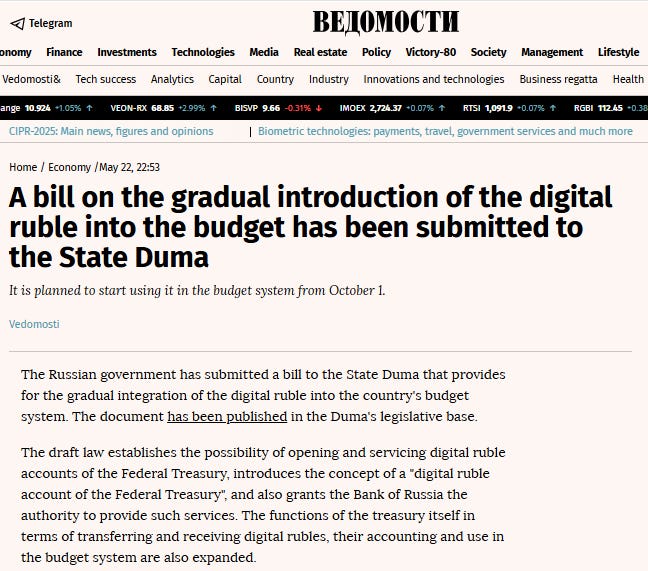
A week before the bill was submitted, the Bank of Russia launched an info-offensive against the conveniencephobes who spread malicious lies and innuendo about the safe, convenient, and forever-voluntary digital ruble.
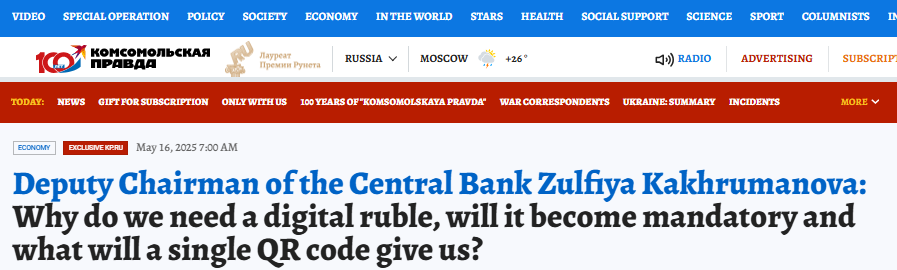
It wasn’t easy, though. Russia’s incredulous mainstream media had a lot of hard-hitting questions about the endless pitfalls of a programmable, centrally-controlled digital token issued by an entity that is not answerable to the Russian government.
Here’s how Komsomolskaya Pravda prefaced its interview with Bank of Russia Deputy Chairman Zulfiya Kakhrumanova:
[I]n the field of finance, we are ahead of the rest of the world! Well, or at least among the world leaders. The financial sector is one of the most technologically advanced in Russia, many countries would envy such a level of development of payment technologies. Large banks are actively introducing innovations that change and simplify our lives. And the rules of the game in this market are set by the Central Bank. And it also creates new entities. For example, the same digital ruble.
What changes await us in the coming years? And how will this affect our wallets? Zulfiya Kakhrumanova, Deputy Chairman of the Bank of Russia, spoke about this and much more in an exclusive interview with KP.RU
And they say journalism is dead. Shame on the people who say that. Shame!
With her feet to the fire, Kakhrumanova regurgitated the boilerplate talking points:
[What is the digital ruble?] It’s simple. The digital ruble is another form of Russian currency … And what’s important is that the choice of [what type of ruble to] use remains with the person. […]
It cannot be said that we are exactly following the Chinese path. But this is a global trend — to simplify life when making not only payments, but also any of our actions in any spheres. We have already gotten used to this convenience.
Rich and pungent word-dung, even for a Novgorod-based manure connoisseur such as myself. Unsurprisingly, the interview attracted the attention of numerous convenience-haters in Russia, including commentator Alexander Lezhava, who worked in the banking sector for many years before going rogue.
https://www.youtube-nocookie.com/embed/TAwN0fVCA-M?rel=0&autoplay=0&showinfo=0&enablejsapi=0
Responding to the KP interview, Lezhava wrote on his Telegram channel:
Another propaganda article from the Bank of Russia has appeared in Komsomolskaya Pravda. This time, the new deputy chairperson of the Central Bank of the Russian Federation, Zulfiya Kakhrumanova, sang hosannas to the digital ruble under the title “Why do we need a digital ruble, will it become mandatory, and what will a single QR code give us?”
There’s nothing new in what she said. It is a rehash of the same banalities from the Bank of Russia, criticisms of which they are unable to respond to intelligibly. There is no point in repeating the same thing, so it is much more interesting to look at this speech from the point of view of manipulation and logical errors.
The interview begins with an appeal to the readers’ feelings and an attempt to create some kind of positive emotional background:
“And yet, in the field of finance, we are ahead of the rest of the world! Or at least among the world leaders.”
This is necessary to evoke positive emotions in the reader and distract his attention from possible substantive criticism. In essence, this is an attempt to create a pseudo-reality, wherein the emotional background is used to shape public opinion in favor of the policy pursued by the central bank.
Then comes the manipulation, through a simplification:
“The digital ruble is another form of Russian currency… the choice of what to use is up to the individual.”
The complex system of the digital ruble is presented as a simple replacement for cash and non-cash funds – just a third type of currency, nothing interesting. At the same time, the potential risks and consequences with regard to maintaining the privacy of citizens and monitoring or managing them with this tool are ignored. This is a typical example of “manufacturing consent”, in which complex processes are simplified to the level of an inconsequential selection in order to reduce the level of critical thinking.
But that’s not all. She also has to underscore the divide between “us” and “them”:
“We are not following the Chinese path exactly. But this is a global trend…”
It is significant that the Chinese path and the introduction of the digital yuan are mentioned as a potentially negative thing, but at the same time she notes that the trend is global. Here, an external model is used to legitimize internal actions, but in such a way as not to associate it with one’s own policy, which is no different from the external one. (Surprisingly, the deputy chairperson did not bring up the Nigerian experience.)
Once again we see manipulation in her touting of the idea of freedom, or, rather, a false promise of freedom of choice:
“If a person does not want to use it [the digital ruble], he will continue to use the services he is accustomed to.”
The statement regarding the voluntary use of the digital ruble contradicts the possible creation of conditions and pressure from the Bank of Russia that can make it essentially mandatory. This is “managed democracy”, when freedom of choice is declared, but in practice it is limited by systemic factors.
At the same time, the Central Bank positions itself as an expert who “knows better”, although it provides no proof of this, and openly avoids open dialogue with the public. And when there was some interaction with the public on these matters, the Bank’s representatives came out on the losing side. This is called “elite management” — when officials of various kinds determine the direction of society’s development without taking into account the real needs of citizens. This is how it sounded this time:
“We predict what will be in demand in the coming years. We take into account the requests of market participants…”
The practical results of such forecasting are well known and have little correlation with real life, and it is practice that is the standard of truth.
Nevertheless, the Bank of Russia does not hesitate to openly manipulate hope, promising future well-being:
“The digital ruble platform is standardized… providing additional convenience for people.”
The idea of some future convenience and technological progress is used to justify current actions, without a detailed justification of their benefits. This approach is known as “technological determinism”. It presents the development of a technology as an end in itself, while the ethical and social consequences of its implementation and use are not taken into account. As our reader correctly noted, if you are unable to explain the usefulness of the digital ruble even to the former Minister of Finance, then what kind of convenience and usefulness are we even talking about?
There are also purely contradictory statements. They contain multidirectional ideas in order to satisfy different groups of readers but not give a clear position. For example, she asserts that there is a need to both unify and preserve the many payment systems, creating a logical contradiction:
“The QR code must be universal and recognized by any payment service…” but then “a universal QR will not eliminate all the different payment services.”
And need we even mention the concealment of information or the provision of incomplete information by the Bank of Russia:
“The digital ruble platform is a unified system… It is impossible to just steal them.”
This does not address the issues of who controls the platform, how data protection is ensured, or what risks there are for users. This is “information control”, when key issues are hushed up during the implementation of the project in order to avoid criticism and doubts. The Bank of Russia itself has previously admitted that digital ruble thefts will occur and that it will be difficult to get them back. The only thing that can be done is to follow them, where they go, but this will not help the victim, since they will already have been spent, and the Bank of Russia does not block channels for funneling stolen funds abroad.
At the moment, we have the following situation: The Bank of Russia forces banks, trade enterprises, and other market participants to invest billions of rubles into organizing the digital ruble infrastructure, with questionable benefit for society, instead of directing these resources to ensuring cyber security and preventing theft of funds from citizens.
How dare you, Mr. Lezhava. Don’t you read Simplicius the Thinker, the Internet’s #1 Thinker, who correctly observed that the digital ruble is a good CBDC that will remain eternally-voluntary as it karate-chops the globalists?
I mean, does Lezhava even read TASS?
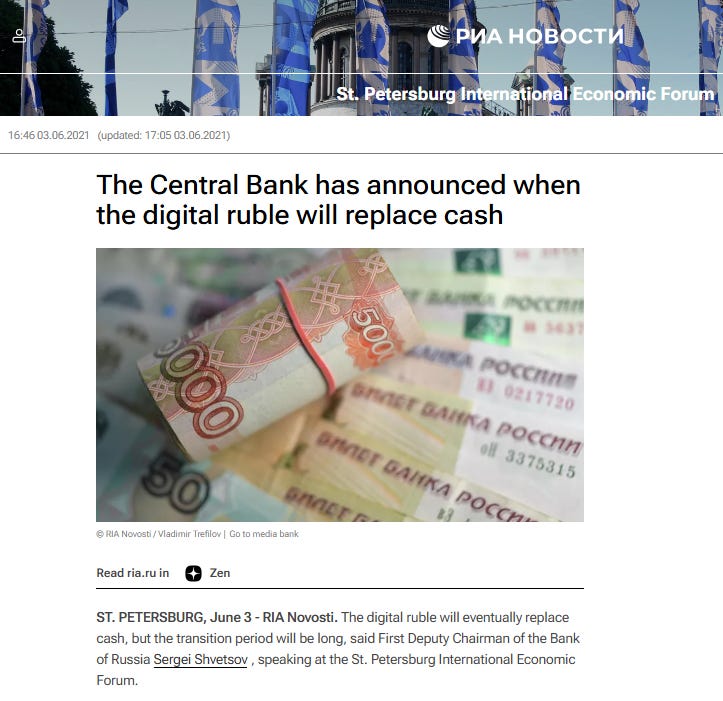
Here are some very inspirational words from First Deputy Chairman of the Bank of Russia Sergei Shvetsov, speaking at the St. Petersburg International Economic Forum in 2021, as quoted by Russian state media:
“Once again: we can thank the pandemic; paper spreads infection. You’ve heard of ‘dirty’ money, now we also have infectious money. This [cash] is probably a technology that’s on its way out, serving either ‘gray’ business or used when there is no alternative. Internet coverage is growing, gadgets are reaching the people. Russia is one of the leaders in this field, and thus we have a technology that allows us to replace cash with digital rubles,” he added.
[…]
“We have moved away from certain inconvenient forms of money. I think that cash will also be marginal at some point, in 10/20/30 years. The digital ruble will have to replace it. And the speed at which this product is created depends very much on our technological readiness,” [the First Deputy Chairman of the Bank of Russia] emphasized.
Yes. Good.
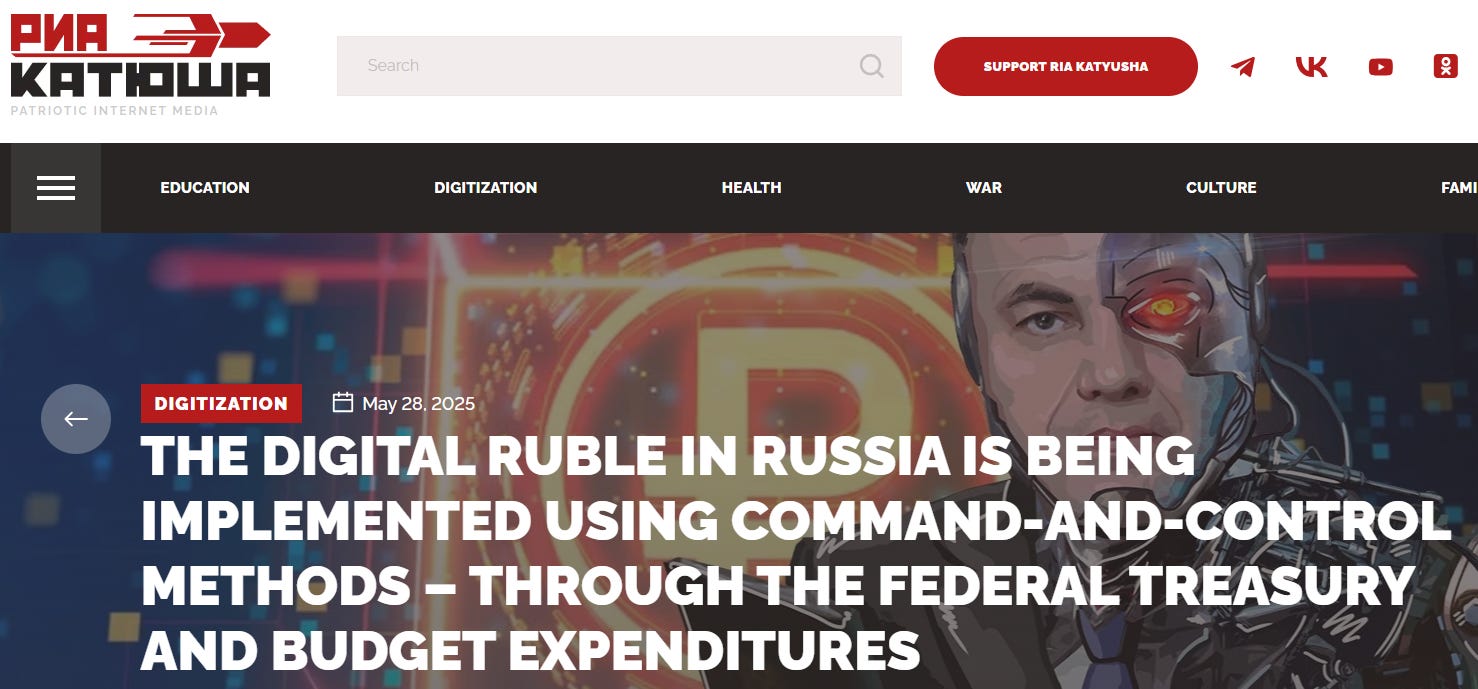
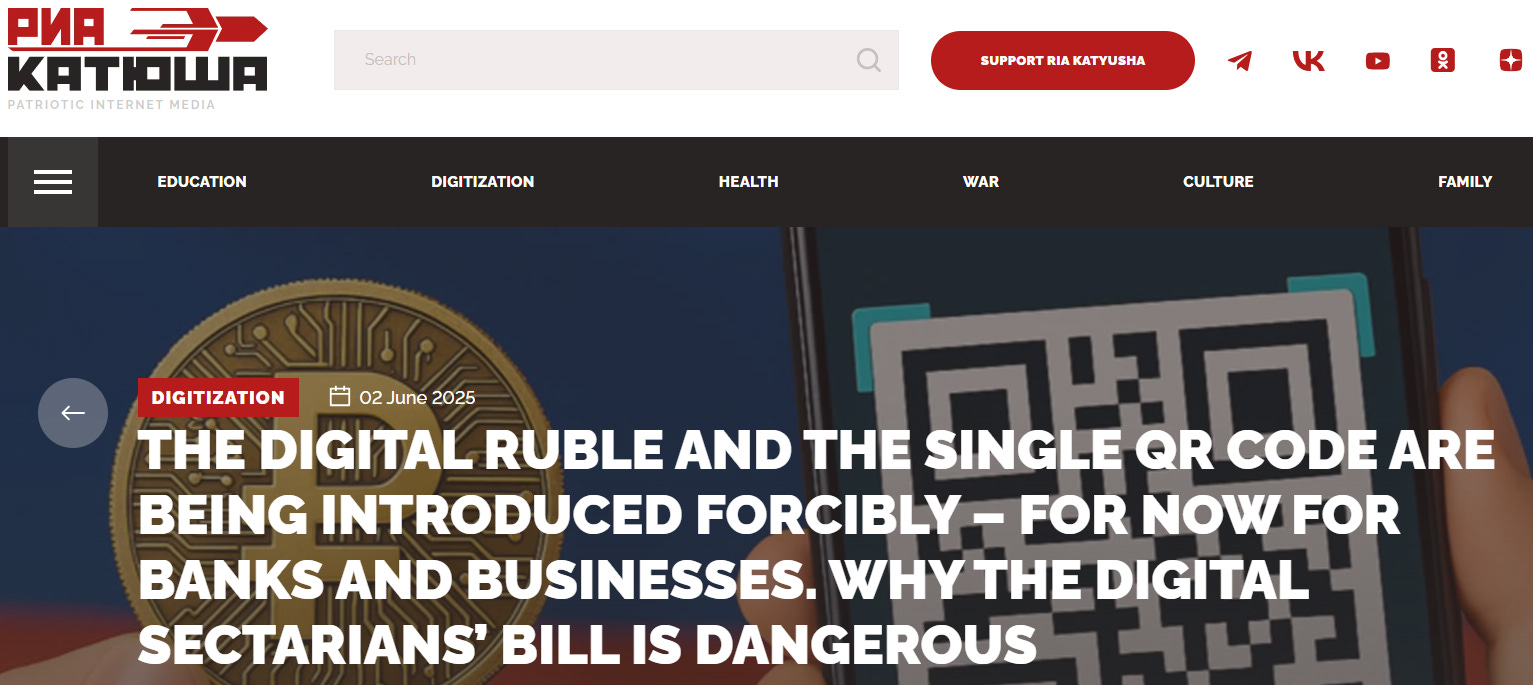
For more information on the World-Leading Convenience that awaits all Russians, read the latest offerings from Katyusha.org: