By Brian McDonald, Substack, 6/7/25
Brian McDonald is an Irish journalist based in Russia for many years. Writing about politics, sports and culture.
You’ve seen the line before. Usually delivered with blue-check sneer: “Russia’s GDP is smaller than Texas.” Or Italy. Or Belgium and the Netherlands combined. This week, it’s Spain and Portugal.
As if geopolitics were a pub quiz and nominal GDP the mic drop.
It’s nonsense. Lazy nonsense chasing engagement from the prejudiced and poorly informed—and the kind of barstool analysis that’s fuelled decades of failed Western policy on Russia.
You can forgive X for favouring punchlines over substance. But when this thinking seeps into diplomatic briefs, “expert” commentary, or editorial pages, the damage is real. Russia becomes a caricature: a “gas station with nukes,” a fading petrostate ripe for sanctions and collapse. And we wonder why each new round of economic war fails to crack the Kremlin.
Here’s the truth: if you want to gauge the scale and resilience of Russia’s economy, you need more than exchange-rate illusions and a glance at the oil ticker. Nominal GDP is a crude lens—distorted by sanctions, currency manipulation, capital controls, and the whims of global markets. It tells you what a bank in Zurich might see—not what Russia can actually do.
Measured by nominal GDP—using current exchange rates—Russia does rank lower than many Western economies. Even trailing Texas. But this isn’t just misleading—it’s economically meaningless.
Exchange rates are volatile and don’t reflect real productivity. In Russia’s case, the ruble is distorted by sanctions, oil fluctuations, and heavy state management. Comparing that to the euro or dollar is like comparing pineapples to hand grenades.
In order to understand Russia’s real weight, look at Purchasing Power Parity (PPP), which adjusts for local prices and actual living costs. A ruble may not go far in Paris, but in Kazan or Yekaterinburg, it stretches much further.
Russia’s economy was worth over $6.9 trillion in 2024 (IMF) in PPP terms. The fourth-largest in the world—ahead of Japan and Germany.
Now let’s look at the week’s favourite punchline, and compare it to Spain ($2.74 trillion) and Portugal ($0.51 trillion). That’s a combined $3.25 trillion.
Russia’s economy, even just on official numbers, is more than twice that size. Not a little bigger—double. That’s a gulf, not a rounding error.
And those are just the numbers we count.
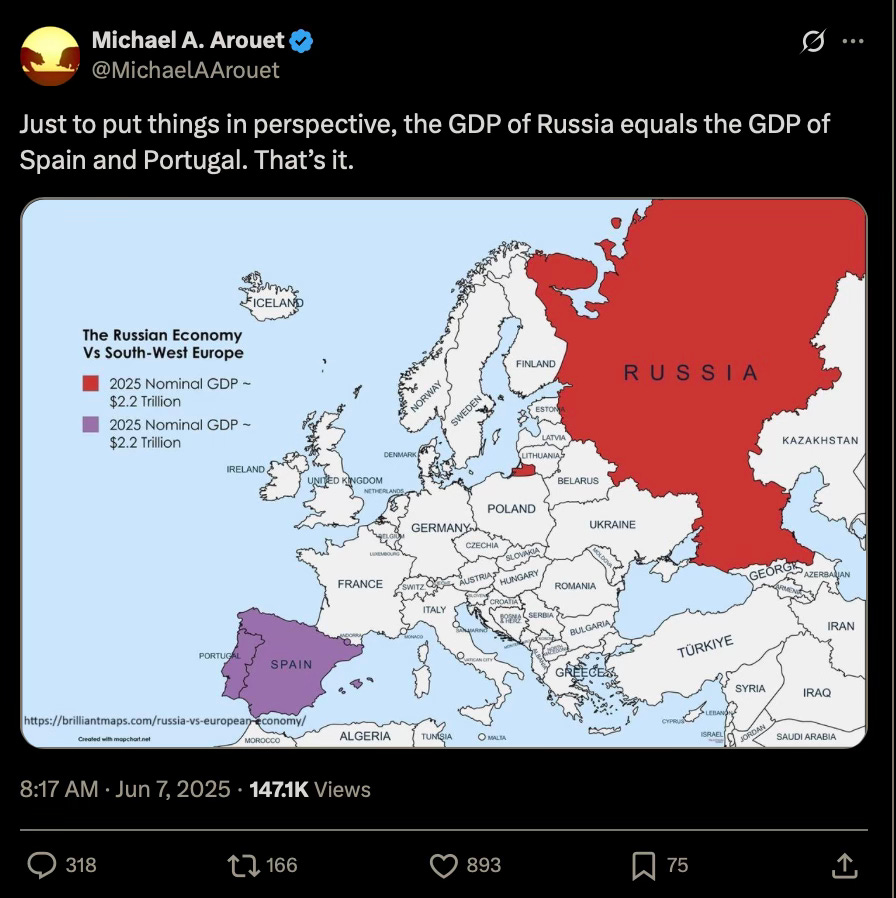
The irony is that Russia’s real economy might be even larger, while Spain and Portugal’s might be smaller. Why? Because of what each includes in its GDP.
In the EU, national accounts include estimates for drug sales, prostitution, and other “non-observed” activities. Eurostat mandates this. Even if a country doesn’t legalise them, statistical agencies estimate their value and add them in.
Russia doesn’t. It leaves out vast swathes of the informal economy—under-the-table wages, grey-market services, barter, unregistered small business, and rural trade. Entire segments of economic life, particularly outside the big cities, simply go uncounted.
So we end up comparing apples padded with cocaine and brothel receipts to potatoes traded for firewood. No wonder the numbers look strange.
This isn’t a moral critique. It’s a statistical one. And when people glibly claim “Russia’s economy is the size of Spain and Portugal,” they’re peddling fiction dressed up as fact.
None of this is to say Russia is an economic superpower. It’s not. It faces real challenges—demographics, investment, capital flight, a tech gap. But it’s also a globally significant economy with vast resources, strategic industries, and real industrial capacity.
It builds jets, icebreakers, submarines, nuclear plants. It feeds itself. It fuels half of Eurasia.
Dismissing that with a GDP soundbite isn’t analysis. It’s self-soothing. And it leads to bad policy.
Russia is not Spain and Portugal. It’s Russia. And we’d do well to treat it accordingly.
Russia’s present war economy is, as measured in February 2025, according to Yale University’s Institution of International economics by professor Sonnenfeld, at the size of Chile’s in South America, i.e. its size position is around number 68-70 in the world.
That tells us nothing of substance. What criteria did Sonnenfield use to measure this?
https://insights.som.yale.edu/insights/with-zero-visibility-into-the-russian-economy-the-imf-is-parroting-putins-line
Apparently Professor Sonnenfeld believes the IMF, Christine Lagarde, and all the other Trump1, Biden, and Trump2 appointed board members are Russian Puppets. This thus gives him the academic allowance to make shit up. Shades of RussiaGate.