Larry Johnson: More Unnecessary Bellicosity From a Senior US General Raises Tensions with Russia

By Larry Johnson, Substack, 7/22/25

The West continues to operate under the delusion that it has the military strength and political support to bully Russia into a ceasefire. The latest example comes from General Christopher Donahue, commander of U.S. Army Europe and Africa, who made an incredibly dangerous assertion during a speech to the Association of the U.S. Army’s inaugural LandEuro conference in Wiesbaden, Germany last week. Donahue stated that NATO land forces have developed the capability to strike and seize Russia’s Kaliningrad exclave “in a timeframe that is unheard of”—faster than ever before. He touted NATO advances in rapid land-based operations and emphasized that Kaliningrad—a heavily militarized Russian enclave surrounded by NATO territory—could be neutralized from the ground much more swiftly than previously possible. He said:

“We can take that down from the ground in a time frame that is unheard of – faster than we’ve ever been able to do.”

Donahue’s statement was not intended to suggest that NATO had imminent plans to launch a first strike; rather it was a warning to Russia about the alliance’s readiness in the event of further aggression, especially against the Baltic states. Commentators and officials interpret these remarks as reassurance to NATO partners and a signal to Moscow that any attack on NATO would prompt a decisive and rapid response. Regardless of Donahue’s intent, this is a reckless, dangerous statement in light of his position as the head of the US European Command. While it may have boosted morale among the Lilliputian Baltic nations, the Russians viewed it as a serious threat and a provocation.

Son of the New American Revolution is a reader-supported publication. To receive new posts and support my work, consider becoming a free or paid subscriber.

Russian authorities responded that any military assault on Kaliningrad would be treated unequivocally as an attack on the Russian Federation itself. Leonid Slutsky, chair of the Russian parliamentary Foreign Affairs Committee (a senior figure who often reflects Foreign Ministry rhetoric), explicitly stated:

“An attack on the Kaliningrad Region will mean an attack on Russia, with all due retaliatory measures stipulated, among other things, by its nuclear doctrine…. The American general should consider this before making such declarations.”

A parliamentary defense committee member called the threats “essentially a declaration of war.”

Donahue’s remarks, beyond being incredibly stupid, displayed the arrogance and contempt that US political and military leaders have for Russia. To make matters worse, NATO is conducting, or will soon conduct, a military exercise that simulates invading Kaliningrad. The Russians have taken notice and do not dismiss this as an idle threat. One retired Russian intelligence officer reacted by saying:

“And what would happen to Washington or New York if we deployed our troops in the ocean, for example, including the submarine fleet, and rehearsed strikes on New York and Washington. How would Trump react?”

I think we know the answer to that rhetorical question… Trump would attack. Now that Russia is mass-producing the Oreshnik hypersonic missile, Putin has an option other than going nuclear. The Oreshnik can hit any target in Europe — i.e., it is a hypersonic version of an intermediate range ballistic missile, except it can be maneuvered while in flight and a single missile can deliver multiple warheads. The West does not have any defense against this missile. I wonder if Donahue understands that?

Ken Klippenstein: Nuclear Threats Are Back

By Ken Klippenstein, Website, 7/28/25

The United States has quietly deployed nuclear weapons to the United Kingdom for the first time since 2008, or 17 years ago.

The move has taken place literally without comment by Congress and very little from the American press, both of which seem more interested in Jeffrey Epstein than the threat of thermonuclear war. 

Defense Secretary Pete Hegseth, apparently busy with more important things — like fussing with military grooming standards and doing pushups with the troops — has said nothing about deployment of new nuclear bombs to Britain. President Donald Trump hasn’t said anything either, most likely because he doesn’t even know it’s happened.

The past three years has seen consistent nuclear brinksmanship over Ukraine, with Putin and company making constant threats (and Washington under the Biden administration counter-threatening). Moscow has threatened to alter its own nuclear posture to “counter” NATO, including making its first deployment of nuclear arms to Eastern Europe (in Belarus) since the end of the Cold War.

“Our relevant departments are monitoring developments in this area and formulating tasks to ensure our security against the backdrop of what is happening,” Kremlin spokesman Dmitry Peskov says.

Moscow has been actively preparing nuclear storage facilities in Belarus, though experts like Hans Kristensen of the Federation of American Scientists believe that the warheads have not yet been deployed. The U.S. sent new B61 nuclear bombs to its base at RAF Lakenheath, where F-15E Strike Eagles are deployed, earlier this month.

The world’s two largest nuclear powers beefing up their nuclear warfighting capabilities in Europe might seem like something Congress would want to weigh in on; but the two officials in charge of the Armed Services Committee, Senators Roger Wicker and Jack Reed, haven’t said a word about it. Neither even responded to my request for comment about the new deployment.

In fact, no one in Congress has. And it’s not like they’ve got anything better to do, having knocked off for an over month-long recess that ends on September 1. But who wants to do homework during summer break? Certainly not Congressman Eric Swalwell, who posted a video of himself lifting weights on X with the caption:

“I should be working right now. But Republicans shut down Congress. So instead, I’m pumping iron at the gym.”

From Hegseth to Swalwell, our leaders are working out while Rome smolders.

Meanwhile in the UK, the Chair of the Campaign for Nuclear Disarmament Tom Unterrainer called the new American deployment “a major escalation in nuclear dangers” and is demanding that Prime Minister Keir Starmer publicly acknowledge it so there can at least be a debate.

Per Unterrainer’s statement:

“It is completely inappropriate for the public to be finding out about such a major escalation in nuclear dangers via reports in British newspapers and the assessments of security experts.”

He makes a good point: it really is a disgrace that we often only learn about national security matters of immense public interest like this when the details tumble out into the open source record, as happened here. In this instance, aviation enthusiasts earlier this month noticed a C-17A Globemaster III depart from Kirtland Air Force Base in New Mexico, home to the Air Force Nuclear Weapons Center, before landing at the British air base Lakenheath, which is also known to have contracted for new nuclear storage sites to be built (thanks to another unintentional disclosure). 

We know everything about Hegseth’s interest in things like false eyelashes, but knowing about the Pentagon’s change in nuclear posture shouldn’t have to happen by accident.

The UK Defence Ministry responded to inquiries by local experts by saying that it can “neither confirm nor deny the presence of nuclear weapons at a given location,” a statement echoed by the Pentagon as a matter of course. They could confirm it — if sufficient pressure was put on the military by their civilian leaders (or by members of the supposed coequal branch of government). But there isn’t pressure, so the deployment of nuclear weapons will be known by the Russians, and by the experts, but not by the people.

Better put pressure on the civilian leaders, then. Not just in the Defense Department, but Congress as well, which seems to think it can get away without exercising oversight of the national security state on even the most obvious matters of public interest, as this case shows. 

If pressed, apologists for congressional laziness might argue that American nuclear weapons are already currently deployed to Belgium, the Netherlands, Germany, Italy, and (very precariously) to Turkey. But unlike the UK, all of these countries are vulnerable to local politics and European anxiety about nuclear war, so the prospects of their being thrown out is somewhat possible. 

But now that Europe and NATO has adopted an all-for-one-and-one-for-all policy in response to the Ukraine war, where “solidarity” is more important than sanity, throwing the UK into the mix all but ensures that the controversial nuclear bombs will likely remain forever. In the case of the UK the United States has a partner that embraces nuclear weapons (having its own arsenal), but one who will stand against others who agitate to remove theirs. 

The other possibility for the future is that the UK deployment is to allow nuclear bombs to be removed from the other countries, NATO then being able that the UK-based nuclear bombs makes sufficient linkage between what happens in Europe and Washington.

In either case, nuclear war in Europe is back on the table, launched in London, so one-for-all the Europeans are working against their own security.

Le Monde: Across Ukraine, new military cemeteries are planned

Le Monde, 7/20/25

Sections reserved for soldiers are at capacity. Across the country, teams of architects have been working on memorials that reflect not only the scale of the ongoing carnage but also the evolving ideas about national identity.

It’s a sandy track, well-hidden among the pines, off the highway connecting Kyiv to Odesa in the Hatne region. The outline of a newly dug off-ramp, carved by bulldozers and still unmarked, signals the start of a massive construction site. This is the highway exit that will serve as Ukraine’s future national military memorial cemetery. The project is enormous, highly sensitive and not just because environmental activists and residents of the small village of Markhalivka – 40 kilometers from the capital, but right at the base of the future cemetery – worry about deforestation and the loss of their rural quiet.

In the village, only a new brown sign, the color used to mark national sites, marks the road that leads trucks to the site. It reads in English: “National Military Memorial Cemetery.” A first section, designed to hold 10,000 graves and already laid out with broad granite paths, benches and lime trees, is due to receive its first burial this summer. But in the long term, “130,000 or even 160,000” people will be laid to rest at this future burial ground, explained architect Serhi Derbin, clad in khaki linen trousers and a straw panama hat, under the blazing July sun.

“Here will be the main entrance,” explained the young man leading this project, which has a budget of more than €37 million. “Below, there’s a shelter for 300 people, in case of bombardment.” The reinforced bunker is a first for a cemetery. Over there, a “house of mourning” for ceremonies, should it be cold or rainy. “And here, the memorial,” the architect continued, sweeping his arms wide to indicate the 120 hectares set aside for the future cemetery, and the 260-hectare estate beyond.

Perhaps the construction projects rising across Ukraine say more about the scale of the slaughter than statistics ever could. The number of soldiers killed in action since the start of the Russian invasion remains a closely guarded secret. In February, President Volodymyr Zelensky mentioned more than 46,000 Ukrainian military personnel killed and 380,000 wounded since February 2022, not including the “tens of thousands” listed as “missing” or held captive by Russian forces. The real death toll is likely much higher.

Passion for ‘memorial subjects’

The giant cemetery project, overseen by the Ministry for Veterans Affairs but closely monitored by the president’s office, has not emerged without controversy. “One day in June 2023,” recalled Anton Drobovych, former president of the National Institute of Remembrance, “I got a call from Bankova Street [the seat of the Ukrainian presidency]. They told me the memorial would be built at Bykivnia,” a site near Kyiv where victims of Stalin’s purges in the late 1930s were buried. At the time, Drobovych was serving with “the paratroopers” in the Zaporizhzhia area during the Ukrainian counteroffensive. He jumped: “You want to build a cemetery on what used to be a mass grave? That’s a grave, historic mistake!”

After much hesitation, public petitions and local protests, the Hatne site was chosen. “I was the only competitor, architects here have little interest in cemeteries,” admitted Derbin. Head of a Kyiv real estate project agency, he has been passionate about “memorial subjects” since 2021, working on projects like the towering flagpoles overlooking the cities of Dnipro and Kryvy Rih. War, unfortunately, has brought new perspectives. In Yahidne, a village near Chernihiv where 350 parents and children were held captive in the school basement in March 2022, and 27 died, he is preparing a museum to commemorate the occupation and Russian war crimes.

Each sector of the future Hatne military cemetery will be organized around a central columbarium, designed to encourage more Ukrainians to consider cremation, a practice that remains uncommon. Temporary white oak graves will hold the first “heroes” as well as the remains of unidentified soldiers. “No more than a year,” warned Derbin. “We are in the 21st century. In the age of DNA research, we reject the outdated “unknown soldier” concept.” To aid future identification, details that could help identify the deceased – distinctive marks (tattoos, scars, etc.) and genetic fingerprints – will be inscribed on the headstones of these anonymous graves.

White stone

Burial space is running out across Ukraine. In Lviv, a major city in western Ukraine, the city hall avoided controversy by involving families in its plans. A year ago, it began a wide-ranging public consultation to rethink the redevelopment of its “Field of Mars,” a plot with 1,000 graves adjacent to the famous Lychakiv Cemetery, the city’s version of Paris’s Père-Lachaise Cemetery, where sculpted tombs and statues tell the story of a vanished century: writers’ quills, violins, sheet music and manuscripts. Around 6 pm, as the workday ends, a stream of cars comes to lay flowers on the fresh graves that have appeared since February 2022, their yellow and blue flags – or red and black nationalist flags – snapping in the wind. Here, no two graves are alike.

For 12 months, the families of the deceased gathered in Lviv city hall’s vast hall with a team of architects to rethink a cemetery that had sprung up too quickly. “Lighting, flowers, the stone – we discussed everything. Sometimes widows would come with four children,” recounted Anton Kolomeitsev, the city’s architect. The winning design, chosen on May 30, underwent revisions, but the final plan is now set. Each plot will be redesigned with terrazzo stone, juniper bushes among the graves, niches for candles and so on.

But the “Field of Mars” faces another problem. “There are already only 40 plots left. That will last barely two months,” admitted the young Kolomeitsev in his stylish, minimalist office in the 19th-century city hall. The city is now also planning a new military cemetery. “It will be built somewhere in the city or outside Lviv – an announcement is imminent.” It will likely follow the new trends of Ukrainian funerary aesthetics: park-like spaces, large esplanades for ceremonies, white stone…

Read more Subscribers only War in Ukraine: No peace, even in death, in Hroza village

All graves are the same size, regardless of the rank of the deceased. And, for the vast majority of believers, they are decorated with “Cossack” crosses – the Maltese cross shape – a military tradition from the 19th century. The benches near the graves, where families once shared a meal or a glass of vodka, have disappeared: “That was a Soviet tradition,” explained Derbin, “because it was the only place the KGB wouldn’t listen in.”

American influence can also be seen. “I visited Arlington Cemetery near Washington,” said Kolomeitsev, “where veterans of all American wars are buried. Here in Lviv, we too had to answer a difficult question: How do you bring together the dead from various conflicts since the early 20th century?”

Families of veterans of the Donbas war in 2014 want their loved ones included in these new cemeteries. And what about those who defended Ukraine outside front-line brigades – civilians who gathered intelligence for the Ukrainian military in occupied territories, volunteers who evacuated the wounded and families, raised donations or built drones, Ukrainian journalists reporting on Russian war crimes? The debate has not yet officially begun, but the idea has been gaining traction in Ukrainian society. “Military memorials are bricks in the wall of national identity,” argued Drobovytch.

Building cemeteries in Ukraine also means marking, in real time, the shifting frontlines of war – even in the worst ways. In Milove, on the Russian border, architect Derbin’s “bell of memory,” dedicated to Ukraine’s liberators in World War II, has already been toppled. “Before the major invasion [in February 2022], I designed the ‘Avenue of Heroes’ honoring those killed since 2014 in Sievierodonetsk.” That gallery of portraits was dismantled by Russian forces. “They want to erase memory and memories,” sighed the Kyiv architect. “I try to chase the dark thoughts from my mind, but I have no doubt that ‘they’ will bomb a cemetery one day.”

Oliver Boyd-Barrett: Multiple Points of Conflagration in West Asia

YouTube link to Redacted’s interview with John Kiriakou on possible CIA involvement in Ukrainian protests against Zelensky here.

By Oliver Boyd-Barrett, Substack, 7/30/25

Oliver Boyd-Barrett is an academic who analyzes and critiques propaganda.

On the battlefield, Russian forces are reliably confirmed to have a strong presence to the south of Pokrovsk and to be fighting Ukrainian forces in the center of Pokrovsk Reports suggest that Russia forces are now moving north of Pokrovsk with a view to outflanking cities in Donbass such as Sloviansk and Kramatorsk that are still held by Ukraine, as Russians move north from Pokrovsk, and north and east of Kamianske in Zaporizhzhia.

Increasingly Russians encounter Ukrainian positions that are no longer defended or poorly defended. Some reports suggest that in effect Ukraine is expecting to retreat west of the Dnieper where it may already be working to establish a major new line of defense. Reports also seem to be converging in agreement on the increasing superiority of Russian drones, in quantity and impact. Russian drone production facilities in Kazan are expanding. The best of Ukrainian forces is said to be being transitioned to the Sumy region, which is critical to the defense of Kiev, which is likely to be Zelenskiy’s paramount concern.

Rumors – fed both by a recent story by Seymour Hersh and by a Russian intelligence statement – are swirling of destabilization in Kiev and the possible overthrow of Zelenskiy in favor of General Zaluzhnyi, currently Ukrainian ambassador to the UK. Such a development, long anticipated, in itself means little. The installation of a new President by coup would simply replace on illegitimate leader, Zelenskiy, with an even more illegitimate leader. The new leader would still be accountable to the kinds of western intelligence, Banderite militia and comparable sources of pressure against making considerable concessions to Russia’s demands as articulated by Putin in July of 2024, and there are few indications to suggest that those demands will be reduced any time soon – quite to the contrary, they will have increased in line with military advances – I dont expect to see Russia give up any territory.

We wait to see whether Trump will move, as he has threatened, to impose further sanctions on Russia, and on the major clients for Russian oil (China, India, Turkey). Russia and China have made it clear that they will not be intimidated. Trump had already been talking about imposing 25% tariffs on India; India has expressed exasperation with US negotiators and their terms and will almost certainly be enraged if Trump now imposes further heavy sanctions on them for their purchase of Russian oil, especially if they end up being charged more than China.

Predictably, the price of oil is rising. Europe, along with being subjected to tariffs of 15% are also committed to spending $750 billion on US LNG (even though there are insufficient European ports available for processing LNG), thus increasing their dependence on US oil very considerably). This will place additional strain on US production and US prices at a time when many experts believe that peak shale oil production in the US has passed and that from now the amount of available oil will be in decline.

On the Middle East, UK Prime Minister Keir Starmer has said that the UK will join France in recognizing a Palestinian state in September if there is no ceasefire agreed by that time. This makes the question of an absolute – the right to national recognition – conditional on what another state, Israel, does or does not do. In reality of course, the UK has more responsibility (yes, OK, it is complicated) than other nation for the original creation of Israel in 1947 (not accompanied, note, by a UN insistence on nation for Palestine) and for the civilizational injustice to the Palestinians that has resulted and is now made egregiously worse as a result of the genocide, a process to which the UK has contributed by its disastrous loyalty to Netanyahu, its direct complicity in making its Cyprus base available for Israeli planes and its transfer of intelligence about Gaza collected by the RAF to Israel. And in so many other ways.

Elsewhere in West Asia, there is growing confirmation that proposed US long lease of the Zangezur corridor in Armenia, along Iran’s border, between Turkey and Azerbaijan, is indeed intended to be a new and significant front in the West’s long-term aim to surround Iran and Russia, perhaps igniting a conflict no less threatening than the West’s proxy war with Russia over Ukraine. The corridor will greatly facilitate the possibility of transfers of military personnel and materiel right to Iran, where Iran must rightly be concerned about the loyalty of its 20 million Azeris in its north even as it continues to send back to Afghanistan a potential four or more million undocumented Afghans, under national conditions of increasing temperatures and water shortage.

Meanwhile to the south and west of Iran the destabilization and possibly ultimately balkanization of Syria is in rapid progress. We learn today that the horrific and brutal slaughter of Druze in the southeast of Syria was the result of a carefully planned joint operation between Israel and the terrorist and illegal HTS regime in Damascus in which the Kurdish SDF also participated alongside HTS forces in a bid, among other things, to consolidate Israeli control over southern Syria and to create a direct line of progress for Israel toward northern Syria and eastwards into Iraq. The US and Israel continue to intimidate the government of Lebanon to crush the country’s major force for civil order, Hezbollah.

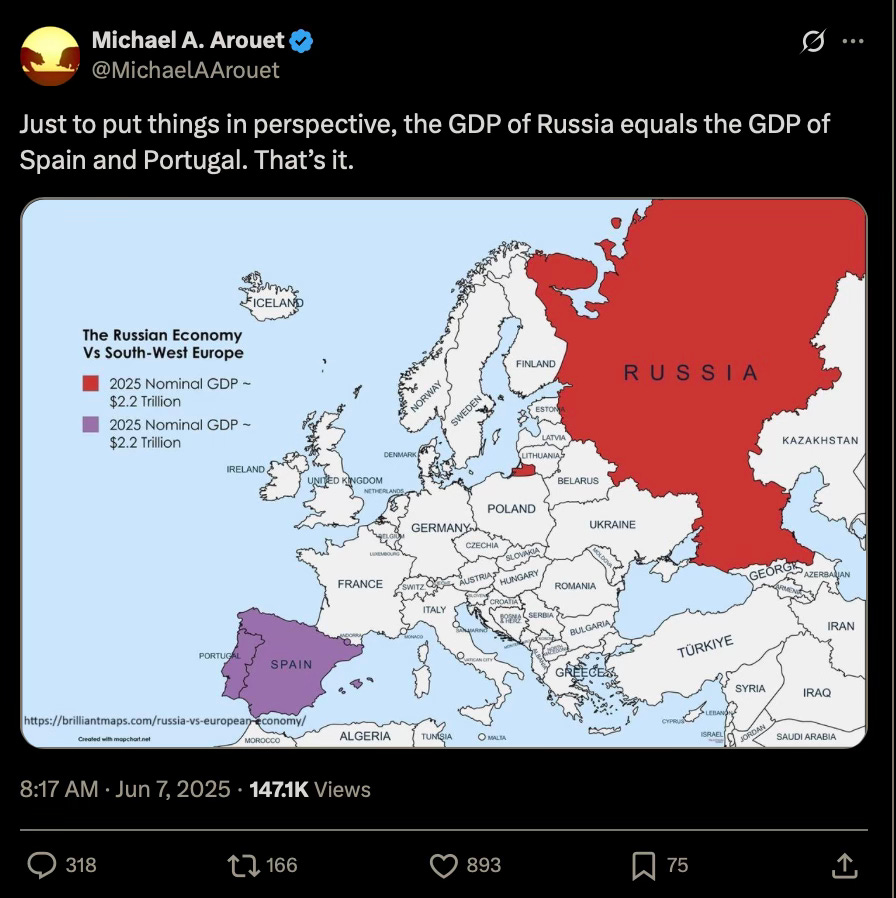
Brian McDonald: Is Russia’s Economy Really Just Spain and Portugal? Let’s Do the Math.

By Brian McDonald, Substack, 6/7/25

Brian McDonald is an Irish journalist based in Russia for many years. Writing about politics, sports and culture.

You’ve seen the line before. Usually delivered with blue-check sneer: “Russia’s GDP is smaller than Texas.” Or Italy. Or Belgium and the Netherlands combined. This week, it’s Spain and Portugal.

As if geopolitics were a pub quiz and nominal GDP the mic drop.

It’s nonsense. Lazy nonsense chasing engagement from the prejudiced and poorly informed—and the kind of barstool analysis that’s fuelled decades of failed Western policy on Russia.

You can forgive X for favouring punchlines over substance. But when this thinking seeps into diplomatic briefs, “expert” commentary, or editorial pages, the damage is real. Russia becomes a caricature: a “gas station with nukes,” a fading petrostate ripe for sanctions and collapse. And we wonder why each new round of economic war fails to crack the Kremlin.

Here’s the truth: if you want to gauge the scale and resilience of Russia’s economy, you need more than exchange-rate illusions and a glance at the oil ticker. Nominal GDP is a crude lens—distorted by sanctions, currency manipulation, capital controls, and the whims of global markets. It tells you what a bank in Zurich might see—not what Russia can actually do.

Measured by nominal GDP—using current exchange rates—Russia does rank lower than many Western economies. Even trailing Texas. But this isn’t just misleading—it’s economically meaningless.

Exchange rates are volatile and don’t reflect real productivity. In Russia’s case, the ruble is distorted by sanctions, oil fluctuations, and heavy state management. Comparing that to the euro or dollar is like comparing pineapples to hand grenades.

In order to understand Russia’s real weight, look at Purchasing Power Parity (PPP), which adjusts for local prices and actual living costs. A ruble may not go far in Paris, but in Kazan or Yekaterinburg, it stretches much further.

Russia’s economy was worth over $6.9 trillion in 2024 (IMF) in PPP terms. The fourth-largest in the world—ahead of Japan and Germany.

Now let’s look at the week’s favourite punchline, and compare it to Spain ($2.74 trillion) and Portugal ($0.51 trillion). That’s a combined $3.25 trillion.

Russia’s economy, even just on official numbers, is more than twice that size. Not a little bigger—double. That’s a gulf, not a rounding error.

And those are just the numbers we count.

The irony is that Russia’s real economy might be even larger, while Spain and Portugal’s might be smaller. Why? Because of what each includes in its GDP.

In the EU, national accounts include estimates for drug sales, prostitution, and other “non-observed” activities. Eurostat mandates this. Even if a country doesn’t legalise them, statistical agencies estimate their value and add them in.

Russia doesn’t. It leaves out vast swathes of the informal economy—under-the-table wages, grey-market services, barter, unregistered small business, and rural trade. Entire segments of economic life, particularly outside the big cities, simply go uncounted.

So we end up comparing apples padded with cocaine and brothel receipts to potatoes traded for firewood. No wonder the numbers look strange.

This isn’t a moral critique. It’s a statistical one. And when people glibly claim “Russia’s economy is the size of Spain and Portugal,” they’re peddling fiction dressed up as fact.

None of this is to say Russia is an economic superpower. It’s not. It faces real challenges—demographics, investment, capital flight, a tech gap. But it’s also a globally significant economy with vast resources, strategic industries, and real industrial capacity.

It builds jets, icebreakers, submarines, nuclear plants. It feeds itself. It fuels half of Eurasia.

Dismissing that with a GDP soundbite isn’t analysis. It’s self-soothing. And it leads to bad policy.

Russia is not Spain and Portugal. It’s Russia. And we’d do well to treat it accordingly.