By Matt Bivens MD, Racket News, 10/23/25
A guest essay from friend-of-Racket and former “Moscow Times” editor Matt Bivens, who writes at The 100 Days.
A big noise was heard in the dark forest,
and a roar echoed.
All the animals ran
to the boyar, the Bear.
Large animals came.
Small ones came.
Captain wolf came,
showing his sharp wicked teeth,
and greedy eyes.Then came the beaver, that visiting merchant.
He, the beaver with the fat tail.
The noble weasel arrived.
Little princess-squirrel arrived.
Came the church clerk-fox, that treasurer.
Then the filthy peasant-rabbit,
poor rabbit, grey rabbit.
The hedgehog-tax collector came,
all huddled up, how he bristles …All to the bear then bowed,
and the bear told his story, crying:
Judge how I have been wronged!
I had an old shoe, of woven basket, torn,
for many years it lay unused.
Gray geese flew over it one day,
they took it and tore it to shreds,
then scattered the pieces in the open field.How am I to endure this bitter wrong?
Who will comfort my brave heart?
Aren’t we going to declare a war on birds?And they went to war, and went to war,
and bravely led the army.
That’s fighting there in the distance!
— from Rimsky-Korsakov’s Opera “The Tsar of Saltan”, playing this fall in St. Petersburg’s Mariinsky Theater
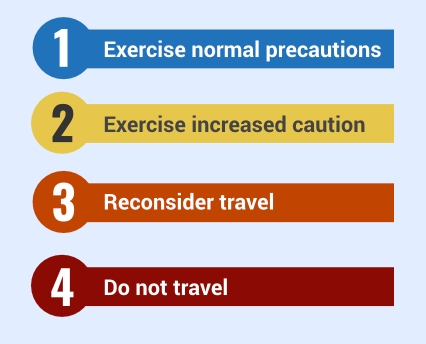
MOSCOW — The U.S. State Department said not to come here. They have a Level 4 warning against Russia travel, which is the fastest they can hyperventilate.
The warning cites free-floating peril associated with the war in not-so-distant Ukraine, “the risk of harassment or wrongful detention,” and the American government’s “limited ability to help” if you get in trouble. It concludes in bold-face:
Do not travel to Russia for any reason.
Seventeen grim-sounding bullet points follow. If you do go to Russia, State says, you should, among other things:
- Prepare a will …
- Discuss a plan with loved ones regarding care and custody of children, pets … funeral wishes, etc.
- Leave DNA samples with your medical provider …
Make funeral arrangements!
I seriously doubt a primary care doctor would know what to do with my “pre-travel DNA samples.”
‘Do not travel to Russia for any reason.’
But Americans are traveling here every day. There are no direct flights anymore, and international sanctions have closed European and American airspace to Russian airlines. But Turkish Air among others has stepped up eagerly, and Istanbul Airport is humming with activity.
We had many reasons to travel to Russia. We needed to reconnect with friends and loved ones, and tend to various family matters. My older daughter wanted her fiancé to meet her Ukrainian-Russian grandparents, and to see the places she remembered fondly from her kindergarten days, when I worked in Russia as a journalist (before I came to my senses and went to medical school).
As a card-carrying member of International Physicians for the Prevention of Nuclear War, I also wanted to meet with like-minded international physicians, to discuss, yes — nuclear war, the prevention of. And I wanted to take Russia’s temperature. It’s a place I know well but hadn’t visited for some years.
There were downsides to such a trip. One was leaving coastal Massachusetts at my favorite time of year. (Sailboat season!) Another was anxiety among family and friends, who have a media-nurtured fear of all things Russian. When I telephoned my father about our planned trip, I could hear my mother in the background call out, “Don’t get captured!”
Don’t get captured? Did we need to worry about that?
Amnesty International does say more than 20,000 ordinary Russians have been arrested and fined, and many dozens at least have received long prison terms for voicing anti-war criticism. We were just tourists visiting family, not anti-government activists. But there are no guarantees: Two years ago, a young woman from Los Angeles — a ballerina from Siberia, with American-Russian dual citizenship (just like my wife and daughters) — went for a visit home to Russia, and at passport control was interrogated about her views. Her phone was searched, and she was charged with treason (!) over a Venmo donation of $51.80 to a New York-based charity raising money for Ukraine. She was convicted, and sentenced to 12 (!) years. (She was released in April as part of a prisoner swap.)
Then there were the drone attacks. All summer, there were multiple Ukrainian-sponsored drone attacks on St. Petersburg’s Pulkovo Airport — the same airport we’d fly in and out of. One day after I left in September, Pulkovo was shut down for a full day by another large drone attack. My wife followed a few weeks later — the same day Russia shot down 46 drones headed for Moscow alone.
The only difference between these drones and terrorist car bombs are that the drones fly, and are apparently guided to target by sleeper agents of Operation Goldfish, who were trained by the CIA and spread throughout Russia.
(As an aside: imagine if American airports, residential buildings and other infrastructure were attacked by flying car bombs, month after month — even as, say, Iran bragged publicly about having secret “Operation Goldfish” sleeper agents spread through our country to guide the bombs to their targets. Would our government also start locking people up over $51 Venmo donations to the wrong people?)
This was all context for our planned trip, and it gave us pause. But by late summer, the geopolitics, which had been awful for years, looked cautiously promising. Vladimir Putin and Donald Trump had just met cordially in Alaska. It seemed a window for safe and hassle-free travel.
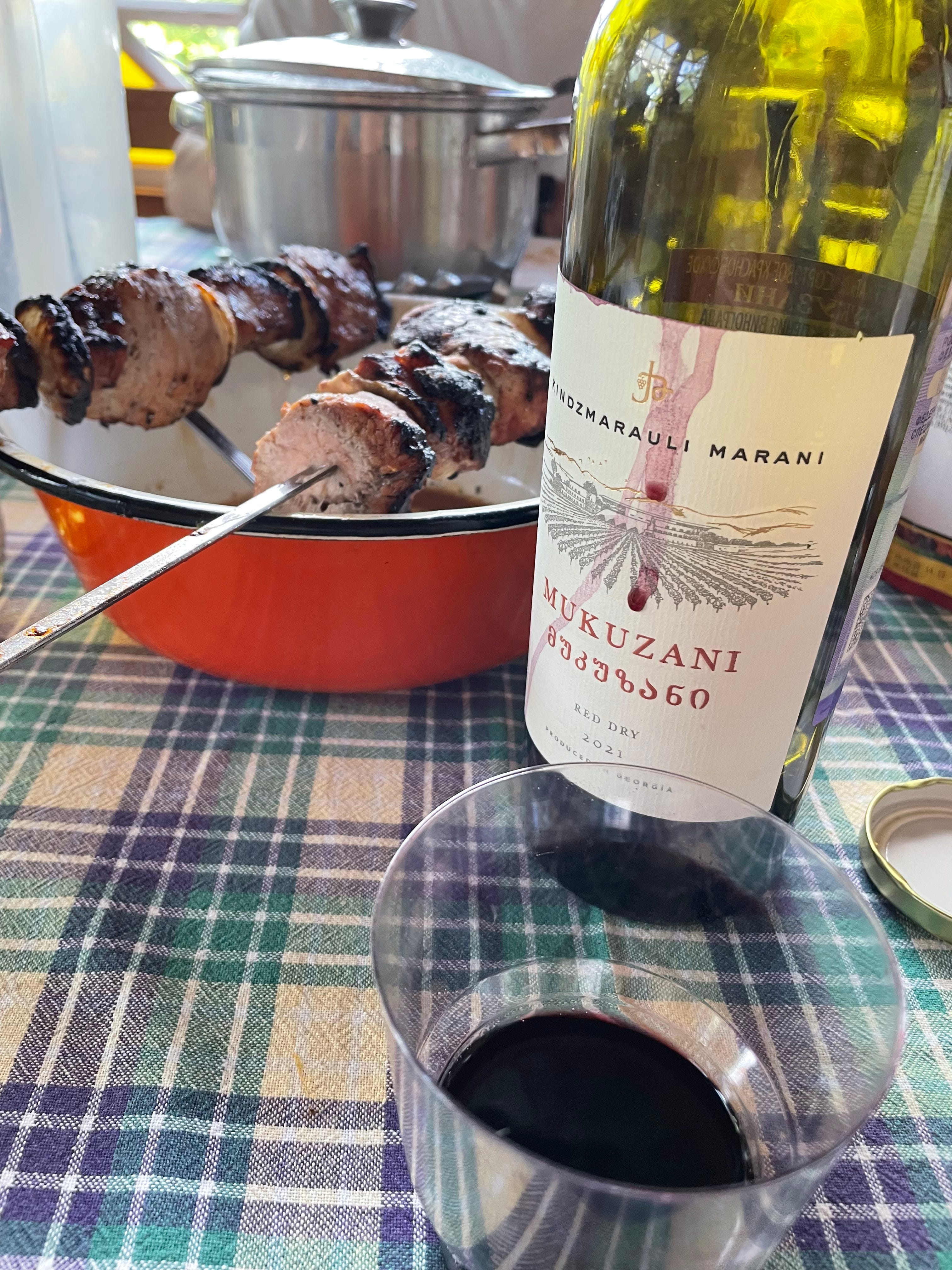
Since we were introducing the fiancé to Russia — and also don’t know what the future holds — we decided to treat ourselves to the full tourist experience. We would attend the Rimsky-Korsakoff Opera mentioned above, a meandering collection of Alexander Pushkin’s fairytales that revolves around the imaginary city of Tmutarakan. We’d go mushroom hunting in the woods outside of St. Petersburg, indulge in a full-day Russian banya (steam sauna) complete with the traditional massage-by-whackings-with-oak branches, ride the elegant overnight sleeping car train to Moscow, explore the Tretyakov and Hermitage museums, and have feast after feast — in fancy Russian restaurants, in Georgian restaurants, and best of all at home with the in-laws, where everyone oohed and aahed and took photos of the home-cooked Ukrainian fare, from borshch to blini.
Spoiler alert, it was a wonderful trip, and no one was “captured.” I won’t bore you with most of it. Instead, I hope to reacquaint you with ordinary Russian people at this moment in time. As I pondered this idea, I remembered a 1949 classic by the novelist John Steinbeck, “A Russian Journal.” I occasionally thought of this slim book as we took our Red Square selfies, or struggled to talk politics over dinners with friends. Then, on the last day of our trip, with a pleasant jolt of recognition, I saw my own long-lost copy on my father-in-law’s bookshelf.
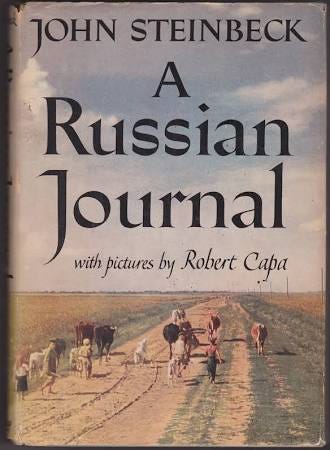
I took it down, and read Steinbeck’s opening account of how he and his photographer colleague Robert Capa conceived their collaboration in the late 1940s, while sitting in a New York hotel bar drinking absinthe-and-crème de menthe cocktails, and complaining about the sad state of international affairs:
Willy, the bartender, who is always sympathetic, suggested a Suissesse, a drink which Willy makes better than anybody else in the world. We were depressed, not so much by the news but by the handling of it. …
Willy set the two pale green Suissesses in front of us and we began to discuss what there was left in the world that an honest and liberal man could do. In the papers every day there were thousands of words about Russia … by people who had not been there, and whose sources were not above reproach. And it occurred to us that there were some things that nobody wrote about Russia, and they were the things that interested us most of all. What do the people wear there? What do they serve at dinner? Do they have parties? What food is there? How do they make love, and how do they die? What do they talk about?
Good questions then and today.
For anyone skeptical about a non-hostile examination of Russia amidst the carnage of Ukraine: Steinbeck the author, Willy the bartender, and many others were open to such an inquiry in 1949 — when the Soviet Union was ruled by Josef Stalin (!), had just taken over Czechoslovakia in a surprise coup, had blockaded West Berlin, and had detonated its first atomic bomb; while the Chinese Communist Party had just driven the nationalists out to Taiwan, and Senator Joseph McCarthy’s Red Scare and the U.S. war in Korea were just a year away.
For anyone still indignant, and angrily aware that far more than 1 million young men on all sides have been killed or maimed in a war Russia alone chose to launch; or, for that matter, that Russia’s recent drone attacks on the Ukrainian power grid have imposed nationwide blackouts; I can only say that I deplore the suffering everywhere — we have family on all sides of the conflict — and the war could end tomorrow if Lockheed Martin and RTX (Raytheon) America stopped fueling it and negotiated a NATO-free Ukrainian future.
Thanks for very nice report from a tourist visit to Russia.
Whatabout the potential end of this illegal war, it is the people of Ukraine which has the full legal right to be member(s) of any European economical and/or military organisation they want, according to the Helsinki agreements of 1975, at the same level as all other Europe today ”permits” Belarus to be a member of the CSTO. That too, is ”fully legal”. Actually! What European countries belong to what possible international institution or organisation is never a subject for great powers’ ”overruling”.