By Ben Aris, Intellinews, 11/21/25
The full text of the US-Russian 28-point peace plan was released on November 20 that the White House hopes will bring the war in Ukraine to an end.
The proposal was leaked earlier this year and thrashed out in talks between Special Envoy to the Middle East Steve Witkoff and Russia’s special envoy and sovereign fund manager head Kirill Dmitriev in secret and without the participation of either Ukraine or the EU.
Bankova (Ukraine’s equivalent of the Kremlin) has yet to comment on the plan, but it is widely expected that Ukrainian President Volodymyr Zelenskiy will reject it.
The list contains most of Russian President Vladimir Putin’s maximalist demands and few concessions to Ukraine. It also includes a demand that Ukraine in effect cede some 20% of its territory to Russia and reduce its military by half – both red lines for Bankova. Reportedly he has been working on an alternative plan together with his European partners, who have taken over the entire burden of supporting Ukraine since Trump pulled out.
The EU has also pushed back against the plan. In comments to journalists on November 20, EU foreign policy chief and former Estonian Prime Minister Kaja Kallas said the EU had a much simpler 2-point plan: weaken Russia and support Ukraine.
Land: The controversial plan concedes the Donbas territories that Russia does not already occupy, which will become demilitarized zones, but freezes the frontline in Zaporizhzhia and Kherson. The Crimea will also be ceded to Russia and all these territorial claims will be recognized by the US, but Ukraine is implicitly not required to recognize the claim. Zaporizhzhia nuclear power plant (ZNPP), the largest in Europe, will be returned to Ukraine, but half its power will be sold to Russia.
Sanctions: Russia will be reintegrated into the global economy with a phased sanctions relief. It will also be invited to join the G8.
Nato and security guarantees: Ukraine will alter its constitution and return to neutrality that was part of its basic law prior to 2014. Nato’s charter will be changed to preclude Ukraine’s membership and expansion will be halted. Instead, Ukraine will be offered security guarantees by the US, which will demand compensation for its services. In effect, the deal would be a step towards the pan-European post-Cold War security deal that Russia first proposed in 2008. The US also commits to renewing the Cold War-era missile agreements, long a top ask by the Kremlin, starting with the renewal of the START II missile agreement, which is due to expire in February.
Reconstruction: Ukraine’s EU accession will be fast-tracked. The European part of the frozen Central Bank of Russia (CBR) funds will be returned and the rest will be invested in a joint US-Russian fund. A $100bn US investment fund will be set up to pay for reconstruction with the US taking half of its returns. Europe will also raise a $100bn fund to help with reconstruction. The Trump administration specifically includes mineral deals that are part of his minerals diplomacy foreign policy. The US will engage in extensive, but undetailed, business deals with Russia covering minerals, energy and technology.
Culture: Russian will become a second official language and restrictions on language and the operations of the Russian Orthodox Church will be lifted.
Politics: all sides will receive a full amnesty for any war crimes committed. Fresh presidential elections will be held within 100 days (with the implication that Zelenskiy will be replaced with someone like General Valerii Zaluzhnyi, a preferred US candidate to take over.)
Text of the 28-point peace plan
1. Ukraine’s sovereignty will be confirmed.
2. A full and comprehensive non-aggression agreement will be concluded between Russia, Ukraine, and Europe. All ambiguities of the last 30 years will be considered resolved.
3. Russia will not invade neighbouring countries, and Nato will not expand further.
4. A US-mediated dialogue will be held between Russia and Nato to resolve security issues, create conditions for de-escalation, ensure global security, and improve opportunities for cooperation and future economic growth.
5. Ukraine will receive reliable security guarantees.
6. The size of Ukraine’s Armed Forces will be limited to 600,000 personnel [down from about 1mn currently].
7. Ukraine will enshrine in its Constitution that it will not join Nato, and Nato will adopt a provision stating that Ukraine will not be admitted at any time in the future.
8. Nato will not deploy its troops in Ukraine.
9. European Nato forces will be stationed in Poland.
10. US security guarantees:
a. The US will receive compensation for providing guarantees.
b. If Ukraine invades Russia, it will lose the guarantees.
c. If Russia invades Ukraine (except for a rapid coordinated military response), all global sanctions will be restored and recognition of new territories will be revoked.
d. If Ukraine unintentionally fires a missile at Moscow or St. Petersburg, the guarantees become invalid.
11. Ukraine may apply for EU membership and will receive short-term preferential access to the European market pending review.
12. A global reconstruction package for Ukraine will include:
a. A fund for investing in high-tech sectors (transport, logistics, data centres, AI).
b. US–Ukraine cooperation on restoring and operating gas infrastructure (pipelines, storage).
c. Joint efforts to rebuild war-affected territories, cities, and residential areas.
d. Infrastructure development.
e. Extraction of minerals and natural resources.
f. A World Bank financing package to accelerate reconstruction.
13. Russia will be reintegrated into the global economy:
a. Sanctions relief will be discussed and agreed individually and gradually.
b. The US will sign a long-term economic cooperation agreement with Russia covering energy, resources, infrastructure, AI, data centres, Arctic rare-earth mining, and other corporate opportunities.
c. Russia will be invited to return to the G8.
14. Frozen Russian assets:
a. $100bn will be invested in US-led reconstruction projects in Ukraine.
b. The US will receive 50% of profits from these projects.
c. Europe will add another $100bn for Ukraine’s reconstruction.
d. European frozen assets will be unfrozen.
e. Remaining Russian assets will be invested in a special US–Russia investment instrument for joint projects aimed at strengthening mutual interests and long-term stability.
15. A joint US–Ukraine–Russia working group on security issues will be established to monitor compliance with the agreement.
16. Russia will legally adopt a policy of non-aggression toward Europe and Ukraine.
17. The US and Russia will extend nuclear non-proliferation and nuclear arms control treaties, including START-1.
18. Ukraine will remain a non-nuclear state under the NPT.
19. The Zaporizhzhia Nuclear Power Plant will be restarted under IAEA supervision, with electricity output divided equally (50/50) between Russia and Ukraine.
20. Both countries will implement educational programs fostering cultural tolerance, understanding, and the elimination of racism and prejudice:
a. Ukraine will adopt EU standards on religious tolerance and minority protection.
b. Both sides will lift discriminatory measures and guarantee equal access for Ukrainian and Russian media and education.
c. Nazi ideology and activity will be banned in both countries.
21. Territorial arrangements:
a. Crimea, Luhansk, and Donetsk will be recognized de facto as Russian, including by the United States.
b. Kherson and Zaporizhzhia will be frozen along current front lines.
c. Russia renounces claims to any other territories it controls beyond these five regions.
d. Ukrainian troops will withdraw from the part of Donetsk region they currently control; this zone becomes a demilitarized neutral buffer internationally recognized as Russian Federation territory. Russian forces will not enter the demilitarized zone.
22. Future territorial arrangements cannot be changed by force; security guarantees will not apply if violated.
23. Russia will not obstruct Ukraine’s commercial use of the Dnipro River, and agreements will be reached on free grain shipments via the Black Sea.
24. A humanitarian committee will resolve outstanding issues:
a. Prisoners and bodies exchanged under “all for all.”
b. All civilian detainees and hostages returned, including children.
c. Family reunification program.
d. Measures to alleviate suffering of conflict victims.
25. Ukraine will hold elections within 100 days.
26. All parties to the conflict will receive full amnesty for wartime actions and agree not to file claims or pursue grievances.
27. The agreement will be legally binding. Its implementation will be monitored and guaranteed by a Peace Council chaired by Donald J. Trump. Sanctions will apply to violators.
28. After all sides agree, the ceasefire will take effect immediately once both sides withdraw to the agreed starting lines.
***
Zelensky Says He’s Willing To Negotiate on Trump’s Peace Plan for Ukraine
By Dave DeCamp, Antiwar.com, 11/20/25
Ukrainian President Volodymyr Zelensky met with US Army Secretary Daniel Driscoll on Thursday and told him that he’s willing to work with the Trump administration on a new plan to end the war with Russia, Axios reported, citing US and Ukrainian officials.
The Trump administration has drafted a new 28-point peace plan with input from Russia that would require Ukraine to cede what territory it still controls in the Donbas and accept limits on its military.
“Our teams – of Ukraine and the United States – will work on the provisions of the plan to end the war. We are ready for constructive, honest and swift work,” Zelensky wrote on X following his meeting with Driscoll.
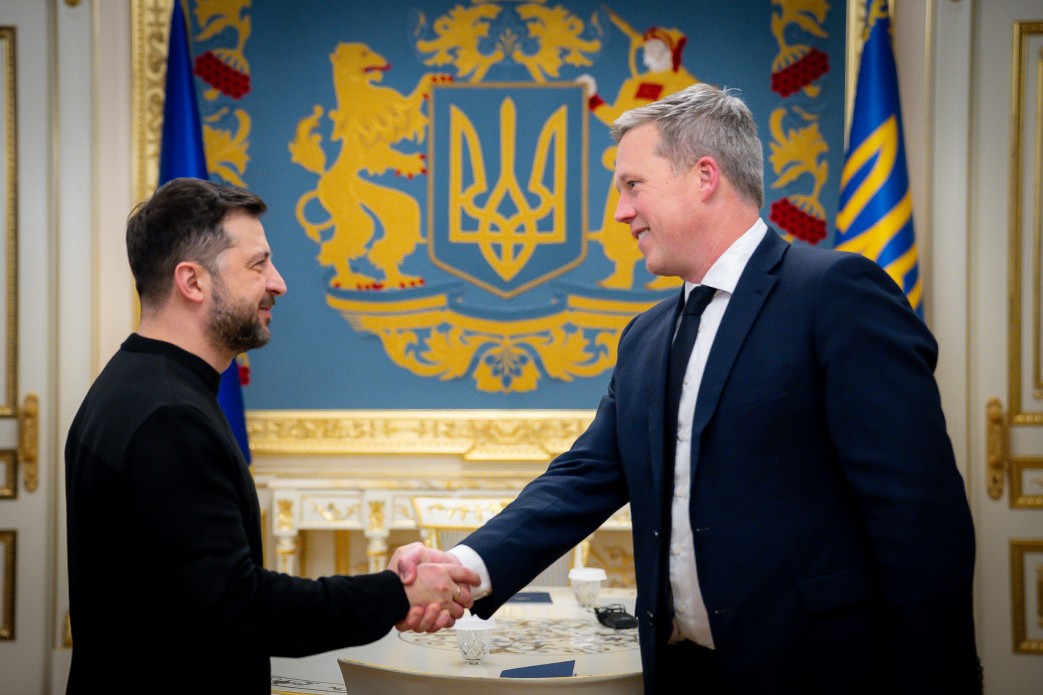
A US official told Axios that Zelensky and Driscoll “agreed on an aggressive timeline for signature,” signaling the Trump administration wants to get the deal done quickly. But the report also said that the US would take Ukrainian concerns into account and potentially alter the plan.
Driscoll’s meeting with Zelensky followed Reuters reporting that Keith Kellogg, Trump’s special envoy to Ukraine, had told associates he planned to leave the administration in January. Kellogg is known for his maximalist positions on the war, always insisting that Ukraine could win, and has reportedly clashed with Steve Witkoff, President Trump’s Middle East envoy, who has also been working on Ukraine and drafted the peace plan after holding talks with Russian envoy Kirill Dmitriev.
The Axios report said that Driscoll didn’t know until last week that he would serve as a peace envoy to Ukraine, an unusual role for the Army secretary. “He’s taking policy briefs. He’s taking backgrounds, history of the war, all sorts of things all the way through the weekend, and then they scream out of here,” a US official said, describing what Driscoll did in the days leading up to his meeting with Zelensky.
The White House said on Thursday that Witkoff and Secretary of State Marco Rubio are in contact with Russian and Ukrainian officials about the potential peace plan.
“Special Envoy Witkoff and Marco Rubio have been working on a plan, quietly, for about the last month. They have been engaging with both sides, Russia and Ukraine equally, to understand what these countries would commit to in order to see a lasting and durable peace,” said White House Press Secretary Karoline Leavitt.
***
Putin’s Meeting with Security Council on November 21, 2025 (Transcript Excerpts re 28 Point Peace Plan)
Kremlin website (machine translation), 11/21/25
The meeting was attended by Prime Minister Mikhail Mishustin , Chairperson of the Federation Council Valentina Matviyenko , Chairman of the State Duma Vyacheslav Volodin , Deputy Chairman of the Security Council Dmitry Medvedev , Chief of Staff of the Presidential Executive Office Anton Vaino , Secretary of the Security Council Sergei Shoigu , Presidential Aide Nikolai Patrushev , Defense Minister Andrei Belousov , Interior Minister Vladimir Kolokoltsev , Foreign Minister Sergei Lavrov , Director of the Federal Security Service Alexander Bortnikov , Director of the Foreign Intelligence Service Sergei Naryshkin , and Special Representative of the President for Environmental Protection, Ecology, and Transport Sergei Ivanov .
V. Putin: Dear colleagues, good evening!
We have two important questions today: the priorities of Russia’s CSTO chairmanship in 2026 and the Russian Federation’s strategy for combating neocolonial practices. The Minister of Foreign Affairs is invited to address both questions. We can begin.
V. Matvienko : Vladimir Vladimirovich, allow me.
Vladimir Putin : Yes, please, Valentina Ivanovna.
V. Matviyenko : Trump’s 28-point peace plan for the Ukrainian crisis is currently being actively discussed around the world. Before we begin discussing the main issues on the agenda, could you please express your opinion and your stance on this plan, and how it relates to your recent talks with Trump in Alaska?
V. Putin : Yes, of course, there’s no secret here. We’ve barely discussed this publicly, only in the most general terms, but it’s no secret: President Trump’s peace plan for resolving the situation in Ukraine was discussed before the Alaska meeting, and during those preliminary discussions, the American side asked us to make certain compromises and, as they put it, to show flexibility.
The main point of the meeting in Alaska, the main goal of the meeting in Alaska, was that during the negotiations in Anchorage we confirmed that, despite certain difficult issues and difficulties, on our part we nevertheless agree with these proposals and are ready to show the flexibility offered to us.
We have thoroughly briefed all our friends and partners in the Global South on all these issues, including the People’s Republic of China, India, the Democratic People’s Republic of Korea, South Africa, Brazil, and many other countries, as well as the CSTO countries , of course. All of our friends and partners, I want to emphasize, every single one, supported these potential agreements.
However, we see a certain pause on the American side following the Alaska talks, and we know this is due to Ukraine’s de facto rejection of President Trump’s proposed peace plan. I believe this is precisely why the new version, essentially a modernized 28-point plan, was released.
We have this text; we received it through existing channels of communication with the American administration. I believe it could also form the basis of a final peace settlement, but it has not been discussed with us in detail. And I can guess why.
I believe the reason is the same: the US administration has so far failed to secure Ukraine’s consent; Ukraine is opposed. Apparently, Ukraine and its European allies are still under the illusion of inflicting a strategic defeat on Russia on the battlefield. I believe this position stems not so much from a lack of competence—I won’t discuss that aspect of the matter now. But, most likely, it stems from a lack of objective information about the real state of affairs on the battlefield.
And, apparently, neither Ukraine nor Europe understands what this could ultimately lead to. Just one, most recent example: Kupyansk. As we recall, just recently, on November 4th, I believe, that is, two weeks ago, Kyiv publicly stated that there were no more than 60 Russian troops in the city and that within the next few days, as stated, the city would be completely unblocked by Ukrainian troops.
But I want to inform you that even at that moment, on November 4th, the city of Kupyansk was almost entirely in the hands of the Russian Armed Forces. Our guys were, as they say, just finishing their assault, clearing out isolated blocks and streets. The city’s fate had already been decided by that point.
What does this indicate? Either the Kyiv leaders lack objective information about the situation on the front, or, even if they do have it, they are simply unable to assess it objectively. If Kyiv is unwilling to discuss President Trump’s proposals and refuses to do so, then both they and the European warmongers must understand that the events that took place in Kupyansk will inevitably be repeated in other key areas of the front. Perhaps not as quickly as we would like, but inevitably, they will be repeated.
And overall, we’re happy with this, as it leads to achieving the goals of the Joint Military District by force of arms, through armed struggle. But, as I’ve said many times before, we’re also ready for peace talks and peaceful resolution of problems. However, this, of course, requires a substantive discussion of all the details of the proposed plan. We’re ready for this.
Let us now move on to the topics proposed for discussion during today’s Security Council meeting…
***
Analyses of the Proposals
Zelenskiy should take the US peace deal – By Ben Aris, Substack, 11/21/25
The U.S. plan: an analysis – By Sergey Radchenko, Substack, 11/21/25
Analyzing All 28 Points Of The Leaked Russian-Ukrainian Peace Deal Framework – By Andrew Korybko, Substack, 11/21/25
The list contains most of Russian President Vladimir Putin’s maximalist demands and few concessions to Ukraine.
One wonders if the author has actually read the 28 Points document. It denies most of Russia’s claims and completely ignore the major Russian concerns that President Putin has been stating since at least 2021.
It manages to antagonize both Ukraine and the Russia Federation at one go.
It’s essentially a dog’s breakfast of uninformed drivel presumably assembled by a 12 year old child with the assistance of a poorly performing AI.
I tend to agree with jrkrideau. Just off the top of my head, I don’t think Russia is going to go with just de facto recognition of the territories; there is no mention of de jure recognition. Freezing at the line of conflict would negate the referendum held to join the 4 oblasts into Russia. Also, utilizing Russian frozen assets to rebuild Ukraine does not seem a likely point to which the Russians would agree. In addition, point 26 seems it was written more for Ukraine than for Russia, especially regarding the writing off of Ukraine’s deep-seated corruption and an accounting of where US monies sent to Ukraine actually ended up.
While it may be a good starting point at which to begin serious negotiations, I see the latter taking quite some time and considerable back and forth; I do not see it being adopted rapidly or as is.