Kautilya The Contemplator, Substack, 8/28/25
Kautilya The Contemplator decodes power, empire and strategy through the lens of ancient statecraft and modern realism.
In the present age, it has become common to view the United States and Russia as irreconcilable adversaries, their fates locked in a perpetual contest for dominance. Commentators in the mainstream media speak of this rivalry as if it were an immutable law of geopolitics. Yet, the notion that hostility between Washington and Moscow is natural or eternal is a historical fiction. For most of its early life as a nation, the United States enjoyed a relationship of goodwill, respect and even quiet solidarity with Russia.
In the late 18th and early 19th centuries, the young American republic was shaped by figures who looked favorably upon Russian leaders, while Russia in turn extended gestures, subtle but consequential, that strengthened America’s independence. From Catherine the Great’s refusal to send Cossack troops to suppress the American Revolution to Russia’s dramatic show of support for the Union during the Civil War, the history of Russian-American relations is filled with episodes of amity rather than antagonism.
This forgotten tradition of friendship contradicts the dominant trend of US foreign policy since the 20th century, which has cast Russia as a perpetual enemy. To recover this earlier history is not to indulge in nostalgia, but to remind ourselves that enmity is not inevitable and that geopolitics is shaped by choices, not fate.
Catherine the Great and the American Revolution
The earliest moment of Russian support for American independence came during the War of Independence itself. In 1775, when Britain sought to crush the colonial rebellion, it scoured Europe for mercenaries. Prussia and the German principalities obliged, sending thousands of Hessians to fight under the British flag. On September 1, 1775, London also appealed to Catherine II of Russia, requesting 20,000 Cossack troops to deploy against the insurgent colonies.1
Catherine refused categorically. Her reasoning was straightforward. Russia would not expend blood to defend Britain’s empire. As she saw it, the request was an affront to Russian sovereignty, an attempt to use Russia as a hired army for British colonial interests. By turning down Britain, Catherine not only preserved Russia’s independence of action, but indirectly aided the American cause. Had thousands of Russian Cossacks landed in America, the balance of forces might well have shifted in Britain’s favor.
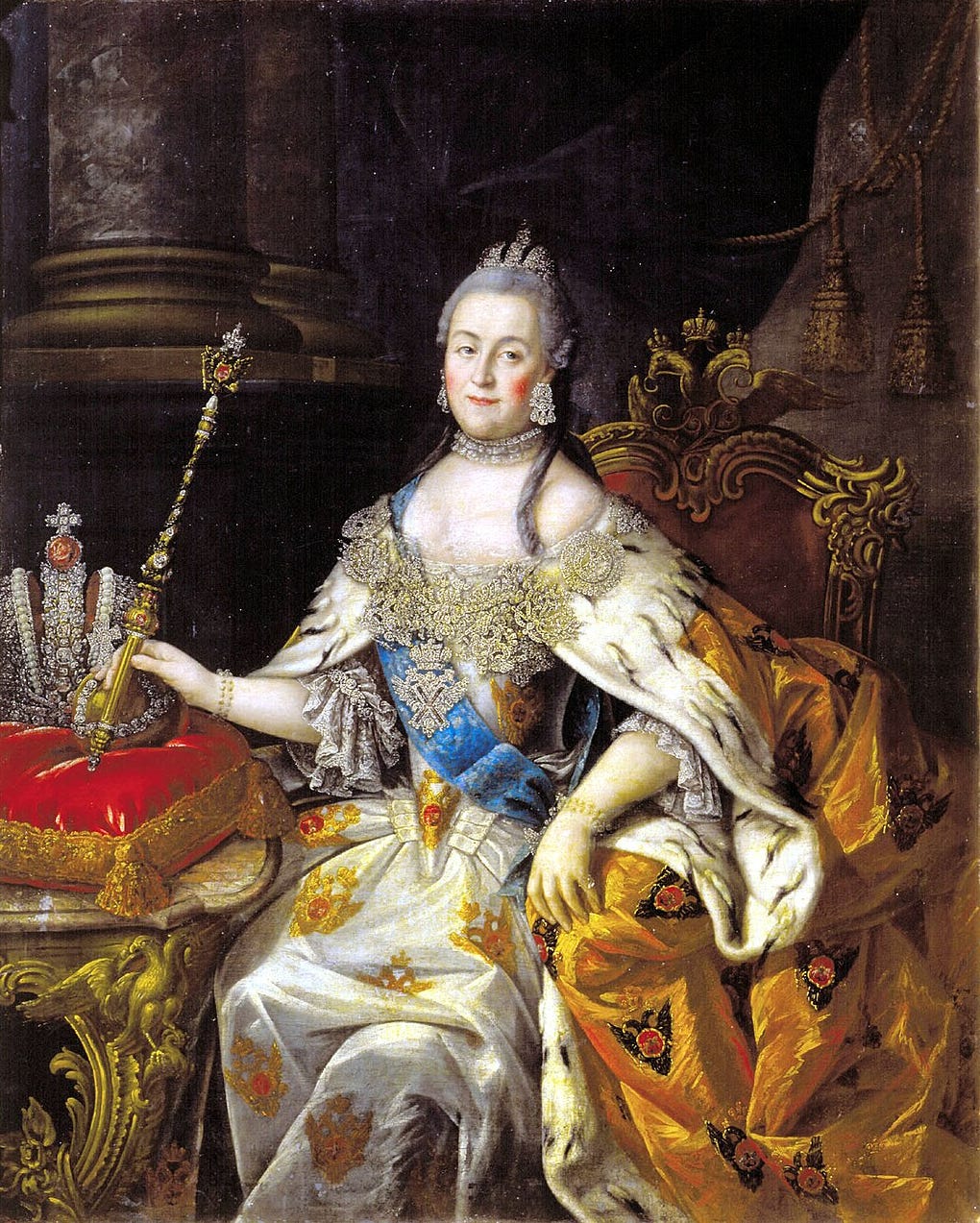
Catherine’s stance was consistent with her broader diplomatic outlook. She was wary of Britain’s naval dominance and its capacity to coerce neutral powers. In 1780, she established the League of Armed Neutrality, declaring that neutral nations had the right to trade with belligerents without interference, unless goods were explicitly contraband. This challenged Britain’s efforts to blockade French and Spanish shipping and weakened London’s ability to isolate the American colonies.2
Though Russia never formally allied with the United States, Catherine’s refusal to send troops and her assertion of neutral rights amounted to an indirect but vital form of support. At America’s moment of birth, Russia acted not as an enemy, but as a power whose policies gave space to the Republic’s survival.
Thomas Jefferson’s Admiration for Tsar Alexander I
With independence secured, American leaders looked outward to cultivate relations with foreign powers. Thomas Jefferson, a principal author of the Declaration of Independence, founder of the University of Virginia and America’s third president, held Russia in particular high regard. Having entered office in 1801, he was a statesman steeped in Enlightenment ideals.
Deeply skeptical of monarchy, Jefferson nonetheless praised Tsar Alexander I as “the most virtuous of the sovereigns of Europe” in a December 1804 letter to Albert Gallatin.3 What Jefferson perceived in Alexander I was an earnest attempt at enlightened governance. Alexander had spoken of constitutional reform and sought to position Russia as a stabilizing, peace-oriented power after the Napoleonic Wars. Jefferson, ever sensitive to tyranny and abuse of power, saw in him a monarch who, if not republican, at least embodied restraint, reason and moral seriousness.
Jefferson’s respect was not only personal admiration but also rooted in strategic logic. For a young United States still wary of Britain, Russia appeared as a natural counterweight. Unlike France, whose revolution devolved into violence, or Britain, which continued to menace America’s sovereignty, Russia was a great power that neither threatened US independence nor sought to draw it into European intrigues. To Jefferson, cultivating cordial relations with Russia offered the Republic a powerful friend across the Atlantic who had little interest in curtailing American growth.
Diplomatic exchanges between Washington and St. Petersburg reflected this respect. In 1807, Alexander proposed a closer diplomatic relationship. His interest was not opportunistic. He viewed the United States as a novel political experiment whose success was worth encouraging. Jefferson supported the idea and just after he left office, President James Madison appointed John Quincy Adams as America’s first minister to St. Petersburg in 1809.
Russia and the War of 1812
When the United States declared war on Britain in 1812, Russia was simultaneously facing Napoleon’s massive invasion. John Quincy Adams had established warm relations with the Russian court and observed the unfolding of Napoleon’s invasion. His dispatches to Washington praised Russian resilience and carried news of Moscow’s burning and the French retreat. American newspapers of the time expressed sympathy for Russia’s struggle against Napoleon, seeing in Alexander’s stand a defense of balance and liberty in Europe.
Russia also sought to play a constructive diplomatic role in the American conflict with Britain. Alexander offered to act as a mediator between the United States and Britain in the War of 1812. Although Britain declined the initial proposal, the Russian overture laid the groundwork for later peace negotiations. These efforts eventually culminated in the Treaty of Ghent in 1814, which ended the war on largely status quo terms.
Thus, during one of the most tumultuous years in both American and Russian history, the two countries’ foreign policies converged in a spirit of mutual respect, sympathy and potential cooperation.
Admiral John Paul Jones: America’s Naval Hero in Russian Service
Few episodes capture the unexpected friendship between Russia and America better than the career of Admiral John Paul Jones. As the celebrated “Father of the US Navy,” Jones won immortal fame by capturing HMS Serapis in 1779, becoming a legend of the Revolution.4 Yet his story did not end there. It took him into the service of the Russian Empire.
In 1788, Catherine the Great invited Jones to join the Russian Navy as a Rear Admiral in the Black Sea fleet during the Russo-Turkish War.5 Despite court intrigue, he commanded with distinction in operations against the Ottomans. The appointment symbolized Russia’s esteem for American military talent and the openness of both sides to cooperation.
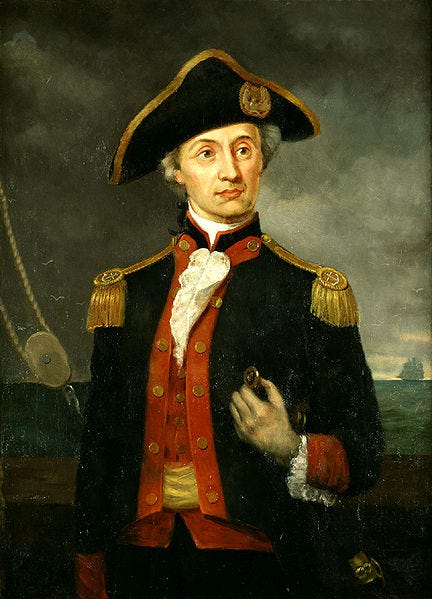
Jones died in Paris in 1792. His remains were returned to the United States in 1905 with full honors and today lie at the US Naval Academy in Annapolis. Jefferson, then in Paris, admired Jones and supported his European ventures, further cementing Russian-American links.
Jefferson’s admiration endured long after Jones’s death. At his estate at Monticello, Jefferson displayed a bust of John Paul Jones in his Tea Room, alongside those of George Washington, Benjamin Franklin and the Marquis de Lafayette. This was a plaster copy of the famous Houdon bust, presented to Jefferson as a gift by Jones himself.6 The placement reflected Jefferson’s esteem, ranking Jones among the foremost heroes of America’s independence.
Jones’s Russian command, coupled with his honored memory at Monticello, demonstrated a level of mutual respect between the two nations that is almost unthinkable today. A founding figure of the American navy was also, for a time, a commander of the Russian fleet, and in Jefferson’s eyes, worthy of standing in symbolic company with Washington, Franklin and Lafayette.
Russia and the American Civil War
If Catherine’s refusal in the 18th century represented an indirect gesture of support, and Jones’s service embodied personal respect, Russia’s conduct during the American Civil War amounted to direct solidarity. When the Union faced an existential crisis, Russia emerged as one of its few reliable friends.
By 1862, Britain and France were seriously considering recognizing the Confederacy, drawn by their dependence on Southern cotton and their desire to see the Union fractured. Such recognition could have tilted the balance of the war, encouraging Confederate resistance and perhaps even prompting European military involvement.
Russia, however, stood firmly with the Union. Tsar Alexander II, who had emancipated the serfs in 1861, identified with the Union’s struggle against slavery. However, strategic calculation also played a role. Britain and France, Russia’s adversaries during the Crimean War of 1853-56, were considering aligning with the Confederacy. Supporting the Union gave Russia a chance to also frustrate its European adversaries.7
The most dramatic gesture came in 1863, when Russia dispatched its Baltic fleet to New York Harbor and its Pacific fleet to San Francisco. Officially, these deployments were to safeguard Russian vessels in the event of war with Britain. However, their presence was widely interpreted in America as a show of friendship and deterrence. Newspapers hailed Russia as “our only friend in Europe,”8 and the symbolism of Russian warships anchored in US ports during the nation’s darkest hour resonated deeply with the American public.
The Union never forgot this moment of solidarity. In an era when its very survival was at stake, Russia had extended a hand of friendship when others hesitated.
US Humanitarian Aid to Russia’s Famine of 1891-92
Friendship was not limited to diplomacy. It extended to humanitarian compassion. When famine struck Russia during 1891–92, triggered by crop failures and a harsh winter, the American people responded with extraordinary generosity.
Across the United States, churches, charities and civic groups raised money and collected grain. The US government supported the effort and American ships carried thousands of tons of food to feed starving Russian peasants. One of the largest shipments came aboard the steamer Missouri, organized by the American Red Cross under the leadership of Clara Barton.9
Russian newspapers reported with gratitude on the American aid and Tsar Alexander III personally thanked the United States. This moment demonstrated that the bond between the two nations was not merely strategic but also human. Ordinary Americans, with no geopolitical agenda, gave to save lives in Russia.
This episode stands in sharp contrast to the hostility of today. Where sanctions now aim to impoverish ordinary Russians, in the late 19th century Americans mobilized to relieve their suffering. It is a powerful reminder of a different moral tradition in US-Russia relations.
The 20th Century Reversal
Given this history, the trajectory of US foreign policy toward Russia in the 20th century appears paradoxical. With the Bolshevik Revolution of 1917, Washington’s perception shifted from cordiality to suspicion. The ideological gulf between American republicanism and Soviet communism deepened into outright hostility after the Second World War, culminating in the Cold War.
What is striking, however, is how completely the earlier record of friendship was erased from memory. The Grand Alliance during the Second World War, in which Americans and Russians fought shoulder-to-shoulder against Nazi Germany, was quickly overshadowed by postwar confrontation. By the 1950s, the narrative of Russia as a natural enemy had become entrenched in American political consciousness.
Even after the Soviet Union collapsed in 1991, this narrative persisted. Instead of building on Russia’s overtures for partnership, the United States pursued NATO expansion, economic encirclement and interventions in Russia’s near abroad.10 Russia’s desire to be integrated into a cooperative European security order was rebuffed. The earlier tradition of mutual respect, embodied by Jefferson’s admiration or Russia’s support during the Civil War, was forgotten.
Recovering Forgotten Lessons
The history of US–Russia relations reveals a tradition of friendship that challenges today’s assumptions. Catherine the Great refused to serve Britain’s empire against America, Jefferson praised Alexander I as a virtuous sovereign and Russia supported the Union during the Civil War with its fleets in American harbors. At key turning points, Russia acted not as America’s enemy, but as its friend.
To remember this history is to expose the contradiction in America’s present foreign policy. Enmity with Russia is not inevitable. It is a political construction sustained by choices that ignore a long record of amity. If the United States could once admire Russia’s leaders and welcome its support in times of crisis, there is no reason why it cannot again imagine a relationship built on respect rather than hostility.
History does not dictate the future, but it offers lessons. One lesson is unmistakably clear: the United States has thrived when it recognized Russia not as a threat to be contained, but as a power with which friendship was both possible and beneficial. To recover that tradition is not naïve nostalgia. It is the rediscovery of a truth America once knew but has since forgotten.
If you’ve enjoyed this analysis, I’d love to welcome you as a subscriber. It’s free, and you’ll get every new essay delivered directly to your inbox. No algorithms, just thoughtful writing.
1 Ragsdale, Hugh. Catherine the Great and the American Revolution. The William and Mary Quarterly, 1988.
2 Dull, Jonathan R. A Diplomatic History of the American Revolution. Yale University Press, 1985.
3 Jefferson to Gallatin, Dec. 1804. The Papers of Thomas Jefferson. Princeton University Press.
4 Morison, Samuel Eliot. John Paul Jones: A Sailor’s Biography. Little, Brown, 1959.
5 Thomas, Evan. John Paul Jones: Sailor, Hero, Father of the American Navy. Simon & Schuster, 1980.
6 Monticello.org. John Paul Jones Bust (Sculpture), Monticello Collections Database, 2024.
7 Lincoln, W. Bruce. The Great Reforms: Autocracy, Bureaucracy, and the Politics of Change in Imperial Russia. Northern Illinois University Press, 1979.
8 Curtis, George Ticknor. Life of James Buchanan: Fifteenth President of the United States, vol. 2. New York: Harper, 1869.
9 Barton, Clara. The Red Cross in Peace and War. American Historical Press, 1899.
10 Gaddis, John Lewis. The Cold War: A New History. Penguin, 2006.