Events in Ukraine (Substack), 4/25/26
The European Union, having gotten Orban out of the way, has finally formally approved its 90 billion euro loan to Ukraine.
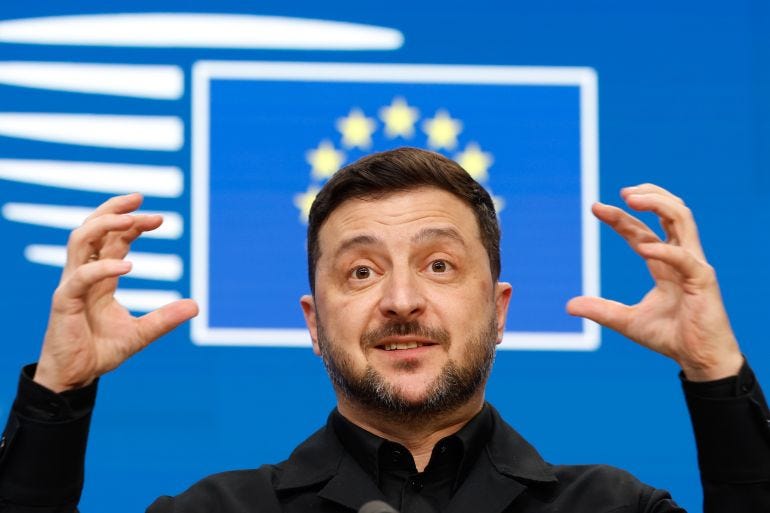
Combined with Zelensky’s recent statements that his country ‘does not need’ Trump’s negotiation team, Ukrainian political analyst Kost Bondarenko has drawn the obvious conclusion — Zelensky is confident that he can blow off Trump. He will continue fighting with European help until 2028, when the hope is for a Democratic administration to return to the White House.
So, how goes the war?
Zelensky and allied western media have been pushing three main narratives this year. First, that Russian casualties are higher than ever. Second, that Ukraine is taking back increasing amounts of territory. Third, that Ukraine has retaken the lead in the drone war that it lost in 2025. The reality doesn’t seem to bear out these claims.
Losses
There have been a remarkable number of contradicting numbers about Russian losses coming from the Ukrainians and their western partners.
To begin with, there is dissonance between Zelensky and the General Staff. Throughout April, Zelensky and his minister of defense Fedorov have been saying that March saw an all-time record of Russian losses, 35 thousand KIA+WIA. But the website of the General Staff, which is the official Ukrainian source for Russian losses, claimed under 32 thousand. More importantly, according to this same website, the Russians lost 28% more troops in the first quarter of 2025, compared to the first quarter of 2026.
Then we turn to Zelensky’s western partners. On April 14, Finnish prime minister Alexander Stubb was overjoyed to declare that the Russians lost 35 thousand KIA in March:
“I actually think that Ukraine is in a much better place than it has been at any stage in this horrific war,..
Since December, they [Ukraine] have killed somewhere around 35,000 Russian soldiers per month,” he said. “Russia is not able to recruit enough soldiers to compensate for those 35,000. Ninety-five percent of the losses are through drones…
The ratio of losses right now is one to five… So one Ukrainian soldier to five Russian soldiers.”
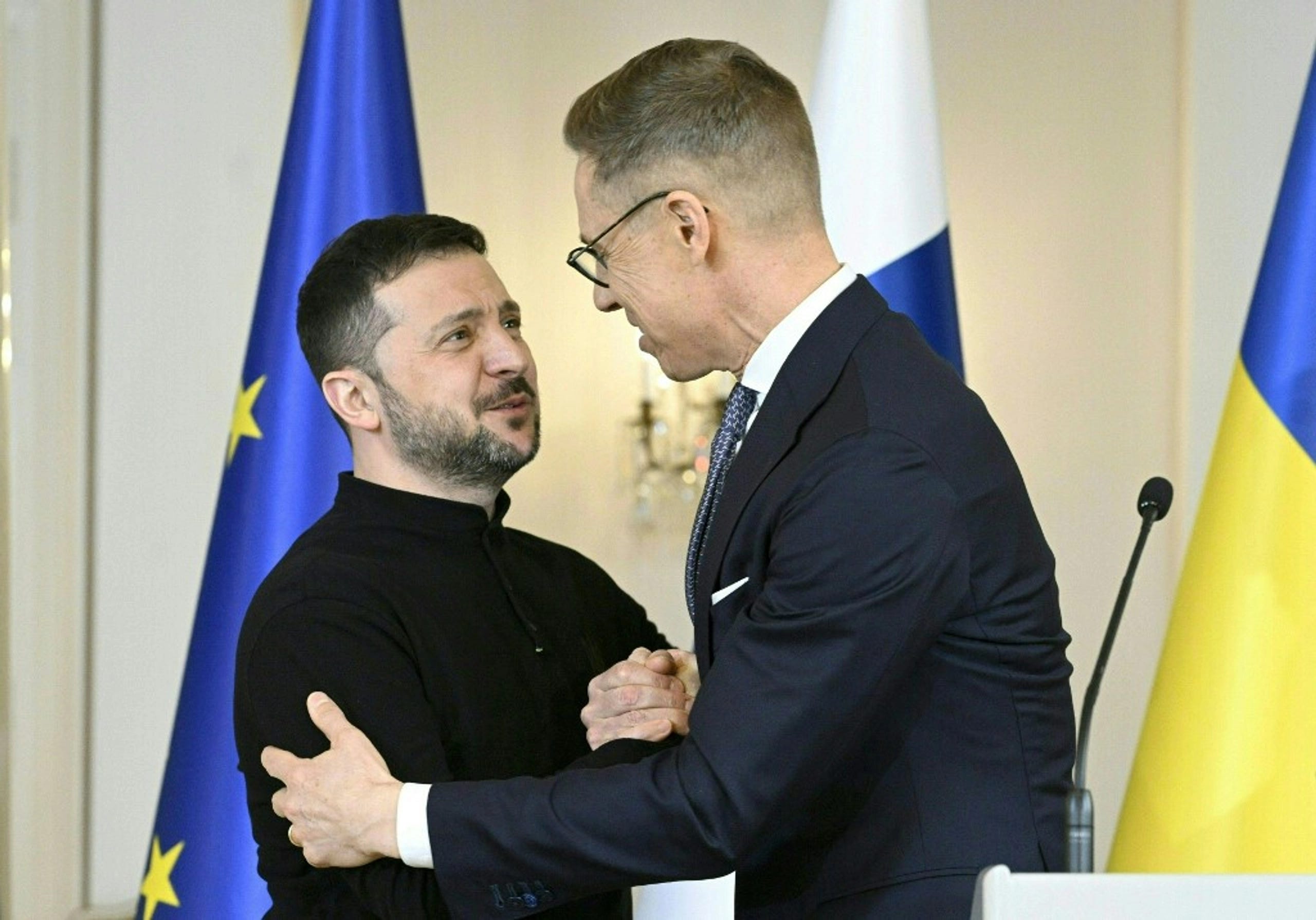
But even Zelensky doesn’t say that 35,000 Russians were killed — he says 35 thousand KIA + MIA.
There are serious issues with gathering statistics on losses. Ukraine’s Russian loss calculations are based on video evidence from drones. But often, a hit by a drone doesn’t actually lead to death. The soldier might be evacuated in the meantime. Or, he might be hit again by another drone, which is counted as two Russian casualties.
A rather interesting article came out on April 17 on the topic of Russian losses. It was published by texty.ua, a liberal nationalist publication opposed to commander-in-chief Oleksandr Syrsky. It was reposted by MP Mariana Bezuhla, who is also opposed to Mr Syrsky.
Anyway, it found that Russian losses have been continually decreasing, while Russian territorial gains increase. This is a continuation of a trend they first identified in mid-2025, which I covered here.
This is the graph they produced in April.
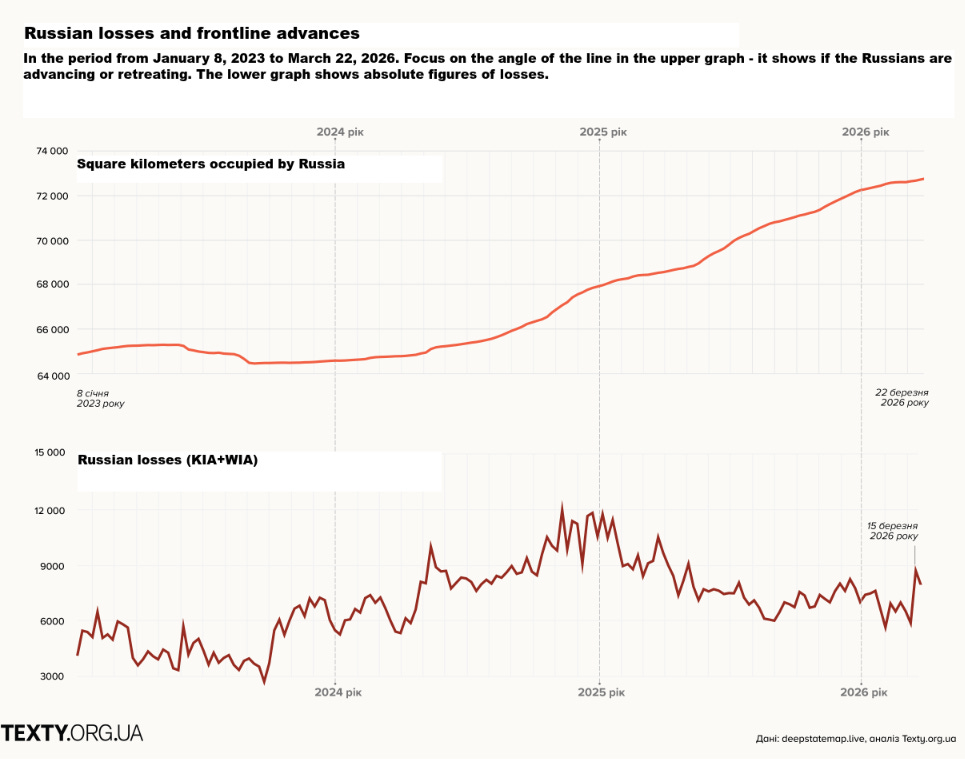
Note that the losses are shown on a weekly basis, based on the data of Ukraine’s General Staff. Advances are based on the DeepState semi-independent OSINT project, which is less optimistic for the Ukrainian side than the claims of the General Staff or president, but also often more optimistic than the real situation on the ground.
Texty writes that the situation could be considered “difficult but controllable” (a beloved phrase of the general staff) if faster advances led to greater Russian losses. This would mean that both lines increase simultaneously. However, this this was only the case in 2024.
Since January 2025, texty believes that ‘the situation has begun to deteriorate’ as ‘the Russians are advancing faster and dying less’.
Following September 2025, Russian losses started to increase slightly, which texty describes as ‘meaning the situation has returned from catastrophic to “complex but manageable.”’
However, starting from January 2026, Russian losses again declined alongside increased territorial advances. For Texty, this ‘signals an extremely bad situation’.
Finally, while the ‘surge in Russian losses’ in the first two weeks of March ‘gives hope for a change in the trend, too little time has passed to understand whether this is a coincidence or a sign of changes in our favor.’
This is certainly quite a different tone from that struck by Zelensky and Fedorov. I think that to begin with, of course, Russian losses are seriously exaggerated. The Ukrainians are also constantly losing troops due to Russian dominance of the skies and because of doomed, ill-planned counterattacks against Russian positions.
And finally, the past few months saw comparatively fewer Russian assault operations due to winter weather. Now that spring has led to a regrowth of greenery, Russian infantry assault teams are finding it easier to infiltrate behind Ukrainian positions without being detected by drones.
Starved out
Meanwhile, the Ukrainians certainly seem to have fewer and fewer troops.
Due to the lack of manpower, troops are being forced to stay in the same trenches without rotations for months on end. On April 23, the liberal nationalist publication Ukrainska Pravda wrote about an outcry on social media from relatives of soldiers in the 14th brigade. Stationed in the Kharkiv oblast, they have apparently been largely starved of food and drinking water for the past 8 months. As a result, they are in a highly emaciated condition that is hardly conducive to active resistance.
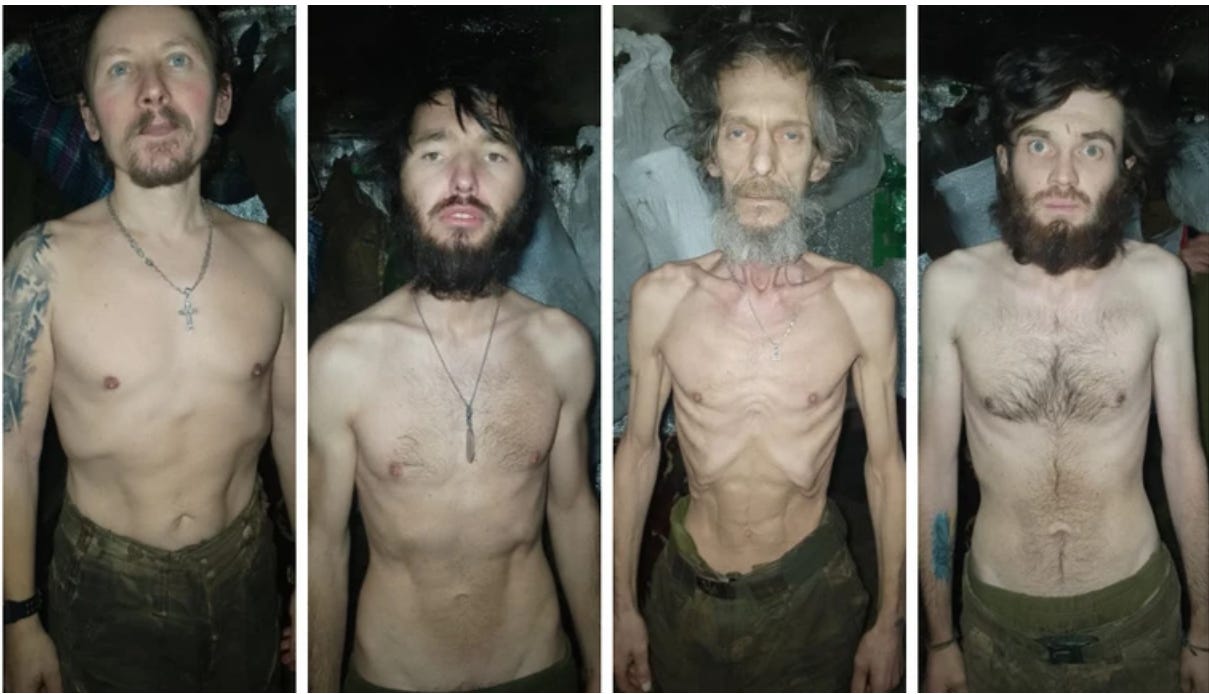
Ivanna Poberezhnyuk, the relative of one soldier who maintains contact with soldiers in the unit, wrote this to threads:
The guys are in positions without food and water! The command is not responding. Fighters are losing consciousness from hunger, drinking rainwater. There are also problems with communication
It is also notable that Poberezhnuk wrote that these soldiers serving in the 14th brigade were ‘attached’ to the 30th brigade. This practice has been much criticized over the past two years, since it means that the ‘attached’ unit is often ‘used up’ at the frontlines by the unit it is attached to. Units that have the privilege to ‘attach’ other units to themselves care little about preserving the lives of troops in these attached units, because they can always just attach another unit. All the while, they can claim to suffer reasonable losses in their own unit.
Anastasia Silchuk, the wife of one of the soldiers, wrote this to Facebook:
“We voluntarily stood up for the defense of Ukraine on the first day of the full-scale invasion. We ask the higher command to deal with this situation and prevent treacherous actions!
Each parcel is meant to last for 7-14 days. We extract water ourselves – rainwater, in winter we melt snow. If it was dumped, then 1.4-2.5 liters. There are frequent situations when there is no connection at all for 3-4 days. This is the situation at all our positions. Even critical medicines are delivered only together with food,”
That same day, army command claimed to have sent new food supplies to the starving troops of the 14th brigade.
Territory
We’ll now take a look at the battlefield.
I’ve noticed that many top Ukrainian military bloggers, which once used to be quite interesting to read for their frankness, have gone rather quiet over 2026. What little they do say tends to be rather neutral or optimistic. I suspect this is related to the desperate need for European aid, and the hope of convincing the Americans into deepening military engagement. As a result, we have these endless media narratives of a victorious Ukraine, along with increased domestic censorship.
However, there is one Ukrainian military channel that continues putting out interesting daily reports about the frontlines — the airborne assault officer Muchnoy Jugend. And in what is surely a sign of the times, his channel went private this week. That means that by providing translations of his reports, I could claim to be relaying ‘confidential Ukrainian military sources’. He also turned off the copy or screenshot option on April 24.
It’s no wonder that Muchnoy went private. He is lauded among Ukrainian military bloggers for his honesty, and that certainly isn’t what the current media conjuncture calls for.
Take, for instance, his April 25 update. Instead of writing about constant Russian ‘meat assaults’, he noted that in the Dnepropetrovsk oblast, Russian forces weren’t always trying to advance. Instead, they were attacking Ukrainian positions with concealed stationary tanks. He also noted several cases of Ukrainian vehicles destroyed by Russian drones.
He also identified the Pokrovsk and Kostiantynivka directions as the most critical sections of the front. Among other things, he criticized Ukrainian command’s decision to send suicide squads into the village of Stare Selo, near Kostiantynivka:
In the area of Stare Selo, there are inexplicable actions on our side: sending infiltration infantry groups into a zone where the enemy tightly controls the air with fiber optic drones. This is essentially a maximally risky one-way game.
To best immerse my readers in the daily events of the frontlines, I decided to use a somewhat experimental approach today. Think of it as a sort of battlefield stream of consciousness — I separated the frontline into eight main hotspots, and translated Muchnoy’s updates, day by day. Along with labeled maps, of course (identifying micro-villages whose names were often recently changed is no easy task).
But first, here are the main trends I identified.
There have been no notable Ukrainian advances over the past month. Instead, Russian forces have gradually advanced across the frontlines. The high-casualty assaults by Ukrainian assault forces in the south fizzled out by early to mid March. The attempts to move forward continue to this day, but with no success and high losses.
Zelensky finds it very important to keep trying here, because his claims of ‘400 square kilometers liberated in the south’ a few months ago were very effective in the western press. In fact, honest Ukrainian mappers believed that around 75 square kilometers of contested territory, not fully controlled by the Russians, was retaken. But since the nature of the terrain here means there is a higher chance of ‘retaking’ territory than elsewhere, the army will continue trying.
Meanwhile, Russian troops continue increasing the amount of drones it uses and the sophistication of their deployment. Russia’s highly effective Rubikon drone team is reported as active along the frontline, and it continues to inflict heavy losses. In response, Ukrainian troops have focused on trying to destroy Rubikon operators and bases in the area around the frontlines.
The key target for both sides is logistics, the zone under 30 kilometers from the frontline. By achieving dominance in the air through drones and drone-corrected artillery, provisions and reinforcements are blocked off, leading to a steady erosion of enemy positions for the side with air superiority (Russia). In recent months, Ukraine has also tried to increasingly use this tactic, to some success. However, its drone teams are often too preoccupied with trying to stop Russian infantry advancing into Ukrainian positions to be able to focus on mid-range logistics.
Now, to the key sections of the frontlines. We’ll analyze separately the following 8 theaters:
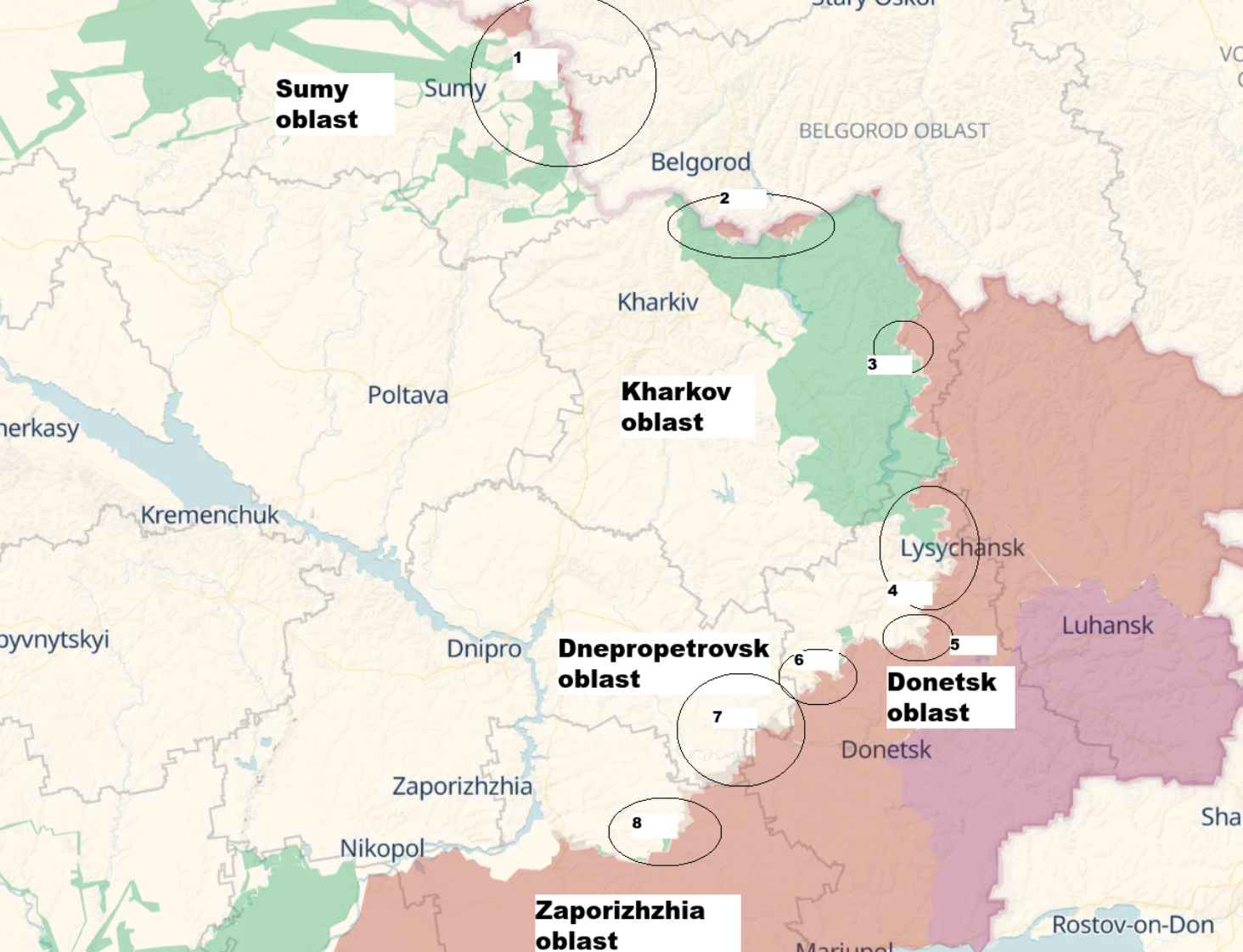
1: Sumy oblast border region
2: Kharkiv oblast border region (Vovchansk)
3: Kupiansk (eastern Kharkiv oblast)
4: Area around Kramatorsk and Sloviansk (northern Donetsk oblast)
5: Kostiantynivka (Donetsk oblast)
6: Pokrovsk area (western Donetsk oblast)
7: Southeastern Dnepropetrovsk oblast, bordering with the Donetsk (northeast) and Zaporizhia (southwest) oblasts
8: Huliaipole and nearby villages (northeastern Zaporizhzhia oblast)
The key battles are taking place in the Donetsk oblast. In the south, there is a fluid back and forth over unpopulated former villages. In the north, Russian troops have moved forward partly due to lack of Ukrainian defenses.
But in the Donbass, the operation to take the Sloviansk-Kramatorsk conglomeration continues. According to Zelensky and the western press, Russia is ready to freeze the war on the current frontlines once it has taken these cities. Most of Russia’s advances over the past month have been concentrated here, to the north and east of these twin cities.
Of course, these haven’t been massive advances, and at the current pace it will take quite a few months until Russian infantry are regularly infiltrating Sloviansk and Kramatorsk. At that point, it is likely that very lengthy urban warfare will ensue, depending on how well Russia manages to encircle the cities from multiple sides and strangle logistics.
To the south of Kramatorsk/Sloviansk, Kostiantynivka’s effective logistical encirclement has been intensifying. Ukrainian troops are increasingly demoralized by constant attacks from the air, including heavy FAB airborne bombs, strike drones like the Molniya and Lancet, and heavy artillery. Meanwhile, open displays of pro-Russian sentiment by the local population have further frustrated Ukrainian soldiers.
And beyond Pokrovsk, the situation is also highly intense. Ukrainian media has publicized demands from Ukrainian troops around Myrnohrad to be allowed to retreat — they have long been effectively encircled.
Now, onto daily reports from the frontlines. All 10,000 words of them.
The north
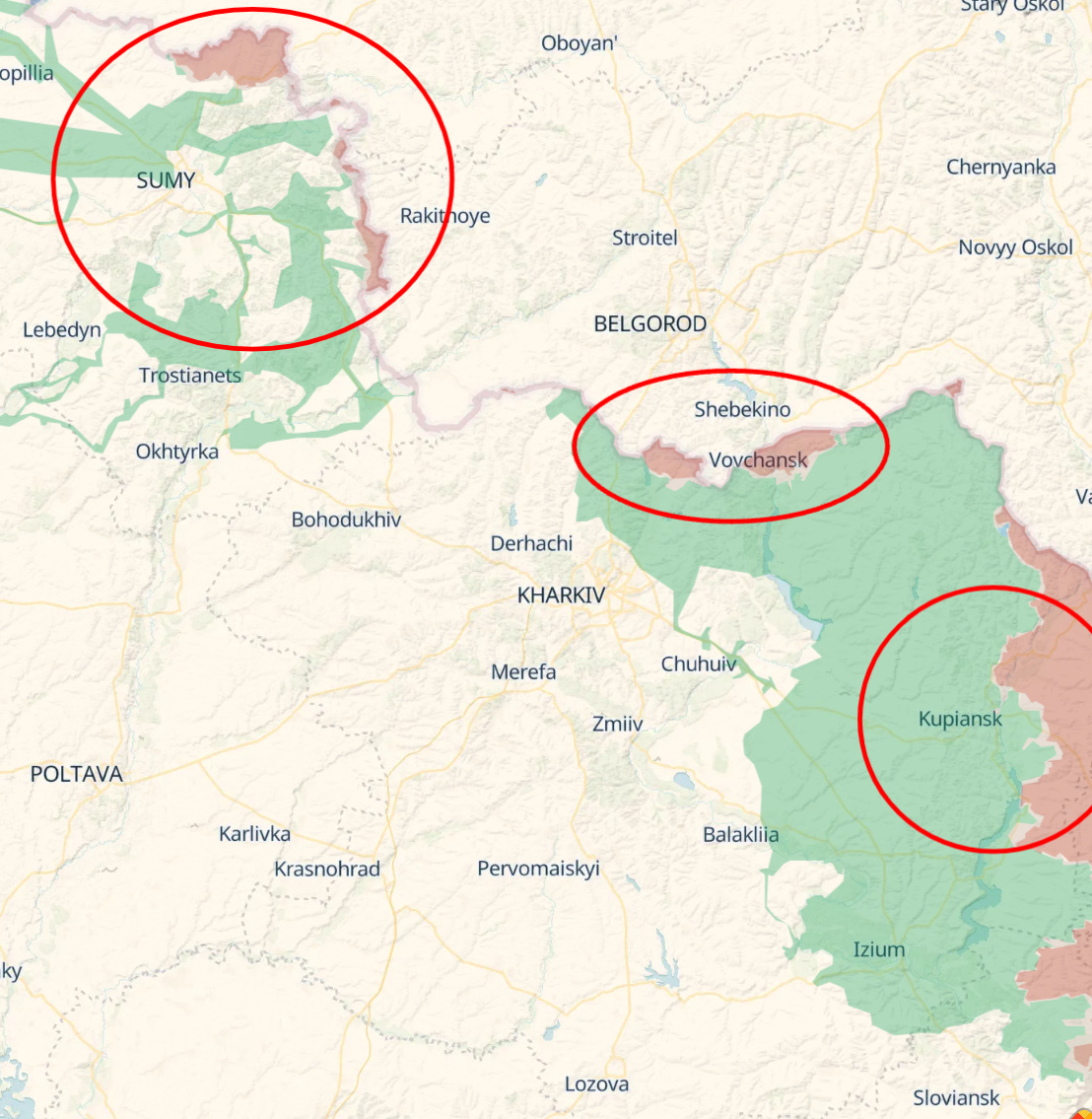
The past month has seen Russian troops take around 150 square kilometers of territory in northern Ukraine, in the border areas of the Sumy oblast. These are often not quite military operations, but look more like Russian troops advancing into essentially unprotected villages. Here’s a comparison between April 1 and April 25.
It seems unlikely that Russia has particularly grand aims here other than pulling Ukrainian reserves away from the more important parts of the front. The Russian government is also implementing its stated strategy of creating a ‘buffer zone’ along the border in order to prevent Ukrainian incursions into Russia, like the 2024 Kursk operation.
However, some think otherwise. Ukrainian journalist Yuliya Kiriyenko sounded the alarm for the city of Sumy on April 20:
A very dangerous situation in the Sumy region.
Earlier, information emerged that active assaults had begun against two brigades in different sectors of the front.
As of now, there are four penetrations along the border. From the east and the north, Russian troops are advancing in small groups.
There is continuous enemy use of KAB glide bombs and artillery strikes.
The worst possible scenario is that Sumy could end up in partial encirclement.
This post earned Kiriyenko a great deal of criticism from the general staff and DeepState. Nevertheless, she maintained that the threat for Sumy exists.
Meanwhile, in the northern Kharkiv oblast, Russian forces continue probing further beyond Vovchansk. Like Sumy, the goal seems mainly to thin out Ukrainian reserves across the frontlines, rather than achieving key territorial aims (as in the Donbass).
And troops certainly are thinly dispersed. The following April 17 update on Vovchansk from Muchnoy illustrated Ukraine’s manpower problems:
Vovchansk direction: A deep infiltration of the enemy in the area of Zybyne has been recorded, groups have gone up to 5 km before being detected and hit by drones. This is not just reconnaissance, but a serious probing of the defense. Such a distance without contact by our forces is a signal that we are blind in some places. If we do not reinforce control and reconnaissance, the enemy may repeat the attempt with larger forces and consolidate.
In general, the enemy’s main focus is on flanking bypasses, infiltration and control of the sky. In short, he is not breaking the front, but slowly eroding it. Our task: not to let these infiltrations turn into full-fledged breakthroughs.
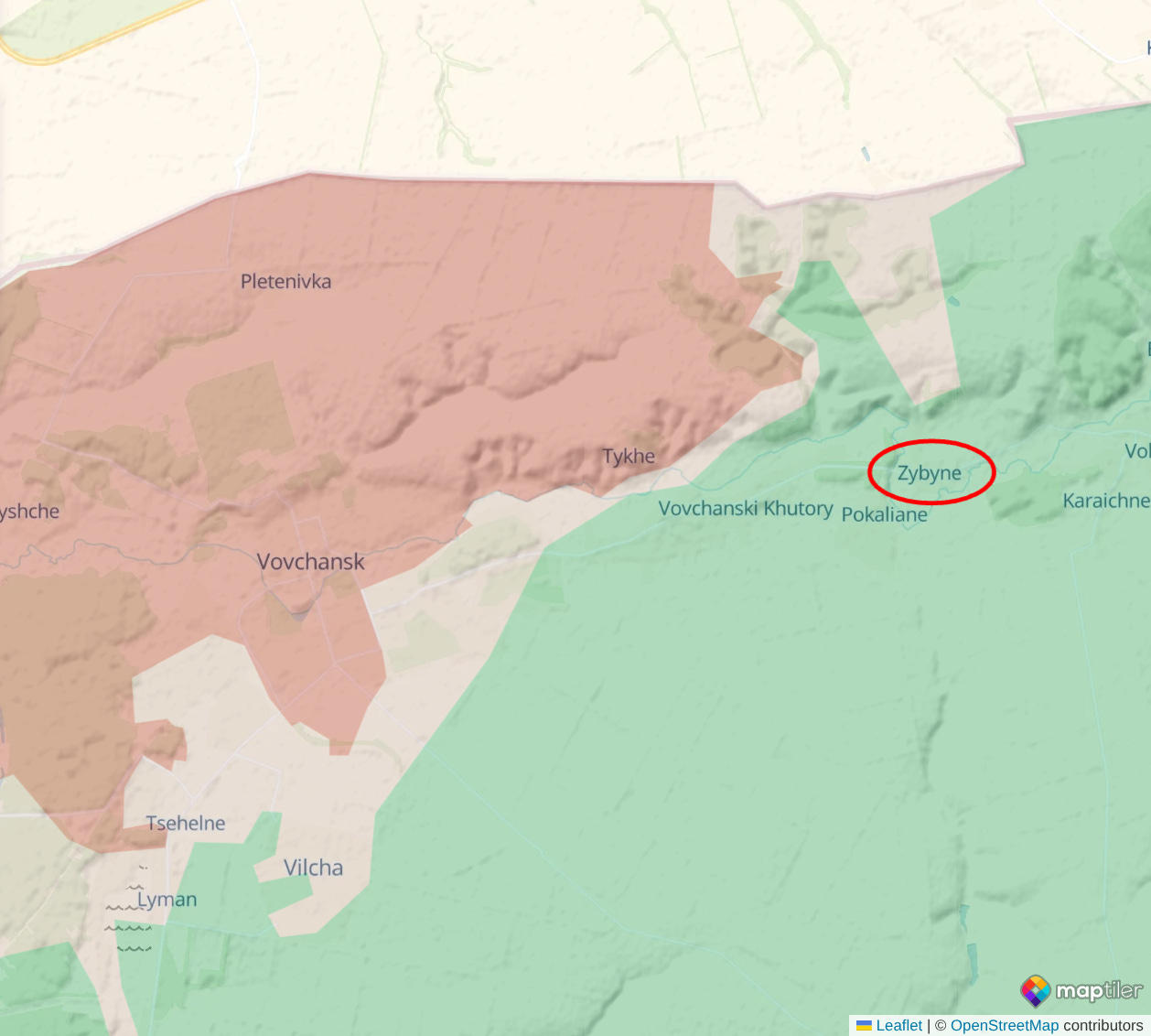
Further south in the Kharkiv oblast is Kupyansk, which the Ukrainians triumphantly ‘retook’ in late 2025. However, despite constant promises to fully clear remaining Russian troops from the city within weeks, that never materialized. And now, Ukrainian defenses here are once again weakening.
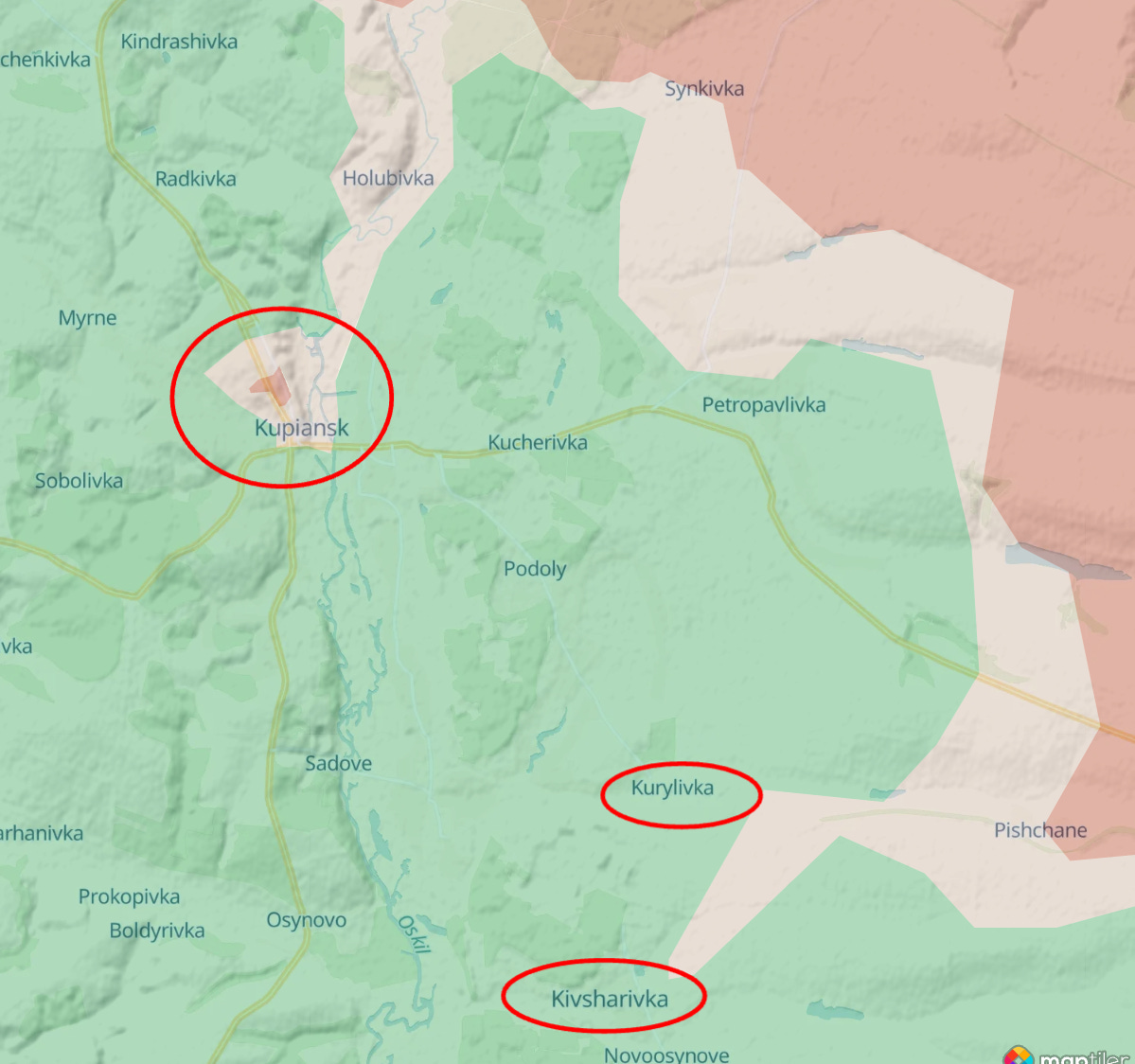
The DeepState map is quite interesting — an island of red consolidated Russian terrain connected by a gray zone. The Russians in Kupyansk are by no means having an easy time and largely receive supplies through drones and such. Nevertheless, their holding out seems to have aided advances nearby.
Much of the Russian advances visible on a map this month were to the southeast of Kupiansk. Muchnoy wrote this on April 16:
Kup’yansk direction: Infiltration attempts are being detected in the eastern part of Kivsharyivka. The enemy is entering in small groups, trying to gain a foothold, but our soldiers immediately suppress them and prevent this from happening. At the moment, the situation is controlled, there are no major breakthroughs or deep incursions, the line is holding steady.
And on April 24, Muchnoy wrote that ‘the situation around Kupyansk is starting to change in favour of the Russians’. They are ‘seizing the initiative west of Kupyansk’ and infiltrating several areas northwest and southwest of the city. Russian units are ‘destabilizing the defense not at a single point, but along the entire arc, stretching out of forces and finding open spaces for maneuvering’.
They are also consolidating gains on the eastern bank of the Oskil river, with Kurylivka effectively under Russian control. Assault actions are being conducted into Kivsharivka.
And finally, the Russians are also infiltrating into the eastern outskirts of Kupiansk-Vuslovy, taking control of key infrastructure and logistics.
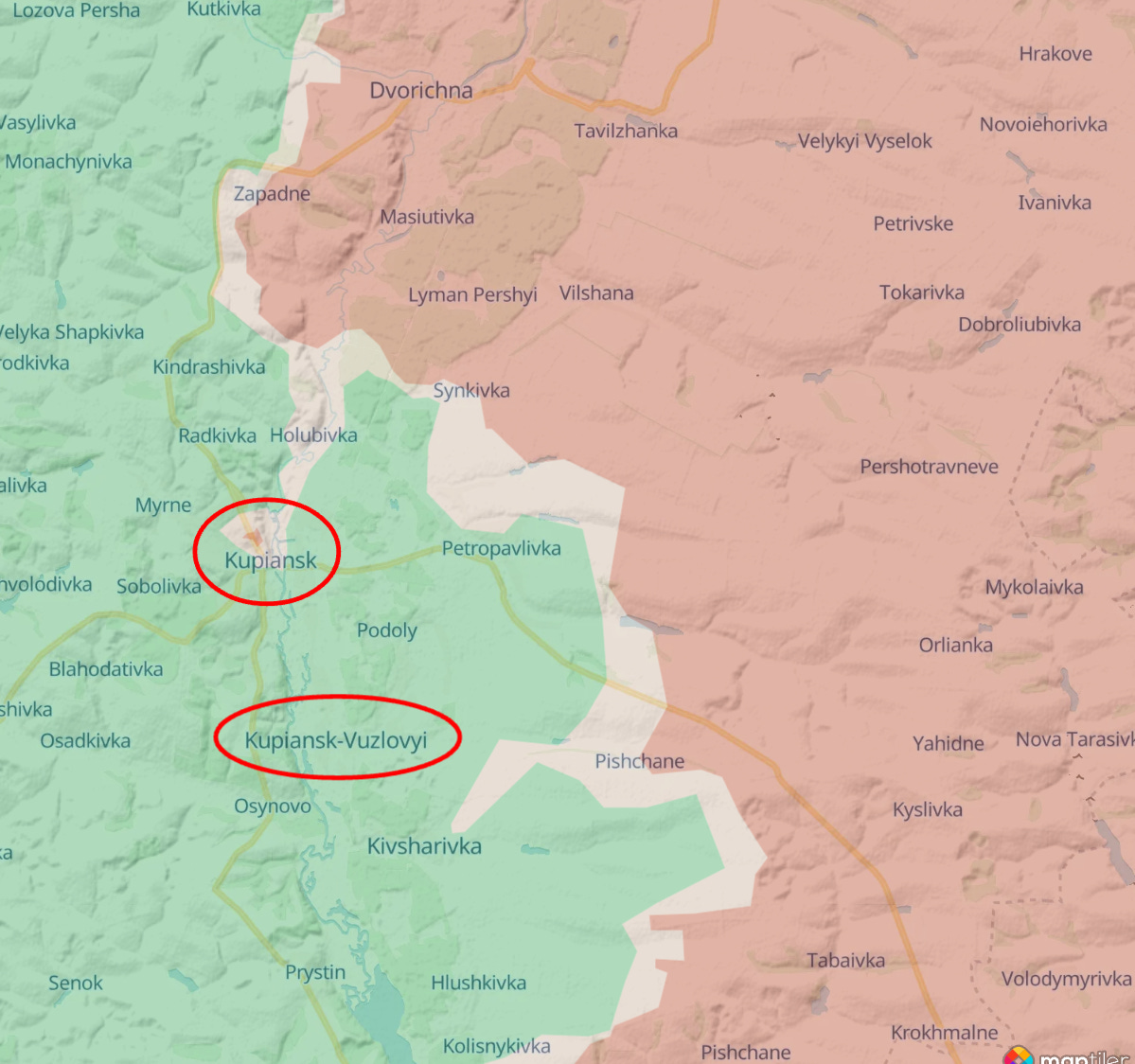
As a result, Kupiansk is being ‘pressured from the west’, Russian troops are ‘consolidating to the east’, and penetrating certain parts of the city itself.
Muchnoy also suspects that the Russians have intensified their efforts here because Ukrainian troops have been redistributed to the north of the Kharkiv oblast, due to Russian advances around Vovchansk. Having sensed a weakening of defense density around Kupiansk, they struck here. Such is the logic of a war of attrition on a 1200 kilometer frontline.
Kramatorsk/Sloviansk
Now we get into a stream of exclusive Muchnoy updates. 10,000 words, all the better to become truly immersed in the killing fields of the steppe.
The steadiest Russian advances have been throughout the Donetsk oblast, the most important theater of the war. These two maps (DeepState) compare April 1 to April 25:
And here are the key locations in the territory around Kramatorsk and Sloviansk:
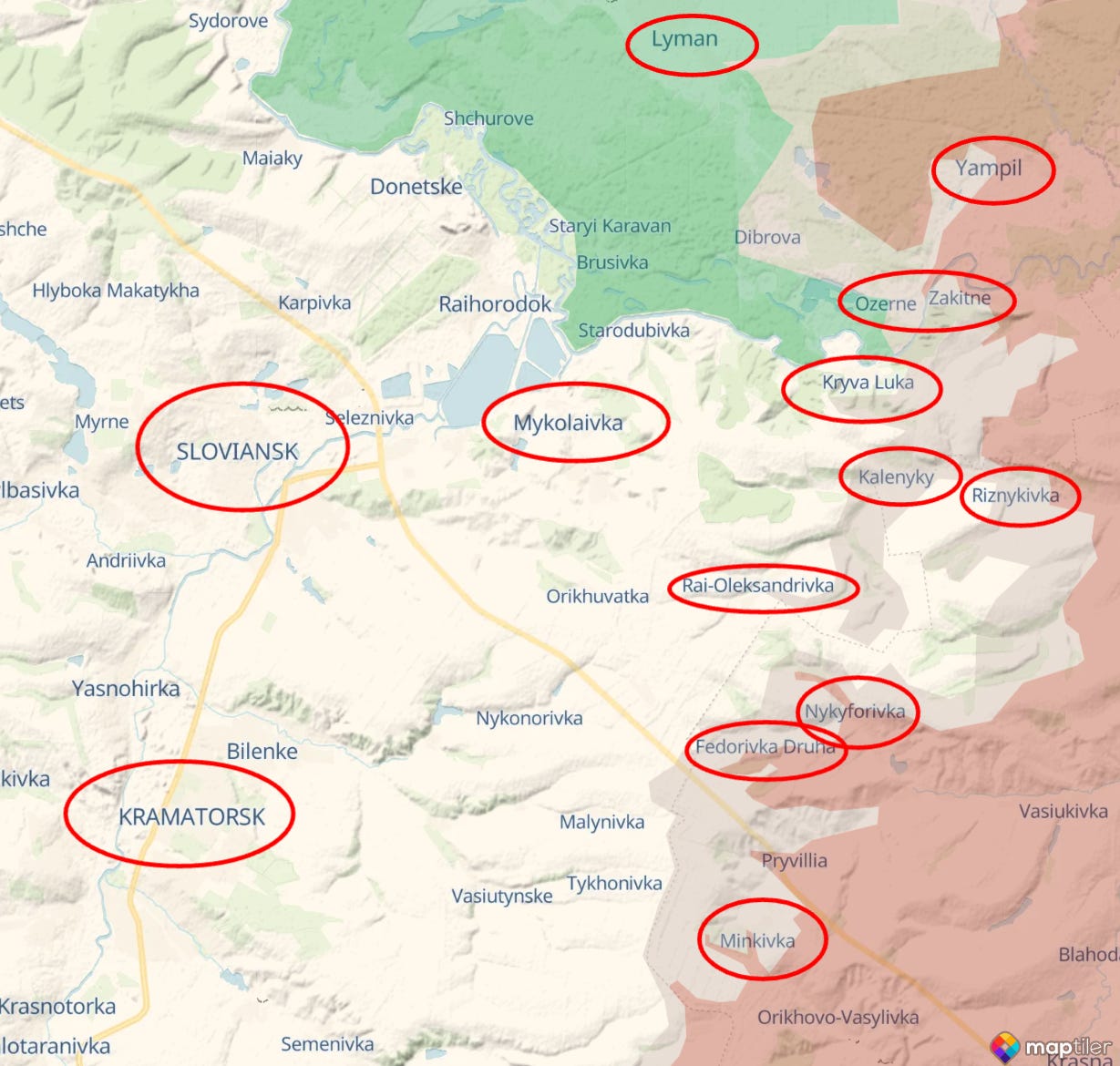
Kramatorsk–Sloviansk direction:
The enemy maintains fire control along the Siverskyi Donets–Donbas canal, preventing us from building up forces. At the same time, they are bringing in reserves for a possible advance toward Minkivka.
In Nykyforivka, the situation remains unclear: strikes south of the center could indicate either enemy attempts to advance or movements by our forces.
Both sides are actively using drones: our forces are operating against Riznykivka, while the enemy is striking Kryva Luka and Ozerne. The area is heavily saturated with UAVs, making any movement difficult.
Lyman direction: The situation in Yampil has transitioned into a phase of close-quarter combat with a completely mixed line of engagement. The settlement is effectively divided into separate control zones, with our units holding positions in the center while the enemy infiltrates and consolidates from the southwest sector. This creates a checkerboard of positions where there is no continuous control—every building could be a battle point. In such conditions, both sides are working to inflict maximum damage, trying to dislodge each other from their positions and prevent the enemy from consolidating.
A key feature is the constant risk of flanking attacks and sudden close-quarter engagements. The enemy operates in small groups, attempting to infiltrate between positions and expand their control zone from the southwest, while our forces hold the center and maintain fire control to prevent the enemy from closing off our flanks.
In Zakitne, our units continue to hold the western outskirts despite systematic pressure. The enemy is trying to dislodge us from this area, as it has tactical significance for further advancement and control of approaches. In response, our forces are working proactively, striking the enemy’s positions east of the central part, which allows us to weaken their defenses and has already yielded results in the form of destroyed fortifications.
Overall, the direction is unstable, with high dynamics and constant clashes. The enemy is trying to expand its presence through the chaos in the built-up area, while we are holding key points and working selectively to prevent them from consolidating and seizing the initiative.
Sloviansk direction: The enemy is methodically working with artillery south of Kryva Luka, simultaneously covering the west of Ozerne. The task is to destabilize the area and not allow us to accumulate forces. This is a classic preparation of the terrain for further movement.
Lyman direction: The movement of new enemy units has been detected. They are already conducting reconnaissance of Lyman and actively adjusting the artillery. This means one thing – the intensity of the fighting here will increase. The enemy is preparing to act harshly, the area is entering a phase of escalation and it will definitely not be easy here.
Sloviansk direction: In Kaleniki, the enemy is already openly visible, the presence in the eastern part is fixed, plus information-psychological pressure: leaflets with calls to surrender are being distributed. In Kriva Luka and Ozerne, intensive artillery work is ongoing, our soldiers’ positions are under constant cover, the enemy is trying to knock out the defense through exhaustion.
Lyman direction: The city is also under regular artillery pressure, especially the south-eastern part, the enemy is working on residential and front-line infrastructure.
In the forests to the east, our attempt at infiltration failed, the enemy quickly reacted and hit with a fiber-optic drone, there are losses. This shows that their control there is tight, there are minimal blind spots.
At the same time, in Sosnovoe, we carried out a cleanup, knocking out a group of the enemy that had managed to get in and held out for a while on the eastern outskirts.
Reading the rest of this article requires a subscription.