By Sylvia Demarest, Substack, 5/10/26
Introduction
It has been difficult for me to accept and to write about the impact of this illegal, dangerous, and highly complex war. Hopefully, this essay will help me get back on track.
The immorality and utter savagery of this war, both on Iran and Lebanon, is deeply troubling. It does not bode well for future world peace. The war was launched during peace negotiations, killing the Iranian negotiators, making future negotiations difficult. The US wants to end the war without resolving the underlying issues or accounting for the damage to Iran or the Gulf region.
The consensus within the US financial elite is that the war will end in 2 to 4 weeks, and that the closing of Hormuz will not be a major issue. What if this consensus is incorrect, the damage is greater, or the war continues for several more months–or even longer?
As this Substack has discussed the American economy is massively dependent on the AI buildout with trillions in venture capital pouring into artificial intelligence and building data centers. AI is not currently profitable, consumes a lot of energy, and the data center build out is facing growing public opposition as the public backlash to data centers continues to grow.
Oil industry and other experts have just begun to acknowledge that a crisis from Hormuz closing is now within sight. It could end up involving vastly rising energy costs, disrupting agricultural supply chains, and straining global transportation networks. If this happens, it will force Big Tech to face up to the AI profitability crisis. The sector that was supposed to carry the US economy forward is currently structurally unprofitable, dependent on cheap energy and stable supply chains, both of which are now under direct threat. The war is placing the AI bubble under stress at the worst possible moment.
This is similar to the internet bubble of the late 1990’s. Many of the high-flying internet stocks crashed in 2000, but the crash did not impact the long-term future of the internet. People like Elon Musk and Eric Schmidt may be correct that artificial intelligence, as a technology, will dominate and radically change the future. The tools will improve. Applications will find footing. The real question is whether the continuation of this war will disrupt the financial edifice built around AI, the expectations, the capital allocation, and the growth assumptions, especially if those assumptions are predicated on a world of cheap energy, stable geopolitics, and endless scaling. The war on Iran has called that world into question, at least for now. As this essay will demonstrate, the billionaires and the financial players do not see the Iran war as a threat, even as it eats into the financial security of most Americans.
Will the effect of the Gulf War be to reinstate the primacy of the physical world over the virtual world? Will other consequences lead to the bursting of the AI bubble? The answer to these questions is currently unknown.
Energy Shortages Begin to Bite
We finally have a time frame for when inventories will be drawn down and shortages begin to bite–June–oil executives and industry insiders are warning that the world is heading for an energy and global trade shock if the maritime chokepoint of Hormuz remains closed for another month
Here’s Bloomberg on May 9th: “The world has burned through oil inventories at a record speed as the Iran war throttles flows from the Persian Gulf, eating into the very buffer that protects against supply shocks.”
“The rapidly shrinking stockpiles mean that the risk of even more extreme price spikes and shortages is getting ever-closer, leaving governments and industries with fewer options to cushion the impact of the loss of more than a billion barrels of supply, two months into the near-closure of the Strait of Hormuz. The sharp depletion will also mean the market stays vulnerable for longer to future disruptions even after the conflict ends.”
“Morgan Stanley estimates global oil stockpiles dropped by about 4.8 million barrels a day between March 1 and April 25 — far exceeding the previous peak for a quarterly drawdown in data compiled by the International Energy Agency. Crude accounts for almost 60% of the decline, and refined fuels the rest.”
“Crucially, the system also requires a minimum level of oil, which means that the “operational minimum” is reached long before the inventories hit actually zero, said Natasha Kaneva, JPMorgan Chase & Co.’s head of global commodities research.”
““Inventories are acting as the shock absorber of the global oil system,” she said. But “not every barrel can be drawn.””
Here’s the litany of warnings over just the last few days:
—Chevron CEO: “We’re starting to see risks of supply outages in some of these economies.”
–Frederic Lasserre, head of research at Gunvor, one of the world’s largest oil traders, warned earlier this week: “The tipping point is clearly June. This is the point at which something has to give.”
–JPMorgan analysts warned that the world is spiraling toward a catastrophic cliff-edge shortage of crude oil if the maritime chokepoint is blocked for another four weeks.
–Here’s Maersk CEO on CNBC’s “Squawk Box Europe” last week, saying a “new wake-up call“ has emerged beyond energy markets and that if the Hormuz chokepoint remains shuttered, it could severely impact global trade in the coming months. Clerc was speaking to CNBC after Maersk reported a plunge in profitability and kept its guidance unchanged but warned that the US-Iran war and the resulting Gulf energy shock are “dominant forces shaping the macroeconomic outlook, as well as the trade and logistics environment.”
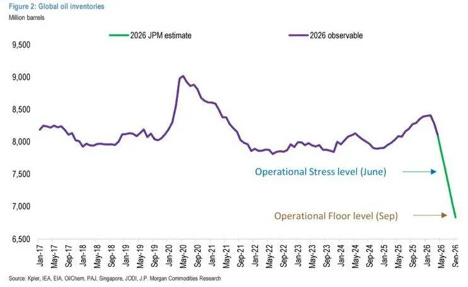
JPMorgan’s Kaneva warns that inventories in the Organization for Economic Co-operation and Development could reach “operational stress levels” early next month, if the strait doesn’t reopen, and then “operational minimum” floors by September. That’s the point when the world hits the bare minimum amounts of oil needed for pipelines, storage tanks and export terminals to function properly.
The chart below provides the duration variable. They are operational stress level by June, operational floor by September. This is the hard infrastructure timeline. The forward question is whether absorption outlasts depletion. The data here says 4 months to test it. This is a relatively short time frame.
Forbes focuses on the looming jet fuel crunch, in Jet Fuel Shortage In ‘Crisis Mode’—More Flight Cuts And Higher Airfares: Note: Aviation is critical to the US economy.
• “It’s not going to be a short-term issue, because it can’t be easily solved,” Matt Smith, director of commodity research at Kpler, the energy data and analytics platform, told Forbes, having likened the jet fuel shortage to a “slow-motion car crash.”
* “We’re going to be in crisis mode,” John Gradek, who teaches aviation risk management at McGill University, told Forbes, noting “the industry has never seen this before, where the actual supply of the product needed to support aviation, that pipeline, is drying up.”
* Europe’s jet fuel inventories are expected to dip below the International Energy Agency’s critical 23-day shortage threshold sometime in June, according to a recent Goldman Sachs research note to investors.
What about other inputs
The above discussion focuses mainly on oil and certain derivatives such as jet fuel and diesel; other inputs are equally important such as shortages of fertilizer, plastic, and the other inputs discussed in previous essays.
Plastics are needed for endotracheal tubes, syringes, pill bottles, IV kits, CPAP and BiPAP headgear, ventilators, peel-apart bags, water-proof gowns and drapes, trash bags, bags for dripping blood, antibiotics, etc., chucks, dialysis ports, gas sterilization, and on and on. Shortages could greatly affect the one-use, disposable, sterile protection of many of these products. The impact could explode the cost of medicine.
Then there’s fertilizer and the prospect for food shortages.
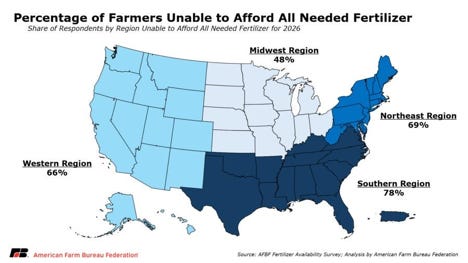
The biggest impact on food availability is likely to be in West Asia, Africa and South America. Here’s a report from Thailand by Rebecca Tan: “Thailand is one of the first ag countries to enter a planting season since the Iran war. We went to document the impact of supply shocks to fuel/fertilizer — It was worse than I anticipated. Farmers are leaving huge tracts of land barren because they can’t afford to plant.”
What will this mean for global food security in the future? If crops are not planted now, it means less food will be harvested.
The Damage Could Be Long Term
There has been a great deal of discussion about the potential damage to Iranian energy assets if Iran is forced to stop pumping oil. Iran disputes this and even US intelligence has said that Iran can hold out for at least another 3 to 4 months.
What about the damage this shut in has caused to other gulf suppliers like Iraq, Bahran, Qatar, Kuwait, Saudi Arabia and the UAE. The Saudi’s and UAE have pipelines that can avoid Hormuz, but it will take time and money for the other countries to resume production.
The issue of confidence cannot be discounted. When will insurance become available, when will transport companies be willing to expose assets and crews to transit Hormuz.
It will take time and a real peace deal to resolve these issues and get gulf energy production back to where it was before February 28th. This may take much more time that market players assume at this time.
US Financial Elite–What Me Worry?
Financial traders point to this contradiction; if the US and the world is facing an energy and economic shock, why is the US stock market hitting new highs? Financial players do not see the closing of the Strait of Hormuz as a threat to US markets. They point to ample liquidity and the fact that global financial flows still favor US markets. Some acknowledge the potential for a short-term squeeze in immediate delivery, but the market does not expect it to last. For example, the future’s contract for April 2027 oil delivery is only at $74 a barrel.
Big finance does not see Hormuz as a threat to economic growth: OECD/IMF forecasts show global GDP growth cut by 0.3–0.5% or more in 2026. This decline is just a rounding error for GDP forecasts. Such a decline is trivial and an indication that there is NO Global Economic Crisis. It is also noted that the Iran war took place at a time of oversupply and falling prices in the oil markets. Mr. Market anticipates that in 3-6 months oil traders will work out new ways to spread the oil around.
According to the Financial Times, the former “Predators Ball” organizer i.e. the Milken Economic conference, was characterized by exuberance as the financial elite basked in the glow of roaring US financial markets. One “high-powered banker” asked, “Does anyone really care if the Strait of Hormuz is open?”
Insulated by their wealth and social position, the Financial Times reported that attendees were living in “blissful ignorance” of the economic pain hitting workers in the US and around the world. Ted Koenig, chief executive of Monroe Capital, told The Financial Times that, while people at the conference were vaguely aware of the suffering of middle-class and working-class Americans, “at the end of the day, everyone’s focused on their own investment portfolios, especially here”.
Is big finance right to be unconcerned? After all, many past scares turned out to be non-events–this one may as well. Yet, war has changed, for example, during the last Hormuz crisis in the 1980’s (the tanker wars) there were no drones or cheap missiles. US war ships could safely escort tankers. This is no longer possible. Also, most traders today have never witnessed a disruption of this magnitude. You have to go back to the 1970’s and 80’s to grasp the potential impact. Then, the oil embargoes led to a decade of high inflation that ended only when US interest rates were raised to 20%–something that would be impossible today given current debt levels.
According to Jeff Currie, every analyst he speaks with calls the current disruptions unprecedented across supply chains. Yet oil and other commodity prices remain strangely calm, as if none of it matters. The market’s dangerous disconnect could be correct or it could be due to flawed assumptions and short-term thinking. It could soon prove catastrophic.
The result, according to Jeff Curie, is that markets are discounting this crisis because of recency bias, surface-level notional metrics, and a total failure to respect volumetric shocks that actually move the real economy. If this is correct, the calm you see today is simply the quiet before inventories run dry and reality hits hard.
US Consumer Sentiment
While the mood at the Milken conference may have been buoyant thanks to the record-setting stock market, fresh data released Friday showed Main Street America is feeling the exact opposite. The University of Michigan’s latest Surveys of Consumers found that consumer sentiment has hit another all-time low, driven in large part by anxiety over price increases caused by the Iran war.
“Taken together, consumers continue to feel buffeted by cost pressures, led by soaring prices at the pump,” explained Joanne Hsu, director of the Surveys of Consumers. “Middle East developments are unlikely to meaningfully boost sentiment until supply disruptions have been fully resolved, and energy prices fall.” Meanwhile, Tahra Hoops, director of economic analysis at Chamber of Progress, noted 30% of respondents in the latest Surveys of Consumers said that Trump’s tariffs were driving up their expenses.
McDonald’s CEO Chris Kempczinski said this week that signs of real strain are starting to appear. As CNBC reported Thursday, Kempczinski described the current economic environment as “challenging,” and warned that “it’s certainly not improving, and it may be getting a little bit worse. “The fast-food CEO pointed to high gas prices as a particular strain on working-class consumers, who are the most regular customers at McDonald’s.
It’s not only the fast food industry that is being impacted, According to a Thursday report from Market Watch, Whirlpool CEO Marc Bitzer said during a quarterly earnings call that the appliance industry had seen a 7.4% drop in demand in the first quarter of 2026.
“This level of industry decline is similar to what we have observed during the global financial crisis,” said Bitzer, “and even higher than during other recessionary periods.
Financial Valuations Remain Stretched
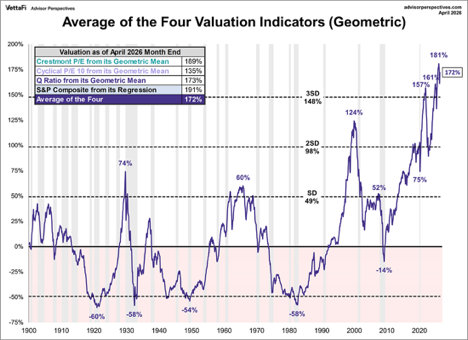
How stretched? Equity valuations sit at 172% above the long-term mean — higher than 1929, higher than 2000. This level of valuation measures risk, not timing. According to the Economic Long Wave Substack, from here, Economic Winter is no longer a forecast. It is an outstanding obligation. Many have warned about the impact of the financial engineering that has been employed to maintain the bull market in stocks–but so far–the bull market rules and the people forecasting an end to the bull market have been wrong.
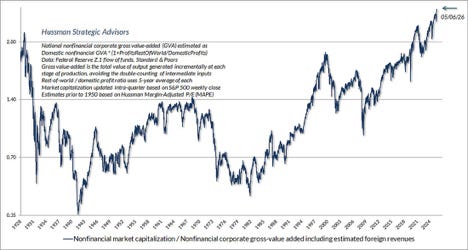
The chart below, from Hussman Strategic Advisors, compares the market value of U.S. nonfinancial companies with the gross value added they produce. In simpler terms, it asks: How much are investors paying for each dollar of real corporate economic output? And right now, the answer is uncomfortable. Investors are paying one of the highest prices in modern financial history. Higher than 1929.Higher than the late 1960s.Higher than the dot-com bubble. Higher than 2007. Higher than 2021.That does not mean the market has to crash tomorrow. But it does mean the broad U.S. stock market is priced for a very optimistic future.
The most disturbing comparison is set out in the chart below between today’s market and the internet bubble of the 1990’s. Today, the S&P 500 is heavily concentrated. Ten stocks account for 40% of the market cap of the S&P 500. This is a very concentrated market. Most of the economic growth in the US economy last year from the growth of AI especially from the building of data centers.
The NASDAQ 100 and the S&P 500 continue to hit new highs. Meanwhile, Jonathan Krinsky with BTIG posted this chart comparing today’s market to the internet bubble:
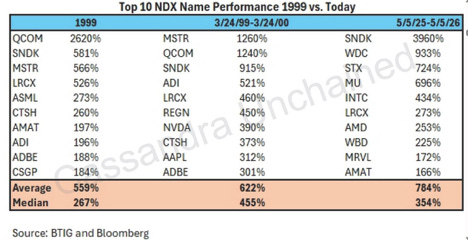
Per Jonathan: “If we look at the top 10 performing NDX stocks in 1999, they were up an average of 559%. The top 10 in the year leading up to 3/24/00 were up an average of 622%. The top 10 NDX names over the last year are up an average of 784%, beating both the dot-com periods. The median gain is still 354%, which is less than the 455% into dot-com peak, but well above the ‘99
There are many differences between the two eras. But the chart shows that the most explosive corner of the market has already moved into dot-com-scale territory — and the cast list makes the comparison feel a little eerie.
In the year before the Nasdaq’s March 2000 peak, the index’s top performers included Strategy (MSTR), Qualcomm (QCOM), Sandisk (SNDK), Analog Devices (ADI), Lam Research (LRCX), Regeneron (REGN), Nvidia (NVDA), Cognizant (CTSH), Apple (AAPL), and Adobe (ADBE). Many of the same names are included today in Krinsky’s list. Hopefully, this time is different.
Conclusion
We can argue about the impact of the closing of the Strait of Hormuz, about whether US strategy is failing, Iranian strategy is succeeding, and how Hormuz has changed the balance of power and leverage in the gulf, but until there is peace, the global economy will be at risk.
Maybe Toynbee was right. Civilizations, as the historian Arnold J. Toynbee famously argued, “die from suicide, not by murder.” They collapse from within. They fall prey to moral, social and spiritual decay. They are seized by a parasitic ruling class. Democratic institutions seize up. The citizenry is immiserated; wealth is funneled upwards to the ruling class and coercion is the principal form of control.