This article is behind a paywall so I will just include a few paragraphs to get across the main point. I highly recommend subscribing to Mate’s Substack for $5.00 a month. He consistently does great work on both Ukraine/Russia and Gaza/Israel. – Natylie
…Now more evidence has emerged that the Biden administration undermined the Turkey peace deal in April 2022, as well as additional diplomatic opportunities in the period since.
A veteran Ukrainian diplomat who was part of Kyiv’s delegation in Istanbul, Amb. Oleksandr Chalyi, has become the latest insider to confirm that an agreement was reached there. At a public event in Geneva, Chalyi recalled that “we were very close” to ending “our war with some peaceful settlement.” Putin, he stressed, “tried to do everything possible to conclude [an] agreement with Ukraine” and “really wanted to reach some peaceful settlement.” And in Istanbul, the two sides “managed to find a very real compromise.”
Yet “for some reasons,” Chalyi added, that compromise “was postponed.” Although he did not elaborate, those reasons are not obscure. As Ukrainian government sources initially revealed and multiple people have confirmed, the US and UK opposed the deal and refused to give Ukraine the security guarantees that it required. According to Davyd Arakhamia, the head of Ukraine’s delegation in Turkey, UK Prime Minister Boris Johnson informed Kyiv that “we would not sign anything with them at all, and let’s just fight.” Johnson’s missive was a joint US-UK order for Ukraine to abandon the peace deal and “fight” Russia on their behalf. For bowing to this demand, Kyiv received a massive new infusion of NATO weaponry – and untold numbers of lost lives.
Despite the significance of the sabotaged Istanbul peace deal, and the high-level corroboration for it, no establishment US media outlet has reported it. The motive is not hard to discern: to justify continuing the Ukraine proxy war, the Biden administration and its media allies must sustain a narrative that portrays Russia as a recalcitrant, belligerent actor that rejects any reasonable accommodation. Accordingly, the most concrete, meaningful diplomatic opportunity to date must be concealed from the public footing the bill….
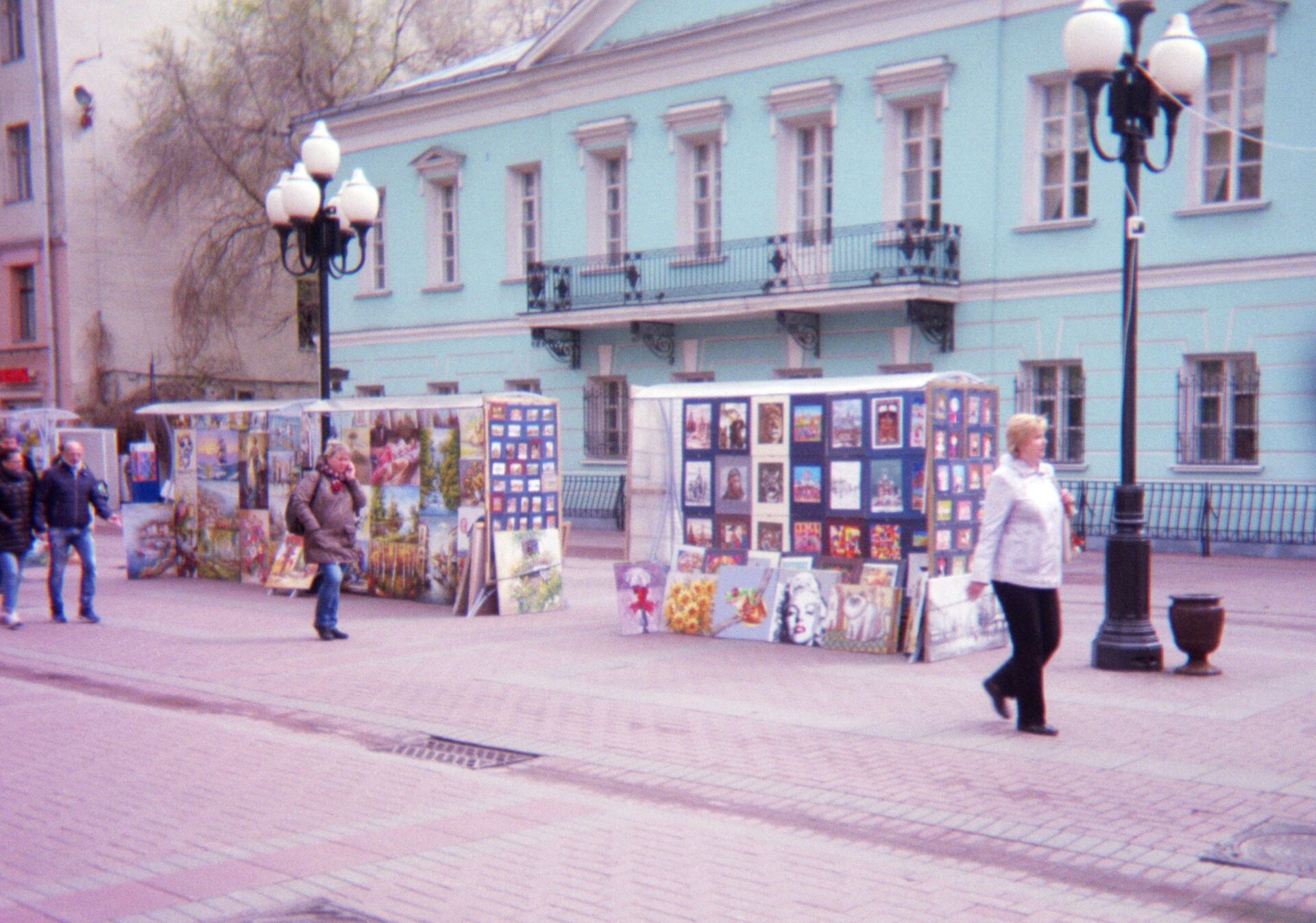
(Old) Arbat Street, Moscow; photo by Natylie Baldwin, May 2017
By Don Harder with Marina Aydova, Facebook, 12/24/23
Very eye-opening impressions from a westernized, Russian liberal who recently visited Russia due to a family emergency- (the part about how she found no hatred towards Ukraine or Ukrainians is absolutely my own experience living here too. It simply does not exist)
Translated from Russian. Thanks for the post Marina:
Lila Kim, a Hollywood screenwriter, found herself abruptly flying from Dubai to Russia due to a family emergency. She hadn’t been back to her homeland in two years. Here are some of her observations:
Amidst the chaos of Dubai, I received news that compelled me to immediately board the next direct flight to my hometown, a place I hadn’t visited in two years. The suddenness of it all left me without warm clothing, a laptop, or necessary documents. Family bureaucratic issues piled up, and medical matters arose.
Over five weeks, I interacted extensively with various government agencies, medical institutions, and my relatives, who are just ordinary people. I also met hundreds of individuals from diverse fields such as high-tech, media, cinema, TV, real estate, retail, medicine, and government. I overheard many conversations, some intentionally. Taxi drivers were, of course, a source of information. In these five weeks, I learned about more Chinese car brands than I had in my entire life. Considering that St. Petersburg experienced a severe snowstorm and frost for two of those five weeks, the cars proved to be surprisingly reliable.
Before I share more of my impressions, here are the top five things that struck me (aside from the volume and quality of free medical treatment my family members received):
The massive film cluster near Moscow! I didn’t personally visit due to time constraints, but the videos on witnesses’ phones were astounding. The size is larger than any LA movie studio’s lots. The diversity is impressive too, with replicas of old Moscow, European cities, and even futuristic settings.
The number of launches everywhere. There were disputes over props at Lenfilm. The number of premieres, platforms, and collaborations with other countries was impressive.
The food culture in St. Petersburg! From deer sous-vide, duck dishes, boar carpaccio, Hassan mustaches, Murman scallops and halibut, to Argentinian, Brazilian, and Japanese steaks. The assortment of my favorite Malbec at the St. Petersburg steakhouse “Mitcoin” rivals that of an Argentinian restaurant near my home in Orange County. Even my relatives started dining out more often due to the availability of affordable Georgian and other Eastern restaurants.
My family, simple folks who enjoy home, cottage, and fishing, had never traveled before. To my surprise, they had started traveling within Russia, where they felt comfortable and could revisit places from their youth. They had no interest in going abroad, despite my offers. They genuinely cared about their old haunts in Russia, and my stepfather, a fishing enthusiast, loved the fishing spots.
Needing everything from underwear to warm shoes, I experienced escorted shopping for the first time in my life. Stylist Tanya saved me a lot of time and money with various discount cards, dressing me head-to-toe in Russian attire within a couple of hours.
I was astounded at how rapidly everything had transformed. These companies, all 10-15 years old, previously didn’t have showrooms, or if they did, they were obscure. They sold everything through marketplaces. Now, they’ve taken over the vacant brand squares, where people continue to shop out of habit, because most people dislike waiting and prefer to try things on.
In general, the resilience of small and medium-sized businesses that not only weathered the odds but also flourished is remarkable. More broadly, the adaptability of people who had no choice but to carry on, making do with what they had – even the 90s didn’t shock me as much as what I witnessed now.
“I’ve already shared an update, and I’m not going to say much more. During my time in St. Petersburg, no one confronted me about living in the USA or being against the war, even though many there believe the US is to blame for the current situation. I didn’t receive any personal animosity for my stories about the United States.
Not a single person, including public servants and taxi drivers, expressed hatred towards Ukrainians. I didn’t encounter the intense hatred I had anticipated. Most people expressed regret, lamenting that all Ukrainians had been deceived and abandoned by the Americans.
Again, I experienced no personal hatred, despite being there with my blue passport. I arrived and left St. Petersburg safely.
I didn’t encounter the wild hysteria and endless hate speech from patriots that I had expected. Nor did I receive death wishes from the ‘bright men’ for me, my family, or anyone in St. Petersburg and beyond, just because I wrote about what I saw.
The image I’m left with is one of expectations, dreams, and wishes. This, too, is part of the strong impressions from my trip.”
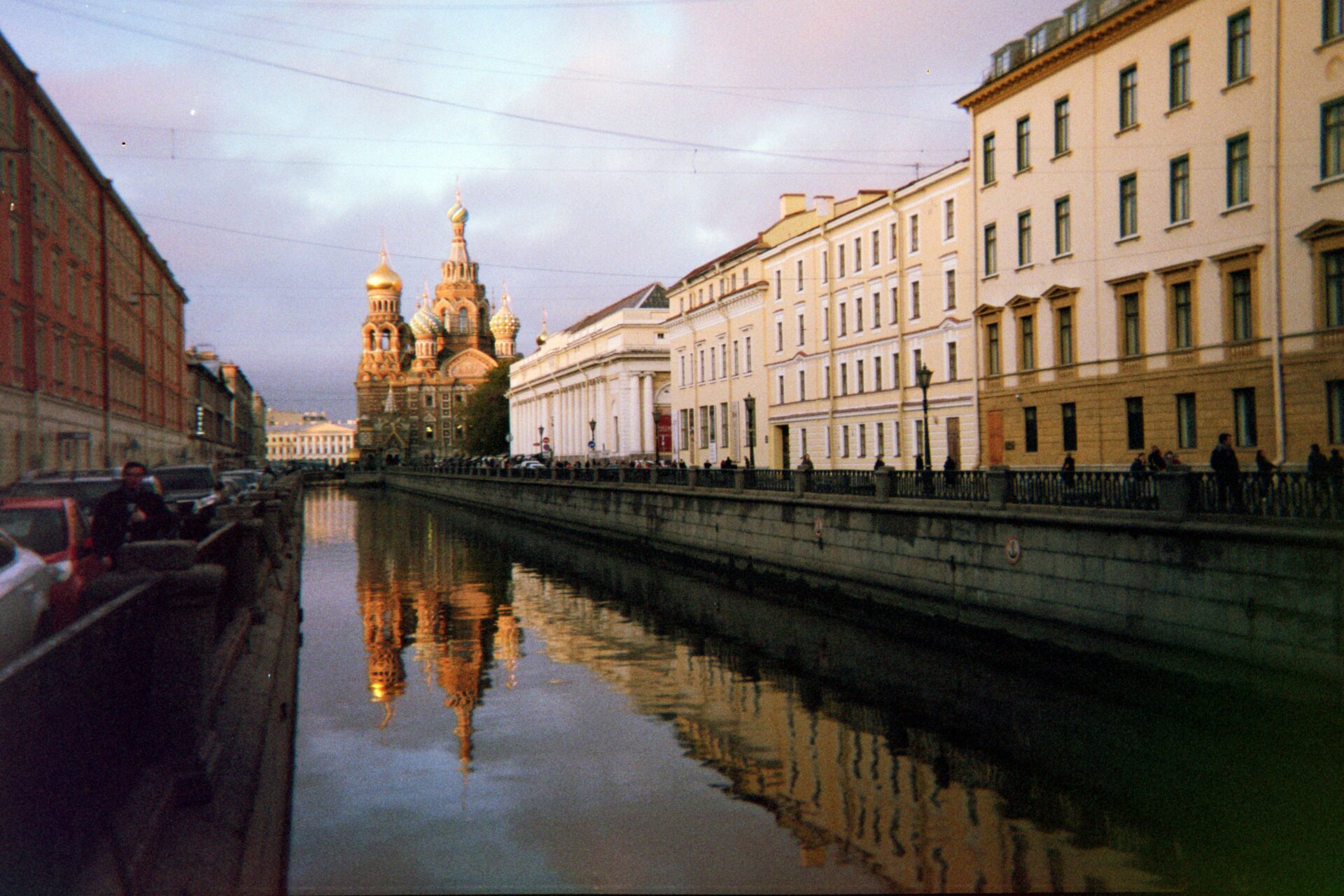
Church on Spilt Blood, Built at site of reformist Czar Alexandaer II’s 1881 assassination. St. Petersburg, Russia; Photo by Natylie S. Baldwin, 2015
By Fred Weir, Facebook, 12/23/23
I quite enjoyed this political travelogue, by an Italian journalist who spent a month or so last summer visiting places along Russia’s vast Volga River route, basically from St. Peterburg to Astrakhan. It’s not chronological, or the least bit touristy, but focuses on a variety of individuals who make up a pretty fair spectrum of Russians, both current and eternal. A lot can be gleaned about the state of life from his descriptions, which seem quite fair and matter-of-fact, even if they are sort of laser-focused. I haven’t been that far afield in awhile, basically since before Covid and the war, so read this with intense interest. Though it’s obviously impressionistic and selective, as these things necessarily are, I think it mostly rings true. The anti-Western moods he detects in even the most eccentric Russians, people who in the not-too-distant past might have been ardent Westernizers, is certainly what I’ve noticed and written quite a bit about, increasingly over the past decade or so. The spirit of resilience, of making do in the face of war and sanctions and turning crisis into opportunity, isn’t just Putin rhetoric, this observer finds it all around him. It’s just good on-the-ground reporting; I observe much the same in my corner. The only thing here that surprises me a bit is his impression that there is a burgeoning cult of Stalin. I don’t see that, and certainly don’t think Putin’s politics or historical forays are an effort to revive Stalinism. But I live in Moscow, and haven’t been to these kinds of places in awhile. It’s worth watching trends affecting more far-flung Russians, especially youth. Anyway, this is a fun, informative read [If you’re Canadian, and can’t click the link, go to the Harpers website, Harpers.org, where this story leads]:
Shelling in the center of the Russian border city of Belgorod Saturday killed 21 people, including three children, local officials reported.
A further 110 people were wounded in the strike, said regional governor Vyacheslav Gladkov, making it one of the deadliest attacks on Russian soil since the start of Moscow’s invasion of Ukraine 22 months ago.
Russian authorities accused Kyiv of carrying out the attack, which took place the day after an 18-hour aerial bombardment across Ukraine killed at least 41 civilians.
Images of Belgorod on social media showed burning cars and plumes of black smoke rising among damaged buildings as air raid sirens sounded. One strike hit close to a public ice rink in the very heart of the city, which lies 25 miles north of the Ukrainian border and 415 miles south of Moscow. While previous attacks have hit the city, they have rarely taken place in daylight and have claimed fewer lives.
Russia’s Defense Ministry said it identified the ammunition used in the strike as Czech-made Vampire rockets and Olkha missiles fitted with cluster-munition warheads. It provided no additional information, and The Associated Press was unable to verify its claims.
“This crime will not go unpunished,” the ministry said in a statement on social media.
The Kremlin said Russian President Vladimir Putin had been briefed on the situation, and that the country’s health minister, Mikhail Murashko, was ordered to join a delegation of medical personnel and rescue workers traveling to Belgorod from Moscow.
Russian diplomats also called for a meeting of the U.N. Security Council in connection with the strike. Speaking to Russia’s state news agency, Foreign Ministry spokeswoman Maria Zakharova said that Britain and the United States were guilty of encouraging Kyiv to carry out what she described as a “terrorist attack.” She also placed blame on EU countries who had supplied Ukraine with weapons.
“Silence in response to the unbridled barbarity of Ukraine’s Nazis and their puppeteers and accomplices from ‘civilized democracies’ will be akin to complicity in their bloody deeds,” the ministry said in a statement.
Earlier Saturday, Moscow officials reported shooting down 32 Ukrainian drones over the country’s Moscow, Bryansk, Oryol, and Kursk regions.
They also reported that cross-border shelling had killed two other people in Russia. A man died and four other people were wounded when a missile struck a private home in the Belgorod region late Friday evening and a 9-year-old was killed in a separate incident in the Bryansk region.
Cities across western Russia have come under regular attack from drones since May, with Russian officials blaming Kyiv. Ukrainian officials never acknowledge responsibility for attacks on Russian territory or the Crimean Peninsula. However, larger aerial strikes against Russia have previously followed heavy assaults on Ukrainian cities.
Russian drone strikes against Ukraine continued Saturday, with the General Staff of the Ukrainian Armed Forces reporting that 10 Iranian-made Shahed drones had been shot down across the Kherson, Khmelnytskyi, and Mykolaiv regions.
Local officials reported that three people had been killed by Russian missiles: a 55-year-old man in the Kherson region, a 43-year-old man in Stepnohirsk, a town in Ukraine’s Zaporizhzhia region, and a 32-year-old in the Chernihiv region.
On Friday, Moscow’s forces launched 122 missiles and dozens of drones across Ukraine, an onslaught described by one air force official as the biggest aerial barrage of the war.
As well as the 39 deaths, at least 160 people were wounded and an unknown number were buried under rubble in the assault, which damaged a maternity hospital, apartment blocks, and schools.
Western officials and analysts recently warned that Russia limited its cruise missile strikes for months in an apparent effort to build up stockpiles for massive strikes during the winter, hoping to break the Ukrainians’ spirit.
Fighting along the front line is largely bogged down by winter weather after Ukraine’s summer counteroffensive failed to make a significant breakthrough along the roughly 1,000-kilometer line of contact.
Poland’s defense forces said Friday that an unknown object had entered the country’s airspace before vanishing off radars, and that all indications pointed to it being a Russian missile.
Speaking to Russian state news agency RIA Novosti, Russia’s charge d’affaires in Poland, Andrei Ordash, said Saturday that Moscow would not comment on the event until Warsaw had given the Kremlin evidence of an airspace violation.
“We will not give any explanations until we are presented with concrete evidence because these accusations are unsubstantiated,” he said.
This past week was quite dull for observers of Russian state television news and talk shows who are looking for dispatches bearing on international events. There was almost nothing about the Houthi (Yemen) attacks on vessels in the Red Sea, about Defense Secretary Austin’s ‘Operation Prosperity’ naval force to secure shipping in the region, about the latest developments of the Israel-Hamas war. The 14.00 and 20.00 Vesti news hours almost exclusively dealt with domestic issues and in particular with the step-by-step validation of Vladimir Putin’s candidacy for the presidential election of March 2024.
You would hardly suspect that there may be other candidates, although online Russian news tickers did mention that the Communist Party, the country’s largest after United Russia, seems to have selected a candidate of its own. Per news.ru, this is Nikolai Kharitonov, a member of the Party’s Central Committee and the chairman of the Committee on the Development of the Far East and Arctic in the State Duma. The seventy-five year old comes from the Novosibirsk region. He holds a doctorate in economics and for several years worked as an agronomist, but then moved to politics. He is one of the longest serving members of the State Duma, to which he was elected from several different constituencies over time, most recently from Krasnodar, center of Russian agriculture in the South. This will be Kharitonov’s second run for the presidency. The first time, in 2004, he garnered 14% of the electorate. It would be safe to say that Kharitonov has no chance whatsoever of being elected president, but he will be a creditable standard bearer who may increase the party’s share of Duma seats.
The second most important bit of local news after Putin’s electoral registration to have received extensive coverage on Russian state television this past week was the official opening of the M12 express highway connecting Moscow and Kazan, some 800 kilometers away. Kazan is the capital of the oil-rich and predominantly Muslim RF region of Tatarstan. It is a showcase for Russia’s outreach to the Arab world and will be the host city for the 2024 BRICS summit in the year of Russia’s presidency of the organization when five Middle Eastern nations take up full membership. Needless to say, the ribbon cutting ceremony, which Putin supervised on a video link, was yet another occasion for him to make a televised speech, one of too many speeches in the past seven days.
The new, ultra-modern highway cuts the travel time by car between the cities in half, from 12 hours down to 6. In the coming year the M12 will be extended to Yekaterinburg and then onward to Tyumen in 2025. The newly opened stretch of the M12 was completed nearly a year ahead of schedule and is another landmark in the infrastructure investment program of the Putin presidency. Given the scale and economic importance of the highways that have been completed in recent years or are under construction, Russia is experiencing something akin to the federal interstate highway project initiated in the United States by then President Eisenhower in 1956.
Otherwise, the biggest component in the daily news has been from the front lines in the Ukraine war. The extensive reporting on the news hours by Russia’s war correspondents details the daily ‘kill’ count of Ukrainian soldiers and destruction of tanks, armored personnel carriers and other heavy equipment at each major point along the 1200 km line of contact where they saw action on that day. Just in the past 24 hours more than 500 Ukrainians were said to be killed or incapacitated. We are told that Russian forces are advancing but that this is to improve their overall position, to even up the line, and should not be confused with some massive offensive which is yet ahead.
Then there were overviews of the fighting provided by Chief of the General Staff Valery Gerasimov and Minister of Defense Shoigu. Gerasimov spoke at his annual briefing to all accredited military attaches of embassies in the Russian capital, including all NATO countries. These attaches were shown on television furiously taking notes or photographing Gerasimov’s slide show. Shoigu spoke to Ministry personnel and made one point worthy of mention: that Russia expects to complete the objectives set out at the start of the Special Military Operation during 2024. Put in simple English, the Ministry officially predicts that the coming year will see the end of the war on Russian terms.
However, as host of the news analysis program Sixty Minutes Yevgeni Popov and as Vladimir Solovyov, presenter of the best known talk show both commented with respect to the optimism coming from the war correspondents and from the top Ministry officials, there is no reason to be cocky and there is still a long road ahead to victory.
Indeed, the Kremlin takes nothing for granted, given its low estimation of the rationality of behavior of the Biden administration. And this brings us to the man I cite in the title of this essay, Deputy Foreign Minister Sergei Ryabkov, who made news yesterday when his interview with Interfax was published. The print version in Russian comes to seven pages and is well worth a close read.
Ryabkov is not a name likely to be familiar to readers of these pages. The last time we heard from him was back in December 2021 when he delivered the hard line on Russia’s demand that a new security architecture for Europe be negotiated which would foresee the withdrawal of NATO troops and installations from the countries brought into the alliance after 1996. He was the one who said that if NATO would not pull back then Russia would push it back. It was Ryabkov’s words, not the more diplomatically couched words of Lavrov that hinted at what was to come in February 2022.
Ryabkov has spent most of his 41 years in the Ministry at home in Moscow in various positions as coordinator of foreign relations. From 2002-2005, he was based in Washington, attached to the Russian embassy, where his calling card read ‘emissary counselor.’ His present responsibilities include issues of bilateral relations with the countries of North and South America, nonproliferation and arms control, regulating the Iran nuclear program and the participation of the Russian Federation in BRICS.
The interview covered a variety of subjects that fall within Ryabkov’s mandate, including arms control under present conditions when most of the fundamental treaties on the subject have been cancelled by American initiative and when the single most important document, START II, governing the strategic nuclear arsenals of the signatories, expires in 2026.
However, the single most striking exchange in the interview was picked out by the Interfax editors for use in their title – “Sergei Rybkov: Diplomatic relations with the USA are not a totem to which one has to bow down.”
Quote
Q: With respect to the 90th anniversary of restoration of diplomatic relations between Russia and the USA, the Ministry of Foreign Affairs said that relations between the countries ‘risk being severed at any moment.’ You said earlier that one of the possible red lines can be confiscation of frozen Russian assets. Is this now a line beyond which it will be impossible to maintain the relationship? Are there still other triggers which would be incompatible from our standpoint with continuing the development of relations between the RF and the USA?
A: Essentially Russian-American relations have really fallen into a comatose state, and for this the responsibility lies with Washington, which not only formulated but even doctrinally and conceptually enshrined the erroneous and dangerous attitude of inflicting a strategic defeat on Russia. I cannot exclude the possibility that at some future date, if there is no enlightenment in terms of assessments of what is happening in the world and specifically in Russia and Ukraine, I cannot rule out that in this case Washington will not go beyond the “near-zero” level at which relations are now. That is to say, there can really be an official reduction in the level of diplomatic presence, in Washington and Moscow respectively, or even a complete rupture of relations. This would not be something unexpected for us.
So far, the Americans are wary of destroying everything to the foundation, but they are not ready to negotiate in a fair manner on the basis of mutual respect and consideration of each other’s interests, even in theory. The existing precarious balance in the Russian-American dialog and the fragmentary work on certain extremely narrow subjects, this balance can be broken at any moment due to the recklessness of Washington and specifically of the administration that is currently in power there.
Of course, diplomatic relations in themselves are not a totem to be worshipped or a sacred cow to be cherished by everyone. But we will not take the initiative to break them, to tear them up. It is not in our rules to act in such a way, including based on our understanding that Russia and the United States have a central role in maintaining international security and strategic stability. As for the trigger for a possible round of confrontation with the potential for breaking off relations, the trigger could be asset confiscation, further military escalation, and many other things. I would not go into negative forecasts here. I am just saying all this to make it clear that we are prepared for any scenario, and the United States should not have the illusion, if they have one, that Russia, as they say, is holding on to diplomatic relations with this country for dear life.
Unquote
Severing diplomatic relations is not yet a declaration of war, but in the circumstances in which such a rupture might occur, as sketched by Ryabkov, it could well be the antechamber to a direct, kinetic war between Russia and the USA.
Discussion of the possible confiscation of the frozen Russian assets was a taboo in Washington and Brussels until very recently, not for fear of Russian reaction but for fear of the damage it might do to the dollar as a reliable international store of value. But greater concerns have now arisen that outweigh the taboo, namely the inability of Washington and Brussels to deliver further financial aid to Kiev due to opposition in the U.S. Congress and within the European Institutions. The frozen assets are valued at more than 300 billion dollars and could be made available to Ukraine without legislative approval. From the Russian perspective, Washington is playing with fire.