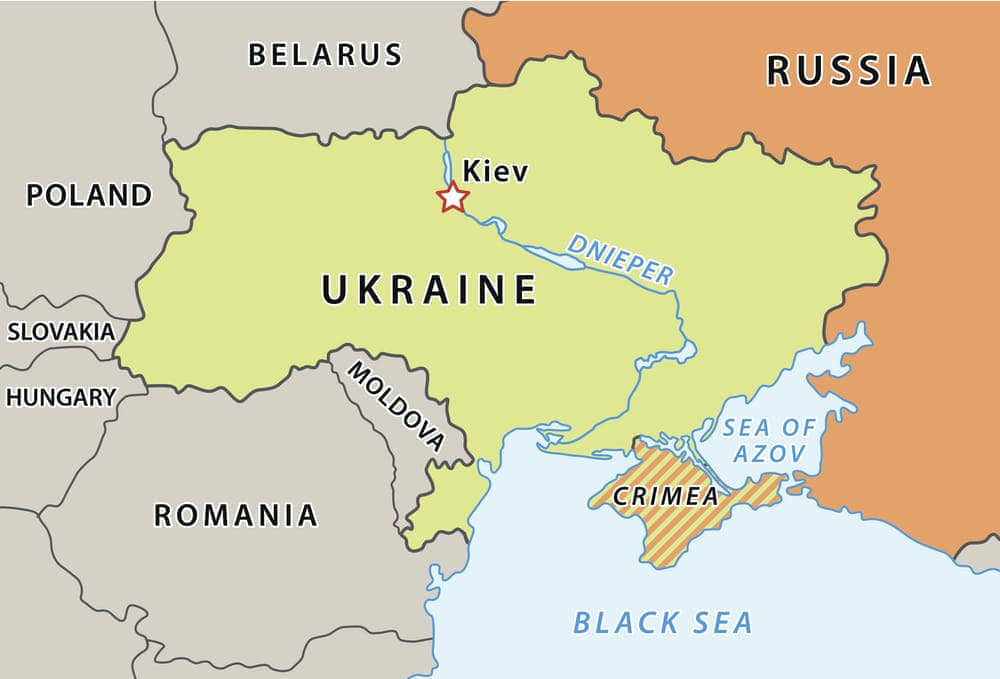
On June 13, 2023, taking questions from war correspondents at the Kremlin, Putin confirmed what had already been reported: that Russia and Ukraine had “reached an agreement in Istanbul.” Peace was possible. The tentative agreement would see Russia withdraw to its prewar position in exchange for a Ukrainian promise to give up its NATO aspirations.
But at the June press conference, Putin revealed for the first time just how close Russia and Ukraine had come to peace in the early days of the war. The tentative agreement had been initialed by both sides. “I don’t remember his name and may be mistaken, but I think Mr Arakhamia headed Ukraine’s negotiating team in Istanbul. He even initialed this document.” Russia, too, signed the document: “during the talks in Istanbul, we initialed this document. We argued for a long time, butted heads there and so on, but the document was very thick and it was initialed by Medinsky on our side and by the head of their negotiating team.”
Days late, on June 17, in a meeting with a delegation of leaders of African countries, Putin went further, dramatically holding up the document and revealing it to the world for the first time. “We did not discuss with the Ukrainian side that this treaty would be classified, but we have never presented it, nor commented on it. This draft agreement was initialed by the head of the Kiev negotiation team. He put his signature there. Here it is.”
But the initialled agreement went no further. “We actually did this,” Putin toldwarcorrespondents at the Kremlin, “but they simply threw it away later and that’s it.” Talking to the African delegation, Putin said, “After we pulled our troops away from Kiev – as we had promised to do – the Kiev authorities … tossed [their commitments] into the dustbin of history. They abandoned everything.” But Putin did not primarily blame Ukraine. He implicitly blamed the US, saying that when Ukraine’s interests “are not in sync” with U.S. interests, “ultimately it is about the United States’s interests. We know that they hold the key to solving issues.”
Putin’s claim that a tentative agreement could have stopped the war on terms that satisfied both Ukraine and Russia in the days before the massive Ukrainian loss of limb, life and land if not for US obstruction has now been verified by four independent sources.
The first is Russian. On September 23, 2023, at a press conference following the UN General Assembly High-Level week, Russian foreign minister Sergey Lavrov confirmed Putin’s account of both the birth and the death of the tentative agreement.
On the first point, Lavrov said, “we did hold talks in March and April 2022. We agreed on certain things; everything was already initialled.”
On the second point, Lavrov said that two days after the agreement was initialled, the talks abruptly ended “because, I think, someone in London or Washington did not want this war to end.” Days later, during a September 28 interview, Lavrov was less speculative. He said that “in April 2022 . . . Ukraine proposed ceasing hostilities and settling the crisis based on providing reciprocal, reliable security guarantees.” He then clearly said, “But this proposal was recalled at the insistence of Washington and London.”
Importantly, the second source is Turkish, the host of the Istanbul talks. Two well placed Turkish officials back the Russian account of the end of the agreement. Turkish Foreign Minister Mevlut Cavusoglu says that, because of the talks, “Turkey did not think that the Russia-Ukraine war would continue much longer.” But, he said, “There are countries within NATO who want the war to continue.” “Following the NATO foreign ministers’ meeting,” he explained, “it was the impression that…there are those within the NATO member states that want the war to continue, let the war continue and Russia get weaker.”
Cavusoglu is not alone. Numan Kurtulmus, the deputy chairman of Erdogan’s ruling party, toldCNN TURK that “We know that our President is talking to the leaders of both countries. In certain matters, progress was made, reaching the final point, then suddenly we see that the war is accelerating… Someone is trying not to end the war. The United States sees the prolongation of the war as its interest… There are those who want this war to continue… Putin-Zelensky was going to sign, but someone didn’t want to.”
The third source is then Israeli Prime Minister Naftali Bennett. Bennett was involved in an earlier set of talks, but reports the same conclusion. “There was,” Bennett says, “a good chance of reaching a ceasefire.” But the West, Bennett says, “blocked it.”
The fourth source is new. In a recent interview with Germany’s Berliner Zeitung, former German chancellor Gerhard Schröder confirms both parts of Putin’s account. For the first time, Schröder has given a detailed account of his role in the Istanbul talks, though, as Nicolai Petro has pointed out to me, he has hinted at it in the past. Schröder says that, at the request of Ukraine, he played a central mediating role in the talks. Along with Rustem Umyerov, Schröder would “convey a message to Putin.”
Umyerov is the current defense minister of Ukraine. At the time in March 2022, he was playing a key negotiating role. Schröder says he “had two conversations with Umyerov, then a one-on-one conversation with Putin and then with Putin’s envoy.”
According to Schröder, Ukraine “does not want NATO membership,” would accept “compromise” security guarantees, said that they would “reintroduce Russian in Donbass,” and “were ready to talk about Crimea.”
“But in the end nothing happened,” Schröder said. “My impression: Nothing could happen because everything else was decided in Washington.” Like the Russian and the Turkish sources, Schröder reports that “the Ukrainians did not agree to peace because they were not allowed to. They first had to ask the Americans about everything they discussed.”
Schröder adds one more significant detail. It is often reported that the massacre in Bucha played a pivotal souring role in the negotiations, contributing to their termination. Schröder challenges that account: “Nothing was known about Butscha during the talks with Umjerov on March 7th and 13th. I think the Americans didn’t want the compromise between Ukraine and Russia. The Americans believe they can keep the Russians down.”
Schröder’s newly published account of the Istanbul talks add to the evidence provided by Putin, Lavrov, Bennett and the Turkish officials that Ukraine and Russia might have arrived at a peace that satisfied both of their goals and avoided the horrid loss of life that has followed since had the US not intervened and put an end to the talks and the tentative agreement.
Ted Snider is a regular columnist on US foreign policy and history at Antiwar.com and The Libertarian Institute. He is also a frequent contributor to Responsible Statecraft and The American Conservative as well as other outlets.
I find it strange that I have to say this but based on some comments I’ve gotten I apparently do….not everything I post on this blog is necessarily something I totally agree with or am promoting. I post articles that I think have at least some useful information for people who follow Russia and US-Russia relations. Some articles have mostly good information, some have some good information and some questionable information or logic. Sometimes it may be useful to know what some people, governments and institutions are thinking even if they ‘re totally wrong-headed. Readers are expected to be adults who use discernment when they read this blog or anything else. – Natylie
Steven E. Harris is professor of modern Russian and European history at the University of Mary Washington. He is presently writing a book on the history of Aeroflot and authoritarianism in the Russian Jet Age from Stalin to Putin.
When the U.S. and its allies slapped sanctions on Russia for its full-scale invasion of Ukraine, severing aviation links was at the top of the list. Direct flights vanished and Russian airlines lost access to spare parts for their foreign airplanes. In retaliation, Vladimir Putin’s regime impounded foreign aircraft and shut off the world’s largest air space to countries imposing sanctions. Not since the early 1980s—when the U.S. suspended routes to the USSR over the Soviet invasion of Afghanistan, repression in Poland and downing of a Korean Air Lines plane—have aviation ties between the two countries dipped so low. Aviation sanctions today are having an impact but come with a major risk. If the fatal crash of a jetliner killing hundreds is linked to the lack of spare parts, Putin will blame sanctions and the West. The stakes are high as Russia seeks to use any issue from cluster bombs to soccer to widen cracks in Western unity over Ukraine. To get ahead of this, U.S. policymakers and their allies need to better explain the effects of sanctions, why they’re worth the risk and why the Russian state, not the West, is ultimately responsible for any fatal crash.
U.S. government assessments place Russian aviation among sectors negatively impacted by sanctions. A closer look shows widening success in degrading this increasingly weak link in Russia’s political economy. By late 2021, foreign aircraft comprised 70% of Russia’s fleet of 801 passenger airplanes, which included 298 Airbuses, 236 Boeings, and 23 other foreign aircraft such as Embraers. In addition, 95% of Russian airline flights were on foreign-made aircraft. Consequently, sanctions aimed at depriving spare parts for foreign airplanes have caused many disruptions such as fare increases to cover higher costs of repairs. Some of Russia’s 53 airlines have periodically suspended or stopped flying some of their foreign planes. Reports of Russian airlines’ cannibalization of foreign aircraft similarly underscore a dire situation.
Less well known is how sanctions hurt Russian manufacturing since Western technology is critical to aircraft such as the Sukhoi Superjet 100, which uses a French-Russian engine (though Russians are working on a substitution). Production of the Yakovlev design bureau’s MC-21 passenger airplane faces significant delays due to sanctions that force substitution of its Western-made parts. Sanctions even helped push Russia out of a joint venture with China to produce the CR929 widebody aircraft. While China is happy to help Russia thwart sanctions, this plane needs Western systems that sanctions complicate.
In response, Russia has adapted to and thwarted some aviation sanctions, which I predicted would happen because Putin’s regime is reproducing a state-centered aviation sector rooted in the Soviet past. The war has accelerated the state’s growing control over this vital economic sector, which began before Russia’s 2014 invasion of Ukraine. Examples include the state’s 51% ownership of Aeroflot since 1994, the merger of two smaller, state-run airlines in 2003 and the consolidation of aircraft manufacturing in the state-owned United Aircraft Corporation (UAC), which was created in 2006. More recently, the Russian state has helped the country’s airlines weather sanctions by facilitating the illegal confiscation of foreign aircraft. Russian airlines have also proven resourceful by purchasing spare parts through brokers in the United Arab Emirates and Turkey. Better known for supplying Russia with drones, Iran also agreed to provide Russian airlines with spare parts and has been fixing an Aeroflot Airbus for months. Many foreign airlines continue to fly to Russia, and Putin’s regime rewards friendly countries with overflight rights.
But the longer sanctions remain, the harder it’s getting for Russia. To regain profitable foreign routes, its airlines are receiving government assistance to legitimately purchase the Western aircraft they illegally seized, although recent holdups in allocating such funds are causing doubts. In a throwback to the Soviet era, Putin’s regime boasts that Russia doesn’t need the West’s airplanes anyway since its one manufacturer, the UAC, will pick up the slack. Such import substitution is unlikely to succeed, as multiple delays suggest. More likely, Russia’s aviation sector will grow more reliant on the state, if not actually part of it like the UAC. This will make Russian aviation less efficient, less innovative and more expensive. Iranian airlines, which have long suffered under foreign sanctions despite some success circumventing them, present their Russian counterparts with a grim vision of the future such as being shut out of lucrative air travel markets and falling behind in emerging aviation technology.
How does this shape safety in Russia’s skies? The short answer is that it’s not as bad as headlines suggest and the impact of sanctions is ambiguous at best. Click bait stories paint a dire picture but often conflate commercial, military and general aviation into alarming numbers that do not accurately capture what ordinary passengers face. Some accounts, such as one claiming 120 accidents occurred in 2023, provide few details or sources. Annual safety reports from Russia’s Interstate Aviation Committee (IAC) allow for comparison over time but often obscure Russia’s situation by combining data from each post-Soviet state it monitors. Its 2019 report is mysteriously missing and its decision not to investigate the fatal crash of Yevgeny Prigozhin’s Embraer Legacy 600 plane suggests meddling from above.
That said, the IAC source base is the most systematic we have. Keeping in mind the potential for the politicization of its conclusions, what does a critical reading of its data alongside other sources suggest? First, fatal crashes in commercial and general aviation actually decreased in Russia from 18 in 2021 to 13 in 2022, and related deaths decreased from 70 to 24. Data for the first half of 2023 points in the same direction, with six fatal crashes and nine deaths. This trend was likely helped by the 14% decline in traffic after February 2022. While so many fatal crashes sound substantial, all but three in 2021 and all but one in 2022 involved small aircraft under 5,700 kilograms, not the jetliners we associate with most commercial flying.
Absolute figures on crashes and deaths capture headlines but they don’t say much about safety without considering their relation to passengers flown or departures. According to the IAC, the rate of aviation accidents and the rate of fatal crashes per one million departures both increased from 2020 to 2021 but then decreased in 2022. The IAC does not single out Russia from other post-Soviet states for this metric. But since Russia has the largest aviation sector among those countries, these data suggest that its aviation safety has not dramatically worsened since early 2022. Indeed, even critics who argue that Russian airlines are less safe partly because of sanctions conclude that “2022 and 2023 were also good years for airline safety [in Russia] compared to 2021.”
Comparisons with the U.S. similarly suggest that passenger aviation is not as disastrous as some headlines suggest. The IAC data indicates that Russia and other post-Soviet states are usually but not always behind the U.S. in passenger aviation safety. In 2018, for example, IAC countries reported a 0.8 rate of fatal crashes per 1 million departures of passenger aircraft above 5,700 kilograms. Comparable statistics from the National Transportation Safety Board showed a 0.11 rate for that year for scheduled U.S. carrier flights. In 2019, the rates were 2.3 (IAC) and 0.10 (U.S.), but in 2020, both IAC countries and the U.S. enjoyed a 0.0 rate of fatal crashes. The following year, however, IAC countries reported a 1.9 rate of fatal crashes, whereas the NTSB reported a 0.0 rate.1
Against this background of Russian airline safety, let’s now turn to the impact of sanctions. While some commentators emphasize that no fatal crashes have been tied to sanctions, others claim they make Russian airlines unsafe and that it’s only a matter of time before such a fatal crash happens. Some even argue that life-threatening dangers prove aviation sanctions are effective and could help turn Russians against Putin.
To reassure the public, Russian aviation officials insist the country’s airlines are safe despite sanctions, as do Russian business media and aviation journalists. This plays to Putin’s claims to legitimacy based in part on withstanding anything the West throws at him. In sharp contrast, Ukrainian media tells Russians their airlines are a disaster waiting to happen precisely because of sanctions. Independent Russian journalists banished by Putin concur, raising alarms about efforts to cover up the impact of sanctions and about the many ways Russian airlines cut corners on safety. In short, an information war exists around the morbid question of whether a Russian jetliner will crash and the role sanctions could play.
Fears of a fatal crash were validated by the emergency landing of a Ural Airlines A320 in September, apparently caused by malfunctioning hydraulics tied to sanctions. But a closer examination by a Russian aviation journalist suggests the pilots played a more important role by pressing on to an airport for which there wasn’t enough fuel. Recent Russian state assessments of aviation safety similarly point to pilot error and poor training as the chief causes of aviation incidents. More generally, airplane disasters are usually caused by a convergence of factors—bad weather, a manageable mechanical failure and pilot error—not just one problem. In public discussions, however, pinpointing sanctions’ role tracks more with the politics of the war than technical expertise.
At the end of the day, Russian airlines and aviation authorities are solely responsible for putting planes in the sky and Russians’ lives at risk. They continue to claim that everything is fine. But if a fatal crash of a Boeing or Airbus flown by a Russian airline kills hundreds, I predict this narrative will quickly change. Putin will blame the West as he does for everything else affecting his legitimacy, from Russia’s economic problems and his diplomatic failures to protests against his regime and even the war he started in Ukraine.
Such a scenario will be a serious test for policymakers who argue that punishing Russia with sanctions is still worth it. To prepare for this, they need to take a page from the Biden administration’s release of intelligence on Russia’s military buildup before the full-scale invasion: publicize as much intelligence as possible on sanctions and their impact, as well as Russia’s aviation sector and what it does or doesn’t do to ensure safety. As Putin’s regime falls back on Soviet-era secrecy about airline safety, sharing such intelligence will be a powerful tool. This will also contribute to broader Western efforts at combatting Russia’s better known disinformation campaigns such as those denying its human rights abuses in Ukraine.
A simultaneous war with China and Russia is a strategic nightmare that sober American strategists such as Henry Kissinger have been warning the US to avoid at all costs, and it is also a topic that some US media outlets have become more and more fond of talking about in recent years. At least from the publicly available information, Washington has never previously addressed it as a formal political agenda, supposedly aware of its seriousness and the terrible risks it carries. But the publication of a report by a congressionally appointed bipartisan panel titled America’s Strategic Posture crossed this “red line” on October 12.
The central point of the 145-page report is that the US must expand its military power, particularly its “nuclear weapons modernization program,” in order to prepare for possible simultaneous wars with China and Russia. Notably, the report diverges completely from the current US national security strategy of winning one conflict while deterring another, and from the Biden administration’s current nuclear policy. It is not a fantasy among the American public, but a serious strategic assessment and recommendation in the service of policymaking.
The 12-member panel that wrote the report was hand-picked by the US Congress from major think tanks and retired defense, security officials and former lawmakers. This report makes us feel that a “strategic nightmare” is sneaking into the US political agenda, but has not drawn due concern and vigilance in Washington, and to a large extent, the American elite group represented by the panel is actively working to make this nightmare come true.
A look at the specific recommendations of this report will send shivers down the spine of those who retain any basic rationality. The report recommends that the US deploy more warheads, and produce more bombers, cruise missiles, ballistic missile submarines, non-strategic nuclear weapons and so on. It also calls on the US to deploy warheads on land-based intercontinental ballistic missiles (ICBMs) and to consider adding road-mobile ICBMs to its arsenal, establishing a third shipyard that can build nuclear-powered ships, etc.
What depths of insanity is the US sinking to? The US’ military spending accounts for nearly 40 percent of the world’s total defense expenditures, and it has been growing dramatically for several years, with military spending in 2023 reaching $813.3 billion, more than the GDP of most countries, but even that is not enough for these politicians. Such a report full of geopolitical fanaticism and war imagery, whether or not it actually ends up as a “guide” for Washington’s decision-making, is dangerous and needs to be resisted and opposed by all peace-loving countries.
According to some American media, the report ignores the consequences of a nuclear arms race. In fact, the report doesn’t seem to consider this at all and doesn’t suggest any measures other than nuclear expansion to address this issue. In other words, it is a reckless approach. Both China and Russia are nuclear powers, and everyone knows that provoking a confrontation between nuclear powers is a crazy idea. Even promoting a nuclear arms race under the banner of “deterrence” is a disastrous step backward in history. Washington’s political elites, who lived through the Cold War, cannot be unaware of this. However, the fact that such an absurd and off-key report is being presented in all seriousness by the US Congress is both surreal and unsurprising. It is in line with the distorted political atmosphere in Washington today.
The motives behind this exaggeration of threats and creating a warlike atmosphere are highly suspicious. The recent outbreak of the Israeli-Palestinian conflict caused a sharp increase in US defense industry stocks, while American defense industry companies have also been the biggest beneficiaries of the long-standing Russia-Ukraine conflict. The military-industrial complex, like a geopolitical monstrosity, parasitically clings to American society, manipulating its every move, pushing Washington step by step to introduce and even prepare for ideas that were once considered “impossible.” The prosperity of the American military-industrial complex is built upon blood and corpses, and carries a primal guilt. Serving the interests of the American military-industrial complex is unethical.
The reality is that such rhetoric is becoming increasingly politically acceptable in today’s Washington. The idea of “preparing for possible simultaneous wars with Russia and China,” once a fringe fantasy, has gradually made its way into Washington’s agenda, which is deeply unsettling. If Washington were to adopt even a small portion of the recommendations in this report, the harm and threats it could pose to world peace would be immeasurable and would ultimately backfire on the US itself. There is an old Chinese saying: “Those who play with fire will perish by it.” This is something that is worth Washington’s careful consideration.
The World Socialist Web Site recently spoke with Stephen Wheatcroft, professorial fellow of Russian and Soviet history at the University of Melbourne, Australia. Wheatcroft is one of the world’s leading experts on the Soviet famine and Soviet economic history more broadly. He has done extensive archival research in the former Soviet Union, and, together with the late Robert W. Davies, he co-authored a seven-volume account of Soviet industrialization. Wheatcroft also co-edited multiple documentary volumes on Soviet agriculture, 1927-1939, and authored multiple articles on the famine, industrialization and other aspects of Soviet history. He has also written on the role of statistics in Vladimir Lenin’s economic thinking and writing and the devastating impact of Stalinism on Soviet statistics.
Based on statistics and reports that became available in the aftermath of the dissolution of the Soviet Union, Wheatcroft and Davies provided a comprehensive account of forced collectivization and the famine in the Soviet Union in 1932-1933 in their 2004 volume The Years of Hunger. Their account, unparalleled to this day, is an unanswerable refutation of the now widely promoted lie that the famine constituted an ethnically targeted genocide of Ukrainians or Kazakhs or other specific peoples of the USSR.
Stephen Wheatcroft [Photo]
The WSWS established contact with Stephen Wheatcroft over our review of Timothy Snyder’s Bloodlands. While legitimizing the Ukrainian far-right distortions of the history of the famine and Soviet history more broadly, Snyder in his book falsely claims to rely on Wheatcroft’s and Davies’ work on the famine. In discussion with the WSWS, Wheatcroft spoke about his findings on the famine, the history of the false claim that the famine constituted an ethnically targeted genocide, the attacks on the concept of objectivity in history, and the current climate in academia. The interview has been edited for length and clarity.
***
Clara Weiss: The Soviet famine and its impact in Ukraine is one of the most complicated and politically loaded subjects of Soviet history. Can you describe how the scholarship on the Soviet famine has developed over the past decades? How would you summarize the key findings of your own research?
Stephen Wheatcroft: The question of responsibility for the famine in Ukraine is very important, especially at this difficult time when very incendiary claims are being made. During the first Cold War, I thought it important to try to maintain a sense of realism when looking at the Gulag. The reality of the Gulag was abhorrent in itself. To exaggerate its size by a factor of more than four or five, as did those who claimed that there were 8-12 million people in the Gulag on the eve of World War II, diminished the impact of the Gulag by making it less real. The exaggerated scale fitted in with the idea that repression was the totality of what the Soviet Union was about. I hope that I played a role in undermining the totalitarian view of Soviet politics and in establishing a more realistic understanding of the scale and nature of repression and politics in the Soviet Union.
In the 1970s, as a student, I was able to spend two years studying in Moscow on a British Council Exchange at the Moscow Institute of National Economics: The Plekhanov Institute, and it had a profound effect on my outlook and understanding of Soviet society. I got to know and understand many leading Soviet historians, especially Viktor Danilov. Such exchanges are no longer possible, and the possibilities of us improving our understanding of different cultures is made more difficult.
The opening of the Soviet archives in the 1990s was a great breakthrough in our understanding of Soviet history. There was a brief period when Robert Conquest and other Cold War warriors and enthusiasts for totalitarianism claimed that the materials emerging from the archives about the scale of repression that challenged their views were all fakes, but eventually they were forced to accept that the data emerging from the archives were real, although they still managed to avoid admitting that their previous estimates of the scale of repression were wrong.
When working on our book on the Soviet famine and food problems of 1931-33, R.W. Davies and I were able to use the state and party archives (up to the party Central Committee level). And even though we could not directly access the Politburo and State Security archives, our work with Viktor Danilov and his group gave us some access to these materials also. We thought that our book [Wheatcroft/Davies, The Years of Hunger, 2004] had resolved many of the earlier disputes over the nature and causation of the famine. We concluded our volume by distinguishing our views from those of Robert Conquest. Conquest, we wrote, had claimed “that Stalin ‘wanted a famine,’ that ‘the Soviets did not want the famine to be coped with successfully,’ and that the Ukrainian famine was ‘deliberately inflicted for its own sake.’ This leads him to the sweeping conclusion: ‘The main lesson seems to be that the Communist ideology provided the motivation for an unprecedented massacre of men, women and children.’” [The Years of Hunger, p. 441.]
Cover: The Years of Hunger
We concluded:
We do not absolve Stalin from responsibility for the famine. His policies towards the peasants were ruthless and brutal. But the story which has emerged in this book is of a Soviet leadership which was struggling with a famine crisis which had been caused partly by their wrongheaded policies, but was unexpected and undesirable. The background to the famine is not simply that Soviet agricultural policies were derived from Bolshevik ideology, though ideology played its part. They were also shaped by the Russian pre-revolutionary past, the experiences of the civil war, the international situation, the intransigent circumstances of geography and the weather, and the modus operandi of the Soviet system as it was established under Stalin. They were formulated by men with little formal education and limited knowledge of agriculture. Above all, they were a consequence of the decision to industrialise the peasant country at breakneck speed. [The Years of Hunger, p. 441]
One of the reasons why we felt so confident that the situation had changed and that the views of those like Conquest who had earlier argued that the famine had been caused by Stalin on purpose were no longer tenable was because we had the rare experience of hearing from our main opponent that he had changed his mind. Conquest had been sent a pre-publication copy of our book to review, and to our amazement he wrote to us saying that he would give us a good review, provided that we corrected one thing in our conclusions. He asked us to publicly state that it is not his opinion “that Stalin purposely inflicted the 1933 famine. No. What I [Conquest] argue is that with resulting famine imminent, he could have prevented it, but put ‘Soviet interest’ other than feeding the starving first—thus consciously abetting it.” We were delighted to comply with Conquest’s wishes and added his statement above to our footnote 145, and duly received Conquest’s blurb: “‘A truly remarkable contribution to research into this important field.’ Robert Conquest, Hoover Institution.”
Robert Conquest [Photo by Rob C. Croes (ANEFO), CC0, via Wikimedia Commons / CC BY 4.0]
At this point we really thought that we were emerging from the Cold War historical distortions. If Conquest himself now denied that the famine was caused on purpose, how could anyone continue that argument?
Little did we know. In Ukraine, James Mace, my old friend Stanislav Kul’chitskii and the Ukrainian Parliamentary Commission would continue to claim that the famine was not only caused on purpose, but was a genocide. They would later be joined by Timothy Snyder (2011) and Anne Applebaum (2017). Surprisingly, they all cited Conquest as one of the major authorities to justify this claim. I have tried to object to the false references to Conquest and to the swell of popularity that these claims have had, but they have continued and now the war in Ukraine has added to the public pressure to accept the incorrect and simplified view that Russia has always harboured genocidal views against Ukrainians. The genocide thesis certainly had a boost with increasing anti-Russian attitudes, and now the war has super-charged the boost.
CW: Can you speak on the historical origins of the claim that the famine that occurred in the Soviet Union in 1932-1933 was an ethnically targeted genocide and explain how the statistics that became available after 1991 helped to conclusively refute such claims?
SW: “Genocide” has all kinds of definitional problems. It is much easier to speak of purposive killings of large groups of people, selected for ethnic or other reasons.
Let us recall that we started from a position where the Soviets were totally denying that there was a famine at all. At that point, it was a question of was there a famine or was there not a famine. That soon then became a question of whether the famine was “man made”—but when they spoke of a “man-made” famine at that time, they meant was it a consequence of policy or was it a “natural famine” as a result of the weather. Within Ukrainian nationalist circles, and earlier under the Nazis, there probably had been claims of all sorts of things, but within academic circles the idea of purposive killing was not considered seriously.
Victims of the famine in Kharkov (Kharkiv) in 1933 (Public domain)
Once the statistics became available [in the 1980s], and it became clear that there was a famine, no one was really denying that there was a famine and that it was largely the result of policy. That is when the debates about “purposive killing” began. In the United States, it was James Mace who was the first promulgator of that. I played some role at the time in criticizing him. The other one I remember quite distinctly is the Ukrainian historian Stanislav Kul’chitsky, who I have known for years. Kul’chitsky was the first Ukrainian historian I know who very distinctly wanted to talk about genocide, but at the same time he was opposing Robert Conquest’s figures on the scale of the deaths. We were planning to write an article together with Sergei Maksudov [Harvard University] on this until I pulled out once I realized that he was determined to use the word “genocide” to describe the famine.
Historians like Andrea Graziosi, who also uses the word “genocide,” emphasize the importance of punitive measures like the “black-boarding” of groups who failed to fulfill their plans of central grain procurement. But as I’ve pointed out, once data became available at the rayon [regional] level, and we could map fairly accurately where the famine was occurring, it was clear that the famine was not located in the major grain procurement regions. [In Soviet Ukraine] it was in the Kiev oblast, which is not a major grain procurement area and did not have many “black boards.”
That’s why I’ve offered the following hypothesis: something that does fit the facts, both the chronology and the geography showing why the famine was particularly serious in Kiev oblast. This was because Ukrainian failure to fulfill the grain collection plan resulted in reduced allocations of grain to the major Ukrainian city of Kiev.
Kiev city did not have much of its urban population on central rations. Only two factories had category one rations. Most of the population of this enormous city were not supplied by central grain supplies. It was consequently up to local agencies working within the confines of Kiev oblast, using decentralized collections after the ending of centralized grain collections, to provide the grain to feed the population of the city of Kiev. That is why there were such severe procurements carried out in Kiev oblast. As far as I can see, they were not centralized collections that were collected to ship out for Moscow. These were local agents collecting grain to feed Kiev city. Of course, Kiev city needed feeding because there was no grain from the rest of the country.
This does not lessen the seriousness of the situation, but it makes it far more difficult to argue that it was done on purpose. We are talking about complex processes that have consequences that people do not necessarily understand. But they [both central and local agencies] were determined to push ahead whatever the consequences. There was a ruthless lack of consideration. I still see it as criminal, but it is not purposeful or intentional murder or genocide. Historians can only continue to call it a genocide by refusing to unpack what is meant by genocide, and by ignoring the chronology and geography of where the most intense famine occurred.
There’s some confusion about the use of the term “Holodomor.” Holodomor literally just means “Hunger to the extent of death.” I am not in principle opposed to the word. Language develops over time when there is a need for greater precision. The Slavic languages are rather strange in having a relatively narrow spectrum of words indicating different degrees of hunger, in comparison with English or German. If it’s just used as a term for famine, there’s nothing particularly wrong with that. But extending that to a completely different phenomenon with this great national and spiritual significance is another matter. It sounds similar to the Holocaust, bizarrely.
CW: That’s not bizarre, it was intended. The reason why the Ukrainian nationalists pushed the term “Holodomor” in the 1980s was the rise of Holocaust research and the exposures in the 1980s of the role of Ukrainian nationalists in the genocide of the Jews. They were trying to equate the famine with the genocide of European Jewry.
SW: Yes, that is perfectly clear. That is also why [some Ukrainian nationalists and James Mace] insisted that the number of victims of the famine in Ukraine was 7 million, more than the 6 million [who died in the Holocaust]. These are parts of the origins.
CW: Timothy Snyder and Anne Applebaum effectively adopt the Ukrainian nationalist narrative of an ethnically targeted genocide in their works. Now these “narratives,” although disproven by your own work and that of other historians, are taught in schools. The German government has even banned denial that the famine was a “genocide.” The Ukrainian far-right routinely attacks and denounces those who insist on the historical truth about the famine. What, in your assessment, are the implications of this development for historical scholarship and historical knowledge?
SW: It’s not new. I think this is a second Cold War. The equivalent to Snyder and Applebaum for earlier generations was a figure like Robert Conquest. But during the first Cold War, Conquest was always more on the fringes of academe apart from the Hoover Institution at Stanford University. But there were many academics even at Stanford University arguing against the Hoover Institution, [opposing] that such a brazenly political, non-scientifically oriented organization should have a position within the university.
That there are Cold War ideologues who are writing histories that are extraordinarily popular is not new. What is new is the collapse of the academic discipline of history in the face of that. The Hoover Institution’s position within academia—even within Stanford—is a symbol of what’s now happening across the entire discipline. I remember the surprise during perestroika when Gorbachev, during his first visit to America, insisted that he should go and visit not a decent academic institute but, actually, Hoover Institution. That seemed to give it a kind of boost.
Having lived through the first Cold War, when I had many academic debates with Robert Conquest, in some regards the situation is very different. There has been a shift in the historical profession which has made people less interested in trying to understand what really happened, because that is talking in old fashioned objectivity terms and one doesn’t do that.
The profession is now more interested in what it “felt like.” What it “felt like” to be a victim, what it “felt like” to be the grandmother or mother who lost her children, or siblings in the famine, etc. I do not want to diminish their personal losses and tragedy, but I do think we’ve lost something. Maybe I’m an old fashioned economic historian who is still thinking in terms of trying to be objective. I’m finding that I’m in a very minority position within much of the discipline.
CW: What you describe is very much bound up with the dominance of postmodernism—the concept that there is no objective truth. Of course, one cannot fully reflect the objective truth as a historian, but one can approach it and must seek to study it as a historian. Instead, everything is reduced to opinions, feelings, how people see the world, and not, as you said, what actually happened.
This goes beyond the field of history, in fact, but it has perhaps the most damaging impact in history. This also legitimizes people like Snyder simply changing their position from one day to the other without even offering anything approximating an explanation. Timothy Snyder was once asked in Berlin why he no longer mentioned the Ukrainian fascist leader Bandera in Bloodlands,even though he wrote an entire book about the crimes of the Ukrainian far-right earlier. He responded, “In one’s life, one writes many books.” This may be something a fiction writer can say, but not a historian. If you change your assessment as a historian, which may at times be necessary, you have to provide documentary evidence and justification.
SW: Yes, in Conquest’s times, it was clear that he had been employed by the British government in a position which was concerned effectively with producing anti-Soviet propaganda. What we’ve got with Applebaum and Snyder is more a “journalistic” approach of trying to find things that will respond to various audiences. It would, in fact, be difficult to treat Applebaum as a real historian. She was just a journalist who at a certain point decided to write for a different audience. By contrast, with Snyder’s earlier writings, you can see that he was a historian, although he’s moved towards a more populist approach.
CW: I’d like to come back to the question of what that means for the historical profession and the intellectual climate. The Ukrainian far-right, as I’m sure you are aware, is exerting immense pressure in academia. There are funding issues involved, but it’s more than that. You will have also heard that, in a parallel development, Polish historians of the Holocaust are now routinely attacked by the far-right.
SW: Yes, and the Stephen Cohen affair in the US—that was absolutely monstrous, the way in which the American Slavic profession responded to him just because he advocated friendlier ties with Russia. It’s perhaps one of the biggest examples of how things have gone completely off the rails.
[Stephen Cohen was a professor of politics at New York University and well-known public intellectual. A biographer and admirer of Nikolai Bukharin, he opposed the anti-Russia witch-hunt in the US media, exposing some of its most glaring contradictions and lies, and warned of a war against Russia.]
CW: He was persona non grata by the end of his life.
SW: It’s odd. I suffered quite a bit back in the 1970s and 1980s by debating Conquest—it got pretty robust at various times, but it’s gotten a thousand times worse since then. I’d very much like to find a way in which we could discuss things without getting out of control.
CW: What, in your view, is the way forward for the writing of Soviet and Russian history?
SW: It’s very important to treat Russian history like other histories. Unfortunately, now, totalitarianism theories are making a comeback and we have crude, ethnically oriented tropes.
A removal of that Russian and Soviet exceptionalism would be a good thing. Soviet and Russian history should be integrated more with the history of Germany, Sweden and other countries. If we’re going to have a spread of genocidal theories starting in Ukraine, moving to Kazakhstan and other places, we’re not getting into the objectifying, normalizing study of the country on a scientific basis.
Last week I was in Sweden and Finland, where I was talking with local historians about the 1860s harvest failures in the Baltic area, trying to fit parts of the Russian Empire that were affected into that history. It is important to treat them as countries having similar problems to neighbouring countries regarding the impact of weather, the politics of relief measures and the ensuing demographic and epidemiological consequences. I would like to extend such work into the 20th century, comparing Russian and Soviet food problems in World War I and World War II with those in other countries, and comparing Soviet and Chinese food problems in the early stages of their forced industrialization, and I have already done some work on these. [1]
CW: Thank you very much. I appreciate that you took the time to do this interview. I think it is important for historians like you to speak up and contribute to a change in the cultural and intellectual climate that is so urgently necessary.
SW: I’d like to thank you. I am very sympathetic to your views and the way you have been checking references that have often been wrongly applied. Perhaps I’ve been getting a bit lazy in my old days, thinking that I fought my battles earlier on and that there’s no need to keep on fighting them, but maybe one ought to keep going.