All posts by natyliesb
Alexander Mercouris: West Intelligence Admits Ukraine Outgunned, Suffering Heavy Losses & Desertions, Rouble Strengthens
Evan Reif: How Pre-WW II Ukrainian Fascists Pioneered Brutal Terror Techniques; Later Improved By CIA, Now Ironically Taught to Descendants

Note: I have removed a handful of photos from this cross-posting because they involve extremely graphic and disturbing images of violence. This article is a very informative piece of historical research, but this is a warning to readers that the subject matter is very disturbing. – Natylie
By Evan Reif, Covert Action Magazine, 6/9/22
“Terror will be not only a means of self-defense, but also a form of agitation, which will affect friend and foe alike, regardless of whether they desire it or not.”
– UVO (fascist Ukrainian Military Organization), brochure from 1929.
Part I of a 3 Part Series on Ukrainian Fascism and the U.S.
The history of Ukraine is long and rich. For millennia, the fertile lands of Ukraine with their black earth and rich seas have been highly contested. From the Scythians of antiquity, the Varangians who would eventually become the Rurukids and the first Tsars, to the Mongols, the Hetmanate and the Ukrainian SSR, it is impossible to truly understand the situation in Ukraine today without some historical background.
Out of all those who have lived, fought and died in Ukraine, one group stands out for their importance to the events of today. The fascist terrorists, bandits and collaborators known as the Organization of Ukrainian Nationalists (OUN).
I do not intend for this to be a comprehensive history of the OUN. Rather, I want to pull on one thread that directly links the terrorists of the past to those of the present. For this, some background is needed.

The beginning: Yevhen and the UVO
“Terror will be not only a means of self-defense, but also a form of agitation, which will affect friend and foe alike, regardless of whether they desire it or not.” -UVO brochure from 1929
Yevhen Konovalets, a former Austro-Hungarian Army Lieutenant, founded the OUN in 1929 in Vienna, Austria, from the ashes of his previous organization, the Ukrainian Military Organization (UVO). The UVO emerged in 1920 from groups of right-wing Austro-Hungarian veterans of WWI who had fought for the short-lived Ukrainian People’s Republic in the early interwar period. The UVO operated mostly in western Ukraine, at the time occupied by Poland, and waged an extensive terrorist campaign against the Polish and Soviets.


Here, in the interest of fairness, it should be mentioned that the Polish regime at the time was a far-right government which had implemented an unpopular series of land reform and language laws. That said, the UVO’s genocidal response to that cannot be justified. The UVO attacked and killed far more innocent Polish civilians than it ever did soldiers or police. The group carried out numerous bombings, assassinations (both attempted and successful) and in 1921 even invaded the Ukrainian SSR, in an ultimately failed “liberation raid.”
The same year, Konovalets would begin official collaboration with German intelligence, meeting with Weimar military intelligence commander Friedrich Gempp. From 1921 to 1928, the UVO would receive several million marks in aid from Weimar Germany. Pressure from the Polish and Soviet governments led to the relocation of UVO leaders to Berlin, where Weimar intelligence would begin their training. After the Nazis came to power, nothing changed, with Konovalets and the Abwehr continuing their collaboration.

The UVO viewed terrorism as an integral part of their struggle to such an extent that they even killed moderate nationalists such as Ivan Babij for not being extreme enough. They operated mostly as bandits, a tactic which they would never abandon. For example, in 1922, the UVO launched about 2,300 attacks on Polish farms, and only 17 on Polish military and police. The UVO would raid farms for supplies, kill the owners and workers if present, and burn the crops when they were finished. Later, flying brigades were founded to “expropriate” Polish property, often turning to bank robbing to finance the organization.
The UVO would continue along the same lines for years, carrying out terrorist attacks and bandit raids with varying levels of success (they were nearly wiped out by Polish police on several occasions) until, in 1929, a merger of five Ukrainian nationalist groups led to the foundation of the OUN.
Stepan Bandera takes charge: How the OUN got its B
“The OUN values the life of its members, values it highly; but—our idea in our understanding is so grand, that when we talk about its realization, not single individuals, nor hundreds, but millions of victims have to be sacrificed in order to realize it.” -Stepan Bandera
After the merger, Konovalets would fall to the wayside as younger, more radical members would take the reins of the OUN. The UVO would technically continue to exist, but its role was drastically diminished in the new organization. One of these young leaders was Stepan Bandera. Bandera was the son of a Catholic priest from Lviv and a long-time fascist, starting as a boy in the Plast movement (a fascist scouting group) before moving on to the OUN.

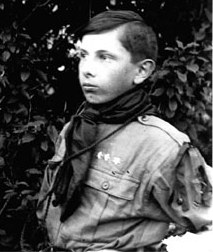
Bandera would quickly climb the ranks and become chief propaganda officer in 1931, before being named head of the national executive in 1933.
Bandera was a dedicated yet psychotic fascist who tortured himself from a young age to build up resilience and a rabid, violent anti-Semite, anti-communist, anti-Hungarian and anti-Polish. He was also a revanchist, seeking to reclaim even lands Ukrainians had not held for centuries, and purge them of all non-Ukrainians. Bandera would quickly radicalize the OUN even further, and his eye for talent meant the OUN could become both larger and more effective. This would become apparent in 1934, when the OUN-B carried out its most brazen attack yet, assassinating Polish foreign minister Bronisław Pieracki at close range with a pistol.

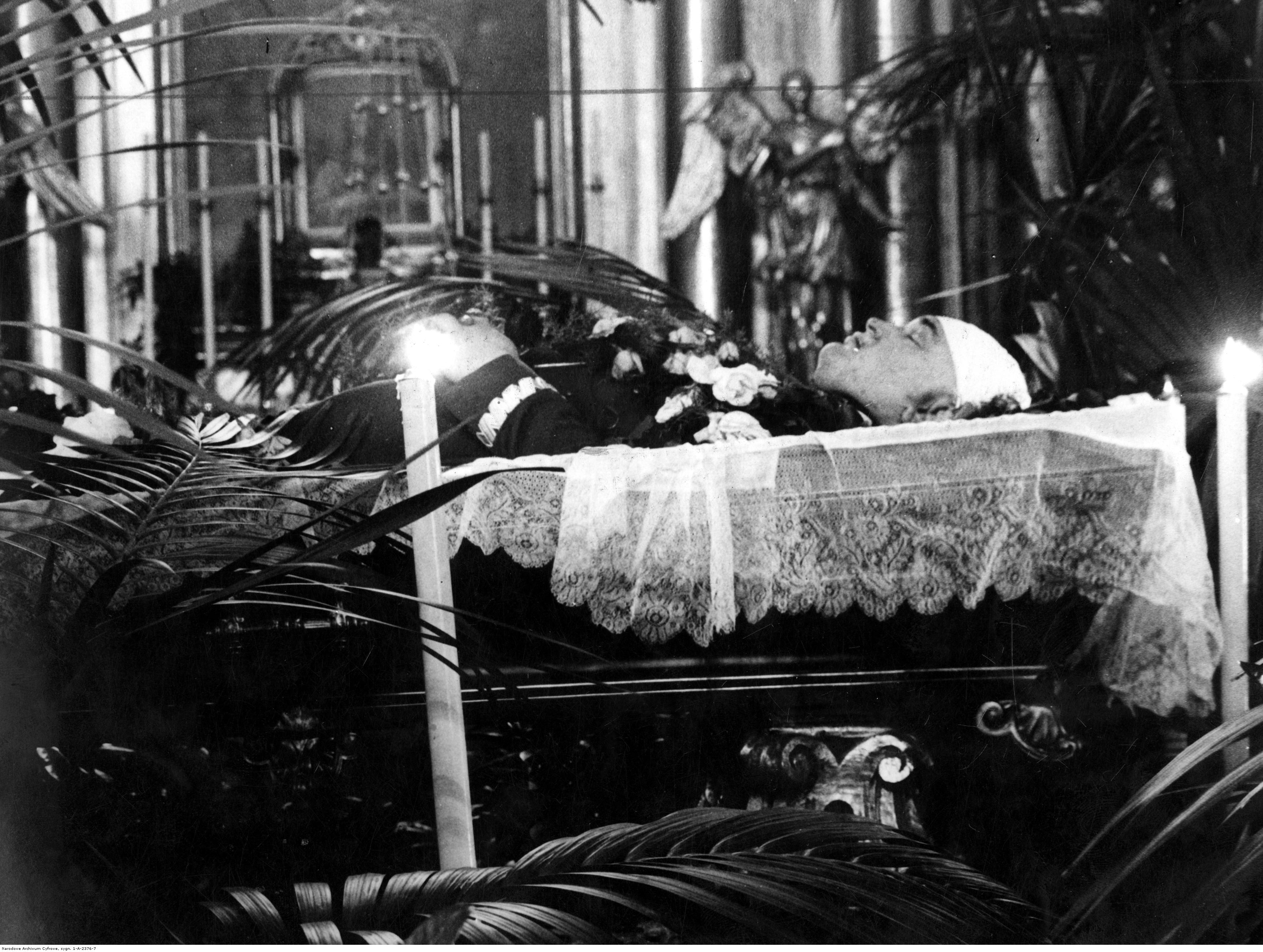
The Polish authorities eventually caught Bandera and sentenced him to death along with other OUN leaders. The death sentence was commuted to life, and Bandera would remain in prison until he was released in 1939 when the Nazis invaded Poland. It is unclear who exactly released him, the Nazis themselves, or his comrades after the jailers fled the invading Nazis. I do not believe the distinction is important: His release was because of the Nazis even if not by them.
After his release, the Nazis would begin to prepare for Operation Barbarossa, the invasion of the USSR with Bandera and the OUN set to play a major role.
On the instructions of top Nazi brass, including Hitler, Abwehr Chief Wilhelm Canaris and Generals Wilhelm Keitel and Alfred Jodl, the Abwehr would actively employ Bandera and the OUN starting in 1940. The goal of this collaboration was not only to attack the Soviets, but also to have a brutal and efficient force to carry out reprisals and atrocities against civilians.

To quote from the testimony of General Erwin von Lahousen at the Nuremburg trials:
“COL. AMEN: In order that the record may be perfectly clear, exactly what measures did Keitel say had already been agreed upon?
LAHOUSEN: According to the Chief of the OKW, the bombardment of Warsaw and the shooting of the categories of people which I mentioned before had been agreed upon already.
COL. AMEN: And what were they?
LAHOUSEN: Mainly the Polish intelligentsia, the nobility, the clergy, and, of course, the Jews.
COL. AMEN: What, if anything, was said about possible cooperation with a Ukrainian group?
LAHOUSEN: Canaris was ordered by the Chief of the OKW, who stated that he was transmitting a directive which he had apparently received from Ribbentrop since he spoke of it in connection with the political plans of the Foreign Minister, to instigate in the Galician Ukraine an uprising aimed at the extermination of Jews and Poles.
COL. AMEN: At what point did Hitler and Jodl enter this meeting?
LAHOUSEN: Hitler and Jodl entered either after the discussions I have just described or towards the conclusion of the whole discussion of this subject, when Canaris had already begun his report on the situation in the West; that is, on the news which had meanwhile come in on the reaction of the French Army at the West Wall.
COL. AMEN: And what further discussions took place then?
LAHOUSEN: After this discussion in the private carriage of the Chief of the OKW, Canaris left the coach and had another short talk with Ribbentrop, who, returning to the subject of the Ukraine, told him once more that the uprising should be so staged that all farms and dwellings of the Poles should go up in flames, and all Jews be killed.
COL. AMEN: Who said that?
LAHOUSEN: The Foreign Minister of that time, Ribbentrop, said that to Canaris. I was standing next to him.
COL. AMEN: Is there any slightest doubt in your mind about that?
LAHOUSEN: No. I have not the slightest doubt about that. I remember with particular clarity the somewhat new phrasing that “all farms and dwellings should go up in flames.” Previously there had only been talk of “liquidation” and “elimination.”
Abwehr Col. Erwin Stolz would clarify who Lahousen was talking about:
“In carrying out the above-mentioned instructions of Keitel and Jodl, I contacted Ukrainian National Socialists who were in the German Intelligence Service and other members of the nationalist fascist groups, whom I roped in to carry out the tasks as set out above.
“In particular, instructions were given by me personally to the leaders of the Ukrainian Nationalists, Melnik (code name ‘Consul I’ and Bandera, to organize immediately upon Germany’s attack on the Soviet Union, and to provoke demonstrations in the Ukraine in order to disrupt the immediate rear of the Soviet armies, and also to convince international public opinion of alleged disintegration of the Soviet rear.
We also prepared special diversionist groups by Abwehr II for subversive activities in the Baltic republics of the Soviet Union.”
While there were no objections to collaboration with the Nazis, the OUN was deeply divided about what to do after. The leader of the OUN at this time, Andriy Melnyk, favored a more moderate stance, remaining more subservient to the Nazis.

Bandera disagreed, favoring a revolutionary stance and a declaration of Ukrainian independence. The disagreement turned into a violent schism, with Bandera taking the most radical members to form the OUN-B. Melnyk’s group, diminished by splits and now under attack from Bandera, was quickly overtaken. OUN-M survived the war, but from this point on, Bandera controlled the Ukrainian fascist movement with little dissent.
Soon, the collaboration with the Abwehr would begin to bear its terrible fruit. Under the aegis of the Abwehr’s commando battalion “Brandenburg” but under OUN command, two OUN units were formed, “Roland” and “Nightingale.” The latter was under command of the infamous Roman Shukhevych, a mass murderer who would later plan some of the worst OUN atrocities. There were also other OUN forces attached to both Wehrmacht and Gestapo units, mostly serving as interpreters and guides. Nightingale and Roland, along with Nazi forces, were sent to Lviv to carry out their bloody mission in 1941.

The Bloody Nightingale
“We are all UPA soldiers and all underground fighters in particular, and I am aware that sooner or later we will have to die in the fight against brutal force. But I assure you, we will not be afraid to die, because when we die, we will be aware that we will become a fertilizer of the Ukrainian land. This is our native land that needs a lot of fertilizer so that in the future a new Ukrainian generation will grow up on it, which will complete what we were not destined to complete.”


By 1943, Lviv had been under Polish or Austrian control since the 1300s. It was a city of around 500,000, over half of them Polish Catholics with a sizable Jewish minority of 100-160,000, with tens of thousands of those being refugees from Nazi-occupied Europe. The Ukrainian population was about 20%. The OUN wasted little time in changing that.
OUN forces entered the city with specific orders to exterminate the Jewish, Polish and Russian populations, a task that they would carry out with aplomb. First blood would go to the interpreters in the late hours of June 30th. Theirs was the dubious honor of the first massacre after the fall of Lviv. Namely, the abduction, torture and murder of suspected anti-Nazi Polish professors.
Working off OUN hit lists, Nazi and Ukrainian forces arrested the professors and their families, holding them in the dorms under torture for hours. All but one of them were executed, and after their deaths, their apartments were looted and occupied by SS and OUN officers.
Not to be shown up, Nightingale would get to work soon after. What happened in Lviv starting on June 30, 1941, should not be understood as one massacre but rather a series of them lasting over a month. Nightingale was one of the first two units to enter Lviv. Accompanied by elite Nazi mountain troops, Nightingale seized the hilltop castle, set up a headquarters and began to round up the local Jews, at first forcing them to clear the streets of bodies and bomb damage. Random murders and looting of Jewish homes and property accompanied this work on the first night.

In the morning, OUN infiltrators, defectors and sympathizers were mobilized and began the systematic violence against Jews alongside the Nazis. In the days preceding the attack, OUN propaganda leaflets were widely proliferated in Lviv telling the residents:
“Don’t throw away your weapons yet. Take them up. Destroy the enemy. … Moscow, the Hungarians, the Jews—these are your enemies. Destroy them.”
It would seem many of them took that advice to heart. In the resulting pogrom, the Ukrainian nationalists brutalized thousands of Jews in broad daylight throughout the city.
They would force many women into the streets, where nationalists would strip them naked, rape and murder them. The men got off only a little better; many were savagely beaten in the streets with clubs and fists, as the throngs taunted and threw trash at them. Nazi reporters filmed and photographed much of this violence as it happened.
A Wehrmacht propaganda company took this image of a local man beating a Jew in the streets, for example. It served the purpose in papers and film broadcasts throughout Germany as evidence that the Nazis would and could carry out their long-planned and well-known extermination plans. On this day, anywhere from 2,000 to 5,000 Jews were wantonly slaughtered, virtually all of them by OUN and affiliated forces.
The Einsatzgruppen would arrive soon after. These were the professional killers, the elite squad of fascist executioners who had already “cleansed” countless cities, towns and villages throughout Poland and the USSR.
Going door to door, the Einsatzgruppen hunted and found their priority targets. In a somewhat orderly fashion, Einsatzgruppen men would march them to pre-dug pits, force them to their knees and execute them via gunshot. They would repeat the process for hours until approximately 3,000 Jews were dead. Nightingale, the OUN militias and various other fascist collaborators were involved in every aspect of this massacre. Functioning as police, they would assist in loading Jews into trucks and driving them to stadiums to face mass execution via machine gun.
These extermination operations would continue over days, along with systematically pillaging anything of value from the Jewish population. The Nazi accountants in Berlin demanded that subjugated people be economically exploited to the maximum extent, going so far as to remove fillings from their teeth, with much of the money going directly to German industrialists, who profited enormously from the Nazi labor and extermination programs.
Throughout this process, more than 4,000 were killed, many of them beaten to death with clubs. The value of everything stolen from the victims of this massacre and the many others like it will never be known.
Sadly, Nightingale and company were not yet finished.
On the 25th of July, Ukrainian forces would start another pogrom lasting about three days. Called the Pelitura days, after an assassinated Ukrainian leader, Ukrainian nationalists from the countryside marched into Lviv under the command of the OUN. Working off lists provided by the Ukrainian auxiliary police, nationalist forces would ferret out remaining Jews, Poles, Communists and other “undesirables.”
In three days of bloodletting, about 2,000 were murdered, most of them hacked to pieces with farming tools. This sort of brutality would remain the calling card of Shukhevych and the OUN for its entire existence.
When the Red Army liberated Lviv in 1944, only 150,000 people remained and of those, only 800 were Jews. The OUN, Ukrainian auxiliaries and Nazis either killed the rest or arrested and deported them to Belzec concentration camp. There the Nazis would murder them all as part of “Operation Reinhard.” Belzec was so efficient that fewer than a dozen survivors have ever been identified.
From high above in the castle, the OUN leadership was not idle. As the slaughter continued in Lviv, Yaroslav Stetsko, the second in command of the OUN, a Lviv native and a militant fascist in his own right, declared an independent, Nazi-aligned Ukrainian government. This would lay the groundwork for a more complicated chapter in the OUN’s history.

The question of collaboration
“The newly formed Ukrainian state will work closely with the National-Socialist Greater Germany, under the leadership of its leader Adolf Hitler which is forming a new order in Europe and the world and is helping the Ukrainian People to free itself from Moscovite occupation.
The Ukrainian People’s Revolutionary Army which has been formed on the Ukrainian lands, will continue to fight with the Allied German Army against Moscovite occupation for a sovereign and united State and a new order in the whole world.
Long live the Ukrainian Sovereign United Ukraine! Long live the Organization of Ukrainian Nationalists! Long live the leader of the Organization of Ukrainian Nationalists and the Ukrainian people – STEPAN BANDERA. GLORY TO UKRAINE!”
-Yaroslav Stetsko, from the “Act of Restoration of the Ukrainian State”
Around here the nationalists will shoot back: Bandera was arrested! He went to the camps! He wasn’t a fascist, or a Nazi! OUN fought the Nazis!


I do not find those arguments convincing for a number of reasons. First, Bandera and the OUN can stand on their own as fascists. They were violently and militantly anti-Semitic, anti-Pole, anti-communist and ethno-nationalist. Even if they were not Nazi collaborators, their own terrible atrocities would leave a permanent black mark on their reputation.
Perhaps the most shocking of these was in Volyna, an ethnic-cleansing campaign carried out over two years’ fighting between Polish and OUN forces, reaching its crescendo with “Bloody Sunday.” On July 11, 1943, an attack was launched by Roman Shukhevych on about 100 Polish settlements simultaneously. The UPA murdered some 8,000 Polish civilians that day, many of them shot or burned alive inside their churches while attending mass. The UPA would then spread out into the countryside to hunt down and kill—with axes, hammers and knives—any who had escaped. The OUN would continue to slaughter the local population for more than two years, resulting in around 100,000 deaths, most of them women and children.

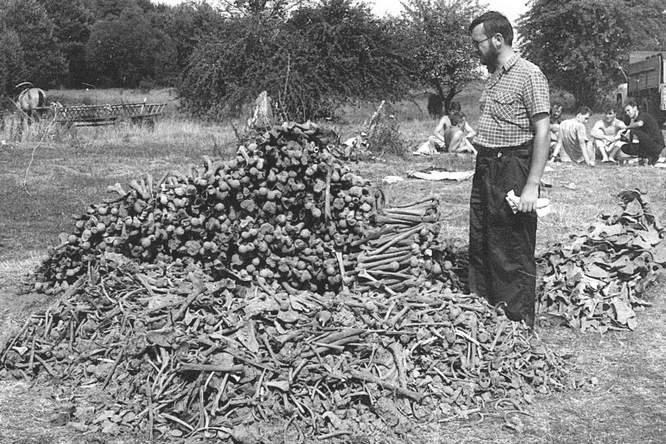
This sort of brutality was very typical for the OUN. Moshe Maltz, a Ukrainian Jew in hiding from the Banderites would make note of it in his journal, later published as his memoir.
“Bandera men … are not discriminating about who they kill; they are gunning down the populations of entire villages.… Since there are hardly any Jews left to kill, the Bandera gangs have turned on the Poles. They are literally hacking Poles to pieces. Every day … you can see the bodies of Poles, with wires around their necks, floating down the river Bug.”
Therefore, the OUN does not need Hitler to make them look bad. Secondly, they were Nazi collaborators.

Several months after the declaration of independence, which the Nazis did not accept, tensions would rise to such an extent that the Nazis arrested Bandera, Stetsko and other leaders. After a period of house arrest, they were transferred to Sachsenhausen concentration camp in 1943.
Bandera’s stay was not typical, however. Bandera had a two-room suite with paintings and rugs, was allowed to have conjugal visits with his wife, performed no forced labor, wore no uniform, was exempt from roll call, ate with the guards and did not lock his cell door at night.
The Nazis released Bandera in 1944 after a meeting with Otto Skorzeny, Hitler’s top commando, to carry out a campaign of terrorism against the advancing Red Army. The Nazis could have killed Bandera and Stetsko at any time in the interim, but they did not. Rather, they made a great and successful effort to recruit them.
While the OUN would take some action against the Nazis, they would do so only briefly and half-heartedly. In 1942 there was virtually no fighting at all.
In early 1943 that would change, and there was some fighting in western Ukraine. In keeping with their reputation as bandits, OUN would mostly raid farms and small settlements, burning and murdering as they went. Most of these attacks, carried out with the OUN’s typical brutality, resulted in more civilian dead than military.
In the year of fighting the OUN killed around 12,000 “Germans.” Only 700-1,000 of them were Wehrmacht; the remainder were civilians, either in Nazi administration or simply farmers and peasants in territory under Nazi control. Indeed, according to Soviet partisan reports of the time, the OUN only engaged with Nazi soldiers when necessary: “Nationalists do not engage in sabotage activities; they only engage in battle with the Germans where the Germans mock the Ukrainian population and when the Germans attack them.”
The Nazis, planning to exterminate both groups eventually, would capitalize on the situation by transferring Polish collaborator units to the region. These, along with Hungarian auxiliaries, did the bulk of the fighting against the OUN.
However, the Soviet victory at Stalingrad scared both the Nazis and the OUN, forcing negotiations and a cooling of tension. At their third council in late 1943, the OUN leadership reaffirmed the Soviets as their primary enemy and ended active efforts against the Nazis. Some skirmishes between the Nazis and OUN would continue until 1944, but it was no longer significant fighting.
To quote historian Russ Bellant:
“The Organization of Ukrainian Nationalists in 1943 under German sponsorship organized a multinational force to fight on behalf of the retreating German army. After the battle of Stalingrad in ’43 the Germans felt a heightened need to get more allies, and so the Romanian Iron Guard, the Hungarian Arrow Cross, the Organization of Ukrainian Nationalists and others with military formations in place to assist came together and formed the united front called the Committee of Subjugated Nations and again worked on behalf of the German military. In 1946, they renamed it the Anti-Bolshevik Bloc of Nations, ABN. Stetsko was the leader of that until he died in 1986.”
It is tempting to think of the OUN as only being its leaders, but the reality is the OUN was always comprised of thousands of mostly anonymous rank-and-file fighters. Many of these fighters would drift back and forth from nationalist militias to the Nazis and back.
It was these “police” units which would do most of the dirty work of what the Nazis called “security warfare.” This was little more than a euphemism for the terrorization and mass murder of any who opposed Nazi rule. Abwehr commando units also gave another outlet for OUN fighters to collaborate and were used almost entirely to pacify resistance movements.
The infamous SS Galicia Division was also formed in 1943, and the overlap between this division and the OUN was extensive. Despite extensive attempts to whitewash their reputation, Galicia was as criminal as you would expect for SS. Marches and monuments in honor of this SS unit are common in western Ukraine today.

“Russian Ukraine cannot be compared to Austrian Galicia… The Austrian-Galician Ruthenians are closely intertwined with the Austrian state. Therefore, in Galicia it is possible to allow the SS to form one division from the local population.”-Adolf Hitler, 1942.
Most of this debate is pointless, however, as the Ukrainians themselves decisively settled this question in 1993. Under the direction of the Ukrainian government, led by then president Leonid Kravchuk, the SBU (Ukrainian state security) was ordered to investigate the extent of the OUN’s collaboration with the Nazis. Kravchuk intended to begin the rehabilitation of the OUN, and wanted historical justification to do so.

He would not get it.
To quote from their findings:
“The archives contain materials, trophy documents of the OUN-UPA and German special services, which testify only to minor skirmishes between the UPA units and the Germans in 1943. No significant offensive or defensive operations, large-scale battles were recorded in the documents. The tactics of the struggle of the UPA units with the Germans in this period was reduced to attacks on posts, small military units, defense of their bases, ambushes on the road.” –The Security Service of Ukraine, “On the activities of the OUN-UPA,” 7-3-1993
As I have previously outlined, there was no fighting at all in 1942 and by 1944 the OUN had officially ended armed struggle against the Nazis. Therefore, since the OUN hardly fought the Nazis in 1943, that would mean they hardly fought the Nazis at all.
In light of this, perhaps the former comedian Zelensky needs better jokes.
The Trident and the Gladius:
“ABN were the best commercial hitmen you ever heard of.”
–L. Fletcher Prouty, Chief of Special Operations for the Joint Chiefs of Staff under Kennedy
Bandera and the OUN would remain thralls of the Nazis until the end of the war. The clearest evidence of this is that Yaroslav Stetsko was in a Nazi convoy American forces strafed in 1945, very nearly killing him.
The OUN would continue to carry out terrorist attacks in western Ukraine until the 1950s in some form or fashion; however, according to the KGB, the OUN was incapable of replenishing losses. Between this and active measures against it, the OUN was broken as a combat organization around 1954.
Roman Shukhevych’s death in a 1950 raid by Soviet forces represented a major blow to the UPA from which they could not recover.
The OUN was in desperate need of new patrons, and they wasted little time in finding them. In 1944, the OUN along with other nationalist groups would form the Ukrainian Supreme Liberation Council, or UHVR. Its members were the usual suspects of OUN-affiliated organizations. The President was Ivan Hrinioch, a former chaplain for Nightingale.
The foreign minister was Mykola Lebed, head of the infamous OUN secret police and a man the U.S. Army called a “well-known sadist and collaborator of the Germans” (he would later become a collaborator for the CIA).

These two, along with UPA liaison officer Yuri Lopatinski embarked on a mission to the Vatican that same year, seeking support from Western governments. It is unclear exactly what came of this meeting, but it is proven that the British began to support the group at around this time.
As he had done with the OUN before, Bandera would quickly cause a violent schism within the UHVR. This became open in 1947 between Bandera/Stetsko and Lebed/Hrinioch on the other over the issue of east Ukraine. East Ukraine is mostly Russian, and it had always been a major weakness for the violently anti-Russian OUN.
Bandera insisted upon not only a single-party dictatorship (which he would lead), but also a pure Ukrainian ethno state, purged of any Russian influence. Lebed and Hrinioch believed that in order for the movement to succeed, it was necessary to include eastern Ukrainians.
For this, Bandera would expel them in 1948. This would eventually lead to Bandera’s downfall, as it led the CIA to believe he was far too extreme and too unwilling to compromise to be a useful agent.
Bandera had significant prestige in the fascist underground; however, his years of violently attacking rivals meant many would never work with him. The CIA wanted a united front and understood that could not happen with Bandera at the helm.
There are still some gaps in the timeline of the early post-war period. However, recent document declassifications have led to a better understanding of Bandera and the OUN’s role as CIA and Western agents.

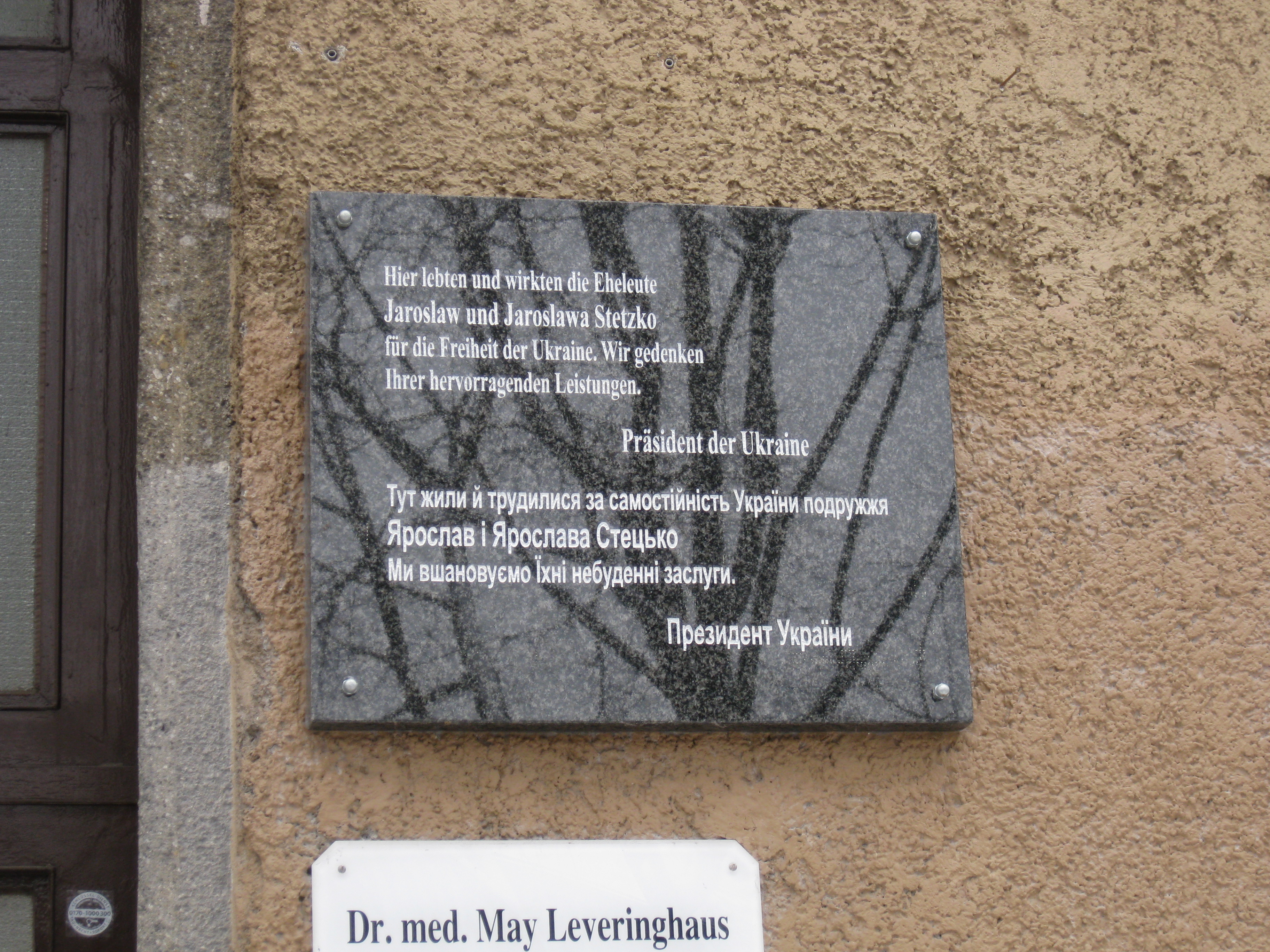
What we can say for sure is this.
Very soon after the war, U.S. Army Counterintelligence found Bandera hiding from the Soviets in the American occupation zone. We know this due to declassified KGB documents detailing a failed special operation to kidnap Bandera in 1946. This was only attempted after a year of failed negotiations to have Bandera extradited for his crimes.
Bandera was living, from at least as early as 1946, in Munich. There, he worked under the protection of and in close collaboration with Reinhard Gehlen, the Nazi spymaster turned CIA agent and future head of West German intelligence.
Gehlen was a totally unrepentant Nazi who covertly operated the infamous “ratlines” which would help countless Nazis escape justice to American-allied countries. He did this with the full support and backing of the CIA, which sought to use the men as assets. In 1946 alone, Gehlen was paid about $3.5 million and employed 50 people, 40 of whom were former SS. Among those Gehlen helped escape were Adolf Eichmann and Otto Skorzeny.
Early on, Bandera and the OUN (or rather, the SB, the secret police formed by Lebed) worked as assassins for MI6 inside the Displaced Persons camps. SB targeted Communists, rival fascists and anyone who knew too much about the OUN’s bloody past. Thousands of refugees met their end at OUN hands in what the West called “Operation Ohio.” They would earn a reputation as frighteningly efficient hitmen, and it was here Lebed earned his codename Devil.
In 1946, Bandera and Stetsko founded the Bloc of Anti-Bolshevik Nations (ABN) in Munich. A sort of fascist international, it combined far-right anti-Communist terrorist groups from around the world into one, well-funded front. Yaroslav Stetsko was the leader; however, his close friendship with Bandera meant that he was not acceptable to the CIA at that time.

While Bandera had some initial contact with the OSS (precursor to the CIA), they quickly came to view him as far too extreme, operationally dangerous (he would often refuse to use encrypted communications) and recalcitrant. Therefore, Bandera primarily worked with MI6 while the CIA backed Lebed. The situation between the two eventually became so tense that the CIA intervened to strong-arm MI6 into dropping Bandera as an agent in 1954.
He was removed from OUN leadership in the OUN conference of that year, to be replaced with “reformists.” That said, the CIA and Germans also protected Bandera against several assassination attempts. At various times he was guarded either by Americans from the Army CIC, or by Gehlen’s SS thugs. The CIA, on at least one occasion, radioed classified information to West German police in order to protect Bandera. While they were no longer willing to throw their full weight behind Bandera, they also did not want him to become a martyr.
The CIA would not get its wish. From 1954 on, their strategy appears to have been simply starving the beast. The Americans wanted Bandera gone, the idea being that he would be removed from leadership and cut off from funding,
Bandera’s career would simply wither and die. Bandera would continue to work in some fashion for Gehlen for the rest of his life; however, his role and profile were intentionally diminished. Throughout all of this, the KGB had never given up. They had repeatedly asked the Americans to extradite Bandera as a war criminal since the end of the war, but were met with complete refusal. Therefore, the KGB made repeated attempts on Bandera’s life. We know of failed attempts in 1947, 1948, 1952 and 1959.
A second attempt in 1959 would finally succeed. On October 15, 1959, KGB agent Bohdan Stashynsky surreptitiously entered Bandera’s home in Munich and shot Bandera in the face using a specially designed poison spray gun.

Bandera collapsed, bleeding from the mouth, and cracked the base of his skull on some stairs. At first, the cause of death was ruled a stroke, resulting in a fall. Further investigation revealed traces of potassium cyanide in Bandera’s system; however, until the defection and arrest of Stashynsky in 1961, it was unclear who had poisoned him. A leading suspect was Theodor Oberländer, a West German politician and ex-Nazi who had served as political officer for Nightingale in 1941.
With Bandera marginalized and then dead, CIA restrictions against ABN were lifted and Yaroslav Stetsko would move into a greatly expanded active role as a CIA collaborator. He would excel at the role for the rest of his life.

In future articles, I will elaborate on the history between Stetsko and the CIA at least as far as the events of the Maidan coup, where a clear link exists.
CAM Notice re Copyrighted Material: This web site may contain copyrighted material the use of which has not always been specifically authorized by the copyright owner. As a not-for-profit charitable organization incorporated in the State of New York, we are making such material available in an effort to advance the understanding of humanity’s problems and hopefully to help find solutions for those problems. We believe this constitutes a ‘fair use’ of any such copyrighted material as provided for in section 107 of the US Copyright Law. You can read more about ‘fair use’ and US Copyright Law at the Legal Information Institute of Cornell Law School.
Author
Evan Reif was born in a small mining town in Western South Dakota as the son of a miner and a librarian. His father’s struggles as a union organizer, and the community’s struggles with de-industrialization, nurtured Evan’s deep interest in left-wing politics. This, along with his love of history, made him a staunch anti-fascist. When not writing, researching or working, Evan enjoys fishing, shooting, and Chinese cooking. Evan can be reached at wharghoul@gmail.com.
TJ Coles: A New Generation of US-trained Extremists Is Fighting Russia. Are We Prepared for the Blowback?
By TJ Coles, Global Research, 6/8/22
US agencies have directly and indirectly trained and empowered Nazis and ultra-nationalists at home and abroad to fight Russians in Ukraine. This program follows the blueprint established by Western intelligence agencies in Afghanistan and Syria.
From 1978 (not ’79 as many believe), the administration of Jimmy Carter decided to “draw the Russians into the Afghan trap,” in the words of the President’s National Security Advisor, Zbigniew Brzezinski. US intelligence called on its British counterparts to activate networks of Afghan fighters. New generations of extremists joined the fight. Aid, arms, and training poured into Afghanistan. Support increased following the Soviet invasion in December 1979.
Throughout the 1980s, tens of thousands of jihadis from dozens of Muslim-majority countries were flown into the US, Britain, and Pakistan to receive training from the CIA, Green Berets, US Marines, and British SAS and MI6. The foreign extremists later rebranded themselves “al-Qaeda” and launched a series of spectacularly bloody attacks on strategically significant targets that provided justification for a global “war on terror” that continues to serve as ideological cover for contemporary US hegemony.
The multi-billion dollar CIA operation to arm and train the so-called freedom fighters, or Afghan mujahedin, was known as Operation Cyclone. Successive administrations repeated the pattern in the 2010s, initiating Operation Timber Sycamore in a failed effort to depose Bashar al-Assad in Syria and Operation Mermaid Dawn before it in a successful effort to remove Muammar Gaddafi and destabilize Libya.
Today, the CIA, US Special Forces, and other branches of government are training regular units in Ukraine. With US support, far-right elements of those units go on to train and recruit for Nazi paramilitary units and gangs. White nationalist Americans are allowed to travel to Ukraine and train paramilitaries and/or receive training, depending on the individual or group. State-corporate media have confirmed the existence of a major CIA training program involving “irregular” (i.e., terrorist) warfare, but we do not yet know the name of the operation.
As Alex Rubinstein reported for The Grayzone, corporate US media has promoted known US white nationalists fighting in Ukraine as heroes, while whitewashing their records of murder and political violence. And while the Department of Homeland Security expresses “concern” over potential blowback when these openly fascist combat veterans return to the US, the administration of Joseph Biden appears to be doing nothing to stop them from making their way to the battlefield.
The US program in Ukraine bears such striking similarities to Operation Cyclone it could be dubbed “Cyclone 2.0”. The nature of the proxy war has all but been admitted by former US Secretary of State, Hillary Clinton, and the endgame of regime change in nuclear-armed Russia has been acknowledged by President Joe Biden.
In pursuing these objectives, US and British elites are taking a nuclear gamble. As even the DHS has warned, their empowerment of neo-Nazis could open a new chapter in the “war on terror” in which civilians will suffer blowback from battle-hardened extremists – imagine the Buffalo shooter with advanced tactical training. Millions will be considered by authorities to be potential white supremacists, ultranationalists, and Nazis. And under the pretext of fighting white extremism, a new phase of total surveillance and foreign “intervention” might begin in the Caucasus and Baltic regions.
Running the ratline to Ukraine behind volunteer non-profit cover
Typical of the kind of operations taking place, former US Marine Benjamin Busch, ex-Infantry Officer Adrian Bonenberger, and Iraq War veteran Matt Gallagher, traveled to Lviv in Western Ukraine to train dozens of what are described by US media as Ukrainian civilians. Gallagher revealed that US intelligence agents were facilitating travel. Border and justice agencies were not obstructing departures and returns.
“(I reached out to) some friends who work in various government jobs, not so much asking them for permission in any kind of official capacity,” Gallagher stated, “but just wanting to know if there were any potential consequences. The almost universal response to that was, as long as they (the people he was training) are actual citizens, as long as this is focused on self-defense, as long as this is not some covert military, paramilitary operation, you’ll be fine. Some fellow Wake Forest [University] graduates [in North Carolina], who I won’t name because they do work for Uncle Sam, were very helpful in collecting information.”
Operations of this sort laid the groundwork for a mass “volunteer” scheme. The creation of an international volunteer force reflects the interests of the Azov Battalion — the Nazi-linked paramilitary unit that has undergone through several name changes (e.g., Azov Movement, Azov Regiment), reportedly de-Nazified, and has supposedly integrated into regular Ukrainian armed units. In reality, the Azov’s political wing, the National Corps (formerly the Patriots of Ukraine), is described as neo-Nazi by contemporary Western experts and even the US Department of Justice.
In February 2018, Azov stated on Discord: “[We] will have the foreign legion set up within the next 18 months or so.” Chiding the Ukrainian government for blocking their efforts, the National Corps’ young leader, Olena Semenyaka, said: “we hope to create a foreign legion. There we could announce loud and clear when we seek volunteers.” If the far-right Ukrainian puppet government was too soft, Azov leadership did not need to worry because Uncle Sam was there to facilitate the creation of an international volunteer league.
Describing itself as a 501(C)3 non-profit pending (hence no info shows up on the IRS website at the time of writing), Volunteers for Ukraine (VFU) has no overt connections to Azov. It was founded in February 2022 as “United Peacekeepers for Ukraine.” The original website was an extension of the Ukrainian Ministry of Foreign Affairs’ International Legion of Ukraine website.
The public relations-minded operatives behind the site evidently decided that the dovish name of the organization (“Peacekeepers”) was not likely to encourage anti-Russian fighters to volunteer, so they changed it to Volunteers for Ukraine. At the time of writing, the VFU website features images of protestors holding signs that include “Kill Putin…” and “Putin = Hitler”—a rather stark departure from peacekeeping.
The new site puts names and faces to the organization, including the professed founder, David Ribardo; a former US Infantry Officer and Afghanistan War veteran. Despite the imagery and recent references to combat, Ribardo claims that VFU is a “humanitarian aid organization.”
VFU’s Chief Operations Officer is combat veteran Phillip Chatham, a former Diplomatic Security Missions leader for numerous US lawmakers. “As an In-Country Operations Manager he maintained facility clearances with multiple intelligence agencies,” says the site. The organization is also run by numerous veterans and PR specialists. Promoting VFU on CNN, another veteran, “Seth,” described working with refugees in Poland thanks to “some very gracious donations from some sponsors.”
This offers insight into how such operations are run: anonymous major donors operate veteran pipelines to Ukraine in neighboring countries. Ribardo says that his job includes vetting volunteers to weed out fantasists, “combat tourists,” and extremists, ensuring that only well-trained US veterans enlist.
The number of veterans who have volunteered is not disclosed, but Ribardo says that the figures are unlike anything seen “since World War Two.”
Extremists and accelerationists: “We’re gonna send home a lot of bodybags”
Other Americans fighting in Ukraine’s regular units included: Dalton Kennedy, a member of North Carolina’s branch of the white supremacist Patriot Front; David Kleman of Georgia who has been photographed sporting Nazi imagery; and Army veteran David Plaster of Missouri. According to British press reports, Plaster has trained “thousands of Ukrainians in tactical medicine,” and headed a team that included even elderly veterans, like former Marine Dave Eggen, who said of Russians: “We are going to send home a lot of bodybags.”US Military Supports Ukraine’s Neo-Nazi National Guard. Are US Forces Involved in Combat Operations?
One such figure told Buzzfeed that they were questioned by federal agencies but still allowed to travel. “I tell them I don’t have anything to hide. Then they let me go. Every time.” In addition to the above fighters, known fascists are signing up to fight.
By March this year, at least 3000 US citizens were allegedly on the Ukrainian battlefield. In April, John T. Godfrey, the State Department’s Acting Coordinator for Counterterrorism, said of American extremists going to fight: “when they return, they have skill – they typically come back more radicalized than when they left … [T]hey do have hard skills that they are able to, in some cases, use in attacking targets domestically.” In intelligence circles, this is called “blowback.”
In April, I filed a freedom of information request with the Department of Homeland Security (DHS) to obtain documents on travelers to Ukraine and its neighbors, including Georgia and Poland, from 2014 to the present. The aim was to measure the size of “Cyclone 2.” From logs and incident reports that had come to the attention of the DHS, I wanted to know how many people had been stopped and questioned about their trips by federal or local authorities. The DHS unlawfully ignored my request, as they have a habit of doing: no acknowledgement, no delayed response, nothing.
Had the department answered, it might have confirmed the story of people like “Alex”: a US armed forces veteran who was connected to Ukraine by an anonymous online account. “Alex” ended up in the extremist-heavy Shyrokyne (near Mariupol), fought with Ukraine’s openly fascist party the Right Sector, and ended up recruiting other Americans for the Azov Battalion. (The source is the US and British intelligence cut-out, Bellingcat.)
Newsweek encountered similar obstructions. It noted that Azov’s political wing, the National Corps, has been connected to the US white supremacist Rise Above Movement, Germany’s Third Path, Italy’s Casa Pound, and other extremist groups. In their efforts to assess the scale of such connections in the US, Newsweek reporters approached the Department of Justice, FBI, and DHS for comment. Silence was the answer.
Newsweek pointed to Cossack House in Kiev as the main Azov recruiting center. Loaned to the Azov Battalion by the Ukrainian Ministry of Defense, the center’s library includes Nazi literature and is described by the Azov National Corps leader Semenyaka as “a small state within a state.” The number of Americans currently there is not known.
In addition to white supremacists, members of accelerationist groups — those that want to hasten society’s collapse in order to remold it in their image — are also present in Ukraine.
Former Marine Mike Dunn from Virginia is an informant and once-influential figure in the politically fluid Boogaloo Bois, having commanded its Last Sons of Liberty Faction. “There hasn’t been much activity in the Boogaloo movement since I walked away,” he says. After being exposed as an informant, Dunn disappeared from the scene only to reappear in February this year announcing his intention to fight in Ukraine via Poland by signing up to an undisclosed recruiting station.
“I wouldn’t say that I am necessarily trying to advance the cause of the Boogaloo movement … But I will say that the Boogaloo movement is going to be represented over there.”
But this makes little sense. Who would follow a fink to Ukraine, except for mercenaries and fellow feds? Also, didn’t Dunn leave the movement, so how could he represent it in Ukraine? “I have a few that are following me there, I have one going with me there,” he says.
Henry Hoeft, a former US Army Infantryman and Boogaloo Boy from Ohio, was cautioned by the FBI against fighting in Ukraine, but was simultaneously advised by the Bureau to call the US Embassy if he got into trouble. Hoeft says:
“I get it. They don’t want to be implicated if Russia harms any of us, and they don’t want to escalate the conflict by saying that they’re sending American soldiers over.” (See also Hoeft’s Grayzone interview.)
Dunn, the Boogaloo former leader and informant, confirmed his presence in Washington DC during the January 6 “Stop the Steal” rally, but claims that he arrived late and did not participate in storming the Capitol. The Ukrainian Right Sector’s Serhiy Dubynin, an influential media figure working for the major Ukrainian channel, Inter, was also at the Capitol that day, signifying that the DHS-FBI “open-door” policy included Ukrainian extremists who would network in the US and vice versa. Dubynin was photographed with Jake Chansley; the highly-decorated US Navy veteran and self-styled “QAnon Shaman.” Dubynin was heard urging the Stop the Steal demonstrators to escalate from peaceful protest to violence: “Come on! … Do it!”
Fascists and Satanists bring their “fetish for death” to Ukraine
Between 2015 and ‘16, several American extremists went to Ukraine to enlist in regular units. Others formed a Right Sector paramilitary spinoff which according to colleagues “had a fetish for death and torture.” Pluto being the Roman god of hell. Their unit was called Task Force Pluto (TFP), named for the Roman god of death, and was led by a US Army deserter-turned-mercenary, Craig Lang, who had also worked as a contractor for the Ukrainian military. Lang operated alongside Brian Boyenger, an Iraq War veteran who served as a sniper in Ukraine. Lang recruited Americans for Ukraine and Boyenger vetted them.
Other TFP members included former Marines Quinn Rickert and Santi Pirtle. The two compiled video evidence of Lang torturing and murdering a local man as well as beating and drowning a young female (age unknown), as an Austrian called Benjamin Fischer — nicknamed “Bin Laden” — allegedly administered adrenaline injections to keep her conscious during the torture. The Department of Justice requested the evidence from their Ukrainian counterparts.
By 2017, a US military deserter, Alex Zwiefelhofer, had joined Lang via the Right Sector in Ukraine. The pair had planned to fight al-Shabaab in Sudan and the Venezuelan military. Upon questioning Zwiefelhofer, North Carolinian authorities discovered child porn on his phone. (The UK-based satanic group, the Order of Nine Angles and its Tempel ov Blood (sic, ToB) offshoot in the US infiltrate secular far-right groups and encourage child rape, possibly as a honeytrap on behalf of the security services).
Influenced by the SIEGE philosophies of the elderly Nazi pedophile James Mason (not to be confused with the late actor), the Atomwaffen Division (AWD, now called the National Socialist Order) was an apocalyptic-accelerationist group founded in 2015 and disbanded five years later. Mason bragged of there being “a lot of action in Ukraine … That’s pretty impressive.”
Private First Class Jarrett Smith, stationed at Fort Riley, Kansas, was a fan of Atomwaffen and a member of the Feuerkrieg Division, founded in the Baltics in late-2018. Smith was also a self-proclaimed satanist, likely connected to the ToB. That group’s leader, Joshua Caleb Sutter, was an FBI informant whose seemed determined to infiltrate and “satanize” Nazi groups with the aim of destroying them from within.
Before joining the Army, Smith was planning to go to Ukraine to fight with the Azov Battalion via his connections to Craig Lang. Before he could go, Smith was set up by an undercover FBI agent and a third party (either an informant or another agent) who put them in touch. The undercover agent contacted Smith through chat forums to ask how to make bombs. In an illustration of how the feds set up fanatical dupes, the agent also said: “Got a liberal texas mayor in my sights (sic)! Boom with that IED [improvised explosive device] and that dude’s dead.”
Via a far-right entity called the Military Order of Centuria, the newly rebranded Azov Movement has been trained by the militaries of America, Britain, Canada, and France.
DHS incident logs note that in December 2018, AWD member Kaleb Cole returned from London with fellow neo-Nazis, Aidan Bruce Umbaugh and Edie Allison Moore. They had visited, among other countries, Ukraine. The DHS log is heavily redacted. Andrew Dymock (alias Blitz), the leader of Britain’s Sonnenkrieg Division (a unit of the AWD), was a member of the occultist Order of Nine Angles and has been pictured wearing an Azov Battalion t-shirt.

Neo-Nazi Andrew Dymock (left), sporting an Azov Battalion t-shirt, with a fellow member of Atomwaffen’s UK chapter
The Rise Above Movement (RAM) is a network of American fascists, some of whom have been convicted of using violence against leftist demonstrators. In 2018, a leading Azov fascist and killer, Sergey Korotkikh, hosted RAM members in Kyiv. National Corps leader Semenyaka also hosted RAM members Michael Miselis of Lawndale, Benjamin Drake Daley of Redondo Beach, and Robert Rundo of Huntington (Calif.). Later that year as RAM members were charged with violence in the US. FBI Special Agent Scott J. Bierwirth said: “the Azov Battalion … is believed to have participated in training and radicalizing United States-based white supremacy organizations.”
According to Time magazine, after the white supremacist Brenton Tarrant murdered 51 people in Christchurch, NZ in 2019, “an arm of the Azov movement helped distribute the terrorist’s raving manifesto.” Among the many countries he reportedly visited was Ukraine.
Today, the neo-Nazi Wotanjugend (Wotan Youth) praises Tarrant as a hero and has distributed his manifesto. Indicative of their sympathies, in April 2020 the Azov National Militia leader Cherkas Mykhailenko conducted an interview with Wotanjugend’s Alexei Levkin. The Azov’s Nazi recruiting station, Cossack House, has also sold Wotanjugend merchandise.
Dire predictions of Ukraine blowback
US intelligence agencies have allowed an open-door policy for veterans, militia, and fascists to travel to Ukraine and its neighbors to kill as many Russian soldiers as possible. The FBI monitors some of the combatants, intervenes in some cases, but typically does nothing. The DHS allows the foreign fighters to travel and return with minimal obstruction. The US charity, Volunteers for Ukraine, is one of the organizations that provides a veneer of legitimacy for the operations that otherwise include extremists.
In Ukraine, meanwhile, US Special Forces are training the National Guard and other regular units, thereby providing a further layer of professional cover. However, with US training, some of these regulars go on to train far-right and Nazi paramilitaries; some Ukrainian, some American. The American fascists return home with the potential to use that training against domestic targets.
Former FBI agent turned consultant, Ali Soufan, notes that in the 1990s, the Afghan Taliban took advantage of constant conflict in the Central Asian country. “Pretty soon the extremists took over. The Taliban was in charge. And we did not wake up until 9/11. This is the parallel now with Ukraine,” Soufan said.
A 2021 report by the Military Academy West Point’s Combating Terrorism Center reinforced his point, stating that the Ukraine conflict “served as a powerful accelerator” for global white supremacy.
Also that year, Elissa Slotkin, chair of the Subcommittee on Intelligence and Counterterrorism declared: “As a former CIA officer who has looked at foreign terrorist organizations in the Middle East most of my career, I was struck by the threat these white supremacist groups pose, the amount of contact they have with extremists in the U.S., the minimal intelligence and diplomatic reporting we have on these groups, and the relative lack of review taken by the U.S. Government.”
Slotkin recommended thirteen white supremacist-extremist organizations including the Azov Battalion be banned. Today, Azov earns gushing praise in Western media and Slotkin is an ardent proponent of massive arms shipments to the Ukrainian military that hosts it.
T.J. Coles is a postdoctoral researcher at Plymouth University’s Cognition Institute and the author of several books, the latest being We’ll Tell You What to Think: Wikipedia, Propaganda and the Making of Liberal Consensus.
Featured image is from The Grayzone
The original source of this article is The Grayzone
Copyright © T.J. Coles, The Grayzone, 2022
Ted Snider – The Dangers of Regime Change: After Putin
By Ted Snider, Antiwar.com, 6/9/22
The comparison between the crisis in Ukraine and the Cuban missile crisis has occasionally been made. With an honest look at that crisis, history has two lessons to offer for the crisis of today.
The first is that the Cuban missile crisis demonstrates clearly how the US would respond to Russia encroaching on its sphere of influence and how it would respond to Russian weapons on its borders. The response is enshrined in the two century old Monroe Doctrine that bars the door from any European power encroaching on the American continents and that declares “any attempt on their part to extend their system to any portion of this hemisphere” to be “dangerous to our peace and safety.” It promises that any alliance between a European nation and a nation in the Western hemisphere would be seen as “the manifestation of an unfriendly disposition toward the United States.”
Kennedy specifically invoked the Monroe Doctrine to justify intervening in Cuba, saying that “The Monroe Doctrine means . . . that we would oppose a foreign power extending its power to the Western Hemisphere.” At around the same time, in April 1961, he would invoke the doctrine more generally. While acknowledging that “any unilateral American intervention, in the absence of an external attack upon ourselves or an ally, would be contrary to . . . our international obligations,” he, nonetheless, said that “If the nations of this hemisphere should fail to meet their commitments against outside Communist penetration then I want it clearly understood that this government will not hesitate in meeting its primary obligations which are to the security of our nation.”
Given its own commitment to the Monroe Doctrine, the US might have anticipated and understood Russian concerns and warnings not to encroach on its borders by moving weapons into Ukraine and Ukraine into NATO.
The second lesson is that the Cuban missile crisis demonstrates how such a crisis can be solved and war avoided. Though American mythology tells a story of the Cuban missile crisis being resolved by Kennedy coldly staring down Khrushchev and forcing a withdrawal, the historical record shows something different. The crisis was resolved when Kennedy negotiated with Khrushchev and promised to remove the US Jupiter missiles that were threatening Russia from their positions in Turkey – and possibly Italy – if Khrushchev would remove the Russian missiles that were threatening the US from Cuba.
It was a quid pro quo agreement that brought the crisis in Cuba under control. Upon Khrushchev’s offer, Kennedy knew that the US would be in an “insupportable position” were he not to accept because “to any man at the United Nations or any other rational man, it will look like a very fair trade.”
The historical lesson was clear as Russian troops moved into Ukraine from the east, and the US and NATO moved into Ukraine from the west.
But there is another crisis from the same period that also offers important historical lessons. In the early days of the Vietnam War, US officials were talking about, as they are hopefully talking about now, “frustrating Soviet ambitions without provoking conflict.” Those were the words of CIA Station Chief in Saigon William Colby. US planners at the time were very cognizant, in the words of Lindsey O’Rourke in Covert Regime Change, that actions could be “potentially costly – especially if [they] escalated to involve the USSR or China.”
In those early days of the Vietnam conflict, the US actively considered solving its problem with North Korea by removing Ho Chi Minh by covert regime change. President Johnson eventually backed away from those coup plans because of the risk of bringing China into the war but also because, as US ambassador to Vietnam Henry Cabot Lodge Jr. warned, “I do not think it profitable to try to overthrow Ho Chi Minh, as his successor would undoubtedly be tougher than he is.”
The US faced a similar problem in the south. As confidence in President Diem waned, US officials began to talk about a coup. Secretary of State Dulles worried, however, that “no substitute for him has yet been proposed.” A fact finding mission led by Secretary of Defense McNamara similarly warned that “The prospects that a replacement regime would be an improvement appear to be about 50-50.”
The US would, eventually, cooperate in a coup against Diem. It backfired by destabilizing Vietnam even more and, ultimately, contributed to bringing America into war in Vietnam.
In both North and South Vietnam, before engaging in regime change, the US considered the alternative leader that could follow the removal of the regime. Though the US has too many times failed in its care or its calculations, it has long been a crucial part of the coup calculus to identify an acceptable alternative to the government you are taking out.
Though the calls are growing for a coup in Moscow, it is not clear that US planners have careful done their calculations.
On March 26, President Joe Biden clearly called for a coup in Russia. Before he ended a speech delivered in Poland, Biden added the call that “For God’s sake, this man cannot remain in power.”
Biden’s fixers struggled to retranslate the potentially dangerous comment. He “was not discussing Putin’s power in Russia, or regime change,” the White House translated. “The President’s point was that Putin cannot be allowed to exercise power over his neighbors or the region.” But Biden spurned their awkward attempt to walk back his call for a coup. While saying that he wasn’t “articulating a policy change,” Biden insisted, “I’m not walking anything back. The fact of the matter is I was expressing the moral outrage I felt toward the way Putin is dealing, and the actions of this man – just – just the brutality of it.” Two months later, in an opinion piece in The New York Times, Biden did walk it back, saying “the United States will not try to bring about his ouster in Moscow.”
But if Biden’s two month call for a coup was off the official script, then it was an unofficial script that was widely distributed. On May 11, British Prime Minister Boris Johnson, the US’s most loyal Western European ally, would repeat the call. Following discussions in Sweden with Swedish Prime Minister Magdalena Andersson, a spokesperson for Johnson said that “relations with Putin could never be normalized.” Andersson, whose country is applying for membership in NATO, joined Johnson in his statement.
Canada’s Deputy Prime Minister, Chrystia Freeland, also seemed to call for regime change when she said in a speech that “Putin’s assault has been so vicious that we all now understand that the world’s democracies – including our own – can be safe only once the Russian tyrant and his armies are entirely vanquished.”
The call for regime change in Moscow has been heard in Eastern Europe as well. On May 9, Lithuanian Foreign Minister Gabrielius Landsbergis said “From our standpoint, up until the point the current regime is not in power, the countries surrounding it will be, to some extent, in danger. Not just Putin but the whole regime because, you know, one might change Putin and might change his inner circle but another Putin might rise into his place.”
Of course, Zelensky has also hinted at regime change, hoping that, before the eventual peace process and the eventual talks, “we would be discussing the issues of who Ukraine will negotiate, with what president of the Russia Federation,” adding that, “I hope that will be a different president in the Russian Federation.”
But in the calculus of coups, there are many ways in which removing Putin could lead to a worse alternative for the West. A little discussed one is that the removal of Putin could lead to an alternative with a more hardline foreign policy toward the West.
Richard Sakwa, Professor of Russian and European Politics at Kent, who has written extensively on Putin, says that Putin has never subscribed to a “virulent anti-Westernism.” He has called Putin “the most European leader Russia has ever had.” During his first several years in office, Sakwa says Putin attempted “to forge a closer relationship with the European Union” and that he “envisaged Russia joining NATO” to form a “greater West” and “even suggested membership [in] NATO.” Putin did not formally ally with the West, not because of a lack of willingness, but because Washington vetoed the idea of Russia’s membership in NATO.
Stephen Cohen, who was Professor Emeritus of Russian studies and politics at Princeton, has pointed out that Putin “long pursued negotiations with the West over the objections of his own hardliners.” Though the West has portrayed Putin’s foreign policy as aggressive toward the West, Cohen says that the historical record points more to a past of US instigations and provocations to which Putin did not react until compelled to. “As a result of this history,” Cohen says, “Putin is often seen in Russia as a belatedly reactive leader abroad, as a not sufficiently ‘aggressive’ one.”
These are the forces that could fill the void left by Western removal of the Putin regime. These forces, this “influential faction in Kremlin politics,” as Cohen calls them “has long insisted . . . that the US-led West is preparing an actual hot war against Russia, and that Putin has not prepared the country adequately,” a warning that may sound more real than it did when first articulated.
Though Putin has now surely given up on relations with the West and has moved to a position of extreme hostility, that was not always so. As recently as the Minsk agreements, and even as late as December, 2021, when Putin sent the US a proposal on mutual security guarantees and requested immediate negotiations, he was still willing to work with the West.
Putin began his presidential career pursuing, like Gorbachev and Yeltsin, partnership with the US, holding back harder line forces in Russia that could be the alternative after regime change. Alexander Lukin, Professor of International Relations at HSE University in Moscow, has argued that the West has had “a fundamentally incorrect understanding” of Putin’s foreign policy. The “main driving force” behind Putin’s foreign policy is domestic policy, “namely, a desire to maintain stability.” For that reason, Putin has avoided expansionism in order to avoid confrontation with the West until Russia “was forced to respond” to the “strategic threat” of “Western encroachments on its traditional sphere of influence and threats to its security.” Hence the hardline criticism that Putin is “belatedly reactive.”
But Putin has been a restrainer not only on expansionism and foreign policy. He has also restrained the Russian nationalists who “believe in creating the ‘Russian world’ by annexing the territories of the neighboring countries populated by ethnic Russians.” Like the political forces that are less reactive and more aggressive, Putin restrains these political forces because they, too, risk confrontation with the West and threaten hard won domestic stability, reacting only when forced to respond with the aim of “neutralizing Western encroachments on its traditional sphere of influence and threats to its security.”
The hardliners in line behind Putin have been critical of this reluctance to confront the West and annex ethnic Russian territories in neighboring countries when they have requested it. Russian hardliners today blame Putin for not going further than the annexation of Crimea following the coup in 2014 by annexing the Donbas as well. Anatol Lieven, senior research fellow on Russia and Europe at the Quincy Institute for Responsible Statecraft, told me that the hardliners criticize Putin for trusting Germany and France’s promise to ensure the implementation of the Minsk Agreement. The Minsk agreement met Putin’s goal of autonomy for the Donbas. But Minks never happened because Germany and France failed to keep their promise, refusing to break with the US or pressure Ukraine into implementing the agreement. Putin had the cases belli and the military ability at the time to annex the Donbas, and Russian hardliners are angry with Putin for his restraint.
Still today, there are, according to Sakwa, “domestic pressures” on Putin to respond more assertively to Western efforts to isolate Russia economically and politically, by, for example, nationalizing Western assets in Russia. “So far,” Sakwa says, consistent with concerns about regime change, “Putin is holding the line, but he is being pushed to be more radical.”
Western calls for regime change in Russia ignore the coup calculus of the “plausible domestic political alternative.” The only other interpretation is even more reckless. The other possible alternative, Lieven suggests, is that the US is willing to allow hardliners to fill the void left by the removal of Putin both because of the weakened Russia that the coup would escort in and because a new hardline government, more manifestly hostile to the West, would provide the justification for the isolation and subordination of Russia that the US seeks.
Either way, the risk is great and ominous. Removal of Putin through regime change could at last open the door for the hardliners in Russia who are willing to prepare for and to risk greater confrontation with the West. And it is dangerous to assume, history has shown, that a post regime change Russia would remain weak.
Ted Snider has a graduate degree in philosophy and writes on analyzing patterns in US foreign policy and history.