From 4 a.m. on 24 February 2022, when the Russian Federation’s armed attack against Ukraine started, to 24:00 midnight on 8 May 2022 (local time), the Office of the UN High Commissioner for Human Rights (OHCHR) recorded 7,061 civilian casualties in the country: 3,381 killed and 3,680 injured. This included:
-a total of 3,381 killed (1,227 men, 787 women, 75 girls, and 91 boys, as well as 69 children and 1,132 adults whose sex is yet unknown)
-a total of 3,680 injured (521 men, 396 women, 83 girls, and 93 boys, as well as 170 children and 2,417 adults whose sex is yet unknown)
In Donetsk and Luhansk regions: 3,694 casualties (1,810 killed and 1,884 injured)
On Government-controlled territory: 3,140 casualties (1,699 killed and 1,441 injured)
On territory controlled by Russian affiliated armed groups: 554 casualties (111 killed and 443 injured)
In other regions of Ukraine (the city of Kyiv, and Cherkasy, Chernihiv, Kharkiv, Kherson, Kyiv, Mykolaiv, Odesa, Sumy, Zaporizhzhia, Dnipropetrovsk, Poltava, Rivne, Vinnytsia and Zhytomyr regions), which were under Government control when casualties occurred: 3,367 casualties (1,571 killed and 1,796 injured)
Most of the civilian casualties recorded were caused by the use of explosive weapons with a wide impact area, including shelling from heavy artillery and multiple launch rocket systems, and missile and air strikes.
OHCHR believes that the actual figures are considerably higher, as the receipt of information from some locations where intense hostilities have been going on has been delayed and many reports are still pending corroboration. This concerns, for example, Mariupol (Donetsk region), Izium (Kharkiv region), and Popasna (Luhansk region), where there are allegations of numerous civilian casualties.
An increase in figures in this update compared with the previous update (as of 24:00 midnight on 5 May 2022 (local time) should not be attributed to civilian casualties that occurred from 6 to 8 May only, as during these days OHCHR also corroborated casualties that occurred on previous days. Similarly, not all civilian casualties that were reported from 6 to 8 May have been included into the above figures. Some of them are still pending corroboration and if confirmed, will be reported on in future updates.
The UN Human Rights Monitoring Mission in Ukraine
Since 2014, OHCHR has been documenting civilian casualties in Ukraine. Reports are based on information that the UN Human Rights Monitoring Mission in Ukraine (HRMMU) collected through interviews with victims and their relatives; witnesses; analysis of corroborating material confidentially shared with HRMMU; official records; open-source documents, photo and video materials; forensic records and reports; criminal investigation materials; court documents; reports by international and national non-governmental organisations; public reports by law enforcement and military actors; data from medical facilities and local authorities. All sources and information are assessed for their relevance and credibility and cross-checked against other information. In some instances, corroboration may take time. This may mean that conclusions on civilian casualties may be revised as more information becomes available and numbers may change as new information emerges over time .
Since 24 February 2022, in the context of the Russian Federation’s military action in Ukraine, HRMMU has been unable to visit places of incidents and interview victims and witnesses there. All other sources of information have been extensively used, including HRMMU contact persons and partners in places where civilian casualties occurred. Statistics presented in the current update are based on individual civilian casualty records where the “reasonable grounds to believe” standard of proof was met, namely where, based on a body of verified information, an ordinarily prudent observer would have reasonable grounds to believe that the casualty took place as described.
German officials are quietly preparing for any sudden halt in Russian gas supplies with an emergency package that could include taking control of critical firms.
An exclusive Reuters report said:
The preparations being led by the Ministry for Economic Affairs show the heightened state of alert about supplies of the gas that powers Europe’s biggest economy and is critical for the production of steel, plastics and cars.
Russian gas accounted for 55% of Germany’s imports last year and Berlin has come under pressure to unwind a business relationship that critics says is helping to fund Russia’s war in Ukraine.
Germany has said it wants to wean itself off Russian supplies but expects to be largely reliant on Moscow for gas until the middle of 2024.
It remains unclear whether an abrupt halt would happen and the officials said Germany wanted to avert an escalation, such as by backing a European gas embargo, having already supported sanctions against Moscow on coal and oil.
But they now fear Russia could cut off gas flows unilaterally and want to be able to cope if it does.
While a broad framework is in place and the government is determined to help, the details of how it will put the plan into action are now being thrashed out, the officials said.
The government would back granting further loans and guarantees to prop up energy firms, helping them cope with soaring prices, and could take critical companies, such as refineries, under its wing, the three officials said.
Asked for comment on the measures, Germany’s economy ministry pointed to statements by its head, Vice-Chancellor Robert Habeck, that the country had made “intense efforts” in recent weeks to reduce its use of Russian energy.
Last month, Berlin approved a legal change to allow it take control of energy companies as a last resort.
It is now discussing how it could use the measure in practice, such as by taking control of the PCK refinery operated by Russia’s Rosneft in Schwedt near Poland, two of the people said. It accounts for most of Germany’s remaining Russian oil imports and could be hit by a European Union oil embargo.
Rosneft declined to comment on any possible German action.
Energy Nationalization?
The Reuters report said:
One of the people said the nationalization of energy companies was an option being considered but it would have to be weighed carefully and justified on the grounds of securing energy supplies rather than to punish Russia.
Germany could also take stakes in other companies, said two people familiar with the matter. In 2018, it made a similar move when state development bank KfW bought 20% of energy network operator 50Hertz to fend off an offer from China’s State Grid.
The final government emergency package has not yet been finalized. One of the people cautioned that taking minority stakes in companies and intervention at the Schwedt refinery remained under discussion but had not been decided.
Officials are also examining how KfW can alleviate pressure on critical companies by supporting them with further loans, or emergency credit lines they could use if energy prices soar and trigger costly margin calls on their market positions.
Earlier this year, KfW helped German energy firm Uniper, EnBW’s gas division VNG and coal-fired power plant operator Leag cope with volatility in energy markets.
KfW declined to comment on which companies it had helped.
Germany is also examining how it would ration gas in an emergency. Its regulator is considering whether to give industry priority over households, which would be a reversal of the current policy where businesses would be cut off first.
The discussions are unfolding against the backdrop of war in Ukraine and an increasingly charged stand-off between Moscow and Brussels, which has backed tough sanctions to isolate Russia.
Economic Spiral
The Reuters report added:
Russia’s Gazprom halted gas exports to Poland and Bulgaria last month after they refused to pay in roubles but the Kremlin has rejected accusations by the European Commission that Moscow was using natural gas supplies as blackmail.
The Kremlin and Gazprom have repeatedly said that Russia was a reliable energy supplier.
The Kremlin and Gazprom did not immediately respond to a request for comment about the reliability of supply.
After hesitantly backing sanctions on coal and oil, Berlin also now wants to draw a line, four officials said.
They are concerned that curbing gas as well could send prices rocketing, allowing Moscow to cash in on sales outside the EU and thus still failing to drain its war chest.
The officials said Germany was reaching the limit of sanctions it could impose without triggering an economic spiral, with even those in the governing coalition wholeheartedly behind penalizing Moscow wary of imposing sanctions on gas.
Berlin has also been swayed by captains of German industry, including chief executives of its biggest listed companies and representatives of firms with ties to Russia, who have regularly met and lobbied officials not to ban gas, one person with knowledge of the matter said.
Company executives have told Berlin they are preparing to pare back Russian energy ties in any event, but appealed to the government not to force them to do so immediately, said a second person familiar with those discussions.
Germany Faces Wave Of Bankruptcies
Media reports said:
Germany will be battered with a wave of bankruptcies due to Ukraine-related sanctions against Russia, according to Commerzbank Chief Executive Officer Manfred Knof.
“The energy supply in Germany is at risk, supply chains are breaking down, we have high inflation,” Knof was quoted by the Handelsblatt daily as saying.
According to the executive, almost a third of Germany’s foreign trade has been impacted, forcing companies to navigate complex issues with customers, including surging commodity prices and supply-chain bottlenecks.
“We shouldn’t delude ourselves: the number of insolvencies in our markets will probably increase and the risk provisions of the banks with it,” Knof said.
German Industry Reels From Anti-Russian Sanctions
German industrial production dropped more than expected in March, data released on Friday by the country’s statistics office shows. According to Destatis, Covid-related supply chain issues have been exacerbated by the conflict in Ukraine.
Production slid by 3.9% last month following a 0.1% increase in February, far outstripping expectations of a one-percent decline. On an annual basis, industrial output slumped by 3.5% in March following a 3.1% jump the month before.
Manufacturing production lost 4.6% in March and energy production was down 11.4%, while construction output gained 1.1%, according to the data. On Thursday, it was reported that manufacturing orders logged a 4.7% month-on-month decline in March.
The largest drop was recorded for capital goods, used by businesses in production, which tumbled by 8.3%.
“In these politically and economically difficult times, the decrease also shows a growing reluctance to invest,” the statistics office said in a statement.
Foreign orders from outside the eurozone nosedived 13.2% in March, while demand from inside the area strengthened by 5.6%. Domestic orders edged down by 1.8%.
“Many enterprises still have problems completing their orders because of interruptions in supply chains, which is due to continuing Covid-19 crisis restrictions and the war in Ukraine,” Destatis said.
German Industries Struggling To Replace Russian Imports, Finds Poll
German industrial companies are finding it “impossible” or “not economically viable” and “only partially possible” to replace imports from Russia, Belarus and Ukraine, which came to a halt due to the conflict in Ukraine and the introduction of harsh economic sanctions on Moscow and Minsk, a poll by the Ifo Institute has revealed.
When asked if they’ll be able to substitute deliveries from those countries, 13.8% of the German companies polled said that “this was not possible at all,” according to the study published by the Munich-based think-tank on Tuesday.
Another 16.3% pointed out that finding other sources of supplies was “not economically viable” for them.
And a staggering 43.4% of the companies confessed that replacing deliveries from Russia and its neighbors would be “only partially possible,” with just 13.8% saying that the situation won’t cause them problems.
The numbers were even worse in the wholesale sector where 17.3% of firms insisted that coping without the sanctioned import items was impossible, and only 7.4% said that they’ll be able to swiftly find new sources of deliveries, according to the poll.
“Changing sources of supply is a headache for many companies,” Ifo researcher Klaus Wohlrabe said, pointing out that “supply chains and production processes that have been tried and tested for years often cannot be reorganized overnight.”
The UN figures show that German imports from Russia stood at almost $30 billion last year. The German Federal Statistical Office said they spiked by over 54% compared to 2020.
Germany was buying not just gas, oil, and coal from Russia, but also raw materials like nickel, palladium, copper and chromium and many other items.
But those deliveries were affected by the severe sanctions that the EU, the US, and some other countries slapped on Moscow after it launched its military operation in Ukraine in late February. The restrictions also saw the foreign assets of the Russian Central Bank and various other entities and individuals being frozen, effectively cutting Russia off from the dollar- and euro-dominated money markets, and a wide array of foreign businesses stopping doing business with the country.
Volkswagen Chief Calls For Ukraine Deal With Putin
A Telegraph report said:
The chief executive of Volkswagen has called for a negotiated settlement between Russia and Ukraine so that sanctions can be lifted to avoid damaging the German economy.
Speaking at an industry summit organized by the Financial Times, Diess said: “I think we should do the utmost to really stop this war and get back to negotiations and get back to trying to open up the world again.
“I think we should not give up on open markets and free trade and I think we should not give up on negotiating and trying to settle.”
He added that if global trade continues to struggle, “Europe will suffer most, and Germany, but I think it will be bad for the whole world”.
Diess’s statement came a day after German chancellor Olaf Scholz pledged to continue to provide weapons to Ukraine, as Europe would not be “capitulating to brute force”.
The measure would have banned Europeans tankers from carrying Russian crude oil anywhere in the world, potentially allowing non-EU countries to step in and grab market share.
The plan was dropped as G7 allies failed to agree to a similar ban in their plans to end imports of Russian oil.
Industries have been supportive of the sanctions against Russia, even though the war has worsened existing supply chain disruption globally.
Volkswagen, the world’s second largest car manufacturer, has cut production due to a shortage of wiring harnesses made in Ukraine.
It has also sold out all electric models in the US and Europe this year.
Diess has previously caused controversy as he told VW employees in 2019 that “EBIT macht frei”, in what appeared to be a play on “Arbeit macht frei” — work makes you free — a notorious Nazi slogan that was inscribed over the entrance to Auschwitz and other concentration camps.
He apologized following resignation calls.
EBIT is an acronym for Earnings Before Interest and Tax, a key indicator of a company’s profit.
I’m actually old enough to remember when Democrats promised us $2,000 Covid relief checks before the election but then became stingy about actually coughing up the extra $600 to Americans so we only got $1400. I also remember countless times when, in response to potentially implementing policies that might actually improve the quality of life for Americans, we heard both parties, including Democrats, ask how we could possibly afford it and suggest pay-as-you-go policies. Republicans, for their part, would suddenly remember how much they cared about the deficit. But when a country on the other side of the world is fighting Russia, suddenly all these politicians can pull tens of billions of dollars out of their rear ends faster than anyone can bat an eye. Maybe one of my readers can help me out here – can you remind me on what date Ukraine was declared the 51st state? Was this new addition to the US voted on or did some politician just decide this? – Natylie
From the start of the Russian invasion of Ukraine on February 24, the Biden White House has repeatedly announced large and seemingly random amounts of money that it intends to send to fuel the war in Ukraine. The latest such dispatch of large amounts of U.S. funds, pursuant to an initial $3.5 billion fund authorized by Congress early on, was announced on Friday; “Biden says U.S. will send $1.3 billion in additional military and economic support to Ukraine,” read the CNBC headline. This was preceded by a series of new lavish spending packages for the war, unveiled every two to three weeks, starting on the third day of the war:
Feb. 26: “Biden approves $350 million in military aid for Ukraine”: Reuters;
Mar. 16: “Biden announces $800 million in military aid for Ukraine”: The New York Times;
Mar. 30: “Ukraine to receive additional $500 million in aid from U.S., Biden announces”: NBC News;
Apr. 12: “U.S. to announce $750 million more in weapons for Ukraine, officials say”: Reuters;
May 6: “Biden announces new $150 million weapons package for Ukraine”: Reuters.
Those amounts by themselves are in excess of $3 billion; by the end of April, the total U.S. expenditure on the war in Ukraine was close to $14 billion, drawn from the additional $13.5 billion Congress authorized in mid-March. While some of that is earmarked for economic and humanitarian assistance for Ukraine, most of it will go into the coffers of the weapons industry — including Raytheon, on whose Board of Directors the current Secretary of Defense, Lloyd Austin, sat immediately before being chosen by Biden to run the Pentagon. As CNN put it: “about $6.5 billion, roughly half of the aid package, will go to the US Department of Defense so it can deploy troops to the region and send defense equipment to Ukraine.”
As enormous as those sums already are, they were dwarfed by the Biden administration’s announcement on April 28 that it “is asking Congress for $33 billion in funding to respond to the Russian invasion of Ukraine, more than double the $14 billion in support authorized so far.” The White House itself acknowledges that the vast majority of that new spending package will go to the purchase of weaponry and other military assets: “$20.4 billion in additional security and military assistance for Ukraine and for U.S. efforts to strengthen European security in cooperation with our NATO allies and other partners in the region.”
It is difficult to put into context how enormous these expenditures are — particularly since the war is only ten weeks old, and U.S. officials predict/hope that this war will last not months but years. That ensures that the ultimate amounts will be significantly higher still.
The amounts allocated thus far — the new Biden request of $33 billion combined with the $14 billion already spent — already exceed the average annual amount the U.S. spent for its own war in Afghanistan ($46 billion). In the twenty-year U.S. war in Afghanistan which ended just eight months ago, there was at least some pretense of a self-defense rationale given the claim that the Taliban had harbored Osama bin Laden and Al Qaeda at the time of the 9/11 attack. Now the U.S. will spend more than that annual average after just ten weeks of a war in Ukraine that nobody claims has any remote connection to American self-defense.
Even more amazingly, the total amount spent by the U.S. on the Russia/Ukraine war in less than three months is close toRussia’s total military budget for the entire year($65.9 billion). While Washington depicts Russia as some sort of grave and existential menace to the U.S., the reality is that the U.S. spends more than ten times on its military what Russia spends on its military each year; indeed, the U.S. spends three times more than the second-highest military spender, China, and more than the next twelve countries combined.
But as gargantuan as Biden’s already-spent and newly requested sums are — for a ten-week war in which the U.S. claims not to be a belligerent — it was apparently woefully inadequate in the eyes of the bipartisan establishment in Congress, who is ostensibly elected to serve the needs and interests of American citizens, not Ukrainians. Leaders of both parties instantly decreed that Biden’s $33 billion request was not enough. They thus raised it to $40 billion — a more than 20% increase over the White House’s request — and are now working together to create an accelerated procedure to ensure immediate passage and disbursement of these weapons and funds to the war zone in Ukraine. “Time is of the essence – and we cannot afford to wait,” House Speaker Nancy Pelosi said in a letter to House members, adding: “This package, which builds on the robust support already secured by Congress, will be pivotal in helping Ukraine defend not only its nation but democracy for the world.”
We have long ago left the realm of debating why it is in the interest of American citizens to pour our country’s resources into this war, to say nothing of risking a direct war and possibly catastrophic nuclear escalation with Russia, the country with the largest nuclear stockpile, with the US close behind. Indeed, one could argue that the U.S. government entered this war and rapidly escalated its involvement without this critical question — which should be fundamental to any policy decision of the U.S. government — being asked at all.
This omission — a failure to address how the interests of ordinary Americans are served by the U.S. government’s escalating role in this conflict — is particularly glaring given the steadfast and oft-stated view of former President Barack Obama that Ukraine is and always will be of vital interest to Russia, but is not of vital interest to the U.S. For that reason, Obama repeatedly resisted bipartisan demands that he send lethal arms to Ukraine, a step he was deeply reluctant to take due to his belief that the U.S. should not provoke Moscow over an interest as remote as Ukraine (ironically, Trump — who was accused by the U.S. media for years of being a Kremlin asset, controlled by Putin through blackmail — did send lethal arms to Ukraine despite how provocative doing so was to Russia).
While it is extremely difficult to isolate any benefit to ordinary American citizens from all of this, it requires no effort to see that there is a tiny group of Americans who do benefit greatly from this massive expenditure of funds. That is the industry of weapons manufacturers. So fortunate are they that the White House has met with them on several occasions to urge them to expand their capacity to produce sophisticated weapons so that the U.S. government can buy them in massive quantities:
Top U.S. defense officials will meet with the chief executives of the eight largest U.S. defense contractors to discuss industry’s capacity to meet Ukraine’s weapons needs if the war with Russia continues for years.
Deputy Defense Secretary Kathleen Hicks told reporters Tuesday she plans to participate in a classified roundtable with defense CEOs on Wednesday to discuss “what can we do to help them, what do they need to generate supply”….
“We will discuss industry proposals to accelerate production of existing systems and develop new, modernized capabilities critical to the Department’s ongoing security assistance to Ukraine and long-term readiness of U.S. and ally/partner forces,” the official added.
On May 3, Biden visited a Lockheed Martin facility (see lead photo) and “praised the… plant that manufactures Javelin anti-tank missiles, saying their work was critical to the Ukrainian war effort and to the defense of democracy itself.”
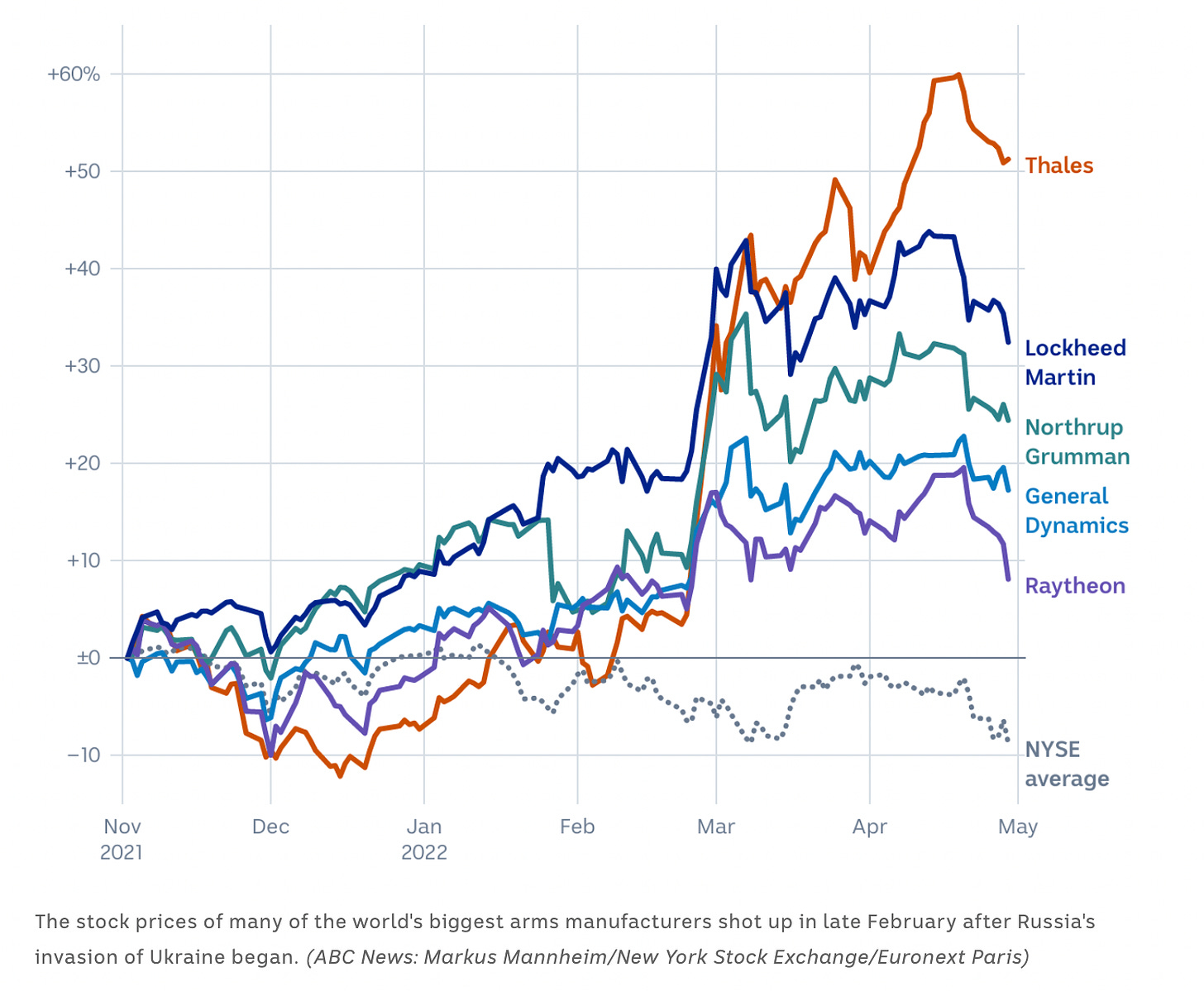
Indeed, by transferring so much military equipment to Ukraine, the U.S. has depleted its own stockpiles, necessitating their replenishment with mass government purchases. One need not be a conspiracy theorist to marvel at the great fortune of this industry, having lost their primary weapons market just eight months ago when the U.S. war in Afghanistan finally ended, only to now be gifted with an even greater and more lucrative opportunity to sell their weapons by virtue of the protracted and always-escalating U.S. role in Ukraine. Raytheon, the primary manufacturer of Javelins along with Lockheed, has been particularly fortunate that its large stockpile, no longer needed for Afghanistan, is now being ordered in larger-than-ever quantities by its former Board member, now running the Pentagon, for shipment to Ukraine. Their stock prices have bulged nicely since the start of the war:
But how does any of this benefit the vast majority of Americans? Does that even matter? As of 2020, almost 30 million Americans are without any health insurance. Over the weekend, USA Today warned of “the ongoing infant formula shortage,” in which “nearly 40% of popular baby formula brands were sold out at retailers across the U.S. during the week starting April 24.” So many Americans are unable to afford college for their children that close to a majority are delaying plans or eliminating them all together. Meanwhile, “monthly poverty remained elevated in February 2022, with a 14.4 percent poverty rate for the total US population….Overall, 6 million more individuals were in poverty in February relative to December.” The latest data from the U.S. Census Bureau found that “approximately 42.5 million Americans [are] living below the poverty line.” Americans with diabetes often struggle to buy life-saving insulin. And on and on and on.
Now, if the U.S. were invaded or otherwise attacked by another country, or its vital interests were directly threatened, one would of course expect the U.S. government to expend large sums in order to protect and defend the national security of the country and its citizens. But can anyone advance a cogent argument, let alone a persuasive one, that Americans are somehow endangered by the war in Ukraine? Clearly, they are far more endangered by the U.S. response to the war in Ukraine than the war itself; after all, a nuclear confrontation between the U.S. and Russia has long been ranked by the Bulletin of Atomic Scientists as one of the two greatest threats facing humanity.
One would usually expect the American left, or whatever passes it for these days, to be indignant about the expenditure of tens of billions of dollars for weapons while ordinary Americans suffer. But the American left, such that it exists, is barely visible when it comes to debates over the war in Ukraine, while American liberals stand in virtual unity with the establishment wing of the Republican Party behind the Biden administration in support for the escalating U.S. role in the war in Ukraine. A few stray voices (such as Noam Chomsky) have joined large parts of the international left in urging a diplomatic solution in lieu of war and criticizing Biden for insufficient efforts to forge one, but the U.S. left and American liberals are almost entirely silent if not supportive.
That has left the traditionally left-wing argument about war opposition to the populist right. “You can’t find baby formula in the United States right now but Congress is voting today to send $40 billion to Ukraine,” said Donald Trump, Jr. on Tuesday, echoing what one would expect to hear from the 2016 version of Bernie Sanders or the pre-victory AOC. “In the America LAST $40 BILLION Ukraine FIRST bill that we are voting on tonight, there is authorization for funds to be given to the CIA for who knows what and who knows how much? But NO BABY FORMULA for American mothers!” explained Rep. Marjorie Taylor Greene (R-GA). Christian Walker, the conservative influencer and son of GOP Senate candidate Herschel Walker in Georgia, today observed: “Biden should go apply to be the President of Ukraine since he clearly cares more about them than the U.S.” Chomsky himself caused controversy last week when he said that there is only one statesman of any stature in the West urging a diplomatic solution “and his name is Donald J. Trump.”
Meanwhile, the only place where dissent is heard over the Biden administration’s war policy is on the 8:00 p.m. and 10:00 p.m. programs on Fox News, hosted, respectively, by Tucker Carlson and Laura Ingraham, who routinely demand to know how ordinary Americans are benefiting from this increasing U.S. involvement. On CNN, NBC, and in the op-ed pages of The New York Times and The Washington Post, there is virtually lockstep unity in favor of the U.S. role in this war; the only question that is permitted, as usual, is whether the U.S. is doing enough or whether it should do more.
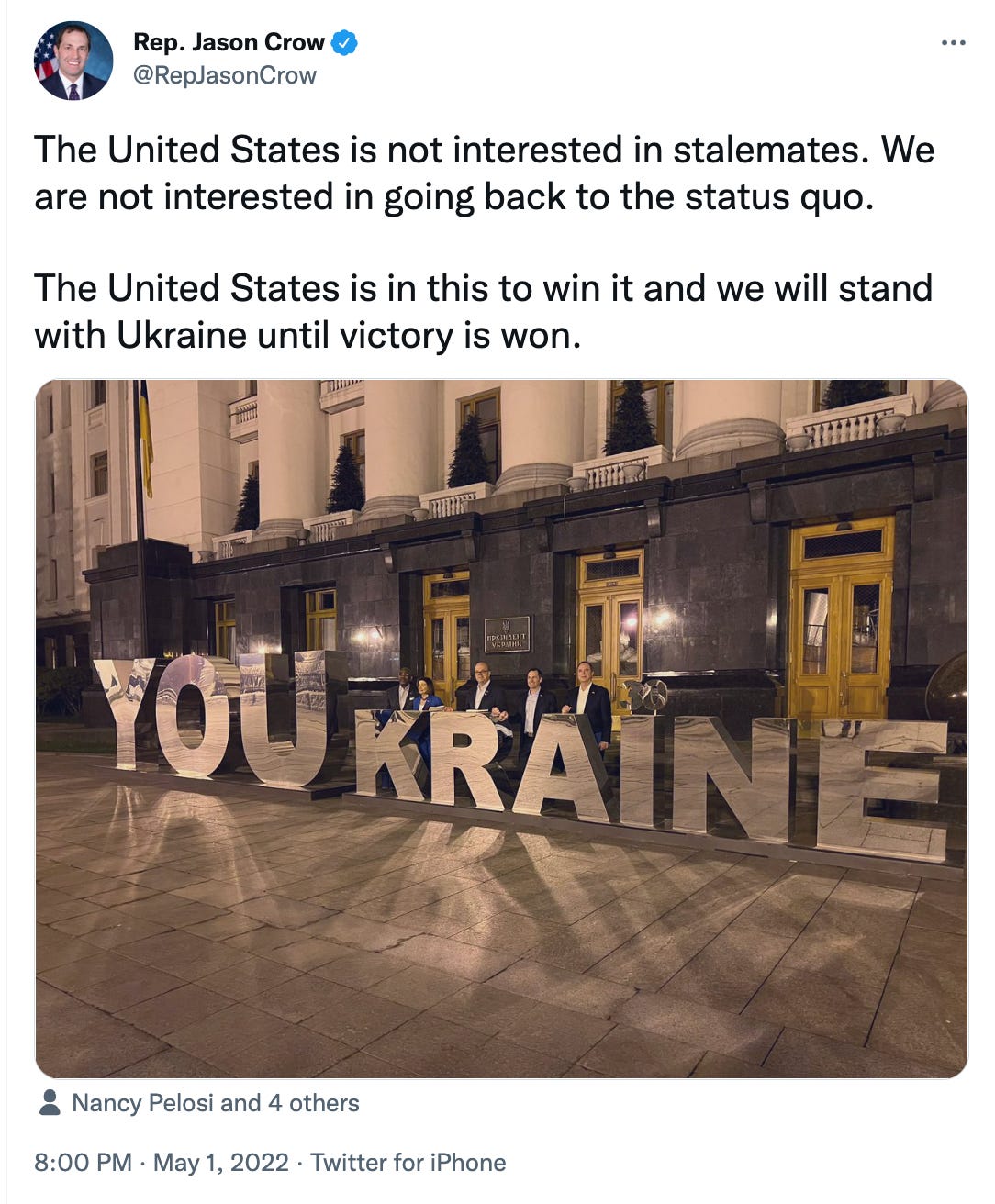
That the U.S. has no legitimate role to play in this war, or that its escalating involvement comes at the expense of American citizens, the people they are supposed to be serving, provokes immediate accusations that one is spreading Russian propaganda and is a Kremlin agent. That is therefore an anti-war view that is all but prohibited in those corporate liberal media venues. Meanwhile, mainstream Democratic House members, such as Rep. Jason Crow (D-CO), are now openly talking about the war in Ukraine as if it is the U.S.’s own:
Whatever else is true, the claim with which we are bombarded by the corporate press — the two parties agree on nothing; they are constantly at each other’s throats; they have radically different views of the world — is patently untrue, at least when it comes time for the U.S. to join in new wars. Typically, what we see in such situations is what we are seeing now: the establishment wings of both parties are in complete lockstep unity, always breathlessly supporting the new proposed U.S. role in any new war, eager to empty the coffers of the U.S. Treasury and transfer it to the weapons industry while their constituents suffer.
One can believe that Russia’s invasion of Ukraine is profoundly unjust and has produced horrific outcomes while still questioning what legitimate interests the U.S. has in participating in this war to this extent. Even if one fervently believes that helping Ukrainians fight Russia is a moral good, surely the U.S. government should be prioritizing the ability of its own citizens to live above the poverty line, have health insurance, send their kids to college, and buy insulin and baby formula.
There are always horrific wars raging, typically with a clear aggressor, but that does not mean that the U.S. can or should assume responsibility for the war absent its own vital interests and the interests of its citizens being directly at stake. In what conceivable sense are American citizens benefiting from this enormous expenditure of their resources and the increasing energy and attention being devoted by their leaders to Ukraine rather than to their lives and the multi-pronged deprivations that define them?
CORRECTION (May 10, 2022, 20:47 pm ET): This article was edited shortly after publication to reflect that Russia’s total annual military budget is $65.9 billion, not $65.9 million.
According to a readout of the call from Johnson’s office, the British leader updated Macron on his April 9 visit to Kyiv. “The Prime Minister updated on his visit to Kyiv last month and shared his conviction that Ukraine would win, supported with the right level of defensive military assistance,” the readout said.
The readout said Johnson “urged against any negotiations with Russia on terms that gave credence to the Kremlin’s false narrative for the invasion but stressed that this was a decision for the Ukrainian government.”
According to a report from Ukrainska Pravda citing sources close to Ukrainian President Volodymyr Zelensky, Johnson told the Ukrainian leader during his Kyiv visit that Russian President Vladimir Putin should be pressured, not negotiated with.
The report said that Johnson told Zelensky that “even if Ukraine is ready to sign some agreements on guarantees with Putin,” Kyiv’s Western backers are not ready. The report said Johnson’s position is that of the “collective West,” which now feels Putin is not as strong as they initially thought and see the war as an opportunity to “press him.”
The Biden administration has abandoned diplomacy with Russia and does not appear to be interested in a diplomatic solution to end the war. Secretary of State Antony Blinken hasn’t spoken with Russian Foreign Minister Sergey Lavrov since February 15, and President Biden has no known plans to hold talks with Putin.
Macron is one of the few Western leaders that has held talks with Putin since Russia invaded Ukraine and favors negotiations as a way to end the war. On Monday, he said peace would be achieved through negotiations. “We will have a peace to build tomorrow, let us never forget that … We will have to do this with Ukraine and Russia around the table. The end of the discussion and the negotiation will be set by Ukraine and Russia.”
Another western fighter goes to Ukraine and comes back describing what a disorganized shitshow it is, in contrast to the narrative of victory coming out of the Ukrainian government and western media.