All posts by natyliesb

Update on Syria

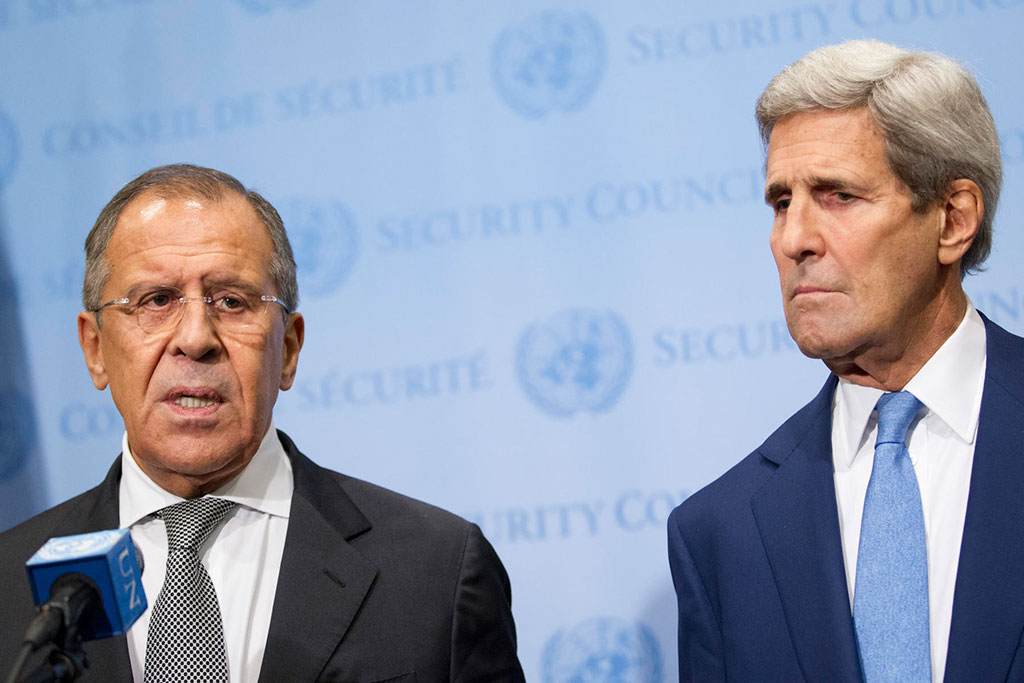
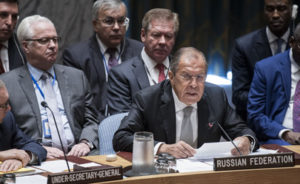
 Sergey V. Lavrov, Minister for Foreign Affairs of the Russian Federation, addresses a high-level meeting of the Security Council on the situation in Syria on Sept. 21, 2016 (UN Photo)

Sergey V. Lavrov, Minister for Foreign Affairs of the Russian Federation, addresses a high-level meeting of the Security Council on the situation in Syria on Sept. 21, 2016 (UN Photo)

Reuters reported last week that, in response to the Syrian Arab Army’s momentum (with the assistance of Russian air support) toward retaking eastern Aleppo from the “rebels,” Turkey and Saudi Arabia may consider supplying the “rebels” with MANPADS with which to shoot down aircraft.

One consequence of the latest diplomatic failure may be that Gulf Arab states or Turkey could step up arms supplies to rebel factions, including shoulder-fired anti-aircraft missiles, something the United States has largely prevented until now.

One U.S. official, speaking on the condition of anonymity to discuss American policy, said Washington has kept large numbers of such man-portable air defense systems, or MANPADS, out of Syria by uniting Western and Arab allies behind channeling training and infantry weapons to moderate opposition groups while it pursued talks with Moscow.

But frustration with Washington has intensified, raising the possibility that Gulf allies or Turkey will no longer continue to follow the U.S. lead or will turn a blind eye to wealthy individuals looking to supply MANPADS to opposition groups.

Some commentators are wondering if that sentence “something the United States has largely prevented until now” represents a veiled threat by Washington to tacitly allow such a move, thereby encouraging an escalation.

Military analyst, The Saker, explains that even this move would ultimately have only a nominal effect on the success of operations by the Syrian army and Russian military:

The effect of that will be marginal. Russian fixed-wing aircraft fly at over 5,000m where they are out of reach from MANPADs. They are currently the main provider of firepower support for the Syrians. Russian combat helicopters, while probably not immune to MANPADs, are still very resistant to such attacks due to three factors—survivability, weapons range and tactics: Mi-28s and Ka-52 have missiles with a maximum range of 10km and the way they are typically engaged is in a kind of ‘rotation’ where one helicopters flies to acquire the target, fires, immediately turns back and is replaced by the next one. In this matter they all protect each other while presenting a very difficult target to hit. Russian transport helicopters would, however, be at a much higher risk of being shot down by a US MANPAD. So, yes, if the US floods the Syrian theater with MANPADS, Syrian aircraft and Russian transport helicopters will be put at risk, but that will not be enough to significantly affect Russian or Syrian operations.

Alexander Mercouris has an excellent summary of the latest developments in Syria and how it is basically inevitable that all of Aleppo will soon be under government control again, but this would not represent full victory yet over the jihadist forces.

However, a reckless move by Washington hardliners cannot be completely ruled out as the Russian foreign ministry’s words at a press conference over the weekend are being viewed by a group of retired U.S. intelligence officers as a warning.

Veteran Intelligence Professional for Sanity (VIPS) has sent an urgent memo to President Obama urging him to take control of his subordinates in the Pentagon and State Dept. and actively de-escalate rising tensions with Russia in Syria.

We are hoping that your President’s Daily Brief tomorrow will give appropriate attention to Saturday’s warning by Russia’s Foreign Ministry spokesperson Maria Zakharova: “If the US launches a direct aggression against Damascus and the Syrian Army, it would cause a terrible, tectonic shift not only in the country, but in the entire region.”

Speaking on Russian TV, she warned of those whose “logic is ‘why do we need diplomacy’ … when there is power … and methods of resolving a problem by power. We already know this logic; there is nothing new about it. It usually ends with one thing – full-scale war.” [Zakharova is likely making reference to the leaked recording of Kerry speaking to Syrian activists reported on by the NYT in which he admits he has actively encouraged the administration behind the scenes to take more military action in Syria – NB]

We are also hoping that this is not the first you have heard of this – no doubt officially approved – statement. If on Sundays you rely on the “mainstream” press, you may well have missed it. In the Washington Post, an abridged report of Zakharova’s remarks (nothing about “full-scare war”) was buried in the last paragraph of an 11-paragraph article titled “Hospital in Aleppo is hit again by bombs.” Sunday’s New York Times totally ignored the Foreign Ministry spokesperson’s statements.

In our view, it would be a huge mistake to allow your national security advisers to follow the example of the Post and Times in minimizing the importance of Zakharova’s remarks.

Events over the past several weeks have led Russian officials to distrust Secretary of State John Kerry. Indeed, Foreign Minister Sergey Lavrov, who parses his words carefully, has publicly expressed that distrust. Some Russian officials suspect that Kerry has been playing a double game; others believe that, however much he may strive for progress through diplomacy, he cannot deliver on his commitments because the Pentagon undercuts him every time. We believe that this lack of trust is a challenge that must be overcome and that, at this point, only you can accomplish this.

It should not be attributed to paranoia on the Russians’ part that they suspect the Sept. 17 U.S. and Australian air attacks on Syrian army troops that killed 62 and wounded 100 was no “mistake,” but rather a deliberate attempt to scuttle the partial cease-fire Kerry and Lavrov had agreed on – with your approval and that of President Putin – that took effect just five days earlier.

In public remarks bordering on the insubordinate, senior Pentagon officials showed unusually open skepticism regarding key aspects of the Kerry-Lavrov deal. We can assume that what Lavrov has told his boss in private is close to his uncharacteristically blunt words on Russian NTV on Sept. 26:

“My good friend John Kerry … is under fierce criticism from the US military machine. Despite the fact that, as always, [they] made assurances that the US Commander in Chief, President Barack Obama, supported him in his contacts with Russia (he confirmed that during his meeting with President Vladimir Putin), apparently the military does not really listen to the Commander in Chief.”

Lavrov’s words are not mere rhetoric. He also criticized JCS Chairman Joseph Dunford for telling Congress that he opposed sharing intelligence with Russia, “after the agreements concluded on direct orders of Russian President Vladimir Putin and US President Barack Obama stipulated that they would share intelligence. … It is difficult to work with such partners. …”

Policy differences between the White House and the Pentagon are rarely as openly expressed as they are now over policy on Syria. We suggest you get hold of a new book to be released this week titled The General vs. the President: MacArthur and Truman at the Brink of Nuclear War by master historian H. W. Brands. It includes testimony, earlier redacted, that sheds light on why President Truman dismissed WWII hero Gen. Douglas MacArthur from command of U.N. forces in Korea in April 1951. One early reviewer notes that “Brands’s narrative makes us wonder about challenges of military versus civilian leadership we still face today.” You may find this new book more relevant at this point in time than the Team of Rivals.

The door to further negotiations remains ajar. In recent days, officials of the Russian foreign and defense ministries, as well as President Putin’s spokesman, have carefully avoided shutting that door, and we find it a good sign that Secretary Kerry has been on the phone with Foreign Minister Lavrov. And the Russians have also emphasized Moscow’s continued willingness to honor previous agreements on Syria.

In the Kremlin’s view, Russia has far more skin in the game than the U.S. does. Thousands of Russian dissident terrorists have found their way to Syria, where they obtain weapons, funding, and practical experience in waging violent insurgency. There is understandable worry on Moscow’s part over the threat they will pose when they come back home. In addition, President Putin can be assumed to be under the same kind of pressure you face from the military to order it to try to clean out the mess in Syria “once and for all,” regardless how dim the prospects for a military solution are for either side in Syria.

We are aware that many in Congress and the “mainstream” media are now calling on you to up the ante and respond – overtly or covertly or both – with more violence in Syria. Shades of the “Washington Playbook,” about which you spoke derisively in interviews with the Atlantic’s Jeffrey Goldberg earlier this year. We take some encouragement in your acknowledgment to Goldberg that the “playbook” can be “a trap that can lead to bad decisions” – not to mention doing “stupid stuff.”

Goldberg wrote that you felt the Pentagon had “jammed” you on the troop surge for Afghanistan seven years ago and that the same thing almost happened three years ago on Syria, before President Putin persuaded Syria to surrender its chemical weapons for destruction. It seems that the kind of approach that worked then should be tried now, as well – particularly if you are starting to feel jammed once again.

Incidentally, it would be helpful toward that end if you had one of your staffers tell the “mainstream” media to tone down it puerile, nasty – and for the most part unjustified and certainly unhelpful – personal vilification of President Putin.

Renewing direct dialogue with President Putin might well offer the best chance to ensure an end, finally, to unwanted “jamming.” We believe John Kerry is correct in emphasizing how frightfully complicated the disarray in Syria is amid the various vying interests and factions. At the same time, he has already done much of the necessary spadework and has found Lavrov for the most part, a helpful partner.

Still, in view of lingering Russian – and not only Russian – skepticism regarding the strength of your support for your secretary of state, we believe that discussions at the highest level would be the best way to prevent hotheads on either side from risking the kind of armed confrontation that nobody should want.

Therefore, we strongly recommend that you invite President Putin to meet with you in a mutually convenient place, in order to try to sort things out and prevent still worse for the people of Syria.

Meanwhile, Deutsche Welle is reporting that the Assad government has demanded that the “rebels” lay down their arms and surrender. They have been promised safe passage out of the combat zone if they agree.

In a statement published by the official SANA news agency, the Syrian army promised “a safe exit and access to the necessary assistance” for rebels, guaranteed by the commands of both the Syrian and Russian armies, if rebels left the besieged city of Aleppo.

The departure of the rebels was necessary for civilians “to live a normal life,” the statement added.

There was no comment from the rebel ranks.

….Syrian regime forces advanced against opposition rebels in Aleppo, state media and the Syrian Observatory for Human Rights reported.

The SANA news agency said forces loyal to President Bashar al Assad had recaptured al-Kindi Hospital and strategic hills on the northern outskirts of Aleppo.

“This advance is significant because it enables the regime to tighten the noose on opposition fighters in the city and distract their combat efforts,” said Observatory head Rami Abdel Rahman.

“The Russians have been instrumental in this advance with their intense air raids in support of the regime forces in Aleppo,” he told news agencies, adding that rebels had incurred “heavy” casualties.

According to the Russian TASS News Agency, Russian Foreign Ministesr, Sergey Lavrov, said the following after another round of phone calls with Secretary of State John Kerry:

“The agreements are now in limbo due to ambiguity on how Washington perceives the approaches of a whole number of opposition groups, militants and political opposition to the Assad regime who are rejecting or refusing to accept the Russian-U.S. deal,” Lavrov said.

As a signal of how frustrated the Russian government has become with this “ambiguity” –  and suspicions of bad faith on the part of Washington – Putin has signed a decree suspending an agreement between the U.S. and Russia over plutonium disposal.   RT reports the following:

Russia has suspended a post-Cold War deal with the US on disposal of plutonium from decommissioned nuclear warheads. The decision was explained by “the hostile actions of the US” against Russia and may be reversed, if such actions are stopped.

A decree signed by Russian President Vladimir Putin cites “the radical change in the environment, a threat to strategic stability posed by the hostile actions of the US against Russia, and the inability of the US to deliver on the obligation to dispose of excessive weapons plutonium under international treaties, as well as the need to take swift action to defend Russian security” as justification for suspending the deal.

Finally, for those interested, independent journalist Vanessa Beeley has written an extensive 2-part report on her recent trip to Aleppo. It is highly informative and includes photo documentation of the places she visited.   Read it here:

Journey To Aleppo Part I: Exposing The Truth Buried Under NATO Propaganda

and

Journey To Aleppo Part II: The Syria Civil Defense & Aleppo Medical Association Are Real Syrians Helping Real Syrians

U.S. House of Representatives Votes to Send Arms to Kiev; Russia Nears Completion of Military Base in Rostov; Attempted Coup in LPR; Russia’s Successful Eurobond Push; Tourists Consider Russia One of Safest Destinations; Moscow Surpasses NY & London in Construction

Ukrainian president Poroshenko receives the first US aircraft with armored vehicles

(Sputnik, Mikhail Palinchak)

After a recent speech by Ukrainian president Petro Poroshenko before the U.S. Congress, the House has voted in support of a bill that would provide lethal weapons to Kiev, which could provide the Ukrainian government with the means and motive to ditch the ceasefire in the Donbass and reignite fighting.  According to Sputnik:

On Thursday, Poroshenko’s wish came one step closer to becoming a reality. The draft bill of the US House-approved Stability and Democracy for Ukraine Act provides for ‘endless sanctions’ against Russia, calling for the “full implementation of the Minsk agreements” (to which Russia is not even a party) and the “restoration of Ukrainian sovereignty over Crimea.” Most significantly for Kiev, the bill also approves granting the provision of ‘lethal defensive weapons’ to Ukraine.

If approved by the Senate, the bill would land on President Barack Obama’s desk for signature. Accordingly, Russian experts are asking whether the White House would really be irresponsible enough to take such a step, which could reignite the deadly civil war that has ravaged eastern Ukraine’s Donetsk and Lugansk regions over the past two years.

…Fortunately, [Russian geo-political analyst Sergei] Markov suggested, President Obama is unlikely to sign the bill, “because he does not want to leave the Oval Office as a war president. Secondly, I think he is well aware of the ultimate futility of the adventurism of the coup in Ukraine. It was not his initiative to begin with – Vice President Joe Biden and the CIA were behind everything. Obama has long been trying to divorce himself from the subject of Ukraine.”

Meanwhile, Russia is close to completing its new military base in the Rostov region of southwest Russia, close to the Ukrainian border. Euronews reports the following:

The base consisting of three military facilities is the latest in a chain of new military sites, part of what the Kremlin sees as an important counterpoint to NATO.

Up to 10,000 service personnel are expected to be deployed at the site which will reportedly house a motorised rifle division.

And British Russia expert, Paul Robinson, discusses the relatively poor leadership of the Luhansk People’s Republic (LPR) – after an attempted coup there – compared to the Donetsk People’s Republic (DPR), and the possible implications for the future of the Donbass region.

This week there was a failed coup in the Lugansk People’s Republic (LPR), and one of the alleged coup leaders has committed suicide in a Lugansk jail. As I have said before, a key issue in determining the outcome of the conflict in Ukraine will be the extent to which the governments in Kiev and the rebel republics are able to turn the areas they control into models of good governance and prosperity. With the events in Lugansk in mind, how are they are getting on?

….How about the situation on the rebel side?

Of the two rebel republics, the Donetsk People’s Republic (DPR) has always seemed like the better governed, and its leader, Alexander Zakharchenko, has a charisma that the LPR’s leader, Igor Plotnitsky, entirely lacks. Recent reports from Donetsk suggest that the DPR is doing about as well as could realistically be expected for a small region in which the state entirely disintegrated two years ago, and which is cut off from the most of the world and forced to spend its limited resources on fighting a war. In a recent report for Meduza, a media outlet not by inclination favourable to the Donbass rebels, journalist Nigina Boroeva wrote the following about a trip she made to Donetsk:

The streets are quiet, cozy, and clean: the locals say the city has never been so well-kept, not even before the war. … The main boulevard is packed with glamorous coffee shops. … A private entrepreneur named Roman … says that some residents have even regained their cars, which were seized two years ago. ‘The courts are overloaded with cases, but rulings are being made and implemented,’ Roman says. … The businessman complains, however, that a stronger presence of the law has a downside, too: ‘In Russia, if you break the rules, you bribe the traffic cop and drive on. As for our inspectors, they are afraid to take bribes now.’

By contrast, the LPR appears to be bedevilled by corruption and political scandals. In 2014, self-styled Cossacks (some local, others from Russia), played an important part in the rebellion in the LPR. The regions under their control became notorious for banditry, and the Cossack leaders zealously defended their autonomy against any attempts to centralize power. The result was a series of violent power struggles, which resulted in the assassination of several prominent rebel leaders. Eventually, with Moscow’s support, Plotnitsky got the upper hand, but it would appear that attempts to concentrate power in the hands of the state authorities have been much less successful in Lugansk than in Donetsk.

*****************

St. Basil's Cathedral, Red Square, Moscow
St. Basil’s Cathedral, Red Square, Moscow

Russia has achieved their goal of placing a Eurobond worth a total of $3 billion in 2 installments, the latter achieved more successfully due to Russian bank VTB’s newfound confidence and experience after the first round earlier in the year.  As Alexander Mercouris explains:

Today what VTB – the Russian bank that is now in charge of placing bonds internationally for the Russian government – said would happen in May, is actually taking place.  The Russians have offered more bonds to the value of $1.25 billion, bringing the total of bonds they have offered this year up to the amount of $3 billion they said they would offer at the start of the year.

Moreover with the question of the provision of depository services by Euroclear and presumably Clearview now resolved in Russia’s favour, there should be no further difficulties with this bond.  Even Timothy Ashe – never an analyst to take an unduly positive view of events concerning Russia – is admitting that “Euroclear’s acceptance should make the latest issue easier”.

As it happens reports are circulating that just a few hours after it was placed the bond had already attracted bids worth $3 billion i.e. it is already more than twice over-subscribed.

As to why the Russians chose to raise $3 billion this year through two offerings of $1.75 billion and $1.25 billion rather than one, the answer as I said in May is almost certainly the inexperience of VTB and its sales team.  Here is what I said about that in May

“Placing a government bond is a massively complex operation.  It is the job of the banks that manage the sale to place the bonds most advantageously on the market.  That requires deep knowledge of the market in order to achieve the most effective outreach to potential buyers.  There are also immense technical challenges in receiving and processing the bids, in deciding amongst them if the issue is oversubscribed, and in transferring the bonds to the buyers.

A small number of Western banks have the necessary expertise to carry out such operations and do so with great efficiency.  By contrast Russian banks like Sberbank and VTB have little such experience since by comparison with Western banks they are relatively small and have far shorter trading histories.

The reason the decision was taken to offer bonds worth only $1.75 billion for sale instead of the full $3 billion talked about was almost certainly VTB’s inexperience in managing such a sale, not worries about a lack of buyers.  The same was almost certainly true of the decision to conduct the sale over 2 days rather than one.  The total bids on the first day apparently came to $5 billion so it cannot have been worries about lack of buyers on the first day that lay behind these decisions. However limiting the offering to $1.75 billion instead of $3 billion and holding the sale over 2 days rather than one is precisely the sort of step that is sensibly taken in order to reduce the pressure on an inexperienced bank and its sales team so as to avoid mistakes.”

The fact the latest bond was offered with no advance publicity – in sharp contrast to what happened with the previous issue earlier this year – shows that VTB is gaining in experience and confidence.

Russia is also enjoying a healthy tourism industry, as originally reported in the Russian daily, Izvestia:

The increase was mostly due to tourists from Asia and Southern Europe, the Federal Tourism Agency told Izvestia, with Russia considered the safest destination.

According to estimates by the Deputy Head of the Federal Tourism Agency Sergei Korneev, Russia  is among the top ten most visited countries. In 2015, almost 27 million foreign tourists visited Russia, and it is expected that about 1.5 million people will come for the 2018 FIFA World Cup.

Indeed, Russia’s medical tourism is also on the rise as more westerners become aware of quality health care available for a lower price.  All of this, of course, brings in revenue to the country. Russia Beyond the Headlines reports:

The number of foreigners coming to the country as medical tourists is on the rise, and has brought the state billions of rubles in extra revenue, according to Igor Lanskoi, advisor to the Russian health minister, who spoke about the phenomenon in an interview with the business daily Kommersant.

He noted that last year such travelers added from 7 to 10 billion rubles ($108-154 million) to the state budget. Earlier, Health Minister Veronika Skvortsova said that in 2015 the number of foreigners who underwent treatment in Russia increased fourfold in respect to 2014.

Before, only citizens from the ex-Soviet republics would come to Russia to improve their health but now Americans are also becoming more and more interested in Russian treatments, according to David Melik-Guseinov, director of the Federal Research Institute for Health Organization.

….Experts surveyed by Kommersant FM underline that foreign demand for Russian medicine is growing because of the weak ruble. Treatment and the accompanying services in the country are now four times as cheap as they are in the West, said Yakov Margolin, general director of the Clinical Hospital in Yauza.

“When someone wants to undergo treatment in his own country but his insurance doesn’t cover it, he gets angry and chooses to come to Russia since here he can receive the same medical services at a much lower price, especially outside Moscow. We have unique services for which people come to us, services in reproductive medicine, in which for relatively little money we solve serious problems, helping people have children,” explained Margolin.


New Evidence Emerges that Strike on UN Convoy Not by Russian or Syrian Air Power; Lavrov Expresses Impatience with Washington’s Game of Not Separating “Moderates” from Al-Nusra; Kerry Continues Habit of Sticking Foot in Mouth

Syria ceasefire is 'not dead' insists Kerry, despite attack on aid convoy

(http://www.euronews.com/2016/09/21/syria-ceasefire-is-not-dead-insists-kerry-despite-attack-on-aid-convoy)

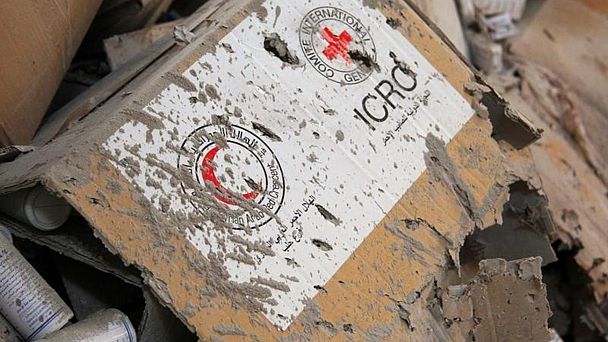
A deadly attack on a UN aid relief convoy near Aleppo, on September 19th, was initially reported as an airstrike and blamed by Washington, particularly Secretary of State John Kerry, on Syria and/or Russia.  However, the UN was later forced to admit that it could not confirm if, in fact, an airstrike was responsible for the attack.   The Duran provided the following details, including the response from the Russian Defense Ministry:

Russia has laid out its evidence that the Russian air force (and by extension the Syrian air force) could not have taken part in the attack on the UN convoy.

The UN has since retracted from saying the convoy was attacked from the air, which reinforces the narrative that the convoy may have been a false flag operation orchestrated by US backed “moderate rebels” from the ground.

….The Russian Defense Ministry has released data showing that a US coalition drone was in the vicinity of the humanitarian convoy when it was attacked outside Aleppo.

The Russian military has revealed that the unmanned aircraft was a Predator drone, equipped with hellfire missiles.

Russian Defense Ministry spokesman Igor Konashenkov laid out the evidence…

“On the evening of September 19, in that specific region, a drone belonging to the international condition, which had taken off from the Incirlik air base in Turkey, was flying at a height of 3,600 meters and traveling at around 200 kilometers per hour.”

“The object was in the area around the town of Urm Al-Kubra, where the convoy was a few minutes before it caught fire.”

“It left after about 30 minutes.”

“Only the owners know what exactly the drone was doing at this particular area at that exact time.”

The owners being the USA…which will now need to explain why its drone was over the UN convoy when it was attacked.

Did it do the attacking with hellfire missiles? Did it provide intelligence to “moderate rebels” who did the attacking? We have many questions that need answering, which only American intelligence can answer.

Military analyst and blogger, Moon of Alabama, has written about which of the parties in Syria had a more credible motive for attacking the convoy:

Why would the Syrian Air Force attack the Syrian Red Crescent with which it has good relations and which also works in all government held areas? Why would the Syrian or Russian forces attack a convoy which earlier had passed through government held areas and checkpoints and was thereby not carrying contraband? I find no plausible reason or motive for such an attack. Nor has anyone else come forward with such.

A few days ago the “rebels” had accused the UN, which had goods on the convoy, of partisanship and said they would boycott it. “Rebels” in east Aleppo had demonstrated against UN provided help and said they would reject it. There was a general rejection of the ceasefire by the “rebels” and they were eager to push for a wider and bigger war against Syria and its allies. Al-Qaeda in Syria even made a video against the ceasefire. A part of the ceasefire deal is to commonly fight al-Qaeda. They naturally want the deal to end. The attack on the aid convoy seems to help their case.

The motive argument makes an attack by the “rebels” plausible and an attack by Syria and its allies implausible.

Russian Foreign Minister, Sergei Lavrov, at a UN Security Council meeting last week, called for an impartial and independent investigation into the attack on the aid convoy.  To further let Washington know that Moscow is on to its skulduggery in Syria, Lavrov also stated that Russia would no longer make concessions unless Washington demonstrated concretely that it was separating “moderate rebels” from terrorist organizations like Al-Nusra and its myriad aliases.

Russia will “no longer take seriously” requests that its own or Syrian forces make unilateral concessions regarding the ceasefire, without the Western coalition providing proof it’s trying to separate moderates from terrorists, the foreign minister said.

In an extensive interview with Russia TV’s Vesti v Subbotu (News on Saturday), Sergey Lavrov reiterated that “the revival of the ceasefire is possible exclusively on collective basis.” If the US and its coalition partners fail to provide credible proof that they have “a sincere intention” to dissociate terrorists from the so-called moderate opposition “our suspicions that this all is being done to take the heat off Al-Nusra Front will strengthen.” 


The events of the past few days, however, showed the reverse trend, as more rebel groups started merging with Al-Nusra Front, Lavrov said, citing a statement from Russia’s General Staff.

One of such radical groups close to Al-Nusra Front is Ahrar Al-Sham, which refused to adhere to the Russia-US agreement as the deal targets its ally, Lavrov said. Russia has been demanding it be designated terrorist for a long time, to little effect. 

“If everything again boils down to asking Russia’s and Syria’s Air Forces to take unilateral steps – such as, ‘Give us another three- or four-day pause and after that we will persuade all opposition groups that this is serious and that they must cut ties with Al-Nusra Front’ – such talk will not be taken seriously by us anymore,” the Russian FM said.

Robert Parry at Consortium News pointed out that Kerry’s shoot-from-the-hip pronouncements about Syrian or Russian responsibility for war crimes prior to any meaningful investigation is a disturbing pattern:

Eager to go on the propaganda offensive – especially after a U.S. military airstrike last Saturday killed scores of Syrian soldiers who were battling the Islamic State in eastern Syria – Kerry pounced on an initial report that the attack on the convoy on Monday was an airstrike and then insisted that the Russians must have been responsible because one of their jets was supposedly in the area.

Secretary of State John Kerry (right) and Russian Foreign Minister Sergey Lavrov. (U.N. photo)

Secretary of State John Kerry (right) and Russian Foreign Minister Sergey Lavrov. (U.N. photo)

But the United Nations – and I’m told CIA analysts – have not ruled out the possibility that the convoy was instead hit by a surface-to-surface missile. On Friday, a source briefed by U.S. intelligence said one fear is that the jihadist group, Ahrar al-Sham, which has fought alongside Al Qaeda’s Nusra Front but is deemed to be part of the “moderate” opposition, may have used a U.S.-supplied TOW missile in the attack.

Ahrar al-Sham, like some other jihadist groups seeking to overthrow the Syrian government, has objected to limited cease-fires arranged by the Russians and the Americans, which still allowed attacks on its ally, the recently rebranded Nusra Front. Ahrar al-Sham thus had a motive for destroying the aid convoy, an act which indeed has upended efforts to negotiate an end to the five-year-old conflict and led to bloody new attacks inside the embattled city of Aleppo on Friday.

Another possibility was that a Syrian government warplane was targeting a rebel artillery piece traveling alongside the convoy and struck the convoy by accident. But the assignment of blame required additional investigation, as other international officials acknowledged.

On Tuesday, a day before Kerry’s outburst, the U.N. revised its initial statement citing an airstrike, with Jens Laerke, a humanitarian affairs representative for the U.N., saying: “We are not in a position to determine whether these were in fact airstrikes. We are in a position to say that the convoy was attacked.” He called the earlier reference to an airstrike a drafting error.

Nevertheless, on Wednesday, Kerry made his high-profile denunciation of the Russians at the U.N. Security Council, the same venue where Secretary of State Colin Powell in 2003 presented a false case against Iraq for possessing hidden stockpiles of WMD. In fiery comments, Kerry accused Russian Foreign Minister Sergey Lavrov of living “in a parallel universe” in denying Russian responsibility.

“The eyewitnesses will tell you what happened,” Kerry said. “The place turned into hell and fighter jets were in the sky.”

Yet, the two points don’t necessarily connect. Just because there are jets in the sky doesn’t mean they fired the rocket that struck the convoy. They might have, but to determine that – and if so, who was flying the jet that fired the missile – requires more thorough study.

Kerry also sought to excuse the U.S. airstrike near Deir ez-Zor last Saturday that killed some 62 Syrian soldiers, saying: We did it, a terrible accident. And within moments of it happening, we acknowledged it. … But I got to tell you, people running around with guns on the ground, from the air, is a very different thing from trucks in a convoy with big U.N. markings all over them.”

But what Kerry ignored was the fact that the United States has no legal authority to be conducting military operations inside Syria, attacks supposedly targeting the terrorist Islamic State but lacking the approval of the Syrian government. In other words, under international law, any such U.S. attacks are acts of aggression and thus war crimes.

….Kerry also has a history of jumping ahead of a story and then going silent when further information is developed.

Read the full article here.

U.S. Military Bombs Syrian Army; FSA Chases American Special Forces Out of Syrian Town; Russian Embassy in Kiev Attacked

(A U.S. Air Force F-15 fighter jet takes off from Incirlik Air Base in Turkey on Dec. 15, 2015. U.S.-led coalition bombers killed an estimated 90 soldiers of the Syrian Army on Saturday, claiming they mistakenly thought they were Islamic State fighters. (Photo: Associated Press))

The U.S.-led coalition bombed an area near the Deir al-Zor airport in eastern Syria on Saturday, killing between 62 and 90 Syrian army soldiers, with over 100 wounded.  Washington claims it bombed the Syrian army by mistake, but as some analysts have pointed out, although circumstances on the ground in other parts of Syria are complicated with many different players active, this area of Syria only consisted of ISIS fighters and members of the Syrian army who had kept ISIS at bay near the airport.  Given the detailed level of surveillance that the U.S. government is capable of, it strains credulity to think that they could make this kind of blunder.

In any event, the bombing of the Syrian army has had an effect that ISIS has been unable to achieve with offensive actions in the area over an extended period of time – strengthening their position around the airport.

Furthermore, the recent diplomatic deal reached by the U.S. and Russia required the grounding of the Syrian air force.  If this is what the Syrian government gets for grounding its own air force in its own country – only to be bombed by a nation that is violating its sovereignty to begin with – it does not bode well for the overall deal.

Common Dreams News provided the following details on this latest crisis:

Early reporting indicated that between 62 and 90 Syrian troops may have been killed in the U.S.-led airstrikes. The Syrian Observatory for Human Rights, a UK-based monitoring group with contacts across Syria, cited sources at the airport saying at least 90 Syrian soldiers had been killed and 120 wounded. Meanwhile, Anti-War.com‘s Jason Ditz described the massacre as perhaps “the single biggest blunder of the entire US war in Syria.”

A statement released by U.S. Central Command acknowledged that airstrikes had been carried out in the area claiming coalition aircraft believed they were targeting ISIS units, but said the bombing was “halted immediately when coalition officials were informed by Russian officials that it was possible the personnel and vehicles targeted were part of the Syrian military.”

The mass-casualty bombing comes less than a week after the start of a cease fire brokered by the U.S. and Russia whose stated purpose was to allow aid convoys to reach besieged areas while also separating various rebel factions in hopes that further progress could be made towards longer-term political negotiations.

According to Ditz’s analysis, the errant bombing and killing of 90 soldiers “during a ceasefire may not be the worst of the story, incredibly enough”—explaining:

Those troops had been defending the area from ISIS, who quickly overran what was left of the base’s defenses, and are now even closer to the Deir [Al-Zor] airport.

The airport has been one of the last major government holdouts in the Deir Ezzor capital, and at times the Syrian warplanes flying out of the airport were the only thing keeping ISIS from overrunning the entire eastern half of the country. The US airstrikes seriously softened up the defenses in the area, and might finally do what years of ISIS offensives couldn’t, put ISIS in control of the airport.

Experts who spoke to the New York Times also expressed worry about the diplomatic and on-the-ground implications of the attack:

Aaron David Miller, a Middle East analyst at the Wilson Center, said the episode was certain to make “an already complex situation more byzantine.”  He said the strikes would “feed conspiracy theories that Washington is in league with ISIS,” as well as create a pretext for Mr. Assad to avoid his commitments under the cease-fire deal.

Mr. Miller added that the episode would create opportunities for President Vladimir V. Putin of Russia “to blast the U.S. on the eve of the U.N. General Assembly,” the global meeting in New York starting this week.

In a statement from its foreign office, the Russian government reacted harshly to the U.S. attack, saying the airstrikes were “on the boundary between criminal negligence and direct connivance with Islamic State terrorists.”

The statement continued, “If this air strike was the result of a targeting error, it is a direct consequence of the U.S. side’s stubborn unwillingness to coordinate its action against terrorist groups on Syrian territory with Russia.

Russia called for an emergency closed session of the UN Security Council in response to the bombing.  The Guardian reported the following on the meeting as well as the heated exchange of barbs by U.S. ambassador to the U.N. Samantha Power and the Russian envoy Vitaly Churkin:

The US and Russia on Saturday clashed at the United Nations over the bombing when the US ambassador to the UN, Samantha Power, described Russia’s call for an emergency closed-door security council meeting over the incident a “stunt” that was “uniquely cynical and hypocritical”. She said Russia had for years blocked UN punitive measures against the Syrian regime of Bashar al-Assad for the barrel bombing of civilian populations in rebel-held cities.

“Since 2011, the Assad regime has been intentionally striking civilian targets with horrifying, predictable regularity … And yet in the face of none of these atrocities has Russia expressed outrage, nor has it demanded investigations, nor has it ever called for a Saturday night emergency consultation in the Security Council,” she said.

After the meeting went ahead, the Russian envoy to the UN, Vitaly Churkin, declared that in his decades as a diplomat he had “never seen such an extraordinary display of American heavy-handedness as we are witnessing today” after the meeting went ahead.

He said that if Power’s actions were any indication of Washington’s possible reaction then the cease-fire agreement is “in serious trouble” but expressed hope the US would convince Moscow it was serious about finding a political solution in Syria and fighting terrorism.

Churkin said the timing of the US airstrike was “frankly suspicious” as it came two days before the US and Russia were supposed under the ceasefire agreement to begin joint planning for air operations against Isis and the former Nusra front, Jabhat Fatah al-Sham, deemed to be terrorist groups by both states.

In another incident exposing Washington’s ludicrous policy in Syria, American special forces were chased out of a northern Syrian town by member of the so-called “Free Syria Army” – keep in mind, these are supposed to be the good guys according to Washington bobble-heads.

***********

People protest against Russian plans to hold parliamentary elections in Crimea near the Russian embassy in Kiev, Ukraine, September 17, 2016. (Photo by Reuters)


In Ukraine, a band of hooligans attacked the Russian embassy in an effort to prevent any Russian citizens from entering the embassy to cast votes for the parliamentary elections that were scheduled in Russia on Sunday.   No one was hurt and there was no major damage as a result of the incident.

More from Press TV:

About 20 unidentified Ukrainians, wearing balaclavas, lobbed scores of fireworks at the embassy building during the early hours of Saturday. They chanted, “There will be no elections,” while holding a banner reading, “Fireworks today, Grad (multiple rocket launchers) tomorrow.”

No arrests or damage have been reported.

On Sunday, polling stations will open across Russia for local parliamentary elections, which are held every five years. Russia previously announced that its citizens in Kiev would also be able to cast their ballots at a polling station at its embassy as well as other diplomatic missions in Ukraine.

However, what most of all has angered the government in Kiev is Moscow’s decision to open polling stations in the Crimean Peninsula for the first time since it rejoined the Russian Federation in 2014. Ukrainian authorities have repeatedly rejected Moscow’s plan, saying they would not recognize such elections in Crimea.

Russia Complains That Washington is Not Keeping its End of Syria Deal, Pushes for Publication of Terms; How Many Times Will NYT & Other MSM Outlets Make Suckers Out of Their Readers About Washington’s Wars?

Fighters seeking the overthrow of Syrian government (Ammar Abdullah, Reuters )

Fighters seeking the overthrow of Syrian government (Ammar Abdullah, Reuters)


Sadly, but not surprisingly, the deal reached by the U.S. and Russia on Syria last week, appears to be faltering.  Russian media, quoting the Russian military, reports that the U.S. is still not following through on its promises to separate out the “moderate” opposition from Al-Nusra (which has recently changed its name).  RT reported the following on September 15th:

Russia says the U.S. is not keeping its end of the bargain on the Syrian ceasefire and has continued its calls for Washington to make public all documents relating to the deal. The Russian military says Damascus is the only party observing the agreement.

“On the third day of the ceasefire only the Syrian Army is observing it. Meanwhile, the U.S.-led ‘moderate rebels’ are intensifying the shelling of residential areas,” Russian Defense Ministry spokesman Igor Konashenkov said on Thursday.

The ministry said in a press briefing that “new conflict flashpoints are appearing” and that government forces and civilians had been shot at 45 times over the past 24 hours, without firing back.

The military added that the U.S. failed to deliver on its promise to separate truce-observing moderates and truce-violating terrorists and is now “apparently trying to use a smoke-screen to cover up the violations of their part of the deal.”

The ministry called on the Pentagon to hand over up-to-date and detailed information about the location of the various factions in the conflict.

….Earlier, the U.S. said that both Damascus and the rebels were reported as violating the ceasefire, which began on Monday. Washington acknowledges its responsibility to stop violations committed by the anti-government forces.

“We’ve always been clear, just as we have said that Russia’s responsibility is to exert influence or put pressure – however you want to put it – on the regime to abide by the cessation of hostilities, it is incumbent on us to persuade, convince the moderate opposition to also abide by the cessation of hostilities, and ultimately, that’s a decision they’re going to have to make,” U.S. State Department spokesman Mark Toner said Wednesday.

“We’re continuing our outreach to the Syrian moderate opposition – that’s been ongoing – and trying to explain the arrangement to them, answer their questions. And again, we’ve seen, as I said, sporadic reports of violence, but in large part we think [the ceasefire] is holding,” he added.

Alexander Mercouris writes over at The Duran:

Various Jihadi groups are refusing to dissociate themselves from Jabhat Al-Nusra.  Though there appears to have been a falling off in the fighting, some fighting is still taking place, and Russian troops on the Castello road have been caught on film coming under fire.  [Russia’s TASS news agency had reported on the 13th that Russian marines had taken up positions on Castello Road – the supply route used by the rebels/terrorists from the north – which had recently been taken by the Syrian army, in an effort to implement the apparent ceasefire terms requiring Damascus to pull back and allow the set up of humanitarian corridors enabling the exit of civilians and rebels willing to lay down their arms – NB]

The Russians are complaining that the US is still not providing information on Jabhat Al-Nusra that it promised, and has failed to force the Jihadi groups it sponsors to dissociate themselves from Jabhat Al-Nusra and to observe the ceasefire.

Meanwhile the air is thick with arguments about the provision of humanitarian aid to Jihadi controlled eastern Aleppo.  Jihadi groups are blocking the aid the UN is providing, complaining that it is not what they want, and because they say they reject the US – Russian agreement under which it is being provided, whilst the UN – entirely predictably – is blaming the Syrian government.  Needless to say there is no sign of any withdrawal of Jihadi fighters from eastern Aleppo by way of the Castello road.

In the midst of all these charges and counter charges the Russians are calling for the text of the agreement with the US to be published whilst the US is saying no – a fact which incidentally all but confirms that it was the US that made the major concessions in order to reach the agreement. 

Not only is Russia now requesting that the terms of the Syria deal be made public so as to subject it to better accountability, but Moscow is also moving to have it officially backed by a UN Security Council resolution, according to Reuters:

UNITED NATIONS- Russia is pushing for the United Nations Security Council to adopt a draft resolution next week endorsing a Syria ceasefire deal agreed by Moscow and Washington, Russia’s U.N. Ambassador Vitaly Churkin said on Thursday.

The deal reached on Saturday, September 10 aims to put Syria’s peace process back on track. It includes a nationwide truce that started at sundown on Monday, improved humanitarian aid access and joint military targeting of banned Islamist groups.

Russian Foreign Minister Sergei Lavrov and U.S. Secretary of State John Kerry agreed on five documents, which they said would not be publicly released. However, on Thursday, France called on Washington to share details of the deal.

Churkin said Russia was working on a draft Security Council resolution that would endorse the deal. When asked if the deal would need to be annexed to such a resolution, he said: “We don’t know yet.”

“We’re working on it … I think we need to adopt it on the 21st (of September), this would make sense,” Churkin told reporters.

The 15-member Security Council is due to hold a high-level meeting on Syria next Wednesday during the annual gathering of world leaders at the United Nations. Kerry and Lavrov are expected to attend, diplomats said.

Note that France has now joined in the call for the terms of the deal to be made public.   On that note, some more details have come out about the deal, including some of the concessions made by each side and what steps Washington has made to attempt to separate the “moderates” from Al-Nusra (whatever name the Al Qaeda backed organization is going by nowadays).  Gareth Porter, an independent journalist and expert on the Middle East, who has done some excellent reporting on both Syria and Iran over the past few years, has reported the following:

The new bargain is actually a variant of a provision in the Feb. 27 ceasefire agreement: in return for Russian and Syrian restraints on bombing operations, the United States would prevail on its clients to separate themselves from their erstwhile Al Qaeda allies.

But that never happened. Instead the U.S.-supported groups not only declared publicly that they would not honor a “partial ceasefire” that excluded areas controlled by Al Qaeda’s affiliate, then known as Nusra Front, but joined with Nusra Front and its close ally, Ahrar al Sham, in a major open violation of the ceasefire by seizing strategic terrain south of Aleppo in early April.

….As the Kerry-Lavrov negotiations on a ceasefire continued, Kerry’s State Department hinted that the U.S. was linking its willingness to pressure its Syrian military clients to separate themselves from Al Qaeda’s forces in the northwest to an unspecified Russian concession on the ceasefire that was still being negotiated.

It is now clear that what Kerry was pushing for was what the Obama administration characterized as the “grounding” of the Syrian air force in the current agreement.

Now that it has gotten that concession from the Russians, the crucial question is what the Obama administration intends to do about the ties between its own military clients and Al Qaeda in Aleppo and elsewhere in the northwest.

Thus far the primary evidence available for answering that question is two letters from U.S. envoy to the Syrian opposition Michael Ratney to opposition groups backed by the United States. The first letter, sent on Sept. 3, after most of the Kerry-Lavrov agreement had already been hammered out, appears to have been aimed primarily at reassuring those Syrian armed groups.

As translated by al-Monitor, it asserted, “Russia will prevent regime planes from flying, and this means there will not be bombing by the regime of areas controlled by the opposition, regardless of who is present in the area, including areas in which Jabhat Fateh al Sham [the new name adopted by Al Qaeda’s Nusra Front] has a presence alongside other opposition factions.”

Ratney confirmed that the U.S. would in return “offer Russia coordination from our side to weaken al Qaeda.” But he also assured U.S. clients that their interests would be protected under the new agreement.

“[W]e believe this ceasefire should be stronger,” he wrote, “because it should prevent Russia and the regime from bombing the opposition and civilians under the pretext that its striking Jabhat al Nusra.”

The Ratney letter makes no reference to any requirement for the armed opposition to move away from their Al Qaeda allies or even terminate their military relationships, and thus implied that they need not do so.

But in a follow-up letter, undated but apparently sent on Sept. 10, following the completion of the new Kerry-Lavrov agreement, Ratney wrote, “We urge the rebels to distance themselves and cut all ties with Fateh of Sham, formerly Nusra Front, or there will be severe consequences.”

The difference between the two messages is obviously dramatic. That suggests that one of the last concessions made by Kerry in the Sept. 9 meeting with Lavrov may have been that a message would be sent to U.S. military clients with precisely such language.

The totality of the two letters from Ratney underlines the reluctance of the United States to present an ultimatum to its Syrian clients, no matter how clearly they are implicated in Al Qaeda operations against the ceasefire. Last spring, the State Department never publicly commented on the participation by the U.S.-supported armed groups in the Nusra Front offensive in violation of the ceasefire agreement, effectively providing political cover for it.

***********

Ousted Libyan leader Muammar Gaddafi shortly before he was murdered on Oct. 20, 2011.

(Ousted Libyan leader Muammar Gaddafi shortly before he was murdered on Oct. 20, 2011.)

Robert Parry at Consortium News has written another critical piece, this time discussing a little-talked about report undertaken by Britain’s Foreign Affairs Committee, which exposes the lies and exaggerations about Qaddafi’s actions used to justify NATO’s regime change in Libya in 2011:

The report from the U.K.’s Foreign Affairs Committee confirms that the U.S. and other Western governments exaggerated the human rights threat posed by Libyan leader Muammar Gaddafi and then quickly morphed the “humanitarian” mission into a military invasion that overthrew and killed Gaddafi, leaving behind political and social chaos.

The report’s significance is that it shows how little was learned from the Iraq War fiasco in which George W. Bush’s administration hyped and falsified intelligence to justify invading Iraq and killing its leader, Saddam Hussein. In both cases, U.K. leaders tagged along and the West’s mainstream news media mostly served as unprofessional propaganda conduits, not as diligent watchdogs for the public.

….According to the new U.K. report on Libya, Britain’s military intervention – alongside the U.S. and France – was based on “erroneous assumptions and an incomplete understanding” of the reality inside Libya, which included a lack of appreciation about the role of Islamic extremists in spearheading the opposition to Gaddafi.

In other words, Gaddafi was telling the truth when he accused the rebels around Benghazi of being penetrated by Islamic terrorists. The West, including the U.S. news media, took Gaddafi’s vow to wipe out this element and distorted it into a claim that he intended to slaughter the region’s civilians, thus stampeding the United Nations Security Council into approving an operation to protect them.

That mandate was then twisted into an excuse to decimate Libya’s army and clear the way for anti-Gaddafi rebels to seize the capital of Tripoli and eventually hunt down, torture and murder Gaddafi.

Yet, there was evidence before this “regime change” occurred regarding the extremist nature of the anti-Gaddafi rebels as well as those seeking to overthrow Bashar al-Assad in Syria. As analysts Joseph Felter and Brian Fishman wrote in a pre-Libya-war report for West Point’s Combating Terrorism Center, “the Syrian and Libyan governments share the United States’ concerns about violent salafist/jihadi ideology and the violence perpetrated by its adherents.”

In the report entitled “Al-Qaeda’s Foreign Fighters in Iraq,” Felter and Fishman also analyzed Al Qaeda’s documents captured in 2007 showing personnel records of militants who flocked to Iraq for the war. The documents revealed that eastern Libya (the base of the anti-Gaddafi rebellion) was a hotbed for suicide bombers traveling to Iraq to kill American troops.

….This reality was known by U.S. officials prior to the West’s military intervention in Libya in 2011, yet opportunistic politicians, including Secretary of State Clinton, saw Libya as a stage to play out their desires to create muscular foreign policy legacies or achieve other aims.

Some of Clinton’s now-public emails show that France’s President Nicolas Sarkozy appeared to be more interested in protecting France’s financial dominance of its former African colonies as well as getting a bigger stake in Libya’s oil wealth than in the well-being of the Libyan people.

An April 2, 2011 email from Clinton’s personal adviser Sidney Blumenthal explained that Gaddafi had plans to use his stockpile of gold “to establish a pan-African currency” and thus “to provide the Francophone African Countries with an alternative to the French franc.”

Blumenthal added, “French intelligence officers discovered this plan shortly after the current rebellion began, and this was one of the factors that influenced President Nicolas Sarkozy’s decision to commit France to the attack on Libya.” Another key factor, according to the email, was Sarkozy’s “desire to gain a greater share of Libya oil production.”

For Clinton, a prime motive for pushing the Libyan “regime change” was to demonstrate her mastery of what she and her advisers called “smart power,” i.e., the use of U.S. aerial bombing and other coercive means, such as economic and legal sanctions, to impose U.S. dictates on other nations.

Parry goes on to explain how Washington policymakers have apparently learned nothing from the chaos and humanitarian disasters they have created with their regime change operations, continuing with a reckless propaganda campaign against Russian President Vladimir Putin – part of the pattern in the run-ups to regime change operations against foreign governments that do not bow to Washington’s dictates.   The fact that Russia represents the world’s other nuclear super-power is not serving as a deterrent in this regard.

For more on the lies and propaganda peddled by the western corporate media and certain mainstream human rights organizations, which enabled the war against Libya, please see the Harvard Belfer Center’s report, Lessons from Libya: How Not to Intervene.

http://belfercenter.ksg.harvard.edu/publication/23387/lessons_from_libya.html

Finally, military analyst and blogger, Moon of Alabama, has exposed the New York Times‘ pathetic lack of knowledge on a war and country they are tasked with informing Americans about when they wrote a piece attempting to mock Libertarian presidential candidate, Gary Johnson’s ignorance when asked about the siege of Aleppo in Syria (Johnson answered “What is Aleppo?”).  It took several corrections of the original piece before the Times gave an accurate characterization of the city of Aleppo.

Read it here.

It never fails to amaze me how intelligent people I talk to still give the NYT credibility and think they are well-informed if they read this outlet which has allowed itself to become a rag.