All posts by natyliesb

The New Nuclear Scare

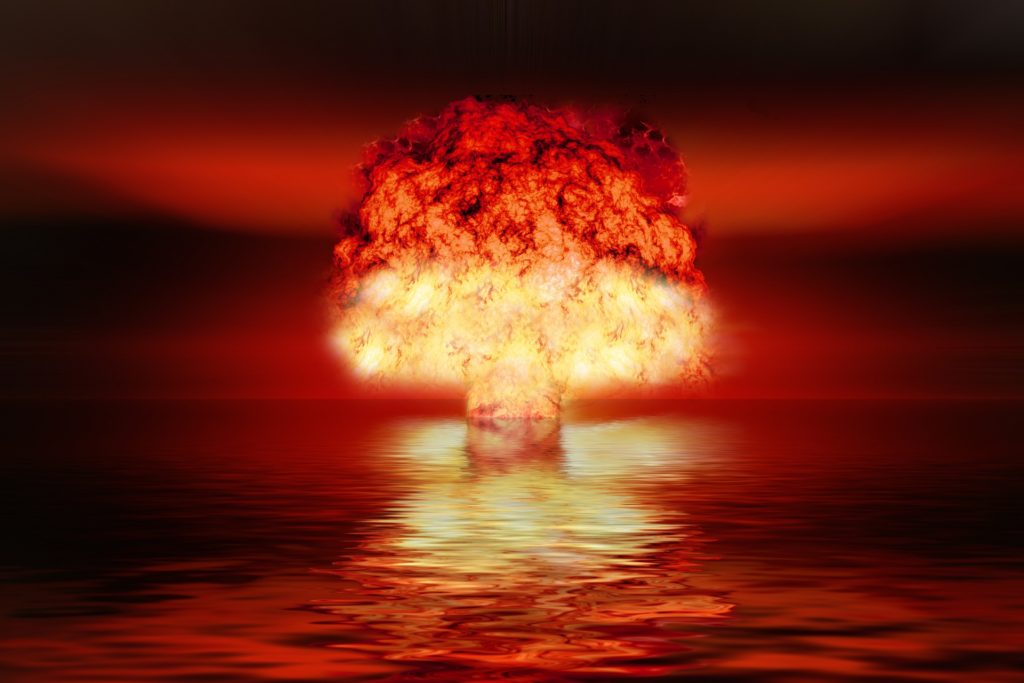
nuclear bombs nuclear explosions j robert oppenheimer bhagavad gita atomic bomb 1920x1200 wallpa Art HD Wallpaper

Verse from the Bhagavad Gita that occurred to Robert Oppenheimer while witnessing the first successful nuclear test blast in 1945

(http://www.knowledgehi.com/Sciences/explosions/nuclear_bombs_nuclear_explosions_j_robert_oppenheimer_bhagavad_gita_atomic_bomb_1920x1200_wallpa_33597)

As some readers familiar with my past writings will already know, there were high-ranking individuals in the U.S. military who had advisory positions to the president and advocated a first-strike nuclear attack on the Soviet Union during the first Cold War.  These advisers even encouraged President Kennedy to escalate during the Cuban Missile Crisis of 1962.  By then, Kennedy had learned of the madness with which he was dealing and had his meetings with his national security advisers secretly tape recorded during the crisis. The transcripts are available for reading in the form of a book.

I have also discussed, to some extent, the warped cultural and ideological thinking that can produce such individuals in both my review of JFK and the Unspeakable by James Douglass and this post.

John Marshall’s must-read article at Consortium News “Dreams of Winning Nuclear War on Russia” covers some of this background and discusses the findings of a new disturbing analysis put out by the Bulletin of Atomic Scientists about the cutting edge new technologies that could make it even more tempting for such ideologues to consider a first-strike on Russia.   An excerpt is below:

In 1961, senior Pentagon consultants drafted a 33-page blueprint for initiating — and winning — a nuclear war against the Soviet Union. It was based on top-secret intelligence that Soviet nuclear forces were few in number and poorly defended — making them an easy target for a U.S. preemptive strike.

Convinced of U.S. superiority, the Joint Chiefs of Staff began advising President John F. Kennedy to risk nuclear war over Cuba and Vietnam — even though their own analysis conceded that if something went wrong, 75 percent of Americans might die. If JFK hadn’t rejected their advice, we might not be here today.

President Trump may soon face a similar test. With almost no public awareness, the Pentagon’s nuclear program has achieved unprecedented capabilities that once again raise the possibility that a U.S. first strike could cripple Russia’s nuclear arsenal and “decapitate” its leadership. Such capabilities all but ensure that hawks will begin lobbying for more aggressive measures toward Russia, based its growing vulnerability to U.S. nuclear weapons.

A frightening new analysis for the Bulletin of the Atomic Scientists — by three eminent strategic arms experts at the Federation of American Scientists, Natural Resources Defense Council, and MIT — provides evidence that U.S. nuclear planners have “implemented revolutionary new technologies that will vastly increase the targeting capability of the US ballistic missile arsenal,” giving it for the first time in decades “the capacity to fight and win a nuclear war by disarming enemies with a surprise first strike.”

U.S. Navy’s ‘Super-Fuse’

The concept of nuclear superiority seemed to lose its relevance in the mid-1960s, when Moscow finally built a large enough nuclear arsenal to withstand attack. Subsequent arms control treaties, starting in the Nixon years, maintained reasonable parity between U.S. and Russian nuclear forces, discouraging either side from contemplating the use of atomic weapons for anything but deterring a nuclear attack.

With absolutely no fanfare, however, U.S. technology advances have once again called mutual deterrence into question. The secret is a “super-fuse” first implemented by the U.S. Navy in 2009 as part of its “life-extension” program for submarine-based nuclear missiles. By permitting more accurate timing of nuclear blasts, this flexible trigger gives America’s sub-launched missiles three times their former killing power — enough to take out even “hardened” Russian missile silos and command centers with a high probability of success.

The authors calculate that a mere 272 warheads could wipe out all of Russia’s intercontinental ballistic missiles housed in hardened silos — leaving in reserve more than 600 lethal warheads deployed on U.S. submarines, as well as hundreds more on U.S. land-based missiles.

Although U.S. war planners would still be challenged to target warheads on Russia’s submarines and mobile land-based missiles, the authors support claims by other scholars that “for the first time in almost 50 years, the United States stands on the verge of attaining nuclear primacy.” Russia’s vulnerability will likely increase over time, as the Pentagon’s implements its planned trillion-dollar nuclear “modernization” program over the next 30 years.

I highly recommend reading the full article here

A detaling of the level of actual damage that could be done by a nuclear attack in one large city is shown here

Here’s what would happen if the bomb targeted Times Square in New York City:

Courtesy of http://viableopposition.blogspot.ca/2017/02/nuclear-superpowers-and-impact-of.html

Here’s what would happen if the bomb targeted Red Square in Moscow:

Courtesy of http://viableopposition.blogspot.ca/2017/02/nuclear-superpowers-and-impact-of.html

For a primer on how easy it would be for an accidental nuclear war to be launched, due to either human or technological error, read Eric Schlosser’s “World War III, By Mistake” from a recent issue of The New Yorker:

The dangers of “launch-on-warning” have been recognized since the idea was first proposed, during the Eisenhower Administration. After the Cuban Missile Crisis, McNamara advised Kennedy that the United States should never use its nuclear weapons until a nuclear detonation had occurred on American soil, and could be attributed to an enemy attack. The first Minuteman missiles had already become a great source of stress for McNamara. The control system of the original model had a design flaw: small fluctuations in the electricity entering the command center could mimic the series of pulses required by the launch switch. An entire squadron of fifty missiles might be launched accidentally without anyone turning a key. “I was scared shitless,” an engineer who worked on the system later confessed. “The technology was not to be trusted.” McNamara insisted that the control system be redesigned, at great expense. The destruction of fifty Soviet cities because of a mechanical glitch, a classified history of the Minuteman program later noted, would be “an accident for which a later apology might be inadequate.”

Read the full article here

It should be noted that Russia has not been resting on its laurels when it comes to maintaining, and even improving, its nuclear defense capabilities.  Over the past year it has begun rolling out its S500 air defense system, which some geopolitical analysts suggest would be able to completely seal off Russian airspace to incoming missile attacks after its implementation all over the country.

What 2 Former U.S. Ambassadors Have to Say About Russian Ambassador’s Contacts with Senate Staff or Those Close to Incoming Administration; Veteran Investigative Journalist Provides His Experience with Political Investigations and When They are Warranted; Is Trump’s Russia Policy So Different from Obama’s?; Trump Reportedly May Be Backing Off Any Detente; Antiwar.com Unpacks Why Russia Has to Remain an Enemy

(http://jackmatlock.com/here-now/)

Jack Matlock served as the specialist on Soviet affairs on Reagan’s national security council and then served as the U.S. ambassador to the Soviet Union/Russia under Bush I.  Although he served under Republican administrations, Matlock himself is not a Republican.  He started out as a Democrat and is now an independent.

In a recent blog post, Matlock provided some insight into the recent controversy over those close to Trump’s campaign or members of his incoming administration having communications with the Russian ambassador:

Our press seems to be in a feeding frenzy regarding contacts that President Trump’s supporters had with Russian Ambassador Sergei Kislyak and with other Russian diplomats. The assumption seems to be that there was something sinister about these contacts, just because they were with Russian diplomats. As one who spent a 35-year diplomatic career working to open up the Soviet Union and to make communication between our diplomats and ordinary citizens a normal practice, I find the attitude of much of our political establishment and of some of our once respected media outlets quite incomprehensible. What in the world is wrong with consulting a foreign embassy about ways to improve relations? Anyone who aspires to advise an American president should do just that.

Yesterday I received four rather curious questions from Mariana Rambaldi of Univision Digital. I reproduce below the questions and the answers I have given….

….Ambassador Kislyak is a distinguished and very able diplomat. Anyone interested in improving relations with Russia and avoiding another nuclear arms race—which is a vital interest of the United States—should discuss current issues with him and members of his staff. To consider him “toxic” is ridiculous.

….If you want to understand the policy of another country, you need to consult that country’s representatives. It is quite common for foreign diplomats to cultivate candidates and their staffs. That is part of their job. If Americans plan to advise the president on policy issues, they would be wise to maintain contact with the foreign embassy in question to understand that country’s attitude toward the issues involved. Certainly, both Democrats and Republicans would contact Soviet Ambassador Dobrynin during the Cold War and discuss the issues with him. As the person in charge of our embassy in Moscow during several political campaigns, I would often set up meetings of candidates and their staffs with Soviet officials. Such contacts are certainly ethical so long as they do not involve disclosure of classified information or attempts to negotiate specific issues. In fact, I would say that any person who presumes to advise an incoming president on vital policy issues needs to understand the approach of the country in question and therefore is remiss if he or she does not consult with the embassy in question.

A similar sentiment was expressed by Michael McFaul, a hardliner who served as U.S. ambassador to Russia during Obama’s first term.  Listen to his comments on this particular issue during a recent interview with MSNBC.  I would note that he says other things that I would characterize as inaccurate, such as his claim that he simply met with a member of the Russian opposition and ran into trouble with Moscow for this.  Actually, McFaul did more than just meet with members of the opposition – he also actively encouraged their actions against the sitting government, which is frowned upon in any country.   But his specific comments addressing the fact that the Russian ambassador was simply doing his job in seeking out members of the incoming administration to get an idea of its attitude toward certain relevant issues is not untoward.

http://www.realclearpolitics.com/video/2017/03/03/former_us_ambassador_to_russia_michael_mcfaul_not_unusual_for_sergey_kislyak_to_meet_sessions.html

Veteran investigative journalist, Robert Parry provides his experience with various political investigations over scandals and non-scandals over the course of decades in response to the controversy over Trump administration contacts with Russia and Trump’s recent tapping accusations against Obama:

The intensifying hysteria over Russia has pushed Official Washington over the edge into outright madness. On one side of this asylum, you have the Democrats, neoconservatives and mainstream media, while on the other, you have the embattled Trump administration. Both sides have been making grave allegations with little or no evidence to support them.

The Democratic/neocon/MSM side has pushed the conspiracy theory that Donald Trump’s campaign colluded with Russians to put the real-estate mogul in the White House, but there is, as yet, no evidence that such a thing happened.

Even one of the top advocates feeding this Russia frenzy, New York Times correspondent Thomas L. Friedman, acknowledged on Sunday on NBC’s “Meet the Press” that “I agree, there is no evidence,” but then added: “which is why we need a special prosecutor or an independent commission to get to the bottom of it.”

But that is not how investigations are supposed to work. You’re supposed to have evidence of wrongdoing and then examine it in the investigative phase to see if the evidence withstands scrutiny. What Friedman is suggesting is more like a “fishing expedition” or a “witch hunt.”

The drip-drip of this investigative water torture finally got to President Trump last week as he flew down to his winter home at Mar-a-Lago. He joined the crazy melee early Saturday morning by sending out a flurry of tweets accusing President Obama of wiretapping Trump Tower in New York City in the weeks before the Nov. 8 election. Trump also offered no evidence while demanding an investigation to get to the bottom of this.

By contrast, in all the major investigations that I have handled as an investigative reporter, such as Oliver North’s secret White House paramilitary operation; the related Nicaraguan Contra drug trafficking scandalRichard Nixon interference with President Lyndon Johnson’s Vietnam peace talks in 1968; and Ronald Reagan’s campaign sabotage of President Jimmy Carter’s Iranian-hostage negotiations in 1980 – there was substantial evidence from eyewitnesses and documents supporting the suspicions before the story was published.

At no point would I have argued that just because Oliver North met a Contra leader that it was time to investigate whether he and his Reagan administration superiors were breaking the law. I first found multiple insiders, including people in the U.S. government and the Contra movement, describing how North was running his back-channel war. In some of these investigative situations, we had two dozen or so sources describing detailed aspects of these operations before we made any allegations in print.

Now the argument is that because some people suspect something, even without evidence, major investigations are warranted. That is usually what a conspiracy theory sounds like. Someone claims not to understand how something could have happened a certain way and thus a full-scale inquiry is needed into some highly unlikely and speculative scenario.

Another one of my favorite analysts, Glenn Greenwald, also weighs in with some great points underscoring the politically motivated and hypocritical actions by the Democrats in the still embryonic Trump era:

This attempt to equate Trump’s opposition to arming Ukraine with some sort of treasonous allegiance to Putin masks a rather critical fact: namely, that the refusal to arm Ukraine with lethal weapons was one of Barack Obama’s most steadfastly held policies. The original Post article that reported the RNC platform change noted this explicitly:

Of course, Trump is not the only politician to oppose sending lethal weapons to Ukraine. President Obama decided not to authorize it, despite recommendations to do so from his top Europe officials in the State Department and the military.

Early media reports about this controversy from outlets such as NPR also noted the irony at the heart of this debate: namely, that arming Ukraine was the long-time desire of hawks in the GOP such as John McCain, Lindsey Graham and Marco Rubio, but the Obama White House categorically resisted those pressures:

Republicans in Congress have approved providing arms to the Ukrainian government but the White House has resisted, saying that it would only encourage more bloodshed.

It’s a rare Obama administration policy that the Trump campaign seems to agree with.

Indeed, the GOP ultimately joined with the hawkish wing of the Democratic Party to demand that Obama provide Ukraine with lethal weapons to fight Russia, but Obama steadfastly refused. As the New York Times reported in March, 2015, “President Obama is coming under increasing pressure from both parties and more officials inside his own government to send arms to the country. But he remains unconvinced that they would help.” When Obama kept refusing, leaders of the two parties threatened to enact legislation forcing Obama to arm Ukraine.

The general Russia approach that Democrats now routinely depict as treasonous – avoiding confrontation with and even accommodating Russian interests, not just in Ukraine but also in Syria – was one of the defining traits of Obama’s foreign policy. This fact shouldn’t be overstated: Obama engaged in provocative acts such as moves to further expand NATO, non-lethal aid to Ukraine, and deploying “missile defense” weaponry in Romania. But he rejected most calls to confront Russia. That is one of the primary reasons the “foreign policy elite” – which, recall, Obama came into office denouncing and vowing to repudiate – was so dissatisfied with his presidency.

A new, long article by Politico foreign affairs correspondent Susan Glasser – on the war being waged against Trump by Washington’s “foreign policy elite” – makes this point very potently. Say what you will about Politico, but one thing they are very adept at doing is giving voice to cowardly Washington insiders by accommodating their cowardice and thus routinely granting them anonymity to express themselves. As journalistically dubious as it is to shield the world’s most powerful people with anonymity, this practice sometimes ends up revealing what careerist denizens of Washington power really think but are too scared to say. Glasser’s article, which largely consists of conveying the views of anonymous high-level Obama officials, contains this remarkable passage:

In other words, Democrats are now waging war on, and are depicting as treasonous, one of Barack Obama’s central and most steadfastly held foreign policy positions, one that he clung to despite attacks from leading members of both parties as well as the DC National Security Community. That’s not Noam Chomsky drawing that comparison; it’s an Obama appointee.

As FBI whistleblower Colleen Rowley and others have noted, certain Democrats seem so consumed by their hatred for Trump that they are failing to see the forest for the trees in their approach of hitching their wagon to the anti-Russia meme because they think it will be the most expedient to get rid of Trump.  It doesn’t matter that there is an existential degree of folly in continuing to ramp up tensions with the world’s other nuclear superpower or that lack of evidence used to be a concern for those who cared about truth and due process.  This reminds me of the level of insanity and stupidity that those who hated Obama manifested with the accusations of no citizenship and being a Muslim, etc.

They also clearly haven’t thought through the consequences of having Mike Pence as president either.

In any event, perhaps all the pressure is finally getting to Trump. According to an AP article, he is ready to shelve his detente plans for Russia:

President Donald Trump is telling advisers and allies that he may shelve, at least temporarily, his plan to pursue a deal with Moscow on the Islamic State group and other national security matters, according to administration officials and Western diplomats.

In conversations with diplomats and other officials, Trump and his aides have ascribed the new thinking to Moscow’s recent provocations. But the reconsideration of a central tenet of his foreign policy underscores the growing political risks in forging closer relations with Russia, as long as the FBI investigates his campaign associates’ connections to Moscow and congressional committees step up their inquiries into Russia’s meddling in the 2016 election.

….Trump’s new skepticism about brokering a deal with Moscow also suggests the rising influence of a new set of advisers who have taken a tougher stance on Russia, including Defense Secretary Jim Mattis and new national security adviser H.R. McMaster. During his first meeting with National Security Council staff, McMaster described Russia — as well as China — as a country that wants to upend the current world order, according to an administration official who attended the meeting.

Michael McFaul, who served as President Barack Obama’s ambassador to Russia, said that while Trump has been open about wanting warmer relations with Russia, “he hasn’t picked people to the best of my knowledge at senior levels that share that view.”

European allies also have been pushing the Trump administration not to make any early concessions to Russia. To bolster their case, European officials have tailored their rhetoric to appeal to Trump’s business background, including emphasizing the risks of negotiating a bad deal, rather than more nuanced arguments, according to one Western diplomat. Given Trump’s “America First” mantra, foreign officials emphasize how U.S. standing in the world could be diminished by making concessions to Russia instead of focusing on the importance of the U.S. and Europe sticking together to counter Moscow.

Finally, Justin Raimondo of Antiwar.com, unpacks the reasons for why Russia must remain the enemy for much of the U.S. political and economic elite:

And so while the present quite extraordinary campaign to portray Russia as our Major Adversary has been given considerable impetus by the Democratic party elites, eager to explain away their humiliating defeat – and discredit the current occupant of the White House – there’s much more to it than that. We can break it down into four major reasons:

1) Inter-service rivalry in the military – In May of last year, I wrote about the war breaking out between the various components of the US military, a battle over budgets:

“In early April, a battalion of senior military officials appeared before a Senate panel and testified that the US Army is ‘outranged and outgunned,’ particularly in any future conflict with Russia. Arguing for a much bigger budget for the Army, they claimed that, absent a substantial increase in funding, the Russians would overtake us and, even scarier, ‘the army of the future will be too small to secure the nation.’

“The Russians are coming! The Russians are coming! And before you know it, Brooklyn will be renamed Putingrad.

“Of course it was pure coincidence that, shortly after these alarm bells were rung, a piece appeared in Politico magazine purportedly showing that the Russians were breathing down our necks: it revealed a ‘secret study’ – revealed for the first time! – that supposedly detailed Russia’s deadly new capabilities as demonstrated in Ukraine. Included in this potpourri of propaganda was the assertion by none other than Gen. Wesley Clark, former presidential candidate and well-known Russophobe, that Moscow had developed a tank that is for all intents and purposes ‘invulnerable.’”

The national debt is now at $20 trillion – a sum that the human mind can barely conceive. The reality is that we cannot afford the kind of money the military is now demanding. Indeed, the defense budget hike being advanced by the Trump administration is dead on arrival, and even if it were passed by Congress – an unlikely outcome – it would hardly satisfy the projected expansion of military spending envisioned by the generals. And so we are now witnessing a ramped up campaign to portray the Russians as ten feet tall. As a follow up piece in Politico by Mark Perry put it:

’This is the ‘Chicken-Little, sky-is-falling’ set in the Army,’ the senior Pentagon officer said. ‘These guys want us to believe the Russians are 10 feet tall. There’s a simpler explanation: The Army is looking for a purpose, and a bigger chunk of the budget. And the best way to get that is to paint the Russians as being able to land in our rear and on both of our flanks at the same time. What a crock.’”

A war with Russia would require land forces in huge numbers, more tanks, more artillery, and much more money for the Army. If the Russian Threat is what they say it is, then the Army will devour a glutton’s share of the military budget, leaving the Navy and the Air Force to starve. It would also require complementary upgrades for the militaries of all the NATO nations – a gold mine for the US weapons industry.

So one answer to the “Why Russia?” question is simple: follow the money.

And speaking of following the money, another big factor energizing the anti-Russian campaign is:

2) The Russian diaspora – When Putin came to power one of the first things he did was go after the infamous oligarchs who had backed – and manipulated – his predecessor, Boris Yeltsin. Under the drunken Yeltsin, these “entrepreneurs” had used the State apparatus to “privatize” (i.e. loot) what had previously been the State-owned economy, gobbling up entire sectors at unbelievably cheap prices. Putin moved to disassemble what was a competing power center, and the result was the flight of the oligarchs to the West. Having put their ill-gotten gains in Western banks and holding companies, they shacked up in London, New York, Switzerland, and the French Riviera, where they plotted Putin’s overthrow and their triumphant return.

There’s an awful lot of money sloshing around in these circles, and a good part of it is being used to buy up media properties that act as outlets for anti-Russian propaganda. Newspapers, think tanks, and various other vehicles for the molding of public opinion are financed by this Russian Diaspora, which acts as an intellectual Praetorian Guard for the politicians hoping to ride the wave of anti-Russia sentiment. They act as a lobby on behalf of the arms industry, and the political forces that stand to gain from the anti-Russian campaign – but they are not alone.

Read the complete article here


The Deep State

Product Details

The Deep State by Mike Lofgren, Penguin Books, Reprint 2016

With the term “deep state” getting a lot of mileage these days with respect to the take-down of Trump’s original National Security Advisor, Michael Flynn, it seems like a good time to draw your attention to the  origins of the term.   Mike Lofgren, a former congressional staffer and defense analyst, wrote a book with that title a few years back.   Below is a link to a 26 minute interview that Bill Moyers conducted with him.

A synopsis of the interview:

Mike Lofgren, a congressional staff member for 28 years, joins Bill Moyers to talk about what he calls Washington’s “Deep State,” in which elected and unelected figures collude to protect and serve powerful vested interests. “It is how we had deregulation, financialization of the economy, the Wall Street bust, the erosion or our civil liberties and perpetual war,” Lofgren tells Moyers.

 As one of the YouTube commenters, tsbrownie, described it:
“It’s a conspiracy of common interests. The elite don’t have to hold meetings nor have secret handshakes. All they have to do is all work to the same goals with loose coordination via news media, and like a team of ants, bit by bit they can move our great country anywhere they want.”


https://www.youtube.com/watch?v=EYS647HTgks

For those who’d rather read Lofgrens’ essay explaining the concept, go here:

http://billmoyers.com/2014/02/21/anatomy-of-the-deep-state/


Update on E. Ukraine; Lavrov Calls for “Post-West” World Order at Munich, Russia’s UN Envoy Churkin Dies Suddenly; U.S. Used Depleted Uranium in Syria; Iraq War Likely to Go On Indefinitely; Daniel Lazare on “McCarthyistic Fever”

(Ukrainian military near Donetsk, Feb. 10, 2017; Oleksandr Klymenko, Reuters)

Another ceasefire was worked out by France, Germany, Russia and Ukraine this past weekend in an attempt to quell recently increased violence in the Donbass.   According to a report from Reuters:

Germany, France, Russia and Ukraine agreed on Saturday to use their influence to implement a ceasefire and the withdrawal of heavy weapons from Monday in eastern Ukraine.

Fighting has recently escalated between Ukrainian forces and Russian-backed separatists in the region, refocusing global attention on a simmering conflict that has strained relations between Russia and the West.

“On Feb. 20 the ceasefire regime will start and withdrawal of heavy military hardware will also start … We have actively supported this decision and obviously expressed a conviction that this time, failure should not be allowed to take place,” Russian Foreign Minister Sergei Lavrov said after talks with his Ukrainian, German and French counterparts in Munich.

Meanwhile, the news agency of the United Nations (UN) is reporting that one million children are in need of aid in Eastern Ukraine – double this time last year – due to the continuing periodic fighting near the contact line that has created a general deterioration of life, in terms of health, safety and education.  Of course, this has intensified with the recent uptick in attacks by the Ukrainian military.   The UN News Center provided the following details:

This is an invisible emergency – a crisis most of the world has forgotten,” said UNICEF’s Representative in Ukraine, Giovanna Barberis, in a news release. “Children in eastern Ukraine have been living under the constant threat of unpredictable fighting and shelling for the past three years. Their schools have been destroyed, they have been forced from their homes and their access to basic commodities like heat and water has been cut off,” she stated.

The release attributed the increase – an additional 420,000 girls and boys – to the continued fighting and the steady deterioration of life in eastern Ukraine, where some 1.7 million people have been internally displaced, and many families have lost their incomes, social benefits and access to healthcare, while the price of living has sharply risen.

Hundreds of daily ceasefire violations put children’s physical safety and psychological well-being at risk. The situation is particularly grave for the approximately 200,000 girls and boys living within 15 kilometres on each side of the ‘contact line’ in eastern Ukraine, a line which divides government and non-government controlled areas where fighting is most severe. In this zone, 19,000 children face constant danger from landmines and other unexploded ordinance and 12,000 children live in communities shelled at least once a month. Thousands of children are regularly forced to take refuge in improvised bomb shelters.

Teachers, psychologists and parents report signs of severe psychosocial distress among children including nightmares, aggression, social withdrawal and panic triggered by loud noises. More than 740 schools – one in five in eastern Ukraine – have been damaged or destroyed.

The DPR and LPR have announced a humanitarian aid program for people in parts of Donbass that are under the control of the Kiev government, including medical and educational services and the payment of pensions.  The Donetsk News Agency reported last week:

DPR head Alexander Zakharchenko and LPR head Igor Plotnitskiy announced in a joint statement on February 17, “We have decided to implement a programme of humanitarian aid and environmental safety for our brothers and sisters living in Ukraine-controlled Donbass areas.”

“The main guidelines for humanitarian assistance are medical and education services, pension payments and assistance to divided families,” the statement said.

The programme envisions humanitarian foundations for financial assistance and joint cultural, education and sporting events involving residents on both sides of the contact line.

Zakharchenko and Plotnitskiy noted that Kyiv-controlled Donbass areas are on the brink of a humanitarian crisis. Economic production is being discontinued in the zone of Kyiv’s so-called “anti-terrorist operation”, living standards are plunging and infrastructure facilities are in disarray.

“We insist on the possibility to inspect water pumping systems at operating and non-operating mines, the Popasnaya water utility, Lisichyansk refinery, Zarya (Rubezhnoye) and Azot (Severodonetsk) companies, Voda Donbassa water company, water treatment plants, chlorine storages, Avdeyevka coking plant, Konstantinovka state-owned chemical plant and Dzerzhinsk phenol plant,” the republics’ leaders said.

They also demanded unhindered access for humanitarian organisations to Kyiv-controlled territory for monitoring, power, water and gas supply facilities.

And the next day, Putin signed an executive order officially recognizing documents pertaining to identification and vital information provided by the DPR and LPR.  This met with criticism by Ukraine and other nations.  Alexander Mercouris provides analysis at The Duran:

The documents in question are things like driving licences, birth and marriage certificates, travel documents and the like.

The Ukrainian authorities are already complaining that Russian recognition of these documents amounts to Russia’s de jure recognition of the two People’s Republics.  The carefully worded Executive Order signed by President Putin however shows that this is not the case:

Being guided by universally recognised principles and standards of the international humanitarian law and in order to protect the rights and freedoms of individuals, the President has resolved that temporarily, during the political settlement period of the crisis in certain districts of Ukraine’s Donetsk and Lugansk regions pursuant to the Minsk Agreements, personal identification documents, education and (or) qualification certificates, birth certificates, marriage, divorce, name change and death certificates, vehicle registration certificates, and vehicle registration plates issued by the corresponding authorities (organisations), valid in the specified district, will be recognised in the Russian Federation as valid for Ukrainian citizens and stateless persons permanently residing in those areas.

Pursuant to the Executive Order, Ukrainian citizens and stateless persons permanently residing in certain districts of Ukraine’s Donetsk and Lugansk regions can enter and leave the Russian Federation without applying for visas upon showing identification documents (birth certificates for children under the age of 16), issued by the corresponding authorities which are valid in the said districts.

The Government of the Russian Federation has been instructed to take the necessary measures to implement this Executive Order.

The Executive Order will come into effect upon its signing.

Russian recognition of the documents in part reflects traditional Russian political and diplomatic practice of recognising and accepting realities.

The Donetsk and Lugansk People’s Republics unquestionably exist irrespective of whether or not they have been recognised internationally.   As the Executive Order says, it is inhumane to consign the people they administer to an international legal limbo because the two People’s Republics are not internationally recognised.

Recognising the documents they issue seems first and foremost intended to make it easier for the people who live in the territories of these two republics to travel to Russia, where many of them have relatives and where many of them go for work.

At the same time recognition of the documents of the two People’s Republics highlights a point the Russians have long been making, which is that the longer Kiev delays reaching a political settlement of the conflict, the further from Kiev’s orbit the two People’s Republics will go.

****************************

Russian Foreign Minister Sergei Lavrov politely sat through speeches at the recent Munich Security Conference given by Washington (e.g. Vice President Mike Pence) and its allies who provided the usual mumbo jumbo about the U.S.-led world order being natural, exceptional and as righteous and cuddly as unicorn hugs.  Then he took to the podium and gave his own perspective on what had just been heard.  A few choice excerpts follow:

Ladies and gentlemen,

Ten years ago, President of Russia Vladimir Putin addressed this conference with a speech that many in the West saw as a challenge and even a threat, although what his message emphasised above all was the need to renounce unilateral action in favour of honest cooperation based on mutual respect, international law, joint assessment of global problems and collective decision-making. Unfortunately, the warnings he sounded then about the negative consequences of attempting to obstruct the emergence of a multipolar world have become reality.

Humanity stands at a crossroads today. The historic era that could be called the post-Cold War order has come to an end. Its main result, as we see it, was the complete failure of the Cold War institutions to adapt to new realities. The world has become neither ‘Western-centric’, nor a safer and more stable place. This is evident in the results of ‘democratisation’ in the Middle East and North Africa, and in other places too.

NATO expansion has created a level of tension in Europe unseen in the last thirty years. Yet this year marks the 20th anniversary of the signing of the Russia-NATO Founding Act in Paris, and 15 years since the Rome Declaration on a new quality of Russia-NATO relations was adopted. These documents’ basic premise was that Russia and the West took on a joint commitment to guarantee security on the basis of respect for each other’s interests, to strengthen mutual trust, prevent a Euro-Atlantic split and erase dividing lines. This did not happen, above all because NATO remained a Cold War institution. It is said that wars start in people’s heads, but according to this logic, it is also in people’s heads that they should end. This is not the case yet with the Cold War. Some statements by politicians in Europe and the United States seem to confirm this particularly clearly, including statements made here yesterday and today during this conference.

….What kind of relationship do we want to establish with the United States? We want relations based on pragmatism, mutual respect, and understanding of our special responsibility for global stability. Our two countries have never been in direct confrontation with each other. Our history is steeped in friendliness more than confrontation. Russia did a lot to support the independence of the United States as it proceeded to become a united powerful state. Constructive Russia-US relations are in our common interest. Moreover, America is our close neighbour, just like the European Union. We are divided by just 4 km of the Bering Strait. The potential of our cooperation in politics, the economy, and the humanitarian sphere is enormous. But, of course, it has to be tapped. We are willing to go ahead and do so inasmuch as the United States is prepared to do so on its part.

….Today, more than ever, we need a dialogue on all complex issues in order to find mutually acceptable compromises. Actions based on confrontation and the zero-sum-game approach will not cut any ice. Russia is not looking for conflicts with anyone, but it will always be in a position to uphold its interests.

Read the full speech and the Q&A that followed at:

http://www.mid.ru/en_GB/press_service/minister_speeches/-/asset_publisher/7OvQR5KJWVmR/content/id/2648249

Russia’s second most well known diplomat, UN envoy Vitaly Churkin, passed away suddenly on Monday from what many are speculating was a heart attack.  Reuters reports:

Russia’s combative ambassador to the United Nations, Vitaly Churkin, died suddenly in New York on Monday after being taken ill at work, the Russian Foreign Ministry said.

The ministry gave no details on the circumstances of his death but offered condolences to his relatives and said the diplomat had died one day before his 65th birthday.

It declined to comment on reports that Churkin had been taken to a hospital shortly before his death.

A U.S. government official, who was not authorized to speak publicly on the case, said that Churkin had died of an apparent heart attack.

A federal law enforcement official, also speaking on condition of anonymity, said that there appeared to be nothing unusual about the ambassador’s death.

************************

An article has recently appeared in Foreign Policy magazine reporting on the illicit use by Washington of depleted uranium in airstrikes against ISIS in Syria.

Officials have confirmed that the U.S. military, despite vowing not to use depleted uranium weapons on the battlefield in Iraq and Syria, fired thousands of rounds of the munitions during two high-profile raids on oil trucks in Islamic State-controlled Syria in late 2015. The air assaults mark the first confirmed use of this armament since the 2003 Iraq invasion, when it was used hundreds of thousands of times, setting off outrage among local communities, which alleged that its toxic material caused cancer and birth defects.

U.S. Central Command (CENTCOM) spokesman Maj. Josh Jacques told Airwars and Foreign Policy that 5,265 armor-piercing 30 mm rounds containing depleted uranium (DU) were shot from Air Force A-10 fixed-wing aircraft on Nov. 16 and Nov. 22, 2015, destroying about 350 vehicles* in the country’s eastern desert.

Earlier in the campaign, both coalition and U.S. officials said the ammunition had not and would not be used in anti-Islamic State operations. In March 2015, coalition spokesman John Moore said, “U.S. and coalition aircraft have not been and will not be using depleted uranium munitions in Iraq or Syria during Operation Inherent Resolve.” Later that month, a Pentagon representative told War is Boring that A-10s deployed in the region would not have access to armor-piercing ammunition containing DU because the Islamic State didn’t possess the tanks it is designed to penetrate.

It remains unclear if the November 2015 strikes occurred near populated areas….

***************************

According to a February 20th AP report, Defense Secretary Mattis admitted that the U.S. will likely be in Iraq for quite a while still:

BAGHDAD (AP) — U.S. Defense Secretary Jim Mattis said Monday he believes U.S. forces will be in Iraq and in the fight against Islamic State militants for a while, despite some rocky times between the two nations.

Speaking at the end of a day of meetings in Baghdad with military commanders and Iraqi political leaders, Mattis said he is open to any request from his military commanders to aid the battle to retake Mosul and launch a major battle to oust IS from the base of its so-called caliphate in Raqqa, Syria. He would not provide details.

….”I imagine we’ll be in this fight for a while and we’ll stand by each other,” Mattis said.

************************

I keep hoping that the hysterical claims against Russia and its purported inappropriate relationship with the Trump administration will die down so I will have less material to sift through.  Now that the election hacking story has lost some steam due to no evidence being presented, a storm has erupted about Michael Flynn’s phone conversation with the Russian ambassador prior to Trump’s inauguration but after Flynn’s designation as his National Security Adviser.  The best analysis I’ve seen on this brouhaha is by Daniel Lazare over at Consortium News.  I highly recommend that you follow the link and read the whole article, but here are some key excerpts:

High-level wrongdoing! Colluding with the enemy! Shock and incredulity! It’s enough to make a concerned citizen reach for the nearest bottle of 151-proof rum. But it’s all nonsense. Liberals are working themselves into a crisis mode on the basis of zero evidence. 

Let’s begin with what The Nation’s Joan Walsh regards as the key issue: what do we know and when did we know it?

Well, we know that on Thursday, Dec. 29, Barack Obama expelled 35 suspected Russian intelligence operatives for allegedly interfering with the presidential election and imposed sanctions on Russia’s two leading intelligence services. We also know that Flynn had called the Russian ambassador a day earlier to discuss sanctions in general and that although he “never made explicit promises of sanctions relief,” according to unnamed government officials cited by the Times, he “appeared to leave the impression it would be possible.”

In Times-speak, “appeared to leave the impression” means that the paper is unable to pin down anything that Flynn did that was specifically wrong, but still believes that the conversation was somehow unseemly.

According to The Washington Post, the key phone call came after Obama’s Dec. 29 decision to expel the Russian diplomats when Kislyak reached Flynn by phone while the national security advisor-designate and his wife were vacationing at a beachside resort in the Dominican Republic.  “As a veteran intelligence officer,” The Post said, “…Flynn must have known that a call with a Russian official in Washington would be intercepted by the U.S. government, pored over by FBI analysts and possibly even shared with the White House.”

In any event, whatever he told Kislyak must have been reassuring since Vladimir Putin announced later that day that he would not engage in a tit-for-tat retaliation by expelling U.S. diplomats.

Getting Payback

Irritated by such maturity, the American “state security organs,” as the KGB and other Soviet intelligence services were once called, pounced. Having intercepted the Russian ambassador’s phone call, the FBI relayed the contents to Obama’s Deputy Attorney General Sally Yates, who authorized it to interrogate Flynn about the conversation. Flynn may have lied or not given a complete account or forgotten some of the details about what he and Kislyak discussed. He also may have given a similarly incomplete account to Vice President Mike Pence, which apparently upset Pence and led to Flynn being tossed overboard.

But if Trump and his team thought that would satisfy the sharks, they were wrong. The press went into a feeding frenzy. But the substance of the complaint against Flynn adds up to very little.

As Obama administration holdovers in the Justice Department searched for a legal justification with which to accuse Flynn of wrongdoing, the only thing they could come up with was the Logan Act of 1799 forbidding private citizens from negotiating with a foreign government that is in dispute with the United States. Adopted during the presidency of John Adams, the law was prompted by Dr. George Logan’s unauthorized negotiations with France, contacts that were praised by the Jeffersonians but anathema to the Federalists.

But invoking the Logan Act in any instance is a stretch, much less this one. It has never been used to prosecute anyone; it has never been tested in a court of law; and its constitutionality couldn’t be more questionable. Moreover, if the law is dubious when used to threaten a private citizen engaged in unauthorized diplomacy, then using it to go after a designated official of an incoming presidential administration that has been duly elected is many times more so.

As journalist Robert Parry points out, the Logan Act has mainly been “exploited in a McCarthyistic fashion to bait or discredit peace advocates” such as Jesse Jackson for visiting Cuba or House Speaker Jim Wright for trying to end the Contra war in Nicaragua. [See Consortiumnews.com’s “Trump Caves on Flynn’s Resignation.”]

Of course, the Obama holdovers at Justice also said that Flynn might be vulnerable to Russian blackmail. But if Flynn assumed that the U.S. intelligence was listening in, then the Russians probably did also, which means that both sides knew that there was no secret dirt to be used against him.

In other words, there’s no there there. Yet anti-Trump liberals are trying to convince the public that it’s all “worse than Watergate.”

….But whether Flynn is a criminal is another matter. As Ronn Blitzer observed in a smart article at Lawnewz.com: “Between the details of the communications being unclear and the complete lack of historical guidance for prosecutors to work off of, chances are slim that he’ll face any legal repercussions.”

Lying to the FBI is another matter, of course. But grilling someone about whether he violated a moldy old law that should have been repealed centuries ago is the equivalent of giving someone the third degree over whether he washed his hands after using a public restroom. It raises questions about civil liberties and prosecutorial abuse that used to concern liberals – before, that is, they went bonkers over Russia.

Moreover, taking a call from the Russian ambassador is not only legal but, with the inauguration only three weeks away, precisely what one would expect a newly designated national security advisor to do. If the call indeed happened while Flynn was on vacation – and hence without the usual staff support – it’s not that surprising that he might not have had total recall of what was discussed. For FBI agents to question him weeks later and test his memory against their transcript of the conversation seems closer to entrapment than a fair-minded inquiry.

The whole area is a gray zone regarding what is and isn’t proper for a candidate or an incoming administration to do. Eight years earlier, Barack Obama reached out to foreign leaders to discuss policy changes before he was even elected.

In July 2008, candidate Obama visited Paris to confer with then-French President Nicolas Sarkozy about Israel, Iraq, Afghanistan and NATO. In late November – after the election, that is, but before the oath of office – he telephoned Afghan President Hamid Karzai to discuss how his country might achieve greater stability.

Yet as Robert Charles notes at the conservative Townhall.com website, no one thought to mention the Logan Act or accuse Obama of overstepping his bounds by engaging in private diplomacy.

Russia Will Not Sell Out Iran for Washington, Suggests Possibility of Returning to Iranian Airbase; Ukrainian Media & Gov’t Sources Admit Kiev Re-ignited Recent Fighting in Donbass; Dennis Kucinich Speaks Out on Syria Trip with Tulsi Gabbard; Patrick Armstrong on Strengths of Russian Economy; What Do Average Americans Really Think of Russia?

Russian long range bomber taking off from a base in Iran, August 16, 2016

Russian long range bomber taking off from a base in Iran, August 16, 2016; © Russian Defense Ministry Press Service Photo via AP

Over the past week, the Russian government has dropped some subtle and not so subtle hints that it is unwilling to sell out it’s strategic economic and military relationship with Iran for promises of playing nice from Washington.   Alexander Mercouris has detailed Russia’s initial moves conveying this message:

First off was President Putin’s spokesman Dmitry Peskov, who made clear Moscow’s disagreement with Donald Trump’s description of Iran as “the world’s number one terrorist state”

We disagree with this postulate.  You all know that Russia has good relations of partnership with Iran and we cooperate with that country on a number of issues. We appreciate our relations in the trading and economic sphere and we hope for their further development
Peskov was followed by Foreign Minister Lavrov, who not only did not agree with Trump’s assessment of Iran as a “terrorist state”, but who on the contrary made clear his belief that Iran should be a party to any anti-ISIS coalition

Iran has never been found linked to Islamic State or Jabhat al-Nusra.  Moreover, Iran makes its own contribution to the struggle against the Islamic State.  We have long pressed for creating a genuinely universal front of struggle against terrorism. I am certain that if we make an unbiased approach to the potential members of such a coalition, Iran must be part of our common efforts

This came after Russia also made known its disagreement with the latest sanctions the US has imposed on Iran.

Within the past couple of days, the Russian ambassador to Iran, Levan Dzhagaryan, spoke publicly about the possibility of Russia working out of Iran’s air base near Hamadan, which they pulled out of months ago after briefly using it to run bombing missions into Syria.  He also highlighted other aspects of the military and technical partnership between the two countries.

In an interview with the Russian news agency TASS, Dzhagaryan said the following:

“If the leadership of the two countries will consider it necessary to use the Iranian military infrastructure to combat terrorism in Syria or elsewhere, such steps will be taken,” the diplomat said.

….By now, Moscow has fully closed a contract for the delivery of S-300 complexes to Iran, the Russian diplomat said.

“Last year, Russia finished completely the fulfillment of its obligations for the delivery of S-300 air defense systems to Iran,” the ambassador said.

….”Cooperation between Russia and Iran proceeds in many fields, including the military-technical sphere,” the diplomat said. “The two countries’ defense ministries are currently in talks at different levels on many projects of interest to Iran.”

*****************

Mark Nicholas at Russia Insider has pointed out how the Ukrainian media, quoting Ukrainian intelligence officials, has admitted that Kiev was the initiator of recent intensified conflict in the Donbass:

Take for example the reporting of the popular local news portal the Ukrainian Pravda:

Escalation in Avdiyivka Sunday January 29 began after the collision of ATO’s [‘Anti-Terrorist Operation’] reconnaissance and sabotage unit with the militants.

This was revealed to Ukrainian Pravda by the source in the intelligence structures familiar with the situation.

The source said the fighters of the intelligence garthering unit encountered DPR militants nearby.

“The battle began. Militants requested artillery support. Therefore, to save soldiers, Commander (23-year-old captain, deputy commander of a mechanized battalion of the Cornel Andrew Ombre 72 -red.) was forced to lead men forward and play a role as fighters,” said the UP source.

According to the UP source the militants are now trying to regain from ATO a strategic position (the position of the militants called “Diamond 2” – Ed.), since it fully controlls the roads Donetsk, Lugansk and Donetsk, Gorlovka. [emphasis in original]

********************

Former congressional Representative Dennis Kucinich, who recently accompanied Rep. Tulsi Gabbard on her fact-finding mission to Syria, has spoken out on his Facebook page about the cheap attacks against Gabbard by certain government officials and members of the media who don’t want to hear the truth that Gabbard speaks:

I have dedicated my life to peace. As a member of Congress I led efforts to avert conflict and end wars in countries such as Afghanistan, Iraq, Lebanon, Libya, Syria and Iran. And yet those of us who work for peace are put under false scrutiny to protect Washington’s war machine. Those who undermine our national security by promoting military attacks and destroying other nations are held up as national leaders to admire.

Recently Rep. Tulsi Gabbard and I took a Congressional Ethics-approved fact finding trip to Lebanon and Syria, where we visited Aleppo and refugee camps, and met with religious leaders, governmental leaders and people from all sides of the conflict, including political opposition to the Syrian government.

Since that time we have been under constant attack on false grounds. The media and the war establishment are desperate to keep hold of their false narrative for world-wide war, interventionism and regime change, which is a profitable business for Washington insiders and which impoverishes our own country.

Today, Rep. Gabbard came under attack yet again by the Washington Post’s Josh Rogin who has been on a tear trying to ruin the reputations of the people and the organization who sponsored our humanitarian, fact-finding mission of peace to the Middle East. Rogin just claimed in a tweet that as community organization I have been associated with for twenty years does not exist.

The organization is in my neighborhood. Here’s photos I took yesterday of AACCESS-Ohio’s marquee. It clearly exists, despite the base, condescending assertions of Mr. Rogin.

Enough of this dangerous pettiness. Let’s dig in to what is really going on, inside Syria, in the State Department, the CIA and the Pentagon. In the words of President Eisenhower, let’s beware (and scrutinize) the military-industrial-complex. It is time to be vigilant for our democracy.

*******************

Patrick Armstrong, Russia expert and former adviser on Russia issues to the Canadian government, provided the following critique of Wikipedia’s claims that Canada and Germany have a bigger GDP than Russia and what this does not take into account in terms of the Russian economy:

RUSSIA INC.  Summarising three recent authorities, Wikipedia says Canada’s GDP is greater than Russia’s and Germany’s is about two and a half times greater. There’s something deeply misleading and, in fact, quite worthless about these GDP comparisons. Russia has a full-service space industry including the only other operating global satellite navigation system. Neither Canada nor Germany does. It has an across the board sophisticated military industry which may be the world leader in electronic warfare, air defence systems, silent submarines and armoured vehicles. Neither Canada nor Germany does. It has a developed nuclear power industry with a wide range of products. Ditto. It builds and maintains a fleet of SSBNs – some of the most complicated machinery that exists. Ditto. Its aviation industry makes everything from competitive fighter planes through innovative helicopters to passenger aircraft. Ditto. It has a full automotive industry ranging from some of the world’s most powerful heavy trucks to ordinary passenger cars. It has all the engineering and technical capacity necessary to build complex bridges, dams, roads, railways, subway stations, power stations, hospitals and everything else. It is a major and growing food producer and is probably self-sufficient in food today. Its food export capacity is growing and it has for several years been the leading wheat exporter. It has enormous energy reserves and is a leading exporter of oil and gas. Its pharmaceutical industry is growing rapidly. It is intellectually highly competitive in STEM disciplines – a world leader in some cases. Its computer programmers are widely respected. (Yes, there is a Russian cell phone.) It’s true that many projects involve Western partners – the Sukhoy Superjet for example – but it’s nonetheless the case that the manufacturing and know-how is now in Russia. Germany or Canada has some of these capabilities but few – very few – countries have all of them. In fact, counting the EU as one, Russia is one of only four. Therefore in Russia’s case, GDP rankings are not only meaningless, but laughably so. While Russians individually are not as wealthy as Canadians or Germans, the foundations of wealth are being laid and deepened every day in Russia. What of the future? Well there’s a simple answer to that question – compare Russia in 2000 with Russia in 2017: all curves are up. Of course Russians support their government – why wouldn’t they? It’s doing what they hired it to do; we others can only dream of such governments. For what it’s worth, PwC predicts Russia will be first in Europe in 2050, but, even so, I think it misses the real point: Indonesia and Brazil ahead of Russia? No way: it’s not GDP/PPP that matters, it’s full service. Russia is a full-service power and it won’t become any less so in the next 30 years. Autarky. Very few aren’t there? And… in that little group of four autarkies on the planet, who’s going up and who’s going down? A big – fatal even – mistake to count Russia out.

***********************

And, finally, some heartening news on the Russia front.  Russia scholar Pietro Shakarian went to several cities in Ohio and interviewed a cross-section of average Americans – on the streets, in bars and coffee shops, etc. – to get their views on Russia, U.S.-Russia relations and what they think about the recent allegations of the Russian government having hacked the U.S. presidential election.

Before I get to an excerpt and link to the results, here is a little more background on Shakarian:

Pietro A. Shakarian, a PhD Candidate in Russian History at The Ohio State University in Columbus, Ohio.  He earned his MA in Russian, East European, and Eurasian Studies at the University of Michigan in Ann Arbor, his MLIS at Kent State University, and his BA in History at John Carroll University in Cleveland.  In addition to Reconsidering Russia, he has written about developments in Russia and the former Soviet space for The Nation, Hetq Online, and Russia Direct and he has appeared on The John Batchelor Show and the podcast for Sean’s Russia Blog.

Here is an except of what Americans in Cleveland told Shakarian:

My first stop in Cleveland was the Clevelander Bar & Grill in the city’s downtown on 27 December 2016. After ordering a beer, I asked the people behind the bar about the Russians.

“Can we get along with them?” I inquired.

“Look, if there was a war or something, I would want Russia on my side,” said the bartender, “They’re big and tough, man. Who was the guy who led them during the war? You know, with the mustache?”

“You mean Stalin?”

“Yeah. He was tough, man.”

“What do you think?” I asked the barmaid.

“Of course, we should have them as our allies,” she said. “We need to have a dialogue with them, but I don’t trust them. You know what they say: keep your friends close, but your enemies closer. Still, I don’t trust Russia. It’s a very scary country.”

“Why do you think Russia is scary?” I asked.

“I dunno. That’s what the media says,” she responded. “However, I don’t think the people are bad. Our neighbor is a Russian. He’s married to a Serbian woman. We have no problems with them. In general, I think that people can get along. The governments can’t. That’s the problem.”

Later, I walked down the street to a Subway restaurant. After ordering a sandwich, I casually began a conversation about the Russians with the owner and his assistant, both middle-aged, round and jovial African-American men.

“The Russians are tough,” said one of the men. “They mean business. You don’t wanna mess with them, man.”

“Do you think that US-Russian relations can improve?”

“Not while Donald Trump is in the White House,” he chuckled heartily. “That man’s crazy! He can’t even keep his Twitter under control! How can we expect him to deal with the Russians?”

Walking back, I traveled to the old beaux arts Leader Building on Superior Avenue. The building is under construction, being converted into condos. This was a perfect place to continue inquiries about the Russians. I found a group of affable construction workers on their break. The men were middle-aged. Three were white, one was black.

“Can we get along with the Russians?” I asked.

“Why not?” said the black construction worker, smiling easily. “We need them.”

“We do need them,” said another construction worker smoking a cigarette, “I mean, look how big their country is! They’re a lot of people. We need as many people to be our friends as possible. We don’t need anymore enemies. You know, my neighbors are Russian immigrants. I have no problems with them. Honestly, I think conflict now between the two governments is basically one big pissing match. If you just bring the people together and leave the politicians out of it, then we’d be fine.”

“I know the authors Dostoevsky and Bulgakov,” interjected another worker. “Crime and Punishment and The Master and the Margarita are among my favorite novels. If Russians can write such great novels, then they must not be bad people. We can work with them.”

Read the full article here