All posts by natyliesb

Analysis of “Russian Public Assessments of the Putin Policy Program: Achievements and Challenges”

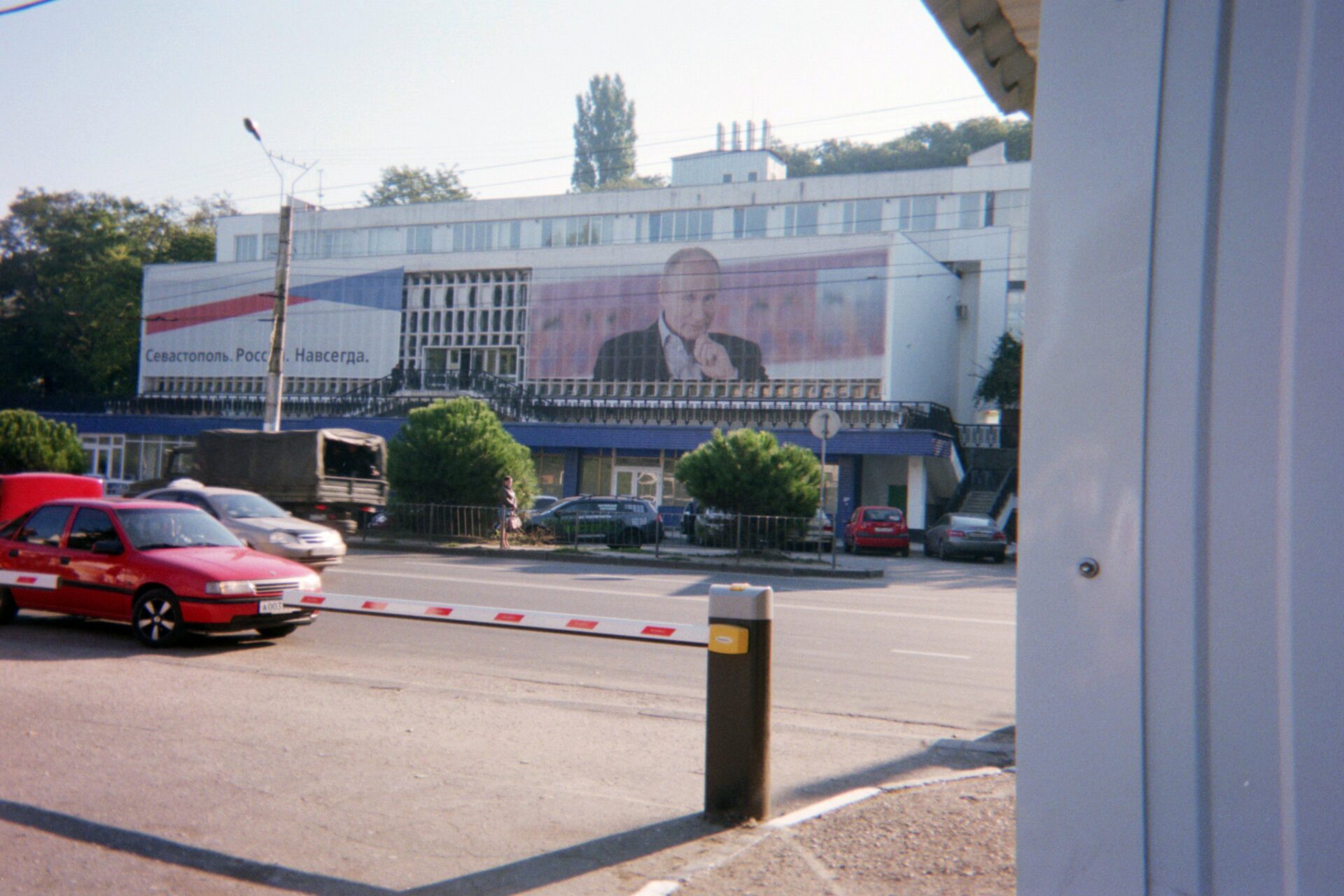
"Crimea. Russia. Forever." Billboard of Putin in Simferopol, Crimea; photo by Natylie Baldwin
“Crimea. Russia. Forever.” Billboard of Putin in Simferopol, Crimea; photo by Natylie Baldwin

“Russian Public Assessments of the Putin Policy Program: Achievements and Challenges” by John P. Willerton, Professor of Political Science at the School of Government and Public Policy at the University of Arizona

Russian Politics, Volume 1, Issue 2, 2016

Professor Willerton provides a valuable assessment of public opinion in Russia with respect to what he refers to as the “Putin Policy Program” – defined as policies pursued by the Putin government during Putin’s first two presidential terms (2000-2008), Dmitry Medvedev’s presidential term (2008-2012, when Putin served as Prime Minister), and Putin’s third presidential term (2012 to present).   Willerton describes the set of policies as:

[Those] directed to the simultaneously overriding goals of strengthening the Russian state, modernizing the Russian society, and bolstering of Russia’s global position. Observers can debate to what extent these policies emerged as part of a coherent program, constitute a more haphazard set of policy responses to changing conditions, or evolved overtime to ultimately form a distinguishable programmatic whole. By 2014, however, a decade and a half after Vladimir Putin’s rise to the Russian presidency and well into his second presidency, a distinguishable policy agenda and program were evident. The Putin agenda and implemented policies were subject to public assessments, and these public judgments merit our attention.

Putin, described as the “paramount leader” receives a consistently high performance assessment by Russians, while the rest of the government receives moderate ratings.  This is contrasted with poor ratings received by Russia’s most visible opposition figure, Aleksai Navalny.

Moreover, Willerton’s evaluation found that Putin’s priorities for Russia are congruent with that of most Russians and that positive assessment was dependent upon the particular policy in question.

It is found that Russians’ positive assessment of Vladimir Putin, Russia’s paramount leader, is juxtaposed with more middling assessments of all other actors, excepting opposition figure Aleksei Navalny, who is poorly viewed. A strong congruence is found between the Putin team’s policy priorities and those of the Russian public, but public assessments of the Putin team’s performance across specific policies are mixed and reveal areas where that team has been both successful and come up short. Results of the October 2014 ROMIR public opinion survey indicate that Putin and his team are well-positioned and that their overall policy performance is acceptable, but policy soft spots and points of concern are revealed: this suggests continuing challenges for the Putin team in delivering a program accommodating the preferences of an aware domestic public.

….An examination of the Russian public’s assessment of the importance of the policy concerns drawn from the Putin position papers and said to be at the heart of the second Putin presidency reveals strong public support, and across all eleven concerns (see Table 1). On a 10-point scale, all eleven concerns register above an 8, with (a) higher standard of living and (b) better quality of social services registering just below 9. Even those policy concerns that rate relatively lower (returned trust to social institutions, return to traditional multi-children families, and efficient state institutions) still garner results well above 8.

It is also pointed out that Putin and his team follow public opinion and make sincere attempts to incorporate it into policy.

There is considerable evidence that Putin and his team are highly concerned about public opinion, expending much effort and many resources to shore up domestic support.7 Indeed, the very return of Putin to the Russian presidency in March 2012 appeared to many as strong evidence of the governing elite’s need to return to the country’s paramount leader when his successor, Dmitry Medvedev, and his platform party, United Russia, were found to be so wanting by both critics and supporters.

Willerton decided that 15 years into Putin’s tenure was enough of a run to obtain a meaningful assessment of his governance by the Russian public.  The data Willerton used to study public opinion of Russians toward the Putin government included studies by the independent Levada Center, government-sponsored VTsIOM, fom and the October 2014 NEPORUS-romir-survey “crafted by a team of Norwegian-Swedish-Russian-American scholars and conducted in the field by the Russian survey firm romir…”

Willerton found that the NEPORUS study provided a rich source of data, with Russian public opinion provided on an array of issues, broken down into two dozen policy concerns.

A sampling of the Willerton’s findings follows:

A few benchmark economic and social developments merit mentioning, they have been important to Russians, and Russians have been fully able to contrast these Putin period advances with earlier troubled realities. First, assessments of Russian economic performance and related societal advances since 2000, including those set out by the World Bank, pointed to a significantly expanded national economy and growing middle class that placed Russia in per capita wealth at the top of the brics countries, with Russia matching Germany as the world’s fifth largest economy (in purchasing power parity) by summer 2013.17 Meanwhile, United Nations Economic Commission for Europe (unece) data showed that the country’s manufacturing productivity had grown by more than 50% over the Putin period, Rosstat data revealed the country’s food production had more than doubled during that same period, while the country recorded a bumper grain crop in fall 2014.18 It was especially notable that Russian state statistics revealed that the decades’ long decline in the Russian population ended by 2012, with population growth recorded for that and subsequent years.19 Russia’s dramatic population decrease over the course of several decades had arguably been the most important suggestive indicator of a Russian ‘failing state’. The population rise in 2012 and succeeding years was modest, indeed miniscule, but it was symbolically important, and both Russian officials and citizens openly celebrated the demographic turnaround. Relatedly, Putin period surveys consistently revealed mounting upbeat attitudes on the part of Russian respondents regarding both their current and their anticipated short-term future socioeconomic circumstances, with governing Putin team members assuming ever more confident and buoyant public posturing (and as directed both domestically and internationally).20 Other developments, including Russia’s increased foreign policy assertiveness and returned international prominence, could also be noted, but the overriding point is that the policy context of the Putin later 2000s and early 2010s contrasted markedly with that of Russia’s 1990s so-called ‘time of troubles’. Domestic Russian critics’ and Western evaluations of the Putin period domestic policy environment – and interpretations of the above-noted developments – were, in contrast, negative,21 but these judgments had little influence on mainstream Russian expectations and reactions.22

Willerton discusses the goals and policy emphasis articulated by Putin in his seven policy papers of 2012, as well as Russians’ views on the prioritization of the goals and the effectiveness of the results.  Russians’ belief in the need for a strong state is reflected here also.

….The seven presidential campaign policy papers appearing in January-February 2012 reveal two fundamental goals articulated by Putin and said to reflect the overriding hopes of the mainstream Russian public: (1) the strengthening of the Russian state, and (2) the modernization of Russia’s society.24 These goals had been emphasized by Putin from his first days as acting president, they had always been treated as inextricably interconnected, and they found strong resonance with the Russian public. From the discussion surrounding these overriding goals that is set out in the Putin position papers, eleven more focused policy concerns can be identified, they may be grouped into five domains, and these policy concerns are at the heart of my efforts to illuminate public assessments of policy priorities and of the Putin team’s performance in realizing a strengthened state and a modernized society. I organize the domains and more specific policy concerns as follows:

Political domain: (1) efficient state institutions; (2) quality social services; and (3) protection of people’s rights and freedoms.

Economic domain: (1) higher standard of living; and (2) provision of goods and services to the public.

Societal domain: (1) revitalization of cultural life; and (2) promotion of traditional families.

Policies tapping the interconnected political, economic, and societal domains: (1) fight against crime and corruption; (2) ensuring social justice; and (3) returned trust to institutions.

Foreign domain: (1) protection of Russia internationally.

In the political domain, Putin gives detailed attention to strengthening the state and making state institutions more effective and efficient. He explicitly discusses protecting people’s rights and freedoms, his emphasis on qualitative rights (e.g., education, healthcare, housing; what some refer to as ‘material’ or ‘quality of life right’), and in this regard he points to the importance of the state providing ‘quality social services’. In the economic domain, ensuring a heightened standard of living is an emphasis, as is the related provision of goods and services to the public. Concerns of the societal domain include revitalization of the country’s cultural life and promotion of the family. Regarding the latter, creating the conditions for couples to once again choose to have multi-children families is salient, albeit this is directly tied to economic advances.

Willerton reminds the reader that the ambient conditions in Russia when Putin took over the leadership of the country in 2000 (virtually a failed state with massive poverty, a mortality crisis, and rampant crime) must be taken into account in terms of understanding Russian public opinion on the “Putin Policy Program.”

Large government investments in the areas of the National Priority Projects (agriculture, education, healthcare, and housing) had yielded evident over-time payoffs, citizens saw the country’s educational system turning around, they saw state-guaranteed healthcare services strengthened, and they found their pensions arriving without delay. In both symbolic and in real terms, the lot of the country’s most vulnerable – children and the elderly – had markedly improved over the period 2000-14, and romir survey results reflect this and reveal the relative credit mainstream Russians accorded the governing team.

….Regarding the effort against crime and corruption, the regime itself has been explicit in acknowledging a lack of success, with Putin himself declaring at the end of his first presidency that the lack of further inroads against corruption had been the greatest failing of his presidency.28 Yet while citizens acknowledge the continuing problem of crime and corruption, the everyday lives of citizens have evolved from the ‘Wild West’ days of the 1990s, when crime and corruption touched most everyone’s lives in profound ways, prevalent at both the macro and micro levels. By the mid-2010s, the everyday lives of mainstream Russians had become more normalized and regularized, not only were citizens securing the desired goods and services (as commented on above), but they were receiving their salaries and pensions, they were depositing them without fear into banks, and their infrastructural needs were increasingly being met. The notion of ‘corruption’, needless to say, is vague, and for most Russians corruption means ‘bribes’.29 As Russia’s political and socioeconomic life has evolved in the Putin period, crime and corruption have become less central to mainstream citizens’ everyday lives. Thus, the results here – that respondents assess the Putin team’s performance in fighting and eradicating crime and corruption as middling, but not failing – make intuitive sense.30

Overall, I found no great surprises in the results of Willerton’s meta-analysis of Russian public opinion towards Putin, his policies and his government.  I’ve been following many of the opinion surveys put out by Levada and VTsIOM for a couple of years now.  These surveys, along with my discussions with Russians last October, gave the impression that many in Russia view Putin as an overall good leader who has provided stability, improved standards of living, and a sense that they can once again hold their heads high as Russians.

Putin is viewed as a generally decent person doing his best to work within a bad system characterized by a sprawling country with a cumbersome and largely corrupt bureaucracy.  It is a deeply entrenched system that will take time and savvy to turn around and Russians trust Putin to continue moving in the generally positive direction he has embarked upon.
Did the Pentagon Declare a “No-Fly Zone” in Syria?; Merchants of Death Admit Russia “Threat” Good for Business; Putin Offers to Host Peace Summit Between Israel & Palestine; Leader of DPR in Donbass Comments on Meeting with OSCE; More on Media Propaganda re Syria

undefined

(https://www.c-span.org/video/?414272-1/defense-department-briefing)

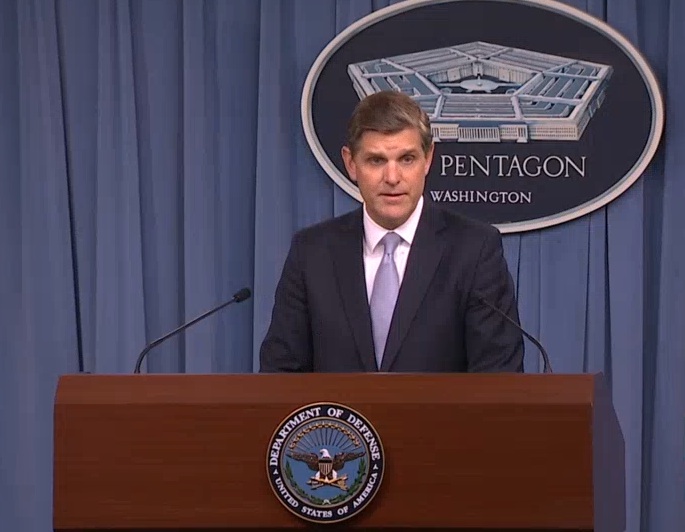
Daniel McAdams, a foreign policy analyst at the Ron Paul Institute for Peace and prosperity, has raised some interesting questions regarding a press conference held by the Pentagon on August 22nd:

Reading between the lines in today’s Pentagon press briefing, a bombshell US policy shift is becoming more apparent: Syrian forces and their Russian partners are being told that conducting military operations in some parts of Syrian airspace opens them up to being shot down by the US military.

Pentagon Spokesman Peter Cook was asked numerous times in numerous ways whether this amounts to a US “no fly zone” over parts of Syria. His first response was vague but threatening:

We will use our air power as needed to protect coalition forces and our partnered operations. …We advise the Syrian regime to steer clear of [certain] areas.The policy shift was so apparent that, one-by-one, the press corps asked for clarification. Does this mean that the US would shoot down Russian or Syrian planes if they attacked any US-backed partners even if they were engaged against Syrian government forces? Are those “coalition forces” and “partnered operations” receiving US protection against attack from the air always in receipt of that protection, or only when they are actively engaged in military operations? What are the rules of engagement?

There was no clear answer from the Pentagon spokesman.

“Is this a ‘no-fly’ zone, then,” asked another reporter. It’s not a “no-fly zone” Cook responded.

Another journalist tried to get some clarity:

How is telling Syria not to fly in certain areas not a ‘no fly’ zone?

“Call it what you will,” Cook eventually said.

Another journalist asked, “Do you think the Syrian regime has the right to fly over its own territory?”

Same answer: “We will use our air power as needed to protect coalition forces and our partnered operations.”

The press conference in question can be viewed here.

On a separate but related note, it has been reported at The Intercept, that U.S. defense contractors are telling investors that the “threat” of Russia that is being played up in Washington and in the corporate media represents a boon for their business:

The escalating anti-Russian rhetoric in the U.S. presidential campaign comes in the midst of a major push by military contractors to position Moscow as a potent enemy that must be countered with a drastic increase in military spending by NATO countries.

Weapon makers have told investors that they are relying on tensions with Russia to fuel new business in the wake of Russia’sannexation of Crimea and modest increases in its military budget.

In particular, the arms industry — both directly and through its arsenal of hired-gun, think-tank experts and lobbyists – is actively pressuring NATO member nations to hike defense spending in line with the NATO goal for member states to spend at least 2 percent of gross domestic product on defense.

Retired Army Gen. Richard Cody, a vice president at L-3 Communications, the seventh largest U.S. defense contractor, explained to shareholders in December that the industry was faced with a historic opportunity. Following the end of the Cold War, Cody said, peace had “pretty much broken out all over the world,” with Russia in decline and NATO nations celebrating. “The Wall came down,” he said, and “all defense budgets went south.”

Now, Cody argued, Russia “is resurgent” around the world, putting pressure on U.S. allies. “Nations that belong to NATO are supposed to spend 2 percent of their GDP on defense,” he said, according to a transcript of his remarks. “We know that uptick is coming and so we postured ourselves for it.”

….Think tanks with major funding from defense contractors, including the Lexington Institute and the Atlantic Council, have similarly demanded higher defense spending to counter Russia.

Stephen Hadley, the former National Security Advisor to President George W. Bush now serving on the board of Raytheon, a firm competing for major NATO military contracts, has argued forcefully for hiking defense budgets and providing lethal aid to Ukraine. Hadley said in a speech last summer that the U.S. must “raise the cost for what Russia is doing in Ukraine,” adding that “even President Putin is sensitive to body bags.”

******************

(Netanyahu and Abbas.  Credit: Associated Press;  http://www.haaretz.com/israel-news/1.737979)

Meanwhile, the Israeli newspaper Haaretz has reported that, according to Egyptian president, Al-Sissi, Putin has stated his willingness to hold a peace summit between Palestinian president Mahmoud Abbas and Israeli prime minister, Benjamin Netanyahu:

Egyptian President Abdel-Fattah al-Sissi said that Russian President Vladimir Putin has expressed a willingness to host Prime Minister Benjamin Netanyahu and Palestinian President Mahmoud Abbas for talks in Moscow, Egyptian media reported on Monday.

Sissi’s remarks came as Israeli and Palestinians officials reported unsuccessful efforts on the part of European officials to try and arrange a similar summit.

“The Russian president has informed me that he has invited Palestinian President [Abbas] and Prime Minister Netanyahu for a meeting in Moscow,” Sissi said.

“Egypt supports these efforts and both sides are urged to participate and respond positively to the initiative for the sake of finding light at the end of the tunnel for Palestinians and establishing their state alongside Israel.”

According to Sissi, “Egypt’s relationship with both sides, Israelis and the Palestinians, permit it to play a central role in the attempt to renew the diplomatic process.” Nonetheless, he said, Egypt cannot be solely responsible, but will rather be “that which convinces the sides that if peace will be attained light will shine on the entire region.”

I’m not sure how Putin would be able to work around the Israeli government’s intransigence on this issue, but if any world leader is adept at pulling a rabbit out of his hat, it is Putin.  I wish him much luck – he will need it .

************************

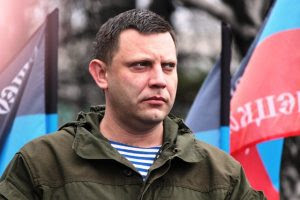
Aleksandr Zakharachenko, First Minister of the Donetsk Peoples Republic

(Aleksandr Zakharachenko, First Minister of the Donetsk Peoples Republic)

There have been several OSCE reports over the months indicating that OSCE monitors of the contact line in Donbass have encountered hostility and threats from soldiers representing the Donetsk People’s Republic (DPR) in the course of doing their job. I’m also aware of reports that many in the DPR do not trust the OSCE monitors and believe them, for various reasons, to be biased.

Consequently, DPR’s leader Aleksandr Zakharachenko, had a meeting with leaders of the OSCE mission in Ukraine, after which he gave the following statement:

We have discussed with Mr. Hug all the questions which are of interest for, on the one hand, the OSCE monitoring mission and, on the other hand, the Donetsk People’s Republic. In particular, it was issues relating to the ceasefire o the contact line. In this regard, I appealed to Mr. Hug with a request for the OSCE mission to be more objective.

With regard to the security of the OSCE observers in the Donetsk People’s Republic, I suggested that Mr. Hug consider an option of our officers accompanying the observers. Then we will be able to take responsibility not only for the safety of the observers, but also for the fact that there will be no obstacles and misunderstandings in the performance of their duties.

In addition, I made a proposal that the OSCE warn us about the work of their drones. In this case, no one will interfere with their work. Otherwise, our military perceive drones as unidentified aircraft that may pose a threat to our residents. As it is known, recently, the Ukrainian side has been using their drones not only for the reconnaissance and subsequent shelling, but also directly to attack, stuffing their UAVs with explosives.

On the whole, the conversation was constructive, and we agreed to meet again after Mr. Hug ponders my suggestions.

********************

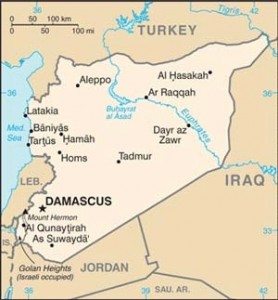
Map of Syria, showing Golan Heights in the lower left corner.

(Map of Syria; https://consortiumnews.com/2016/08/23/propaganda-for-syrian-regime-change/)

Rick Sterling, whom was an acquaintance of mine during the mid-2000’s when we both volunteered for the Mt. Diablo Peace & Justice Center in Walnut Creek, has gone on several fact-finding missions to Syria in the past couple of years.  His latest article details how the American people are being primed with propaganda to support military escalation on behalf of regime change in Syria, being sold under the “humanitarian” label:

….There has been lots of publicity around a letter to President Obama, supposedly written by 15 doctors in East Aleppo. The letter ends “We need your action.” The flow and wording of the letter suggests it may have been composed by a marketing company and there has been no verification of the doctors who supposedly signed it.

The letter was likely written by a paid Syria War propagandist or Washington lobby firm. Read the letter here and judge for yourself. For contrast watch this interview with a real Syrian doctor not mouthing propaganda from K Street in Washington D.C.

An online Change petition asks German Chancellor Angela Merkel and President Barack Obama to “save the people of Aleppo.” The publicly funded Holocaust Memorial Museum has promoted the video #SaveSyria. One of the producers of the video is The Syria Campaign which is the marketing organization which branded the pervasive “White Helmets,” as documented in “Seven Steps of Highly Effective Manipulators”.

In parallel with this media campaign, the House Foreign Affairs Committee has introduced HR5732 the “Caesar Syrian Civilian Protection Act of 2016.” The resolution calls for escalating economic/financial pressure on Syria and “Assessment of potential effectiveness of and requirements for the establishment of safe zones or a no fly zone in Syria”.

Dr. Sahloul, the Syrian American Medical Society doctor / spokesperson, says that Obama’s legacy will be defined by whether or not he attacks Syria to impose a “no fly zone.”  It seems unlikely that Obama would do that at the end of his term. Instead, the goal is to prepare the public for the new war to begin after Hillary Clinton becomes President.

….Here a few facts about Aleppo which contradict the mainstream media narrative:

–At least 85 percent of Aleppo’s population is in government-controlled areas.

–The estimate of 300,000 civilians in rebel/terrorist-controlled east Aleppo is likely a gross exaggeration. In spring 2015, Martin Chulov of the Guardian visited the area and estimated there were 40,000.

–While there are very few doctors serving in the opposition-controlled Aleppo, there are thousands of doctors working in the government-controlled area.

–The dominant rebel-terrorist group in Aleppo is the Syrian version of Al Qaeda.

–The armed groups who invaded Aleppo have been unpopular from the beginning. In the fall of 2012, journalist James Foley wrote: “Aleppo, a city of about 3 million people, was once the financial heart of Syria. As it continues to deteriorate, many civilians here are losing patience with the increasingly violent and unrecognizable opposition — one that is hampered by infighting and a lack of structure, and deeply infiltrated by both foreign fighters and terrorist groups.” (Foley was later captured by Syrian rebels and executed by the Islamic State on Aug. 19, 2014.)

–The rebel-terrorists launch dozens and sometimes hundreds of mortars daily into the government-controlled areas causing huge casualties. Western media ignores this destruction and loss of life.

–The much publicized April bombing of the supposed Medecins sans Frontieres-supported “Al Quds Hospital” in Aleppo was full of contradictions and discrepancies. These were highlighted in an Open Letter to MSF. To this date, MSF has not provided corroborating information.

–Much of the video purporting to show bombing effects in Aleppo are stamped with the “White Helmets” logo. White Helmets is a creation of the U.S. and U.K. and primarily a propaganda tool. The claims they are Syrian, independent and non-partisan are all false.

–Much of the information about Syria comes from “activists” trained and paid by the U.S. In her book  Hard Choices, Secretary Clinton says the U.S. provided “training for more than a thousand (Syrian) activists, students, and independent journalists” (p464, hardback version). Obviously they are not independent and their reports should be carefully checked.

–In contrast with the ambiguous situation at “Al Quds Hospital”, consider what happened to Aleppo’s “Al Kindi Hospital.” Take three minutes to view the suicide bombing of Al Kindi Hospital. Take two minutes to view what the “rebels” did to Syrian soldiers who had been guarding the hospital.

–Like NBC correspondent Richard Engels’s fake kidnapping and the contrived CNN reports by “Syrian Danny,” the Aug. 21, 2013 chemical attack in Ghouta has been essentially shown to have been a staged event intended to force a U.S. attack on the Syrian government by making it appear that President Bashar al-Assad had crossed President Obama’s “red line.”

–The latest propaganda tool being used to promote U.S. aggression against Syria is the photograph of little Omran in the orange ambulance seat. The video comes from the Aleppo Media Center, or AMC. Like the White Helmets, AMC is a U.S. creation.

The photo of Omran has been widely accepted without scrutiny. The insightful Moon of Alabama has raised serious questions about the media sensation. Brad Hoff has documented that the main photographer, Mahmoud Raslan, is an ally of the Nour al Din al Zenki rebel terrorists who beheaded a young Palestinian Syrian a few weeks ago, confirmed step by step in this short video. Another good short video exposing the propaganda around #Syrianboy is here.

Why the Burst of Propaganda?

The Syrian crisis is at a critical point with the prospect that the rebel/terrorists will collapse.  If they are crushed or expelled, it would allow hundreds of thousands of displaced Aleppans to return home as soon as services are restored. This would also allow the Syrian army and allies to focus on attacking the Islamic State in the east and rebel/terrorist groups remaining in Idlib, Hama, the outskirts of Damascus and the south.

The full article can be read here.

Leaked Documents Reveal George Soros’ Influence on Washington’s Ukraine Policy in 2014; U.S. Moves Nukes Out of Turkey; Russia’s Response to Accusations of Bombing Civilians in Syria

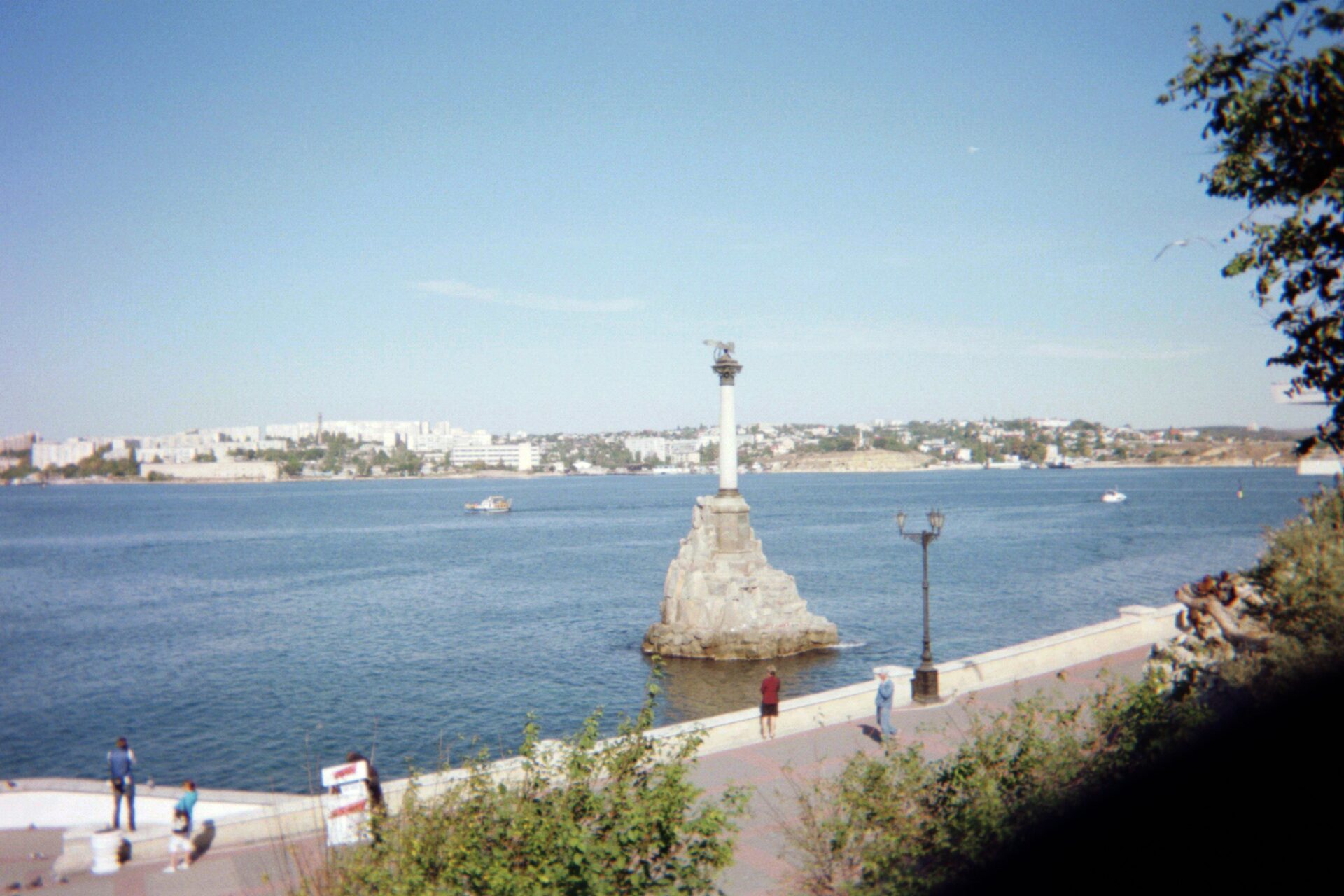
Russian Naval Base at Sevastopol, Crimea; photo by Natylie S. Baldwin

As reported in The Duran, recently leaked emails reveal that George Soros used his influence with many key players from Washington with respect to the Ukraine coup and its aftermath in 2014.

Soros has a history of using his network of NGO’s to foment instability in target countries in order to help pave the way for insertion of leaders who will be receptive to American corporate and geopolitical interests, while Soros often gets to profit as a carpetbagger afterwards.  The role of Soros and his network of NGO’s in the Ukraine crisis of 2013-2014 is discussed in my co-author’s half of Ukraine: Zbig’s Grand Chessboard & How the West Was Checkmated.

….More documents, in the massive 2,500 leaked tranche, show the immense power and control Soros had over Ukraine immediately following the illegal Maidan government overthrow.

Soros and his NGO executives held detailed and extensive meetings with just about every actor involved in the Maidan coup…from US Ambassador Geoffrey Pyatt, to Ukraine’s Ministers of Foreign Affairs, Justice, Health, and Education.

The only person missing was Victoria Nuland, though we are sure those meeting minutes are waiting to see the light of day.

Plans to subvert and undermine Russian influence and cultural ties to Ukraine are a central focus of every conversation. US hard power, and EU soft power, is central towards bringing Ukraine into the neo-liberal model that Soros champions, while bringing Russia to its economic knees.

Soros NGO,  International Renaissance Foundation (IRF) plays a key role in the formation of the “New Ukraine”…the term Soros frequently uses when referring to his Ukraine project.

The leaked documents can be found here.

***************

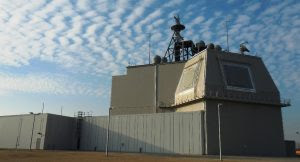
Military base at Deveselu, Romania (photo by Lockheed Martin)

(Military base at Deveselu, Romania (photo by Lockheed Martin))

EurActiv is reporting that, as a consequence of cratered relations between Washington and Ankara in the wake of the failed coup attempt which Erdogan blames on Washington, the U.S. is in the process of removing its 50 tactical nuclear weapons from the Incirlik base in Turkey to Romania.

EXCLUSIVE – Two independent sources have told EurActiv.com that the U.S. has started transferring nuclear weapons stationed in Turkey to Romania, against the background of worsening relations between Washington and Ankara.

According to one of the sources, the transfer has been very challenging in technical and political terms. “It’s not easy to move 20+ nukes,” said the source, on conditions of anonymity.

According to a recent report by the Simson Center, since the Cold War, some 50 U.S. tactical nuclear weapons have been stationed at Turkey’s Incirlik air base, approximately 100 kilometres from the Syrian border.

During the failed coup in Turkey in July, Incirlik’s power was cut, and the Turkish government prohibited U.S. aircraft from flying in or out. Eventually, the base commander was arrested and implicated in the coup. Whether the U.S. could have maintained control of the weapons in the event of a protracted civil conflict in Turkey is an unanswerable question, the report says.

Another source told EurActiv.com that the U.S.-Turkey relations had deteriorated so much following the coup that Washington no longer trusted Ankara to host the weapons. The American weapons are being moved to the Deveselu air base in Romania, the source said.

Deveselu, near the city of Caracal, is the new home of the U.S. missile shield, which has infuriated Russia.

***********

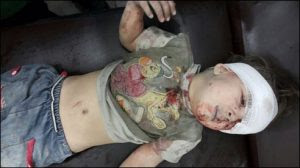
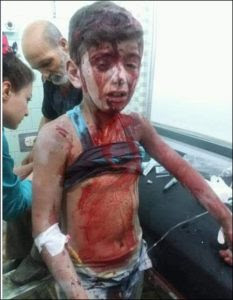
Five year old Omar Daqneesh whose image went worldwide is shown following treatment by doctors in Aleppo (Twitter)

(Five year old Omar Daqneesh whose image went worldwide is shown following treatment by doctors in Aleppo (Twitter))

By now, many are aware of the reports of dead civilians allegedly resulting from Russian bombing runs in support of the Syrian government in the battle of Aleppo.

Russia’s Defense Ministry has announced an official denial of the charges:

Russia’s Defense Ministry has denied claims it carried out attacks on a civilian area in Aleppo’s Qaterji district. The claims were made by Western media after video and pictures of a wounded five-year-old boy from the area emerged online.

“The critical plight that the children from eastern Aleppo districts are in – unwillingly taken hostage by terrorists – is surely a tragedy,” said the official representative of the Russian Defense Ministry, Igor Konashenkov.

He criticized certain Western media for the “cynical use of this tragedy in anti-Russian propaganda material,” calling it a “moral crime.”

“We have repeatedly stressed that the Russian Air Force planes operating in Syria never work on targets within residential areas,” Konashenkov said.

“It is all the more relevant regarding al-Qaterji, mentioned by the Western media, as it is adjacent to the exit corridors for locals which were opened in the framework of the Russian humanitarian mission,” he added, as quoted in a Defense Ministry press release.

Russian monitoring groups have noted daily terrorist strikes in the area, conducted using makeshift artillery mounts. The terrorists, the Russian humanitarian mission says, “target roads, streets, and residential buildings in the close proximity of the humanitarian passages.”

“It is done to disrupt any attempts to receive medical and other kinds of aid for eastern Aleppo residents, who are basically terrorist hostages now.

“The nature of the debris shown by Western broadcasters during the operation to save [the wounded boy, Omran Daqneesh] demonstrates that there are intact windows in a building nearby, and this in turn shows that the strike, if it happened, was carried out not using aircraft ammunition but a mine or a gas cylinder, which are commonly used by terrorists,” Konashenkov also said.

This Syrian boy's image did not go viral because he was injured by the extremist forces fighting the Syrian government (image on Twitter)

(This Syrian boy’s image did not go viral because he was injured by the extremist forces fighting the Syrian government, according to New Cold War.org’s news site (image on Twitter))

RTreports that the Russian Defense Ministry also announced that it is backing a proposal from the UN’s Syria envoy, Staffan de Mistura, calling for 48-hour ceasefires, during which the UN can deliver aid relief to civilians trapped in Aleppo.

As a means to broaden the scale of the humanitarian mission in Aleppo, the Russian Defense Ministry is ready to back the UN proposal to introduce the 48-hour pauses, which would allow the city’s population to be supplied with food and medication, and for vital infrastructure damaged by terrorist shelling to be restored, the ministry’s spokesman, Major General Igor Konashenkov, said.

A test-run of the 48-hour truces could be organized next week to see if relief can reach civilians safely.

“A more precise date and time will be determined after receiving information about the readiness of the convoys from the UN representatives and receiving confirmation of the security guarantees of their safe travel from our American partners,” Konashenkov said.

The Russian Ministry of Defense proposed that humanitarian aid be delivered to Aleppo by two separate routes to western and eastern parts of the city, as the eastern part of Aleppo is controlled by militia while the western part is controlled by government forces.

The first route will start from Gaziantep, Turkey, through a border checkpoint, and by the Castello road to the eastern part of Aleppo. The second one will use the road to the east of Aleppo which encircles the city to the Handarat area, and then by the Castello road to the western part of the city.

The Ministry of Defense added that Moscow is ready to discuss the issues concerning the safety of UN humanitarian convoys with Damascus and expects the same security guarantees from Washington regarding the so-called “moderate opposition” and other units.

The UN has welcomed Russia’s support of the decision to put hostilities in Aleppo on 48-hour pauses weekly to make sure humanitarian convoys reach their destinations, Farhan Haq, deputy spokesman for the secretary-general, said on Thursday.

**For in-depth and contextual background on the war in Syria, I recommend the following articles:

  1.  Deconstructing the NATO Narrative on Syria by Eva Bartlett.  (Bartlett is an independent journalist who has been reporting in different parts of Syria throughout the war)
  2. Syria; Another Pipeline War by Robert F. Kennedy, Jr. (This article appeared at The Ecologist in February of 2016)
  3. Pentagon Report Says West, Gulf States and Turkey Foresaw Emergence of ISIS by Nafeez Ahmed (This article was originally published at The Middle East Eye on May 29, 2015)
  4. The Red Line and the Rat Line by Seymour Hersh (This article was originally published in April of 2014 by Hersh, Pulitzer Prize winning investigative journalist, at the London Review of Books)

The Scoop on Putin’s New Chief of Staff; Are Russians Really Unhappy?; Engdahl Reports that Putin Has Finally Cast the Neoliberals Aside in Economic Policy

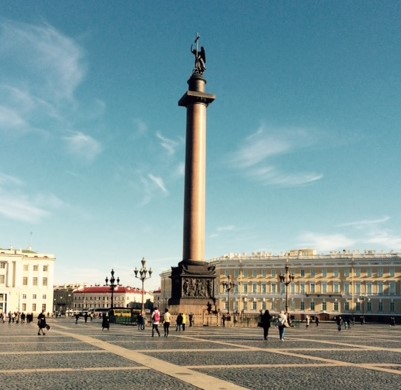
Alexander's Column at Palace Square, St. Petersburg, Russia; photo by Natylie S. Baldwin
Alexander’s Column at Palace Square, St. Petersburg, Russia; photo by Natylie S. Baldwin

As mentioned in a previous post, Putin’s long-time Chief of Staff, Sergei Ivanov, resigned recently and has been replaced by Anton Vaino.  Vaino is not well-known and Marina Obrazkova at Russia Direct had an article providing some background and information about him:

Last week Russian President Vladimir Putin appointed a new Chief of Staff of the Presidential Administration, Anton Vaino, who will also become a permanent member of Russia’s Security Council. The former head of the Presidential Administration, Sergei Ivanov, will now focus on questions of environmental protection, ecology and transport as a special presidential envoy.

….Until recently Vaino worked as a deputy head of the Kremlin’s Presidential Administration. The new Chief of Staff is 44 years old and is originally from Tallinn, the capital of Estonia. A graduate of the Moscow State Institute of International Relations (MGIMO University), Vaino is fluent in English and Japanese. After graduation, he worked in the Russian embassy in Japan and, later, served in the Asia department of the Russia’s Foreign Ministry.

Vaino’s colleagues argue that he is a competent and reserved person. “Such traits as composure, friendliness, and discretion will merge well with his managerial style. He is hardworking and energetic. He is capable of setting goals of different scope and scale as well as controlling them. Vaino is a classic manager,” Dmitry Orlov, general director at the Agency of Political and Economic Communications, told Russia Direct

The new Chief of Staff has acquired his popularity quite quickly, the expert points out. “In terms of ratings, Vaino moved up quickly from the top 90 to the top 20, even though transitions in Russian politics are usually quite conservative,” he explains. “This is a sign that he has a serious position in the power structure and the president has a high assessment of his work.”

According to Orlov, the growth of Vaino’s influence has not surprised the expert community. His appointmentthoughdid.

Meanwhile, Pavel Salin, director of the Center for Political Studies at the Financial University under the Russian Government, argues that Ivanov, as a trusted member of the president’s inner circle, was a very strong political figure and had power to influence the decision-making process. In contrast, Vaino is just a technocrat, notwithstanding his knowledge of the Kremlin’s inner workings.

“It might be said that he is Putin’s former aide-de-camp. He was the head of protocol carrying out all technical functions and had access to the physical presence of the president 24/7,” the political analyst says. “Notwithstanding his invisibility, he is well aware of all intricacies of the Presidential Administration.”

Obrazkova’s sources reiterate the importance of this particular political role in the Kremlin:

The position of Chief of Staff of the Presidential Administration is one of the most influential ones in Russian politics. According to Orlov, this position is in the top five judging by overall importance. Officially, the head of this structure is the third most important person in the country.

“The head of the Presidential Administration is an important position – the third most significant role in Russia,” the political analyst says.

Salin agrees with this view but he adds that this position depends a lot on personality.

“The role of Chief of Staff as well as the role of any presidential body, is highly dependent on the loyalty of its leader. Another factor is the president’s vision for the given institution: whether he wants to see it strong or weak, independent or simply technical,” he said.

*************

Gilhard Verjoen, a new writer on Russia issues over at The Duran,  discusses his experience with a phenomena that many of us independent Russia analysts (who have done in-depth research with an open mind and even visited the country we’re commenting on) know all too well:  the major disconnect between the real Russia and the Russia that is portrayed in western mainstream media.

Just as in any other country some people in Russia like their President and some people don’t.  However when the Western media continually bad mouths a country (Russia), there is always an agenda behind it. In every country where Washington wanted a regime change, they demonised its leader in order to get public support to intervene and come to the rescue of its poor population that suffers under this demon of a leader. Now they are doing the same with Russia.

Truth however is, Yes Putin is not an Angel nor a knight in shining armour, but he has paid off all the debt the country owed and he turned the economy round and built up its military again.

One of the most common ways to interpret a country’s well being is to look at its GDP. Russia’s GDP speaks for itself.  However I went further and looked at findings of the OECD (Organisation for Economic Co-operation and Development), which states on its website, that 69% of people in Russia are employed compared to 65% of OECD countries. In OECD countries 13% of employees work extremely long hours, compared to 0.2% in Russia.

Yes in Russia, the average disposable income per household is at $19,292, lower than the $25,908 of the OECD countries, but when people were asked how satisfied they are with life (out of 10), the Russian average was 6 – very close to the OECD average of 6.6. In the OECD countries, 75% of people have secondary education, whilst in Russia it is 94%. The list goes on and on. All the detail can be found here.

So just where do the Western media get their sources that Russians are not happy or are suffering under Putin?

Most of the cross-section of Russians I spoke to on my trip last October, were reasonably content with their lives.  I will add the caveat that I visited major cities and, therefore, cannot speak to how Russians living in the hinterlands may feel about their lives – at least, not from personally talking to them.

*********

Independent journalist and academic, F. William Engdahl, reports at New Eastern Outlook that Putin has finally sidelined the neoliberals, led by Alexei Kudrin, and given a green light to the “statists,” led by Sergei Glazyev.

After more than two years of worsening economic growth and an economy struggling with 10.5% central bank interest rates that make new credit to spur growth virtually impossible, Russian President Vladimir Putin has finally broken an internal factional standoff. On July 25 he mandated that an economic group called the Stolypin Club prepare their proposals to spur growth revival to be presented to the government by the Fourth Quarter of this year. In doing so, Putin has rejected two influential liberal or neo-liberal economic factions that had brought Russia into a politically and economically dangerous recession with their liberal Western free market ideology. This is a major development, one I had been expecting since I had the possibility to exchange views this June in St. Petersburg at the annual St. Petersburg International Economic Forum.

With very little fanfare, Russian press a few days ago carried a note that could have a most profound positive significance for the future of the Russian domestic economy. The online Russian blog, Katheon, carried the following short notice: “Russian President Vladimir Putin instructed (the Stolypin economist group–w.e.) to finalize the report of the Stolypin Club and on its basis to prepare a new program of economic development, alternative to Kudrin’s economic plan. The program itself should be given to the Bureau of Economic Council in the IV quarter of 2016.”

….In the current situation of severe Western economic and financial sanctions against Russia the flows of such private investment into the economy as the Kudrin camp advocates are rare, to put it gently. Cutting what is a very minimal budget deficit only increases unemployment and worsens the situation. President Putin has clearly realized that that neo-liberal “experiment” has failed. More likely, is that he was forced to let economic reality unfold under the domination of the liberals to the point it was clear to all internal factions that another road was urgently needed. Russia, like every country, has opposing vested interests and now clearly the neo-liberal bested interests are sufficiently discredited by the poor performance of the Kudrin group that the President is able to move decisively. In either case, the development around the Stolypin Group is very positive for Russia.

In convening the new meeting of the Economic Council Presidium on May 25, after a hiatus of two years, President Putin, noting that the group deliberately consisted of opposing views, at that time stated, “I propose today that we start with the growth sources for Russia’s economy over the next decade…The current dynamic shows us that the reserves and resources that served as driving forces for our economy at the start of the 2000’s no longer produce the effects they used to. I have said in the past, and want to stress this point again now, economic growth does not get underway again all on its own. If we do not find new growth sources, we will see GDP growth of around zero, and then our possibilities in the social sector, national defense and security, and in other areas, will be considerably lower than what is needed for us to really develop the country and make progress. “

Now just two months later, Putin obviously has decided. He clearly has an eye as well to Russia’s next presidential elections in March 2018. In doing so he has selected the one group of the three on the Economic Council that believes that the state has a positive role to play in development of the national economy.

The Stolypin group in many ways harkens back to the genius behind the German “economic miracle” after 1871, whose ideas created the most impressive economic growth from backwardness in all Europe within just over three decades. The only other countries to come near to that German economic achievement were the United States after 1865, and the Peoples’ Republic of China after 1979, with the Deng Xiaoping “Socialism with Chinese Characteristics.” The national economic development model is based on the work of the now-all-but-unknown 19th Century German national economist, Friederich List, the developer of the basic model of national economic development.

….The group is in essence followers of what the great almost-forgotten 19th Century German economist, Friedrich List, would call “national economy” strategies. List’s national economy historical-based approach was in direct counter-position to the then-dominant British Adam Smith free trade school.

List’s views were increasingly integrated into the German Reich economic strategy beginning under the Zollverein or German Customs Union in 1834, that unified one German internal domestic market. It created the basis by the 1870’s for the most colossal emergence of Germany as an economic rival exceeding Great Britain in every area by 1914.

….A broad indication of the kind of proposals the Stolypin group will propose to revive substantial economic growth in Russia and deal with major basic infrastructure deficits that greatly hinder productive enterprise came in a series of proposals Glazyev made in September 2015 to the Russian Security Council, a key advisory body to the President.

There, Glazyev proposed a five-year ‘road map’ to Russia’s economic sovereignty and long-term growth. It was aimed toward building up the country’s immunity to external shocks and foreign influence, and ultimately, toward bringing Russia out of the periphery and into the core of the global economic system. Goals included raising industrial output by 30-35 percent over a five year period, creating a socially-oriented ‘knowledge economy’ via the transfer of substantial economic resources to education, health care and the social sphere, the creation of instruments aimed at increasing savings as a percent of GDP, and other initiatives, including a transition to a sovereign monetary policy.

However, Dmitry Dokuchaev at Russia Direct has taken a much more tepid view of what has actually been decided upon in terms of the economic policies of the liberals vs. the statists:

For now, the competing strategies have not been written yet, and public discussions on them have not started. True, this May, the two concepts were discussed during the meeting of the Presidential Presidium of the Economic Council, but only behind closed doors. Nevertheless, over the last couple of months, the two sides have made a sufficient number of statements and allowed some “leaks” that can provide the basis on which to judge the content of future programs.

In December 2015, representatives of the Stolypin Club issued a report, which, apparently, will form the basis of their strategy. In it, they outline how to boost the economic growth in the country. They proposed to increase investments, pumping up the economy with state money from the budget, and by having the Central Bank issue 1.5 trillion rubles. Simultaneously with that, they expressed the idea of cancelling the “free floating” ruble (i.e., the pure market determination of its exchange rate), by having the exchange rate set by the Central Bank, while at the same time limiting speculative assaults against the national currency.

At the second stage, they plan to bring the tax system into line with the standards used in developed countries. In particular, this calls for the return of the unified social tax (UST) that was canceled in 2010, as well as the reduction of the tax burden on businesses from the current 49 percent, to an average 41 percent level. Also outlined were such measures as “soft” currency regulation, as well as reforms to land laws, the judicial system and certain aspects of the old age pensions program.

A different concept was proposed by the Center for Strategic Studies, headed by Kudrin. In his opinion,investments should come from the private sector, but the state needs to create favorable conditions for this – by ensuring macroeconomic stability, low inflation and reduced budget deficits. This also means carrying out reforms, as well as ending the new “cold war” with the West, reducing geopolitical tensions and seeking foreign investments.

In addition, Kudrin does not believe that economic growth is being hampered by a lack of money, which allegedly the country needs to print. Corporate bank accounts currently have accumulated savings of 14 trillion rubles, which is sufficient for the investment needs of the country for one year. However, according to Kudrin, in the current circumstances, business simply prefers not to invest these funds, but keep them in reserve for the proverbial “rainy day.”

Commodity companies have also acquired a stockpile of money, which they are not planning to invest. This money is sitting in bank accounts, earning very good returns due to high interest rates, argues Titov of the Stolypin Club. The demand for cheap money is huge – if one were to announce the availability of loans at below market rates, lineups would form from the Kremlin to the Garden Ring Road, he insists.

Titov refers to the economic program of his rival Kudrin as the “lazy economy.” According to him, Kudrin’s plan, which involves inflation targeting and following a tight fiscal policy, does not imply active actions – one just needs to wait for the economy to adapt to external conditions. For their part, Kudrin and his supporters are convinced that the active stimulation of the economy, through the use of the printing press and the issuance of cheap loans, as proposed by the Stolypin Club, will, in the end, only lead to the acceleration of inflation and ruble volatility.

….With his program, Kudrin is forcing the head of state to make a tough choice – either ambitious political goals and economic stagnation, or modest political goals and moderate economic growth. The ex-finance minister’s concept is strong, in that it will preserve the financial reserves of the government and the Central Bank, which, in turn, ensure the security of the state.

However, Putin is unlikely to look favorably on Kudrin’s defeatist position, which involves talk about backwardness and a lack of faith in a positive future, as well as conviction that Russia cannot rely on four-percent GDP growth in the coming years.

The same applies when it comes to improving relations with the West: Putin has already clearly stated that Russia will not sell its sovereignty. Nevertheless, many experts believe that, in the end, priority will be given to Kudrin’s program. After all, Putin, over the years of his reign, has shown himself as a statist in the political sense, but at the same time, he has always favored liberal approaches when it came to the economy.

I don’t totally agree that Putin has always had a cut-and-dried preference for neoliberal economic policy.  In my assessment, he has had a more discerning approach, believing in trade and markets but not to the extent of selling out control of its economic resources to foreign investors or completely lopsided trade agreements, and also stating publicly that Russia is a welfare state.  I think Putin tends to lean more toward the economic model of the Scandinavian countries (circa the 1970’s and 1980’s) as a long-term goal.

This will, no doubt, be an interesting story to follow in the coming months.

Crimea Update; Russian Bombers Take Off from Iran into Syria; Putin’s Chief of Staff Resigns

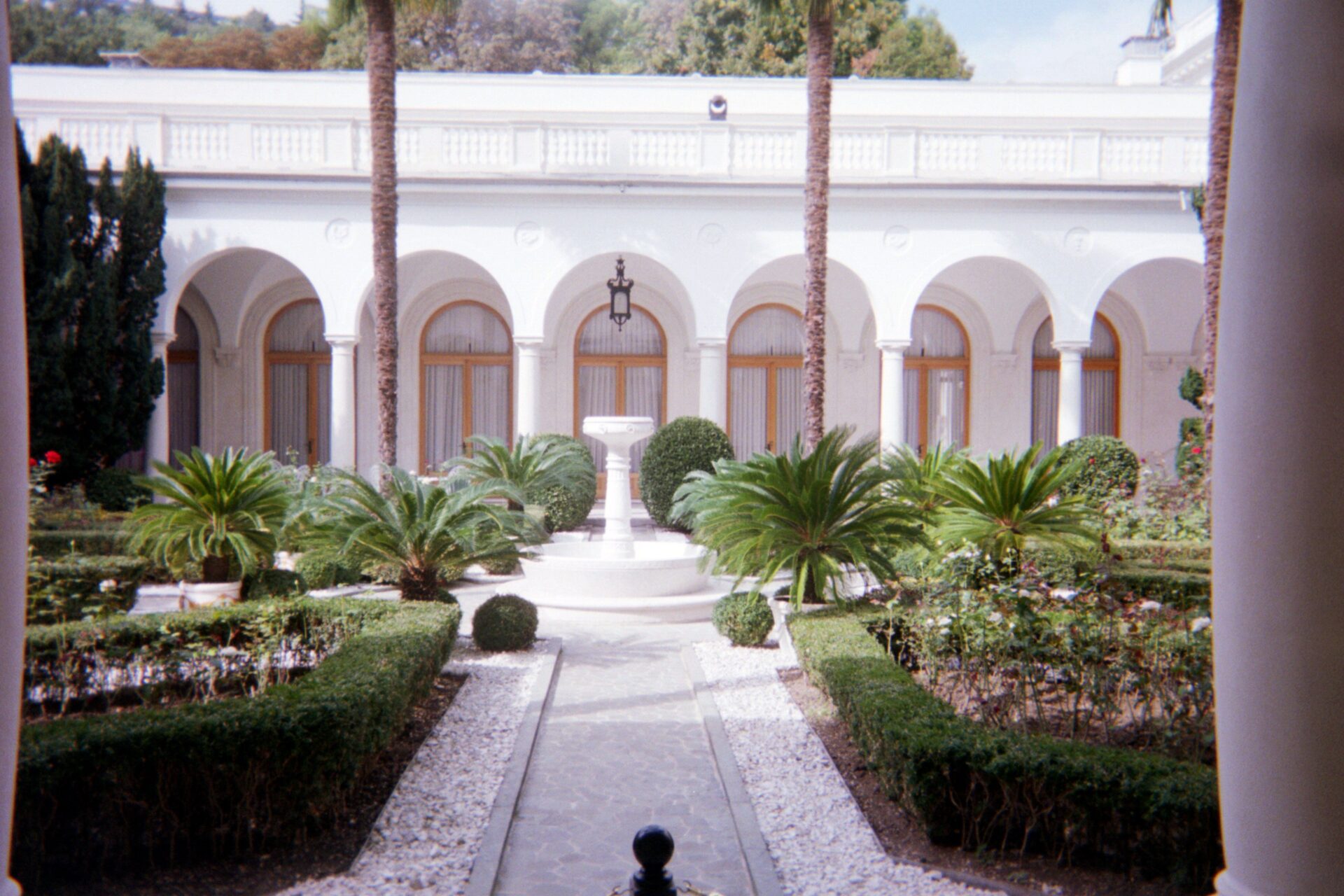
Courtyard where famous photo of Stalin, Churchill and FDR was shot in 1945 at the Yalta Conference
Courtyard where famous photo of Stalin, Churchill and FDR was shot in 1945 at the Yalta Conference; photo by Natylie S. Baldwin

As an update to the last post in connection with the provocations from Ukraine into Crimea, analyst Alexander Mercouris has noted that Western governments have provided little to no public support to the Kiev government on this issue:

In the event the most surprising fact about the Crimean incident is that there have not even been the ritual statements from Western governments of support for Ukraine that I expected.  On the contrary Western governments have publicly said virtually nothing about the incident.  A meeting of the UN Security Council did take place on Thursday to discuss the incident, but the meeting took place in closed session so scarcely anything is known about it.  By contrast the calls for restraint I said would be made by the West to Ukraine in private are being made in public as well.

Meanwhile Ukrainian attempts to drum up international support have met with only a tepid response.  US Vice President Biden did speak on Friday to Ukrainian President Poroshenko.  However the White House press release on the conversation significantly fails to support the Ukrainian account of the Crimean incident.  Instead, whilst making ritual references to US support for Ukraine’s sovereignty and territorial integrity, it says that

“The Vice President urged President Poroshenko to do his part to avoid escalating tensions. The Vice President noted that we have urged the Russian side to do the same.”

Not only does this comment fail to back Ukraine’s account of the incident, but it puts Ukraine on the same level as Russia, implying that Ukraine needs to heed calls for “restraint” as much as Russia.  That would certainly not be what the US would be saying if it were publicly blaming Russia for the incident.

….The lack of support for Ukraine over this incident is partly explained by the fact that the Russian account of it is (as I have said previously) undoubtedly true.  Not only do all the known facts confirm as much, but Ukrainian explanations – that the shooting incident was the result of drunk Russian soldiers shooting at each other, and that Yevgeny Panov (the alleged Ukrainian leader of the spy ring) was supposedly abducted by the Russian secret service from Ukraine and smuggled to Crimea in order to give the Russian account verisimilitude – is just too fantastic for anyone to take seriously.  The Kremlin’s website shows that no Western leaders have called Putin to discuss or rather scold him over the incident.  The absurdity of Ukraine’s explanations probably means they are too embarrassed to do so.

Western governments have not however in the past hesitated to back Ukrainian accounts of incidents however preposterous those accounts might be.  The failure in this case therefore has to be taken as further evidence of Western “Ukraine fatigue” and disenchantment with the Maidan regime.

Consistent with this assessment are the public comments from Germany’s foreign minister, Frank-Walter Steinmeier in which he admonished both sides to refrain from escalation.  UPI reports the following:

German Foreign Minister Frank-Walter Steinmeier on Monday said Germany is concerned about the security situation in Crimea, adding that Russia and Ukraine “must refrain from anything that may lead to a further deterioration of the situation.”

Steinmeier met with Russian Foreign Minister Sergey Lavrov in the Russian city of Yekaterinburg to discuss Moscow’s evidence about an attack the Kremlin accuses the Ukrainian government of carrying out in which two Russian servicemembers were killed. Ukraine denies the attack took place.

“The main thing is that the situation doesn’t get out of control,” Steinmeier said. “We call on everyone to de-escalate.”

A personal contact in Yalta had the following to say when asked how things were going this past week in this scenic city in Crimea:

People go to the beach, thousands of holiday makers enjoy their time, we do feel very secure and protected.  Thousands of Russians are flying into Crimea right now for summer holidays and security measures are pretty high everywhere. So we feel no danger.  This is the view from inside.
*************
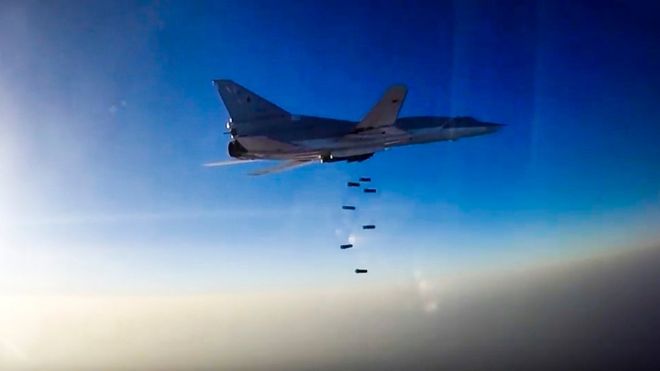
A still image, taken from video footage released by the Russian Defence Ministry on 16 August 2016, shows a Russian Tupolev Tu-22M3 long-range bomber based in Iran dropping bombs on an unknown location in Syria
(A Russian defence ministry video showed a Tupolev Tu-22M3 dropping bombs over Syria; http://www.bbc.com/news/world-middle-east-37093854)
For the first time, Russian bombers took off for their runs over Syria from an air base in Iran.   The Washington Post underscored the diplomatic and geopolitical significance in their report earlier today:

Russian bombers flying from an Iranian air base struck rebel targets across Syria on Tuesday, Russian and Iranian officials said, dramatically underscoring the two countries’ growing military ties and highlighting Russia’s ambitions for greater influence in a turbulent Middle East.

….Iran has long banned foreign militaries from establishing bases on its soil. But the raids on Tuesday appeared to signal a budding alliance that would expand Russia’s military footprint in the region.

Iran and Russia “enjoy strategic cooperation in the fight against terrorism in Syria, and share their facilities and capacities to this end,” Iran’s National Security Council chief, Ali Samkhani, said Tuesday, according to the state-run Islamic Republic News Agency (IRNA).

 ….Russian intervention marked a turning point in the fate of the Assad regime, which had been losing ground to rebel forces. Outside the government-held side of Aleppo earlier this year, roadside billboards featured Russian President Vladimir Putin and Assad. In Damascus, keychains and mugs with the Russian leader’s picture were on sale in the city’s markets.

But until now, Russia’s long-range bombers, which require longer airstrips, had to be launched from Russian territory more than 1,200 miles away. Now, those same bombers need to fly only about 400 miles from Iran to Syria, Iran’s Fars News Agency reported Tuesday. The shorter distance will allow Russia to intensify its air campaign against rebel-held areas.

This follows the decision by Russia to go ahead and make the Khmeimim air base in Syria a permanent one, creating a presence in the Mediterranean.  More details and context with respect to this move are provided at The Duran:

Following negotiations between the Syrian government and Russia an agreement dating to 2015 has now been ratified by Russia turning the Russian air base at Khmeimim in Syria into a permanent base.  In other words Russia will retain the base at Khmeimim beyond the conclusion of the Syrian conflict, and its presence there has just been made permanent.

That the Syrian government has wanted to grant the base to Russia on a permanent basis has been known for some time.  From the Syrian point of view the Russian base not only guarantees Russia’s support for the present Syrian government but also provides Syria with a measure of protection it has never had before from Israeli air incursions. These have been a continuous reality for decades with Syria lacking the capability to prevent them.  The Russians do have that capability and the Syrians will be hoping that because of the presence of the base they will now use it to protect Syria from Israeli air incursions.  As it happens reports suggest that the number of Israeli incursions of Syrian airspace have fallen off significantly since the Russian Aerospace Forces deployed to Syria last autumn, with the Israelis now careful to keep the Russians informed of their flights.

Whilst the Syrian government is known to have been keen to grant Russia a permanent base, the Russians have up to now been less sure.  Establishing a permanent foreign base in Syria is for the Russians a major departure from their former policy given the Russian military’s overwhelming focus on defending Russian territory rather than projecting Russian military power far beyond Russia’s borders.

….The military reality is that since 1943 it is the US Navy which together with its naval allies (primarily Britain and France) has been the overwhelmingly dominant military power in the Mediterranean.  Since the Second World War the Mediterranean has been in military terms an American lake.

The base at Khmeimin however is different from anything that has existed before.  Not only does it already host a formidable strike force of aircraft roughly equivalent to that of a US Navy carrier strike group, but it is heavily defended by formidable air defence assets including S400, BUK and Pantsir anti aircraft missiles, and contains a host of radar, electronic warfare and command facilities.  It is also defended by a formidable force of Russian ground troops, said to be of battalion strength.  Moreover there is talk the base is going to be significantly expanded to make it capable of hosting much heavier strike aircraft, possibly TU22M3s.  Khmeimim also forms part of what is becoming a very powerful complex of Russian military bases and facilities in Syria, which obviously include the Tartus naval facility (which may also now be expanded) and a top secret Russian listening post which has long been rumoured to exist somewhere in Latakia province.

In aggregate this is a base complex of a sort the Russians have never had in the Mediterranean before, and one that has now been made permanent.

**************

(Pictured (left-right): Sergei Ivanov, the former head of Russia’s presidential administration, and Russian President Vladimir Putin. Photo: RIA Novosti)

And, in a surprise move, Putin accepted the resignation of his chief of staff and long-time friend, Sergei Ivanov.   Russia Direct has an article that gives a good run down on the relationship between Putin and Ivanov, beginning in the 1970’s when both worked for the KGB in St. Petersburg (then known as Leningrad).   However, I disagree with the conclusion expressed by the author that this move represents Putin simply trying to consolidate more power around himself.  And the author is wrong to suggest that Putin has unlimited power in Russia.  He does not and, again, anyone who studies contemporary Russia and Putin carefully knows this is not true. Putin is the one who makes the ultimate decisions on most things but he has various interests that he must consider and balance when making those decisions.   He has also had problems in the past with those lower down the bureaucratic chain not enforcing his decisions.

Alexander Mercouris provides a different perspective on the possible reasons for the shake-up:

Officially Ivanov asked to be dismissed himself having supposedly asked Putin to be appointed for just a four year term when he was first appointed, which has now run out.  Officially Ivanov has also proposed his successor – Anton Vaino  – who was previously his deputy.

It could be that all this is true.  However Ivanov is being transferred from one of the important positions in the government to one of the least important – Special Representative on Environment and Transport Issues – which is a major downgrade.  It is difficult to see in all this anything other than a major demotion.

There may be a possible hint in Putin’s comment as to the real reason for this step.  He is reported to have said to Vaino (Ivanov’s successor) that he would “like to see as little bureaucracy as possible and a more hands-on approach to solving everyday problems faced by the Executive Office, as well as in the key areas of economic development and social issues.”  There have been constant rumours going back to Ivanov’s time as Defence Minister that he is not a good manager, and in these words there may be a hint that this is the real reason he has just been removed from a post where management skills are essential.