Category Archives: Uncategorized

Kit Klarenberg: NSC advisors urged ‘ISIS’-style drone attacks on Russian rail, leaked files show

By Kit Klarenberg, The Grayzone, 6/23/25

A coterie of British and American academics advising the US National Security Council explicitly urged Ukraine adopt the tactics of ISIS in a detailed proposal for “anti-rail drone operations,” according to leaked documents reviewed by The Grayzone.

The aggressive war plans recommended in the files eerily foreshadowed Ukraine’s Operation Spider Web, which consisted of a series of brazen drone attacks waged inside Russia between May 24 and June 1 – the eve of scheduled negotiations between Russia and Ukraine. A pair of Ukrainian bombings of Russian trains in Bryansk on May 31 and Kursk and the following day left seven dead, and injured more than 30 people, including two children.

The attacks on Russian rail infrastructure have continued since the launch of Operation Spiderweb, suggesting the British-born strategy has heavily influenced the thinking of Kiev’s increasingly desperate military.

The leaked plans reviewed by The Grayzone explore the use of “inexpensive drones” as “a low-cost means for disrupting Russian logistics,” but also include blueprints for terror attacks composed by three “drone experts” before being passed to the Biden administration’s then-Director for Russia at the National Council, Col. Tim Wright.

Those experts belonged to a secret academic-intelligence cell called Project Alchemy, whose existence was first exposed by The Grayzone, and which was founded with a mission to “to keep Ukraine fighting” by imposing “strategic dilemmas, costs and frictions upon Russia.”

As previously reported here, Project Alchemy researchers called “to take a page from ISIS’ playbook,” presenting the jihadist group’s psychological operations as a model for Ukrainian attacks on Russian civilians. The Grayzone can now reveal that Alchemy’s team also urged US war planners to look to the Islamic State for inspiration in using commercial drones for attacks on Russian civilian targets.

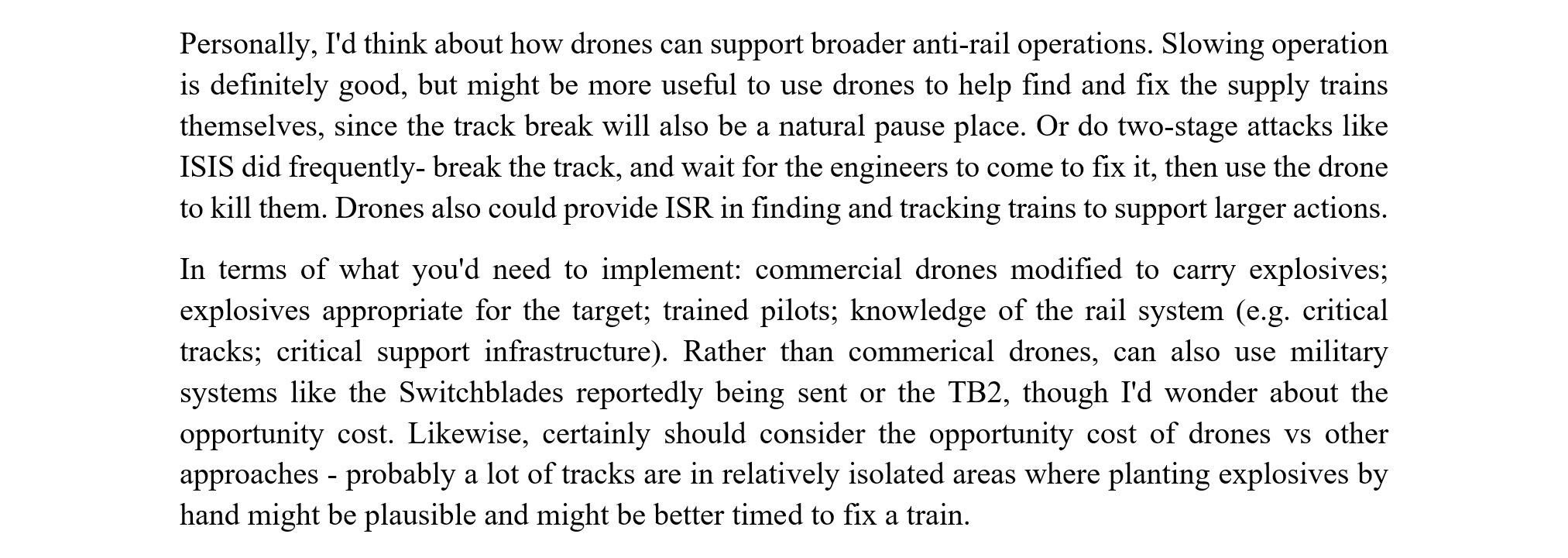
One academic advising the Alchemy cell, Zachary Kallenborn of George Mason University, recommended Ukraine carry out “two-stage attacks like ISIS did frequently” on Russian-held railways, suggesting that Kiev first “break the track, and wait for the engineers to come to fix it, then use the drone to kill them.” In other words: double tap kamikaze drone strikes.

“Drones also could provide ISR [intelligence, surveillance, and reconnaissance] in finding and tracking trains to support larger actions,” with satellite imagery exploited for targeting purposes, Kallenborn added.
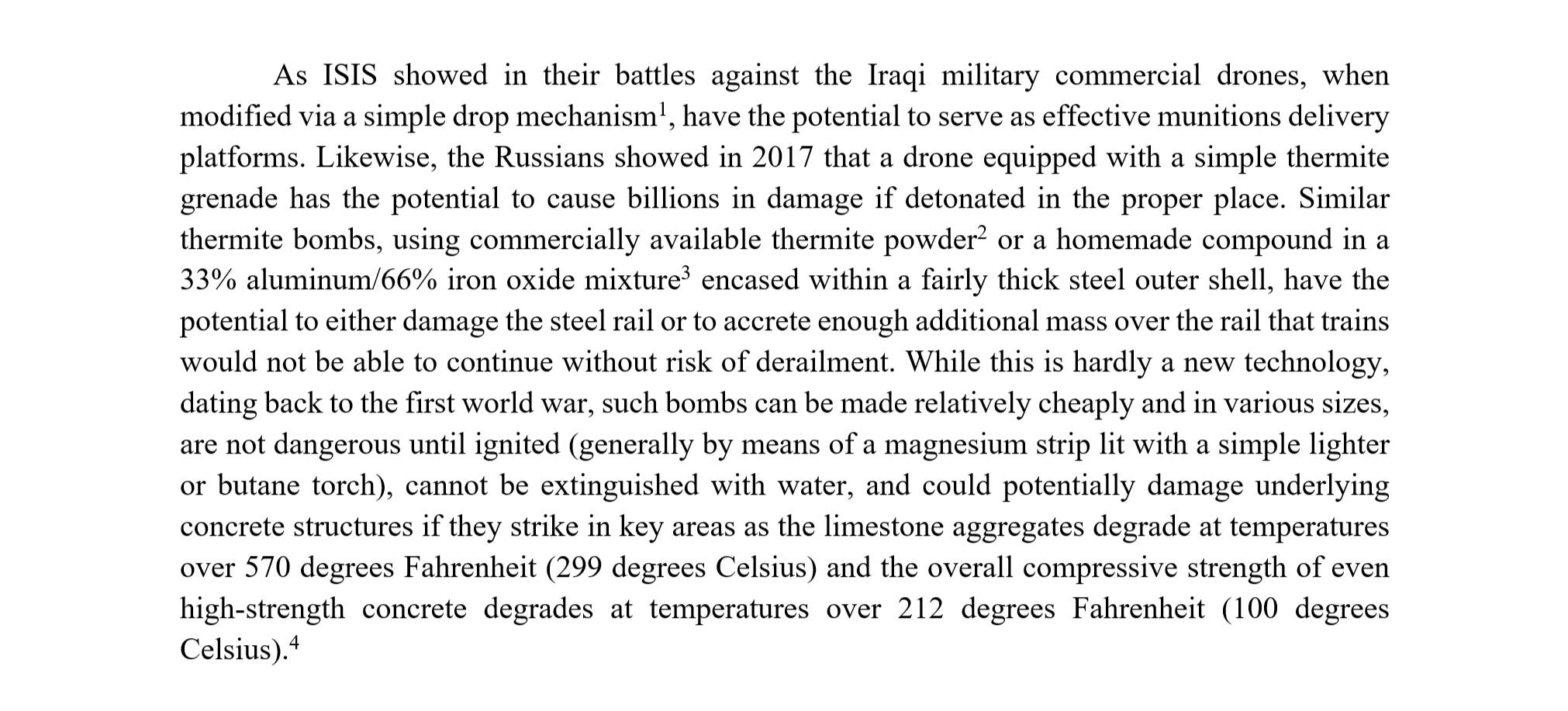
An unnamed Durham University researcher consulted by the NSC declared that “ISIS showed in their battles against the Iraqi military” that drones could be “modified via a simple drop mechanism… to serve as effective munitions delivery platforms.” The conversion of everyday commercial drones into munitions-bearing killing machines would prove one of the most deadly tactics of the war for both sides.
The origin of Kiev’s ‘drone swarm’ offensives?

During a meeting between military historians from Kansas State University and faculty from the Command and General Staff School at Ft. Leavenworth, academic war planners discussed “the idea of using inexpensive drones to prevent Russia from using captured Ukrainian railroads to resupply their combat units.” The academics then delivered the proposal to “three drone experts in the Ukraine Working Group who each provided their analysis for how to achieve this.”

A separate leaked document describes the Working Group as a vast collection of “strategic studies, military technology and Eastern Europe regional studies experts” who “came together to analyze the Russian invasion of Ukraine and to think deeply about policy options” which could “assist Ukraine’s defense (short of deploying combat forces).” The Working Group was composed of “approximately 60 experts hailing from states throughout NATO.”

The operations file begins by noting that, “when operating in its own territory,” the Russian army “relies on its well-developed rail system which is integrated with Ukraine’s domestic rail network.” As Russian forces moved deeper into Ukraine, the Working Group forecasted that they would “increasingly need to rely on Ukraine’s rail system or face logistic-induced paralysis as their lines of supply lengthen and their road-based logistical become increasingly inefficient.”

“The question should therefore be posed as to whether inexpensive drones can be used to hinder Russian efforts to use those portions of Ukraine’s railway network they have captured,” the document stated. An academic using the initials “M.E.D.” who hailed from Britain’s prestigious Durham University declared, “if Ukrainian forces could sustain attacks on occupied railroads, they could hamper Russian forces’ ability to operate deeper inside of Ukraine.”

While believing it “unlikely that drone attacks, even kamikaze attacks, could bring down bridges” – although this “would be ideal” – they suggested “commercial drones could be modified with a sufficient explosive to inflict meaningful damage of railroads, it would greatly complicate Russian efforts.” After all, “even a small amount of damage would force rail traffic to stop until repairs could be made to the line.”

These attacks “could be carried out away from major stations likely to have active air defenses,” and “augment attacks by stay-behind guerrilla forces.” M.E.D. cited a July 2018 paper on Islamic State’s “innovative” use of drones published by the West Point military academy’s “combating terrorism center” as a reference point for such tactics. It discussed “creative ways” ISIS had deployed “simple, low-cost, and replaceable devices” to devastating effect against its adversaries, which could be replicated by the US and its allies.

M.E.D. postulated that “if larger drones could be procured, of if light commercial aircraft could be modified to fly as drones, they might be able to damage rail bridges enough to force substantive repairs, which would greatly slow rail traffic” – a proposal which closely resembles the June 1 attacks on rail bridges in Russia’s Bryansk and Kursk regions. “Another possibility” was “to use a number of commercial drones in a swarm attack” comparable to Ansar Allah’s September 2019 strikes on Aramco sites in Saudi Arabia, “wherein a number of thermite munitions are used to weaken steel or concrete infrastructure.”
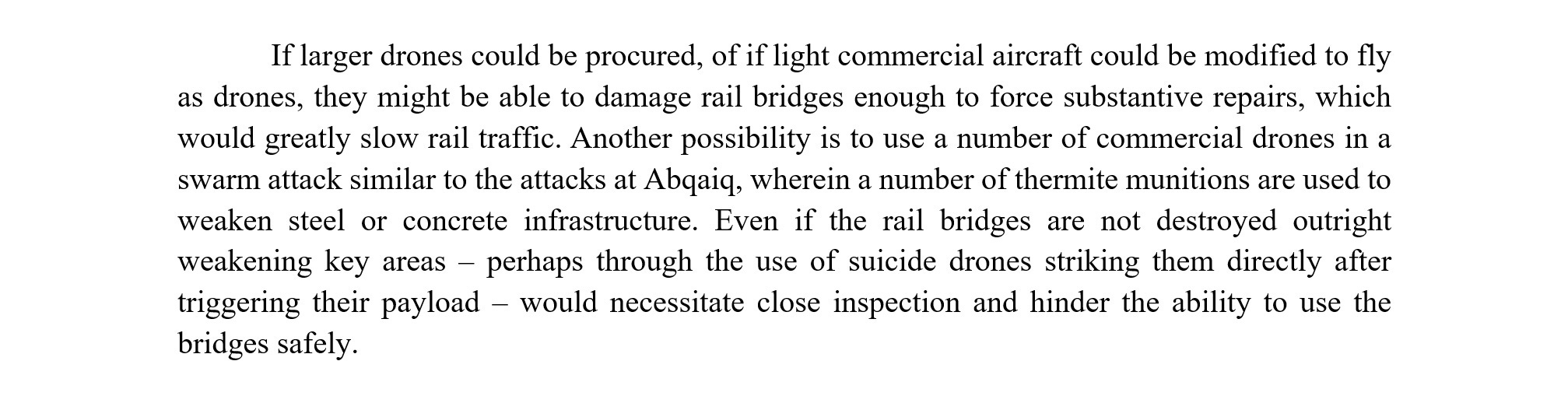
“Even if the rail bridges are not destroyed outright weakening key areas – perhaps through the use of suicide drones striking them directly after triggering their payload – would necessitate close inspection and hinder the ability to use the bridges safely,” M.E.D. concluded. Throughout the proxy war, Ukraine has regularly deployed drone swarms against Russian targets, in some cases inflicting significant damage.

“Track switches would probably be good targets too”

Another “drone expert” consulted by the St. Andrews cabal was Dominika Kunertove, formerly of Swiss university ETH Zurich’s Center for Security Studies. Kunertove currently serves as director of “a research project on future drone warfare and technology” at the Atlantic Council, the semi-official, arms-industry funded think tank of NATO in Washington DC.

Kunertove suggested using drones to strike “anything that uses” railroads, rather than railways themselves, as this would mean “neither side would be able to use railroads for some time (in case [Ukraine] recaptures…territory previously held by Russians.” This June, Kiev destroyed a military supply train carrying heavy armor, including tanks and artillery systems in an effort dubbed Operation Spiderweb 2.0.

Meanwhile, Zachary Kallenborn, a self-described “war doctor in training” from George Mason University’s Schar School, noted the “limited payloads” offered by commercial drones, with “only a few pounds” of explosive able to be attached to them, meant “the best bet would be to hit sensitive, difficult to repair targets to maximize harm.” While admitting to “not know too much about rail infrastructure,” he suggested “switching yards, engine houses, or the equipment to load and unload trains” as prospective targets.

“Track switches would probably be good targets too,” Kallenborn said, as “a hit would disrupt multiple lines and…would be tougher to repair.” He went on to advocate “[thinking] about how drones can support broader anti-rail operations.” While “slowing” operations intended were “definitely good,” Kallenborn believed it would be “be more useful to use drones” to target “supply trains themselves,” echoing Dominika Kunertove’s suggestions.

Kallenborn specifically highlighted five commercial drone models which could be outfitted with explosives and sent to disrupt rail operations, including the $2,200 DJI Mavic III, which Ukrainian forces used in their attack on a Russian fuel train this May 24.

“All of these would need to be modified to allow carrying and dropping of any munitions, which will increase the cost,” Kallenborn wrote. But “depending on model, there may be secondary suppliers who can help with that,” he noted.
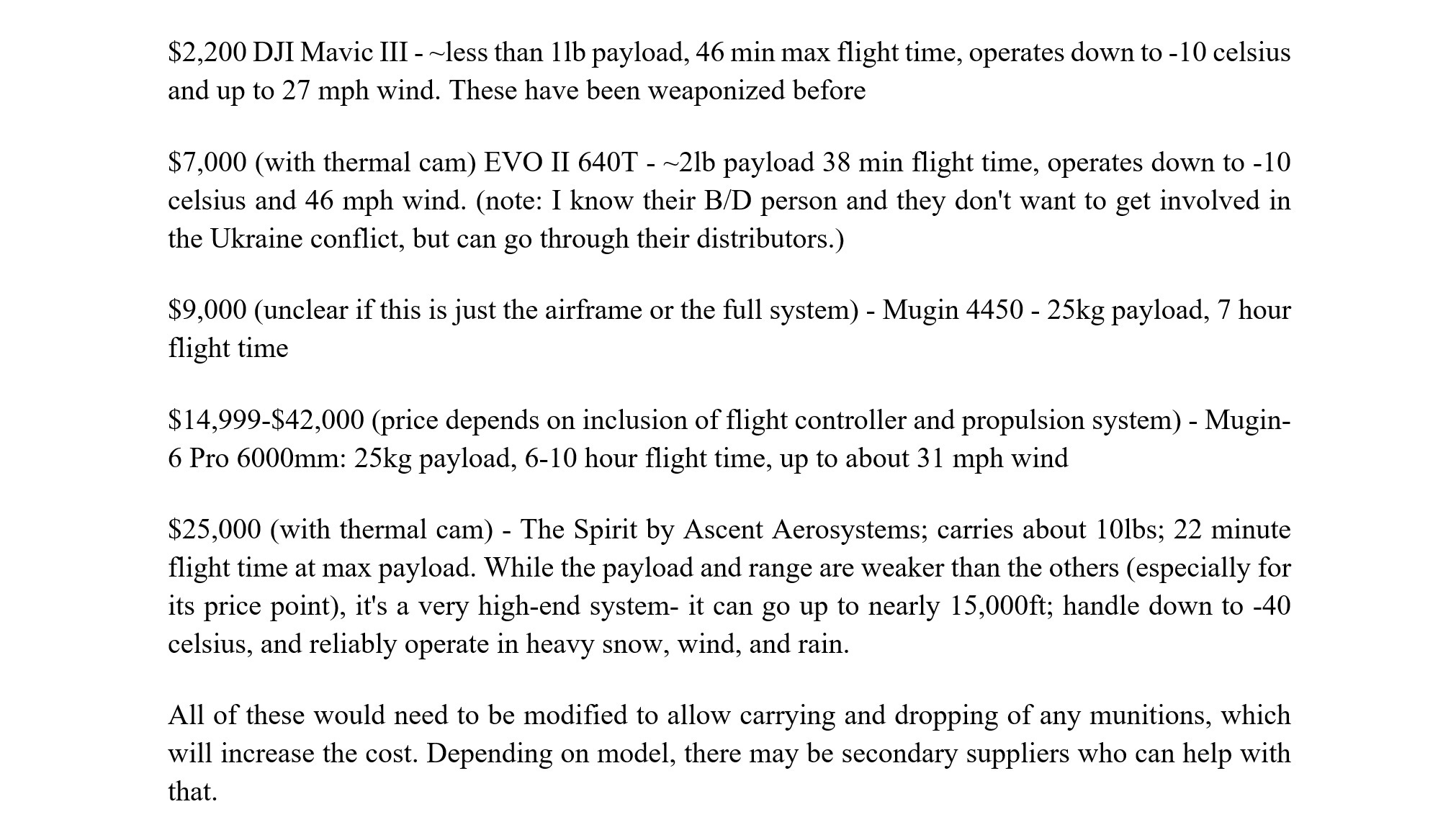
Still, Kallenborn appeared to express some cynicism about the utility of drones. He urged the National Security Council to “consider the opportunity cost of drones vs other approaches.” He speculated there were “probably a lot of tracks… in relatively isolated areas where planting explosives by hand might be plausible and might be better timed to fix a train.”

That task that could be handily carried out by secret Operation Gladio-style “stay-behind guerrilla forces” which other British academics proposed standing up as part of a proposal to strike “sensitive, difficult to repair targets to maximize harm” in Russian territory.

In the face of constant Russian battlefield gains and a looming reduction in Washington’s military aid to Ukraine, the British government remains committed to spending vast sums on ensuring Kiev has a vast supply of drones at its disposal at all times.

As Ukraine places drone attacks on Russian infrastructure at the heart of its increasingly desperate strategy, Project Alchemy’s ISIS-inspired plans are more relevant than ever.
Why Does Seymour Hersh Never Question His Government Sources?

In the past, I’ve criticized Seymour Hersh’s reporting relating to Russia and the Russia-Ukraine war as I’ve noticed that his understanding of Russia seems to be reliant upon his government sources and establishment writers who are the intellectual fellow travelers of Fiona Hill.

I have to say I don’t understand why such a respected and seasoned investigative journalist who covered the worst of the Vietnam and Iraq wars shows no discernment or inclination to question some of the nonsense he’s being fed by his sources.

As a recent cross-post by Simplicius made clear, the high numbers of Russian casualties being bandied about by US/Western government officials and establishment media are not credible when subjected to a modicum of scrutiny. But this shouldn’t be a surprise to those who remember that it was admitted at the beginning of the Russia-Ukraine war that they considered this an information war and that US government officials would be promulgating stories and information that made Ukraine and the west look good and Russia bad – with the implication that the information would not always be accurate or truthful. Did Hersh forget that admission from 2022?

I don’t deny that there are analysts and commentators who are clearly sympathetic to Russia and put out stories and commentary about how Russia is 20 feet tall and is going to defeat Ukraine next week. I won’t mention any names. I’m interested in those who are attempting to report a reasonable approximation of the truth to the extent that is possible during a proxy war between superpowers who both have motivations and purveyors of biased narratives.

On to some relevant excerpts from Hersh’s article from this past week:

…Zaluzhnyi is now seen as the most credible successor to Zelensky. I have been told by knowledgeable officials in Washington that that job could be his within a few months. Zelensky is on a short list for exile, if President Donald Trump decides to make the call. If Zelensky refuses to leave his office, as is most likely, an involved US official told me: “He’s going to go by force. The ball is in his court.” There are many in Washington and in Ukraine who believe that the escalating air war with Russia must end soon, while there’s still a chance to make a settlement with its president, Vladimir Putin….

…I have been provided with new Russian casualty numbers, from carefully evaluated US and British intelligence estimates, that show that Russia has suffered two million casualties—nearly double the current public numbers—since Putin started the war in early 2022. “Putin is not afraid of losing power, but he is losing popularity,” the US official said, “and Donald Trump is Zelensky’s supplier and the only one who can keep the Ukraine war going. Who’s got real power? It isn’t Zelensky. His only lifeline is the US. Trump is asking, ‘How do we get the pissants to stop? He thinks he’s the only one who can make the deal.

“The message to Putin is you can still say you won” if Zelensky is replaced.

The Russian combat losses are seen in Washington, I was told, as key to a renewed urge to get new leadership in Ukraine in order to begin serious negotiations to end the war, given Putin’s contempt for Zelensky and the possibility of escalation. The losses were at an all-time low of twenty per month last fall, as Putin waited for the results of the US election. “When Trump won,” I was told, the Russian leadership organized a spring offensive “to capture as much territory as possible” before another round of expected peace talks with Ukraine started.

The results were dismal. The offensive has only progressed 120 miles beyond the areas Russia already controlled in Ukraine. That gain, amid high casualties, was of minimal importance, I was told: “all farmland, no fortified towns or critical communication sites. The monthly casualties have been 380 a month through May. The total now is two million. Most importantly,” the official stressed, “was how this number was described. All the best trained regular Army troops, to be replaced by ignorant peasants. All the best mid-grade officers and NCOs dead. All modern armor and fighting vehicles. Junk. This is unsustainable.”

For more comparative context, here is what Russia Matters – a project that relies on western establishment media and commentators – had to say about Russia’s recent advances in Ukraine:

“In the battle for Ukraine, the front line is increasingly at a standstill,” The Wall Street Journal reported on July 13.1 Four days later this newspaper described the situation on the frontline as a “slowdown.” But is it? According to RM’s latest Russia-Ukraine War Report Card, the week preceding July 16 saw Russian forces gain 61 square miles of Ukrainian land, which is triple the rate of the previous week.Moreover, if one compares the monthly rate of change in territorial control in June 2025 (the latest month for which full monthly data is available) with the average monthly rate of change in such control in the five preceding months of this year (Period 1) and in the 18 months (year and a half) that had preceded June 2025 (Period 2), then one sees that the June 2025 rate was considerably higher than the average rate during either of these two periods, regardless of which organization’s data was used to make the calculations (U.S.-based Institute for the Study of War or an online resource that reportedly relies on data from Ukraine-based DeepState, which is affiliated with the Ukrainian MoD). Moreover, the June 2025 rate of advance was higher than that of May 2025 (see Table 2). Thus, it is perhaps not accurate to portray the situation on the Russian-Ukrainian front as “increasingly at a standstill.” [much less a dismal result as Hersh states – Natylie]

Center for Citizen Initiatives: Is Ressentiment Inevitable?

By Paula Day, Center for Citizen Initiatives, 7/11/25

In the article below, Patrick Lawrence presents his rather bleak assessment of the future when the war in Ukraine ends.  After what he refers to as the ‘dead end’ of supposed negotiations between Russia and the US (which, on the American side, have frequently consisted of “social media messages demanding a ceasefire, replete with capital letters and exclamations points, (which) do not count and do not work as statecraft”) Lawrence anticipates a time – a very long time – of Ressentiment.

Ressentiment is a concept that was of great interest to a number of heavy thinkers of the 19th century. What it boils down to is what we at CCI have been anticipating for the aftermath of the bloodiest war in Europe since WWII since the day it commenced:  bone marrow-deep bitterness, rancor, frustration and blame among the citizens of Ukraine and Russia – and many in the West as well.  These toxic feelings have the potential to poison relations between the countries involved in this war, whether directly or peripherally, for generations to come. 

Please read Lawrence’s article, “Trump Dead-Ends Putin,” and let us know what you think.  And in the next few weeks we will tell you of our plan to put citizen-to-citizen diplomacy to work, in some small way, to counter this inevitability.

PATRICK LAWRENCE: Trump Dead-Ends Putin – Consortium News

On a far more positive note, please see the video below from the CCI archives titled, “Present! – Charles Heberle: You the People.”  Charles joined the CCI Board of Directors in February, but he was involved with the organization and in work in Russia long before.  In 2015 he was in the first citizens’ delegation to return to Russia with Sharon Tennison following the Maidan coup.  The videoed interview by Mel Van Dusen, also a 2015 CCI delegate, covers his remarkable involvement in ‘teaching democracy’ in Russia in the decade before that.  If you have not seen the interview already, please take a look.  After the first Cold War ended, the relationship between the former ‘enemies’ could comfortably be called the opposite of Ressentiment.  Let’s hope we haven’t lost that connection forever.

Present! – Charles Heberle: You the People

Sylvia Demarest: DNI head Tulsi Gabbard has referred former president Barack Obama to the Justice Department for investigation

By Sylvia Demarest, Substack, 7/19/25

Sylvia Demarest is a retired trial lawyer.

On Friday, Director of National Intelligence Tulsi Gabbard declassified documents revealing “overwhelming evidence” demonstrating how, before and after President Donald Trump won the 2016 election against Hillary Clinton, then-President Barack Obama and his national security team laid the groundwork for what would be the years-long Trump–Russia collusion probe. In a series of posts on X, DNI head Tulsi Gabbard explains the investigation and the declassification of 114 pages of previously top-secret documents revealing that Russiagate was essentially an intelligence created hoax. Gabbard said, “There was a treasonous conspiracy at the highest levels of government”.

Director Gabbard’s release of these documents is related to an intelligence community operation that took place during and after the 2016 presidential election. This operation was designed to accuse Donald Trump of being a Russian agent and created the Trump-Russia hysteria that occupied the country’s attention for years. The operation was spread by anonymous intelligence community leaks to the corporate media which saturated the the country with what has now been revealed to have been completely “fake news”. We have yet to hear from this media, which includes the New York Times, the Washington Post, MSNBC, NBC, and CNN. The coverage of this fake story by this media, resulted in the media, and their reporters, being awarded Pulitzer Prizes.

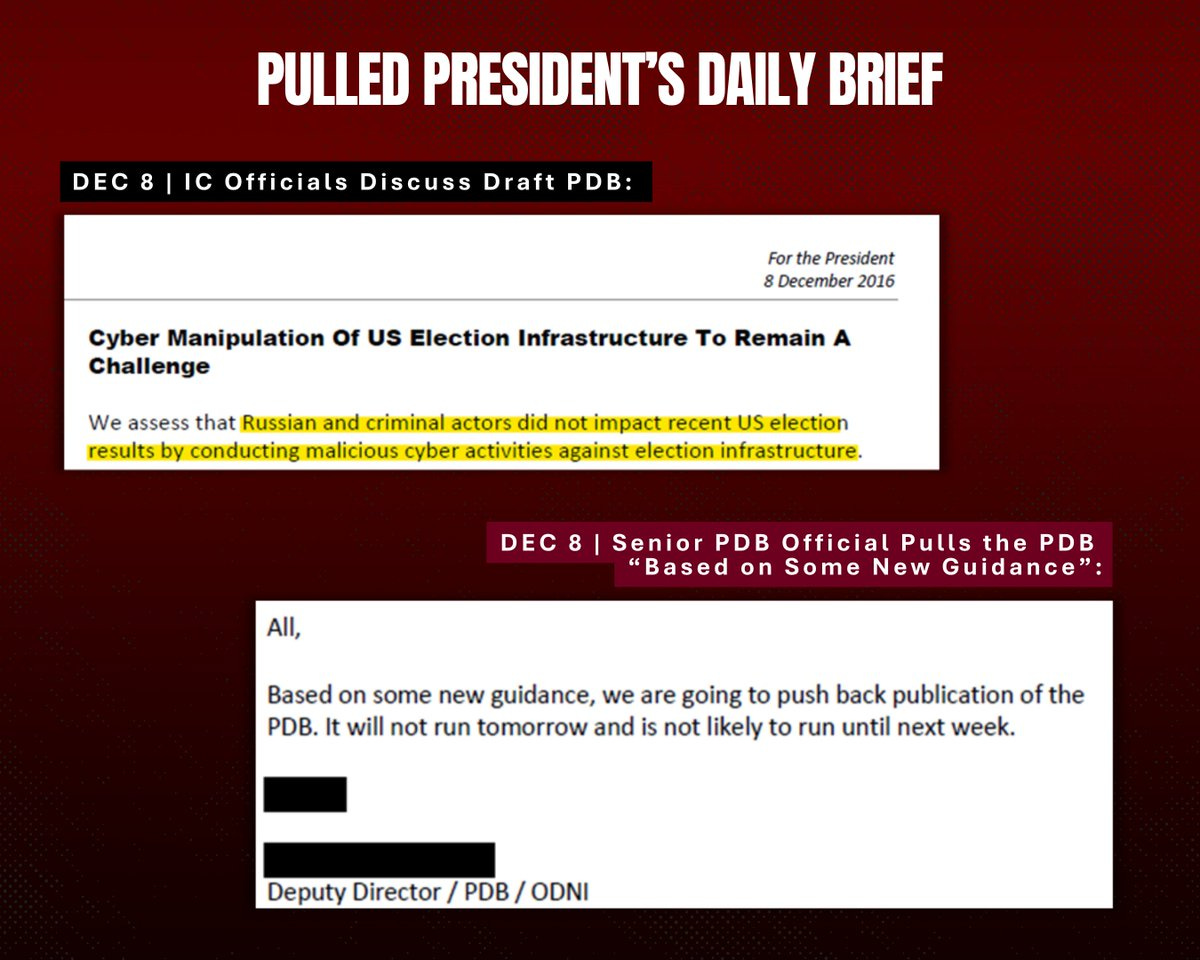
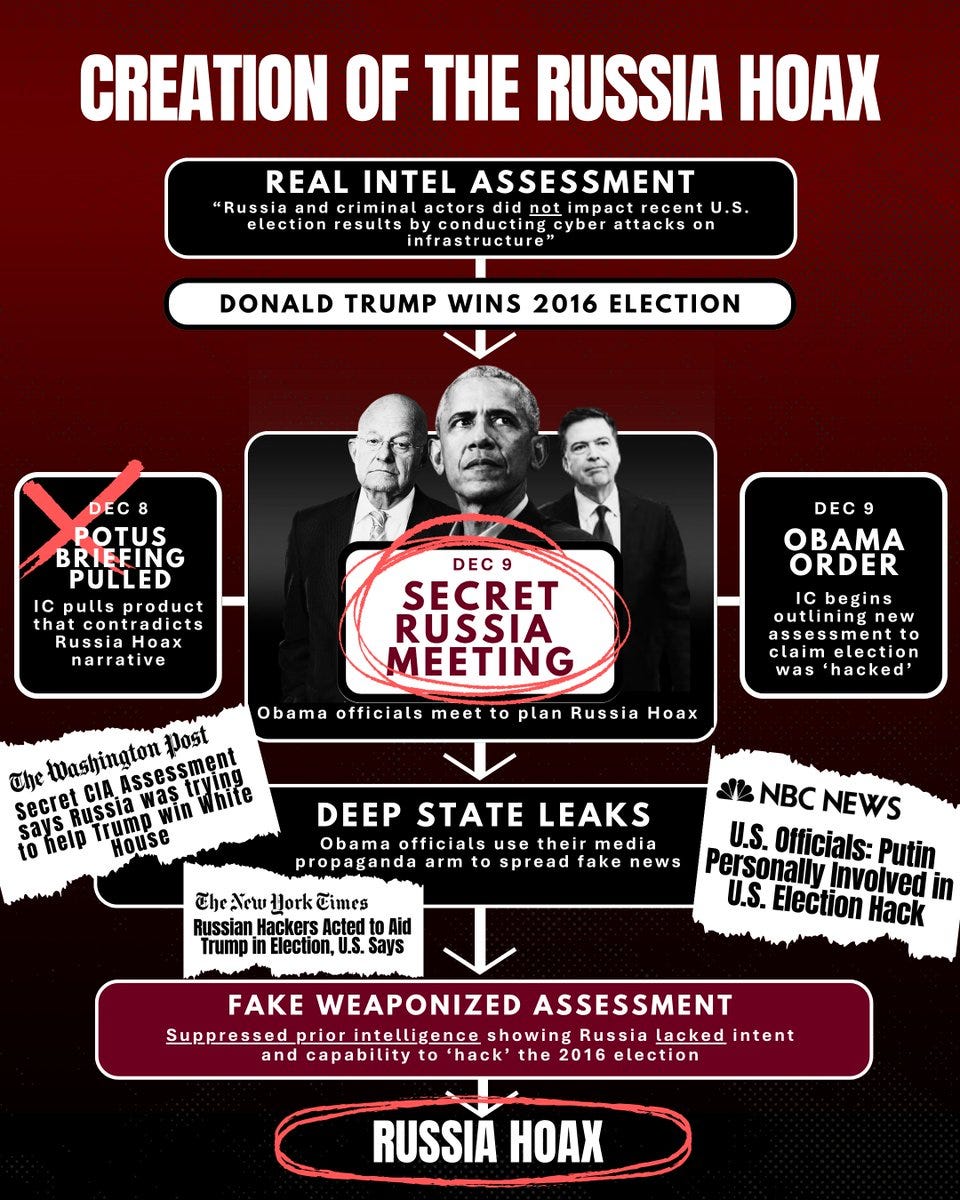
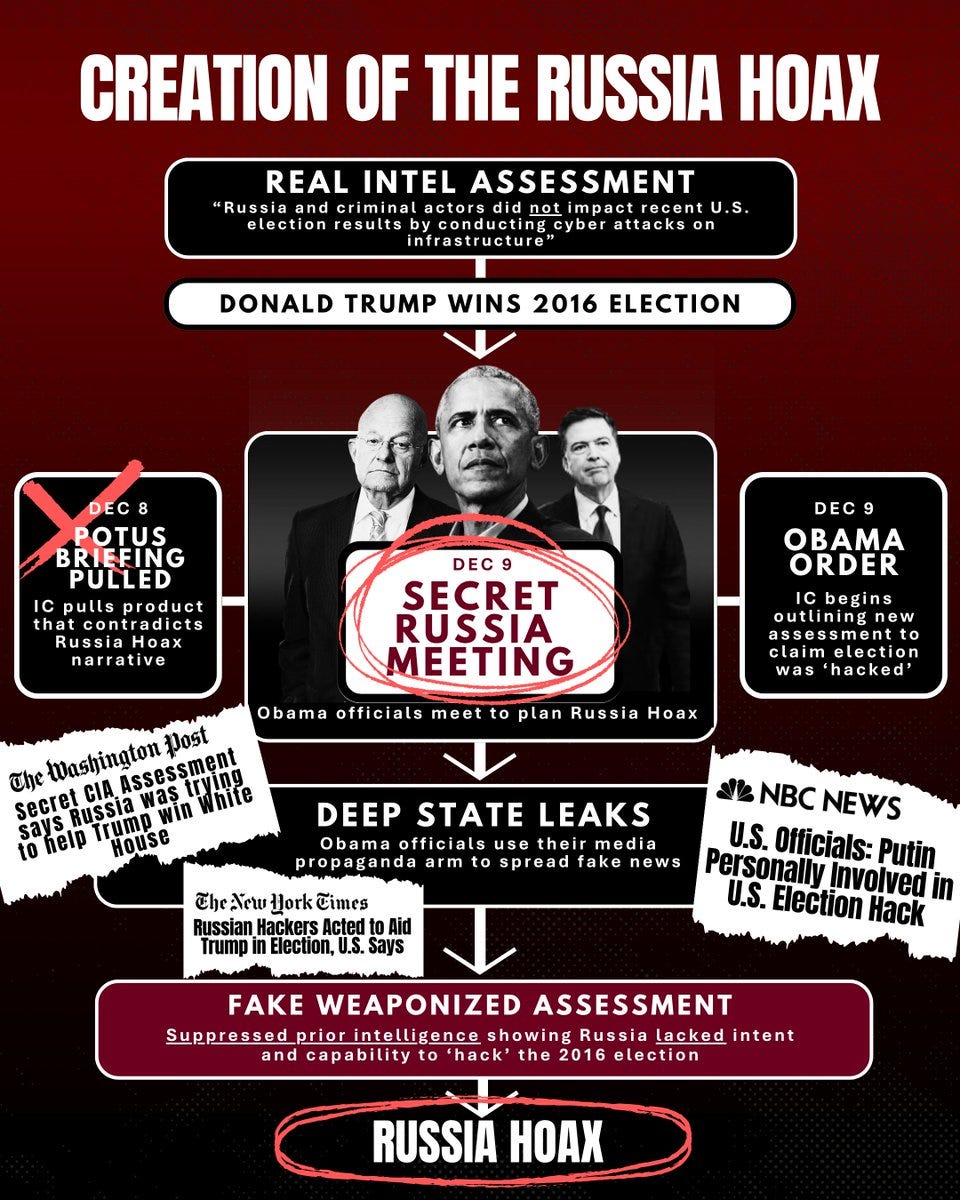
Here’s one example from the DNI disclosures. On December 8, 2016, intelligence officials were prepared to release the President’s Daily Briefing which concluded that “Russian and criminal actors did not impact recent US election results by conducting malicious cyber activities against election infrastructure”:

This “did not impact” memo was never issued due to the intervention of James Clapper and what was contained in these IC memos was the exact opposite of what the Obama White House would claim a month later.

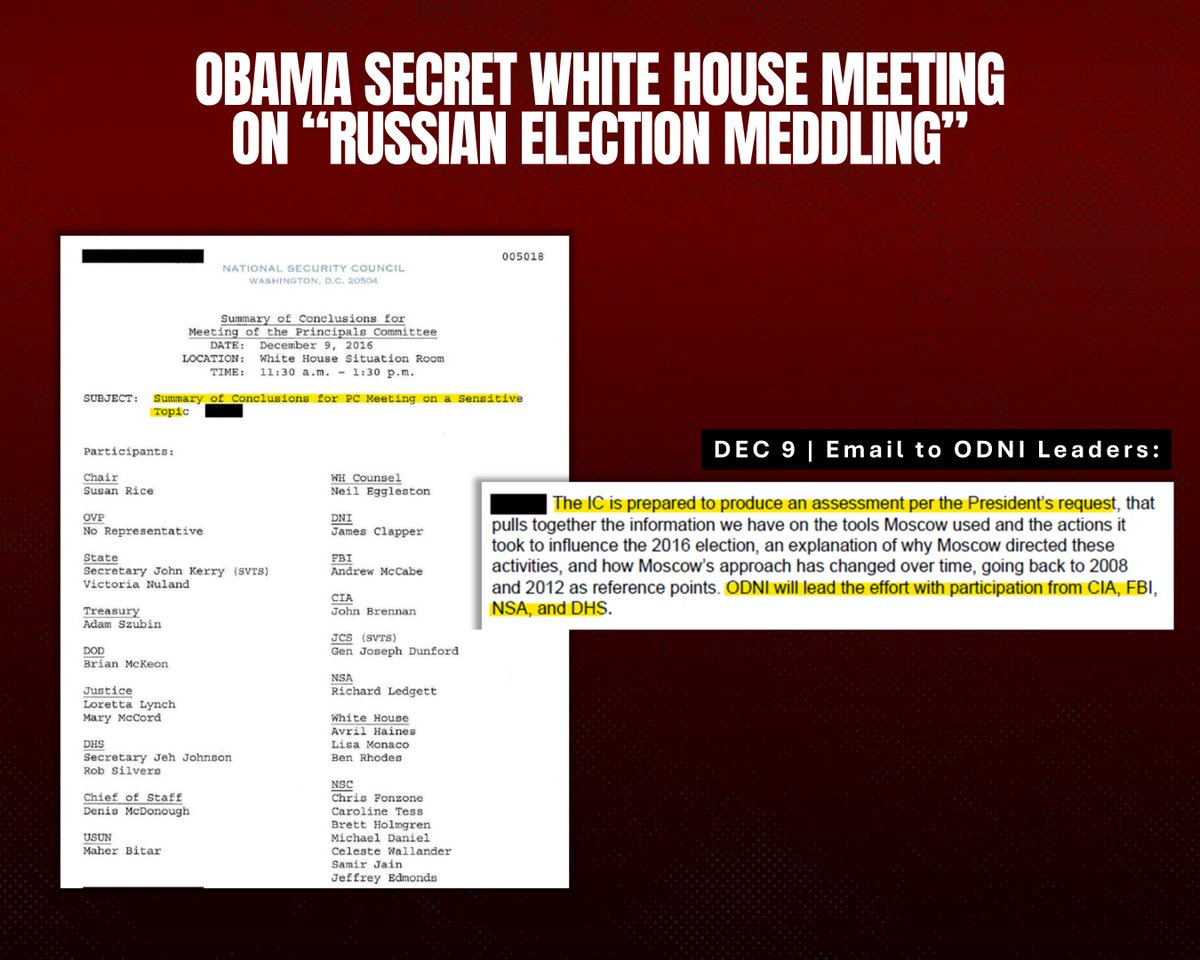
On December 9th Obama’s National Security Principals Committee met and after this meeting each team member received an email tasking them with creating a new “assessment per the President’s request.” This is when the anonymous leaks to the media began, leaks now labeled by the DNI as “blatantly false”. The leaks were about a non-existent “secret assessment” that Russia had intervened to influence “the outcome of the election”. The leaks continued until Brennan could organize and release a Intelligence Community Assessment. These actions put in motion a series of developments that led to the publication of the Steele Dossier and a barrage of media stories linking Trump to Russia, and to an unprecedented scandal that essentially accused Trump of being a traitor.

The materials were bolstered by a whistleblower from then DNI head James Clapper’s office. The documents implicate a wide range of White House officials including President Obama himself, all designed to create a false narrative that Russia had meddled in the election to help Donald Trump.

The release was preceded by an “urgent meeting” of Trump’s Presidential Intelligence Advisory Board, at a secure facility which included officials from the Department of Justice.

The Russiagate hoax seriously impaired US, Russia relations, which appears to have been the ultimate objective.

Here’s Russia Today: “Former President Barack Obama’s administration deliberately manipulated intelligence to frame Russia for interfering in the 2016 presidential election, according to newly declassified documents released on Friday by America’s Director of National Intelligence Tulsi Gabbard. Gabbard unveiled more than 100 pages of emails, memos, and internal communications, which she described as “overwhelming evidence” of a coordinated effort by senior Obama-era officials to politicize intelligence and launch the multi-year Trump–Russia collusion investigation. She dubbed it “a treasonous conspiracy to subvert the will of the American people.” The scandal severely damaged relations between Moscow and Washington, leading to sanctions, asset seizures, and a breakdown in normal diplomacy.”

Catherine Herridge, who had covered the story stated the following: “The newly declassified records are additional, compelling evidence that the 2016 Russia Collision narrative was not rooted in credible intelligence reporting but manufactured to fit a preferred political narrative.”

The significance of this action by DNI cannot be overstated.

This is the first time an intelligence domestic operation has been exposed by its own leadership. It also exposed the abuse of the “classified top secret” label to hide illegal, potentially treasonous activities, which could and should lead to serious reforms in classification procedures. The release of such highly classified documents to the public is also unprecedented and avoids claims that there is “no supporting evidence”.

The criminal referral of former president Barack Obama would have never happened had the Biden DOJ not spent 4 years prosecuting Donald Trump. The Supreme Court case resulting from one of the prosecutions, lays out the circumstances under which a former president can be criminally prosecuted. The Supreme Court said there was “no immunity” for “illegal acts”. The acts revealed by DNI Gabbard, are alleged to be part of a domestic counterinsurgency designed to remove or impair a duly elected president from carrying out his duties under the US Constitution. They were also designed to worsen relations with a foreign country and promote a path to war. If proven, this would constitute an illegal act.

Here is what DNI head Tulsi Gabbard released on Friday:

@DNIGabbard

“Americans will finally learn the truth about how in 2016, intelligence was politicized and weaponized by the most powerful people in the Obama Administration to lay the groundwork for what was essentially a years-long coup against President @realDonaldTrump, subverting the will of the American people and undermining or democratic republic. Here’s how:”

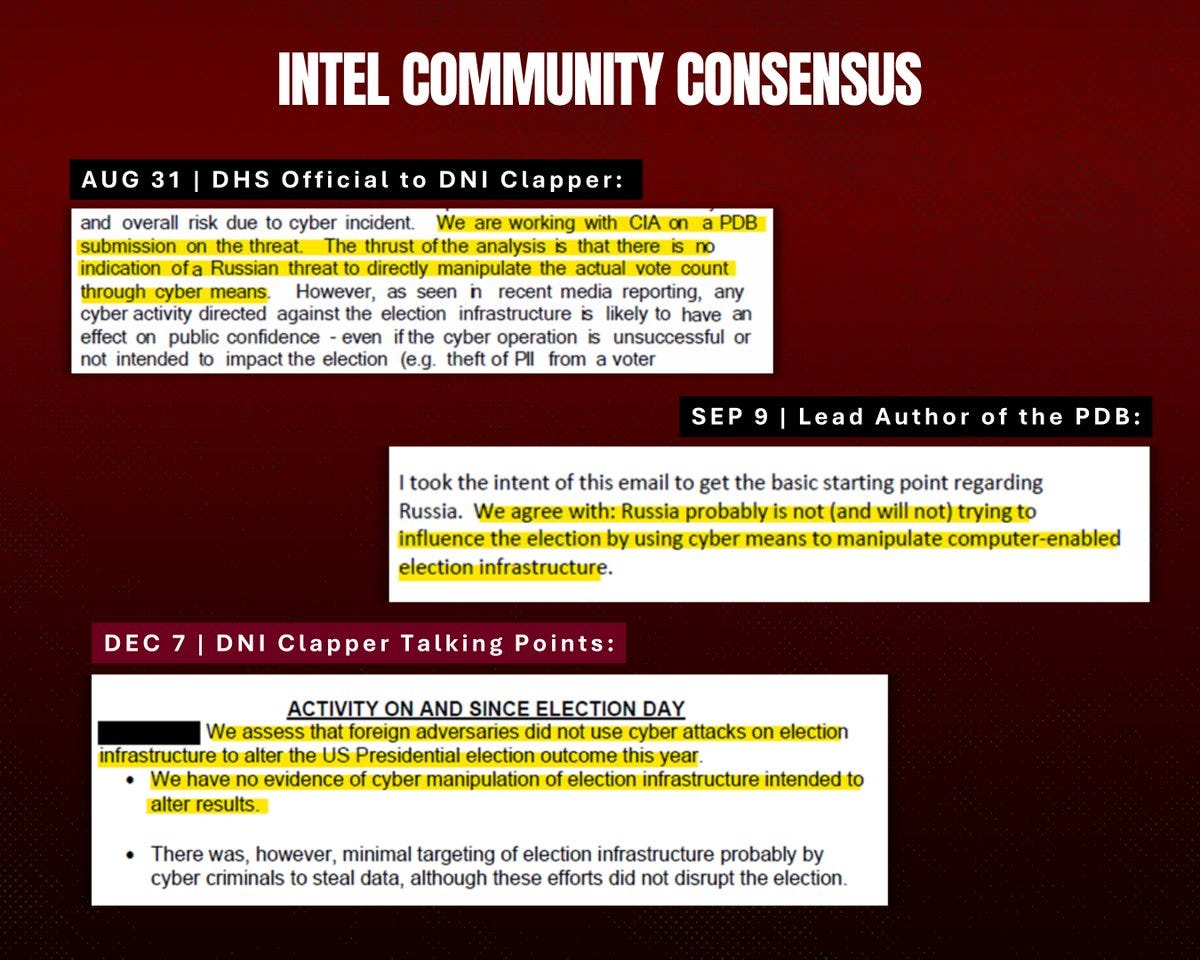
For months preceding the 2016 election, the Intelligence Community shared a consensus view: Russia lacked the intent and capability to hack U.S. elections.

But weeks after President Trump’s historic 2016 victory defeating Hillary Clinton, everything changed.

Image.jpeg

On Dec 8, 2016, IC officials prepared an assessment for the President’s Daily Brief, finding that Russia “did not impact recent U.S. election results” by conducting cyber attacks on infrastructure.

Before it could reach the President, it was abruptly pulled “based on new guidance.” This key intelligence assessment was never published.

Image.jpeg

The next day, top national security officials including FBI Dir James Comey, CIA Dir John Brennan and DNI James Clapper gathered at the Obama White House to discuss Russia. Obama directed the IC to create a new intelligence assessment that detailed Russian election meddling, even though it would contradict multiple intelligence assessments released over the previous several months.

Image.jpeg

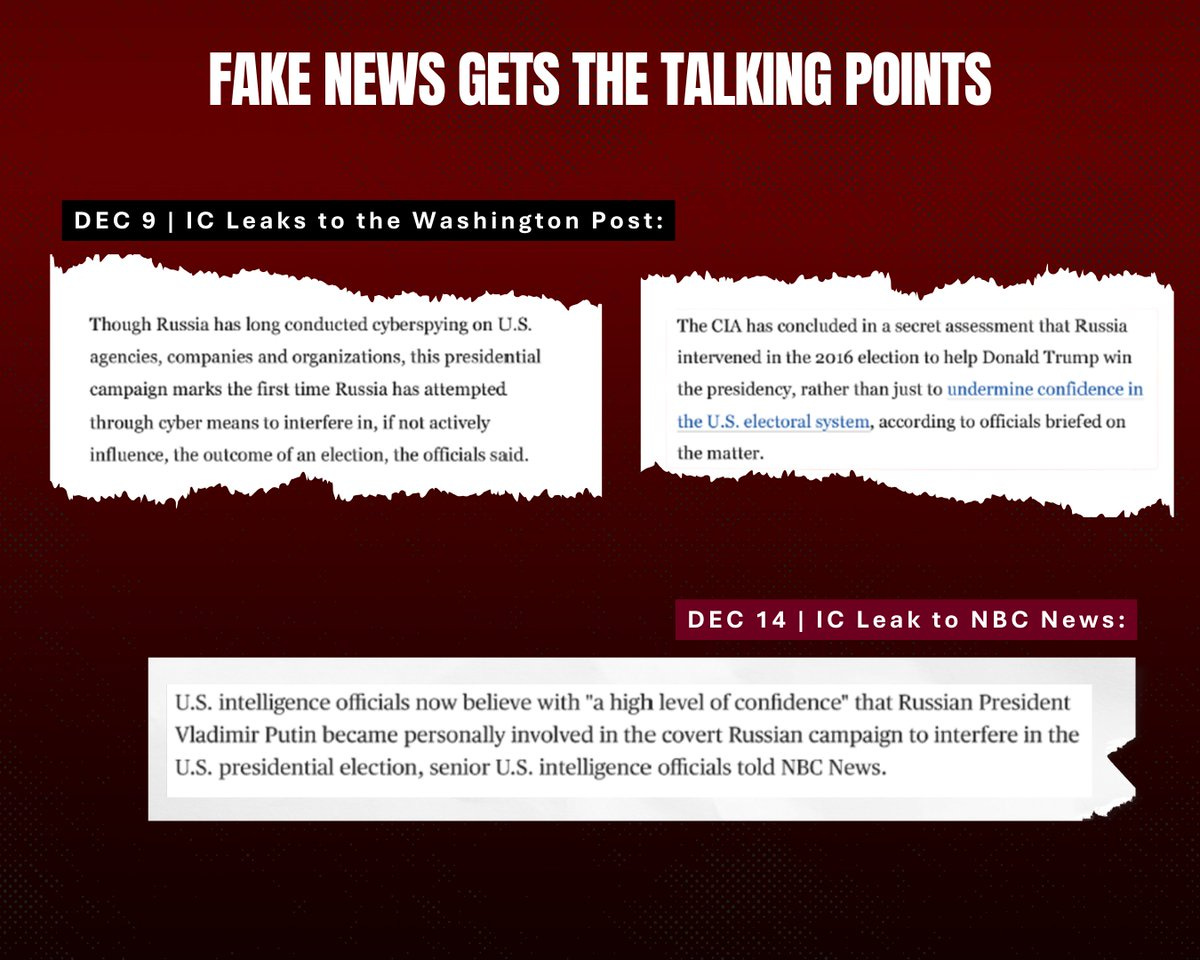
Obama officials immediately leaned on their allies in the media to advance their falsehoods. Anonymous IC sources leaked classified information to the Washington Post and others that Russia had intervened to hack the election in Trump’s favor.

Image.jpeg

On January 6, 2017, just days before President Trump took office, DNI Clapper unveiled the Obama-directed politicized assessment, a gross weaponization of intelligence that laid the groundwork for a years-long coup intended to subvert President Trump’s entire presidency.

According to whistleblower emails shared with us today, we know Clapper and Brennan used the baseless discredited Steele Dossier as a source to push this false narrative in the intelligence assessment.

Image.jpeg

These documents detail a treasonous conspiracy by officials at the highest levels of the Obama White House to subvert the will of the American people and try to usurp the President from fulfilling his mandate.

This betrayal concerns every American. The integrity of our democratic republic demands that every person involved be investigated and brought to justice to prevent this from ever happening again.

I am providing all documents to the Department of Justice to deliver the accountability that President Trump, his family, and the American people deserve.

Conclusion:

In all there were 17 different investigations which Wired Magazine outlined in an article in 2018. These investigations included a Special Prosecutor, two impeachments, and lawsuits against Russian companies that never went anywhere. These investigations resulted in criminal indictments of several people who worked in the Trump campaign. As a result of these investigations, many people were bankrupted and their families threatened, forcing them to plead to charges; others were tried and convicted, and at least 2 were imprisoned. I followed the entire saga at the time, put together a timeline, read Indictments, court transcripts, and depositions. I concluded it was an anti-Russia intelligence operation designed demonize Russia and to keep President Trump from trying to improve US, Russia relations i.e. that it was a likely intelligence operation bordering on treason. Now DNI has reached the same conclusion.

I have not had the opportunity to review all the documents that were released. There are several Substack’s that are following this issue, including Matt Taibbi’s Racket News, which I highly recommend.

Brian McDonald: What one Russian journalist saw when he came home — and why he stayed | Putin’s spokesman explains why Moscow believes censorship is a weapon of war

By Brian McDonald, Substack, 7/11/25

“The truth is that repression in Russia is still very selective and limited. Even if you’re against the war, it’s much more likely that you’ll be hit by a car or killed by a falling brick than be repressed. But you don’t get paranoid about bricks every time you go outside, do you?”

So begins an extraordinary dispatch from The Moscow Times — which, despite the name, is Dutch, not Russian. The article, written anonymously for obvious reasons, is a quiet, defiant challenge to the dominant media narratives about modern Russia. It’s not a defence of the Kremlin, nor an apology for authoritarianism. It’s something rarer: a dose of clear-eyed realism in an age of curated hysteria.

The author is a Russian journalist who returned home after a year abroad, expecting arrest, surveillance, or worse. Instead, he found… life. Strange, complicated, contradictory life. “Of course, I’m a little afraid,” he writes. “Especially when a friend asks me ‘aren’t you afraid the FSB will arrest you?’ But I haven’t been paranoid for a long time. I’m not the only one in Russia. There are more of us than you might think.”

It’s hard to reconcile these accounts with what you see in Western media, which often treats Russia as if it were North Korea with snow. As someone who’s moved between both worlds it increasingly feels like we’re living on two different planets. There is the Russia of The Daily Mail and Der Spiegel, where jackboots echo daily and citizens speak only in code, terrified of voicing a thought. And then there’s the real Russia — the one 145 million people live in — where bars stay open late, the borders remain unlocked, and you’re far more likely to be hit by a moron on an electric scooter than interrogated by the FSB.

That’s not to say there is no repression. There are arrests. There are prison sentences — some for things as mild as social media posts. There are red lines, and if you cross them — especially on the Ukraine conflict — the consequences can be severe. The journalist admits as much: “Naturally, I have to work very carefully… And if [the police] find out that I write for The Moscow Times or any other banned media, I could face a substantial fine or even a prison sentence.”

But for a country at war, the system is not as suffocating as outsiders assume. There is no mass mobilisation. Men of military age come and go. The nightclubs are full, the restaurants are jammed, and cities like Moscow, St. Petersburg, and even Rostov or Voronezh feel safer than their Western counterparts. Certainly safer than Amsterdam or Paris or Barcelona.

In Britain or Germany today, you can be arrested for posting pro-Palestinian content. That’s not a hypothetical — it’s happening. Some of the Western European states claiming the moral high ground are detaining thousands of people annually for comments on social media. That’s not a justification; it’s a comparison. And in this age of double standards, comparisons matter.

Too many Western outlets seem committed to a storyline where Russia must always be descending, a grim theatre of horror to justify sanctions, decoupling, and moral posturing. The idea that ordinary life continues — that people still laugh, dance, build friendships, fall in love — is treated as taboo. As if noticing it is a betrayal.

Worse still is the sheer volume of stories written by people who haven’t set foot in Russia for years — often based in Berlin, Riga, or even Brooklyn — reporting on a society they no longer understand, quoting “sources close to the Kremlin” who, in reality, don’t exist. Anyone genuinely close to power in today’s Moscow would not speak to Western media; to do so would be essentially treasonous. What we get instead are vague, unsourced whispers dressed up as revelations. Controlled leaks — when they come — go to a tiny, sanctioned few: Reuters, CNN, maybe The New York Times. The rest of the coverage is padded with conjecture, fantasy, and recycled Twitter threads.

The bias drips from every paragraph. Anonymous quotes from “Russian officials” who speak in perfect press-release English and just happen to align with the worldview of Western elites. Descriptions of cities and people that feel airlifted from Cold War thrillers. A steady refusal to admit that Russia, despite sanctions, war, and geopolitical isolation, is functioning. Not booming in the headline-friendly style of Singapore or Dubai — but trundling along in a way that undermines the narrative of collapse.

Take, for instance, a breathless Daily Beast piece last month titled “Meet the Woman Who Vladimir Putin Fears the Most.” Not a general, not a rogue ex-oligarch, not a cyberwarfare genius — no, apparently it’s a 32-year-old feminist poet. Daria Serenko herself laughed at the absurdity, saying she nearly fell off her chair when she read it. Her activist group can’t even muster 100 Patreon subscribers. She never claimed to be Putin’s nemesis — that fiction was concocted in an English-language newsroom by people who don’t speak Russian, don’t understand the country, and frankly don’t care. It’s not journalism. It’s political fan fiction: a feel-good morality tale for Western audiences, where every Kremlin critic is a lionhearted hero and every headline is a cartoon villain monologue. And if they’ll invent that, what else will they invent?

What this journalist captures so powerfully is the schizophrenia of exile — the gap between what you’re told and what you see. “I think many journalists in exile become prisoners of their own bubble of like-minded anti-war emigrants,” he writes. The exiled media, he suggests, increasingly focuses more on the Russian diaspora than on Russians themselves.

And there are things they miss. “Over the last few months, I’ve met queer people who have found common ground with Z-patriots through unusual situations. I have spoken to hippie hermits who have gone to live in remote forests… I have visited communes in Moscow and St. Petersburg where leftists, queer people and artists live and stage guerrilla art actions.”

That doesn’t sound like a hellscape. It sounds like life under pressure. People don’t vanish; they adapt. They navigate. They find workarounds. And they tell their stories — carefully, quietly, but with conviction.

The most revealing passage might be the one where the journalist describes a quiet moment of paranoia. Sitting in a cafe with a colleague, who whispers: “There’s a guy sitting there. Behind you, with his back to us, behind the bar… I think he was on the bus with me.” They left quickly, just in case.

Even that tension fades. Eventually, he stopped scanning rooms and looking over his shoulder. What replaced the fear wasn’t denial, but familiarity. A survival instinct fine-tuned not to hysteria, but to realism.

In the end, he chooses to stay. Not because it’s safe. Not because it’s easy. But because, as he writes, “I am much more afraid of missing the unfolding story here, of leaving and never returning home. So between those two fears, I choose to face the first one.”

That, in its quiet bravery, may be the most subversive line of all. Not every Russian unhappy with the status quo is in Paris or Berlin. Some remain in Perm or Samara, in cafes and train carriages, staying grounded in reality and rejecting the imported panic.

You won’t read much about them in the West. But they’re still here. And they’re still living. And laughing. And crying. Some are still writing.

***

Putin’s spokesman explains why Moscow believes censorship is a weapon of war

By Brian McDonald, Substack, 7/11/25

If you want to grasp how Russia views itself in the grip of war—how it rationalises, justifies, and narrates its choices—then Dmitry Peskov’s latest interview is essential reading. The voice of President Vladimir Putin for over two decades, Peskov rarely wastes words and seldom speaks off-key. His conversation with Expert magazine, timed to the outlet’s 30th anniversary, lifts the curtain on how Moscow now sees the press: as both a weapon in its arsenal and a shield against what it calls hostile information fire.

As both press secretary and deputy head of the Presidential Administration, Peskov’s words carry institutional weight.

In Western capitals, the verdict on Russia’s press restrictions is swift and damning: censorship, propaganda, control. But what’s seldom heard—perhaps because few bother to listen—is how the story sounds from Moscow’s side of the glass. Peskov, speaking without bluster, lays out a case that’s less about silencing dissent than about holding the line in what he calls an information war. It’s not a plea for sympathy. It’s an argument for why the Kremlin sees the narrowing of the media field as long overdue.

“Now is a time of military censorship—unprecedented for our country,” he says bluntly. “The war is being waged not just with weapons, but in the information space.”

The argument is not new, but the framing is telling. According to Peskov, Russia faces a two-pronged challenge: a hot war in Ukraine and a broader information campaign waged by foreign-backed media and hostile platforms. He believes that some Russian-language outlets—operating from abroad—are explicitly geared toward undermining the Russian state.

“There are media that deliberately engage in discrediting Russia,” he says. “And it would be wrong to ignore them.”

He defends the restrictive environment as a necessary response not only to the war, but to what he characterises as years of adversarial coverage. In Peskov’s telling, skepticism toward Russia was baked into the editorial DNA of some domestic newsrooms and effectively institutionalised.

“I would even say that for a number of Russian media, expressing doubt or negativity about their own country was part of the editorial policy.”

The rise of more patriotic coverage over the past three years, in his view, is a corrective—not an aberration.

“Being a patriot is not some great achievement—it’s a normal human condition,” he says.

Peskov does concede that some loyalist outlets might go overboard, adding with characteristic sharpness: “There will always be those to whom the saying applies: ‘Teach a fool to pray, and he’ll knock his head against the floor.’”

But Peskov—Putin’s long-time spokesman—is firm in his belief that Moscow has no intention of returning to what he sees as the bad old days—when tearing strips off the country passed for analysis, and constructive criticism was in short supply. He reserves particular ire for Meduza, the Riga-based outlet branded a foreign agent by Moscow, dismissing its tone as “rabid.”

That criticism doesn’t land in a vacuum. Even before the war in Ukraine, Russia had long grown used to its portrayal in Western media—a country boxed in caricature, its failings broadcast with clockwork regularity, its achievements barely granted a line. You’d be forgiven, surveying two decades of headlines, for thinking Russia had no scientists, no artists, no valid grievances—just villains in suits and shadows.

Meanwhile, some of the loudest Russian-language outlets—The Moscow Times, Current Time, Svoboda, and yes, Meduza—were openly funded by Western governments or affiliated institutions. That funding wasn’t a secret, nor was it apolitical. Western states didn’t bankroll these outlets out of curiosity. They funded them to serve strategic purposes—and flattering Moscow was never on the brief.

Faced with this imbalance, Russia built its own response—RT, Sputnik, a global push to tell its story in its own words. But the effort was swiftly met with claims of propaganda and blacklists. Since 2022, RT has been barred across the EU. Moscow, for its part, answered in kind, shutting out a host of Western-funded publications from operating on its soil.

So now, we’re left with a media world split down the middle: two narratives, each one largely sealed off from the other, each convinced of its own authority.

Even Peskov seems to grasp that this stand-off can’t last forever. Not if you want to keep the public’s trust. Not if you want to build anything that might pass for consensus.

“Of course, the time will come when a softer information policy will be in demand,” he says. “Then we will see the emergence of a larger number of neutral media outlets—those that write about both problems and achievements.”

But if there’s to be that future, it will have to reckon with the cost of the present. The sharpening of Russia’s media laws has not come without consequence. Since 2022, statutes targeting “false information” and “discrediting” the armed forces have been used to detain and jail a range of voices.

In April, four journalists were each sentenced to five and a half years in prison over alleged ties to a group founded by the late opposition figure Alexei Navalny. All four denied wrongdoing, saying they were being punished not for conspiracy, but for their reporting. Maria Ponomarenko, another journalist, is serving a six-year sentence over claims she spread falsehoods about the Russian military.

Of course, not everyone buys the hymn sheet. Human rights groups call the new laws a wrecking ball for press freedom. Even within Russia, there are voices—quieter now, but not gone—that see the Kremlin’s doctrine less as strategy, more as slow suffocation.

Cases like these are held up in the West as emblematic of repression. Yet Russia is not alone in drawing blood where journalism cuts too close: according to the Committee to Protect Journalists’ 2024 global census, Israel jailed more media workers in Palestine and its occupied territories than Russia. Still, the Kremlin’s legal red lines have been drawn with unmistakable force.

As the news cycle barrels forward—shorter, louder, faster—Peskov sees opportunity in slowness and specialisation. He argues that in an age of instant takes and shrinking attention spans, demand is rising for curated, subject-driven content in niche sectors like aviation or metallurgy.

“There is a huge layer of sectoral issues that are of public interest, but which few are seriously analysing,” he notes.

In his telling, the future of journalism won’t hinge on speed but depth—on mastering a field and making it legible to power. That’s the role he sees for serious media going forward: to support informed decisions, not just spark arguments.

Whether one agrees with his views or not, Peskov’s remarks are essential reading for anyone seeking to understand how Russia sees the information war—and why the Kremlin sees its current media doctrine as both deliberate and necessary

In a world where every side preaches its own gospel, it helps to hear the sermon from the pulpit itself. You don’t have to believe it. But you do need to understand it. This is one of those moments.