Tom Stevenson: The Russians are coming

By Tom Stevenson, London Review of Books, 10/8/26

If Russia Wins: A Scenario 
by Carlo Masala, translated by Olena Ebel and Ruth Ahmedzai Kemp.
Atlantic, 120 pp., £9.99, August 2025, 978 1 80546 574 4

Atlantic Resolve: The War for Estonia 
by Thomas Newman and John Pierson.
Amazon, 224 pp., £7.55, March 2025, 9798313464589

At Narva​ in north-east Estonia, Hermann Castle, a reconstructed Teutonic fort, sits directly opposite Ivangorod Fortress on the Narva river. The two castles are only about 150 metres apart, but between them lies the border between Nato territory and Russia. In the 18th century the Great Northern War between Sweden and Russia began at Narva. The German empire and the Bolsheviks fought there in 1918. Next to the affronting fortifications there is a modern road bridge built by the Soviet Union in the late 1950s to replace an older bridge blown up first by the retreating Red Army in 1941 and again by the retreating German army in 1944. It is still called Most Druzhby, the friendship bridge, though recently druzhba has been in short supply. Russia closed the bridge to cars in 2024 and last year metal gates were erected on the Estonian side.

Narva, a mostly Russian-speaking border town inside the European Union on the main road from Tallinn to St Petersburg, might have been dreamed up as the perfect location for a conflict between Russia and the West. Since the failure of Ukraine’s counter-offensive in 2023, there has been plenty of conjecture about future wars with Russia, and Narva has been one of the places earmarked as a potential Sudetenland. Earlier this year, a group on the Telegram app called ‘Narva People’s Republic’ began posting fantasy descriptions of a pro-Russia militia taking over the city and declaring a breakaway people’s republic along the lines of the Luhansk People’s Republic, formally annexed in 2022. The Telegram group attracted dozens of articles about Russian hybrid threats to Estonia and was briefly a cause of concern in European security circles. But the Narva People’s Republic was an obvious hoax. There was no embryonic separatist movement organising online.

Another imagined Narva is at the centre of Carlo Masala’s book, or ‘scenario’, about a future Russian invasion of Nato territory. Masala, a professor at the University of the Bundeswehr in Munich and an occasional commentator on security matters for the Frankfurter Allgemeine Zeitung, opens his story in 2028. Ukraine has been forced to sign an unequal peace with Russia that includes handing over slabs of land in eastern Ukraine. Volodymyr Zelensky has resigned and Ukraine has been ‘plunged into chaos’. Vladimir Putin has resigned too – though in his case in the wake of victory – and been replaced by President Obmanshchikov (a name with an echo of the Russian obmanshchik, ‘deceiver’). In Europe, far-right political parties celebrate. Worst of all, the US pulls large numbers of troops out of Europe and packs them off to East Asia. The time is ripe for the Kremlin to plot its next move, which turns out to be an occupation of Narva.

The opening scene is not set in Narva, however, but in Mali. A group of civilians is captured and driven somewhere in North Africa to be put on boats heading to Europe. The intention is to draw Germany into moving its frigates from the Baltic Sea to the Mediterranean in anticipation of another migrant crisis. Xi Jinping has agreed to create a diversion by landing men on the Second Thomas Shoal in the South China Sea, which causes the government of the Philippines to ask the US to send in an aircraft carrier. Russian forces move on Narva under the pretext of protecting the rights of Russian speakers. When news arrives that the Russian army has crossed into Estonia, Nato is in disarray. Unlike in 2022, US intelligence doesn’t know what’s going on even after it has started, let alone before.

Nato faces a big decision: should it assemble forces to repel the attack? And if so, who will die for Narva? A Russian diplomat visits the White House to argue that Washington surely can’t care all that much about a small Estonian town. Meanwhile, a Russian nuclear-armed submarine surfaces in the strait between Greenland and Canada. The US president – unnamed, but presumably Trump in his final year in office – is happy to let the Russians have their way. Poland, the UK and the Baltic states are gung-ho about pushing Russia out of Estonia but Southern European countries are reluctant to fight. Without the US, some Nato states argue, they can’t defend themselves from Russia’s ballistic missiles. Public opinion is against another war with Russia. To make matters worse, ‘high-ranking Western politicians’ keep pointing out the complexity of Eastern European history. So the transatlantic alliance that ‘guaranteed peace, freedom and economic prosperity’ is revealed to be a sham. Putin and Lukashenko appear at a ceremonial public event where Obmanshchikov declares the ‘return’ of Narva to the Russian Federation. Xi thinks that ‘Chinese domination of the world is within reach.’

Though it is presented as the kind of scenario planning that goes on in military staff offices – imagining plausible futures and drawing up strategies – Masala’s approach is closer to that of a television scriptwriter imagining Nato meetings. Mr Secretary General, might the military commanders be allowed to give their assessments? ‘Gentlemen, please.’ Wise army officers are ignored by foolish political leaders. Russia is crafty and pitiless. The EU is impotent and the US brash and unlettered. Russian rearmament is an obvious sign of impending aggression, whereas European rearmament is prudent deterrence. The book’s reception was predictably positive – it was Alastair Campbell’s book of the year for 2025 – thanks to its irresistible offer of conventional wisdom dressed up as provocation. ‘What makes Masala’s scenario so compelling – and unnerving’, the New Statesman said, is that ‘it is so plausible.’

Masala wrote the book as a protest against the idea of a ceasefire in the Ukraine war. For him, the underlying problem is the weakness of European societies, which he believes are unwilling to ‘consistently face down Russia’. Apart from Poland and the Baltic states – classed as ‘resilient’ societies – Masala’s Europe refuses to notice that it is being attacked by Russian ‘hybrid warfare’. Western Europeans are even opposed to reintroducing universal conscription. This is why, despite the relatively negative picture of Washington he presents, Masala wants US forces to remain in Europe. The true enemies are at home, on both sides of European politics, whether victims of Russian disinformation or simply traitors (in Germany, as in Britain, critical perspectives on national security matters are often suspected to be foreign influence operations). The great fear of a Russian victory in Ukraine is not the price paid by Ukraine but the potential fracturing of the holy transatlantic alliance.

In an afterword to the book, Masala takes aim at ‘fearmongers’ in the West who insist on taking into account Russia’s thousands of thermonuclear weapons. It goes unmentioned that in 2022 US intelligence assessed that there was a 50 per cent chance Russia would use nuclear weapons if it started losing in Ukraine. Masala’s prescription is to ignore that possibility and subject European societies to the usual conservative medicine of increased military budgets and lower social spending. As usual there is no consideration of whether this reallocation of resources might destroy what it claims to preserve.

Masala’s book isn’t the only recent example of war fiction designed to raise the alarm about Russia. In their self-published Atlantic Resolve, John Pierson and Thomas Newman, two US army veterans, imagine a similar invasion of Estonia. In their narrative, the Ukraine war ended in an unstable ceasefire forced on Zelensky by the US. As in Masala’s scenario, Putin is removed from the picture (he succumbs to a stroke offstage) and is replaced by Igor Belov, the owner of a Russian arms company that profited handsomely from the war. The West has made an ‘overall pivot to isolationism’: the US has reduced troop levels in Europe and Germany is again buying Russian gas. Seizing the opportunity, Belov lights on a plan to use Estonia to break ‘Nato’s hold over our rightful sphere’.

The operation is launched in February 2033, when the handful of US soldiers stationed in Estonia have their plans to visit the saunas of Tallinn thwarted by the arrival of 300,000 Russian troops. Russia calculates that the US won’t care enough about Estonia to fight, but it has underestimated American mettle. The Europeans come off worse. Baltic leaders are brave and clear-sighted but subject to forces beyond their control (‘It is fortunate,’ a cackling FSB chief remarks, ‘that the Nato governments with the most foresight are often the weakest’). The UK, ‘always competent and reliable’, agrees to send four thousand paratroopers to Tallinn but they will take too long to arrive. Germany and France decline to commit troops and the Hungarian prime minister thinks Estonia deserves to be invaded.

As in the Masala scenario, Russia envisions a bloodless coup de main. Instead, US ground forces make quick work of the first wave of Russian soldiers and then dig in to stall the invasion until help can arrive. The US president orders a huge airlift of troops and equipment to Europe in ‘the greatest display of logistical prowess the modern world had ever seen’. The war is won through the grit of individual American heroes, who hold the line until the cavalry arrives in the form of the US air force, which beats back Russia’s air support and wipes out its missile defence network. The rest of Nato (except Hungary, Turkey and Slovakia) is heartened by an unambiguous display of American power and joins the fight to hand Russia a humiliating defeat.

Pierson and Newman have lifted their title from the name of a US-led military operation launched in 2014 and still ongoing: Operation Atlantic Resolve was designed to bolster Nato’s eastern flank following Russia’s annexation of Crimea. The title gives the game away when it comes to the book’s tone and style, as does the back cover, imprinted with le drapeau de l’OTAN. ‘The Russians’ emerge from the snow as manifestations of the malicious world-soul, an ‘alien race’ of starvers and plunderers. You can detect the influence of social media discourse about the Ukraine war: in English, Ukrainians often use the term ‘orc’ to refer to Russians (in Ukrainian, a homophobic slur is more common). ‘Can’t they just be normal?’ a US private asks. A fellow soldier explains: ‘This kind of shit is pretty much the story of Russian history.’

At its core the book is a fantasy of American salvation of Europe. Whatever strife might exist in Congress about riding to the old world’s rescue, in the end the US president chooses to scramble the F-35s. Russia’s army of professional orcs is ruthless, but no match for the Americans. The Russian president stages an ICBM test with a nuclear warhead, but after that the threat of nuclear weapons recedes. Better to have a straightforward story of American soldiers driving Russia from the field than a bloody stalemate in the devastated bocage of eastern Ukraine.

Successive​ Estonian governments have worked to present the country as one of the success stories of the post-Soviet world – a pioneer of ‘e-residency’, flat taxes and cybersecurity conferences. Yet the country now finds itself the backdrop for the imaginings of sympathetic war-fi writers. Estonian politicians aren’t delighted about this. The former president Kersti Kaljulaid politely dismissed Masala’s Narva scenario as unhelpful. Estonia has tried to be the most pliable of US allies. It supported the invasions of Afghanistan and Iraq, is reflexively pro-Israel and was quick to endorse the US-Israeli attack on Iran. Apparently that’s no protection against lurid portrayals of national disaster.

The war-fi phenomenon may seem puerile, but these books are only embellishments of the dire warnings about Russia regularly relayed in national newspapers. In February, the minister of defence for the Netherlands, Ruben Brekelmans, predicted that Russia would be in a position to move large numbers of troops towards Nato’s borders within a year. British generals, both retired and in uniform, continue to make similar statements. The idea that Russia, despite being bogged down in Ukraine, is already considering another adventure further north isn’t wholly unsupported: its military has repeatedly violated the airspace of the Baltic states and Poland (sometimes with drones, occasionally with MiGs and Tupolevs). But these incursions are invariably met with an air policing response from Nato.

Newspapers also like to report on more elaborate hypotheticals. Die Welt recently published the results of a war game conducted by the Helmut-Schmidt University of the German Armed Forces, in which ‘Russia’, under the pretext of a humanitarian crisis in Kaliningrad, successfully seized Marijampole in Lithuania with 15,000 troops. These results attracted a lot of attention, though no one mentioned that the point of publicising war games in the media is to lend credibility to political arguments. War games are useful for staff training, and for testing plans under the harsh light of hostile review. Military staffs around the world are fond of them and participants seem to find them very diverting. But their outcomes are heavily influenced by their starting assumptions and by the prejudices of participants about the way putative adversaries think. Some are straightforwardly designed to be lost, with Western forces defeated: an effective basis on which to campaign for increased military spending.

The current trend for war games springs from the same source as the taste for ‘plausible’ war-fi. Over the past year, the Centre for Strategic and International Studies in Washington has conducted more than seventy war games simulating Chinese blockades and invasions of Taiwan, yielding the remarkable discovery that there would be large numbers of casualties and that a ‘Ukraine strategy’ – in which the US supplies Taiwan but doesn’t join the fight – would not work on water. Last year, Sky News and Tortoise produced a radio series, The Wargame, which simulated a Russian attack on Britain, conducted for mysterious reasons, that was principally a vehicle for bemoaning Britain’s missing military capabilities. The series has now been remade as a TV documentary starring Michael Gove, Nicola Sturgeon and Christopher Steele.

In light of admonitions that it is once again 1938 in Europe, it’s worth noting that the official assessment of Nato intelligence agencies is that Russia is not in a position to attack any Nato country. American intelligence has briefed about the possibility of a cyber attack, or even a ‘limited incursion’ into Nato territory in the next few years. But in June the supreme allied commander Europe, General Alexus Grynkewich, was asked about the risk of war in the Baltics. ‘I’ve watched the intelligence very closely,’ he said. ‘Russia is not looking for a conflict.’ Yet as long as the war in Ukraine continues, the risk of a larger war in Europe remains. From Russia’s perspective, Nato is financing and supplying the destruction of Russian army units in Ukraine and is providing intelligence and communications networks that allow for Ukrainian strikes inside Russia. Despite the risk of a general war it would entail, Russia could decide to attack Nato on a different front. But Nato security types often want to have it both ways: should Russia win in Ukraine, we’re told, it will be more likely to attack the Baltic states; yet when Russia gets bogged down in eastern Ukraine and struggles even to seize small towns in the Donbas, we’re told that this too increases the chances of further adventures.

The strength of these fictional accounts is that they accurately depict the frontier between Europe and Russia as being in an unstable equilibrium. In the long term, Russia is clearly a military threat to the Baltic states, though no longer to Poland. But the war-fi accounts all conveniently ascribe this to dynamics endogenous to Russia, which figures as a metastasising cancer for which one is either prepared or not. The risk of war derives from the existence, or non-existence, of Obmanshchikov or Belov or Putin. Put aside the fact that Baltic governments haven’t always been models of defensive restraint themselves (in May, Lithuania’s foreign minister, Kestutis Budrys, threatened to ‘show the Russians that we are capable of breaking into their little fortress that they have built in Kaliningrad’). Is it credible that no responsibility for the tensions lies with Nato’s own actions, or for that matter with the original decision to extend the American empire in Europe to an unsustainable point? And is there no better solution than a very long militarised border secured by elaborate demonstrations of commitment to small Eastern European towns?

Since April 2025, Germany has stationed its 45th Panzer brigade in Lithuania. By 2035 Germany plans to nearly double the size of its military forces and become ‘the strongest conventional army in Europe’. Polish rearmament continues. But the paradigm is still defined by the American military presence in Europe. In early May, the US caused a brief panic when it said it would withdraw five thousand troops from Germany. But days later Trump announced that an additional five thousand soldiers would be sent to Poland. The Pentagon is currently conducting a review of the US military posture in Europe, which has security officials in Brussels on edge. But the current National Defence Authorisation Act, signed by Trump in December, mandates that the US must keep at least 76,000 troops deployed across the continent, at least for now. Last July, the Pentagon significantly increased the number of B61-12 tactical nuclear bombs stationed in European bases.

In 2024, the defence ministers of the Baltic states announced a joint plan to set up a 1600-kilometre line of ‘anti-mobility installations’ along the borders with Russia and Kaliningrad. Dragons’ teeth, anti-tank ditches and bunkers wouldn’t be enough to prevent a ground invasion but they might buy a little time. In June, Poland lodged a request with Washington that a permanent US military base be established in the country (in addition to the existing US army garrison at Poznan). Last spring, Poland, Finland and the Baltic states all announced they would withdraw from the Ottawa Treaty, which bans anti-personnel landmines. Estonia has adopted an approximation of the Finnish conscription model with mandatory military service for young men, though in practice there are plenty of indefinite deferments on offer. Latvia reintroduced conscription in 2023 against the preferences of its defence ministry and most of its Russian-speaking minority. Poland, having wasted some money on a frigate in the Baltic Sea, is now talking of developing ‘nuclear potential’. In February the Estonian foreign minister, Margus Tsahkna, said the prospect of deploying Nato nuclear weapons on its territory should not be ruled out.

An obvious objection to the war-fi genre is that there are quite enough wars to be getting on with without inventing fictional ones. Most of them are started by a country that the genre doesn’t consider dangerous. There is no market for a book titled ‘If America Wins’, or for a fictional account of how the most aggressive state in the world, if finally successful in Iran, will feel emboldened to take on Cuba and Greenland (should the latest deal to site two US bases there fall through, or fail to satisfy Trump’s appetite). Rather than writing about real aggression conducted or facilitated by the state of which you’re a citizen, you can always tell stories about imaginary aggression by designated enemies. What would we think of Russian authors writing fictional scenarios of American aggression that are really veiled political arguments for diverting more resources to Russian security forces? We might hope that instead they would oppose their own government’s criminal aggression and, to whatever extent possible, advocate for efforts to reduce the risk of catastrophe.
Latvia moves to deport journalist over Kremlin narrative claims

By Ben Aris, Intellinews, 10/8/26

Latvia has initiated deportation proceedings against Russian-born journalist and IntelliNews columnist Leonid Ragozin accusing him of propagating a Kremlin narrative after he gave an outspoken interview to US blogger Anton Mate in a move widely condemned by the press corps covering Russia as an attack on the freedom of speech.

On October 6, Latvian Foreign Minister Baiba Braže announced he was launching proceedings to declare “another Russian citizen” persona non grata that would lead to his expulsion from Latvia if carried out after Ragozin has lived in exile in the country for more than decade. The minister cited findings from “competent authorities” as the legal basis, although he gave no specific details of Ragozin’s misdemeanours.

The announcement provoked widespread comment on social media with many colleagues decrying the decision as bullying of a journalist that has been critical of the EU policies to support Ukraine but defended Ragozin’s right to make those criticisms as part of the regular journalistic holding of the powers that be to account when they follow questionable policies.

“Huge thanks to everyone who offered support – it means a lot to me and I do need it. Unable to answer most messages and comment requests at the moment, but I’ll try over some time,” Ragozin said in a social media post after the first wave of reactions swept the net. “Shame on those who react to it with a sadistic glee.”

At the same time there was a vitriolic reaction from the social media public that follow the Russian/Ukraine story, abusing and insulting Ragozin, who is a controversial figure in some quarters as he has refused to toe the narrative “Ukraine is winning the war” and seen by many as a stooge promoting “Kremlin talking points.”

The scandal has highlighted the emotional nature of the coverage of the Ukraine conflict and how partisan it has become. May of those defending Ragozin claim the threat of being made PNG in Latvia is little more than a reaction to him saying “the wrong things.”

The nature of the attacks by activists from the online movement NAFO and aligned users—including politicians, journalists, and researchers—have labelled Ragozin pro-Russian, despite his long and distinguished career; formerly a reporter for the BBC, he has also worked for Russian Newsweek, Politico, Bloomberg and is a regular columnist for Al Jazeera and IntelliNews. In addition, he has been contributing to the Lonely Planet as a travel writer for years and has just returned from an assignment in Johannesburg.

Following the outbreak of the war, he has regularly published articles criticizing the European political establishment, pointing out parallels between the securitization of the public sphere in the EU and censorship in Russia. He is also an expert on the integration of the far-right elements into the Ukrainian military and regularly condemns the open glorification of Nazis amongst some Armed Forces of Ukraine (AFU) division, which is highly unpopular given the Kremlin demands for the “denazification” of the Ukrainian government. This reporting has been meticulous and objective and has been echoed in other respectable titles, such as the Financial Times, which has also featured stories on openly neo-fascist elements in divisions like the Avoz fighters.

“I don’t know what the Latvian authorities are alleging Leonid has done to deserve this but, as a former colleague at the BBC and more recently an occasional reader of his analysis, I cannot see any justification,” Gabriel Gatehouse said on social media, formerly the International Editor of BBC Newsnight and a co-host of BBC Sounds’ Ukrainecast. “He is an astute observer of the war. Alongside his well-documented opposition to the regime in Russia and its actions in Ukraine, he is also critical of the Ukrainian government and of western governments that support Kyiv. Disagree with his analysis by all means. But declaring someone persona non grata for the crime of criticism is the kind of thing you’d expect from Moscow, not an EU country.”

Ragozin has consistently advocated prioritizing the diplomatic track, arguing that the military course has not only reached a dead end but is also fostering dangerous transformations within European societies, which are militarising and swinging to the far-right end of the political spectrum as a result of the conflict.

As for the Pro-Russia claims, Ragozin left Russia following the annexation of the Crimea and remains in self-imposed exile. He participated in the anti-government demonstrations on Bolotnaya square in 2011, following a more blatant than usual fixing of the Duma elections that year and was arrested by Russian riot police for participating in what were the largest mass protests against the Putin regime in the president’s quarter of century in power.

Should he return to Russia he would face censure and possible arrest due to [his] uncompromising and critical stance on Russia’s war on Ukraine, where it is now illegal to even use the word “war” in articles about the conflict.

“What I am observing at the moment is a threat of very severe extrajudicial punishment for speaking my mind and providing original opinions and analysis,” Ragozin said, who told IntelliNews that he is now waiting to see how this plays out and if the authorities follow through on their threat to bar him from Latvia.

Ragozin pointed out the option of making him persona non grata status is, “the desire to deny me justice in the court system where the case – as senior politicians involved in attacking openly admit – won’t hold water. This is why I interpret the situation as an instance of political persecution.”

PNGing a foreign national is an administrative act, not a legal act that can be challenged in court, and leaves the subject of the ban helpless to defend themselves if they feel wrongly accused.

“The threat is accompanied with a character assassination campaign involving far right infowar and fake news outfits which deliberately distort my views on the conflict,” Ragozin said in his defence. “The goal of the attack is to destroy my life and to put a gag on me as a notable voice in public debate on the Russo-Ukrainian war.”

Attack on press freedoms

Many of Ragozin’s supporters made it plain that they don’t always agree with his analysis of the Ukraine conflict, but passionately defended his right to offer his opinions as he is quite clearly a professional, responsible and expert journalist.

“I have known Leonid for many years, and he is one of the most astute observers of Russia in the conflict with Ukraine,” Ben Aris, the editor of IntelliNews said in a social media post. “He is not a pro-Russian – a label that gets bandied around too easily and slapped on anyone who says anything that the pro-Ukraine narrative drivers don’t want to hear.”

As an example of his willingness to buck the trend, a takedown of the recent “turning point” rhetorical hype in the run up to the Ankara Nato summit published in IntelliNews, was cutting, incisive and has subsequently been entirely vindicated. “It’s exactly this sort of critical thinking that’s needed if an end to the conflict is to be found. Not PNGs if a journo you don’t like goes off message,” said Aris.

“This is bullying of [an] accredited and certified professional journalist with a long standing and prestigious career. There are too many people who have no idea what they’re talking about when it comes to the conflict and Leonid does not belong to that camp,” Aris added.

Many members of the press corps and analysts have condemned the Latvian announcement, saying it will be a black stain on its democratic credentials and ironically plays into the Kremlin’s hands as it validates Putin’s arguments about western double standards and the proxy war Nato is waging against Russia when the West is supposed to stand for values, like freedom of speech, not lower itself to petty bullying of critical journalists.

“Latvia’s commitment to freedom of speech appears to be a joke,” said Volodymyr Ishchenko in a post supporting Ragozin, a Ukrainian sociologist and political analyst based in Berlin, specialising in protest movements, revolutions, nationalism, the Ukrainian left and right, Euromaidan, and the Russia-Ukraine war. “All Leonid did was write balanced takes on Ukraine and Russia — usually far more thoughtful than those of the average, even credentialed, commentator on the war.”

Swiss Neutrality: Between Autonomy & NATO

By Uroš Lipušcek, Consortium News, 10/9/26

The Protection of Swiss Neutrality referendum, which Swiss voters overwhelmingly rejected on Sept. 27, appeared, at first sight, to be a vote on a very specific Swiss question:  whether the country’s traditional neutrality should be defined more precisely and strictly in the Constitution.

The referendum was an immediate effort to stop Switzerland from joining European Union sanctions against Russia, and honor only U.N. Sanctions,  and to prevent the country from entering into cooperation with a military alliance unless Switzerland is attacked.

The broader question is  whether Swiss neutrality has become so flexible that it risks losing its strategic meaning?  What does the referendum’s defeat mean for neutrality as an element of a future European security architecture?

Despite deep historical roots, Swiss neutrality was not formalized in the 1848 Federal Constitution.  

The initiators of the Sept. 27 referendum called for a much more precise constitutional definition of neutrality, intended to prevent the government’s current and highly flexible interpretation of neutrality, which allows Switzerland to move increasingly closer to NATO’s security doctrine.

The referendum raised a fundamental question that is important not only for Switzerland but for all European states: what does neutrality actually mean in 21st-century Europe?  

Can a state be simultaneously neutral and closely integrated into Western security structures? Can neutrality be used selectively, à la carte — as a legal principle, a security strategy, an instrument of foreign policy and at the same time an element of national identity?

The result was very clear. 70.15 per cent of voters rejected the initiative, while 29.85 per cent supported it. All 26 cantons rejected the proposal.

Voter turnout was 47.07 per cent, meaning that approximately 33 per cent of all eligible voters actually voted against the initiative. Switzerland has no minimum turnout requirement for a federal referendum to be valid. According to the Swiss federal authorities, average turnout in referendums is around 46 per cent.

Turnout in this referendum was therefore slightly above the long-term average, although the relatively low level of participation may also reflect the repeated assurances by the government and the leading media that the referendum was not a vote on abolishing neutrality, but merely on whether a stricter and more restrictive form of neutrality should be written into the Constitution.

Neutrality as a Binding Principle

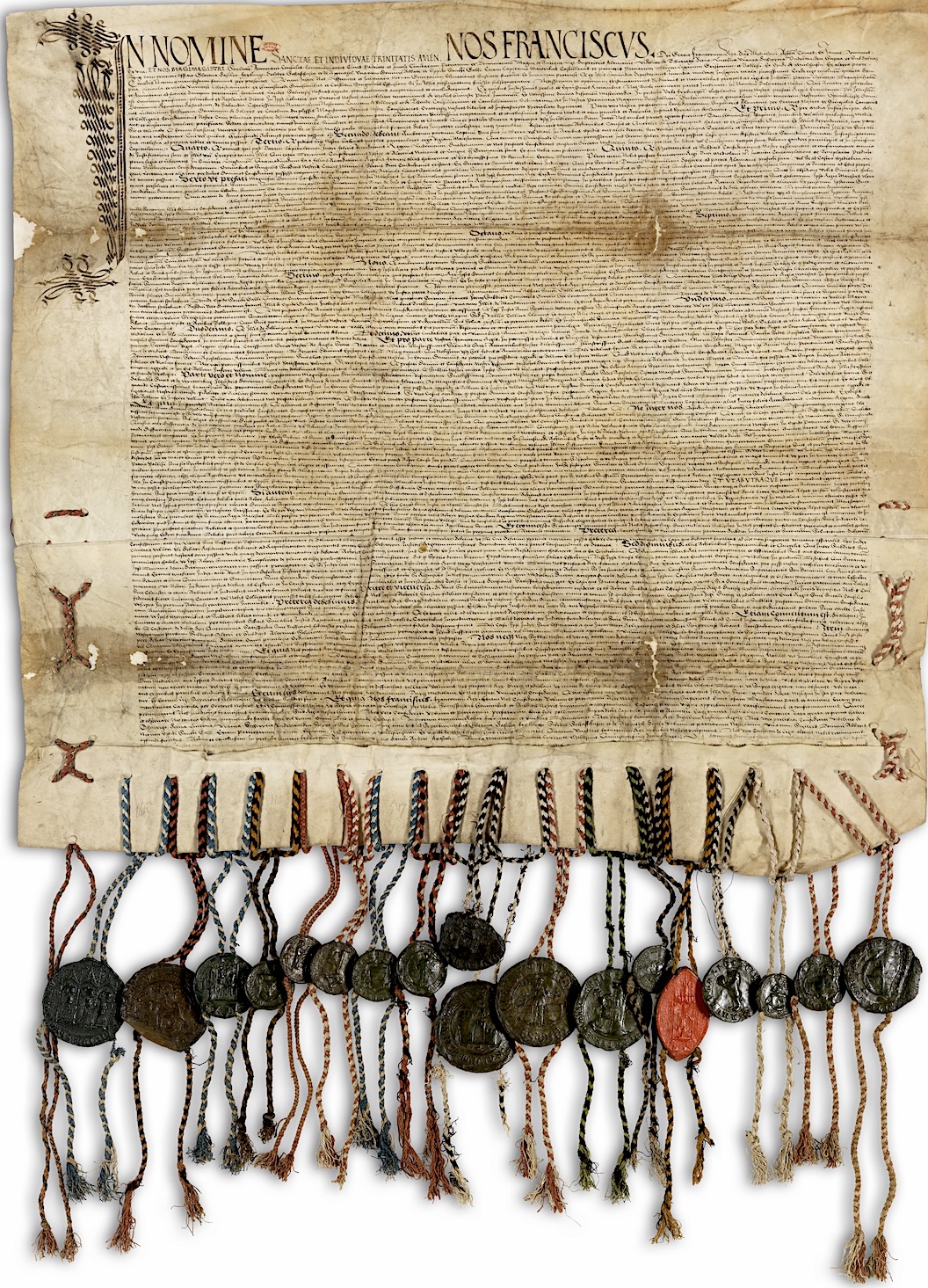
Latin copy of the Treaty of Fribourg or Treaty of Perpetual Peace bearing the seals of the cantons and their allies, preserved at the French National Archives. (Archives Nationales /Wikimedia Commons/ Public Domain)

Swiss neutrality has a tradition stretching back several centuries.

The Old Swiss Confederacy had been an expansionist power between 1470-1516 in which it fought the Habsburgs, the Burgundians in the 1470s, the Swabians in 1499 and the Italians, pushing into Lombardy, leading Machiavelli to compare the Swiss to the Romans leading Machiavelli to compare the Swiss to the Romans and a Macedonian Phalanx. The Italian campaign ended with the defeat at Marignano in 1515 and the 1516 Treaty of Perpetual Peace with France, which led to the origins of Swiss neutrality.

The first formal declaration that the confederacy was a “neutral estate” came in 1674 in a resolution of the Tagsatzung (a diet of envoys from the 13 cantons).

The Old Swiss Confederacy collapsed when Napoleon’s troops invaded and established the Helvetic Republic, a French-dominated centralised state.  This episode demonstrated an essential fact: neutrality alone could not protect Switzerland if the European balance of power collapsed.

At the 1815 Congress of Vienna, the victorious European powers over Napoleon agreed that a permanently neutral Switzerland was in the interests of European stability and it was internationally recognized. This remains an important geopolitical fact even today. Switzerland became one of the principal examples of a permanently neutral state operating within this legal framework.

The First World War

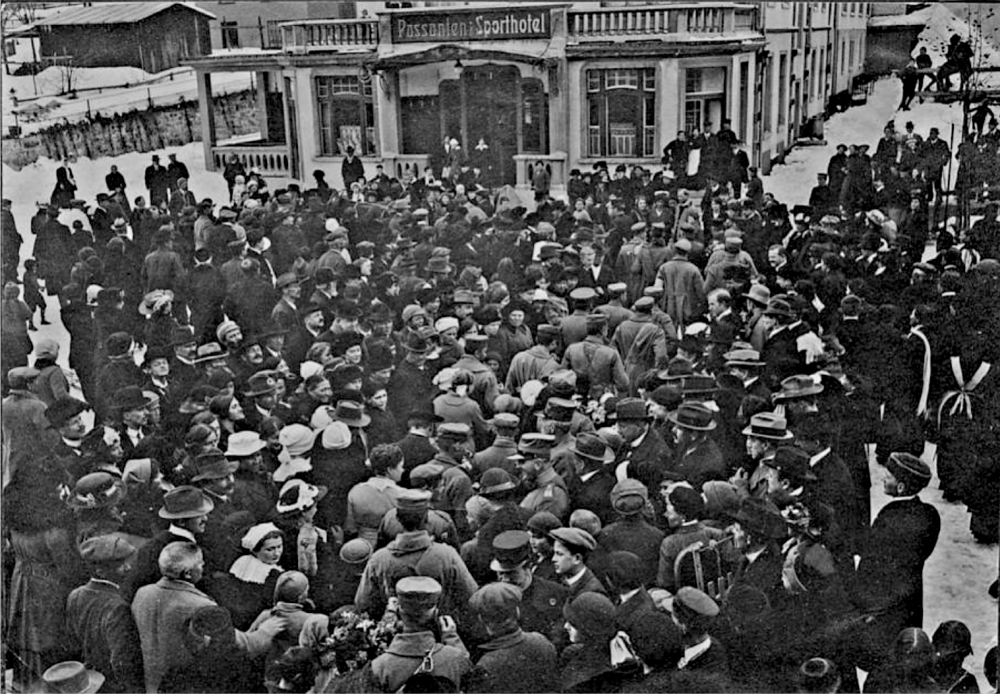
German prisoners of war arriving in Davos, Switzerland, 1916. (Unknown from Barton, Susan, Internment in Switzerland during the First World War, Bloomsbury Publishing, 2019.)

The First World War pitting France against Germany provided a dramatic test of Swiss neutrality. Joining one side could have threatened Switzerland’s internal cohesion among Swiss, French and German speakers.

Neutrality therefore became not only a foreign-policy principle but also a mechanism for holding together a multilingual and multi-confessional society.

The Second World War

The Second World War was the greatest test of Swiss neutrality to that time. Surrounded by Axis-controlled powers, Switzerland maintained formal neutrality. It mobilised its armed forces and developed defensive plans designed to make an invasion costly.

At the same time, the history of Swiss neutrality during the Second World War remains highly controversial. Switzerland maintained extensive economic and financial relations with both sides and made significant concessions to Nazi Germany. Its banking system and trade policy have subsequently been subjected to extensive historical investigation and criticism.

The Cold War

After 1945, Swiss neutrality entered a new phase. Switzerland remained outside both NATO and the Warsaw Pact. During the Cold War, neutrality gave Switzerland a distinctive diplomatic position.

Geneva became an important centre of international diplomacy and humanitarian activity. The International Committee of the Red Cross, the European headquarters of the United Nations and numerous international organisations developed a major presence in Switzerland. Neutrality therefore became an important diplomatic asset.

The Post-Cold War Period

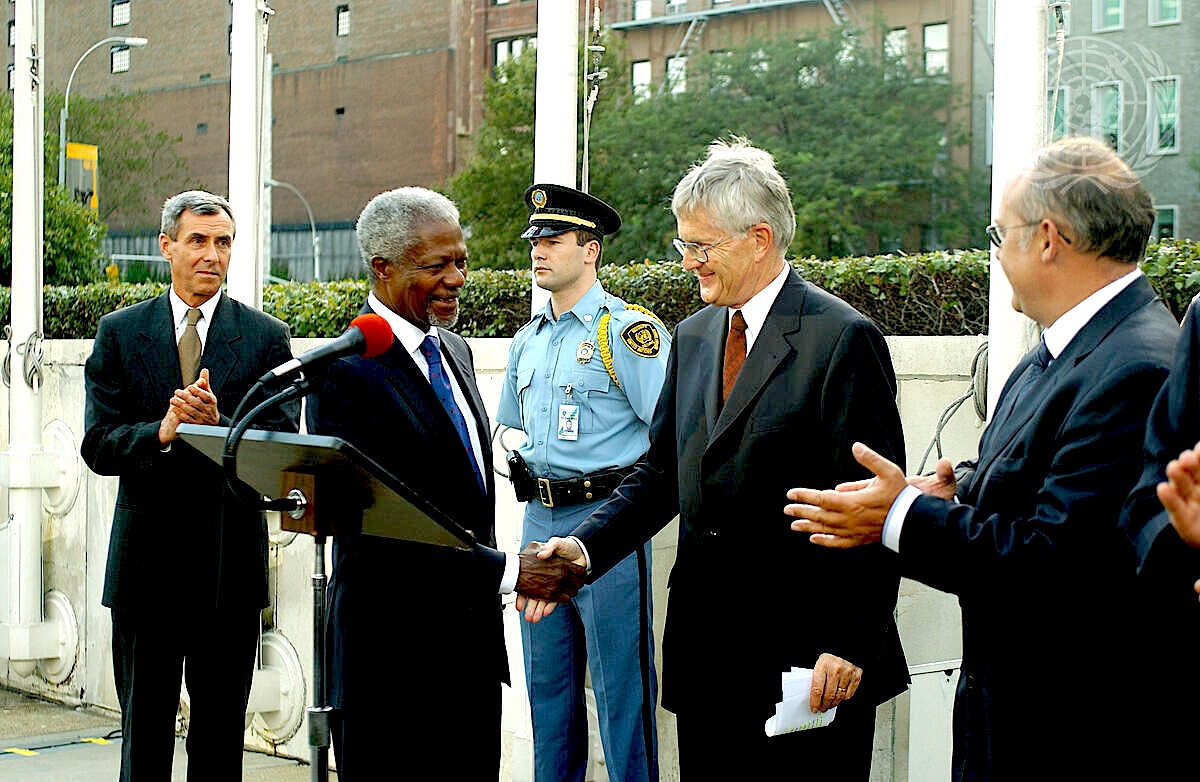
U.N. Secretary-General Kofi Annan center left, congratulating Swiss President Kaspar Villager as Switzerland became the 190th state to join the United Nations, Sept. 10, 2002. (UN Photo/Mark Garten)

After the end of the Cold War, Switzerland began to reconsider neutrality in a more flexible and pragmatic way.

In 1991, Switzerland participated in economic sanctions against Iraq. In 1996, it joined NATO’s Partnership for Peace, although it did not join NATO itself. In 1999, it sent unarmed personnel to support international peace-building efforts in Kosovo. In 2002, Switzerland joined the United Nations.  In March 2025, it joined NATO’s Science and Technology Organization – Enhanced Partnership.

In December 2025, the Swiss government announced that Switzerland and NATO had established a cooperation programme for 2025–2028, aimed, among other things, at increasing the interoperability of the Swiss armed forces, including its air force and communications systems.

Switzerland has therefore repeatedly adjusted its interpretation of neutrality to changing international circumstances since the end of the Cold War.

The Referendum Proposal for Stricter Neutrality Criteria

The initiative, supported by the Swiss People’s Party (SVP) and organised by the group Pro Switzerland, demanded a considerably stricter constitutional definition of neutrality.

In its view, neutrality should be defined as “permanent and armed.” Switzerland should not join any military or defence alliance, nor cooperate with such an alliance, except if Switzerland itself were attacked or an attack against it were directly imminent.

Had the initiative succeeded, Switzerland would have been constitutionally committed to a much stricter interpretation of neutrality, under which the continuation of sanctions against Russia, for example, not authorised by the U.N. Security Council, would have become legally and politically far more difficult.

According to the initiators, Switzerland’s increasing rapprochement with NATO and its policy of confrontation with Russia have therefore moved the country away from strict neutrality.

What Does Neutrality Mean under International Law?

The official opening of the League of Nations, Nov. 5, 1920. (Frédéric Boissonnas, National Library of Norway, Wikipedia Commons, Public Domain)

International law determines how a neutral state must behave during a war between other states. The Hague Conventions of 1907 stipulate that neutral states must not allow foreign troops or weapons to cross their territory and must not provide military assistance to belligerent parties.

This does not mean, opponents of the initiative argued, that a neutral state must be politically or economically indifferent to every international conflict or violation of international law.

Even before the Second World War, Switzerland adopted what became known as “differential neutrality.” It remained exempt from military action but accepted certain economic sanctions imposed by the League of Nations.

Switzerland’s participation in League of Nations sanctions against Fascist Italy in 1935 became an important historical example of what was then called “differential neutrality.” The modern Swiss debate concerns whether such differentiated neutrality remains legitimate when sanctions are not collectively authorised by the U.N. Security Council.

The Confrontational Geopolitical Climate in Europe

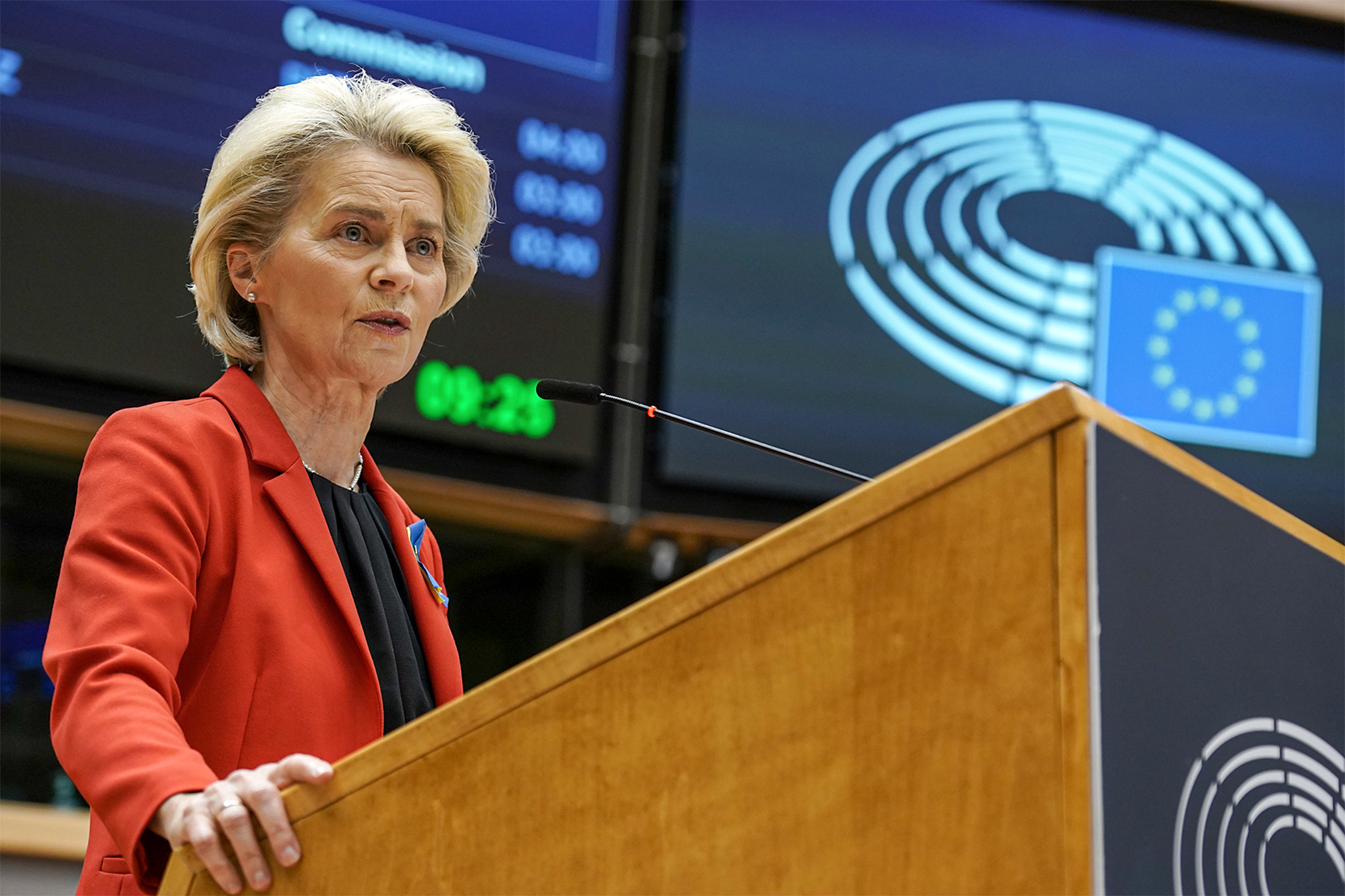
European Commission President Ursula von der Leyen on March 24, 2022, when MPs condemned Russia’s attack on Ukraine and urged further sanctions on Moscow to “protect the European economy.” (European Parliament, Flickr, CC-BY-4.0)

Because of the growth of a perceived Russian “threat“ to Europe, Switzerland has increased its military expenditure with the rest of Europe. By 2032, the military budget is expected to rise from approximately CHF 6.3 billion, or 0.7 per cent of GDP, to 1 per cent of GDP.

For 2028–2030, the Swiss government intends to earmark additional revenue generated by a 0.5 percentage-point increase in VAT specifically for defence spending. This is expected to generate approximately CHF 1.7 billion in additional funds annually during those three years.

In August this year, the Swiss government also approved an additional CHF 970 million for military expenditure, particularly for air defence and protection against drones. In addition, the Swiss government has estimated that another CHF 24 billion will be required exclusively for weapons procurement projects.

The combination of a higher regular military budget, additional VAT revenue and the extraordinary procurement programme represents a substantial increase in Swiss defence expenditure.

Despite this increase, Switzerland is not automatically following NATO’s new 2025 guideline calling for defence expenditure of 3.5 per cent of GDP, plus up to another 1.5 per cent for broader security-related expenditure by 2035.

Domestic Political Dimension of the Referendum

The referendum was also an important test of Swiss domestic politics.

On one side stood primarily the country’s largest political party, the SVP, which associates neutrality with national sovereignty, limiting external influence and preserving traditional Swiss identity, as well as several non-governmental organisations and prominent academics.

On the other side were the federal government and practically all the other major political parties, which argued that constitutionally locking neutrality into a rigid framework would reduce Switzerland’s room for maneuver. Most of the media took the same position.

Although Switzerland is not a NATO member, an important question remains: where is the boundary between cooperation with one side in a conflict and actual alignment with that side? How much substantive difference can there still be between a neutral state and a state politically aligned with one geopolitical bloc before neutrality becomes little more than a decorative legal label?

This fundamental question remains open after the referendum.

Factors Behind the Rejection of the Initiative

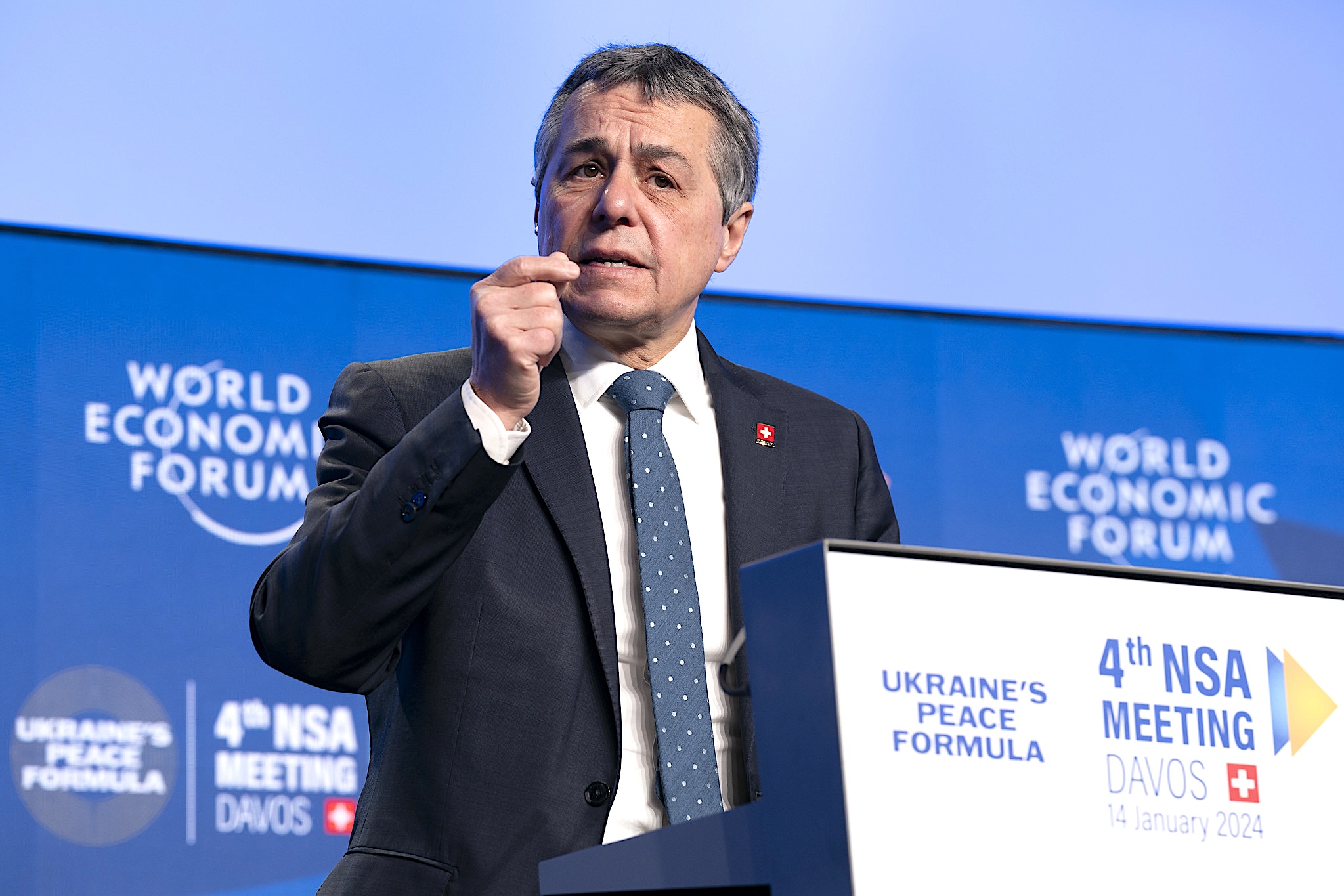
Swiss Foreign Minister Ignazio Cassis addressing a press conference on the Ukrainian peace process at the World Economic Forum in January 2024 in Davos-Klosters, Switzerland. (World Economic Forum/Pascal Bitz/
CC BY-NC-SA 2.0)

A particularly important factor was the almost complete political isolation of the referendum’s initiators.

Because the initiative was supported primarily by the SVP/UDC, while the federal government and almost all other major political parties opposed it, the average voter received a fairly strong political signal about how to vote.

Foreign Minister Ignazio Cassis formulated the central message very clearly: “Switzerland was and is neutral and will remain neutral.” The question, he argued, was merely whether Switzerland needed a “new neutrality.”

This was a politically, effective formulation because it allowed voters to reject the initiative while still feeling that they were defending Swiss neutrality.

Before the referendum, the government warned that stricter neutrality would hamper security cooperation, intelligence-sharing and participation in military exercises with NATO members.

It was therefore defending precisely the type of neutrality that permits continued cooperation with NATO.

This position was also reflected in the draft Swiss Security Strategy 2026, which argues that, because of the changed security environment – particularly the war in Ukraine and the increased risk of conflict between Russia and NATO – Switzerland should strengthen cooperation with its European partners.

The Swiss armed forces likewise published material in September, just over two weeks before the referendum, emphasising that the war in Ukraine demonstrated that it was in Switzerland’s interest to orient its security and defence policy more strongly towards cooperation with partners.

Leading media organisations and various research institutes adopted broadly similar positions.

A study by the University of Zurich’s Research Center for the Public Sphere and Society (Fög), which analysed 523 articles about the initiative in the German- and French-speaking parts of Switzerland, found that media coverage of the initiative was overwhelmingly negative.

The average tone was –22 on a scale ranging from –100 to +100. Fög explicitly concluded that the tone was negative in the large majority of the media outlets analysed.

The extensive system of public support for Swiss media raises a legitimate question about the structural relationship between government policy and media independence. It does not, by itself, prove editorial dependence, but it is relevant when assessing the broader political environment surrounding the referendum.

The Fög study also found that Russia was the most important reference point in media coverage. In most reports, Russia was presented as an aggressor and a threat, including to Switzerland.

Opponents of the initiative used Russia’s war in Ukraine to argue in favour of sanctions and closer security cooperation with European states. Switzerland is being gradually integrated into a broader European security architecture increasingly oriented towards preparing for a possible long-term confrontation with Russia.

Criticism of closer alignment with NATO consequently acquired the connotation of support for Russian President Vladimir Putin and was often portrayed as a “pro-Putin” initiative.

A similar tendency can be observed elsewhere in Europe, where criticism of NATO policies has regulary  been dismissed as implicitly pro-Russian. In Slovenia, for example, the pro-NATO Trivelis Institute portrayed me, because of my criticism of excessive NATO-related military spending, as being almost a Russian spy. [The Institute later removed my name from its report but did not apologize.]

The fact is that media pluralism has declined across Europe, including in Switzerland. Arguments concerning Russian security concerns and interests are increasingly dismissed as “Putinism,” making serious discussion of these issues increasingly difficult.

Putin addressing a military parade on Red Square on May 9 to mark the 81th anniversary of victory for the eastern front in World War II. (President of Russia)

In Switzerland, there are many influential institutions and security research institutes that have systematically emphasised the need for closer security cooperation with NATO.

Leading think tanks argued that Switzerland should strengthen European security cooperation, reconsider the future form of its partnership with NATO, recognise that neutrality had become less important from a security-policy perspective and acknowledge that neutrality could restrict Switzerland’s room for maneuvre in certain circumstances.

But Prof. Pascal Lottaz, a scholar, host of the Neutrality Studies podcast, and a prominent advocate of a stricter and more conceptually rigorous understanding of neutrality rejected a flexible approach to neutrality. He treats neutrality as an independent field of study, rather than as a mere historical remnant.

Lottaz warns against thinking in categories of “good” and “bad” actors because such thinking reduces the space available to neutral states and neutral diplomacy.

His basic idea is highly relevant today: if the world is moving from a unipolar to a multipolar system, the need for neutrality will not necessarily decline. It may actually increase.

Lottaz’s approach opens the possibility of understanding neutrality as an element of a new European security architecture: a transformation of the European security system from a predominantly bloc-based logic towards a pan-European system in which NATO members, neutral states and Russia could all participate.

International Dimension of the Referendum

Ukraine’s President Volodymyr Zelensky at the meeting of the NATO-Ukraine Council on July 12, 2023. (NATO/Flickr, CC BY-NC-ND 2.0)

With the war in Ukraine, Europe has returned to an era of bloc politics. Russia, the United States, NATO, the E.U. and China are creating an increasingly complex system of geopolitical competition. Under such circumstances, neutrality means much more to a small state than a question of national identity.

It is a question of strategic autonomy. A neutral state must be capable of deciding, in a conflict between major powers, not to automatically follow one of them.

To make such a decision meaningful, however, a state must possess sufficient capabilities to implement it. If a country is heavily or completely dependent on another state for energy, food, finance, weapons, critical technologies or security guarantees, its formal neutrality can be severely constrained.

The general rule is simple: the greater a state’s strategic autonomy, the more credible its neutrality can be.

Switzerland is particularly interesting because it is a wealthy and highly developed country that has traditionally linked neutrality to its own defence capabilities, allowing it to maintain a relatively high degree of strategic autonomy.

Nevertheless, the referendum revealed a fundamental dilemma: is it possible to remain neutral while simultaneously becoming increasingly integrated into a Western security system?

Lesson for Neutral States

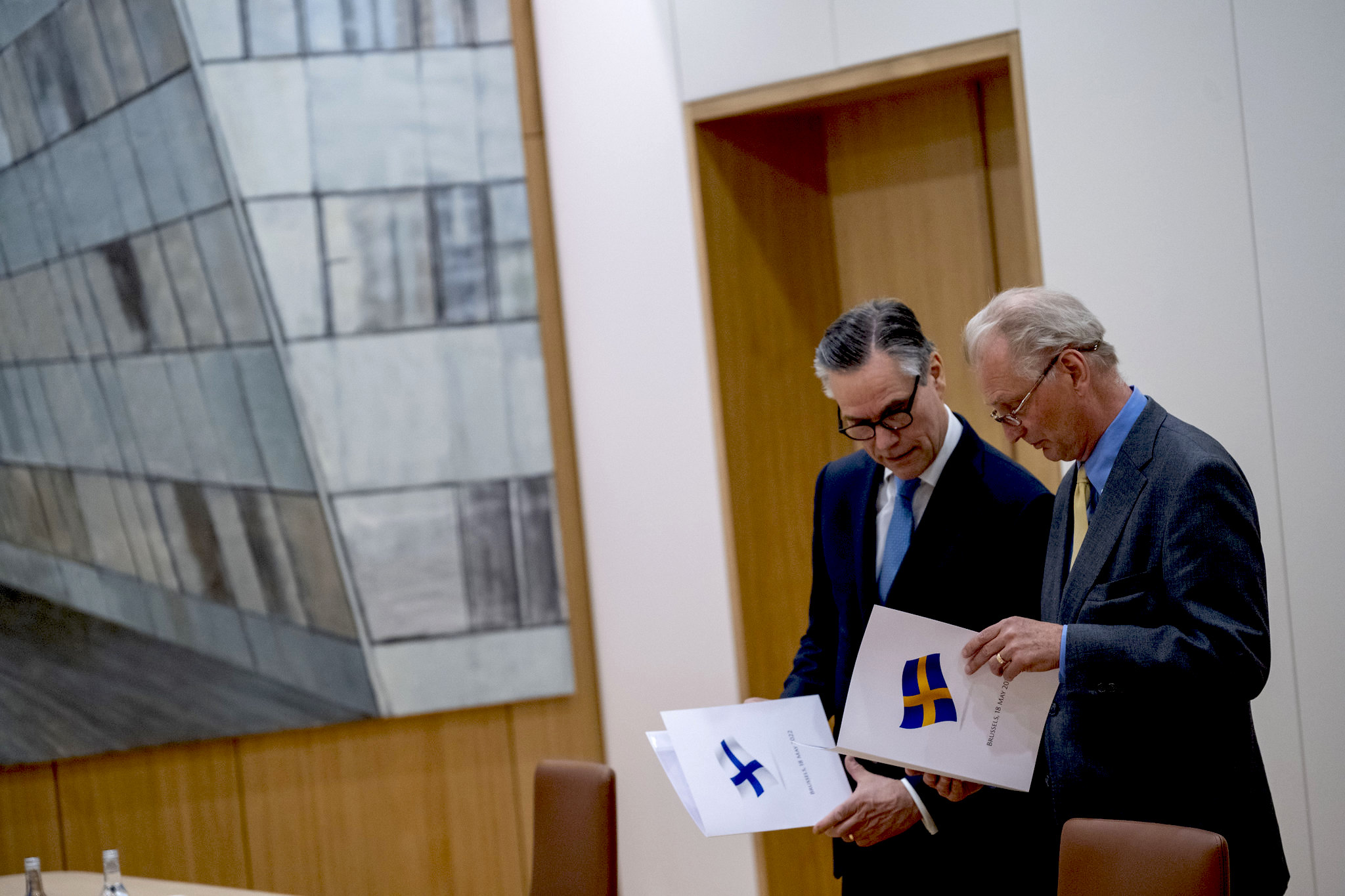
NATO ambassadors Klaus Korhonen of Finland and Axel Wernhoff of Sweden, with letters of application to the military alliance on May 18, 2022. (NATO/Flickr/CC BY-NC-ND 2.0)

The Swiss case is especially important for European countries considering strategic autonomy, particularly European states with established neutrality traditions: Austria, Ireland, Malta and Cyprus, as well as two special cases, Vatican City and Moldova.

In Asia, comparable or partially comparable cases include Turkmenistan, whose permanent neutrality was formally recognised by the U.N. General Assembly in 1995; India, which has oscillated between non-alignment and a form of flexible neutrality; and Indonesia.

Panama, Costa Rica and Mexico have also declared themselves neutral in different historical contexts. The members of the Non-Aligned Movement rejected membership in military blocs, although they did not formally declare themselves neutral states.

Neutrality, if it is not supported by strategic autonomy or an explicit security guarantee from major powers, cannot by itself guarantee a state’s security. On the other hand, membership in a military bloc is not an absolute security guarantee either.

Sweden and Finland, which abandoned their previous neutral or non-aligned status — a status that had brought them considerable economic advantages, particularly in Finland’s case — are today members of NATO.

Their accession to NATO did not make their security environment objectively safer; rather, it illustrates how dramatically the European security environment has deteriorated since 2022.

This is undoubtedly a warning that should be taken seriously. For example, the E.U. today speaks of “strategic autonomy,” but a large part of European security remains tied to NATO, whose strategic defence capabilities depend to a considerable extent on American military power.

It is therefore difficult to speak of complete European strategic autonomy as long as European security depends on American military power.

The Concept of Security Zones

U.S. President Gerald R. Ford signing the Helsinki Final Act or Helsinki Accords at the end of the Conference on Security and Cooperation in Europe, 1975, in Helsinki. (U.S. National Archives/ No known restrictions)

During the Cold War, both superpowers — the United States and the Soviet Union — recognised security interests in what they regarded as their respective spheres of influence: the United States in Western Europe and the Soviet Union in Eastern Europe.

The Swiss Confederation was unofficially part of the Western security sphere, partly because of its central geographical position in the middle of Europe. This was not the case with some other states in Eastern Europe during the Cold War.

One of the closest advisers to former U.S. Secretary of State Henry Kissinger, Helmut Sonnenfeldt, told American ambassadors in Western Europe at a meeting in Brussels in December 1975 that the United States had to accept the fact that the Soviet Union had special security interests in Eastern Europe, while at the same time seeking to transform the Soviet relationship with Eastern Europe gradually from a coercive relationship into a more “organic” one.

Sonnenfeldt’s argument was not intended as a formal recognition of Soviet sovereignty over Eastern Europe. He advocated an evolution of the relationship between Moscow and the countries of Eastern Europe, not formal recognition of Soviet sovereignty over them.

Opponents later interpreted his ideas as recognition of a permanent Soviet sphere of influence — hence the term “Sonnenfeldt Doctrine,” which he rejected.

As a Yugoslav correspondent in the United States, I had several extensive conversations with Sonnenfeldt about this doctrine in the late 1980s. The Yugoslav leadership believed that, under this doctrine, the United States would abandon non-aligned Yugoslavia to the Soviet Union.

Sonnenfeldt in 1974 accompanying U.S. President Gerald Ford to the Vladivostok arms control summit. (David Hume Kennerly /Gerald R. Ford Presidential Library/Wikimedia Commons/Public Domain)

Sonnenfeldt categorically denied this and claimed that such rumours were being spread by the Soviet secret service, the KGB.

The Sonnenfeldt Doctrine remains a fascinating and newly relevant Cold War concept, particularly in relation to the question of spheres of influence and “gray zones” between major powers as a means of preventing armed conflict between them.

Sonnenfeldt’s logic was based on the recognition that major powers have legitimate security interests in their respective neighbourhoods. This creates a need for compromise in order to prevent direct confrontation between great powers.

The Sonnenfeldt Doctrine was not a theory of neutrality, but an approach to managing spheres of influence and great-power security interests. A contemporary version of this logic can be found in the concept of “security zones” proposed by the influential American economist and peace advocate Professor Jeffrey Sachs.

Sachs has introduced an important conceptual shift into the theory of spheres of influence. According to him, major powers may have legitimate security interests along their borders, but they do not have the right to create spheres of influence or dictate the internal policies of smaller neighbouring states.

The Helsinki Final Act on security and cooperation expressed a related principle: the security of one state must not come at the expense of the security of another.

This insight was also incorporated into the thinking of George Kennan, one of the principal architects of the American policy of containment of the Soviet Union.

Kennan later became a prominent critic of the militarisation of the division of Europe, and of West Germany’s integration into NATO, warning that this could dangerously intensify the security dilemma with Moscow. (After German reunification he also opposed NATO’s eastward expansion.)

Kennan’s conclusion was remarkably close to the idea of “grey zones” as neutral spaces between two blocs. Kissinger was even more explicit. His approach was based on the balance of power, spheres of influence and the prevention of direct confrontation between the United States and the Soviet Union through détente and negotiations between the two superpowers.

He illustrated this policy in the case of Yugoslavia.

According to U.S. State Department documents, the United States wanted, within the framework of détente, to preserve non-aligned Yugoslavia’s “substantial independence” from the Soviet Union.

Yugoslavia was therefore an early example of a strategically autonomous European state outside both blocs – a kind of grey zone between the two geopolitical systems.

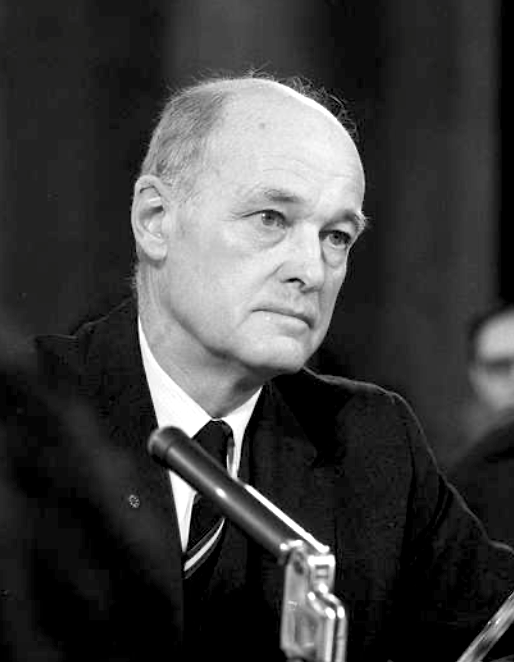
Kennan testifying before the Senate Foreign Relations Committee in 1966. (Warrren K. Leffler /Wikimedia Commons/Public Domain)

Today, a grey-zone state can be understood as a country that is not a formal member of a major military bloc, maintains security relations with several powers, is not completely subordinate to any one great power, occupies a geopolitical space between competing systems, and can use neutrality to reduce direct military confrontation.

Sachs’s theory of security zones, which would have neutral status, is particularly relevant to the debate over the current geopolitical position of Ukraine, Moldova and Georgia, as well as the European security architecture as a whole.

The neutrality of these zones is not merely a national legal status; it can become an institutional component of a European security architecture based on mutually recognised security interests.

The deeper question is therefore not whether neutrality belongs to the nineteenth century, but whether neutrality could become one of the institutional building blocks of a future European security system.

Former Secretary of State Kissinger formulated a similar proposal in 2014, following the political upheaval in Ukraine. Ukraine had the right to political and economic integration with Europe, he argued, but should not join NATO. It could cooperate with the West while maintaining a relationship with Russia comparable to that of neutral Finland at the time.

The failure to create a European security arrangement capable of accommodating Russian security concerns while preserving the sovereignty of smaller states remains one of the central unresolved questions behind the Ukraine conflict.

Whether a different application of the Sonnenfeldt, Kennan and Kissinger logic could have prevented the war remains a matter of historical debate.

In the End

The referendum did not end Swiss neutrality.

Switzerland remains neutral, but it will continue to adapt its neutrality to changing international circumstances.

The à-la-carte approach, however, raises an uncomfortable question: how much flexibility can neutrality tolerate before it becomes merely a political label?

A new European security system would be possible if NATO were gradually transformed into a pan-European security organisation within the framework of the Organisation for Security and Cooperation in Europe (O.S.C.E.) [It is worth noting here that the U.S. did not agree to Russia’s desire to join NATO].

Some prominent German intellectuals are speaking in terms of Entspannungspolitik, a European security architecture, non-alignment, arms control and the restoration of diplomatic dialogue with Russia.

There are, however, significant differences among academics dealing with these questions.

Some advocate classical military neutrality.

Others advocate European non-alignment.

A third group primarily advocates a new European security architecture in which Russia would be incorporated into a system of common security.

A fourth group believes that neutrality is no longer an appropriate response after Russia’s invasion of Ukraine.

The present Swiss model lies somewhere between classical neutrality and strategic partnership with the West.

Swiss neutrality is unlikely to disappear. The more important question is what kind of neutrality will survive.

If neutrality becomes sufficiently flexible to accommodate sanctions, military interoperability and increasingly close cooperation with one geopolitical bloc, it may remain a constitutional label only, while losing part of its strategic meaning.

If, on the other hand, neutrality is understood as a form of strategic autonomy, it could become not an outdated remnant of the past but one of the foundations of a future European security order.

For my native, Slovenia, the Swiss debate on neutrality  raises a broader strategic question: whether a small European state can combine credible defence, strategic autonomy and military non-alignment while contributing to a European security system based on cooperation rather than permanent bloc confrontation.

Uroš Lipušcek Ph.D. is a Slovenian journalist and historian who was the long-time correspondent for RTV Slovenija from the U.N., U.S. and  China. He was a candidate for the E.U. parliament in 2024.  At present he is a professor at Emuni University (Euro-Mediterranean University) in Piran, Slovenia. He is the author of several  books  and analyses on history, among them Ave Wilson: USA and the Remaking of Slovenia in Versailles 1919–1920, (2003) and Sacro Egoismo: Slovenians in the Clutches of the Secret London Pact of 1915  (2012). 

The views expressed are solely those of the author and may or may not reflect those of Consortium News.

Andrew Korybko: Why Won’t China Cut Ukraine Off From Drone-Related Sales?

By Andrew Korybko, Substack, 9/6/26

Radio Free Europe/Radio Liberty (RFE/RL) referenced the EU’s summertime disbursement of the first €1 billion to Ukraine for drone procurement out of the €6 billion promised for this program in an article late last month about how “Ukraine’s Drone War Exposes An Uncomfortable Reliance On China”. They drew attention to the carve-out allowing Ukraine to purchase Chinese parts with these funds, ergo the politically incorrect observation back then that “The EU Plans To Pay China To Help Ukraine Kill Russians”.

RFE/RL reported that “While Kyiv has cut back on the purchase of ready-made drones from China, components such as motors, lithium batteries, and fiberoptics are still in high demand.” Additionally, “In the first six months of 2026, imports of Chinese parts had already reached around 76 percent of the total recorded for the previous year.” They also cited a Ukrainian report which claimed that “38 percent of the value of drone components imported by Ukraine in the first half of 2025 came from China.”

The purpose of their piece appears to be to instill a sense of urgency in Ukraine and the West alike to radically ramp up domestic drone production in order to reduce what one of their cited experts described as Ukraine’s “hostile interdependence” on China. They explained that “Beijing remains Kyiv’s largest trading partner, while Ukraine is a key supplier of agricultural goods to China.” That’s true, and it’s one of the reasons why China won’t cut Ukraine off from drone-related sales, but there’s more to it.

While Sino-Russo ties are better than at anytime in history, it was suspected as far back as early 2023 that “China Doesn’t Want Anyone To Win In Ukraine”, the reason being that a supposedly manageable forever war would indefinitely delay the full implementation of the US’ planned “Pivot (back) to (East) Asia”. Moreover, resource-rich Russia could become disproportionately dependent on China, thus leading to Moscow selling its natural wealth to Beijing at bargain-basement prices.

In pursuit of this cynical end, China has simultaneously played an irreplaceable role in providing Ukraine with drones, parts, and fiber optics (even if only indirectly through intermediaries like apologists have speculated) while serving as an irreplaceable valve from sanctions pressure for Russia. Ukraine is therefore able to keep pace with Russia’s military-technical advancements, the Russian economy avoids the crisis that the West sought to catalyze through sanctions, and China maintains its “active neutrality”.

The last point refers to China actively helping Ukraine and Russia, thus making it neutral in the sense of not taking either side. China financially profits from Ukraine’s drone-related purchases, its economy continues growing due to the large-scale import of heavily discounted Russian energy, and it relatively reduces the overall Western pressure upon it by proving that it’s not secretly “allied” with Russia. This policy, for whatever one might think about its merits, indisputably contributed to prolonging the conflict.

Had China cut Ukraine off from its drone-related sales in the spirit of its “no-limits” partnership with Russia that was declared several weeks before the start of special operation, then Russia might have attained more of its stated objectives in the conflict by now, if not outright achieved maximum victory. The US’ military and intelligence support for Ukraine is more important than China’s drone-related sales, but since there’s no end to US support in sight, Russia should try to get China to finally cut Ukraine off.