Category Archives: Uncategorized

Kit Klarenberg: Collapsing Empire: RIP Royal Navy

By Kit Klarenberg, Substack, 11/24/24

All my investigations are free to access, thanks to the generosity of my readers. Independent journalism nonetheless requires investment, so if you took value from this article or any others, please consider sharing, or even becoming a paid subscriber. Your support is always gratefully received, and will never be forgotten. To buy me a coffee or two, please click this link.

On November 15th, The Times published a remarkable report, revealing serious “questions” are being asked about the viability of Britain’s two flagship aircraft carriers, at the highest levels of London’s defence establishment. Such perspectives would have been unmentionable mere months ago. Yet, subsequent reporting seemingly confirms the vessels are for the chop. Should that come to pass, it will represent an absolutely crushing, historic defeat for the Royal Navy – and the US Empire in turn – without a single shot being fired.

The HMS Queen Elizabeth and HMS Prince of Wales first set sail in 2017 and 2019 respectively, after 20 years in development. The former arrived at the Royal Navy’s historic Portsmouth base with considerable fanfare, a Ministry of Defence press release boasting that the carrier would be deployed “in every ocean around the world over the next five decades.” The pair were and remain the biggest and most expensive ships built in British history, costing close to $8 billion combined. Ongoing operational costs are likewise vast.
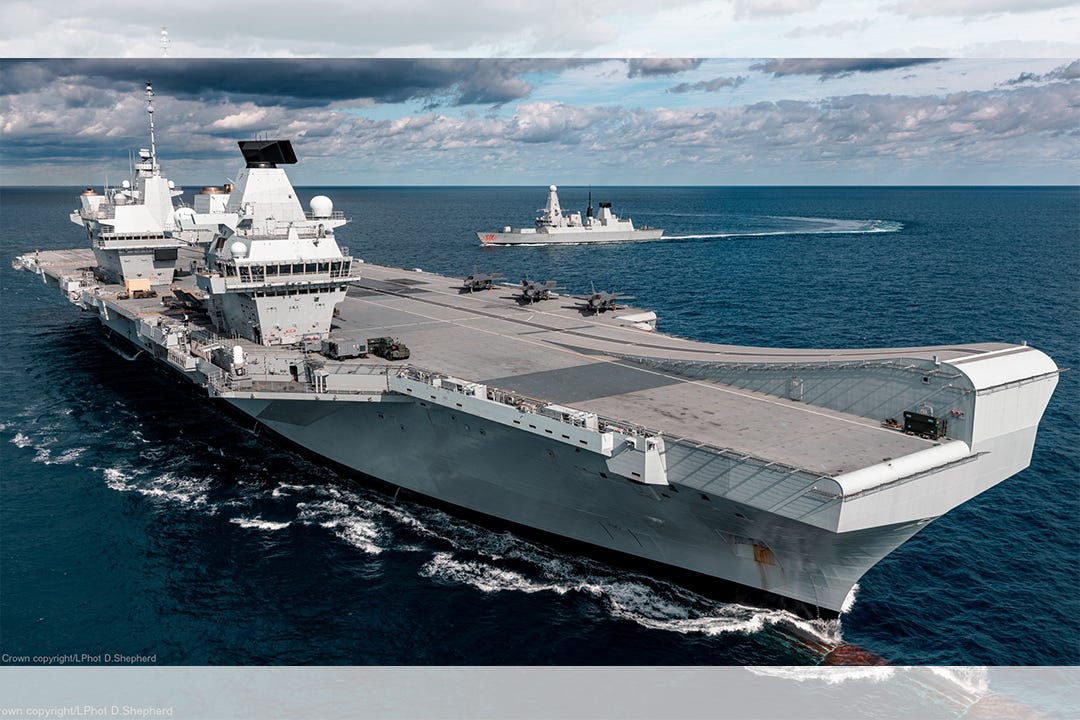
HMS Queen Elizabeth departs on maiden operational tour, 2021

Fast forward to today however, and British ministers and military chiefs are, per The Times, “under immense pressure to make billions of pounds’ worth of savings,” with major “casualties” certain. Resultantly, senior Ministry of Defence and Treasury officials are considering scrapping at least one of the carriers, if not both. The reason is simple – “in most war games, the carriers get sunk,” and are “particularly vulnerable to missiles.” As such, the pair are now widely perceived as the “Royal Navy’s weak link.”

Matthew Savill of British state-tied Royal United Services Institute told The Times that missile technology is developing “at such a pace”, carriers are rapidly becoming easy for Britain’s adversaries to “locate and track”, then neutralise. “In particular,” he cautioned, China is increasing the range of its ballistic and supersonic anti-ship missiles. Meanwhile, Beijing’s “hypersonic glide vehicle”, the DF-17, “can evade existing missile defence systems,” its “range, speed and manoeuvrability” making it a “formidable weapon” neither Britain nor the US can adequately counter.
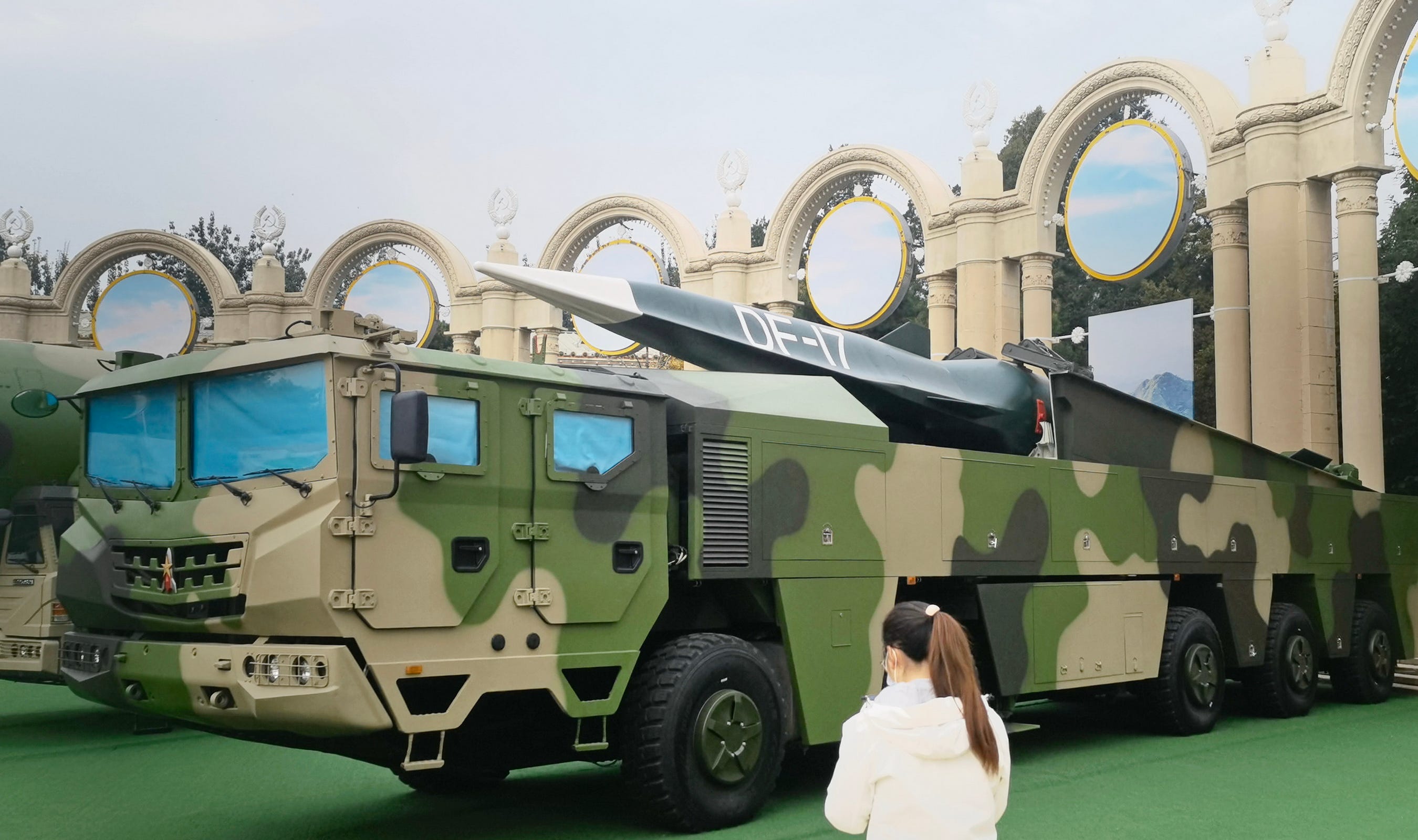
China’s DF-17

Savill advocated “cutting one or both of the carriers,” as this “would free up people and running costs and those could be reinvested in the running costs of the rest of the fleet and easing the stresses on personnel”. Nonetheless, he warned that scrapping the carriers would be a “big deal for a navy that has designed itself around those carriers…and the £6.2 billion paid for them would be a sunk cost.”

That the Royal Navy has “designed itself” around the two aircraft carriers is quite an understatement. For just one to set sail, it must be supported by a strike group consisting of two Type 45 destroyers for air defence, two Type 23 frigates for anti-submarine warfare, a submarine, a fleet tanker and a support ship. This “full-fat protective approach”, Savill lamented, means “most of the deployable Royal Navy” must accompany a single carrier at any given time:

“You can protect the carriers, but then the Navy has put all of its eggs in a particularly large and expensive basket.”

‘National Embarrassment’

March 2021 saw publication of a long-awaited British government report, Global Britain in a Competitive Age – “a comprehensive articulation” of London’s “national security and international policy,” intended to “[shape] the open international order of the future.” The two aircraft carriers loomed large in its contents. One passage referred to how HMS Queen Elizabeth would soon lead Britain’s “most ambitious global deployment for two decades, visiting the Mediterranean, the Middle East and the Indo-Pacific”:

“She will demonstrate our interoperability with allies and partners – in particular the US – and our ability to project cutting-edge military power in support of NATO and international maritime security. Her deployment will also help the government to deepen our diplomatic and prosperity links with allies and partners worldwide.”

Such bombast directly echoed the bold wording of a July 1998 strategic defence review, initiated a year earlier by then-prime minister Tony Blair. Its findings kickstarted London’s quest to acquire world-leading aircraft carriers, which culminated with the birth of HMS Queen Elizabeth and HMS Prince of Wales. Britain’s explicit objective, directly inspired by the US Empire’s dependence on carriers to belligerently project its diplomatic, economic, military and political interests abroad, was to recover London’s role as world police officer, and audaciously assert herself overseas:

“In the post-Cold War world, we must be prepared to go to the crisis, rather than have the crisis come to us. So we plan to buy two new larger aircraft carriers to project power more flexibly around the world…This will give us a fully independent ability to deploy a powerful combat force to potential trouble spots without waiting for basing agreements on other countries’ territory. We will…be poised in international waters and most effectively back up diplomacy with the threat of force.”

Blair’s reverie appeared to finally come to pass in May 2021, when HMS Queen Elizabeth set off on a grand tour of the world’s oceans, escorted by a vast carrier strike group. Over the next six months, the vessel engaged in a large number of widely-publicised exercises with foreign navies, including NATO allies, and docked in dozens of countries. Press coverage was universally fawning. Yet, in November, as the excursion was nearing its end, an F-35 fighter launched from the carrier unceremoniously crashed.

Sonar image of the crashed F-35 jet resting upside down on the seafloor

The F-35’s myriad issues were by that point well-established. The jet, which has cost US taxpayers close to $2 trillion, entered into active service in 2006 while still under development. It quickly gained a reputation for hazardous unreliability. In 2015, a Pentagon report acknowledged its severe structural issues, limited service life and low flight-time capacity. Two years later, the Department of Defense quietly admitted the US Joint Program Office had been secretly recategorising F-35 failure incidents to make the plane appear safe to fly. 

Despite this, the HMS Queen Elizabeth and HMS Prince of Wales were specifically designed to transport the F-35, to the exclusion of all other fighter jets. However, Britain has consistently struggled to source usable F-35s, which produces the ludicrous situation of the two carriers almost invariably patrolling seas with few if any fighters aboard at all, therefore invalidating their entire raison d’etre. In November 2023, the Daily Telegraph dubbed these regular “jet-less” forays a “national embarrassment”.

‘Carrier Gap’

An even graver embarrassment, rarely discussed with any seriousness by the British media, is that the two aircraft carriers have been plagued with endless technical and mechanical issues as long as they’ve been in service. Flooding, mid-operation breakdowns, onboard fires, and engine leaks are routine. Both vessels have spent considerably more time docked and under repair than at sea over their brief lifetimes. In 2020, an entire HMS Prince of Wales crew accommodation block collapsed, for reasons unclear.

As elite US foreign policy journal National Interest acknowledged in March 2024, “the Royal Navy remains unable to adequately defend or operate” its two carriers “independently” – code for the Empire being consistently compelled to deploy its own naval and air assets to support the pair. This is quite some failure, given British officials originally intended for the vessels to not only lead NATO exercises and deployments, but “slot into” US navy operations wherever and whenever necessary.

The Empire’s inability to outsource its hegemonic duties to Britain has precipitated a critical “carrier gap”. Despite maintaining an 11-strong fleet, Washington cannot deploy the vessels to every global flashpoint at once, grievously undermining her power and influence at a time of tremendous upheaval worldwide. In a bitter irony, by encouraging and facilitating London’s emulation of its own flawed and outdated reliance on aircraft carriers, the US has inadvertently created yet another needy imperial dependant, further draining its already fatally overstretched military resources.

Several Royal Navy destroyers were originally part of abortive US-led Operation Prosperity Guardian, launched in late 2023 to smash AnsarAllah’s righteous anti-genocide Red Sea blockade. Almost immediately, it became apparent the British lacked any ability to fire on land targets, therefore rendering their participation completely useless. Subsequently, photos emerged of areas on Britain’s ships where land attack cruise missiles should’ve been situated. Instead, the spaces were occupied by humble treadmills, for use as on-board gyms.

It transpired that the appropriate weapons hadn’t been purchased, due to a lack of funds – the money having of course been spent instead on constructing barely operable aircraft carriers, which now face summary defenestration. By investing incalculable time, energy, and money in pursuing the mythological greatness associated with carrier capability, Britain – just like the US Empire – now finds itself unable to meet modern warfare’s most basic challenges. Meanwhile, its adversaries near and far have remorselessly innovated, equipping themselves for 21st century battle.

Days after The Times portended the impending death of London’s aircraft carriers, mainstream media became awash with reports of savage cutbacks in Britain’s military capabilities, in advance of a new strategic defence review. Five Royal Navy warships, all of which have lain disused due to staff shortages and structural decay for some time, were among the first announced “casualties”. What if anything will replace these losses isn’t certain, although it likely won’t be aircraft carriers.
Joe Lauria: US Bill Would Reverse ATACMS Order

By Joe Lauria, Consortium News, 12/7/24

A bill introduced into the U.S. House of Representatives by Rep. Clay Higgins (R-LA) would prohibit the U.S. from sending long-range ATACMS missiles to Ukraine to be fired into Russia.

As U.S. personnel and satellites are required to fire the missiles from Ukrainian territory, Moscow considers it a direct U.S. attack on Russia putting it in a state of war with the U.S. which could lead to nuclear conflict. 

To remove the potential of nuclear war, the proposed legislation seeks to end ATACMS launches into Russia. The bill reads:

(a) Prohibition.—For the period beginning on the date of the enactment of this Act and ending at the close of January 20, 2025, notwithstanding any other provision of law, during any period for which a state of conflict exists between Ukraine and the Russian Federation—

1) no Army Tactical Missile Systems (ATACMS) may be transferred to Ukraine; and

(2) U.S. Military Services or intelligence agencies may not provide support to Ukrainian units operating High Mobility Artillery Rocket Systems (HMARS) platforms utilizing ATACMS munitions to strike outside of internationally recognized Ukrainian territorial borders—

(A) targeting intelligence support;

(B) mission planning support; and

(C) any other type of support.

Several members of Congress and their staff said they were taken off guard by President Joe Biden’s reversal of his previous decision not to allow the use of ATACMS to be fired into Russia from Ukraine.

The  members and their staff made these remarks during meetings on Thursday on Capitol Hill with former U.N. weapons inspector Scott Ritter and activists of Code Pink, led by Medea Benjamin. 

Biden Breaks With Realists

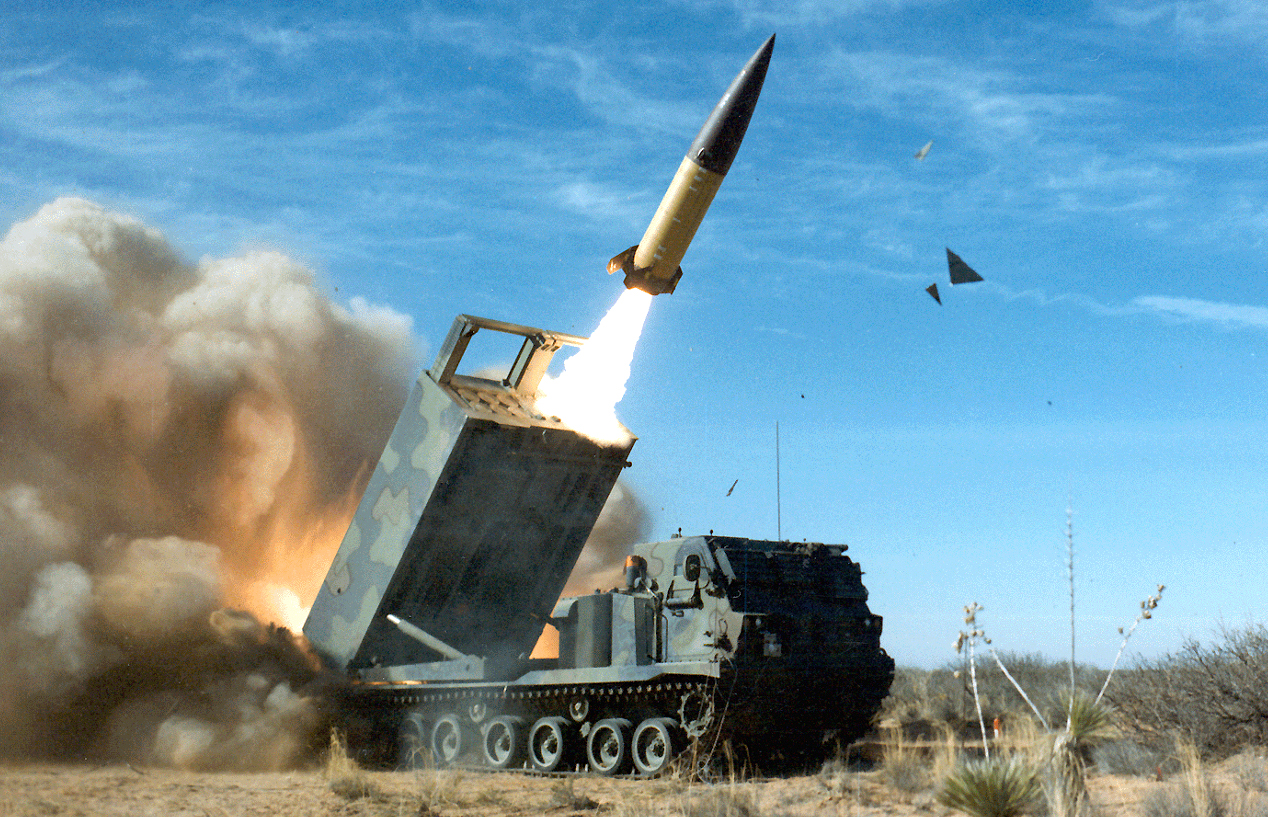
ATACMS missile firing in May 2006. (U.S. Army/Wikimedia Commons)

Biden had twice before sided with the Pentagon to avoid direct war with Russia. In March 2022 he overruled his Secretary of State Antony Blinken to scotch plans for a NATO no-fly zone over Ukraine, which could have lead to direct conflict with Russia.

Biden opposed the no-fly zone, he said at the time, because “that’s called World War III, okay? Let’s get it straight here, guys. We will not fight the third world war in Ukraine.”

Then in September Biden deferred to the realists in the Pentagon to oppose long-range British Storm Shadow missiles from being fired by Ukraine deep into Russia out of fear it would also lead to a direct NATO-Russia military confrontation with all that that entails.

Putin warned at the time that because British soldiers on the ground in Ukraine would actually launch the British missiles into Russia with U.S. geostrategic support, it “will mean that NATO countries — the United States and European countries — are at war with Russia. And if this is the case, then, bearing in mind the change in the essence of the conflict, we will make appropriate decisions in response to the threats that will be posed to us.” 

That was a clear warning that British and U.S. targets could be hit. Biden thus wisely backed off. 

But after he was driven from the race and his party lost the White House last month, Biden suddenly switched gears allowing not only British, but also U.S. long-range ATACMS missiles to be fired into Russia. It’s not clear that the White House ever informed the Pentagon in advance.

Higgin’s bill was introduced as H.R. 10218 on Nov. 21, but none of the other House members that Ritter and Benjamin met with on Capitol Hill had heard of it. Nor was it reported in the mainstream media.

“We found that commonsense is actually alive and living here in the halls of Congress,” Ritter told Consortium News. “Members of Congress and their staffs understand the danger of nuclear war.  We found that there was a bill already written … that sought to achieve what we were trying to get them to do.”   

Benjamin said: “We are excited to push this bill, which we just found out about. … It will not pass, but the idea is to get momentum for it so that message is coming out there that there are members of Congress who want to see this reversed and that in the next Congress, they will introduce it again with a lot more momentum.”

“To stop a nuclear war comes down to one issue,” Ritter said:

“The United States has to stop attacking Russian soil with American-made ATACMS missiles. Even though we use a Ukrainian cutout, it’s American provided, American targets and American intelligence. It’s the Americans attacking Russia. From the Russian perspective, the United States is at war with Russia … which has triggered their nuclear doctrine.”

Joe Lauria is editor-in-chief of Consortium News and a former U.N. correspondent for The Wall Street Journal, Boston Globe, and other newspapers, including The Montreal Gazette, the London Daily Mail and The Star of Johannesburg. He was an investigative reporter for the Sunday Times of London, a financial reporter for Bloomberg News and began his professional work as a 19-year old stringer for The New York Times. He is the author of two books, A Political Odyssey, with Sen. Mike Gravel, foreword by Daniel Ellsberg; and How I Lost By Hillary Clinton, foreword by Julian Assange.

Millennium 7 – ORESHNIK Attack: Nobody Noticed This.

YouTube video link here.

More on Millennium 7 YouTube channel:

“In this channel we are going to cover military history and military technology in particular, with a heavy bias on aerospace, from slightly unusual point of views. We will try to stimulate your critical thinking and have some fun in the process.”

What do people think of this report? Does this sound like it could serve as a non-nuclear capability for a decapitation strike on Europe? Let me know in the comments. – Natylie

Intellinews: Syrian opposition captures key port city of Tartus (Home to Russian Naval Base)

Intellinews, 12/8/24

Opposition forces have seized control of Syria’s strategic Mediterranean port city of Tartus, consolidating their grip on the country following the dramatic fall of Damascus and President Bashar al-Assad’s departure.

The capture of Tartus, home to a significant Russian naval facility, marks another milestone in the opposition’s swift campaign that has seen them secure control of most major Syrian cities in less than two weeks.

Syria’s Prime Minister Mohammed Ghazi al-Jalali, who remains in the country with several cabinet members, confirmed he has established contact with Hayat Tahrir al-Sham leadership, the group that led the advance into Damascus. However, he said he has lost contact with both the president and former defence minister.

“The prime minister, along with key ministers, remains in Syria, though we have no information about the whereabouts of the president or defence minister”, a government spokesman told state media, which is now under opposition control.

Russia’s Foreign Ministry earlier confirmed that Assad had left Syria after negotiations with conflict participants, though Moscow stressed it was not involved in these talks.

Moscow’s Kremlin later confirmed he had arrived safely in Moscow, Tass later reported.

As bne IntelliNews was first to report on December 7, Assad fled Syria to Abu Dhabi before flying on to Moscow, where the rest of his family had already been in exile for a week and where his eldest son was studying at Moscow State University.

The ministry said Assad had ordered a peaceful transfer of power before his departure.

The fall of Tartus raises questions about the future of Russia’s naval facility in the city, which has served as Moscow’s sole Mediterranean naval base.

The Russian Foreign Ministry has previously stated its military installations in Syria remain secure, though the rapidly evolving situation may present new challenges.

Earlier in the day, Syrian opposition forces claimed the television station of the state broadcaster SANA and began producing updated news bulletins under the new rule.

Russia Matters: Trump Team’s Ukraine Peace Plan: Territorial Concessions, No NATO Membership

Russia Matters, 12/6/24

5 Things to Know

  1. Advisers to Donald Trump are floating proposals to end the Ukraine war that would cede large parts of the country to Russia for the foreseeable future and take NATO membership for Ukraine off the table, according to a Reuters analysis of statements and interviews with several people close to the U.S. president-elect, including his incoming Russia-Ukraine envoy Keith Kellogg. Meanwhile, Volodymyr Zelenskyy has said Ukraine must find diplomatic solutions to regaining occupied territories and suggested he may be open to negotiations by sending his chief of staff Andrei Yermak to Washington to meet with members of Trump’s team such as JD Vance, Mike Waltz and a representative for Kellogg. While Yermak has so far made no public comments on the outcome of these meetings, Ukraine’s foreign minister repeated his government’s stance that Kyiv would reject any security guarantees other than NATO membership. Just as Ukraine’s territorial losses and manpower shortages may make Zelenskyy more amenable to negotiating a deal with Putin, the latter’s knowledge of these losses and shortages may make him less willing to pursue such a deal for as long as his forces keep capturing land in Ukraine and retaking land in Russia’s Kursk region. It is also difficult to imagine how any mediator of talks between Ukraine and Russia can accommodate Ukraine’s demands for NATO membership given the persistent opposition of some of the alliance’s members, such as Hungary.*
  2. In the past month (Nov. 1–Dec. 4), the Russian forces made a net gain of 354 square miles in Ukraine, which is about the size of the city of Dallas, Texas. This gain includes 95 square miles Russia gained in the past week, which is slightly larger than the size of Boston, Mass., according RM staff’s Dec. 4, 2024, estimate based on data provided for that period by the Institute for the Study of War. ISW itself has calculated that Russia captured 1,042 square miles (2,700 square kilometers) in 2024, about the size of Rhode Island, compared with just 180 square miles (465 square kilometers) last year, according to FT. In the latest developments reported on Dec. 6, the Russian military claimed to have captured the Donetsk region settlements of Sukhi Yaly and Pustynka, with the latter about 30 kilometers away from the embattled supply hub of Pokrovsk and about 35 kilometers away from the industrial town of Kurakhove. Ukrainian military analyst DeepState said Russian troops were less than 7 kilometers from the outskirts of Pokrovsk, which is a major logistics base and transport hub for Ukraine’s armed forces, where multiple roads and rail lines intersect. Given how precarious the situation has become in eastern Ukraine, Zelenskyy announced that he was replacing the commander of Ukraine’s ground forces, appointing Maj. Gen. Mykhailo Drapaty to succeed Lt. Gen. Oleksandr Pavliuk, accordiung to NYT.
  3. The U.S. has pressed Ukraine to lower its military recruitment age to 18 to address a severe shortage of manpower that has weakened its position on the battlefield and led to the fastest Russian gains in two years, according to FT. In addition to casualties, the personnel strength of the Ukrainian armed forces has been diminished by desertions. More Ukrainian soldiers have deserted in the first 10 months of this year than in the previous two years of the war, according to FT. Since 2022, Ukraine has opened nearly 96,000 criminal cases against servicemen who abandoned their positions in what represents a sixfold increase over the past two years, and most of the cases were opened this year, according to Bloomberg.
  4. Gen. Valery Gerasimov, chief of the Russian General Staff, and Gen. Charles Q. Brown Jr., the chairman of the U.S. Joint Chiefs of Staff, have spoken by phone on how to manage escalation concerns between the two countries, defense and military officials told NYT. The rare phone call took place on Nov. 27, just six days after Russia launched a new nuclear-capable MRBM, “Oreshnik,” at Ukraine and nine days before Vladimir Putin said he would heed Belarus’ request to deploy this missile on Belarus’s territory. The past week has seen Putin continue to talk up the Oreshnik, describing its impact as being “comparable in power to that of a nuclear weapon.” In remarks made on Nov. 28, Putin also said Russia will use any means it has at its disposal to prevent the acquisition of nuclear weapons by Ukraine. The Russian Defense Ministry is yet to confirm Gerasimov’s conversation with Brown. Previously, the Kremlin denied reports in the U.S. media that Putin spoke to Donald Trump upon the latter’s victory in the U.S. presidential election.
  5. Three-quarters of Americans (76%) worry Russia might use nuclear weapons in the war in Ukraine, and 70% are concerned about Russia launching a thermonuclear attack against the U.S., up 10 points since 2021, according to the 2024 Reagan National Defense Survey, conducted in November 2024. In contrast, only 39% of Russians think Russia would be definitely or probably justified in using nuclear weapons in this war, while 45% do not find such actions justifiable, according to the Levada Center’s November poll. The gap between nuclear hawks and doves in Russia was wider than in the previous poll: in April 2023, some 29% of Russians said they’d justify the use of nukes in Ukraine, while 56% held the opposite view.