By Andrew Korybko, Substack, 11/22/24
Putin surprised the world on Thursday when he addressed the nation to inform them that Russia had tested a new hypersonic medium-range missile earlier that morning in an attack against a famous Soviet-era industrial complex in the Ukrainian city of Dnepropetrovsk. He explained that this was a response to the US and UK recently allowing Ukraine to use their long-range missiles inside of Russia. Their decision resulted in the NATO-Russian proxy war in Ukraine “assuming elements of a global nature” in his words.
As was explained here with regards to the “moment of truth” that this latest phase of the conflict led to, he was faced with the choice of either escalating or continuing his policy of strategic patience, the first of which could foil attempts by Trump to reach a peace deal while the second could invite more aggression. Putin chose the former and did so in a creative way that few foresaw. The Oreshnik missile system whose existence he disclosed on Thursday has Multiple Independently-targetable Reentry Vehicles (MIRVs).
It’s essentially the same sort of weapon that Russia could use in the event of a nuclear conflict with the West since the aforesaid feature coupled with its hypersonic speed means that it’s impossible to intercept. In other words, Putin rattled Russia’s nuclear saber in the most convincing way possible short of testing a nuclear weapon, which his government previously confirmed that it wouldn’t do for the reasons that were explained here. He’s therefore finally climbing the escalation ladder.
Putin hitherto declined to escalate in response to the over 1,000 days’ worth of NATO-backed Ukrainian provocations that included bombing the Kremlin, early warning systems, strategic airfields, nuclear power plants, and the Crimean Bridge, among many other sensitive targets, so as to avoid World War III. He also prioritized political goals over military ones up until this point, but that’s all changing now since he realized that his strategic patience was interpreted as weakness and only invited more aggression.
Seeing as how Ukraine’s latest use of Western weapons inside of Russia’s pre-2014 territory isn’t unprecedented due to the HIMARS already having been used in Belgorod and Kursk Regions, the latter of which Ukraine invaded with NATO’s support over the summer, the question arises of why it took over three months for his views to change. It should also be noted that Russia didn’t significantly respond to Ukraine fielding the F-16s despite Lavrov previously warning that they could be nuclear-equipped.
Russia might have therefore received intelligence that the West is plotting an even greater provocation in the future. Belarusian media just aired a documentary exposing a Western plot to destabilize and invade their country, which readers can learn more about by reviewing the seven analyses that were listed in this one here. Correspondingly, it was assessed that “Russia’s Updated Nuke Doctrine Aims To Deter Unacceptable Provocations From NATO”, and the aforesaid would certainly constitute such.
Putin’s strategic patience would have finally reached its limits if he caught wind that anything of the sort was afoot, which would explain why he’d order the Oreshnik to be used against that Soviet-era industrial complex in Central Ukraine in order to send an unmistakable message to the West to reconsider its plans. Recalling how concerned he is about avoiding World War III, it also makes sense why his spokesman confirmed that Russia informed the US about this approximately half an hour ahead of time.
After all, launching an intermediate-range hypersonic missile westward without any advance notification could have prompted the US to panic by interpreting this as the start of a potential nuclear first strike by Russia, thus setting into motion the exact same scenario that he’s worked so hard to avoid. His motive was to deter the West from carrying out unacceptable provocations that cross Russia’s most sensitive redlines, which the West might be plotting out of desperation to “escalate to de-escalate” on its terms.
It was written here, here, and here that Trump might resort to that, but the latest ATACMS escalation – which can be regarded as a provocation due to these missiles having a much longer range than the HIMARS – suggests that the “Collective Biden” decided to do so first out of fear that whatever deal he might reach with Putin would compromise on too many of the US’ interests. Accordingly, Putin might now have decided to beat the US to the punch by “escalating to de-escalate” on Russia’s terms instead.
Thursday morning was the first time that a MIRV was used in combat, which is much more significant than the US “boiling the frog” by expanding the range of the missiles that Ukraine has already been able to use inside of Russia’s pre-2014 borders after once again signaling its escalatory plans long in advance, especially since few saw it coming and the US only had around a 30-minute notice. Putin also warned that Russia’s new doctrine allows it to use such weapons against those who arm Ukraine.
It’s unlikely that he’ll throw caution to the wind by launching Oreshniks against military targets in NATO countries at the risk of sparking World War III, but it can’t be ruled out that the next escalation that he’s considering in response to more aggression could be bombing Moldova instead. Foreign Ministry spokeswoman Zakharova said earlier in the week that the Western-backed government there is “turning the country at a rapid pace into a logistics hub used to supply the Ukrainian armed forces.”
It’s not a NATO member though so Russia could bomb it without crossing the West’s red lines while still signaling that he’s not the pushover that they convinced themselves that he was after misreading the reasons for his strategic patience if they still keep provoking him even after Thursday’s escalation. They want him to accept Western/NATO peacekeepers along the Line of Contact (LOC), Ukraine’s continued militarization, its future membership in NATO, and no change in its anti-Russian legislation.
By contrast, Putin wants to expel Ukraine from the four regions that voted to join Russia in September 2022, no Western/NATO peacekeepers along the LOC, Ukraine’s demilitarization, the restoration of its constitutional neutrality, and the rescinding of its anti-Russian legislation. Beating the West to the punch by “escalating to de-escalate”, or at least finally climbing the escalation ladder in response to their provocations, is therefore aimed at achieving as many of these maximum goals as he can.
If he sticks to his guns and doesn’t waver from his newfound approach, which is arguably long-overdue since some believe that he should have begun applying it after the failure of spring 2022’s peace talks, then he stands a much greater chance of achieving at least part of the most important ones. NATO can always conventionally intervene in Ukraine west of the Dnieper to salvage some of its geopolitical project so Russia should assume that it won’t be able to demilitarize or denazify that part of the country.
What it can do, however, is employ military and diplomatic means (both individually and in combination through its abovementioned newfound approach) to obtain control over all the territory that it claims as its own east of the Dnieper, possibly including Zaporozhye’s eponymous city of over 700,000 people. The new LOC could then be patrolled by purely non-Western forces deployed as part of a UN mandate while Ukraine might be coerced to demilitarize everything that remains under its control east of the Dnieper.
All heavy weapons would have to be withdrawn westward as part of a massive demilitarized zone (DMZ), while the possibility also exists that this “Transdnieper” region might also receive political autonomy or at least cultural autonomy to protect the rights of ethnic Russians and those who speak that language. This scenario was first tabled here in March and could take the form shown below, with the western part of the country in blue possibly hosting NATO troops as part of the arrangement that’ll then be described:
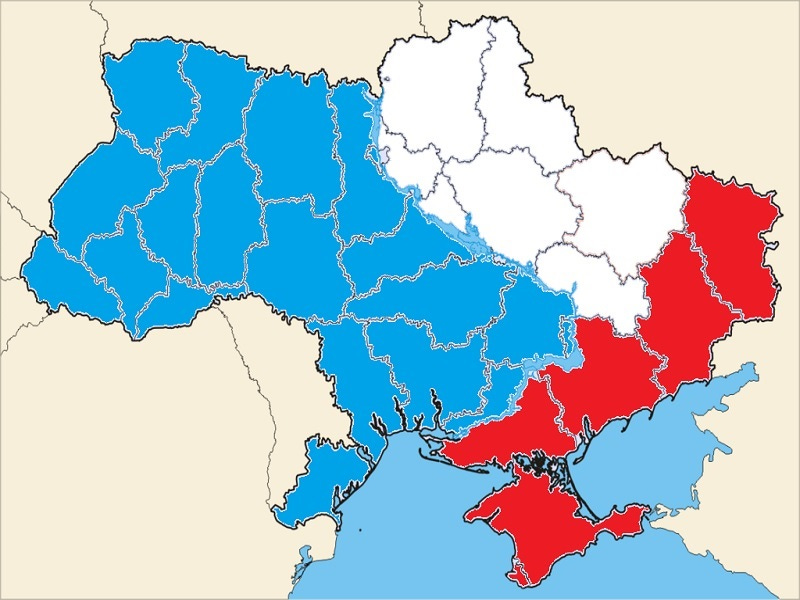
Ukraine could be deterred from breaking the ceasefire due to the DMZ placing it at a disadvantage, while Russia would be deterred by the “security guarantees” that Ukraine clinched with a bunch of NATO countries this year, which amount to de facto Article 5 support. While Russia could storm into the DMZ, NATO could also storm into Western Ukraine or possibly even cross the Dnieper, whether due to a swift intervention or having already deployed its troops west of the river per tacit agreement with Russia.
What was detailed in the three preceding paragraphs is the maximum that Russia can realistically achieve given the new military-strategic circumstances in which it finds itself over 1,000 days since the special operation began. Putin finally started climbing the escalation ladder in order to deter the even greater provocations that the West might now be plotting with the intent of coercing him into freezing the existing LOC and then possibly accepting the deployment of Western/NATO peacekeepers there.
Such a scenario would be completely unacceptable for him from the perspective of Russia’s national security interests and his own reputational ones after promising to check NATO’s expansion in Ukraine. Keeping that bloc west of the Dnieper while demilitarizing everything east of it and north of the administrative borders of the four former Ukrainian regions that joined Russia in September 2022, tentatively known as the “Transdnieper” region, would be a tolerable compromise though.
Trump might deem this to be pragmatic enough of a deal for him to go along with since it could still be spun by all relevant parties to the conflict as a victory (e.g. Russia gained land and created a DMZ deep inside Ukraine; Ukraine continued to exist as a state; and the US de facto incorporated Western Ukraine into NATO). It could even enter into force prior to that if either side “escalates to de-escalate” before his inauguration and this is the “mutually face-saving” compromise that they reach to avoid World War III.
Of course, it would be better if they agree to this without sparking a Cuban-like brinksmanship crisis that risks spiraling out of control, hence why their diplomats should begin discussing it now or a third country’s ones like India’s should propose it behind the scenes to get the ball rolling. Putin’s newfound (and arguably long-overdue) approach signals that he won’t accept freezing the existing LOC, nor especially the deployment of NATO/Western peacekeepers there, and will escalate to avert that.
He might even go as far as using tactical nukes in Ukraine (and/or NATO’s logistics hub in Moldova) if he feels that he’s being cornered by the evolving circumstances in which the West might soon place him through its possibly forthcoming greater provocations (e.g. destabilizing and invading Belarus). The West must therefore start taking Putin seriously after he finally began climbing the escalation ladder otherwise the worst-case scenario of World War III might become unavoidable if they push him too far.