We would like to share with our readership a recent interview with renowned scholar Dmitri Simes about the FBI raid on his home in the United States a short while ago.
Dr. Simes is a distinguished writer and thinker and was head of the Center for National Interest in Washington DC for over 30 years. This think tank was founded by former US President Richard Nixon following his detente with the Soviet Union and the signing of the ABM treaty. It was part of the effort by President Nixon to promote better understanding and better relations between the US and Russia.
Please review the interview and make your own judgment. In our hope for better US Russia relations, it is important that all voices be heard, dissent not be seen as a threat, and freedom of expression be honored. In this interview, you will have the opportunity to listen personally to what Dr. Simes has to say, and the challenges facing those who seek a better environment of peace and security between the US and Russia….
Respectfully,
Krishen, Paula and Pamela Center for Citizen Initiatives
Russia’s budget deficit declined to just 331 billion rubles ($3.7 billion) or 0.2% of GDP for the first eight months of the year, according to Bloomberg. Russia recorded a budget surplus of 767 billion rubles ($8.5 billion) in August, thanks to almost 1 trillion rubles of increased revenue from non oil-and-gas sectors compared to July, this news agency reported. The Russian government’s revenues from taxes on oil and gas surged too, totaling 778.6 billion rubles ($8.7 billion) last month, up by 21% from a year ago, according to Bloomberg. In good news for Russian consumers, consumer prices in the week through Sept. 2 fell 0.02%, according to data from the Federal Statistics Service release, this news agency reported. On the negative side, S&P Global’s Purchasing Managers’ Index for Russian manufacturing fell to 52.1 last month compared to 53.6 in July, according to MT.
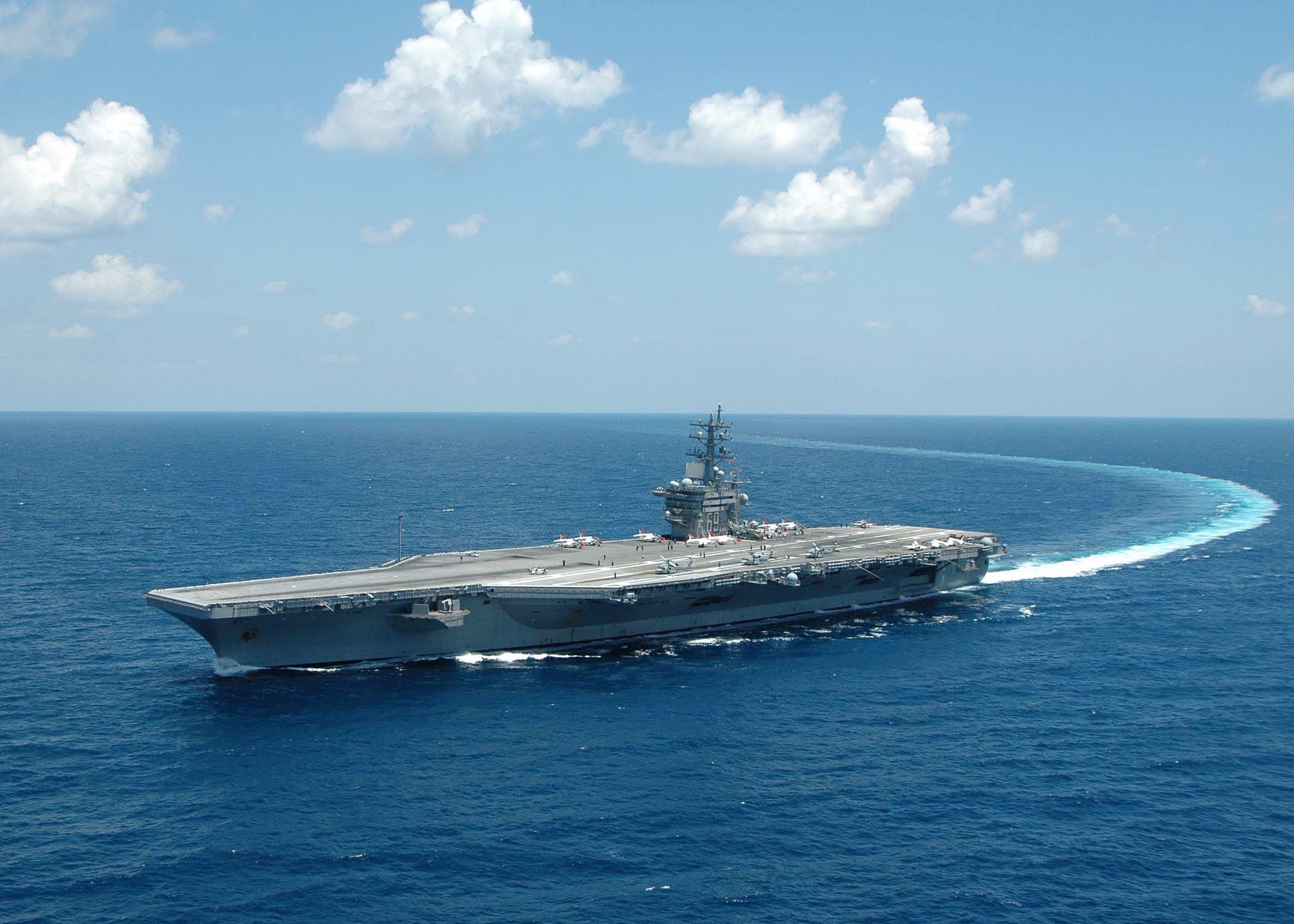
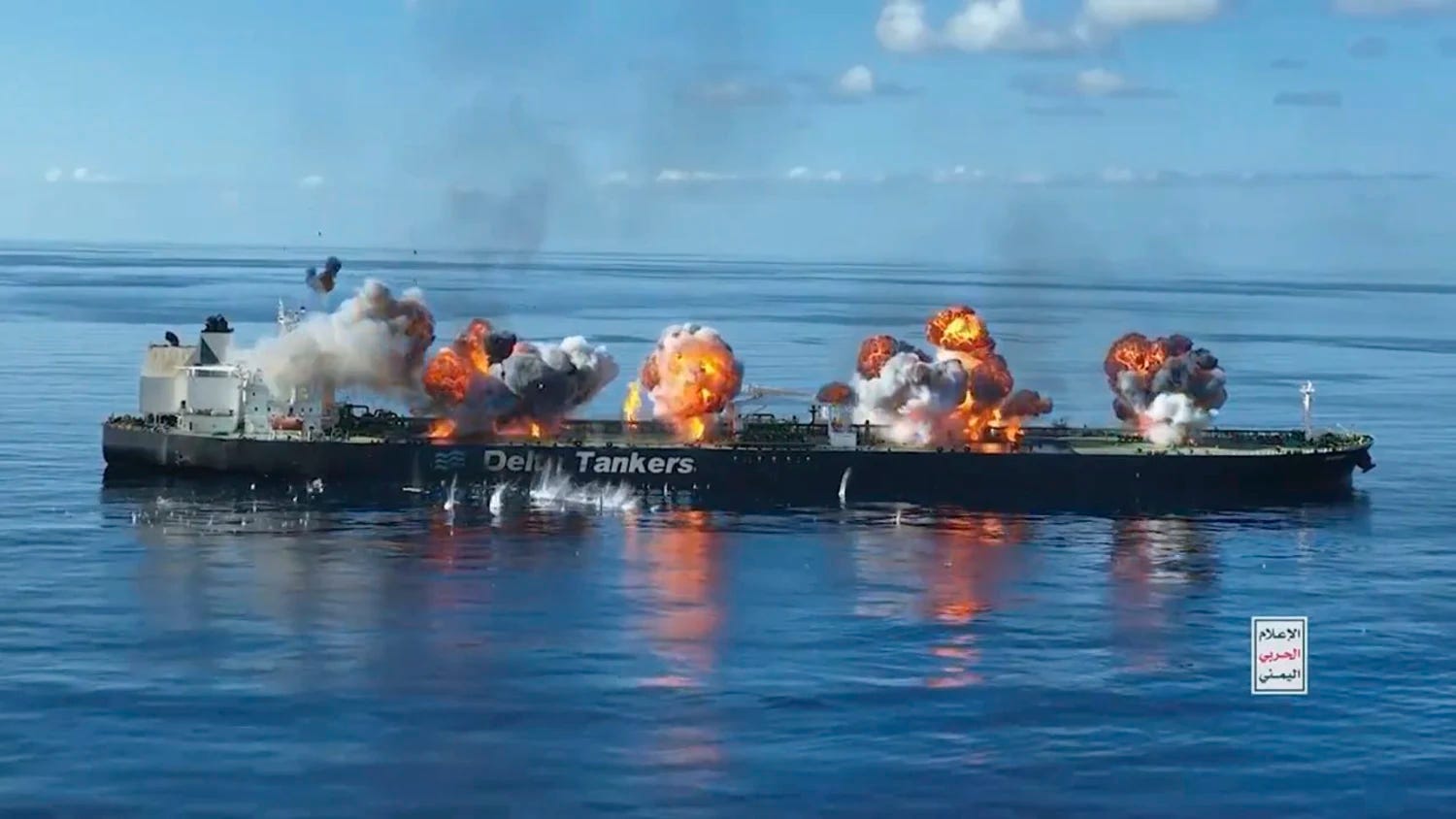
An Al Mayadeen investigation of July 19th laid bare the US Navy’s crushing defeat by Yemen’s AnsarAllah, in Washington’s initially-vaunted Operation Prosperity Guardian. Western media has finally acknowledged the Empire’s comprehensive trouncing by God’s Partisans, in an epic David vs Goliath triumph. Elsewhere, reporting on the much-hyped USS Eisenhower aircraft carrier strike group’s return to base after months of relentless bombardment by the Resistance amply underlines how aircraft carriers – the core component of US hegemony for decades – are quite literally dead in the water.
The New York Timesinnocuously headlined USS Eisenhower’s humiliating retreat as, “the end of a strategic deployment”, while simultaneously hailing a heroic homecoming. The article records how as the grand vessel neared Virginia’s Norfolk Harbor, one of the world’s largest US naval installations, a plane carrying National Security Adviser Jake Sullivan touched down on its deck. He addressed “thousands” of returning sailors, “all eager to be home”, in what the outlet dubbed “an extraordinarily pumped ‘all hands’ call’.”
USS Eisenhower
Recounting “how he would walk into the Oval Office and tell President Biden about the exploits of the Eisenhower and its strike group, shooting down all manner of Iranian-made drones and rescuing sailors attacked by the Houthis,” Sullivan volubly burnished the Navy’s courage and successes. “Man, what stories I got to tell: You guys played defense, you played offense,” he boasted. “When somebody comes at us, we come back harder at them.”
Similar bombast was present in remarks Sullivan madein an accompanying “exclusive” interview with The Times. He spoke of how in the immediate aftermath of “Oct. 7”, his White House national security team decided strident “military muscle movements that could show decisiveness” were absolutely vital. As such, Washington sought to “over-deliver on speed, and scope and scale of American power protection to reassure the Israelis, and to deter adversaries.” USS Eisenhower’s dispatch was considered the boldest “military muscle movement” possible.
Sullivan expressed delight with the results of Operation Prosperity Guardian, suggesting USS Eisenhower’s “fight” with AnsarAllah in the Red Sea “showed that [aircraft carriers] could still battle effectively at close ranges.” This appraisal was echoed by US Navy Secretary Carlos Del Toro. He dismissed “critics” who “predicted the end of the usefulness of carriers”, claiming Operation Prosperity Guardian was a “valuable lesson” demonstrating that US aircraft carrier naysayers had gotten it badly wrong.
‘Imperfect Result’
This is a truly bizarre analysis. Operation Prosperity Guardian can only be considered a deeply embarrassing cataclysm. As NBC reported following the effort’s launch, USS Eisenhower’s mere presence in the Mediterranean was initially calculated by White House apparatchiks to be a “blunt message” that would scare off Iran, Lebanon’s Hezbollah, and Yemen’s AnsarAllah from striking the Zionist entity. However, the Resistance was not deterred one iota from its collective anti-genocide crusade. And now the flagship aircraft carrier has beaten a hasty retreat back to base.
A ship attacked by AnsarAllah
The Times understatedly concedes the conclusion of the US Navy’s Red Sea “strategic deployment” was “obviously an imperfect result”. As the outlet acknowledges, the Zionist entity’s 21st century Holocaust in Gaza continues apace, “fighting between Hezbollah and Israel could spiral”, and AnsarAllah’s blockade not only endures, but may expand if and whenever the movement’s leaders deem it necessary. Meanwhile, official figures indicate vast numbers of difficult-to-reproduce missiles, costing millions each, were expended shooting down low-cost AnsarAllah drones throughout the failed operation.
A far more rational conclusion to draw from Operation Prosperity Guardian is that US aircraft carriers have been proven beyond any reasonable doubt to be a redundant relic of a bygone, unipolar age. The Empire’s bloated, exorbitantly expensive military machine built in recent decades, exclusively suited to one-sided gang-beatings of adversaries that can’t retaliate, is now unable to meet the challenges of modern warfare. By contrast, the Resistance have effortlessly innovated and equipped themselves for 21st century battle.
If the effusive endorsements of Operation Prosperity Guardian issued by Del Toro and Sullivan are truly sincere, then unambiguous, urgent takeouts from the fiasco evidently have not been heeded. Eerily, such cecity was precisely foreshadowed by the July 2002 Millennium Challenge. Largely forgotten today, it remains one of the grandest war games ever mounted by the Pentagon. Costing $250 million – almost $500 million in today’s money – it involved both live-action exercises and computer simulations. In all, 13,000 real-life US troops participated.
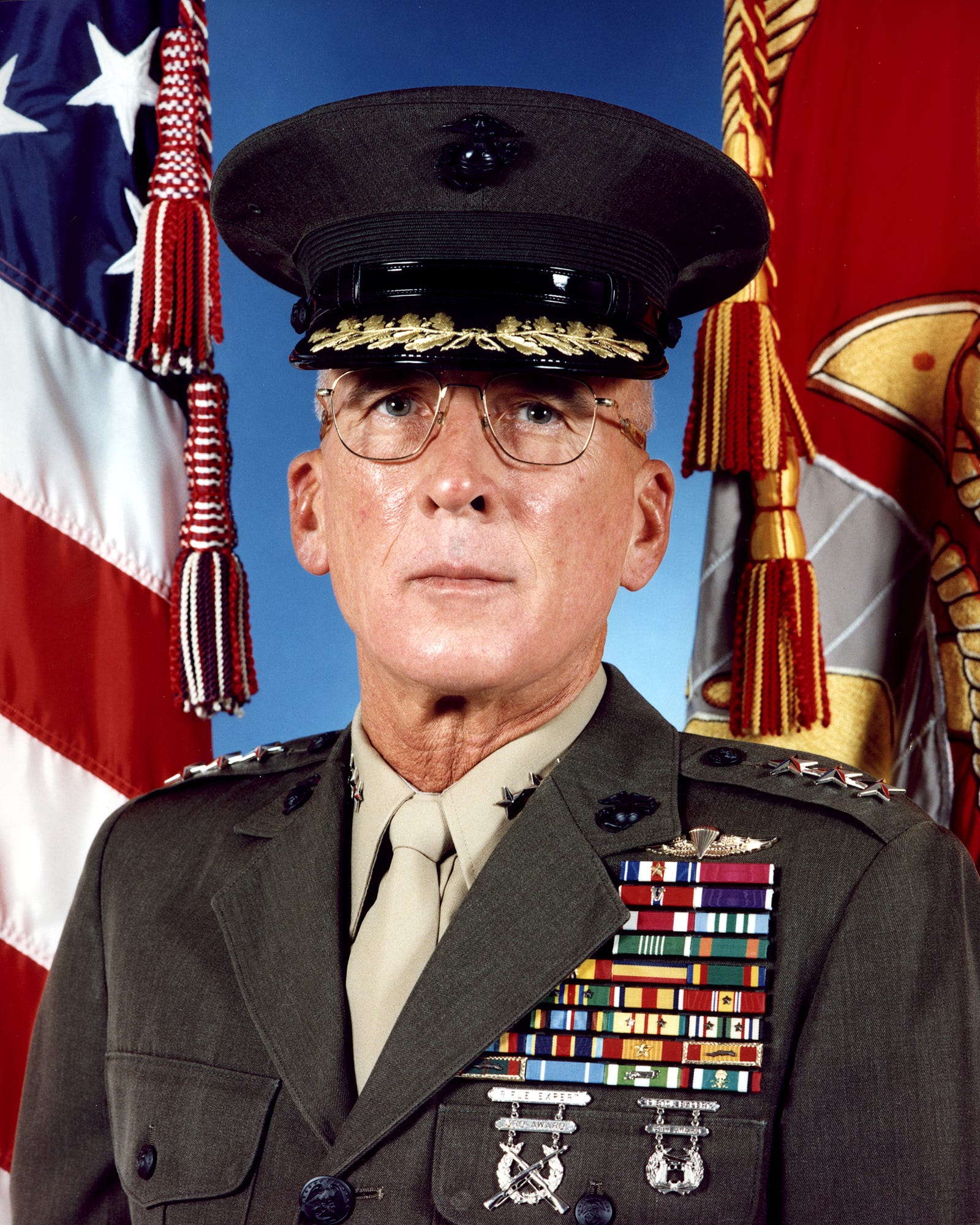
The Millennium Challenge’s simulated combatants were the US – “Blue” – and a fictitious West Asian state, led by a tyrannical maniac – “Red”. Under the war game’s auspices, a vast US expeditionary fleet headed to the Persian Gulf, in preparation for invading “Red”. The effort was widely considered to be an advance test of US military readiness for “intervening” in Iran and/or Iraq. Red was led by Paul Van Riper, a retired Marine Corps lieutenant general.
Paul Van Riper
Believing Blue would launch a surprise attack, Van Riper opted to strike first. A vast swarm of computer-generated small civilian boats and propeller planes at his disposal were dispatched on a kamikaze blitz against both US military bases in the region, and the advancing expeditionary force, while cruise missiles fired upon the flotilla from mobile launch points, on land and at sea. Before Blue even reached Red territory, its aircraft carrier and 16 accompanying vessels were sunk, with 20,000 fictional US soldiers killed.
‘Scripted Exercise’
The Empire had been comprehensively defeated by day two of the two-week-long simulation, in a worse drubbing than Pearl Harbor. So the Pentagon simplyrestarted the exercise, and began changing the rules, to rig US victory. A “control group” steadily imposed constraints on Van Riper. First, his military was forced to use unencrypted cellphones to coordinate and plan missions, to ensure Blue could closely monitor what its adversaries were saying. Red simply opted to use motorcycle messengers, and coded messages broadcast via local mosque minarets.
This was just one troublesome, unorthodox tactic Van Riper deployed to frustrate Blue’s incursion, which was blocked by the war game’s Pentagon-directed referees. Meanwhile, constraints and demands on Red’s operations grew ever-wilder. Van Riper was compelled to switch off his side’s air defences, and move Red forces away from simulated beaches and other areas where Blue’s marines and soldiers were scheduled to swoop in from aircraft carriers, allowing them to invade unmolested. The restrictions imposed became so onerous, and ludicrous, Van Riper quit in disgust.
Millennium Challenge was initially hyped by Pentagon chiefs as a resounding success, and validation of the Empire’s aircraft carrier-dependent war-fighting doctrine. So it was Van Riper embarrassingly blew the whistle, exposing the effort as a scam consciously contrived to produce a desired, bogus result. He expressed grave concerns about US forces being sent into battle based on strategies that either hadn’t been properly tested, or were outright proven to end in defeat:
“It was scripted to be whatever the control group wanted it to be….Instead of a free-play, two-sided game…it simply became a scripted exercise. They had a predetermined end, and they scripted the exercise to that end…Nothing was learned from this…A culture not willing to think hard and test itself does not augur well for the future.”
Today, in light of AnsarAllah’s triumphant victory over the US Navy, Van Riper’s warnings reverberate as a prophet’s curse come true. But it seems that once again, the imperial braintrust has learned nothing from the experience. While one might be tempted to scoff at the Empire’s enduring hubristic delusions, when the reality of its decline is writ so large, we must remain vigilant. Washington’s inability to fight wars doesn’t mean it won’t keep provoking or launching them, with devastating consequences for the world.
Military veteran Lawrence Wilkerson has testified how, while chief of staff to US Secretary of State Colin Powell 2002 – 2005, he participated in a large number of war games exercises pitting the Empire against China, in defence of Taiwan. Every scenario ended in nuclear war, typically within a matter of days. One might expect this inevitable outcome would discourage any and all prospect of conflict with Beijing. Yet, fast forward to today, and US military chiefs openly discuss all-out conflict with China with alarming regularity. God help us all.
The U.S., U.K. and France have continued to debate this week whether to allow Ukraine to use some Western-supplied long-range missiles for long-range strikes at targets inside Russia, such as U.K.-built Storm Shadows and their French-made equivalents, Scalps, that rely on U.S. equipment for navigation, thus, giving Washington the right of veto for their use. The Biden administration is reportedly poised to approve Storm Shadows and Scalps for such use (though not on Sept. 13), but it remains divided on whether to allow use of U.S.-made Army Tactical Missile Systems (ATACMS) for the same purpose. The U.S. State Department is open to Kyiv’s request for use of ATACMS, while the Pentagon and the intelligence agencies are skeptical, according to FT. But even the use of Storm Shadows and Scalps inside Russia would mean NATO countries are at war with Russia, according to Vladimir Putin’s Sept. 12 remarks, which were echoed by his spokesman Dmitry Peskov and his U.N. envoy Vasily Nebenzia. The fear in the White House is that hardliners in the Kremlin could insist this retaliation take the form of attacking transit points for missiles on their way to Ukraine, such as an airbase in Poland in what would lead to invoking of NATO’s Article 5, meaning the alliance would be at war with Russia, according to the BBC.
Asked on Friday about Russia’s threats, John Kirby, the White House spokesman, said that Mr. Putin “has obviously proven capable of escalation over the last now going on three years. So yeah, we take, we take these comments seriously.” “But,” he added, “it is not something that we haven’t heard before.” (NYT, 09.13.24)
Lord Kim Darroch, Britain’s former national security adviser, said western allies should think carefully about Putin’s warnings of a war between Moscow and NATO. “We really don’t want to escalate this,” he told FT.
Matthew Savill of RUSI believes lifting restrictions on use of Western-made long-range missiles by Ukraine would pose a dilemma for Russia as to where to position its precious air defenses. Ultimately however, such use is unlikely to turn the tide, according to Savill. If Savill’s estimate is accurate, then as was the case with prior steps in the ladder of arming Ukraine, the use of Storm Shadows and Scalps would be a morale booster for the Ukrainian leadership and would also generate some benefits on the battlefield, but wouldn’t be a game changer.*1
William Burns of CIA and Richard Moore of MI6 said it would be wrong to take Putin’s threats of nuclear escalation lightly but that the West should not be unnecessarily intimidated, according to FT.
In 1989 I served as an advisor to the first post-communist government of Poland, and helped to devise a strategy of financial stabilization and economic transformation. My recommendations in 1989 called for large-scale Western financial support for Poland’s economy in order to prevent a runaway inflation, enable a convertible Polish currency at a stable exchange rate, and an opening of trade and investment with the countries of the European Community (now the European Union). These recommendations were heeded by the US Government, the G7, and the International Monetary Fund.
Based on my advice, a $1 billion Zloty stabilization fund was established that served as the backing of Poland’s newly convertible currency. Poland was granted a standstill on debt servicing on the Soviet-era debt, and then a partial cancellation of that debt. Poland was granted significant development assistance in the form of grants and loans by the official international community.
Poland’s subsequent economic and social performance speaks for itself. Despite Poland’s economy having experienced a decade of collapse in the 1980s, Poland began a period of rapid economic growth in the early 1990s. The currency remained stable and inflation low. In 1990, Poland’s GDP per capita (measured in purchasing-power terms) was 33% of neighboring Germany. By 2024, it had reached 68% of Germany’s GDP per capita, following decades of rapid economic growth.
On the basis of Poland’s economic success, I was contacted in 1990 by Mr. Grigory Yavlinsky, economic advisor to President Mikhail Gorbachev, to offer similar advice to the Soviet Union, and in particular to help mobilize financial support for the economic stabilization and transformation of the Soviet Union. One outcome of that work was a 1991 project undertaken at the Harvard Kennedy School with Professors Graham Allison, Stanley Fisher, and Robert Blackwill. We jointly proposed a “Grand Bargain” to the US, G7, and Soviet Union, in which we advocated large-scale financial support by the US and G7 countries for Gorbachev’s ongoing economic and political reforms. The report was published as Window of Opportunity: The Grand Bargain for Democracy in the Soviet Union (1 October 1991).
The proposal for large-scale Western support for the Soviet Union was flatly rejected by the Cold Warriors in the White House. Gorbachev came to the G7 Summit in London in July 1991 asking for financial assistance, but left empty-handed. Upon his return to Moscow, he was abducted in the coup attempt of August 1991. At that point, Boris Yeltsin, President of the Russian Federation, assumed effective leadership of the crisis-ridden Soviet Union. By December, under the weight of decisions by Russia and other Soviet republics, the Soviet Union was dissolved with the emergence of 15 newly independent nations.
In September 1991, I was contacted by Yegor Gaidar, economic advisor to Yeltsin, and soon to be acting Prime Minister of newly independent Russian Federation as of December 1991. He requested that I come to Moscow to discuss the economic crisis and ways to stabilize the Russian economy. At that stage, Russia was on the verge of hyperinflation, financial default to the West, the collapse of international trade with the other republics and with the former socialist countries of Eastern Europe, and intense shortages of food in Russian cities resulting from the collapse of food deliveries from the farmlands and the pervasive black marketing of foodstuffs and other essential commodities.
I recommended that Russia reiterate the call for large-scale Western financial assistance, including an immediate standstill on debt servicing, longer-term debt relief, a currency stabilization fund for the ruble (as for the Zloty in Poland), large-scale grants of dollars and European currencies to support urgently needed food and medical imports and other essential commodity flows, and immediate financing by the IMF, World Bank, and other institutions to protect Russia’s social services (healthcare, education, and others).
In November 1991, Gaidar met with the G7 Deputies (the deputy finance ministers of the G7 countries) and requested a standstill on debt servicing. This request was flatly denied. To the contrary, Gaidar was told that unless Russia continued to service every last dollar as it came due, emergency food aid on the high seas heading to Russia would be immediately turned around and sent back to the home ports. I met with an ashen-faced Gaidar immediately after the G7 Deputies meeting.
In December 1991, I met with Yeltsin in the Kremlin to brief him on Russia’s financial crisis and on my continued hope and advocacy for emergency Western assistance, especially as Russia was now emerging as an independent, democratic nation after the end of the Soviet Union. He requested that I serve as an advisor to his economic team, with a focus on attempting to mobilize the needed large-scale financial support. I accepted that challenge and the advisory position on a strictly unpaid basis.
Upon returning from Moscow, I went to Washington to reiterate my call for a debt standstill, a currency stabilization fund, and emergency financial support. In my meeting with Mr. Richard Erb, Deputy Managing Director of the IMF in charge of overall relations with Russia, I learned that the US did not support this kind of financial package. I once again pleaded the economic and financial case, and was determined to change US policy. It had been my experience in other advisory contexts that it might require several months to sway Washington on its policy approach.
Indeed, during 1991-94 I would advocate non-stop but without success for large-scale Western support for Russia’s crisis-ridden economy, and support for the other 14 newly independent states of the former Soviet Union. I made these appeals in countless speeches, meetings, conferences, op-eds, and academic articles. Mine was a lonely voice in the US in calling for such support. I had learned from economic history — most importantly the crucial writings of John Maynard Keynes (especially Economic Consequences of the Peace, 1919) — and from my own advisory experiences in Latin America and Eastern Europe, that external financial support for Russia could well be the make or break of Russia’s urgently needed stabilization effort.
It is worth quoting at length here from my article in the Washington Post in November 1991 to present the gist of my argument at the time:
This is the third time in this century in which the West must address the vanquished. When the German and Hapsburg Empires collapsed after World War I, the result was financial chaos and social dislocation. Keynes predicted in 1919 that this utter collapse in Germany and Austria, combined with a lack of vision from the victors, would conspire to produce a furious backlash towards military dictatorship in Central Europe. Even as brilliant a finance minister as Joseph Schumpeter in Austria could not stanch the torrent towards hyperinflation and hyper-nationalism, and the United States descended into the isolationism of the 1920s under the “leadership” of Warren G. Harding and Sen. Henry Cabot Lodge.
After World War II, the victors were smarter. Harry Truman called for U.S. financial support to Germany and Japan, as well as the rest of Western Europe. The sums involved in the Marshall Plan, equal to a few percent of the recipient countries’ GNPs, was not enough to actually rebuild Europe. It was, though, a political lifeline to the visionary builders of democratic capitalism in postwar Europe.
Now the Cold War and the collapse of communism have left Russia as prostrate, frightened and unstable as was Germany after World War I and World War II. Inside Russia, Western aid would have the galvanizing psychological and political effect that the Marshall Plan had for Western Europe. Russia’s psyche has been tormented by 1,000 years of brutal invasions, stretching from Genghis Khan to Napoleon and Hitler.
Churchill judged that the Marshall Plan was history’s “most unsordid act,” and his view was shared by millions of Europeans for whom the aid was the first glimpse of hope in a collapsed world. In a collapsed Soviet Union, we have a remarkable opportunity to raise the hopes of the Russian people through an act of international understanding. The West can now inspire the Russian people with another unsordid act.
This advice went unheeded, but that did not deter me from continuing my advocacy. In early 1992, I was invited to make the case on the PBS news show The McNeil-Lehrer Report. I was on air with acting Secretary of State Lawrence Eagleburger. After the show, he asked me to ride with him from the PBS studio in Arlington, Virginia back to Washington, D.C. Our conversation was the following. “Jeffrey, please let me explain to you that your request for large-scale aid is not going to happen. Even assuming that I agree with your arguments — and Poland’s finance minister [Leszek Balcerowicz] made the same points to me just last week — it’s not going to happen. Do you want to know why? Do you know what this year is?” “1992,” I answered. “Do you know that this means?” “An election year?” I replied. “Yes, this is an election year. It’s not going to happen.”
Russia’s economic crisis worsened rapidly in 1992. Gaidar lifted price controls at the start of 1992, not as some purported miracle cure but because the Soviet-era official fixed prices were irrelevant under the pressures of the black markets, the repressed inflation (that is, rapid inflation in the black-market prices and therefore the rising the gap with the official prices), the complete breakdown of the Soviet-era planning mechanism, and the massive corruption engendered by the few goods still being exchanged at the official prices far below the black-market prices.
Russia urgently needed a stabilization plan of the kind that Poland had undertaken, but such a plan was out of reach financially (because of the lack of external support) and politically (because the lack of external support also meant the lack of any internal consensus on what to do). The crisis was compounded by the collapse of trade among the newly independent post-Soviet nations and the collapse of trade between the former Soviet Union and its former satellite nations in Central and Eastern Europe, which were now receiving Western aid and were reorienting trade towards Western Europe and away from the former Soviet Union.
During 1992 I continued without any success to try to mobilize the large-scale Western financing that I believed to be ever-more urgent. I pinned my hopes on the newly elected Presidency of Bill Clinton. These hopes too were quickly dashed. Clinton’s key advisor on Russia, Johns Hopkins Professor Michael Mandelbaum, told me privately in November 1992 that the incoming Clinton team had rejected the concept of large-scale assistance for Russia. Mandelbaum soon announced publicly that he would not serve in the new administration. I met with Clinton’s new Russia advisor, Strobe Talbott, but discovered that he was largely unaware of the pressing economic realities. He asked me to send him some materials about hyperinflations, which I duly did.
At the end of 1992, after one year of trying to help Russia, I told Gaidar that I would step aside as my recommendations were not heeded in Washington or the European capitals. Yet around Christmas Day I received a phone call from Russia’s incoming financing minister, Mr. Boris Fyodorov. He asked me to meet him in Washington in the very first days of 1993. We met at the World Bank. Fyodorov, a gentleman and highly intelligent expert who tragically died young a few years later, implored me to remain as an advisor to him during 1993. I agreed to do so, and spent one more year attempting to help Russia implement a stabilization plan. I resigned in December 1993, and publicly announced my departure as advisor in the first days of 1994.
My continued advocacy in Washington once again fell on deaf ears in the first year of the Clinton Administration, and my own forebodings became greater. I repeatedly invoked the warnings of history in my public speaking and writing, as in this piece in the New Republic in January 1994, soon after I had stepped aside from the advisory role.
Above all, Clinton should not console himself with the thought that nothing too serious can happen in Russia. Many Western policymakers have confidently predicted that if the reformers leave now, they will be back in a year, after the Communists once again prove themselves unable to govern. This might happen, but chances are it will not. History has probably given the Clinton administration one chance for bringing Russia back from the brink; and it reveals an alarmingly simple pattern. The moderate Girondists did not follow Robespierre back into power. With rampant inflation, social disarray and falling living standards, revolutionary France opted for Napoleon instead. In revolutionary Russia, Aleksandr Kerensky did not return to power after Lenin’s policies and civil war had led to hyperinflation. The disarray of the early 1920s opened the way for Stalin’s rise to power. Nor was Bruning’sgovernment given another chance in Germany once Hitler came to power in 1933.
It is worth clarifying that my advisory role in Russia was limited to macroeconomic stabilization and international financing. I was not involved in Russia’s privatization program which took shape during 1993-4, nor in the various measures and programs (such as the notorious “shares-for-loans” scheme in 1996) that gave rise to the new Russian oligarchs. On the contrary, I opposed the various kinds of measures that Russia was undertaking, believing them to be rife with unfairness and corruption. I said as much in both the public and in private to Clinton officials, but they were not listening to me on that account either. Colleagues of mine at Harvard were involved in the privatization work, but they assiduously kept me far away from their work. Two were later charged by the US government with insider dealing in activities in Russia which I had absolutely no foreknowledge or involvement of any kind. My only role in that matter was to dismiss them from the Harvard Institute for International Development for violating the internal HIID rules against conflicts of interest in countries that HIID advised.
The failure of the West to provide large-scale and timely financial support to Russia and the other newly independent nations of the former Soviet Union definitely exacerbated the serious economic and financial crisis that faced those countries in the early 1990s. Inflation remained very high for several years. Trade and hence economic recovery were seriously impeded. Corruption flourished under the policies of parceling out valuable state assets to private hands.
All of these dislocations gravely weakened the public trust in the new governments of the region and the West. This collapse in social trust brought to my mind at the time the adage of Keynes in 1919, following the disaster Versailles settlement and the hyperinflations that followed: “There is no subtler, no surer means of over- turning the existing basis of society than to debauch the currency. The process engages all the hidden forces of economic law on the side of destruction, and it does it in a manner which not one man in a million is able to diagnose.”
During the tumultuous decade of the 1990s, Russia’s social services fell into decline. When this decline was coupled with the greatly increased stresses on society, the result was a sharp rise in Russia’s alcohol-related deaths. Whereas in Poland, the economic reforms were accompanied by a rise in life expectancy and public health, the very opposite occurred in crisis-riven Russia.
Even with all of these economic debacles, and with Russia’s default in 1998, the grave economic crisis and lack of Western support were not the definitive breaking points of US-Russian relations. In 1999, when Vladimir Putin became Prime Minister and in 2000 when he became President, Putin sought friendly and mutually supportive international relations between Russia and the West. Many European leaders, for example, Italy’s Romano Prodi, have spoken extensively about Putin’s goodwill and positive intentions towards strong Russia-EU relations in the first years of his presidency.
It was in military affairs rather than in economics that the Russian – Western relations ended up falling apart in the 2000s. As with finance, the West was militarily dominant in the 1990s, and certainly had the means to promote strong and positive relations with Russia. Yet the US was far more interested in Russia’s subservience to NATO that it was in stable relations with Russia.
At the time of German reunification, both the US and Germany repeatedly promised Gorbachev and then Yeltsin that the West would not take advantage of German reunification and the end of the Warsaw Pact by expanding the NATO military alliance eastward. Both Gorbachev and Yeltsin reiterated the importance of this US-NATO pledge. Yet within just a few years, Clinton completely reneged on the Western commitment, and began the process of NATO enlargement. Leading US diplomats, led by the great statesman-scholar George Kennan, warned at the time that the NATO enlargement would lead to disaster: “The view, bluntly stated, is that expanding NATO would be the most fateful error of American policy in the entire post-cold-war era.” So, it has proved.
Here is not the place to revisit all of the foreign policy disasters that have resulted from US arrogance towards Russia, but it suffices here to mention a brief and partial chronology of key events. In 1999, NATO bombed Belgrade for 78 days with the goal of breaking Serbia apart and giving rise to an independent Kosovo, now home to a major NATO base in the Balkans. In 2002, the US unilaterally withdrew from the Anti-Ballistic Missile Treaty over Russia’s strenuous objections. In 2003, the US and NATO allies repudiated the UN Security Council by going to war in Iraq on false pretenses. In 2004, the US continued with NATO enlargement, this time to the Baltic States and countries in the Black Sea region (Bulgaria and Romania) and the Balkans. In 2008, over Russia’s urgent and strenuous objections, the US pledged to expand NATO to Georgia and Ukraine.
In 2011, the US tasked the CIA to overthrow Syria’s Bashar al-Assad, an ally of Russia. In 2011, NATO bombed Libya in order to overthrow Moammar Qaddafi. In 2014, the US conspired with Ukrainian nationalist forces to overthrow Ukraine’s President Viktor Yanukovych. In 2015, the US began to place Aegis anti-ballistic missiles in Eastern Europe(Romania), a short distance from Russia. In 2016-2020, the US supported Ukraine in undermining the Minsk II agreement, despite its unanimous backing by the UN Security Council. In 2021, the new Biden Administration refused to negotiate with Russia over the question of NATO enlargement to Ukraine. In April 2022, the US called on Ukraine to withdraw from peace negotiations with Russia.
Looking back on the events around 1991-93, and to the events that followed, it is clear that the US was determined to say no to Russia’s aspirations for peaceful and mutually respectful integration of Russia and the West. The end of the Soviet period and the beginning of the Yeltsin Presidency occasioned the rise of the neoconservatives (neocons) to power in the United States. The neocons did not and do not want a mutually respectful relationship with Russia. They sought and until today seek a unipolar world led by a hegemonic US, in which Russia and other nations will be subservient.
In this US-led world order, the neocons envisioned that the US and the US alone will determine the utilization of the dollar-based banking system, the placement of overseas US military bases, the extent of NATO membership, and the deployment of US missile systems, without any veto or say by other countries, certainly including Russia. That arrogant foreign policy has led to several wars and to a widening rupture of relations between the US-led bloc of nations and the rest of the world. As an advisor to Russia during two years, late-1991 to late-93, I experienced first-hand the early days of neoconservatism applied to Russia, though it would take many years of events afterwards to recognize the full extent of the new and dangerous turn in US foreign policy that began in the early 1990s.