YouTube link to CN interview with Richard Medhurst on his recent arrest here.
At the time when Prime Minister Tony Blair brought in the Terrorism Act 2000 — note that this was before 9/11 – I was working in the Royal Courts of Justice. As I remember the lawyers were buzzing about it, worried about its vague and sloppy language, and its overt authoritarianism and capacity for abuse.
There was general incredulity that Blair, who is himself a lawyer, as of course is his wife, and his Home Secretary Jack Straw, who is also a lawyer and a former adviser of Barbara Castle, one of the most revered figures in modern Labour history, would bring in a law like that.
Looking back and thinking of those days, it’s amazing how naive we were.
Here we are and this terrible law is now being used against journalists, and is being used in a way which violates fundamental human rights.
The terrible thing is that it was at precisely this same time that the Blair government was bringing into law – with wide support from within the legal community — the Human Rights Act 1998, which embedded the European Convention on Human Rights (ECHR) into U.K. law (the Human Rights Act 1998 was signed into law in 1998 but only came into force on Oct. 2, 2000).
At the time everyone in the legal world assumed that it was the Human Rights Act 1998 that was by far the more important Act, and which would be far more consequential than the Terrorism Act 2000.
Indeed I distinctly remember all sorts of assurances floating around that there was no need to worry because the Terrorism Act 2000 would be restricted and its loose wording interpreted by reference to the ECHR and the Human Rights Act 1998.
In reality what has happened is the opposite. Far from the Human Rights Act 1998 mitigating the effect of the Terrorism Act 2000, it is the Terrorism Act 2000 which is prevailing over the ECHR and the Human Rights Act 1998 – as the Medhurst case shows.
None of this would be happening were it not for a radical change in the whole legal and political culture in the U.K., which has taken place since these two Acts were brought into law.
I don’t want to romanticise the past, but the shift towards authoritarianism, and the ongoing repression of free speech and journalism, which has taken place since 2000, still seems to me astonishing and at some level inexplicable.
The cases brought against Julian Assange and former British diplomat Craig Murray (imprisoned for his journalism on a contempt of court conviction) and the misuse of the Terrorism Act 2000 to harass journalists, including Murray, illustrate this.
What illustrates it even more is that all of this is happening practically without protest. The media here in the U.K. are currently maintaining a stony silence about the Medhurst arrest, whereas if anything like that had happened in 2000 or before there would have been outrage.
It is this sharp authoritarian turn in British legal and political culture — and the lack of any pushback against it — which shocks me. Its origins are obviously in the U.S., but the extent to which it is now sweeping the entire West, is astonishing.
I have heard that in Germany things are even worse, with people like former Greek Finance Minister Yanis Varoufakis prevented from entering the country.
Here in Britain we are throwing away the liberties people once fought for, for example in the 18th century Wilkes Case. Moreover we are doing it without a murmur. Liberty is dying in silence.
On the specifics of the Medhurst case, I would say two things:
1. I think the objective is to intimidate and silence Medhurst, and to get Google to de-platform his YT channel, rather than to prosecute him. Even allowing for the current climate I cannot believe that the U.K. authorities are going to bring a prosecution.
If they do something like that then things are even darker than I supposed. Having said that, assuming I am right, acting to intimidate and silence a journalist, thereby depriving him of his livelihood, is already appalling enough.
2. It’s clear from Medhurst’s account that the police were acting under instructions and under tight supervision. Based on what he says, it looks as if the police were constantly checking and getting instructions throughout the entire period of his detention and arrest.
It would be interesting to know from whom, and what the chain of command was. Perhaps in better times we will find out.
Alexander Mercouris is a legal analyst, political commentator and editor ofThe Duran.
The views expressed are solely those of the author and may or may not reflect those of Consortium News.
The Soviet government was pretty good at developing sophisticated techs and executing grand scale projects — nuclear power plants, supersonic jets, nuclear submarines, various rockets & missiles, space stations and space shuttles, in addition to high-tech factories and general infrastructure.
They weren’t particularly good at making simple consumer goods, though. Or, rather, they were failing to satisfy the demand. Soviet people always desired foreign clothes (even those made by other Eastern Block countries), foreign sweets, foreign cigarettes, foreign cosmetics, and so on. Soviet automobiles, although relatively well made and well suited for their price category, were a frequent subject of ironic remarks.
The Soviet Union, although having high technological capacity and know-how in the high-order things, was lugging terribly in all those little things that constitute people’s everyday experiences.
In the United States, corporations and their research departments have been working tirelessly on coming up not only with the ways to fulfil the consumer demand, but also to create and control it since, like, the 1940, if not earlier. All the advances in Behavioural Science were made, in part, due to big marketing departments trying to figure out the ways to sell people things that they didn’t even know they needed.
So, in the West, having more resources, corporations were nurturing consumer culture for decades. In the Soviet Union, in contrast, they didn’t really care about those.
Under Stalin, all the down-to-earth consumer needs were being taken care of by small corporate enterprises (so-called artels) that were decentralised and, therefore, could react faster to spontaneous market fluctuations. When Krushchev came to power in the mid-1950s, he cancelled artels, seeing them as left-overs of the Capitalist system. The supply of consumer goods got compromised severely, on a systemic level. Later economic reforms, such as the one developed by Lieberman and implemented by Kosygin in the 1960s, didn’t solve the issue and only worsened it.
It became a huge Cold War factor, with Americans using it to their advantage, waging a cultural war on the Soviet Union. And it hit the hardest in the late 1980s, when the Soviet economy was going through a terminal “Perestroika” crisis. When McDonald’s first opened in Moscow in the year 1990, people were lining up for multiple kilometres, literally, wanting to experience it and perceiving it as a wonder of American superiority.
We all know how it ended for the USSR.
Russia is in another long-term confrontation with the United States and its allies at the moment. It started in a soft phase after 2007, following Putin’s Munich speech, when he criticised NATO expansion and American foreign policy. Then it intensified badly in 2013-2014, and it all went into high-gear in 2022, with large scale proxy-wars, diplomatic boycotts, and intense economic sanctions.
Well, you know, even though the modern Russian Federation is far from being the Soviet Union, in terms of demographic potential and technological capacity (relative to its time), the United States & Co do not have consumer culture superiority this time. It’s not a factor they can bet on anymore.
Russia has overabundance of high quality affordable food nowadays. You won’t impress locals with large American style supermarkets. The general service industry in Russia is arguably better than in the West. Fancy looking cafes, restaurants, and all of that — you can find them at every corner in here nowadays, even in small rural towns (and the fact that they remain in business and multiply indicates that people can afford going there frequently). An average coffee place in Russia is arguably better than a Starbucks outlet in Australia.
Also, don’t forget that Russia is geographically huge and it has virtually all natural resources one might need, so it’s next to impossible to embargo it the same way they have been doing it to smaller nations like North Korea and Cuba.
Speaking of consumer electronics, the shops are filled with Chinese Huawei and Xiaomi laptops and gadgets (I assume it’s similar in professional tech sector, with servers and network equipment; besides, Russia has its own microprocessors that are used in specialised areas nowadays). I got myself a portable 4G router here recently (out of curiosity and because it’s not always convenient to rely on my phone as a Wi-Fi hotspot) from a local mobile carrier, and the package says it was made in China.
Same with cars — BMWs and Cadillacs are not being officially serviced in Russia by manufacturers, but there are heaps of quality Chinese vehicles and mid-range domestic cars on the market.
As for social media, search engines, and whatsnot — ha! Yandex has been rivalling Google since 1997 (Russia is the only country, besides the United States, China, and South Korea, that has its own widely used search engine). VK and Telegram negate the need for Meta and X/Twitter services.
Russia has a crapload of its own streaming platforms nowadays (START, Wink, PREMIER, and so on). So, unless you want to watch Netflix or Amazon Prime exclusives, you’re very well set with Russias domestic services (Russian TV-shows have been catching up on production values in recent years; there are also lots of Korean, Chinese, and Turkish dramas to choose from).
Speaking of banks and payment systems, even though the US policy makers had cut Russia off the SWIFT system, rendering foreign Visa and Mastercard cards useless in here, Russia has its own Mir system nowadays, with vibrant banking industry, convenient ATM services, instant transfers, and banking apps that are at least a generation ahead of what people use in the West (I’m, for one, not a huge fan of strong privately owned banks and financial institutions, as a phenomenon, but that’s due to my personal political views, and I’m talking purely about customer experience side of things in this post).
YouTube is still far superior to Russian domestic alternatives, such as RUTUBE and VK Video, in terms of search, suggestion algorithms, and monetisation policies and mechanisms for content creators, yes, but they have come a long way in the last 2-3 years, and they keep improving.
So, I don’t know how the United States & Co are planning to wage propaganda war against Russia and what are they going to use to impress ordinary Russian citizens with this time. F-16 jets? Because the dominant, dominant majority of all the publications in the Western mainstream media regarding the troubles in Russian economy is a mixture of crude propaganda and mean spirited wishful thinking for domestic consumption & self-delusion.
On Wednesday, Aug. 7, the F.B.I. executed a search warrant at my residence. The F.B.I. claimed they were investigating whether I was functioning as an unregistered agent of a foreign government. But what was really taking place was a frontal assault on peace.
Shortly before 2 p.m. on Aug. 5, attorneys from the Northern District of New York, accompanied by agents from the National Security Division of the Federal Bureau of Investigation (F.B.I.), gathered in the chambers of Christian F. Hummel, a United States magistrate judge for the Northern District of New York. Hummel was appointed to this position in September 2012.
Prior to his appointment, Hummel, a graduate of Albany Law School, had a career in civil litigation as a trial lawyer, before being elected as the town justice for the town of East Greenbush. Hummel moved on to be a Rensselaer County Family Court judge and, later, the Rensselaer County surrogate, the position he held at the time of his appointment as a U.S. magistrate judge.
The U.S. attorneys presented Hummel with a series of affidavits from the F.B.I. and possibly other U.S. government agencies which they maintained established probable cause for the federal law enforcement to conduct a search of my residence for “any computers, computer equipment, cellular telephones, and/or any other electronic media or storage devices.”
According to the affidavits (which were not included as part of the search warrant presented to me by the F.B.I. agents), these electronic devices contained information they believed would advance their case that I was operating as an unregistered agent of a foreign government in violation of the Foreign Agent and Registration Act.
[Scott Ritter will discuss this article and answer audience questions on Ep. 185 of Ask the Inspector on Thursday, August 15 at 8 PM ET.]
Based upon the questions asked of me by the F.B.I. during the conduct of this search, the foreign government in question was the Russian Federation.
The search warrant required that the search be conducted in the daytime between 6 a.m. and 10 p.m., which meant that the U.S. attorneys and the F.B.I. either did not seek to establish cause for a nighttime raid or were unable to convince Judge Hummel that such cause existed. Likewise, the U.S. attorneys and the F.B.I. did not make a case to delay notification of their execution of the search warrant.
In short, this search warrant was as non-confrontational a process as one can have when 20-plus armed U.S. government agents invade your home and rifle through your life’s possessions, and those of your family.
The F.B.I. agents involved in both the search and the questioning were professional and courteous throughout the five-plus hour event.
A couple of takeaways from a cursory analysis of this search warrant. First, the F.B.I. was most likely not looking for anything related to the active commission of a crime — I was not handcuffed, and the interview process was completely voluntary on my part — they did not read me my rights, nor was I asked to waive my rights.
This suggests that neither the U.S. attorneys nor the F.B.I. were operating based on any federal indictment — if such an indictment existed and had been used as the foundation of this search, the tenor of the proceedings would have been far different. Indeed, at no time did the F.B.I. suggest that I had committed a crime — they simply said there was concern within the U.S. government that I was engaged in activities that fell under the FARA statute.
Second, it appeared to me that the F.B.I. was on a fishing expedition. The two special agents who questioned me each held thick folders filled with documents that they would refer to during the interview. On one occasion, after they completed a particular line of questioning, the two agents stared at each other, as if they were struggling with how to proceed.
“You guys clearly have something on your mind,” I said. “Just say what it is. I’m being completely cooperative here. Ask your question, and I’ll answer it to the best of my ability.”
At that point, one of the agents reached into her folder and pulled out copies of an email exchange I had back in February 2023 with Igor Shaktar-ool, a senior counselor with the Russian embassy.
‘Unmasked’
The production of this email demonstrated that the F.B.I. had most likely obtained a FISA warrant which enabled them, directly or indirectly, to monitor my communications.
This did not necessarily mean that they had received permission to monitor me directly — as a U.S. citizen, I have constitutionally-derived rights of privacy which preclude such monitoring void of very specific justification and authorization, none of which could possibly have been met given the facts of the case. (Moreover, if there had been a FISA warrant issued, and this product was the result, then I doubt the F.B.I. agent would have shared it with me in such a non-confrontational manner.)
The F.B.I. is, however, allowed to monitor the emails of foreign diplomats, of whom Igor Shaktar-ool is one. As an American citizen caught up in any intercepted communication, my identity would normally be “masked,” meaning that anyone who encountered the intercepted email would only know me as a faceless, nameless “U.S. citizen.”
At some point in time, however, my actions regarding Russia must have reached a level of concern where my identity was “unmasked” so that the data contained in the emails could be more thoroughly evaluated.
And this “unmasking” undoubtedly led to the F.B.I. seeking a court order to gain access to the emails in question outside the FISA procedures, freeing up the information contained within to be used by a wider audience.
This appears to be the case.
Back on June 3, I had received an email from Google informing me that they had “received and responded to a legal process issued by the F.B.I. compelling the release of information related to Google accounts that are linked to or associated with a specific identifier.” Google’s response, the email noted, “included information about your account.”
Google had been prohibited from disclosing this information to me by a “court order.” This order had either expired or had been rescinded, and Google was now permitted to disclose their receipt of the F.B.I. request.
I’m not a big believer in coincidences. June 3 was also the date the Customs and Border Protection agents seized my passport as I was preparing to board a flight at JFK airport that was to take me to Russia, where I was scheduled to participate in the Saint Petersburg International Economic Forum before embarking on a 40-plus day tour of Russia.
As was the case with the search warrant, if I was under suspicion of having committed a crime, I would have been arrested and detained once they seized my passport.
The fact that the Customs and Border Protection agents allowed me to leave unhindered pointed to the existence of an ongoing federal law enforcement investigation which feared the unmonitored connectivity I would have with Russians, including Russian government officials, while travelling in Russia.
Igor Shaktar-ool and most of the Russian embassy staff use Gmail as their email provider.
To legally seize my passport in the manner they did, the U.S. government would be revealing that they had an ongoing federal investigation against me. This would require the unsealing of the court order related to that investigation. Which would free up Google to send me the email about the F.B.I. investigation.
Life is stranger than fiction.
Now to the email chain in question.
I had visited the Russian embassy, at my request, on Feb. 20, 2023, to inform the Russian government of my intent to travel to Russia later in the spring as part of a book tour to promote the publication of my recently released memoir —Disarmament in the Time of Perestroika: Arms control and the end of the Soviet Union— of my time as an inspector implementing the Intermediate Nuclear Forces (INF) treaty in the Soviet Union back in 1988-1990.
The U.S. had withdrawn from the INF treaty back in August 2019, an action that I believed accelerated the risk of nuclear war. At the time, I was promoting the idea of a major anti-nuclear war rally here in the United States, and I was thinking about trying to organize similar rallies in Russia.
As I explained to the Russians, my background as a former Marine Corps intelligence officer who had worked in the Soviet Union in that capacity would undoubtedly raise alarms in the Kremlin. My purpose in visiting the Russian embassy — which was done on my request and my initiative — was to answer any questions the Russians might have about my upcoming trip so that there were no misperceptions or concerns about motive.
The last thing I wanted, I told the Russian diplomats I met with, was to be viewed as a threat by the Russian government.
My mission in travelling to Russia was to promote better relations by reminding a Russian audience that once upon a time our two nations actively worked together in the furtherance of the cause of peace by eliminating the very weapons — nuclear-armed missiles — that threatened our mutual existence.
The story of my experience as a weapons inspector in the Soviet Union, in my opinion, served as an example of not only what was, but what could — and, in my opinion, should — be again. I wanted to go to Russia, engage in a conversation with the Russian people about furthering nuclear arms control and bettering relations, and then return to the United States and educate the American people about the Russian reality as I saw it.
Rage Against War
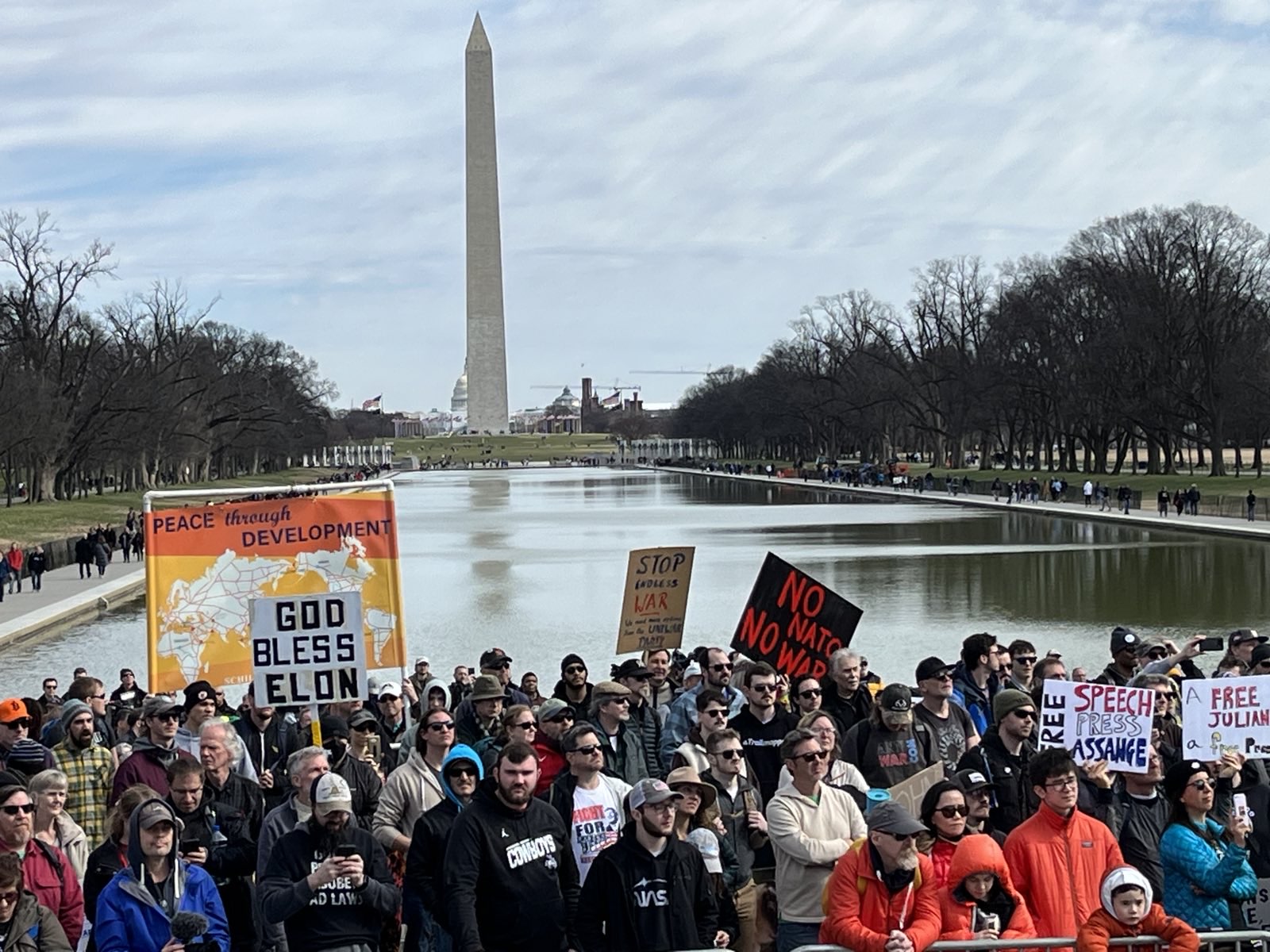
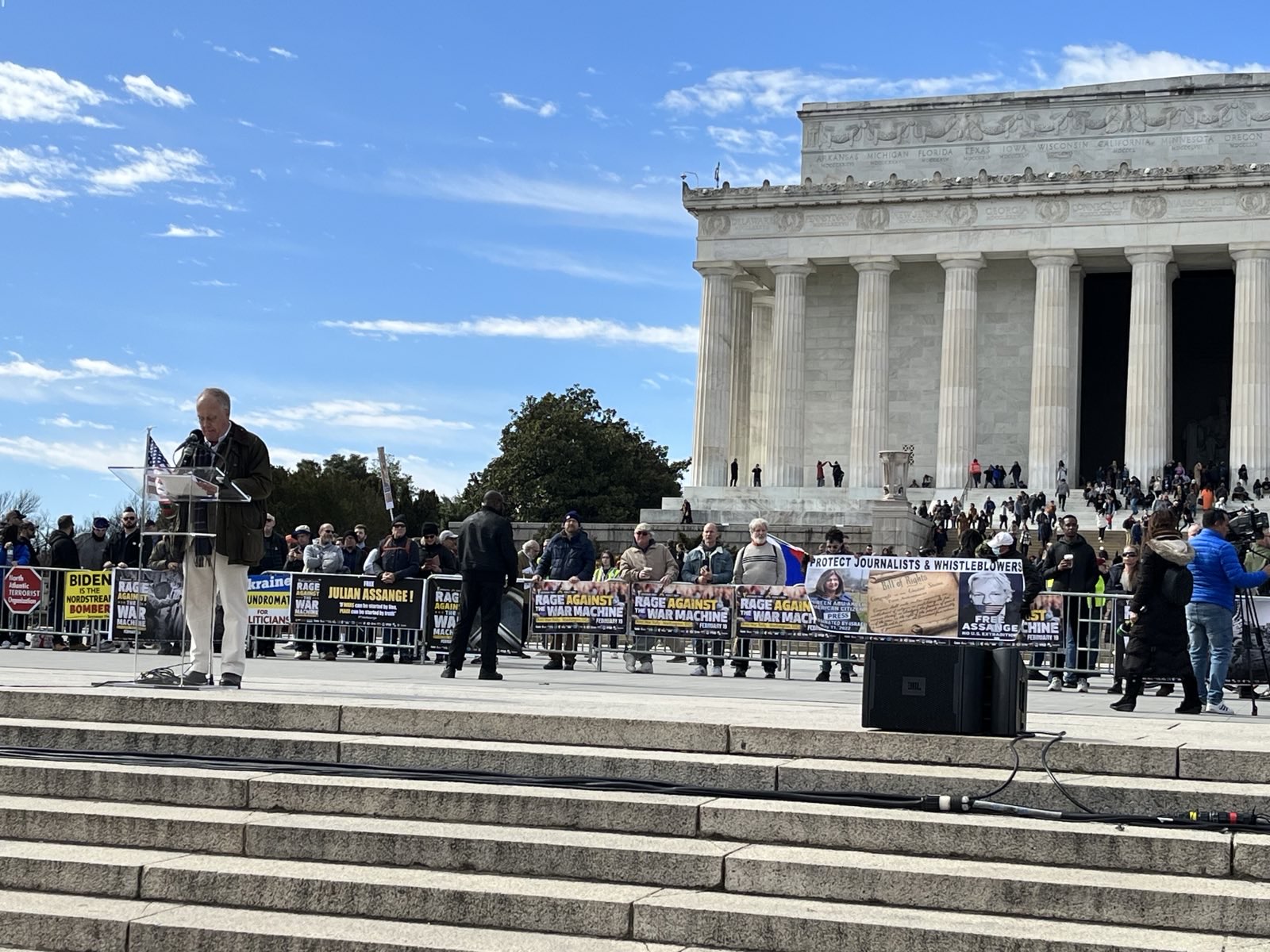
Rage Against the War Machine rally in D.C., February 2023. (Joe Lauria)
I had been scheduled to speak as part of the “Rage Against the War Machine” rally scheduled to take place in Washington, DC on Feb. 19, 2023. My conviction as a sex offender (unjust, based upon a manufactured case, and which I will continue to challenge on appeal), combined with what my critics contend is my “pro-Russian” attitude toward the ongoing conflict in Ukraine, created such a controversy that I withdrew from the event.
I published my prepared remarks on Feb. 10 on my Substack. Extracts from this undelivered speech best explain my mindset at the time of my meeting at the Russian embassy on Feb. 20:
“Everyone standing here today should reflect on this statement and say a quiet word of thanks to those men and women, American and Soviet alike, who made the Intermediate Nuclear Forces Treaty a reality and, in doing so, literally saved the world from nuclear destruction.
Arms control, however, is no longer part of the U.S.-Russian dialogue. The American war machine has conspired to denigrate the notion of mutually beneficial disarmament in the minds of the American public, instead seeking to use arms control as a mechanism to achieve unilateral strategic advantage.
When an arms control treaty becomes inconvenient to the objective of American global domination, then the war machine simply quits. America’s record in this regard is damnable — the Anti-Ballistic Missile Treaty, the Intermediate Nuclear Forces Treaty, the Open-Skies Treaty — all relegated to the trash bin of history in the cause of seeking unilateral advantage for the American war machine.
In a world without arms control, we will once again be confronted with a renewed arms race where each side develops weapons that protect nothing while threatening everything. Without arms control, we will return to a time where living on the edge of the abyss of imminent nuclear annihilation was the norm, not the exception…
In the case of U.S.-Russian relations, this fear is produced by systemic Russophobia imposed on the American public by a war machine and its compliant minions in the mainstream media. Left to its own device, the collusion between government and media will only further reinforce ignorance-based fear through a process of dehumanizing Russia and the Russian people in the eyes of the American public, until we have become desensitized to the lies and distortions, accepting at face value anything negative said about Russia…
Some 60 years ago, on these very steps, in this very place, a man of peace gave a speech that captured the imagination of the nation and the world, searing into our collective hearts and minds the words, “I have a dream.”
Dr. Martin Luther King’s historic address confronted America’s sordid history of slavery, and the inhumanity and injustice of racial segregation. In it, he dreamed ‘that one day this nation will rise up and live out the true meaning of its creed: We hold these truths to be self-evident, that all men are created equal.’
All men are created equal.
These words resonated in the context of America’s desperate internal struggle with the legacy of slavery and racial injustice.
But these words apply equally, especially when taken in the context that we are all God’s children, black, white, rich, poor.
American.
Russian.
You see, I too have a dream.
That the audience gathered here today can find a way to overcome the ignorance-based fears generated by the disease of Russophobia, to open our minds and our hearts to accept the Russian people as fellow human beings deserving of the same compassion and consideration as our fellow Americans — as all humankind.
I too have a dream.
That we the people of the United States of America, can unite in common cause with the Russian people to build bridges of peace that facilitate an exchange of ideas, open minds closed by the hate-filled rhetoric of Russophobia that is promulgated by the war machine and its allies, and allow the love we have for ourselves to manifest itself into love and respect for our fellow man.
Especially those who live in Russia.
Newton’s Third Law, that every action has an equal and opposite reaction, applies to the human condition every bit as much as it applies to the physical world.
Love thy neighbor as thyself is applicable to all humanity.
I too have a dream.
That by overcoming the hate generated by systemic Russophobia we can work with our fellow human beings in Russia to create communities of compassion that, when united, make a world filled with nuclear weapons undesirable, and policies built on the principles of mutually beneficial arms control second nature.
I too have a dream.
That one day, whether on the red hills of Georgia, or the black soil of the Kuban, the sons and daughters of the men and women who today operate the Russian and American nuclear arsenals will be able, to quote Dr. King, ‘to sit down together at the table of brotherhood.’
This is not an impossible dream.
I have lived it. I once was corrupted by the hatred that comes from fear generated by the ignorance about the reality of those whom I was trained to kill.
But I then embarked on a remarkable journey of discovery, facilitated by the implementation of the very same Intermediate Nuclear Forces Treaty that ended up saving humanity from nuclear annihilation, where I came to know the Russian people not as enemy, but as friend. Not as opponent, but colleague. As fellow humans capable of the same emotions as myself, imbued with the same human desire to build a better world for themselves and their loved ones, a world free of the tyranny of nuclear weapons.
I too have a dream.
That the people gathered here today will join me on a new journey of discovery, one that tears down the walls of ignorance and fear constructed by the war machine, walls designed to separate us from our fellow human beings in Russia, and instead builds bridges that connect us to those we have been conditioned to hate, but now — for the sake of ourselves, our children, and our grandchildren —must learn to love.
This will not be an easy journey, but it is one worth taking.
This is my journey, your journey, our journey, where we will embark, literally, down the road less travelled.
And yes, it will be the one that will make all the difference.”
Among the many speakers at the Washington rally was Chris Hedges, but not the author. (Joe Lauria)
The Russian embassy officials were familiar with this article (apparently, they subscribe to my Substack — it’s a free subscription! The F.B.I. should do so as well, if they already have not.) In addition to discussing my plans regarding bringing the message of peace and hope contained in my book Disarmament in the Time of Perestroika to Russia, our conversation turned to the issue of Russophobia in the United States.
I viewed Russophobia as the greatest impediment to the cause of bringing about good relations between Russia and the United States — so long as the American people were taught to be afraid of Russia, they would never be able to responsibly engage on the issue of improving relations with Russia.
It was at this juncture that Igor Shaktar-ool mentioned that the Russian ambassador, Anatoly Antonov, had recently written an article on the problem of Russophobia. I was shown a draft of the article.
Igor noted that in the past the ambassador would have sought to publish the article as an Op Ed in either The New York Times or TheWashington Post, both of which had in the past published essays written by Russian diplomats. Igor noted that in the present climate, neither publication was sympathetic to the views of a Russian diplomat.
I asked if Igor could provide me with a copy of the article so I could read it over. Igor promised to email me a copy.
The next day Igor sent me an email:
“It was [a] pleasure to meet you in the Embassy yesterday. I a.m. grateful to you for the very interesting discussion on Russia-U.S. relations in the context of Ukraine crisis.
As we agreed I a.m. sending to you our article on Russophobia.
We would appreciate [it] if you could assist us in publishing it in the U.S. media, for instance, in the Nation or Consortium News. It was pleasure to meet you in the Embassy yesterday. I am grateful to you for the very interesting discussion on Russia-U.S. relations in the context of Ukraine crisis.
I reached out to both The Nation and Consortium News about Ambassador Antonov’s essay. I never heard back from The Nation, and Joe Lauria, the editor at Consortium News, was gun-shy about running something sourced straight from the Russian embassy. Given the reality of the current climate, I couldn’t blame him.
I sent an email to Igor on Feb. 23, informing him as much. I also told him that I had taken the initiative to write my own article, using Antonov’s essay as the core point of departure.
You Are Being Directed by the Russian
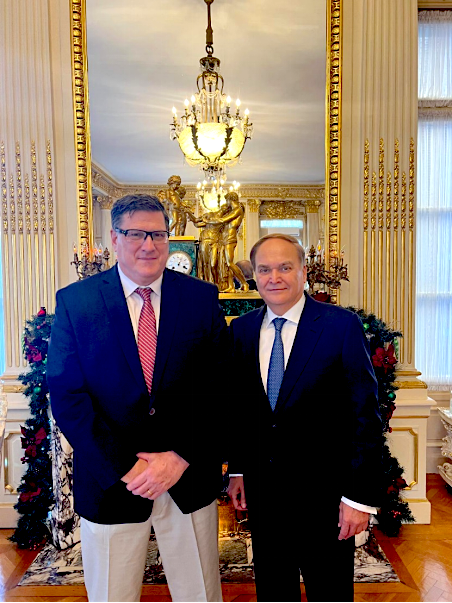
The author with Russian Ambassador Anatoly Antonov at the Russian ambassador’s residence, December 2022. (Russian Embassy)
Instead of trying to place the essay in an American publication, I proposed that I publish my article on my own Substack. “I would then publish it on Twitter (100,000-plus followers), Telegram (80,000-plus followers) and Facebook (I have no idea how many followers). There is a good chance it would be picked up by other outlets,” I noted, adding (optimistically) “It could easily get a million views.”
“I used every word in your essay as written. I did move a paragraph to the front to help me set the stage properly.
Let me know what you think. I could publish this as soon as I got your approval.
Or if you have concerns, we can talk it through.
And, at the end of the day, [if] you would prefer to have your essay published as is, we can keep trying.”
The F.B.I. agent who showed me the email exchange between Igor and myself underscored the sentence in bold, above.
“You asked for his approval,” she said. “It suggests that you were taking instructions from the Russian Embassy.”
I laughed. “It shows no such thing,” I replied. I pointed out that I had shifted paragraphs around, breaking up the flow of Ambassador Antonov’s essay as it had originally been written. It was only proper that I make sure the source was okay with this.
“I’m a journalist,” I said. “I’m using material written by someone else. I have a duty to make sure that I use this material in a manner which meets with the approval of the source. It’s standard practice.”
Igor replied to me the next day. He thanked me for my interest in Antonov’s Russophobia article, and for my “creative approach with substantial comments on the problem we raise.”
Igor asked that I give the embassy some time to discuss my draft. “I will let you know about our decision,” he wrote.
Igor was as good as his word, writing to me on Feb. 25. He told me that the embassy had decided to publish Antonov’s article on the Embassy Facebook page. “This doesn’t negate our great interest in your article,” he wrote, “which we find very strong, thoughtful, detailed and well-written.”
Igor proposed that I publish my article as a separate piece. He did request that I change the opening passage of the article “for objective reasons.”
“And you made those changes,” the F.B.I. agent said. “It shows that you are being directed by the Russians, and that you are complying with their directions.”
The opening passage of the draft article that I had sent to Igor reads as follows:
“Recently, I had the opportunity to speak with a Russian diplomat assigned to the Russian Embassy in the United States. He shared with me an essay prepared by the Embassy which was intended for publication in an American media outlet. In years past, this was common practice—as part of a time-honored practice derived from the principles of free speech which encourage debate, dialogue, and discussion of topical issues, foreign diplomats would have essays published, often as Op-Ed articles, in the pages of prestigious American newspapers.
But the Russian Embassy, when it came to the essay in question, had been met with a wall of silence. There was no interest, it seemed, in providing a platform for any Russian opinion.
It is not as if the essay that had been prepared by the Russian Embassy addressed a controversial issue, such as the ongoing conflict in Ukraine. Rather, it addressed the elephant in the room when it came to explaining the very psychology which motivated the decision to ban the Russian essay from the pages of American newspapers designed to promote, and provoke, thought—Russophobia.”
It was my understanding that the Russians objected to identifying them as the source of the essay. So, I rewrote the passage.
“Recently, I ran across an essay that had been published by the Ambassador of Russia to the United States, Anatoly Antonov, in the Russian newspaper, Rossiyaskaya Gazeta, and subsequently posted on the Russian Embassy Facebook page. The title of the essay, “Russophobia as a malignant tumor in the United States”, is, admittedly, provocative—as all good, thought-provoking titles should be. After reading it, it became apparent to me that, in the interest of combating Russophobia, I should help bring the Ambassador’s essay to the attention of as many people as possible.”
Once again, the F.B.I. agent expressed her concern. “You clearly took instruction from the Russian Embassy and complied.”
And once again, I objected. “I’m a journalist. I was respecting my source’s wishes regarding how to describe the source of the material. Nothing I wrote was inaccurate. All journalists do this.”
As I responded, I couldn’t help but recall the case of Evan Gershkovich, TheWall Street Journal journalist who had been arrested and charged with espionage by the Russian government for receiving classified information from an employee of a sensitive military industrial facility near the city of Ekaterinburg.
In recordings released by RT of Gershkovich’s rendezvous with his source, the source is heard telling Gershkovich to be “very careful,” adding that the information he was providing is “secret.”
Gershkovich replied that in his article he would not mention seeing the documents in question, and that he would cite “anonymous sources” in what he wrote. In this way, Gershkovich would shield from discovery the fact that secret information had been collected, and that there was a source leaking this classified information.
According to Gershkovich’s editor at The Wall Street Journal, Gershkovich’s deception regarding the source of the information he was collecting was consistent with the actions taken by a journalist to protect the identity of his source.
Gershkovich was clearly practicing deception, and yet his technique is considered standard journalistic practice.
In many ways, my rewritten passage was more accurate in describing the source of information used in my article than the original draft.
The F.B.I. agent clearly was not happy with my answer. “You were acting as a foreign agent,” she said.
The Foreign Agents Registration Act (FARA) (22 U.S.C. § 611 et seq.), defines the term “agent of a foreign principal” as:
“any person who acts as an agent, representative, employee, or servant, or any person who acts in any other capacity at the order, request, or under the direction or control, of a foreign principal or of a person any of whose activities are directly or indirectly supervised, directed, controlled, financed, or subsidized in whole or in major part by a foreign principal [who] engages within the United States in political activities for or in the interests of such foreign principal [or] acts within the United States as a public relations counsel, publicity agent, information-service employee or political consultant for or in the interests of such foreign principal.”
The FARA statute also notes that “the term ‘agent of a foreign principal’ does not include any news or press service.”
I once again reminded the F.B.I. agent that I was acting as a journalist when I both met and exchanged emails with Igor Shaktar-ool, that it was I who had requested the meeting with the Russians, not them, and that it was me who raised the topic of Russophobia.
I was the one who decided to write the article in question. That I had a source of information with whom I worked to make sure that the information provided was used in a manner agreeable to the source is basic journalism — nothing more, nothing less. Any “requests” made by the Russians in this regard were simply in the context of the interaction between a journalist and his source.
In short, my actions did not fit the definition of an “agent of a foreign principle,” but rather that of a working journalist.
FARA defines “political activities” to mean:
“… any activity that the person engaging in believes will, or that the person intends to, in any way influence any agency or official of the Government of the United States or any section of the public within the United States with reference to formulating, adopting, or changing the domestic or foreign policies of the United States or with reference to the political or public interests, policies, or relations of a government of a foreign country or a foreign political party.”
There is no doubt that much of my work falls under the category of “political activity.”
As I wrote in my Substack article of Feb. 10, my goal was to defeat the disease of Russophobia so that the American people would be empowered by fact-based knowledge and information to make decisions that could lead to the betterment of relations between Russia and the United States.
I am therefore guilty of trying to influence the American public when it comes to U.S. attitudes toward Russia and, in doing so, seek to generate public pressure on U.S. policy makers to formulate more responsible policies that don’t lend themselves to a nuclear arms race with Russia.
This is the moral duty and responsibility of every American citizen — to hold his or her elected representatives accountable for what is done in their name.
It is the bedrock principle of representational democracy.
And now the F.B.I. is seeking to criminalize it.
I am a practitioner of what is known as “advocacy journalism,” a genre of journalism which openly pursues a social or political purpose. I am an advocate for the betterment of relations between the U.S. and Russia, not because I seek to further Russian interests on behalf of Russia, but because I firmly believe, as an American, it is in the best interests of my country to facilitate the peaceful coexistence between the U.S. and Russia predicated on a mutual desire to avoid nuclear war and, as such, embrace arms control.
In pursuing this advocacy, I have been assiduous in ensuring that what I report on is derived from fact-based truth, something that separates me from the bias that has corrupted the more conventional “balanced” reporting of mainstream media.
There is no doubt that there are those in the United States, including many in the U.S. government (and, very likely, many in the Department of Justice and the F.B.I.) who take extreme umbrage over what I say and write when it comes to Russia.
Compare and contrast my approach to journalism with admissions by the U.S. intelligence community that it deliberately declassifies and releases for public consumption intelligence information it knew to be unverified or even wrong about Russia for the sole purpose of shaping public opinion amongst the American people so that they would unquestioningly support U.S. policy objectives vis-à-vis Russia that not only have put the United States on the cusp of a direct conflict with Russia in Ukraine, but run the real risk of inciting a larger conflict that could, and probably would, lead to a nuclear conflagration that would not just hazard American lives, but humanity as a whole.
Free to Censure the Government
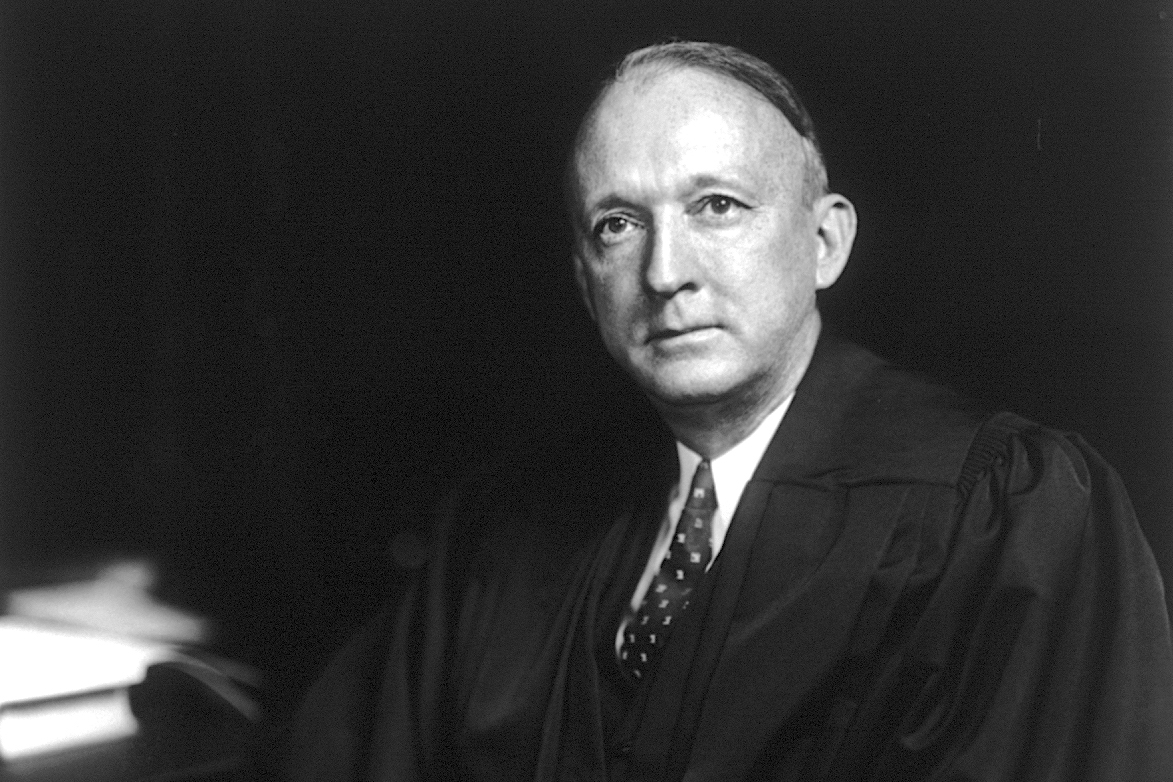
Justice Hugo Black in 1937. (Libray of Congress/Wikimedia Commons)
“The press was to serve the governed, not the governors. The Government’s power to censor the press was abolished so that the press would remain forever free to censure the Government. The press was protected so that it could bare the secrets of the government and inform the people. Only a free and unrestrained press can effectively expose deception in government. And paramount among the responsibilities of a free press is the duty to prevent any part of the government from deceiving the people and sending them off to distant lands to die of foreign fevers and foreign shot and shell.”
That is my mission as a journalist — to prevent my government from deceiving my fellow citizens and, in doing so, preventing the men and women who honor us with their service in the U.S. military from being sent off to fight and die in a distant land in furtherance of a cause that was built on the foundation of lies, half-truths, and misinformation, most if not all of which is being disseminated to the American people on behalf of the U.S. government by a compliant and controlled mainstream media.
I don’t work for the U.S. government.
I don’t advocate on its behalf.
I work for myself.
And I advocate on behalf of the American people.
Because I am an American.
A citizen true to the demands of citizenship, which mandates that I oppose the governors when they are acting in a manner which I believe is to the detriment of the governed.
And now the F.B.I. and the Department of Justice want to criminalize my work.
If the Department of Justice wants to have a legal wrestling match over the definition of journalism and a working journalist in the United States, and the rights accrued to me as an American citizen under the First Amendment of the U.S. Constitution (“Congress shall make no law…prohibiting the free exercise thereof; or abridging the freedom of speech, or of the press…”), that is a fight I am ready to engage in.
FARA is literally a law made by the U.S. Congress.
And, according to the F.B.I., it can now be used to define what is and isn’t journalism in the United States.
The F.B.I.’s reasoning, and that of the Department of Justice, in this matter represents nothing less than a frontal assault on both free speech and a free press, one which, should the F.B.I. decide to proceed, cannot and will not go unchallenged.
The FARA statute was promulgated ostensibly to serve the national security interests of the United States by denying foreign governments the ability to interfere in the internal political affairs of the American people by hiding their actions through American citizens acting on their behalf. On the surface, this is a good thing to try and prevent.
However, by seeking to extend the jurisdiction of FARA so that it covers the practice of journalism by American citizens, it is a frontal assault on that most precious American right — free speech and a free press, all in the name of “national security.”
“[W]e are asked to hold that…the Executive Branch, the Congress, and the Judiciary can make laws … abridging the freedom of the press in the name of ‘national security’.”
To permit this, Justice Black argued,
“would wipe out the First Amendment and destroy the fundamental liberty and security of the very people the Government hopes to make ‘secure’…[t]he word ‘security’ is a broad, vague generality whose contours should not be invoked to abrogate the fundamental law embodied in the First Amendment.”
There is no legitimate national security interest in interfering in the work of a journalist whose ideas the U.S. government finds objectionable. Justice Black agreed. “The Framers of the First Amendment,” he wrote,
“fully aware of both the need to defend a new nation and the abuses of the English and Colonial governments, sought to give this new society strength and security by providing that freedom of speech, press, religion, and assembly should not be abridged.”
In its efforts to label me a foreign agent because of my journalistic activity, the F.B.I. and the Department of Justice are seeking to do just that — abridge freedom of speech and a free press.
Having arrived at this juncture, however, I was still concerned about the tactics being employed by the Department of Justice in addressing the one alleged “violation” of FARA alluded to by the F.B.I. agents who interviewed me.
If this was the basis of their concern, it could have — and indeed, should have — been addressed by having the FARA Unit send me a “letter of inquiry” advising me of my potential obligations under FARA, and seeking additional information from me that hopefully answered their concerns.
Instead, they executed a search warrant.
Why?
This is a question only those who swore out the affidavits that were presented to Magistrate Judge Hummel can answer.
Hopefully, someday they will.
The F.B.I. had, by their own admission, been monitoring my communications for well over 18 months.
All they had to show for it was a meeting between myself and Russian diplomats that resulted in me publishing an article talking about the danger of Russophobia.
An article which detailed the sourcing of the information used to write it.
By their own actions the F.B.I. demonstrated that this, in and of itself, did not constitute a violation of the FARA statute, let alone a crime.
If it was a clear-cut violation of FARA, the Justice Department’s FARA Unit would have issued a letter of inquiry.
Instead, the F.B.I. executed a search warrant based upon affidavits possessing information sufficient to satisfy a federal magistrate judge that there was probable cause for a search of my personal electronics which the F.B.I. claimed would show…what?
The commission of a crime?
No.
If that was the case, the entire tenor of the search would have been different.
I would have more than likely been detained.
One is left, therefore, with the F.B.I. looking for additional information to sustain their theory that I am operating as an unregistered agent of the Russian government.
The F.B.I. was clearly concerned about the time I spent in Russia, outside their span of control.
Maybe they thought that my computer and cell phone would contain evidence of a covert relationship between myself and the Russian government.
They will be disappointed.
Detained at the US Border
Upon my return from my first trip to Russia, I was detained by the Customs and Border Protection agents for several hours. During that time, I was questioned in depth by an agent who specialized in Russia about my trip. He had many questions, and I had many honest answers.
He inspected my luggage, including the gifts I had received from Alexander Zyrianov, my host, which I had declared on my customs declaration. The agent then exercised his option to waive charging me a duty assessment on the gifts.
The F.B.I. acknowledged they were aware of this.
On my return from my second trip, I was detained by the Customs and Border Protection agents for an hour. I was prepared with a fully filled-out customs declaration form.
I was ready to answer all their questions.
Instead, the CBP agents released me after an hour with no interview and no inspection of my luggage.
Just a simple cursory “welcome home” from the CBP agent as he returned my passport.
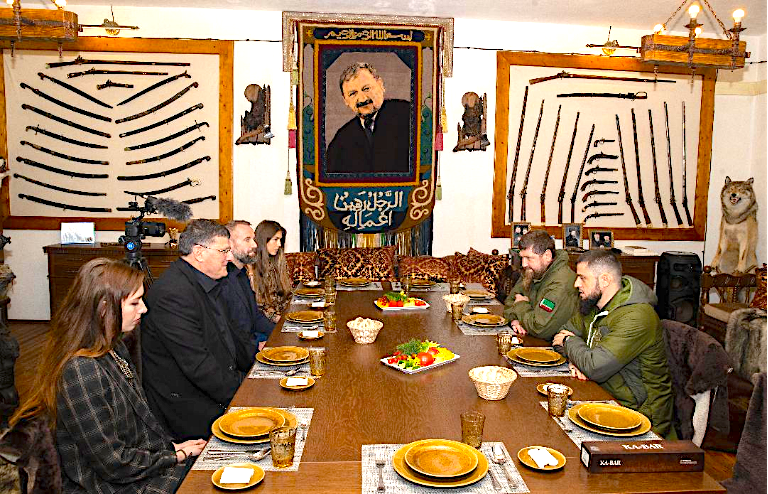
This was after a trip which took me to Chechnya, where I met with Ramzan Khadirov and spoke before 25,000 Chechen soldiers.
The author, accompanied by Alexander Zyrianov, at lunch with Ramzan Khadirov, January 2024. (Chechen Minister of Information)Where I visited Crimea.
Where I visited the four “new territories” of Kherson, Zaporizhia, Donetsk and Lugansk.
If there ever was a visit to Russia that demanded attention from CBP, this was it.
And yet they let me go, no questions, no inspection.
In retrospect, I believe this was the moment that the F.B.I. decided they were going to begin manufacturing their case against me, creating the foundation of probable cause based upon demonstrated behavior patterns that could sustain an argument before a magistrate judge that I was involved in activities which would require me to register as a foreign agent under the FARA statute.
This case would have been undermined if the CBP agents had questioned me, and I answered the questions as completely and honestly as I had done back in 2023.
This case would have been undermined if the CBP agents had inspected my luggage, eliminating the element of uncertainty the F.B.I. was later able to create about the contents of my bags.
It also explains why my passport was seized by the CBP back on June 3.
The F.B.I. was making a case that I was an unregistered Russian agent.
That I was working under the control and direction of the Russian government.
And yet the trip I was scheduled to begin on June 3 would prove the exact opposite — that I was a journalist whose interest in Russia was to learn more about the Russian people — the Russian “soul” — so that I might empower an American audience to rethink their attitudes toward all things Russian, attitudes shaped in large part by systemic Russophobia.
Because the F.B.I. had been monitoring my communications, they were aware of the agenda, goals, and objectives of this planned trip, which included taking my podcast, Ask the Inspector, to some 16 Russian cities over the course of 40 days.
The F.B.I. was aware that myself and my co-host, Jeff Norman, had been raising money in support of this trip, and that we were in the final phases of discussions with a donor who was going to provide the money needed to make this ambitious trip a reality.
The F.B.I. was aware of the detailed line-item budget we had prepared, and the fact that we intended to pay for every single expense associated with this trip.
The F.B.I. knew that if I went on this trip, they could never successfully manufacture a case built on the premise that I was operating under the direction of the Russian government.
So, the F.B.I. killed the trip.
And when I adjusted to this new reality by refocusing my efforts on a massive peace rally hosted by Gerald Celente in Kingston, New York, which is scheduled for Sept. 28, the F.B.I. had no choice but to act.
Perhaps they thought the Kingston rally is being directed and/or funded by the Russians.
There is no doubt that the Kingston rally is going to be a political event — as part of the event, I am organizing Operation DAWN, an event designed to help prevent nuclear war between the U.S. and Russia by asking the following questions of American voters:
“What would you do to save Democracy, save America, save the World, by empowering your vote in November?”
All the F.B.I. had to do was ask me a question outlining their concern; as I demonstrated during their multi-hour interview conducted while my home was being searched, I am fully cooperative and transparent when it comes to my work.
But simply asking me questions wouldn’t achieve what I believe to be the larger objective — to bring harm to the rally itself.
To stop Operation DAWN in its tracks.
Perhaps the F.B.I. honestly believes that I am a Russian agent, and as such Operation DAWN is prohibited political action conducted on behalf of the Russian government.
Maybe they think there will be some form of communication between myself and my imaginary Russian controllers that detail this perceived collaboration.
They will be disappointed.
Or maybe someone in the F.B.I. and/or the Department of Justice, on their own volition or following orders from above, simply decided to try and discredit Operation DAWN and the Kingston rally by doing the only thing they were capable of doing at this juncture — execute a daytime search warrant of my residence in a manner which generated the maximum amount of publicity, and then remain silent about why they had done this, knowing all too well that the compliant mainstream media would pick up the ball and run with it, publishing scandalous stories based upon a rehashing of past events and full of irresponsible speculation drawn from the imaginations of so-called “experts” who know nothing whatsoever about the facts of the case (yes, Albany Times Union, I’m speaking about you.)
Maybe the F.B.I. thought I would be intimidated by the raid, and opt to remain silent out of fear of generating unwanted attention.
But all the F.B.I. really accomplished that day was to execute a raid on peace.
Because that is what Operation DAWN and the Sept. 28 rally in Kingston are all about — promoting the cause of peace based upon good relations between nations, of preventing nuclear war through meaningful arms control.
I don’t know yet how this story ends.
I know how it should end — with the F.B.I. returning my electronics and issuing a statement that nothing had been found of interest.
Maybe even issue a statement that I was no longer a subject of interest.
Maybe even return my passport.
But in this day and age of politicized justice, such an outcome, even if warranted, is not assured.
But I do know a few things.
One, I am not an agent of the Russian government.
Two, I am an American patriot who loves my country with all my being.
Three, I believe the threat of nuclear war represents the greatest existential threat to my country today.
Four, one of the last remaining opportunities for the American people to help prevent a nuclear war is to empower their vote in November’s presidential election by making the candidates for that office earn it by articulating policies that promote peace, the prevention of nuclear war, and the promotion of arms control.
And, finally, five — that God willing, I will be in Kingston, New York, on Sept. 28, side by side with Gerald Celente and a host of friends and colleagues, including those physically present and those participating remotely, to promote the cause of peace that constitute the core objectives of Operation DAWN.
I hope many of you who read this can join us on that day.
Let’s shut down the thruway, just like they did back during the Woodstock Festival in August 1969.
Let us make happen what the F.B.I. and Department of Justice appear hellbent on stopping.
Let’s make peace, not war, a national priority.
I’ll see you in Kingston.
Scott Ritter is a former U.S. Marine Corps intelligence officer who served in the former Soviet Union implementing arms control treaties, in the Persian Gulf during Operation Desert Storm and in Iraq overseeing the disarmament of WMD. His most recent book is Disarmament in the Time of Perestroika, published by Clarity Press.
Journalist Tatiana Rybakova notes that the war with Ukraine has led to a reduction of inequality in Russia and looks at whether that will continue after the war ends.
Russia’s economically depressed areas – typically where defense enterprises, agriculture and barely competitive sectors, such as light industry, are concentrated – are currently on the rise. The previously prosperous northwest of the country is declining, while Eastern Siberia and the Far East have caught a second wind.
Social shifts caused by the war
The Russian middle class, increasingly filled with officials in recent years, is now seeing more people from disadvantaged social strata, which previously seemed doomed to poverty and debt. Meanwhile, the part of the middle class that is usually called the “creative intelligentsia” is visibly struggling – besides those who are on the pro-war side. What do these shifts mean?
The Baikal–Amur Mainline (BAM) and Trans-Siberian Railway, the main railways of Eastern Siberia and Primorye (the territory along the Sea of Japan), are overwhelmed. They have become the main routes for transporting goods to China and Far Eastern ports, from where they are sent to India and other countries. Wage gains in logistics have outpaced all other sectors, including IT. Not long ago, it was people working in transportation at the other end of the country, in the Northwestern Federal District, who made good money; today, however, the Baltic ports, customs terminals and railways are empty: practically no freight flows to or from Europe – the borders are closed.
Where there is freight, there is money. The closure of the northwestern borders was a big hit to the region’s timber industry, which had been the biggest in the country. It is too expensive to transport timber across the country to China, and besides, the Siberian taiga has its own lumberjacks and sawmills. Moreover, China has its own pulp and paper mills, several of which are located right on the border with Russia, while the inputs are provided by long-trusted local suppliers. Industry officials say that it is economically feasible for these mills to transport raw materials from no more than a thousand kilometers away.
Timber is not the only industry on the border with Europe that has suffered, as the entire region lived on trade with Russia’s neighbors. In particular, raw materials and components were actually cheaper for a local enterprise to bring over from the neighboring Baltic countries or Finland. Petersburgers, citing better quality and price, even went to Finland for their weekly groceries.
Now, Russia’s Far East is invigorated. For example, the largest construction companies in Russia have rushed in to build new residential complexes in Vladivostok, Sakhalin, Khabarovsk and Nakhodka. The boom is driven not only by more money in the wallets of the local population but also the Far Eastern Mortgage program, with interest rates of 2% per annum – versus the 20% prevailing in the market – spurring demand.
Besides railways and ports, another important source of new income for the Far East is contract service in the army, as it is for residents of Ryazan and Voronezh regions and other Russian backwaters.
War pays
Russia’s regions are now competing in terms of enlistment bonuses: the highest-paying are Karachay-Cherkessia and Moscow Region, offering RUB 1.3 million (about $20,000) and RUB 1.7 million ($25,000), respectively, though nowhere is less than a million paid.
Still, it is not only money that motivates people to enlist: as political commentator Abbas Gallyamov notes, contracts are often signed by men who were considered good-for-nothings – by their relatives, acquaintances and sometimes even themselves. But now they are heroes, “participants in the special military operation,” “the new elite,” as Putin called them, entitled to all sorts of benefits, honor and respect. Those who are lucky enough to return alive and in one piece are given comfortable jobs with good pay.
Even if they do not come back, their families receive substantial compensation for a killed-in-action father or husband. Political commentator Vladimir Pastukhov has calculated that payments for a family member killed in action can reach RUB 14 million (EUR 140,000). This compares to the average monthly wage in Russia of approximately EUR 730 and means a family receives approximately 16 years of average wages for every member killed.
“If we take into account that now a significant part of the army is people who get paid not the average but the minimum wage, which this year is about EUR 192 [a month], then compensation in the event of their death for their families is up to 60 years of their potential income. In Russia, these people do not work that long, so the compensation covers the income of two or three generations of Russian men at once, who have finally become economically attractive to their partners. In other words, the payment immediately compensates for lost income from unborn children,” Pastukhov wrote on his Telegram channel.
Professional military men are now much better off, too. Not long ago, military salaries were, by Moscow standards, pathetic. A military career attracted only people from poor regions: sure, the salary is small, but the pay is stable; the uniform is free, they feed you, you can retire at 45, and the pension is good compared to a civilian one.
Now, not only do officers receive good money for staying in the combat zone, but they also have excellent opportunities for additional “earnings.” Before, there were quiet rumors that Prigozhin’s Wagner PMC, while recruiting convicts into its ranks, manufactured time at the front, followed by an amnesty six months later, for some inmates who could pay. These days, the trade in “special operation participant” documents has become an open secret: more and more deputies and bureaucrats are announcing that they fought in Ukraine, while even small businessmen who want to protect themselves from raiders and siloviki are getting in on it. For those who are actually in Ukraine, there is the option to pay off your commander so that he does not send you to fight on the front line but rather to, for example, unload shells in the rear.
So what? a cynic would say. What’s wrong if the poor are becoming, if not rich, then at least better off? In Russia, there has been a lot of talk for a long time about the need to reduce inequality – both across the population and across regions – which in Russia was already very high. People got what they wanted, albeit in a terrible way.
How long will there be money for war payments?
Even if we ignore the moral side of getting rich by killing other people, we still must admit that this method of reducing inequality is not only expensive (already a third of federal budget expenditures go toward the war and related payments) but also toxic.
First of all, because war is a short-term affair. The Russia-Ukraine war is unlikely to last a decade, and not only because the sides hardly have enough resources for that. Judging by Putin’s rhetoric, even he is for peace – albeit on his own terms.
Almost the entire West is for ending the war, while China, apparently, is not happy about the current situation. And though predicting the end of a war is a thankless task, we can still say with reasonable confidence that we are talking about 2-3 more years at most. Everyone understands this, including those who are benefitting from the war.
Even now, many in Russia, including high-ranking officials, are asking a completely reasonable question: what will happen when those 300,000-400,000 soldiers, who are accustomed to mortal risk and good money and know how to handle weapons, come back? Of course, the authorities will probably give them benefits, perhaps some kind of regular payments or a preferential mortgage. But it is unlikely that these payments and benefits will be indexed, even to real inflation, which is still high now, while there are no factors suggesting it will come down after hostilities end.
Of course, they will be shown honor and respect and will continue to be invited to schools to speak, just like veterans of the Great Patriotic War in Soviet times. Yet during United Russia primaries for local elections, across the country special operation veterans were sunk – after all, party functionaries did not get into politics to give way to some kind of “new elite.” The candidacy of a former tractor driver who fought in the special operation had to be rammed through so he could become a Federation Council senator.
Others will not be able to live on “veteran payments” alone; they will have to work. But will there be work for those who before the war often did not have a real vocation or who during the war lost the skills they had? Besides them, there are workers at defense factories: today, they work three shifts for good wages, but what about tomorrow? Will they have to choose between keeping their job for the prewar pay of $200 a month or taking a hike?
Not everything is hunky-dory in terms of regional development, either. Yes, the current modernization of the BAM and Trans-Siberian Railway, like other infrastructure projects in Siberia and the Far East, is likely to continue, as if the war ends, trade with China, which has faltered of late amid Chinese fears of secondary sanctions, will certainly pick up. Perhaps, the northwest of the country will see some relief if some sanctions are lifted – at least if the borders are open for the export and import of goods.
But how high will demand and prices be? Inflation around the world is dying down, and the end of the war may also cause prices for key Russian commodities to fall, from oil and gas to metals. For example, Kuzbas coal is already facing headwinds: China does not want to buy more; it just does not need so much. Stockpiling is a bad thing, however: production cannot just be stopped, while stockpiling means direct losses, and no expansion of the Trans-Siberian Railway or the BAM can change that.
Oddly enough, salvation from the crisis for Russian industry might be defeat in the war – at least in the form of an obligation to rebuild what was destroyed in Ukraine. Then there would be a place to sell metals, oil and gas, timber and coal. If the war ends without such an obligation and without the lifting of sanctions, then those who have greatly benefited from the war risk reverting to their starting point. But with weapons in hand and anger at the politicians who promised them everything.
Once the Armed Forces of Ukraine (AFU) took its first Russian railway station inside Russia it was in the position to cause chaos and glean valuable troop movement intel.
“Russia has a fully digitised railway system, so once you access the system of any train station, no matter how small, you have access to the entire network,” Paul Con, a Ukraine observer, said in a social media post.
The AFU breakthrough has led to a severe disruption in railway operations, paralysing key routes across the country. The central office of Russian Railways (RZD) has urgently requested the Belarusian railway authorities to halt the dispatching of freight trains to Russia, as the system has become overloaded, according to a report by the Union of Belarusian Railroad Workers.
The main problem is that a reported 133,000 civilians are fleeing the region at the same time after the AFU crossed the border on August 6. And the situation may be getting worse after Ukrainian forces were seen in the Belgorod region to the north, which has now also declared a state of emergency.
The load has incapacitated RZD’s ability to receive trains from Belarus on the Moscow and Bryansk railway routes, which also abuts the Ukrainian border.
Official documents indicate that the request to stop incoming freight trains was issued on August 12, reflecting the critical situation on the ground. The ban is indefinite, as Russian authorities are uncertain when control over the affected railways will be restored, UA Wire reports.
Transport logistics between Russia and Belarus have reportedly collapsed, with numerous freight trains now stranded in dispatch areas. Russia’s Smolensk region in particular has become a bottleneck, with “abandoned” trains accumulating due to the halted traffic. A lack of locomotives has made the situation worse, UA Wire reports.
What remains unclear is if the AFU has been able to hack the RZD’s IT system to further disrupt the railways, however, once into the system they have been able to glean valuable information about Russia’s troop movements. RZD is reportedly now trying to lock the AFU out of the system.
“It seems that the Ukrainians managed to infiltrate the Russian railway system and were able to track the routes of arms shipments. Completely overhauling the system is currently causing significant headaches for IT specialists in Moscow,” added con.
Russia has been struggling to counter the AFU’s incursion. Other reports say that the expeditionary force has brought upgraded drones with them that use new frequencies that are impervious to Russian electronic warfare jamming, while the AFU has also upgraded their own jamming software which is now highly effective against Russian drones. Western reporters that made it to the Russian-Ukrainian border were surprised with the freedom of movement AFU forces have and the total absence of Russian drones. As bne IntelliNews reported, in the drone war, Russia has had the upper hand until recently.
The Kremlin has been bringing reinforcements up from Donbas to counter the AFU’s incursion, and also troops from as far away as Kaliningrad, but to move men and materiel over such long distances in Russia there are few alternatives to the railway.