One of the most serious allegations of war crimes against Russia is that it kidnapped tens of thousands of Ukrainian children during its invasion and sent them to “re-education” camps in Russia and, in some cases, gave the children to Russian families to adopt. Because the children are allegedly being Russianized with the intention of eradicating their Ukrainian cultural identity, this conduct qualifies as genocide under international law.
The International Criminal Court has issued a warrant for Vladimir Putin and Russia’s Children’s Rights Commissioner Maria Lvova-Belova over these child deportations. In March, the U.S. House of Representatives passed a resolution condemning the “illegal kidnapping” of Ukrainian children by Russia, and the nine Republican congressmen who voted against the resolution were excoriated.
But is the charge true? Lvova-Belova says the children were evacuated from the war zone due to concerns for their safety and that children can be claimed by their Ukrainian parents or guardians in person with the proper documentation. The Kremlin also disputes the number of children removed from Ukrainian territory: Kiev says more than 19,000; Moscow says it has 600 children from Ukraine in state care.
So which side is right? A story in the Wall Street Journal this week paints a picture of a tragic situation brought about not by the wickedness of Russian authorities, but by the inherent difficulties of wartime. According to the WSJ, people who have brought money and influence to bear on this issue with the goal of rescuing Ukrainian children have discovered, upon closer examination, that the situation is more complicated than they initially thought.
In July 2023, Qatar pledged millions of dollars and diplomatic assistance to help reunite Ukrainian children with their parents and guardians. “But the wealthy Gulf state downsized initial ambitions to return thousands at once after confronting myriad logistical and political challenges,” the WSJ writes. “To date, Qatar has returned approximately 70 children in several batches, most recently when a group of 16 were reunited with their families last month. Around 29 more children are expected to be sent home soon.”
“When we started engaging with the details, it turned out that getting each child is a long process,” a Qatari official said. One challenge is paperwork. Russian authorities will not hand over a child simply on a Ukrainian claimant’s say-so. An 18-year-old girl trying to bring home her 11-year-old brother was told by his Russian foster family, “I can’t give him to you like he’s a kitten.” The two siblings were orphans; the brother’s foster parents in Ukraine did not want him back, making the question of legal guardianship tricky.
Many of these children were living in orphanages on Ukrainian territory that was seized by Russian forces, who then evacuated them. Americans trying to understand this issue need to know two things about orphanages in Ukraine. The first is that, unlike in America, children in Ukrainian orphanages often have a living parent. It is common in Ukraine for single mothers or impoverished families to send their children to orphanages hoping one day to reclaim them when their circumstances improve. This makes it difficult for Russian authorities who want to place war orphans in new homes; they don’t know which ones still have parents in Ukraine who might want them back.
The second thing is that child trafficking in Ukraine is a real problem. The U.S. State Department, the European Union, and UNICEF have all named Ukraine as a hotspot for “institution-related trafficking.” Children in orphanages have been sold to American parents by unscrupulous adoption agents or taken away on false pretenses by criminal gangs, who then use the children in any one of their various money-making enterprises. (For a fictional treatment of this issue, based on real stories, see the 2014 novel Orphanage 41 by Canadian investigative journalist Victor Malarek, an expert in human trafficking and author of the non-fiction expose The Natashas: Inside the New Global Sex Trade.)
In other words, there are good reasons why Russian authorities will not release a child simply because someone in Ukraine claims to be his rightful guardian. The desire to reunite children with their relatives must be balanced against the need to protect children from bad actors. Those concerned with the welfare of these children should put their effort into meeting the criteria the Russian authorities have set for reunification in order to bring them home as soon as possible—and leave charges of “genocide” out of it.
On June 3, US Customs and Border Protection officers seized Scott Ritter’s passport as he was boarding a flight to Istanbul en route to Russia. The former UN weapons inspector was booked to speak at the St. Petersburg International Economic Forum before embarking on a 40-day tour of Russia organized by Alexander Zyryanov, the head of the Novosibirsk Region Development Corporation.
Zyryanov was also prevented from traveling to St. Petersburg: The Novosibirsk FSB arrested him just a few hours before Ritter was supposed to fly out of JFK International Airport.
While the confiscation of Ritter’s passport has received extensive coverage in alternative media (and rightfully so), there is a conspicuous lack of discussion in independent media about Zyryanov’s curiously timed detention.
I hope that this blog post will help remedy this odd information blackout.
— Riley
“We want to have you as our guest”
How did a businessman from Novosibirsk come to be Ritter’s point man in Russia?
In a July 5, 2023 interview with Komsomolskaya Pravda, Zyryanov said he had been following Ritter for the “last 2-3 years” and decided to contact him upon learning of Ritter’s “dream” of visiting Russia:
I wrote him a letter saying, “Scott, I invite you, I will show you Russia without embellishment, as it really is. We want to have you as our guest.”
And he replied that he really wanted to come, but it would be difficult. He wrote: “It will be very difficult for me to live in America if I just fly. But if my book about the history of relations between America and the USSR during the disarmament of the 80s was published in Russia, then it would be easier for me, there would be fewer complaints from the Pentagon, the CIA, the FBI and everyone else.”
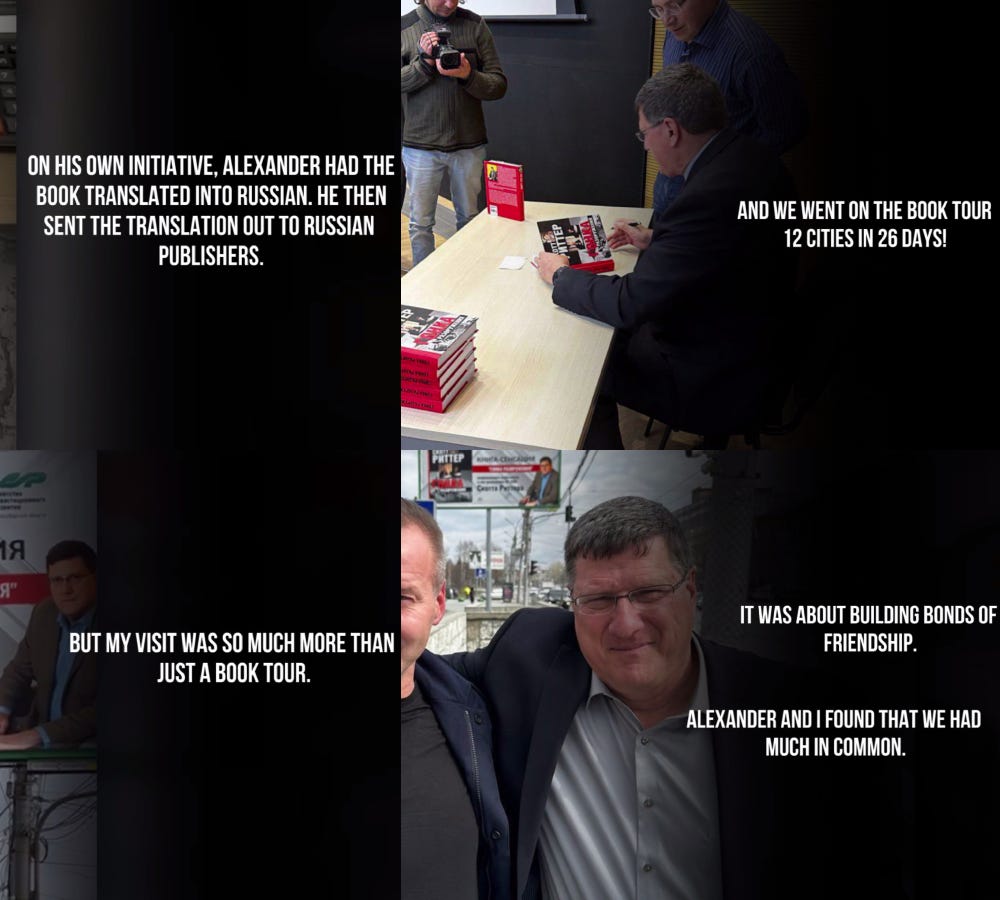
He sent his book in English. Our professional translators translated it, and then I spent six months looking for where to publish it. And so I went to the Komsomolskaya Pravda Publishing House. They successfully released the book, met Scott and took him to 12 cities and regions of Russia.
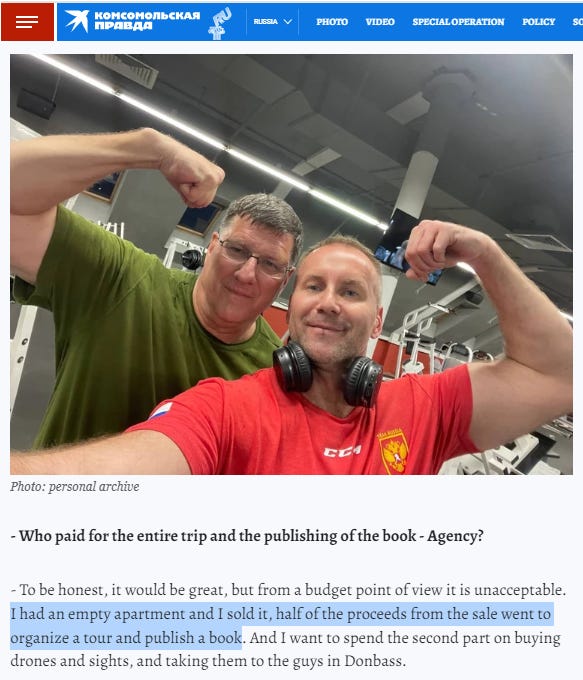
Zyryanov paid for everything himself. He claims he sold his “empty apartment” to finance the book’s publication and Ritter’s 12-city tour.
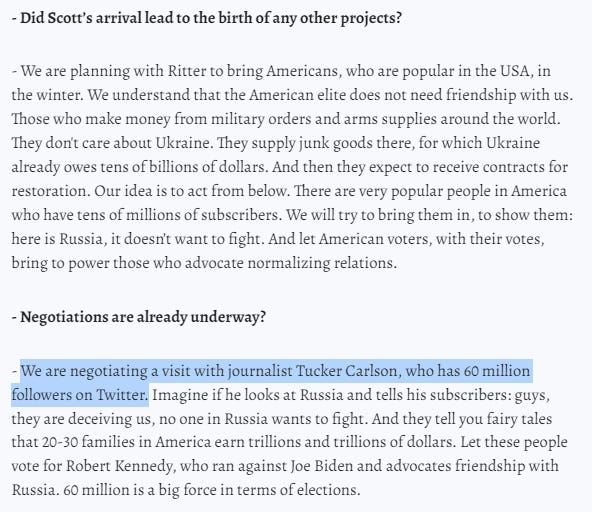
Ritter’s March 2023 trip was followed by even more ambitious plans: Zyryanov told Komsomolskaya Pravda that he was working with Ritter to bring influential Americans to Russia, including Tucker Carlson (who later traveled to Moscow to interview Putin in February of this year).
Ritter returned to Russia at the end of December. During his 24-day trip, he gave numerous interviews to Russian media, and recounted his visits to Chechnya, Crimea, Zaporozhe, Kherson, Lugansk, and Donetsk in a series of articles published by RT.
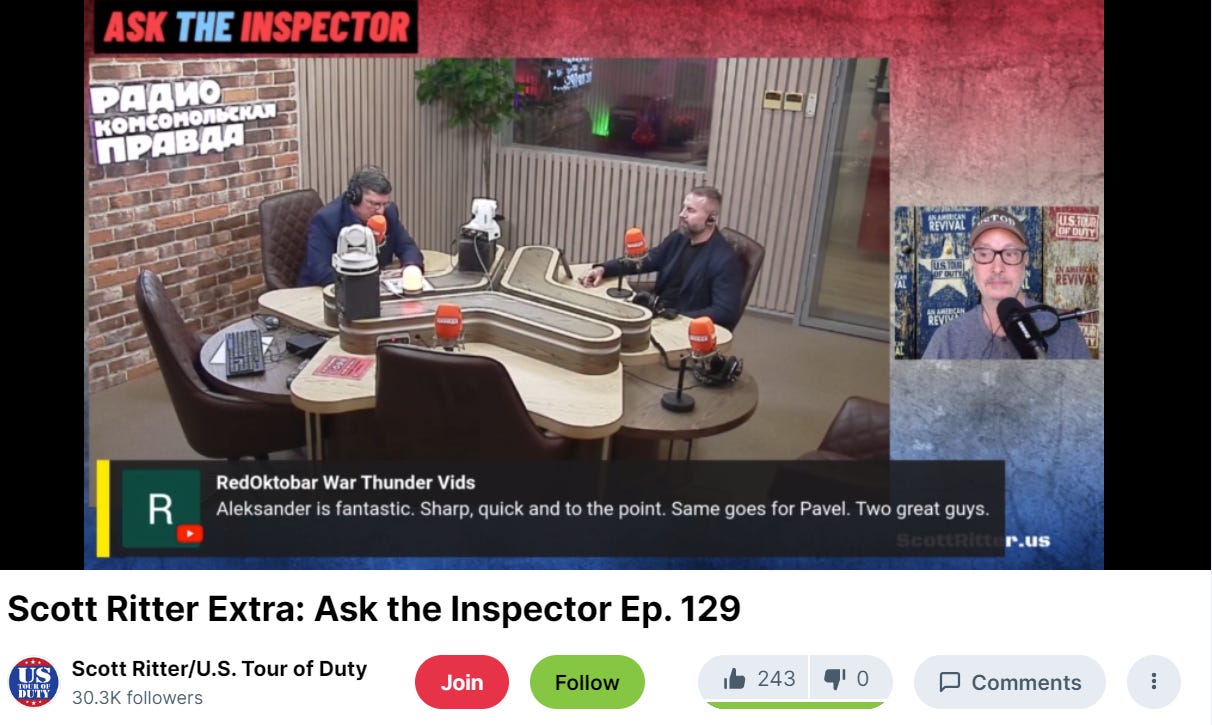
While Ritter was making splashes in Russian media, Zyryanov was reaching English-language audiences. With the help of an interpreter, he appeared alongside Ritter on Andrew Napolitano’s “Judging Freedom” program on January 11. A week later, he participated in a special edition of Ritter’s “Ask the Inspector” livestream.
“He’s like Tom Cruise in Hollywood,” Zyryanov said of Ritter while answering questions on “Ask the Inspector” about their time together in Russia.
Ritter and Zyryanov answering questions from Komsomolskaya Pravda’s Moscow studio on January 19, 2024. source: rumble.com
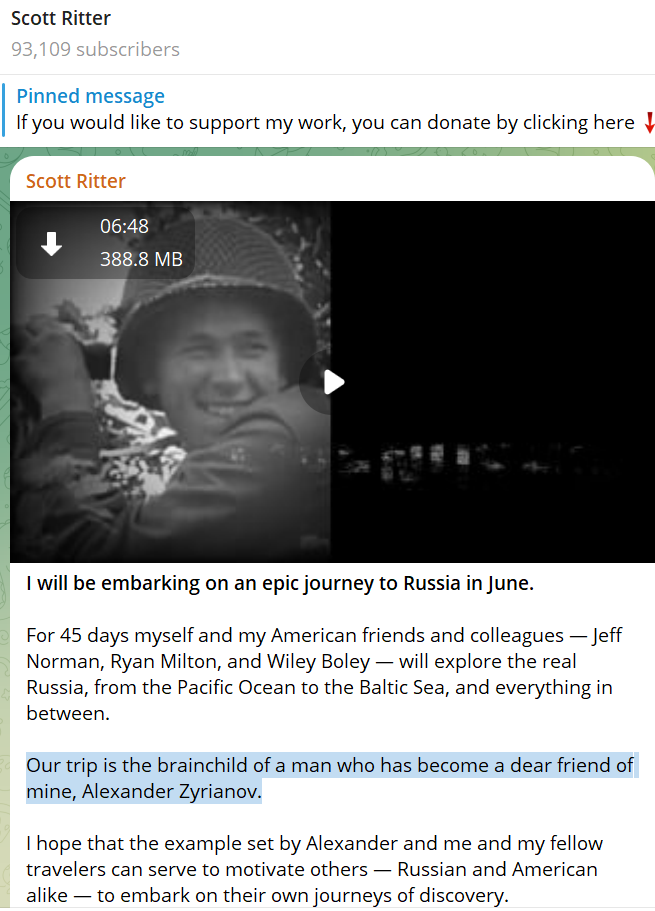
Within four months of Ritter’s return to the US, Zyryanov had already organized another—and even more ambitious—tour of Russia for his American friend. On May 23, Ritter revealed that he would soon embark on an “epic journey” across the Russian Federation:
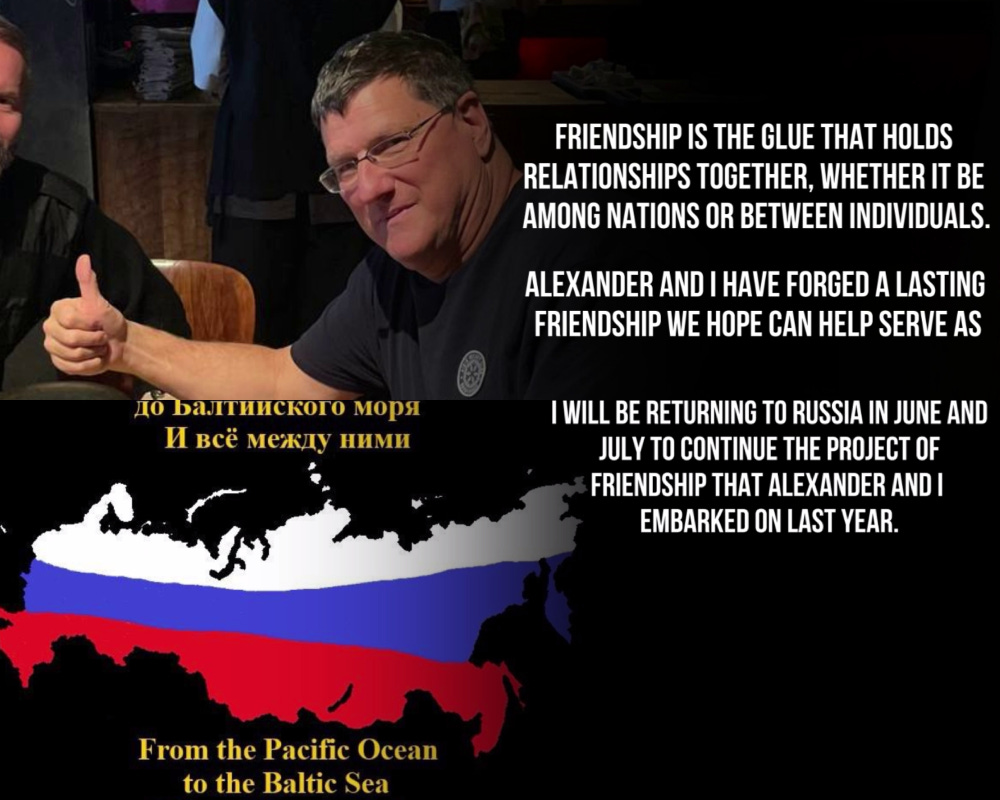
The announcement included a slideshow highlighting Ritter’s close friendship with Zyryanov.
“Friendship is the glue that holds relationships together, whether it be among nations or between individuals. […] I will be returning to Russia in June and July to continue the project of friendship that Alexander and I embarked on last year.”
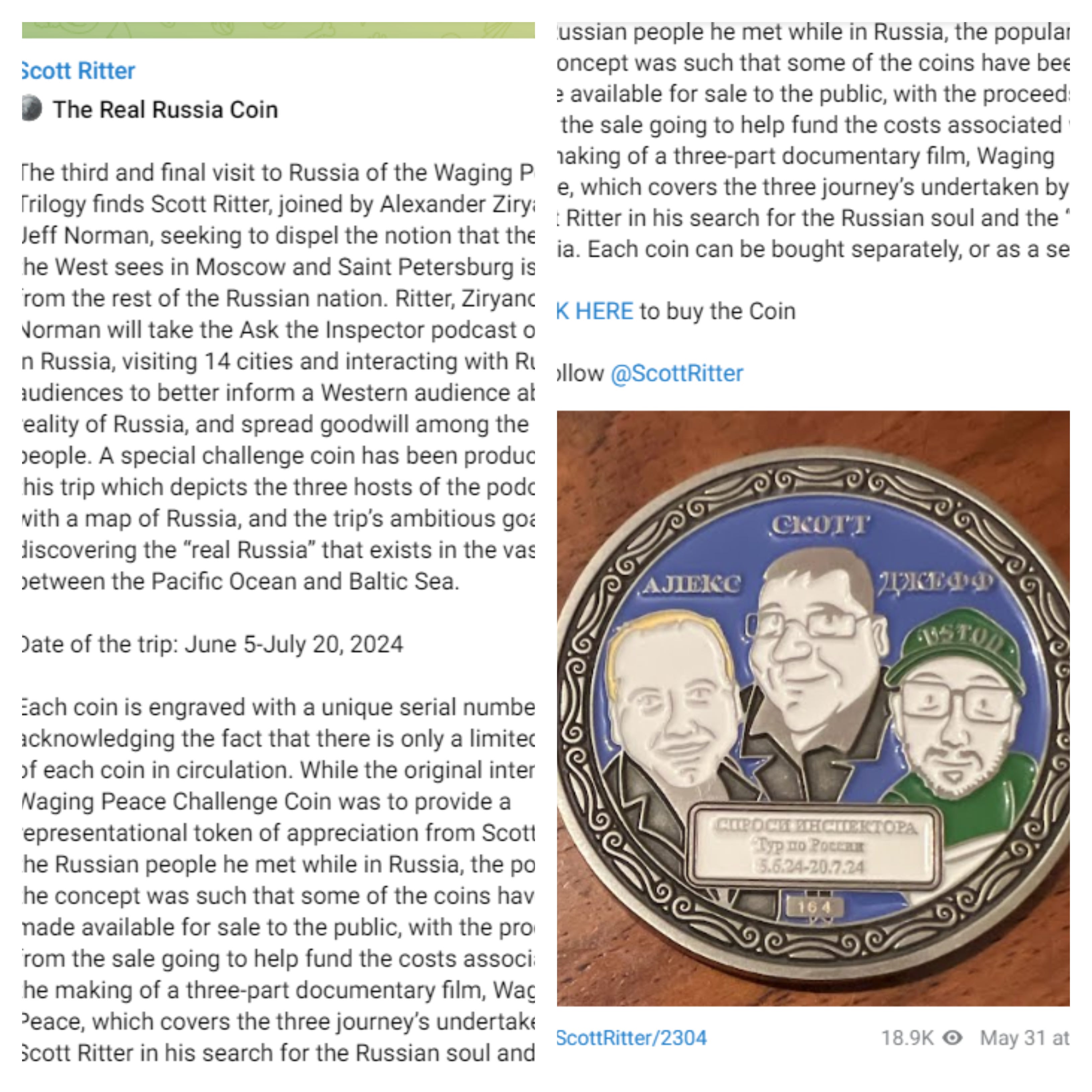
A week later, Ritter began marketing a “challenge coin” with proceeds “going to help fund the costs associated with the making of a three-part documentary film, Waging Peace, which covers the three journey’s undertaken by Scott Ritter in his search for the Russian soul and the ‘real’ Russia.” The coin featured Ritter, his podcast co-host Jeff Norman, and Zyryanov.
If you visit ScottRitter.com you can still purchase the coin for $50—but you will not find any mention of the arrest of his “dear friend” who is prominently featured on the collectable. You will have to look elsewhere for that information.
“What kind of bribe are we talking about here?”
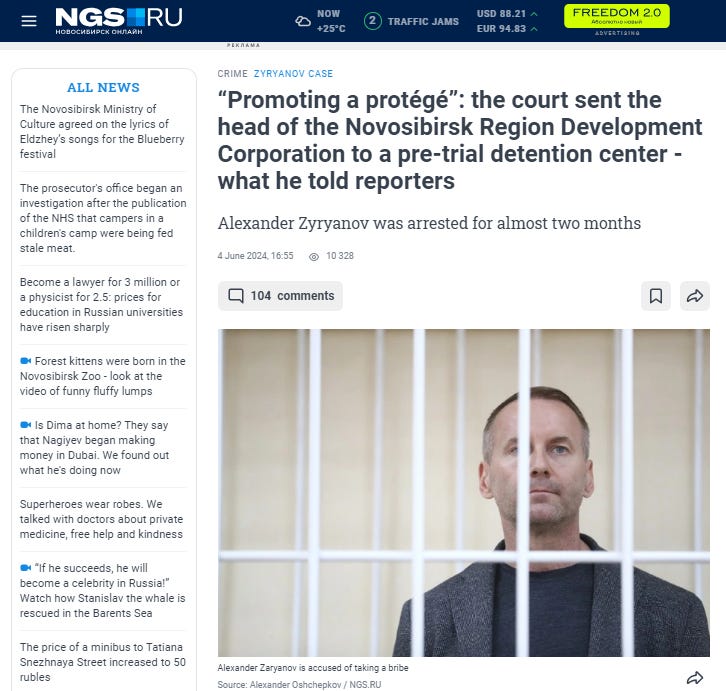
Zyryanov was arrested on June 3 and charged with taking a bribe in the form of “various services”.
Prosecutors claim he asked two businessmen to pay 9.5 million rubles to promote a film festival hosted by the Development Corporation. In return, they purportedly received “priority” contracts worth over 60 million rubles. Zyryanov is accused of using the arrangement to receive “personal PR” in the media.
Zyryanov expressed bafflement at the charges brought against him, noting that the film festival in question was intended as a Putin reelection campaign event that had been approved by both the Kremlin and the Central Election Commission. He told reporters who came to his court hearing:
How can it be a bribe to hold an event, namely the Family Film Festival, agreed upon by the presidential administration, approved by the election headquarters of a candidate for head of state and held under an agreement with the Central Election Commission? The media coverage did not contain information about my identity. As part of the festival, we showed 53 films to city residents, more than 3,000 spectators attended the event. What kind of bribe are we talking about here? I’ve held dozens of events, including sports and culture. Four times I organized the delivery of humanitarian aid to the Northern Military District, which was financed by businessmen. Can this also be considered a bribe?
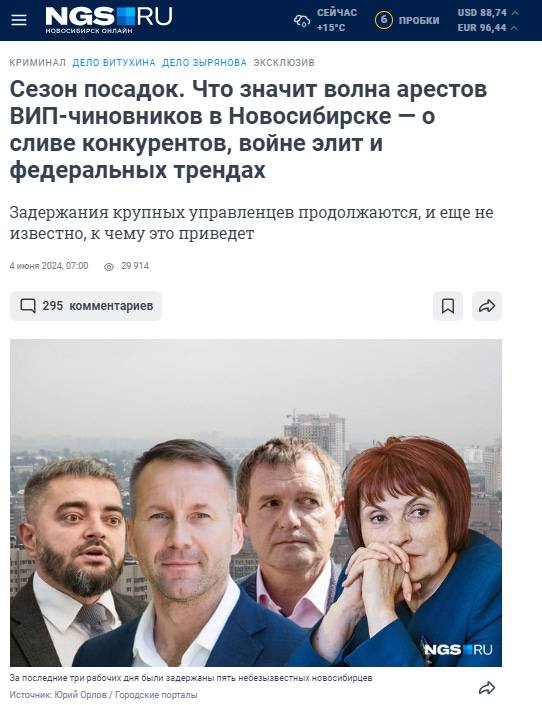
Zyryanov isn’t the only VIP who has been targeted by the Novosibirsk FSB in recent weeks. His arrest coincided with the detention of several other high-profile businessmen and politicians in Novosibirsk, prompting media speculation that Zyryanov had fallen victim to an “intra-elite” feud ahead of next year’s regional elections.
Local media wrote on June 4 about the arrests of five “VIP officials” in Novosibirsk, including Zyryanov (pictured second to left). source: ngs.ru
At his arraignment hearing, Zyryanov denied his guilt and claimed that his arrest by the FSB Directorate for the Novosibirsk Region had been “ordered” by “one of the regional leaders”.
“Since November, they have been hinting to me that it would be a good idea to leave my position, because one of the leaders of the region is interested in promoting his protégé,” the head of the Development Corporation told reporters.
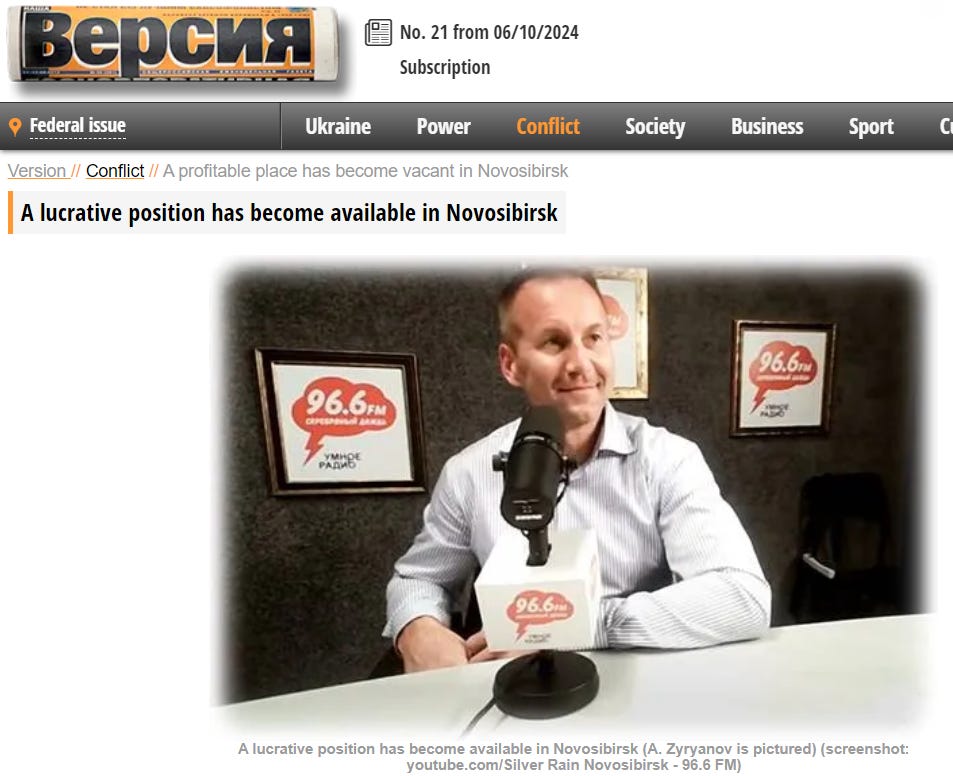
source: ngs.ruRussian outlets used not-so-subtle methods to question the true motives behind Zyryanov’s arrest. source: versia.ru
In March, immediately after the end of the presidential campaign, the security forces revived the temporarily subdued machine of arrests of Novosibirsk officials , deputies, representatives of government and para-government structures. The number of arrests went into dozens when on the morning of June 3, law enforcement officers came for those involved in new criminal cases, among whom was the head of the Novosibirsk Region Development Corporation, Alexander Zyryanov.
The interests of several influential alliances converge and collide in the region. […] The claim that we are witnessing a conflict among elites is clearly supported by the words of Alexander Zyryanov himself at his court hearing, although he did not utter the name of the Chairman of the Legislative Assembly Andrei Shimkiv or Governor Andrei Travnikov. The head of the Corporation simply said: “since November they hinted that it would be a good idea to leave my position, because one of the leaders of the region wanted his protégé to take it.”
[…]
The development corporation works with commercial structures and is focused on attracting investment to the region. On March 15 and 16—that is, on the days of voting for the President of Russia—the organization hosted a film festival, Family Traditions, at the Pobeda cinema. What is the connection between investments, elections and this event? The connection is that the re-elected Vladimir Putin declared 2024 the Year of the Family, and the Development Corporation organized a film festival in support of the presidential nomination and presented it in advance at a meeting of the election headquarters.
Overcoming the demographic crisis is one of the government’s priorities. The business and political community in the region is asking the question: what did the Development Corporation do wrong by attracting private “partners” in support of the “Year of the Family”? By opening a domain with the self-explanatory name “family-filmfestival.rf”, you can read: “2024 has been declared the Year of the Family and the Novosibirsk Region Development Corporation supports this initiative, therefore, together with its partners, it is organizing a festival where all family members will find something to their liking.”
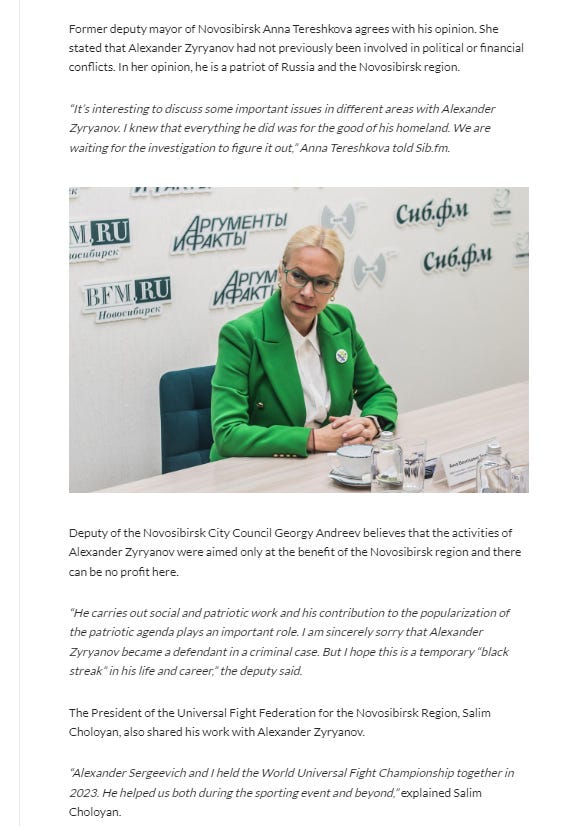
Local media also collected reactions from regional politicians who expressed support for Zyryanov and puzzlement over the allegations against him.
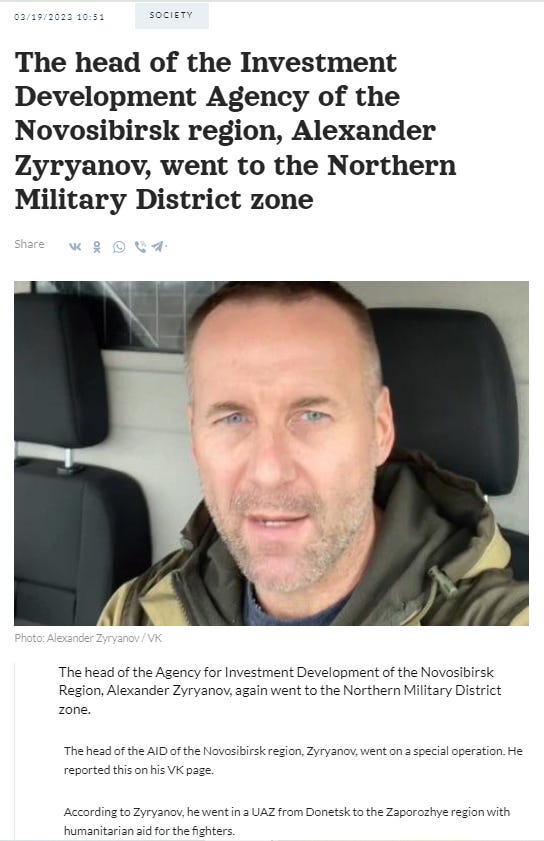
Russian news reports about Zyryanov’s arrest pointed to the fact that the businessman had personally traveled to East Ukraine to deliver supplies to Russian troops.
Zyryanov will remain in pre-trial detention until August 2. The court denied his request for house arrest so that he could take care of his 78-year-old mother, who is recovering from two strokes. His alleged co-conspirators in the case were released.
“This is an internal Russian thing, none of my business”
Ritter has remained tight-lipped about his “dear friend’s” arrest, choosing either to ignore his detention altogether or employ ambiguous language while mentioning it in passing.
In his first media appearance after having his passport seized, Ritter had the following exchange with Andrew Napolitano:
Napolitano: Was I with you?
Ritter: No, you weren’t. Actually, you weren’t with me because I made a phone call to you earlier in the morning recommending that you not travel to Russia. And it had nothing to do with what happened to me and everything to do with what happened to our sponsor, Alexander Zyryanov, who from my standpoint tragically was placed under arrest in Novosibirsk on his way to St. Petersburg.
Here’s the clip: [Clip available at original article]
Ritter suggested returning to this topic later. They never did.
Hours later, Ritter participated in a livestream with his podcast co-host Jeff Norman.
About 25 minutes into their discussion, Ritter decided to promote a “challenge coin” (featuring Zyryanov’s portrait) that he was selling to raise funds for his trip to Russia:
This coin is not a symbol of a failed trip. This coin is now the symbol of resistance. This is the resistance coin … We need a war chest. We need to raise money so that we can do this trip. […] The Russian government is 100% behind us. They want this project to succeed. They believe in this project. They have affirmed that.
But Ritter made no mention of Zyryanov’s arrest.
Ritter asking his viewers to buy a coin with Zyryanov’s face on it. For mysterious reasons, Ritter never mentioned that Zyryanov had been arrested just hours earlier.
Here’s the clip: [Clip available at original article]
Fifteen minutes later into the livestream, Ritter confirmed that he had advised Andrew Napolitano against flying to Russia—but said he wasn’t in a position to explain why:
This morning I called the judge and recommended that the judge not get on the airplane. There’s reasons for that and I’ll address those later when I’m able to address those. It has nothing to do with me or the judge or this trip.
The clip: [Clip available at original article]
Ritter’s most forthright comments about Zyryanov were made in a discussion with Jimmy Dore published on June 5:
The tour that I was going to take with the documentary film crew is sponsored by a Russian who I consider to be a very close friend, Alexander Zyryanov, and he’s the director of what’s known as the investment development agency of Novosibirsk. Yesterday morning I got a notification that he was arrested and charged with corruption. He denies the charges. This is an internal Russian thing, none of my business.
Here’s the clip: [Clip available at original article]
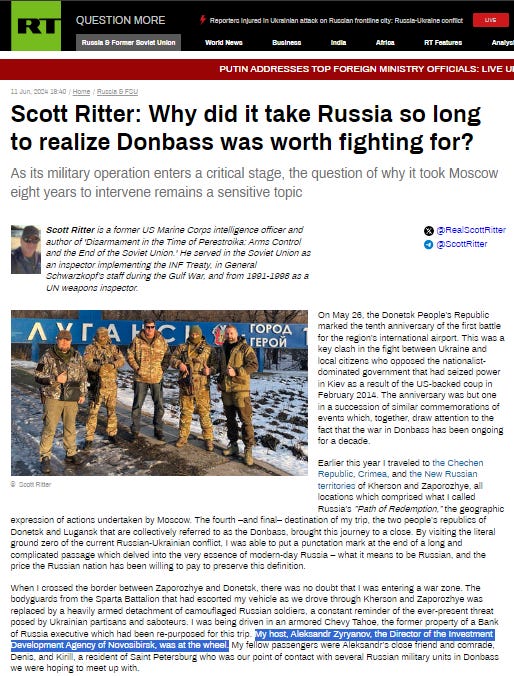
On June 11, RT.com published an article by Ritter that mentioned his Russia adventures with Zyryanov. An uninformed reader might deduce from the article that Zyryanov was a free man walking around Novosibirsk as happy as a clam.
If RT is your #1 place for Questioning More, you would never know that Zyryanov was arrested because RT’s coverage of Ritter being prevented from traveling to Russia makes no mention of the fact that Ritter’s Russian sponsor was arrested by the FSB.
My scientific research (“watching Scott Ritter livestreams”) ended on June 9 so if there have been relevant updates since then please let me know in the comments section and provide a link and the timestamp and I will update this blog post accordingly.
I have also searched in vain for an official statement from Ritter about Zyryanov’s arrest, but have turned up absolutely nothing. But again, I vow to promptly update this blog post if someone can point me to such a statement.
A few closing thoughts.
What the heck is going on here?
I have a few questions.
If Zyryanov’s arrest has “nothing to do” with Ritter, why is it that the Novosibirsk businessman was arrested just hours before Ritter and Napolitano were scheduled to board a flight to Russia, causing Ritter to panic and urge Napolitano to cancel his trip to St. Petersburg? The timing is mere coincidence?
Ritter uses his friendship with Zyryanov to promote his “message of peace” and encourage US-Russia rapprochement. You could even say that Zyryanov is a key part of the “Ritter brand”. Their relationship is supposed to serve as an example for Washington and Moscow. So how exactly is Zyryanov’s arrest “none of Ritter’s business”? That makes zero sense.
If Ritter doesn’t want to involve himself in an “internal Russia thing”—even if this “thing” involves his “dear friend” being arrested for highly dubious reasons—maybe he shouldn’t be selling coins featuring Zyryanov’s portrait? By doing so he is making Zyryanov his “business” in the most literal sense of the word. Or no? What am I missing here?
If Ritter still has the “full support” of the Russian government, is he doing everything in his power behind the scenes to secure the release of his friend, and will he use his considerable social media presence to shine a light on Zyryanov’s case, which is already facing questions in Russian media?
There are about 10,000 other questions that need to be asked. For example, how is it possible that a key player Ritter’s “waging peace” campaign was tossed into prison by the FSB just hours before Ritter was slated to begin a very expensive 40-day tour of Russia?
What does this mean?
I 100% condemn the seizure of Scott Ritter’s passport. As readers of the blog know, your correspondent is not keen on passports or other forms of cattle tags.
It’s true that I very strongly disagree with Scott Ritter’s assessment of the Not-War in Ukraine, but that is totally irrelevant. He should be allowed to travel freely and say whatever he wants. Is the State Department really so frightened by Ritter’s weekly prediction that the Russian military is about to liberate Odessa? If so, that is sad.
And it is sad that two friends are being kept apart by rival spook states. Or maybe something else is going on here?
But if Ritter’s friendship with Zyryanov really is supposed to “serve as the foundation for a similar relationship between [the US and Russia]”, we are in big huge trouble.
Foreign Minister Sergey Lavrov: Mr President, colleagues,
We are always pleased to see you at the Foreign Ministry. Let me welcome you to this meeting on behalf of the entire staff.
First of all, I would like to express our sincere gratitude for your constant attention to the foreign service: both for our professional activities and for providing the Ministry, our embassies and consulates general with everything necessary for the successful completion of the assigned tasks.
I would also like to acknowledge the colleagues present here from the Presidential Executive Office, the Government, the Federal Assembly, and the executive authorities.
We are always committed to the closest cooperation and coordination when pursuing the unified foreign policy course set by the President and outlined in the Foreign Policy Concept.
You signed the latest version of the concept in March 2023. We are actively working to strengthen our positions on the international stage and ensure security and the most favourable external conditions for development, guided by the strategic goals stipulated there.
As a matter of priority, we are building up ties with the countries of the global majority, the global South, and the global East, redistributing our material and human resources accordingly and transferring them to those areas where they are most in demand in the new geopolitical conditions.
I would also like to mention that we are actively assisting in establishing the international ties of Crimea, the Donetsk and Lugansk people’s republics, and the Zaporozhye and Kherson regions. To this end, the Foreign Ministry has already established its representative offices in Donetsk and Lugansk, and strengthened the capabilities of the representative office in Simferopol.
I am confident that today’s meeting will enable us to specify all the areas of our practical work on the international stage.
Mr President, you have the floor.
President of Russia Vladimir Putin: Thank you very much.
Colleagues, good afternoon.
I am pleased to welcome all of you and express my gratitude for your active work in the interests of Russia and our people.
We last met in this extended format in November 2021, and since then, there have been many pivotal and even fateful events, without exaggeration, both in Russia and around the world. Therefore, I think it is important to assess the current situation in global and regional affairs, as well as set the appropriate tasks for the Foreign Ministry. All of these tasks are aimed at achieving our main goal: creating conditions for Russia’s sustainable development, ensuring its security, and improving the well-being of Russian families.
In today’s challenging and unpredictable conditions, our work in this area demands that we concentrate our efforts, initiative, perseverance, and abilities not only to respond to current challenges, but also to set our own long-term agenda. We should propose possible solutions to fundamental issues that concern not only us, but also the entire international community. It is crucial to discuss them with our partners in an open and constructive manner.
Let me repeat: the world is changing rapidly. Global politics, the economy, and technological competition will never be the same as before. More countries are striving to strengthen their sovereignty, self-sufficiency, and national and cultural identity. The countries of the Global South and East are gaining prominence, and the role of Africa and Latin America is growing. Since the Soviet times, we have always acknowledged the importance of these regions, but today the dynamics have completely shifted, and this is becoming increasingly evident. The pace of transformation in Eurasia, where many significant integration projects are underway, has also accelerated significantly.
This new political and economic reality now serves as the foundation for the emerging multipolar and multilateral world order, and this is an inevitable process. It reflects the cultural and civilisational diversity that is inherently part of humanity, despite all attempts at artificial unification.
These profound, system-wide changes certainly inspire optimism and hope because the establishment of multipolarity and multilateralism in international affairs, including respect for international law and broad representation, make it possible to resolve the most complex problems together for the common benefit, and to build mutually beneficial relations and cooperation between sovereign states for the sake of well-being and security of peoples.
Such a vision for the future aligns with the aspirations of the vast majority of countries. This is evident, among other things, in the growing interest in the work of a universal association such as BRICS, which is based on a culture of trust-based dialogue, sovereign equality of its members and respect for each other. Under the Russian chairmanship this year, we will facilitate the smooth inclusion of new BRICS members in the association’s working bodies.
I ask the Government and the Foreign Ministry to continue substantive work and dialogue with our partners to make sure that the BRICS summit in Kazan in October will have a considerable set of agreed decisions that will determine the direction of our cooperation in politics and security, the economy and finance, science, culture, sports and humanitarian ties.
In general, I believe that the potential of BRICS will allow it to become one of the core regulatory institutions of the multipolar world order.
I should note in this connection that international discussions are already underway regarding the parameters of interaction between states in a multipolar world and the democratisation of the entire system of international relations. In this regard, we have agreed on and adopted, together with our colleagues in the Commonwealth of Independent States, a joint document on international relations in a multipolar world. We have also invited our partners to discuss this subject at other international platforms, primarily in the SCO and BRICS.
We are interested in fostering this dialogue within the UN, including on such a vital topic for all as the creation of an indivisible security system. In other words, global affairs must be based on the principle that the security of some cannot be ensured at the expense of the security of others.
Let me remind you that at the end of the 20th century, after the end of the intense military and ideological confrontation, the international community had a unique opportunity to build a reliable and just security order. This did not require much – simply the ability to listen to the opinions of all interested parties and a mutual willingness to take those opinions into account. Our country was determined to engage in constructive work of this nature.
However, a different approach prevailed. The Western powers, led by the United States, believed that they had won the Cold War and had the right to determine how the world should be organised. The practical manifestation of this outlook was the project of unlimited expansion of the North Atlantic bloc in space and time, despite the existence of alternative ideas for ensuring security in Europe.
They responded to our justified questions with excuses, claiming that there were no plans to attack Russia, and that the expansion of NATO was not directed against Russia. They effectively forgot about the promises made to the Soviet Union and later Russia in the late 1980s and early 1990s that the bloc would not accept new members. Even if they acknowledged those promises, they would grin and dismiss them as mere verbal assurances that were not legally binding.
In the 1990s and later, we consistently pointed out the flawed approach taken by Western elites. Instead of simply criticising and warning them, we suggested options and constructive solutions, emphasising the need to develop a mechanism of European and global security that would be acceptable to all parties involved (I want to underscore this point). It would take too long to list all the initiatives advanced by Russia over the years.
Let us recall the idea of a European security treaty, which we proposed in 2008. In December 2021, a memorandum from the Russian Foreign Ministry was submitted to the United States and NATO, addressing the same issues.
However, all our repeated attempts (it is impossible to list them all) to convince our partners, as well as our explanations, appeals, warnings and requests, met with no response. Western countries, confident not so much in the righteousness of their cause as in their power and ability to impose whatever they wish on the rest of the world, simply disregarded other perspectives. At best, they proposed discussions on less significant matters (that did little to resolve the actual problems), or matters that only benefitted the West.
It soon became clear that the Western concept, seen as the only viable option for security and prosperity in Europe and the world, was, in fact, ineffective. Let us recall the tragedy in the Balkans. While domestic issues had certainly contributed to the problems in former Yugoslavia, they were greatly exacerbated by intrusive external interference. At that time, the main principle of NATO diplomacy manifested itself most vividly – a deeply flawed principle that is of no use in addressing complex internal conflicts. In essence, this principle aims to assign blame to one party (often disliked by the West for various reasons) and unleash the full political, informational and military might of the West, including economic sanctions and restrictions against it.
Later, these same approaches were applied in various countries, which we know all too well: Iraq, Syria, Libya, and Afghanistan. These interventions have done nothing but worsen existing problems, ruin the lives of millions of people, destroy entire states, and create hubs of humanitarian and social disasters, as well as terrorist enclaves. In fact, no country in the world is immune from joining this tragic list.
For example, the West is currently trying to brazenly meddle in the affairs of the Middle East. They previously held a monopoly over this region, and the consequences of their actions are now evident to everyone. The South Caucasus and Central Asia are also prime examples. Two years ago, at the NATO summit in Madrid, it was declared that the alliance would now deal with security issues not only in the Euro-Atlantic, but also in the Asia-Pacific region. They claim those areas can not do without them. Clearly, this was an attempt to exert more pressure on those countries in the region whose development they have decided to restrain. As you know, Russia ranks high on this list.
Let me also remind you that it was Washington that undermined strategic stability by unilaterally withdrawing from the treaties on anti-missile defence, on the elimination of intermediate- and shorter-range missiles and on open skies, and, together with its NATO satellites, dismantling the decades-old system of confidence-building measures and arms control in Europe.
Lastly, the self-centeredness and arrogance of Western countries have led us to a highly perilous situation today. We are inching dangerously close to a point of no return. Calls for a strategic defeat of Russia, which possesses the largest arsenals of nuclear weapons, demonstrate the extreme recklessness of Western politicians. They either fail to comprehend the magnitude of the threat they are creating or are simply consumed by their notion of invincibility and exceptionalism. Both scenarios can result in tragedy.
It is evident that the entire system of Euro-Atlantic security is crumbling before our eyes. At present, it is practically non-existent and must be rebuilt. To achieve this, we must collaborate with interested countries, of which there are many, to develop our own strategies for ensuring security in Eurasia and then present them for broader international deliberation.
This is the task set in the Address to the Federal Assembly: to outline a vision for equal and indivisible security, mutually beneficial and equitable cooperation, and development on the Eurasian continent in the foreseeable future.
What needs to be done to achieve this and on what principles?
First, it is important to establish dialogue with all potential participants in this future security system. I would like to ask you to address the necessary issues with countries that are open to constructive interaction with Russia.
During my recent visit to China, President Xi Jinping and I discussed this issue. It was noted that the Russian proposal is not contradictory, but rather complements and aligns with the basic principles of the Chinese global security initiative.
Second, it is crucial to recognise that the future security architecture should be open to all Eurasian countries that wish to participate in its creation. ”For all“ includes European and NATO countries as well. We share the same continent, and we must live and work together regardless of the circumstances. Geography cannot be changed.
Yes, Russia’s relations with the EU and many European countries have deteriorated, and it is important to emphasise that we are not to blame for that. The anti-Russia propaganda campaign, involving senior European politicians, is accompanied by speculation that Russia intends to attack Europe. I have addressed this issue before, and there is no need to repeat it again here. We all understand that these claims are baseless and serve only to justify an arms race.
In this context, I would like to make a brief digression. The threat to Europe does not come from Russia. The main threat to Europeans is their critical and increasing dependence on the United States in military, political, technological, ideological, and informational aspects. Europe is being marginalised in global economic development, plunged into the chaos of challenges such as migration, and losing international agency and cultural identity.
Sometimes, I get the impression that European politicians and representatives of the European bureaucracy are more afraid of falling out of favour with Washington than losing the trust of their own people. The recent election to the European Parliament has also demonstrated this. European politicians tolerate humiliation, rudeness, and scandals, such as surveillance of European leaders, while the United States simply exploits them for its own benefit. For instance, they are forced to purchase expensive gas, which costs three to four times more in Europe than in the United States. Additionally, European countries are pressured to increase arms supplies to Ukraine. The demands are constant, and sanctions are readily imposed on European economic operators without any hesitation.
They are now pressuring their partners to supply Ukraine with more weapons and increase their capacity for manufacturing artillery shells. Who will need these shells once the conflict in Ukraine ends? How does this ensure European military security? It is difficult to understand. The United States is investing in military technologies, particularly advanced future technologies such as space exploration, modern drones and strike systems based on new physical principles. The United States is funding areas that will shape the nature of future armed conflicts, as well as the military and political power of nations and their standing in the world. These countries are expected to invest in areas of interest to the United States. However, this does not expand European potential. Let them do as they wish. We will probably benefit from it, but, in effect, that is the situation.
If Europe wants to continue being an independent centre of global development and a cultural and civilisational pole on our planet, it should definitely maintain good and friendly relations with Russia. Most importantly, we are ready for this.
Indeed, politicians of truly European and global scale, who are patriots of their countries and nations, understand this simple and obvious fact. They think in terms of historical categories and are not mere followers of someone else’s will and influence. Charles de Gaulle spoke about this during the post-war period. I vividly recall participating in a conversation in 1991 where German Chancellor Helmut Kohl emphasised the importance of partnership between Europe and Russia. I hope that new generations of European politicians will eventually restore this legacy.
Speaking of the United States, the never-ending attempts by the current globalist liberal elites to spread their ideology worldwide, to maintain their imperial status and dominance in one way or another, are only further exhausting the country, leading to its degradation, and clearly contrary to the genuine interests of the American people. If it were not for this dead-end policy, driven by aggressive messianism based on the belief in their own superiority and exceptionalism, international relations would have long been stabilised.
Third, it is necessary to significantly intensify the dialogue process between multilateral organisations already operating in Eurasia to promote the idea of a Eurasian security system, above all such organisations as the Union State, the Collective Security Treaty Organisation, the Eurasian Economic Union, the Commonwealth of Independent States, and the Shanghai Cooperation Organisation.
We consider it possible that other influential Eurasian associations from Southeast Asia to the Middle East will join these processes in the future.
Fourth, we believe that the time has come to start a broad discussion of a new system of bilateral and multilateral guarantees of collective security in Eurasia. At the same time, it is necessary, in the long term, to gradually phase out the military presence of external powers in the Eurasian region.
Of course, we are aware that in the current situation this point may seem unrealistic, but that will change. However, if we build a reliable security system in the future, there will simply be no need for such a presence of out-of-region military contingents. To be honest, there no need today either – just occupation and that’s all.
In the final analysis we believe that countries and regional structures in Eurasia should themselves identify specific areas of cooperation in joint security. Guided by this, they must also build a system of working institutions, mechanisms, and agreements that would really serve to achieve common stability and development goals.
In this sense, we support our Belarusian friends’ initiative to develop a programme document – a charter of multipolarity and diversity in the 21st century. It can formulate not only the framework principles of Eurasian architecture based on the essential norms of international law, but also, a strategic vision of the nature of multipolarity in a broader sense and multilateralism as a new system of international relations which would replace the Western-centric world. I consider it important and would like to ask you to thoroughly work out on this document with our partners and with all interested states. I will add that when discussing such complicated and comprehensive issues, we need as broad representation as possible and a consideration of different approaches and positions.
Fifth, an crucial part of the Eurasian security and development system should definitely be the issues of the economy, social well-being, integration, and mutually beneficial cooperation, as well as addressing such common problems as overcoming poverty, inequality, the climate, the environment, and developing mechanisms to respond to the threats of pandemics and crises in the global economy. All that is important.
The West not only undermined the world’s military-political stability by its actions. It has compromised and weakened the key market institutions by its sanctions and trade wars. Using the IMF and the World Bank and twisting the climate agenda, it has been restraining the development of the Global South. Yielding in competition, even by the rules that the West has written for itself, it applies prohibitive barriers and all kinds of protectionism. Thus the United States has abandoned the World Trade Organisation as an international trade regulator. Everything is blocked. Meanwhile, the pressure is exerted not only on competitors, but on their own satellites. Suffice it to see how they are now “siphoning off the juices” from the European economies which are teetering on the brink of recession.
Western countries have frozen some of Russia’s assets and currency reserves. Now they are trying to invent some legal justification for their irreversible appropriation. On the other hand, however, despite all the crooked lawyerism, theft will obviously remain theft and will not go unpunished.
The issue is even deeper. By stealing Russian assets, they will take one more step towards destroying the system that they created themselves and that for many decades ensured their prosperity, allowed them to consume more than they earn, and attracted money from all over the world through debts and liabilities. Now it is becoming clear to all countries, companies and sovereign wealth funds that their assets and reserves are far from safe, both legally and economically. And anyone could be the next in line for expropriation by the United States and the West, those foreign sovereign wealth funds could also be the one.
There is already a growing distrust of the financial system based on Western reserve currencies. There has appeared a certain outflow of funds from securities and bonds of Western countries, as well as from some European banks, which were until fairly recently considered to be absolutely reliable to put capital in. Now gold is also being taken out gold from those banks. And this is the right thing to do.
I believe that we need to seriously intensify the formation of effective and safe bilateral and multilateral foreign economic mechanisms as alternatives to those controlled by the West. This includes the expansion of settlements in national currencies, the creation of independent payment systems and the building of value chains that bypass the channels blocked or compromised by the West.
Naturally, it is necessary to continue efforts to develop international transport corridors in Eurasia, the continent with Russia as its natural geographical core.
Through the Ministry of Foreign Affairs, I instruct you to assist as much as possible in developing international agreements in all these areas. They are extremely important for strengthening economic cooperation between our country and our partners. This should also give a new impetus to building a large Eurasian partnership, which, in essence, may become a socioeconomic basis for a new indivisible security system in Europe.
Colleagues,
Our proposals aim to establish a system where all nations can feel secure. With such a framework, we could approach today’s numerous conflicts in a different way, and more constructively. The issues of insecurity and mutual distrust are not limited to the Eurasian continent; rising tensions are evident worldwide. The interconnection and interdependence of our world are constantly apparent, with the Ukrainian crisis serving as a tragic example with its repercussions spreading across the globe.
I want to clarify right away: the crisis involving Ukraine is not a conflict between two states or peoples stemming from issues between them. If that were the case, there is no doubt that Russians and Ukrainians, united by a shared history and culture, spiritual values, and millions of familial and human connections, would have found a fair resolution to any disputes and disagreements.
Meanwhile, the situation is different as the roots of the conflict are not in bilateral relations. The events in Ukraine are a direct result of global and European developments from the late 20th and early 21st centuries. They stem from the aggressive, unrestrained, and utterly reckless policy that the West has been pursuing for many years, long before the special military operation began.
The elites of Western countries, as I mentioned earlier today, set a course for further geopolitical restructuring of the world after the end of the Cold War. They aimed to establish and enforce the so-called rules-based order, where strong, sovereign, and self-sufficient states simply do not belong.
This explains the policy of containment directed against our country. Some figures in the United States and Europe openly declare the goals of this policy, speaking today about the so-called decolonisation of Russia. Essentially, this is an attempt to ideologically justify the division of our Fatherland along ethnic lines. The dismemberment of the Soviet Union and Russia has been a discussion topic for a long time, as everyone in this room is well aware.
In pursuing this strategy, Western countries aimed to absorb and militarily and politically develop territories near us. There have been five, now six, waves of NATO expansion. They sought to transform Ukraine into their stronghold, an “anti-Russia.” To achieve these objectives, they invested money and resources, bought politicians and entire parties, rewrote history and educational programmes, and nurtured groups of neo-Nazis and radicals. They did everything possible to undermine our inter-state ties, divide us, and turn our peoples against each other.
They would have pursued that policy even more brazenly and unceremoniously, had it not been for southeastern Ukraine, the region that had been part of historical Greater Russia for centuries, which was in their way. The people who lived there, and still do, continued to advocate better and closer ties with our country, including when Ukraine declared independence in 1991. Ethnic Russians and Ukrainians, as well as representatives of other ethnic groups, they were united by the Russian language, culture, traditions, and historical memory.
Ukrainian presidents and presidential hopefuls simply had to reckon with the opinion, moods, and interests of those people – the millions of people living in the southeast. Ukrainian politicians needed their votes. However, having used their support when running for high posts, they later maneuvered out of doing what they promised, got out of it, lied, and cited the so-called European choice. They did not dare sever all ties with Russia though, because southeastern Ukraine had a different view, and one that was to be reckoned with. This duality has always been present in the Ukrainian government’s policies, ever since the recognition of independence.
The West saw that, of course. Western politicians have long been aware of the problems in Ukraine that could be raked up; they also realised the importance of the southeast as a restraining factor, and knew that even years of propaganda could not radically change that. Not that they were not trying; but it was really difficult to reverse the situation.
Try as they might, there was not a chance they could distort the historical identity and consciousness of the majority of people in southeastern Ukraine, to eradicate good feelings for Russia and the sense of our historical community, even from the younger generations. And they decided to use force again, to go and break the people in the southeast, as if they didn’t matter. To do this, they masterminded, organised and financed an armed coup, clearly taking advantage of the difficulties and political infighting in Ukraine. They prepared it purposefully and consistently.
A massive wave of riots, violence, and murders swept thorough Ukrainian cities. Finally, radical nationalists seized and usurped power in Kiev. Their aggressive nationalist slogans, including the rehabilitation of Nazi henchmen, were proclaimed at a level of state ideology. They inaugurated a policy of abolishing the Russian language in all aspects of government and society, and stepped up pressure on Orthodox believers and interference in church affairs, which eventually led to a schism. No one seemed to notice that interference, like it was no big deal. Try something like this elsewhere, everyone will go so ballistic you will regret it. But over there, this is allowed, because it is against Russia.
As is well-known, millions of people residing in Ukraine, primarily in its eastern regions, made a stand against the coup. They began to be threatened with violence and terror. In the first place, the new authorities in Kiev started preparing an attack on the Russian-speaking Crimea, which, as you may know, was transferred from the RSFSR to Ukraine in 1954 with the violation of all norms of the law and procedures, even those in effect in the Soviet Union at that time. In this situation, we certainly could not abandon and leave without protection the people of Crimea and Sevastopol. They made their choice and, as is common knowledge, the historic unification of Crimea and Sevastopol with Russia took place in March 2014.
The peaceful protests against the coup in Kharkov, Kherson, Odessa, Zaporozhye, Donetsk, Lugansk and Mariupol were suppressed, with the Kiev regime and nationalist groups unleashing the reign of terror. There is no need to recall all this, for everyone is well aware of what was happening in those regions.
In May 2014, referendums were held on the status of the Donetsk and Lugansk people’s republics, at which the overwhelming majority of local people voted for independence and sovereignty. This bids the following question: сould people generally express their will in this way and declare their independence? People present in this room know that they certainly could and had the full right and reason to do that under international law, including the right of people to self-determination. There is no need to remind this to you, of course, but since the media are at work, I will say that Article 1, paragraph 2, of the UN Charter extends this right.
Let me recall in this connection the notorious Kosovo precedent. We spoke many times about this in the past, but I will say it once again now. The precedent that the Western countries created themselves in an absolutely identical situation: they recognised Kosovo’s secession from Serbia in 2008 as legitimate. Later, the International Court of Justice issued its well-known Advisory Opinion. Based on Article 1, paragraph 2, of the UN Charter, it ruled on 22 July 2010 that, I quote: “No general prohibition against unilateral declarations of independence may be inferred from the practice of the Security Council.” Next quote: “General international law contains no applicable prohibition of declarations of independence.” More than that, it said that the parts of any country, which decided to declare their independence, were not obliged to apply to the central organs of their former state. They wrote all this with their own hand in black and white.
So, did the Donetsk and Lugansk republics have the right to declare their independence? Of course, they did! This issue even cannot be considered in a different way.
But what did the Kiev regime do in this situation? It fully disregarded people’s choice and unleashed a full-scale war against the new independent states, the people’s republics of Donbass, with the use of aircraft, artillery and tanks. They launched bombing and artillery attacks on peaceful cities and resorted to intimidation. So, what happened next? The people of Donbass took up arms to protect their lives, their homes, their rights and legitimate interests.
In the West, the prevailing narrative is that Russia initiated the war with its special military operation and is therefore the aggressor, so it is allowed to attack the Russian territory using Western weaponry. It is argued that Ukraine is merely defending itself, and is justified in doing so.
I want to reiterate: Russia did not start the war. It was the Kiev regime that initiated hostilities, following the declaration of independence by residents of certain parts of Ukraine in accordance with international law, and continues to do so. If we do not recognise the right of these peoples to declare their independence, then this is indeed aggression. Those who have supported the Kiev regime’s war machine over the years are, therefore, accomplices to this aggression.
Back in 2014, the residents of Donbass refused to surrender. Militia units stood their ground, repelled the punitive forces, and eventually pushed them back from Donetsk and Lugansk. We hoped this would bring those who initiated the violence to their senses. To halt the bloodshed, Russia made its customary appeals for negotiations. Talks began, involving Kiev and representatives of the Donbass republics, with the support of Russia, Germany, and France.
The talks were not easy, but ultimately led to the conclusion of the Minsk Agreements in 2015. We took their implementation very seriously, hoping to resolve the situation within the framework of the peace process and international law. There was hope that this would lead to the recognition of the legitimate interests and demands of Donbass, including enshrining the special status of these regions and ensuring the fundamental rights of the people living there, all while maintaining Ukraine’s territorial integrity. We were prepared for this and sought to persuade the residents of these territories to resolve issues through such means. We proposed various compromises and solutions multiple times.
However, Kiev ultimately rejected everything and simply discarded the Minsk Agreements. As representatives of the Ukrainian elite later confessed, none of the articles in these documents satisfied them; they simply lied and evaded as much as possible.
The former Chancellor of Germany and the former President of France, who were essentially co-authors and purported guarantors of the Minsk Agreements, later openly admitted that the implementation was never their intention. Instead, they claimed it was a tactic to stall while they bolstered Ukrainian armed groups, supplied weapons and equipment. It was another instance of them playing a trick on us and deceiving us once again.
Instead of fostering a genuine peace process and pursuing policies of reintegration and national reconciliation, as Kiev often claimed, Donbass endured eight years of relentless shelling, terrorist attacks, murders, and severe blockade. Throughout these years, the residents of Donbass – women, children, and the elderly – were dehumanised, labelled as “second-class” or “subhuman,” and threatened with retaliation, with promises of settling scores with everyone. What else can this be if not genocide in the heart of Europe in the 21st century? Meanwhile, in Europe and the US they pretended that nothing was happening and nobody was noticing anything.
In late 2021 and early 2022, the Minsk process was finally buried by Kiev and its Western handlers. Another large-scale attack was planned on Donbass. A large group of the Ukrainian armed forces was preparing to start a new offensive against Lugansk and Donetsk, which obviously entailed ethnic cleansing campaigns, numerous casualties and hundreds of thousands of refugees. We were obliged to prevent that catastrophe and to protect the people. We saw no other solution.
Russia recognised the Donetsk and Lugansk people’s republics. We did not do that in the previous eight years, hoping to come to an agreement [with Kiev]. You know the result. On February 21, 2022, we signed treaties of friendship, cooperation and mutual assistance with the republics we recognised. Did these people’s republics have a right to ask us for help if we recognised their independence? Did we have a right to recognise their independence, and did they have a right to proclaim their sovereignty in accordance with the articles and decisions of the UN International Court of Justice I have mentioned? Did they have a right to independence? They did. If they had this right and exercised it, then we had a right to sign a treaty with them, which we did, as I have said, in full compliance with international law and Article 51 of the UN Charter.
At the same time, we called on the Kiev authorities to withdraw their troops from Donbass. I can tell you that we contacted them and told them that they should pull their troops out, and that would be the end of it. They rejected our proposal almost immediately; they simply ignored it, even though it was an opportunity to settle the problem peacefully.
On February 24, 2022, Russia had to announce the start of the special military operation. I addressed the citizens of Russia, the people of the Donetsk and Lugansk republics and Ukrainian society, outlining the goals of that operation – the protection of people in Donbass, the restoration of peace, and the demilitarisation and denazification of Ukraine. We did that to avert the threat to our state and to restore balance in the sphere of security in Europe.
At the same time, we continued to believe that our priority was to attain the above goals by political and diplomatic means. I would like to remind you that at the first stage of the special military operation we agreed to hold negotiations with representatives of the Kiev regime. They were first held in Belarus and then moved to Türkiye. The message we tried to get across was that they should respect the choice made by Donbass, withdraw their troops and stop shelling peaceful cities and towns. This was all we asked for, saying that everything else could be decided later. But their reply was, No, we will fight. It was clearly the order that came from their Western masters. I will speak about this now.
As you know, in February and March 2022 our troops approached Kiev. There are many speculations both in Ukraine and in the West about this.
What do I want to say about this? Our units were indeed deployed near Kiev, and the military departments and the security bloc had different proposals on our possible further actions, but there was no political decision to storm the city with three million people, no matter what anyone said or speculated.
In fact, it was nothing else but an operation to coerce the Ukrainian regime into peace. The troops were there in order to push the Ukrainian side to negotiations, try to find acceptable solutions and thereby end the war Kiev had started against Donbass back in 2014, and resolve issues that pose a threat to the security of Russia.
Surprisingly, as a result, agreements that satisfied both Moscow and Kiev were indeed reached. These agreements were put on paper and initialled in Istanbul by the head of the Ukrainian negotiating delegation. This means that this solution was suitable for the Kiev authorities.
The document was titled “Agreement on Permanent Neutrality and Security Guarantees for Ukraine.” It was a compromise, but its key points were in line with our fundamental demands and resolved the problems that were stated as major ones even at the start of the special military operation. Let me also note that this included demilitarisation and denazification of Ukraine. And we also managed to find challenging outcomes. They were complicated but they had been found. It was meant that a law would be adopted in Ukraine banning Nazi ideology and any of its manifestations. All of that was written there.
In addition, in exchange for international security guarantees, Ukraine would have limited the size of its armed forces, undertaken obligations not to join military alliances, not to host foreign military bases, not to station them and contingents, and not to conduct military exercises on its territory. Everything was written on paper.
Russia, which also understood Ukraine’s security concerns, agreed that Ukraine would receive guarantees similar to those that NATO members enjoy without formally joining the alliance. It was a difficult decision for us, but we recognised the legitimacy of Ukraine’s demands to ensure its security and did not object to the wording proposed by Kiev. This was the wording proposed by Kiev, and we generally did not have any objections, understanding that the main thing was to cease the bloodshed and war in Donbass.
On March 29, 2022, we withdrew our troops from Kiev because we were assured that conditions must be created to complete the political negotiation process, and that one of the parties cannot sign such agreements, as our Western colleagues said, with a gun to their head. Okay, we agreed to that, too.
However, the very next day after the Russian troops were withdrawn from Kiev, the Ukrainian leadership suspended its participation in the negotiations staging the infamous provocation in Bucha, and rejected the prepared version of the agreements. I think today it is clear why that ugly provocation was necessary: to explain why the results that had been achieved during the negotiations were rejected. The path to peace was rejected again.
As we know now, it was done on orders from Western curators, including the former UK Prime Minister who said directly during his visit to Kiev – no agreements; Russia must be defeated on the battlefield to achieve its strategic defeat. Thus they began to intensively pump Ukraine up with weapons and started talking about the need to inflict a strategic defeat on Russia, as I have just mentioned. Some time later, as everyone knows, the President of Ukraine issued an executive order banning his representatives and himself from conducting any negotiations with Moscow. This episode with our attempt to solve the problem through peaceful means came to nothing again.
As for negotiations, now I would like to make public another episode. I haven’t spoken about this publicly either but some of those present here know about it. After the Russian army seized part of the Kherson and Zaporozhye regions, many Western politicians offered their mediation in a peaceful settlement of the conflict. One of them was on a working visit to Moscow on March 5, 2022. We accepted his mediation efforts, especially since he said during the conversation that he had secured the support of the leaders of Germany and France, as well as high-ranking US representatives.
In course of our conversation our foreign guest wondered – an interesting moment – saying if you are assisting Donbass, then why Russian troops are in the south of Ukraine, including in the Kherson and Zaporozhye regions? We responded to the effect that it was our General Staff ‘s decision on planning the operation. And I will add today that the idea was to bypass some fortified areas built in Donbass over the eight years by Ukrainian authorities, primarily for liberating Mariupol.
Then our foreign colleague specified – a professional man, to be fair to him: are Russian troops going to stay in the Kherson and Zaporozhye regions? And what will happen to these regions after the Special Military Operation has attained its goals? I answered to this that in general I do not rule out preservation of the Ukrainian sovereignty over these territories, provided Russia has a stable land bridge to Crimea.
It means that Kiev should guarantee servitude, as they call it, a legally formalised right of access for Russia to the Crimean Peninsula via Kherson and Zaporozhye regions. This is a critical political decision. And, of course, in its final version, it would not be adopted unilaterally but only after consultations with the Security Council, with other institutions, of course, after discussion with citizens, the public of our country and, above all, with residents of the Kherson and Zaporozhye regions.
In the end, that is what we did: we asked the opinion of the people themselves and held referendums. And we did what the people decided, including in the Kherson and Zaporozhye regions, in the Donetsk and Lugansk peoples’ republics.
At that time, in March 2022, our negotiating partner said that he was going to head to Kiev to continue the conversation with his colleagues in the Ukrainian capital. We welcomed this, in general, as attempts to find a peaceful settlement to the conflict, because every day of fighting meant new casualties and losses. However, the services of the Western mediator were not accepted in Ukraine, as we later learnt, and on the contrary, as we became aware, they accused him of taking pro-Russian positions in a rather harsh form, it has to be mentioned, but that is a small thing.
Now, as I have already said, the situation has fundamentally changed. The residents of Kherson and Zaporozhye have expressed their position in referendums, and Kherson and Zaporozhye regions, as well as the Donetsk and Lugansk People’s Republics, have become part of the Russian Federation. And there can be no talk of disturbing our state unity. The people’s will to be with Russia shall be inviolable. This matter is closed forever and is no longer a matter for discussion.
Once again, it was the West that premeditated and provoked the Ukraine crisis; it is the West that is trying its best now to extend this crisis indefinitely, to weaken and mutually embitter the people of Russia and Ukraine.
They keep sending in more batches of arms and ammunition. Certain European politicians have been recently toying with the possibility of deploying their regular troops in Ukraine. At the same time, as I already noted, these puppeteers, the true rulers of Ukraine – unfortunately, these are not the people of Ukraine, but the globalist elites from overseas – are now trying to shift the burden of unpopular decisions to the Ukrainian executive authorities, including the decision to further lower the conscription age.
As you know, the draft-eligible age for Ukrainian men was recently lowered to 25; they may well lower it to 23 next time, and then to 20, or go all the way down to 18. The next thing you know, they will get rid of the officials who made these unpopular decisions under pressure from the West, just discard them as if they were expendable, blaming it entirely on them, and replace them with other officials, also dependent on the West, but with clearer reputations – yet.
Hence, perhaps, the idea of cancelling the next presidential election in Ukraine. They will let the incumbent team do it before throwing that team in the trash, and will continue doing whatever they think is right.
In this regard, I would like to remind you of something Kiev prefers to forget, and the West keeps silent about as well. What is it? In May 2014, the Constitutional Court of Ukraine ruled that, quote – “The president is elected for a term of five years, no matter whether the election is regular or early.” Furthermore, the Constitutional Court noted that “the president’s constitutional status implies no norms setting any other office term than that of five years” – end of quote, period. The court’s decision was final, not subject to appeal. That was it.
What does this mean in relation to today’s situation? The presidential term of the previously elected head of Ukraine has expired along with his legitimacy, which cannot be reinstated by any tricks. I will not go into detail about the background of the Ukrainian Constitutional Court’s ruling on the presidential term. It is clear that it was made amid attempts to legitimise the 2014 coup. Nonetheless, the verdict was passed, and this is a legal fact, which makes any attempt to justify today’s pantomime of cancelling the election untenable.
In fact, as I said earlier, the current tragic chapter in Ukraine’s history began with a power grab, an anti-constitutional coup in 2014. To reiterate, an armed putsch lies at the origin of the current Kiev regime. Now, the circle has closed. Just like in 2014, the executive power in Ukraine has been usurped and is held illegally. In fact, we are dealing with an illegitimate government.
I will say more: cancelling elections reflects the very nature, the innards of the current Kiev regime, which grew out of the armed coup of 2014, is tied to it and has its roots there. The fact that, having canceled the elections, they continue to cling to power is something that is expressly prohibited by Article 5 of the Constitution of Ukraine. To quote, “The right to determine and change the constitutional order in Ukraine belongs exclusively to the people and shall not be usurped by the State, its bodies or officials.” In addition, such actions fall under Article 109 of the Criminal Code of Ukraine, which precisely refers to the forcible change or overthrow of the constitutional order or seizure of state power, as well as conspiracy to commit such actions.
In 2014, such usurpation was justified by the revolution, and now by hostilities, but it does not change the actual state of affairs. In fact, we are talking about collusion between the executive branch of the Ukrainian government, the leadership of the Verkhovnaya Rada and the parliamentary majority that it controls. This collusion is aimed at usurping the state power (this is the only way to describe it), which is a criminal offence under Ukrainian law.
Next, the Constitution of Ukraine does not provide for the possibility of canceling or postponing the election of the President of the country, or the continuation of his powers in connection with martial law, which they are now referring to. What does the Ukrainian fundamental law say? It says that the elections to the Verkhovnaya Rada can be postponed during the martial law. Article 83 of the Ukrainian Constitution says that.
So, the Ukrainian legislation has provided the only exception when the powers of a public authority are extended for the period of martial law, and elections are not held. This applies exclusively to the Verkhovnaya Rada. This designates the status of the Parliament of Ukraine as a permanent body under martial law.
In other words, unlike the executive branch, the Verkhovnaya Rada is a legitimate body now. Ukraine is not a presidential republic, but a parliamentary and presidential republic. This is the point.
Moreover, by virtue of articles 106 and 112, the Chairman of the Verkhovnaya Rada, acting as President, is vested with special powers, including in the sphere of defence, security, and supreme command of the armed forces. Everything is spelled out there in black and white.
By the way, in the first half of this year, Ukraine signed a series of bilateral agreements with several European states regarding cooperation in security and long-term support. A similar document has been signed with the United States as well.
Since May 21, 2024, questions naturally arise regarding the authority and legitimacy of the Ukrainian representatives who are signing such documents. It does not matter to us; let them sign whatever they want. Clearly, there is a political and propaganda angle at play here. The United States and its satellites seem eager to support their allies, enhancing their credibility and standing.
And yet, if a serious legal examination of such an agreement is later conducted in the US (not regarding the content, but the legal framework), questions will undoubtedly arise about who signed these documents and with what authority. It might turn out to be all bluster, rendering the agreement void, and the entire structure could collapse, provided there is a willingness to analyse the situation. One can pretend everything is normal, but the reality is far from it, I have read it. It is all documented, laid out in the Constitution.
Let me also remind you that following the commencement of the special military operation, the West initiated a vigorous and quite undiplomatic campaign aimed at isolating Russia on the global stage. It is now evident to everyone that this attempt has failed. However, the West has not abandoned its goal of forming an international coalition of sorts against Russia and maintaining a facade of pressure on our country. We are fully aware of this strategy as well.
As you may be aware, there has been active promotion of the initiative to convene the so-called high-levelinternational conference in Switzerland on peace in Ukraine. Moreover, they intend to hold it shortly after the G7 summit, that is those those who essentially fuelled the conflict in Ukraine through their policies.
The organisers of the meeting in Switzerland are proposing yet another manoeuvre to divert attention, distort the root causes of the Ukrainian crisis, misdirect the discussion, and to some extent, reaffirm the legitimacy of the current executive power in Ukraine.
Hence, it is expected that the conference in Switzerland will avoid addressing the fundamental issues underlying the current crisis in international security and stability, including the true roots of the Ukrainian conflict. Despite efforts to present a seemingly respectable agenda, these critical matters are unlikely to be discussed.
We can expect that everything will boil down to general demagogic speeches and a new set of accusations against Russia. The idea is easy to read: bring in as many states as possible by any means possible and present the matter as if Western recipes and rules are shared by the entire international community as a result, which means Russia must unconditionally accept them.
As you know, we were naturally not invited to the meeting in Switzerland. After all, these are not negotiations, but a desire of a group of countries to keep pushing their policy and resolve issues that directly affect our interests and security as they see fit.
In this regard, I would like to stress that it is impossible to reach a peaceful solution to the Ukraine crisis and to overall European security without Russia’s participation, without an honest and responsible dialogue with us.
Right now, the West ignores our interests, while prohibiting Kiev from negotiating, and keeps hypocritically calling on us to negotiate. It looks simply idiotic: on the one hand, they are forbidden to negotiate with us, but we are called on to negotiate implying that we refuse to do so. It is nonsense. It looks like we are living in some kind of a fantasy world.
Meanwhile, they should first command Kiev to lift the ban on negotiating with Russia, and second, we are ready to get down to negotiations as soon as tomorrow. We understand the peculiarity of the legal situation but there are legitimate authorities there, even in accord with the Constitution, as I have said. There is someone to negotiate with. Here you are, we are ready. Our conditions for starting such talks are simple, and come down to the following.
You know, I am going to take some time to recall the entire chain of events once again to make it clear that what I am about to say is not just about today for us, but that we have always adhered to a certain position and always strived for peace.
So, these conditions are simple. The Ukrainian troops must be completely withdrawn from the Donetsk and Lugansk people’s republics and Kherson and Zaporozhye regions. Let me note that they must be withdrawn from the entire territory of these regions within their administrative borders at the time of their being part of Ukraine.
As soon as Kiev declares that it is ready to make this decision and begin a real withdrawal of troops from these regions, and also officially notifies that it abandons its plans to join NATO, our side will follow an order to cease fire and start negotiations will be issued by us that very moment. I repeat – we will do this expeditiously. Of course, we also guarantee an unhindered and safe withdrawal of Ukrainian units and formations.
We would certainly like to expect that such a decision on troops withdrawal, on a non-bloc status and on launching dialogue with Russia, on which Ukraine’s existence in the future depends, will be adopted in Kiev independently, proceeding from the established realities and guided by genuine national interests of the Ukrainian people, and not at the behest of the West, although there are, of course, great doubts about it.
Nevertheless, what do I mean to say again in this connection and what do I want to remind you about? I said that I would like to go through the timeline of the events again. Let us spend some time on this.
SThus, during the events on the Maidan in Kiev in 2013–2014, Russia repeatedly offered its assistance in the constitutional resolution of the crisis which had been actually masterminded from outside. Let us return to the timeline of events at the end of February 2014.
On February 18, the opposition provoked armed clashes in Kiev. A number of buildings, including the mayor’s office and the House of Trade Unions were set on fire. On February 20, unidentified snipers opened fire at protesters and law enforcement personnel, that is , the masterminds of the armed coup did everything to push the situation to violence, to radicalisation. And those who were in the streets of Kiev and expressed their discontent with the then authorities were deliberately used as cannon fodder for their own selfish purposes. They are doing exactly the same thing today, mobilizing and sending people to slaughter. Still, back then there was a chance to exit the situation in a civilised manner.
It is on record that on February 21 the then President of Ukraine and the opposition signed an agreement on settling the political crisis. Its guarantors, as is well known, were the official representatives of Germany, Poland and France. The agreement provided for a return to a parliamentary-presidential form of government, holding early presidential elections, a formation of a government of national accord, as well as the withdrawal of law enforcement forces from the centre of Kiev and the surrender of weapons by the opposition.
I should add that the Verkhovna Rada adopted a law ruling out criminal prosecution of the protesters. Such an agreement, which would have stopped the violence and returned the situation to the constitutional framework, was a fact. This agreement was been signed, although both Kiev and the West prefer not to bring it up either.
Today, I will tell you another important fact that has not been publicly disclosed before: at the very same hours on February 21, I had a conversation with my American counterpart at the initiative of the American side. Essentially, the American leader offered unequivocal support for the Kiev agreement between the authorities and the opposition. Furthermore, he described it as a genuine breakthrough and an opportunity for the Ukrainian people to prevent the escalating violence from crossing all imaginable boundaries.
Furthermore, during our discussions, we collaboratively formulated the following approach: Russia committed to persuading the then-President of Ukraine to exercise maximum restraint, refraining from deploying the army and law enforcement against protesters. Conversely, the United States pledged to urge the opposition to peacefully vacate administrative buildings and work towards calming the streets.
All of these efforts were intended to restore normalcy in the country, ensuring adherence to constitutional and legal principles. Overall, we agreed to collaborate towards fostering a stable, peaceful, and well developing Ukraine. We fulfilled our commitments in full. At that time, President Yanukovych, who had no intention to deploy the army, refrained from doing so and even withdrew additional police units from Kiev.
What about our Western colleagues? During the night of February 22 and throughout the following day, despite agreements and guarantees from the West (both Europe and the United States, as I just mentioned), radicals forcibly seized control of the Rada building, the Presidential Administration, and took over the government while President Yanukovych left for Kharkov, where the congress of deputies of the southeastern regions of Ukraine and Crimea was supposed to take place. And none of the guarantors of these political settlement agreements – neither the United States nor the Europeans – did a thing to fulfill their obligations by urging the opposition to release the seized administrative buildings and renounce violence. It is evident that this sequence of events not only suited them but also suggests they may have orchestrated the unfolding events.
On February 22, 2014, the Verkhovna Rada, in contravention of Ukraine’s Constitution, passed a resolution declaring the self-removal of President Yanukovych from office and scheduled early elections for May 25. This marked an armed coup instigated by external influences. Ukrainian radicals, with implicit consent and direct backing from the West, obstructed all efforts for a peaceful resolution of the crisis.
Then we urged Kiev and the Western capitals to initiate dialogue with the people in southeastern Ukraine, respect their interests, rights, and freedoms. However, the regime that seized power through the coup d’état opted for war and began punitive actions against Donbass in the spring and summer of 2014. Once again, Russia appealed for peace.
We made every effort to address arising urgent issues within the framework of the Minsk Agreements. However, as previously emphasised, the West and the Kiev authorities showed no intention of implementing them despite verbal assurances from our Western colleagues, including the head of the White House, that they viewed the Minsk agreements as crucial and were committed to their implementation. They claimed that these agreements would help resolve the situation in Ukraine, stabilise it, and take into account the interests of the residents of eastern Ukraine. Instead, they effectively initiated a blockade, as I mentioned earlier, against Donbass. The Ukrainian Armed Forces systematically prepared for an all-out operation aimed at destroying the Donetsk and Lugansk People’s republics.
The Minsk agreements were ultimately disregarded by the actions of the Kiev regime and the West. I will revisit this topic shortly. Therefore, in 2022, Russia was forced to begin the special military operation to cease the war in Donbass and safeguard civilians from genocide.
From the outset, we consistently proposed diplomatic solutions to the crisis, as I mentioned earlier today. These included negotiations in Belarus and Turkiye, as well as the withdrawal of troops from Kiev to facilitate the signing of the Istanbul Agreements, which had been broadly accepted. However, these efforts were also rebuffed. The West and Kiev persisted in their aim to defeat us. Yet, as you kmoe, these efforts ultimately faltered.
Today, we are presenting another concrete and genuine peace proposal. If Kiev and Western capitals reject it again, as they have done before, then ultimately, it becomes their responsibility, both political and moral, for the ongoing bloodshed. Clearly, the situation on the front lines will continue to evolve unfavourably for the Kiev regime, altering the conditions necessary for initiating negotiations.
Let me underscore the key point: the essence of our proposal is not a temporary truce or ceasefire, as the West might prefer, to allow the Kiev regime to recover, rearm, and prepare for a new offensive. I repeat: we are not discussing freezing the conflict, but its definitive resolution.
And I will reiterate: once Kiev agrees to the course of action proposed today, including the full withdrawal of its troops from the DPR, LPR, the Zaporozhye and Kherson regions, and begins this process earnestly, we are prepared to commence negotiations promptly without delay.
I repeat our firm stance: Ukraine should adopt a neutral, non-aligned status, be nuclear-free, and undergo demilitarisation and denazification. These parameters were broadly agreed upon during the Istanbul negotiations in 2022, including specific details on demilitarisation such as the agreed numbers of tanks and other military equipment. We reached consensus on all points.
Certainly, the rights, freedoms, and interests of Russian-speaking citizens in Ukraine must be fully protected. The new territorial realities, including the status of Crimea, Sevastopol, Donetsk and Lugansk people’s republics, Kherson, and Zaporozhye regions as parts of the Russian Federation, should be acknowledged. These foundational principles need to be formalised through fundamental international agreements in the future. Naturally, this entails the removal of all Western sanctions against Russia as well.
I believe that Russia is proposing an option that will make it possible to bring the war in Ukraine to a real end, that is, we call for turning the tragic page of history and, although with difficulty, gradually, step by step, restoring relations of trust and neighbourliness between Russia and Ukraine and in Europe as a whole.
Having settled the Ukrainian crisis, we, and our partners in the CSTO and the SCO, which today are still making a significant and constructive contribution to the search for a peaceful settlement of the Ukraine crisis, as well as Western partners, including European countries that are ready for dialogue, could embark on the fundamental task that I spoke about at the beginning of my statement, namely the creation of an indivisible system of Eurasian security that takes into account the interests of all the states on the continent without exception.
Of course, a verbatim return to the security proposals that we put forward 25, 15 or even two years ago is impossible, as too much has happened and the conditions have changed. However, the basic principles and, most importantly, the very subject of dialogue remain unchanged. Russia is aware of its responsibility for global stability and reaffirms its readiness to talk to all countries. But this should not be an imitation of a peace process in order to serve someone’s selfish will or someone’s vested interests, but a serious and thorough conversation on all issues, on the entire range of questions of world security.
Colleagues,
I believe that all of you are well aware of the large-scale tasks facing Russia and how much we need to do, including in the foreign policy area.
I sincerely wish you success in this difficult work to ensure Russia’s security, our national interests, strengthen the country’s position in the world, promote integration and bilateral relations with our partners.
For their part, the national leadership will continue to provide the foreign ministry and all those involved in the implementation of Russia’s foreign policy with the necessary support.
Thank you once again for your work, thank you for your patience and attention to what has been said. I am confident that we will succeed.
Thank you very much.
Sergey Lavrov: Mr President, first of all, I would like to say thank you very much for your assessment of our work.
We are trying, and life makes us try even harder, and we will continue to do so, because everyone understands that this is necessary for the destiny of our country, the destiny of our people, and to a certain extent for the destiny of the world. We will fulfil the instructions you have just outlined as you detailed the concept of Eurasian security. We will pointedly follow your instructions together with our colleagues from other agencies,
In the context of building a new fair, as you said, indivisible security system based on the same principles, we will continue to assist in resolving individual crisis situations, of which, of course, the Ukraine crisis is of the highest priority for us.
We will certainly use your new initiative in a variety of situations, including in our work within BRICS, the Shanghai Cooperation Organisation, with the People’s Republic of China, with the countries of Latin America and Africa, which have also put forward their initiatives, but which have so far been completely ignored by those who govern Ukraine.
Will Russia return to dialogue with the West? Or is humanity sliding from a cold war to a “hot” one? What is the essence of the Ukrainian crisis? Will we arrive at a multipolar world? Can Russia be split by inter-ethnic differences? We talk about these pressing political topics with politologist, Richard Sakwa, the leading British expert on Russia, Emeritus Professor at the University of Kent, and a member of the Valdai international discussion club.
Q: Richard, you are the author of many books and articles about Russia, you often visit our country, give lectures, and interviews. Is this causing problems for you in Britain?
In Britain they’ve made it a “moral issue” – they say you can’t have anything to do with Russia because it is at war with Ukraine. But for some reason, no one called for a boycott of the United States and Great Britain during the Vietnam War, the invasion of Iraq, the bombing of Serbia, or the destruction of Libya. I am a supporter of diplomacy; dialogue is needed now more than ever. As a scientist, I must explain what is happening, and this requires constant dialogue with colleagues and politicians. It’s good there is the Valdai Club, a classic liberal discussion platform where everyone can express their opinion.
Q: Why did the second Cold War happen if, with the disappearance of the USSR, there were no ideological contradictions left between East and West?
When George Orwell coined the term “Cold War” in a Tribune article in September 1945, few thought the concept would last long. But the first Cold War began almost immediately after World War II, and lasted until the fall of the Berlin Wall in 1989. Then there was a 25-year “cold peace” that gave way to a new Cold War. In 2014, the European security system created as a result of the old Cold War collapsed spectacularly. Europe has lived in uncertainty for nearly thirty years, stuck with Cold War institutions and practices that have failed to develop structures and ideas anchored in the new reality.
Q: Is this what you call a crisis of purpose in Europe?
There is no goal here, because there is no dialectic of development, but there is an endless movement in a circle, causing dizziness among politicians. This is also visible at the everyday level. When I was young, even Labourites talked about specific goals: a bridge will be built here, a factory there, and a nuclear power plant there. There was always a vision of the future, there was some kind of plan. Now no one is saying where we are going. This has affected all European politics.
During the years of the “cold peace”, not a single fundamental problem of European security was resolved. It is Europe’s failure to create an inclusive and comprehensive peace regime covering the entire continent that has given rise to the current confrontation and discord. Europe has simply resumed its “civil wars”. An eloquent example is Ukraine. This conflict shows the deep “tensions” in the European order and the “failure” of the security system…The collapse of a “united and free” Europe is now obvious.
Q: Have we jumped from one Cold War to another Cold War?
Yes, and this one is much more dangerous and deeper than the first one when everything was clear: communism versus capitalism, the struggle of ideas, etc. Then the “political West” appeared. A common economic and humanitarian space emerged in Europe, and that is good. But at the same time, the American military-industrial complex also strengthened, which inevitably led to the creeping militarisation of the state and society.
The West perceived the end of the Cold War in 1989 as a victory, while in the USSR under Gorbachev they talked about a return to universal human values and counted on equal relations with the West, recognising the market economy and human rights. In 1989 Gorbachev was confident the “spirit of April 1945” – when Soviet and American soldiers embraced on the Elbe – had returned. But in the West, they long ago forgot this spirit and behaved with the USSR, and then with Russia, not as partners, but as winners. In Washington they started talking seriously about the “end of history.”
Q: After all, it was then that the United States received a decade of complete freedom of action and began to feel like “masters of the world” in the literal sense?
Yes, the disappearance of the USSR led to an imbalance, the emergence of a unipolar world in which the United States reigned supreme. But the unipolar world did not become safer and did not bring peace. America, which felt itself a hegemon, did what it wanted throughout the 90s, not paying attention to the UN and especially not remembering the “spirit of 1945.” Washington preferred to solve problems by military force.
Washington assumes systems (civilisations) cannot coexist peacefully, and that force decides everything. But Russia, China and many other countries believe the world needs a fundamentally new system of relations based on equality, and not on the forceful dictatorship of one superpower. West and East understand each other less and less.
Q: It turns out that Kipling was right when he noted in 1889 the West and the East cannot come together – East is East and West is West?
Perhaps he was right, but today it is more and more obvious that this “civilisational discrepancy” is secondary. The main reason for instability is America’s attempts to maintain global hegemony, which gives rise to a series of wars and colour revolutions. I am not an idealist, but I am convinced that such contradictions can be resolved peacefully. The idea of a pan-European home from Lisbon to Vladivostok is wonderful, but this pan-Europeanism contradicts Atlanticism, based on US hegemony. This is a strategic mistake because there can be no peace without a balance of power. The political West has, to put it mildly, been radicalized….
-Russians in such cases say oborzel: loosely translated – became insolent. Or, more politely, stopped seeing the shores.
– A very precise word! This political West “does not notice” the UN and absolutised human rights no longer protect human rights but are used as a tool to achieve geopolitical goals. Militarisation remains the “engine of the economy” and “liberalisation” – taken to the point of absurdity – has become its opposite, denying the state and thereby bringing anarchy closer. This is indicative of a “new conservatism” in the United States in which “America is above all.”
Q: I remember someone once said that “Germany above all” … It turns out that the idea of Pax Americana is alive? However, Secretary of State Blinken recently admitted that America’s hegemony is ending.
Objectively, it is ending. But in Washington they are still confident of their right to messianism and world hegemony, and they do not abandon the logic of confrontation. This became completely clear after the 78-day bombing of Yugoslavia, the unprovoked war in Iraq and the destruction of Libya. It was after this that what I call Post-Western Russia began to emerge. But a “post-Westernising” Russia denies not Western civilization or culture, but those policies of the West that have become an obstacle to the creation of a pan-European home as the main condition for common security in both Europe and the world.
If you like, you can call me Britain’s last Gaullist, but I agree with General de Gaulle’s grandson, Philippe de Gaulle, who sees the solution not in strengthening and expanding NATO, but in creating a common economic and humanitarian space from the Atlantic to the Pacific.
Q: There cannot be normal relations with America?
Normal relationships are equal relationships. But for this, Americans must move away from Atlanticism and stop looking at the world as their backyard, where they are free to do whatever comes into their head. For now, I doubt their desire to live in a world of equals. They are accustomed to the role of hegemon and will not give it up.
Q: Is it possible today to perceive the EU and NATO as a single whole?
For me the EU was always a peace project, but, alas, it is now a war project. With the end of the Cold War, we expected the emergence of a common economic Eurasian space without borders, we expected good relations between Europe and Russia. In reality, the EU has become a political-economic appendage of NATO.
Q: Or maybe the United States simply doesn’t need a united and strong Europe? Sorry, but, for example, an alliance between Berlin and Moscow has always been a “bad dream” for the Anglo-Saxons – which means that they still don’t want to lead matters to such an alliance?
The idea of Ostpolitik dominated the minds of the Germans for a long time; it was a policy beneficial to Germany, which involved close cooperation with Russia in all spheres – from economic to humanitarian. But, as you correctly noted, such an alliance did not suit Washington and London, which means that such an alliance could not be permitted, especially when the EU became part of the political West. The “European project” is no longer working, and, unfortunately, I do not yet see any path to compromise in Europe’s relations with Russia.
Q: Have all diplomatic means been exhausted?
Today we are present at the funeral of old school of diplomacy – an institution that was based on immutable laws and rules that were observed even at the height of the Cold War. Now diplomatic dialogue has been reduced to almost zero. This is the result of the actions of the political West – of the unified system of Western political, financial and cultural institutions created and controlled by Washington and London. During the Cold War, these institutions were called upon to help the West fight the USSR. In 1989–1991, it seemed that they would die out as relics of the past. But the rudiments did not disappear, they became stronger. Now NATO is transforming from a regional association into a global one, and there is already talk of an Asia-Pacific “branch” of the alliance. NATO has become a tool for promoting American ideology, just like the IMF, WTO or the World Bank.
Q: The Americanization of Europe is, in fact, the colonisation of the Old World? Who is behind this? The notorious deep state?
I don’t think there is a “conspiracy theory” at work here. I would talk about the global interests of the United States, which deliberately upset the balance of power after the destruction of the USSR, and the vassalisation of Europe is one of the consequences of such a policy. Yes, there are still islands of disobedience – Hungary with Orban, Slovakia with Fico, Serbia with Vucic, there is the Alternative for Germany or Marine Le Pen in France. But the rest are no longer resisting; the political West has swallowed up the political elite of Europe.
Q: Can the political East balance the situation?
Right now, the process of crystallising a political East is underway. This is not a primitive anti-West, but a conscious counterbalance, an alternative to the political West to ensure a balance of power in Europe and the world. This is just emerging, and is the core is the Russian-Chinese alliance, which wants to return to the “spirit of 1945.” Moscow and Beijing want peace and cooperation rather than confrontation – a return to peace based not on the protectionist “rules” of Washington, but on International Law. BRICS and the SCO are examples of such cooperation. India, Vietnam, Thailand, Singapore, Malaysia and other rapidly developing states claim that they have a vested interest in avoiding the logic of the Cold War and Atlanticism. They see NATO creeping into the Asian region, but they know that where there is NATO, there will be war. The danger lies in the transformation of NATO from an aggressive regional system into an aggressive global system. The political East – Russia and China – does not want collective defense, but collective security.
Q: Does the West have a scenario for ending anti-Russian sanctions?
I will answer in the words of Lenin. When asked how long the New Economic Policy, introduced in 1922, would last, he replied: “NEP is serious, and for a long time, but not forever.”
Q: Why is the influence of the United States weakening?
I think the problem is that the system created by the political West has become hermetic, closed in on itself. It does not take into account the interests of most of the world because it was created to meet the needs of specific Western countries. It cannot find a common language with systems external to the West – with Russia, China, and the countries of the Global South. This causes protests from countries that do not belong to the political West. Hence the confrontation with Russia, which refused to play by the “rules” imposed by Washington.
Q: You also spoke about the role of the Western military-industrial complex. How much does it influence US policy?
The military-industrial complex today dominates both in the States and throughout the Western world. This is also reflected in the formation of public opinion. The military-industrial complex has united both decision-making centre and the media; this complex needs the image of an enemy – otherwise why arm? Note that the veiled demonisation of Russia continued even after the disappearance of the USSR. And when friction between Moscow and Washington began, it turned out to be very easy to return to the coordinates of the Cold War, where Russia is an existential enemy. Nothing was left of diplomacy, the image of a “fierce Russia” was fixed in the minds of the masses, and then it was easier to declare that they won’t talk to the enemy, they will fight with the enemy. And Ukraine was chosen as the battlefield for this war.
Q: Why did Washington choose Ukraine as a battering ram against Russia, and not, for example, Kazakhstan?
It’s good that you remembered Kazakhstan. This country is self-confident, interested in multipolarity, and the Kazakhs have chosen a smart, multi-vector policy, focusing on cooperation with Russia, China, as well as the West. In Ukraine, they preferred “one master.” It had seemed that Ukraine – which emerged from the USSR as a powerful industrial state – could become a “bridge” between East and West and derive enormous benefits from both the Soviet legacy and its geographical location. Instead, Kiev pointedly turned its back on Russia and scurried to the EU. In 2014, the Ukrainian nationalists who came to power started a war in Donbass. Recently I had the opportunity to communicate with representatives of the DPR, and they said: in 2014 we did not talk about secession from Ukraine, we only asked that they leave the Russian language alone, but they sent an army against us, they started killing us, and this forever turned Donbass away from Ukraine. But the Ukrainians themselves voted twice for peace, choosing Poroshenko and then Zelensky, who promised the peaceful development of the country. But instead of giving Ukrainians the constitutional basis for such a peace, they began to build a “political nation”, ban the Russian language and portray Ukraine as anti-Russia. What happened is what I call the Galicisation of Ukraine.
We need a path to peace, and it lies through the system of European collective security, which includes Russia. But today that system is in ruins.
Q: Don’t you have any comforting forecasts for the foreseeable future?
I’m rather pessimistic! The political West is militarising, not only economically, but also culturally and in terms of mass consciousness. These are steps towards a “hot war.” We are at a turning point when someone’s victory will mean the crushing defeat of others, and then peaceful resolution of conflict becomes less and less realistic.
Q: Can anything change after the November elections in the USA?
Don’t think so. Escalation of the conflict and Europe’s involvement in it is beneficial to the United States, especially since almost all European NATO members have agreed to increase military budgets. Alas, NATO has become an ideological project; and because of this super-ideologisation, the alliance has lost its flexibility and pragmatism, which means it has lost the ability to use a wide range of peaceful opportunities to ensure European security.
Q: Is the idea of dividing Russia into 41 regions still popular in the West today?
Such reasoning can be heard more often from those Russian liberals who have fled to the West. These people consider the fragmentation of Russia inevitable, if there is a new government in Russia or it suffers military defeat in Ukraine. But only a madman can seriously think about such “fragmentation”. Serious politicians do not even consider this scenario, if only because Russia is a nuclear power.
Q: But there are hopes of inciting interethnic conflicts within Russia?
These are groundless hopes. Once I had the opportunity to visit Nizhny Novgorod at the festival of Tatar culture. In a huge hall, where there were Tatars, Russians, and people of other nationalities, the concert went on for four hours, Tatar songs were played, Tatar dances were performed, and then everyone stood up and sang the Russian anthem together. For me, it was a symbol of Russia – a huge multinational, multi-religious country, a common home, where all peoples feel safe, where the state helps develop the national culture of large and small nations. This does not mean that there are no problems, but there are also achievements. The West doesn’t see this and thinks that Russia can be divided along ethnic lines. This is a strategic mistake!
Q: There are such expressions- as “Russian dream”, “American dream”. Does Britisher Richard Sakwa have an “English dream”? How do you see the world in twenty years?
The main thing is that there is peace. I want humanity to arrive at what I would call conservative socialism, or natural socialism, with equality of opportunity and a market economy. In such a society, the law, time-tested traditions, local cultures and languages, must all be respected. Diversity within a single framework. It should be a high-tech, environmentally friendly world of reason and of moderation in all things, with strong states and strong self-government. But to achieve this, it is necessary to break with the psychology of Cold War and confrontation, to get rid of the habit of measuring military strength when it is possible to come to agreements that respect each other’s interests.
I would like to see a world where there is a global order of peace, not war. That is my English dream.
Q: Now, my favourite question: what book would you take with you to a desert island?
I definitely couldn’t get by with just one book. I would definitely take the Bible, a volume of Shakespeare and the complete collection of Dickens. I hope that by the time I finish reading all this, a ship will appear on the horizon that will rescue me!
Richard Sakwa was interviewed by Grigorii Sarkisov.