The Russian economy is growing while becoming less reliant on oil and gas exports, Prime Minister Mikhail Mishustin told lawmakers on Wednesday. The government’s revenue is increasing, allowing Moscow to finance growth and development projects, and to meet social obligations, he added.
The federal budget income surpassed 29 trillion rubles ($314 billion) in 2023, a rise of almost 5% compared to the previous year, the head of the Russian government said, as he presented his report to the State Duma. “Non-oil-and-gas income grew by a quarter,” he told MPs.
The economy, he said, “is becoming less dependent on the export of the raw materials.” According to Mishustin, the nation’s GDP increased by 3.6% last year, more than double the average growth reported by most developed nations over the same period, which amounted to 1.6%.
Total industrial output grew by 3.5%, the prime minister said, adding that the manufacturing sector demonstrated growth of 7.5%, while the unemployment rate was cut in half by the end of 2023 and amounted to 3%.
Russia also witnessed record high investments last year, which grew by 10% and reached the highest level in 12 years, according to the official. He added that the policies of the Russian central bank also allowed for inflation to be reined in, reducing it from 11.9% to 7.4%.
The nation’s debt, which is 17% of GDP, remains at a “secure level,” Mishustin noted, pointing out that it is far lower than in the West. Earlier this week, the central bank reported that as of January 1, “the external debt of the Russian Federation amounted to $316.8 billion, having decreased by $68.2 billion, or by 17.7%, over the course of [2023].”
Moscow has also managed to circumvent what Mishustin called a trade blockade imposed by the West in the form of sanctions. Russia’s trade volume with “friendly nations” surpassed $548 billion last year, which was roughly equal to the turnover Russia had with the whole world, including Western nations, four years ago, according to the prime minister.
In early March, The Economist reported that the Russian economy had “defied the doomsayers” and returned to its pre-conflict performance levels despite unprecedented sanctions imposed by the US and its allies over the Ukraine conflict.
In late February, President Vladimir Putin said that Russia was on track to become the fourth largest economy in the world in terms of purchasing power parity (PPP). The nation had already become the biggest economy in Europe in terms of PPP, he added.
The Georgian security services thwarted an attempt by rioters to storm parliament on Wednesday in response to their country’s impending foreign agents law that’s modeled off of the US’ one but has been spun by Western media as being “Russian-inspired”. This J6 redux was met with a shrug by the US and the EU in a tacit sign of support for the protesters’ increasingly violent demonstrations. Here are some background briefings on this rolling Color Revolution to bring everyone up to speed about it:
Basically, the West’s attempted regime change against the Georgian government is driven by the former’s hatred of the latter’s balanced approach towards the NATO-Russianproxy war in Ukraine. Tbilisi’s refusal to impose sanctions against Moscow, which would crush its own economy, is twisted as alleged proof of its leadership taking orders from the Kremlin. Ditto their American-inspired foreign agents law that’s simply meant to inform the populace of who’s funding which information products.
The larger geopolitical agenda at play is to replace the Georgian government with Western puppets in order to facilitate NATO’s military logistics to neighboring landlocked Armenia, which the bloc envisages turning into their new regional bastion for dividing-and-ruling the South Caucasus. The failure thus far to overthrow the ruling Georgian party caused the Armenian leader to get cold feet and finally begin delimiting his country’s border with Azerbaijan, which will foil NATO’s plans if successfully completed.
Therein lies the reason why the West revived its Color Revolution against Georgia at this precise moment, not only because its foreign agents bill is planned to enter into law by sometime this month, but also to signal to Armenia that it should freeze its border talks since NATO aid might be incoming. This timely legal pretext is therefore being exploited for geopolitical ends, though it remains unclear whether it’ll topple the Georgian government and/or influence the ongoing Armenian-Azerbaijan negotiations.
The latest riots in Tbilisi were importantly preceded by Congress tabling the “Azerbaijan Sanctions Review Act”, which was yet another signal to Armenia to hold out until help from NATO arrives. Simply put, what’s presently taking place is the geostrategic reorientation of the region away from Western hegemony, which is being accelerated by Armenia beginning its long-delayed border talks with Azerbaijan. If NATO can’t “poach” Armenia from the CSTO, then its whole regional policy will collapse.
The blatant double standards on display as regards false claims of Azerbaijan “ethnically cleansing” Armenians from its previously occupied western regions and shrugging in the face of Georgia’s latest J6 redux are evidence of the West’s ulterior geopolitical motives in the region. The goal is to “poach” Armenia from the CSTO in parallel with overthrowing the Georgian government, though the latest developments suggest that this will be much more difficult to achieve than the West expected.
[Editor’s note: this is the fourth installment of the Simone Weil Center’s Symposium on ‘Containment 2.0.’ The first two installments can be read here, here, and here]
Victor Taki is a historian interested in imperial Russia’s Balkan entanglements and the intellectual history of the eighteenth and the nineteenth centuries. His latest book Russia’s Turkish Wars was published by the University of Toronto Press in 2024.
It has become customary in certain quarters to contrast the current international imbroglio to the good old days of the Cold War: in comparison with the present-day protagonists, the two superpowers of yore might indeed appear as paragons of self-restraint. By the same token one might be tempted to contrast George Kennan’s foreign political wisdom to the collective folly of the mainstream media experts in the West. However, I would emphasize the continuity.
Late in his life, Kennan was a rare voice of caution advising the Clinton administration against the first post-1991 round of NATO expansion, yet his “Long Telegram” never really impressed me as a fair description of the Soviet Union and its foreign policy. The following words in particular strike me as a fundamental misperception: “[We] have here a political force committed fanatically to the belief that with the US there can be no permanent modus vivendi, that it is desirable and necessary that the internal harmony of our society be disrupted, our traditional way of life be destroyed, the international authority of our state be broken, if Soviet power is to be secure.”
This misperception reflected a profound difference of political cultures of the two countries shaped by very different historical experiences and geographic conditions. Despite its initial parochialism, post-Petrine Russia ultimately became an integral part of European great power politics. Both in its pre-1789 “balance of power” variant, and in its post-1815 “Concert of Europe” version, this great power politics was nothing other than a modus vivendi of a handful of states whose rulers for all practical purposes abandoned the hope of imposing their will (rules, norms) on the rivals. Two centuries of this historical experience produced among Russian elites a notion of great power equality that was strong enough to prevail over the early Soviet revolutionary messianism and become a defining characteristic of both Soviet and post-Soviet Russian foreign policy. It stood behind the Soviet interest in “peaceful co-existence of the two systems,” just as it informs present-day Moscow’s rhetoric of “indivisible security.”
It is precisely this notion of great power equality that the American political establishment never accepted, as is clear (among other things) from both Kennan’s initial concept of containment and the current attempts to revive it. The basic reasons for this are easy enough to see. Unlike Russia, the United States has never been part of the European balance of power or the European Concert. In a century of self-chosen isolationism, they turned from a country, which had been smaller and weaker than a European great power, into a country that eclipsed all of them by its economic and ultimately military might. In itself, this difference of scale and potential is not a barrier to the development of a modus vivendi mentality – the powers that balanced each other in Europe were after all vastly different in terms of territory, population, wealth, etc. However, the discrepancy in scale was further enhanced by a highly advantageous geographic position of the United States and a messianic collective psychology that has its roots in the Calvinist concept of double predestination. As a result, American foreign policy makers have been quite insensitive to Moscow’s post-1945 security concerns and, at the same time, tempted to exploit its strategic vulnerabilities.
Decades of Cold War “containment” have manifestly failed to make Russian elites abandon their great power mentality, yet this policy may still succeed in making the Russian perception of the United States similar to Kennan’s initial (mis)perception of the post-WWII Soviet Union. In fact, the Foreign Affairs proposal for a new containment may stimulate the Russian leadership to conclude that “we have here a political force committed fanatically to the belief that with us there can be no permanent modus vivendi, that it is desirable and necessary that the internal harmony of our society be disrupted, our traditional way of life be destroyed, the international authority of our state be broken, if American power is to be secure.” Once the master of the Kremlin makes this conclusion, the authors of “new containment” may rightfully celebrate an important step forward in their efforts to reshape the world in America’s image, yet will the world become a safer place?
Dmitri Kovalevich is the special correspondent in Ukraine for Al Mayadeen English. He writes military-political situation reports from there.
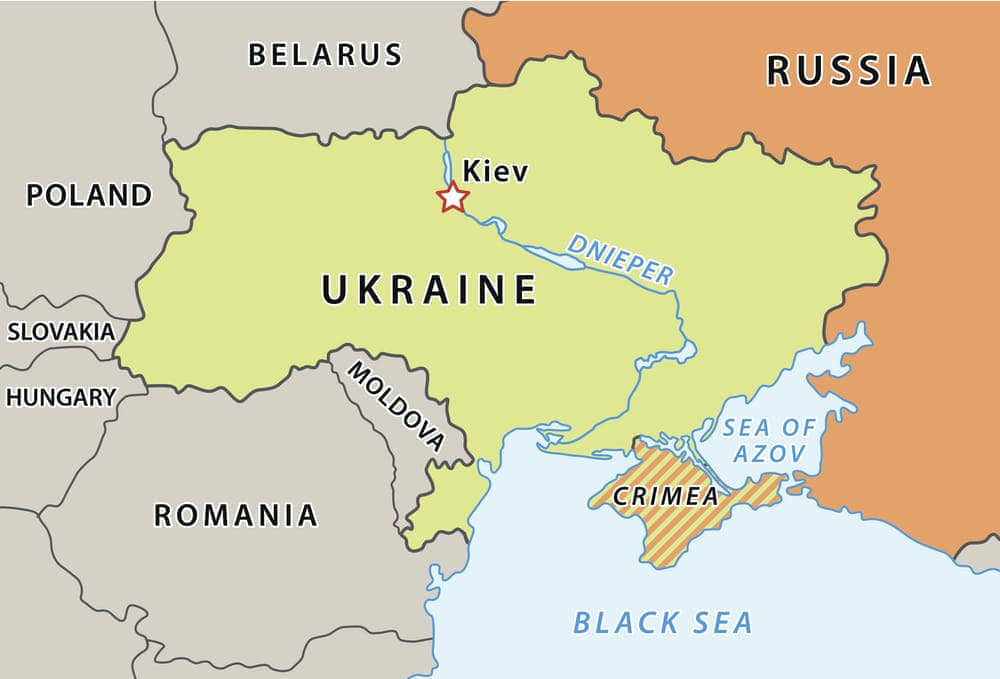
April 2014 was a pivotal month for the people of the Donbass region in what was then still part of Ukraine. It was then that the governing regime was newly installed in Kiev by a coup d’état on February 20/21embarked on military hostilities against the people of the region. The coup overthrew Ukraine’s elected president and legislature. It sparked rebellion in Crimea, Donbass (Lugansk and Donetsk), and in towns and cities in other regions of eastern and southern Ukraine.
The coup installed a pro-Western, anti-Russia government. Police actions by the new regime to suppress opposition to the coup only deepened the rebellions, whose consequences are still felt today.
On April 10, 2014, a group of communists in the city of Lugansk seized the local headquarters of the Security Service of Ukraine (SBU), the national police agency of Ukraine. They issued demands for the release of opponents of the U.S.-supported coup who had been jailed for upholding Ukraine’s shaky constitutional foundation and opposing the coup, whose epicenter was Maidan Square in central Kiev.
Uprisings against the coup government quickly spread throughout southern and eastern Ukraine, including in Crimea, the two Donbass oblasts (provinces) of Lugansk and Donetsk, and, to a lesser degree, in Odessa and other cities and towns.
No one could have imagined in Lugansk in early April 2014 that hostilities could end in full-scale warfare by Kiev with essential political and military backing by the United States and the NATO military alliance it leads. But that is exactly what unfolded. The attempt by Kiev to suppress opposition to the coup in Donbass soon escalated into an eight-year war by Kiev. In early 2022, that war escalated into today’s large-scale conflict with Russia.
Elsewhere in Ukraine, the people of Crimea avoided war by voting on March 16 to secede from the coup Ukraine and join the Russian Federation. The people of Odessa city were not so lucky. On May 2, a day of anti-coup protest in the city ended in tragedy when right-wing paramilitaries who had traveled to the city from elsewhere in Ukraine for the purpose of violent provocations set fire to the large building in the center of the city where protesters had taken refuge from paramilitary violence. More than 45 protesters died.
The hypocrisy of democracy – some are allowed to have it, others not so
On April 10 in Lugansk, hundreds of local residents took up the call of the local Communist Party activists. One of the main arguments for storming the SBU building was the example set by coup fomenters in late 2013 and early 2014 in seizing police stations (and their arsenals of weapons) in western Ukraine, for example in the city of Lviv, the sixth largest city in Ukraine at the time, with a population of some 750,000. The communists in Lugansk argued that opponents of the coup should take similar actions to those of the coup makers months earlier.
The Western powers were watching events very closely. For them, violence and the seizure of weapons by some groups (right-wing paramilitaries) was justified, while for others (anti-coup protesters) it was totally ‘illegal’. This policy of double standards was on full display as the violent assault by Kiev against the population of Donbass began in earnest in April 2014. Locals became all the more convinced that all the talk coming from Western leaders and institutions about ‘equality’ and ‘democracy’ for Ukraine was nothing more than empty words.
Goal was autonomy; the accusations of ‘separatism’ were false
As rebellion quickly grew in Donbass, far-right paramilitary formations which were already formed in the west of the country to carry out the coup, or which rapidly developed following it, threatened violent, armed actions to suppress the developing protests in Kharkiv, Donetsk, Lugansk, and Zaporizhzhya oblasts and in other locations in the south and east. But the paramilitaries were only partly ‘successful’ (for example, one month later in Odessa).
In Lugansk and Donetsk cities, the local police offered little or no resistance to the anti-coup rebellions. This was parallel to how police in the western regions of Ukraine had largely stood by as the coming coup gained momentum in late 2013. As it turned out, much of the existing police and army personnel in Lugansk and Donetsk crossed over to the side of anti-coup protests, bringing their weapons with them. This was a major blow to Kiev and the West. Additionally, the soldiers of the Ukraine army as a whole were proving to be reluctant to follow orders to fire on anti-coup protesters. The paramilitaries responded to this by forming their own, military battalions, while the coup regime in Kiev embarked on a transformation of army personnel as a whole. In the coming years, the paramilitary formations would receive official status as autonomous constituents of the army and national police.
The BBC’s Ukraine service reported on the seizure of the SBU headquarters in Lugansk on April 10, 2014, writing, “The police did not interfere with the takeover and left the building to the applause of pro-Russian [sic] activists who had gathered in the square. The crowd chanted ‘Russia’ and ‘referendum’.”
The BBC report went on to cite the broadcast of a leader of the anti-coup protests in Lugansk, Vyacheslav Petrov, who appealed to the population. “I ask you not to panic. Everything will be fine. We are preparing for a referendum, which will take place on May 11. For that, everyone must think and make a choice.” The BBC continued, “The demands [of the anti-coup protest in Lugnsk] included an amnesty for all political prisoners, a referendum [on autonomy], the abolition of price and tariff increases, and giving the Russian language an official status of state language.”[1]
‘Pro-Russian’ or anti-coup?
Anti-coup protesters in Donbass wanted a referendum to decide the future of the territory. They were inspired by the events taking place in Crimea. There, the government of the Autonomous Republic of Crimea (ARC) responded promptly to the threats by Ukraine authorities and paramilitaries to invade the territory and suppress opposition to the coup. With the cooperation of Russian leaders in Moscow and Russian armed forces long established in Crimea by a 1997 ‘treaty of friendship’ (Wikipedia) between Russia and Ukraine, the ARC government held a referendum on March 16, 2014, on the future status of the territory. An overwhelming majority voted to secede from Ukraine and join the Russian Federation. Polling showed that even a majority of ethnic Ukrainians residing in the peninsula voted in favor.
Thus ended Ukraine’s unpopular and unconstitutional governance of Crimea, ‘bestowed’ upon Ukraine by the leaders of the Soviet Union (USSR) in 1954, albeit with no vote offered to the local population. Crimea was the only region of Ukraine to have a regional, autonomous government. This meant that the very strong anti-coup sentiment in early 2014 had an immediate solution in the form of a referendum organized by the ARC, which was a fully constitutional entity of Ukraine.
Unfortunately, no such quick and democratic option was available to the other anti-coup regions of Ukraine, notably in Donbass. That’s because these regions lacked any strong forms of local or regional government that could step into the breach once the elected and constitutional government in Kiev was overthrown. It was also because the existing political parties in the anti-coup regions, as in the rest of Ukraine, largely represented only the economic elites.[2]
‘Separatism’ or political autonomy?
Western governments and media responded to the anti-coup protests in central and eastern Ukraine with epithets, calling them ‘separatist’. This was utterly false. The republics of Lugansk and Donetsk are, indeed, today constituents of the Russian Federation. The reason for this is the obstinance of Ukraine’s coup leaders. Following its military defeat in Donbass in early 2015, the Kiev regime signed the ‘Minsk 2’ peace agreement of February 12, 2015 (text here). It contained sweeping autonomy measures for Lugansk and Donetsk. The UN Security Council endorsed the agreement unanimously a short five days later. But as subsequent events proved, Kiev and its foreign backers, notably France and Germany who, like Russia, co-signed Minsk 2 as ‘guarantors’. But unlike Russia, the two EU powers never intended to implement it. As subsequent revelations showed, Kiev and its EU ‘co-signers’ never intended to implement Minsk 2; they signed it in order to ‘buy time’ for Ukraine’s army and paramilitaries to regroup and re-arm.
The claim that the ‘pro-autonomy movement’ in Donbass, to give it its proper name, was ‘pro-Russian’ was another of the Ukrainian and Western epithets. Of course, there was widespread pro-Russian sentiment in Donbass. Historically, the region had always been Russian in its ethnic composition. It always had positive economic relations with the Russian Federation and the Russian Soviet Republic before that. Where was the crime in that? But for the rulers of Ukraine and the West, this was, indeed, a ‘crime’ because they were embarked on a course to weaken Russia and to displace it entirely from Donbass and other regions of Ukraine. They wanted Ukraine to totally uproot its economic relations with Russia and become an economic subordinate to the EU and the United States.
Battle for Chasov Yar
After ten years, the territory of Lugansk is fully under the control of the Lugansk People’s Republic and it is a constituent of the Russian Federation. Next door in Donetsk, a battle is taking place in and around the town of Chasov Yar, app. 100 kilometers north of Donetsk city. This follows the capture by Russian forces of the city of Avdeevka several weeks ago, barely 20 km north of Donetsk, and the capture of the larger city of Artemivsk (called ‘Bakhmut’ in Ukraine, also app. 100 km north of Donetsk) in May 2023.
The tactics being used by the Russian Armed Forces at Chasov Yar (pre-war population 12,000) are similar to those at Avdeevka (barely 20 km north of Donetsk) and Artemivsk. Ukrainian troop positions are hit with heavy aerial bombs that destroy underground fortifications. Assault groups then surround the city from three sides, leaving only one way out: retreat westward toward Ukraine.
The ‘Kholodnyi Yar’ telegram channel of the 93rd Brigade of the Armed Forces of Ukraine is circulating a video in which a resident of Chasov Yar says he is waiting hopefully for the Russians to come. “He says that he is waiting for Russia and that he has relatives who live there. He says he cannot leave the town because our soldiers shoot all those wanting to cross over to territory held by the Russians.”
The liberation of Chasov Yar by the Russian army may become a turning point in the Russian Special Military Operation (SMO) overall. It certainly opens highly unpredictable scenarios in the entire conflict. Russian military correspondent Alexander Sladkov believes that from Chasov Yar, the Russian offensive will advance in a straight line to the major industrial cities of Kramatorsk, a key railway junction 45 kilometers further east with a pre-war population of 160,000, and nearby Sloviansk. “Kramatorsk is the next city of Donbass that we will liberate,” he predicts.
Forcing Ukrainians to fight for NATO
In this context, it is becoming increasingly difficult for the Kiev regime to conduct its forced military conscription. The most common practice by Ukrainian men of military age [3] to avoid military recruiters is to hide in their homes or in ruins and wait for a chance to surrender to Russian forces. The Strana online news outlet in Ukraine published a report on April 2 by an officer of the AFU under the nickname ‘Night Stalker’ describing common methods used by the Ukraine army to pressure its soldiers who are reluctant to fight (and quite possibly die). It wrote, “How to motivate a recruit to fight who would otherwise choose to lie down in the trench on his belly and wait to surrender? The officer replied that ‘a conversation is enough for some. For others, a beating by the company officer or shooting over the soldier’s head may be needed.’ “
The officer noted that there are also harsher methods of influence, but the report did not elaborate.
As more and more AFU soldiers are forcibly conscripted (abducted) from their homes or from streets or shops, the number of ‘refuseniks’ – soldiers who refuse to go into combat – is growing in Ukrainian units. As a rule, refuseniks are arrested and then held in cramped, damp cages. The Ukrainian Telegram channel ‘Legitimny’ writes that according to its sources, rising numbers of Ukrainian soldiers are refusing to fight because that “no one wants to fight for the governing regime in Kiev and its leaders since it treats its people as slaves.”
In early April, the German state news outlet Deutsche Welle published a video report from Luzanivka in the Cherkasy region (central Ukraine), explaining there are no men left of military service age in the village. “If someone happens to die, there is no one left here to dig their grave,” says village council chairman Serhiy Nikolaenko. DW reports that about 50 men have been conscripted from the village of 400 people.
Strana cites Deutsche Welle in reporting from the village of Valentina. A resident explains, “In our small village, there are already so many missing and dead. Imagine for the whole of Ukraine!” The resident says both of his sons have been conscripted into the army.
Despite all this, President Volodymyr Zelensky and his government continue to try and ‘sell’ to Western media and politicians that a new ‘counteroffensive’ by the AFU may be launched. This is at a time when the human resources to replace the soldiers being lost to death, injury, or desertion are all but exhausted. “Yes, we have a plan for a counteroffensive. We will definitely win; we have no other alternative. But I can’t promise it and I can’t name a date,” Zelensky stressed in an interview with Germany’s BILD daily newspaper on April 9.
Oleksandr Dubinsky, a former MP from Zelensky’s Servant of the People party, adds that as long as the Ukrainian army is in retreat, it will be difficult to negotiate financial aid. In other words, the Ukraine regime plans to throw yet more Ukrainians into the slaughter so that the Ukrainian elite can maintain its economic ties with the West and continue to receive funding from it.
How neoliberalism has undermined Western hegemony
Another reason for the impossibility of an AFU ‘counteroffensive’ is the shortage of ammunition, which neither the West nor Ukraine are able to replenish. In Ukraine and the West, deindustrialization processes have undermined the ability to quickly organize production facilities.
Russian political scientist Malek Dudakov writes that it is extremely difficult for European Union countries to now boost their production of armaments. The EU countries today buy 80 percent of their armaments from outside their borders; 60 percent of that comes from the United States. “Euro bureaucrats miraculously want to reduce dependence on armaments imports to 50 percent by 2030. This is in the context of a severe crisis already happening in the European economy, due largely to deindustrialization. Even the production of shells faces problems because of the shortages of nitrocellulose (also known as ‘guncotton’) and other cotton products purchased from China,” he writes.
In early April, police searches were conducted in Ukraine and Poland amidst investigations by the Ukraine Defense Ministry of overpriced arms purchases. In 2022, the Ukrainian Defense Ministry signed several contracts with the Polish-registered firm Alfa for the supply of ammunition worth tens of millions of euros. Despite the fact that the firm failed to fulfill the terms of the first several contracts, the Ministry continued to cooperate with it. As of the beginning of 2023, Alfa owed the Defense Ministry more than 3.5 billion hryvnias (US$89 million) for arms purchases never received.
In late February, Zelensky claimed that global prices for artillery shells have increased five times (500%) since the start of the war with the Russian Federation. “Because of the war in Ukraine, even an ordinary artillery shell which cost $1500 at the beginning of the war can cost $4000 to $8000 today. So much for the war. For some it is a war, while for others it is just big business”, he said.
The Wall Street Journal reported on April 10 that U.S. drones produced in California’s Silicon Valley have not performed well in Ukraine. “U.S.-made UAVs [unmanned aerial vehicles] tend to be expensive, faulty and complicated to repair, say drone company executives, Ukrainians on the front lines, Ukrainian government officials, and some former U.S. military officials.”
In general, the entire Western world is oriented to produce small numbers of expensive products, with high involvement of private middlemen. This model turns out to be highly ineffective in modern military conflicts, which require cheap and quick production on a mass scale. The only two ways, then, for Western firms to compete is to exploit the countries of the Global South for cheap production or to lower their own production standards.
Russia, meanwhile, has been undergoing processes of de-privatization, that is the return of manufacturing by private enterprises to state ownership. This helps to eliminate middlemen and make production cheaper. Since 2020, the number of cases in which the Russian Prosecutor General’s Office has challenged the legalities of privatizations during the privatization wave of the 1990s has grown eight times, according to the Russian TV channel RTVI.
The chief of Sweden’s SAAB arms producer, Micael Johansson, recently told the Financial Times that shortages of nitrocellulose were an example of why companies producing armaments need to build new supply chains in today’s “multipolar world” where “not only the Western,’ rules-based order’ will be present”. He added: “We have to think about like-minded countries who we can trust and with whom we can work with in the long term.”
Reading between the lines, the SAAB official’s words mean increased pressure by Western countries on the Global South to locate more and more production there on the cheap. Effectively, it means a continuation of colonialist practices against smaller and less developed countries.
It has been fashionable in recent years for capitalist ideologues and commentators in the imperialist countries to criticize and even condemn the ‘offshoring’ of their manufacturing to China and other countries. But the drive to maximize profits takes precedence, and so offshoring remains an attractive practice. The capitalist system of production serves private interests, not public needs. Thus it has always been and will always remain.
Notes:
1. In post-Soviet Ukraine, there was and remains only one official language: Ukrainian. This was even true in Crimea where ethnic Ukrainians composed only some 15% of the population. In today’s Crimea (Russian Federation), there are three official languages: Russian, Crimean Tatar, and Ukrainian.
2. Crimea’s autonomous status dates back to the Russian Revolution of 1917, which implemented sweeping forms of political self-determination for the many nationalities that comprised the pre-Revolution Russian Empire. This was and remains the origin of independent Ukraine. ‘Soviet’ Ukraine was formed during the harsh years of civil war from 1918 to 1920. It went on to become a founding constituent of the Union of Soviet Socialist Republics in 1922. Officials of Soviet Ukraine led a secession from the USSR in 1990/1991. The country had already won its independence 70 years earlier.
3. Military registration is obligatory in Ukraine for all men between the ages of 18 and 65. The age of military service (conscription) is 25 to 60 (recently reduced from 27).
Interview Conducted By Benjamin Bidder und Ann-Dorit Boy, Der Spiegel, 4/3/24
Alexandra Prokopenko works in Berlin at the Carnegie Russia Eurasia Center and the Center for East European and International Studies (ZOiS). She previously served as an advisor to the Russian Central Bank in Moscow. In March 2022, Prokopenko handed in her notice in protest against the war.
DER SPIEGEL: Ms. Prokopenko, Russian President Vladimir Putin has radicalized his domestic and foreign policy in recent years, while his economic policy has remained surprisingly pragmatic and constant. Why is that?
Prokopenko: Putin has clearly understood that great empires such as the Czarist Empire and the Soviet Union perished due to poor economic management. That is why he makes sure that the management of the Russian economy is as non–ideological as possible and remains in the hands of experts. Putin trusts them completely and does not interfere in the operational business.
DER SPIEGEL: Russia’s good growth figures have long been doubted. What is the real situation?
Prokopenko: The official figures largely correspond to reality. The economic situation is not great, not terrible. The economy grew significantly last year. On the other hand, however, we are seeing clear signs that the Russian economy is overheating.
DER SPIEGEL: What does that mean?
Prokopenko: The economy has grown faster than its potential actually allows. The labor market is at its limit, as good as empty. Unemployment is at a record low. This shortage of skilled labor is already having a negative impact on production. In short, it is an unhealthy situation and the Russian economy does not have the necessary resources to expand so rapidly in the long term. Exports are also unlikely to expand any further. If we look at the statistics, we can also see that a large part of last year’s growth was attributable to defense-related industries. This ranges from the metal industry to textile processing, which produces uniforms on a massive scale.
DER SPIEGEL: Could this affect the Russian economy and Russia’s ability to wage war?
Prokopenko: We keep seeing local problems. The egg crisis last year was one example. There are always acute staff shortages or local bottlenecks in the supply of certain foods to the population. This is caused by logistics chains that are disrupted by the sanctions. However, they are usually re-established. But today they have to be longer and more complex than in the past. This also means: more expensive. At the moment, this does not look particularly threatening. In the medium- to long term, however, this development is not sustainable.
DER SPIEGEL: Is that a problem for Putin’s warfare?
Prokopenko: The time horizon of 12 to 18 months is decisive for developments on the battlefield, and I don’t see any significant economic problems for Russia.
DER SPIEGEL: Nevertheless, you speak of “Putin’s trilemma.” What do you mean by that?
Prokopenko: He has three main tasks: Putin must continue to finance the war. At the same time, the standard of living of the general population must not deteriorate drastically. Thirdly, it must ensure that the economy does not lose its macroeconomic balance. It will be difficult to fulfill all three tasks at the same time. They contradict each other. Stability requires low inflation. In order to keep the inflation rate in check, government spending would have to be cut. But that is not possible because of the cost of the war.
DER SPIEGEL: Citizens don’t seem to notice a dramatic fall in living standards.
Prokopenko: It’s a gradual process. Take a look at the car market: You can buy cars in Russia again, but they now generally come from Chinese rather than Western brands. Most of these vehicles are also imported from China and are no longer built by VW or Toyota in Russian factories. In order to maintain the standard of living in the country, sooner or later certain decisions will have to be made, including investments. Then the Kremlin will have to say which task is more important to it.
DER SPIEGEL: You used to work at Russia’s central bank until the start of Russia’s large-scale attack in 2022. Many of your former colleagues are continuing – and thus keeping Russia’s war machine running. Yet some representatives of the Central Bank and the Economics Ministry were once considered liberals. Why is this “economic bloc” so reliable in its support of the regime?
Prokopenko: The “economic bloc” doesn’t just support the Putin regime. It is an integral part of the system, just like its other pillars, such as the security services. Of course, its fundamental nature is interesting. The “economic bloc” is made of different material than the security bloc. In fact, the economists have proven to be more capable and reliable than the generals on the battlefield.
DER SPIEGEL: What do you mean by that?
Prokopenko: Let’s look on the Russian actions after the Ukrainian counteroffensive. It took the Russian army a few months and thousands of dead and wounded to conquer the village of Avdiivka in eastern Ukraine. Apart from that, there were hardly any successes on the battlefield. In the area of economic policy, on the other hand, the defense measures were extremely successful, everything that has been described as the “Fortress Russia” strategy.
DER SPIEGEL: You are referring to the idea of making Russia’s economy as invulnerable as possible to external pressure. How has that been achieved?
Prokopenko: Of course, it has only been partially successful, the sanctions are definitely affecting the Russian economy. However, fundamental stability has been maintained. And that has a lot to do with the earlier design of Russian economic policy, as it had already developed many years before the war. It allowed the Kremlin to rapidly reorganize the country for war. I observe all of this with a certain pang in my heart: the war and the sanctions have devalued many of the economic policy institutions and principles that an entire generation of economic policymakers helped to build.
DER SPIEGEL: Which ones?
Prokopenko: A vivid example is the Moscow financial center, which had actually developed extremely well. In the years before the war began, it had become increasingly interesting for many investors from other emerging countries. Today, there is nothing left of it. There are no more foreign investors, hardly any normal trade. Sure, formally this market still exists. But it has as much to do with a real trading center as a children’s shop game has to do with a supermarket. Another example is the so–called “budget rule” …
DER SPIEGEL: … a kind of Russian spending brake to limit government spending.
Prokopenko: It has allowed Russia to save up a large financial safety buffer. This was made possible by transfers from the oil and gas business to the National Welfare Fund, but also by prescribed restrictions on government spending. Since 2018, the budget rule has prevented Moscow from inflating the state budget. Russia therefore entered the war with extremely solid state finances. This allowed the Kremlin to quickly divert a lot of money into armaments.
DER SPIEGEL: But that was not the original goal. The idea was to pursue a clever economic policy and save money for a rainy day. Shouldn’t more economic policy decision–makers therefore have thrown in the towel?
Prokopenko: I don’t think it’s particularly surprising that many stay. In the United States, we didn’t experience a mass exodus from government agencies during the Vietnam War and the growing criticism of it.
DER SPIEGEL: Are you still in contact with your former colleagues? How strong is the support for the war there?
Prokopenko: If people continue their work, that doesn’t necessarily mean that they support the war. In any case, I haven’t met anyone among my former colleagues who would be in favor of this war and say: Yes, we’re doing everything right! We just need to kill more Ukrainians and really devastate the Ukrainian economy. There is no such thing there.
DER SPIEGEL: Are you talking about the Central Bank now?
Prokopenko: I have not heard any such statements from the Central Bank or the Finance Ministry, or even from the Russian government as a whole.
DER SPIEGEL: But these people are not against the war either.
Prokopenko: I don’t perceive any enthusiasm for war in the bureaucracy or within the Russian business world. There is just this enthusiasm for war that we read about in the Russian official media. I don’t think it is authentic at its core. This broad coalition among the Russian population, which allegedly actively wants the war, does not exist. It’s an invention.
DER SPIEGEL: Let me ask you again: Wouldn’t many more civil servants have to resign?
Prokopenko: Like me, some have left. But please bear in mind that people are in different life situations. For some, it is easier to burn all bridges. After the war began, the secret services started holding preventive talks at the Central Bank and the ministries. They went along the following lines: “If you resign, we will have your deputies thrown in prison or there will be other unpleasantness.” What’s more: In such large apparatuses, a resignation, even if it is demonstrative, changes little. For many, it is also difficult to find another position: Senior employees have been banned from leaving the country because they had access to classified documents. There are reports that some officials had to hand in their passports.
DER SPIEGEL: How many people are we talking about? Probably only a few top civil servants.
Prokopenko: No, it affects very broad groups of employees. We also see something similar in large Russian companies: There are employees who may not even formally come into contact with classified information. Nevertheless, they are given instructions that they must provide information about planned trips abroad in good time. For many, this is received exactly as it is intended: as half a threat, half a ban. So, the mood among many civil servants and managers is bad, they don’t feel safe. Even in this situation, it is an enormous risk to demonstratively oppose the system. Not everyone is capable of doing this. And let’s be honest: Where are these people supposed to go today? Anyone who has worked for the Russian state will not find a job anywhere except within the Russian Federation. Even if a person demonstratively declares their resignation, they can’t expect to be able to pursue a career abroad again.
DER SPIEGEL: Are you talking about people against whom personal sanctions have been imposed?
Prokopenko: No, not at all. I also mean normal civil servants. Some of them are excellently trained and capable people with expertise that is internationally recognized. The few who have decided to resign have major problems. They find it extremely difficult to find a job in academia. They’re not wanted in the consulting business, not even in international organizations. And I’ll say it quite openly: Perhaps more people in Russia would make a different choice if they saw a way out. But the West doesn’t offer them one.
DER SPIEGEL: What is your general assessment of the West’s sanctions policy?
Prokopenko: There is no exit option. Why are no conditions being set? Distance yourself from the regime, pay in money for Ukraine here – and then the sanctions will be weakened or lifted. But there is no such offer. This also applies to many Russian businesspeople: Their assets are frozen, they can no longer travel. They have become pariahs of the international system. There is only Putin left, and he says: You stay with me. It may be that Putin is the devil – but for many, he is a devil that they know how to deal with. Added to this is the increasing repression and growing fear within Russia. All of this is fueling fatalism.
DER SPIEGEL: You once spoke of “moral sanctions” against all Russians. What do you mean by that?
Prokopenko: These are sanctions that have not been formalized at all, but which affect all Russians, regardless of whether they are civil servants or have left the country in protest. Every holder of a Russian passport in Berlin can tell you a thing or two about it: It is enormously difficult even for ordinary Russians to open an account in Germany, almost impossible. This is not only annoying for those affected: It also cements the narrative of Russian propaganda that Russians are being persecuted abroad across the board and that the West is pursuing anti-Russian propaganda.
DER SPIEGEL: Should the West change its sanctions policy?
Prokopenko: I think we have now reached a point where we can clearly see that the measures taken so far are not working as intended. I think it wouldn’t hurt to experiment a little. Unfortunately, the EU has so far done the opposite: It is simply expanding its register of banned goods and sanctioned persons. Will this throw the Russian economy off course? Of course not.
DER SPIEGEL: What do you suggest?
Prokopenko: A more intelligent approach: Instead of sealing off the West from Russian money, we could, on the contrary, try to stimulate the outflow of capital from Russia. Every billion less in Russia means less support for the war machine. Even at a time when the Russian Central Bank had already introduced capital controls, tens of billions of dollars were still flowing abroad. Why shouldn’t the West encourage such movements instead of fighting them as it does now? I believe it is time for the West to do everything it can to encourage both the brain drain and capital flight from Russia. That would undermine Putin’s regime. It would be time to slowly bleed Russia’s economy dry.
DER SPIEGEL: Hasn’t the wave of emigration of critically minded Russians actually stabilized the political system in Russia?
Prokopenko: The Kremlin talks about traitors and always pretends that it doesn’t mind the mass exodus. But that’s not true. That’s why the regime is doing everything it can to prevent even more people from going abroad.