Chinese Ministry of Foreign Affairs website, 2/24/23
1. Respecting the sovereignty of all countries. Universally recognized international law, including the purposes and principles of the United Nations Charter, must be strictly observed. The sovereignty, independence and territorial integrity of all countries must be effectively upheld. All countries, big or small, strong or weak, rich or poor, are equal members of the international community. All parties should jointly uphold the basic norms governing international relations and defend international fairness and justice. Equal and uniform application of international law should be promoted, while double standards must be rejected.
2. Abandoning the Cold War mentality. The security of a country should not be pursued at the expense of others. The security of a region should not be achieved by strengthening or expanding military blocs. The legitimate security interests and concerns of all countries must be taken seriously and addressed properly. There is no simple solution to a complex issue. All parties should, following the vision of common, comprehensive, cooperative and sustainable security and bearing in mind the long-term peace and stability of the world, help forge a balanced, effective and sustainable European security architecture. All parties should oppose the pursuit of one’s own security at the cost of others’ security, prevent bloc confrontation, and work together for peace and stability on the Eurasian Continent.
3. Ceasing hostilities. Conflict and war benefit no one. All parties must stay rational and exercise restraint, avoid fanning the flames and aggravating tensions, and prevent the crisis from deteriorating further or even spiraling out of control. All parties should support Russia and Ukraine in working in the same direction and resuming direct dialogue as quickly as possible, so as to gradually deescalate the situation and ultimately reach a comprehensive ceasefire.
4. Resuming peace talks. Dialogue and negotiation are the only viable solution to the Ukraine crisis. All efforts conducive to the peaceful settlement of the crisis must be encouraged and supported. The international community should stay committed to the right approach of promoting talks for peace, help parties to the conflict open the door to a political settlement as soon as possible, and create conditions and platforms for the resumption of negotiation. China will continue to play a constructive role in this regard.
5. Resolving the humanitarian crisis. All measures conducive to easing the humanitarian crisis must be encouraged and supported. Humanitarian operations should follow the principles of neutrality and impartiality, and humanitarian issues should not be politicized. The safety of civilians must be effectively protected, and humanitarian corridors should be set up for the evacuation of civilians from conflict zones. Efforts are needed to increase humanitarian assistance to relevant areas, improve humanitarian conditions, and provide rapid, safe and unimpeded humanitarian access, with a view to preventing a humanitarian crisis on a larger scale. The UN should be supported in playing a coordinating role in channeling humanitarian aid to conflict zones.
6. Protecting civilians and prisoners of war (POWs). Parties to the conflict should strictly abide by international humanitarian law, avoid attacking civilians or civilian facilities, protect women, children and other victims of the conflict, and respect the basic rights of POWs. China supports the exchange of POWs between Russia and Ukraine, and calls on all parties to create more favorable conditions for this purpose.
7. Keeping nuclear power plants safe. China opposes armed attacks against nuclear power plants or other peaceful nuclear facilities, and calls on all parties to comply with international law including the Convention on Nuclear Safety (CNS) and resolutely avoid man-made nuclear accidents. China supports the International Atomic Energy Agency (IAEA) in playing a constructive role in promoting the safety and security of peaceful nuclear facilities.
8. Reducing strategic risks. Nuclear weapons must not be used and nuclear wars must not be fought. The threat or use of nuclear weapons should be opposed. Nuclear proliferation must be prevented and nuclear crisis avoided. China opposes the research, development and use of chemical and biological weapons by any country under any circumstances.
9. Facilitating grain exports. All parties need to implement the Black Sea Grain Initiative signed by Russia, Türkiye, Ukraine and the UN fully and effectively in a balanced manner, and support the UN in playing an important role in this regard. The cooperation initiative on global food security proposed by China provides a feasible solution to the global food crisis.
10. Stopping unilateral sanctions. Unilateral sanctions and maximum pressure cannot solve the issue; they only create new problems. China opposes unilateral sanctions unauthorized by the UN Security Council. Relevant countries should stop abusing unilateral sanctions and “long-arm jurisdiction” against other countries, so as to do their share in deescalating the Ukraine crisis and create conditions for developing countries to grow their economies and better the lives of their people.
11. Keeping industrial and supply chains stable. All parties should earnestly maintain the existing world economic system and oppose using the world economy as a tool or weapon for political purposes. Joint efforts are needed to mitigate the spillovers of the crisis and prevent it from disrupting international cooperation in energy, finance, food trade and transportation and undermining the global economic recovery.
12. Promoting post-conflict reconstruction. The international community needs to take measures to support post-conflict reconstruction in conflict zones. China stands ready to provide assistance and play a constructive role in this endeavor.
The greatest threat of nuclear catastrophe that humanity has ever faced is now centered on the Crimean peninsula. In recent months, the Ukrainian government and army have repeatedly vowed to reconquer this territory, which Russia seized and annexed in 2014. The Russian establishment, and most ordinary Russians, for their part believe that holding Crimea is vital to Russian identity and Russia’s position as a great power. As a Russian liberal acquaintance (and no admirer of Putin) told me, “In the last resort, America would use nuclear weapons to save Hawaii and Pearl Harbor, and if we have to, we should use them to save Crimea.”
In the eyes of all the participants in the war, Crimea is freighted with crucial strategic significance.
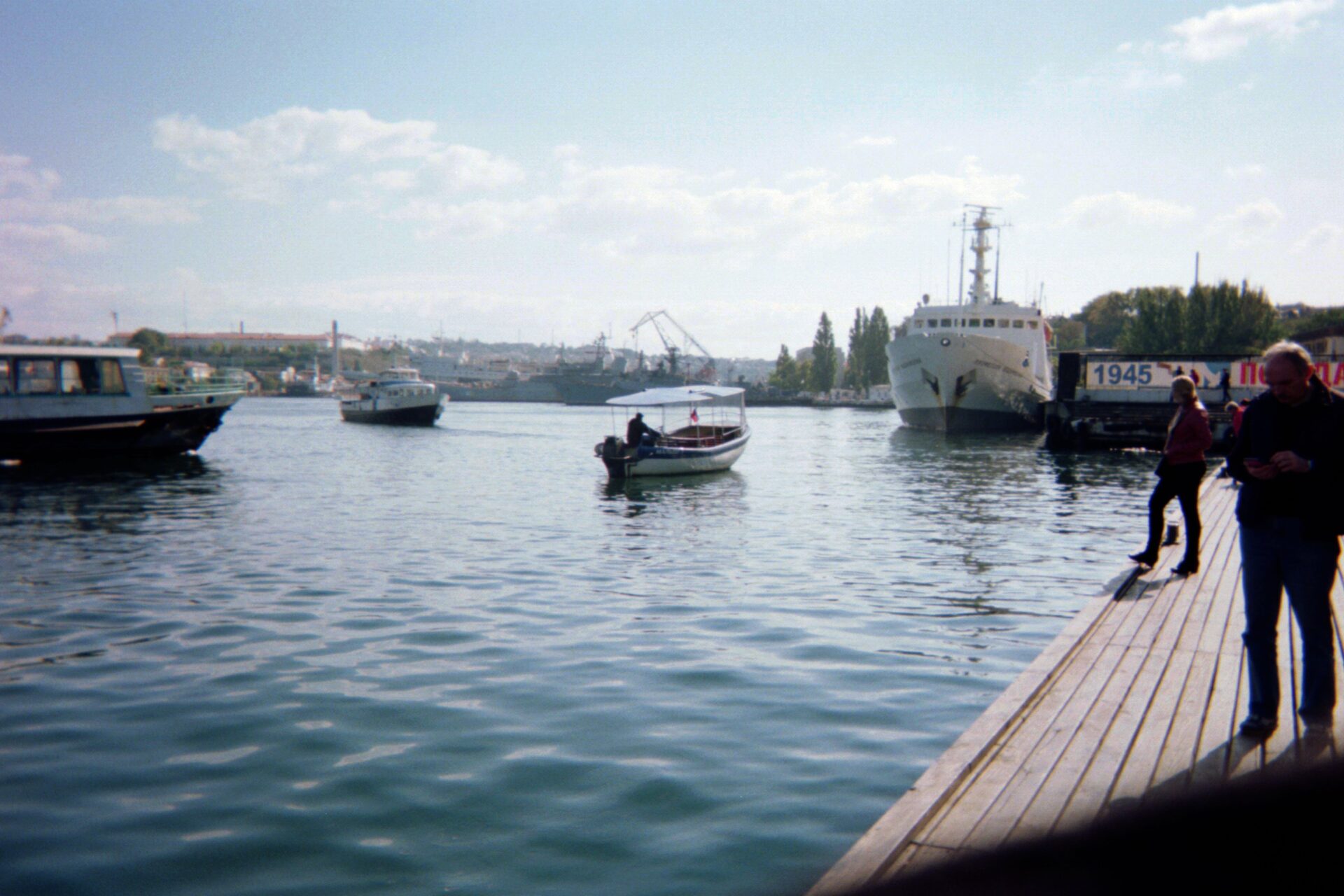
For the Ukrainian government, the recapture of Crimea and the naval base of Sevastopol would not only mark Ukraine’s total defeat of Russian aggression, but would also eliminate Russia’s ability to blockade Ukraine’s Black Sea ports, and make any future Russian invasion of Ukraine much more difficult.
The latter belief seems on the face of it flawed, since Russia would retain 1,200 miles of border with Ukraine to the east and north. However, it is tied up with the belief that the Russian loss of Crimea would mark victory over Russia in this war, and would be a humiliation so crushing that the Putin regime would fall — and that from this would follow the drastic weakening or even complete disintegration of the Russian Federation.
This is also the hope of the Polish and Baltic governments and of hardliners in Western Europe and the United States. They hope for the elimination of Russia as a significant factor in global affairs, leading to the isolation of China and the strengthening of US global primacy. Hence the increasing language (cynically borrowed from the Left) of the “decolonization” of Russia, a transparent code for the destruction of the existing Russian state.
US strategists also have a more specific reason to hope that Russia can be driven from Crimea. Sevastopol is the only Russian deepwater port on the Black Sea. The others would take immense effort, time, and expense to be turned into viable naval bases. The loss of Sevastopol would therefore virtually eliminate Russia as a significant power not only in the Black Sea but in the adjacent Mediterranean as well.
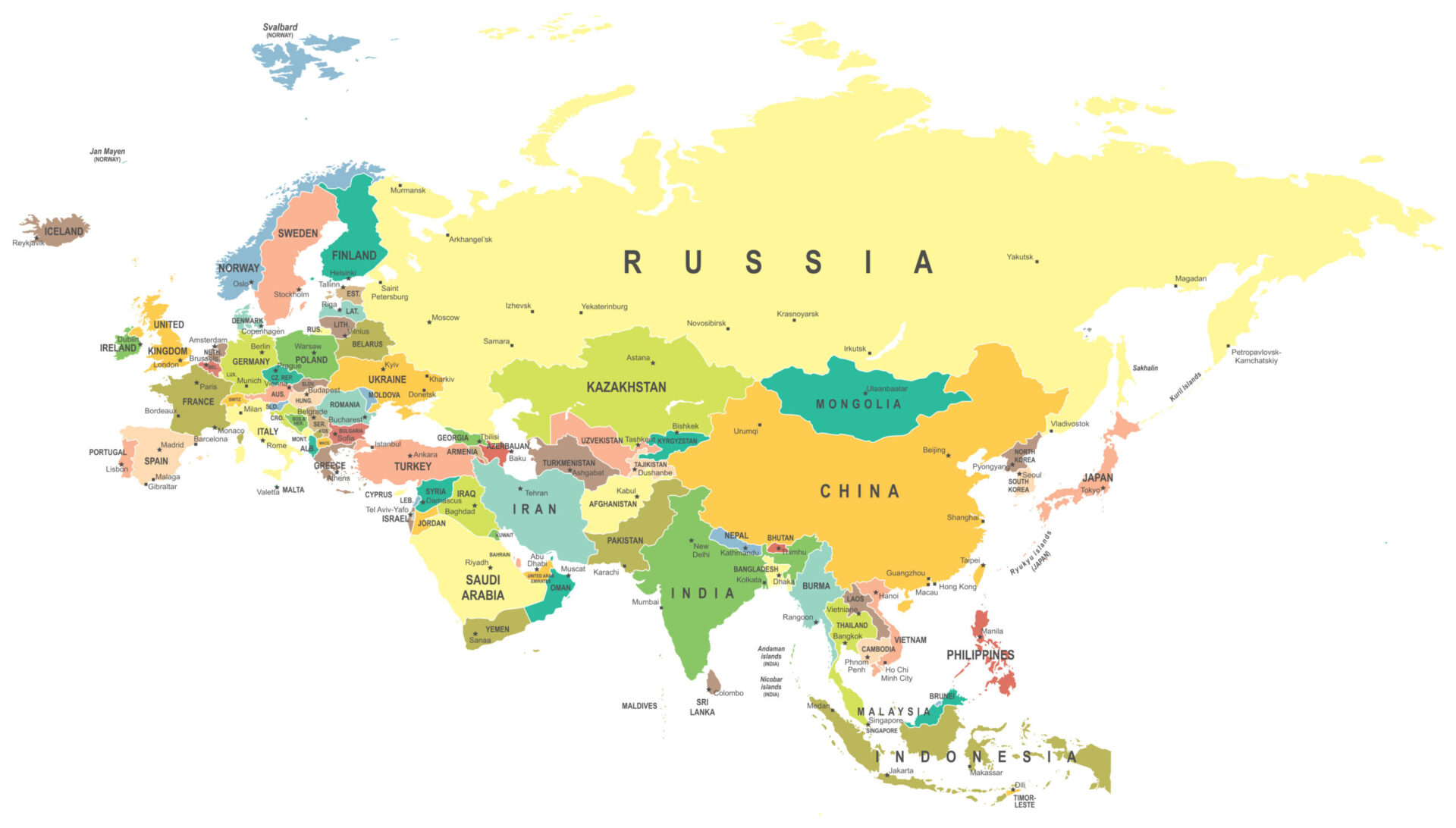
Then again, perhaps these US strategists should be careful what they wish for. A glance both at the map and at the policies of the Erdoğan government in Turkey should make clear both that Turkey, not the United States, would probably be the greatest beneficiary of this, and that a steep rise in Turkish power would by no means necessarily be to the benefit of the West.
It should also be noted that many Russian goals in the Middle East and Mediterranean have not in fact been contrary to the interests of the United States. If the Bush administration had listened to Russia (and France and Germany) and not invaded Iraq, it would have spared the United States losses of thousands of lives and trillions of dollars, and the people of the Middle East infinitely greater losses and sufferings.
If the Obama administration had listened to Russia and not overthrown the Gaddafi state in Libya, it would have avoided more than a decade of civil war in Libya, the spread of civil war and Islamist extremism across much of western and central Africa, and a great increase in illegal migration to Europe. If the Obama administration had destroyed the Ba’ath state in Syria, it would almost certainly have found itself mired in another catastrophe along the lines of Iraq, but without Iraq’s Shia majority to provide some sort of basis for state reconstruction. These actual or potential disasters were all the work of forces in Washington — not Moscow.
As to the Biden administration, it seems divided on the subject of how far to defeat Russia. On Crimea, a line leaked to the New York Times and other outlets has said that the administration wants to strengthen Ukraine sufficiently to be able to credibly threaten Crimea (presumably by recapturing the “land bridge” between Crimea and Russia proper, through the Russian-occupied territories of Kherson and Zaporizhzhia), but like the Pentagon, does not believe that Ukraine could in fact recapture it and thereby risk nuclear war.
The Biden administration appears to believe that if the Ukrainian army could break through to the Sea of Azov, this would frighten Moscow so much that it would agree to a deal (which Ukrainian president Volodymyr Zelensky indeed offered back in March) whereby Russia would return to the lines it held between 2014 and last February, and the issues of the formal status of Crimea and the Donbas would be deferred for future negotiation.
This strategy is however extremely risky, because it requires a strong degree both of military fine-tuning and of control over Ukrainian actions — and neither is guaranteed. Moreover, without a full recognition of Russian sovereignty over Crimea, it would be very difficult for Russia to withdraw completely from the “land bridge” to the peninsula that it seized last year, because that would put Ukraine in a far stronger position to start a new war to capture Crimea at some stage in future. For the loss of the land bridge to Crimea would leave only the bridge across the Kerch Strait as a means for Russia to supply Ukraine by land — and Ukraine has already demonstrated its ability to destroy that bridge.
Furthermore, one of the reasons for Russia’s invasion of Ukraine last year was that Ukraine had been blocking the canal from the Dnieper River to Crimea, thereby gravely damaging Crimean agriculture. As long as a renewed war remains a possibility, if Russia wishes to hold Crimea, it must fight to hold or retake the land bridge.
An understanding of the importance of Crimea to Russians can be drawn largely from the goals of Western hardliners, mentioned above. The Russian establishment, and most ordinary Russians, are determined to maintain Russia’s position as a great power. Three other factors are however also present. The first is Crimea’s emotional significance, stemming from memories of the heroic defense of Sevastopol against the French, British, and Turks in 1854–55, and the Germans and Romanians in 1941–42. The Red Army lost more men in Crimea than the US army lost on all fronts of World War II put together.
The second is that between Crimea’s 1783 conquest by Catherine the Great from the Ottoman Empire and its Crimean Tatar allies, and its 1954 transfer to Ukraine by Soviet decree, Crimea was part of Russia. Until the latter date, at no point in Crimea’s history had it been part of Ukraine. Russians say — not without reason — that if the situation were reversed, and Crimea had been transferred from Ukraine to Russia, then much of Western public opinion would have sympathized with Ukrainian demands for its return.
The third is that Ukraine has an ethnic Russian majority. In January 1991, an overwhelming majority (94 percent) of Crimeans voted to become a separate “Union Republic” of the USSR, which would have led to Crimea becoming an independent state alongside Ukraine and Russia when the Soviet Union dissolved. In December of that year, a slim majority (54 percent) of Crimeans voted for an independent Ukraine, but on condition of Crimea’s autonomy, which the Ukrainian government unilaterally abolished four years later. Throughout the period of Ukrainian rule, a majority of Crimeans repeatedly expressed the desire for autonomy within Ukraine.
After the Russian seizure in 2014, an (internationally unrecognized) referendum and a series of opinion polls indicated that annexation to Russia had solid majority support. How things stand today is difficult to say given the level of repression now prevailing in Russia. But as former Zelensky adviser Oleksiy Arestovych has pointed out, the intense anti-Russian cultural measures introduced by the Ukrainian government — including the banning of the Russian language and the burning of Russian books — are unlikely to have increased support for Ukraine in Crimea.
It is impossible to say for sure if Russia would in the last resort use nuclear weapons to hold Crimea. It seems likely that they would begin by a less dangerous unconventional attack — for example the disabling of US satellites — that could begin escalation toward nuclear war. There are no grounds at all, however, for reasonable doubt that the Russian state would be willing to run colossal risks, for itself and for humanity. This being so, we should remember the words of President John F. Kennedy in his “Peace Speech” to American University in June 1963, reflecting the lessons that he had learned during the Cuban Missile Crisis:
“Above all, while defending our own vital interests, nuclear powers must avert those confrontations which bring an adversary to a choice of either a humiliating retreat or a nuclear war. To adopt that kind of course in the nuclear age would be evidence only of the bankruptcy of our policy — or of a collective death-wish for the world.”
Ballooning budget deficit and ‘backdoor’ tax proposals
The Russian authorities are turning to businesses for money to top up the budget. As The Bell reported this week, the government is demanding large companies make a one-time budget contribution of up to 250 billion rubles ($3.5 billion). This comes on top of December’s tax recalculation that is expected to take a further 1.8 trillion rubles ($25 billion) out of the economy. Businesses are trying to resist, but the government is not budging – and has good reasons for its position: January statistics released this week showed a rapid rise in spending against a background of falling incomes.
What’s happening?
At the end of last year, the government grew concerned about the increasing budget deficit and Prime Minister Mikhail Mishustin proposed a “revenue mobilization.” Among the measures under discussion were increased dividends for state-owned companies and one-off payments from large private companies, Bloomberg reported.
The government acted quickly. Back in mid-December, the Russian Union of Industrialists and Entrepreneurs (RSPP), which unites Russia’s biggest companies, was invited to contribute about 200 billion rubles (the first proposal had been a sum that was twice as much, a source close to the discussions told The Bell). This was the brainchild of Finance Minister Anton Siluanov, the source claimed. Another source said that behind-closed-doors meetings with business leaders were led by Deputy Prime Minister Andrei Belousov.
After The Bell published its article, Belousov confirmed our information.
“A voluntary contribution from businesses is under discussion,” he said. “The fact is that last year’s financial results were very good.”
The government has invited businesses to come up with their own proposals on how exactly to levy additional payments. However, there is not much time: Maxim Oreshkin, Russian President Vladimir Putin’s advisor on economics, is apparently eager to offer a “gift” to his boss at RSPP’s spring congress.
The Bell has seen RSPP documents suggesting the association will resist any form of new payment. The documents point out that, in December, the Finance Ministry ordered a retroactive tax on profits generated by companies whose assets were revalued due to the strengthening ruble. And they stated that the mooted one-off payments will cost the Russian economy 1.8 trillion rubles — of which just 270 billion rubles will go to the budget.
The RSPP documents suggest that the government should either treat the December tax recalculation as a “contribution,” or cancel the tax recalculation and generate the required money by raising corporate income tax by 0.5 percentage points to 20.5%.
The Finance Ministry has already stated it is “categorically opposed” to any tax increases.
Could Russia get more money from business without raising taxes?
The current situation is nothing new. The government always talks about the need for predictable tax rates — however, whenever it needs money, it has a habit of trying to impose sudden surcharges on businesses (allowing them to claim taxes remain the same):
Gazprom paid 1.24 trillion rubles into the budget as an additional Mineral Extraction Tax payment in 2022. This sum was sufficient to compensate the state for the sharp fall in oil-and-gas revenues in the second half of the year. For example, in November Gazprom’s MET payment of 466 billion rubles represented almost half of the total oil-and-gas income – without it, revenues would have been down 48%. In January 2023, Gazprom’s MET payments reverted to their usual 44 billion rubles.
Belousov in 2021 said that metal companies had “ransacked” the state for 100 billion rubles during the pandemic, and insisted that this money should be returned either through taxation or a one-off payment.
In 2018, when he was working in the presidential administration, Belousov calculated windfall profits of metal companies, fertilizer and chemical gas companies at more than 500 billion rubles. He proposed collecting this money and spending it on the president’s initiatives. Nothing came of the proposal.
During the 2016 oil price slump, the Russian budget was saved by a deal to sell 19.5% of the state’s shares in oil giant Rosneft, which generated more than 700 billion rubles. The deal was extremely opaque.
What’s making the government nervous?
This week saw the release of the first budget statistics of the year, which showed the budget recorded a deficit in January of 1.8 trillion rubles ($25 billion). This compared to the surplus of 125 billion ($1.9 billion) that was recorded in January, 2022.
Budget revenues in January fell 35%, mostly due to a 46% reduction in oil-and-gas income to 426 billion rubles. The reasons for that decline are related to falling prices for Russian oil (Urals blend was selling for $49 per barrel in January —much lower than the $70 a barrel that was expected in Russia’s budget calculations) and reduced gas exports.
Non-oil and gas revenues fell 28% to 931 billion rubles ($13 billion). The most serious slump was in revenues from domestic VAT and income tax. However, that is largely a result of changes in the way these taxes are administered. In April, Russia switched to an accelerated payment of VAT refunds —- and from Jan. 1 almost all taxes and fees have been transferred to a single payment that is made on the 28th of each month.
Expenditure went up by a record 58.7% in January to 3.1 trillion rubles. Again, much of this can be explained away as a one-off — for example, the government paying up front for state contracts. The volume of public procurement increased fivefold in January compared with the same month last year (from 249 billion rubles to 1.3 trillion rubles).
At the same time, some of this points to different dynamics — before the war, the Finance Ministry’s peak expenditure was in the fourth quarter. However, it’s not clear which expenses are being brought forward – after war broke out, the Finance Ministry stopped publishing a detailed breakdown of government expenditure.
It is still far too early to make any predictions about the state of the budget by the end of the year. But the dynamic is an important confirmation that things won’t be easy — and that revenue will fall. Under these conditions, the Kremlin and the government usually embark on so-called “resource mobilization” — i.e. going in search of hidden reserves they can tap.
Where is this leading?
The Russian government’s attitude toward business is only adding to heightened levels of uncertainty. Taxing profits after the fact is the complete opposite stable taxation. But the entire history of relations between business and the state suggests that the government will find a way to acquire what it wants — while maintaining the fiction of unchanging tax rates.
Household incomes in Russia fell just 1% in 2022
Russians’ real disposable incomes fell 1% in 2022, Russia’s State Statistics Service (Rosstat) reported this week. That is significantly less than forecast – the Ministry of Economic Development expected a slump of 2.2%. Incomes for Russians (following record growth of 2.2% in 2021) declined for three quarters in a row in 2022 and rebounded only in the final months of the year. The fourth quarter saw incomes jump 0.9%.
The late growth was due to falling inflation and increasing salaries. That was, in turn, fueled by the country’s sudden need for labor after the September mobilization and the related mass exodus abroad. In its report on the regional economy, the Central Bank indicated that, in December, half of Russia’s businesses suffered staff shortages. Firms said that they plan to keep increasing salaries in 2023 as a way of overcoming staffing problems.
According to calculations by the “Hard Figures” Telegram channel, car manufacturers were among the leaders for salary growth in November: pay was up 30% year-on-year. This coincided with a gradual resumption in output after a collapse in the months after the invasion. Salaries in passenger rail transportation were up 27% last year, in pipeline transport 23%, electronics 21% and 20% in metal products.
Entrepreneurship saw a 0.7% rise in its share of household incomes. “The changes in the structures of income favor funds from entrepreneurial activity,” said Lilia Ovcharova, an economist at the Higher School of Economics. “This is an effect of sanctions — as a result we saw a number of small and medium enterprises trying to develop imports for a range of products.” The role of “other cash income” also seems to be growing. In Rosstat’s methodology, this can include shadow incomes and remittances from abroad.
Russians spent less and saved more last year. In particular, the increase in saving (+7.3%) was noticeable. This indicates uncertainty – both about the present and the near future.
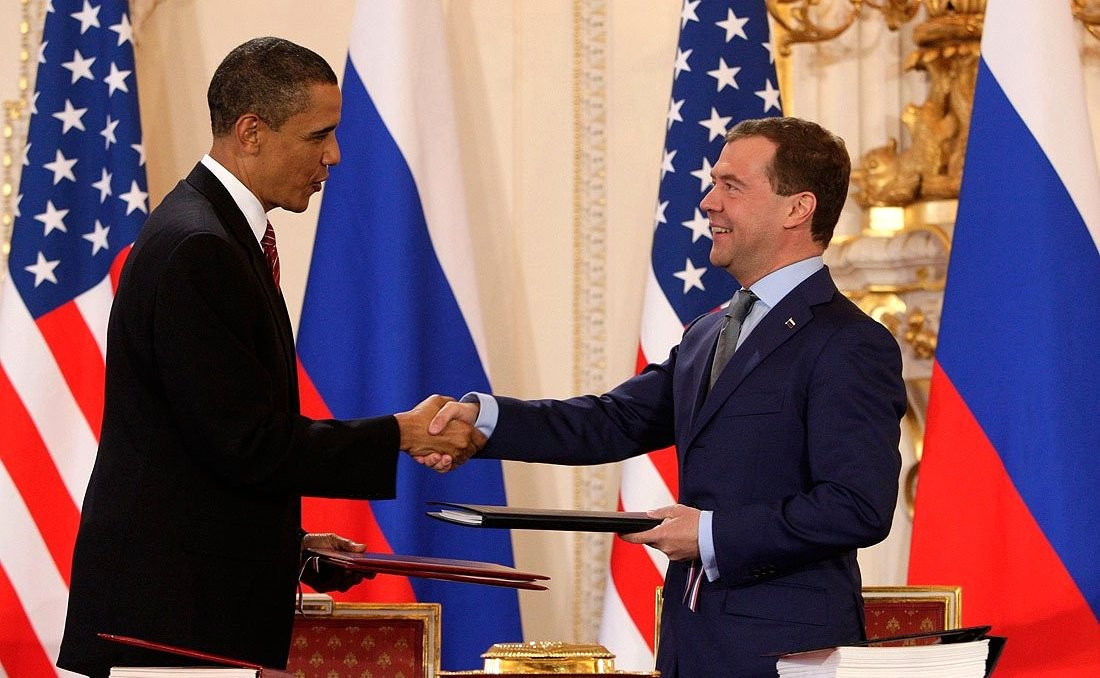
U.S. President Barack Obama and Russian President Dmitry Medvedev after signing the New START treaty in Prague, April 2010. (Kremlin.ru, CC BY 4.0, Wikimedia Commons)
Good background information provided here by Ritter on Putin’s decision to suspend Russia’s participation in the New START Treaty. – Natylie
The backstory to New START is important, especially in the context of Putin’s declaration regarding Russia’s suspension. The core of that backstory is missile defense.
In December 2001, then-President George W. Bush announced that the United States was withdrawing from the landmark 1972 anti-ballistic missile (ABM) treaty, which banned (with limited exception) the development and deployment of missile defense systems designed to shoot down intercontinental ballistic missiles (ICBMs).
The ABM treaty set in stone the Cold War concept of mutually assured destruction, or MAD, the idea that no side possessing nuclear weapons would use them against another nuclear power for the simple reason that to do so would bring about their own demise through guaranteed nuclear retaliation.
“The backstory to New START is important, especially in the context of Putin’s declaration regarding Russia’s suspension. The core of that backstory is missile defense.”
The insanity of MAD helped pave the way for all arms control agreements that followed, from the Strategic Arms Reductions Talks (SALT), to the Intermediate-range Nuclear Forces (INF) treaty and on to the various iterations of Strategic Arms Reduction treaties (START).
Putin condemned the U.S. decision to withdraw from the ABM treaty as “a mistake.” At the time, U.S. and Russian strategic nuclear arsenals were subject to the limitations imposed by the 1991 START treaty. Efforts to further reduce U.S. and Russian nuclear weapons were undertaken as part of the START II treaty.
But post-Cold War politics, combined with the U.S. decision to abandon the ABM treaty, left the treaty signed but unratified, effectively killing it.
Similar issues helped conspire to kill the START III treaty in the negotiation stage. The narrowly focused Strategic Offensive Reductions Treaty, or SORT, which was signed in 2002, committed both the U.S. and Russia to additional reductions beyond those mandated by START I, but contained no verification or compliance mechanisms.
The START I treaty expired in 2009, and SORT in 2012. New START was intended to replace both agreements.
The Medvedev Presidency
One of the sticking points has been the issue of missile defense. Under President Putin, Russia refused to enter any new substantive arms control treaty (SORT was more informal agreement than treaty in structure and substance) that did not meaningfully address missile defense.
But in May 2008, Dmitry Medvedev took over as Russian president. The Russian constitution prohibited a president from serving more than two consecutive terms in office, and so, with Putin’s support, Medvedev ran for Russia’s highest office, and won. Putin was subsequently appointed prime minister.
While the Bush administration sought to negotiate a follow-on treaty to the soon-to-be expired START I, Medvedev proved to be every bit as reluctant to entering any agreement with the U.S. that did not include limitations on missile defense, something President Bush would not accept.
In the end, the problem of negotiating a new treaty would be left to the administration of Barack Obama, who assumed office in January 2009.
In their first meeting, in London in late March 2009, the two leaders issued a statement in which they agreed “to pursue new and verifiable reductions in our strategic offensive arsenals in a step-by-step process, beginning by replacing the Strategic Arms Reduction Treaty with a new, legally-binding treaty.”
As for missile defense, Obama and Medvedev agreed to treat it as a separate issue. “While acknowledging that differences remain over the purposes of deployment of missile defense assets in Europe,” the statement read, “we discussed new possibilities for mutual international cooperation in the field of missile defense, taking into account joint assessments of missile challenges and threats, aimed at enhancing the security of our countries, and that of our allies and partners.”
Let there be no doubt — the New START treaty that was negotiated between Russia and the United States, while singularly focused on reducing strategic offensive nuclear arsenals, contained a clear understanding that this treaty would be followed by a good-faith effort by the U.S. to address Russia’s longstanding concerns over missile defense.
This was reflected in the exchange of non-binding unilateral statements attached to the New START treaty. The “Statement of the Russian Federation Concerning Missile Defense” set out the position that New START “may be effective and viable only in conditions where there is no qualitative or quantitative build-up in [U.S. missile defense system capabilities].”
Moreover, the statement said any build-up in U.S. missile defense capabilities which gave “rise to a threat to [Russia’s strategic nuclear force potential]” would be considered one of the “extraordinary events” mentioned in Article XIV of the treaty and could prompt Russia to exercise its right of withdrawal.
For its part, the United States issued its own statement declaring that U.S. missile defenses “are not intended to affect the strategic balance with Russia” while declaring that it intended “to continue improving and deploying its missile defense systems in order to defend itself against limited attack.”
“… the statement said any build-up in U.S. missile defense capabilities which gave ‘rise to a threat’ … could prompt Russia to exercise its right of withdrawal.”
The agreements reached between Obama and Medvedev, however, was not necessarily acceptable to Putin. According to Rose Gottemoeller, the U.S. negotiator for New START, Putin, as prime minister, nearly scuttled the talks when, in December 2009, he once again raised the issue of missile defense.
“They [the Russians] were going to have a critical National Security Council meeting,” Gottemoeller later recounted in an October 2021 talk with the Carnegie Council, “and the story I have heard told is that Putin, for the first time showing some interest in these negotiations, walks into the National Security Council meeting and simply draws lines through all the issues on this decision sheet and said, ‘No, no, no, no, no.’”
Gottemoeller went on to describe how Putin then travelled to Vladivostok and delivered a speech where he denounced the treaty as “totally inadequate,” criticizing both the U.S. and Russian negotiating teams as being “only focused on limiting strategic offensive forces,” noting that “they are not limiting missile defense. This treaty is a waste of time,” Gottemoeller quoted Putin. “We should get out of the negotiations.”
According to Gottemoeller, Medvedev stood up to Putin, telling his prime minister, “No, we are going to continue these negotiations and get them done.”
Broken Promise
Anatoly Antonov was the Russian negotiator for New START. He dutifully complied with his instructions from the Kremlin to craft a treaty focused on the reduction of strategic offensive weapons, working under the assumption that the U.S. would be as good as its word when it came to engaging in meaningful negotiations on missile defense.
And yet, less than a year after New START entered into force, Antonov found that the U.S. had no intention on following through on its promises.
In an interview with Kommersant newspaper, Antonov said that talks with NATO on a planned Western European missile-defense system had reached “a dead end,” adding that NATO proposals were “vague” and that the promised participation of Russia in the proposed system “is not even up for discussion.”
Antonov indicated that the lack of good faith shown by the U.S. regarding missile defense could lead to Russia withdrawing from the New START treaty altogether.
While the U.S. did offer to let Russia observe specific aspects of a specific test of a U.S. missile interceptor, the offer never amounted to anything, with the U.S. downplaying the abilities of the SM-3 missile when it came to intercepting Russian missiles, noting that the missile lacked the range to be effective against Russian missiles.
The late Ellen Tauscher, who at the time was the U.S. undersecretary of state for arms control and international security, had offered Antonov written assurances that the Mk. 41 Aegis Ashore system, which would employ the SM-3 missile interceptor, was not directed against Russia.
However, Tauscher said, “We cannot provide legally binding commitments, nor can we agree to limitations on missile defense, which must necessarily keep pace with the evolution of the threat.”
Tauscher’s words were prophetic. In 2015, the U.S. began testing the SM-3 Block IIA interceptor against ICBM targets. The SM-3 did, in fact, have the range to shoot down Russian intermediate- and intercontinental-range missiles.
And now those missiles were to be stationed on bases constructed in Poland and Romania, two former Warsaw Pact nations that were closer to the border with Russia than NATO forces had ever been.
The Americans had negotiated in bad faith. Putin, it turned out, had been right to question a strategic arms control treaty that did not consider Russia’s concerns over missile defense.
And yet this did not weaken Putin’s commitment to fulfilling New START. According to Gottemoeller,
“Putin, since this treaty has been signed, has taken a very positive stance about it. Since the treaty has entered into force, he has called it repeatedly publicly the ‘gold standard’ of nuclear treaties and has supported it…I know that he has been committed to the treaty and really committed to the efforts underway now in this strategic stability dialogue to get some new negotiations going.”
But Putin’s assiduous adherence to New START did not mean that the Russian leader had stopped worrying about the threat posed by U.S. missile defense. On March 1, 2018, Putin delivered a major address to the Russian Federal Assembly — the same forum he spoke to on Tuesday. His tone was defiant:
“I want to tell all those who have fueled the arms race over the last 15 years, sought to win unilateral advantages over Russia, and introduced unlawful sanctions aimed at containing our country’s development — everything that you wanted to impede with your policies has already happened. You have failed to contain Russia.”
Putin then unveiled several new Russian strategic weapons, including the Sarmat heavy ICBM and the Avangard hypersonic vehicle, which he said were developed in direct response to the U.S. withdrawal from the ABM treaty.
Putin said Russia had warned the U.S. that it would take such measures back in 2004. “No one listened to us then,” Putin declared. “So listen to us now.”
One of the people listening was Rose Gottemoeller. “[P]eople are worried about … the new so-called exotic weapons systems that President Putin rolled out in March of 2018,” the former arms control negotiator, by then retired, said in 2021. “[T]wo of them are already under the limits New START, the so-called Sarmat heavy [ICBM] and also the Avangard, which is their first strategic-range hypersonic glide vehicle that they are getting ready to deploy. They have already said that they will bring it under the New START Treaty.”
Gottemoeller noted that any future arms control agreement would be seeking constraints on these systems.
Treaty Extension in 2021
The New START Treaty was extended for a five-year term in February 2021, even though the Russians believed that the “conversion or elimination” procedures used by the U.S. to determine whether B-52H bombers and Ohio-class submarines converted from nuclear- to non-nuclear use, or eliminated altogether, were insufficient.
The Russians hoped that these issues could be worked out using the treaty-mandated Bilateral Consultative Commission (BCC) process, which meets twice a year to resolve issues such as these.
One of the problems facing both the U.S. and Russian inspectors and negotiators, however, was the Covid-19 pandemic. In early 2020, both sides agreed to suspend on-site inspections and BCC meetings due to the pandemic. By mid-2021, U.S. and Russian negotiators began discussing the creation of joint Covid protocols that could get both inspections and BCC consultations up and running.
But then came Ukraine.
On March 9, 2022, the U.S., U.K. and European Union all passed sanctions which banned Russian aircraft form overflying their respective territories and placed visa restrictions on Russians transiting EU or the U.K. en route to the United States. According to the Russians, these restrictions effectively prohibit the dispatch of weapons-inspection teams to the U.S. using New START short-notice inspection protocols, which have strict treaty-mandated timelines attached to their implementation.
“By mid-2021, U.S. and Russian negotiators began discussing the creation of joint Covid protocols that could get both inspections and BCC consultations up and running. But then came Ukraine.”
In June 2022, the U.S. unilaterally declared that the moratorium on inspections imposed because of the Covid-19 pandemic was no longer in effect. On Aug. 8, 2022, the U.S. attempted to dispatch a short-notice inspection team to Russia to carry out treaty-mandated inspection tasks.
Russia denied entry to the team, and accused the U.S. of trying to gain a unilateral advantage by conducting on-site inspections while Russia could not. Citing the restrictions imposed by sanctions, the Russia Foreign Ministry said “there are no similar obstacles to the arrival of American inspectors in Russia.”
To resolve the impasse over inspections as well as other outstanding treaty-implementation issues, Russian and U.S. diplomats began consultations on convening a meeting of the BCC, and eventually were able to settle on a Nov. 29, 2022, date in Cairo, Egypt. Four days before the BCC was supposed to begin, however, Russia announced that the meeting was off.
Russian Deputy Foreign Minister Sergei Ryabkov, in statements made to Kommersant, said that the war in Ukraine was at the heart of the decision. “There is, of course, the effect of what is happening in Ukraine and around it,” Ryabkov said. “I will not deny it. Arms control and dialogue in this area cannot be immune to what is around it.”
Arms Control Could Be Dead
The State Department issued an official report to Congress on Russian compliance with New Start in early 2023 which accused Russia of violating the New START treaty by refusing U.S. inspectors access to sites inside Russia.
Russia, a State Department spokesperson stated, was “not complying with its obligation under the New START Treaty to facilitate inspection activities on its territory,” noting that “Russia’s refusal to facilitate inspection activities prevents the United States from exercising important rights under the treaty and threatens the viability of U.S.-Russian nuclear arms control.”
The insensitivity of the U.S. side to the impact of its actions targeting Russia — sometimes literally — as part of the overall U.S. response to Putin’s initiation of the Special Military Operation in February 2022 is, however, telling.
In his Feb. 21, 2022, address, Putin highlighted the role played by the U.S. and NATO in facilitating the Ukrainian use of Soviet-era drones to carry out an attack on a base near Engels, Russia, that housed Russia’s strategic aviation assets, including nuclear-capable bombers. He also pointed out that he had just signed orders for the Sarmat and Avangardsystems to become operational and, as such, inspectable under the terms of New START.
“The United States and NATO are directly saying that their goal is to inflict a strategic defeat on Russia,” Putin said. “Are they going to inspect our defense facilities, including the newest ones, as if nothing had happened? Do they really think we’re easily going to let them in there just like that?”
Rose Gottemoeller observed that the U.S. is “not going to change our policy on Ukraine because he’s [Putin] in a hissy fit over the New START treaty. That’s just not going to happen.”
But Putin’s stance is far more principled than a simple “hissy fit.” Born of the original sin perpetrated by the U.S. in withdrawing from the ABM treaty, Putin’s angst is directly tied to the deceit displayed by U.S. officials — including Gottemoeller — when it came to assurances given Dmitry Medvedev about missile defense during the New START negotiations.
This deceit led to Russia deploying new categories of strategic nuclear weapons — the Sarmat and Avangard — to defeat U.S. missile defense systems, including those that had been forward deployed into Europe.
And now, with the war in Ukraine being linked to a U.S. strategy of achieving the strategic defeat of Russia, the U.S. is seeking to use New START to gain access to these very systems, all the while denying Russia its reciprocal rights of inspection under the treaty. As Putin aptly noted, such an arrangement “really sounds absurd.”
The inability and/or unwillingness of either party to compromise on New START means that the treaty will remain in limbo for the indefinite future which, given that the treaty expires in February 2026, means there is a distinct possibility arms control between the U.S. and Russia is dead.
Risk of New Arms Race
While the U.S. and Russia had previously committed to a follow-on treaty to replace New START, the ongoing conflict between Russia and Ukraine poses a nearly insurmountable obstacle for anyone seeking to have such a treaty document ready for signature and ratification by the time New START expires.
There is a good chance the U.S. and Russia, in two years’ time, will find themselves without any verifiable mechanism to assuage the fears and uncertainty about the two parties’ respective nuclear arsenals, leading to the real possibility — if not probability — that they will both embark on an unconstrained arms race fueled by ignorance-based angst that could very well result in the kind of misunderstandings, mistakes, or miscalculations that could trigger a nuclear war and, in doing so, end all humanity.
“The truth is behind us,” Putin said, closing out his address to the Russian Federal Assembly.
So, too, may be humanity’s last chance to prevent nuclear calamity, if a way can’t somehow be found to get arms control back on the agenda.
Here, Gottemoeller’s assertion that the U.S. would not alter its Ukraine policy to save New START underscores the self-defeating reality of the Biden administration’s efforts to arm Ukraine.
The sooner the war in Ukraine is over, the sooner the U.S. and Russia can get down to the business of preserving arms control as a viable part of the relationship between the two nations.
By seeking to extend the Ukraine conflict, however, the U.S. is in effect engaging in an act of self-immolation that threatens to engulf the world in a nuclear holocaust.
During the Vietnam War, the noted correspondent Peter Arnett quoted an unnamed U.S. Army officer as saying, “We had to destroy the village to save it.” With regard to the linkage that has been created between Ukraine and arms control, the same sick logic now applies — to save one, the other must be destroyed.
To save Ukraine, arms control must be destroyed.
To save arms control, Ukraine must be destroyed.
One sacrifices a nation, the other a planet.
This is the Hobson’s Choice U.S. policy makers have created, except it is not.
This doesn’t necessarily reflect my view of the situation, but it’s an interesting analysis. – Natylie
Joe Lauria is editor-in-chief of Consortium News and a former U.N. correspondent for The Wall Street Journal, Boston Globe, and numerous other newspapers, including The Montreal Gazette and The Star of Johannesburg.
In his impassioned address to the United Nations Security Council on Wednesday, in which he appealed to the council’s humanity to bring about a ceasefire in Ukraine, British rock legend Roger Waters called Russia’s military action “illegal.”
That has gotten some attention and raised the question again of the legality of the military operation according to international law. As is often the case with law, the question is not as simple as it might seem.
What the Charter Says
The U.N. Charter has something to say about the legal use of military force. It allows it in two cases: when it is authorized by the Security Council and when it is legitimately used in self-defense. Council authorization for force is contained in Chapter VII, Article 42:
“Should the Security Council consider that measures provided for in Article 41 [economic sanctions] would be inadequate or have proved to be inadequate, it may take such action by air, sea, or land forces as may be necessary to maintain or restore international peace and security. Such action may include demonstrations, blockade, and other operations by air, sea, or land forces of Members of the United Nations.”
The second instance allowing armed force is in self-defense, explained in Chapter VII, Article 51:
“Nothing in the present Charter shall impair the inherent right of individual or collective self-defence if an armed attack occurs against a Member of the United Nations, until the Security Council has taken measures necessary to maintain international peace and security. Measures taken by Members in the exercise of this right of self-defence shall be immediately reported to the Security Council and shall not in any way affect the authority and responsibility of the Security Council under the present Charter to take at any time such action as it deems necessary in order to maintain or restore international peace and security.”
So, on these narrow legal grounds, the U.N. Charter only permits the use of force after authorization by the Security Council or in self defense by a “member state.” Russia entered the eight-year Ukrainian civil war on Feb. 24, 2022 to defend against attacks against the majority-ethnic Russian oblasts of Donetsk and Luhansk, which had declared independence from Ukraine in 2014.
Russia only recognized their independence on Feb. 21, 2022, three days before its intervention. It intervened without authorization from the Security Council, where the U.S., Britain and probably France would have vetoed it.
As the self-defense article pertains only to U.N. member states, it could not apply to Donetsk and Luhansk. Russia is a member state but the article says “if an armed attack occurs” against it, and there was at the time no armed attack against Russia.
So according to the U.N. Charter, Russia’s military intervention was not legally authorized.
Montevideo Convention
However, states are not prohibited by the Charter to request the presence of foreign forces on their territory. There is no language in the Charter about it. Officially inviting foreign forces onto one’s territory would not be considered an illegal occupation. Article 42 of the 1907 Hague Convention says:
“Territory is considered occupied when it is actually placed under the authority of the hostile army.”
The Russian army is certainly not seen as hostile in Donetsk and Luhansk. The murkiness of the legal issue arises then on the question of whether Donetsk and Luhansk were independent states in February of last year — states that could invite foreign forces onto its territory — or were they at the time still part of Ukraine? (Ukraine and the West argue they still are today. The republics passed referenda in September 2022 to join the Russian Federation.)
So what makes an independent state? According to the Montevideo Convention of 1933, “The state as a person of international law should possess the following qualifications:
a permanent population;
b. a defined territory;
c. government; and
d. capacity to enter into relations with the other states.”
This is key: Article 3 of the convention adds, “The political existence of the state is independent of recognition by the other states.” That means no other other country has to recognize their independence if the above criteria are met.
Donetsk and Luhansk met the four requirements of the Convention including capacity to enter into relations with other states, as it has relations with the Russian Federation. The Convention says a state need not be recognized by other states. They have been recognized by Russia, Syria and North Korea.
So the Russian intervention is considered illegal under the U.N. Charter because it was not authorized by the Security Council nor does it meet the test of the self-defense Article 51.
But the Charter does not prohibit a state from inviting foreign forces onto its territory. A legal argument based on the Montevideo Convention can be made that the two territories were independent states at the time of Russia’s intervention and had the right to request foreign forces to enter their territory. In that sense, Russia’s military action in February a year ago was legal.