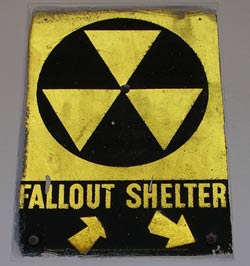
A recurring feature of the Cold War was that the United States almost always placed great store on the optics of a Soviet-American affair while Moscow chose to concentrate on the end result. The Cuban Missile Crisis is the best known example where the denouement was about the publicized abandonment of the planned Soviet deployment of missiles in Cuba and a US public declaration and agreement not to invade Cuba again. But it later came to be known that there was also an unpublicised part, namely, the dismantling of all of the Jupiter ballistic missiles that had been deployed to Turkey.
The behavioral pattern remains the same in Ukraine. Per the western narrative, Russia is staring at the abyss of defeat amidst the “rout” in Kharkov Region. Interestingly, though, at the responsible levels in the Beltway, there is a noticeable reticence about beating the drums presumably because of their awareness that the Ukrainian forces simply re-entered the Balakleysko-Izyum direction to occupy areas that the Russians had planned to vacate.
Moscow is once again leaving the optics almost entirely to the American journalists while Moscow concentrates on the end result, which has had three dimensions: one, complete the ongoing evacuation from the Balakleysko-Izyum direction without loss of lives; two, exploit the Ukrainian troop movements to target the forces that came out into the open from well-fortified positions in the Kharkov Region; and, three, concentrate on the campaign in Donetsk.
The last part is becoming very sensitive for Moscow, as a significant section of Russian “war correspondents” carried sensational reports that it is apocalypse now. Even senior politicians such as Gennady Zyuganov, General Secretary of the Communist Party, and a powerful voice in the State Duma, feels agitated.
Zyuganov said at the first plenary meeting of the Russian State Duma’s fall session on Tuesday that the “special operation” has grown into a full-fledged war and the situation on the front has “changed drastically” in the past couple of months.
A fragment of the speech posted in the Communist Party’s website also quoted Zyuganov as saying that “every war requires a response. First and foremost, it requires maximum mobilization of forces and resources. It demands social cohesion and clear prioritisation.”
Although intended as constructive criticism, Zyuganov’s advice will almost certainly be passed over by the Kremlin. Russian presidential spokesman Dmitry Peskov has responded with alacrity, saying,“At this moment — no, it (full or partial mobilization) is not on the agenda.”
President Putin’s support base remains as strong as ever. The recent Russian regional and local elections partly turned into a “referendum” on the Ukraine situation. And the fact that the ruling party received one of the best results in its history by winning about 80 percent of the mandates in regional and local parliaments shows a resounding vote of confidence in Putin’s leadership.
That said, the “angry patriots” pose a headache. That is why the latest situation around Bakhmut in Donetsk assumes particular significance. Bakhmut is undoubtedly the lynchpin of the entire fortification that Kiev erected in Donbass in the past 8 years. It is a strategic communication junction with roads in many directions — Lysychansk, Horlivka, Kostiantynivka, and Kramatorsk — and control of the city is vital for establishing full supremacy over Donetsk Region.
The Russian troops and allied militia groups have been trying since August 3 to break into the Ukrainian defenses in the Bakhmut-Soledar direction but with patchy success. Now comes reports that the Russians have entered Bakhmut city and taken control of the industrial zone in the northeastern parts.
Some reports say the Russian military contractors known as the Wagner Group have been deployed in Bakhmut. These are highly trained ex-military personnel.
The stakes are exceedingly high. For Kiev, the entire logistics of the operations in Donetsk can unravel if it loses control of Bakhmut. As for the Russians, the breakthrough in the Bakhmut-Soledar direction will clear the main hurdle for the crucial offensive towards the Slavyansk-Kramatorsk axis to the west, the last conglomeration of Ukrainian forces in Donetsk. Bakhmut is only 50 kms from Slavyansk-Kramatorsk.
Speaking about the Ukrainian “counteroffensive” last weekend to National Public Radio, General Mark Milley, US chairman, Chiefs of Staff, had made some interesting points:
-Ukraine has amassed a good amount of combat power. How do they use that will now be the determining factor. Things will clarify “in the coming days and weeks.”
-Ukrainian military so far fought extraordinarily well in defence. Defense has always been the stronger form of war.
-Ukraine is now moving into offensive operations where it is critical to integrate fire power into their manoeuvre in order to achieve superiority.
-Therefore, “it remains to be seen” what is happening in the next few weeks. “It is a very, very difficult task that the Ukrainians are undertaking” – combining their offence with manoeuver.
The Ukrainian offensive in Kharkov was planned as a flank attack to encircle and destroy the Russian groupings in the area of Balakleya, Kupyansk and Izyum. But the Russian command anticipated such an attempt, as its frontline had thinned out lately. The Ukrainian forces outnumbered the Russians by almost 4-5 times.
Interestingly, in anticipation of a Ukrainian offensive, civilians who agreed to leave the region for Russia were evacuated from the threatened settlements in military convoys. Using mobile defense tactics under the cover of specially organized units, Russians finally succeeded in withdrawing their forces.
In effect, the Ukrainian/US/NATO plan to manoeuvre a flank attack and encircle the Russian troops was thwarted with minimal losses. On the other hand, Ukrainians also admit that Russians inflicted significant losses of manpower on their opponents (who included a big chunk of fighters from NATO countries.)
But the Russian military also made mistakes. Thus, their forward positions were not mined—inexplicably enough; frontline intelligence gathering was deficient; and, the residual Russian troops (drawn down to one-third of full strength) were not even equipped with anti-tank weapons.
The single biggest outcome of the past week’s happenings is that the conflict has assumed the nature of a full-fledged war. Zyuganov was not off the mark when he said in his Russian state Duma speech: “The military-political operation… has escalated into a full-fledged war, which has been declared against us by the Americans, NATO members, and a unified Europe.
“A war is fundamentally different from a special operation. A special operation is something you announce – and something you can choose to put an end to. A war is something you can’t stop even if you want to. You have to fight to the end. War has two possible outcomes: victory or defeat.”
Putin has a big decision to make now. For, while the good part for the Russian military may be that the frontline has been straightened and large Russian reserves are being transferred to the battlefields, de facto, a state of war exists now between Russia and NATO.
The recent phone calls to Putin in quick succession by French President Emmanuel Macron and German Chancellor Olaf Scholz, after an interlude of months, signals that an exigency may have arisen to re-engage the Kremlin leader.
The proposal emphasizes Ukraine’s desire to become a NATO member and says that until Kyiv joins the Western military alliance, it needs security guarantees from other countries.
The document says that the “strongest security guarantee for Ukraine lies in its capability to defend itself.” It says building up a sufficient defensive force requires “a multi-decade effort of sustained investment in Ukraine’s defense industrial base, scalable weapons transfers and intelligence support from allies, intensive training missions and joint exercises under the European Union and NATO flags.”
The security guarantees Ukraine seeks from other countries is a commitment for them to support Ukraine’s ability to create this force to deter future attacks through military aid, funding of reconstruction, training, intelligence sharing, and joint exercises.
According to the document, the countries Ukraine wants security guarantees from include but are not limited to “the US, UK, Canada, Poland, Italy, Germany, France, Australia, Turkey, and Nordic, Baltic, and Central European countries.”
As part of this arrangement, Ukraine seeks a “massive training and joint maneuver program of Ukrainian forces and partners on Ukrainian territory with international trainers and advisors.”
Zelensky on Wednesday welcomed the plan, which was drawn up with the help of Anders Fogh Rasmussen, a former NATO secretary-general. Zelensky said that the report “should become the basis of the future security compact.”
Russia condemned the document as the threat of NATO expansion into Ukraine was one of its main motivations for launching the invasion. Russian Foreign Ministry spokeswoman Maria Zakharova pointed out that many of the proposals are already being implemented as Ukraine is receiving billions in aid from Western countries.
“Weapons have been supplied to Ukraine non-stop,” Zakharova said, according to the Russian news agency TASS. “The financial assistance being channeled to Ukraine in all of its forms, be it money transfers, or loans and so on, is unprecedented in recent history.”
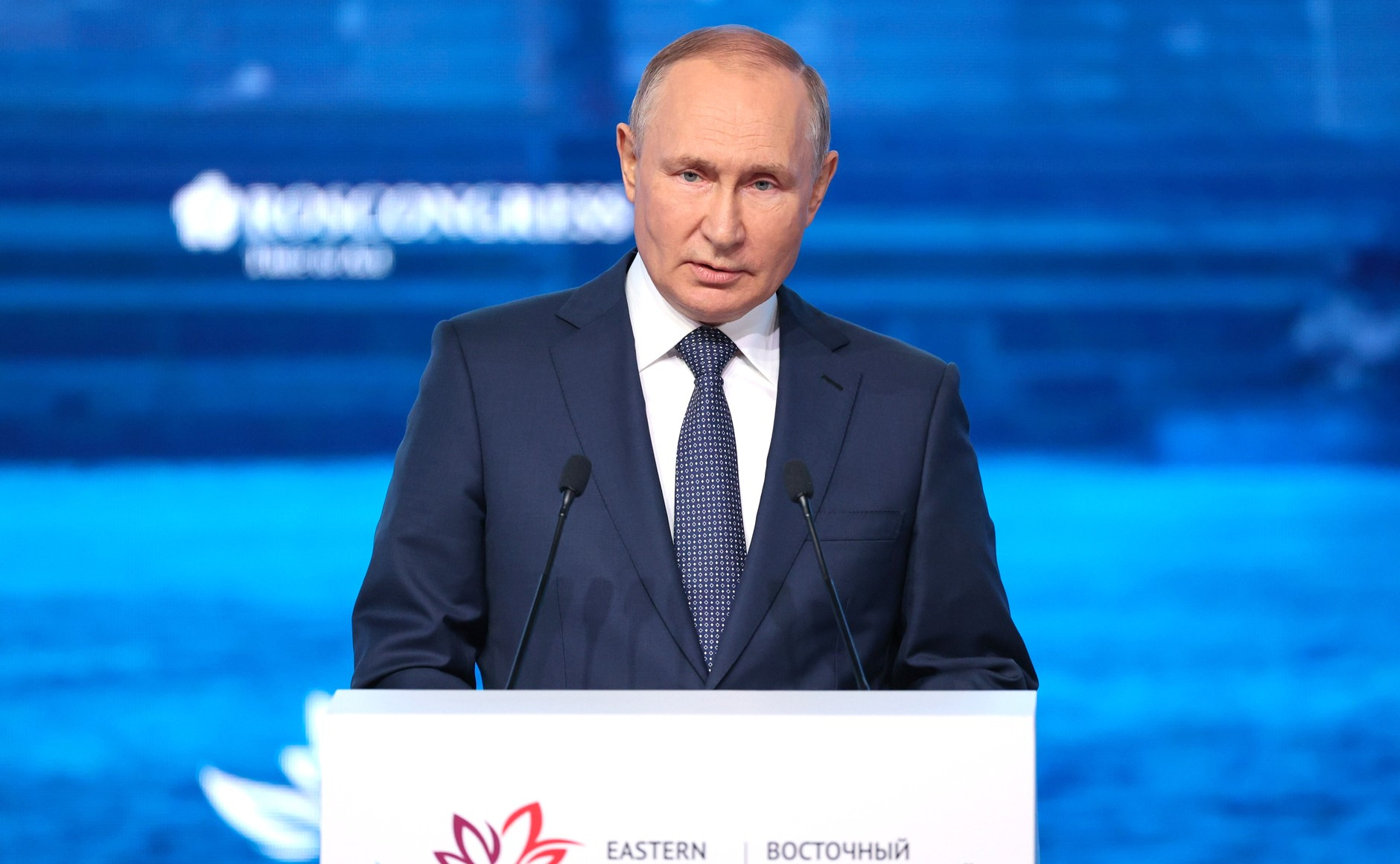
Addressing the Eastern Economic Forum plenary session. Photo: Bobylev Sergei, Host Photo Agency TASS
President of Russia Vladimir Putin: Friends, Mr Min Aung Hlaing, Mr Pashinyan, Mr Oyun-Erdene, Mr Li Zhanshu, ladies and gentlemen,
I am delighted to greet all participants and guests of the Eastern Economic Forum. Russia and Vladivostok are again hosting a forum of business leaders, experts, politicians, public figures and members of government from dozens of countries across the world.
Video addresses have been sent to us by Prime Minister of India Narendra Modi, Prime Minister of Malaysia Ismail Sabri Yaakob and Prime Minister of Vietnam Pham Minh Chinh. I am delighted that they have made time to take part in this plenary session.
As per tradition, the programme of the Eastern Economic Forum includes discussions on the projects and initiatives that are extremely important for the development of the regions in Russia’s Far East and for strengthening Russia’s cooperation and production ties with Asia Pacific countries, both our old, traditional partners and countries that are only developing dialogue with Russia in a broad range of areas and business projects.
Of course, this meeting in Vladivostok is a good opportunity to once again review the situation in the global economy and to exchange views on its main trends and risks.
Last year, the Eastern Economic Forum was held after a long pause caused by the coronavirus pandemic. At that time, the majority of experts agreed that global business activity was beginning to recover and that it would normalise soon after the lifting of the coronavirus restrictions, However, the pandemic has given way to new challenges, global ones that are threatening the world as a whole. I am referring to the Western sanctions frenzy and the open and aggressive attempts to force the Western mode of behaviour on other countries, to extinguish their sovereignty and to bend them to its will. In fact, there is nothing unusual in that: this policy has been pursued by the “collective West” for decades.
The waning dominance of the United States in the global economy and politics, as well as the stubborn unwillingness or even inability of the Western elites to see, let alone recognise objective facts, acted as a catalyst for these processes.
I have already mentioned that the entire system of international relations has recently undergone irreversible, or should I say, tectonic, shifts. Emerging states and regions around the world, primarily, of course, in the Asia-Pacific region, now play a substantially bigger role. Asia-Pacific countries emerged as new centres of economic and technological growth, attracting human resources, capital and manufacturing.
Despite all that, the Western countries are seeking to preserve yesterday’s world order that benefits them and force everyone to live according to the infamous “rules”, which they concocted themselves. They are also the ones who regularly violate these rules, changing them to suit their agenda depending on how things are going at any given moment. At the same time, other countries have not been forthcoming when it comes to subjecting themselves to this dictate and arbitrary rule, forcing the Western elites, to put it bluntly, to lose grip and take short-sighted, irrational decisions on global security, politics, as well as economics. All these decisions run counter to the interests of countries and their people, including, by the way, the people in those Western countries. The gap separating the Western elites from their own citizens is widening.
Europe is about to throw its achievements in building up its manufacturing capability, the quality of life of its people and socioeconomic stability into the sanctions furnace, depleting its potential, as directed by Washington for the sake of the infamous Euro-Atlantic unity. In fact, this amounts to sacrifices in the name of preserving the dominance of the United States in global affairs.
Back in spring, many foreign corporations rushed to announce their withdrawal from Russia, believing that our country will suffer more than others. Today, we see one manufacturing site after another shutting down in Europe itself. One of the key reasons, of course, lies in the severed business ties with Russia.
The competitive ability of European companies is in decline, for the EU officials themselves are essentially cutting them off from affordable commodities and energy, as well as trade markets. It will come as no surprise if eventually the niches currently occupied by European businesses, both on the continent and on the global market in general, will be taken over by their American patrons who know no boundaries or hesitation when it comes to pursuing their interests and achieving their goals.
More than that, in an attempt to obstruct the course of history, Western countries have undermined the pillars of the global economic system, built over centuries. It is in front of our eyes that the dollar, euro and pound sterling have lost trust as currencies suitable for performing transactions, storing reserves and denominating assets. We are taking steps to shed this dependence on unreliable and compromised foreign currencies. By the way, even allies of the United States are gradually reducing their dollar assets, as we can see from statistics. Step by step, the volume of transactions and savings in dollars is diminishing.
I want to note here that yesterday, Gazprom and its Chinese partners decided to switch to 50/50 transactions in rubles and yuan with respect to gas payments.
I want to add that with their short-sighted actions, Western officials have triggered a global inflation. In many developed economies, the inflation rate has reached a record-high level that had not been seen in many years.
Everybody is aware of this but I will reiterate: as of late July, inflation in the United States reached 8.5 percent. Russia has just over 14 percent (I will speak about this further) but it is declining, unlike in Western economies. The inflation there is on the rise, and in our country it is declining. I believe that as of the end of the year, we will have around 12 percent and, as many of our experts think, in the first quarter or by the second quarter of 2023, we will most likely reach the target inflation rate. Some say it will be 5–6 percent. Others say it will go down to 4 percent. We will see. In any case, the trend is positive. Meanwhile, what is happening with our neighbours? The inflation in Germany has reached 7.9 percent, in Belgium 9.9 percent, in the Netherlands 12 percent, Latvia 20.8 percent, Lithuania 21.1 percent and Estonia 25.2 percent. And it is still on the rise.
Rising prices in the global markets can be a real tragedy for most of the poorest countries, which are facing shortages of food, energy, and other vital goods. I will cite a few figures that underline the danger: while in 2019, according to the UN, 135 million people in the world were facing acute food insecurity, their number has soared by 2.5 times to 345 million by now – this is just horrible. Moreover, the poorest states have completely lost access to the most essential foods as developed countries are buying up the entire supply, causing a sharp increase in prices.
Let me give you an example. Most of the ships – you all know very well how high passions have been running, how much has been said about the need to facilitate the export of Ukrainian grain at all costs, to support the poorest countries. And we certainly had no other choice but to respond, despite all the complicated developments taking place around Ukraine. We did everything to ensure that Ukrainian grain was exported, and we certainly assumed – I met with the leaders of the African Union, with the leaders of African states and I promised them that we would make every effort to uphold their interests and would facilitate the export of Ukrainian grain.
Russia did it together with Turkiye. We did it. And I would like to report the result to you, colleagues: if we exclude Turkiye as an intermediary, all the grain exported from Ukraine, almost in its entirety, went to the European Union, not to the developing and poorest countries. Only two ships delivered grain under the UN World Food Programme – the very programme that is supposed to help countries that need help the most – only two ships out of 87 – I emphasise – transported 60,000 tonnes out of 2 million tonnes of food. That’s just 3 percent, and it went to the developing countries.
What I am saying is, many European countries today continue to act as colonisers, exactly as they have been doing in previous decades and centuries. Developing countries have simply been cheated yet again and continue to be cheated.
It is obvious that with this approach, the scale of food problems in the world will only increase. Unfortunately, to our great regret, this could lead to an unprecedented humanitarian disaster, and perhaps, exporters need to think about limiting their exports of grain and other food to this destination. I will certainly consult with President of Turkiye, Mr Erdogan, because together with him we were the ones who developed a mechanism for the export of Ukrainian grain, primarily, I repeat, to help the poorest countries. But what happened in practice?
I would like to stress once again that this situation has been caused by the reckless steps taken by the United States, the UK and the European Union, which are obsessed with illusory political ideas. As for the wellbeing of their own citizens, let alone people outside the so-called golden billion, they have been pushing it to the backburner. This will inevitably lead Western countries into a deadlock, an economic and social crisis, and will have unpredictable consequences for the whole world.
Colleagues,
Russia is coping well with the economic, financial and technological aggression of the West. I am talking about a real aggression; there is no other word for it. Russia’s currency and financial market has stabilised, inflation is going down, as I have already mentioned, and the unemployment rate is at an all-time historical low of less than 4 percent. The assessments and forecasts of our economic performance, including by businesspeople, are more optimistic now than in early spring.
I would like to say that our economic situation has stabilised overall, but we also see a number of problems in some sectors, regions and individual enterprises, especially those that relied on supplies from Europe or supplied their products there.
It is important to continue working with businesses to take prompt decisions and launch effective targeted support mechanisms. I would like to ask the Government Commission to Increase the Sustainability of the Russian Economy under the Sanctions to keep track of the situation. It is true that we are doing this almost on a daily basis. Nevertheless, despite the evidence of stabilisation I have mentioned, we are also aware of the risks and so we must keep an eye on them.
Russia is a sovereign state. We will always protect our national interests while pursuing an independent policy, and we also appreciate this quality among our partners, who have demonstrated their reliability and responsible attitude in the course of our trade, investment and other types of cooperation over many years. I am referring, as you are aware, to our colleagues from the Asia Pacific countries.
An absolute majority of Asia Pacific countries reject the destructive logic of sanctions. Their business relations are focused on mutual advantage, cooperation and the joint use of our economic capabilities to the benefit of our countries’ citizens. This adds up to a huge competitive advantage of the regional countries and a guarantee of their dynamic long-term development, which has been growing faster than the world’s average for a long time.
You are aware of this, but I would like to remind everyone that over the past 10 years Asian countries’ GDP has been increasing by approximately 5 percent every year, while the figure is 3 percent in the world, 2 percent in the US and 1.2 percent in the EU. But it is even more important that this trend persists. What will this ultimately lead to? As a result, the share of Asian economies in global GDP will grow from 37.1 percent in 2015 to 45 percent in 2027, and I am sure that this trend will persist.
It is important for Russia that the economy of the Russian Far East grows together with Asia Pacific economies, that this region provide modern living conditions, boost people’s incomes and well-being, and that it create high-quality jobs and cost-effective production facilities.
We have already tested unique national tax, administrative and customs privileges in the Far East. They help implement landmark projects, even by global standards, in such fields as natural gas conversion and the shipbuilding sector, bioengineering technologies and clean energy.
In the past seven years, industrial production volumes in the Far East have increased by about 25 percent. This exceeds nationwide levels by one third. I want to stress this: growth rates of industrial production in the Far East greatly exceed similar nationwide growth rates.
We will continue to promote the priority development of the Far Eastern regions by using new advanced state support measures and by creating the best and highly competitive business environment. For example, we intend to continue adjusting the mechanism of priority development areas for modern and joint projects with other countries, to create the best possible business climate for attracting the most advanced technologies to Russia and for manufacturing high value-added goods in the Far East.
Events of this year confirm the special significance of such a factor as accessible and affordable raw materials without which it is impossible to organise any production process or to set up co-production chains. Russia is just about the only country that is completely self-sufficient in terms of natural resources, and the Far East plays a substantial role here. This region is a highly important supplier of crude oil and natural gas, coal, metals, timber and marine biological resources to the domestic market and our foreign partners.
We are staking on the prudent and rational development of Russia’s natural riches under the most stringent environmental standards. First of all, we will refine all extracted raw materials domestically as much as possible. We will also use these raw materials to strengthen the sovereignty of this country, to ensure industrial security, to raise incomes and to develop the regions.
We have already protected the resource extraction industry from unfriendly actions. From now on, only companies with Russian jurisdiction have the right to develop natural resources in Russia.
The Ministry of Natural Resources and Environment together with the Ministry of Industry and Trade and leading business associations has determined the national economy’s demand for strategic raw materials. This information will become the foundation of the revised Strategy for the Development of Russia’s Mineral Resources Base with an extended planning horizon up to 2050.
At the same time, special focus should be placed on geological exploration and processing of rare raw materials (such as titanium, manganese, lithium, and niobium), which are used in metallurgy, medical and chemical industries, microelectronics, aircraft manufacturing and other industries, as well as in new energy storage and transmission technologies.
I would like to separately ask the Government to have a look at the bioresources harvesting sphere, where we have a mechanism of investment quotas. Here, it is important to achieve balanced growth and full utilisation of production capacities, as well as to ensure the harmonious development of the regions’ infrastructure.
I would like to stress that the funds the state receives from the utilisation of water bioresources must above all be allocated for developing the infrastructure of rural areas, employment support, and increasing incomes of local residents. I ask the Government to take specific measures on this. We have discussed this many times.
Next, over the past years Russia has implemented big plans for the development of transport infrastructure, railways and roads, seaports and pipelines. These timely decisions have made it possible for businesses to quickly rebuild logistics in today’s conditions, and redirect cargo flows to those countries that are ready and willing to trade with Russia and prefer civilised and predictable business relations.
It is noteworthy that despite the attempts of external pressure, the total cargo of Russian seaports has only slightly decreased over the seven months of this year; it has remained at the same level as a year earlier, which is about 482 million tonnes of cargo. Last year there were 483 million, so the figure is practically the same.
At the same time, Far Eastern ports are seeing a real logistics boom. The volume of cargo transhipment and container handling is such that specialists are working 24/7 to handle the workload. In a word, no matter how much someone might like to isolate Russia, it is impossible to do it, as we have always said so. It is enough just to look at the map.
We will use natural competitive advantages to build up our further transport capabilities, expand the road and railway network, build new access roads to sea terminals and expand their capacity.
I mentioned earlier that our focus is on building the eastward infrastructure and developing the North-South international corridor and ports of the Azov-Black Sea basin which we will keep working on. They will open up more opportunities for Russian companies to enter the markets of Iran, India, the Middle East and Africa and, of course, for reciprocal deliveries from these countries.
The total volume of freight and cargo transportation along these routes and arteries will be able to grow by about 60 percent by 2030. We are absolutely realistic about our predictions, and this is how it will be. To achieve these numbers, the Government has drafted specific “roadmaps” in the three areas I outlined earlier, which will enable us to make this work consistent, consolidate and coordinate our efforts in terms of deadlines and capacity to break up the bottlenecks and upgrade border checkpoints and related infrastructure.
In addition to our plans to expand transport corridors, it is important to put in place new rolling stock and railway traction vehicles, to provide Russian shipyards with orders for modern high-quality tankers, dry cargo ships and container vessels, including ice-class ships, for the further expansion of the Northern Sea Route as a potent transport corridor of national and global importance with, I want to stress this, year-round navigation. The state-of-the-art icebreakers that we are designing and building make it possible for us to do this already now.
This year, a container vessel made its first run between Murmansk and Kamchatka along the Northern Sea Route to reaffirm the reliability and safety of shipping operations in the Arctic zone.
Notably, the point is not just about authorising the passage of ships in the Arctic or simply connecting two destinations. What we need to do is make sure that ships are properly serviced and cargo is properly handled at each port along the route, and the traffic schedule is sustainable, predictable and reliable. Then, every Northern Sea Route waypoint and region will benefit from the logistics corridor. That is what we should be striving for.
The Government has approved a development plan for the Northern Sea Route until 2035 with plans to allocate 1.8 trillion rubles from various sources to implement it. As forecasted, the cargo traffic along this corridor will go from the current 35 million tonnes per year to the targeted 220 million tonnes per year.
The availability of freight vehicles is certainly a key factor in the transportation of goods to and from the Russian Far East. This means we need to offer economically justified and competitive freight rates. I am asking the Government to study all these issues carefully.
Aviation is a special issue for the Far East. Here, the availability of flights from the European part of Russia to the Far East is not the only issue, but connectivity between the Far Eastern regions themselves also matters – air services should cover as many destinations, cities and regions of the Far East as possible.
That is why we have established a single Far Eastern airline. It offers almost 390 destinations, some of them subsidised by the state. In the next three years, this airline’s traffic should increase, and the number of destinations will exceed 530. And as we could see after those flights were opened, these destinations are in great demand.
To implement these plans, we need to expand the company’s fleet, to make sure it has modern aircraft, including small aircraft. A decision has been made in this regard, and I ask the Government to strictly implement it.
I would like to note that in general, Russian air carriers will soon be thoroughly re-equipped. Our airlines, including Aeroflot, have placed the largest order package in modern history, for about 500 Russian-made mainline aircraft. By the way, as far as I know, the United Aircraft Corporation and Aeroflot have signed a respective agreement on the sidelines of this Eastern Economic Forum, and the figures in there are quite impressive – over a trillion, I think.
This high demand should become a powerful incentive for aircraft factories and design bureaux, for many related industries, including electronics and aircraft components, and, of course, for the schools training professional personnel including engineers and skilled blue-collar workers in the aviation industry.
I would like to add that a decision has been made on another sensitive issue for the Far East. I am referring to the development of air medical services and increasing the availability of medical care for people living in remote areas. Starting next year, we will more than double federal funding for these purposes, which means that the number of flights will also increase, and there will be faster and better provision of healthcare in the region.
Friends, colleagues,
All our decisions involving the economy and social sphere, all the mechanisms that we are implementing in the Far East have the same important purpose – to make this region a truly attractive place for living, studying, working, for starting families, to ensure that more children are born.
Several important initiatives in this regard have been included in the package of measures that the Government is now considering. One of them is to create an up-to-date environment for living, to improve the local cities and towns.
Let me remind you that at the last forum, we set a task to develop master plans for the development of the largest Far Eastern cities. These include all administrative centres of the regions, and cities with a population of over 50,000 people, as well as Tynda and Severobaikalsk, the key stations on the Baikal-Amur Mainline railway.
We had in mind an integrated approach to the development of communities, where plans for the modernisation of infrastructure, social facilities, and creation of public spaces and so on would be combined competently and conveniently, and economic and industrial projects would rely on thoroughly calculated business models.
In all cities, the initial task was to make strategic development plans. Master plans are already being actively developed on the basis of those strategic plans in 17 cities and metropolitan areas. One of them has to do with the development of the Petropavlovsk-Kamchatsky urban area, and the day before yesterday, we discussed this issue with our colleagues on the spot. Once again, I ask the Government to provide maximum assistance in implementing this and other master plans in order to have them unconditionally implemented.
Here, among other things, it is important to use tools such as the Far Eastern concession, the government’s infrastructure loans and infrastructure bonds. It is necessary to determine target limits for the Far East in these programmes. The funds should be used for urban development and improvement, and of course, for infrastructure, including the upgrade of existing networks and connections to utilities.
I would like to add that at the recent St Petersburg Economic Forum, I instructed the Government to allocate an additional 10 billion rubles annually for improvement projects in Russian cities. I think it would be right to channel half of this financing, that is, 5 billion a year, towards upgrading Far Eastern cities and towns with populations below 250,000.
Separate resources should also be allocated under all our main infrastructure development programmes for projects to modernise Far Eastern cities. I have already given such an instruction, and I ask you to ensure its implementation as quickly as possible. Target limits should be stipulated in the federal budget for the next three years.
Something else I would like to stress – we need to increase the volume of housing construction in the Far East, while also widely applying the most advanced ‘green’ and energy-efficient construction technologies.
This year, the Far Eastern Quarters programme was launched. Under this programme, developers will be able to take advantage of priority development areas, including tax and infrastructure benefits, which will reduce the cost of flats and the price of finished housing. This will increase the availability of housing for people. The plan is to build about 2.5 million square metres of housing by 2030 using this cost-reduction mechanism. I ask the regional authorities and the Ministry for the Development of the Russian Far East to hold the first tenders by the end of the year, to select developers and start designing and developing the residential buildings.
Next, the Far Eastern residents are entitled to special, preferential mortgage terms. As many as 48,000 families have already purchased new housing using mortgages with a rate of 2 percent. This year, we have expanded the Far Eastern mortgage programme so that doctors and teachers, regardless of their age, can apply for it along with young Far Easterners.
Let me remind you that the programme is planned until 2024. But given the demand and efficacy – and this programme is working effectively – I propose extending it until at least 2030. I hope that the Far Eastern residents will also appreciate this.
(Applause.)
A separate decision concerns the support of young professionals who come to the Far East or graduate from local educational institutions, get a job and consider local accommodation. As many as 10,000 rental apartments will be built for them. The rental rate will be significantly below the market level due to subsidies from the regional and federal budgets. The Government has already envisaged such a measure. I ask you to work out all the details in order to start building rental housing for young professionals without delay. And I would like to specifically point out that the location of this housing should be included in the development master plans for Far Eastern cities, which means all the necessary infrastructure should be available – in short, such accommodation should be convenient and enjoy demand.
I would like to note that the Far Eastern regions, like many other regions of the Russian Federation, are experiencing a shortage of workers today. We will also take several important steps to intensify personnel training in key competencies. Over 900 modern workshops will be opened in Far Eastern colleges by 2030, and in the near future, until the end of 2025, we will launch 29 production and educational clusters. In addition, businesses will receive compensation for employing young workers.
Another important area is improving the quality of higher education in the Russian Far East. The goal is to attract qualified instructors, upgrade facilities and equipment in higher education institutions, and provide grants to stimulate academic research and prospective developments in the crucial areas of the technological agenda.
There are network programmes for Far Eastern universities that connect education institutions in the region with the country’s leading universities such as St Petersburg State Marine Technical University, Moscow Aviation Institute and others. We will undoubtedly support this area of cooperation.
Finally, branches of the Russian Institute of Theatre Arts (GITIS), the National State Gerasimov Institute of Cinematography (VGIK) and the Boris Shchukin Theatre Institute will open in 2025 in the Russian Far East to train cultural and art workers. I would like to ask the Government to provide all necessary assistance.
I would like to note that the Far Eastern regions offer their own professional development initiatives. For example, the Agency for Strategic Initiatives in the Sakhalin Region supports a pilot project called Earning Money Together. Participants in the project will be able to undergo free additional training, receive career guidance and get help with starting a business. Based on the outcome of these pilot projects we will think about scaling up.
I also want to mention a training programme for a new generation of managers in the Far East. The programme focuses on cultivating a local pool of talent, and on integrating study programmes and internships in public offices and development institutions. This programme is already running and I suggest that the heads of all regions in the Far Eastern Federal District get involved.
Colleagues, I want to conclude my remarks by stressing once again that the modern global economy and the entire system of international relations is going through challenges. However, I believe that the logic of cooperation, aligning the potentials and mutual benefits that our countries and our friends in the region adhere to, will prevail no matter what. By reasonably taking advantage of the competitive sides and strengths of the Asia-Pacific countries, by creating constructive partnerships we will open new colossal opportunities for our peoples. We are ready to work together for the sake of a successful future. And we are grateful to our partners for participating in this work.
The Postil (TP): You have just published your latest book on the war in Ukraine—Operation Z, published by Max Milo. Please tell us a little about it—what led you to write this book and what do you wish to convey to readers?
Jacques Baud (JB): The aim of this book is to show how the misinformation propagated by our media has contributed to push Ukraine in the wrong direction. I wrote it under the motto “from the way we understand crises derives the way we solve them.”
By hiding many aspects of this conflict, the Western media has presented us with a caricatural and artificial image of the situation, which has resulted in the polarization of minds. This has led to a widespread mindset that makes any attempt to negotiate virtually impossible.
The one-sided and biased representation provided by mainstream media is not intended to help us solve the problem, but to promote hatred of Russia. Thus, the exclusion of disabled athletes, cats, even Russian trees from competitions, the dismissal of conductors, the de-platforming of Russian artists, such as Dostoyevsky, or even the renaming of paintings aims at excluding the Russian population from society! In France, bank accounts of individuals with Russian-sounding names were even blocked. Social networks Facebook and Twitter have systematically blocked the disclosure of Ukrainian crimes under the pretext of “hate speech” but allow the call for violence against Russians.
None of these actions had any effect on the conflict, except to stimulate hatred and violence against the Russians in our countries. This manipulation is so bad that we would rather see Ukrainians die than to seek a diplomatic solution. As Republican Senator Lindsey Graham recently said, it is a matter of letting the Ukrainians fight to the last man.
It is commonly assumed that journalists work according to standards of quality and ethics to inform us in the most honest way possible. These standards are set by the Munich Charter of 1971. While writing my book I found out that no French-speaking mainstream media in Europe respects this charter as far as Russia and China are concerned. In fact, they shamelessly support an immoral policy towards Ukraine, described by Andrés Manuel López Obrador, president of Mexico, as “We provide the weapons, you provide the corpses!”
To highlight this misinformation, I wanted to show that information allowing to provide a realistic picture of the situation was available as early as February, but that our media did not relay it to the public. My goal was to show this contradiction.
In order to avoid becoming a propagandist myself in favor of one side or the other, I have relied exclusively on Western, Ukrainian (from Kiev) and Russian opposition sources. I have not taken any information from the Russian media.
TP: It is commonly said in the West that this war has “proven” that the Russian army is feeble and that its equipment is useless. Are these assertions true?
JB: No. After more than six months of war, it can be said that the Russian army is effective and efficient, and that the quality of its command & control far exceeds what we see in the West. But our perception is influenced by a reporting that is focused on the Ukrainian side, and by distortions of reality.
Firstly, there is the reality on the ground. It should be remembered that what the media call “Russians” is in fact a Russian-speaking coalition, composed of professional Russian fighters and soldiers of the popular militias of Donbass. The operations in the Donbass are mainly carried out by these militias, who fight on “their” terrain, in towns and villages they know and where they have friends and family. They are therefore advancing cautiously for themselves, but also to avoid civilian casualties. Thus, despite the claims of western propaganda, the coalition enjoys a very good popular support in the areas it occupies.
Then, just looking at a map, you can see that the Donbass is a region with a lot of built-up and inhabited areas, which means an advantage for the defender and a reduced speed of progress for the attacker in all circumstances.
Secondly, there is the way our media portray the evolution of the conflict. Ukraine is a huge country and small-scale maps hardly show the differences from one day to another. Moreover, each side has its own perception of the progress of the enemy. If we take the example of the situation on March 25, 2022, we can see that the map of the French daily newspaper Ouest-France (a) shows almost no advance of Russia, as does the Swiss RTS site (b). The map of the Russian website RIAFAN (c) may be propaganda, but if we compare it with the map of the French Military Intelligence Directorate (DRM) (d), we see that the Russian media is probably closer to the truth. All these maps were published on the same day, but the French newspaper and the Swiss state media did not choose to use the DRM map and preferred to use a Ukrainian map. This illustrates that our media work like propaganda outlets.
Thirdly, our “experts” have themselves determined the objectives of the Russian offensive. By claiming that Russia wanted to take over Ukraine and its resources, to take over Kiev in two days, etc., our experts have literally invented and attributed to the Russians objectives that Putin never mentioned. In May 2022, Claude Wild, the Swiss ambassador in Kiev, declared on RTS that the Russians had “lost the battle for Kiev.” But in reality, there was never a “battle for Kiev.” It is obviously easy to claim that the Russians did not reach their objectives—if they never tried to reach them!
Fourthly, the West and Ukraine have created a misleading picture of their adversary. In France, Switzerland and Belgium, none of the military experts on television have any knowledge of military operations and how the Russians conduct theirs. Their “expertise” comes from the rumours from the war in Afghanistan or Syria, which are often merely Western propaganda. These experts have literally falsified the presentation of Russian operations.
Thus, the objectives announced as early as February 24 by Russia were the “demilitarization” and “denazification” of the threat to the populations of Donbass. These objectives are related to the neutralization of capabilities, not the seizure of land or resources. To put it bluntly, in theory, to achieve their goals the Russians do not need to advance—it would be enough if Ukrainians themselves would come and get killed.
In other words, our politicians and media have pushed Ukraine to defend the terrain like in France during the First World War. They pushed Ukrainian troops to defend every square meter of ground in “last stand” situations. Ironically, the West has only made the Russians’ job easier.
In fact, as with the war on terror, Westerners see the enemy as they would like him to be, not as he is. As Sun Tzu said 2,500 years ago, this is the best recipe for losing a war.
One example is the so-called “hybrid war” that Russia is allegedly waging against the West. In June 2014, as the West tried to explain Russia’s (imaginary) intervention in the Donbass conflict, Russia expert Mark Galeotti “revealed” the existence of a doctrine that would illustrate the Russian concept of hybrid warfare. Known as the “Gerasimov Doctrine,” it has never really been defined by the West as to what it consists of and how it could ensure military success. But it is used to explain how Russia wages war in Donbass without sending troops there and why Ukraine consistently loses its battles against the rebels. In 2018, realizing that he was wrong, Galeotti apologized—courageously and intelligently—in an article titled, “I’m Sorry for Creating the Gerasimov Doctrine” published in Foreign Policy magazine.
Despite this, and without knowing what it meant, our media and politicians continued to pretend that Russia was waging a hybrid war against Ukraine and the West. In other words, we imagined a type of war that does not exist and we prepared Ukraine for it. This is also what explains the challenge for Ukraine to have a coherent strategy to counter Russian operations.
The West does not want to see the situation as it really is. The Russian-speaking coalition has launched its offensive with an overall strength inferior to that of the Ukrainians in a ratio of 1-2:1. To be successful when you are outnumbered, you must create local and temporary superiorities by quickly moving your forces on the battlefield.
This is what the Russians call “operational art” (operativnoe iskoustvo). This notion is poorly understood in the West. The term “operational” used in NATO has two translations in Russian: “operative” (which refers to a command level) and “operational” (which defines a condition). It is the art of maneuvering military formations, much like a chess game, in order to defeat a superior opponent.
For example, the operation around Kiev was not intended to “deceive” the Ukrainians (and the West) about their intentions, but to force the Ukrainian army to keep large forces around the capital and thus “pin them down.” In technical terms, this is what is called a “shaping operation.” Contrary to the analysis of some “experts,” it was not a “deception operation,” which would have been conceived very differently and would have involved much larger forces. The aim was to prevent a reinforcement of the main body of the Ukrainian forces in the Donbass.
The main lesson of this war at this stage confirms what we know since the Second World War: the Russians master the operational art.
TP: Questions about Russia’s military raises the obvious question—how good is Ukraine’s military today? And more importantly, why do we not hear so much about the Ukrainian army?
JB: The Ukrainian servicemen are certainly brave soldiers who perform their duty conscientiously and courageously. But my personal experience shows that in almost every crisis, the problem is at the head. The inability to understand the opponent and his logic and to have a clear picture of the actual situation is the main reason for failures.
Since the beginning of the Russian offensive, we can distinguish two ways of conducting the war. On the Ukrainian side, the war is waged in the political and informational spaces, while on the Russian side the war is waged in the physical and operational space. The two sides are not fighting in the same spaces. This is a situation that I described in 2003 in my book, La guerre asymétrique ou la défaite du vainqueur (Asymmetric War, or the Defeat of the Winner). The trouble is that at the end of the day, the reality of the terrain prevails.
On the Russian side, decisions are made by the military, while on the Ukrainian side, Zelensky is omnipresent and the central element in the conduct of the war. He makes operational decisions, apparently often against the military’s advice. This explains the rising tensions between Zelensky and the military. According to Ukrainian media, Zelensky could dismiss General Valery Zoluzhny by appointing him Minister of Defence.
The Ukrainian army has been extensively trained by American, British and Canadian officers since 2014. The trouble is that for over 20 years, Westerners have been fighting armed groups and scattered adversaries and engaged entire armies against individuals. They fight wars at the tactical level and somehow have lost the ability to fight at the strategic and operative levels. This explains partly why Ukraine is waging its war at this level.
But there is a more conceptual dimension. Zelensky and the West see war as a numerical and technological balance of forces. This is why, since 2014, the Ukrainians have never tried to seduce the rebels and they now think that the solution will come from the weapons supplied by the West. The West provided Ukraine with a few dozen M777 guns and HIMARS and MLRS missile launchers, while Ukraine had several thousand equivalent artillery pieces in February. The Russian concept of “correlation of forces,” takes into account many more factors and is more holistic than the Western approach. That is why the Russians are winning.
To comply with ill-considered policies, our media have constructed a virtual reality that gives Russia the bad role. For those who observe the course of the crisis carefully, we could almost say they presented Russia as a “mirror image” of the situation in Ukraine. Thus, when the talk about Ukrainian losses began, Western communication turned to Russian losses (with figures given by Ukraine).
The so-called “counter-offensives” proclaimed by Ukraine and the West in Kharkov and Kherson in April-May were merely “counter-attacks.” The difference between the two is that counter-offensive is an operational notion, while counter-attack is a tactical notion, which is much more limited in scope. These counterattacks were possible because the density of Russian troops in these sectors was then 1 Battle Group (BTG) per 20 km of front. By comparison, in the Donbass sector, which was the primary focus, the Russian coalition had 1-3 BTG per km. As for the great August offensive on Kherson, which was supposed to take over the south of the country, it seems to have been nothing but a myth to maintain Western support.
Today, we see that the claimed Ukrainian successes were in fact failures. The human and material losses that were attributed to Russia were in fact more in line with those of Ukraine. In mid-June, David Arakhamia, Zelensky’s chief negotiator and close adviser, spoke of 200 to 500 deaths per day, and he mentioned casualties (dead, wounded, captured, deserters) of 1,000 men per day. If we add to this the renewed demands for arms by Zelensky, we can see that the idea of a victory for Ukraine appears quite an illusion.
Because Russia’s economy was thought to be comparable to Italy’s, it was assumed that it would be equally vulnerable. Thus, the West—and the Ukrainians—thought that economic sanctions and political isolation of Russia would quickly cause its collapse, without passing through a military defeat. Indeed, this is what we understand from the interview of Oleksei Arestovich, Zelensky’s advisor and spokesman, in March 2019. This also explains why Zelensky did not sound the alarm in early 2022, as he says in his interview with the Washington Post. I think he knew that Russia would respond to the offensive Ukraine was preparing in the Donbass (which is why the bulk of his troops were in that area) and thought that sanctions would quickly lead to Russia’s collapse and defeat. This is what Bruno Le Maire, the French Minister of the Economy, had “predicted.” Clearly, the Westerners have made decisions without knowing their opponent.
As Arestovich said, the idea was that the defeat of Russia would be Ukraine’s entry ticket to NATO. So, the Ukrainians were pushed to prepare an offensive in the Donbass in order to make Russia react, and thus obtain an easy defeat through devastating sanctions. This is cynical and shows how much the West—led by the Americans—has misused Ukraine for its own objectives.
The result is that the Ukrainians did not seek Ukraine’s victory, but Russia’s defeat. This is very different and explains the Western narrative from the first days of the Russian offensive, which prophesied this defeat.
But the reality is that the sanctions did not work as expected, and Ukraine found itself dragged into combats that it had provoked, but for which it was not prepared to fight for so long.
This is why, from the outset, the Western narrative presented a mismatch between media reported and the reality on the ground. This had a perverse effect: it encouraged Ukraine to repeat its mistakes and prevented it from improving its conduct of operations. Under the pretext of fighting Vladimir Putin, we pushed Ukraine to sacrifice thousands of human lives unnecessarily.
From the beginning, it was obvious that the Ukrainians were consistently repeating their mistakes (and even the same mistakes as in 2014-2015), and soldiers were dying on the battlefield. For his part, Volodymyr Zelensky called for more and more sanctions, including the most absurd ones, because he was led to believe that they were decisive.
I am not the only one to have noticed these mistakes, and Western countries could certainly have stopped this disaster. But their leaders, excited by the (fanciful) reports of Russian losses and thinking they were paving the way for regime change, added sanctions to sanctions, turning down any possibility of negotiation. As the French Minister of Economy Bruno Le Maire said, the objective was to provoke the collapse of the Russian economy and make the Russian people suffer. This is a form of state terrorism: the idea is to make the population suffer in order to push it into revolting against its leaders (here, Putin). I am not making this up. This mechanism is detailed by Richard Nephew, head of sanctions at the State Department under Obama and currently Coordinator on Global Anti-Corruption, in his book entitled, The Art of Sanctions. Ironically, this is exactly the same logic that the Islamic State invoked to explain its attacks in France in 2015-2016. France probably does not encourage terrorism—but it does practice it.
The mainstream media do not present the war as it is, but as they would like it to be. This is pure wishful thinking. The apparent public support for the Ukrainian authorities, despite huge losses (some mention 70,000-80,000 fatalities), is achieved by banning the opposition, a ruthless hunt for officials who disagree with the government line, and “mirror” propaganda that attributes to the Russians the same failures as the Ukrainians. All this with the conscious support of the West.
TP: What should we make of the explosion at the Saki airbase in the Crimea?
JB: I do not know the details of the current security situation in Crimea. . We know that before February there were cells of volunteer fighters of Praviy Sektor (a neo-Nazi militia) in Crimea, ready to carry out terrorist-type attacks. Have these cells been neutralized? I don’t know; but one can assume so, since there is apparently very little sabotage activity in Crimea. Having said that, let us not forget that Ukrainians and Russians have lived together for many decades and there are certainly pro-Kiev individuals in the areas taken by the Russians. It is therefore realistic to think that there could be sleeper cells in these areas.
More likely it is a campaign conducted by the Ukrainian security service (SBU) in the territories occupied by the Russian-speaking coalition. This is a terrorist campaign targeting pro-Russian Ukrainian personalities and officials. It follows major changes in the leadership of the SBU, in Kiev, and in the regions, including Lvov, Ternopol since July. It is probably in the context of this same campaign that Darya Dugina was assassinated on August 21. The objective of this new campaign could be to convey the illusion that there is an ongoing resistance in the areas taken by the Russians and thus revive Western aid, which is starting to fatigue.
These sabotage activities do not really have an operational impact and seem more related to a psychological operation. It may be that these are actions like the one on Snake Island at the beginning of May, intended to demonstrate to the international public that Ukraine is acting.
What the incidents in Crimea indirectly show is that the popular resistance claimed by the West in February does not exist. It is most likely the action of Ukrainian and Western (probably British) clandestine operatives. Beyond the tactical actions, this shows the inability of the Ukrainians to activate a significant resistance movement in the areas seized by the Russian-speaking coalition.
TP: Zelensky has famously said, “Crimea is Ukrainian and we will never give it up.” Is this rhetoric, or is there a plan to attack Crimea? Are there Ukrainian operatives inside Crimea?
JB: First of all, Zelensky changes his opinion very often. In March 2022, he made a proposal to Russia, stating that he was ready to discuss a recognition of Russian sovereignty over the peninsula. It was upon the intervention of the European Union and Boris Johnson on 2 April and on 9 April that he withdrew his proposal, despite Russia’s favorable interest.
It is necessary to recall some historical facts. The cession of Crimea to Ukraine in 1954 was never formally validated by the parliaments of the USSR, Russia and Ukraine during the communist era. Moreover, the Crimean people agreed to be subject to the authority of Moscow and no longer of Kiev as early as January 1991. In other words, Crimea was independent from Kiev even before Ukraine became independent from Moscow in December 1991.
In July, Aleksei Reznikov, the Ukrainian Minister of Defense, spoke loudly of a major counter-offensive on Kherson involving one million men to restore Ukraine’s territorial integrity. In reality, Ukraine has not managed to gather the troops, armor and air cover needed for this far-fetched offensive. Sabotage actions in Crimea may be a substitute for this “counter-offensive.” They seem to be more of a communication exercise than a real military action. These actions seem to be aimed rather at reassuring Western countries which are questioning the relevance of their unconditional support to Ukraine.
TP: Would you tell us about the situation around the Zaporizhzhia nuclear facility?
JB: In Energodar, the Zaporizhzhia nuclear power plant (ZNPP), has been the target of several attacks by artillery, which Ukrainians and Russians attribute to the opposing side.
What we know is that the Russian coalition forces have occupied the ZNPP site since the beginning of March. The objective at that time was to secure the ZNPP quickly, in order to prevent it from being caught up in the fighting and thus avoid a nuclear incident. The Ukrainian personnel who were in charge of it have remained on site and continue to work under the supervision of the Ukrainian company Energoatom and the Ukrainian nuclear safety agency (SNRIU). There is therefore no fighting around the plant.
It is hard to see why the Russians would shell a nuclear plant that is under their control. This allegation is even more peculiar since the Ukrainians themselves state that there are Russian troops in the premises of the site. According to a French “expert,” the Russians would attack the power plant they control to cut off the electricity flowing to Ukraine. Not only would there be simpler ways to cut off the electricity to Ukraine (a switch, perhaps?), but Russia has not stopped the electricity supply to the Ukrainians since March. Moreover, I remind you that Russia has not stopped the flow of natural gas to Ukraine and has continued to pay Ukraine the transit fees for gas to Europe. It is Zelensky who decided to shut down the Soyuz pipeline in May.
Moreover, it should be remembered that the Russians are in an area where the population is generally favorable to them and it is hard to understand why they would take the risk of a nuclear contamination of the region.
In reality, the Ukrainians have more credible motives than the Russians that may explain such attacks against the ZNPP. , which are not mutually exclusive: an alternative to the big counter-offensive on Kherson, which they are not able to implement, and to prevent the planned referendums in the region. Further, Zelensky’s calls for demilitarizing the area of the power plant and even returning it to Ukraine would be a political and operational success for him. One might even imagine that they seek to deliberately provoke a nuclear incident in order to create a “no man’s land” and thus render the area unusable for the Russians.
By bombing the plant, Ukraine could also be trying to pressure the West to intervene in the conflict, under the pretext that Russia is seeking to disconnect the plant from the Ukrainian power grid before the fall. This suicidal behavior—as stated by UN Secretary General António Guterres—would be in line with the war waged by Ukraine since 2014.
There is strong evidence that the attacks on Energodar are Ukrainian. The fragments of projectiles fired at the site from the other side of the Dnieper are of Western origin. It seems that they come from British BRIMSTONE missiles, which are precision missiles, whose use is monitored by the British. Apparently, the West is aware of the Ukrainian attacks on the ZNPP. This might explain why Ukraine is not very supportive of an international commission of inquiry and why Western countries are putting unrealistic conditions for sending investigators from the IAEA, an agency that has not shown much integrity so far.
TP: It is reported that Zelensky is freeing criminals to fight in this war? Does this mean that Ukraine’s army is not as strong as commonly assumed?
JB: Zelensky faces the same problem as the authorities that emerged from Euromaidan in 2014. At that time, the military did not want to fight because they did not want to confront their Russian-speaking compatriots. According to a report by the British Home Office, reservists overwhelmingly refuse to attend recruitment sessions . In October-November 2017, 70% of conscripts do not show up for recall . Suicide has become a problem. According to the chief Ukrainian military prosecutor Anatoly Matios, after four years of war in the Donbass, 615 servicemen had committed suicide. Desertions have increased and reached up to 30% of the forces in certain operational areas, often in favor of the rebels.
For this reason, it became necessary to integrate more motivated, highly politicized, ultra-nationalistic and fanatical fighters into the armed forces to fight in the Donbass. Many of them are neo-Nazis. It is to eliminate these fanatical fighters that Vladimir Putin has mentioned the objective of “denazification.”
Today, the problem is slightly different. The Russians have attacked Ukraine and the Ukrainian soldiers are not a priori opposed to fighting them. But they realize that the orders they receive are not consistent with the situation on the battlefield. They understood that the decisions affecting them are not linked to military factors, but to political considerations. Ukrainian units are mutinying en masse and are increasingly refusing to fight. They say they feel abandoned by their commanders and that they are given missions without the necessary resources to execute them.
That’s why it becomes necessary to send men who are ready for anything. Because they are condemned, they can be kept under pressure. This is the same principle as Marshal Konstantin Rokossovki, who was sentenced to death by Stalin, but was released from prison in 1941 to fight against the Germans. His death sentence was lifted only after Stalin’s death in 1956.
In order to overshadow the use of criminals in the armed forces, the Russians are accused of doing the same thing. The Ukrainians and the Westerners consistently use “mirror” propaganda. As in all recent conflicts, Western influence has not led to a moralization of the conflict.
TP: Everyone speaks of how corrupt Putin is? But what about Zelensky? Is he the “heroic saint” that we are all told to admire?
JB: In October 2021, the Pandora Papers showed that Ukraine and Zelensky were the most corrupt in Europe and practiced tax evasion on a large scale. Interestingly, these documents were apparently published with the help of an American intelligence agency, and Vladimir Putin is not mentioned. More precisely, the documents mention individuals ” associated ” with him, who are said to have links with undisclosed assets, which could belong to a woman, who is believed to have had a child with him.
Yet, when our media are reporting on these documents, they routinely put a picture of Vladimir Putin, but not of Volodymyr Zelensky.
I am not in a position to assess how corrupt Zelensky is. But there is no doubt that the Ukrainian society and its governance are. I contributed modestly to a NATO “Building Integrity” program in Ukraine and discovered that none of the contributing countries had any illusions about its effectiveness, and all saw the program as a kind of “window dressing” to justify Western support.
It is unlikely that the billions paid by the West to Ukraine will reach the Ukrainian people. A recent CBS News report stated that only 30-40% of the weapons supplied by the West make it to the battlefield. The rest enriches mafias and other corrupt people. Apparently, some high-tech Western weapons have been sold to the Russians, such as the French CAESAR system and presumably the American HIMARS. The CBS News report was censored to avoid undermining Western aid, but the fact remains that the US refused to supply MQ-1C drones to Ukraine for this reason.
Ukraine is a rich country, yet today it is the only country in the former USSR with a lower GDP than it had at the collapse of the Soviet Union. The problem is therefore not Zelensky himself, but the whole system, which is deeply corrupted, and which the West maintains for the sole purpose of fighting Russia.
Zelensky was elected in April 2019 on the program of reaching an agreement with Russia. But nobody let him carry out his program. The Germans and the French deliberately prevented him from implementing the Minsk agreements. The transcript of the telephone conversation of 20 February 2022 between Emmanuel Macron and Vladimir Putin shows that France deliberately kept Ukraine away from the solution. Moreover, in Ukraine, far right and neo-Nazi political forces have publicly threatened him with death. Dmitry Yarosh, commander of the Ukrainian Volunteer Army, declared in May 2019 that Zelensky would be hanged if he carried out his program. In other words, Zelensky is trapped between his idea of reaching an agreement with Russia and the demands of the West. Moreover, the West realizes that its strategy of war through sanctions has failed. As the economic and social problems increase, the West will find it harder to back down without losing face. A way out for Britain, the US, the EU, or France would be to remove Zelensky. That is why, with the deteriorating situation in Ukraine, I think Zelensky starts to realize that his life is threatened.
At the end of the day, Zelensky is a poor guy, because his best enemies are those on whom he depends: the Western world.
TP: There are many videos (gruesome ones) on social media of Ukrainian soldiers engaging in serious war crimes? Why is there a “blind spot” in the West for such atrocities?
JB: First of all, we must be clear: in every war, every belligerent commit war crimes. Military personnel who deliberately commit such crimes dishonor their uniform and must be punished.
The problem arises when war crimes are part of a plan or result from orders given by the higher command. This was the case when the Netherlands let its military allow the Srebrenica massacre in 1995; the torture in Afghanistan by Canadian and British troops, not to mention the countless violations of international humanitarian law by the United States in Afghanistan, Iraq, Guantanamo and elsewhere with the complicity of Poland, Lithuania or Estonia. If these are Western values, then Ukraine is in the right school.
In Ukraine, political crime has become commonplace, with the complicity of the West. Thus, those who are in favor of a negotiation are eliminated. This is the case of Denis Kireyev, one of the Ukrainian negotiators, assassinated on March 5 by the Ukrainian security service (SBU) because he was considered too favorable to Russia and as a traitor. The same thing happened to Dmitry Demyanenko, an officer of the SBU, who was assassinated on March 10, also because he was too favorable to an agreement with Russia. Remember that this is a country that considers that receiving or giving Russian humanitarian aid is “collaborationism.”
On 16 March 2022, a journalist on TV channel Ukraine 24 referred to the Nazi war criminal Adolf Eichmann and called for the massacre of Russian-speaking children. On 21 March, the military doctor Gennadiy Druzenko declared on the same channel that he had ordered his doctors to castrate Russian prisoners of war. On social networks, these statements quickly became propaganda for the Russians and the two Ukrainians apologized for having said so, but not for the substance. Ukrainian crimes were beginning to be revealed on social networks, and on 27 March Zelensky feared that this would jeopardize Western support. This was followed—rather opportunely—by the Bucha massacre on 3 April, the circumstances of which remain unclear.
Britain, which then had the chairmanship of the UN Security Council, refused three times the Russian request to set up an international commission of enquiry into the crimes of Bucha. Ukrainian socialist MP Ilya Kiva revealed on Telegram that the Bucha tragedy was planned by the British MI6 special services and implemented by the SBU.
The fundamental problem is that the Ukrainians have replaced the “operational art” with brutality. Since 2014, in order to fight the autonomists, the Ukrainian government has never tried to apply strategies based on “hearts & minds,” which the British used in the 1950s-1960s in South-East Asia, which were much less brutal but much more effective and long-lasting. Kiev preferred to conduct an Anti-Terrorist Operation (ATO) in the Donbass and to use the same strategies as the Americans in Iraq and Afghanistan. Fighting terrorists authorizes all kinds of brutality. It is the lack of a holistic approach to the conflict that led to the failure of the West in Afghanistan, Iraq and Mali.
Counter-Insurgency Operation (COIN) requires a more sophisticated and holistic approach. But NATO is incapable of developing such strategies as I have seen first-hand in Afghanistan. The war in Donbass has been brutal for 8 years and has resulted in the death of 10,000 Ukrainian citizens plus 4,000 Ukrainian military personnel. By comparison, in 30 years, the conflict in Northern Ireland resulted in 3,700 deaths. To justify this brutality, the Ukrainians had to invent the myth of a Russian intervention in Donbass.
The problem is that the philosophy of the new Maidan leaders was to have a racially pure Ukraine. In other words, the unity of the Ukrainian people was not to be achieved through the integration of communities, but through the exclusion of communities of “inferior races.” An idea that would no doubt have pleased the grandfathers of Ursula von der Leyen and Chrystia Freeland! This explains why Ukrainians have little empathy for the country’s Russian, Magyar and Romanian-speaking minorities. This in turn explains why Hungary and Romania do not want their territories to be used for the supply of arms to Ukraine.
This is why shooting at their own citizens to intimidate them is not a problem for the Ukrainians. This explains the spraying of thousands of PFM-1 (“butterfly”) anti-personnel mines, which look like toys, on the Russian-speaking city of Donetsk in July 2022. This type of mine is used by a defender, not an attacker in its main area of operation. Moreover, in this area, the Donbass militias are fighting “at home,” with populations they know personally.
I think that war crimes have been committed on both sides, but that their media coverage has been very different. Our media have reported extensively about crimes (true or false) attributed to Russia. On the other hand, they have been extremely silent about Ukrainian crimes. We do not know the whole truth about the Bucha massacre, but the available evidence supports the hypothesis that Ukraine staged the event to cover up its own crimes. By keeping these crimes quiet, our media have been complicit with them and have created a sense of impunity that has encouraged the Ukrainians to commit further crimes.
TP: Latvia wants the West (America) to designate Russia a “terrorist state.” What do you make of this? Does this mean that the war is actually over, and Russia has won?
JB: The Estonian and Latvian demands are in response to Zelensky’s call to designate Russia as a terrorist state. Interestingly, they come at the same time a Ukrainian terrorist campaign is being unleashed in Crimea, the occupied zone of Ukraine and the rest of Russian territory. It is also interesting that Estonia was apparently complicit in the attack on Darya Dugina in August 2022.
It seems that Ukrainians communicate in a mirror image of the crimes they commit or the problems they have, in order to hide them. For example, in late May 2022, as the Azovstal surrender in Mariupol showed neo-Nazi fighters, they began to allege that there are neo-Nazis in the Russian army. In August 2022, when Kiev was carrying out actions of a terrorist nature against the Energodar power plant in Crimea and on Russian territory, Zelensky called for Russia to be considered a terrorist state.
In fact, Zelensky continues to believe that he can only solve his problem by defeating Russia and that this defeat depends on sanctions against Russia. Declaring Russia a terrorist state would lead to further isolation. That is why he is making this appeal. This shows that the label “terrorist” is more political than operational, and that those who make such proposals do not have a very clear vision of the problem. The problem is that it has implications for international relations. This is why the US State Department is concerned that Zelensky’s request will be implemented by Congress.
TP: One of the sadder outcomes of this Ukraine-Russia conflict is how the West has shown the worst of itself. Where do you think we will go from here? More of the same, or will there be changes that will have to be made in regards to NATO, neutral countries which are no longer neutral, and the way the West seeks to “govern” the world?
JB: This crisis reveals several things. First, that NATO and the European Union are only instruments of US foreign policy. These institutions no longer act in the interests of their members, but in the interests of the US. The sanctions adopted under American pressure are backfiring on Europe, which is the big loser in this whole crisis: it suffers its own sanctions and has to deal with the tensions resulting from its own decisions.
The decisions taken by Western governments reveal a generation of leaders who are young and inexperienced (such as Finnish Prime Minister Sanna Marin); ignorant, yet thinking they are smart (such as French President Emmanuel Macron); doctrinaire (such as European Commission President Ursula von der Leyen); and fanatical (such as the leaders of the Baltic States). They all share some of the same weaknesses, not least of which is their inability to manage a complex crisis.
When the head is unable to understand the complexity of a crisis, we respond with guts and dogmatism. This is what we see happening in Europe. The Eastern European countries, especially the Baltic States and Poland, have shown themselves to be loyal servants of American policy. They have also shown immature, confrontational, and short-sighted governance. These are countries that have never integrated Western values, that continue to celebrate the forces of the Third Reich and discriminate against their own Russian-speaking population.
I am not even mentioning the European Union, which has been vehemently opposed to any diplomatic solution and has only added fuel to the fire.
The more you are involved in a conflict, the more you are involved in its outcome. If you win, all is well. But if the conflict is a failure, you will bear the burden. This is what has happened to the United States in recent conflicts and what is happening in Ukraine. The defeat of Ukraine is becoming the defeat of the West.
Another big loser in this conflict is clearly Switzerland. Its neutral status has suddenly lost all credibility. Early August, Switzerland and Ukraine concluded an agreement that would allow the Swiss embassy in Moscow to offer protection to Ukrainian citizens in Russia. However, in order to enter into force, it has to be recognized by Russia. Quite logically, Russia refused and declared that “Switzerland had unfortunately lost its status as a neutral state and could not act as an intermediary or representative.”
This is a very serious development because neutrality is not simply a unilateral declaration. It must be accepted and recognized by all to be effective. Yet Switzerland not only aligned itself with the Western countries but was even more extreme than them. It can be said that in a few weeks, Switzerland has ruined a policy that has been recognized for almost 170 years. This is a problem for Switzerland, but it may also be a problem for other countries. A neutral state can offer a way out of a crisis. Today, Western countries are looking for a way out that would allow them to get closer to Russia in the perspective of an energy crisis without losing face. Turkey has taken on this role, but it is limited, as it is part of NATO.
The West has created an Iron Curtain 2.0 that will affect international relations for years to come. The West’s lack of strategic vision is astonishing. While NATO is aligning itself with US foreign policy and reorienting itself towards China, Western strategy has only strengthened the Moscow-Beijing axis.
TP: What do you think this war ultimately means for Europe, the US and China?
JB: In order to answer this question, we first must answer another question: “Why is this conflict more condemnable and sanctionable than previous conflicts started by the West?”
After the disasters of Afghanistan, Iraq, Libya and Mali, the rest of the world expected the West to help resolve this crisis with common sense. The West responded in exactly the opposite way to these expectations. Not only has no one been able to explain why this conflict was more reprehensible than previous ones, but the difference in treatment between Russia and the United States has shown that more importance is attached to the aggressor than to the victims. Efforts to bring about the collapse of Russia contrast with the total impunity of countries that have lied to the UN Security Council, practiced torture, caused the deaths of over a million people and created 37 million refugees.
This difference in treatment went unnoticed in the West. But the “rest of the world” has understood that we have moved from a “law-based international order” to a “rules-based international order” determined by the West.
On a more material level, the confiscation of Venezuelan gold by the British in 2020, of Afghanistan’s sovereign funds in 2021, and then of Russia’s sovereign funds in 2022 by the US, has raised the mistrust of the West’s allies. This shows that the non-Western world is no longer protected by law and depends on the goodwill of the West.
This conflict is probably the starting point for a new world order. The world is not going to change all at once, but the conflict has raised the attention of the rest of the world. For when we say that the “international community” condemns Russia, we are in fact talking about 18% of the world’s population.
Some actors traditionally close to the West are gradually moving away from it. On 15 July 2022, Joe Biden visited Mohammed bin Salman (MbS) with two objectives: to prevent Saudi Arabia from moving closer to Russia and China, and to ask him to increase its oil production. But four days earlier, MbS made an official request to become a member of the BRICS, and a week later, on 21 July, MbS called Vladimir Putin to confirm that he would stand by the OPEC+ decision. In other words: no oil production increase. It was a slap in the face of the West and of its most powerful representative.
Saudi Arabia has now decided to accept Chinese currency as payment for its oil. This is a major event, which tends to indicate a loss of confidence in the dollar. The consequences are potentially huge. The petrodollar was established by the US in the 1970s to finance its deficit. By forcing other countries to buy dollars, it allows the US to print dollars without being caught in an inflationary loop. Thanks to the petrodollar, the US economy—which is essentially a consumer economy—is supported by the economies of other countries around the world. The demise of the petrodollar could have disastrous consequences for the US economy, as former Republican Senator Ron Paul puts it.
In addition, the sanctions have brought China and Russia, both targeted by the West, closer together. This has accelerated the formation of a Eurasian bloc and strengthened the position of both countries in the world. India, which the US has scorned as a “second-class” partner of the “Quad,” has moved closer to Russia and China, despite disputes with the latter.
Today, China is the main provider of infrastructure in the Third World. In particular, its way of interacting with African countries is more in line with the expectations of these countries. Collaboration with former colonial powers such as France and American imperialist paternalism are no longer welcome. For example, the Central African Republic and Mali have asked France to leave their countries and have turned to Russia.
At the Association of Southeast Asian Nations (ASEAN) summit, the US proudly announced a $150 million contribution to “strengthen its position in the broader geopolitical competition with China.” But in November 2021, President Xi Jinping offered $1.5 billion to the same countries to fight the pandemic and promote economic recovery. By using its money to wage war, the US has no money left to forge and consolidate alliances.
The West’s loss of influence stems from the fact that it continues to treat the “rest of the world” like “little children” and neglects the usefulness of good diplomacy.
The war in Ukraine is not the trigger for these phenomena, which started a few years ago, but it is most certainly an eye-opener and accelerator.
TP: The western media has been pushing that Putin may be seriously ill. If Putin suddenly dies, would this make any difference at all to the war?
JB: It seems that Vladimir Putin is a unique medical case in the world: he has stomach cancer, leukemia, an unknown but incurable and terminal phase disease, and is reportedly already dead. Yet in July 2022, at the Aspen Security Forum, CIA Director William Burns said that Putin was “too healthy” and that there was “no information to suggest that he is in poor health.” This shows how those who claim to be journalists work!
This is wishful thinking and, on the higher end of the spectrum, it echoes the calls for terrorism and the physical elimination of Vladimir Putin.
The West has personalized Russian politics through Putin, because he is the one who promoted the reconstruction of Russia after the Yeltsin years. Americans like to be champions when there are no competitors and see others as enemies. This is the case with Germany, Europe, Russia and China.
But our “experts” know little about Russian politics. For in reality, Vladimir Putin is more of a “dove” in the Russian political landscape. Given the climate that we have created with Russia, it would not be impossible that his disappearance would lead to the emergence of more aggressive forces. We should not forget that countries like Estonia, Latvia, Lithuania, Poland or Georgia have never developed European democratic values. They still have discriminatory policies towards their ethnic Russians that are far from European values, and they behave like immature agents provocateurs. I think that if Putin were to disappear for some reason, the conflicts with these countries would take on a new dimension.
TP: How unified is Russia presently? Has the war created a more serious opposition than what previously existed within Russia?
JB: No, on the contrary. The American and European leaders have a poor understanding of their enemy: the Russian people are very patriotic and cohesive. Western obsession to ” punish ” the Russian people has only brought them closer to their leaders. In fact, by seeking to divide Russian society in an effort to overthrow the government, Western sanctions—including the dumbest ones—have confirmed what the Kremlin has been saying for years: that the West has a profound hatred of Russians. What was once said to be a lie is now confirmed in Russian opinion. The consequence is that the people’s trust in the government has grown stronger.
The approval ratings given by the Levada Centre (considered by the Russian authorities as a “foreign agent”) show that public opinion has tightened around Vladimir Putin and the Russian government. In January 2022, Vladimir Putin’s approval rating was 69% and the government’s was 53%. Today, Putin’s approval rating has been stable at around 83% since March, and the government’s is at 71%. In January, 29% did not approve of Vladimir Putin’s decisions, in July it was only 15%.
According to the Levada Centre, even the Russian operation in Ukraine enjoys a majority of favorable opinions. In March, 81% of Russians were in favor of the operation; this figure dropped to 74%, probably due to the impact of sanctions at the end of March, and then it went back up. In July 2022, the operation had 76% popular support.
The problem is that our journalists have neither culture nor journalistic discipline and they replace them with their own beliefs. It is a form of conspiracy that aims to create a false reality based on what one believes and not on the facts. For example, few know (or want to know) that Aleksey Navalny said he would not return Crimea to Ukraine. The West’s actions have completely wiped out the opposition, not because of “Putin’s repression,” but because in Russia, resistance to foreign interference and the West’s deep contempt for Russians is a bipartisan cause. Exactly like the hatred of Russians in the West. This is why personalities like Aleksey Navalny, who never had a very high popularity, have completely disappeared from the popular media landscape.
Moreover, even if the sanctions have had a negative impact on the Russian economy, the way the government has handled things since 2014 shows a great mastery of economic mechanisms and a great realism in assessing the situation. There is a rise in prices in Russia, but it is much lower than in Europe, and while Western economies are raising their key interest rates, Russia is lowering its own.
The Russian journalist Marina Ovsyannikova has been exemplified as an expression of the opposition in Russia. Her case is interesting because, as usual, we do not say everything.
On 14 March 2022, she provoked international applause by interrupting the Russian First Channel news program with a poster calling for ending the war in Ukraine. She was arrested and fined $280.
As a result, in June 2022, she left Germany to live in Odessa, her hometown. But instead of being grateful, the Ukrainians put her on the Mirotvorets blacklist where she is accused of treason, “participation in the Kremlin’s special information and propaganda operations” and “complicity with the invaders.”
The Mirotvorets website is a “hit list” for politicians, journalists or personalities who do not share the opinion of the Ukrainian government. Several of the people on the list have been murdered. In October 2019, the UN requested the closure of the site, but this was refused by the Rada. It should be noted that none of our mainstream media has condemned this practice, which is very far from the values they claim to defend. In other words, our media support these practices that used to be attributed to South American regimes.
Ovsyannikova then returned to Russia, where she demonstrated against the war, calling Putin a “killer,” and was arrested by the police and placed under house arrest for three months. At this point, our media protested.
It is worth noting that Russian journalist Darya Dugina, the victim of a bomb attack in Moscow on 21 August 2022, was on the Mirotvorets list and her file was marked “liquidated.” Of course, no Western media mentioned that she was targeted by the Mirotvorets website, which is considered to be linked to the SBU, as this would tend to support Russia’s accusations.
German journalist Alina Lipp, whose revelations about Ukrainian and Western crimes in the Donbass are disturbing, has been placed on the website Mirotvorets. Moreover, Alina Lipp was sentenced in absentia to three years in prison by a German court for claiming that Russian troops had “liberated” areas in Ukraine and thus “glorified criminal activities.” As can be seen, the German authorities are functioning like the neo-Nazi elements in Ukraine. Today’s politicians are a credit to their grandparents!
One can conclude that even if there are some people who oppose the war, Russian public opinion is overwhelmingly behind its government. Western sanctions have only strengthened the credibility of the Russian president.
Ultimately, my point is not to take the same approach as our media and replace the hatred of Russia with that of Ukraine. On the contrary, it is to show that the world is not either black or white and that Western countries have taken the situation too far. Those who are compassionate about Ukraine should have pushed our governments to implement the agreed political solutions in 2014 and 2015. They haven’t done anything and are now pushing Ukraine to fight. But we are no longer in 2021. Today, we have to accept the consequences of our non-decisions and help Ukraine to recover. But this must not be done at the expense of its Russian-speaking population, as we have done until now, but with the Russian-speaking people, in an inclusive manner. If I look at the media in France, Switzerland and Belgium, we are still very far from the goal.
TP: Thank you so very much, Mr. Baud, for this most enlightening discussion.