Western policymakers appear to have reached a consensus about the war in Ukraine: the conflict will settle into a prolonged stalemate, and eventually a weakened Russia will accept a peace agreement that favors the United States and its NATO allies, as well as Ukraine. Although officials recognize that both Washington and Moscow may escalate to gain an advantage or to prevent defeat, they assume that catastrophic escalation can be avoided. Few imagine that U.S. forces will become directly involved in the fighting or that Russia will dare use nuclear weapons.
Washington and its allies are being much too cavalier. Although disastrous escalation may be avoided, the warring parties’ ability to manage that danger is far from certain. The risk of it is substantially greater than the conventional wisdom holds. And given that the consequences of escalation could include a major war in Europe and possibly even nuclear annihilation, there is good reason for extra concern.
To understand the dynamics of escalation in Ukraine, start with each side’s goals. Since the war began, both Moscow and Washington have raised their ambitions significantly, and both are now deeply committed to winning the war and achieving formidable political aims. As a result, each side has powerful incentives to find ways to prevail and, more important, to avoid losing. In practice, this means that the United States might join the fighting either if it is desperate to win or to prevent Ukraine from losing, while Russia might use nuclear weapons if it is desperate to win or faces imminent defeat, which would be likely if U.S. forces were drawn into the fighting.
Furthermore, given each side’s determination to achieve its goals, there is little chance of a meaningful compromise. The maximalist thinking that now prevails in both Washington and Moscow gives each side even more reason to win on the battlefield so that it can dictate the terms of the eventual peace. In effect, the absence of a possible diplomatic solution provides an added incentive for both sides to climb up the escalation ladder. What lies further up the rungs could be something truly catastrophic: a level of death and destruction exceeding that of World War II.
AIMING HIGH
The United States and its allies initially backed Ukraine to prevent a Russian victory and help negotiate a favorable end to the fighting. But once the Ukrainian military began hammering Russian forces, especially around Kyiv, the Biden administration shifted course and committed itself to helping Ukraine win the war against Russia. It also sought to severely damage Russia’s economy by imposing unprecedented sanctions. As Secretary of Defense Lloyd Austin explained U.S. goals in April, “We want to see Russia weakened to the degree that it can’t do the kinds of things that it has done in invading Ukraine.” In effect, the United States announced its intention to knock Russia out of the ranks of great powers.
What’s more, the United States has tied its own reputation to the outcome of the conflict. U.S. President Joe Biden has labelled Russia’s war in Ukraine a “genocide” and accused Russian President Vladimir Putin of being a “war criminal” who should face a “war crimes trial.” Presidential proclamations such as these make it hard to imagine Washington backing down; if Russia prevailed in Ukraine, the United States’ position in the world would suffer a serious blow.
Russian ambitions have also expanded. Contrary to the conventional wisdom in the West, Moscow did not invade Ukraine to conquer it and make it part of a Greater Russia. It was principally concerned with preventing Ukraine from becoming a Western bulwark on the Russian border. Putin and his advisers were especially concerned about Ukraine eventually joining NATO. Russian Foreign Minister Sergey Lavrov made the point succinctly in mid-January, saying at a press conference, “the key to everything is the guarantee that NATO will not expand eastward.” For Russian leaders, the prospect of Ukrainian membership in NATO is, as Putin himself put it before the invasion, “a direct threat to Russian security”—one that could be eliminated only by going to war and turning Ukraine into a neutral or failed state.
Toward that end, it appears that Russia’s territorial goals have expanded markedly since the war started. Until the eve of the invasion, Russia was committed to implementing the Minsk II agreement, which would have kept the Donbas as part of Ukraine. Over the course of the war, however, Russia has captured large swaths of territory in eastern and southern Ukraine, and there is growing evidence that Putin now intends to annex all or most of that land, which would effectively turn what is left of Ukraine into a dysfunctional rump state.
The threat to Russia today is even greater than it was before the war, mainly because the Biden administration is now determined to roll back Russia’s territorial gains and permanently cripple Russian power. Making matters even worse for Moscow, Finland and Sweden are joining NATO, and Ukraine is better armed and more closely allied with the West. Moscow cannot afford to lose in Ukraine, and it will use every means available to avoid defeat. Putin appears confident that Russia will ultimately prevail against Ukraine and its Western backers. “Today, we hear that they want to defeat us on the battlefield,” he said in early July. “What can you say? Let them try. The goals of the special military operation will be achieved. There are no doubts about that.”
Ukraine, for its part, has the same goals as the Biden administration. The Ukrainians are bent on recapturing territory lost to Russia—including Crimea—and a weaker Russia is certainly less threatening to Ukraine. Furthermore, they are confident that they can win, as Ukrainian Defense Minister Oleksii Reznikov made clear in mid-July, when he said, “Russia can definitely be defeated, and Ukraine has already shown how.” His U.S. counterpart apparently agrees. “Our assistance is making a real difference on the ground,” Austin said in a late July speech. “Russia thinks that it can outlast Ukraine—and outlast us. But that’s just the latest in Russia’s string of miscalculations.”
In essence, Kyiv, Washington, and Moscow are all deeply committed to winning at the expense of their adversary, which leaves little room for compromise. Neither Ukraine nor the United States, for example, is likely to accept a neutral Ukraine; in fact, Ukraine is becoming more closely tied with the West by the day. Nor is Russia likely to return all or even most of the territory it has taken from Ukraine, especially since the animosities that have fueled the conflict in the Donbas between pro-Russian separatists and the Ukrainian government for the past eight years are more intense than ever.
These conflicting interests explain why so many observers believe that a negotiated settlement will not happen any time soon and thus foresee a bloody stalemate. They are right about that. But observers are underestimating the potential for catastrophic escalation that is built into a protracted war in Ukraine.
There are three basic routes to escalation inherent in the conduct of war: one or both sides deliberately escalate to win, one or both sides deliberately escalate to prevent defeat, or the fighting escalates not by deliberate choice but inadvertently. Each pathway holds the potential to bring the United States into the fighting or lead Russia to use nuclear weapons, and possibly both.
ENTER AMERICA
Once the Biden administration concluded that Russia could be beaten in Ukraine, it sent more (and more powerful) arms to Kyiv. The West began increasing Ukraine’s offensive capability by sending weapons such as the HIMARS multiple launch rocket system, in addition to “defensive” ones such as the Javelin antitank missile. Over time, both the lethality and quantity of the weaponry has increased. Consider that in March, Washington vetoed a plan to transfer Poland’s MiG-29 fighter jets to Ukraine on the grounds that doing so might escalate the fight, but in July it raised no objections when Slovakia announced that it was considering sending the same planes to Kyiv. The United States is also contemplating giving its own F-15s and F-16s to Ukraine.
The United States and its allies are also training the Ukrainian military and providing it with vital intelligence that it is using to destroy key Russian targets. Moreover, as The New York Times has reported, the West has “a stealthy network of commandos and spies” on the ground inside Ukraine. Washington may not be directly engaged in the fighting, but it is deeply involved in the war. And it is now just a short step away from having its own soldiers pulling triggers and its own pilots pressing buttons.
The U.S. military could get involved in the fighting in a variety of ways. Consider a situation where the war drags on for a year or more, and there is neither a diplomatic solution in sight nor a feasible path to a Ukrainian victory. At the same time, Washington is desperate to end the war—perhaps because it needs to focus on containing China or because the economic costs of backing Ukraine are causing political problems at home and in Europe. In those circumstances, U.S. policymakers would have every reason to consider taking riskier steps—such as imposing a no-fly zone over Ukraine or inserting small contingents of U.S. ground forces—to help Ukraine defeat Russia.
A more likely scenario for U.S. intervention would come about if the Ukrainian army began to collapse and Russia seemed likely to win a major victory. In that case, given the Biden administration’s deep commitment to preventing that outcome, the United States could try to turn the tide by getting directly involved in the fighting. One can easily imagine U.S. officials believing that their country’s credibility was at stake and convincing themselves that a limited use of force would save Ukraine without prompting Putin to use nuclear weapons. Alternatively, a desperate Ukraine might launch large-scale attacks against Russian towns and cities, hoping that such escalation would provoke a massive Russian response that would finally force the United States to join the fighting.
The final scenario for American involvement entails inadvertent escalation: without wanting to, Washington gets drawn into the war by an unforeseen event that spirals upward. Perhaps U.S. and Russian fighter jets, which have come into close contact over the Baltic Sea, accidentally collide. Such an incident could easily escalate, given the high levels of fear on both sides, the lack of communication, and the mutual demonization.
Or maybe Lithuania blocks the passage of sanctioned goods traveling through its territory as they make their way from Russia to Kaliningrad, the Russian enclave that is separated from the rest of the country. Lithuania did just that in mid-June, but it backed off in mid-July, after Moscow made it clear it was contemplating “harsh measures” to end what it considered an illegal blockade. The Lithuanian foreign ministry, however, has resisted lifting the blockade completely. Since Lithuania is a NATO member, the United States would almost certainly come to its defense if Russia attacked the country.
Or perhaps Russia destroys a building in Kyiv or a training site somewhere in Ukraine and unintentionally kills a substantial number of Americans, such as aid workers, intelligence operatives, or military advisers. The Biden administration, facing a public uproar at home, decides it must retaliate and strikes Russian targets, which then leads to a tit-for-tat exchange between the two sides.
Lastly, there is a chance that the fighting in southern Ukraine will damage the Russian-controlled Zaporizhzhya nuclear power plant, the largest in Europe, to the point where it spews radiation around the region, leading Russia to respond in kind. Dmitry Medvedev, the former Russian president and prime minister, delivered an ominous response to that possibility, saying in August, “Don’t forget that there are nuclear sites in the European Union, too. And incidents are possible there as well.” Should Russia strike a European nuclear reactor, the United States would almost certainly enter the fighting.
Of course, Moscow, too, could instigate the escalation. One cannot discount the possibility that Russia, desperate to stop the flow of Western military aid into Ukraine, would strike the countries through which the bulk of it passes: Poland or Romania, both of which are NATO members. There is also a chance that Russia might launch a massive cyberattack against one or more European countries aiding Ukraine, causing great damage to its critical infrastructure. Such an attack could prompt the United States to launch a retaliatory cyberattack against Russia. If it succeeded, Moscow might respond militarily; if it failed, Washington might decide that the only way to punish Russia would be to hit it directly. Such scenarios sound far-fetched, but they are not impossible. And they are merely a few of the many pathways by which what is now a local war might morph into something much larger and more dangerous.
GOING NUCLEAR
Although Russia’s military has done enormous damage to Ukraine, Moscow has, so far, been reluctant to escalate to win the war. Putin has not expanded the size of his force through large-scale conscription. Nor has he targeted Ukraine’s electrical grid, which would be relatively easy to do and would inflict massive damage on that country. Indeed, many Russians have taken him to task for not waging the war more vigorously. Putin has acknowledged this criticism but has let it be known that he would escalate if necessary. “We haven’t even yet started anything in earnest,” he said in July, suggesting that Russia could and would do more if the military situation deteriorated.
What about the ultimate form of escalation? There are three circumstances in which Putin might use nuclear weapons. The first would be if the United States and its NATO allies entered the fight. Not only would that development markedly shift the military balance against Russia, greatly increasing the likelihood of its defeat, but it would also mean that Russia would be fighting a great-power war on its doorstep that could easily spill into its territory. Russian leaders would surely think their survival was at risk, giving them a powerful incentive to use nuclear weapons to rescue the situation. At a minimum, they would consider demonstration strikes intended to convince the West to back off. Whether such a step would end the war or lead it to escalate out of control is impossible to know in advance.
In his February 24 speech announcing the invasion, Putin strongly hinted that he would turn to nuclear weapons if the United States and its allies entered the war. Addressing “those who may be tempted to interfere,” he said, “they must know that Russia will respond immediately, and the consequences will be such as you have never seen in your entire history.” His warning was not lost on Avril Haines, the U.S. director of national intelligence, who predicted in May that Putin might use nuclear weapons if NATO “is either intervening or about to intervene,” in good part because that “would obviously contribute to a perception that he is about to lose the war in Ukraine.”
In the second nuclear scenario, Ukraine turns the tide on the battlefield by itself, without direct U.S. involvement. If Ukrainian forces were poised to defeat the Russian army and take back their country’s lost territory, there is little doubt that Moscow could easily view this outcome as an existential threat that required a nuclear response. After all, Putin and his advisers were sufficiently alarmed by Kyiv’s growing alignment with the West that they deliberately chose to attack Ukraine, despite clear warnings from the United States and its allies about the grave consequences that Russia would face. Unlike in the first scenario, Moscow would be employing nuclear weapons not in the context of a war with the United States but against Ukraine. It would do so with little fear of nuclear retaliation, since Kyiv has no nuclear weapons and since Washington would have no interest in starting a nuclear war. The absence of a clear retaliatory threat would make it easier for Putin to contemplate nuclear use.
In the third scenario, the war settles into a protracted stalemate that has no diplomatic solution and becomes exceedingly costly for Moscow. Desperate to end the conflict on favorable terms, Putin might pursue nuclear escalation to win. As with the previous scenario, where he escalates to avoid defeat, U.S. nuclear retaliation would be highly unlikely. In both scenarios, Russia is likely to use tactical nuclear weapons against a small set of military targets, at least initially. It could strike towns and cities in later attacks if necessary. Gaining a military advantage would be one aim of the strategy, but the more important one would be to deal a game-changing blow—to create such fear in the West that the United States and its allies move quickly to end the conflict on terms favorable to Moscow. No wonder William Burns, the director of the CIA, remarked in April, “None of us can take lightly the threat posed by a potential resort to tactical nuclear weapons or low-yield nuclear weapons.”
COURTING CATASTROPHE
One might concede that although one of these catastrophic scenarios could theoretically happen, the chances are small and thus should be of little concern. After all, leaders on both sides have powerful incentives to keep the Americans out of the fighting and avoid even limited nuclear use, not to mention an actual nuclear war.
If only one could be so sanguine. In fact, the conventional view vastly understates the dangers of escalation in Ukraine. For starters, wars tend to have a logic of their own, which makes it difficult to predict their course. Anyone who says that they know with confidence what path the war in Ukraine will take is mistaken. The dynamics of escalation in wartime are similarly hard to predict or control, which should serve as a warning to those who are confident that events in Ukraine can be managed. Furthermore, as the Prussian military theorist Carl von Clausewitz recognized, nationalism encourages modern wars to escalate to their most extreme form, especially when the stakes are high for both sides. That is not to say that wars cannot be kept limited, but doing so is not easy. Finally, given the staggering costs of a great-power nuclear war, even a small chance of it occurring should make everyone think long and hard about where this conflict might be headed.
This perilous situation creates a powerful incentive to find a diplomatic solution to the war. Regrettably, however, there is no political settlement in sight, as both sides are firmly committed to war aims that make compromise almost impossible. The Biden administration should have worked with Russia to settle the Ukraine crisis before war broke out in February. It is too late now to strike a deal. Russia, Ukraine, and the West are stuck in a terrible situation with no obvious way out. One can only hope that leaders on both sides will manage the war in ways that avoid catastrophic escalation. For the tens of millions of people whose lives are at stake, however, that is cold comfort.
What rages today is the largest conventional conflict in the European continent since the Second World War, fought by around half a million soldiers serving almost two hundred million people for a territory nearly ten times the size of the whole island of Ireland, yet surprisingly scant primary source material on the roots of the present Russo-Ukrainian conflict exists in either Russian or Ukrainian, let alone in English.
The YouTuber Ian McCollum, who runs the Forgotten Weapons gun channel with almost 2.5 million subscribers, had announced at the very eve of the official Russian invasion his intent to publish The Foreigner Group, a first-hand memoir of the conflict by a Swedish foreign volunteer Carolus Andersson, who served in the ranks of the Ukrainian Azov Battalion. His announcement however sparked controversy amongst his large fanbase, due to the Azov Battalion’s adjacency with National Socialism and Andersson’s own right-wing beliefs, and McCollum eventually cancelled the project. As of writing this however, The Foreigner Group is set to be published instead by Antelope Hill Publishing, who have also recently published Chechen Blues, an account of the First Chechen War of 1994 by Russian journalist Alexander Prokhanov.
This all being said, Nemets (@Peter_Nimitz), a rather eccentric yet affable history book account with just over 50,000 followers on Twitter, has recently done a great service to preserving the historiography of the conflict by translating one of the seminal works of pro-Russian separatist literature into English, 85 Days in Slavyansk by Alexander Zhuchkovsky.
Zhuchkovsky, who fought himself alongside the militants of the newly-proclaimed Donetsk’s People Republic (DPR), sought to write the first book of its kind to examine in depth the Battle of Slavyansk, the first engagement of what would become an eight-year protracted conflict between the Ukrainian government and pro-Russian separatists in the Donbass region of the south-east, comprising the oblasts (regions) of Donetsk and Lugansk.
It is unapologetically a pro-separatist account, but a remarkably sober and honest one, a work that is not intended to be consumed in the vein of propaganda, and a work which consults an impressively vast array of Russian, separatist and even Ukrainian sources as well as extensive interviews with many of the prominent separatist commanders and fighters. One such figure ‘inextricably linked to the Donbass Uprising’, cuts head and shoulders above the rest, a constant presence in almost every single chapter, and a figure so prominent that a faithful retelling of Slavyansk could not be told without.
On 12 April 2014, 52 masked volunteers, commanded by its quiet yet imposing leader, Igor Strelkov, crossed the Russo-Ukrainian border, entered the large city of Slavyansk in the Donetsk Oblast, populated by around 100,000 people, and quickly surrounded the offices of the Interior Ministry in the city where a small police garrison were stationed.
After a brief exchange of gunfire, the police garrison swiftly surrendered, were detained, disarmed and quickly released. The militants would in the succeeding hours gradually seize control of the city’s civil administration buildings, its police headquarters and the offices of the SBU, the Ukrainian Security Service. By the end of April 12, Strelkov and his men had seized the city of Slavyansk without bloodshed and almost without a single shot fired.
‘Strelkov’ was only Igor Girkin’s nom de guerre, yet of the man Igor Girkin, very little was known. He was born and educated in Moscow, and was a soldier by profession, having served with Russian peacekeepers in the Moldovan breakaway region of Transnistria, a foreign volunteer for the ethnic Serbian separatists Republika Srpska in the Bosnian War, as well as a regular Russian soldier fighting in both the First and Second Chechen Wars.
He had also worked for the FSB, the Russian state’s successor to the KGB of the Soviet Union, in both operational and managerial capacities for around seventeen years, varying from playing an active role in counter-insurgency operations in the recently re-conquered Chechenya to more mundane bureaucratic work based out of the capital.
‘War was Strelkov’s native habitat,’, Zhuchkovsky writes of Strelkov, ‘He had grown from a bookish boy to a specialist in small wars and paramilitaries. When not at war, he had to make his own by participating in historical re-enactments, decked out as a monarchist Che Guevara with the epaulettes of the army of the old Russian Empire. It says a great deal about Strelkov’s idealism and nobility that he never became a pure mercenary, working indiscriminately for any faction.’
Strelkov is also ideologically quite eccentric even for a political landscape that had spawned the likes of National Bolshevism, a neo-monarchist committed to the restoration of the Russian monarchy that had been deposed by the 1917 Revolution, as well as an irredentist seeking the re-establishment of a Greater Russia to encompass Belarus, Ukraine and other Russian lands, with the remaining rump of the old Soviet Union to be an ‘unconditional zone of Russian influence.’
Strelkov today enjoys a semi-sacred status for his command of the defence of Slavyansk, a cult of personality which the reserved and rather humble Strelkov eventually found himself unnerved by. The events of Slavyansk however transformed him into a nihilist, his reflections of the many failures, little and big, that led ultimately to the separatists’ retreat made him utterly distrustful of both the separatists and the Russian state, a distrust and fatalism which has stayed with him even when analysing the current war.
Zhuchkovsky found Strelkov to be evasive when asked on whether he acted alone or with the tacit support of the Russian government. Some months earlier, Strelkov had played an instrumental yet discreet role in the bloodless Russian annexation of Crimea and in one of the only answers he would give to Zhuchkovsky on the matter, seemed to suggest that the Russian-installed head of the Republic of Crimea Sergey Aksyonov had given his personal blessing to Strelkov’s operation.
Zhuchkovsky himself is at difficulty as to the question, for although it was implausible that a mere ragtag group of fifty-two volunteers acting alone could capture a city of 100,000 without bloodshed, it was also similarly implausible that the Russian state played any significant role, for they would have sent forces in the thousands as in Crimea rather than in the mere dozens.
Alexander Boroday, who would become the first Prime Minister of the Donetsk’s People Republic, writes interestingly of the attempt by himself and ‘some comrades in Moscow’ to recall Strelkov so as to suspend or outright cancel the operation:
‘I left the airport, got into a car, and called Strelkov on his cell phone. The call didn’t go through. I found out later that Strelkov had turned his phone off. He had foreseen this development, and had no intention of changing his plan for the Donbass.’
He writes further on the general opinion of the Russian state regarding the Donbass:
‘The support for Russian annexation was both less intense and less widespread than in Crimea. It was also apparent that there would be no repetition of the Crimean scenario in Donbass. Yes, a majority of the people in Donbass wanted to join Russia, yes there were large protests, but Russia herself hadn’t decided if the Donbass was worthy of involvement. We wanted to wait for the outcome of the protests before making a decision, and decided to slow Strelkov’s operation down. Strelkov had his own opinions, and rushed forward.’
A rational analysis fails to give Zhuchkovsky any real closure, yet such an analysis must assume that the Russian state was acting rationally, which cannot always be certain since states, like the men who create and govern states, are not always rational beings. Strelkov, for instance, argues that Vladimir Putin had effectively crossed the rubicon at Crimea yet inexplicably stopped short at the Donbass, and that the failure of the Russian government to strike while the iron was still hot in 2014 had condemned the separatists at Slavyansk to a long protracted conflict spanning years rather than a swift and decisive seizure of power that might have spanned only days.
The volunteers at Slavyansk on April 12 were largely welcomed by the majority Russian-speaking population, and the volunteer ranks would swell from its original 52 to around a peak of 2,500. Largely made up of the local population, the separatist force also included a large contingent of ordinary Russian volunteers (around 40% were Russian citizens by end of June) as well as a smattering of volunteers from further afield.
A military administration would be established by Strelkov in the following days, enforcing curfews, armed patrols and restricting the sale of alcohol. Military courts were established and the death penalty became a de facto punishment in the city. Interestingly however, conscription, with the exception of local delinquents, was not enforced and the separatist force remained organised on a volunteer basis. Much to the chagrin of Strelkov, large sections of the population did not join the separatist militia, for many it was out of continued loyalty to the Ukrainian government, although Strelkov suspected that general lethargy also played its part.
‘Twenty four men, six of them officers, came from the Union of Afghanistan Veterans. They said they were ready to serve, but requested they be held in reserve near their homes rather than sent to the front line. I thanked them, but told them that we needed men who would listen to orders and fight where they were needed. Only three of them, only one an officer, ended up in the militia. The rest decided it was too inconvenient.’
In the early stages of the crisis, there was regular contact between the separatists and local soldiers serving in the Ukrainian Army, many of whom were seriously considering defection. They knew the separatists well, they were family, neighbours, friends from their school years and so on. The reorganisation of the Ukrainian forces, replacing these more locally based soldiers with more nationalistic troops from the Ukrainian-speaking western provinces largely prevented any such mass defection from occurring.
On April 13, the separatists ambushed an elite Alpha GRU unit eight kilometres to the north of Slavyansk at a checkpoint near the small village of Semyonovka, killing one and wounding four. The Ukrainians were so taken aback by the attack that for many weeks afterwards believed their assailants to have been Russian Spetsnaz, and led to a general overcautiousness amongst the Ukrainian troops who believed that storming the city would lead to a direct conflict with the Russian Armed Forces.
The general belief amongst many of the separatists and indeed the local population was that the Russians would eventually formally intervene, yet as time passed, it become more evident that the Russians would not intervene. On April 17, the Russian Foreign Minister Sergey Lavrov formally agreed with his Ukrainian counterpart that all illegal armed groups were to be disarmed and that all armed actions were to be suspended.
Hopes were raised by a Russian military exercise being conducted in the bordering Rostov region, yet were quickly dashed again. The locals of Slavyansk waited intently for a formal move on Victory Day yet no Russian troops arrived. Repeated appeals by Strelkov, who had finally revealed himself to the public in a press conference on April 26, for Russian intervention were ignored, and following the Ukrainian presidential elections on May 25, Vladimir Putin formally recognised the winner Petro Poroshenko as the legitimate president of Ukraine. A month later, the decree which authorised Putin to use Russian military force in Crimea and therefore would have authorised Russian intervention in the Donbass was revoked by the Russian Parliament.
The aspirations of the separatists were not federalisation or independent republics, but re-unification with Russia proper, yet without Russian commitment, they had little choice but to fall back on independence. Two referendums were held in Donetsk and Lugansk respectively, several weeks before the Ukrainian presidential election, both returned overwhelming majorities in favour of independence, both votes however were believed by international observers to be heavily rigged and therefore illegitimate.
The tentativeness of the Ukrainians began to slowly wear off as they became more confident and therefore more aggressive, seizing back nearby villages as well as commencing artillery bombardment on the city itself. The TV tower overlooking the city at Mount Karachun was seized from a small unit of only twelve separatist defenders, and used as a Ukrainian artillery post. Small groups of saboteurs would be also deployed inside the city, assisted no doubt by the pro-Ukrainian loyalist elements of Slavyansk.
The defence of the city, now effectively under siege, relied on weaponry that had been mainly pilfered from the Ukrainians; guns, artillery, MANPADs etc. Separatist communications were unencrypted and therefore listened in at all times by the Ukrainians. The separatists, knowing that a full frontal assault on the city would result in their rout, employed the age-old tactic of deception; ‘Appear weak when you are strong, and appear strong when you are weak.’ Strelkov, keenly aware that his communications were being monitored, would grossly exaggerate the strength of the militia and play up to the Ukrainian belief that the Russian Armed Forces were in Slavyansk during phone calls.
‘He would reference well-armed companies where there were only poorly-equipped platoons, hoping to demoralise the Ukrainians with tales of an invincible force of Russian mercenaries. Strelkov’s years of experience in the special forces had not been in vain.’
Like all great war memoirs, we have our fair share of characters, the eccentrics, the ideologues, even the fools. One of the most compelling figures frequently mentioned is ‘Motorola’, or Arseny Pavlov, one of the more semi-legendary figures of the separatist struggle.
Motorola, affectionally known as ‘the red-headed separatist’, had formed one of the original 52 who had captured Slavyansk. He was an ethnic Komi, one of the Finnic peoples of Russia, born in the Komi Province and had been in the Russian Army, serving two tours in Chechnya. He had been one of the reconnaissance platoon that had successfully ambushed the most elite unit of the GRU on April 13. He would assume command of said reconnaissance platoon which quickly swelled into the most effective heavy weapons unit in the separatist militia, of around 200 men.
He had a notorious reputation for psychological warfare; often recording his skirmishes with the Ukrainian forces with a GoPro camera and sending the footage to Russian journalists for publication as well as claiming Chechen Kadyrovites were fighting alongside the separatists, often screaming ‘Allahu Akhbar!’ in battle and broadcasting Islamic calls to prayer every few hours as to instil fear into the Ukrainians. Alexander Kots, the military correspondent for the Russian newspaper Komsomolskaya Pravda writes of Motorola:
‘There are men who fight in bloody battles and survive, but with broken souls and constant cynicism. And there are those who cannot only love and war, but also keep possession of themselves. Motorola is one such man – a fighter from God, a joker, and a lover of Russian rap.’
Motorola would be killed several years later by an IED explosion in his Donetsk apartment, the exact perpetrators to this day unknown.
Another interesting figure that made up the original 52 was ‘Vandal’, in fact a sixteen-year old field medic Andrey Savelyev from Kiev, who gained a reputation for his heroic bravery in rescuing his mortally wounded commander ‘Bear’ whilst under Ukrainian fire. He had been initially refused several times by Strelkov whilst in Crimea, yet his persistence paid off and he was despatched to Slavyansk.
There is also Zhuchkovsky himself; Zhuchkovsky, a native of Saint Petersburg, joined the separatists at Slavyansk following a Strelkov appeal for more men, having been initially stationed at Lugansk. He had narrowly escaped death by shelling twice, once by a few minutes and once by only a few seconds. Near the tail end of the battle, whilst accompanying new Russian recruits to the frontline, his minibus was ambushed by Ukrainian forces. Although Zhuchkovsky and his men escaped with their lives, two of the recruits were killed, their mangled bodies charred beyond recognition and only identifiable by process of deduction.
By July, the position of the separatists had become untenable as the Ukrainians completed their encirclement of the city. Strelkov, by July 4, ordered a withdrawal from the city southwards to Kramatorsk, breaking through the encirclement and thus ending the Battle of Slavyansk after 85 days.
Although the battle of Slavyansk had ended in defeat, the wider struggle had only begun. Eight years of grinding warfare later, Russia has finally crossed the Rubicon and their troops are within twenty miles of Slavyansk, inching ever closer by the day. Strelkov may live to see the day where the Russian flag is finally once more hoisted over Slavyansk, yet it will have come at a personal cost to himself having made too many enemies over the years, but perhaps it will have been at an even graver cost for the many thousands dead since, including Motorola, that may have lived had the Russians taken action eight years ago as Strelkov so desperately appealed.
Separatism is a fine art that the Irish are masters of, and many of the themes evoked in this memoir appeal very deeply to the Irish nationalist; the sense of betrayal the separatists felt at the ambivalence of their motherland is something that as a nationalist from the North appealed to me especially so. But what most struck me and what, I think, will strike the average reader is that 52 men shaped not only the destiny of a country, or even of two countries, but that of an entire continent.
There is little criticism to be made regarding such a highly valuable work that has been re-published and translated at such an important juncture in perhaps the entire history of European civilization. To make petty criticisms here and there would be to nip at ankles. I salute Mr. Nemets for his commendable work in translating Mr. Zhuchkovsky’s excellent memoir. I shall hope that many such memoirs, whether they be the testaments of Russians or Ukrainians, will be published in the coming future.
James Meek, who has lived in both Moscow and Kyiv, is a contributing editor at the LRB. His latest novel is To Calais, in Ordinary Time.
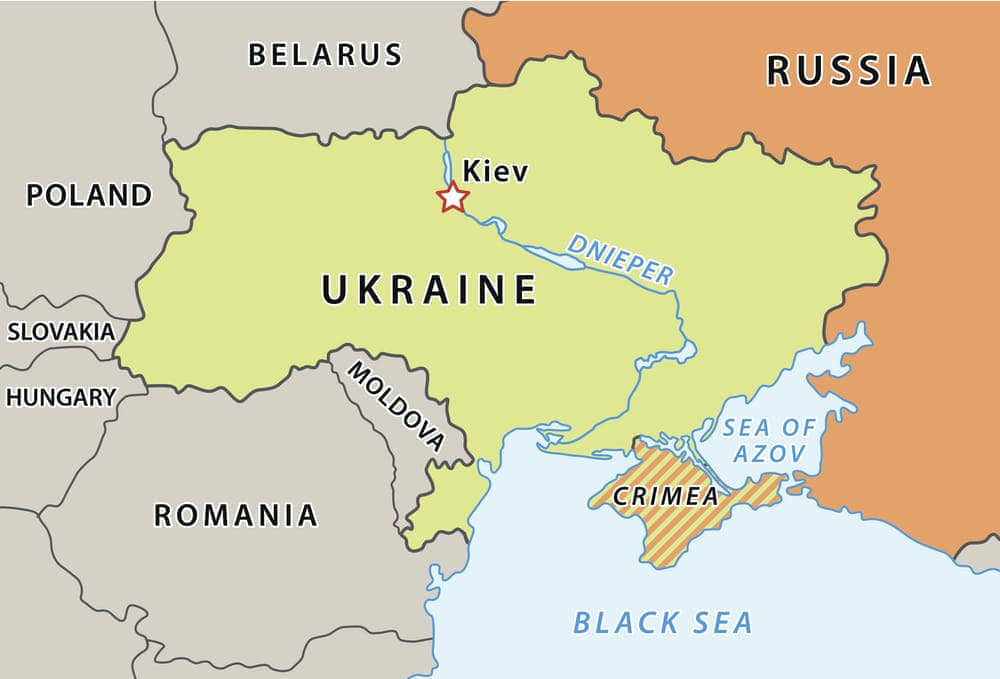
Ukraine’s fate won’t be decided in Donbas, where the biggest part of Ukrainian and Russian forces are concentrated, but hundreds of miles away, on the more obscure battlefield of the south-west. The country’s future turns on Russia’s ability to hold on to a piece of land on the western side of the Dnieper, between two port cities: Russian-occupied Kherson, and Mykolaiv, less than forty miles north-west. If Ukraine manages to sweep the Russians from Kherson, the western half of the country will be protected by the great barrier of the Dnieper, Putin will suffer a politically damaging defeat and Kyiv will be closer to freeing its biggest ports from Russian blockade. European leaders sceptical of Ukraine’s ability to resist the invaders may think again. If, however, Russia clings on to its western bridgehead, it will retain the potential to swallow more of Ukraine, threatening Mykolaiv, Odesa and the rest of the Ukrainian Black Sea coast all the way to the Danube, and, eventually, the whole country.
Mykolaiv is less than twenty miles from the front line, if that is defined as an imaginary set of points halfway between the trenches where Russian and Ukrainian troops are dug in. The city is still within the range of Russian conventional artillery, and vulnerable, like other Ukrainian cities, to missile attack. It is bombarded every night. I often wake up in the early hours for no obvious reason, and when I woke at four a.m. on my first night in Mykolaiv, I wasn’t sure whether it was one of those random awakenings, or whether air-raid sirens had stopped just before I came out of my dreams. I lay in complete darkness and complete silence. The bangs, when they came, were firm and powerful, but quite distant and muffled, partly because the windows of my hotel were covered with thick squares of chipboard to prevent the glass shattering if a missile landed nearby. When I arrived my driver had been keen to show me the ruins of a different hotel, destroyed by a Russian missile. He had been thinking of suggesting I stayed there. Another hotel, close to the one I ended up in, was hit in a different attack. I would catch sight of the smashed concrete of its sagging pediment when I went to the shops.
The targets that morning had been two of the city’s universities. I went to see one of them, V.O. Sukhomlinsky National. All the windows of its main building, a late 20th-century concrete block, had been shattered, and a turret on one corner of the façade was teetering (later, I saw firemen apply the coup de grâce with a looped cable). The ground was covered in a dusty mess of white bricks and plane tree leaves. The students were on holiday, but a huddle of academics stood in the bright sunshine regarding the damage. The women summoned a pale, purposeful determination, but the deputy rector, Anatoly Ovcharenko, displayed a deeper level of shock. ‘Defenders,’ he said sarcastically. ‘The Russians defend us.’ He laughed joylessly. He had heard there were six missiles.
I asked him why he thought the Russians might have wanted to fire half a dozen rockets at his university.
‘Only one reason,’ he said. ‘“I want Ukraine.” That’s it.’
There were pieces of shrapnel all over the place, but it bothered Ovcharenko that on one chunk of metal you could see the year of the missile’s manufacture, 1988, when Ukraine and Russia were still geopolitical roomies in the crumbling dormitory of the Soviet Union. Could it have been one of the weapons Ukraine transferred to Russia for decommissioning when it gave up its inherited nuclear warheads in the 1990s?
‘What now?’ I asked, rather tactlessly, meaning for the university.
‘There are many questions, of which one is “What now?”’ Ovcharenko said. ‘Putin knows what’s next.’
One of the minor blast effects is irony. The other university hit that Friday was the Admiral Makarov Shipbuilding University, once the centre of naval architecture in this city of former military shipyards. The university is named after Stepan Makarov, an officer in the Russian imperial navy, born in Mykolaiv and killed in 1904 during the Russo-Japanese War. Also named after Makarov is the flagship of the Russian Black Sea Fleet, a frigate that has been firing missiles at Ukraine. Whether Admiral Makarov, the ship, is responsible for bombarding Admiral Makarov, the university, isn’t clear, but the two are no longer comrades. This is not the only ghostly doubling. The frigate became flagship after the cruiser Moskva was sunk by Ukrainian missiles early in the invasion. The Moskva was built in Mykolaiv, and rebuilt there in the 1990s, when Russia paid Ukraine to do the work. Now the Moskva is at the bottom of the sea, but on a wharf in Mykolaiv’s derelict shipyards a rusting replica of it is still afloat: its sister vessel, the Ukraina, launched on the eve of the Soviet Union’s collapse and still waiting to be fitted out.
I couldn’t get back to sleep that first night so I sat up and worked. There’s electricity, internet and mobile phone access in Mykolaiv, and there’s gas. The shops take contactless payments. After shelling took out a pumping station, the city had to revert to brackish water from the mouth of the Southern Buh river, OK for washing and flushing but not fit to drink. Drinking water is handed out free, though you have to queue for it. The streets are swept and rubbish is collected. Petrol is plentiful but expensive, and food abundant for those who can afford it. There are supermarkets in Mykolaiv whose shelves, groaning with fresh produce and packaged goods from all over the world, wouldn’t look out of place in Paris.
After curfew, when the sun was up, I walked to the centre of town, through wide streets lined with enormous old trees, weathered old houses – some built with the local stone, rakushnyak, a kind of limestone with a high proportion of fossilised crayfish shells – and grungy flowerbeds, evidently loved but lightly gardened, lurid with petunias, hollyhocks and orange lilies. There was little traffic and few people were about. Many have left the city, and many businesses are shut, though you can still find open shops and cafés. In the shade of Chestnut Park I came across a young man in a black T-shirt with a pistol on his belt, sitting on a bench and drinking latte from a takeaway cup.
He was a policeman from Kherson, he said. His unit had been ordered to leave before the Russians took over. Now he was waiting with his comrades for Kherson to be liberated so they could go back to their stations. They were confident of victory. It was a sign of how badly the Kremlin had judged the mood of Ukrainians: the success of the invasion was contingent on young men like this, local police in historically Russian-speaking areas, historically sceptical about the Ukrainian project, switching their loyalty to Putin. I asked him if he was worried that in liberating Kherson from the Russians, Ukraine would end up subjecting his city to the kind of bombardment suffered by the Ukrainian cities Russia seized in the east. ‘Our people try to work in a more surgical way,’ he said.
Central Mykolaiv seemed a peaceful, sleepy summer place, half-forest under the shade of those great trees. People strolled at an easy, Mediterranean pace. There were still children around. When the air-raid sirens whined through the birdsong, as they often did, nobody paid much attention, at least in daytime. This was unwise. One of the tallest trees in Mykolaiv is a vast oak, not much younger than the city itself – two centuries – and reaching to the top of the nine-storey regional administration building. In March, a Russian missile punched a seven-storey hole through the building, killing 37 and wounding 34. Visiting journalists are taken to marvel at the hole, a memorial to something that doesn’t need to be remembered because it is still happening.
That missile struck in daylight. Different areas of Ukraine have different degrees of justification for dropping their guard. On my way to the Black Sea I spent the afternoon in Kyiv. After downloading the national air-raid warning app I sat in a café. My phone went off at full volume a few seconds before the actual sirens did. I took my cue from the locals: rather than running for shelter, I turned the sound down, embarrassed. Kyivans continued to whizz past on electric scooters. At the far end of the café terrace, a photographer and a model carried on their fashion shoot. Kyiv hadn’t been attacked for weeks, but a fortnight later, it was. My train from Poland to Kyiv had passed through an Arcadian landscape of downs, meadows, ponds and spinneys. We stopped at Vinnytsia. Twenty minutes later, I was in the buffet when somebody looked up wide-eyed from their phone. Just after the train left Vinnytsia, Russia had dropped three missiles on the city, killing 25 people, including three children, and injuring more than two hundred. Vinnytsia, like Kyiv, is seldom struck. But people in Mykolaiv know that in any 24-hour period missiles are almost certain to fall.
By the end of July, 121 civilians in the city had been killed by Russian missiles, and 558 injured. The mayor, Oleksandr Senkevych, reckons that about half of Mykolaiv’s pre-invasion population of half a million have fled. You could rationalise the risk according to the odds, you could fold the idea that you might be killed while you sleep into the general hazard of life, or you could sleep in a shelter every night, though few do. The missiles used by the Russians are either rockets that describe a parabola – Pynchon’s gravity’s rainbow – or cruise missiles. In both cases they fly too fast to be heard before they hit. They’re fired from the backs of trucks, from ships, from submarines and from bombers, sometimes from thousands of miles away. The Ukrainians try to shoot them down, and sometimes succeed, but their technology is old, and they don’t have many anti-missile missiles, and the handful of systems promised by Germany and the US have yet to arrive.
Deaths during air strikes are becoming ‘part of everyday life’, according to Anatoly Onufriychuyk, editor of the Mykolaiv news site Novosti-N. ‘If it happened in peacetime, people would be talking about it for months. “What a tragedy!” It would be analysed from every side, discussed. And now it’s news for a day, and then everyone forgets about it. Everyone has got used to it. Everyone has got used to people dying, that they’re killing peaceful citizens for completely incomprehensible reasons.’
Firing missiles with non-nuclear warheads at a large city is a fantastically ineffective and expensive way of killing everyone in it, or of levelling it to the ground. It’s not the tactic of an army set on presenting itself as a liberator. It is, however, quite a good way of terrorising and demoralising people. And if a country with a large arsenal of such missiles set itself the task of slowly crushing a city, factory by factory, shopping centre by shopping centre, university by university, it could do that, eventually.
I heard the booms again on my second night in Mykolaiv. This time I got back to sleep. In the morning I went to see the damage. Two factories had been struck. Nobody was hurt, but the factories were wrecked. One of them, Transammyak, made ammonia. The other, NikoTex, recycled old fabrics to make industrial felt. It was a new Ukrainian factory, rather than one built on the legacy of the Soviet years. The owner had just put in Italian and German machinery. Workers in blue boiler suits and orange safety helmets were standing in groups, staring at the fresh ruin. On one side of the main workshop, walls of shining corrugated steel lay peeled and buckled. The roof had been reduced to a skeleton and the production line was a mess of charred scrap. A woman swept lumps of felt into the shovel of a digger. The owner’s son, who ran the factory, had the same look of shock and nausea that I’d seen on the face of the university director. I talked to Natalya Konstantinova, the factory’s chief electrician, who was standing at the edge of a deep crater next to the smashed-up workshop. She’d worked there for fifteen years. ‘We worked absolutely on the level,’ she said. ‘Our director held to that principle – everything clear and in the open. We paid our taxes, salaries were always scrupulously accounted for, and we contributed our share to the budget of the country as a whole. And now fifty people are out of work.’
Why did she think Russia had targeted NikoTex? ‘Either they assumed, or they got some tip-off claiming that we were storing something,’ she said. By ‘something’, she meant military material. ‘Or it was simply a deliberate attempt to destroy the productive infrastructure of our country. Because they’re purposely attacking all industry. Transammyak, it’s the same thing, a business that didn’t have any military purpose. We saw: they had no military equipment, no munitions. The most infuriating thing is that this was always a Russian-speaking city. We’re from Ukraine, and we all speak Russian, and nobody had a problem with that. It wasn’t that anyone was pro-Russian or anti-Russian. We didn’t pose a risk to anyone.’
Konstantinova pointed out that there was no space to store military equipment in the factory. Aware of the risk of being targeted if Russian intelligence or locals – either motivated by sympathy with Russian aims, or by money – thought there was a connection between the army and the factory, the director made sure nothing military ever came near it.
It’s impossible to know how much of the Russian missile campaign against Mykolaiv is to do with terror, how much with maiming the Ukrainian economy, how much with an out-of-date checklist of targets, and how much the non-military death and destruction is, to use the American phrase, collateral damage from Russia’s efforts to hunt down Ukraine’s military. Given the unprovoked nature of Russia’s invasion, killing Ukrainian soldiers (or exposing its own troops to death) is not much less of a crime than killing civilians or ruining buildings, but there’s no doubt that killing soldiers and vaporising their equipment is a large part of the purpose behind Russia’s bombardment.
The Ukrainian military presence in Mykolaiv is discreet. I saw no movements of heavy equipment through the streets. Hostility to Russia is high, as is support for the Ukrainian armed forces and belief in their abilities. It’s hard to imagine these feelings have ever run higher. But they’re not universal. The nature of Russia’s initial assault can only be explained by an assumption that most Ukrainians regarded their own leaders, and the concept of Ukraine as a real, independent country, with the same contempt as the Kremlin. Faced with the collapse of this assumption when put to the test of invasion, and dismayed by the non-appearance of the expected army of collaborators, the Russian government fell back on a different framing, that the scale of death and destruction was Ukraine’s fault for resisting. It’s a version of the robber or the rapist’s threat: ‘I’ll get what I want whether you struggle or not, but if you struggle, I might have to kill you too.’ I met one man in Mykolaiv who had had a family member in the Soviet KGB, which, he felt, gave him an insight into Putin’s character. ‘I do ask myself why my friends, people who are so dear and close to me, are fighting and dying, when Putin will get what he wants in the end,’ he said. ‘He’ll find a way.’
The robber/rapist comparison breaks down for the minority of Ukrainians who want to keep an instrumental distance between themselves and the troops fighting in their name. One woman took me to see her daughter’s school, smashed by Russian missiles. Through the broken concrete you could see a shelf of library books exposed to the sun and rain. Instead of blaming Russia for firing missiles at the school, she blamed Ukraine for quartering soldiers there. (Schools in Mykolaiv haven’t been open since before the invasion – pandemic remote learning simply rolled over into conflict remote learning.)
When I asked her about Putin’s aims, she said: ‘I don’t know. He must have his reasons for what he’s doing.’ Did she think what he was doing was right? ‘I never get involved in politics.’ She mentioned that salaries in Russian-annexed Crimea were higher than in Ukraine. She’d been angry, earlier on in the fighting, when Russian troops were approaching Mykolaiv, about how close Ukrainian armoured vehicles were to her house. She was Russian-born. She was unhappy that Russian language teaching was disappearing from Ukraine. She said people were punished for using Russian. (This is untrue: Russian is still the dominant everyday language in Mykolaiv, and still very widely used in Kyiv, though it has been gradually restricted in schools since 2014.) When she said she’d been surprised to learn what a strong army Ukraine had, I thought she was displaying an unexpected Ukrainian patriotism. But thinking back on it, I realise she was expressing disappointment that the Ukrainian army hadn’t melted away, as Putin expected. She did say she’d been perfectly happy in independent Ukraine before the invasion, but her position now was clear: she would rather Putin won, and took what he wanted quickly.
It’s important to know that some Ukrainians think this way. They may be a small and quiet minority for now, and will, I suspect, continue to be a minority. But they exist. And the longer the war drags on, particularly into winter, when problems with heating, water and money become acute, the louder and more numerous they will become, and the angrier and more bitter towards them the loyal majority will be.
Another well-informed man told me what most locals would not say, that after a devastating strike on a Mykolaiv barracks in March, which killed scores and perhaps hundreds of marines, the authorities adopted a policy of dispersal, with small groups of Ukrainian personnel spending the night in a wide array of buildings, including schools. He was a staunch patriot and I was interested in his views about Ukraine’s chances of forcing the Russians out of Kherson. He said it wasn’t important. ‘In the big picture it doesn’t make any difference whether Ukraine takes Kherson or not. The Russian empire is doomed to fall apart. It’s destined to break up into a number of lesser countries. Maybe fewer, maybe more, but it won’t withstand this test.’ I heard this quite often in Mykolaiv: a genuine conviction that Ukraine was bound to win, Russia bound to lose, accompanied by a vagueness about how victory would be gained. It seemed to me that he was wrong. It does make a difference who holds Kherson.
One day I took a car west out of Mykolaiv, across the Varvarivsky bridge over the Southern Buh, and down the west bank of the river to the little town of Parutyne. We passed vineyards, sunflower fields, beaches. There was barely any traffic. At one point I saw the black and white striped feathers of a hoopoe flying alongside us, keeping pace with the car. Near Parutyne are the ruins of the ancient Greek town of Olbia. The archaeological site is closed, and initially the warden didn’t want to let me in, but after a while he relented. He led me over hillocks, through dry yellow grass and wiry herbs, to a crest overlooking the little stone squares among windblown trees that are the remnants of the Greek grain entrepôt. This was where Herodotus encountered the Scythians, who roamed what is now southern Ukraine and provoked his thoughts on the meaning of ‘civilised’ and ‘barbaric’.
Beyond Olbia were the choppy greenish waters of the mouth of the Buh, and, on the horizon, the gulf of the Dnieper. It was as close as I could get to the Dnieper. From the gulf to about 120 miles upstream, both banks are held by Russian troops. The front line lies between the Dnieper and the Buh. I could hear the shelling a few miles away on the other side of the estuary. I saw a sprinkle of lights appear between a pair of wind turbines, followed by a series of puffs of smoke, followed by explosions: a salvo of artillery rockets.
As much as the strength of armies matters, big wars turn on natural barriers: mountains and the passes between them, rivers and the bridges over them. There are no mountains on the former steppe of southern Ukraine, now flat farmland. But there are rivers, and one river in particular. The Dnieper, which splits Ukraine in two, runs from near Chernobyl at the Belarus border past Kyiv and a series of large industrial cities down to the Black Sea at Kherson. It’s vast. For much of its length, it’s miles wide. It’s better thought of as a series of reservoirs than a river. Half a dozen dams supplement Ukraine’s electricity supply: thanks to its whirring hydroelectric and nuclear power stations, along with the loss of its energy-hungry metallurgical plants in the east, invaded Ukraine has so much electricity to spare it’s started exporting it to the EU.
As both the Wehrmacht and the Red Army found during the Second World War, the Dnieper is a hard river to cross under fire, and there are few bridges. In most of Ukraine, Russian forces are a long way from the river, but even if the Ukrainian army continues to be pushed back in the east, the Dnieper should provide a secure line of defence for the west of the country, often known, thanks to the way the river flows, as ‘right-bank Ukraine’, which contains the greater part of Kyiv, as well as Odesa and Lviv. If the eastern front collapses and the war becomes about the defence of right-bank Ukraine, certain ideas which seemed fanciful and dangerous at the beginning of the invasion – a Western-enforced no-fly zone, foreign peacekeeping troops – become more practical. The problem is that while most of left-bank Ukraine is still in Ukrainian hands, in the south, the Russians crossed the Dnieper early in the conflict, and stayed.
How the Russian army managed to reach the Dnieper so fast and cross it so easily is the subject of much bitter speculation among Ukrainians. Early in the invasion President Zelensky sacked the head of the Kherson branch of the Ukrainian domestic intelligence agency, the SBU, calling him a traitor. The Kherson cop I met in Mykolaiv passed on a rumour that a week before the invasion this same officer, Serhiy Kryvoruchko, had ordered the removal of explosives placed to blow up the Antonovsky bridge, the only passage across the Dnieper at Kherson. It seems highly unlikely an SBU chief would have that power. Another story I heard was that the Kherson defenders did try to blow the bridge, but the explosives didn’t work. The most plausible explanation for the fall of Kherson is that the Ukrainians didn’t have the forces to cover every possible route of attack, the defenders of the city were badly prepared and a number of key leaders fled prematurely.
In those early days, it seemed Ukraine would quickly lose its entire coastline. On 24 February, the first day of the war, Russian troops, pouring northwards out of Crimea, seized the left-bank city of Nova Kakhovka and crossed the Dnieper by the bridge over a power station barrage. By the next day they were in control of the Antonovsky bridge; by 2 March, they had taken Kherson city itself, and were fanning out west, towards Mykolaiv and Odesa.
Mykolaiv could have fallen with the same ease as Kherson, such was the shock at the Russian assault. One businessman I spoke to, Yuri, had mocked his son when he called from Kyiv on the eve of the invasion to warn him. When he called again the next morning to tell him the shooting had started, Yuri asked him what he’d been smoking. His son told him to look at the internet.
Some of the first shots of the war were against Mykolaiv. Early on the morning of the 24th, the Russians fired missiles against the Ukrainian military airfield at Kulbakino, to the south-east of the city. ‘When I heard the first blast I lay there for five minutes, thinking, well, the port’s not far away, maybe there was an accident, something fell, something exploded,’ Novosti-N’s editor said. ‘When I heard the second explosion, I got up, went to the car park, got in the car, and went to film Russian rockets … the Russian Kalibr cruise missiles were coming in and our fighters were taking off towards them. I saw one plane take off right into the bombardment. I stopped filming after a while and just watched him gaining height, and it was as if at some point he lost the thread – what now? Should I try and shoot those missiles down, which in theory his plane was capable of doing, or should I try to light out for Romania? It was like for several seconds his plane just hung there and he didn’t know what to do. And then he flew away.’
Many people in Mykolaiv believe that within 48 hours, Russian tanks were in the heart of the city, and that Russian troops carried out a helicopter-borne assault near the shipyards. My understanding is that, in a sign of the degree of chaos at the time, both were horrific episodes of friendly fire. The tanks were Ukrainian tracked artillery that had retreated from Kherson; the helicopters were Ukrainian helicopters trying to find a safe place to land. Scores of Ukrainian personnel were killed and wounded by their own side, who thought they were under attack.
The defence of Mykolaiv was entrusted to a Ukrainian general with a high public profile, a paratrooper veteran of Donbas, Dmitry ‘Marcello’ Marchenko. In a YouTube interview with a local reporter two months later, he described the complete breakdown of co-ordination between the city authorities, the security agencies and the military he saw when he arrived on 25 February: ‘In one street I saw a resident taking down the flag and crumpling it up and I said: “What are you doing?” He said: “It’s over. Kherson’s surrendered, we’re next. Everyone understands, they’re many, we’re few. We need to prepare.” I said: “Hang on, this is Mykolaiv, we’ll put up a fight.” He said: “Everyone can see how many troops they have.” I said: “It’s fine.” When I got the heads of all the services together I could see that, unfortunately, there was no overall command. I asked the head of one brigade what his task was and he said it was to defend his unit’s base. I said: “Hang on, what about the city, who’s going to defend that?”’
Communications were so poor that the defenders relied on mobiles. Early on, Marchenko himself was shot at several times by Ukrainians who took him for a Russian officer. He split the city into zones, set his forces to dig trenches, and took a hard line with senior officials who tried to run away, telling one he was likely to be shot for treason. The region’s governor, Vitaly Kim, projected a message of calm and resilience.
Thousands of Russian troops arrived in early March, hoping to surround and neutralise Mykolaiv to pave the way for an assault on Odesa. At one point, with the city almost completely encircled, Marchenko defied an order from Kyiv to blow up the Varvarivsky bridge, Mykolaiv’s last connection to the outside world. A group of policemen armed with anti-tank missiles drove Russian troops from Kulbakino. Ukrainian artillery began to thin out the invaders. Far beyond their supply lines, heavy on high-tech equipment but light on basic infantry, the Russians were diluted in the wide green Ukrainian flatlands. Defeated around Mykolaiv, and further north at Voznesensk, they retreated to the positions they’ve pretty much held ever since, roughly on the administrative border between Mykolaiv and Kherson regions, halfway between the two cities, which in normal times are only an hour and a half’s drive apart. They have set the concrete plant in Kherson to work making fortifications for the string of villages that mark the 150-mile perimeter of their western foothold, and are hunkered down, waiting for the Ukrainians to mount their long-promised effort to drive them back across the Dnieper.
This front could become part of a new border between Russia and Ukraine, a temporary ceasefire line that becomes permanent, like the border between the two Koreas. I asked Leonid Klimenko, the head of another of Mykolaiv’s universities, the Petro Mohyla Black Sea National University, what he thought of this idea. He gave it short shrift, partly because he assumed, on the basis of past experience, that Russia would carry on shooting, even if it stopped trying to advance. ‘The ceasefire line would only be about 20 km from Mykolaiv. It would be a second Mariupol. They would be continually shelling the city. The city couldn’t develop, nothing would get built. It would be a catastrophe. Nobody would want to study here; what parent would allow their children to study on a campus that might get hit by an artillery shell? For us the minimum is to free Kherson city, to liberate right-bank Ukraine, and to let the Dnieper protect us from Russia.’
Klimenko’s university is still open. A pile of MA dissertations lay on his desk. Some MA students, who in the Ukrainian system mount a PhD-style defence of their work, had their vivas on 25 February, when the city’s military defenders were still in disarray. On the way to his office I passed workmen fixing ornate new ceramic tiles in the lobby. It seemed a bold step, given that two of his peers had just seen their institutions given the Russian missile treatment. But in light of what Klimenko said, it was an attempt to cope by carrying on as normal; collateral defiance, like the woman I met on the train to Kyiv, worried she was going to miss her manicure appointment, whose family had been shot at and almost blown to bits in a minefield when they fled Kherson.
Klimenko’s hopes of victory were tempered by the realism of a man Putin’s age who had spent the first four decades of his life living and working in the Moscow-dominated system. ‘Kherson fell in a day, but I don’t know how long it’ll take to win it back, or whether we’ll manage to do it,’ he said. ‘Are we counting on Russia being populated exclusively by idiots who don’t know how to fight a war? I wouldn’t bet on it. I’m old, and I remember how all our best people were posted to Moscow, and intelligent, qualified people were concentrated there over a period of many years. They’re not all fools.’
On the eve of the Russian invasion, Volodymyr Zelensky’s stock, once so high, had fallen. Few Ukrainians had a good word to say about him. I was in Kyiv the week leading up to 24 February and everyone I spoke to was of the same view. It wasn’t that they hated him; they were just disappointed, unimpressed. Staying and leading the country’s defence has brought him respect, authority and unprecedented power. His pre-invasion unpopularity, in retrospect, seems harsh. Impoverished Ukraine had a bad pandemic, Zelensky struggled to reduce corruption, rents and utility bills steepened, no good way could be found out of Russia’s grip on eastern Donbas. But all the same, Ukraine was developing in a way it hadn’t since independence. Much has been made of the extraordinary success of its military, less of the resilience of Ukrainian society and institutions: the railways, the electricity grid, the financial system, telecoms, education, pensions, retail. Much of that resilience is due to individual sacrifice and initiative, and to volunteers; corruption and incompetence, of course, persist. But there isn’t a sense that the government is absent or falling apart. This can’t be just luck. It was striking that this time, as soon as I started talking about politics, where previously people would have grumbled about Zelensky, now they complained vehemently about his predecessor, Petro Poroshenko. I asked everyone I met to try to remember the mood in the year before the invasion. People remembered Zelensky’s unpopularity, the rapidly increasing bills for basic services, Covid. They also remembered a sense that, eight years after the Maidan revolution, the annexation of Crimea and Russia’s damaging but limited incursion into Donbas, the economy was beginning to stabilise.
Many cities in the communist world were economically devastated by the collapse of the Soviet Union, but few fell so far, so fast, as Mykolaiv. In its heyday as a centre of shipbuilding for the Soviet navy, it was closed to outsiders. Every morning, thirty thousand workers went to the yard on foot and by tram. Those who weren’t building warships were making parts for warships, or working in one of the nuclear weapons bases outside the city. Two gigantic eggshell blue cranes that still loom over the city were bought by the USSR from Finland to build aircraft carriers. The Soviet Union fell apart just as four reactors were due to be installed on its first nuclear-powered aircraft carrier. The reactors were taken away, the aircraft carrier was cut up for scrap, and the shipbuilders lost their jobs, their status, their framing of the world.
As that industry vanished, another was trying not to. ‘You can imagine how hard it was for us to maintain the agriculture system here after the fall of the Soviet Union,’ said Oleh Pilipenko, head of one of the communities of Ukrainian villages known as a ‘hromada’. ‘In the 1990s farmers were standing watch over their equipment at night with weapons in their hands to make sure it wasn’t stolen. And now, in the most barbaric way, it’s all been destroyed.’
To the extent that an alternative to warships has been found for Mykolaiv, it’s agriculture: Ukraine’s former Pontic steppe as the world’s kitchen garden, with Mykolaiv, Kherson and Odesa as food ports. A Ukrainian-Canadian farm manager told me that Kherson’s large irrigated areas, now under Russian occupation, were more productive for fruit and vegetables than the Netherlands. The politics of Ukrainian land reform are highly polarised, emotional and complex, involving vast oligarchic land portfolios, overseas investors, property theft, exploitation, memories of Stalin-era famine and rural poverty as well as highly successful smaller private farmers and family smallholders doing quite nicely. The invasion happened in the middle of a controversial change allowing Ukrainians to buy and sell farmland for the first time. But a new agricultural economy was coming into being. A Ukrainian offensive to liberate Kherson will not only be an attempt to cross empty space between cities but a battle for the land itself, which many Ukrainians hope will bring future prosperity. It was clear by the start of May, when Russia introduced the rouble in occupied Kherson and began to purge Ukrainian teaching in its schools, that Putin wanted to take that land for Russia.
I drove to a village called Peresadivka, north of Mykolaiv, on a new concrete highway smoother than many British roads. It could have been Euro-anywhere. The driver hadn’t read the memo that Ukrainians were supposed to like Zelensky now. He’d been bad-mouthing him as corrupt like the others. Suddenly, when we hit the new road, he began to gush. ‘This is the road to Kirovohrad,’ he said. ‘It’s a hundred kilometres. It used to take seven and a half hours. It’s all Zelensky’s work. When we had Poroshenko as president he only managed a few kilometres. As soon as Zelensky came to power, they finished it in a year.’
We turned off towards the village. The road got a little rougher and we drove past wild apricot trees bright with fruit. Dozens of storks edited frogs out of the wheat stubble. In the village guys with bucket hats and shorts parked their bikes outside the store. Tanned boys and girls dived off an unfinished concrete bridge into the river Ingul. Grapevines shaded the walled yards of cottages painted pink and brown and blue.
I wouldn’t have seen the signs that the Russians had been through the village – and come under Ukrainian fire – if Tatiana, an official from the Peresadivka hromada, hadn’t given me a tour. The old pontoon bridge blown up. The shot-up door of the shop where the Russians stole some groceries. A smashed-up grain store. Roofs with holes in them. On a rise above the town, in March, the Russians set up their armoured vehicles in a sunflower field. A villager was in the wrong place at the wrong time. They found his body later. He had been shot, with signs of torture. Nobody was sure how he had ended up there. He left a wife and children. The Russians, who had a database showing the names and addresses of people connected to the Ukrainian military, went to the house of a man who worked in a military recruitment office, but he wasn’t there. They talked to his family and left. Under fire from Ukrainian forces, the Russians retreated. The front line is fifteen miles away now, but Tatiana said they sometimes hear it. ‘You often see a pillar of white smoke on the horizon,’ she said. ‘They say that’s a field burning. If it’s black smoke, it means a shell landed somewhere.’
The front line runs through the hromadas, dividing villages across the great flat square fields. In the hromada of Pervomaiske, east of Mykolaiv, two of the eleven villages are under occupation, though they are both now empty of civilians. Maxim Korovai, a local councillor, told me the last four pensioners had just been evacuated. He was visiting a charity depot in Mykolaiv to pick up supplies. The hromadas, which were set up a few years ago as a smaller, more accountable and corruption-proof layer of local government, have become a framework for delivering aid and keeping in touch for people who won’t or can’t leave, about 1500 out of an original population of ten thousand. Twice a week Korovai and his team deliver 1200 loaves of bread around the area.
The Russians briefly occupied Pervomaiske’s largest village in mid-March. The shelling has been ceaseless ever since. Russian jets dropped bombs on a British-owned sugar factory, putting five hundred people out of work. There is no running water, gas, power, sewage or internet; mobile phone signals flicker in and out. Across the hromada, 48 civilians have been killed by shells, rockets or mortars, and three-quarters of homes have been damaged. Next to the school in Pervomaiske is a crater six metres deep. ‘Every day, at about the same time and place, they shell us – the people who still live there don’t understand why the shells fall where they do,’ Korovai said. ‘Not for some obvious reason, a weapons store, or a concentration of troops, but in civilian areas. Houses, gardens, schools, hospitals, farms, businesses.’
Sasha, a regular Ukrainian army soldier, came into Mykolaiv for a break and to get his car fixed. It’s an ancient jalopy with bits missing, like a stock car, but it goes. His brigade is based right at the front, in Posad-Pokrovske, the last Ukrainian-held village on the M14 highway to Kherson, directly facing the Russian troops. The village has been heavily shelled. One civilian described it to me as ‘like Stalingrad’. Sasha, a biker from Odesa, was tired, defiant and knowing, full of terse and slightly self-conscious veteran’s talk, though he only joined up on the day after the invasion. He took part in the operation to clear the Russians from Posad-Pokrovske in March and has been there ever since. ‘Stupid people dig shallow trenches’ is one of his aphorisms. ‘The deeper you dig, the longer you live.’
When Sasha’s company got to Posad-Pokrovske, they spent the first night in a school. The next day it was flattened in an air strike. They spent the next three and a half months living in concrete pipes under a bridge. ‘I’m already used to it,’ he said. ‘A typical day is they shell and bomb us from morning to night. Mum says, “Where are you?” and I say: “I’m home.” It’s our home now. People say, “We’re looking forward to you coming home,” and we say: “We are home.”’
Bodies of dead civilians have been lying unburied in Posad-Pokrovske for months. The soldiers aren’t allowed to collect them; since they’re civilians, it has to be done by the police, and the police don’t come. A few days before I met him, Sasha and his comrades had buried one of their own. ‘He was driving a car at the front and he ran into fire. He was carrying fuel in the boot. There was just half a person left when they got him out. He was a professional soldier, he only had two months left on his contract. There seems to be a rule: whenever you’re down to your last month or two – 200, 200, 200.’ ‘Cargo 200’ is the old Soviet military code for a shipment of dead bodies. Both sides use the expression. It’s become a verb – ‘I don’t want to get two hundreded.’ It almost happened to Sasha. A car he was in was hit by a shell and he had shrapnel wounds to his head and neck. As he tells it, he ran away from hospital back to the front.
At night, Sasha can see the lights of Kherson, about fifteen miles away. Despite frequent pronouncements by Ukrainian officials and social media war geeks that the offensive is about to start, or has already started, there has been little change to the front line in recent months. A handful of villages have been liberated in the north of the Russian bridgehead, and Ukraine has won a toehold on the hostile side of a smaller river, the Ingulets. But mainly the two sides remain a few miles apart, with more lines of artillery further back. In the flat, open landscape, with little cover except the trees along the roads, any attempt by one side to breach the other’s lines is subject to withering fire from anti-tank missiles and guns, or shelling. Both sides launch drones to spy out artillery targets; when the artillery fires, it becomes the target for the other side’s artillery.
Russia has an overwhelming advantage in all these areas. It has more artillery guns and rockets than Ukraine, by a large margin. It has more attack planes and helicopters. It has more anti-aircraft missiles to shoot down Ukrainian drones, and a crushing advantage in electronic warfare systems to jam them. ‘It’s easier for them,’ Sasha said. ‘They haul in shells by rail, by the wagonload. They unload them with cranes. They dig shelters with bulldozers. They shoot rockets from morning till night as if they came out of a machine. It’s shameful to admit – they have drones flying over us 24/7 and we have one. Sometimes we can see what they’re up to … but it’s embarrassing. We don’t have the capability.’
Ukraine has been good at hiding its military, but even so, the absence in Mykolaiv and the surrounding countryside of the signs of a build-up of equipment, troops and supplies that you might expect for a counter-offensive is striking. There’s only so much you can move by night. If Ukraine is using its much vaunted mobilisation to expand its army with new units to retake Kherson, it’s being done with extraordinary stealth – or it’s simply taking a long time to integrate a chaotic array of foreign weapons and untrained recruits. Sasha was coy about his unit’s losses, but he did say they hadn’t been replaced.
None of this means Ukraine can’t retake Kherson by the end of the year. Ukraine has been using a newly acquired American-made weapon, a precise, long-range rocket fired from two types of mobile launcher known as HIMARS and MLRS, to destroy Russian ammunition dumps and command centres, reducing its artillery advantage and killing experienced officers. Russian forces in right-bank Kherson have taken grievous losses, and are fighting far from home, without leave, as part of an oppressive occupying force they were never psychologically prepared to be. Militarily, their position is precarious. They’re dependent for supplies and reinforcements on just three bridges over the Dnieper – the Antonovsky road bridge and the railway bridge in Kherson, and the bridge over the hydroelectric barrage upstream at Nova Kakhovka. All three have now been bombarded by Ukrainian rockets (it has been suggested that Ukraine is also using steerable artillery shells) and the Antonovsky bridge has been rendered unusable, possibly the rail bridge too. Russian forces on the wrong side of the Dnieper face the terrifying prospect of not only having their supply lines cut off, but their retreat.
The question remains whether Ukraine will be able to take advantage of the opportunity it has opened up. Jack Watling, a British defence analyst with good access to the Ukrainian military at high level, argues that they have ‘massively expanded their force’. The key shortage, prosaically enough, is middle management. ‘They don’t have very many … kind of middle level commanders, battalion and brigade staffs who know how to integrate machine guns, snipers, mortars, armour artillery, into the same battle space … But if they want to conduct a major attack, they need to make sure that they’ve got enough people who are trained and prepared and have a clear plan down at the tactical level. If they don’t do that, there is a risk that they will take very heavy casualties. The main challenge at this point is ensuring that it’s not done prematurely.’
Oleh Pilipenko, the head of Shevchenkove hromada, said the Ukrainian army’s feat in pushing back the Russians was already an extraordinary victory. ‘I don’t like those fakers out there on the internet, saying: “Our people are already fighting in Kherson city!” They give Ukrainians the impression that the counter-attack is going to begin tomorrow. The turning point in the war was getting HIMARS, giving us the ability to destroy munitions dumps behind the lines. Now the Russians are panicking. It’s much easier for our troops now. But as far as an actual counter-offensive is concerned – let’s be clear, their positions are so well fortified, any counter-offensive would have to break through the Russian front line to the rear, bypassing Russian strongpoints. The army’s ready to do this, but it needs better supplies and equipment, because right now they are far, far stronger than us in terms of the number of weapons they have.’
Pilipenko is a trained military artillery spotter as well as a local politician. Shevchenkove is only four miles from the front line at Posad-Pokrovske. Eight of the hromada’s villages are under Russian occupation. And Pilipenko had an opportunity to observe the Russian military up close when they kidnapped him in March. He and his driver were arrested while delivering food aid across the lines – the front is a little porous, even now. Pilipenko had made sure he had no documents showing he was a government official, but the Russians identified him from their database. They gave him and the driver a kicking and took them to their base at Chornobaivka outside Kherson in an armoured troop carrier. The elderly driver was allowed to sit inside; Pilipenko was lashed to the top of the vehicle with rope and carried without boots in temperatures of -10ºC. He got frostbite. At Chornobaivka, under heavy bombardment from Ukrainian artillery, Pilipenko was tortured with electric shocks and rubber truncheons in the hope he knew something about the defence of Mykolaiv – he didn’t. Eventually the Russians were forced to withdraw from Chornobaivka and move their base to Nova Kakhovka, on the other side of the Dnieper. Pilipenko was taken with them, his conditions improved, and in June he was returned to Shevchenkove as part of a prisoner exchange.
While he was in Nova Kakhovka, Pilipenko said, he was able to talk to some of the Russians about their situation. Morale fell in May when the expected troop rotation didn’t happen. The original plan, he learned, had been to take the whole of Ukraine in one week. ‘Kyiv would fall in three days, the government would either be evacuated or captured, and if the government was evacuated, the entire Ukrainian armed forces would surrender. They understood that our most effective troops were in Donbas, so they didn’t confront them head-on at first, they wanted to surround them and force them to lay down their arms, as with Mariupol. But when months passed without effect … they understood they’d fallen victim to their own propaganda.’
I hadn’t mentioned to Pilipenko my visit to Herodotus’ hangout in Olbia. But when I listened to the recording of our conversation, I noticed he used the concepts of ‘barbarity’ and ‘civilisation’ as part of the frame of reference for his experiences. The Russians, as a whole, were barbarous; but he drew a distinction between a ‘barbarous, aggressive’ paratroop unit from Asian Russia and a more ‘civilised’ unit from European Russia, who treated him with more decency. A danger of a drawn-out war is that ordinary Ukrainians increasingly other and dehumanise the Russians, in response to the daily toll of atrocities – while I was writing this, video footage emerged apparently showing a Russian soldier castrating a Ukrainian prisoner – and the Russian state’s relentless, hysterical dehumanisation of the Ukrainians. ‘I like this kind of figurative comparison of the fascistisation of Ukraine with a cancerous tumour,’ the pundit Vasily Fatigarov said on Russian TV. ‘We are now working like surgeons. And when a surgeon cuts out a cancerous tumour, while he’s cutting it, it’s growing. And when he cleans it up, he also has to clean up a certain amount of healthy tissue, so that, God forbid, nothing remains and starts growing again … Therefore we will purify that territory very precisely, very severely, and ensure that that fascist infection doesn’t grow anywhere else.’ One day in Mykolaiv a woman whose husband is in the Ukrainian special forces wanted to show me something on her phone. It was a video clip of dead Russian soldiers. ‘My husband killed some orcs in the east,’ she said proudly.
Pilipenko took me to Shevchenkove in a police car with the local postmistress, who was making her first trip back since March. The village is shelled every day. While I was there, the rounds weren’t landing all that close – a few miles away, perhaps. There were different flavours of thunder in three directions, and smoke most ways you looked. The village stands halfway between dereliction and life. Most of its buildings are damaged. As in Pervomaiske, there’s no running water, electricity or gas. Pilipenko showed me the shrapnel holes in one of the gas pipes. The rusting pipe, above the surface in classic Soviet fashion, didn’t look as if it had been in great shape to begin with. The hromada had had a mountain of work even before it was invaded. In the early days of the invasion, in winter, Pilipenko said, local hunters shot foxes that had grown fat feeding on the bodies of Russians killed when their armoured columns were hit by Ukrainian shellfire. Many of the houses are still inhabited. Residents depend on aid deliveries. There’s a shop selling baby formula and acting as a makeshift pharmacy. We dropped the postmistress off at her house to pick up some things of her grandmother’s. The pavement outside was speckled black with fallen mulberries, and the walnuts were almost ripe. The postmistress came back out and I asked her how the house was. ‘Not too bad,’ she said, sounding relieved. ‘The ceiling fell in.’
We swung by the volunteer fire brigade, often called out during the harvest to fight fires started by shells exploding in the fields. Sometimes, while they turn their hoses and flails on the flames, the combine harvester carries on. One of the firemen, Alexander, showed me the ‘cassette’ from a Russian Uragan artillery rocket, a heavy steel core to which a set of bomblets is fixed. Just before the rocket lands, the bomblets are scattered over a wide area, to kill as many soldiers – or civilians – as possible. He told me that three days earlier the village had been shelled with Uragans, and three people had been killed.
Two of the victims were killed in a single yard. It was a tiny space, barely two metres square, still covered in a vine trellis, with a chicken enclosure next to it. There wasn’t a mark on the concrete floor. It took me a while to spot the small hole in the roof of a shed the bomblet had made. An old man lost his brother and his friend. ‘Mytka was there, and Vytka was there,’ he said, jabbing his finger at the ground. The brothers’ very old mother stood in the cottage doorway in a flowered housecoat, shaking and weeping, a handkerchief squeezed in one fist. She looked at us as if expecting us to perform some meaningful duty. There was nothing meaningful to say.
Fred Weir has been a correspondent for Christian Science Monitor, based in Russia, for decades.
The murder of Daria Dugina, in a car bombing, has the full attention of the Russian media today. The target was almost certainly her father, right-wing “Eurasianist” philosopher Alexander Dugin, who was apparently supposed to be in the car but went in a different one at the last moment.
If we live in a world where people are to be murdered for their intellectual sins, then Dugin is certainly guilty. Eurasianism provides a very coherent rationale for Russian neo-imperialism, and he has been to the right of Putin on Ukraine and the post-Soviet world for a long time. But if the idea of killing him — in what was clearly a very professional assassination — was meant to get at Putin, it was a monstrously botched effort.
It was fashionable at some point among Western Russia experts to claim that Dugin was Putin’s mentor, or geopolitical muse, or something more sinister. The proliferation of articles like this one [https://www.foreignaffairs.com/articles/russia-fsu/2014-03-31/putins-brain] calling him “Putin’s Brain” in recent years was a sad embarrassment to the entire Russia-watching profession. I see the same silly old tropes being recycled in Western news coverage of the murder today, calling him a Putin “aide”[the Mail], “ally” [Washington Post], “spiritual guide” [CNN], along with lots of “Putin’s Brain” references, and so forth. Even the NYT calls his relationship with Putin “opaque,” whatever that’s supposed to imply.
I have been acquainted with Dugin for many years, in the line of work, and talked to him frequently. You only had to ask him about his supposed Kremlin influence, and he would cheerfully admit that he had none, knew almost nobody in power and couldn’t even say for sure whether Putin had ever read any of his books. When he was fired from his job at Moscow University a few years ago, absolutely nobody came to his assistance, and he’s lived in relative penury ever since. He’s a critic of Putin, from the hard right, not a cheerleader. Terrible thing about his daughter; nobody deserves that.
‘Putin’s brain’ says he doesn’t have Putin’s ear. Do we know who does?
The cultural and historical elements that determine the relations between Russia and Ukraine are important. The two countries have a long, rich, diverse, and eventful history together.
This would be essential if the crisis we are experiencing today were rooted in history. However, it is a product of the present. The war we see today does not come from our great-grandparents, our grandparents or even our parents. It comes from us. We created this crisis. We created every piece and every mechanism. We have only exploited existing dynamics and exploited Ukraine to satisfy an old dream: to try to bring down Russia. Chrystia Freeland’s, Antony Blinken’s, Victoria Nuland’s and Olaf Scholz’s grandfathers had that dream; we realized it.
The way we understand crises determines the way we solve them. Cheating with the facts leads to disaster. This is what is happening in Ukraine. In this case the number of issues is so enormous that we will not be able to discuss them here. Let me just focus on some of them.
Did James Baker make Promises to Limit Eastward Expansion of NATO to Mikhail Gorbachev in 1990?
In 2021, NATO Secretary General Jens Stoltenberg stated that “there was never a promise that NATO would not expand eastward after the fall of the Berlin Wall.” This claim remains widespread among self-proclaimed experts on Russia, who explain that there were no promises because there was no treaty or written agreement. This argument is a bit simplistic and false.
It is true that there are no treaties or decisions of the North Atlantic Council (NAC) that embody such promises. But this does not mean that they have not been formulated, nor that they were formulated out of casualness!
Today we have the feeling that having “lost the Cold War,” the USSR had no say in the European security developments. This is not true. As a winner of the Second World War, the USSR had a de jure a veto right over German reunification. In other words, Western countries had to obtain its agreement, in exchange for which Gorbachev demanded a commitment to the non-expansion of NATO. It should not be forgotten that in 1990 the USSR still existed, and there was no yet question to dismantle it, as the referendum of March 1991 would show. The Soviet Union was therefore not in a weak position and could prevent the reunification.
This was confirmed by Hans-Dietrich Genscher, the German Foreign Minister, in Tutzing (Bavaria) on 31 January 1990, as reported in a cable from the U.S. embassy in Bonn:
“Genscher warned, however, that any attempt to expand [NATO’s] military reach into the territory of the German Democratic Republic (GDR) would block German reunification.”
German reunification had two major consequences for the USSR: the withdrawal of the Group of Soviet Forces in Germany (GSFG), the most powerful and modern contingent outside its territory, and the disappearance of a significant part of its protective “glacis.” In other words, any move would be at the expense of its security. This is why Genscher stated:
“…The changes in Eastern Europe and the process of German unification should not ‘undermine Soviet security interests.’ Therefore, NATO should exclude an ‘expansion of its territory to the East, i.e. to get closer to the Soviet borders.’”
At this stage, the Warsaw Pact was still in force and the NATO doctrine was unchanged. Therefore Mikhail Gorbachev expressed very soon his legitimate concerns for USSR national security. This is what prompted James Baker, the American Secretary of State, to immediately begin discussions with him. On 9 February 1990, in order to appease Gorbachev’s concerns, Baker declared:
“Not only for the Soviet Union but also for other European countries, it is important to have guarantees that if the United States maintains its presence in Germany within the framework of NATO, not one inch of NATO’s current military jurisdiction will spread eastward.”
Promises were thus made simply because the West had no alternative, to obtain the USSR’s approval; and without promises Germany would not have been reunified. Gorbachev accepted German reunification only because he had received assurances from President George H.W. Bush and James Baker, Chancellor Helmut Kohl and his Foreign Minister Hans-Dietrich Genscher, British Prime Minister Margaret Thatcher, her successor John Major and their Foreign Minister Douglas Hurd, President François Mitterrand, but also from CIA Director Robert Gates and Manfred Wörner, then Secretary General of NATO.
Thus, on 17 May 1990, in a speech in Brussels, Manfred Wörner, NATO Secretary-Geenral, declared:
“The fact that we are prepared not to deploy a NATO army beyond German territory gives the Soviet Union a solid guarantee of security.”
In February 2022, in the German magazine Der Spiegel, Joshua Shifrinson, an American political analyst, revealed a declassified SECRET document of March 6, 1991, written after a meeting of the political directors of the foreign ministries of the United States, Great Britain, France and Germany. It reports the words of the German representative, Jürgen Chrobog:
“We made it clear in the 2+4 negotiations that we would not extend NATO beyond the Elbe. Therefore, we cannot offer NATO membership to Poland and the others.”
The representatives of the other countries also accepted the idea of not offering NATO membership to the other Eastern European countries.
So, written record or not, there was a “deal,” simply because a “deal” was inevitable. Now, in international law, a “promise” is a valid unilateral act that must be respected (“promissio est servanda“). Those who deny this today are simply individuals who do not know the value of a given word.
Did Vladimir Putin disregard the Budapest Memorandum (1994)
In February 2022, at the Munich Security Forum, Volodymyr Zelensky referred to the 1994 Budapest Memorandum and threatened to become a nuclear power again. However, it is unlikely that Ukraine will become a nuclear power again, nor will the nuclear powers allow it to do so. Zelensky and Putin know this. In Fact, Zelensky is not using this memorandum to get nuclear weapons, but to get Crimea back, since the Ukrainians see Russia’s annexation of Crimea as a violation of this treaty. Basically, Zelensky is trying to hold Western countries hostage. To understand that we must go back to events and facts that are opportunistically “forgotten” by our historians.
On 20 January 1991, before the independence of Ukraine, the Crimeans were invited to choose by referendum between two options: to remain with Kiev or to return to the pre-1954 situation and be administered by Moscow. The question asked on the ballot was:
“Are you in favor of the restoration of the Autonomous Soviet Socialist Republic of Crimea as a subject of the Soviet Union and a member of the Union Treaty?”
This was the first referendum on autonomy in the USSR, and 93.6% of Crimeans agreed to be attached to Moscow. The Autonomous Soviet Socialist Republic of Crimea (ASSR Crimea), abolished in 1945, was thus re-established on 12 February 1991 by the Supreme Soviet of the Ukrainian SSR. On 17 March, Moscow organized a referendum for the maintenance of the Soviet Union, which would be accepted by Ukraine, thus indirectly validating the decision of the Crimeans. At this stage, Crimea was under the control of Moscow and not Kiev, while Ukraine was not yet independent. As Ukraine organized its own referendum for independence, the participation of the Crimeans remained weak, because they did not feel concerned anymore.
Ukraine became independent six months after Crimea, and after the latter had proclaimed its sovereignty on September 4. On February 26, 1992, the Crimean parliament proclaimed the “Republic of Crimea” with the agreement of the Ukrainian government, which granted it the status of a self-governing republic. On 5 May 1992, Crimea declared its independence and adopted a Constitution. The city of Sevastopol, managed directly by Moscow in the communist system, had a similar situation, having been integrated by Ukraine in 1991, outside of all legality. The following years were marked by a tug of war between Simferopol and Kiev, which wanted to keep Crimea under its control.
In 1994, by signing the Budapest Memorandum, Ukraine surrendered the nuclear weapons of the former USSR that remained on its territory, in exchange for “its security, independence and territorial integrity.” At this stage, Crimea considered that it was—de jure—no longer part of Ukraine and therefore not concerned by this treaty. On its side, the government in Kiev felt strengthened by the memorandum. This is why, on 17 March 1995, it forcibly abolished the Crimean Constitution. It sent its special forces to overthrow Yuri Mechkov, President of Crimea, and de facto annexed the Republic of Crimea, thus triggering popular demonstrations for the attachment of Crimea to Russia. An event hardly reported by the Western media.
Crimea was then governed in an authoritarian manner by presidential decrees from Kiev. This situation led the Crimean Parliament to formulate a new constitution in October 1995, which re-established the Autonomous Republic of Crimea. This new constitution was ratified by the Crimean Parliament on 21 October 1998 and confirmed by the Ukrainian Parliament on 23 December 1998. These events and the concerns of the Russian-speaking minority led to a Treaty of Friendship between Ukraine and Russia on 31 May 1997. In the treaty, Ukraine included the principle of the inviolability of borders, in exchange—and this is very important—for a guarantee of “the protection of the ethnic, cultural, linguistic and religious originality of the national minorities on their territory.”
On 23 February 2014, not only did the new authorities in Kiev emerge from a coup d’état that had definitely no constitutional basis and were not elected; but, by abrogating the 2012 Kivalov-Kolesnichenko law on official languages, they no longer respected this guarantee of the 1997 treaty. The Crimeans therefore took to the streets to demand the “return” to Russia that they had obtained 30 years earlier.
On March 4, during his press conference on the situation in Ukraine a journalist asked Vladimir Putin, “How do you see the future of Crimea? Do you consider the possibility that it joins Russia?” he replied:
“No, we do not consider it. In general, I believe that only the residents of a given country who are free to decide and safe can and should determine their future. If this right has been granted to the Albanians in Kosovo, if this has been made possible in many parts of the world, then no one is excluding the right of nations to self-determination, which, as far as I know, is laid down in several UN documents. However, we will in no way provoke such a decision and will not feed such feelings.”
On March 6, the Crimean Parliament decided to hold a popular referendum to choose between remaining in Ukraine or requesting the attachment to Moscow. It was after this vote that the Crimean authorities asked Moscow for an attachment to Russia.
With this referendum, Crimea had only recovered the status it had legally acquired just before the independence of Ukraine. This explains why it renewed its request to be attached to Moscow, as in January 1991.
Moreover, the status of force agreement (SOFA) between Ukraine and Russia for the stationing of troops in Crimea and Sevastopol had been renewed in 2010 and to run until 2042. Russia therefore had no specific reason to claim this territory. The population of Crimea, which legitimately felt betrayed by the government of Kiev, seized the opportunity to assert its rights.
On 19 February 2022, Anka Feldhusen, the German ambassador in Kiev, threw a spanner in the works by declaring on the television channel Ukraine 24 that the Budapest Memorandum was not legally binding. Incidentally, this is also the American position, as shown by the statement on the website of the American embassy in Minsk.
The whole Western narrative about the “annexation” of Crimea is based on a rewriting of history and the obscuring of the 1991 referendum, which did exist and was perfectly valid. The 1994 Budapest Memorandum remains extensively quoted since February 2022, but the Western narrative simply ignores the 1997 Friendship Treaty which is the reason for the discontent of the Russian-speaking Ukrainian citizens.
Is the Ukrainian Government Legitimate?
The Russians still see the regime change that occurred in 2014 as illegitimate, as it was not done through constitutional process and without any support from a large part of the Ukrainian population.
The Maidan revolution can be broken down into several sequences, with different actors. Today, those who are driven by hatred of Russia are trying to merge these different sequences into one single “democratic impulse”: A way to validate the crimes committed by Ukraine and its neo-Nazis zealots.
At first, the population of Kiev, disappointed by the government’s decision to postpone the signing of the treaty with the EU, gathered in the streets. Regime change was not in the air. This was a simple expression of discontent.
Contrary to what the West claims, Ukraine was then deeply divided on the issue of rapprochement with Europe. A survey conducted in November 2013 by the Kyiv International Institute of Sociology (KIIS) shows that it was split almost exactly “50/50” between those who favored an agreement with the European Union and those favoring a customs union with Russia. In the south and east of Ukraine, industry was strongly linked to Russia, and workers feared that an agreement excluding Russia would kill their jobs. That is what would eventually happen. In fact, at this stage, the aim was already to try to isolate Russia.
In the Washington Post, Henry Kissinger, Richard Nixon’s National Security Advisor, noted that the European Union “helped turn a negotiation into a crisis.”
What happened later involved ultranationalist and neo-Nazis groups coming from the Western part of the country. Violence erupted and the government withdrew, after signing an agreement with the rioters for new elections. But this was quickly forgotten.
It was nothing less than a coup d’état, led by the United States with the support of the European Union, and carried out without any legal basis, against a government whose election had been qualified by the OSCE as “transparent and honest” and having “offered an impressive demonstration of democracy.” In December 2014, George Friedman, president of the American geopolitical intelligence platform STRATFOR, said in an interview:
“Russia defines the event that took place at the beginning of this year [in February 2014] as a coup organized by the US. And as a matter of fact, it was the most blatant [coup] in history.”
Unlike European observers, the Atlantic Council, despite being strongly in favor of NATO, was quick to note that the Maidan revolution had been hijacked by certain oligarchs and ultra-nationalists. It noted that the reforms promised by Ukraine had not been carried out and that the Western media stuck to an acritical “black and white” narrative.
A telephone conversation between Victoria Nuland, then Assistant Secretary of State for Europe and Eurasia, and Geoffrey Pyatt, the U.S. ambassador to Kiev, revealed by the BBC, shows that the Americans themselves selected the members of the future Ukrainian government, in defiance of the Ukrainians and the Europeans. This conversation, which became famous thanks to Nuland’s famous “F*** the EU!”
The coup d’état was not unanimously supported by the Ukrainian people, either in substance or in form. It was the work of a minority of ultra-nationalists from western Ukraine (Galicia), who did not represent the whole Ukrainian people. Their first legislative act, on 23 February 2014, was to abrogate the 2012 Kivalov-Kolesnichenko law, which established the Russian language as an official language along with Ukrainian. This is what prompted the Russian-speaking population to start massive protests in the southern part of the country, against authorities they had not elected.
In July 2019, the International Crisis Group (funded by several European countries and the Open Society Foundation), noted:
“The conflict in eastern Ukraine began as a popular movement. […]
“The protests were organized by local citizens claiming to represent the Russian-speaking majority in the region. They were concerned both about the political and economic consequences of the new government in Kiev and about that government’s later abandoned measures to prevent the official use of the Russian language throughout the country [“Rebels without a Cause: Russia’s Proxies in Eastern Ukraine,” International Crisis Group, Europe Report N° 254, 16 juillet 2019, p. 2].”
Western efforts to legitimate this far-right coup in Kiev led to hide the opposition in the southern part of the country. In order to present this revolution as democratic, the real “hand of the West” was cleverly masked by the imaginary “hand of Russia.” This is how the myth of a Russian military intervention was created. Allegations about a Russian military presence were definitely false, an event the chief of the Ukrainian Security service (SBU) confessed in 2015 that there were no Russian units in Donbass.
To make things worse, Ukraine didn’t gain legitimacy through the way it handled the rebellion. In 2014-2015, poorly advised by NATO military, Ukraine waged a war that could only lead to its defeat: it considered the populations of Donbass and Crimea as enemy foreign forces and made no attempt to win the “hearts and minds” of the autonomists. Instead, its strategy has been to punish the people even further. Bank services were stopped, economic relations with the autonomous regions were simply cut, and Crimea didn’t receive drinking water anymore.
This is why there are so many civilian victims in the Donbass, and why the Russian population still stands in majority behind its government today. The 14,000 victims of the conflict tend to be attributed to the “Russian invaders” and the so-called “separatists.” However, according to the United Nations—more than 80% of civilian casualties are the result of Ukrainian shelling. As we can see, the Ukrainian government is massacring its own people with the help, funding and advice of the military of NATO, the countries of the European Union, which defends its values.
In May 2014, the violent repression of protests prompted the population of some areas of the Donetsk and Lugansk regions of Ukraine to hold referendums for Self-Determination in the Donetsk People’s Republic (approved by 89%) and in the Lugansk People’s Republic (approved by 96%). Although Western media keeps calling them referendums of “independence,” they are referendums of “self-determination” or “autonomy” (самостоятельность). Until February 2022, our media consistently talked about “separatists” and “separatist republics.” In reality, as stated in the Minsk Agreement, these self-proclaimed republics didn’t seek “independence,” but an “autonomy” within Ukraine, with the ability to use their own language and their own customs.
Is NATO a Defensive Alliance?
NATO’s rationale is to bring European Allies under the US nuclear umbrella. It was designed as a defensive alliance, although recently declassified US documents show that the Soviets had apparently no intention to attack the West.
For the Russians, the question about whether NATO is offensive or defensive is beside the point. To understand Putin’s point of view, we have to consider two things that are usually overlooked by Western commentators: the enlargement of NATO towards the East, and the incremental abandonment of the international security’s normative framework by the US.
In fact, as long as the US didn’t deploy missiles in the vicinity of its borders, Russia didn’t bother so much about NATO extension. Russia itself considered to apply for membership. But problems stated to appear in 2001, as George W. Bush decided to unilaterally withdraw from the ABM Treaty and to deploy anti-ballistic missiles (ABM) in Eastern Europe. The ABM Treaty was intended to limit the use of defensive missiles, with the rationale of maintaining the deterrent effect of a mutual destruction by allowing the protection of decision-making bodies by a ballistic shield (in order to preserve a negotiating capacity). Thus, it limited the deployment of anti-ballistic missiles to certain specific zones (notably around Washington DC and Moscow) and prohibited it outside national territories.
Since then, the United States has progressively withdrawn from all the arms control agreements established during the Cold War: the ABM Treaty (2002), the Open Skies Treaty (2018) and the Intermediate-range Nuclear Forces (INF) Treaty (2019).
In 2019, Donald Trump justified his withdrawal from the INF Treaty by alleged violations by the Russian side. But, as the Stockholm International Peace Research Institute (SIPRI) notes, the Americans never provided proof of these violations. In fact, the US was simply trying to get out of the agreement in order to install their AEGIS missile systems in Poland and Romania. According to the US administration, these systems are officially intended to intercept Iranian ballistic missiles. But there are two problems that clearly cast doubt on the good faith of the Americans:
-The first one is that there is no indication that the Iranians are developing such missiles, as Michael Ellemann of Lockheed-Martin stated before a committee of the American Senate.
-The second one is that these systems use Mk41 launchers, which can be used to launch either anti-ballistic missiles or nuclear missiles. The Radzikowo site, in Poland, is 800 km from the Russian border and 1,300 km from Moscow.
The Bush and Trump administrations said that the systems deployed in Europe were purely defensive. However, even if theoretically true, it is technically and strategically false. For the doubt, which allowed them to be installed, is the same doubt that the Russians could legitimately have in the event of a conflict. This presence in the immediate vicinity of Russia’s national territory can indeed lead to a nuclear conflict. For in the event of a conflict, it would not be possible to know precisely the nature of the missiles loaded in the systems—should the Russians therefore wait for explosions before reacting? In fact, we know the answer: having no early-warning time, the Russians would have practically no time to determine the nature of a fired missile and would thus be forced to respond pre-emptively with a nuclear strike.
Not only does Vladimir Putin see this as a risk to Russia’s security, but he also notes that the United States is increasingly disregarding international law in order to pursue a unilateral policy. This is why Vladimir Putin says that European countries could be dragged into a nuclear conflict without wanting to. This was the substance of his speech in Munich in 2007, and he came with the same argument early 2022, as Emmanuel Macron went to Moscow in February.
Finland and Sweden in NATO—A Good Idea?
The future will tell if Sweden’s and Finland’s decision to apply for NATO membership was a wise idea. They probably overstated the value of the nuclear protection offered by NATO. As a matter of fact, it is very unlikely that the US will sacrifice its national soil by striking Russian soil for the sake of Sweden or Finland. It is more likely that if the US engages nuclear weapons, it will be primarily on European soil and only as a last resort on Russian territory, in order to preserve its own territory from nuclear counter-strike.
Further, these two countries, which met the criteria of neutrality that Russia would want for its direct neighbors, deliberately put themselves in Russia’s nuclear crosshairs. For Russia, the main threat comes from the Central European theater of war. In other words, in the event of a hypothetical conflict in Europe, Russian forces would be engaged primarily in Central Europe, and could use their theater nuclear armies to “flank” their operations by striking the Nordic countries, with virtually no risk of a U.S. nuclear response.
Was it Impossible to Leave the Warsaw Pact?
The Warsaw Pact was created just after Germany joined NATO, for exactly the same reasons we have described above. Its largest military engagement was the invasion of Czechoslovakia in August 1968 (with the participation of all Pact nations, except Albania and Romania). This event resulted in Albania withdrawing from the Pact less than a month later, and Romania ceasing to participate actively in the military command of the Warsaw Pact after 1969. Therefore, asserting that no one was free to leave the treaty is not correct.