In military terms, the crude, locally assembled drone dropping a country-made bomb or two on unguarded sites in Crimea are at best pin pricks in the big picture of Russia’s special military operation in Ukraine. But it can be profoundly consequential in certain other ways.
For a start, this escalation has Washington’s approval. A senior Biden administration official told NatSec Daily the US supports strikes on Crimea if Kiev deems them necessary. “We don’t select targets, of course, and everything we’ve provided is for self-defence purposes. Any target they choose to pursue on sovereign Ukrainian soil is by definition self defense,” this person said.
But Washington knows — and Moscow knows — that like any sophistry, this one too is a clever argument but inherently fallacious and deceptive. The New York Times has interpreted the drone attack on Crimea as a challenge to the leadership of President Vladimir Putin. The Times wrote that the Crimea attacks “put domestic political pressure on the Kremlin, with criticism and debate about the war increasingly being unleashed on social media and underscoring that even what the Russian government considers to be Russian territory is not safe.”
Times claimed that “as images of antiaircraft fire streaking through the blue Crimean sky ricocheted through social media, the visceral reality of war was becoming more and more apparent to Russians — many of whom have rallied behind the Kremlin’s line, hammered home in state media, that the “special military operation” to save Ukraine from Nazi domination is going smoothly and according to plan.”
The paper quoted a prominent establishment think tanker in Moscow acknowledging that the Crimean attack is a “serious” development insofar as “People are beginning to feel that the war is coming to them.” The Ukrainian president Volodymyr Zelensky claimed in a nationwide address on Saturday, “One can literally feel in the air of Crimea that the occupation there is temporary, and Ukraine is returning.”
Once again, while Russia is steadily winning the ground war in Ukraine, the US is determined not to lose the information war. In Washington’s reckoning, in this Internet Age, the war is to be ultimately won in the Russian people’s minds. Therefore, this studied escalation by Washington puts Moscow in a dilemma, since if it is unanswered, Zelensky may target the 19-km long Crimean Bridge connecting the Taman Peninsula of Krasnodar in mainland Russia with the Kerch Peninsula of Crimea.
In fact, it is a near certainty. The point is, the Kerch bridge is “Putin’s bridge” in the Russian people’s consciousness. While formally opening the bridge to car traffic in May 2018, Putin was quoted as telling the workers, “In different historical epochs, even under the tsar priests, people dreamed of building this bridge. Then they returned to this in the 1930s, the 40s, the 50s. And finally, thanks to your work and your talent, the miracle has happened.”
Therefore, there is no better way to puncture the halo around Putin than by despatching at least a bit of the Kerch bridge to the bottom of the Black Sea. Meanwhile, from the US perspective, Kiev’s drone attacks on Crimea already serve three purposes.
First, this is meant to be a blow to the Russian morale. Indeed, Putin’s towering popularity within Russia has become an eyesore for the Biden Administration. Putin’s masterly navigation of the Russian economy out of crisis mode is an incredible feat that defied all logic of power in the American calculus — inflation is steadily falling (in contrast with the European countries and the US); the GDP decline is narrowing; foreign reserves are swelling; the current account is on the plus side; and lo and behold, the Biden Administration’s so-called “nuclear option” — Russia’s removal from the SWIFT messaging system — failed to cripple foreign trade.
Second, both Washington and Kiev are desperately scrambling for “success” stories to distract attention. The Times playing up the story speaks for itself. In reality, Russia’s Donbass offensive has created a new momentum and is steadily grinding the Ukrainian forces. Within the week, Russian forces will have encircled the lynchpin of the Ukrainian defence line, Bakhmut city, which is a communication hub for troop movements and supply logistics in Donbass. Russian forces have reached the city outskirts from the north, east and south. The fall of Bakhmut will be a crushing defeat for Zelensky.
On the other hand, even after two months after Zelensky promised a “counteroffensive” on Kherson near Crimea, it is nowhere in sight. Even his most ardent votaries in the western media feel let down. To be sure, there is growing disenchantment in Europe.
The Hungarian PM Viktor Orban, undoubtedly the smartest European politician today (with an economy registering over 6% growth when the rest of the continent is mired in recession), told German magazine Tichys Einblick in an interview last week that this war marked the end of “western superiority.” Interestingly, he named Big Oil as “war profiteers” and singled out that Exxon doubled its profits, Chevron quadrupled, and ConocoPhillips’ profits have shot up manifold. (Of course, all three are American companies.) Orban’s message was clear: America has weakened the EU. This thought must be troubling many a European politician today.
Third, Washington has thrown down the gauntlet in a measured way. But there is no way the war can be brought into the drawing rooms of the average Americans the way Times says is happening in Russia. Twenty Americans were killed in Kharkiv two days ago in a high-precision Russian missile strike, but there aren’t going to be any body bags returning to Arlington Cemetery; nor does it make headline in the cooperative American media.
The US plans to go further up on the escalation ladder. Escalation is the Biden Administration’s last chance to stall a Russian victory. The American strategic thinker and academic John Mearsheimer has written that the risk of a disastrous escalation is “substantially greater than the conventional wisdom holds. And given that the consequences of escalation could include a major war in Europe and possibly even nuclear annihilation, there is good reason for extra concern.”
Moscow’s preference is to avoid any escalation, since the special military operation is achieving results. Whereas, it is the US that is in some visible despair, and in immediate terms, Russia’s plans to hold referendums in Kherson and Zaporozhye in September must be stalled. Herein lies the danger.
The US’ current build-up over Zaporozhye Nuclear Power Plant points toward a hidden agenda to intervene in the war at some point directly. Kiev’s attempt to arrange a nuclear explosion in Zaporozhye can only be seen in this light. Moscow seems to anticipate such an eventuality.
Defence Minister Sergey Shoigu disclosed yesterday that Russia has begun mass production of Tsirkon hypersonic cruise missiles and is already deploying them. The US lacks the capability to counter Tsirkon, which is estimated to be 11 times faster than Tomahawk with far superior target-penetration characteristics. Shoigu may have given a stark warning that Russia will not be cowed down if there’s a NATO intervention in Ukraine.
Ramzy Mardini is an Associate at The Pearson Institute and a Ph.D. candidate in political science at the University of Chicago, where he studies the intersection of social networks and civil war dynamics, with a focus on the Islamic State.
As the United States continues to deepen its involvement in Ukraine, policymakers say the dangers and costly sacrifices are still warranted. “As long as it takes,” stressed President Joseph Biden at the NATO summit in Madrid this July, “so Russia cannot in fact defeat Ukraine and move beyond Ukraine.” This escalatory approach is sustained by twin assumptions about the war, which claim Russian president Vladimir Putin resorted to an “unprovoked” military invasion of Ukraine to fulfill “maximum” aims of conquest.
But these purported assertions are erroneous.
And yet, they’re propagated, repeatedly, within the Western discourse over the war. The purpose of the narrative they conjure up is straightforward. The distortion and inflation of the threat serve to compel and enable Western governments to pursue—and maintain—hardline policies to deny Russia a victory in Ukraine.
Early on, with bias run amok in the West, the media’s glaring and lopsided access into the conflict had also undercut its legibility of what was happening on the ground. By default, it over-relied on information furnished by one side of the war’s ledger. This empowered Washington (and also Kyiv) with nearly unfettered access to shape the interpretation of the war and its events to Western audiences without facing much, if any, scrutiny.
In effect, the American public has been bamboozled into supporting a costly and risky proxy war against Russia. Then, it was actively led to believe that Ukraine was winning the fight, despite later reports that the U.S. intelligence community has lacked an accurate portrayal of the war on the ground from its very onset.
As a tool of foreign policy, threat inflation involves concerted and deliberate actions to misrepresent information and manipulate public perception so as to inspire overblown fear and outrage. In turn, this helps to justify costly and risky policies that would otherwise fail to earn sufficient political and public support. Such efforts not only amplify the threat posed by an adversary, but also characterize the source of aggression as an intrinsic quality of its leadership. This is to discredit the belief that its behavior may be a reaction to one’s own policies or actions motivated by circumstance. Thus, the course of action desired is situated within the public discourse as the only reasonable path forward.
Needless to say, Putin started an illegal and unjustified war. Yet, to enable a course correction toward a diplomatic solution, it’s the Western-based narrative about the war that requires a repudiation.
Take, for instance, the purported certainty in the West that Russia’s military sought to conquer a heavily populated and fervently nationalistic country nearly the size of Texas—and initially, intended to do so in a matter of days, no less. This belief is entirely baseless. In fact, even the U.S. military is incapable of pulling off such a feat in that little time. And yet, the falsehood, which formed the West’s perception of Russia’s intentions, remains unabated. So too is Washington’s incessant deflection of holding any responsibility for provoking the invasion, despite its ubiquitous and escalatory involvement in the precipitating crisis.
Today, the narrative of an unprovoked and maximum-aim war persists and dominates the public discourse in the West. There’s no doubt that it has advanced popular and political support for a noble cause. Not only does it help to punish Russia’s aggression in invading a sovereign country, but it also helps Ukraine defend itself. Now surpassing $53 billion in total aid since the war began on February 24, the notable U.S. commitment aims to keep Ukraine in the fight over the long term. By extension, it prolongs the effort to bleed and degrade Russia’s military in hopes of ushering in its retreat from Ukraine.
However, the trade-off in keeping a distorted reality intact undermines better judgments in bringing the war ravaging Ukraine to a responsible end. Indeed, despite the strategic and moral goals the narrative is meant to facilitate, its propagation has also obstructed diplomacy, expanded the consequences of the war beyond Ukraine, and intensified its modes of destruction within it. More troublingly, the blowback continues to compound. Since the West’s approach was founded on misleading assumptions to enact it, ensuring its continuation over time will become more difficult and inextricably bound up with risky military escalation and greater adverse effects on the global economy.
Enabling Denial by Proxy
In late 2021, as pessimism over the crisis ramped up, Biden pledged to put together “the most comprehensive and meaningful set of initiatives to make it very, very difficult” for Putin to “do what people are worried he may do.” This included deterrence of both the punishment and denial variants. Deterrence-by-punishment involved a range of retaliatory sanctions inflicted on Russia’s economy if it invaded its neighbor. Deterrence-by-denial centered on manipulating Putin’s calculus to avoid an invasion by making it unlikely to be successful. Additionally, this also prepared the U.S. to burden, complicate, and spoil Russia’s chances of a speedy and economical victory should it resort to war.
But problems with U.S. strategy persisted. On the one hand, hesitancy in Europe, given the continent’s economic dependence on Russian energy exports, hindered the credibility of deterrence-by-punishment. To sanction Russia risked retaliatory measures in kind. On the other hand, deterrence-by-denial was inoperable through direct military engagement. Ultimately, Russia’s nuclear arsenal eliminated that possibility and neither the U.S. nor NATO intended to send troops to Ukraine, fearing escalation toward nuclear brinksmanship. To issue threats of direct war would be regarded as a bluff by Moscow and fail to deter its aggression.
Thus, to fill the coercive void and strengthen and signal resolve, Washington turned to threat inflation. This sought to buttress ongoing threats of sanctions and facilitate a deterrent strategy of indirect military engagement—or denial-by-proxy. Since the U.S. cannot directly prevent Russia from achieving its aims in Ukraine, it can try to rally Western support to overburden its strategy, resources, and tactics—rendering an invasion more costly to pursue and less likely to succeed if pursued. Without threat inflation to secure political and public buy-in, commitment to help defend Ukraine would fail to launch, be reduced to symbolic gestures, or fizzle out as soon as risks and costs mounted.
The driving logic is to shape the narrative because the narrative enables an indirect form of deterrence-by-denial. The Russian military may, ultimately, achieve some degree or outcome of victory on the battlefield in Ukraine. However, the blow to the West—and the liberal international order it seeks to preserve—is mitigated if that victory comes at great cost to Moscow, so much so that it turns the narrative of the war into Putin’s blunder.
No doubt, the prospect of another foreign policy calamity weighed heavily on the White House. In 2021, the fiasco ensued by the U.S. withdrawal from Afghanistan—prompting an unforeseen swift takeover by the Taliban—had damaged the post-Trumpian image of Biden’s competence and credibility on the world stage. At home, he never fully recovered. A Russian military victory in Ukraine would deliver an even more consequential and humiliating defeat for the West, especially the United States. Some feared that back-to-back debacles abroad could weaken U.S. deterrence extended to Taiwan, emboldening China’s efforts to control the islands. Accordingly, from an intelligence, political, and strategic standpoint, Washington faced enormous pressure to overcorrect on the crisis in Ukraine.
As such, the Biden administration went to great lengths to deny Russia any semblance of a speedy victory—be it a swift military triumph or a quick political capitulation by Kyiv. Initially, the U.S. worked to bridge the divide among its NATO allies. To allow for a more credible deterrent threat to materialize, it shared intelligence on Russia’s military buildup at a two-day conference in Riga, Latvia, held on November 30 and December 1, 2021. But Putin’s resolve appeared to only harden. By the start of 2022, it was apparent that deterrence-by-punishment was failing to de-escalate the crisis. In turn, the U.S. intensified efforts at deterrence-by-denial.
In January 2022, the Biden administration leaned forward to get ahead of an invasion that hadn’t yet occurred—but one that it had to be ready to confront, nonetheless. Three key pieces of evidence pointed to an intensification in the U.S. approach. First, U.S. officials began to publicly estimate that an invasion was an ever-growing likelihood. “My guess is he (Putin) will move in,” said Biden on January 19, “He has to do something.” This was a change from the previous position, which emphasized that Putin’s intent to invade was unknown or inconclusive. Second, the U.S. incorporated denial-based plans to pre-empt and stifle the likelihood of a speedy Russian victory in case an invasion did happen. Finally, noticeable indications of threat inflation began to appear in the public discourse, whereby Russia’s ostensible aims and projected danger to the West were deliberately exaggerated.
These changes occurred as the U.S. knowingly prepared to officially dismiss Russia’s diplomatic proposal later that month. Centering on grievances and concerns over NATO’s role and its eastward expansion to induct Ukraine, Russia put forth a draft agreement in December 2021 to reset the post-Cold War security arrangement with the West. But in a delivered letter, the diplomatic proposal was declared by the U.S., in clearest terms, to be a non-starter. “There is no change. There will be no change,” said Secretary of State Antony Blinken on January 26, in regards to the U.S. commitment to uphold NATO’s open-door policy to prospective members, including Ukraine.
A Blindspot within American Intelligence
Within the media discourse, the American intelligence community was “spot on” in predicting an invasion of Ukraine. But this assumption is misleading, at best, and dangerous, at worst. It has allowed statements and warnings issued by U.S. policymakers, who cite the authority of intelligence, to go unchallenged. Upon closer scrutiny, an examination of the rhetoric of the Biden administration in the lead-up to the war suggests good reason to question the quality of their information. Undoubtedly, the lack of access into the decisions and deliberations inside the Kremlin extends to the lack of insight into Russia’s intentions. Hence, the certainty espoused by U.S. leaders when maximizing Russia’s war aim is unsubstantiated and constitutes an overreach.
A healthy dose of skepticism about the veracity and depth of American intelligence—or, at least, how political elites portrayed it to the public—is needed. First, given the rhetoric and actions by Washington throughout the crisis, there’s no credible indication that access into Moscow’s deliberations over aims, strategy, and intentions was ever obtained by the U.S. intelligence community. Second, the eleventh-hour upswing in alarmism from U.S. officials was also intertwined with an intensified information campaign that sought to preempt and inflate the Russian threat so as to deter it. Importantly, evidence of threat inflation had well preceded the shift to assert a near certainty of an invasion. This makes it difficult to disentangle and discern if the alarmism was derived from new streams of intelligence—or if it stemmed from political decisions to strengthen deterrence-by-denial. Finally, there existed profound political and strategic incentives for U.S. policymakers (and the intelligence community) to hedge their bets. After the debacle in Afghanistan, the uncertainty and inaccessibility to the Kremlin would likely incentivize widening intelligence estimates or political statements to incorporate some level of plausibility over the worst-case scenario. As such, there’s little doubt that avoiding the surmountable damage of being caught flat-footed again was of paramount concern, driving an overcorrection.
Contrary to popular depiction, the U.S. forewarning of an invasion of Ukraine doesn’t necessitate that intelligence access into Russia’s intentions, aims, and strategy drove its decision to issue a prediction. In fact, it was only in the final week of the yearlong military escalation that U.S. officials signaled some modest level of certainty about the prospect of a Russian invasion, yet were still engaged to find a diplomatic solution. Warnings ratcheted up over the likelihood of war as the crisis visibly escalated to a boiling point. In Washington, concern grew over Moscow’s costly signaling after it publicized its ultimatum on December 17, 2021, whereby its rejection would set up a pretext to invade. Some believed Russia’s mere issuance of the demands had indicated that an invasion was a foregone conclusion.
In its public engagement, Washington hedged its threat assessment. It signaled that a Russian invasion was a growing likelihood, inflated the threat to help buttress ongoing deterrent efforts, but still couched those warnings within continued uncertainty regarding Putin’s plans and intentions. This rhetorical balancing act served to preserve the public perception of American credibility regardless of how events unfolded. If Russia invaded, the U.S. credits the accuracy of its intelligence to advance preparations to confront the threat; absent an invasion, it credits its deterrent strategy that kept Russia’s aggression in check.
Up until the closing days, U.S. officials had, repeatedly, stressed that its intelligence had not revealed Putin’s calculus. Throughout the crisis, not to mention the years preceding it, the U.S. intelligence community had been encumbered by a critical blind spot into reading Russia’s intentions. It acknowledged an inability to pinpoint decision-making inside the Kremlin, which required obtaining access to Putin and his deliberations or penetrating his inner circle. The uncertainty forced U.S. intelligence, in large part, to rely on interpreting Russia’s visible military posture and maneuvers along the borders with Ukraine. Indeed, former U.S. intelligence officials doubted if access inside the Kremlin was ever obtained, believing that assessments had to rely on imagery and signals intelligence on Russia’s military deployment, particularly as final orders came down the chain of command.
Indeed, leading up to the invasion, a snapshot into the rhetoric used by U.S. leaders points to the general but imprecise nature of information. In early 2022, the White House estimated an invasion between mid-January and mid-February. On February 11, National Security Advisor Jake Sullivan said the U.S. intelligence community had “sufficient confidence” of a “distinct possibility” that an invasion occurs before the end of the Beijing Olympics, which concluded on February 20. But he also added, “We are not saying that…a final decision has been taken by Putin.” Meanwhile, in an hourlong call, Biden warned Western leaders that an invasion was expected to happen on February 16. Of course, that turned out to be incorrect. “Putin has put in place the capacity to act on very short notice,” said Blinken on that day, “He can pull the trigger. He can pull it today, he can pull it tomorrow, he can pull it next week.” On February 17, Biden said that there was “every indication” Russia prepared to attack Ukraine “in the next several days.” He added, “I guess it will happen.” The next day, on February 18, he stretched that prediction’s timeframe to “in the coming week, in the coming days,” but still emphasized it wasn’t too late for a diplomatic path.
This rolling-basis framing of prediction suggests that Western intelligence assessments suffered from a lopsided composition in source material. Analytically speaking, insight into Russia’s intentions exhibited an overreliance on its capabilities because the U.S. lacked access into the deliberations inside the Kremlin. Indeed, as late as February 17, NATO Secretary General Jens Stoltenberg emphasized the ongoing lack of entry into Putin’s inner circle, saying that “we know about their capabilities but of course we don’t know with certainty about their intentions, so it remains to be seen what they will do.” This may have been sufficient to make estimations on general outcomes and provide an early warning system of an invasion’s final ground preparations. But the lack of direct access into Russia’s intentions undermined efforts to determine critical details, such as its strategy, military plans and objectives, and ultimately, political goals.
As such, U.S. predictions were made in the context of Russia having positioned its final military pieces. In February, Putin had claimed a partial withdrawal of Russian forces from the border. But evidence contradicted any signs of a pullback. “So far we have not seen any de-escalation on the ground from the Russian side,” said Stoltenberg on February 15, “Over the last weeks and days we have seen the opposite.” This suggested an invasion was on the horizon, and likely prompted U.S. officials to get ahead of it and elevate their warning status. The chances of an invasion are “very high,” Biden said on February 17, “because they have not moved any of their troops out,” but instead “have moved more troops in.”
Another sign of the unbalanced and limited nature of U.S. intelligence was the wide-ranging projections into the mechanics of a military invasion. Devoid of knowing Russia’s war-aim and military strategy, U.S. estimations of how an invasion would look relied on deducting plausible scenarios. Essentially, it focused on information gleaned from Russia’s mobilized military capabilities, force posture, and unit compositions.
Speaking from a White House podium, Sullivan suggested on February 11 that an invasion “could take a range of different forms,” with “a possible line of attack” being “a rapid assault on the city of Kyiv,” whereby the Russians “could also choose to move in other parts of Ukraine as well.” On February 17, in a speech to the United Nations Security Council, Blinken described a wider range of scenarios, even as he admitted: “We don’t know exactly the form it will take.”
Surely, at the individual level, U.S. policymakers were also incentivized to overcorrect and safeguard their reputations. Back in summer 2021, Blinken’s dismissal of a hyperbolic scenario he conceived—that a Taliban takeover of Afghanistan wasn’t going to happen over the span of a weekend—had ironically turned out to be the reality foreshadowed. Now, the incentives at using hyperbole were reversed. Akin to throwing spaghetti on the walls at the UN, he warned of a false flag operation in the form of “a fabricated so-called ‘terrorist’ bombing inside Russia, the invented discovery of a mass grave, a staged drone strike against civilians, or a fake—even a real—attack using chemical weapons,” whereby Russian leaders “may theatrically convene emergency meetings” that greenlight an invasion. In the attack stage, “missiles and bombs will drop across Ukraine,” whereby “communications will be jammed,” and “cyberattacks will shut down key Ukrainian institutions,” all occurring prior to soldiers marching in “on key targets that have already been identified and mapped out in detailed plans.”
Needless to say, the forewarnings turned out to be wildly incorrect. Despite laying out an array of possibilities, the U.S. still missed Russia’s decision, days prior to the invasion, to recognize the independence of the two Russian-speaking breakaway provinces in the Donbas region in eastern Ukraine. This represented even more evidence of Washington’s lack of access to the decision-making calculus in Moscow. Moreover, the expectations over how Russia might conduct its war strategy were so overly generalized that military observers noted they “mirror-image” how the U.S. would conduct an invasion of its own….
A War to Bargain, Not Conquer
For Russia, a maximum aim was not only out of reach, but it never even attempted the preparations to grasp it. Upon closer scrutiny, its invasion reflects a limited-aims war waged as an extension of Russian statecraft. In essence, Russia seeks not to conquer Ukraine, but to coerce it. Its use of military force is a mechanism to gain bargaining power so as to strong-arm Kyiv’s compliance and coxswain Ukraine’s orientation, whereby it doesn’t threaten Russia’s security or its geopolitical interests.
In the opening salvo of the invasion, Russia’s northern front, operating from Belarus, deployed a small but rapid military force that quickly arrived at Kyiv’s doorstep. In real-time, U.S. officials publicly proclaimed the maneuver was intended to “seize” the capital city of 3 million people and “decapitate” the Ukrainian government in 48 hours. In the West, the mad dash straight toward Kyiv had all but confirmed the purported theory that Russia’s intent was to enact regime change. And henceforward, the Western media fallaciously adopted it as an empirical fact.
The assertion, however, was an artifact of American distortion. Such a military endeavor was impossible with the size and type of forces deployed. Kyiv is a vast city of “broad, sweeping avenues, bisected by narrower streets often paved with lumpy cobblestones,” with “extensive basements and cellars” inhabiting many of its structures. By itself, this renders any task to establish control over the city to be a bloody slog, lasting many weeks, if not months. “None of our leaders, neither the president nor anyone else, has ever said that we would like to capture Kyiv,” said Russia’s ambassador to the U.K., “I do not believe that it is possible to capture or occupy Kyiv. It is a big city.”
In reality, Russia’s military maneuver toward Ukraine’s capital was about coercive signaling, not conquering it. The military invasion, in fact, paralleled a diplomatic track, which explicitly sought to coerce Kyiv to promptly enter into negotiations. The goal of Russia’s Plan A was to elicit a conditional-based surrender favoring its terms, while keeping the bulk of its mobilized forces on the horizon. In exchange to comply early, Ukrainian leaders could avoid a destructive and devastating war that plays out on their soil.
Furious and disappointed with NATO’s initial hesitancy to offer support, Zelenskyy, in fact, publicly signaled (and threatened) on February 25 that he might accept Putin’s delivered request earlier that day “to talk about Ukraine’s neutral status.” Days later, he called on a national resistance to fight the invader and rejected Russia’s proposed talks in Belarus, where a delegation from Moscow waited. Yet, he was forced to send a delegation the next day since his public rejection gave Putin a propaganda victory. Nevertheless, no agreement emerged, but further rounds of negotiations were expected, and each sought to improve their bargaining position on the battlefield.
In the West, Zelenskyy’s bravado was heroized. But this rash defiance wasn’t driven by an abrupt change in personal conviction. Instead, it was motivated by a Western commitment, along with unprecedented actions by Europe, to assist in Ukraine’s defense. Quite possibly, it represented an overpromise given the Ukrainian leader’s subsequent and public frustrations with the actual level of support delivered.
To be clear, Moscow’s plan for a so-called “quick-and-decisive victory” wasn’t about capturing the flag; it was about expediting, under duress, a negotiated settlement over neutrality. In effect, Plan A wasn’t spoiled by a military defeat, but rather because it failed to coercively extract political compliance. Immediately thereafter, Moscow initiated its Plan B, which sought to enhance its bargaining power.
But with the faulty assumptions of an unprovoked and maximum-aimed invasion still intact, Western observers initially perceived Russia’s follow-on military behavior as an effort to “double-down” on still conquering Ukraine. Later on, it was said to have “downgraded” its earlier ambition and now seeks control over partial territory as opposed to the entire country. Both of these misinterpretations are driven by confirmation bias, given the misplaced certainty in the prevailing narrative.
Thus far, there’s no indication that Moscow has relegated its original war aim. Plan B, in fact, seeks the same principal goal in shaping Ukraine’s orientation as Plan A. Essentially, the change hasn’t so much occurred in the substance of Russia’s primary aim, but rather in the type of military strategy to secure it. Having preferred to obtain an agreement and avoid a costly war, Russia has been in the process of inflicting those costs to force the desired submission.
As already demonstrated, Russia’s contingency plan embarked on the arduous endeavor to establish hard facts on the ground to first position its bargaining power. This parallels a separate coercive campaign to build pressure and squeeze the acquiesce of Kyiv (and the West) to begrudgingly comply with Moscow’s terms for peace. Having targeted global food and energy supplies, the compellence phase is likely to expand and exploit other vulnerabilities. This can include attacks on infrastructure in parts of the country largely left untouched, which could extend to targeting civilians.
Nevertheless, the plethora of contradictions on the battlefield hasn’t forced a reevaluation of the axioms that underpin the distorted interpretation of the war. Despite the persistent confusion over the Russian military’s behavior, the tendency in the West has been to uphold the maximum aim of conquest and then erroneously attribute any shortfalls and irregularities as symptoms of Russian ineptitude, irrationality, or weakness.
For example, the miles-long Russian military convoy, which entered Ukraine in late February from Belarus, was expected to encircle and enforce a siege of the capital and topple the government. Despite arriving promptly outside Kyiv, Western observers were then baffled by the convoy’s perpetual stagnation. Appearing to be “sitting ducks,” the convoy was alleged in the media to have been impeded by “logistical problems” and “fierce resistance.”
In reality, the purpose of the Russian convoy wasn’t to seize Kyiv. Instead, it served as a decoy operation to facilitate the efficacy of the contingency plan, initiated after Zelenskyy rejected talks.
Stationary-like, maintaining the convoy in striking distance from the capital city kept the Ukrainian military divided. Unable to prioritize and concentrate its maximum strength to defend against the other invading fronts, the decoy allowed Russian forces to make territorial advances in the south and east. Later on, the convoy’s withdrawal was misinterpreted by the West to be a sign of Moscow relinquishing its aim to “seize” Kyiv. But this optimism, which followed the closure of Russia’s northern front, was also misplaced. The convoy’s role was fulfilled and the purpose of its northern front phased out when it aided the completion of a land bridge that connected Russia’s southern and eastern fronts. With the Crimean Peninsula now reinforced from Russia’s own border, Moscow has hardened and entrenched its staying power, bolstering its bargaining position.
A Course Correction Toward Diplomacy
Today, the situation grows direr for Ukraine’s military. But there’s little appetite in the West to correct the narrative in making a pivot to diplomacy. The West continues to leverage a favorable, but fleeting, discourse to justify its policy of denial. Even as the narrative loses momentum, political elites will continue to propel it forward. “You can already see in the media that interest is going down, and that is also affecting the public, and the public is affecting the politicians,” said Ann Linde, the Foreign Minister of Sweden in July. “So, it is our responsibility to keep Ukraine and what Russia is doing high up on our agenda.”
The interest to preserve the narrative’s tenets prolong efforts to punish and degrade Russia. But it also shapes how victory is defined. Certainly, the war looks abysmal for Putin if his original aim is perceived as maximum. However, if interpreted through the lens of a limited aim, the war’s trajectory is reversed in favor of Moscow, not Kyiv—and advocates of pursuing “victory” ought to take notice.
Either way, the West isn’t winning the war. A decisive victory in Ukraine is neither realistic nor worth the dangers or costs to try to achieve it. Even if more Western support arrives, it won’t stop Russia from escalating in kind. It also won’t do much to roll back the tremendous coercive leverage it has already gained. In reality, Russia’s terms for peace will be difficult to defy in any eventual settlement.
Moreover, prolonging the fight furthers the carnage and could likely worsen Ukraine’s negotiating power rather than boost it. Indeed, Moscow’s aims are, in fact, expanding over secondary interests beyond its primary interest of neutrality. This expansion is not only driven to justify the costs expended in the war but also because of emerging security concerns produced as a result of the war.
For instance, since Ukraine’s possession of newfound military systems, Russia is likely inclined to create a buffer zone that reduces the coercive value of those weapons. “Now, [our] geography is different,” said Sergei Lavrov, Russia’s foreign minister in July, “It is not only the DNR and LNR,” referring to the provinces in the Donbas region, “it is also the Kherson region, the Zaporizhzhia region and a number of other territories.” This would not only harden Moscow’s bargaining power, but also sustain its coercive superiority vis-à-vis Kyiv by reducing the efficacy of the latter’s retaliatory capability. “If Western countries supply long-range weapons to Ukraine,” Lavrov warned, territorial interests “will move even further.”
Inevitably, the misguided U.S.-led approach will be exposed by the merits of a hard and inconvenient truth: Russia’s resolve will likely prevail over the thin veneer of Western unity. As Europe steadily finds itself having to absorb the blowback of a U.S.-driven policy, escalation may accelerate its defection to seek accommodation with Russia. Moreover, NATO’s deepening involvement will only intensify a threat that Russia has deemed existential. This fuels its resolve rather than abates it. As demonstrated by the rattling of its nuclear saber, the vital interests at stake for Russia gives its leadership far more political will than the West in accepting the burdens and perils of escalation.
To end the fighting, recent calls have suggested Ukraine make territorial concessions to Russia. But neither a bilateral deal nor redrawing borders alone will bring about a lasting peace. This is because Ukraine is entangled in a proxy war. Its casus belli cannot be simplified as a territorial tiff between neighbors. Although such disputes played a role in the crisis, the taproot of the instability remains NATO’s living commitment—issued in 2008 and reiterated in 2021—to bring Ukraine into the Western alliance.
As such, the West must be a party to negotiations and a signatory to any lasting settlement. Without a multilateral agreement over Ukraine’s strategic orientation, the war could settle into a ‘frozen’ or recurring conflict. Putin may be content with either scenario. If diplomacy with the West remains an intractable path to pacify its security concerns, Russia will continue to hold Ukraine hostage in the broader dispute with NATO, as it has with Georgia. Doing so preserves a backdoor mechanism to obstruct Ukraine’s admission into the alliance, indefinitely.
A negotiated settlement is in the best interest for all parties. However, diplomacy has long stalled behind the scenes and given the multiple layers of actors on the Western side of the ledger, the prerequisite conditions will be slow and stubborn. Indeed, despite their perilous position, Zelenskyy’s domestic and foreign backers are adamant to prolong the fighting until a final victory is achieved. But for diplomacy to gain traction sooner rather than later, the U.S. and Europe must pivot in unison to pressure and empower him to seek the compromise that is necessary with Putin, which also requires the West to formally relinquish its position to bring Ukraine into NATO.
Before all else, Washington must come to terms with its role in provoking and now prolonging the war. Unfortunately, the conventional narrative dampens that realization and delays the course correction.
This reckless obduracy from afar will only add to Ukraine’s wrecking.
by Lindsey Snell and Cory Popp, The Grayzone, 8/18/22
Lindsey Snell is a journalist covering conflict and crises in the Middle East and North Africa, especially Syria, Iraq, Turkey, and Tunisia. Cory Popp is a director, DP and camera operator whose work has appeared at HBO, Discovery, Travel Channel, National Geographic, TLC, MTV, Animal Planet, Fox Sports and PBS
“The weapons are stolen, the humanitarian aid is stolen, and we have no idea where the billions sent to this country have gone,” a Ukrainian complained to The Grayzone.
In a video sent via Facebook messenger in July, Ivan* can be seen standing next to his car, an early 2010s model Mitsubishi SUV. Smoke is pouring out of the rear window. Ivan laughs and pans his phone’s camera across the length of the vehicle, pointing out bullet holes. “The turbocharger died in my car,” he said, panning his phone toward the front of the vehicle. “My commander says I should pay to repair it myself. So to use my own car in the war, I need to buy a new turbocharger with my own money.”
Ivan flipped the camera toward his face. “Well, you fucking motherfucker members of parliament, I hope you fuck each other. Devils. I wish you were in our place,” he said.
Last month, Ukraine’s parliamentarians voted to give themselves a 70% salary increase. Filings indicate the raise was enabled and encouraged by the billions of dollars and euros of aid that have poured in from the US and Europe.
“We, the Ukrainian soldiers, have nothing,” said Ivan. “The things the soldiers have been given to use in the war came directly from volunteers. The aid that goes to our government will never reach us.”
Ivan has been a soldier since 2014. Currently, he’s stationed in the Donbas region, where he is tasked with using small, consumer-grade drones to spot Russian positions for artillery targeting. “There are so many problems on the frontline now,” he said. “We don’t have an internet connection, which makes our work basically impossible. We have to drive to get a connection on mobile devices. Can you imagine?”
Another soldier in Ivan’s unit sent us a video of himself from a trench near the frontlines in Donbas. “According to documents, the government has built us a bunker here,” he says. “But as you see, there are only a few centimeters of a wood covering over our heads, and this is supposed to protect us from tank and artillery shelling. The Russians shell us for hours at a time. We dug these trenches ourselves. We have two AK-74s between 5 soldiers here, and they jam constantly because of all the dust.
“I went to my commander and explained the situation. I told him it’s too hard to hold this position. I told him I understand this is a strategically important point, but our squad is broken, and no relief is coming for us. In 10 days, 15 soldiers died here, all from shelling and shrapnel. I asked the commander if we could bring some heavy equipment to build a better bunker and he refused, because he said the Russian shelling could damage the equipment. Does he not care that 15 of our soldiers died here?”
“If you tried to explain the situation Ukrainian soldiers are facing to an American soldier, they would think you were insane,” said Ivan. “Imagine telling an American soldier that we are using our personal cars in the war, and we’re also responsible for paying for repairs and fuel. We’re buying our own body armor and helmets. We don’t have observation tools or cameras, so soldiers have to pop their heads out to see what’s coming, which means at any moment, a rocket or tank can tear their heads off.”
Illya*, a 23 year-old soldier from Kiev, says his unit is facing the same conditions in another part of the Donbas region. He joined the Ukrainian Army shortly after the war started. He has a background in IT and knew such expertise was in high demand. “If I had known how much deception there was in this Army, and how everything would be for us, I never would have joined,” he said. “I want to go home, but if I flee, I face prison.”
Illya and the other soldiers in his unit lack weapons and protective gear. “In Ukraine, people cheat each other even in war,” he said. “I’ve watched the medical supplies donated to us being taken away. The cars that drove us to our position were stolen. And we have not been replaced with new soldiers in three months, though we should have been relieved three times by now.”
“Everyone is lying”: US doctor describes shocking corruption
Samantha Morris*, a doctor from Maine, went to Ukraine in May to try to help provide medical training for soldiers. “The first time I crossed the border from Poland, I had to hide my medical supplies under mattresses and diapers to prevent them from being stolen,” she said. “The border guards on the Ukrainian side will just take things, and tell you, ‘we need this for our war,’ but then, they just steal the items and resell them. Honestly, if you don’t hand-deliver donations to the intended recipients, the items will never reach them.”
Morris and a few other American medical professionals began to hold training courses in Sumy, a mid-sized city in northeastern Ukraine. “We drew up a contract with the governor in Sumy, though all they provided to us were meals and lodging, and the lodging was just us sleeping in the same public university we held our training courses in,” she said. “The Sumy governor had a friend, a local businessman, and he demanded that this businessman be added to the contract as a ‘liaison’ between us and the city of Sumy. And as a liaison, he would get a percentage fee of the contract. Our lawyers tried to negotiate the businessman out of the contract, but the governor of Sumy wouldn’t budge. We ultimately just signed the contract so we could hold our trainings.”
In the two months she spent in Ukraine, Morris says she encountered theft and corruption more times than she could count. “The lead doctor at the military base in Sumy has ordered medical supplies from and for the military at different points in time, and he has had 15 trucks of supplies completely disappear,” she said. The military first aid kits she had intended to give to soldiers once they graduated her training program were stolen. She saw the same kits for sale at a local market days later.
“I got a call from a nurse at a military hospital in [the Ukrainian city of] Dnipro,” Morris recalled. “She said the president of the hospital had stolen all the pain medications to resell them, and that the wounded soldiers being treated there had no pain relief. She begged us to hand-deliver pain medications to her. She said she would hide them from the hospital president so that they’d reach the soldiers. But who can you trust? Was the hospital president really stealing the medications, or was she trying to con us into giving her pain medications for her to sell or use? Who knows. Everyone is lying.”
Donated protective military equipment and combat medical supplies have flooded Ukraine’s online marketplaces. Sellers are careful to hide their identities, often creating new vendor accounts for each sale and willing to fulfill orders exclusively by mail. “We have found armored helmets given as aid from the Americans for sale on websites,” Ivan said. “You know, inside the helmet, the class of protection and brand are written. We saw this brand before and realized the helmets were the ones given to us as aid. Some of us tried to contact the sellers to set up a meeting, so we could prove they were selling stolen aid, but they were suspicious and stopped responding to us.”
Ivan says he has heard about the theft of weapons donated from Western countries, but pointed out that several soldiers in his unit are sharing a single AK-74. “I wouldn’t know about how they’re stealing the weapons, because the weapons never reach the Ukrainian soldiers in the first place,” he said. “And if they were giving more than small missiles and rifles, if they were giving us what we actually need to fight Russia, they would be weapons too big to steal.”
“I don’t think they want us to win”: Ukrainians scoff at Western aid
Ivan is not optimistic about Ukraine’s chances to win the war. “There won’t be a Donbas left,” he said. “The Russians will destroy it, or they’ll control all of it, and then they’ll move on to the south. And now, as it is, I’d say 80% of the civilians who have stayed in Donbas support Russia and leak all of our location information to them.”
When asked if he thought the US and European countries truly want Ukraine to win the war, Ivan laughed. “No, I don’t think they want us to win,” he said. “The West could give us weapons to make us stronger than the Russians, but they don’t do this. We know Poland and the Baltic countries want us to win, 100%, but their support isn’t enough.”
“It is obvious that the US doesn’t want Ukraine to win the war,” said Andrey*, a Ukrainian journalist based in Mykolayiv. “They only want to make Russia weak. No one will win this war, but the countries the US is using like a playground will lose. And the corruption related to the war aid is shocking. The weapons are stolen, the humanitarian aid is stolen, and we have no idea where the billions sent to this country have gone.”
Andrey is especially appalled by the lack of services provided to internally displaced Ukrainians. “It really isn’t a mystery why everyone wants to go to Europe,” he said. “There’s a refugee center near Dnipro, for example, and displaced people are only allowed to stay there for three days. And it’s 45 or 50 people in one big, open room with one bathroom and a tiny kitchen. Horrible conditions. So after the three days, if they have no money, no clothes, nothing, they are kicked out and have no choice but to go back to their homes in dangerous areas. We must ask our government where all the aid money has gone, when our soldiers don’t have what they need, and our civilians don’t have safe places to stay.”
Foreign journalists cover up grim reality with triumphalist delusions
Before the war started, Andrey spent several years reporting on corruption and crooked politicians in Ukraine. After an investigation into a government official in Odessa resulted in death threats against his wife and young daughter, Andrey sent them to live with relatives in France. “Ukraine is a democracy, right? So the government won’t press on you in an official way. First, you get phone calls warning you to stop. Then, they offer you money to stop. And then, if you refuse to be bought, you should be prepared for an attack.
“Real journalism is dangerous here,” he continued. “You see, since the war started, we have these new star reporters, and every day, they write that ‘Putin is bad, the Russian soldiers behave very badly…today, the Ukrainian army killed 1,000 Russians and destroyed 500 Russian tanks.’ They get a million followers on Twitter because they lie, and this isn’t real reporting. But if you write about the corruption in the Armed Forces, and have real examples…you won’t be famous, and you’ll be in trouble.”
Andrey has been picking up extra work as a fixer, arranging interviews and translating for foreign journalists in Ukraine to cover the war. “I have worked with about a dozen journalists from different countries in Europe,” he said. “All of them have been shocked. They left Ukraine shocked. They said they could not believe the situation here. But this shock did not make it into any of their articles about the war. Their articles said that Ukraine is on the road to victory, which is not true.”
Ukrainian soldiers and volunteers confirm Ukraine’s Armed Forces endanger civilians
In July, we spent the night at a hotel in Kramatorsk and were concerned to see that neo-Nazi Azov battalion soldiers were among the hotel’s guests. On August 4th, Amnesty International published a study revealing that since the start of the war in February, Ukrainian forces have endangered civilians by establishing bases in schools and hospitals and operating weapons systems in civilian areas, which is a violation of international law.
Amnesty International now plans to “re-assess” its report, in response to a massive public outcry after its publication, but Ukrainian soldiers and foreign volunteers have confirmed that Ukrainian armed forces maintain a heavy presence in civilian areas. “Our bases were mostly built in Soviet times,” said Ivan. “So now, Russia knows our bases inside and out. It’s necessary to spread the soldiers and weapons out to other places.”
A former US serviceman who goes by the moniker “Benjamin Velcro” was a volunteer fighter for the International Legion of Territorial Defense of Ukraine, the Ukrainian Armed Forces’ official unit for foreign volunteers. He spent five months in various parts of Ukraine, and says that soldiers being stationed in civilian areas was a common occurrence.
“Whenever I hear that Russia bombed a school, I just kinda shrug,” the American foreign fighter said. “Because I garrisoned inside a school. That’s a fact. The school didn’t have kids in it, so it’s not like they were endangering children. So all it takes is for Ukraine to say, ‘Ah! They hit a school!’ And that cumulates into an easy media narrative on their part.”
Like Ivan, Velcro is also pessimistic about Ukraine’s chances to win the war. “Man, I want everything in the world for Ukraine to win this. I want Ukraine to get its pre-2014 borders back. But do I think that’s tenable? No. You can’t sustain a war by crowdfunding forever.”
*Several interview subjects requested to be quoted under assumed names to protect themselves from potential danger.
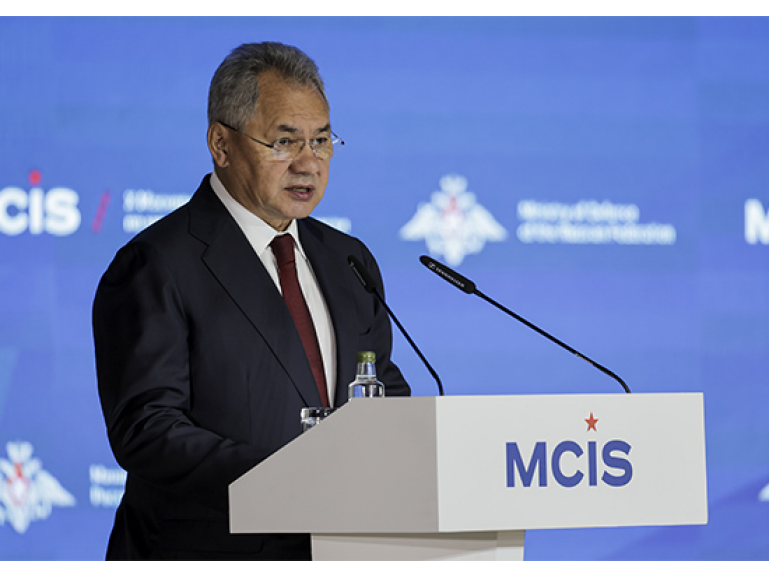
The opening of the 10th Moscow Conference on International Security took place at Avangard Centre for Military and Patriotic Education of Youth within the framework of ARMY 2022 IMTF. Minister of Defence of the Russian Federation, General of the Army Sergei Shoigu, addressed the participants of the event:
Ladies and gentlemen!
It is a pleasure to welcome you to the 10th Moscow Conference on International Security.
This conference comes at a time of radical change in global and regional security. The unconditional dominance of the US and its allies is a thing of the past. On February 24, 2022, the start of the special military operation in Ukraine marked the end of the unipolar world.
Multipolarity has become a reality. The poles of this world are clearly defined. The main difference between them is that some respect the interests of sovereign states and take into account the cultural and historical particularities of countries and peoples, while others disregard them. There have been numerous discussions on this topic during previous sessions of the Moscow conference.
In Europe, the security situation is worse than at the peak of the Cold War. The alliance’s military activities have become as aggressive and anti-Russian as possible. Significant US forces have been redeployed to the continent, and the number of coalition troops in Eastern and Central Europe has increased manifold.
It is important to note that the deployment of additional NATO Joint Force formations on the bloc’s “eastern flank” had already started before the start of the special military operation in Ukraine.
NATO has dropped its masks. The aggressive nature of the bloc was no longer concealed by the wording of the coalition’s purely defensive orientation. Today, the alliance’s strategic planning documents enshrine claims to global dominance. Alliance’s interests include Africa, the Middle East and the Pacific Rim.
In the West’s view, the established system of international relations should be replaced by a so-called rules-based world order. The logic here is simple and ultimatumatic. Either the alliance’s “democratic partner” candidate loses sovereignty and becomes supposedly on the “right side of history”. Or it is relegated to the category of so-called authoritarian regimes, against which all kinds of measures, up to and including coercive pressure, can be used.
Given that the Conference is attended by heads of defence agencies and security experts from different regions of the world, I would like to highlight some aspects of the special military operation in Ukraine.
In Ukraine, the Russian military is being confronted by combined Western forces that run the leadership of that country in a hybrid war against Russia.
The supply of weapons and military equipment to Ukraine is being stepped up, and training of the Ukrainian army is being carried out. Huge financial resources are transferred to maintain the viability of the nationalist regime.
The actions of Ukraine’s armed forces are planned and coordinated by foreign military advisers. Reconnaissance data is supplied from all available NATO sources. The use of armaments is supervised by Western specialists.
NATO’s efforts are aimed at prolonging the agony of the Kiev regime. However, we know for a fact that no one in NATO has any doubt that the goals of the Russian leadership’s special military operation will be achieved, and that plans to strategically and economically weaken Russia are failing. The dollar has not reached the ceiling of 200 roubles, as predicted by the US president, the Russian economy has stood firm.
The special military operation has dispelled the myth of “super-weapons” supplied to Ukraine by the West, which are capable of fundamentally changing the situation on the front. Initially, they were talking about deliveries of Javelin anti-tank systems, some kind of “unique” drones. Lately, the Westerners have been promoting the role of super-weapons with HIMARS multiple launch rocket systems and long-range howitzers. However, these weapons also grind to a halt in battle. They did not make a significant impact. The Russian weapons, for their part, have proved their best qualities in combat.
We are taking a close look at trophy weapons from the West. The features and their specific qualities are taken into account in order to improve the way combat operations are conducted and the effectiveness of Russian armaments.
The supply of NATO weapons to Kiev means that Western countries are responsible for their inhumane use and for the deaths of civilians in Donbass and in the liberated territories. Ukrainian armed forces operations are planned in Washington and London. Not only are the coordinates of the targets to be attacked provided by Western intelligence, but the input of this data into weapons systems is conducted under the full control of Western specialists.
Kiev’s role in the West’s combat approach has been reduced to supplying manpower, which is seen as expendable. This explains the huge loss of personnel in Ukraine’s armed forces and territorial defence formations.
So far, the real figures of dead soldiers and mobilised so-called territorial defence forces have been concealed by the Kiev leadership.
In time, however, this information will become public. The testimonies of POWs of AFU allow us to form a realistic picture of what is happening on the other side of the front. The dismissive attitude towards the loss of foreign soldiers reinforces the thesis that NATO has purely selfish interests in Ukraine. Clearly, Britain’s colonial experience as the main sponsor of the Kiev regime has come in very handy for London in dealing with the current leadership in Kiev.
Against this background, speculation is spreading in the media about the alleged use of Russian tactical nuclear weapons in the special military operation or the readiness to use chemical weapons. All of these information gibberish are lies.
From a military point of view, there is no need to use nuclear weapons in Ukraine to achieve its goals. The main purpose of Russian nuclear weapons is to deter a nuclear attack. Its use is limited to extraordinary circumstances as defined in the Russian guideline documents, which are open to public inspection.
The allegations about the possible use of chemical weapons in Ukraine are also absurd. Let me remind you that, unlike the US, such weapons were completely destroyed in our country back in 2017 as part of our international obligations. Meanwhile, poisoning provocations have become the hallmark of Western-sponsored so-called civil society organisations such as the White Helmets in Syria.
The information provocations are aimed at distracting attention from the facts discovered in Ukraine that US experts have conducted banned military and biological research.
Currently, a significant amount of data has been accumulated and is regularly made available to the general public. Work will continue in this direction.
US military-biological activities in Ukraine are not exceptional. Pentagon-controlled laboratories have been established and operate in many post-Soviet, Asian, African and Latin American countries. Local authorities generally have no control over research carried out on their premises that poses a lethal threat to the local population. The consequences of epidemics, I believe, were felt by all during the period of the fight against the spread of coronavirus.
I would like to focus separately on the humanitarian aspects of the special military operation. Compliance with the Geneva Conventions on the rules of war has always been and remains the focus of commanders at all levels. Since the beginning of the operation, orders have been issued stipulating the procedures to be followed by soldiers in dealing with civilians and enemy prisoners of war.
In the territories liberated from nationalists, the troops are actively involved in the delivery of humanitarian aid, the restoration of infrastructure and the maintenance of law and order. This was the case in Syria, in Nagorno-Karabakh, and it is also the case in Donbass.
On humanitarian issues, there has been fruitful cooperation with the UN and the International Committee of the Red Cross. We are grateful for the constructive, depoliticised cooperation of the leaders and staff of these organisations who interact with us. In particular, under the auspices of the UN and with Turkey’s active role, the difficult problem of grain exports from Ukraine’s Black Sea ports was resolved. The Red Cross specialists carry out an important mediation mission in relation to captured soldiers.
NATO has recently initiated a new phase of alliance enlargement, with Sweden and Finland joining the military bloc. The claim that the reason for this was the Russian special operation is untrue.
The practical rapprochement between these countries and the alliance has been ongoing for many years. In fact, the regional association NORDEFCO (Committee for Nordic Defence Cooperation) is a northern affiliate of NATO and serves as a cover for these countries’ participation in joint military training activities.
Of course, the official involvement of Helsinki and Stockholm in NATO’s strategic planning and the possible allocation of territory to these states for deployment of strike weapons will change the security environment in the Baltic region and the Arctic and will require a reconsideration of approaches to defence of Russian territory.
Certain conclusions have already been reached and are enshrined in the updated Maritime Doctrine approved by the President of the Russian Federation on July 31. Work will continue in this area.
The reinforcement of the NATO military grouping on the “eastern flank” completes the degradation of the trust and arms control mechanisms that emerged in Europe during the Cold War. A few years ago, experts proposed that the European experience should be used to build confidence-building measures, in particular in the Pacific Rim. Now, of all the “baggage” of the Euro-dialogue, only the idea of bloc confrontation is exported to Asia, which has not brought anything positive to security in Europe.
Today, no one remembers the US destruction of the Anti-Ballistic Missile Treaty, the Intermediate-Range and Shorter-Range Limitation Treaty and the Open Skies Treaty. Although previously these agreements were crucial for disarmament and confidence-building.
Organisation for Security and Cooperation in Europe, which was conceived as a platform for dialogue and consideration of different views, has become a generator of anti-Russian narratives.
Vienna Document 2011 remains formally in force, but there are no prospects for practical implementation. In the absence of trust between the parties, the verification mechanism effectively becomes a source of intelligence, which is not in the spirit of this agreement.
The situation with regard to the Strategic Arms Limitation Treaty is also complicated. The agreement remains in force until 2026. On the Russian side the commitments are fulfilled, the declared levels of carriers and warheads are maintained within the established limits.
U.S. claims that Russia must earn the right to continue dialogue with the U.S. do not resist criticism. Arms control is a two-way street.
The result is only achievable if the interests and commitment of all participants are balanced. I believe that the Russian experience of interaction with the West in the field of disarmament shows that the so-called rules-based peace it promotes does not involve the implementation of treaty obligations in the traditional sense. This fact needs to be taken into account when entering into agreements, especially in the field of security and arms control.
Western opposition to the consolidation of a multipolar world, along with Europe, is most active in the Asia-Pacific region, where the US has begun to dismantle the existing ASEAN-based system of regional cooperation. This started with the announcement of the AUKUS initiative by the US, Australia and the UK. Plans to expand this partnership to include new regional partners have not been concealed. AUKUS is merging with NATO, which in turn claimed a dominant role in the Asia-Pacific region at the June summit. This is despite the fact that all NATO countries are thousands of miles away from the region.
On 2 August, the Russian Federation marked the 77th anniversary of the Soviet Union’s entry into the war with Japan, the occasion for which was Tokyo’s militarist policy. The defeat of Japanese forces in the Far East effectively sealed the end of World War II and provided the start for the liberation of the peoples of Asia from colonial oppression. The assistance of the USSR was of key importance. We remember and are proud of the legacy of our ancestors, including those who laid the foundation for military cooperation between Russia and the countries of the Asia-Pacific region.
Another dangerous regional trend is the AUKUS focus on developing a nuclear submarine fleet in Australia. The implementation of this plan would have a complex negative impact on global and regional security, creating the conditions for undermining the Treaty on the Non-Proliferation of Nuclear Weapons.
The US claims that nuclear-powered submarines are needed in Australia ostensibly to offset China’s growing naval capabilities. This logic in fact replicates the actions of the US in justifying its exit from the Intermediate-Range and Shorter-Range Missile Treaty. The collapse of this agreement was also motivated by the need to offset Russian and Chinese efforts to develop missiles with a range allegedly prohibited by the treaty.
In the global context, the appearance of a nuclear-powered fleet in Australia will provide an excuse for other states to begin developing similar armaments. Pandora’s box will be opened, the global nuclear arms race will resume.
AUKUS has the potential to develop into a politico-military alliance. It cannot be excluded that NATO’s experience with joint nuclear planning and joint “allied” nuclear exercises will also be transferred to the region. The technical basis for this is already being laid by the active promotion of US-made aircraft. The participation of nuclear and non-nuclear weapon states in joint exercises on the use of nuclear weapons is contrary to obligations under the Treaty on the Non-Proliferation of Nuclear Weapons. Transferring nuclear training from Europe will blow up the region.
Although it can be assumed that this is precisely the purpose of the US. The provocative landing in Taiwan of a third person of the US bureaucratic hierarchy is another move to destabilise the situation.
Block-less, equal interaction in the region is an achievement that should not be lost due to externally imposed phobias and attempts to counter a multipolar world.
Mechanisms for interaction and dialogue with extra-regional partners are created and are proving their relevance and effectiveness. First and foremost is the ASEAN Defence Ministers’ and Partners’ Meeting, the so-called “ADMM-Plus” format. Its diverse activities focus on security issues of relevance to the Asia-Pacific region.
In addition, there is positive experience of cooperation within the Shanghai Cooperation Organisation, of implementing mutually beneficial projects on a bilateral basis.
As before, we are ready to share our experience of combat training, in particular during the Vostok-2022 strategic exercise to be held in the near future.
Despite significant successes in the fight against terrorism in the Middle East, the threat of international terrorist groups taking over the initiative remains. The Syrian military, in cooperation with allies and partners and with the support of the Russian Aerospace Forces, continues to suppress spikes in terrorist activity. We see a particular danger in using the Kurdish factor to unsettle the situation in Syria.
The engagement of the guarantor countries in the Astana format remains virtually the only legal and effective mechanism to address security concerns in Syria. We welcome the increased engagement between the Syrian leadership and the Arab world. Overcoming contradictions created by outside forces is possible and necessary.
The role of the military in building trust between countries is an important element in the search for political solutions. We expect that the Moscow conference will be one of the rallying points for the stabilisation of the situation in the Near East.
After the rapid withdrawal of US and NATO forces from Afghanistan, the situation in the Central Asian region remains extremely tense. Afghanistan’s new leadership faces serious military and economic challenges. The legacy of two decades of alliance troop presence is a disappointing one. As a result, there remains a high level of terrorist danger in the region.
The security problems of Central Asia can only be solved by coordinated action by all the countries and international organisations concerned. For our part, we will continue to support our Collective Security Treaty Organisation allies in enhancing the capabilities of national armed forces.
It is important to keep the topic of Afghanistan on the agenda of the Shanghai Cooperation Organisation discussions. Russia, China, India, Iran and Pakistan together could make a significant contribution not only to stabilising the region, but also to preventing the threat from spreading beyond its borders.
The security of each region, despite the general trends of a multipolar world, has its own peculiarities.
For Africa, the specificity lies in the desire of the countries of the collective West to return to the order and rules of engagement typical of the colonial period. Neo-colonialism is imposed through military pressure on governments of sovereign countries and support for separatist and terrorist movements. A case in point is Libya, where statehood has still not been restored after the NATO invasion. Another example is the situation in West Africa, where European troops have been deployed on the pretext of combating terrorism. For decades, these EU missions had been fighting terrorists, training national security forces, until they recognised the utter failure of their own efforts.
I would like to point out that African governments and leaders are holding their own, as they call it, in the context of a multipolar world, to pursue their own agenda of independence, sovereignty, economic development and defence capabilities.
The Russian Ministry of Defence is seeking to expand cooperation with African countries in the field of military and military-technical cooperation. Interest in the participation of national teams and delegations from Africa in the Army International Games and the “ARMY 2022” IMTF has increased significantly. It is very encouraging that prominent military commanders from our friendly states – Burundi, Cameroon, Guinea, Mali, Sudan, Uganda, Chad, Ethiopia and the Republic of South Africa – are present in this hall today. We appreciate your support and intend to increase cooperation on mutually beneficial projects.
Latin America today faces serious security challenges because of the American desire to maintain influence in the region under the provisions of the so-called Monroe Doctrine. Liberal values, whose adherence is seen by the US as agreeing to live in a world based on their rules, in fact mask the true objective – to build up a military presence by blocking the possibility of sovereign development of states.
U.S. policy focuses on deterring engagement by countries in the region with any other pole of power outside Washington’s control. The purpose of this policy is to involve the region in a confrontation with Russia and the PRC, to destroy traditional ties and to block new forms of cooperation in the military and military-technical spheres.
Anti-Russian information campaigns are launched in Latin America, hiding the truth about the causes and course of the special military operation in Ukraine. Analogies can be drawn to the British actions during the conflict in the Falkland Islands. What is happening in the Western media today with the coverage of the Russian special military operation was also happening when the media was chorally broadcasting only one point of view – that of London.
The question arises: are such policies in the fundamental interest of the countries of the region? The answer is clear – no. We hope that during the discussions at the conference we will hear assessments of the situation in Latin America from our partners from Venezuela and Nicaragua.
The Tenth Moscow Conference on International Security has a special importance for the Russian Ministry of Defence as organiser of the forum for a number of reasons.
Firstly, the conference is taking place during the ongoing special military operation in Ukraine. Despite attempts of the US and NATO to isolate Russia once again, your participation in the forum is a visible confirmation that these plans have collapsed. We appreciate your support.
Secondly, a multipolar world is the reality of today. The transition from dominance by a single global leader to several centres of gravity is not an easy one. However, this creates real conditions for the development of sovereign states.
Thirdly, the role of military agencies is changing in the new realities. The military not only guarantees a secure environment for economic development, but through military cooperation it builds predictability and trust between countries.
Finally, this is the tenth anniversary conference, which allows for a kind of review of what has been achieved over the years. It is important to observe how the priorities of the discussions have changed, and which conclusions and recommendations from the forum have been put into practice over the years. A short historical overview, prepared by Russian experts, can be viewed on the monitors between plenary sessions.
I wish you all good health and interesting contacts and discussions during your stay in Moscow.