From Eva Bartlett’s YouTube channel. Link here.
First Foreign Ship Sails From Mariupol Port, As Mariupol Starts To Rebuild
From Eva Bartlett’s YouTube channel. Link here.
From Eva Bartlett’s YouTube channel. Link here.
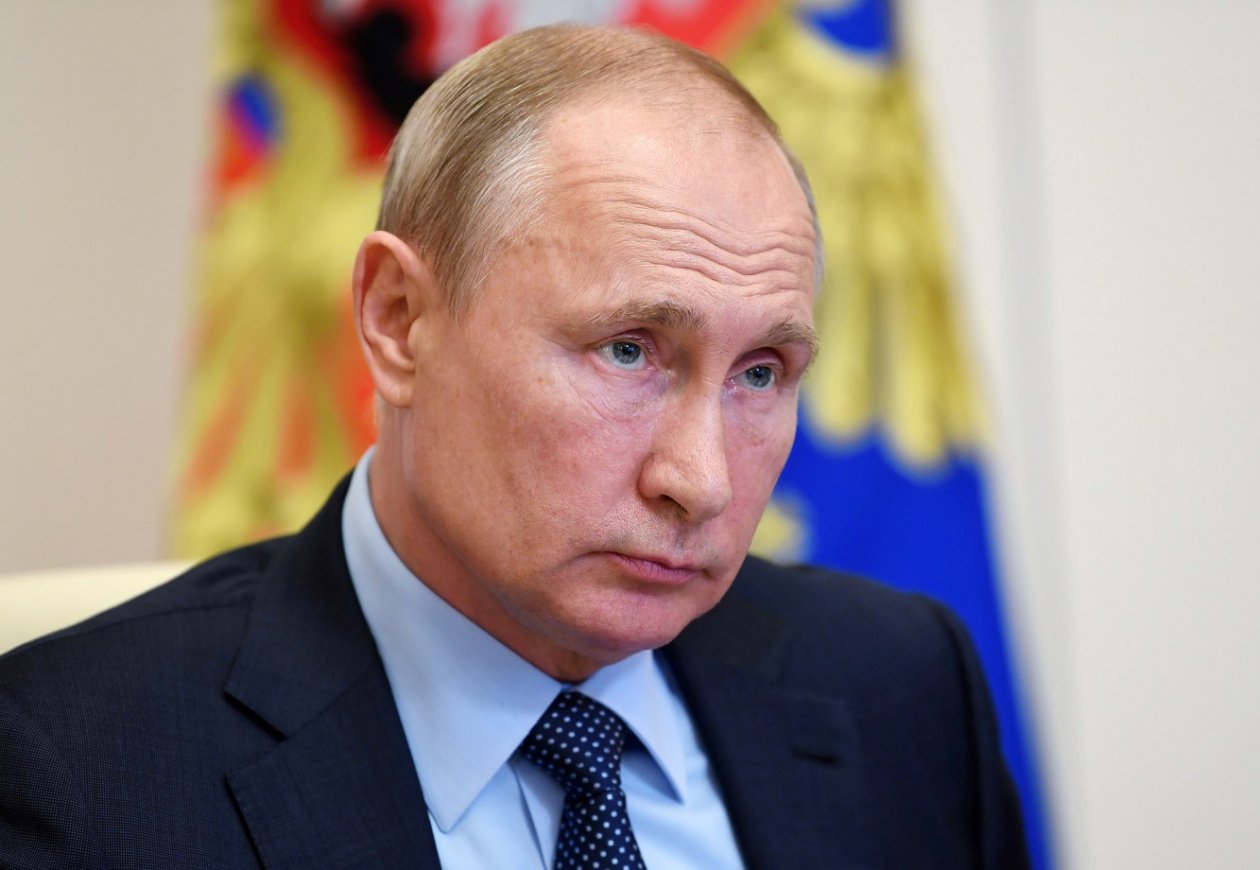
Kremlin Transcript, 6/29/22
In conclusion of his working visit to Turkmenistan, Vladimir Putin answered questions from media representatives.
President of Russia Vladimir Putin: Good evening.
Please go ahead. How did you like Ashgabat? The weather is hot, though. But the city has completely transformed in the past years, with new architecture. It is so beautiful.
Question: Mr President. It has been a while since your last visit to Turkmenistan. Today you have arrived in our country to attend the 6th Caspian Summit. Also today, you have met with the President of Turkmenistan and Chair of the Halk Maslahaty of the Milli Gengesh [the upper chamber of parliament] of Turkmenistan Gurbanguly Berdimuhamedov, who turns 65 today. You offered birthday greetings to your former colleague.
Therefore, my question is: what significance you attach to this visit to Turkmenistan, and, in your opinion, what are the prospects of further partnership between the Caspian littoral states following the 6th Caspian Summit here in Ashgabat.
Thank you.
Vladimir Putin: I have already said it and want to say it again: congratulations to Turkmenistan and the people of Turkmenistan on such a good choice. Your new President is a young and energetic man with brilliant education and experience in public administration. We are forming a good relationship. He is taking over from his predecessor and father. We had a very informative and good conversation during his visit to Moscow. We outlined a plan of specific actions to develop our bilateral relations and we are starting to implement it.
As concerns your previous leader, Mr Gurbanguly Berdimuhamedov, we have established a very good and friendly relationship over the years. In many respects it was thanks to his efforts that a framework was created for developing Russia-Turkmenistan relations, and that our cooperation continues, both between our energy companies and in humanitarian affairs, in education and transport. It is very important as logistics in the modern world are essential to economic success.
I must say that, after the official part, he invited us to an informal lunch, where we had a chance to offer our birthday greetings, but perhaps 90 percent of the time was dedicated to an informal and open conversation about the development of cooperation in the Caspian region. You know which areas were in our focus. There were many ideas and proposals expressed. I do not want to reveal everything as they must first be formalised in corresponding multilateral and bilateral documents.
Naturally, we did not speak only about energy or logistics. We also covered industrial cooperation – in the areas that, certainly, are of common interest to all the countries – in particular, the main areas of our economic activity. We agreed on selecting these priority areas and distributing competences among ourselves. According to these competences, we will take steps to build broad cooperation in major areas, primarily in industrial production and high technology.
In my opinion, there are great prospects. It is important and relevant to focus more on these things.
As for our traditional areas of cooperation such as energy and some others, we reached specific agreements as well, including with respect to extending several contracts. Gazprom management will be travelling to Turkmenistan soon.
So, we are very grateful to the leadership of Turkmenistan for organising this event. After this lengthy break, let’s call it a COVID hiatus, we finally had a chance to work with each other in a full format. It was very useful. So, thank you very much.
Question: The keynote of the G7 summit in Germany was punishing Russia as much as possible. Also, jokes were made about, I apologise, your naked torso. Everybody had a go, including the Prime Minister of Canada, who suggested dropping jackets to be cooler than Putin. Here, at the Caspian Summit, did you by any chance discuss anything like that?
Also, Boris Johnson said that if the Russian President were a woman, there would be no war. What do you think about that?
Vladimir Putin: I do not know how much they wanted to take off, to only bare their tops or also bottoms. But I think it would have been a disgusting sight anyway. I would like to quote Pushkin here. I may be wrong with the details but he said something to the effect that “You can be a sensible person and think about the beauty of your nails.” So, obviously, I agree with that: everything should be balanced in a person, both body and soul should be taken care of. To achieve this, one should refrain from drinking too much and other bad habits. It’s important to exercise and keep fit.
The colleagues you mentioned, I know them all personally. It is not the best period in our relationship, clearly. Nevertheless, they are all leaders, which means they have strong characters. If only they set their minds to it, they can achieve success, of course. But it takes effort. The mere fact that they are talking about it is good and I can praise them for that.
Now, to the second part of the question. Did you say Johnson? I do not want to elaborate on what could have been, I simply want to remind you about the events in recent history, when Margaret Thatcher made a decision to start a military operation against Argentina for the Falklands. There was a woman who decided to start a military operation. Where are the Falkland Islands and where is Great Britain? The decision was dictated by nothing but imperial ambitions and the goal was to reaffirm the country’s imperial status.
Therefore, I think that, at any rate, it is not exactly a good jab from the Prime Minister of the United Kingdom at the current events.
Question: The NATO summit has begun with the war-mongering rhetoric. Russia has been declared a “direct threat” to the security of the Alliance. Stoltenberg admitted that NATO had been rearing for confrontation with Russia since 2014. The Prime Minister of Belgium said that Ukraine must win and that it must do this on the battlefront, which has allegedly been coordinated with the Ukrainian authorities.
How would you assess these statements? And how should we regard them?
Vladimir Putin: We should regard it as a fact. As regards their preparations for some actions against us since 2014, this information is not new to us. It explains our decisive actions to protect our interests. They have long been looking for an external enemy, for a threat that would rally their allies. I am referring above all to the United States.
Iran is not quite right for that role. Russia is much better. They see us as a chance to rally their allies in a new historical period. There is nothing new in this for us. This is fresh proof of what we have been saying all along: that NATO is a relic of the past, of the Cold War era. They always replied that NATO had changed, that it had become more of a political alliance, but at the same time they were looking for an opportunity to give it a new lease on life as a military organisation. Well, this is exactly what they are doing now. There is nothing new in this for us.
Question: What about Ukraine’s victory?
Vladimir Putin: As for Ukraine’s victory, we are aware of this as well. Ukraine conducted talks with us, sometimes better than at other times. We made certain arrangements at some point, but later they, pardon the expression, chucked them. The calls to Ukraine to continue fighting and to abandon any further negotiations reaffirm our supposition that the united West and NATO do not care for Ukraine or the interests of the Ukrainian people, and that their goal is to protect their own interests. In other words, NATO and the leading members of the alliance are using Ukraine and the Ukrainian people to reinforce their positions and their role in the world, not to reaffirm their leadership but their hegemonism in the direct meaning of the word, their imperial ambitions. This is what they want. What they have always said about their exceptionalism, the idea they tried to impress on the international community that those who are not with them are against them – all this are manifestations of the same policy. This is not new to us.
Question: Mr President, Turkey has abandoned its convictions on the issue of Sweden and Finland’s accession to NATO. Will that decision have any effect on Russia-Turkey relations? What will Russia do now, especially in light of Stoltenberg’s statement that you wanted less NATO on Russia’s borders but got the opposite: more NATO.
Vladimir Putin: I am aware of this premise, which is wrong and bears no relation to reality. Our position has always been, as I have already said during this conversation today, that NATO is a relic of the Cold War and is only being used as an instrument of US foreign policy designed to keep its client states in rein. This is its only mission. We have given them that opportunity, I understand that. They are using these arguments energetically and quite effectively to rally their so-called allies. This is the first point.
On the other hand, regarding Sweden and Finland, we do not have such problems with Sweden and Finland as we have, regrettably, with Ukraine. We do not have territorial issues or disputes with them. There is nothing that could inspire our concern regarding Finland and Sweden’s accession to NATO. If they want it, they can do it.
However, they should know that they did not face any threats before but, if military contingents and infrastructure are deployed in their territory now, we will have to take mirror-like actions and create the same threats for them that are created for us. This is obvious. Don’t they understand this? Everything was good between us before, but now there will be tension, which is obvious and certainly unavoidable if, as I have said, any threats are created for us.
As for the assumption that we were fighting against NATO approaching us through Ukraine but now have Sweden and Finland to deal with, there is no substance behind it at all, because Finland and Sweden’s NATO membership is not at all the same as the potential membership of Ukraine. These are two different things. They know this very well, but they are promoting this idea to show that Russia has received more of what it did not want to have. No, this is entirely different, and we are aware of that. And they are aware of that. They are trying to substitute these notions, to show that Russia has not attained its goals. But this will not deceive us.
If Sweden and Finland want to join NATO, let them do it. You know, there are rude jokes about stepping into unsavoury things. This is their business. Let them step into what they wish. But Ukraine is a totally different matter. They were turning Ukraine into an anti-Russia, a bridgehead for trying to stir up Russia itself. They began fighting Russian culture and the Russian language, they began to persecute those who regarded themselves part of the Russian world. There is nothing like that in Finland or Sweden; the situation is completely different. If they want to join [the bloc], they are free to do it.
Question: Today Lev Leshchenko said that he was willing to perform a song about the heroes of the special operation. Ilya Reznik has already written lyrics. The other day I came back from Lugansk where Head of the Lugansk People’s Republic Pasechnik proposed making a film. He pitched his idea to Vladimir Mashkov who was immediately inspired by it. We remember the role that Soviet art played during the Great Patriotic War. What do you think about these ideas and proposals?
Vladimir Putin: It is a good idea. You see, the guys who are performing their combat duty there, fighting, risking their lives, some actually losing their lives, they are sacrificing themselves for the goals of this military operation. They are protecting people in Donbass, protecting Russia’s interests and ensuring the security of our country. Don’t we realise this? I have said it many times before: if an anti-Russia foothold is established at our borders, we will be constantly under this threat, under this sword of Damocles. So, these guys are performing a crucial mission to ensure the security of Russia and, of course, they deserve to be known and talked about around the country. Not only do I support such ideas (this is the first time I have heard about this), but I think that we should write songs and poems and build monuments to these heroes.
Question: Mr President, have the goals of the special operation changed since it began? What is the current goal? Do you understand when all this will end?
Vladimir Putin: Nothing has changed, of course. I talked about it in the early morning on February 24. I talked about it directly and publicly for the entire country and the world to hear. I have nothing to add. Nothing has changed. Also back then, several days into the operation, I said that the tactics may be different, the tactics proposed by the Defence Ministry and the General Staff, with respect to where the troops must move and what targets must be hit, what must be achieved when several groups entered central Ukraine and what must be achieved in Donbass. The Kiev regime had been preparing for that for a long time, since 2014. Therefore, we needed to take certain action to distract them.
Yes, I am the Supreme Commander-in-Chief, but I have not graduated from the Military Academy of the General Staff. I trust professionals. They are doing what they consider necessary to attain the overall goal. I have formulated the overall goal, which is to liberate Donbass, protect its people and create conditions that will guarantee the security of Russia itself. That is all. We are working calmly and steadily. As you can see, our forces are moving forward and attaining the objectives that have been set for the particular period of the engagement. We are proceeding according to plan.
We are not speaking about any deadlines. I never speak about them, because this is life, this is reality. It would be wrong to make things fit any framework, because, as I have already said, the issue concerns combat intensity, which is directly connected with possible losses. And we must think above all about saving our guys’ lives.
Question: May I ask about the terrorist attack, well, not an attack but the explosion at the shopping centre in Kremenchug in Ukraine? There are different versions.
Vladimir Putin: There was no terrorist attack there nor an explosion.
I was here, so I do not know the details. What I know, and what we have pointed out many times and we have shown the footage, including from drones, that weapons, MLRS, artillery guns and heavy weapons are deployed in residential districts and other places. We are not shooting at empty fields. We usually shoot at targets that have been identified.
I am sure that this is what happened in this case as well. They are hiding the equipment, especially equipment delivered from the West, in hangars, at outdoor markets, at plants and in the shops where this equipment is repaired or adjusted after a long period of transportation from foreign countries.
The Russian army does not strike at civilian facilities. There is no need for that. We have the possibility of identifying the targets, and we have modern long-distance precision weapons to attack them. Of course, I will find out the details when I return to Moscow.
Earlier this week, a mall burned down in the Ukrainian town of Kremenchuk after a missile attack by Russian forces. There have been conflicting claims about what happened and how many people died. Ukrainian president Zelensky initially claimed up to a thousand potential victims from the attack. Subsequent reporting seems to indicate far fewer casualties. I’m presenting two analyses of what happened: one from the Moon of Alabama blog – a good source but one that has a pro-Russia slant. The other is from Meduza, a Russian outlet based in Latvia that has a pro-Western slant. Both are worth a read. – Natylie
Another Zelensky Lie Debunked
By Moon of Alabama, 6/27/22
Yesterday I mentioned the burning shopping center in Kremenchuk, Ukraine, of which the Ukrainian president Zelensky falsely claimed that thousand people had been inside.
I asked:
Satellite pictures show that the shopping center is right next to the large Kredmash machine plant. Was that the real target of the attack with the shopping center being an unintended casualty?
It has now been confirmed that the answer to my question is ‘yes’.
Today’s report on the war by the Russian Defense Ministry says:
On June 27, in Kremenchug (Poltava region), Russian Aerospace Forces launched a high-precision air attack at hangars with armament and munitions delivered by USA and European countries at Kremenchug road machinery plant.
High-precision attack has resulted in the neutralisation of west-manufactured armament and munitions concentrated at the storage area for being delivered to Ukrainian group of troops in Donbass.
Detonation of the storaged munitions caused a fire in a non-functioning shopping centre next to the facilities of the plant.
Ahhh – “don’t trust the Russians!” you say. Well, don’t trust anyone I say, just scrutinize the facts.
The Ukrainians have published surveillance video from a park catching the moments of the two explosions. A large flash appears and people are running away as some debris falls down.
The park is around an artificial lake with an island in the middle that can be reached by a bridge. There is a small round building on the island.
bigger
Here is a Google satellite view of the whole scene.
bigger
The light gray shopping center roof can be seen south of the large Kredmash machine plant in the center. The small park from which the surveillance videos come is directly north of it. Google has marked it in green as some special recreational space. The factory has direct rail access at its southern side with several rail tracks for loading and unloading machinery. Rail access makes it an ideal space for preparing or repairing heavy weapons. It seems that the railway area was one of the two targets.
Still not convinced? Well, here is video from a Ukrainian TV station taken on the factory grounds. It is showing a crater and the debris of the factory. The areas where it was hit are pretty much destroyed.
bigger
According to the Ukrainian emergency services the attack has caused the death of 16 people and wounded 59. So most of Zelensky’s ‘thousand’ people inside the shopping center must have either survived or never existed at all with the latter being the more likely case.
The shopping center was obviously as empty as its large empty parking space I mentioned yesterday. It somehow came on fire after the factory next door was bombed. Those who died were most likely soldiers or factory workers who were preparing ‘western’ weapons for delivery to the front.
Zelensky’s lie has been debunked just as the other horror fictions he has told about Russians.
The Kremenchuk Missile Strike: What the Evidence Shows
By Meduza, 6/28/22
On Monday, June 27, a Russian airstrike on a shopping mall in Kremenchuk, a city in Ukraine’s Poltava region, killed at least 20 civilians; dozens more are still unaccounted for. Kyiv called the strike a terrorist act and an “intentional attack on a civilian target.” Russian officials initially claimed the attack was a “Bucha-style false flag,” but the Russian Defense Ministry soon acknowledged that a strike had indeed occurred. In Russia’s telling, however, a strike “on a foreign munitions warehouse” caused some of the weapons stored there to detonate, damaging a nearby defunct shopping mall. Meduza explains the holes in Russia’s story.
At around 4:00 pm on June 27, there was a powerful explosion in the center of Kremenchuk, and almost ten seconds later, there was another. At the same time, the Amstor shopping mall caught on fire. Within several hours, it had burned to the ground.
The city authorities reported that evening that 19 bodies had been found at the fire scene and that another person had died in the hospital. About 40 other people who had been in the mall were now missing. Over 50 people had injuries, most of which were burns.
Ukraine’s Interior Ministry reported that the strikes were carried out by Kh-22 missiles launched from Tu-22 bombers that had taken off from the Shaykovka air base in Russia’s Kaluga region.
The Kremenchuk authorities later showed journalists a giant crater and a destroyed production facility at a road machinery plant close to the Amstor mall. The hole is about a third of a mile from the shopping center, which would seem to confirm the Russian Defense Ministry’s version of events; according to the Ministry, they had launched a strike on the plant because Ukraine had been storing weapons there, and that some of the weapons had detonated, setting the mall nearby on fire. But that story is false.
On June 28, several videos from surveillance cameras in a Kremenchuk city park were posted online. The park is located directly behind the road machinery plant, halfway between the plant and the Amstor mall. At the start of the video, the people and the birds at the park are visibly alarmed, presumably by a distant explosion; ten seconds later, a second explosion can be seen — this one much closer.
Based on the layout of the things seen in the videos, it’s clear that the second explosion was the one at the road machinery plant. It’s not possible to determine the epicenter of the first explosion based on the footage, but in one of the videos, a heavy column of smoke can be seen rising behind the plant from the approximate location of the mall.
In addition, Meduza has obtained photos taken on the day of the attack from a higher elevation about two miles from the Amstor mall. The person who sent the photos asked Meduza not only not to use his name, but also not to publish the photos themselves, as they could be used to determine where he lives, and publishing images of possible military targets can bring criminal charges in Ukraine. Meduza was unable to confirm his claims regarding the photos’ origin, but also found no evidence to suggest the photos had been forged.
The photos show two explosions of similar size; the smoke in the upper part of the mushroom cloud over one of them has already begun to dissipate, suggesting that that one occurred slightly earlier. Meduza has geolocated the location where the photo was taken, as well as the approximate locations of the explosions: the first explosion (whose smoke had begun to dissipate) happened at or near the mall, while the second happened at or near the road machinery plant.
The photos (which appear to have been taken consecutively over roughly a half-hour period) don’t show any signs of secondary munitions detonations (such as what happened, for example, in March 2022 after a missile strike on Kyiv’s Retroville mall, where the Ukrainian military was hiding artillery and shells). The smoke from the explosions simply continues to dissipate, and the fire can be seen breaking out at the mall.
By comparing satellite images from April and from June 28, it’s possible to determine where exactly the missile landed near the Amstor mall. In addition to the destruction at the mall, the June images show what is presumably the crater left by the missile; it’s right next to the single-track railway that divides the mall from the plant. The likely impact site is about a hundred feet from the mall — specifically from a store called Comfy, which had more victims and missing persons after the strike than any other store, according to mall employees, because the store caught on fire immediately after the explosion. Security camera footage showing the missile strike confirms the location (the coordinates can be seen here).
Anton Gerashchenko
Based on this evidence, we can safely conclude that the first missile detonated in the immediate vicinity of Amstor, and that the second missile hit the production facility at the road machinery plant. The evidence also suggests that there was no “detonation of munitions,” which the Russian Defense Ministry claims was the cause of the fire at the Amstor mall (at the very least, in the days since the explosion, no evidence has appeared to suggest that any munitions were detonated).
That leaves one question: was there ammunition or any other military equipment at the plant? So far, the Russian Defense Ministry has made this claim without presenting any evidence. The Ukrainian authorities and the plant’s management have denied it, and none of the journalists reporting at the scene have found any sign of munitions at the plant.
Judging by the evidence at the strike site, it’s difficult to conclude that Russia’s airstrike was a “deliberate attack” on the Amstor mall. The missile didn’t hit the mall directly. Its most crowded section, the Silpo supermarket, suffered almost no damage in the initial minutes after the attack, according to mall employees (but it was later destroyed in the fire). Technically, while one of the missiles landed in the immediate vicinity of the mall, both of them landed on the territory of the nearby road machinery plant. It stands to reason that the plant was the target of both strikes.
The rest can be explained by the particular features of the missiles used to carry out the strikes (based on the Ukrainian authorities’ reports that they were Kh-22s). These missiles were developed in the 1960s (and modernized in the 1970s) and intended not for precise strikes on ground targets but for attacks on large groups of NATO ships and aircraft carriers.
The missiles have two possible guidance systems:
No. This attack has all the hallmarks of a war crime — one of many committed by Russia since it launched its invasion of Ukraine.
The shelling of the mall in Kremenchuk shows that when Russia’s military commanders are planning a strike, they prioritize effectiveness and cost above all else — including civilian lives.
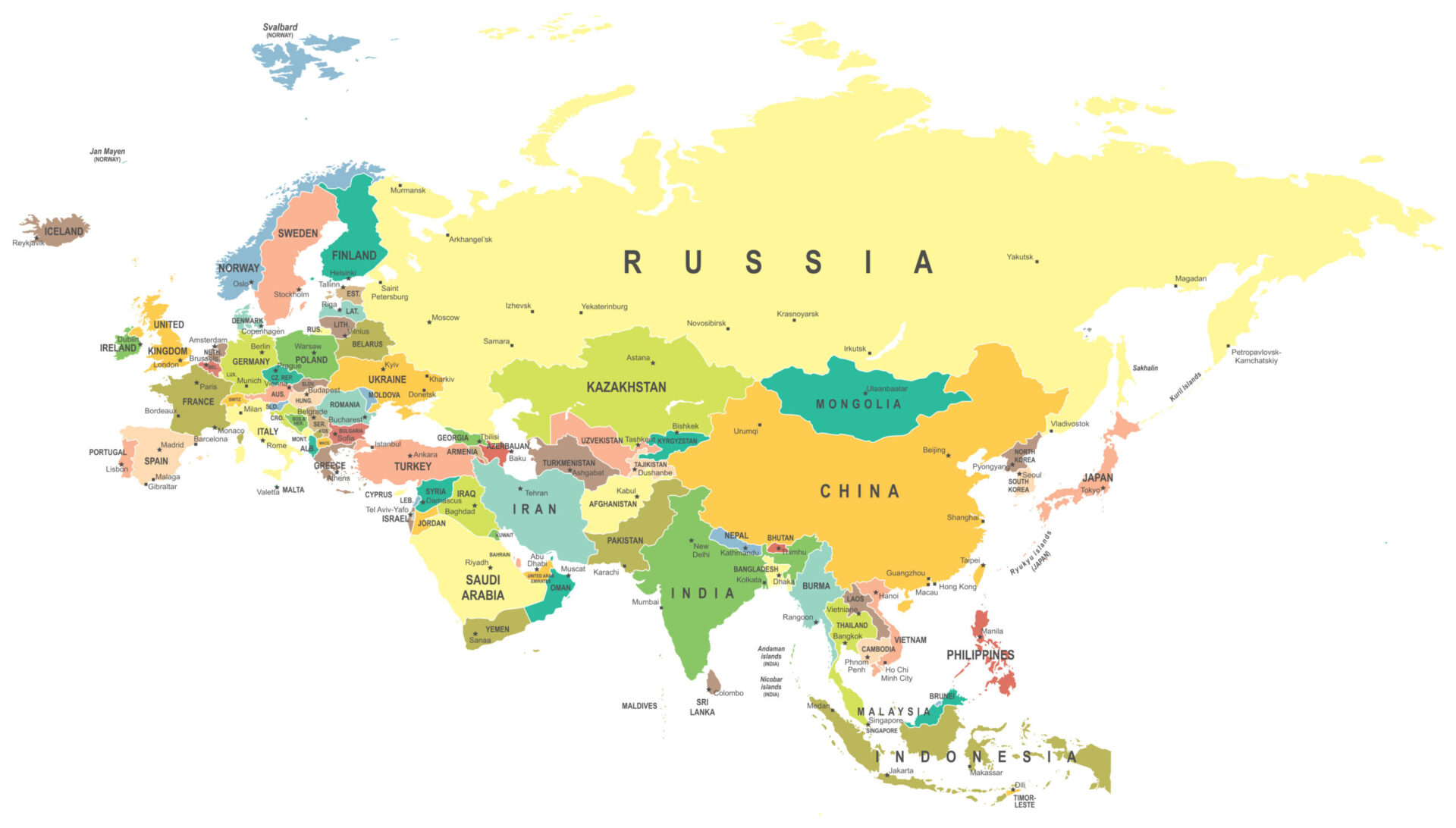
By Thomas Bergman, Substack, 7/1/22
In the Western corporate media, they are starting to speak about Ukraine teaching a bargain with Russia to end the military conflict. Some members of American and British governments have privately disclosed that Ukraine will never see some of its territorial claims restored to its control. Henry Kissinger said that the Kiev regime should offer Crimea and the Donbass to Russia in exchange for some sort of peace agreement with Russia. Yet others, including President Zelensky, want to deliver defeat to Russia on the battlefield. Neoconservatives and liberal interventionists alike also believe that Ukraine and its NATO allies must defeat Russia at all costs; wishing to deliver regime change in Moscow. Yet if we consider the military realities on the ground, the economic picture in Russia compared to the West, and also the public statements of Russian leaders, it is clear to see how Russia will not relent until it fulfills all of its objectives, which are the elimination of the Ukrainian military from the battlefield, a change in the Kiev regime, as well as the security of Russian regions.
If we look at the military operations currently taking place on the ground, it can easily be seen how Russia accelerates the pace of Ukrainian attrition and is learning from any mistakes it may have made at the beginning. Some popular pro-Kiev figures for Russian deaths have been over thirty thousand, but more recent pro-Kiev analyses have revised that down to around twenty five thousand. Whatever the true number is, we can say that it is less than the Kievan propaganda has been saying, and they have a track record of giving whoppers. Contrast this to public admissions of Ukrainian officials themselves, which track what pro-Russian commentators have been saying and could amount to up to a hundred thousand Ukrainian troops dead. This is according to the Ukrainian presidential advisor who said that deaths average a thousand a day. If you multiply that by the number of days of the Russian Special Military Operation, it would exceed a hundred thousand.
The situation around Lysychansk also shows how Russian success in fulfilling its objectives can occur even more quickly than that. Towns all around that area are falling under Russian control, with rapid success over the past several days and the whole area taking only a few more days to completely physically encircle or capture. At one point, there was up to twenty thousand Ukrainian troops there to capture or kill. Some of them were allowed to attempt retreat, but the area of retreat has been under close fire control for at least a week, if not longer, hindering any mass retreat. There are still thousands of Ukrainian troops to encircle and force to surrender.
As Ukrainian forces are forced to abandon the frontlines there and retreat to more defensible positions not yet destroyed by the Russian frontlines, Russian forces are rushing to find as many weak points as possible before they are fortified and consolidated under Ukrainian retreat. Their two main targets for these operations are Seversk and Bakhmut/Artemosk, with Seversk being the only currently conceivable point of retreat from Lysychansk. Moreover, Russian control of Seversk would allow Russian troops north of the Siverskydonetsk river to attack from the other side and eventually flood into the the area. It would move the whole eastern Donbass frontline all the way to Slavayansk. Not only that, but those frontlines would also eventually reach the other side of Artemosk from the west, according to the Military Analysis YouTube channel, as there are no significant towns south of Seversk until you get to Artemosk. This would allow Russian forces to grind away at much more Ukrainian military strength, and would precipitate Russian success in the entire region. Russian forces have already made quick gains all the way up to the next-door neighbor towns around Seversk, so it is conceivable that Russian forces could break through the whole region very shortly.
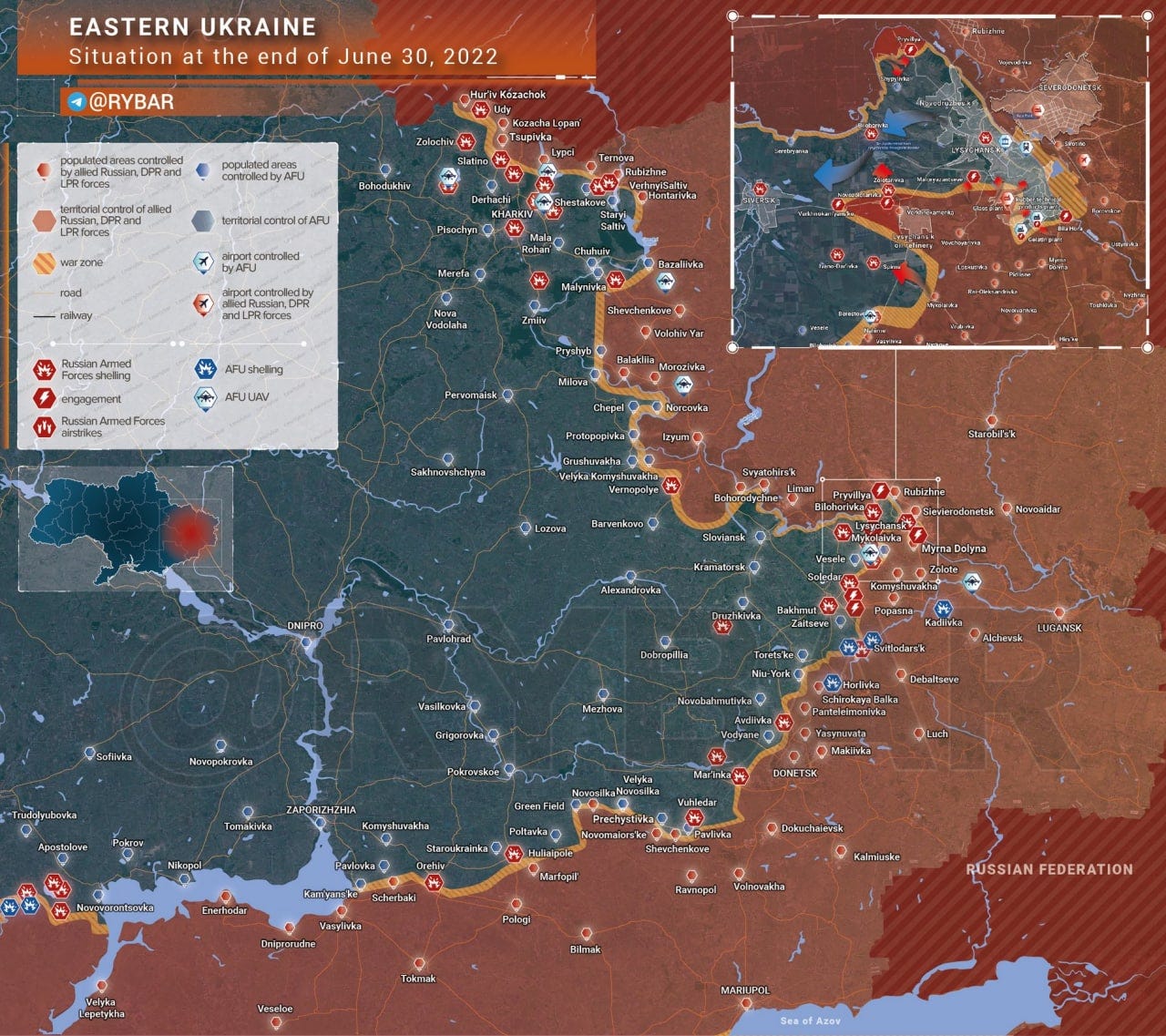
As can be seen on the inset map, Russian forces are advancing towards all towns around Lysychansk, pushing all forces there into operational-tactical encirclement. Also, if you look at the area east of Slavayansk downwards, you can see the open area where Russian forces can break through village after village and rapidly push the frontlines to the south of Slavayansk.
With Russia on the cusp of so much success, its government has no incentive to negotiate with Kiev whatsoever. They are making sure gains in destroying the Ukrainian military every day, and after each breakthrough can repurpose the victorious troops to achieve other victorious breakthroughs elsewhere. This means that Russia can keep increasing the pressure on the Kiev regime around the whole country, encircling and capturing other important regions and cities. President Putin and Foreign Minister Lavrov affirm this when they say that they can completely achieve their objectives and that President Zelensky will not be allowed to sit at the negotiating table anymore.
Not only does Russia have an advantage over the Kiev regime, but they are finding advantages over Western political and economic realities as well. America faces increasing chatter about a civil war while an unpopular American president imposes increasing costs upon basic goods and services. Europe also faces a highly predictable economic recession combined with a winter without sufficient heating or fuel to pursue economic and social activities. This is all due to American and European policies against Russia. The Russian government has already indicated a lack of trust towards Western leaders. It is therefore Western leaders who need to get back into the good graces of Russia in order to solve their basic problems rather than Russia restoring any trust from the West.
Mistrust of Russia by Americans has been driven by Russophobic hysteria for decades. Those in the Western corporate media are so eager to punish and defeat Russia that they blind themselves and others to basic facts on the battlefield and in our own economies. The proverb says “Know thine enemy,” but we should also know ourselves first.

Note: Economist Jack Rasmus provides an even more blunt analysis of western sanctions against Russia, particularly the idea being floated of an oil price cap.
By Ben Aris, Intellinews, 6/29/22
Turkish President Recep Tayyip Erdogan got what he wanted. Sweden and Finland agreed to crack down on the various Turkish dissident groups, including the PKK, sheltering in their countries to unblock Turkish objections to their joining Nato. Erdogan came to the Nato summit in Madrid with a shopping list of requests and it was clear that he was going to play hardball. With Russia blasting Ukraine into the stone age it wasn’t hard for the Scandinavians to roll over.
Of course, the irony is if Russian President Vladimir Putin was paranoid about Nato expansion before, his war in Ukraine has brought about what he most feared. Russia had a tiny border with Nato before with Estonia. Now it has a much longer one with Finland. But I suspect that Putin accepts this. The only difference is that Russia is now in open conflict with the Nato members, and we are in effect back to a Cold War set-up. He was always prepared to go there as he assumed that a conflict with Nato was inevitable.
The world is being divided into two: the West vs Russia and the nonaligned countries. The race to shore up these new relations is on and expect to see the majority try and sit on the fence, especially in the Global South.
But is it really such a bad bet? The Global South accounts for 80% of the world’s population and just over half of global GDP. Russia is already a major player there and the only one of the big emerging markets to be classed as “high income” by the UNDP after Putin’s 20 years on the job.
Going forward EMs are where all the growth is, while the West is, not stagnating exactly, but not dynamic either. Almost all of Europe is suffering from exactly the same demographic problems as Russia and already facing labour shortages: Germany’s demographic replacement rate was 1.48 last year — less than Russia’s 1.5 — and the EU average is currently about 1.55. You need 2.1 for the population to grow. You’ve got that and more in most EMs.
Of course, the developed world has all the technology and is denying it to Russia – the only sanction that is really working well. But this has been true since the industrial revolution a 100 years ago and the basis for the West’s leap forward to dominate the planet. That advantage has still not been undone, but surely it is only a matter of time before the EMs close this gap, even if it does take decades. In the meantime, what the EMs lack in tech they will make up for with babies as a locomotive for growth. It will be fascinating to watch this story play out.
The addition of Finland and Sweden to the Nato family further consolidates and expands the North Atlantic block and the EU has shown remarkable unity on imposing sanctions on Russia, but that process has now hit a brick wall. All the easy “one-way” sanctions (that hurt Russia, but don’t hurt the West) that could be applied have been applied.
I post an explainer from our sister publication NewsBase.com on the proposed oil price cap sanctions that are supposed to be part of the seventh package. I also post a piece about Russia’s Dutch Disease where the only way the government can control the value of the ruble is by reducing the amount of oil and gas it exports. The Central Bank of Russia (CBR) was once probably one of the best run central banks in the world and now it is reduced to using the crudest of all possible tools.
The oil price cap was supposed to be the centerpiece of the G7 summit in Bavaria this week, but I think that we can call that meeting a failure as nothing concrete came out of it other than “proposals”. French President Emmanuel Macron admitted there were “technical problems” with the idea, which is putting it mildly.
The whole issue turns on using the threat of sanctions on oil tanker insurers to enforce the caps and that has two problems.
Firstly, the nonaligned countries are not on board. India has already given Russia’s fleet operator Sovcomflot safety certifications it needs to get non-Western insurance, which India will accept, and so in effect Delhi has opted out of any oil sanctions.
Secondly, even the EU countries are not as unified as US President Joe Biden and European Commission President Ursula von der Leyen would like you to believe. Note too that Erdogan also said this week that Turkey will not participate in sanctions.
I won’t go into the details here, but to make this work you would have to reopen the sixth package of sanctions where the rules on insurance are now and no one wants to do that as it will kick off more really hard talks that would lead to the sixth package being watered down from the original proposals.
There is a fundamental flaw in the West’s economic war with Russia: it is trying to hurt Russia as much as possible but will not accept any pain itself (two-way sanctions).
The six packages in place now are full of exemptions and exclusions to protect Western interests. Extremely harsh sanctions were placed on Belarus in 2020, yet EU trade with Belarus doubled that year for the same reason. With Russia, an energy embargo and self-sanctions have been imposed on Russia’s oil business, yet Putin will earn the biggest current account surplus on record this year. What should have happened is the EU should have banned oil and gas imports from Russia in the first week of the war (with the summer to look forward to) and the Kremlin’s finances would probably have collapsed within a few months as Russia came close to a financial crisis with just the SWIFT and CBR reserve sanctions. But that would have come with a huge shock to the EU’s economy, which no one is prepared to accept. Even now, these exemptions are still being put in place: Greek shipping has been exempted from the sixth package bans on carrying Russian oil as it makes up half the international oil tanker fleet. Likewise, in Russia the largest insurer Ingosstrakh is part owned (36%) by Italian insurance giant Generali, which has refused to sell its stake and makes the largest share of its money from marine insurance. Allianz, Europe’s biggest insurer, has a big Russian business and is also not leaving.
More generally, the International Association of Classification Societies (IACS) that gives out safety certificates that oil tankers need to get insurance has 11 members but only four of them (France, UK, Norway and the US) have stopped certifying Russian ships. And the Indian Register of Shipping (IRClass), which is the official Indian member of IACS, has just certified all of Sovcomflot’s tankers.
The conflict has catalysed a process of EMs maturing politically that had already started. Until now the EM story has largely been an economic one about fast “catch up” growth and huge returns investors can make. Increasingly it is now going to be political as well. The BRICS is one obvious focus that has gone from a Goldman Sachs marketing term to a powerful political organisation and Russian Foreign Minister Sergei Lavrov called for Argentina and Iran to join this week as well.
The biggest change is that China and Russia have been driven together and clearly the Kremlin has to work as hard as it can to build up its nonaligned alliances in order to avoid being simply consumed by China and becoming little more than a raw materials warehouse.
Although China has kept Russia at arm’s length to avoid being sanctioned itself, there is no chance of driving a wedge between Moscow and Beijing now as China can see its next. Biden used the G7 summit to hype a new US infrastructure fund that is designed to challenge China’s Belt and Road initiative. While the nonaligned countries will happily take the US money, unless the US also opens its lucrative markets to them, I doubt that this will make much difference.
Trade is the key to China and Russia’s offering and this is Russia’s ace thanks to its cornucopia of raw materials (and its arms and nuclear power industries). Putin is going to work very hard to build up Russia’s relations with the nonaligned nations and actually has already been working on that for years, with especially notable progress in the Middle East.
That will continue in November at the G20 summit, to counterpoint the G7, and also the second Russian-Africa summit that will be held in Ethiopia – both important platforms for promoting Russia’s soft power.
The West has run out of one-way sanctions, and it is hard to see what it can do next without going onto a war footing. The same is true of the military campaign in Ukraine. As this increasingly looks like it will be a much longer war than expected, the West needs to go onto a war footing militarily too. The West has largely used up its stock of Soviet-era armaments and I’m seeing an increasing number of reports saying that despite the massive US defence budget it doesn’t have the manufacturing capabilities to churn out a lot more weapons quickly. Russia has used up a lot of its high-tech weapons like smart missiles, but it has huge stores of “dumb” artillery shells and has the war in Ukraine is turning into an artillery duel slugfest that is what will make the difference.
Increasingly it seems that the US has overestimated its own economic and military power (will Ukraine turn into another Afghanistan?) and underestimated how deeply Russia is integrated into the global economy, which is causing significant leakage to the sanctions regime already. Now that one-way sanctions are exhausted, the West will have to start using two-way sanctions and the failure of the G7 summit to produce anything concrete shows how hard that will be. The West is already spending huge amounts of political capital in its effort to isolate Russia and frankly it is not working.


