Category Archives: Uncategorized

Review – Roosevelt & Stalin: Portrait of a Partnership

Order book here

Academic Susan Butler’s Roosevelt and Stalin:  Portrait of a Partnership is dense, covering a lot of historical background on how the Allies worked together and prevailed in WWII, the groundwork laid for the United Nations, and the origins of the Cold War and how it possibly could have been avoided had FDR lived another year or longer.  But it’s also a compelling read – I often had trouble putting it down and often found myself wanting to quickly pick it back up to find out what came next.

The overriding theme of the book is Roosevelt’s deliberate and painstaking efforts to win Stalin’s trust in order to not only achieve victory in the war but to implement his vision of a post-war world order in which the UN would mediate international conflicts to prevent war and eventually facilitate disarmament.

Roosevelt was under no illusions that Stalin or the Soviet Union would become the U.S.’s friends, but that the world’s other emerging superpower needed incentive to cooperate with his post-war vision in which all nations could be reined in.

In order to achieve his goals, however, FDR would have to navigate a potential minefield of distrust between Britain and Russia as historic imperial rivals, as well as the personal dislike between their leaders.  FDR was confident in his ability to serve as a mediator between the two and his confidence turned out to be well-placed.

According to observers, FDR was by turns charming, audacious and used subterfuge in order to gain Stalin’s trust and keep Churchill at bay:

“FDR was a master manipulator of people.  He instinctively knew how to keep Stalin and Churchill working together…Roosevelt was brilliant at sizing people up.  He could intuit other people’s views of reality and appeal to them.  He could lay out a path that made sense from where other people stood; in the process of understanding, he could lead them forward to accept his goals as theirs.” (p. 324)

Roosevelt began working his diplomatic skills with Stalin at the Tehran Conference in 1943 and through the Yalta Conference of 1945, including many direct and indirect communications in between.  Consequently, Stalin developed a deep respect for the American president, eventually finding him to be fair and trustworthy.  Roosevelt was aware that the British had a habit of not keeping their word with Russia and that he could, in contrast, obtain the trust and backing of the Soviet leader with honorable behavior.

Stalin had reportedly never heaped as much praise on anyone, with the exception of Lenin, as he did on Roosevelt.  The two leaders developed a genuine personal rapport.  Stalin expressed sympathy for FDR’s disabilities after chatting with him at his bedside during a health setback at Yalta, commenting to his ambassador:  “Why did nature have to punish him so?  Is he any worse than other people?” (p. 370)

As a reflection of the respect and fondness for Roosevelt felt by both Stalin and the Soviet people, the USSR mourned his passing in April of 1945:

“Virtually the entire Soviet nation, people at every level of society, reacted as if they had lost a real friend.  It was “suggested” by the all-powerful Council of People’s Commissars that all government agencies hang flags of mourning from their buildings, which of course they did.  Not just flags flew black borders, but the front pages of all Soviet newspapers announcing the president’s death were bordered in black as well: his death dominated the news for days.  The front page of Izvestia on April 13 featured Stalin’s condolence letter to Eleanor Roosevelt, in which he called the president “the great organizer of the struggle of freedom-loving nations against the common enemy…the leader of the cause ensuring security world over.”” (p. 466)

By 1939, FDR and some of his advisers had recognized the serious threat to world peace that Hitler’s Germany posed.  They also realized why Stalin signed the Molotov-Ribbentrop pact with the Nazis, though FDR made a personal appeal to Stalin not to.

Origins of the German-Soviet Non-Aggression Pact of 1939

Stalin was well aware of Hitler’s anti-Slavic views as reflected in Mein Kampf.  Along with Jews, Slavs were considered sub-human.  Through trade with the U.S., Stalin hoped to obtain materials that might be useful in the event of war with Germany.

But however sympathetic FDR might have been on the matter, he faced domestic obstacles that included strong isolationist sentiment and possible accusations of being a communist sympathizer.

The desire of the Bolshevik leadership for trade and cordial relations with the U.S. to balance out anti-Russian dynamics in Europe and in the Pacific started with Lenin as early as 1919:

“It is only the United States of America that may help the Soviet Government since they need friendship with the Republican Russia in the interests of their domestic and foreign politics.  They need: first, markets for the products of their industry; second, opportunities for profitable investment of their capitals; third to weaken English influence in Europe…The relations between the United States and Japan are not sincere…The war between them is inevitable….Entering into relationship with the United States is the issue of paramount national importance and the fate of Soviet Russia depends on its successful resolution.” [emphasis in the original] (pp. 149-50)

Lenin still advocated for such a policy in 1921.  After his death in 1924, Stalin proceeded to seek official recognition of the Soviet government but didn’t succeed until after Roosevelt took office in 1933.

Moreover, after Hitler had taken Austria, Czechoslovakia, and the Sudetenland, Stalin vigorously sought a security pact with Britain and France to counter any potential German aggression.  But Prime Minister Chamberlain continually rebuffed such offers.  The fact that the British and French elites tended to be fearful of communism and even sympathetic to fascism didn’t help matters.  It was also a problem that, in terms of defending border countries, the Polish leadership would not agree to Soviet troops on its soil even in the event of a German invasion.

Finally, at the end of July of 1939, diplomats from France and Britain were sent to the Soviet Union, but Chamberlain had them placed on a slow freighter instead of quicker transport that was available.  Upon arrival, a further delay occurred when it was realized that the British diplomat did not have documents authorizing him to officially negotiate.  When Soviet officials were finally told that Britain had minimal divisions available for potential military operations, revealing serious weakness, the Soviets concluded that Britain was not acting in good faith.

It is believed by some that the British leadership didn’t foresee any potential for a pact between Germany and the Soviet Union and felt that the approaching autumn/winter weather would preclude any possibility of a German attack.  Thus, the mere appearance of negotiations between Britain and the Soviet Union were thought to be a sufficient deterrent.

Meanwhile, FDR saw the decision of Britain and France to not ally with the Soviet Union to counter Germany as a grave miscalculation and thought a war was inevitable.  Consequently, he “quietly” signed orders creating military infrastructure that could be utilized for action in the future. He also attempted to persuade key senators to repeal the American Neutrality Act so as to allow transfer of weapons to vulnerable European nations based on diplomatic information from Belgium that such a move would make Hitler think twice about further aggression. But he was unsuccessful in those efforts.

Sensing the futility of his attempts to ally with Britain and France, Stalin fired the pro-British Maxim Litvinov as Foreign Minister and appointed Molotov who was more sympathetic to Germany.  Stalin also knew that as the Soviet official who was by far the closest to him, he would get more detailed reports of negotiations from Molotov. Talks on trade with Germany were eventually begun and those on political issues soon followed.

When Stalin signed the pact with Germany on August 24, 1939, he believed that he was buying time to prepare for any invasion.  He clung to the delusion that Germany would seek to take out Britain first and Hitler intentionally gave that impression.

Operation Barbarossa: The German Invasion of the Soviet Union

Stalin’s denial in the face of continual warnings of an imminent German attack from his own generals and multiple intelligence and diplomatic sources, including information passed on to the Soviet Ambassador from the U.S. State Department, which had surreptitiously obtained a copy of Hitler’s Directive for Operation Barbarossa, is simply mind-boggling.

Due to pressure from General Georgi Zhukov and Semyon Timoshenko, Stalin agreed to some modest defensive preparations.  But he was so convinced that Germany would not yet attack the Soviet Union that he even granted a German request to search for bodies of German soldiers who’d died in WWI in Russia. Zhukov and Timoshenko were flabbergasted at this blatant attempt to survey Russian military positions and troop levels.  Stalin’s justification was that he was appeasing Germany to avoid giving it a pretext for an early attack.

The books’ description of Germany’s vicious assault on the Soviet Union as it began in early summer, and its devastation to the western part of the country in short order, is one of the most sobering accounts I’ve read of these events:

“Beginning at 3:15 on the morning of June 22 three million German soldiers, plus another half million Romanian, Finnish, Hungarian, Italian and Croat troops, coordinating their attack from the Finnish border to the Black Sea, equipped with 700,000 field guns –some marching on foot, some riding in one of 3,600 tanks or one of the 600,000 motor vehicles, some mounted on one of the 600,000 horses – spilled over the Soviet western border.  Over their heads flew 500 bombers, 270 dive-bombers, and 480 fighters.

“Because the Germans, using various pretexts, had been allowed to fly reconnaissance missions over the Russian border and had checked out the airfields, army bases, and command centers for the better part of a year, the Luftwaffe easily and quickly found its targets; the immediate devastation was huge:  twelve hundred Soviet planes were lost the first day. The commander of the western front’s air forces was so stunned he committed suicide….

“In three days the Wehrmacht advanced 150 miles.  Within a week the Germans had captured 400,000 soldiers, damaged more than four thousand planes beyond repair, and penetrated 300 miles into Russia, capturing Minsk.  Another 200,000 soldiers were captured the second week.” (p. 191)

It took several days for the profound error in judgment he’d made to sink into Stalin, during which he retreated to his dacha, drank heavily, and reportedly suffered a nervous breakdown.  Molotov was forced to give the first post-invasion speech to the Soviet population.  When finally Molotov, Beria – the head of the NKVD (precursor to the KGB) – and another Soviet official entered his dacha, Stalin feared they had come to arrest him.  Upon realizing that they had not come to depose him but expected him to assume his duties as the Soviet leader, he managed to pull himself together.

Stalin proceeded to put in 18-hour days and got himself quickly up to speed on all relevant military and logistical matters. He immediately made efforts to reach out to the U.S. and Britain for an alliance.

By mid-September, however, Kiev had been captured and over 400,000 Soviet soldiers taken prisoner after which they were held in open air fields where they were shot or allowed to starve or die from exposure.

Everyone has heard of the infamous Siege of Leningrad.  However, in September of 1941, the siege of Moscow began and would kill 926,000 before ending.

“By October 5 three German fronts were close to encircling the city.  Zhukov, ordered by Stalin to return to Moscow, arrived on October 8.  On that day 600,000 Muscovites were mobilized to mine the main bridges and tunnels, build barricades, create obstacles, dig trenches, and destroy all remaining industrial sites.  In all, 498 companies and 210,000 workers were packed up, put on rails, and transported to the east.” (p. 213)

By the middle of the month, Stalin was forced to order the evacuation of the city.

“October 16 was a day of terror in Moscow.  The Moscow police had been sent to the front. The city closed down:  there were no buses, no trolleys; the metro stopped running.  The streets were jammed with panicked people – families, possessions, baggage – all trying to move out of the city, amid a rain of soot swirling overhead as office workers set their files on fire.” (p. 216)

In early November the anniversary of the 1917 revolution was coming up, which was normally commemorated with an elaborate celebration in the capital.  Stalin decided to hold the traditional march in Red Square with a military parade. Molotov and Beria were incredulous at the idea.

But Stalin ordered a fighter “umbrella” to protect the city from German bombers.  Stalin then gave a 30 minute speech broadcast all over the Soviet Union.  A reporter for Overseas Press, Ralph Parker, relayed the impact of the speech on heretofore despondent Muscovites:

“The war is won,” a Red Army colonel said to him as they stood at a railway station east of Moscow….

All around him, Parker noticed, “people stood transfixed by their leader’s voice and turned rapt faces towards Moscow whence it came.”

By November 23rd things were looking extremely grim as German soldiers were close enough to see the highest points of the capital city and Russian officials had asked British diplomats for help in destroying the oil wells in the Caucasus.  Then something fateful happened:  the temperature dropped to -4 F.  German soldiers weren’t prepared for the Russian winter, their leaders assuming they would have captured Moscow well before then.  At this point, General Zhukov was finally able to mount a successful counter-attack and go on the offensive.  Moscow then handed the Wehrmacht its first major defeat.

FDR’s Response to German Invasion of Soviet Union

“Roosevelt knew that if Hitler emerged victorious from the Soviet Union, with the oil of the Caucasus, the grain of the Ukraine, and the manpower of Russia at his fingertips, with Hirohito and Mussolini as his allies, he would not rule just Western Europe but the world.  Therefore, the Soviet Union had to be helped.” (p. 194)

Though Roosevelt understood the grave implications if Hitler succeeded in his conquest of the Soviet Union, he had to deal with the deep anti-Russian sentiment that permeated much of the State Department.  Indeed the prejudice interfered with the foreign service staff’s ability to perform its duties competently.  Comprised mostly of “conservative, wealthy socially prominent eastern establishment families that were bitterly anti-New Deal,” the staff’s assessment of Stalin’s proclivities on foreign affairs and willingness to cooperate with the U.S. turned out to be dead wrong.  (p. 113)

FDR appointed Sumner Welles as Under Secretary of State to lead a reorganization of the department’s staff.  But the results were less than successful and FDR was forced to find ways to circumvent the stonewalling he encountered within the State Department and other agencies when trying to implement policies to assist the Soviet Union.

For the time being, FDR had to work with Harry Hopkins to expand the Lend-Lease program to provide direct assistance as quickly as possible to the Soviet defense.  Hopkins convinced FDR to let him go to Moscow as soon as possible for a direct meeting with Soviet officials.  Hopkins subsequently had a 2-hour meeting with Stalin to coordinate assistance.  During this meeting the Soviet leader said he would allow American troops to operate in any part of Russia under American command if they were willing to do so.

Roosevelt still encountered attempts to sabotage his robust efforts to supply the Soviet Union lower down the chain of his administration.  Nevertheless, by the fall, the Lend-Lease program and the “Moscow Protocol” were providing “massive” supplies to Russia in the fight against Germany.

“The list of goods that Roosevelt committed to send to the Soviet Union was astounding.  It included shipments every month of 400 planes, 500 tanks, 5,000 cars, 10,000 trucks, and huge quantities of antitank guns, anti-aircraft guns, diesel generators, field telephones, radios, motorcycles, wheat, flour, sugar, 200,000 pairs of boots, a million yards of woolen overcoat cloth, as well as 500,000 pairs of surgical gloves and 15,000 amputation saws.  Shipments began virtually immediately.  By the end of October ships carrying 100 bombers, 100 fighter planes, and 166 tanks – all with spare parts and ammunition – plus, 5,500 trucks were on the high seas.” (p. 210)

Later at the Tehran Conference, Stalin would acknowledge the critical contribution of Lend-Lease to the Soviet defense:

“I want to tell you, from the Russian point of view, what the President and the United States have done to win the war.  The most important things in this war are machines.  The United States has proven that it can turn out from 8,000 to 10,000 airplanes per month.  Russia can only turn out, at most, 3,000 airplanes a month.  England turns out 3,000 to 3,500, which are principally heavy bombers.  The United States, therefore, is a country of machines.  Without the use of these machines, through Lend-Lease, we would lose this war.” (p. 117)

FDR also felt he had to come up with ways to prevent any senior military officials from working to oppose his plans.  For example, the Map Room was set up for important diplomatic messages to be passed and military information to be tracked via charts and maps displayed on the walls.  Only FDR, Hopkins and Admiral Leahy were allowed access to this room outside of the staff of code officers and 6 watch officers – 3 from the army and 3 from the navy.  To prevent any military officials from knowing his complete correspondence with Churchill, Stalin and Chiang Kai-Shek, incoming messages were relayed through the War Department and outgoing messages through the Navy Department.

The U.S. Officially Enters the War

After the attack on Pearl Harbor, the Roosevelt administration faced few domestic political obstacles to any military assistance against the axis powers.  In early 1942, discussions were underway for a cross-channel attack on Germany the following year, opening up a western front in Europe.  The plan was known as Operation Overlord and was supported by most of the American military leadership, including Secretary of War Stimson, General Marshall and Eisenhower who was then a colonel/brigadier-general.  Eisenhower drafted the plan for spring of 1943.  However, British cooperation was necessary and Churchill argued for delay of the plan as the Joint Chiefs of Staff knew he would.

Churchill’s main delaying tactic was to argue for a diversion of troops to capture islands in the Mediterranean, a further push into Italy, and increasing supplies to “partisans” in the Balkans in the hope of provoking a Balkans split from Germany thereby pushing Turkey into the war. None of the other allied political or military leaders were convinced of the feasibility of Churchill’s plan, but his opposition to Overlord prevented its implementation at that time.  It was only at the Tehran Conference at the end of 1943 that Churchill begrudgingly agreed to the operation.

After being talked out of opening the second front in Europe in 1942, FDR went into North Africa.

Though Stalin was hoping for a second front to take the pressure off of the Soviet Union in the east, Molotov reportedly later admitted that he knew the second front plan was not viable for the U.S. at the time but public acknowledgment that they were planning to do so served an important political purpose: “I remained calm and realized this was a completely impossible operation for them.  But our demand was politically necessary…I don’t doubt that Stalin too believed they would not carry it out.” (p. 246)

By the time of the Tehran Conference in December of 1943, indirect communications were being conducted regularly between FDR and Stalin via diplomatic personnel and cables back and forth.  The nature of these contacts made Stalin realize that the Soviet Union was being viewed as an equal.  As a result of concerns communicated that would smooth the way for productive negotiations at Tehran and the basis for a quid pro quo relationship, Stalin began to allow for some freedom of religion in the Soviet Union and he dissolved the Comintern.

The concession on religion came about due to FDR’s suggestion that to do so would quell domestic criticism about assisting the Soviet Union.  Furthermore, Stalin was already inclined to dissolve the Comintern due to a belief that each nation should have its own communist party and it was not the Soviet Union’s responsibility to export revolution.  In addition, some of the duties of the Comintern could be reassigned to other Soviet agencies.

FDR turned down Churchill’s offer to let him stay at the British embassy in Tehran for the conference, instead he “charmed” Stalin into inviting him to stay at the Russian embassy.  On the day of his arrival, FDR had the first of three meetings with Stalin without Churchill.  FDR, of course, was deliberately keeping Churchill at arm’s length in order to begin his plan to gain Stalin’s trust and cooperation by building a rapport.  Naturally, Churchill resented such treatment by the American president.

The first meeting lasted around 40 minutes.  China, colonialism, mutual dislike of the French leadership, opening up a western front, and Stalin’s wish to become a post-war trading partner with the U.S. were all discussed to varying degrees.

First impressions of Stalin by American officials were largely positive, noting the Soviet leader’s patience and friendliness.  His intelligence was also observed:

“[Stalin] had the ability to grasp and retain certain information and had the additional gift of a photographic memory.  At meetings he worked “with no papers, no notes,” “missed nothing”; he had a “memory like a computer,” according to Andrei Gromyko, later to be Soviet ambassador to the United States.  Beria said that Stalin “dominated his entourage with his intelligence.” (p. 73)

Of course, Stalin had his match in FDR whom associates described as being a quick study even when it came to complicated matters, possessing remarkable listening skills, mastery of detail, and ability to switch gears from one issue to another.

During the second meeting without Churchill, FDR detailed his vision of the post-war world order and more specifically the United Nations.  He relayed his idea of the “4 Policemen” of the world, consisting of the U.S., Britain, China and the Soviet Union, overseeing the peace in their respective regions.  All four would become members of what would become the Security Council of the UN.  FDR had already described his UN vision with Molotov the year before, noting that initially the 4 Policemen would be the only nations allowed to have arms, with others possibly being allowed the privilege in the future if they’d demonstrated trustworthiness; the UN would conduct inspections and “if any nation menaced the peace, it could be blockaded and then if still recalcitrant bombed.”  (p. 236)

It became clear to FDR during their conversations that Stalin had to be convinced of any post-war order being able to block the resurgence of Germany, which Stalin believed would be able to rebuild within a generation unless prevented from doing so.  Stalin was not initially persuaded by FDR’s idea of the UN being able to accomplish this.  Moreover, Stalin was skeptical of China as one of the four policeman.

FDR, however, believed that China’s population alone meant that it would eventually become a serious power.  Additionally, he believed that a non-white nation must be represented on the Security Council and that China could balance out the Soviet Union’s power in Eurasia.

During the third meeting, the UN was discussed further as well as Poland and the Baltics.  Roosevelt was willing to accept Soviet control of Poland as long as it was “peaceful and its institutions preserved.” FDR and Harriman acknowledged that the UK-recognized Polish government-in-exile was problematic in terms of its leaders tendency to be strident and Russophobic in addition to expecting the U.S. and UK to “restore their position and their landed properties, which were extensive, and prop up the feudalistic system that had existed in Poland earlier in the century.”  (p. 124) Mindful of domestic politics in an upcoming election year, FDR did not discuss borders at the conference in order not to upset Polish-Americans.  He did, however, show openness to the idea of ceding Polish territory in the east to the Soviets and adding German territory in the west as compensation.

As far as the Baltics, FDR initially wanted them to be independent but eventually gave up that request.  Roosevelt got Stalin to agree to the UN as a universal global organization rather than having regional bodies in return for Soviet Control of Poland and the Baltics.

By the time of the Yalta Conference in February of 1945, the Polish question would be worked out in more detail.  By then, the Red Army had pushed the Germans out of Poland and Stalin had established the Polish Committee of National Liberation (PCNL) to govern.  At Yalta, Stalin and Churchill butted heads on the issue.

Not only had Stalin personally seen Russia’s vulnerability to attack and invasion during the Russo-Japanese war, WWI and WWII, he had a library containing more than 20,000 books on history and political theory, many of them with heavy personal annotation.  Protecting Russia’s future security with all the resources at his disposal was one of two top priorities for Stalin after the war ended.  This had everything to do with his attitude toward Poland.

Still supporting the Polish government-in-exile with its Russophobic elements, however, Churchill stated his vision of a post-war Poland under such leadership:

“The Poles have a home where they could organize their lives as they wished…that Poland be mistress in its own house and captain of its own soul…” (p. 375)

Stalin subsequently delivered a lengthy and impassioned rebuttal about Russia’s security:

“It was a question of strategic security…because throughout history Poland had been the corridor for attack on Russia…During the past thirty years Germany twice has passed through this corridor…Poland was weak.  Russia wants a strong, independent and democratic Poland…” (pp. 375-6)

Of course, “independent” and “democratic” meant a Poland that was friendly toward the Soviet Union and did not contain elements within its leadership who were members of the pre-1939 government which had harbored pro-German sympathies and actively spoke of “the next war against Russia.”  (p. 376)

FDR supported the removal of anti-Russian elements in any future Polish government and developed a rapport with the leader of the Polish Peasant Party who favored amiable relations with the Soviet Union as a possible solution.  But the leadership of the Polish Peasant Party was unable to secure significant support from the émigré community to agree to certain conditions.  Consequently, the Party was unable to successfully work with the Soviet-sponsored PCNL, cementing FDR’s resignation on Poland that it simply be allowed the outward trappings of “free and fair” elections.

Stalin’s other top priority was the reconstruction of the Soviet Union which had seen a third of its vast country destroyed by the war.  He sought a major loan from the U.S. to help with this, although it never came to fruition.  A peaceful post-war period was therefore in Stalin’s interest in order to rebuild.  He also believed it would facilitate Europe’s evolution toward communism as a superior economic system.  This may seem laughable to readers today, but at the time Stalin had good reason to think this was a very real possibility in light of all that he was able to achieve in terms of the Soviet Union’s industrial and social development within 10 short years:

“His belief was founded on the fact that he had eliminated unemployment in the Soviet Union, provided food, shelter, education, and health care where there had been minimal or none before.  He had presided over the top to bottom reorganization of Soviet society.  His five-year plans had produced remarkable results, although at great cost, little comprehended at the time.  The execution of these plans required great courage and utter ruthlessness, according to Joseph E. Davies.  Stalin had turned the Soviet Union, a backwards society, into an industrial state that had to be reckoned with.  Collectivizing the farms – involving the murder and deportation of millions of agricultural workers, the virtual extinction of the kulaks – in the end worked to change Russia forever.  In 1928, the Soviet Union had produced 4.3 million tons of steel; by 1938 that figure had risen to more than 18 million tons.  The production of trucks went from 700 per year to 182,000.  In the space of ten years Soviet Russia, an agricultural society, had become an industrial society.” (p. 261)

FDR’s main focus at Yalta, which despite his ailing health he was enthusiastic to attend, was the establishment of the UN and its potential for ushering in a new age of peace and stability.  Not only did FDR want to obtain Stalin’s buy-in for the UN and keep the other superpower in check, he also wanted to gradually push Churchill into relinquishing some of the British colonies.  Along with Stalin, FDR believed that the “pursuit and maintenance of colonial empires was a root cause of WWII.”  (p. 352)

FDR was also personally opposed to colonialism and the racism that undergirded it.  Moreover, he felt that maintaining colonial empire was against the unfolding direction of history.  Hopkins – whose views on the subject were considered to be in sync with Roosevelt’s – once told Ambassador John Winant, with respect to negotiations with the Soviet Union about the post-war future:  “The days of the policy of ‘the white man’s burden’ are over.  Vast masses of people simply are not going to tolerate it and for the life of me I can’t see why they should.” (p. 244)

However, Churchill was a virulent racist and believed whole-heartedly in the colonial system.

The most infamous example of this thinking by Churchill was his attitude toward and actions against the Indians whom he had once referred to as “pernicious vermin.” During the war, Churchill had knowingly set in motion policies that led to massive starvation in the Bengal region. As word got out of the genocidal levels of the enforced famine, offers of food aid were made by the U.S., the House of Commons voted to take steps to alleviate the starving, and appeals were made by the local viceroy and the Archbishop of Canterbury.  All of these were actively blocked and ignored by Churchill, leading to an ultimate death toll that reached into the millions.

Churchill’s cynicism about FDR’s motives were reflected in his belief that moral and practical opposition to colonialism/imperialism were not possible and that FDR merely wanted the colonies of Britain to be released so they could then become dependent politically and economically on the U.S.

FDR was ultimately able to get Churchill to allow India to sign on separately to the UN.

In preparation for the conference, FDR had his ambassador Averill Harriman communicate the issues he most wanted to discuss to FM Molotov and Soviet ambassador Maisky:  In addition to the future of international security (UN), FDR had wanted to resolve the issues surrounding Germany, namely reparations and partitioning.

Roosevelt had decided by early 1943 his policy of total surrender of the axis powers, which would obviate the need for a peace conference and give him the freedom he needed to implement his post-war plans.  But it was also for psychological reasons as he pointed out in an exchange with a journalist in 1944:  “Practically all Germans deny the fact they surrendered in the last war, but this time they are going to know it.” (p. 260)

Partition of post-war Germany into 4 or more sections was discussed, with the possibility of Britain and even France presiding over areas being entertained.  In the end, it was divided between the U.S.(later under a more general U.S.-led western/NATO umbrella) and the Soviet Union.

Japan

After the allied victory in Europe, FDR and Stalin began working out how the Soviet Union would contribute to the war against Japan.  U.S. military leaders were keen on getting Soviet assistance in order to decrease the number of American casualties in the planned invasion of Japan’s main islands.  Previous experience fighting the Japanese saw a 98% death rate for Japanese soldiers who would fight to the death rather than surrender.  In a series of memos from the Joint Chiefs of Staff to FDR on this subject, the JCOS suggested that Stalin be asked what steps should be taken to best facilitate quick and effective collaboration between the U.S. and Soviet Union and to provide feedback on any prior problems with the U.S. that had been observed by Soviet officials that could hamper such an effort.

The joint military action to take out Japan was expected to be relatively quick with Stalin offering the use of the largest army in the world.  Allied intelligence would, in fact, reveal that the entry of the Soviet Union into the war against Japan would push the latter to surrender.

In return, Stalin wanted the return of the Kurile Islands which it had lost to Japan in 1875 and territory lost in the 1905 war, as well as control of a couple of ports.  Return of the Kuriles was eventually agreed upon, along with the southern portion of Sakhalan and an internationalized free warm water port at Dairen, the use of which was to be shared with China.

The Atomic Bomb

By the time of the Yalta conference, there had been much discussion within the Roosevelt administration about the advantages and disadvantages of revealing to the Soviet Union the existence of the program to build the bomb.

By 1940, Soviet officials had already developed suspicions based on the sudden absence of any discussion of nuclear fission in American physics journals and the simultaneous disappearance of top physicists from academia.  The Soviet Union had started a program, but with the invasion of Germany, resources were diverted to other more immediate needs and it was not restarted until after the defeat of the Nazis.

After receiving a letter from Albert Einstein in 1939 about the dangers of Germany developing a nuclear weapon and the need for the U.S. to preempt it, along with advice from his economist friend Alexander Sachs, FDR ordered a team of scientists to work on the project, which would later become part of the war effort.  Ironically, the Manhattan Project would come to rely heavily on the expertise of émigré scientists forced out of Europe by Hitler.  At its peak, the Manhattan Project “employed 120,000 people and built and ran 37 installations, at a cost of $2 billion.” (p. 308)

Early on, FDR struggled with whether to share information with his Soviet ally.  The question was not only over whether to reveal the existence of the program but how much information to share.  After receiving feedback from relevant scientific and military leaders, there was majority opinion that the Soviet Union should be informed.  The reasoning that underscored this opinion was that the Soviet Union would likely be able to build their own such weapon within a matter of a few years and if no moves toward openness about the existence of such a weapon on the American side had been made, the anger and distrust would make a dangerous arms race inevitable.

Roosevelt was inclined to follow this advice, but Churchill was again the spoiler, persuading FDR in September of 1944 to hold off on revealing the program at that time.  With advisers suggesting that a successful detonation would not occur until spring, it is believed that FDR thought that a delay in sharing the information with the Soviet Union until then made sense.  By the time of the Yalta Conference, of course, this had not happened.  Even by the time of FDR’s death, it had not happened.

Unfortunately, Harry Truman did not have FDR’s understanding of the nuances of the international arena or the Soviet Union’s security concerns, much less his diplomatic skills. Truman ordered the leaders of the Manhattan Project to push the testing of the bomb up so he could use it as leverage at the Potsdam Conference.

He also refused counsel from many more knowledgeable and wiser individuals who had been part of the Roosevelt administration.  Instead, Truman was more comfortable taking advice from those who confirmed his own “gut” feelings on matters.  He therefore listened to more conservative and anti-Russian voices, like Leslie Groves.

Unfortunately, FDR did not live long enough to attend the UN Conference that April.  Some believe that he intended to step down as president after the war’s end and serve as the organization’s first Secretary General.

By the time of the conference, there were still a few issues to be ironed out between the two superpowers.  The first was the Soviet position on the scope of a veto as a Security Council member. The Soviets, who believed that as the only Communist member (Stalin did not view China’s communists as genuine) they could be ganged up on, wanted the veto to extend beyond actions to also cover discussion of particular issues.  This position was a non-starter for the U.S.

Furthermore, Truman had been dismissive of Molotov during his first meeting with the Soviet FM and made comments that seemed to indicate a backtracking of what had been agreed to at Yalta on the Polish issue.

During the UN conference, Hopkins had to fly to Moscow to assuage Stalin’s growing concerns about the attitude of the president after he ordered the immediate halt of Lend-Lease – an order he quickly reversed after being advised of its irresponsibility.

Stalin also wanted the Soviet republics of Belorussia and Ukraine to have separate votes in what would become the General Assembly.  Doing so, especially in the case of Ukraine, would give Stalin a domestic boost.

After a series of six meetings with Hopkins, Stalin finally relented on the veto issue and reiterated his promise to enter the war against Japan.  He also would later get agreement on the two Soviet republics.

Eventually, Stalin also signed on to the Declaration of Liberated Europe, which called for the formation of “interim government authorities broadly representative of all democratic elements in the population and pledged the earliest possible establishment through free elections of governments responsive to the will of the people” as well as facilitating such elections.  (pp. 430-1)

Supposedly Stalin signed the declaration in the belief that the Soviet Union’s influence on the governments of eastern Europe would be, at a minimum, tolerated due to the Red Army’s contribution to their liberation and the assumed success of communist parties in free elections.  Not to mention, Stalin wanted to maintain good relations with the U.S. in the hopes of economic assistance.

But under the Truman administration, relations continued to deteriorate and a “cold war” emerged.



North & South Korea Re-establish Direct Hotline, Diplomatic Meeting in Works

http://therealnews.com/t2/index.php?option=com_content&task=view&id=31&Itemid=74&jumival=20861

After months of off-and-on blusterous exchanges between President Trump and the North Korean leader, North Korea reached out directly to the South Korean president requesting direct diplomatic talks.  Subsequently, Kim Jong-un “ordered the reopening of a hotline with south Korea’s leaders – bringing the biggest thaw in relations between the two Koreas in years,” according to Democracy Now!

Arrangements are underway for a meeting between the two governments in Pyeongchang, South Korea, near the DMZ, on Tuesday January 9th.  Meanwhile, this past Thursday, the United States and South Korea agreed to delay military exercises in the area until after the Winter Olympics, which are being hosted by South Korea.

One of the foremost experts on North Korea, Bruce Cumings was interviewed by Amy Goodman and clarified what the North Korean leader and his government have actually said about its nuclear arsenal and why they may feel they’re in a good place to make a conciliatory gesture toward the South:

BRUCE CUMINGS: Well, it’s very important, and particularly the tone of Kim Jong-un’s statement, which was very conciliatory toward the South and was followed up by a high official who was even more conciliatory, talking about North Korea’s hopes for the South Korean Winter Olympics going well. And, of course, Kim Jong-un offered to send a delegation to the Olympics. This is in great contrast to, for example, the 1988 Olympics, which the North Koreans tried to disrupt with terrorist attacks. So, it’s a very good sign.

And I would add that Kim Jong-un did say he had a big button with a lot of nuclear weapons, but he very clearly said that North Korean nuclear weapons are for defensive purposes and would not be used unless North Korea was attacked. And secondly, he said something that North Korean officials have been saying for the last six months without a lot of attention. And that is words to the effect that their nuclear program is nearly completed, which would mean they don’t have to test so much. They tested a great deal in 2017, particularly missiles, and then a very large H-bomb test last September. So, I think, on all three counts, this was generally a welcome statement, a conciliatory statement.

While it is a good sign for the moment that North and South Korea have agreed to talks, no one should be naive enough to assume that Washington policymakers will simply allow peace to break out on the Korean peninsula, even if that is what all parties who live there want.  In response to these developments, Aaron Mate (who is doing excellent work) at the Real News Network  interviewed journalist Tim Shorrock, who has reported on the Koreas for decades and lived in the area, for his insight into these latest developments.  The following excerpt is insightful:

It’s a very good sign. It’s a very good sign that North and South Korea have opened this communication line and then on Tuesday, they’re going to talk because North Korea has, you know, that Kim Jong-un said in his January 1st speech, that North Korea would be interested in sending a delegation to the Olympics, which are going to happen in February in South Korea.

They’re going to talk about that and hopefully, it will lead to some other kinds of negotiations between the two sides. I think it’s very hopeful, but I don’t think the United States has much to do with it. If you read the official line on this in the New York Times and the mainstream press, and you read these quotes they bring up from Republican and Democratic foreign policy people, there’s a lot of disinterest in this. There’s a thinking that South Korea is sort of operating on its own, as if it’s not a real independent country. That’s a real danger here.

AARON MATÉ: Well, Tim, one of those quotes, I’m going to read to you is from Daniel Russel, speaking to the New York Times. He was a former assistant secretary of state in the Obama administration. He says, “It is fine for the South Koreans to take the lead, but if they don’t have the U.S. behind them, they won’t get far with North Korea. If the South Koreans are viewed as running off the leash, it will exacerbate tensions within the alliance.”

That’s not Trump’s Twitter account, that is a former Obama administration official, talking about South Koreans as “running off the leash.” What is he referring to there?

TIM SHORROCK: Well, he and most other national security people in Washington, whether they’re Republican or Democrat, basically see South Korea as an appendage of the United States. And South Korea is on a tight leash, the U.S. basically, controls South Korea. It’s a very illuminating comment I think. Extremely arrogant. It just underscores the arrogance of America towards both Koreas since 1945.

Daniel Russel, of course, he’s also the same guy who, during the Obama administration, said if Kim Jong-un obtains super weapons, he will die instantly. Obama and his people made similar threats against North Korea. They just didn’t do it quite as loudly, like on Twitter, that Trump has done.

That’s what I’m talking about. That’s sort of underscoring this … The U.S. thinks that, well, South Korea can only do what we tell them to do. Moon Jae-in has been very, very frustrated since he was elected president, last May, because he ran on a platform of trying to defuse the situation by having negotiations and having direct talks with North Korea.

He began his presidency by proposing military talks and also talks so divided families could meet. North Korea rebuffed him because North Korea feels that South Korea is too close to the United States, and is basically a pawn of the United States.

In that sense, I think, Kim Jong-un, reaching out to the Moon Jae-in government and saying, “Let’s have some discussion,” shows that maybe the two Koreas are going to, you know, can move in their own direction and try to defuse this situation.

By the way, the last talks between them were in 2005, so it’s actually a little bit longer than you said at the top of the show. The last talks were with the Park Geun-hye government, who was overthrown and was impeached. Those talks hardly went anywhere because the South Korean government at that time, had such a hard line against North Korea.

I think this, there’s real opportunity here, but there’s also danger that people like Daniel Russel and his equivalent, and the Trump administration, can really throw a cold water on this and turn it, and try to torpedo any kind of discussions that go on.

Speaking of North Korea and the larger context of U.S. imperialism, I had lunch with a friend a few weeks ago who, aware of my study and writing on foreign affairs, asked me why the U.S. government would want to be so aggressive on North Korea.  Unlike the Middle East, there were no resources to control and no ideological divide with another rival superpower like during the Cold War – i.e. nothing about dominoes.

I don’t think I gave a particularly articulate response at the time.  But when I thought about it more later, I realized that I would have had to explain the overall dynamics of power, what it does to those who get a taste of it, and find that they can wield it for decades with nothing and no one to provide a check on them.

Despite the dangerous myths that get propagated in U.S. culture about winning it, the Cold War ended because the leader of the Soviet Union, Mikhail Gorbachev, chose – in the face of major problems at home, a quagmire in Afghanistan, and a huge military burden – to peacefully dismantle the Soviet empire and call the troops home from Afghanistan and Eastern Europe.  As far as I’m aware, this is unprecedented in human history.  No empire in decline or crisis has ever chosen to gracefully relinquish it in order to focus their resources on domestic reform.  We can certainly debate how successful Gorbachev was in the long-run with domestic reform, but the fact that he handed the leaders of the other superpower, the U.S., with a once-in-a-lifetime opportunity to follow his lead and negotiate a peaceful international order – not to mention, an economic peace dividend that could have led to a more vibrant and equitable U.S. society – has significant implications.

The first is how the leadership of a supposedly sclerotic and authoritarian system like the Soviet Union could have allowed a humane reformer like Gorbachev to take power.  Yet, in the supposedly more open, democratic and free U.S. the most moderate proponent of reform, Bernie Sanders – who would never advocate for the U.S. to close all of its ~700 military bases around the world, completely withdraw from all of its current wars and focus on domestic reform, engineering a soft landing for its imperial decline – is blocked from even running for president.  This, despite the fact that the U.S. is also in crisis as approximately half of Americans are effectively poor while our military budget dwarfs the next half dozen or so nations combined and has continually increased under both Democratic and Republican administrations since the end of the Cold War – even though we’ve had no plausible threat to the homeland and no one seriously challenging our domination until very recently.

There is a quote by Chalmers Johnson in his book, The Sorrows of Empire, about the proliferation of America’s hundreds of military bases around the world since the end of WWII and how it didn’t stop with the end of the Cold War:

There is something else at work, which I believe is the post-Cold War discovery of our immense power, rationalized by the self-glorifying conclusion that because we have it, we deserve to have it. The only truly common elements in the totality of America’s foreign bases are imperialism and militarism – an impulse on the part of our elites to dominate other peoples largely because we have the power to do so, followed by the strategic reasoning that, in order to defend these newly acquired outposts and control the regions they are in, we must expand the areas under our control with still more bases.

To maintain its empire, the Pentagon must constantly invent new reasons for keeping in our hands as many bases as possible long after the wars and crises that led to their creation have evaporated. As the Senate Foreign Relations Committee observed as long ago as 1970: “Once an American overseas base is established it takes on a life of its own. Original missions may become outdated but new missions are developed, not only with the intention of keeping the facility going, but often to actually enlarge it.” (p. 152)

And this leads to an even greater implication – about the nature of unfettered power itself.  Those who are attracted to power in the first place tend to either have poor character or psychological pathologies.  When such a person then gets a taste of more and more power, it becomes like a drug – they want more and more.  It is never enough.

After the collapse of the Soviet Union, those controlling policy in the U.S. no longer had another country or alliance of countries to serve as a check on them.  They could simply dictate to the rest of the world how things would be.  Any nation that did not want to agree to the U.S.’s dictates – even if it was justifiably perceived to be against its interests to go along with U.S. dictates – would be bombed or invaded (e.g. Hussein and Qaddafi, both of whom wanted to trade oil in currency other than dollars, among other dangerously independent policies, and had given up their WMD programs at the behest of the West) and the country destroyed.  Or, in the event that the nation in question has a nuclear arsenal or a military large enough to inflict significant casualties or damage on the U.S./NATO, then bogus sanctions are employed in an attempt to bleed the nation (e.g. Iran, North Korea and Russia).

The U.S., since the end of the Cold War, doesn’t know how to conduct diplomacy.  Firstly, when was the last time we had a Secretary of State (remember the Department of State is supposed to be the Department of Diplomacy) who talked like a diplomat?  Colin Powell’s craven performance at the UN peddling propaganda to enable Washington’s illegal invasion of Iraq?  Hillary Clinton leading the charge to bomb Libya and cackling gleefully at the torture and murder of Qaddafi on camera?  John Kerry at the podium in September of 2013 chomping at the bit to bomb Syria on what turned out to be dubious claims?

Secondly, there is the intolerance of the mainstream (corporate) media and among government officials (from whom they often take their lead) for attempts to understand a competitor nation’s perspective.  A good recent example is, of course, Russia.  In order to successfully conduct diplomacy, it is imperative that one have an understanding of one’s opponent or competitor’s worldview.  This doesn’t mean one has to agree with it, but understanding it allows officials to determine how that nation perceives its own interests and what it might be willing to sacrifice in order to protect those perceived interests.   None of that can be ascertained without having an understanding of the other nation’s history, culture and geography  – which all shapes its worldview.

In order to successfully conduct diplomacy then government officials must have genuine quality experts advising them on other nations.  As Gilbert Doctorow pointed out in a recent article, the post-Cold War crop of Russia experts is abysmal as reflected by mediocrities and ideologues like Celeste Wallander and Michael McFaul.  This has led to profound miscalculations about Russia’s motives and capabilities with respect to Syria  as well as Ukraine, and its resilience in the face of sanctions.

But then why conduct diplomacy or teach the skills needed to do so when you can instead bully what you want out of everyone because…well, because you can?  And, after a while, you have developed a sense of entitlement to do so.  It’s barely thought about any more than breathing.  It is simply the way things are done.  And when a whole military-industrial-complex exists to profit from it, there is even less incentive to ever end it.

So it should come as no surprise that the U.S. is acting aggressively and with profound ignorance about North Korea.  Trump and those he has surrounded himself with don’t bother with smooth pretenses like human rights or democracy promotion to justify the essential violence and hubris of imperial aggression they preside over.

As Jimmy Dore keeps saying, Trump is a symptom not the problem itself.  He has simply pulled the mask off for all the world to see the unvarnished truth of the systemic ugliness of Washington policy.


National Security Archive Releases Declassified Docs Proving Once & For All that Gorbachev Was Lied to About NATO Expansion; Russia Offers to Mediate Israel-Palestine Conflict After U.S. Declares Jerusalem Capital of Israel; U.S. Government to Send Arms to Ukraine While European Leaders Call for Dialogue; Iran Reportedly Close to Joining Russian-Led Eurasian Economic Union

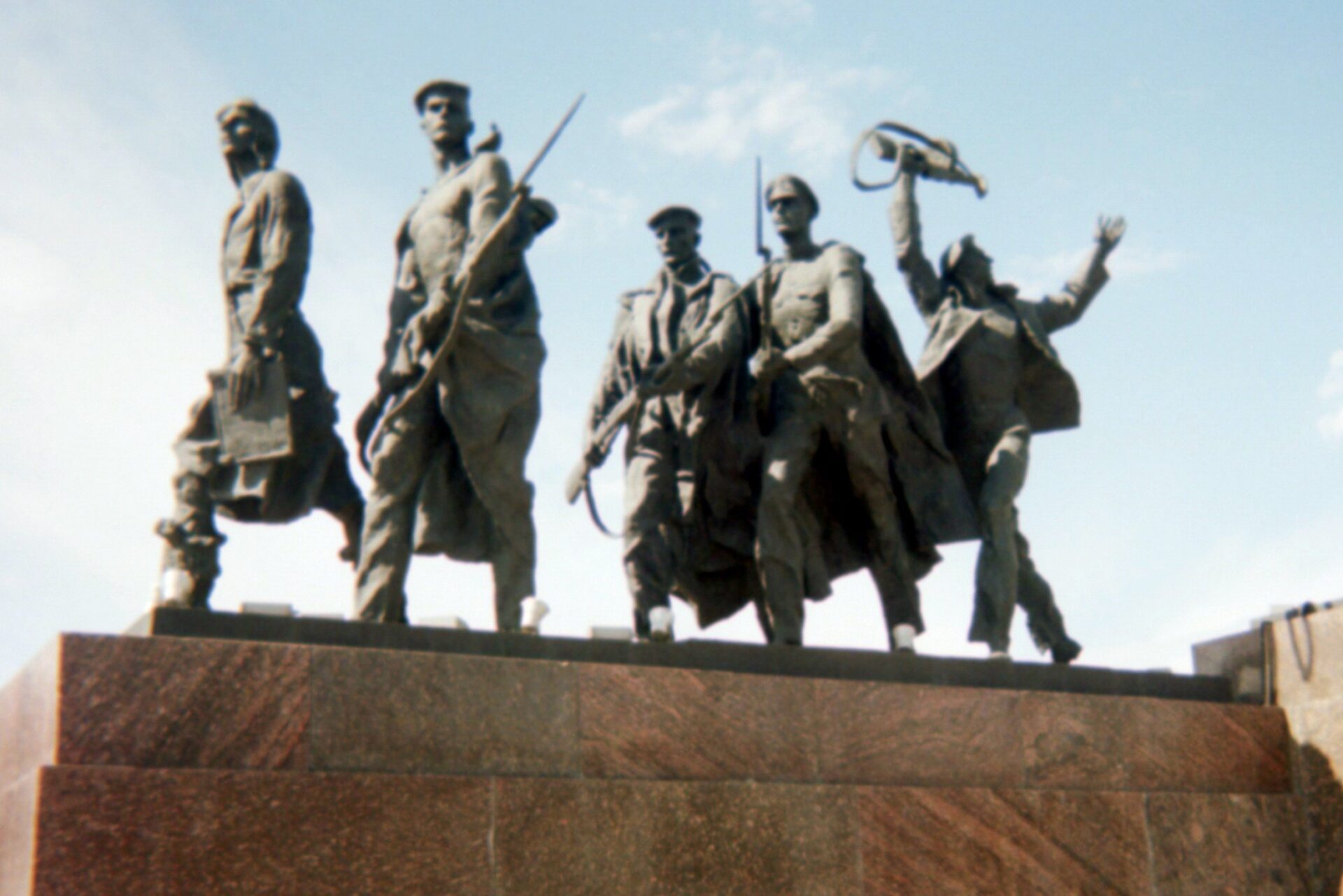
Front Left of Monument to Siege of Leningrad, St. Petersburg; photo by Natylie Baldwin, May 2017


Declassified documents have now been published by the National Security Archive (a program of George Washington University) that evidence once and for all that Gorbachev was, in fact, lied to by Washington about NATO expansion during negotiations to allow reunification of Germany.

Here is an excerpt of the write-up that accompanied the publication:

The documents show that multiple national leaders were considering and rejecting Central and Eastern European membership in NATO as of early 1990 and through 1991, that discussions of NATO in the context of German unification negotiations in 1990 were not at all narrowly limited to the status of East German territory, and that subsequent Soviet and Russian complaints about being misled about NATO expansion were founded in written contemporaneous memcons and telcons at the highest levels.

The documents reinforce former CIA Director Robert Gates’s criticism of “pressing ahead with expansion of NATO eastward [in the 1990s], when Gorbachev and others were led to believe that wouldn’t happen.”[1] The key phrase, buttressed by the documents, is “led to believe.”

….The first concrete assurances by Western leaders on NATO began on January 31, 1990, when West German Foreign Minister Hans-Dietrich Genscher opened the bidding with a major public speech at Tutzing, in Bavaria, on German unification. The U.S. Embassy in Bonn (see Document 1) informed Washington that Genscher made clear “that the changes in Eastern Europe and the German unification process must not lead to an ‘impairment of Soviet security interests.’ Therefore, NATO should rule out an ‘expansion of its territory towards the east, i.e. moving it closer to the Soviet borders.’” The Bonn cable also noted Genscher’s proposal to leave the East German territory out of NATO military structures even in a unified Germany in NATO.[3]

….Not once, but three times, Baker tried out the “not one inch eastward” formula with Gorbachev in the February 9, 1990, meeting. He agreed with Gorbachev’s statement in response to the assurances that “NATO expansion is unacceptable.” Baker assured Gorbachev that “neither the President nor I intend to extract any unilateral advantages from the processes that are taking place,” and that the Americans understood that “not only for the Soviet Union but for other European countries as well it is important to have guarantees that if the United States keeps its presence in Germany within the framework of NATO, not an inch of NATO’s present military jurisdiction will spread in an eastern direction.” (See Document 6)

I don’t think it gets much clearer than that.  Read the complete analysis and see the documents here.

**************************************************************************

After the Trump administration received near-unanimous opprobrium from the UN General Assembly for officially declaring Jerusalem to be the capital of Israel, it seems to be no longer feasible to pretend that Washington is anything close to a credible mediator in the Israel-Palestine conflict.  Of course, in reality, they have not been for decades as one cannot be a neutral arbiter when arming one side to the tune of $3-4 billion a year, enabling that side to implement its brutal and illegal occupation of the other.

Into the void, Russia has stepped, with its deputy UN envoy declaring that Russia stands ready and willing to serve as a mediator of the seemingly intractable conflict, after a UN Security Council Resolution condemning Washington’s move and demanding its withdrawal was vetoed by the U.S.:

Moscow is ready to become a new mediator in resolving the Israeli-Palestinian conflict, the Russian deputy UN envoy Vladimir Safronkov said. He also added that Russia is ready to host direct talks between the two sides.

Russia is ready to become “an honest mediator” in the Middle Eastern peace process, Nebenzia said at the UN Security Council meeting, after a resolution on Jerusalem demanding the US decision recognizing it as the Israeli capital be withdrawn was vetoed by Washington.

In my opinion, Russia, China, the UN or some combination thereof would be more credible mediators.

**************************************************************************

The Trump administration, on a roll with its dumb foreign policy moves, has agreed to send arms to the Ukrainian government, which will serve no purpose but to potentially inflame the situation in the Donbass.  Daniel Larison of The American Conservative summed it up best:

As I said last month, Trump would be a fool to arm Ukraine, so it comes as no surprise that this is what he has decided. While the U.S. isn’t giving Ukraine everything it was asking for, it is still recklessly throwing weapons at the problem. Russia will view this as a provocative act on our part, and it will respond with its own aggressive measures before long. When these weapons fail to have the desired effect, the drumbeat for sending more and more advanced weapons will start. Trump has already shown how easily he can be led by his advisers to endorse needlessly destructive measures. The U.S. will find itself caught in a fruitless and unnecessary competition with another major power that has far more at stake in the conflict. Because it has more at stake, Russia will always outmatch whatever support the U.S. provides, and so by adding more weapons to the mix the U.S. is simply fueling a conflict that it should be trying to resolve peacefully.

Meanwhile, there has been an increase in the fighting in the Donbass, which of course, motivated German Chancellor Merkel and French President Macron to reiterate that the Minsk 2 Agreement was the only solution to the problem (as opposed to armed conflict) but publicly put the pressure on Russia to stop it.  This is despite the fact that the Minsk 2 Agreement requires Kiev to take the next steps in resolving the crisis, which it has steadfastly refused to do for a long time.

As a goodwill gesture, both sides agreed to a prisoner release which took place on December 27th.  The OSCE Chairperson-in-office Karen Kneissl made the following statement:

“Allowing such a significant number of people, who have been held on both sides, to return home before the New Year and Orthodox Christmas is a very welcome development. Today’s exchange is not only a humanitarian act but also a helpful step in confidence-building. We encourage the sides to continue their efforts to improve the life of people directly affected by the conflict”, said Chairperson-in-Office Kneissl.

….Kneissl and Greminger stressed that today’s exchange of prisoners, together with the lower number of ceasefire violations during the last several days, represent a step forward.

*******************************************************************

Wrapping up this post, I wanted to share what international journalist Pepe Escobar reported recently at the Asia Times about Iran joining the Eurasian Economic Union (EAEU) as soon as February, with other countries possibly poised to follow suit:

….In a parallel development, Iran is bound to join the EAEU as early as February, according to Behrouz Hassanolfat, director of the Europe and Americas Department of Iran’s Trade Promotion Organization, as quoted by the Islamic Republic News Agency (IRNA).

….As much as Beijing in relation to its BRI [One Belt, One Road Initiative], Moscow has been on a charm offensive to enlarge the EAEU. Turkey – already on board the BRI – is a possible EAEU candidate for the near future, as well as India and Pakistan.

Springtime in Russia (May 2017)

This is an unpublished travel essay about my trip to Russia this past May.  – Natylie

Me in Moscow,


The first thing one sees to their right as they begin the descent down into Moscow’s largest airport is the sun glistening off the Moscow River surrounded by lots of greenery.  It gave me the pick-up I needed after an exhausting 24 hours of minimal sleep, being crammed on several airplanes and literally running from one end of an airport to another because my first flight was almost 2 hours late and nearly made me miss my connection.


We were blessed with sunny weather in the Russian capital, which was a welcome change from the rain and dreariness at both New York and Paris.


After departing the airport, I had to snicker in the back seat of our cab as my travel companion, who had never been to Russia before, became frazzled over the high speeds and improvised lanes that one sees on some of the major roads in Moscow.  Our taxi driver, a young military veteran who works in the veterinary profession and drives for extra money on the weekends, kept getting an earful from my friend but took it in stride.


Having settled in later that evening, I heard music at various times out in the distance from our apartment, alternating between classical piano and a lady’s voice singing.  I couldn’t pinpoint exactly where it was emanating from, but it was pleasant nonetheless.


On Sunday morning, just before 10:00 am, as I was sitting in the kitchen drinking my tea, enjoying the breeze through the open window on another sunny day, I heard the lovely sound of church bells ringing followed by a beautiful piano sonata.

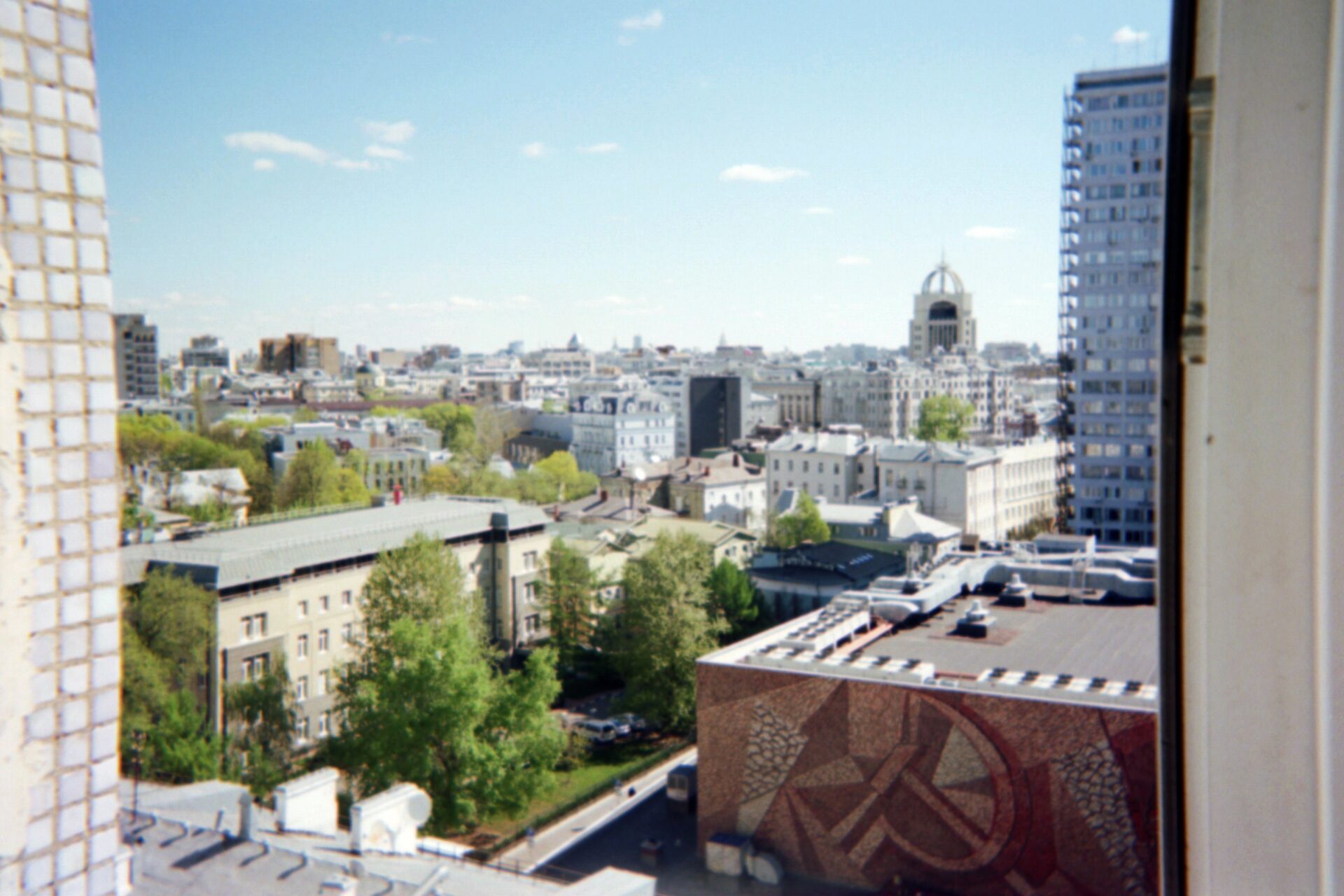
View from apartment on New Arbat Street, Moscow, Russia; photo by Natylie Baldwin


About a half hour later, I ventured out to the street where many spectators were standing along the sidewalk waiting for the procession to pass by in rehearsal for Tuesday’s Victory Day Parade.  Lots of families were out with little ones in tow and babies were being pushed in strollers as I made my way to a small grocery a couple of blocks down to buy a few necessities.


***********


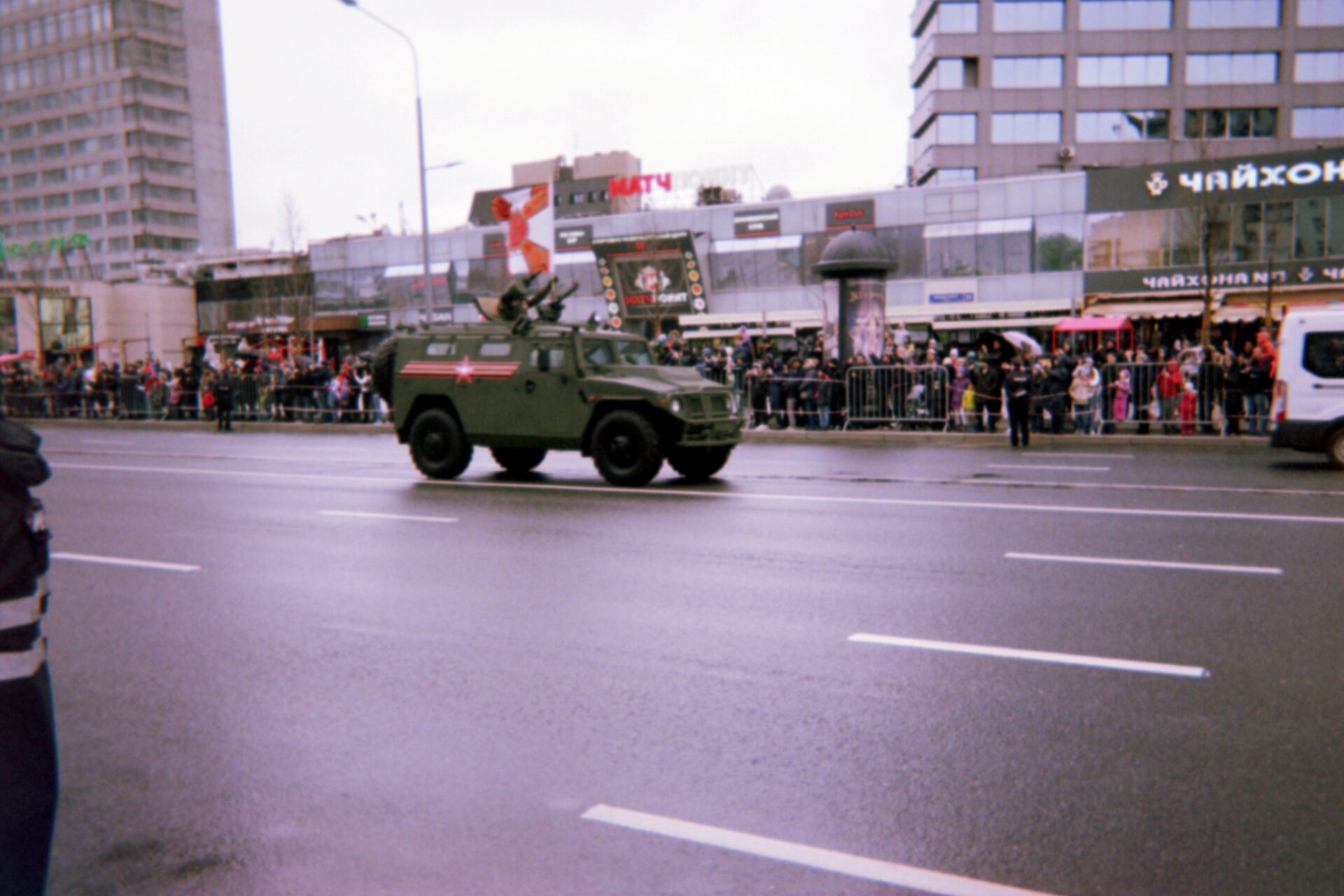
By Tuesday, the weather was not holding up so well.  Part of the parade route included New Arbat which is the street our apartment was located on, so I headed outside about a half hour or so before the start time and braved the cold.  I was able to find a good vantage point to watch and take pictures, having decided that I wouldn’t walk all the way over to Red Square, reasoning that it would be too crowded and I likely wouldn’t be able to get in for a good view.  I later learned my intuition was correct and that only people who have permission can actually get into the square on Victory Day – probably officials, foreign dignitaries and special guests.

Victory Day, Moscow; photo by Natylie Baldwin, May 2017


More people came out to line the damp streets as the time drew near.  Lots of families, people with their phones out ready to snap pictures, and a smattering of individuals waving Russian flags thronged the edge of the modest barricades and tape that separated the spectators from the road.  In terms of security, the atmosphere was fairly low-key.  Police officers were stationed every 25-30 feet. At one point I spotted an officer on the roof of one of the buildings across the street surveying the scene.  When I looked up again a while later he was gone.


Many officers wore wind breakers and some had on rain coats.  City officers generally don’t carry guns. There was no riot gear.


As people waited, earnest Russian music spilled out of loudspeakers.  Then the music stopped and a brief announcement was made.  A short motorcade of military officers in their crisp uniforms drove by about 5 minutes before the rest of the procession of tanks and other military vehicles began their ride down the street.  Some soldiers in the procession waved to the cheering crowds as they rode by, sometimes honking their horns.


The holiday celebrations concluded with a fireworks display at 10:00 pm, which I watched from our kitchen window as the balcony was too crowded with other residents from our floor of the building.  Fireworks could actually be seen in different parts of the city, but the largest display lit up over Red Square and the Kremlin.


According to a recent survey by the independent Levada Center, 76 percent of Russians planned on celebrating Victory Day this year.  Interest and participation was relatively equal among Russians, regardless of age, education or income level, which is unsurprising given the effects of the Great Patriotic War – as WWII is known here – on the former Soviet Union.  The Soviets lost about 27 million people fighting off the Nazis – 17 million of them civilians – and one third of their country was destroyed in the process.  General Eisenhower wrote in his memoirs of what he saw when he went into the Soviet Union in 1945:


When we flew into Russia, in 1945, I did not see a house standing between the western borders of the country and the area around Moscow. Through this overrun region, Marshal Zhukov told me, so many numbers of women, children and old men had been killed that the Russian Government would never be able to estimate the total.


Although many Americans and Europeans have been bombarded with the America-centric rhetoric of the U.S. winning WWII in Europe, it was not controversial in the aftermath to acknowledge that the Soviet Union had, in fact, broken the Nazi Wehrmacht, likely saving many American lives by bearing the brunt of the fighting as one of FDR’s advisers had talked him into going into North Africa in late 1942, which significantly delayed the U.S. opening up a western front attack on Germany.


Russia solemnly commemorates Victory Day each year with elaborate parades in major cities, like Moscow and St. Petersburg.  The Russian president gives a speech before the Moscow parade and the parade is followed by the Immortal Regiment Rally in which Russians march through the streets carrying photos of family members who fought and/or died in the Great Patriotic War.


***********************

I met my guide Natasha outside of the apartment at 10:00 am to begin our all-day tour of Moscow. We went around the corner to the bus stop across the street from the American Embassy.  The bus took us close to our first destination of the day.


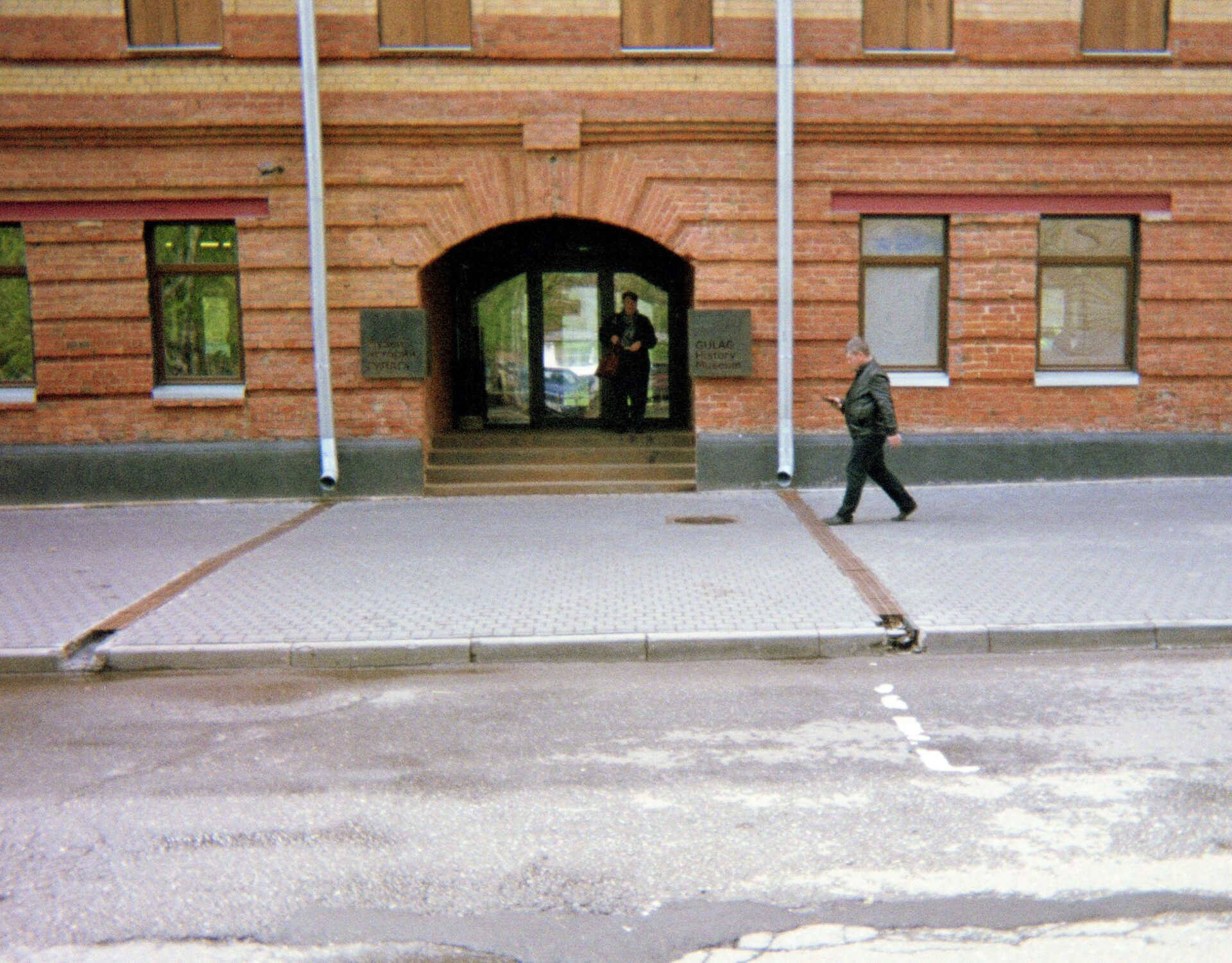
The Gulag Museum is a large red rectangular building with numerous windows covered with closed wooden shutters.  This is the first unsettling clue of what awaits inside.

Entrance to Gulag Museum, Moscow, Russia; photo by Natylie Baldwin


The Museum, which was moved to this area from its former location closer to central Moscow a couple of years ago, is now open to individual visitors for self-guided tours, whereas before only group tours were accommodated.  Natasha explained to me that this new iteration of the Museum was more elaborate, having been designed by professionals for a more realist atmosphere and the addition of more artifacts from the actual prison camps.


In the first dimly-lit room was a large four-sided frame with about 8 to 10 actual doors from Gulag cells affixed to three of the four sides.  Each door included a card, in both Russian and English, stating which camp the door was from. The worn and pock-marked doors were made of wood, metal, or a combination of both. Most had a small square window that opened out in the middle, presumably for the passing of food.  All had sliding bars and heavy locks.  The fourth side of the frame was open and I could see the interior of the doors – the side the prisoners saw for hours, months or years – that is, when they weren’t toiling in the extreme cold.


Various artifacts from the Gulag prisons could be seen hanging on the walls of this same room, such as a prisoner’s shirt, a small lantern from a cell, metal beds and benches, and a pair of handcuffs.


On one wall was a schematic illustration of one of the gulag prison camps before it was constructed.


In the next room were several glass cases.  One displayed fragments of letters written by the prisoners on cloth, typically parts of clothing, as they were provided no paper. Another displayed pieces of wood with messages written on them by the prisoners, demonstrating their need to communicate with anyone who might see it.  One case had items that had been made by some female prisoners, such as a utility box and shoes, constructed from whatever materials they could get their hands on.


In another room was a long table with photos and biographies of prisoners who survived the camps and wrote about the experience.  A copy of some of the books written appeared in front of the author’s picture.  Of course, the most recognizable was Aleksandr Solzhenitsyn.


The second to last room I was in had 3 video screen displays on one wall.  The middle screen had a continually scrolling list in white against a black background of the names of those who’d been executed directly during the Great Purge of 1936-38.  This would have been 700,000 to 750,000 people out of the 1.5 million that were arrested during that period.


The screen on the left had photos and a brief description of certain prisoners along with the dates of their arrest and execution.  These people were engineers, teachers, military officers and other average people – all of whom had been declared “enemies of the people.” I stopped to study the faces of a few of these individuals – one man in particular stood out to me because of his sad eyes.  I wondered if the photos were taken at the time of arrest (did he know his fate?) or if they were just everyday photos that may have been available.


The screen on the right had portions of actual lists of those to be arrested and executed projected on to it.


The last room I was in had a large television with video interviews playing of several elderly people who’d survived the prisons, discussing their ordeals, particularly their feelings about what life was like after they were released, including the process of becoming “rehabilitated.” Many mentioned being faced with possible ostracism for having once been imprisoned and the subsequent decision of whether to hide their past or not.  One woman recalled her apprehensiveness at telling her future husband, fearing rejection.  However, his respect for her only increased after learning of what she’d endured.  Another woman said that the legacy of her imprisonment was that she lived a life of fearlessness, “What could I possibly be afraid of after what I’d been through?”


After Stalin’s death in 1953, Nikita Khrushchev denounced Stalin and gradually released all of the prisoners, shutting down the Gulags and implementing a program of re-integration.  Khrushchev later admitted that he’d had much blood on his hands from the Stalin era, but that he and many others knew that if they resisted they likely would have also been executed.


One of the explanatory panels in the exhibit had stated that Stalin’s goal was to “destroy the possibility of political opposition, to nip non-conformity in the bud.”


Natasha and I sat on the bench in front of the television talking about the video when a young man from Kazakhstan briefly joined in our discussion.  Upon realizing that I was American he politely asked me some things about the United States, including Guantanamo prison.  I answered his questions as best I could. He also mentioned that there were people in Kazakhstan – a part of the Soviet Union at the time – who lived in the old buildings there that had constituted some of the Gulag prisons.  When Natasha and I expressed surprise at this, he simply replied that the buildings were sturdy so people put them to use.


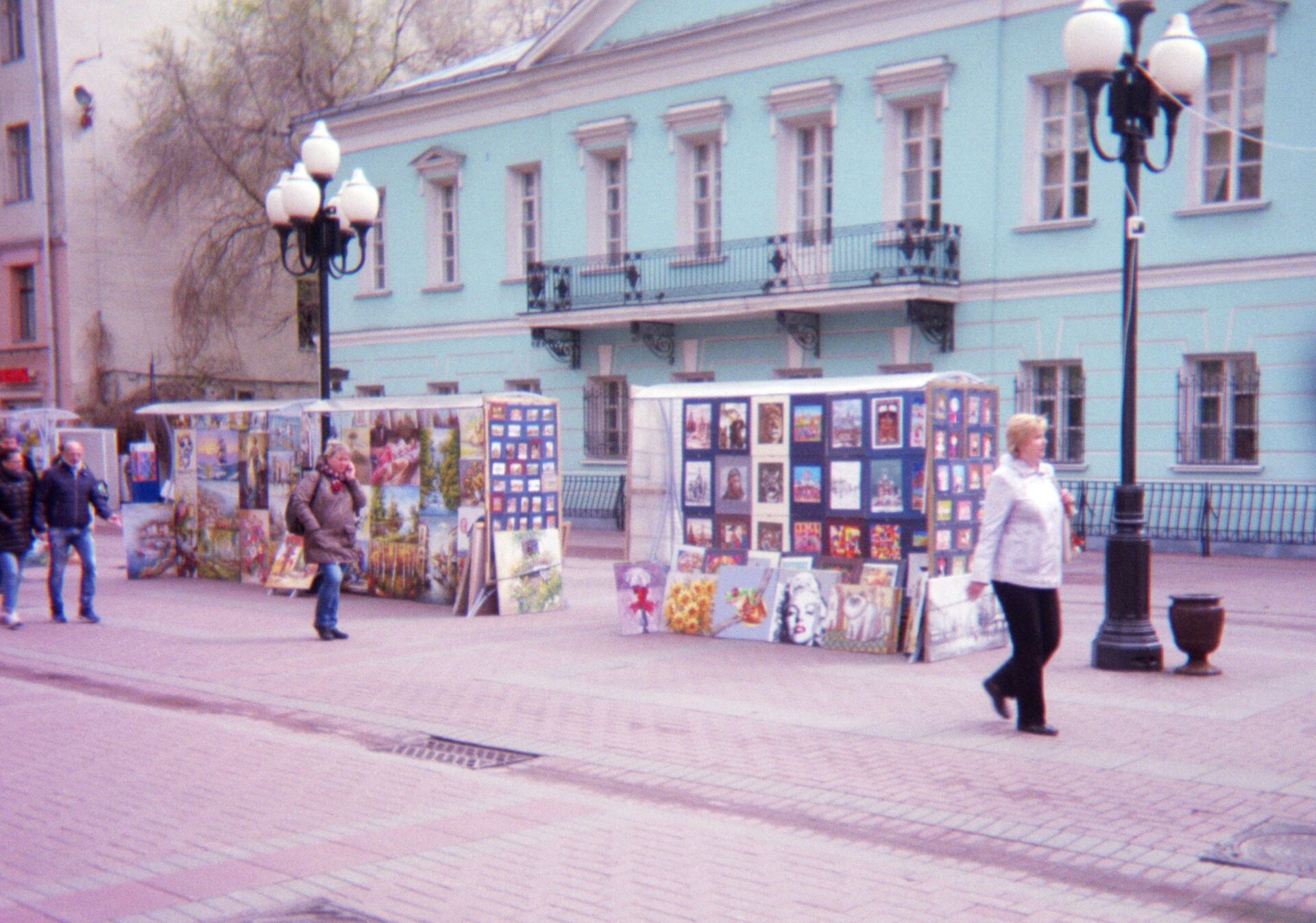
Exhausted, we finally left the museum and went over to the old Arbat street, a charming area that had been closed to auto traffic in the 1990’s and turned into a pedestrian thoroughfare with shops, gardens, restaurants and sculptures.  We passed by the Pushkin monument comprised of statues of the poet and his wife.

(Old) Arbat Street, Moscow; photo by Natylie Baldwin, May 2017

We stopped for lunch at a Russian buffet style restaurant and I asked Natasha her opinions about the Revolution, what alternatives (if any) might have prevented the Bolshevik coup in October of 1917 and the subsequent repressions, culminating in Stalin’s “concentration camps” and mass murder.  We discussed Nicholas II’s tragic incompetence and whether the February Revolution, led by social democrats, would have had potential if it had been allowed to run its course.


We also talked about the Monument to Victims of Repression, aka The Wall of Grief, which will commemorate Stalin’s victims.  I had originally requested to see this monument as part of the tour but was told that it would not open until October 13th, which is the officially designated day of remembrance for victims of repression in Russia.


Reportedly, Putin played a key role in getting this monument approved. Despite Western depictions of Putin as a dictator, he must arbitrate among different powerful factions when making his decisions.  I imagine there were some factions that weren’t too keen on this monument.


Most Russians, in fact, do not view Putin as a dictator since they know what real dictators look and act like.  A Levada Center poll from last year reveals that 66 percent of Russians consider themselves to be free and do not believe Russia will return to dictatorship.  Generally, the Russian president is seen as a strong and effective leader.  I remember speaking to a group of professionals in Krasnodar during my first visit who insisted that a strong leader was needed to get things done.  But they also insisted that the leader needed to be accountable to the people and their needs.  As reflected in Putin’s consistent approval rating above 80% – even according to independent polls – over the past few years, apparently most Russians believe he meets this criteria.  This is not to say that Russians are totally uncritical of Putin either or that they are afraid to express any criticism of him – that was not my experience during either of my visits.


Moreover, Russians are an educated people with just over half of the population holding a college degree – compared to about a third of Americans – and everyone I spoke to on both trips acknowledged that they have access to western media through satellite and the internet – though they were bemused by the west’s cartoonish portrayal of their country and their leader.  Simply writing Russians’ generally positive views of Putin and the progress Russia has made since the 1990’s off to government propaganda would be a mistake.


With regard to Stalin, Natasha mentioned that there is a segment of Russians who don’t want to talk about the repressions or want to downplay them.  In her view, this is explained by the fact that many average Russians participated in or enabled the repressions, including reporting other Russians, not because they suspected them of a real crime, but due to personal vendettas, jealousy, or the hope of acquiring someone’s property.  “Many Russians have someone in their family or circle who were victims and many have someone in their family or circle who were the enablers.  It’s the latter group that doesn’t want to condemn Stalin’s repressions.”


According to interviews I conducted in person and questionnaires answered by Russians I networked with during my visit, most credit Stalin with the industrial buildup and leadership necessary to save the Soviet Union from the Nazis, while acknowledging the brutality and excesses.


400 artists competed for the opportunity to design the Wall of Grief.  The winner, Georgy Frangulyan, has designed a bronze wall that will have the names and figures of the victims.  The Wall of Grief monument will cost around 400 million rubles and will be placed in the center of Moscow at the intersection of Sakharov Avenue (named after the famed Soviet dissident Andrey Sakharov) and the Garden Ring.


After lunch, we visited a park where the Elbe Monument was located.  Dedicated in April of last year, the Elbe Monument commemorates the meeting up of the US and Soviet armies on a broken bridge over the Elbe River near Torgau in Germany on April 25, 1945.

Elbe Monument, Moscow, Russia; photo by Natylie Baldwin


The monument was much smaller than I expected and was one of several sculptures by the same artist at this location.  Right next to the Elbe Monument is a sculpture of Abraham Lincoln shaking hands with his contemporary Alexander II.  Alexander II, the reformist Czar, freed the serfs in Russia in 1861 and Lincoln freed the slaves by 1865. Alexander II had also sent naval support to the Union during the Civil War.   Both were later assassinated.


Courtyard of Museum of Contemporary Russian History, Moscow, Russia; photo by Natylie Baldwin


We then took the Metro to another part of Moscow to go to the Museum of Contemporary Russian History which had a special exhibit on the Russian Revolution  A bright young man guided us through the exhibit while Natasha translated.  We concluded with an interesting conversation among the three of us about what might have averted the Revolution, Lenin’s motivations, what fueled his fanaticism, and whether he knowingly received assistance from the Germans for his journey from western Europe back to Russia in April of 1917 after which the Bolsheviks overthrew the Provisional Government.  Subsequently, the Bolsheviks signed a peace treaty with Germany under terms that were widely seen as humiliating to Russia.


*************

The next day we took a 4-hour train ride to St. Petersburg.  The train was clean, modern and fast.  After settling in, I looked out the window to watch the scenery, which included a lot of open land, with birch forests and salt marshes.  There was a stretch where dachas dotted the landscape, some so diminutive and colorful they reminded me of dollhouses.


We originally planned to visit the Hermitage on our first full day in St. Petersburg but since the weather was nice we decided to go sightseeing instead.


My friend and liaison, Misha, a native of the city known as The Venice of the North, drove us around to some key landmarks.  One of these was a park that included the Immortal Flame, which commemorates the Great Patriotic War. The Immortal Flame was framed with an abundance of roses that had been recently laid down for Victory Day. An older man on a bike stopped for a moment to pay his respects, while a pair of young women quietly snapped photos with their phones.  I walked around with my camera and saw families on picnics and couples strolling by.

The eternal flame at memorial park in St. Petersburg, Russia; photo by Natylie Baldwin


After a short walk near the Aurora ship on the dock of the Neva river where an old man sat playing the accordion and a handful of Russians dressed in imperial era costumes milled about, we stopped for lunch at a Georgian restaurant at the request of my travel companion.  The restaurant was named after a Georgian painter of the primitivist school and the interior was elaborate, with a mural on one wall exemplifying his style, a fountain and fancy furniture.

The big finale for our day’s sightseeing was a river boat ride throughout the Neva, which is surrounded by numerous architectural delights, such as the Winter Palace (aka the Hermitage), the Peter and Paul Fortress where the remains of the last imperial family (who have been canonized by the Orthodox Church) are interred, the Admiralty building, and numerous other historical sites.  It was cold and windy, especially on the first leg of the ride, but well worth it to see the grand city that Peter the Great decided would be built on a marsh, a city intended to rival the finest of Europe in terms of art and architecture.   My travel companion, a retired journalist who has been all throughout Europe, including France and Italy, remarked:  “I just can’t get over this city.  I think Peter outdid them all.”

Peter & Paul Fortress as viewed from Neva River, St. Petersburg, Russia; photo by Natylie Baldwin

Like his 20th century counterpart, Stalin, Peter meant to drag what was perceived to be a lagging nation kicking and screaming into modernity.  The human toll of making this magnificent city a reality is estimated to be in the thousands.


I was tired from the day’s outing but had my first formal interview on the Russian Revolution scheduled with an 86-year old retired engineer who’d worked in the shipping industry. This was part of my project to interview a cross-section of Russians to get their views on the 1917 Revolutions since it was the centennial anniversary.


I had formulated a series of questions to ask my interview subjects:  were the Revolutions overall positive or negative for Russia and why, what did they think of Nicolas II, Lenin, Stalin, etc.


This gentleman had given interesting answers about the Revolutions, his assessment of Nicolas was typical – he was weak, incompetent and completely ill-equipped to deal with the historical moment he’d been faced with, and he offered some thought-provoking points about Lenin, though he clearly was not a fan of the Bolshevik leader.


However, he lingered a long time on the issue of Stalin, elaborating more on this question than any of the others.  At one point, his hands gripped the corners of the table.  I was debating whether to ask if anyone in his family had been affected by the mass repressions.  On the one hand, it is a legitimate question in terms of my research, but another part of me cringes when a question goes beyond discussing something in the abstract and crosses over into personal territory that will dredge up something painful.


My dilemma soon resolved itself as he began the story on his own about how his father had been taken away in the night when he was 7 years old.  His parents had decided not to wake him to say goodbye.  When he got up the next morning and went to his parents’ room, his father was simply gone and the bookshelves had been sealed off with wax.  The rest of the family was exiled to a city far away from Leningrad.  They were originally told that his father had been imprisoned incommunicado, but they found out years later that he’d actually been executed on the charge of conspiring against “Comrade Stalin.”


I was mystified by the sealing off of the bookshelves and asked if there was any explanation for this.  He explained that his father was a talented mathematician and geologist, had written several books and had a leadership role in several scientific societies.  When an individual was arrested, any items of particular value were confiscated.  Since his father was an intellectual and a writer, his books were taken and the bookshelves rendered unusable.


Before I realized it, 2 1/2 hours had gone by since we arrived at his apartment.  I recall one moment, after we’d gotten through the worst parts of the interview, looking out the window at the first signs of dusk.  The clock beside the window indicated it was 9:30 pm.


As we concluded our discussion, I expressed my condolences for what had happened to his family and my appreciation of his taking the time to talk with me about such a painful subject.  He admitted that it was painful but that it needed to be talked about.  He wanted to ask me a few questions as well.  I realize that many Russians have very few, if any, interactions with Americans and when they do encounter one they are often curious and inquisitive.  So I’m no longer surprised when this occurs. He asked me about certain aspects of what happened on 9/11 and what priority Americans currently placed on countering Islamic terrorism.


On the way back to the apartment, Misha and I discussed the interview and the difficult history of Russia in the 20th century.  He told me that many Russians expressed shock when the archives were opened up and the ugly truth of the Stalin era started to come out into the open.  But he said that he’d known about it because his grandfather had told him of the repressions when he was 15.  Misha lamented how crazy it was for the leadership of a country to kill and imprison the most intelligent, educated and talented members of society – the very ones who had the skills to contribute to the nation’s development.  The next day, after he’d thought about it some more, he told me: “We have a very complicated history and it becomes hard to love a country when you know about such bad things.  But it is still our country and we have to learn to do that.”


******************

Our second day of sightseeing began with a pretty blue and white church called the St. Nicholas Naval Cathedral, located only a couple of blocks away from where we were staying.  It was often used by sailors and naval officers who would come to pray and receive blessings before embarking on a journey.  The main church was open only at certain times and was mainly for the seafaring folks.  Another smaller church building off to the side was open at all times and received anyone.

St. Nicholas Cathedral, smaller chapel, St. Petersburg, Russia; photo by Natylie Baldwin


The church is still in use and a section is cordoned off for tourists and sightseers in which they can view the magnificent interior of gold and artwork.  Only churchgoers are allowed to go beyond this point.  I watched Russians light candles and pray.  One woman kissed an icon as is customary in the Russian Orthodox religion.


We then made our way over to the Church on Spilled Blood, which I’d been anxious to visit so I could see the interior.  On my last visit I’d seen the splendid outer part of the church but didn’t have time to go inside.  I’d heard that the mosaic artwork on the inside was amazing and was determined to see it this time.


Since this was a Sunday and the weather was unusually gorgeous, the church was packed, so I kept my visit shorter than I normally would have as trying to maneuver my way within crowds tends to wear me out. But I was not disappointed by the church’s interior.  The rich imagery on the walls and ceiling was beautiful, along with the set of marble steps that led to the altar and the canopy that covered the actual spot where Czar Alexander II had fallen when he was assassinated in 1881.  The church was built as a memorial to him.

Church on Spilt Blood, Built at site of reformist Czar Alexandaer II’s 1881 assassination. St. Petersburg, Russia; Photo by Natylie S. Baldwin, 2015


Before being mortally wounded by a bomber from the terrorist revolutionary group Narodnaya Volya, the reformist czar had decided on a decree that would have set Russia on the road from an autocracy to a constitutional monarchy.  But the assassin got to the czar before the decree was issued and his son, Alexander III, made no pretense as to reform, so the idea languished until the 1905 revolution when Czar Nicholas II would cede some power to a parliament – if only on paper.

Palace Square in St. Petersburg where thousands of starving peasants gathered to petition the Czar and plead for justice but were gunned down by the Czar’s forces, known as Bloody Sunday, triggering the first Russian Revolution of 1905


Putin Has Telephone Talks with Several World Leaders, Including Trump; Change of Leadership of LPR in Donbass; Turkey Plays Footsie with Russia as Further Alienation with West Sets In; US Has Spent $8 Trillion on IWOT While Tripling Number of Bombs Dropped in Afghanistan; Is NATO a Paper Tiger?

Popular billboard of Putin in Crimea that reads:  Crimea.Russia.Forever

Putin held telephone talks with numerous leaders in the Middle East last Tuesday, including Egypt, Saudi Arabia and Israel.

According to the Kremlin press service report of the talks between Putin and Israeli PM Netanyahu, topics discussed included the sharing of mutually beneficial security information and progress in the fight against terrorism in Syria.  Due to the wording, I’d say that there was no new agreement reached on the situation in Syria, in which Israel has given assistance to jihadist rebels in the past.  Israel does not see the maintenance of the Assad government as in its interest.  The current right-wing Israeli government wants to see any governments that support the Palestinian cause cast aside in order to pursue a program of forcing the Palestinians to accept whatever terms the Israelis want to offer for “peace” – which means Israel not allowing any viable Palestinian state or independence.

Next, Putin had a conversation with Egyptian president Abdel Fattah Sisi.  The two leaders discussed the final phase of routing terrorists from Syria and a joint nuclear energy project.  From the Kremlin press service:

“Vladimir Putin informed the Egyptian leader in detail about the Russian assessments of the latest developments in the situation in Syria in the context of the final stages of the military operation to destroy terrorists in that country and discussed the results of the recent talks with Syrian President Bashar Assad,” press service of the Russian president said.

Moreover, Russian President and Egyptian Leader have discussed in phone talks on Tuesday major joint projects, including in the nuclear energy sector, press service said.

“The topical issues of the bilateral agenda were touched upon, with focus on the implementation of major joint projects, including in the nuclear energy sector. The sides reaffirmed mutual satisfaction with the overall development of friendly Russian-Egyptian relations,” the statement said.

Putin then got on the horn with the Saudi king.  Syria, again, was a major topic of conversation.

“The leaders continued the exchange of views on the situation in the Middle East region and discussed issues related to the prospects for a long-term settlement of the Syrian conflict in light of recent successes in the fight against terrorist groups there,” the press service said in a statement.

According to the statement, the Russian president noted that the Syrian National Dialogue Congress, to be held in Sochi, will give impetus to the intra-Syrian contacts and to the settlement of the Syrian conflict in general, as well as stimulate work under the UN aegis in Geneva.

The Kremlin press service also said in a statment that Putin has informed all of his counterparts about the Monday meeting with Syrian President Bashar Assad, as well as about the main issues on the agenda of the upcoming summit of the countries-guarantors of the Astana process  — Russia, Iran and Turkey — in Sochi on November 22.

On the following day, Putin had a 1-hour phone conversation with President Trump in which Syria and Ukraine apparently comprised the majority of the discussion.   ZeroHedge reported the following:

According to ABC, president Donald Trump spoke for more than an hour Tuesday by phone with Russian President Vladimir Putin. Syria, Iran, North Korea and Ukraine were on the agenda, the White House said.

The Kremlin echoed the White House, and said that the two leaders discussed “a number of topics”, including the Syrian crisis, the North Korean nuclear problem and the situation in Afghanistan as well as the Ukrainian crisis. Putin briefed Trump in the phone call about his talks with the Syrian leader and plans for a political settlement in Syria.

Putin stressed that there were no alternatives for full implementation of the Minsk agreements on peaceful settlement of the armed conflict in eastern Ukraine.

“Considering the crisis situation in southeastern Ukraine, the Russian president pointed out the absence of a real alternative for the unconditional implementation of the Minsk accords signed on February 12, 2015,” the statement said.

Speaking of Ukraine, as winter approaches the UN and other aid organizations are highlighting the plight still experienced by many in the Donbass, due to the “frozen” conflict there.  Euronews provided the following details:

Various aid organizations and volunteers help the population affected by the protracted conflict. Food, medicine, clothes are often collected and delivered here by Ukrainians from every corner of the country.

There are still inaccessible areas. In the cold winter months the need for aid only increases.

A Christian mission from Dnipropetrovs’k oblast’ brings bread and spiritual literature to Krasnogorovka, located around 1 km from the frontline. Aid is aimed at the most vulnerable sections of the population. Euronews previously reported the example of a social bakery project, based in Marinka, where the situation remains tense. Locals are regularly subjected to the sound of explosions and gunfire and forced to hide in underground cellars for safety.

Marina, a resident of the village of Kamyanka, in the Volnovakha district in Donetsk oblast’, said she was afraid to return home the day she spoke to Euronews as she could hear heavy explosions in the fields nearby. Earlier, when her village was shelled, she had lost her hearing, only partially recovering since. A house in neighbouring Hranitne was damaged at the end of September.

Freedom of movement in the region continues to be restricted. The waiting time at roadblocks installed by the Ukrainian army and the separatists stretches to many hours, causing enormous human suffering as the roadblocks lack even basic facilities. Searches, interrogations, long lists of banned products provoke frustration and anger among the local population. With the winter season approaching, the roadblocks’ working hours have been shortened by both sides furthermore.

“Thousands of people are without electricity, gas and water, as the ongoing conflict continues to take a heavy toll on critical civilian infrastructure crisscrossing the contact line”, says Ertugrul Apakan, the Chief Monitor from OSCE, whose Special Monitoring Mission has worked in Ukraine since 2014.

In the midst of this, Igor Plotnitsky, the leader of the Lugansk People’s Republic (LPR) for the past couple of years, has apparently been forced to resign and temporarily fled to Russia as former minister of state security Leonid Pasechnik has now taken over the leadership of the republic.  Russia expert Paul Robinson reported the following on his blog:

Plotnitsky, meanwhile, has been appointed the LPR’s representative in negotiations over implementation of the Minsk Agreements, which he signed, and which are meant to provide a blueprint for an eventual peace settlement in Ukraine. What does this all mean?

The Russian online newspaper Vzgliad has a few ideas. According to an article by Pyotr Akopov, stories of treason in high places are false, and the LPR is secure. Akopov adds that, ‘merger with the DPR [Donetsk People’s Republic] is currently impossible’ and could happen only in the event of a renewal of large-scale military operations. Plotnitsky’s involvement with the Minsk negotiations doesn’t mean very much, as the negotiations are not going anywhere. And finally, recent events won’t change the relationship between the Russian Federation and the LPR. In short, after a brief flurry of excitement, everything will return to the way it was a week ago. It was all much ado about nothing.

Akopov comments also that the events in the LPR show that ‘Russia supports and helps the republics [LPR and DPR] in all sorts of ways, but in no way leads them.’ To make his point, Akopov quotes a response Vladimir Putin gave to a questioner who suggested that Moscow is in total charge of the rebel Ukrainian republics: ‘You’ve got it wrong … these guys are really stubborn … they’re difficult.’ The Vzgliad article concludes that ‘If Moscow was in charge of Lugansk, it wouldn’t have let the conflict among the republic’s leaders develop into open confrontation.’ Having said as much myself in a recent post, I concur.

Robinson provides more context and discussion on the complicated client-patron relationship between Russia and the Donbass here.

**************************************************************************

Upon discovery that he was named on an “enemy chart” during a recent NATO drill in mid-November, Turkish president Erdogan pulled Turkish troops out of the exercise in Norway.  According to ZeroHedge:

The president said he was informed about the issue by Chief of General Staff Gen. Hulusi Akar and EU Affairs Minister Omer Celik.

 “They told me that they are withdrawing our 40 soldiers from there [Norway],” Erdogan said.

“I told them to do that immediately. There can be no alliance like that.”

While the NATO powers increasingly tick off the Turkish leadership, Russia has been deftly filling the void with a pending sale of the S400 anti-missile shield, cooperation on Turkstream, etc.  According to Al-Monitor‘s sources, Russia’s wooing is paying off:

Nihat Ali Ozcan, a consultant with the Economic Policy Research Foundation of Turkey, believes Russia is indeed laying the groundwork to recast the Turkish public’s perception of the United States, the European Union and NATO. “No wonder we are overwhelmed with Russian-origin news, some factual and some manufactured according to the need of the day,” he told Al-Monitor.

“Putin’s team is competent — not a bunch of pompous imbeciles — and under the management of a former intelligence man and [with] a wisely designed strategy,” he added. Ozcan, an academic and retired major with the Turkish armed forces, underlines that the West’s contradictory policies and populist narratives against Turkey are also driving the Turkish public toward Russia.

My personal opinions match those of Ozcan and are backed by the results of a poll, “Turkey’s Foreign Policy: Research on Public Perceptions,” released by Kadir Has University in July. The poll showed “combating terror” was seen by 44.2% of respondents as the biggest problem for Turkish foreign policy. The Syrian war was second, with 24.6%.

Moscow, which is aware of these two sensitivities, skillfully paints the United States as the leading threat in terror and on Syria issues, while managing to keep a low profile in the media regarding its own relations with the Kurdistan Workers Party and its supposed Syrian offshoot, the Democratic Union Party — both of which Turkey considers terrorist groups. In this annual poll, one striking finding was that the percentage of the Turkish public that perceives Russia as a threat dropped from 34.9% in 2016 to 18.5% in 2017.

**************************************************************************

The air force is now on track to triple the number of bombs being dropped in Afghanistan – the nation that officially began Washington’s War on Terror after 9/11/01.  As the longest U.S. war on record – and Afghanistan being no closer to a Taliban-free, terrorist-free oasis of liberal democracy, heroin-free flourishing economy and women’s rights – it will likely just represent flushing more money down the toilet that already has sucked up ~$8 trillion.  Democracy Now! reports:

This comes as a new report from Brown University’s Costs of War Project estimates that the U.S. wars since the 9/11 attacks in 2001 will cost up to $8 trillion in interest payments alone over the coming decades. Their report says the U.S. has already spent $4.3 trillion on the wars—and that the U.S. will be paying trillions of dollars in interest on the war debt for decades to come.

To get some perspective on just how much money we’re talking about here, go here to get an idea of what $1 trillion looks like.

**************************************************************************

To conclude this week’s post, I wanted to share an excerpt from a thought-provoking article from Canadian Russia expert Patrick Armstrong entitled NATO:  A Dangerous Paper Tiger.  Considering the fact that NATO can’t even beat some goat herders in flip-flops in Afghanistan, the points made in this article sound plausible to me.

Some Russians are concerned that there are today more hostile troops at the Russian border than at any time since 1941. While this is true, it is not, at the moment, very significant. The Germans invaded the USSR with nearly 150 divisions in 1941. Which, as it turned out, were not enough.Today NATO has – or claims to have – a battle group in each of the three Baltic countries and one in Poland: pompously titled Enhanced Forward Presence. The USA has a brigade and talks of another. A certain amount of heavy weaponry has been moved to Europe. These constitute the bulk of the land forces at the border. They amount to, at the most optimistic assessment, assuming everything is there and ready to go, one division. Or, actually, one division equivalent (a very different thing) from 16 (!) countries with different languages, military practices and equipment sets and their soldiers ever rotating through. And, in a war, the three in the Baltics would be bypassed and become either a new Dunkirk or a new Cannae. All for the purpose, we are solemnly told, of sending “a clear message that an attack on one Ally would be met by troops from across the Alliance“. But who’s the “message” for? Moscow already has a copy of the NATO treaty and knows what Article V says.

In addition to the EFP are the national forces. But they are in a low state: “depleted armies” they’ve been called: under equipped and under manned; seldom exercised. The German parliamentary ombudsman charged with overseeing the Bundeswehr says “There are too many things missing“. In 2008 the French Army was described as “falling apart“. The British Army “can’t find enough soldiers“. The Italian army is ageing. Poland, one of the cheerleaders for the “Russian threat” meme, finds its army riven over accusations of politicisation. On paper, these five armies claim to have thirteen divisions and thirteen independent brigades. Call it, optimistically, a dozen divisions in all. The US Army (which has its own recruiting difficulties) adds another eleven or so to the list (although much of it is overseas entangled in the metastasising “war on terror”). Let’s pretend all the other NATO countries can bring another five divisions to the fight.

So, altogether, bringing everything home from the wars NATO is fighting around the world, under the most optimistic assumptions, assuming that everything is there and working (fewer than half of France’s tanks were operationalGerman painted broomsticksBritish recruiting shortfalls), crossing your fingers and hoping, NATO could possibly cobble together two and a half dozen divisions: or one-fifth of the number Germany thought it would need. But, in truth, that number is fantasy: undermanned, under equipped, seldom exercised, no logistics tail, no munitions production backup, no time for a long logistics build up. NATO’s armies aren’t capable of a major war against a first class enemy. And no better is the principal member: “only five of the US Army’s 15 armoured brigade combat teams are maintained at full readiness levels“. A paper tiger.