Russia Matters: Russia, Ukraine Reportedly Discussing Non-Targeting of Nuclear Facilities

Russia Matters, 1/17/25

  1. U.S. President-elect Donald Trump and Russian President Vladimir Putin are expected to hold a phone call “in the coming days and weeks,” Trump’s nominee for national security advisor, Mike Waltz, said Jan. 12. However, Putin’s foreign policy aide Yuri Ushakov, as cited by TASS, claimed on Jan. 17 that there have been no contacts “as of today” between Moscow and Trump’s team on the organization of his possible meeting with Putin. Ushakov also said Russia will be represented at Trump’s inauguration by its chargé d’affaires in the U.S. only if the Russian diplomat is invited to attend the ceremony.
  2. Ukraine and Russia are holding limited talks in Qatar about rules to shield nuclear facilities from being targeted, a person familiar with the Kremlin’s preparations told Bloomberg. A spokesman for the Kremlin declined to comment on Bloomberg’s report, but if accurate, the report raises the question of whether the rules would protect substations connecting nuclear facilities to the grid, which Russia has been targeting even as it was reportedly refraining from direct attacks on the three Ukrainian energy-generating nuclear plants. Ukraine has become dependent on these three plants for two–thirds of the country’s electricity generation, so the destruction of the substations that connect these three NPPs to the grid could cause significant pain, not only for the economy—including military-related production—but also for the population. In 2024, electricity outages in Ukraine lasted almost 1,951 hours (so 5.5 hours a day), according to Ukraine’s Dixi Group. Electricity outages lasted 226 hours in the period of Dec. 1–Dec. 13, according to this group.*
  3. In the past month, Russian forces made a net gain of 172 square miles in Ukraine (the rough equivalent of 7 1/2 Manhattan islands), according to the Jan. 15, 2025, issue of the Russia-Ukraine War Report Card that is based on data provided for that period by the Institute for the Study of War. As of Jan. 16, 2025, 18.55% of Ukraine’s territory was under Russian occupation, according to Ukraine’s DeepState OSINT group’s interactive map. 
  4. The IMF’s latest World Economic Outlook anticipates Russia’s economic growth will slow from 3.8% in 2024 to 1.4% in 2025 and 1.2% in 2026. In comparison, world output grew by 3.2% in 2024 and is expected to grow by 3.3% in 2025 and then another 3.3% in 2026. As the table below shows, Russia’s rate of growth will be lower in 2025–2026 than that of China, India, the U.S., advanced economies as a whole and developing economies as a whole. 
  5. Russia’s Vladimir Putin and Iran’s Masoud Pezeshkian signed a treaty on “comprehensive strategic partnership” between their countries on Jan. 17. The new treaty, which runs for 20 years, aims to strengthen Tehran and Moscow’s “military-political and trade-economic” relations, the Kremlin said, according to RFE/RL. The signing of the Treaty on Comprehensive Strategic Partnership Between the Russian Federation and the Islamic Republic of Iran has been expected by officials in Moscow and Teheran, as well as by watchers of the relationship between the two countries, since at least last fall. But when Vladimir Putin and Masoud Pezeshkian inked the deal in the Kremlin on Jan. 17, it came as an anti-climax of a sorts for those in Russia and Iran that expected a significant strengthening of the two countries’ geopolitical alignment from the treaty. Even though last year saw Putin twice refer to Iran as Russia’s ally at one and the same event in October 2024, while Pezeshkian did the same in July 2024, the text of the treaty, as published by the Kremlin, contains no reference to Russia and Iran being allied. Nor does it have a clause for mutual military aid of the kind that can be found in the 2024 Treaty on Comprehensive Strategic Partnership bbetween the Russian Federation and the Democratic People’s Republic of North Korea. The names of both treaties use the same words to describe the bilateral relationship, but the level of military relationship that the two accords provide for differs.  The 2024 Russian-DPRK agreement states: “In the event of an immediate threat of an act of armed aggression against one of the Parties, the Parties, at the request of one of the Parties, shall immediately engage bilateral channels to conduct consultations with the aim of coordinating their positions and agreeing on possible practical measures to assist each other in helping to eliminate the threat that has arisen.” In contrast, the 2025 Russian-Iranian treaty says: “In the event that one of the Parties is subjected to aggression, the other Contracting Party shall not provide any military or other assistance to the aggressor that would facilitate the continuation of aggression, and shall assist in ensuring that the differences that arise are settled on the basis of the Charter of the United Nations and other applicable norms of international law.” We have also gone through references to military and military-technical cooperation in the Russian-Iranian treaty and found none that would call for mutual military aid in the event of aggression. Neither does the treaty’s text refer to the signatories as allies or say they have allied relations, even though Iran is helping Russia’s aggression against Ukraine by supplying hundreds of drones. It should be noted that the 2024 Russian-North Korean treaty did not contain such “allied” references either, but overall, Moscow and Pyongyang are considerably closer to being military allies than Moscow is with Teheran, if only because thousands of DPRK soldiers are presently engaged in direct combat on the Russian side against the Ukrainian forces in the Kursk region, shedding blood on the frontline [this has been alleged but not proven – Natylie]. No other country does that for Russia, even though at least four countries have signed bilateral treaties or declarations that designate them as Russia’s allies.
Kit Klarenberg: Collapsing Empire: RIP CIA Front’s ‘Overt Operations’

By Kit Klarenberg, Substack, 1/5/25

In recent months, a remarkable development in the Empire’s decline has gone almost entirely unnoticed. The National Endowment for Democracy’s grant database has been removed from the web. Until recently, a searchable interface allowed visitors to view detailed records of Washington-funded NGOs, civil society groups, and media projects in particular countries – covering most of the world – the sums involved, and entities responsible for delivering these initiatives. This resource has now inexplicably vanished, and with it, enormous amounts of incontrovertible, self-incriminating evidence of destructive US skullduggery abroad.

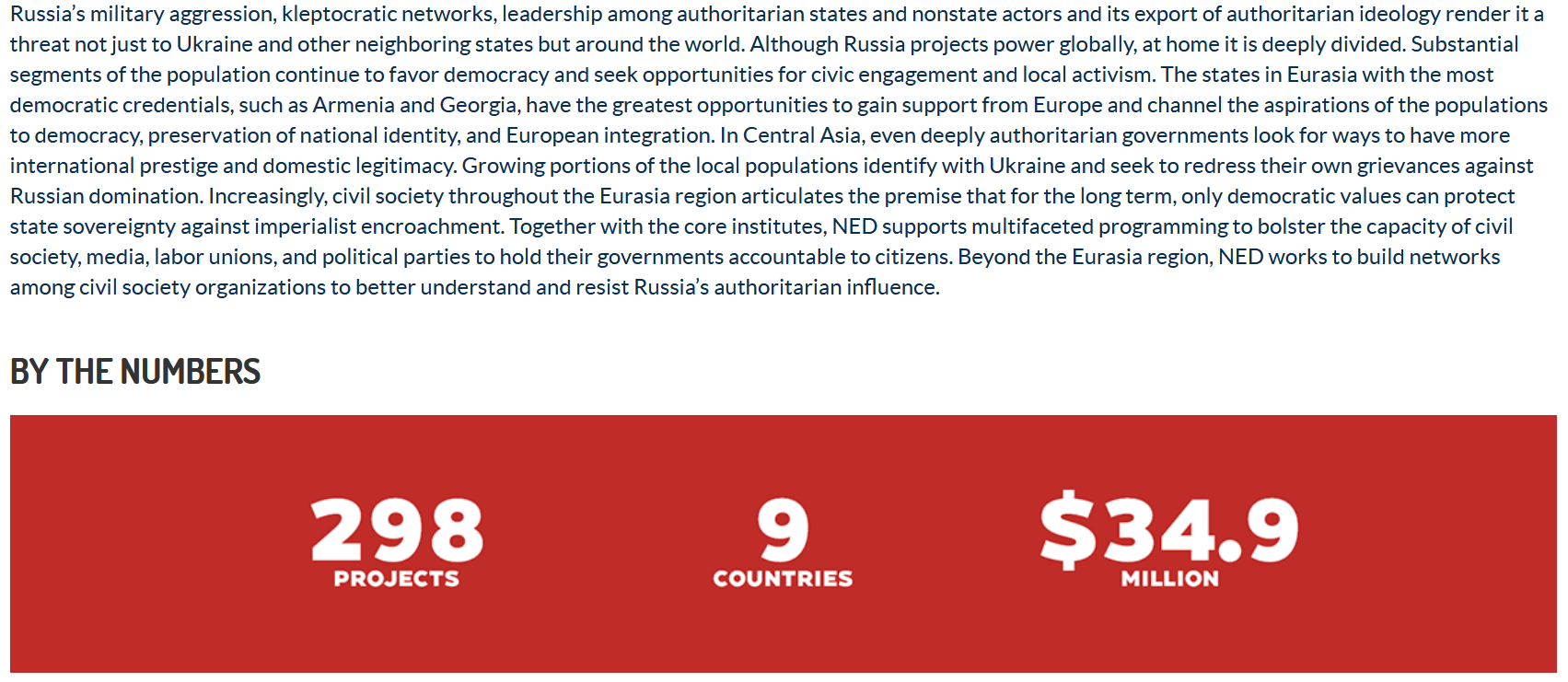
Take for example NED grant records for Georgia, the site of recent repeated colour revolution efforts, at the forefront of which were Endowment-bankrolled organisations. While still accessible via internet archives, they were deleted during the summer. Today, visitors to associated URLs are redirected to a brief entry simply titled “Eurasia”. The accompanying text describes in very broad terms the Endowment’s aims regionally and the total being spent, but the crucial questions of where and on what aren’t clarified. In a comic hypocrisy too, the blurb boldly states:

“The heart of NED’s work in the region is the need to maintain access to objective information for local populations. Across the region, government actors are attempting to limit the space for citizens to distribute information and communicate freely online.”

Resultantly, independent academics, activists, researchers, and journalists have been deprived of an invaluable resource for tracking and exposing the Empire’s machinations. Yet, the Endowment incinerating its public paper trail can only be considered a significant victory for these same actors. NED’s explicit and avowed raison d’être was to do publicly what US intelligence did – and in many cases still does – covertly. Now, after 40 years of wreaking havoc worldwide in service of the Empire, the CIA front has been forced underground, defeating its entire purpose. How long can it now survive?

NED’s ‘Eurasia’ entry

‘Spyless Coups’

NED was founded in November 1983, after the CIA became embroiled in a series of embarrassing public scandals. Then-Agency director William Casey was central to its construction. His objective was to create a public mechanism to conduct traditional CIA meddling overseas, except out in the open. Ever since, the Endowment has financed countless opposition groups, activist movements, media outlets, and trade unions to the tune of untold millions to engage in propaganda and political activism, to disrupt, destabilize, and displace ‘enemy’ regimes the world over.

The NED’s true nature was openly acknowledged by the mainstream media for many years. In June 1986, longtime Endowment president Carl Gershman told the New York Times, “it would be terrible for democratic groups around the world” to be subsidized by the CIA. Past exposure of such connivances meant they had been “discontinued”, and farmed out to NED. Several high-ranking interviewees strenuously denied there was any connection between NED and the Agency, although the outlet acknowledged many Endowment programs seemed “superficially similar” to past CIA operations.

At this time, NED was hard at work killing off Communism in the Soviet Union, Warsaw Pact, and Yugoslavia. This included for instance enormous investment in Poland’s famous Solidarity trade union, which became a global emblem of anti-Communist resistance. In September 1991, the Washington Post published a highly laudatory appraisal of these efforts, stating the “political miracles” the Endowment achieved in the former Soviet sphere had ushered in a “new world of spyless coups” and “innocence abroad”:

“The old era of covert action is dead. The world doesn’t run in secret anymore. We are now living in the age of Overt Action…When such activities are done overtly, the flap potential is close to zero. Openness is its own protection. Covert funding for these groups would have been the kiss of death, if discovered. Overt funding, it would seem, has been a kiss of life.”

NED proceeded to take down a number of governments throughout the 1990s and 2000s, very overtly. In many cases, mainstream outlets published highly revealing accounts detailing precisely how. In Ukraine in November 2004, Endowment-trained and bankrolled activists forced a rerun of that year’s presidential election to install a pro-Western puppet. As The Guardian jubilantly reported, the entire effort was “an American creation” and “sophisticated and brilliantly conceived exercise in Western branding and mass marketing,” which had been repeatedly deployed in the new millennium to “topple unsavoury regimes”:

“Funded and organised by the US government, deploying US consultancies, pollsters, diplomats, the two big American parties and US non-government organisations…the operation – engineering democracy through the ballot box and civil disobedience – is now so slick that the methods have matured into a template for winning other people’s elections.”

‘Kiss of Death’

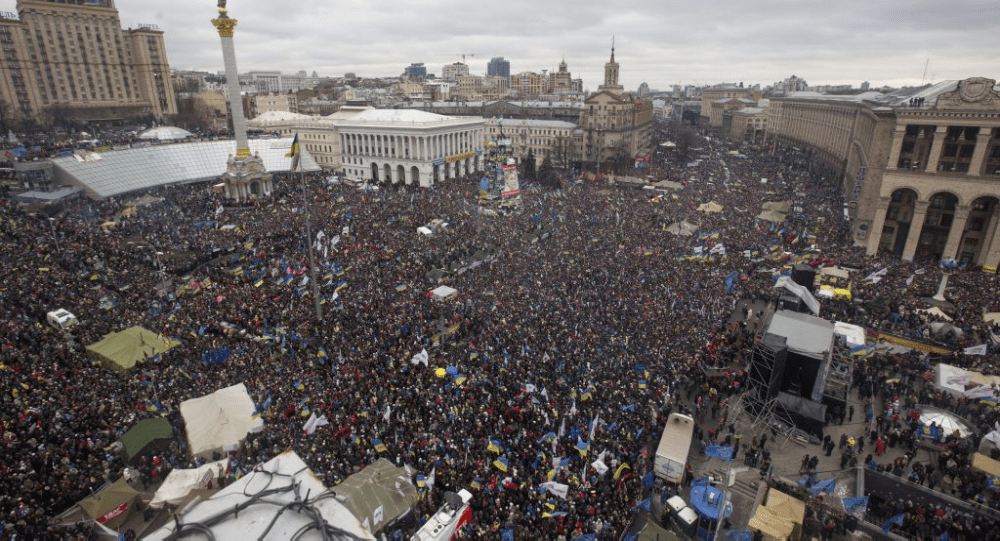
The next year, USAID published glossy magazine, Democracy Rising, bragging extensively about how it and NED were fundamental to a wave of insurrectionary upheaval in Georgia, Kyrgyzstan, Lebanon, Yugoslavia, and elsewhere during the first years of the 21st century. Fast forward to February 2014, and Ukraine’s government once again fell victim to an Endowment-orchestrated coup, in the form of the Maidan ‘revolution’. Yet, the media either ignored the irrefutable US role in fomenting the upheaval, or dismissed the proposition as “Russian disinformation” or conspiracy theory.

Democracy Rising

4.12MB ∙ PDF file

Download

This is despite; contemporary polls never showing majority Ukrainian support for the Maidan protests; ousted President Viktor Yanukovych remaining the most popular politician in the country until his last day in office; every actor at Maidan’s forefront, including the individuals who started the demonstrations, receiving NED or USAID funding; leaders of Washington-financed organizations in the country openly advertising their desire to overthrow Yanukovych in the years prior; and the Endowment pumping around $20 million into the country in 2013 alone.

A Maidan crowd

This mass omertà, which has intensified since, may be attributable to ever-rising hostility towards NED by foreign governments and populations, and associated efforts to restrict or outright proscribe the organization. The reality of the Endowment’s raison d’être and modus operandi has thus not only become unsayable, but must be vehemently denied by Western journalists. Representatively, a July 2015 Guardian report on Russia banning NED quite unbelievably relied on a brief quote from the Endowment’s own website to describe its operations.

While the mainstream media may have remained silent on the NED’s mephitic influence overseas over the past decade, the same is not true of dissident academics, activists, researchers, and journalists. The Endowment grant database served as an invaluable tool for keeping a close eye on Washington’s international intrigues, and mapping the personal and organisational connections of NED-sponsorsed agents and entities of influence. Meanwhile, the Enowment’s status as a CIA front could be simply proven, via multiple public admissions of its own leaders.

Whenever protests erupted somewhere in the world and received widespread Western news coverage, concerned citizens could consult the NED grant database and find in the overwhelming majority of cases, most if not all individuals and groups quoted in media reports were in receipt of Endowment funding. While impossible to quantify, it would be unsurprising if dissident voices calling attention to this fact have helped avert colour revolution efforts, disrupted meddling campaigns, protected popular governments and political figures, and more.

Of course, despite NED brazenly purging evidence of its vast operations from the web, that conniving continues apace regardless – now, covertly. One might even argue the Endowment’s chicanery is all the more dangerous resultantly, given individuals and organizations can conceal their funding sources. But the move amply shows NED today cannot withstand the slightest public scrutiny, which its existence was intended to exemplify. It also demonstrates that “overt operations” with open US funding are now the very “kiss of death” the Endowment was meant to replace. The Empire is on the run.

Brian McDonald: Russians Will Ultimately Embrace West Over BRICS

Brian McDonald is an Irish citizen who has been living in Russia for many years, has family there, speaks Russian and used to work for RT. – Natylie

By Brian McDonald, Twitter, 1/5/25

FWIW, I believe Russia will eventually become part of the West. The BRICS and ‘global south’ messaging is top-down; on the ground, nobody talks about it. Russians remain fascinated by Western culture and politics.

Most Russians are far warier of Central Asia and China than the ‘evil West.’ They’d still pick a German car over a Chinese one any day.

When the current psychosis fades, normal ties with the US and EU will likely bring relief. Russia has wanted to be part of that world since 1991. And let’s face it, Western Europe needs Russia economically. Just look at Germany — it’s struggling.

The next generation — on both sides — has no Cold War baggage holding them back. Deep down, the West and Russia are urban, industrial civilizations with shared Christian roots. More alike than different.

John Webster: Don’t Play Poker with Putin

By John Webster, Website, 12/14/24

John Webster has been active in politics since the late 1960’s. He has worked in senior positions in Local Government and is a long-term critic of Government economic, environmental and foreign policy. He served two terms as Deputy Leader of Cheltenham Borough Council as a Liberal Democrat before returning to the Forest of Dean and re-joining the Labour Party which he had first joined in 1980 and left at the time that it was clear that Britain was to support the war in Iraq. He is member of Jewish Voice for Labour which is led by Jews who are opposed to the actions of the Israeli Government.

I’d like to take a close look at the war in Ukraine. If the UK and NATO wants to fight Russia, people need to know the facts.

Ukraine is a large country – 2.5 times the size of the UK but with a pre-war population of about 40 million. The Ukraine conflict has been brewing for years and the areas annexed by Russia are about the size of the United Kingdom. They include some 7 million people in 4 regions in addition to the Crimea peninsula with a front line stretching from Land’s End to John O Groats.

Internal conflicts between Ukrainian Nationalists in the west of the country and Russian speakers in the east led to a US supported ‘coup’ in 2014 and a civil war which cost some 14,000 lives. The army split between nationalists and pro-Russian elements who defended the Donbas area and Crimea was annexed by Russia.

The USA fully supported the Ukrainian nationalists and despite the majority of Ukrainians not wanting to join NATO, the Ukrainian Government declared it wanted to and allowed US intelligence services (the CIA) to establish spy bases on the Russian border.

What concerned Russia was the aim of NATO to place intermediate missiles in Ukraine that could hit Moscow in 5 minutes or less. In 2019 the USA tore the existing INF (Intermediate Range Nuclear Forces) treaty up which would have forbidden the production of such missiles.

Prior to this there were attempts brokered by Germany and France to reach an agreement in which Ukraine didn’t join NATO and, in an attempt to resolve civil conflict, give the Luhansk and Donetsk republics the kind of autonomy that Wales and Scotland have, but still as part of Ukraine. The agreements were sabotaged by ‘the west’ and Ukraine. Ukraine subsequently banned the Russian language and closed down the Russian Orthodox Church.

The encroachment of NATO was seen as such an extreme threat by Russia that, in breach of international law, it intervened in February 2022 with a token force of about 200,000 troops. The Ukrainian army was somewhat bigger than this and had been armed to the teeth by ‘the west’. The force moved in on Kiev and the Donbas, taking most of the Donbas very quickly mainly because many Russian speakers there welcomed them. This was their prime target.

Negotiations took place brokered by Turkey which both sides agreed to – but which were rejected by Ukraine when it was given guarantees by western politicians to support Ukraine for ‘as long as it takes’. The agreement would have meant Ukraine would stay intact but NOT be part of NATO. When it was rejected, Russia expanded its army to approaching 1 million troops and set about resolving the situation with the use of extreme force.

Russia is depicted by lazy thinkers in ‘the west’ as a ‘gas station with nukes.’ It is the biggest country in the world with a population of 146 million and a working population of 74million (compared to 33million in the UK) and has an abundance of natural resources. Measured in conventional terms this puts it 11th in the world’s economies behind Britain but measured according to what is called Purchasing Power Parity (which is favoured by most international organisations like the world bank and the IMF), Russia is the 5th largest economy in the world after China, the USA, India and Japan. It looks like it will shortly become the 4th.

The 30,000 or so sanctions applied to Russia by ‘the west’ to try and destroy it have meant it has had to reorientate its economy towards China in the east and has had to become much more self-reliant. In sharp contrast to ‘the west’ its economy is growing. Whereas in Britain and the USA, most ‘economic activity’ is now in service, finance and administrative sectors, much more of Russia’s economy produces real things – food and manufactured goods.

It also has massive military capacity and produces is own munitions and weapons including tanks and aircraft. It has 5th generation aircraft. F16s are a capable 4th generation aircraft but up against Russia’s air defence systems aren’t capable of being deployed anywhere near the front line. Along with the USA and China, it is working on 6th generation aircraft. A ‘gas station with nukes’ would not be able to do this. Where is Britain in this race? Nowhere.

It has a formidable military which now dominates the battle field in a country right next to it so its supply lines are relatively compact– it has (in the words of President Obama) ‘escalatory dominance’.

According to Mediazona (established with the BBC and Russian ‘dissidents’ to monitor Russian casualties), Russia has suffered under 80,000 killed in action since the beginning of the conflict. This is a record of funerals etc and is almost certainly an underestimate with the real figure probably being somewhere around 150,000 deaths.

There are no such figures for Ukraine but the reports from the battlefields and the extension of graveyards etc indicate a very much greater death toll – probably in the order of at least 3 times that of Russia. Bear in mind that Britain’s total military killed in action in World War 2 amounted to just over a quarter of a million over a period of 5 years. Ukrainian losses are likely double this in half the time.

The reality is that Russia has fought the war as one of attrition with saturation shelling on a 650 mile front with the use of drones and spy satellites that expose the battlefield. It has air superiority, outguns Ukraine with shells at a rate of 7 to one, uses massive glide bombs and has accurate hypersonic missiles which have largely demolished the power grid and which are very difficult to intercept with the current missile defence systems.

It has more battle-hardened infantry. It has increasing superiority in drone warfare. It has the most sophisticated electric warfare system in the world and is working on the s500 air defence system which it maintains can intercept hypersonic missiles. Neither the USA or the UK possess such missile at the moment but it is assumed they will in then future because the US plans to locate them in Germany where there is growing opposition to them.

The western media complacently dismisses such claims BUT they are demonstrated every day on the Ukrainian battlefield as the Russian army advances. It now outnumbers the Ukrainian army which cannot recruit enough willing volunteers to fight. In these conditions who do you think is taking most casualties?

At the start of the war many Ukrainians fled – over 5 million of them to Russia. The idea that everybody in Ukraine supports ‘the west’ is clearly not true. The hope of the west is that Russia will ‘collapse’ as a result of sanctions and western pressure. The sabotage of the Nord Stream gas pipeline to Germany was intended to bankrupt Russia. Instead, it has crippled the German economy. This is not a strategy that is working.

Neither does calling Putin names amount to a strategy. Putin has mass popular support. Recent reports from the western backed Levada institute put it at some 80%. Does this indicate collapse? People in ‘the west’ may think Putin is a nasty bully. In Russia he is a hero.

The USA has poured tens of billions of dollars into Ukraine but despite this, Russia is winning the war. The UK has pledged £3billion a year to Ukraine while seeking cuts to the British armed forces and has recently sent Stormshadow cruise missiles capable of striking deep into Russia.

This has led to retaliation with an Intermediate Ballistic Missile with multiple conventional war heads that has destroyed a missile production facility in Dnipro, and which can hit anywhere in Europe and which ‘the west’ has no defence against at all. Russia could literally destroy any military facility in the UK and the only response that we could offer would be to escalate to nuclear retaliation. The message to any rational organisation should be clear.

The fiction in most media in the UK is that brave little Ukraine is holding its own. It is actually being torn to shreds and has been used by ‘the west’ to try and weaken Russia and disrupt the developing alliance between Russia and China. Sanctions have backfired and driven China and Russia closer together: they are becoming increasingly economically and militarily interdependent and have almost certainly shared missile technology which has transformed modern warfare and in which they lead the world making ‘power projection’ with aircraft carriers a thing of the past. If we keep antagonising these two powers then we will suffer.

The majority of non-western countries in the world are opposed to the economic and military domination of the USA, and we are seeing more and more countries align themselves with the BRICS group which supports the UN charter rather than the ‘rules based order’ of the USA. Russia’s intervention in Ukraine has been judged illegal but to say it was ‘unprovoked’ is simply not the case. This is why, outside of the ‘western world’, Russia is NOT isolated.

The USA spends more than China and Russia on Defence BUT it has much bigger commitments. China has one overseas base and Russia 21, mainly in than old Soviet Union area. The USA has some 800 and Britain 30. This is where much of the military budgets actually go.

The kind of contempt for Russia that has been fed to the British people by the media to maintain the fiction that Ukraine is winning is to justify the huge amount of money we are giving to it. We SHOULD be asking what are we doing in Ukraine?

The idea that we are ‘defending democracy’ is not serious. Ukraine is dominated by corrupt politicians and has banned all those that question the war. This is about global dominance based on a declining US Empire.

Will Trump make any difference? Trump is what people in the US call a ‘Blowhard’ and bully. In my view unless he decides to stop the war immediately, he is likely to threaten to escalate it under the impression that Russia will bend to such threats.

Vladimir Putin may or may not be a nice man. That is not the prime qualification needed for being President of Russia or any other country. Can you really see him bending to Trump. Would YOU like to play poker against Putin?

We need to step back from this now. British policy is putting us directly in harm’s way.

Analysis & Book Reviews on U.S. Foreign Policy and Russia