MK Bhadrakumar: A defining moment in the Ukraine war

By MK Bhadrakumar, Indian Punchline, 11/24/24

The Russian President Vladimir Putin issued a statement on Thursday regarding the two attacks by Western long-range weapons on Russian territory on November 19 and 21 and Moscow’s reactive strike on a facility within Ukraine’s defence industrial complex in the city of Dnepropetrovsk with a hitherto unknown non-nuclear hypersonic ballistic missile named Oreshnik.

On Friday, at a meeting in the Kremlin with the military top brass, Putin revisited the topic where he clarified that Oreshnik not really in “experimental” stage, as Pentagon had determined, but its serial production has commenced.

And he added, “Given the particular strength of this weapon, its power, it will be put into service with the Strategic Missile Forces.” He then went on to reveal, “It is also important that along with the Oreshnik system, several similar systems are currently being tested in Russia. Based on the test results, these weapons will also go into production. In other words, we have a whole line of medium- and shorter-range systems.”

Putin reflected on the geopolitical backdrop: “The current military and political situation in the world is largely determined by the results of competition in the creation of new technologies, new weapons systems and economic development.”

Succinctly put, an escalatory move authorised by the US president Joe Biden has boomeranged. Did Biden bite off more than he could chew? This is the first thing.

The US apparently decided that Putin’s “red lines” and Russia’s nuclear deterrence were the stuff of rhetoric. Washington was clueless about the existence of a wonder weapon like the Oreshnik in the Russian armoury. The shock and awe in the western capitals speaks for itself. Biden avoided commenting on the issue when asked by reporters.

The Oreshnik is not an upgrade of old Soviet-era systems but “relies entirely on contemporary cutting-edge innovations,” Putin stressed. Izvestia reported that Oreshnik is a new generation of Russian intermediate-range missiles with a range of 2,500-3,000km and potentially extending to 5,000km, but not intercontinental, equipped with multiple independently targeted re-entry vehicles (MIRV) — ie., having separating warheads with individual guidance units. It has a speed between Mach 10 and Mach 11 (exceeding 12,000 kms per hour).

The Russian daily Readovka reported that with an estimated 1,500 kgs of combat payload, lifting to a maximum height of 12 km and moving at a speed of Mach 10, the Oreshnik launched from the Russian base at Kaliningrad would strike Warsaw in 1 minute 21 seconds; Berlin, 2 min 35 sec; Paris, 6 min 52 sec; and London, 6 min 56 sec.

In his statement on Thursday, Putin said, “there are no means of countering such weapons today. Missiles attack targets at a speed of Mach 10, which is 2.5 to 3 kilometres per second. Air defence systems currently available in the world and missile defence systems being created by the Americans in Europe cannot intercept such missiles. It is impossible.”

Indeed, a terrible beauty is born. For, Oreshnik is not just an effective hypersonic weapon and is neither a strategic weapon nor an intercontinental ballistic missile. But its striking power is such that when used en masse and in combination with other long-range precision systems, its effect and power is on par with strategic weapons. Yet, it is not a weapon of mass destruction — rather, it’s a high-precision weapon.

Serial production implies that dozens of Oreshnik are in the process of being deployed, which means that no US / NATO staff group and no Anglo-American target intelligence unit in bunkers in Kiev or Lvov is safe any longer.

Oreshnik is also a signal to the incoming US president Donald Trump who is ad nauseam calling for an immediate end-of-war settlement. Oreshnik, ironically, has been developed only as Moscow’s reaction to the hawkish decision by then US president Trump in 2019 to unilaterally withdraw from the 1987 Soviet-American treaty on intermediate range nuclear forces (INF). Hence this also signals that Moscow’s trust in Trump is near zero.

To drive home this point, on the very same day Oreshnik emerged out of its silo, Tass carried an unusual interview with a top Russian think tanker affiliated to the foreign ministry and Kremlin — Andrey Sushentsov, program director of the Valdai Discussion Club, dean of the Russian Foreign Ministry’s MGIMO International Relations Department, and member of the Scientific Council under the Russian Security Council.

The following excerpts of the interview, plain-speaking and startling, should scatter the hypothesis that there is something special going on between Trump and Putin:

“Trump is considering ending the Ukrainian crisis, not out of any sympathy for Russia, but because he acknowledges that Ukraine has no realistic chance of winning. His goal is to preserve Ukraine as a tool for US interests, focusing on freezing the conflict rather than resolving it. Consequently, under Trump, the long-term strategy of countering Russia will persist. The US continues to benefit from the Ukrainian crisis, regardless of which administration is in power.”

“The United States has regained its position as the European Union’s top trading partner for the first time in years. It is the Europeans who are bearing the financial burden of prolonging the Ukrainian crisis, while the US has no interest in resolving it. Instead, it is more beneficial for them to freeze the conflict, keeping Ukraine as a tool to weaken Russia and as a persistent hotspot in Europe to maintain their confrontational approach.”

“Trump has made numerous statements that differ from the policies of Joe Biden’s administration. However, the US state system is an inertial structure that resists decisions it deems contrary to American interests, so not all of Trump’s ideas will come to fruition.”

“Trump will have a two-year window before the midterm congressional elections, during which he will have a certain freedom to push his policies through the Senate and the House of Representatives. After that, his decisions could face resistance both domestically and from US allies.”

Make no mistake, Russia is under no illusions. Putin will not waver from the conditions he outlined in June for resolving the conflict: the withdrawal of Ukrainian troops from Donbass and Novorossiya; Kiev’s commitment to abstain from joining NATO; the lifting of all Western sanctions against Russia; and the establishment of a non-aligned, nuclear-free Ukraine.

Clearly, this war will continue on its course till it reaches its only logical conclusion, which is Russian victory. Russian Security Council Deputy Chairman Dmitry Medvedev is spot on when he said in an interview with Al Arabiya yesterday that the use of Oreshnik missile “changes the course” of the Ukrainian conflict.

The Western capitals will have to reconcile with the reality that the scope for escalation of the war is ending. Make no mistake, if another ATAMCS strike inside Russia is attempted, it will have devastating consequences for the West.

Serbian President Aleksandar Vucic put it nicely: “If you [NATO] think you can attack everything on Russian territory with Western logistics and weapons without getting a response, and that Putin won’t use whatever weapons he deems necessary, then you either don’t know him or you’re abnormal.”

Seymour Hersh on Biden White House Decision to Approve Long Range Missile Strikes on Russia (Excerpt)

By Seymour Hersh, Substack, 11/26/24

…I have been told that the strategic implications of the president’s escalation—both Biden and Russian President Vladimir Putin have nuclear bombs at their fingertips—had not been fully analyzed inside the Pentagon, and that some important offices, sure to have different views about escalation, were never asked for their input….

…Trump’s casualty numbers [on the Ukraine war that he cited in his debate with Kamala Harris] might have been off, but his consistency, especially when pressed, adds to the credibility of what I have been learning in recent weeks: that an understanding about the mechanisms for ending the war has been debated and discussed and even tentatively outlined between informal advisors to Trump and Putin and their teams. I was told by one American that “the lines are open” between those representing the two men, with some vague “assurances sent and received.”

I have also been told by experts here in Washington who are knowledgeable about Russian political affairs that Putin does not want to make a settlement with Zelensky “until he is good and ready”—meaning that he is going to wait until the currently very successful Russian surge targeted at Donetsk and Kursk plays out. There is said to be concern in Moscow about extensive “stay-behind” intelligence and operational activity in Ukraine that is believed to be organized by American and British agencies.

What is going on now, one American expert told me, is an attempt to change the long-standing American support for containment, exemplified by the Biden administration’s instinctive disdain for the governments of Russia and China, which marred the initial meetings with each in 2021…

…This is not a brief for Putin, a former Soviet intelligence agent who is brutal to his political opponents and runs a government that is quick to put foreign journalists in jail. He is also considered by many in the American intelligence community to be a competent and informed leader.

Trump’s agenda, I was told, was to find a way once in office not to be haunted by worries about contacts with those who dissent from America’s foreign policy. Hence the idea of working more with military-to-military negotiations as a start. One American told me that “reality over politics and history over headlines” would be a fresh way to close out the murderous war between Russia and Ukraine…

Russia Matters: US Officials Predict Ukraine Could Be Pushed Into Talks ‘Within a Few Months’

Russia Matters, 11/27/24

Many U.S. officials now privately concede that within a few months, Ukraine could be pushed into negotiations with Russia to end the war and that it could be forced to give up territory, WP reported on Nov. 26. Speaking publicly on that day, Anthony Blinken acknowledged that Ukraine might end up entering into talks with Russia sometime soon, according to NYT. A statement, which Blinken and his G-7 colleagues adopted after their meeting on Nov. 26, contained no explicit calls for peace negotiations between Ukraine and Russia. Meanwhile, a Pew poll released one day before the G-7 event shows that Americans are split on whether the U.S. has a responsibility to help Ukraine defend itself from Russia’s invasion. Half of Americans say the U.S. is responsible, while 47% say it is not, according to Pew’s Nov. 12–17 poll.

Kit Klarenberg: The CIA/MI6 Skripal Conspiracy Exposed

By Kit Klarenberg, Substack, 11/17/24

All my investigations are free to access, thanks to the generosity of my readers. Independent journalism nonetheless requires investment, so if you took value from this article or any others, please consider sharing, or even becoming a paid subscriber. Your support is always gratefully received, and will never be forgotten. To buy me a coffee or two, please click this link.

On October 14th, a much-delayed inquiry into the mysterious death of Dawn Sturgess, a British citizen who died in July 2018 after reputedly coming into contact with Novichok nerve agent left in England by a pair of Russian assassins, finally commenced. Already, the public show trial has unearthed tantalising evidence gravely undermining the official narrative of the poisoning of GRU defector Sergei Skripal and his daughter Yulia in Salisbury, in March that year.

These revelations emerged despite the British state’s best efforts to sabotage the inquiry, and curtail its ability to ascertain the truth. For one, the Skripals have been prevented from testifying, despite formally requesting to do so. Such is the apparent risk of Russian intelligence attempting to target the pair anew, not even their video-recorded police interviews from the time can be entered into evidence. Meanwhile, the urgent question of what British intelligence and security services knew, and when they knew it, will not be explored.

Yet, primary source evidence British spies and their American counterparts were well-aware the two Russians accused of attempting to murder the Skripals were visiting Britain in advance of their arrival has lain in plain sight for years. Whether such foreknowledge implies the CIA and MI6 were in reality behind the abortive hit remains a matter of interpretation – but that the CIA and MI6 sought to exploit the Russian presence in Salisbury for their own malign purposes is beyond doubt.

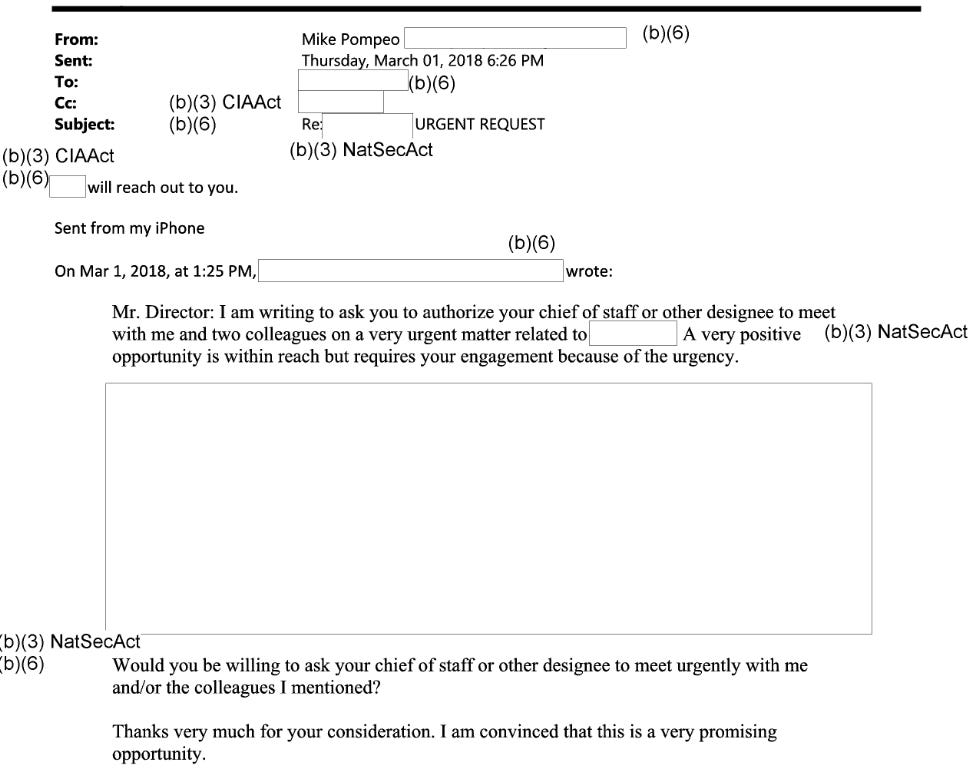
In January 2021, US watchdog group American Oversight released hundreds of pages of emails sent to and from the personal address of Mike Pompeo, CIA director January 2017 – April 2018. In many cases, the emails were official Agency communications discussing matters of extreme sensitivity, conducted off-books. The records – heavily redacted under the US National Security Act – show that on March 1st 2018, Pompeo was approached by two high-ranking CIA operatives, who asked for a meeting on a “very urgent matter”. They added:

“A very positive opportunity is within reach but requires your engagement because of the urgency…I am convinced that this is a very promising opportunity.”

Pompeo responded in the affirmative, and the meeting went ahead early the next morning. Underlining their covert summit’s importance, the emails indicate CIA staffers were preparing to pitch the “positive opportunity” to the Agency’s chief from the early hours of March 2nd. Eerily, the email requesting Pompeo’s signoff on the proposal was sent less than half an hour after Ruslan Boshirov and Alexander Petrov, Skripal’s alleged assassins, purchased plane tickets from Moscow to London Gatwick for their Salisbury visit.

‘Strong Option’

Who emailed Pompeo is redacted, although then-CIA deputy director Gina Haspel is an obvious candidate. A longstanding Russia hawk, who cut her Agency teeth recruiting spies in the Soviet Union in the years before its collapse, she twice served as the CIA’s London station chief twice – from 2008 – 2011, and 2014 – 2017. Sergei Skripal arrived in Britain in July 2010 via a grand spy swap during her first tenure, which was negotiated by Haspel’s longtime collaborator Daniel Hoffman, then-CIA Moscow station chief. He was among the very first sources to publicly blame Russia for the Salisbury incident.

During Haspel’s “unusual” second spell in London, Skripal’s enduring connection to his homeland, and yearning to return, would’ve been well-known to British intelligence. Serendipitously, BBC veteran Mark Urban serendipitously interviewed the GRU defector in the year prior to his poisoning. He recorded that Skripal was “an unashamed Russian nationalist, enthusiastically adopting the Kremlin line in many matters, even while sitting in his MI6-purchased house.” Coincidentally, Urban once served in the same tank regiment as Pablo Miller, Skripal’s MI6 recruiter/handler, and Salisbury neighbour.

Moreover, former Kremlin official Valery Morozov, an associate of the GRU defector likewise exiled to Britain, claimed days after the poisoning that Skripal remained in “regular” contact with Moscow’s embassy in London, and met with Russian military intelligence officers there “every month”. He also flatly repudiated any suggestion the purported nerve agent attack on Sergei and Yulia was the work of Russian spies:

“Putin can’t be behind this. I know how the Kremlin works, I worked there. Who is Skripal? He is nothing for Putin. Putin doesn’t think about him. There is nobody in Kremlin talking about former intelligence officer [sic] who is nobody. There is no reason for this. It is more dangerous for them for such things to happen.”

That this information was not shared with Haspel stretches credulity. The Washington Post has reported how her time in Britain made her the personal “linchpin” of the CIA’s relationship with MI6, the Agency’s “most important foreign partner.” Her British colleagues gushed to the outlet, “she knows them so well…they call her the ‘honorary UK desk officer’.” Haspel regularly drew on this experience to “stabilize the transatlantic alliance” between London and Washington, which was frequently strained while she was CIA director May 2018 – January 2021.

This friction resulted in no small part from Trump legitimately accusing British chaos agents of “conspiring with American intelligence to spy on his presidential campaign,” charges that “rattled the British government at the highest levels.” Strikingly, a cited example of Haspel stabilising CIA relations with MI6 provided by WaPo was convincing a highly reluctant President to back the Western-wide expulsion of Russian diplomats, encouraged by London in the Salisbury incident’s wake.

How Haspel pressed Trump over Salisbury was revealed in April 2019. The New York Times reported that the President at first downplayed Skripal’s alleged poisoning and refused to respond, believing the apparent attack to be “legitimate spy games, distasteful but within the bounds of espionage.” However, Haspel successfully lobbied Trump to take the “strong option” of expelling Russian embassy staff in the US, by providing him with British-sourced “emotional images”:

“Haspel showed pictures the British government had supplied her of young children hospitalized after being sickened by the Novichok nerve agent that poisoned the Skripals. She then showed a photograph of ducks British officials said were inadvertently killed by the sloppy work of the Russian operatives…Trump fixated on the pictures of the sickened children and the dead ducks. At the end of the briefing, he embraced the strong option.”

‘Operation Foot’

The New York Times exposé caused a stir upon release, not least because the “emotional images” described had never hitherto been published or referred to in the mainstream media. While the Skripals giving bread to three local boys to feed ducks in Salisbury’s Avon Playground on March 4th 2018 was initially widely reported, no media outlet, government minister, spokesperson, health professional or law enforcement official had ever previously claimed children and/or waterfowl were “sickened” after coming into contact with Novichok. The reverse, in fact.

On March 26th that year, the Daily Mail recorded that the boys given bread by the Skripals – one of whom apparently ate some – were “rushed to hospital for blood tests amid fears they’d been poisoned,” but promptly discharged after being given “the all-clear.” Moreover, two days after the New York Times article was published, British health officials issued a statement not only refuting the report entirely, but denying any children were admitted to hospital in Salisbury as a result of Novichok exposure at all.

Subsequently, the New York Times radically amended its piece, removing any suggestion Haspel showed Trump photos of Novichok victims provided by the British. In fact, the newspaper reverse-ferreted, she had “displayed pictures illustrating the consequences of nerve agent attacks, not images specific to the chemical attack in Britain.” The question of whether the aforementioned images did exist, and were forged by British intelligence for the explicit purpose of bouncing Trump into a hostile anti-Russia stance, remains thoroughly open five-and-a-half years later.

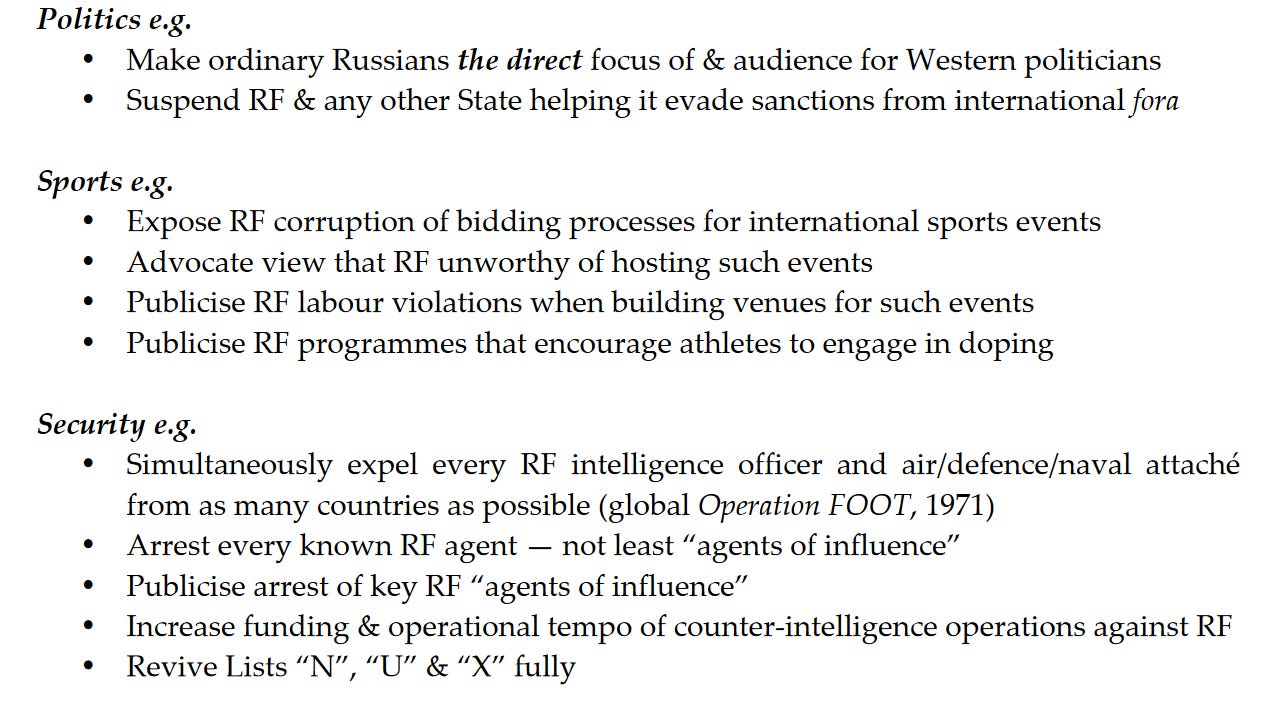
After all, British spies had been planning and hoping for a mass defenestration of Russian diplomats globally, as a prelude to all-out war with Moscow, for years by that point. In January 2015, MI6/NATO front the Institute for Statecraft (IFS) a document setting out “potential levers” for achieving “regime change” in Russia, spanning “diplomacy”, “finance”, “security”, “technology”, “industry”, “military”, and even “culture”. One “lever”, which IFS listed thrice, stated:

“Simultaneously expel every [Russian] intelligence officer and air/defence/naval attaché from as many countries as possible (global ‘Operation Foot’).”

Operation Foot saw 105 Soviet officials deported from Britain in September 1971. Several mainstream media outlets referenced this incident when reporting on London successfully corralling 26 countries – including, of course, the US – into expelling over 150 Russian diplomatic staff in response to the Salisbury incident in March 2018. As a result, IFS got one step closer to its longstanding objective of “armed conflict of the old-fashioned sort” with Russia, which “Britain and the West could win.”

Fast forward to today, and Britain and the West are on the verge of losing that conflict once and for all. Meanwhile, the Salisbury incident’s ever-fluctuating official narrative continues to shift radically, in ways large and small. Contrary to all prior media reports on the matter, the Dawn Sturgess Inquiry has now been told one boy given bread by the Skripals to feed ducks actually “got sick” as a result, and he and his friends “were unwell for a day or two afterwards.”

This fresh rewriting neatly ties in with the highly controversial claim, unflinchingly clung to by British authorities, that the Skripals were poisoned with Novichok smeared on the doorknob of Sergei’s home on the morning of March 4th 2018, before heading into Salisbury. As subsequent investigations will show, available evidence – including Yulia Skripal’s own hospital bed testimony – points unmistakably to the pair being attacked elsewhere, at another time and by another means entirely, with British and American intelligence square in the frame.

Analysis & Book Reviews on U.S. Foreign Policy and Russia