Joe Lauria: Using Ukraine Since 1948

By Joe Lauria, Consortium News, 6/10/24

The United States has for nearly 80 years seen Ukraine as the staging ground for its once covert and increasingly overt war with Russia. 

After years of warnings, and after talk since 2008 of Ukraine joining NATO, Russia fought back two years ago. With neither side backing down Ukraine is increasingly becoming a flashpoint that could lead to nuclear war. 

The West thinks Russia is bluffing. But its doctrine states that if Russia feels that its existence is threatened it could resort to nuclear arms. Instead of taking these warnings seriously, NATO is recklessly opening corridors for a ground war against Russia in Ukraine; France says it’s putting together a coalition of nations to enter the war, despite Russia saying French or any other NATO force would be fair game. 

Unless you read Consortium News and a few other alternative outlets, you won’t get this perspective. You will  think Russia is an out of control aggressor bent on destroying the world.  So …

Please Donate to Our Spring Fund Drive!

In Paris the other day Joe Biden said Russia wants to conquer all of Europe but can’t even take Khariv. It is this kind of inflammatory nonsense, combined with allowing Ukraine to fire NATO weapons into Russian territory, that is imperiling us all. 

The danger started building up many years ago but it is now reaching a head. 

The U.S. relationship with Ukraine, and its extremists, to undermine Russia began after the Second World War. During the war, units of the Organization of Ukrainian Nationalists (OUN-B) took part in the Holocaust, killing at least 100,000 Jews and Poles. 

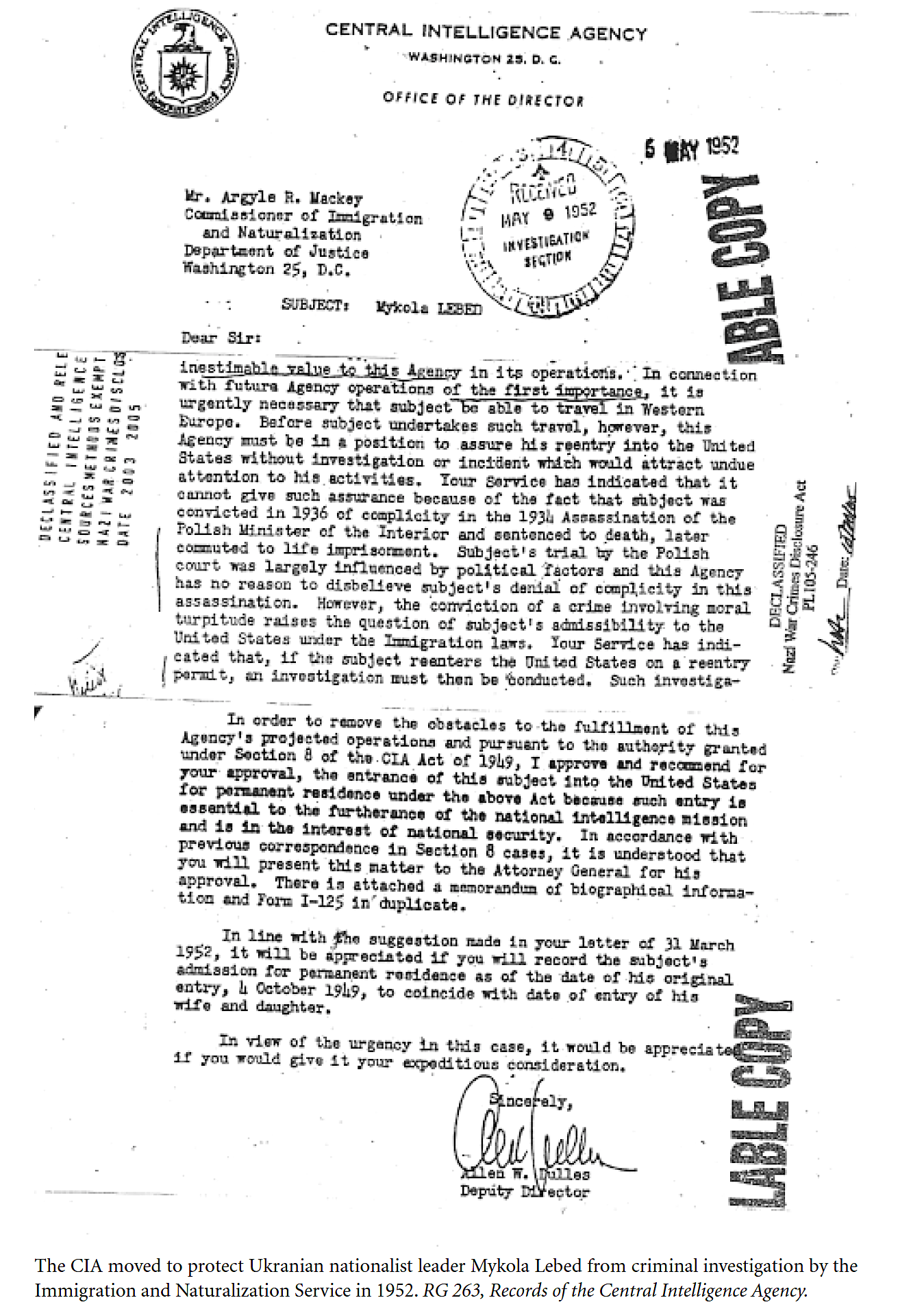
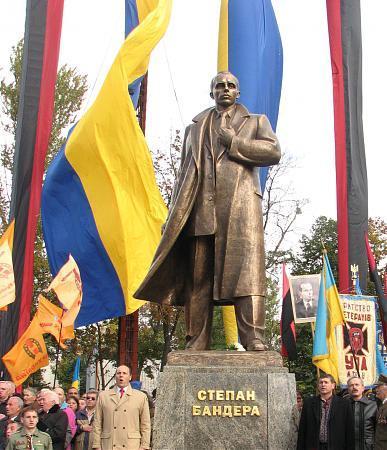
Mykola Lebed, a top aide to Stepan Bandera, the leader of the fascist OUN-B, was recruited by the C.I.A. after the war, according to a 2010 study by the U.S. National Archives. 

Lebed was the “foreign minister” of a Banderite government in exile, but he later broke with Bandera for acting as a dictator. The U.S. Army Counterintelligence Corps termed Bandera “extremely dangerous” yet said he was “looked upon as the spiritual and national hero of all Ukrainians….”

Instead of Bandera, the C.I.A. was interested in Lebed, despite his fascist background. They set him up in an office in New York City from which he directed sabotage and propaganda operations on the agency’s behalf inside Ukraine against the Soviet Union.  The U.S. government study says:

“CIA operations with these Ukrainians began in 1948 under the cryptonym CARTEL, soon changed to AERODYNAMIC. … Lebed relocated to New York and acquired permanent resident status, then U.S. citizenship. It kept him safe from assassination, allowed him to speak to Ukrainian émigré groups, and permitted him to return to the United States after operational trips to Europe. Once in the United States, Lebed was the CIA’s chief contact for AERODYNAMIC. CIA handlers pointed to his ‘cunning character,’ his ‘relations with the Gestapo and … Gestapo training,’ [and] the fact that he was ‘a very ruthless operator.’”

The C.I.A. worked with Lebed on sabotage and pro-Ukrainian nationalist propaganda operations inside Ukraine until Ukraine’s independence in 1991.

“Mykola Lebed’s relationship with the CIA lasted the entire length of the Cold War,” the study says. “While most CIA operations involving wartime perpetrators backfired, Lebed’s operations augmented the fundamental instability of the Soviet Union.” 

Continued Until and Beyond Ukrainian Independence

The U.S. thus covertly kept Ukrainian fascist ideas alive inside Ukraine until at least Ukrainian independence was achieved. “Mykola Lebed, Bandera’s wartime chief in Ukraine, died in 1998. He is buried in New Jersey, and his papers are located at the Ukrainian Research Institute at Harvard University,” the U.S. National Archives study says.  

The successor organization to the OUN-B in the United States did not die with him, however.  It had been renamed the Ukrainian Congress Committee of America (UCCA), according to IBT.

“By the mid-1980s, the Reagan administration was honeycombed with UCCA members. Reagan personally welcomed [Yaroslav] Stetsko, the Banderist leader who oversaw the massacre of 7,000 Jews in Lviv, in the White House in 1983,” IBT reported.  “Following the demise of [Viktor] Yanukovich’s regime [in 2014], the UCCA helped organise rallies in cities across the US in support of the EuroMaidan protests,” it reported.

That is a direct link between the U.S.-backed 2014 Maidan coup against a democratically-elected Ukrainian government and WWII-era Ukrainian fascism. 

Since 2014, the U.S. pushed for an attack on Russian speakers in eastern Ukraine who had rejected the coup, and NATO began training and equipping Ukrainian troops.  Combined with talk since 2008 of Ukraine joining NATO, Russia acted after years of warning. 

More than two years later, with Ukraine clearly losing the war, Western leaders will do just about anything to save their political skins as they have staked so much on winning in Ukraine.   Don’t listen to them.  They need a West in denial of the dangers facing us.

As President John F. Kennedy said in his 1963 American University speech:

“Above all, while defending our own vital interests, nuclear powers must avert those confrontations which bring an adversary to a choice of either a humiliating retreat or a nuclear war. To adopt that kind of course in the nuclear age would be evidence only of the bankruptcy of our policy–or of a collective death-wish for the world.”

The world may wake up when it’s too late — after the missiles have already started flying.

George Beebe: The Coming Russian Escalation With the West

By George Beebe, Time, 7/1/24

To judge from the editorial pages and Capitol Hill currents that both shape and reflect Washington’s perceptions of the world, the doomsayers sounding alarms over the risk of direct military conflict between the U.S. and Russia over Ukraine have been proved wrong. Despite many Russian warnings and much nuclear saber-rattling, the United States has managed to supply advanced artillery systems, tanks, fighter aircraft, and extended-range missiles to Ukraine without an existential contest—or even significant Russian retaliation.

For Washington’s hawkish chorus, the benefits of providing increasingly greater lethality to Ukraine outweigh the dangers of provoking a direct Russian attack on the West. They insist that the U.S. not allow fears of an unlikely Armageddon to block much-needed aid for Ukraine’s defense, particularly now that battlefield momentum has swung toward Russia. Hence the White House’s recent decision to green-light Ukraine’s use of American weapons to strike into internationally recognized Russian territory and its reported deliberations over putting American military contractors on the ground in Ukraine.

There are several problems with this reasoning. The first is that it treats Russia’s redlines—limits that if crossed, will provoke retaliation against the U.S. or NATO—as fixed rather than moveable. In fact, where they are drawn depends on one man, Vladimir Putin. His judgments about what Russia should tolerate can vary according to his perceptions of battlefield dynamics, Western intentions, sentiment inside Russia, and likely reactions in the rest of the world.

It is true that Putin has proved quite reluctant to strike directly at the West in response to its military aid for Ukraine. But what Putin can live with today may become a casus belli tomorrow. The world will only know where his red lines are actually drawn once they have been crossed and the U.S. finds itself having to respond to Russian retaliation.

The second problem is that by focusing narrowly on how Moscow might react to each individual bit of American assistance to Ukraine, this approach underestimates the cumulative impact on Putin and the Kremlin’s calculations. Russian experts have become convinced that the U.S. has lost its fear of nuclear war, a fear they regard as having been central to stability for most of the Cold War, when it dissuaded both superpowers from taking actions that might threaten the other’s core interests. 

A key question now being debated within Russia’s foreign policy elite is how to restore America’s fear of nuclear escalation while avoiding a direct military clash that might spin out of control. Some Moscow hardliners advocate using tactical nuclear weapons against wartime targets to shock the West into sobriety. More moderate experts have floated the idea of a nuclear bomb demonstration test, hoping that televised images of the signature mushroom cloud would awaken Western publics to the dangers of military confrontation. Others call for a strike on a U.S. satellite involved in providing targeting information to Ukraine or for downing an American Global Hawk reconnaissance drone monitoring Ukraine from airspace over the Black Sea. Any one of these steps could lead to an alarming crisis between Washington and Moscow.

Underlying these internal Russian debates is a widespread consensus that unless the Kremlin draws a hard line soon, the U.S. and its NATO allies will only add more capable weapons to Ukraine’s arsenal that eventually threatens Moscow’s ability to detect and respond to strikes on its nuclear forces. Even just the perception of growing Western involvement in Ukraine could provoke a dangerous Russian reaction.

These concerns undoubtedly played a part in Putin’s decision to visit North Korea and resurrect the mutual defense treaty that was in force from 1962 until the Soviet Union’s demise. “They supply weapons to Ukraine, saying: We are not in control here, so the way Ukraine uses them is none of our business. Why cannot we adopt the same position and say that we supply something to somebody but have no control over what happens afterwards? Let them think about it,” Putin told journalists after the trip.

Last week, following a Ukrainian strike on the Crimean port of Sevastopol that resulted in American-supplied cluster munitions killing at least five Russian beachgoers and wounding more than 100, Russian officials insisted that such an attack was only possible with U.S. satellite guidance aiding Ukraine. The Foreign Ministry summoned the U.S. ambassador in Moscow to charge formally that the U.S. “has become a party to the conflict,” vowing that “retaliatory measures will definitely follow.” The Kremlin spokesperson announced that “the involvement of the United States, the direct involvement, as a result of which Russian civilians are killed, cannot be without consequences.”

Are the Russians bluffing, or are they approaching a point where they fear the consequences of not drawing a hard line outweighs the dangers of precipitating a direct military confrontation? To argue that we cannot know, and therefore should proceed with deploying American military contractors or French trainers in Ukraine until the Russians’ actions match their bellicose words, is to ignore the very real problems we would face in managing a bilateral crisis. 

Unlike in 1962, when President John F. Kennedy and his Russian counterpart Nikita Khrushchev famously went “eyeball to eyeball” during the Cuban missile crisis, neither Washington nor Moscow is well positioned to cope with a similarly alarming prospect today. At the time, the Soviet ambassador was a regular guest in the Oval Office and could conduct a backchannel dialogue with Bobby Kennedy beyond the gaze of internet sleuths and cable television. Today, Russia’s ambassador in Washington is a tightly monitored pariah. Crisis diplomacy would require intense engagement between a contemptuous Putin and an aging Biden, already burdened with containing a crisis in Gaza and conducting an election campaign whose dynamics discourage any search for compromise with Russia. Levels of mutual U.S.-Russian distrust have gone off the charts. Under the circumstances, mistakes and misperception could prove fatal even if—as is likely—neither side desires a confrontation.

Pivotal moments in history often become clear only in hindsight, after a series of developments produce a definitive outcome. Discerning such turning points while events are in motion, and we still have some ability to affect their course, can be maddeningly difficult. We may well be stumbling toward such a moment today.

Jonathan McCormick – Nicolai Petro on Ukraine’s prospects: If something happens in Kiev, it will be sudden and dramatic

Brave New Europe, 6/6/24

So, we have reached the point where the first speculations concerning the removal of Zelensky are appearing

Nicolai Petro, Professor of Political Science at the University of Rhode Island and author of The Tragedy of Ukraine: What Classical Greek Tragedy Can Teach Us About Conflict Resolution

Cross-posted from Štandard (Slovakia) May 12, 2024

No country which is weaker and which borders a larger and stronger neighbour can survive if it makes an enemy of that neighbour. This has simply never happened in human history. The Americans and NATO obviously think only of their own security interests in relation to Russia, and Ukraine is only interesting to them as a tool to defeat it, says American professor Nicolai Petro.

As the situation in Ukraine gets steadily more desperate, with military experts now considering a possible collapse of Ukraine’s front line, some Western voices have begun to dismiss the conventional wisdom that negotiations must eventually take place between Moscow and Washington, calling instead for direct talks between Ukrainian and Russian leaders. One such voice is Nicolai Petro, Professor of Political Science at the University of Rhode Island and author of The Tragedy of Ukraine: What Classical Greek Tragedy Can Teach Us About Conflict Resolution.

Fluent in both Russian and German from his youth, Petro served as Special Advisor for Policy in the Office of Soviet Union Affairs at the US State Department in the early 1990s, as dramatic and historic events were unfolding. Since that time he has written extensively on Russian foreign and domestic policy, and was invited in 2008 by the Ukrainian Academy of Sciences to come and talk about ‚future visions‘ of Ukraine. This began a long-term cooperation with Ukrainian academia which continues to this day. His recent remarks in favour of direct talks between Ukraine and Russia, which came as something of a surprise to me, have been echoed by the likes of John Mearsheimer, Chas Freeman and others. And so – as the mood among Western leaders deteriorates and more desperate measures are being considered – I wanted to hear more of what Nicolai Petro had to say on the possibility of some sort of directly negotiated settlement between the two warring countries.

Q: You’ve recently argued that the logical path to peace for Russia is not to negotiate with the West but rather directly with Ukraine, and that Ukraine should see that it’s in their interest to deal directly with Russia – which would essentially cut the West out of the picture. Given the strong influence of ultra-nationalist figures in the current Ukrainian government, do you see any realistic chance of that happening?

Someone more knowledgeable than I am, and with his ear to the upper echelons of Ukrainian society – and who was Zelensky’s advisor until January of last year – Oleksiy Arestovych, has made a similar point: that there is no alternative, for a Ukraine that wants to have agency in its own affairs, but to regain its sovereignty. Not only from Russia but also from the West. And that requires negotiating directly with the only country that can guarantee Ukraine’s stability and safety and prosperity, and that is Russia. Because, as I’ve said many times, no country that is weaker and that borders on a larger more powerful neighbour can survive by making that neighbour its enemy. That has just never happened in human history. And as a result, we will have to come to that at some point. The question is only at what cost.

Q: Why couldn’t Ukrainian leaders see that?

Because they believed Boris Johnson’s lie, when the Istanbul accords were derailed. At that time it seemed plausible to believe that a well-funded Ukraine could be given sufficient military supplies to fight back the Russian army. And in answer to the obvious question: How is that going to happen, given that Russia has a population, let’s say five times larger than Ukraine? Well, in the same way, presumably, that smaller, more dedicated countries have fought, historically, against larger empires. And that is by demoralizing them. And I remember the articles written at the outset of the Ukrainian counteroffensive last year, that once Ukrainian forces begin to make advances, the Russian front lines will collapse and they will flee. As a matter of fact they would even flee from Crimea. And so it wasn’t just a matter of supplying weapons that were, of course, supposed to be superior both in quality and in quantity to their Russian counterparts. And it wasn’t only that these be provided in very large numbers, along with all the additional social support that would be needed for Ukrainian society. It was also the aspect of morale, and the demoralization of the Russian troops, that would make a difference. None of this came to pass, and as a result we have a situation on the battlefield which is not successful for Ukraine. But if it had succeeded, this should have provided an impetus. As some argued in the West at the time: once Ukraine recaptures what it wants to recapture we will then rein it in, and Ukraine will be able to achieve a negotiated settlement much more to its liking than what it achieved in Istanbul. And now we have the reverse happening. I think the logic is true, but having failed, Russia is now in a much better position to open the negotiations. And it is interesting to me that Putin, who had disavowed not long ago the relevance of the Istanbul accords for future negotiations, is now starting to refer to them – I should say not Putin himself, but his press spokesman Dmitry Peskov – as a plausible starting point for negotiations, taking into consideration how realities have changed.

Q: In what sense can the Istanbul accords be a starting point for negotiations, now that four oblasts, in addition to Crimea, have been annexed to Russia, and Russia is not likely ever to agree to give them back?

No, but Russia is still advancing within those four regions and looking to ‚liberate‘ them, as it sees it, to their administrative borders. When that happens, as seems likely, will Russia continue? And to what end? If I am right, that Russia invaded not in order to subjugate Ukraine but in order to force it to accept neutrality – to keep it from manoeuvring in ways that Russia considered threatening – then we’re essentially back to where the Istanbul accords left us: with the same deal on the table of security and neutrality for Ukraine in exchange for Russia not taking more territory, for not pushing further. It’s still the same exchange. So let’s assume for a moment one scenario, which is being more and more widely discussed. There’s a breakthrough on the front lines, the lines collapse, Ukraine has no defensive positions left. Russia can now either move forward – for example in the direction of major cities, Kharkiv, Kiev, Odessa – or not. Let’s assume Russia really doesn’t want to do that, because of the costs involved – in all senses. Then the option of not doing that becomes what they are offering – because they could obviously do it, given the collapse of Ukraine’s lines. And they say to Ukraine: we will in fact guarantee the security of your borders, in a multilateral guarantee with other parties agreeing to serve as guarantors, as they did in the 1990s with the Budapest Memorandum. And this then becomes part of the negotiations.

Q: Right, the Budapest Memorandum, which involved Western countries as well. And you foresee this as a possibility as to how things might be settled, some sort of similar agreement for Ukraine’s security, guaranteed by Russia on one side and Western countries on the other?

Logic would dictate that if a country’s elite wants to survive, then in the face of military collapse it negotiates. It negotiates essentially a surrender. World War I ended without Germany being invaded, because the high command of the German staff said: Well, we lost the battle, we are now vulnerable, let’s cut a deal. Which is why they suffered at the settlement in Versailles, but not to the extent that the Austro-Hungarian and Ottoman Empires did, which were totally dismembered. And we know that the German high command basically posed an ultimatum to Kaiser Wilhelm II. They said we can’t fight anymore – there are no resources – so you need to abdicate, so that we can negotiate a ceasefire and surrender. So that would be the scenario presumably in Ukraine now. Again, not an unusual scenario – basically involving, as it did after World War I, a military coup replacing the political leadership at the time.

Q: And how likely do you think a military coup is? You said recently that you think it’s unlikely, given the presence of Western military intelligence everywhere the Ukrainian government and military. So any little hints of a coup being organized would immediately be reported to the authorities in Kiev.

Yes, that is a concern, but that’s not to say that Western intelligence services couldn’t decide to turn a blind eye, or couldn’t also decide that it’s time for Zelensky to go. There are clearly tensions already, about which we have not only hints but actual public statements by Lloyd Austin, US Secretary of Defense, and Vice President Kamala Harris, saying: Ukraine, stop bombing oil refineries in Russia – that raises the price of oil and endangers Joe Biden’s re-election. Much is said about the influence of the West in Ukraine, but this influence is a double-edged sword. On the one hand we have influence because we could withdraw the support Ukrainians need simply in order to pay their bills and fund the war effort. But will we do that? And what would the costs be? That depends on what we see as a plausible outcome. If in the higher echelons of power they decide there is no way to save Ukraine, then the strategy in the West might well be simply to fund Ukraine at a persistent but ever decreasing level in order to further weaken Russia – the objective being: who cares about Ukraine, we need to contain Russia. And the longer we can draw out this bloodletting between Russia and Ukraine, the better. The better for the United States strategically, and that’s an argument that makes sense in Washington. But if that’s the case, then it cannot have escaped the attention of Ukrainian political leaders. Hence the double-edged sword. And you see hints of this in the frustration attributed to Zelensky, and in the caustic statements by the Ukrainian foreign minister and several people in the president’s party in the Rada, the Ukrainian parliament, that the West should be doing much more: ‚We are all frustrated and disappointed in the West; we are indeed angry with the West.‘ Then the question becomes: If we’re being hung out to dry, why not negotiate a settlement with Russia, because they can actually give us what we want. Whereas the West says it will give us what we want but is refusing to do so. So we can’t fight and we we’re just bleeding to death, whereas if we reach a settlement – an unpalatable settlement, a hurtful settlement, but nevertheless a settlement – we can then begin to rebuild. And that kind of settlement can only be reached directly with Russia, which the West does not want. So again, that’s an incentive, as I see it, for negotiating directly with Russia, and one that has been mentioned many times now by senior Ukrainian officials.

Q: What do you know about what’s happening within the Ukrainian political establishment – with hard-core nationalists on the one hand and moderates on the other – that might suggest this is more likely, or less likely, to happen?

If something happens it will be sudden and dramatic. There is no political life in Ukraine anymore, because there are no elections. In order to have a political life you have to have political competition, and elections have been suspended for the foreseeable future at every level – local, parliamentary and presidential. So there’s nothing, there are no debates. And the president therefore retains his office and his absolute majority in parliament. Which politicians in his party do not seem especially happy about, because they believe they are being scapegoated. Because Zelensky’s popularity remains fairly high – it has suffered somewhat as the political and military situation has deteriorated, but nevertheless it remains much higher than the popularity of the parliament. So as soon as there are elections, obviously everyone in parliament is going to go and be replaced with somebody. And so, whatever happens – in terms of changing the dynamics of the conflict and enabling negotiations – will happen, I think, by virtue of personalities replacing other personalities and beginning to speak about the need to do things in a very different light. And it will have to happen, as I said, fairly suddenly. And if it becomes a matter of senior officials in Ukraine reaching out to have a negotiation with Russia, then I think far right militarized units would oppose this and launch an attack on Kiev, and probably themselves try to oust the current government and form some sort of national committee for salvation or something like that. And so in order to avoid that – which is an obvious thing to worry about – the negotiations would have to be well underway and an agreement essentially presented as a fait accompli. And people would then have to be brought on board, larger groups of people, constituencies would have to be appealed to – to support the government in its peace efforts, and to oppose the nationalists who are committed to war and therefore the eventual destruction of Ukraine at any cost. That would be the argument.

Q: And these negotiations would have to happen in secret somehow beforehand?

Yeah, I think so. And then also there would have to be efforts made by the police and the military of Ukraine, essentially to arrest or contain key nationalist leaders who are on record as opposing any compromise short of victory for Ukraine. So it would be that kind of coup – not really slow moving and not overnight either. But essentially still a coup.

Q: And is that feasible, given the fact that – as you mentioned when we talked last year – these far right leaders have been placed in positions at the highest levels of government, precisely in the area of internal security? Wouldn’t be hard to arrest them?

It could be, but I don’t know enough about the people in the Kiev menagerie to really understand who feels committed one way or another. On the eve of his resignation, Oleksiy Arestovych was a Ukrainian nationalist. Now he’s all for ‚negotiate with Russia or we’re all doomed.‘ And he’s not the only one. You see a lot of that now.

Q: Would the West be able to prevent a coup of this sort, if they didn’t want it to happen?

I don’t think the West has enough special forces in Kiev and Ukraine to actually prevent it. They would be forewarned but unable to stop it. They could, at that point, exercise leverage on whoever the alternatives would be, and say ‚do this‘ or ‚don’t do that‘. But I don’t know what the scenario will be and it’s a very fluid situation. Right now we’re in a kind of ‚in between‘ period. Nine months ago we were saying ‚Ukrainian victory is on the horizon, let’s plan for negotiations with a defeated Russia.‘ Now we’re in the middle period of: ‚Oh, things are not going very well. Let’s try to sit it out, provide a minimum level of support and see how it goes.‘ In any case, we’re not ready in the United States to make any serious decisions before November. We just can’t focus on Ukraine right now, we have to focus on the American presidential elections. Everything else is a distraction. After November, whoever is in power will have a free hand. So November-December is the ideal time to actually make an innovative proposal with respect to Ukraine. But what the situation on the ground will be, we don’t know. Will it be one in which Ukraine has survived, or has theoretically retaken some territory and moved on the offensive, with Western assistance – new weapons and new troops and things like that? Or will it be, as people like John Mearsheimer and Lieutenant Colonel Davis have said, that the lines will collapse and it’ll be obvious that there’s nothing but military defeat ahead for Ukraine? The Americans can plan for these various contingencies, but I think the basic decision as to what to do next has to be made, and will be made, by Ukrainians themselves. But they have to decide that they have the agency to do that, and be willing to think again in the interests of the country of Ukraine, not in the interests of the United States. Obviously the Americans and NATO are only thinking about the interests of their own security with respect to Russia, and Ukraine is only interesting to them as a tool to beat Russia. So it’s important that Ukrainians think independently, recognising that ultimately only Russia can guarantee Ukraine’s security – not the West. And Russia is not demanding so-called ‚co-optation‘ – to co-opt or subsume Ukraine. What it has demanded is neutrality. Which is rather a generous position, I would say.

Q: Isn’t it more in Russia’s interest not to subsume Ukraine, but rather to keep it as a separate state that can serve as a buffer between Russia and NATO?

Well the interesting thing about that is that Ukraine is being offered a curious combination of security and economic prosperity: security by Russia agreeing to the current borders – guaranteed also by a number of other countries – and prosperity by membership in the EU.

Q: Which Russia will not object to?

Will not object to, right. That was part of the Istanbul accords as well. It’s an interesting strategy, because what it ultimately does, oddly enough, is to reconstitute Ukraine in what I have been arguing for, for more than a decade. Actually sixteen years ago – in 2008, my first trip to Ukraine – I gave a talk at Kharkiv University, which was later published. And I said: Ukraine needs to be a bridge between Russia and the West. And by linking the essential security and economic interests of Russia and Europe in Ukraine, it effectively constitutes Ukraine as that bridge.

Gordon Hahn: War or Peace? Towards a Ukrainian Peace or a Direct NATO-Russian War

By Gordon Hahn, SOTT, 6/28/24

Introduction

The following is an overview of the recent events and present state of the NATO-Russia Ukrainian War. We observe movement towards the end of the conflict in its present configuration and in two new directions simultaneously — a race to the final resolution of the NATO-Russia question. One direction consists of movement towards peace negotiations. The other is toward escalation into a open, direct NATO-Russia war likely to expand beyond the borders of Ukraine and far western regions of Russia. The race to resolution is on and it remains anyone’s guess whether peace or greater war will win the day.

Russia Proposes Diplomacy…Again

On June 14 Russian President Vladimir Putin proposed a roadmap for ending the NATO-Russia Ukrainian War during a speech at Russia’s Ministry of Foreign Affairs. He called the “Ukrainian crisis” “a tragedy for us all” and the result not of a Russo-Ukrainian conflict per se but “of the aggressive, cavalier, and absolutely adventurous policy that the West has pursued and is pursuing.” He proposed what he called “a real peace proposal” for establishing a permanent end to the Ukrainian conflict and war rather than a ceasefire. Putin based his proposal on principles he has reiterated numerous times, most of which were agreed upon by Kiev and Moscow in Istanbul in March-April 2022; a process scuttled by Washington, London, and Brussels. In particular, he has now offered “simple” conditions for the “beginning of discussions.” They include: the full withdrawal of all Ukrainian troops from Donetsk, Luhansk, Kherson, and Zaporozhia oblasts as they existed as of 1991 — that is, Russia would receive all the oblasts’ territories not just those now controlled by Russian troops. Immediately upon agreeing to this condition and a second requiring Kiev’s rejection of any NATO membership (Ukraine’s “neutral, non-bloc, non-nuclear status”), from the Russian side “immediately, literally the same minute there will follow an order to cease fire and begin negotiations” and Moscow “will guarantee the unhindered and safe withdrawal” of Ukrainian units. However, he expressed “huge doubts” that the West would allow Kiev to agree to this. If his offer is rejected, Putin emphasized that all future blood-letting in Ukraine would be the West’s and Kiev’s “political and moral responsibility” and that Kiev’s negotiating position would only deteriorate as its troops’ position at the front.

To be sure, Putin’s offer was not made under the illusion that it would be taken up within the next few months and was certainly another effort to lay blame for the conflict at Washington’s, Brussels and, less so perhaps, Kiev’s doors. Nevertheless, Putin’s public offering before Russia’s Foreign Ministry personnel is a most authoritative and official statement of a specific proposal from Russia; one that included paths to both a ceasefire and permanent peace, if Washington and/or Kiev choose to take them as Ukraine continues to crumble at the front, in the political sphere, and economically throughout this year. The pressure from the Western and Ukrainian publics to negotiate with Moscow will continue to mount through the U.S. presidential elections, as Ukraine deteriorates and the risk of direct, open, full-scale NATO-Russia war grows. It is possible that if US intelligence concludes and reports to the White House that the Ukrainian front and/or army and/or regime will collapse before the November elections, then the Biden administration may be moved to open talks or force the Ukrainians to do so.

Putin’s territorial demands are not likely to be static, as the territorial configuration changes rapidly on the ground. Russia seizes more territories beyond the four oblasts and Crimea, and the negotiating algorithm changes. Thus, the seizure of areas in Sumy and Kharkiv may not just be an attempt to begin establishing a broad ‘buffer zone’ to move more Ukrainian artillery and drones out of range. The Sumy, Kharkiv, and areas near, say, areas of Nikolaev and Odessa in the south can serve as trading cards to entice acquiescence to talks, as long as Russia makes no claims on those territories. In other words, the Ukrainians could have inferred and were perhaps supposed to infer that they could demand a request for the immediate withdrawal of Russian forces from Sumy and Kharkiv simultaneously with Kiev’s withdrawal of Ukrainian forces from the four Novorossiyan regions. The incursions into Sumy and Kharkiv in May might reflect preparation then already for Putin’s official reiteration of the peace proposal in June. Putin’s call for Ukrainian withdrawal from the four noted ‘Novorossiya’ regions implies the ‘return’ of any and all other areas occupied by Russian troops. Continued refusal to talk with Moscow and any further Russian gains give Putin flexibility in enticing or threatening Washington, Brussels, and/or Kiev to the negotiating table. Refuse talks and lose non-Novorossiyan lands; accept talks and Kiev gets them back.

Also, both subjectively (with Putin’s intent) and objectively (without Putin’s intent) the proposal undermined Ukrainian President Volodomyr Zelenskiy’s ‘disnamed’ ‘peace summit’ in Switzerland which was nothing other than an exercise in rallying support among supporters for the beleaguered Maidan regime. Tied to this issue is the Russian president’s assertions in the speech both Zelenskiy and the Maidan regime are illegitimate. Putin got mired down in some self-contradictions here. His assertion that the Maidan regime is illegitimate, since it came to power by an illegal “armed putch” – an absolutely correct one – contradicts his other claim that only Ukraine’s parliament or Supreme Rada is now a legitimate authority and representative of the Ukrainian people. According to Putin, Zelenskiy is not Ukraine’s legitimate authority according to the Ukrainian constitution and thus the Rada is, because Zelenskiy’s first five-year term expired without his being re-elected, but this is a plausible but debatable conclusion regarding a now extremely complicated legal issue. The key point here is that if the Maidan regime that arrived in power in February 2014 by way of an illegal coup is illegitimate, then the organs of power elected under it are equally as illegitimate, putting aside the issue of creeping legitimization by time (still too early) and international recognition. Indeed, it was a decision of the Rada on 21 February 2014 ostensibly impeaching the already overthrown (for all intents and purposes) President Viktor Yanukovych, without a quorum moreover, that gave a quasi-legal veneer of legitimacy to the Maidan coup, as Putin himself notes in his June speech.

However, it should be noted that Putin’s raising of this issue is probably less driven by legalities than politics. Putin may be trying to drive a wedge between parliament and the Office of the President in order to strengthen any coup d’etat being planned in the wings by those such as former president Petro Poroshenko and former Chief of the General Staff Valeriy Zaluzhniy. In Putin’s interpretation of Ukraine’s “unique juridicial situation” as well as that of some Ukrainians, Poroshenko’s or Zaluzhniy’s legitimacy to rule is no less and indeed greater than that of Zelenskiy’s own.

It appears that Zelenskiy’s increasingly weak position at home, which I have discussed numerous times elsewhere, declining support for Ukraine abroad and most importantly in the U.S., Ukrainian forces’ dire situation all along the front and in the rear (lack of men and weapons to fight), the threat of a Russian summer offensive (see below), and Putin’s June proposals had their effect. As Zelenskiy arrived in Brussels on the eve of the NATO summit in Washington DC, a series of events confirmed the likelihood that Putin’s speech reflected developments in secret US-Russian talks, and Zelenskiy suddenly moved to suggest Kiev prepare. In the days prior, US Defense Secretary Lloyd Austin telephoned Russian Defense Minister Andrei Belousov and supposedly discussed measures to prevent a US-Russian clash that could lead to war likely motivated by the ATACMs attack on Crimea that killed some ten beach-goers, including children, and wounded some 40. It seems almost certain that there was some discussion of negotiations on war and peace. This was followed by rumors that a Russian plane had departed to Washington DC on June 25th. Now, just days later, Zelenskiy said in Brussels that Kiev “must put a settlement plan on the table within a few months.” This followed a statement weeks earlier by Ukraine Foreign Minister Dmitro Kuleba and Office of the President Andriy Yermak that the next Ukrainian peace summit following the failure of early June’s session should lead to a peace agreement and include Russia directly or indirectly for the first time and lead to a peace agreement. This confirms my sense that the Ukrainian war will end one way or the other this year unless NATO intervenes directly with troops on the ground.

Moscow’s Military Plans: Reject Talks and War You Shall Have

Moscow’s military plans for the remainder of the year can be summed up as continuity in Ukraine and preparations for war beyond Ukraine against the West. Thus, in Ukraine Russia will continue its more offensive strategy of ‘attrit and advance’ upgraded from, an intensification of what Alexander Mercouris calls ‘aggressive attrition’. Under attrit and advance, Russian forces still emphasize destruction of Ukraine’s armed forces over the taking and holding of new territory. The attrition of massive, combined air, artillery, missile, and drone war supersedes the advances on the ground by armor and infantry in this strategy. Thus, territorial advance is slow, but personnel losses are fewer. The Russians do not have their eyes on Kharkiv and may not even be attempting to create a border buffer zone. The main military strategic goal of the Kharkiv, now Kharkiv-Sumy offensive likely is to stretch the frontlines and thus resources of the Ukrainian armed forces. Building a buffer zone is secondary and concomitant with the military-political strategy of attrit, advance, and induce Kiev to talk. Look south in summer or autumn for offensives or very heightened activity in Kherson and/or, perhaps, Zaporozhia. The goal of this will be to stretch out the length of the entire war front beyond that which is being accomplished by the attacks on Kharkiv and Sumy oblasts. The Russian strategy at this higher level is to stretch and thin out the Ukrainian forces’ already exhausted personnel, weapons, and equipment resources in the hope that a whole can be punched deep into Ukrainian lines and the rear at some overstretched point, allowing a major, perhaps even ‘big arrow’ breakthrough aimed at some key Ukrainian stronghold or an encirclement of a large number of Ukrainian troops.

Despite the calls of some Russian hawks, Putin will never acquiesce to bomb Ukraine, no less Kiev ‘into a parking lot’ or ‘the stone age.’ For Russians, Ukrainians are a fraternal eastern Slavic people, with long-standing ties to Russia. Most Russian families have relatives or friends from or in Ukraine. Kiev is ‘the mother of all Russian cities’, and despite Russia’s possession of precise smart weapons, the risk of destroying Orthodox holy sites and other historical monuments in Kiev is too high. Russia’s overwhelming strength in weapons and manpower, despite Western inputs into Ukraine’s armed forces, could allow Russian attrit and advance to persist for many years — more than will be necessary to force negotiations or seize much of Ukraine.

Boiling the Russian Frog – Escalation by Any Other Name

There has been much talk about the US repeatedly stepping over Russian red lines. The most recent is Washington’s and Brussels’ (NATO’s) grant of permission to Kiev to target the territory of Russia proper (1991 territory) with Western-made weapons. The West itself has drawn many red lines that it said could spark direct war with Russia and, therefore, should not be crossed: offensive weapons, artillery, tanks, aircraft, various types of missiles, cluster munitions, etc., etc. Most recently, Washington crossed two red lines in rapid succession by approving Kiev use of U.S missiles, such as ATACMs to target Russian territory across the border in Kharkov and, presumably Sumy, where Russian forces have made a new incursion in order to develop a buffer zone so that Ukraine cannot target civilians as it has been doing in cities in Belgorod, send Ukrainian and Russian-manned pro-Ukrainian units across the border into Russia, and otherwise target Russian territory from northeastern Ukraine. It then expanded approval of the use of such missiles against any Russian territories from which attacks in Ukraine are being supported. Days later Ukraine fired 5 ATACMs (4 were intercepted) at Sevastopol which hit beach-goers far from any military target, wounding 46 and killing 3, including 2 children. The potential escalation of the overall war resulting from this Ukrainian target was compounded when on the same day jihadi terrorists attacked the ancient Muslim city of Derbent in Dagestan, long a hotbed of global jihadi terrorism in Russia. The terrorists, likely from Central Asia or Afghanistan’s ISIS-affiliated Islamic State of Khorosan, attacked an Orthodox church and a Jewish synagogue, killed several civilians, 15 policeman, and cut the throat of an Orthodox priest. This attack will likely be conflated with the Sevastopol attack. Recall the jihadin attack on Moscow’s concert venue, Crocus City Hall, which Russian authorities immediately suspected to be one involving Ukrainians.

Russian President Vladimir Putin himself has drawn few if any clear red lines, but several have been implied. Cautious and cagey Putin has never explicitly promised a particular response to any particular crossing of a red line. Instead, he has invoked Russia’s great military potential, including nuclear, as sufficient reason for rational leaders to cease and desist. The assumption – both Putin’s and observers’ – is that this is a spontaneous, gradual escalation, driven by panic over Kiev’s deteriorating military, political, and economic situation as Russia marches forward, expanding the war front. The likelihood is that this is not a spontaneous response to conditions at the battlefront but rather a calculated policy of ‘boiling the frog’, and the ‘frog’ is as much Western publics as it is Russian political and military planners. After all, it matters less to Russian military planners at least why NATO is escalating the NATO-Russia Ukrainian War than the fact that NATO is escalating, crossing red lines. For Western publics, however, the approach of war needs to go unnoticed until it is too late. Whether by hook or crook, a false flag operation or a provoked Russian overreaction, Western NATO leaders seem intent on expanding the war beyond Ukraine’s borders and that will require Western public support and thus a vacuum of public discussion of NATO actions and national interests. Even if the constant escalation is ‘simply’ a game of chicken, upping the ante to see if Putin blinks or if the war can be dragged out past the November U.S. elections, there are many in U.S. intelligence and other departments, who are itching for a war against Russia who may escalate or enable Kiev to do so, intentionally or not, such that one is provoked. Unintentionality comes in, as Kiev has been anxious to force NATO or at least NATO member-states into direct involvement in the war. Ukraine has achieved some success in this, but so far such Western involvement has been limited, initially, to secret injections of Western troops and mercenaries, and then to open advisory roles. The summer and fall of 2024 will be a dangerous window in which a spark can detonate the larger war that such mad men and women are playing with.

Comment: As Alexander Mecouris has remarked, the parallels with the U.S. strategy in Vietnam are unsettling.
To the extent that the West remains intent on continuing the escalation of the NATO-Russia Ukrainian War, Moscow will engage in asymmetrical escalation targeting Western forces outside of Europe and prepare for possible full-scale war with NATO or NATO members in and beyond Ukraine. Putin recently noted that asymmetrical escalation would be Moscow’s choice should the West continue escalating against Russian in Ukraine. Many commentators have noted what such options might be: arming the Houthis with missiles or air defense, supporting Hezbollah and/or Hamas against Israel, arming terrorist groups in the Middle East to attack U.S. bases, say, in Syria, Iraq, or elsewhere. Given the thousands of U.S bases around the world, American and other Western forces are eminently vulnerable. Moscow only needs the will and networks for deploying its ample means in the necessary directions. Moscow has the will. It is building networks.

Towards a Eurasian Security Pact: Getting Ready for Direct War with NATO

With war with NATO now firmly in the cards, a distinct possibility, the Kremlin is intensely set on military and military-political preparations. The rejection of Putin’s next peace proposal was likely the last straw that will set in motion the next phase in Russia’s diplomatic offensive in tandem with China aimed it rallying the Rest against the West. This new phase will focus on developing military partnerships and alliances. This was signalled most notably in the same June 14th speech in which Putin made his peace offering, evidencing the connection between it, the West-Ukraine rejection, and Russia’s first diplomatic move in this security direction.

For years, particularly after the Maidan coup, Putin has been conducting Russian diplomacy with the goal of creating a Great Eurasian and global alternative to the West’s ‘rules-based world order’, seeking to base a new, alternative international system of political, economic, financial, and monetary institutions on different rules written by all the great powers – the ‘Rest’ – rather than just the West. This ‘democratization’ or a certain ‘de-hierarchization’ or ‘levelling’ of the international system is to be organized on the principle of multipolarity and diversity for the world’s major civilizations. Putin’s model has come to mirror the ideas of the late Russian neo-Eurasianist Aleksandr Panarin in many ways. It has taken years for Putin to arrive firmly at the idea of an interconnected Greater Eurasia as the core of a global community of civilizations, preferably ‘traditional’ (i.e. non-postmodernist Western ones) as a kind of ‘Russian idea.’

However, in his February 29th annual address to both houses of the Russian Federal Assembly, Putin introduced the idea of creating a Eurasian security system. He reiterated his idea of “democratizing the entire system of international relations,” by which he means dismantling Western hegemony or ‘rules-based world order.’ However, he also proposed replacing it with a “system of undivided security,” under which “the security of some cannot be secured at the expense of the security of others,” and gave marching orders to Russia’s diplomatic corps and other departments to what in effect would culminate in a Greater Eurasian security ‘architecture’ or pact.

On June 14th, Putin declared the death, the “collapse of the system of Euro-Atlantic security,” and repeated his call for the international security architecture to be “created anew.” He instructed the government and foreign ministry to work out “jointly with partners, with all interested countries…their version of guaranteeing security in Eurasia, proposing them then for a wide international discussion.” He revealed that during his May visit to China he discussed this with PRC Chairman Xi Jinping, and they “noted that the Russian proposal does not contradict, but, to the contrary, complements and is fully in agreement with the basic principles of the Chinese initiative in the sphere of global security.” Ukrainian President Volodomyr Zelenskiy responded to the summit by criticizing China for being Putin’s tool, contributing further to the anti-diplomatic dynamic and isolation of the West from the Rest. China responded by declaring its geopolitical military solidarity with Russia. Nevertheless, in his June speech Putin stated that Russia “future architecture of security is open to all Eurasian countries,” including “European and NATO countries.”This Greater Eurasia security pact is thus also a mechanism for splitting NATO, particularly Europe from the U.S. This is to be achieved by networking and lobbying all the international organizations in Eurasia that Russia has been building for decades now: the Russia-Belarus Union, BRICS+, SCO, EES, CSTO, and the CIS — all specifically mentioned by Putin in his speech behind such a project — as well as “influential international organizations of Southeast Asia and the Middle East.” According to Putin, the “states and regional structures of Eurasia should determine concrete spheres of cooperation in the area of joint security. Proceeding from this: that they themselves should build a system of working institutions, mechanisms, and agreements that would really serve the attainment of the common goals of stability and development.” In this regard, he supported the Belarus’s proposal “to work out a programmatic document: a charter of multipolarity and diversity in the 21st century”. The Belarusian proposal was made by Minsk’s Foreign Minister in 23 October 2023 speech and envisaged what Putin discussed on June 14 but included the OSCE as a potential participant.

It is likely no coincidence that Putin openly supported Belarus’s idea of such a charter ten days before Belarus, with Russian sponsorship, was set to become a member of SCO on June 25th. Belarus’s membership in the largely Asian based organization founded by Moscow and Beijing places SCO’s flag farther west than ever before. This comes days after Putin’s visit to North Korea and the agreement to establish a de facto Russo-North Korean alliance. Thus, the growing network of the Sino-Russian-organized networks of international networks based in Eurasia but extending globally through BRICS+5 to every continent is growing apace and now includes a robust security component.

Putin suggested in his June 14th speech that building an “undivided system of Eurasian security” and in fact global security architecture would be a post-Ukrainian war focus, again implying possible inclusion of the West or elements thereof, in any such architecture. But the train of the Rest’s rejection of the Western worldview has left the station, and, with the danger of escalation in Ukraine, Israel, and elsewhere afoot, it seems more likely that the new Eurasian-South bloc will be an alternative to, possibly a foe of the West’s ‘rules-based world order’ rather than a partner.

Conclusion

Again, the NATO-Russia Ukrainian War – the current war with military combat confined largely to Ukrainian and far western Russian territory — will end this year or very early next year. However, a new broader war can take its place, if the peace fails or is never agreed upon. Such a broader war could be confined to the present war’s territorial parameters in Ukraine, while expanding to a worldwide proxy war led by Russia and its direct or indirect allies against Western foreign bases and/or spreading to western Ukraine as a result of a NATO military intervention across the Dniepr’s Right Bank. And NATO fighter jets, such as F-16s, based outside Ukraine, could make Romanian or Polish air bases or other facilities targets for Russian missiles and drones. A NATO or Russian no fly zone of one kind or another could lead to NATO-Russian air combat. A Russian shoot-down of the U.S. intelligence drone Global Hawk could be the spark for such tensions in the air.

The hope is that cooler heads will prevail, but the U.S. is in the midst of a deep and potentially explosive political crisis in which bureaucratic politics can become highly cryptic, conspiratorial, chaotic, and irrational, provoking new more dangerous conflict. Similarly, in Kiev a meltdown of the Maidan regime could be imminent and will likely come as a shot in the dark, unexpected by all. That could lead to the same kind of breakdown of bureaucratic, state discipline, and the rule of law – something far weaker in Ukraine than in the ‘U.S. – and lead to clandestine adventures of desperation, such as a false flag on a nuclear plat in Ukraine’s Energodar or elsewhere or a ‘Hail Mary’ operation targeting a Russian nuclear or other strategic object, sparking a Russian overreaction and a full-scale NATO-Russian war. Worse still, state organizational (as opposed to territorial) breakdown in Ukraine could bring a complete political, economic, social, and state breakdown, with opposing Ukrainian partisan armies, warlords, and ultranationalist/neofascist formations fighting between themselves and carrying out guerilla and terrorist warfare against Russian and even Western occupiers. That Zelenskiy is now broaching peace talks with Putin is a reflection of the opportunity and dangers that are in the offing.
Meduza: Why are Western tourists and expats returning to Russia?

By Alex Mitchell, Meduza, 6/6/24

New Year’s Eve 2023. My friends and relatives in Russia were dejected. Nobody felt like celebrating. It was my first time back since the full-scale invasion of Ukraine, and the war fatigue was palpable everywhere.

In 2022, few foreign tourists came from the West — except small numbers of curious “war tourists” who wanted to capture the Russian reality for social media. Official figures show that tourism fell by about 30 percent year-on-year, with the number of people entering the country on tourist visas dwindling to 200,000 (one tour operator estimated that organized tourism fell by 90 percent).

Businesspeople, cultural figures, and academics did not want to harm their reputations by being seen in Russia. Academics made noise on X, formerly Twitter, about never returning unless the war ended. Nevertheless, 13.1 million foreign nationals visited Russia in 2022 for tourism, work, studies, and “private trips.”

For most would-be visitors, the only way into Russia was a nine-hour bus or three-hour train ride from Finland or the Baltic countries. With Russian planes banned from E.U. and U.K. airspace, flying in from another third country remains equally tricky. Higher flight prices and lengthy detours are just the start. Russia is cut off from the SWIFT international payment system, making it possible to book tickets on Russian airlines only with a Russian MIR card (or a huge pile of cash).

I was the only foreigner on my flight from Istanbul in late 2022. Those who took the buses and trains told stories of hours-long queues, border guards searching phones, and even full-on interrogations. But when I got to the border, I waltzed through.

Fast forward to 2023, and I was one of many Westerners standing in line at passport control at an airport in neither Moscow nor St. Petersburg. The border guards took the time to question each of us individually and search our phones, opening emails, messenger apps, and contact lists. I spent 40 minutes waiting behind visitors hailing from France, Switzerland, Spain, Turkey, Italy, and even Argentina. The interview itself took all of 10 minutes, but I was still two hours late getting home.

‘What’s not to like here?’

In 2023, tourism to Russia was up nearly 3.5-fold compared to the previous year, with an increase in tourist flows from practically every country. The total number of trips by E.U. citizens shot up 30 percent, with Estonians and Germans making the most visits. Though a far cry from pre-pandemic tourism levels, more increases are expected this year. Labor migration figures are less reliable as the different visa types make it hard to decipher who is checking in permanently.

Yet, expats who stayed in Russia throughout the invasion say they are bumping into newcomers all the time. An old friend from the Vladimir region recently met an Englishman in Rostov-on-Don who had just moved there with his Russian wife and couldn’t speak a word of Russian. (The Englishman declined to be interviewed for this story.)

Some Westerners are coming back for purely practical reasons. Tony just flew into Izhevsk, the regional capital of Russia’s Udmurt Republic. He has to spend a certain number of days in the country each year to keep his permanent residency. A Colombian I met at a local mall said that he and his wife have nowhere else to go because of visa rules, but they expressed no regrets about staying in Russia. “What’s not to like here?” he asked rhetorically.

Western academics have started attending conferences again on the down-low. Some are even conducting bits of research — and indeed, it is still possible to visit the archives. Most academic institutions forbid their employees from traveling to Russia, but you can still visit as a private citizen.

One Cambridge academic who has traveled here twice since 2022 told me, “Having Russian contacts is vital, especially now. Russians still have a voice, and we need to hear it.” The academic also encourages PhD students to try and visit because understanding the nuances of Russia and its culture is impossible without spending a certain amount of time here.

Many more of those returning have Russian spouses and families. (This was true of most people I spoke to in the line at the airport in late 2023.) Craig, a Californian, has a young son. His work visa expired after the start of the 2022 invasion, and so he had to leave temporarily. In his own words, the war had a “zero-percent” impact on his decision to return.

“I missed my family. And things are just fine [here],” he said. “[The war] made certain things harder. There are more rules and visa requirements now, but to be honest my life has hardly changed. If anything, I make more money now than before.”

‘Western problems’

Raymond, back after a year’s hiatus, agreed. He is more in demand as an English-language teacher now because so many others left soon after Russia invaded Ukraine. But that’s not all he and Craig have in common. “A lot of the new arrivals from the U.K. and America are trying to escape Western problems,” Raymond explained. “The wokeness, the [political correctness], the entitlement.” 

Both he and Craig said they see Russia as a country fighting the “woke epidemic.” They do not see Russia as a savior of “traditional values,” as some claim, but rather as a bulwark against what they perceive as liberal values run amok. Russia, in their view, is not going down the rabbit hole over issues of gender identity, race, and policing language — and is much better for it.

Of course, gender and sexuality are actually huge talking points. Russia banned the so-called “international LGBT movement” late last year, effectively outlawing all LGBTQ+ rights activism and visibility. Discrimination is rife, and rights have been curtailed, particularly for trans people. Police have raided LGBTQ+ nightclubs and bars and charged their employees with “extremism.”

Everyone interviewed for this piece, including those who spoke off the record, mentioned rightwing talking points about a “culture war” and the alleged decline of Western societies. Many said they feel “lost” in the West and blamed the political and cultural elites for “forcing” social change on millions of people without their consent. Craig said he felt unable to express his opinions when he returned to America, fearing that young people — who, in his words, are “too easily offended” — would unfairly and prematurely judge him.

It is tricky to assess the degree to which these views reflect the majority of Westerners still living in Russia. Somewhat ironically, though, most of the people I approached for interviews declined to speak on the record because they and their families were afraid of possible repercussions.

These concerns are not unfounded. There are now stringent wartime censorship laws, and Russia has arrested and jailed several U.S. passport holders, including Evan Gershkovich, a Wall Street Journal reporter accused of spying, and, most recently, Gordon Black, a U.S. soldier charged with theft. RFE/RL journalist Alsu Kurmasheva, a dual Russian-American citizen, faces up to 10 years in prison for “discrediting” the Russian military. Russian opposition figure Vladimir Kara-Murza, who is currently serving a 25-year treason sentence, is also a British citizen. 

Getting on with living

Despite fearing the Russian authorities, the Westerners I spoke to seemed unaffected by the war. For many, this sense of detachment was due to the fact that they and their relatives have no direct connection to the fighting. That said, where they stood on the war was often hard to gauge — and this isn’t a popular topic of discussion.

Sarah, an American teacher at a prestigious Moscow school, said she ignores stuff that “bums her out.” “I don’t engage with anything negative anymore,” she replied when asked to comment for this story.

Asked if he felt guilty or complicit in Russia’s actions in Ukraine, Raymond said the war has nothing to do with him. “It would be no different if I lived back home and opposed the war. What would be different? What would that change?” he asked rhetorically. “Every country has its problems,” he continued. “If foreigners here live a good, happy life without hurting anyone, just let them be. Let them get on with living.”

Being here, it is indeed easy to sympathize with my foreign compatriots’ feeling of normality. The dust does seem to have settled following the early panic in 2022. Yes, sanctions and inflation have increased the cost of living, but things are manageable. Most of our favorite local and Western products are still available. Our favorite places are still open. Sending money abroad and traveling have become more complicated but not impossible. People have adapted and feel smug about it.

Moreover, Westerners who come to Russia for jobs or because of family members often live in a bubble. They do not engage in Russian politics and have little contact with society beyond a small group of people. They see a city like Moscow or St. Petersburg for all its splendor, not its sins.

Nevertheless, the sight of people busy living ordinary lives provokes a sense of melancholy. Most foreigners here see the carefully maintained image of “normalcy” in Russia, with its wealthy megapolis and picturesque countryside. Too preoccupied with work and families, the fighting on the frontline and the repressions that capture headlines and draw so much attention on social media often feel far away.

Learning not to worry about the war and living in an alternative reality is something Western expats appear to have learned from the Russian population. The risks of speaking out are prohibitively high and deemed futile. Perhaps only naturally, both have switched their focus from war to their personal lives and the things under their control.

When asked what advice he would give to Westerners moving to Russia now, Craig said without missing a beat, “You’ve gotta have a thick skin.” He continued, “People can be prickly and very direct. Imagine that or the police stopping you for no reason at 7:00 a.m. in the middle of winter. If you’re easily upset, go somewhere else.” This image of Russia was prevalent even before 2022. In some ways, it seems less has changed than one might think.

Analysis & Book Reviews on U.S. Foreign Policy and Russia