Mikhail Zygar: How Russian Elites Made Peace With the War

I’ve made some notes/comments within the text in a few places. Keep in mind that this analysis was published by Foreign Affairs – the pre-eminent establishment foreign policy journal. Is it any wonder that our foreign policy is so incompetent? – Natylie

By Mikhail Zygar, Foreign Affairs, 6/28/24

When the war in Ukraine began, the Russian elite entered a state of shock. As the West imposed sanctions and travel bans, Russia’s rich and politically connected citizens became convinced that their previous lives were over. Battlefield losses quickly piled up, and many deemed the invasion a catastrophic mistake. “The Russia we deeply love has fallen into the hands of idiots,” Roman Trotsenko, the former head of the country’s largest shipbuilding company, told another businessperson during a phone conversation that was leaked in April 2023. “They adhere to bizarre, outdated nineteenth-century ideologies. This cannot end well. It will end in disaster.” In another leaked conversation, the famous music producer Iosif Prigozhin (not related to Yevgeny Prigozhin) called Russian President Vladimir Putin and his government “fucking criminals.” Some of the oligarchs who were abroad at the time of the invasion refused to return to Russia, including Mikhail Fridman, the owner of the country’s largest private bank.

But that was then. As 2023 wound on, elites started endorsing the war. More musicians began traveling to perform in the occupied territories. In October, Fridman returned to Moscow from London, having decided that life in the West under sanctions was unbearable and that the situation in Russia was comparatively comfortable. And there have been no new recordings of oligarchs grousing about the war. In fact, it is hard to imagine such conversations happening.

That is because Russian elites have learned to stop worrying about the conflict. They have concluded that the invasion, even if they do not support it outright, is a tolerable fact of life. As a result, the odds that they might challenge the Kremlin’s decisions—which were always slim—have gone away entirely. And instead of debating whether to support Putin, Russian elites are now discussing a different question: how the war might end.

They have different answers. Some believe that a big battlefield win would allow Putin to claim a partial victory and, therefore, pause the war. Others think that Putin will not stop until he has gone all the way to Kyiv. Some are convinced that what truly matters to Putin is confrontation with the West, not victory in Ukraine, and that he will thus attack another state in Europe irrespective of what happens with the current conflict. But a few pessimists maintain that the premise of the question itself is wrong. As they see it, the war suits Putin’s political interests, and so he will keep fighting for as long as he lives.

HOW THEY LEARNED TO STOP WORRYING

There are multiple reasons why Russian elites have shifted toward Putin. One is that they have become more cautious as Moscow cracks down on dissent. Another, relatedly, is that they understand it is meaningless to protest. But perhaps the biggest reason for their change is they have begun to see the invasion in a fundamentally different light. Today, they believe Russia is prevailing. Moscow, after all, is making steady, if slow, battlefield gains. Ukraine is battered and outgunned, operating with a massive artillery-shell disadvantage. And Western support for Kyiv is waning, jeopardizing Ukraine’s access to military supplies.

“It’s bad to be an outcast as a winner, but it’s worse to be an outcast as a loser,” one Russian oligarch, who had criticized the war before but now seems to understand it, told me. (He, like others, spoke on the condition of anonymity, to protect his safety.) The oligarch said that everything in Russia has changed: attitudes toward Putin, views of Ukraine, and outlooks on the West. “We must win this war,” he told me. “Otherwise, they won’t allow us to live. And, of course, Russia would collapse.”

With this switch in perspective, oligarchs are now discussing what conditions in Ukraine might constitute a victory. For the relative optimists, any major successful offensive would be enough. To these elites, such a victory would satisfy Putin and break Ukraine’s will to liberate more territory, even if it doesn’t deter the country from defending what it has left. They believe the most probable target of this sort of offensive to be Kharkiv, Ukraine’s second-largest city.

An all-out assault on Kharkiv would be gruesome. The city, Ukraine’s capital from 1919 to 1934, was a vibrant hub of Ukrainian and Russian culture, science, and education before the war began. If Russia tries to take it, Kharkiv will experience the near-total destruction of its remaining infrastructure, leading to rapid depopulation as already scant essential services become impossible to maintain. The people who stick around would then have to survive under Russian occupation.

But as horrible as this outcome is, it is the least terrible vision championed by Russia’s elite. According to one businessman with close connections to the Kremlin, Putin won’t be satisfied by winning Ukraine’s northeast. The only outcome he will accept is the capture of Kyiv. Putin harbors a special, almost mystical connection with the Ukrainian capital, which he views as the cradle of Russian civilization. Putin has a particular fondness for the Kyiv-Pechersk Lavra, an old Orthodox monastery where he spent nearly all his time during his last official visit to the city, in 2013. The Lavra is the resting place of several venerated Russian saints and historical figures, including the imperial Russian Prime Minister Pyotr Stolypin, whom Putin deeply admires. Putin even commissioned a statue of Stolypin that now stands near the Kremlin. His desire to preserve the Lavra may explain why Russia has not heavily bombed Kyiv in the way it has other Ukrainian cities. (Russia’s new defense minister, the deeply religious Andrei Belousov, also has a strong affinity for the Lavra.)

If Russia launches a second campaign to capture the Ukrainian capital, the military would likely begin its offensive in Belarus, just as it did in the winter of 2022. It would probably involve, as it did then, Russian troops driving through the radioactive wasteland surrounding the Chernobyl nuclear power plant. But many in Moscow believe that this time, with Russia’s military hardened and Ukraine’s reserves weakened, their country could win. In the view of Russian elites, Ukrainians are simply too tired to put up another tenacious defense.

NO WAY OUT

For Putin, however, the war in Ukraine is not only—or even mostly—about Ukraine. Instead, people close to Russia’s president say that he sees the invasion as just one front in a conflict with the West. That means Russia’s battlefield success may not be enough to please Putin. To defeat his real foes, in Brussels and Washington, Putin may feel that he needs to attack a NATO member.

According to Russia’s elites, the most likely target would be Estonia or Latvia: the two Baltic countries with large Russian minorities. Moscow would follow a familiar playbook. First, members of the Russian Federal Security Service would get Russian speakers in one of the two countries to claim they are being oppressed by a neo-Nazi government and are in need of the Kremlin’s aid. In response, Russian troops would cross the border and take control of municipalities in an eastern part of either state, such as the predominantly Russian-speaking Estonian city of Narva. [The only way this would follow the Russian “playbook” of Ukraine is if the Latvian or Estonian governments started shelling their Russian speaking minorities like Kiev did. The Baltic countries are already in NATO, unlike Ukraine. The negotiations that almost led to a peace agreement in April of 2022 revealed that NATO membership and its trappings were the primary concern of Putin and the primary reason for the “special military operation”. Who is Zygar talking to about this stuff? It can’t be anyone with real connections to the Kremlin or even any Russian who is nominally informed.] This territorial seizure would issue a momentous challenge to NATO, an alliance based on the principle that an attack on one of its members, no matter how small, is an attack on all. By taking Narva, Putin would test whether the bloc is really willing to risk a third world war over a few square miles on the Russian border.

In the past, Russian elites had little desire to chance nuclear conflict. But now many of them are persuaded that NATO would not dare to respond. They see the West as tired and divided and, therefore, far less interested in a struggle against Russia. They believe U.S. President Joe Biden and European leaders are weak. In this context, they think that NATO would not unanimously rally to defend an attacked country. Instead, Russian elites believe that NATO will be overwhelmed with so much panic and chaos that it would do little at all—ruining the credibility of Western governments. [Doing something this unnecessary and reckless would be out of character for Putin. Again, it makes me wonder who the author’s sources are. Do these anonymous sources simply not exist and the author is just making stuff up?]

A provocation like this could be particularly helpful to Russia in the lead-up to the U.S. presidential election. The Kremlin may even believe that such a crisis would fatally undermine Biden’s odds. An emergency in the Baltics in which Biden stumbles could paint the U.S. president as weak and incompetent, and prove former U.S. President Donald Trump’s assertion that NATO is obsolete.

Putin, of course, may also try to weaken Biden without attacking the Baltics. Most of my sources believe that Putin could deal blows to the president by simply winning more battles in Ukraine—and that he will try to do just that. The Kremlin wants to weaken Biden so that Trump can win, given the latter candidate’s vocal fondness of Russia. [The laundry list of policies that Trump enacted that were totally antithetical to Russian interests has been enumerated by several writers. This idea that Putin really has much of a preference for either Biden or Trump is ill-informed] Trump, for example, has promised to end the war in Ukraine “within 24 hours” if elected.

But not everyone in Russia thinks the war will end if Trump is elected. Some believe that the war will not end in any situation. As a businessman close to the Kremlin told me, Putin has grown too fond of the war, which has helped him mobilize society, imprison some dissidents, kill others, and force most of the rest out of the country. The war has also united the elites, who now feel unwanted in the West and see Putin as their only hope for a good life. As a result, the invasion means there is less pressure on Putin than ever before. [The idea that Putin thinks this war going on indefinitely is some kind of day at the beach as opposed to it being resolved with an acceptable agreement, given the West’s constant escalations and braindead ideologues at the wheel, sounds a little batshit to me]

The notion of an endless war in Ukraine terrifies Russia’s elite, who still hope that the invasion will conclude. They dream of returning as quickly as possible to the peaceful time of February 23, 2022. But for now, they are silent. They see no way back.
Ted Galen Carpenter: US Must Accept Spheres of Influence To Preserve Peace

By Ted Galen Carpenter, Antiwar.com, 5/27/24

U.S. leaders once understood and accepted that strong powers would insist on a security zone and broad sphere of influence in their immediate geographic region. An especially persistent feature of international affairs has been the existence of spheres of influence. Major powers routinely seek to shape the international system to their advantage and exclude, or at least sharply limit, the influence of potential rivals. Both incumbent dominant players and rising powers are prone to engage in such behavior. Unfortunately, U.S. leaders have forgotten what they once understood. And until they relearn it, the world will be a more chaotic, and more dangerous, place than it needs to be.

The United States embraced the sphere of influence standard even before it had the power to enforce such a role effectively in its own region. That broader ambition became clear with the proclamation of the Monroe Doctrine in 1823. Washington still lacked either the economic clout or the military capabilities to enforce its claim to pre-eminence in the Western Hemisphere. If Great Britain’s regional policy objectives had not generally aligned with Washington’s, the Monroe Doctrine would have been little more than a hollow boast for several decades. When a major European power (France) took advantage of the U.S. Civil War to set up a client regime in Mexico, there was little the United States could do about it. Only when America’s own conflict ended were U.S. leaders able to end the French intrusion. And it was not until the 1890’s that Washington could assert a role as the hemisphere’s hegemon.

After World War II, however, Washington was not just the hemispheric hegemon, but also the global hegemon.  Only the USSR offered a credible challenge to that status, and the degree of even Moscow’s challenge was inflated. Given the extent of Washington’s economic and military power during the post-World War II era, it is probably not surprising that U.S. leaders came to regard the entire concept of spheres of influence as illegitimate or at least irrelevant. Only the United States and a few chosen U.S. clients were apparently entitled to such a status. That attitude became even more pronounced after the Soviet Union unraveled. The U. S. government officially repudiates even the concept of spheres of influence, contending that today, such a standard has no place in the modern international system.

Condoleezza Rice, President George W. Bush’s secretary of state, made that point explicitly in response to Moscow’s 2008 military intervention in Georgia. She scorned the notion of Russian primacy along the perimeter of the Russian Federation as the manifestation of “some archaic sphere of influence.” President Barack Obama’s secretary of state, John Kerry, expressed a similar view. In November 2013, he even declared that “the era of the Monroe Doctrine is over.” Following Russia’s annexation of Crimea and the Kremlin’s unsubtle support for secessionist forces in eastern Ukraine, Kerry asserted that “you don’t in the 21st Century behave in 19th century fashion” by invading a neighbor.

With the collapse of the Soviet Union and the gradual emergence of a more multipolar world economically, though, Washington is pursuing an increasingly ineffectual, indeed dangerous and self-defeating, policy. The ongoing crisis in U.S. relations with Russia should underscore that reality. The Western bloc’s current wretched state of those relations with that country has developed primarily because Washington and its NATO allies refused to accord a weakened noncommunist Russia even a modest security zone, much less a broader sphere of influence in Eastern Europe. The U.S. backed attempt to make Ukraine a NATO client was the last straw for the Kremlin.

Joe Biden’s administration apparently assumed that the rest of the world – even major, rising players such as China and India – would obediently follow the lead of the United States in adopting punitive policies toward Moscow in response to Russia’s escalation of force against Ukraine in February 2022. The range of responses was much more frustrating and disappointing from Washington’s standpoint, however. China, India, Pakistan, South Africa, Brazil, and other increasingly important players tenaciously defied U.S. wishes and pursued a neutral course.  It was especially significant that those governments have refused to impose sanctions on Russia, much less send military aid to Ukraine as the United States has been advocating. The roster of countries imposing sanctions is limited to the long-standing bloc of U.S. security dependents in NATO and East Asia.

There are other signs that U.S. dominance in the global arena is rapidly waning. Even before the Gaza war, numerous changes were taking place in Middle East affairs. In the past year, important signals of the new political environment were Saudi Arabia’s restoration of diplomatic relations with Iran and Syria’s re-entry into the Arab League. Instead of adjusting to the new diplomatic and geopolitical realities in the region, the Biden administration has engaged in futile obstructionism. In contrast, the People’s Republic of China (PRC) played a significant, constructive role in helping to resolve such long-standing tensions, especially those between Saudi Arabia and Iran. That breakthrough had an important ripple effect. It led to Riyadh ending its efforts to unseat Bashar al-Assad, the leader of Tehran’s principal Middle East ally, Syria. That more conciliatory atmosphere in turn led to Syria’s reentry into the Saudi-led Arab League, after it had been excluded for more than a decade.

Ukraine is even a more prominent case in which China sought to be proactive as a mediator.  On the first anniversary of the Russian invasion of Ukraine, China offered a 12-point plan to bring an end to the bloodshed, starting with an immediate cease fire. The proposal stated that “the sovereignty of all countries should be respected” and reiterated China’s longstanding opposition to the use of nuclear weapons. However, it also called for an end to “unilateral sanctions” and – in an apparent swipe at NATO – condemned “bloc confrontations” and manifestations of a “cold-war mentality.” President Biden was utterly dismissive of Beijing’s handiwork. “If Putin is applauding it, so how could it be any good?”,  Biden said in an interview with ABC News.  Indeed, the president rejected the very idea that the PRC could play a constructive diplomatic role of any sort to end the war.

It was a disturbing, unrealistic attitude. Multiple developments confirm that the United States is no longer the diplomatic or even as the military global hegemon. Other powers are stepping up to pursue their own initiatives, without deferring to Washington. It is yet another manifestation of an increasingly multipolar international system. Defying that trend is a blueprint for futility. Like it or not, U.S. leaders will need to accept that the post-Cold War period of unipolarity is over. To minimize instability and the risk of war, the United States will need to recognize that both Russia and China, as well as a rising number of mid-sized powers, will work to establish their own spheres of influence and play more active roles in international affairs.

Ted Galen Carpenter, Senior Fellow at the Randolph Bourne Institute, is the author of 13 books and more than 1,300 articles on international affairs. Dr. Carpenter held various senior policy positions during a 37-year career at the Cato institute. His latest book is Unreliable Watchdog: The News Media and U.S. Foreign Policy (2022).

Author: Ted Galen Carpenter

Ted Galen Carpenter, Senior Fellow at the Randolph Bourne Institute, is the author of 13 books and more than 1,100 articles on international affairs. Dr. Carpenter held various senior policy positions during a 37-year career at the Cato institute. His latest book is Unreliable Watchdog: The News Media and U.S. Foreign Policy (2022). View all posts by Ted Galen Carpenter

Stephen Bryen: Why did Pentagon chief phone Russian counterpart?

By Stephen Bryen, Asia Times, 6/28/24

On June 25 US Secretary of Defense Lloyd Austin telephoned Russian Minister of Defense Andrew Belousov. It was the first contact between the US and Russian defense heads in more than a year and it was initiated by Austin. Was the conversation useful?

There is very little information about the content of the call. Both the Pentagon and the Russian Ministry of Defense have given very brief accounts, but the two accounts do not align with each other.

US readout

According to the Pentagon Austin emphasized the “importance of maintaining lines of communication.” This came after a US ATACMS missile hit a beach in Sevastopol, Crimea.

In the wake of the attack the US Ambassador to Moscow, Lynne Tracy, was summoned to the Russian Foreign Ministry. According to news reports the Russians formally warned the ambassador that retaliation would follow from the Crimea attack.

After that there were reports among Russian mil bloggers that the Russians had shot down a US Global Hawk drone over the Black Sea. However, the US said that its drone supposedly involved in the targeting, identified as an RQ-4 Global Hawk, had returned safely to Sigonella (Sicily).

The US has had very minimal contact with Russia and only on specific issues including potential exchanges of political prisoners. On the whole, the American position has been to isolate Russia and not hold any dialog on Ukraine or other security issues.

Before the Crimea attack Ukraine launched two drone attacks on Russian strategic early warning radar stations. Such attacks would have required US/NATO targeting assistance including evasion tactics to avoid Russian air defenses. Unlike the US, which has satellite early warning capabilities, the Russians depend on land based radars that can alert air defenses designed to intercept ballistic missiles. 

On the same day as the attack on the Sevastopol Beach (June 23) four ATACMS missiles were fired at the NIP-16 Center for Long-Range Space Communications radar base, in Vitino, Crimea. According to russianspaceweb.com,

NIP-16 was intended for hosting the Pluton deep-space communications complex, which could maintain contact with spacecraft up to an incredible distance of 300 million kilometers. Such a capability would be enough to guide missions beyond the orbit of Mars. The Pluton antennas were designed to send commands, track trajectories and receive and decipher telemetry from spacecraft. In addition, the same complex could be used to bounce radio waves off the faces of Mars and Venus.

NIP-16 at Vitino is under the control of the Russian Ministry of Defense. It is not clear if it plays a role in the Ukraine war or if it is tied into Russia’s early warning system. According to satellite imagery, the Vitino base appears to have survived the Ukrainian attack.

On June 26, the day after the Austin call, The Ukrainian military shelled a radiation monitoring station near the Zaporozhye Nuclear Power Plant, the largest such facility in Europe. The attack targeted a monitoring station in Velikaya Znamenka, a village around 15 kilometers west of the nuclear facility​. The monitoring station was destroyed in the attack. The Velikaya Znamenka station is one of a group of such stations used to monitor potential radiation leaks. For some time Ukraine has been threatening the nuclear power station.

Russian readout

The Russian readout is not about maintaining communications. The Russians reported that Belousov and Austin “exchanged views on the situation around Ukraine.”

​Belousov, according to the Russian Defense Ministry, ​”pointed to the danger of further escalation of the situation in connection with the ongoing supply of US weapons to the Armed Forces of Ukraine​.” The Ministry added:”Other issues were also discussed.”

​Discussing the “situation around Ukraine” could be a reference to US Black Sea operations supporting Ukraine’s attacks on Crimea and on Russian territory, although that is only speculation.

It is clear that the Russian focus in the conversation was on escalation and a potentially bigger war. Austin’s emphasis on “maintaining lines of communications” is clearly ironical, as there are no significant lines of communications and the US Defense Department, along with the rest of the US government, has maintained a policy of isolating Russia and not engaging in any useful dialogue.

Time will tell if this was only a defusing exercise by Austin because of Russian threats of retaliation – or a serious attempt to engage in more meaningful contacts with Russia.

Gilbert Doctorow: Travel Notes, St Petersburg, April-May 2024: fourth and final installment

By Gilbert Doctorow, Website, 5/11/24

We come to Russia, to Petersburg for a lot more than the pleasures of High Culture. A bigger incentive is people, our good and long time friends here. I already mentioned in passing in my first installment that we met up with friends Masha and Ivan (names changed to protect their privacy) from Moscow who came here expressly for a get-together with us and with still another two-some who live here in the city center of Petersburg, Irina and Alexei.

 Whether partly or fully retired from their lifelong professional positions, these people, through their own networks, are upstanding members of the intelligentsia in Russia’s two capitals. Ivan may no longer be president of the Moscow branch of the Union of Journalists, but he remains on the editorial board of their magazine and has administrative responsibilities in the university department of journalism. Irina may publish fewer articles today than in the past, but she performs public relations tasks on behalf of one of the clubs of Petersburg’s international friends headed by Hermitage director Mikhail Piotrovsky. Then there are the publishers of the Russian editions of our books with whom we did not share a meal, but with whom we spent three very pleasant hours in their office talking about the state of the book trade and about a lot more.

The overarching conclusion from spending time with these friends, who could all in the past have been described as pro-Western in orientation, is that what Alexander Dugin and Dmitry Simes were saying in the interview on The Great Game that I described a couple of days ago is borne out: these friends now have very positive feelings about the direction the country is taking.

This is not to say that there is complete unanimity among us about what is going on in public life. On the one side, I heard the remark that ever tighter censorship is being imposed on journalism. On the other side, our publishers say that there is absolutely no censorship in the book trade. Of course, we put to one side the ban on sales of the author of the detective stories Boris Akunin and on the one-time Russian Booker Prize winner Ludmila Ulitskaya. Akunin has publicly stated that he donates royalties from his book sales to the Ukrainians and Ulitskaya has made damning remarks on the ‘Putin regime’ and on the country as a whole. In wartime, their removal from bookstores is something you could expect even in nominally free and open countries.

The impact of the war on the lives of our friends is clearest as regards the Petersburg pair. For the past twenty years they travel each summer to Crimea, where they own a patch of land and a tiny house on a hillside overlooking the port town of Feodosiya on the eastern shores of the peninsula. Last year there were Ukrainian drone and missile attacks on the town and they witnessed the midair destruction of these aircraft. One girl who was spending the night on a hillside to watch the dawn was killed by falling debris. As the countdown begins for their train journey to Crimea at the end of this month, they cannot avoid thinking about a possible Ukrainian missile strike on the Kerch bridge on which their train will be traveling for 20 minutes to reach the peninsula. Then there is the uncertainty about how intense the missile and drone attacks on Feodosiya will be this summer. The risks are low but they do not make for calm nerves, which is what you really want from a summer get-away. Some friends of theirs who are also owners of dachas on the hills above Feodosia have cancelled their travel plans, though others are proceeding to the Crimea as in the past.

                                                                      *****

I have in previous installments spoken about goods. Now I will turn to services. The one we use daily is taxis and I direct attention to that.

We take taxis around town in Pushkin. But mostly we use them to drive into and from the Petersburg city center.

Back in the bad old days of generalized pauperdom in the 1990s, every jalopy Lada traveling down the street could be hailed and would take you wherever you were going for next to nothing. Forget seat belts! Forget suspension! Forget the rules of the road! The drivers, mostly coming from Central Asia, were free spirits.

Those days are long gone. Nobody today will stop to pick you up if you raise your hand curbside. Unoccupied taxis will not let you in, because they are all radio dispatched, waiting for their next order. And the business has really consolidated in the past couple of years, with many smaller taxi companies having been bought out and with Yandex, the Russian equivalent to Google, having taken a dominant if not monopolistic position in the Petersburg market. I assume Yandex is similarly placed across the country.

One result of Yandex scooping up all the cars and drivers is that when you place your order by phone you have no idea what will be the quality of the car and driver who arrives to pick you up. It may be a proper Yandex branded car in full livery, or it may be just an ordinary passenger car, often quite worn out, operated by a Yandex ‘partner.’ Placing your order via their App is a safer bet, because you see on your telephone what the car and driver look like and have veto power.

Measured in dollars or euros, the taxis operating in Petersburg are cheap. The cars must take in 8 – 10 euros per hour if they are fully engaged. Fares for a given trip are revised up or down depending on the computer projected time of the journey taking into account density of traffic. How much of the gross revenue is passed along to the driver depends on his relationship to the company: his contract may be for rental of the vehicle from the taxi company, or it may be that he provides the vehicle. Our Pushkin based taxi service competes with others when it posts a new passenger call, since any one driver may be under contract with several firms.

In the past, going back a dozen years, when there were only local taxi companies, you could do side deals with drivers to order their services directly, not going through the dispatcher. Back then and until quite recently, I found the drivers to be very chatty and a good source of all kinds of information about local politics, local gripes and so forth. The ride into Petersburg takes between 45 minutes and an hour and a half depending on the weekday and the time of travel, so there was plenty of time to ‘chew the fat,’ as we say.

 With the recent professionalization or corporatization of taxis under the Yandex banner, drivers seem less approachable and I rarely strike up conversations with them. However, two days ago, in the last 5 minutes of our late evening drive from Petersburg center to our apartment in Pushkin, I asked the driver what he thought about the fancy and impressive top of the line Geely car we were in. It was as if he had been just waiting for the opportunity to share his concerns as he weighs the possibility of actually buying a Geely, not renting it from Yandex to raise his share of the fares.

The Geely, for those of you who are not familiar with Chinese brands, is one of the biggest Chinese manufacturers, with extensive operations outside China. Inter alia, they happen to be the owners of Sweden’s Volvo cars.

The ride in his Crossover was very comfortable, as you would expect in a car of this type. It was very easy to get into and to get out of. And the interior was up to date, with large a informational screen on the dashboard. However, the driver’s interests lay elsewhere, namely in service life, in resistance to rust (poor) and the robustness of the electronics (poor). Then there is the question of availability of spare parts, which, per his information can take up to two months to procure, and that is a real negative.

You see quite a few Geely cars on Petersburg streets these days, but still more Haval cars produced by China’s Great Wall Motors, Chery from the manufacturer of the same name, and Exeed.

Last night we traveled home from the city in a Yandex liveried Exeed, which also was noteworthy for passenger space and comfort, for good suspension and tight steering. Once again I decided to talk cars with the driver and he was delighted to oblige. By his face seen in profile, it was clear he himself came from one of the Chinese sphere of influence countries. But his Russian was perfect, and he clearly aims to make his future here.

He is satisfied with his Exeed, though he acknowledges there are potential problems with spare parts. We may assume that this will be resolved once the newly arrived Chinese brands build their dealerships and local inventory.

The experience of last night’s driver with his Exeed only goes back a couple of months. Before that he drove a Chery, also in the luxury car category. Its best and endearing feature was safety. He and the car parted company when someone crashed into him at a crossroads and the car was destroyed. However, the air bags worked perfectly and he walked away from the wreck without a scratch.

From this chap I picked up the observation that the Chinese entered the Russian market a couple of years ago with very cheap prices. However, when the South Korean manufacturers left Russia some months ago, the Chinese immediately steeply raised their prices. Chinese cars may still be priced below comparable West European brands like Mercedes, but that is only because Russian consumers pay a premium to import their Mercedes, etc. from third countries in parallel trade.

 We may assume that Chinese manufacturers have found their new Russian market to be a boon. Here they can dispose of their internal combustion cars for which there is falling demand in their domestic market now that the Chinese public is turning to Electrical Vehicles in big numbers. In Russia there is virtually no demand for EVs, because there is virtually no charging infrastructure for private cars.

Finally, on the subject of cars and drivers, I say with conviction that the more expensive and comfortable the car, the better the taxi driver follows the rules of the road and shows courtesy to pedestrians. None is ‘racing a traffic light.’ None is flying over speed bumps. None is weaving between lanes. All of these bad habits that raise safety risks were common in the driving public before.

                                                                 *****

Victory in Europe Day, 9th May, was celebrated this year like last, with only military parades that people watched at home on television. There were no Immortal Regiment parades that brought the broad public out onto the streets in the years leading up to the Special Military Operation. The risk of terror attacks put an abrupt end to the Immortal Regiment and that is sad.

On the positive side, this year it was common for strangers to congratulate one another with good wishes for the holiday. So it was with our taxi driver who took us to the late lunch/early dinner we shared with friends in the city center. This year you could see cars flying the red flag of Victory day with the same patriotic gusto that Americans show on the 4th of July when they drive around their towns.

Finally, I close out these Travel Notes with a remark on the big Russian attack on the Kharkov region that began yesterday and is still underway, said to be the biggest of its kind since the Special Military Operation began.

There is considerable speculation in the West on what this means. Some say the Russians will try to take the city in the coming days. Others say it is just a feint, to draw Ukrainian troops away from other sectors of the front, in particular, from the Donetsk region, where the Russians will stage their real offensive, seeking to capture the strategic town of Chasiv Yar that has been contested for months and open the way to the full liberation of the Donbas.

Following as I do the Russian state news, I emphasize that the Russians are presently not tipping their hand. They only report the names of the villages in the Kharkov region lying between the city and the border with Russia that they have taken in the past 24 hours. Consequently all that we can say at this point is that the Russian forces have de facto created a ‘sanitary zone’ from which the Ukrainians can no longer fire artillery , drones and short range missiles into the residential neighborhoods of the Belgorod region on the other side of the border, killing civilians and creating havoc as they have been doing for months.

RAY McGOVERN: Will Putin Attack Poland & the Baltics?

By Ray McGovern, Consortium News, 7/1/24

At Thursday’s debate with Donald Trump, President Joe Biden, calling Russian President Vladimir Putin a “war criminal,” claimed that he “wants all of Ukraine. … Do you think he’ll stop? … What do you think happens to Poland and other places?”

Spoiler Alert: Official Ukrainian sources confirm that Putin did stop in March 2022, after Ukrainian President Volodomyr Zelensky agreed to forswear membership in NATO. This was the key provision in the Ukraine-Russia deal initialed by Davyd Arakhamia, who at the time was Zelensky’s chief negotiator (and his party’s faction leader in the Rada) at the talks in Istanbul at the end of March, hardly a month into the war.

The Russians lifted their objection to Ukraine joining the EU, as the Ukrainians agreed to neutrality. Security guarantees sought by Kyiv (short of NATO membership) would be worked out. The fighting would stop. Agreement on the status of Crimea would be put off to the future.

Putin and Zelensky reportedly were micromanaging the March 2022 negotiations, and at that early stage the Russians expressed readiness for the two to meet. 

At the same time that Biden and other Western leaders raise the alarm that Putin will attack other parts of Europe when he’s through with Ukraine, they claim Russia can’t even take the Ukrainian province of Kharkiv, has lost more than 500,000 men to just 30,000 Ukrainians and its economy is faltering (none of which is true.)  But Cold War Western power was based on an exaggerated Soviet threat and the same is true today. 

Ukrainian Negotiator Spills the Beans

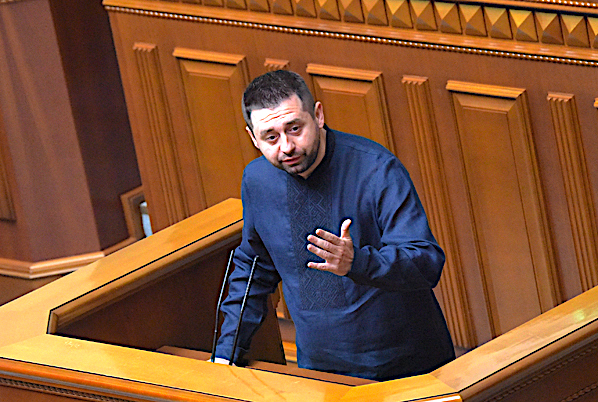
Arakhamia in Ukraine’s Parliament in 2021. (Vadim Chuprina, Wikimedia Commons, CC BY-SA 4.0)

In a November 2023 Kyiv Post report titled “Russia Offered to End War in 2022 If Ukraine Scrapped NATO Ambitions – Zelensky Party Chief,”  Arakhamia confirmed that in the March 2022 negotiations Russia proposed ending the war on the condition that Ukraine abandon its NATO aspirations and adopt a neutral stance.

Arakhamia continued:

“Neutrality was the biggest thing for them, they were ready to end the war if we took — as Finland once did — neutrality and made commitments that we would not join NATO. This was the key point. 

While negotiations continued in Istanbul, former U.K. Prime Minister Boris Johnson unexpectedly arrived in Kyiv on April 9 and said that Ukraine shouldn’t sign anything with them at all – and ‘let’s just fight.’ ”

Arakhamia’s candor was refreshing. But it came as no surprise to those of us following Ukraine in early 2022. On May 5, 2022 — a year and a half before Arakhamia spilled the beans to the Kyiv Post — Ukrainska Pravda ran a report under the title “Possibility of talks between Zelensky and Putin came to a halt after Johnson’s visit:

“According to sources close to Zelenskyy, the Prime Minister of the United Kingdom, Boris Johnson, who appeared in the capital almost without warning, brought two simple messages.

The first is that Putin is a war criminal, he should be pressured, not negotiated with. And the second is that even if Ukraine is ready to sign some agreements on guarantees with Putin, they [the West] are not. The collective West felt that Putin was not really as powerful as they had previously imagined, and that here was a chance to press him.”

Three days after Johnson left Kyiv, Putin publicly stated that talks with Ukraine had “turned into a dead end.” Putin expressed confidence that Russia would ultimately prevail and added that it would “rhythmically and calmly” continue conducting the operation in Ukraine.

Putin Provides Detail

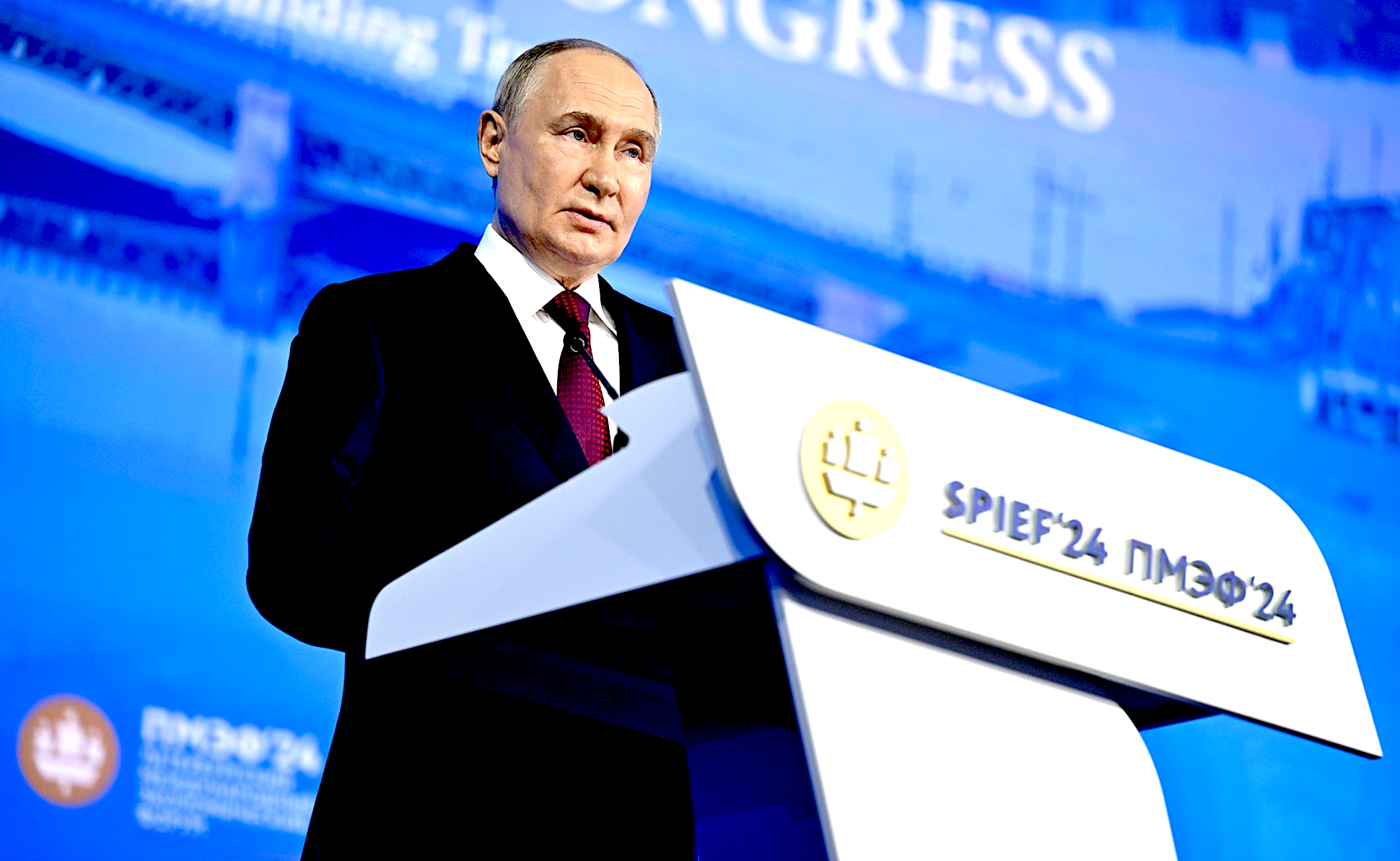
Putin addressing the St Petersburg International Economic Forum in early June.  (Ivan Sekretarev, RIA Novosti, Kremlin)

In his major speech to the Russian Foreign Ministry on June 14, Putin said the Russian troops approaching Kyiv in February-March 2022 were there “to push the Ukrainian side to negotiations.” 

From Feb. 24 on, the Russians had expressed readiness for diplomacy. Interestingly, Zelensky appointed Arakhamia chief negotiator on Feb. 28.

Putin continued:

“Surprisingly, as a result, agreements that satisfied both Moscow and Kyiv were indeed reached and initialed in Istanbul. … The document was titled ‘Agreement on Permanent Neutrality and Security Guarantees for Ukraine’. It was a compromise but  resolved the problems that were stated as major ones even at the start of the special military operation.

But the path to peace was rejected again. … The former UK prime minister said directly during his visit to Kyiv – no agreements. Russia must be defeated on the battlefield. … Thus they began to intensively pump Ukraine up with weapons and started talking about the need to inflict a strategic defeat on Russia.”

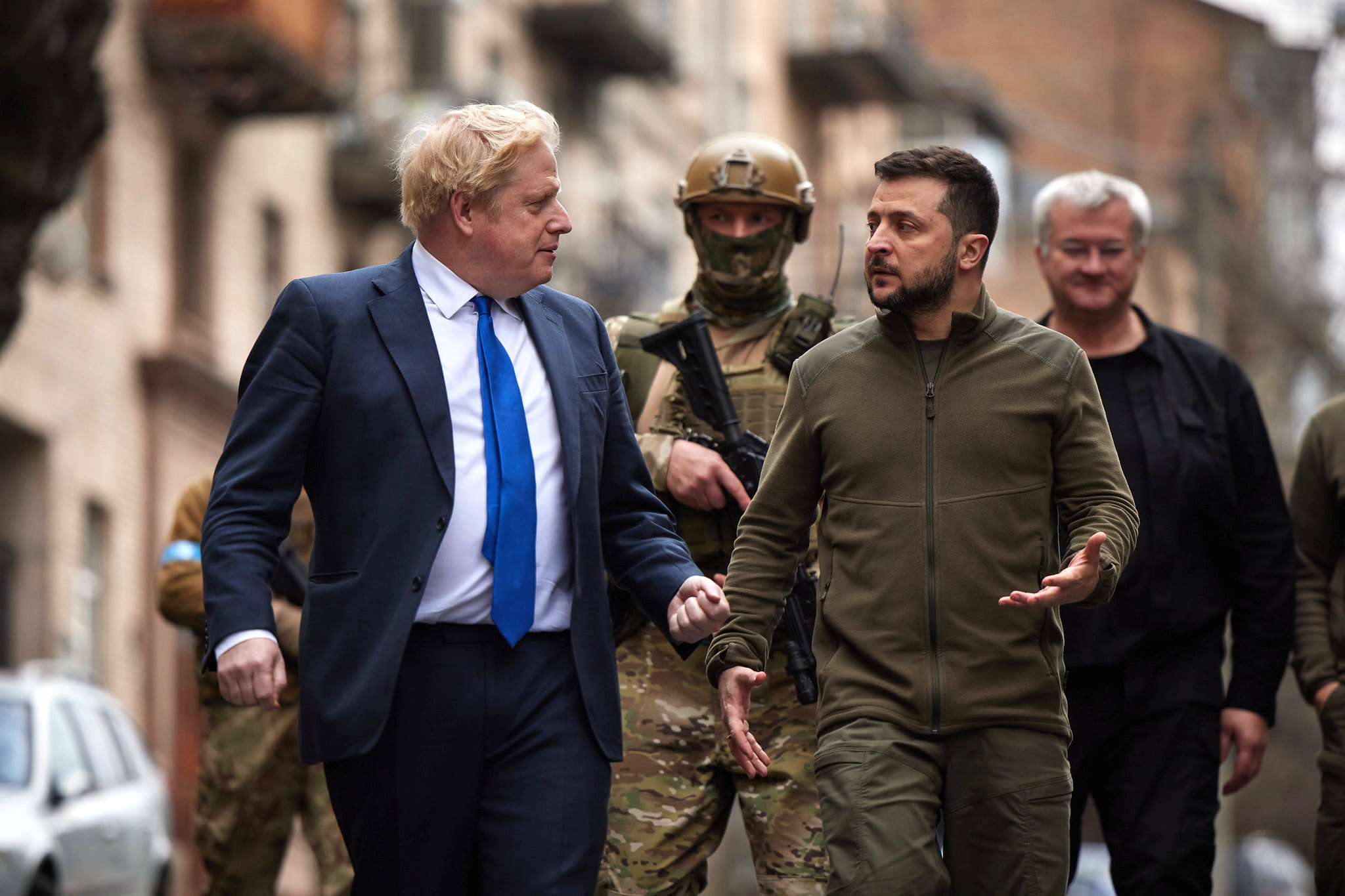
Johnson and Zelensky walking around the center of Kiev on April 9, 2022. (President of Ukraine)

Biden & Pseudo-Experts on Russia

Who has been telling Biden that Putin “will not stop at Ukraine?” Exhibit A would be Fiona Hill, disciple of arch-Russophobe historian Richard Pipes, and national intelligence officer for Russia (2006-09). 

Her insights appeared in The New York Times exactly a month before Russia invaded Ukraine.

On Jan. 24, 2022, the Times featured a guest essay by Hill titled “Putin has the U.S. Right Where He Wants It”:

“This time, Mr. Putin’s aim is bigger than closing NATO’s ‘open door’ to Ukraine and taking more territory — he wants to evict the United States from Europe. As he might put it: ‘Goodbye, America. Don’t let the door hit you on the way out.’”  [Emphasis added.]

Fiona Hill’s NYT essay about Putin driving the U.S. out of Europe had a short (two-month) shelf life, as Putin’s negotiators in Istanbul extracted a Ukrainian commitment not to seek NATO membership and a stop in hostilities. Hill admitted as much in a September/October 2022 Foreign Affairs article which included, briefly, the substance of the Istanbul agreement.

This may be damning with faint praise but, in this respect, Fiona Hill showed far more integrity than the Times, which continues to deny its readers the facts about the Istanbul accord and how it showed that in March-April 2022 Putin did stop once Ukrainian negotiators agreed to forswear membership in NATO.

With Putin having provided, in his June 14 speech, chapter and verse on the (aborted by Boris Johnson) “Agreement on Permanent Neutrality and Security Guarantees for Ukraine,” the Times wasted no time distorting the terms of the Istanbul accord, mostly by omission and turgid obfuscation, in publishing two highly deceptive articles on June 15. 

Neither article mentions  Johnson’s wrecking-ball role in scuttling the Istanbul accord. And even the subsequent admissions of Ukrainian negotiators are mangled.

Thus, New York Times readers, and the thousands of media outlets that take their lead from the Times, are once again misled on a crucial issue — one for which there is ample official Ukrainian testimony that the Times chooses to omit or fudge. And many Americans will be inclined to believe Biden’s evidence-free claims about Putin’s ultimate objectives, and to acquiesce in the dangerously growing tension with Russia — malnourished as they are on accurate information.

For many it will come down to: Between Biden and Putin, Americans “know” whom to believe!

Putin’s Take

Speaking to Western journalists on June 5, Putin cautioned: 

“You should not make Russia out to be the enemy. You’re only hurting yourself with this … They thought that Russia wanted to attack NATO. Have you gone completely crazy? … Who came up with this? It is just complete nonsense, you know? Total rubbish.”

Sadly, it is the kind of nonsense that could mislead Americans, conditioned to believe the worst of Russia, into supporting some kind of risky escalatory move by an administration determined to show how tough it is, as the November election inches closer and closer. Strap on your seatbelts.

Ray McGovern works with Tell the Word, a publishing arm of the ecumenical Church of the Saviour in inner-city Washington. His 27 years as a C.I.A. analyst included leading the Soviet Foreign Policy Branch and conducting the morning briefings of the President’s Daily Brief. In retirement he co-founded Veteran Intelligence Professionals for Sanity (VIPS).

Views expressed in this article and may or may not reflect those of Consortium News.

Analysis & Book Reviews on U.S. Foreign Policy and Russia