By Jeffrey Childers, Substack, 6/6/24
Jeff Childers is an attorney and conservative commentator based in Florida.
Until very recently — so recently you will be forgiven lack of notice of the change — it was fashionable among elites to wring their hands over letting robots decide whether to kill people. Countless conferences were devoted to the subject, new UN departments were designed, and new job descriptions were drafted, spawning battalions of specialized military bioethicists.
Zing! What was that? That was bioethics flying out the window. Sorry, chaps, pack it in. All those new ethics experts and professors and opinion influencers just became redundant. They are moot.
Pre-pandemic, so-called autonomous killing machines were de facto no bueno, the stuff of war crimes. Everyone agreed they were bad. Even if a robot lines up the shot and delivers the killing blow, an accountable human, not an unaccountable machine, must make the ultimate decision to take another human life.
The risks could not possibly be more well-known. Hollywood has thoroughly explored the subject to the point of cliché in countless silver screen series, from The Terminator and its innumerable sequels, spinoffs, and television adaptions, to Netflix’s Black Mirror, whose bleak, terrifying, and unforgettable 2017 episode “Metalhead” conclusively settled the argument in 41 minutes of runtime.
On June 4th, 2024 — mark the date — the Washington Post quietly ran an unobtrusive “good news” op-ed headlined, “The Pentagon is learning how to change at the speed of war.” To call it “just an op-ed” would do violence to its malevolent significance. First of all, the author, spy novelist and columnist David Ignatius, is one of WaPo’s most senior writers, and it’s a poorly hidden secret he is inextricably intertwined with the deep security state.
In other words, David and the CIA are besties. He knows what he’s talking about, and probably much more.
David’s op-ed began gently chiding the U.S. military for, with the very best of intentions, its antiquated ‘addiction’ to overly complicated, finicky, insanely expensive, super high-tech, human-directed weapons systems, rather than cheap, practical, reliable, and effective alternatives like the Russians are using to beat the Dickens out of Ukraine.
Ignatius ripped off the band-aid, rebelliously breaking from all conventional wisdom, and authoritatively accused the U.S.’s powerful and influential military-industrial complex of being systematically broken.
David Ignatius — the military-industrial complex’s best friend in media — openly scoffed at U.S. generals’ multi-billion dollar high-tech toys, which he predicted were so vulnerable they would only survive the first few minutes in a war with China:
David described an existential crisis. And you know Obama’s first rule: Never let a good crisis go to waste. The country thus breathlessly awaits an intervention, a Hegelian solution to the problem the MIC created, a savior. What could it be?
Most folks now agree the Russians’ pragmatic, entrepreneurial approach in Ukraine has decisively proven its battlefield superiority over our fancy, high-tech, acronymized weapons that took decades to develop: our top-tier M1 Abrams tanks, our PATRIOT air defense systems, our HIMARS and ATACMS missiles, our JDAMS flying bombs, and our networked cluster munitions.
They all literally or figuratively bogged down in the Ukrainian rasputitsa. In other words, stuck in the mud.

But the bigger problem is that all our defense systems, from the most modest mobile artillery unit to the sky-scraping F35 intelligent fighter jet, are all e-something, or i-something. They are all linked together, connected to the internet, in a networked global battlefield information system (GBIS). They were designed to be centrally controllable from the confines of an op center safely concealed under two hundred feet of granite below the Pentagon in Washington, DC.
Unfortunately, the Russians — those ‘incompetent,’ slipshod, gas-station-with-nukes ice jockeys — somehow overtook us in electronic jamming technology. And then kept going, without looking back. The Russians are jamming all our toys!
Our Borg-like, electronically interconnected technology is dead in the water, or in the mud, if it can’t talk to the other parts of itself. Worse, Russian jamming cuts it all off from its handlers thousands of miles away in America. In other words, it’s damned useless, which is why Ignatius predicted it wouldn’t last five minutes against China.
Ignatius’ description of this perfectly foreseeable development understated the terror and panic on the part of U.S. generals. It all worked so well against Saddam Hussein’s disorganized army! But the generals are slowly and reluctantly coming to terms with the fact our entire arsenal is close to useless against near-peer adversaries like Russia and China.
In desperation, and because Ukraine uber alles, all those ethical concerns over autonomous weapons systems instantly became as obsolete as our trillion-dollar aircraft carriers. The ban on machines that kill on automatic has been swept aside.
It’s an emergency, dummy.
Then, Ignatius described the easy fix to the problem. The simple correction is truly autonomous weapons, weapons that can’t be jammed, weapons that don’t have to talk to each other, weapons that push the pesky humans right out of the picture. In the same way the military is now quietly moving aside the humans, David also glided right over the pesky ethical issues, which earned not a single syllable in his column.
Ignatius said the only answer is machines that can think for themselves:
The military is way ahead of us. It’s almost too late to even hold a debate over whether saving Ukraine is worth a Metalhead future. Two years ago, the Deep State’s influential Council for Foreign Relations openly argued to cut off debate, in its article “Stop the “Stop the Killer Robot” Debate: Why We Need Artificial Intelligence in Future Battlefields.”
Read it for yourself. The CFR waved off arguments about risks the robots will run amok and kill civilians. Humans make mistakes too! Soldiers kill civilians all the time! Robots might be even more accurate deciders of who to kill, and when. Who knows?
But the CFR never grappled with the accountability problem. Who’s responsible when the robot goes rogue and wipes out a village, or a wedding, or a whole city? Who’s tried for the war crimes?
Nobody, that’s who. You can’t expect technology to be perfect, dummy.
You can’t put a robot on trial. Come on, be serious.
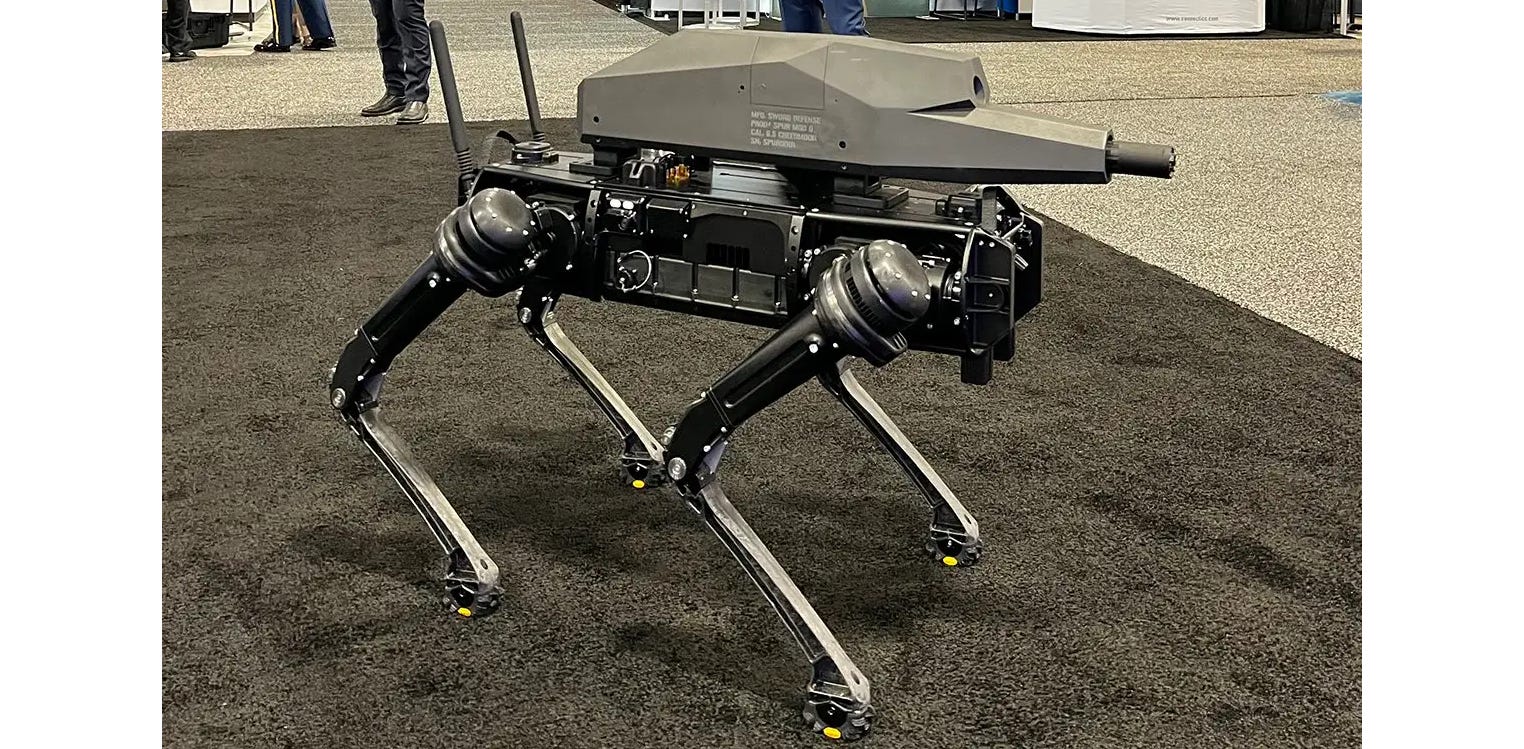
The government knows full well that public outcry will only slow down the killer robot train. The military is now moving with mind-blowing, demonic, uncharacteristic speed toward building its dystopian, robot-armed future. The first fully autonomous killing machines have already been designed, built, and delivered to Ukraine.
To our chagrin, we learned during the pandemic that government can move unimaginably fast when it wants to. Ignatious heard it directly from Deputy Secretary of Defense Kathleen Hicks:
Autonomous killer drones are nothing more than autonomous killer robot dogs with wings.
Ignatius also assured us that the Air Force is, right now, building robotic fighter jets labeled with the grim euphemism “uncrewed.” The robots can keep on fighting, long after the human crews are gone.
Similarly, last month, the Navy formed a new squadron of hundreds of fully autonomous, uncrewed boats, a water swarm with the unwieldy name, “Global Autonomous Reconnaissance Craft.” GARC doesn’t exactly roll off the tongue, but maybe it echoes the last thing dying sailors say.
Instead of applying that awkward acronym, the Navy has nicknamed its new robot squadron the “Hell Hounds.” Coincidentally, Hell Hound also aptly describes the shiny robot dogs prowling Metalhead’s bleak, apocalyptic landscape, where they will forever be roaming in metallic packs, slowly herding the shrinking remnants of the human race into extinction.

It’s easy to blame Congress for failing to pull the plug, slow things down, or at least hold a public debate. But remember: attractive, well-spoken military analysts constantly deliver confidential, top-secret briefings to Congressmen, direly warning them China will win in five minutes unless we do something.
What can I say? It’s 2024. Here come the terminators, and nothing can stop it. We all knew this day was coming; we just didn’t think it would come from us.
Somebody track down that scrappy Sarah Connor and tell her it’s time to report for duty.