Joe Lauria – Biden: ‘I’m Running the World’

I’m just going to leave this here as a supplement to Lauria’s analysis below. – Natylie

Why Do Psychopaths Crave Power?

By Joe Lauria, Consortium News, 7/6/24

About midway through what was billed as the most consequential interview of Joe Biden’s political career, he uttered the most consequential words in the interview: “I am running the world.”

Those five words explain why he refuses to withdraw from the race and confirm what most Americans deny, but which most of the world knows: U.S. presidents act as world emperors. 

The interview with ABC News’ George Stephanopoulos was supposed to be Biden’s chance to show the country he is mentally fit to remain in the presidency and run for a second term, at the end of which, if he is still alive, he’d be 86 years old. 

Biden is trying to recover from a debate performance on June 27 that showed 43.7 million television viewers the debilitated state of his mind. On the whole, he was as addled in the debate as he has been for years now, but never before not live in front of such an immense audience. 

The reaction from the Democratic Party and its media was unprecedented: pundits and editorialists; Democratic members of Congress; major donors; party political operatives and analysts all demanded in apparent, coordinated uniformity:  Stop being selfish Joe and quit the race so Donald Trump doesn’t win.

But it’s had the opposite effect. Biden has resisted the chorus from the party elite: “I’m not going anywhere,” he told a rally on Friday, saying erroneously that he would beat Trump again in 2020. Earlier he met with Democratic state governors at the White House. He told them he was fine. “It’s just my brain,” he said, according to The New York Times.

And to show the public he’s still got his marbles he sat down with Stephanopoulos in a taped interview, the subject of which was only his brain.

“GEORGE STEPHANOPOULOS: Would you be willing to undergo an independent medical evaluation that included neurological and cognit– cognitive tests and release the results to the American people?

PRESIDENT JOE BIDEN: Look. I have a cognitive test every single day. Every day I have that test. Everything I do. You know, not only am I campaigning, but I’m running the world. Not– and that’s not hi– sounds like hyperbole, but we are the essential nation of the world..

Madeleine Albright was right. And every single day, for example, today before I came out here, I’m on the phone with– with the prime minister of– well, anyway, I shouldn’t get into detail, but with Netanyahu. I’m on the phone with the new prime minister of England.

I’m workin’ on what we were doin’ with regard to– in Europe with regard to expansion of NATO and whether it’s gonna stick. I’m takin’ on Putin. I mean, every day there’s no day I go through there not those decisions I have to make every single day.”

Biden thinks he’s running the world and he’s not gonna give it up. No matter that he’s losing his mind for all to see. No matter that he is fully supporting an ongoing genocide in Gaza. No matter that he provoked and keeps expanding a conflict in Ukraine that is heading towards nuclear confrontation with Russia. 

Biden is obsessed with power — with the power of “running the world.” And he won’t let go.

America is the first world empire. The U.S. president is the first world emperor. The debate to win the emperorship between Biden and Trump — the “stable genius” deranged in his own right — was an end-of-empire spectacle, as though it were Caligula debating Nero.

The rest of the world shudders in apprehension at what will come of this.  

Ben Aris: Russia overtakes Japan to become the fourth largest economy in the world in PPP terms | World Bank Upgrades Russia to “High Income” Country

By Ben Aris, Intellinews, 6/4/24

The Russian economy has overtaken Japan to become the fourth largest in the world in PPP terms (purchase power parity), according to revised data from the World Bank released at the start of June.

As bne IntelliNews reported in August, Russia had already overtook Germany to become the fifth biggest economy in adjusted terms. Hit by multiple shocks recently and cut off from cheap Russian gas, Germany is now stagnating and has fallen to sixth place in the World Bank’s ranking.

PPP GDP measurement is preferred by many economists, as it takes into account the difference between local prices and nominal prices similar to The Economist’s famous Big Mac index: a burger in Moscow costs about half as much as the same burger in New York.

The World Bank improved Russia’s ranking after revising its data and says that Russia actually overtook Japan in 2021 and has maintained its position as number four since then. Its previous calculations were based on 2017 data but have now been updated to reflect 2021 figures.

Previously, Russian President Vladimir Putin set his government the goal of producing economic growth ahead of the global average. Before the war in Ukraine started, Russia’s economic growth was well behind that of the global average and close to stagnation. However, following the invasion of Ukraine in 2022, the economy has been enjoying a military Keynesianism boost and is currently the fastest growing of any major economy in the world.

And Russia has overtaken Japan ahead of schedule. Putin explicitly set his government the goal of attaining fourth place among the world’s largest economies in terms of PPP earlier this year, and the Cabinet was instructed to prepare measures to achieve this goal by March 31, 2025.

By breaking off relations with the West Putin has made a big bet on the Global South Century, where most of the developing world countries are growing much faster than the West. Currently China and India are in the number one and three slots in the global ranking in PPP terms but both are expected to become the leaders in nominal terms as well over the next three or four decades. Most of the fastest growing economies from lower down the list are also from the Global South.

As bne IntelliNews has extensively reported, Russia has changed its economic model and after decades of austerity began to invest heavily, spurring growth in a new Putinomics. At the same time as investment is pouring into the military industrial complex, Putin has also launched the National Projects 2.1 programme to invest into the civilian economy as well and improve the quality of life for the average Russian, as he made clear in his recent guns and butter speech. And the war is proving to be a boon for Russians, as Russia’s poorest regions have been the biggest winners and as bne IntelliNews recently reported, the country’s despair index has fallen to its lowest level ever this year – the sum of inflation, unemployment and poverty.

As a result of these changes, economists estimate that Russia’s growth potential has increased from 1-1.5% pre-war to around 3.5% now. Last year, Russia’s economic growth caught analysts off guard with a 3.6% expansion. This year the World Bank has already almost trebled its forecast for growth from 1.1% to 3.2%. Russia’s Economic Ministry is similarly bullish.

Even the World Bank’s PPP adjusted size of the economy may be an underestimate. The World Bank also estimates that 39% of Russia’s economy is in the shadows, while the shadow economy only makes up 10% of Japan’s economy, which would add an additional $2.5 trillion to Russia’s $6.4 trillion PPP adjusted economic size – still not enough to overtake India’s $14.6 trillion PPP adjusted GDP value, but widening the gap with Japan further.

***

World Bank upgrades Russia to “high-income” country due to war-spending boost

By Ben Aris, Intellinews, 7/3/24

The positive economic news keeps coming for Russia after the World Bank upgraded it from an “upper-middle-income” to a “high-income” country, putting it in the same group as the leading G7 nations, the bank said on July 1.

Bulgaria and Palau were also upgraded to “high-income” in the World Bank’s ranking.

Russia’s economy has defied expectations by outperforming all expectations following the imposition of harsh economic sanctions that have been offset by heavy spending on the military industrial complex.

“Economic activity in Russia was influenced by a large increase in military related activity in 2023, while growth was also boosted by a rebound in trade (+6.8%), the financial sector (+8.7%), and construction (+6.6%). These factors led to increases in both real (3.6%) and nominal (10.9%) GDP, and Russia’s Atlas GNI per capita grew by 11.2%,” the World Bank said.

The World Bank’s reclassification is based on the increase in the size of the economy based on its 2023 gross national income (GNI) per capita of $14,250, the World Bank said in a blog. Any country with a GNI per capita of more than $14,005 is considered to be a high-income country.

However, the World Bank noted that the increase in wealth is mostly due to the military Keynesianism boost that the Russian economy has enjoyed as a result of the war with Ukraine that broke out over two years ago. Incomes have also been artificially driven up by the chronic labour shortage that has pushed up nominal wages well above the rate of inflation.

Russia’s economy grew by an unexpected 3.6% last year making it the fastest growing major economy in the world, and is on course to grow again this year by at least 3%, according to the latest Central Bank of Russia (CBR) monthly macroeconomic forecast.

If sanctions were designed to collapse the Russian economy, they have been a failure and some have argued that the economy is now stronger than ever as a result of a fundamental change to Putinomics strategy from hoarding money to releasing massive amounts of pent up fixed investment. Some economists have argued that what started as a Keynesian bump is now transforming into a structural change in the nature of Russia’s economy thanks to the investment that will make growth stronger and more persistent in the medium-term.

Last month Russia also overtook Japan to become the world’s fourth largest economy in the world in PPP (purchase power parity) terms, according to World Bank data. Three of the world’s five largest economies are now BRICS members: China, US, India, Russia and Japan, in that order. Germany was fifth in the last ranking, but has now been pushed into sixth place. Both Japan and Germany are seeing their economies slow in PPP terms while most of the leading Global South countries are seeing their economies accelerate and rise up the income rankings in recent years.

The World Bank attributed Russia’s economic uplift to a significant increase in military-related activities and rebounds in trade, the financial sector, and construction.

Despite the challenges posed by international sanctions and ongoing geopolitical tensions, these sectors have demonstrated resilience and contributed to the country’s economic performance, the World Bank reported.

Ukraine also had an upgrade to “lower-middle-income” to an “upper-middle-income” country, after its GNI per capita rose to $5,070 in 2023. Like Russia, Ukraine was lifted by heavy military spending that has largely been funded by international financial aid – money that Ukraine did not have access to before the war broke out. Since the start of the conflict Ukraine has received some $86bn from donors, equivalent to about two thirds of the value of the pre-war economy.

The World Bank Group assigns the world’s economies to four income groups: low, lower-middle, upper-middle, and high. The classifications are updated each year on July 1, based on the GNI per capita of the previous calendar year. GNI measures are expressed in dollars.

The classification of countries into income categories has evolved significantly over the period since the late 1980s. In 1987, 30% of reporting countries were classified as low-income and 25% as high-income countries. Jumping to 2023, these overall ratios have shifted down to 12% in the low-income category and up to 40% in the high-income category.

The scale and direction of these shifts, however, varies a great deal between world regions. The World Bank profiled some of the notable changes in its blog:

·100% of South Asian countries were classified as low-income countries in 1987, whereas this share has fallen to just 13% in 2023.

·In the Middle East and North Africa there is a higher share of low-income countries in 2023 (10%) than in 1987, when no countries were classified to this category.

·In Latin America and the Caribbean, the share of high-income countries has climbed from 9% in 1987 to 44% in 2023.

·Europe and Central Asia have a slightly lower share of high-income countries in 2023 (69%) than it did in 1987 (71%).
Riley Waggaman: You will be tagged and you will love it

There are a lot of misconceptions about Russia that I encounter on a regular basis. There are, of course, the ones from the establishment about Russia being an autocratic backwards aggressor country. But I also encounter many of a different kind.

For example, I’ve had to explain to several conservative members of my family that Russian conservatism is rather different than American conservatism and if they think they’re going to move to the Russian countryside and enjoy minimal government and have lots of guns, they best think again.

There is also the anti-establishment civil libertarian types who think that the Russian government is some kind of warrior against the WEF-influenced biometric, “cattle-tag” digital id, and vaccine mandate agenda.

Um, no.

While many average Russians do not like or want this, the Russian government largely seems to be ramming it down their throats, as Russian media and sources attest. Neoliberal technocrats still have a lot of sway in the Putin government.

But many people would still rather believe goofy western commentators who are projecting their idealistic fantasies onto Russia. – Natylie

Riley Waggaman, Substack, 6/10/24

As expected, the St. Petersburg International Economic Forum was the hottest anti-globalist multipolar traditional RETVRN values conference of 2024—possibly of all-time.

The unipolar world suffered non-stop humiliations during this mind-blowing freedom event. For example, Moscow Region governor Andrei Vorobyov made an incredible BRICS announcement during a titillating panel discussion about the joys of biometrics, causing the dollar to lose 50% of its value against the gold-backed ruble:

Biometrics is a tool that gives people better quality and more convenience in certain procedures, keeping them neat and tidy. You don’t need any papers or passports—that will all be in the past. Resisting it, in my opinion, is absurd.

The governor of Russia’s second-most-populated region, explaining the inevitable convenience of biometrics—which will replace archaic “papers” and “passports”.

Nothing is being hidden. They’re speaking very frankly. It’s all out there, in the open.

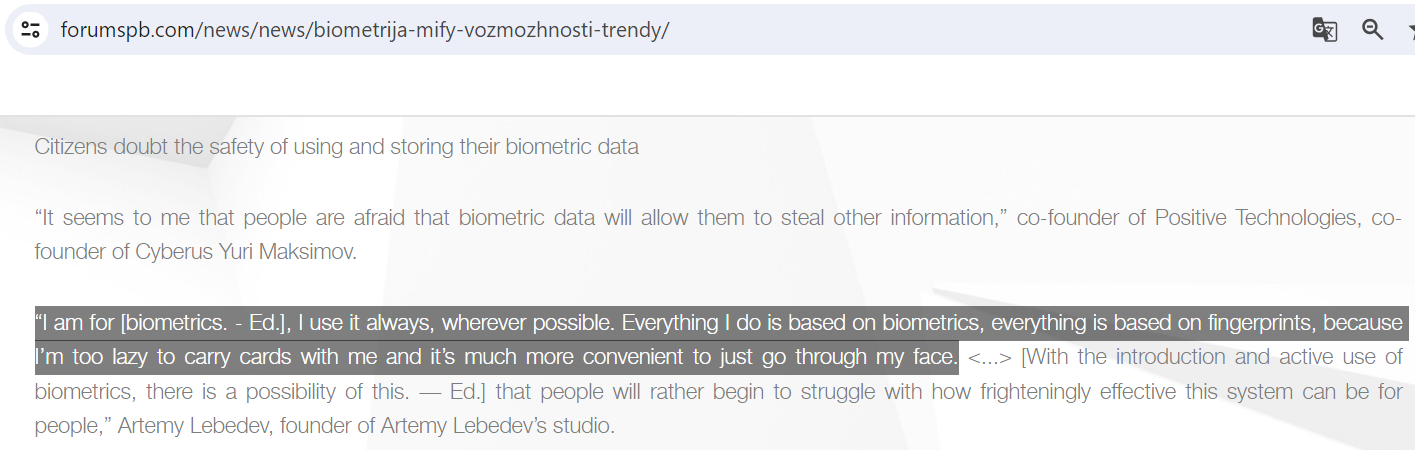
There is even a helpful “recap” of the panel discussion published by SPIEF. Behold the “highlights”:

source: https://forumspb.com/

“I am for biometrics … Everything I do is based on biometrics, everything is based on fingerprints, because I’m too lazy to carry cards with me and it’s much more convenient to just [login in/pass/go] through my face,” pontificated an expert panelist.

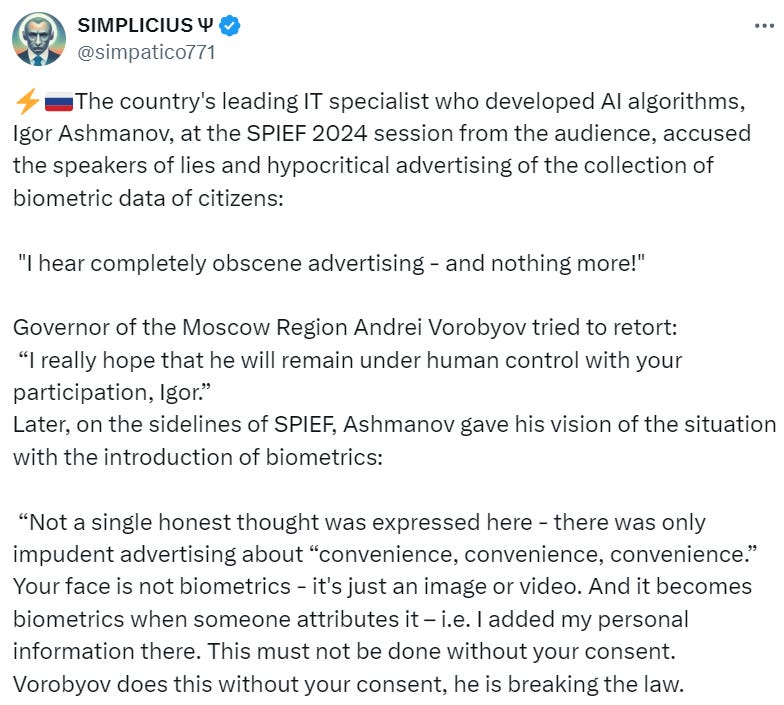
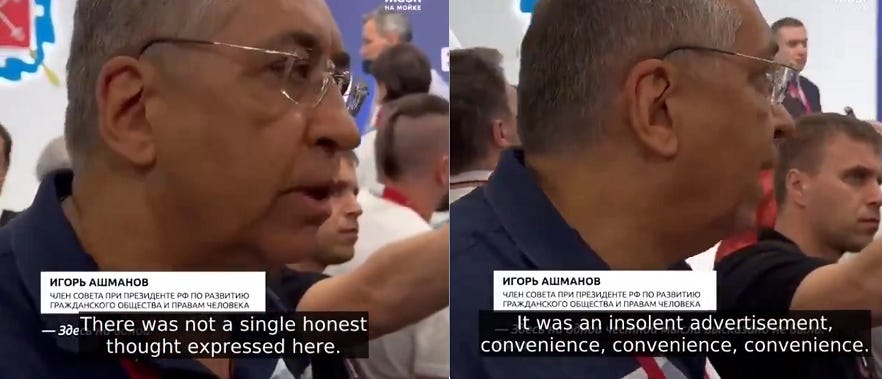
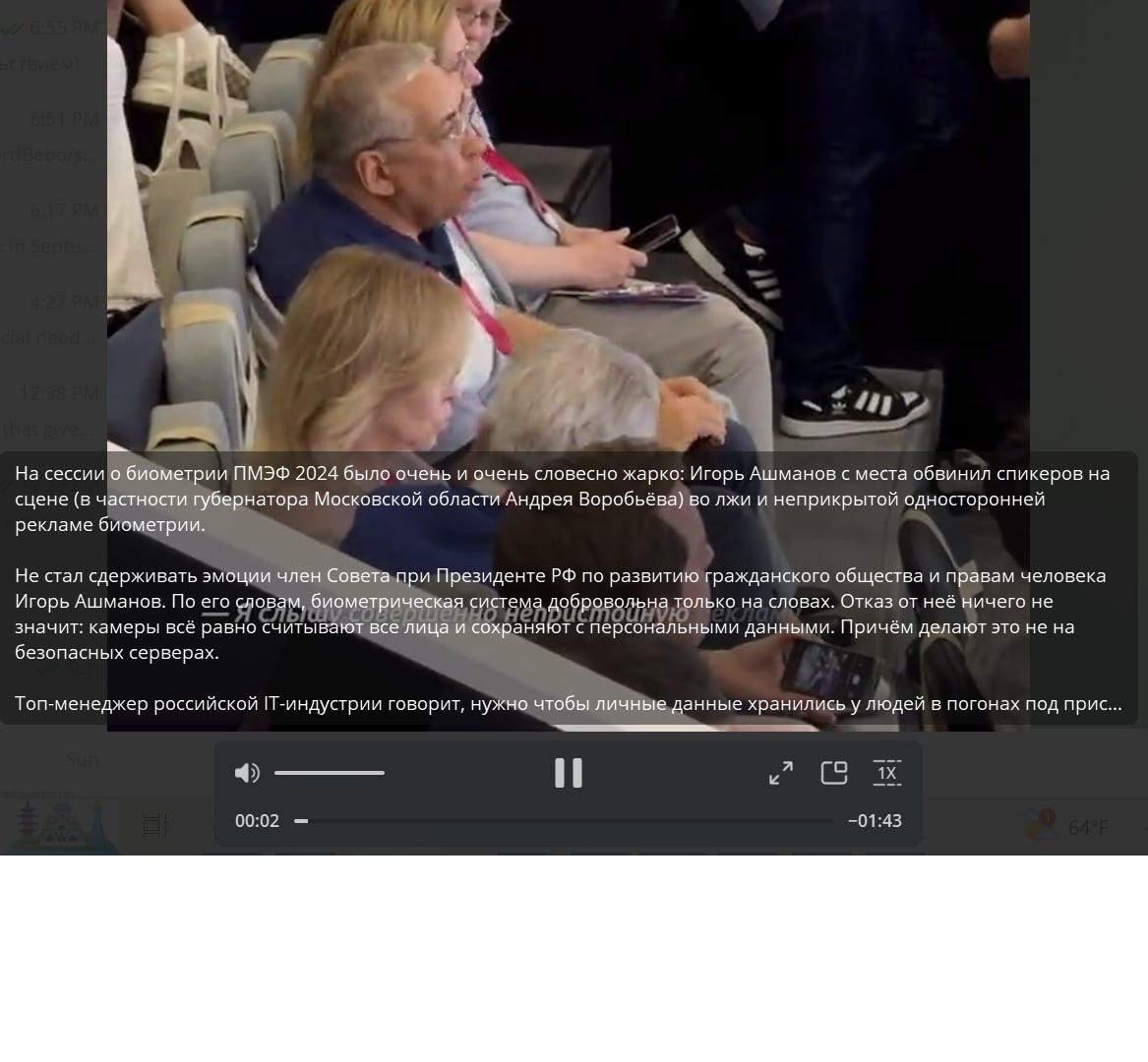
Was the BRICS Multipolar Happy Order incapable of finding a single panelist who had reservations about turning eyeballs into IDs? Igor Ashmanov, a member of the Presidential Council for the Development of Civil Society and Human Rights, had to shout his objections from the bleachers because they wouldn’t let his dirty anti-biometric ideas onstage:

source: Telegram

Friend of the blog Simplicius posted a Twitter-summary of Igor’s very rude unipolar objections to biometrics:

This guy sounds like Edward Slavsquat. Great minds think alike.

“Yes, but Russians like biometrics, the most convenient of all forms for identification, which will replace ‘papers’ and ‘passports’,” you might be saying to yourself for some weird and tragic reason.

Take the wheel, nakanune.ru:

People in Russia are narrow-minded and have not yet realized how beautiful, convenient and progressive biometrics are. Therefore, whether they want it or not, the authorities will introduce it wherever possible. Approximately the same reasoning (without these words, but with this meaning) was heard at SPIEF in the section devoted to biometrics. Nakanune.RU provides characteristic statements about the attitude of business towards people.

At first, the presenter of the Russia 24 channel, Maria Kudryavtseva, advertised biometrics, showing how she enters the Unified Biometric System using her face and even the greeting “Hello, Maria!” appears there, which she enthusiastically shows to the audience.

At the same time, there was a feeling of a white gentleman showing “digital beads” to the local natives. And the whole “discussion” came down to one thing—intrusive advertising. It is characteristic that the governor of the Moscow region Andrei Vorobyov, who is a public servant, but showed himself to be a business lobbyist, was also involved in this.

As with artificial intelligence in healthcare , the panel included only proponents of biometrics. Those who might object were simply not invited. Those present were mainly engaged in advertising. Old people do not understand the digital world, but young people were already born with a gadget in their hand, they are very flexible, progressive, digital. They understand how convenient, cool and fast it is. In general, the conversation became very revealing in its vacuity and disregard for the position of citizens.

The first question to the speakers was provocative: is society ready to use biometrics? That is, don’t people want it, does the country need it, not what it will give, not what the risks are—but is society ready, as if the issue has been fundamentally resolved. Which is obscene. Let us recall that according to a 2023 survey , a third of Russians have a positive attitude towards taking biometrics, but almost half are opposed—48%.

[…]

Vorobiev spoke as if he had gone back in time a hundred years ago and was telling backward people of the past about the wonders of the technology of the future. Here are just a few quotes.

“You don’t need a paper or a passport, all this will be a thing of the past, it’s absurd to resist it. We all already use biometrics, including children at school… It’s convenient, you don’t need to twist anything, you just look and that’s it,” said Vorobiev. […]

It is characteristic that one of the main experts in the field of artificial intelligence in the country, a member of the Human Rights Council, Igor Ashmanov, was not invited to the section, who was forced to make remarks from the audience several times, and the section participants politely drew attention to the fact that someone might disagree. So, when Lebedev said that all people are for biometrics, he objected that this was not true. And when they started talking about different points of view, he very briefly but accurately described what was happening.

“You haven’t invited anyone to the presidium, you’re all blowing the same tune! As a member of the Presidential Human Rights Council, I hear completely obscene advertising, and nothing more!” said Ashmanov.

Joe Lauria: Using Ukraine Since 1948

By Joe Lauria, Consortium News, 6/10/24

The United States has for nearly 80 years seen Ukraine as the staging ground for its once covert and increasingly overt war with Russia. 

After years of warnings, and after talk since 2008 of Ukraine joining NATO, Russia fought back two years ago. With neither side backing down Ukraine is increasingly becoming a flashpoint that could lead to nuclear war. 

The West thinks Russia is bluffing. But its doctrine states that if Russia feels that its existence is threatened it could resort to nuclear arms. Instead of taking these warnings seriously, NATO is recklessly opening corridors for a ground war against Russia in Ukraine; France says it’s putting together a coalition of nations to enter the war, despite Russia saying French or any other NATO force would be fair game. 

Unless you read Consortium News and a few other alternative outlets, you won’t get this perspective. You will  think Russia is an out of control aggressor bent on destroying the world.  So …

Please Donate to Our Spring Fund Drive!

In Paris the other day Joe Biden said Russia wants to conquer all of Europe but can’t even take Khariv. It is this kind of inflammatory nonsense, combined with allowing Ukraine to fire NATO weapons into Russian territory, that is imperiling us all. 

The danger started building up many years ago but it is now reaching a head. 

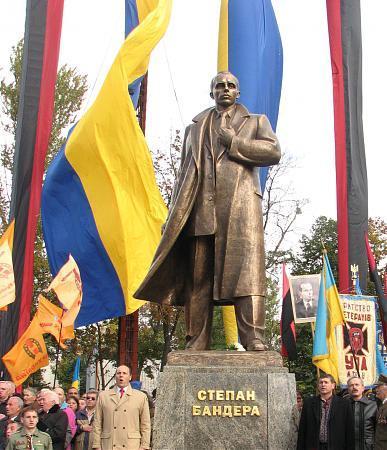
The U.S. relationship with Ukraine, and its extremists, to undermine Russia began after the Second World War. During the war, units of the Organization of Ukrainian Nationalists (OUN-B) took part in the Holocaust, killing at least 100,000 Jews and Poles. 

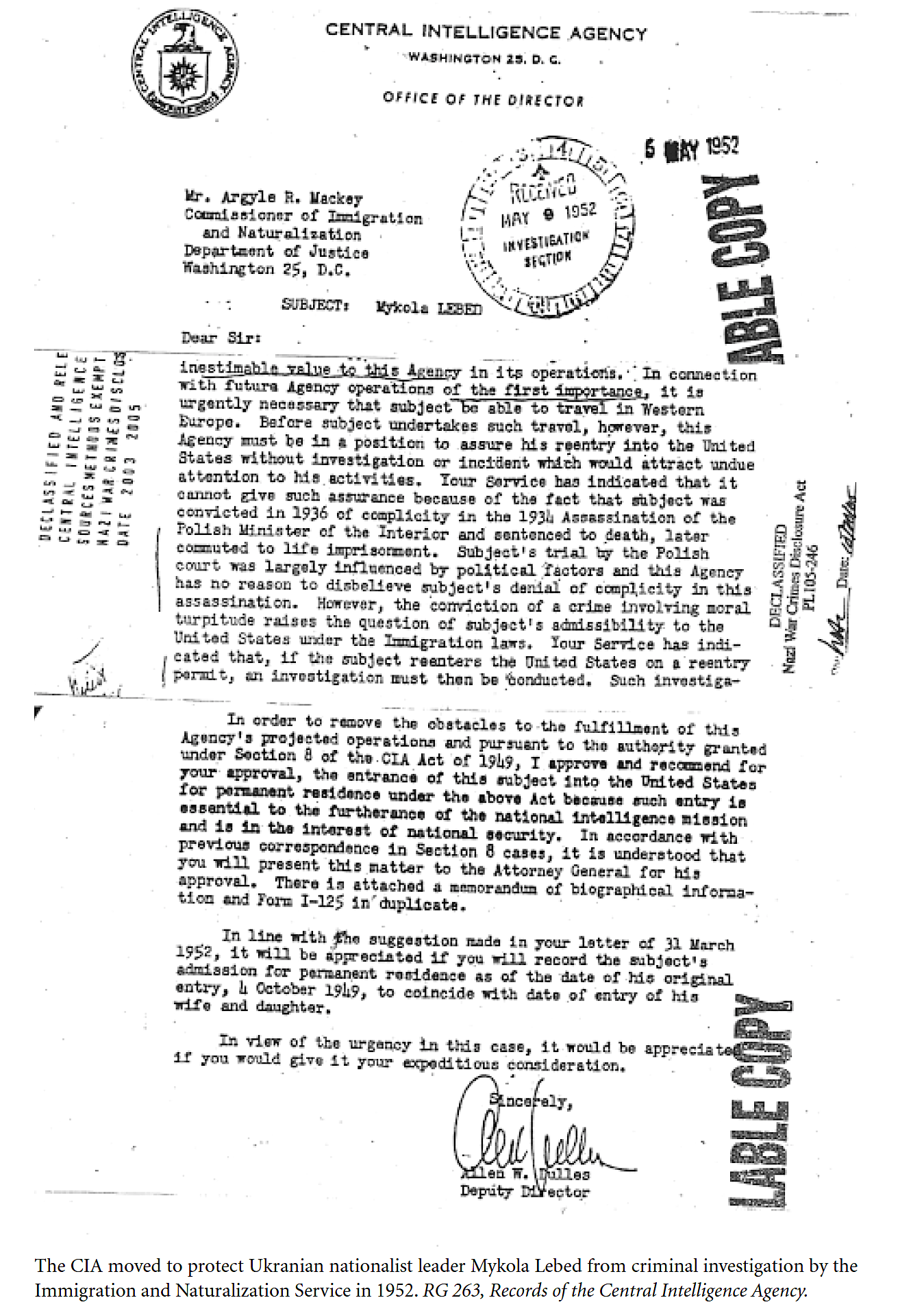
Mykola Lebed, a top aide to Stepan Bandera, the leader of the fascist OUN-B, was recruited by the C.I.A. after the war, according to a 2010 study by the U.S. National Archives. 

Lebed was the “foreign minister” of a Banderite government in exile, but he later broke with Bandera for acting as a dictator. The U.S. Army Counterintelligence Corps termed Bandera “extremely dangerous” yet said he was “looked upon as the spiritual and national hero of all Ukrainians….”

Instead of Bandera, the C.I.A. was interested in Lebed, despite his fascist background. They set him up in an office in New York City from which he directed sabotage and propaganda operations on the agency’s behalf inside Ukraine against the Soviet Union.  The U.S. government study says:

“CIA operations with these Ukrainians began in 1948 under the cryptonym CARTEL, soon changed to AERODYNAMIC. … Lebed relocated to New York and acquired permanent resident status, then U.S. citizenship. It kept him safe from assassination, allowed him to speak to Ukrainian émigré groups, and permitted him to return to the United States after operational trips to Europe. Once in the United States, Lebed was the CIA’s chief contact for AERODYNAMIC. CIA handlers pointed to his ‘cunning character,’ his ‘relations with the Gestapo and … Gestapo training,’ [and] the fact that he was ‘a very ruthless operator.’”

The C.I.A. worked with Lebed on sabotage and pro-Ukrainian nationalist propaganda operations inside Ukraine until Ukraine’s independence in 1991.

“Mykola Lebed’s relationship with the CIA lasted the entire length of the Cold War,” the study says. “While most CIA operations involving wartime perpetrators backfired, Lebed’s operations augmented the fundamental instability of the Soviet Union.” 

Continued Until and Beyond Ukrainian Independence

The U.S. thus covertly kept Ukrainian fascist ideas alive inside Ukraine until at least Ukrainian independence was achieved. “Mykola Lebed, Bandera’s wartime chief in Ukraine, died in 1998. He is buried in New Jersey, and his papers are located at the Ukrainian Research Institute at Harvard University,” the U.S. National Archives study says.  

The successor organization to the OUN-B in the United States did not die with him, however.  It had been renamed the Ukrainian Congress Committee of America (UCCA), according to IBT.

“By the mid-1980s, the Reagan administration was honeycombed with UCCA members. Reagan personally welcomed [Yaroslav] Stetsko, the Banderist leader who oversaw the massacre of 7,000 Jews in Lviv, in the White House in 1983,” IBT reported.  “Following the demise of [Viktor] Yanukovich’s regime [in 2014], the UCCA helped organise rallies in cities across the US in support of the EuroMaidan protests,” it reported.

That is a direct link between the U.S.-backed 2014 Maidan coup against a democratically-elected Ukrainian government and WWII-era Ukrainian fascism. 

Since 2014, the U.S. pushed for an attack on Russian speakers in eastern Ukraine who had rejected the coup, and NATO began training and equipping Ukrainian troops.  Combined with talk since 2008 of Ukraine joining NATO, Russia acted after years of warning. 

More than two years later, with Ukraine clearly losing the war, Western leaders will do just about anything to save their political skins as they have staked so much on winning in Ukraine.   Don’t listen to them.  They need a West in denial of the dangers facing us.

As President John F. Kennedy said in his 1963 American University speech:

“Above all, while defending our own vital interests, nuclear powers must avert those confrontations which bring an adversary to a choice of either a humiliating retreat or a nuclear war. To adopt that kind of course in the nuclear age would be evidence only of the bankruptcy of our policy–or of a collective death-wish for the world.”

The world may wake up when it’s too late — after the missiles have already started flying.

George Beebe: The Coming Russian Escalation With the West

By George Beebe, Time, 7/1/24

To judge from the editorial pages and Capitol Hill currents that both shape and reflect Washington’s perceptions of the world, the doomsayers sounding alarms over the risk of direct military conflict between the U.S. and Russia over Ukraine have been proved wrong. Despite many Russian warnings and much nuclear saber-rattling, the United States has managed to supply advanced artillery systems, tanks, fighter aircraft, and extended-range missiles to Ukraine without an existential contest—or even significant Russian retaliation.

For Washington’s hawkish chorus, the benefits of providing increasingly greater lethality to Ukraine outweigh the dangers of provoking a direct Russian attack on the West. They insist that the U.S. not allow fears of an unlikely Armageddon to block much-needed aid for Ukraine’s defense, particularly now that battlefield momentum has swung toward Russia. Hence the White House’s recent decision to green-light Ukraine’s use of American weapons to strike into internationally recognized Russian territory and its reported deliberations over putting American military contractors on the ground in Ukraine.

There are several problems with this reasoning. The first is that it treats Russia’s redlines—limits that if crossed, will provoke retaliation against the U.S. or NATO—as fixed rather than moveable. In fact, where they are drawn depends on one man, Vladimir Putin. His judgments about what Russia should tolerate can vary according to his perceptions of battlefield dynamics, Western intentions, sentiment inside Russia, and likely reactions in the rest of the world.

It is true that Putin has proved quite reluctant to strike directly at the West in response to its military aid for Ukraine. But what Putin can live with today may become a casus belli tomorrow. The world will only know where his red lines are actually drawn once they have been crossed and the U.S. finds itself having to respond to Russian retaliation.

The second problem is that by focusing narrowly on how Moscow might react to each individual bit of American assistance to Ukraine, this approach underestimates the cumulative impact on Putin and the Kremlin’s calculations. Russian experts have become convinced that the U.S. has lost its fear of nuclear war, a fear they regard as having been central to stability for most of the Cold War, when it dissuaded both superpowers from taking actions that might threaten the other’s core interests. 

A key question now being debated within Russia’s foreign policy elite is how to restore America’s fear of nuclear escalation while avoiding a direct military clash that might spin out of control. Some Moscow hardliners advocate using tactical nuclear weapons against wartime targets to shock the West into sobriety. More moderate experts have floated the idea of a nuclear bomb demonstration test, hoping that televised images of the signature mushroom cloud would awaken Western publics to the dangers of military confrontation. Others call for a strike on a U.S. satellite involved in providing targeting information to Ukraine or for downing an American Global Hawk reconnaissance drone monitoring Ukraine from airspace over the Black Sea. Any one of these steps could lead to an alarming crisis between Washington and Moscow.

Underlying these internal Russian debates is a widespread consensus that unless the Kremlin draws a hard line soon, the U.S. and its NATO allies will only add more capable weapons to Ukraine’s arsenal that eventually threatens Moscow’s ability to detect and respond to strikes on its nuclear forces. Even just the perception of growing Western involvement in Ukraine could provoke a dangerous Russian reaction.

These concerns undoubtedly played a part in Putin’s decision to visit North Korea and resurrect the mutual defense treaty that was in force from 1962 until the Soviet Union’s demise. “They supply weapons to Ukraine, saying: We are not in control here, so the way Ukraine uses them is none of our business. Why cannot we adopt the same position and say that we supply something to somebody but have no control over what happens afterwards? Let them think about it,” Putin told journalists after the trip.

Last week, following a Ukrainian strike on the Crimean port of Sevastopol that resulted in American-supplied cluster munitions killing at least five Russian beachgoers and wounding more than 100, Russian officials insisted that such an attack was only possible with U.S. satellite guidance aiding Ukraine. The Foreign Ministry summoned the U.S. ambassador in Moscow to charge formally that the U.S. “has become a party to the conflict,” vowing that “retaliatory measures will definitely follow.” The Kremlin spokesperson announced that “the involvement of the United States, the direct involvement, as a result of which Russian civilians are killed, cannot be without consequences.”

Are the Russians bluffing, or are they approaching a point where they fear the consequences of not drawing a hard line outweighs the dangers of precipitating a direct military confrontation? To argue that we cannot know, and therefore should proceed with deploying American military contractors or French trainers in Ukraine until the Russians’ actions match their bellicose words, is to ignore the very real problems we would face in managing a bilateral crisis. 

Unlike in 1962, when President John F. Kennedy and his Russian counterpart Nikita Khrushchev famously went “eyeball to eyeball” during the Cuban missile crisis, neither Washington nor Moscow is well positioned to cope with a similarly alarming prospect today. At the time, the Soviet ambassador was a regular guest in the Oval Office and could conduct a backchannel dialogue with Bobby Kennedy beyond the gaze of internet sleuths and cable television. Today, Russia’s ambassador in Washington is a tightly monitored pariah. Crisis diplomacy would require intense engagement between a contemptuous Putin and an aging Biden, already burdened with containing a crisis in Gaza and conducting an election campaign whose dynamics discourage any search for compromise with Russia. Levels of mutual U.S.-Russian distrust have gone off the charts. Under the circumstances, mistakes and misperception could prove fatal even if—as is likely—neither side desires a confrontation.

Pivotal moments in history often become clear only in hindsight, after a series of developments produce a definitive outcome. Discerning such turning points while events are in motion, and we still have some ability to affect their course, can be maddeningly difficult. We may well be stumbling toward such a moment today.

Analysis & Book Reviews on U.S. Foreign Policy and Russia