For a long time, the Kremlin has done a diplomatic dance in the Middle East to maintain equally good relations with all the major players. And for more than a decade, it had succeeded beyond expectations, keeping workable, if not warm, terms with Israel, Turkey, Saudi Arabia, and Iran simultaneously.
But that was before Israel and Iran threatened open hostilities against each other. Now, amid tensions in the Middle East – somewhat eased since an Israeli strike in Iran over the weekend – Moscow’s long-standing outreach to Tel Aviv may become a casualty.
Despite strong personal ties between Russian President Vladimir Putin and Israeli Prime Minister Benjamin Netanyahu, Israel has fallen back on its traditional friends in the West for support amid the deepening crisis. Meanwhile, Russia has moved into an even tighter embrace with Iran, which it relies on for weapons to fight the war in Ukraine, growing trade and economic cooperation, and vital assistance in evading Western sanctions – apparently including a fleet of “ghost tankers” to move Russian oil to world markets.
And if the situation between Iran and Israel does spiral, it could become a major problem for Russia.
“Relations with Israel have deteriorated, though both sides retain contact,” says Vladimir Sotnikov, an expert with the IMEMO Center for International Security in Moscow. Ideally, he says, “Russia wants to maintain ties with Israel, while strengthening its strategic partnership with Tehran. A war between Israel and Iran would not be beneficial to Moscow. But Russia’s ability to influence events is quite limited. … If it were to be drawn into such a conflict, it would divert significant resources from its operations in Ukraine.”
The big exception
After Israel attacked Iran’s embassy in Damascus, Syria, on April 1, killing several top Iranian officials, Moscow issued a stern condemnation. Russia’s ambassador to the United Nations, Vasily Nebenzya, called it a “flagrant violation” of international law and alleged that “such aggressive actions by Israel are designed to further fuel the conflict. They are absolutely unacceptable and must stop.”
But following a retaliatory Iranian attack, involving 300 missiles and drones fired at Israel, Moscow only called upon the two sides to exercise greater restraint. In a subsequent telephone conversation with Iranian President Ebrahim Raisi, Mr. Putin emphasized improving relations between the two countries, and both leaders agreed on the need to avoid a new round of confrontations.
“Russia still wants to keep a balance, and has no interest in seeing a big conflict in the Middle East, but Israel has become the big exception” to traditional efforts to stay on good terms with everyone, says Dmitry Suslov, an international affairs expert at the Higher School of Economics in Moscow.
He says that Israel disappointed Moscow by condemning Russia’s invasion of Ukraine, even though it declined to supply lethal weapons to Kyiv. But basic channels of communication, and even cooperation in Syria, remained until the present. “Russia still does not shoot down Israeli planes and missiles over Syrian territory, although it could,” says Mr. Suslov.
Meanwhile, Russia has supplied some advanced weaponry to Iran, including S-300 air defense systems. Unconfirmed reports suggest that it’s ready to greatly upgrade Iran’s military capabilities with advanced Su-35 fighter planes, S-400 anti-aircraft systems, submarines, and more. Russia has not yet begun major deliveries of modern weapons to Iran, which experts variously ascribed to the demands of the Ukraine war on Russian military industry and Iran’s failure to make payment.
Trade between Russia and Iran has expanded rapidly in the past few years, in a wide range of goods beyond energy cooperation and weaponry. One big item is Russia’s investment of almost $700 million in an Iranian railway that will complete the last section of the North-South Corridor, a long-discussed and much-delayed transport route that would connect Iranian ports on the Indian Ocean with Russia’s vast railway network. The completed line would help defeat efforts to sanction Russia and could potentially rival the Suez Canal as a trade route.
“The company Russia wants to be part of”
That said, some Russian analysts don’t deny that the outbreak of conflict in the Middle East has benefited Russian diplomacy and relieved international pressure on Moscow over its war in Ukraine.
“While Russia is not in favor of an Israeli-Iran war, it probably is interested in the continuation of managed tensions,” says Mr. Suslov. “It distracts from Ukraine and forces the U.S. to divert resources to Israel.”
It also dovetails with Russia’s growing investment in alternative international forums that represent mainly countries of the Global South, such as the BRICS group (originally Brazil, Russia, India, China, and South Africa), where condemnation of Israel’s war in Gaza is nearly universal and Western attempts to drum up support for Ukraine have largely gone unheeded.
“It’s vital that Iran has joined BRICS along with several other countries of the global majority,” says Mr. Suslov. “This is the company Russia wants to be part of. It’s existential for us, and for the future world order we hope is being formed.”
A wider geopolitical realignment has been underway for some time, in which Russia, in concert with China, is seeking to build alternative economic and political alliances to replace the existing Western-led ones.
It helps to have common enemies, says Sergei Markov, a former Kremlin adviser. “Russia and Iran had lots of differences in the past,” he says, “but in the situation where they both find themselves in opposition to the U.S. and its world order, they are drawn together out of common interest.”
Marko Suprun, an influential NATO state-funded Ukrainian ‘fact-checker’ with close ties to Nazi activists, was taken into police custody in Washington, DC, after assaulting a contributor to The Grayzone at an event hosted by a neocon Beltway think tank.
The Ukrainian-Canadian host of a self-styled ‘anti-disinformation’ outfit — which receives thousands of dollars from the US and UK governments and works with Facebook to censor content — was arrested on Capitol Hill last week after assaulting a contributor to The Grayzone.
On April 16, Marko Suprun, who presents an English-language show for the group StopFake.org, and whose wife has served as Ukraine’s acting Minister of Health, was charged with simple assault after strangling, shoving, and stomping on Grayzone contributor Moss Robeson. The incident occurred during an anti-Russia event hosted by the neoconservative Jamestown Foundation, entitled “Russia’s Rupture and Western Policy.” Robeson was fully credentialed and authorized by organizers to participate in the discussion.
“This is the guy! This is the guy!” Suprun reportedly shouted, while forcing Robeson into the hallway, choking him with both hands, and pushing him to the ground, leaving his glasses broken.
Footage of the event streamed online shows that immediately after the assault, one of the organizers took to the stage to denounce the US-born Robeson as a “Russian troll” and claimed that The Grayzone’s contributor deliberately incited the physical attack against him, before admonishing attendees to behave themselves:
“Today we had a troll called Moss Robeson who provoked one of our participants and managed to get him in trouble. So I’m warning everyone, be careful. Don’t get into any arguments with anyone. Just walk away.”
Mr. Stopfake and ‘Dr. Death’ honor Bandera and court Nazis
Suprun’s organization, StopFake, publicly presents itself as a humble Kiev-based “nongovernmental organization” focused on fact-checking. Its stated goals include implementing “high standards of journalism education in Ukraine, raising the “level of media literacy,” and informing the public about “the danger of propaganda and dissemination of fake information in the media.” The group insists that it receives no government funds, stating flatly on its “About Us” page: “Stopfake.org is not supported financially or otherwise by any official Ukrainian organization or government agency.”
But the group’s claim of editorial independence is immediately contradicted by its own website, which admits just four sentences later that StopFake is “also supported by… the Foreign Ministry of the Czech Republic, [and] the Embassy of [the] United Kingdom.”
In fact, StopFake has received extensive funding from not only the British government but also the US-based National Endowment for Democracy, a CIA cutout that’s largely funded by Congress and the State Department.
StopFake was founded in 2014, but as a 2017 Politico report explained, “it was only after [the 2016] presidential election in the U.S. — when Russian fake news and cyberattacks were blamed for swaying the election in Donald Trump’s favor — that the site burst onto the global stage.”
“Almost overnight, the founders of StopFake went from provincial do-gooders to international media stars,” Politico marveled, while praising the group as “the ‘grand wizards’ of the fake-news-busting world.”
With lavish funding from Western governments and regular citations in legacy media outlets, Suprun has exploited his position in the “fake-news-busting world” to whitewash notorious Nazi collaborator Stepan Bandera as a heroic resistance fighter who simply “refused to cooperate” with the Germans. His fascist-friendly tendencies do not stop there.
Not long after the Politico article was published, Suprun appeared at a nationalist summer camp in Ukraine alongside a pair of prominent neo-Nazi band leaders, Andriy Sereda and Arseniy Bilodub, who affectionately referred to Suprun as one of their ‘blood brothers’ — a term of endearment reportedly bestowed only on those who’ve completed a pagan-style ceremony which involves bloodletting. In addition to serving as the frontman for white supremacist band Perun’s Ax, Bilodub is also a leader of the infamous Right Sector movement and has been described as “the spiritual leader of the Ukrainian far right.”
Among the attendees of the Jamestown Foundation event, Suprun was hardly alone in maintaining such relationships. Other speakers from Ukraine included the odious Russian “opposition leader” Ilya Ponomarev, a political figurehead of the Nazi-infested Russian units in the International Legion, which reports to Ukrainian military intelligence chief Kyrylo Budanov. Ponomarev is also the spokesman of the dubious “National Republican Army” in Russia, on whose behalf he previously attempted to claim responsibility for Ukraine’s assassinations inside Russia.
After StopFake partnered with Facebook in 2020 to create a fact-checking service for the popular social media platform in Ukraine, it seemed that such associations might come back to haunt Suprun and his employer. In an effort to address the controversy, Suprun published a lengthy defense of his behavior which culminated with a bizarre admission:
“Have I had people with swastika tattoos in my office? I don’t examine people’s bodies as a rule, but yes. Does that make me a neo-Nazi? No,” he insisted.
Marko Suprun’s far-right connections in Ukraine are, in fact, extensive and well-documented, but they appear to pale in comparison to those of his wife, Ulana Suprun. Long before her 2016 appointment as Ukraine’s acting Minister of Health, where her lethal push for privatization earned her the nickname “Dr. Death,” Suprun has maintained close relations with a number of violent neo-Nazi organizations, including C14, which has been credited with carrying out a wave of brutal anti-Roma pogroms.
According to Ukrainian journalist Olekisy Kuzmenko, “Suprun’s contacts with C14 go back years.” What could have been a major scandal for Facebook got swept under the rug, and StopFake, which remains one of its fact-checking partners, only doubled down on its defense of C14.
Ulana Suprun has been described as one of the main patrons of the far-right activist Serhii Sternenko, 29, who led the Right Sector’s massacre of “anti-Maidan” protesters in Odessa in May 2014 and ultimately helped to ignite the civil war in eastern Ukraine. In March 2020, after StopFake officially partnered with Facebook, Suprun declared the “Russian world” to be “a threat that’s scarier than coronavirus,” and went on to hail Sternenko, who once stabbed a man to death, as “an example of that [new] generation of Ukrainians who can put everything in its place.” In the coming months, Suprun hired Sternenko’s girlfriend as her press secretary.
Suprun helps lead secret fascist network behind cover of Ukrainian American community
At the Jamestown Foundation’s April 16 event in Washington DC, Moss Robeson attempted to question Suprun approximately an hour before the assault. “Can I interest you in some OUN documents?” The Grayzone contributor asked Marko Suprun, who stonewalled.
As an independent researcher, Robeson has spent years studying the present-day activities of the Organization of Ukrainian Nationalists (OUN), the infamous group of Nazi collaborators who oversaw the elimination of over 100,000 Poles and Jews in German-occupied Ukraine.
Evidence has emerged that the Supruns are sworn members of the contemporary OUN-B, the more radical ‘Banderite’ faction of the OUN which was personally founded by the genocidal fascist Stepan Bandera.
For decades, legacy media outlets have ignored the OUN-B’s continued existence in Ukraine and the diaspora, assuming the group to be irrelevant and defunct. That was certainly the impression relayed by the Jamestown Foundation forum’s alleged expert on “Russia’s rupture,” Janusz Bugajski, who visited the OUN-B headquarters in Ukraine in early 2024, but who privately insisted that the OUN-B no longer exists.
However, firsthand testimony and deep documentation reviewed by The Grayzone indicates that the group has been secretly maintained by its founders’ descendants, and continues to operate in the shadows behind a web of seemingly legitimate Ukrainian lobbying and communal organizations. The Supruns operate at the heart of this secret fascist network.
According to Ulana herself, she met her future husband, Marko Suprun, at a Banderite ideological camp in Ellenville, New York that consisted of “political workshops” with OUN-B leaders. The event was organized by the Ukrainian Student Organization of Mikhnovsky (TUSM), a Cold War-era international youth group affiliated with OUN-B and named for a pioneering ultranationalist who famously dreamed of an ethnically pure Greater Ukraine “from the Carpathians to the Caucasus.” Many contemporary leaders of the surviving OUN-B network in the Ukrainian diaspora cut their teeth in this organization, which kept the flame of Banderite fascism burning long after it was extinguished in Ukraine under Soviet authorities.
In 1984, the TUSM elected as its vice president 21-year-old Ulana Jurkiw, just one year after she led a sit-in at the Dachau concentration camp museum to protest its supposed anti-Ukrainian bias. In 1981, Jurkiw participated in a commemoration of the 40th anniversary of the Banderites’ “restoration of Ukrainian statehood” in Nazi-occupied western Ukraine alongside the former Prime Minister of its short-lived Nazi client state, OUN-B leader Yaroslav Stetsko — who famously endorsed “the destruction of the Jews and the expedience of bringing German methods of exterminating Jewry to Ukraine.”
After Bandera’s former deputy Yaroslav Stetsko died in 1986, the local OUN-B leader in Jurkiw’s hometown of Detroit became the chairman of Stetsko’s government in exile, which only existed on paper.
Five years later, Ulana Jurkiw married Marko Suprun. They moved to New York City, where they became active in a pair of OUN-B “facade structures” established at the dawn of the Cold War — the Ukrainian Youth Association (CYM) and Organization for the Defense of Four Freedoms for Ukraine (ODFFU). By the mid-2000s, Marko Suprun joined the board of directors of ODFFU, Inc., which owns the “Home of the Organizations of the Ukrainian Liberation Front” in Manhattan — the OUN-B’s headquarters in the US.
In December 2013, when anti-Russian ‘Euromaidan’ protests began to gather steam, the Supruns relocated to Kiev, apparently viewing the deadly political crisis as a major opportunity. By February 2014, Marko Suprun was hard at work assisting far-right leader Oleh Tyahnybok as a translator. Just over a year earlier, the New York Timesobserved that Tyahnybok infamously “used slurs to refer to the ‘Jewish-Russian mafia, which rules in Ukraine,’” and reported that “some of his [Svoboda] party’s members are unabashed neo-Nazis.”
The Supruns were largely catapulted into the spotlight by their “Patriot Defense” initiative, which sent first aid kits to volunteer battalions in Ukraine, including extremist groups like Right Sector and Azov. “Patriot Defense” originated in the Manhattan branch of ODFFU, and rented an office in the Ukrainian headquarters of OUN-B. In the meantime, the Banderite-led Ukrainian World Congress adopted Patriot Defense and hired Ulana Suprun as its Director of Humanitarian Initiatives.
In 2016, the Supruns’ status as a diaspora-bred Ukrainian power couple was cemented when Ulana became the acting Healthcare Minister of Ukraine, and Marko joined StopFake. Already millionaires, they lived in a Kiev apartment that belonged to a treasurer of the Ukrainian American Freedom Foundation (UAFF) — another “facade structure” which owns 40% of the Banderite headquarters in Ukraine’s capital, according to an OUN-B financial report. Their landlord’s first husband, Oleh Vitovych (1967-2011), was an early leader of yet another far-right organization in Ukraine.
In 2019, when UAFF leaders engineered a coup d’etat in ODFFU for the OUN-B to retain full control of its building in Manhattan, an anonymous whistleblower submitted a sensational complaint to the New York State Attorney General’s office, entitled “UAFF Inc - Large Scare Fraudulent Financial Activities - Fascist Organization - Underground Paramilitary Training Activities - Grand Scale Fraud.” The report described Marko Suprun as “a very active [OUN-B] member.”
The small entourage of the OUN-B’s Ukrainian-American leaders participating in the Jamestown Foundation’s April 2024 forum included UAFF president Walter Zaryckyj, an influential OUN-B figure affiliated with the TUSM, who arrived at the event alongside the Supruns. During a previous visit to the OUN-B’s Manhattan headquarters, Zaryckyj warned Robeson about the looming presence of “someone out in Washington who’s gonna blow you [up] and [The Grayzone editor] Max Blumenthal and that whole fucking circle of dipshits working with the Russians.”
Marko Suprun and his aforementioned landlord have served on the board of Zaryckyj’s Center for US-Ukrainian Relations. The Center is yet another important OUN-B front, which was established in 2000 by the “informational arm” of the UAFF — in other words, the US branch of the OUN-B’s Ukrainian Central Information Service, which shared its international headquarters with a private Stepan Bandera museum in London.
But the Supruns’ extensive links to Ukrainian fascist movements don’t end there.
In 2012-13, the Center for US-Ukrainian Relations established a Washington bureau in the headquarters of the neoconservative American Foreign Policy Council (AFPC), with financial support from Ulana Suprun’s father, George Jurkiw. An official Ukrainian Catholic University Foundation profile describes Jurkiw as “a defense contractor that helped produce valuable technology and fire suppression equipment for the A-1 Abrams tank.”
ODFFU president Mykola Hryckowian, another veteran of the now-defunct TUSM youth camps, currently heads up the Banderite bureau in the AFPC. Robeson reports that, prior to the assault by Suprun, Hryckowian subjected him to profanity-laced tirades before complaining to forum organizers about alleged “harassment” by Robeson.
American Banderite leader Walter Zaryckyj openly refers to Herman Pirchner, the president of the AFPC, as “one of [his] best friends.” The Grayzone exposed Pirchner in 2020 as an inner-circle member of the “Christian Right’s secretive and powerful Council for National Policy.”
In 2018, after Max Blumenthal questioned the AFPC’s judgment for hosting a meeting with far-right Ukrainian politician Andriy Parubiy in the Senate, Pirchner responded with a bizarre non-sequitur in defense of the long-dead Nazi collaborator Bandera, whose OUN-B organization actually helped arrange Parubiy’s trip to Washington.
When another gadfly, Moss Robeson, challenged OUN-B activist Marko Suprun six years later in Washington, Suprun decided to take matters into his own hands, strangling the “Bandera Lobby Blogger” and winding himself up in a DC jail.
But as with his apparent affection for Nazis, this rare moment of accountability was unlikely to interfere with Suprun’s lavish Western funding. As the Ukraine proxy war slogs ahead, propagandists like him remain too useful for Washington to discard.
Chinese President Xi Jinping’s extremely warm reception of President Vladimir Putin yesterday in Beijing sealed the increasingly formidable Russia-China strategic relationship. It amounts to a tectonic shift in the world balance of power.
The Russia-China entente also sounds the death knell for attempts by U.S. foreign policy neophytes to drive a wedge between the two countries. The triangular relationship has become two-against-one, with serious implications, particularly for the war in Ukraine. If U.S. President Joe Biden’s foreign policy geniuses remain in denial, escalation is almost certain.
In a pre-visit interview with Xinhua, Putin noted the “unprecedented level of strategic partnership between our countries.” He and Xi have met more than 40 times in person or virtually. In June 2018, Xi described Putin as “an old friend of the Chinese people” and, personally, his “best friend.”
For his part, Putin noted Thursday that he and Xi are “in constant contact to keep personal control over all pressing issues on the Russian-Chinese and international agenda.” Putin brought along Defense Minister Andrey Belousov as well as veterans like Foreign Minister Sergey Lavrov and key business leaders.
Joint Statements Matter
Putin and Xi in Beijing on Feb. 4, 2022. (Kremlin.ru, CC BY 4.0, Wikimedia Commons)
Xi and Putin signed a strong joint statement Thursday, similar to the extraordinary one the two issued on Feb. 4, 2022, in Beijing. It portrayed their relationship as “superior to political and military alliances of the Cold War era. Friendship between the two States has no limits, there are no ‘forbidden’ areas of cooperation …”
The full import of that statement did not hit home until Putin launched the Special Military Operation into the Donbass three weeks later. China’s muted reaction shocked most analysts, who had dismissed the possibility that Xi would give “best friend” Putin, in effect, a waiver on China’s bedrock policy of non-interference abroad.
In the following weeks, official Chinese statements made clear that the principles of Westphalia had taken a back seat to “the need for every country to defend its core interests” and to judge each situation “on its own merits.”
Nuclear War
Thursday’s statement expressed concern over “increased strategic risks between nuclear powers” — referring to continued escalation of the war between NATO-supported Ukraine and Russia. It condemns “the expansion of military alliances and creation of military bridgeheads close to the borders of other nuclear powers, particularly with the advanced deployment of nuclear weapons and their means of delivery, as well as other items.”
Putin has undoubtedly briefed Xi on the U.S. missile sites already in Romania and Poland that can launch what Russians call “offensive strike missiles” with flight time to Moscow of less than 10 minutes. Putin surely has told Xi about the inconsistencies in U.S. statements regarding intermediate-range nuclear missiles.
For example, Xi is aware — just as surely as consumers of Western media are unaware — that during a Dec. 30, 2021, telephone conversation, Biden assured Putin that “Washington had no intention of deploying offensive strike weapons in Ukraine.”
There was rejoicing in the Kremlin that New Years’ Eve, since Biden’s assurance was the first sign that Washington might acknowledge Russia’s security concerns. Indeed, Biden addressed a key issue in at least five of the eight articles of the Russian draft treaty given to the U.S. on Dec. 17, 2021. Russian rejoicing, however, was short-lived.
Foreign Minister Lavrov revealed last month that when he met Antony Blinken in Geneva in January 2022, the U.S. secretary of state pretended he’d not heard of Biden’s undertaking to Putin on Dec. 30, 2021. Rather, Blinken insisted that U.S. medium-range missiles could be deployed in Ukraine, and only that the U.S. might be willing to limit their number, Lavrov said.
The Mother of All Miscalculations
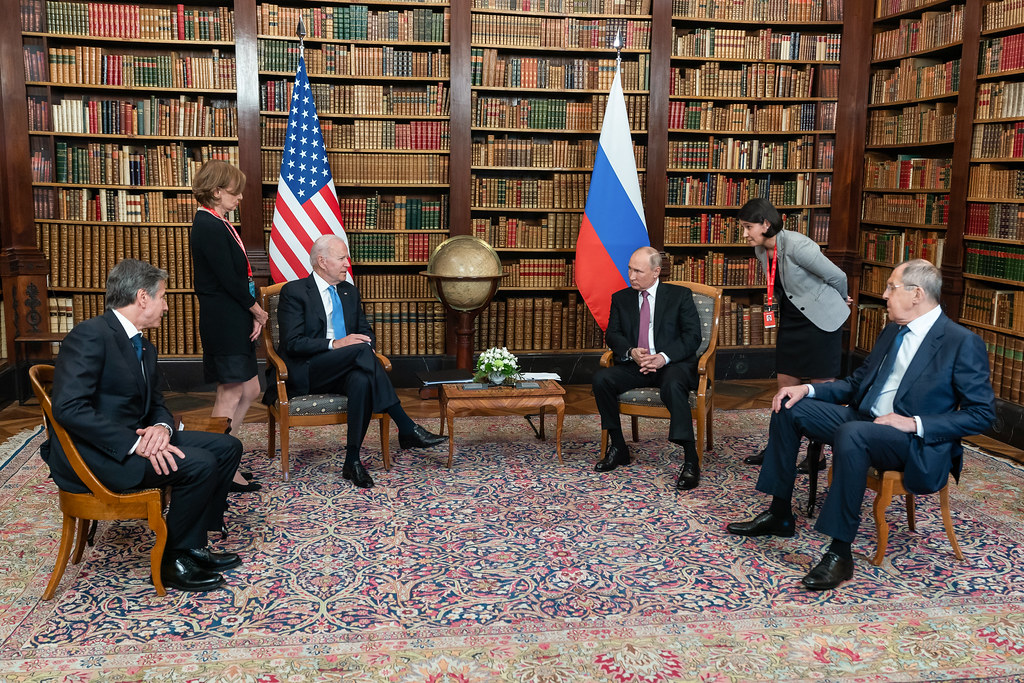
Biden and Putin meeting at the at the Villa La Grange in Geneva, June 16, 2021, flanked by Blinken on left, Lavrov on right. (White House/ Adam Schultz)
When Biden took office in 2021, his advisers assured him that he could play on Russia’s fear (sic) of China and drive a wedge between them. This became embarrassingly clear when Biden indicated what he had told Putin during their Geneva summit on June 16, 2021.
That meeting gave Putin confirmation that Biden and his advisers were stuck in a woefully outdated appraisal of Russia-China relations.
Here is the bizarre way Biden described his approach to Putin on China:
“Without quoting him [Putin] — which I don’t think is appropriate — let me ask a rhetorical question: You got a multi-thousand-mile border with China. China is seeking to be the most powerful economy in the world and the largest and the most powerful military in the world.”
The ‘Squeeze’
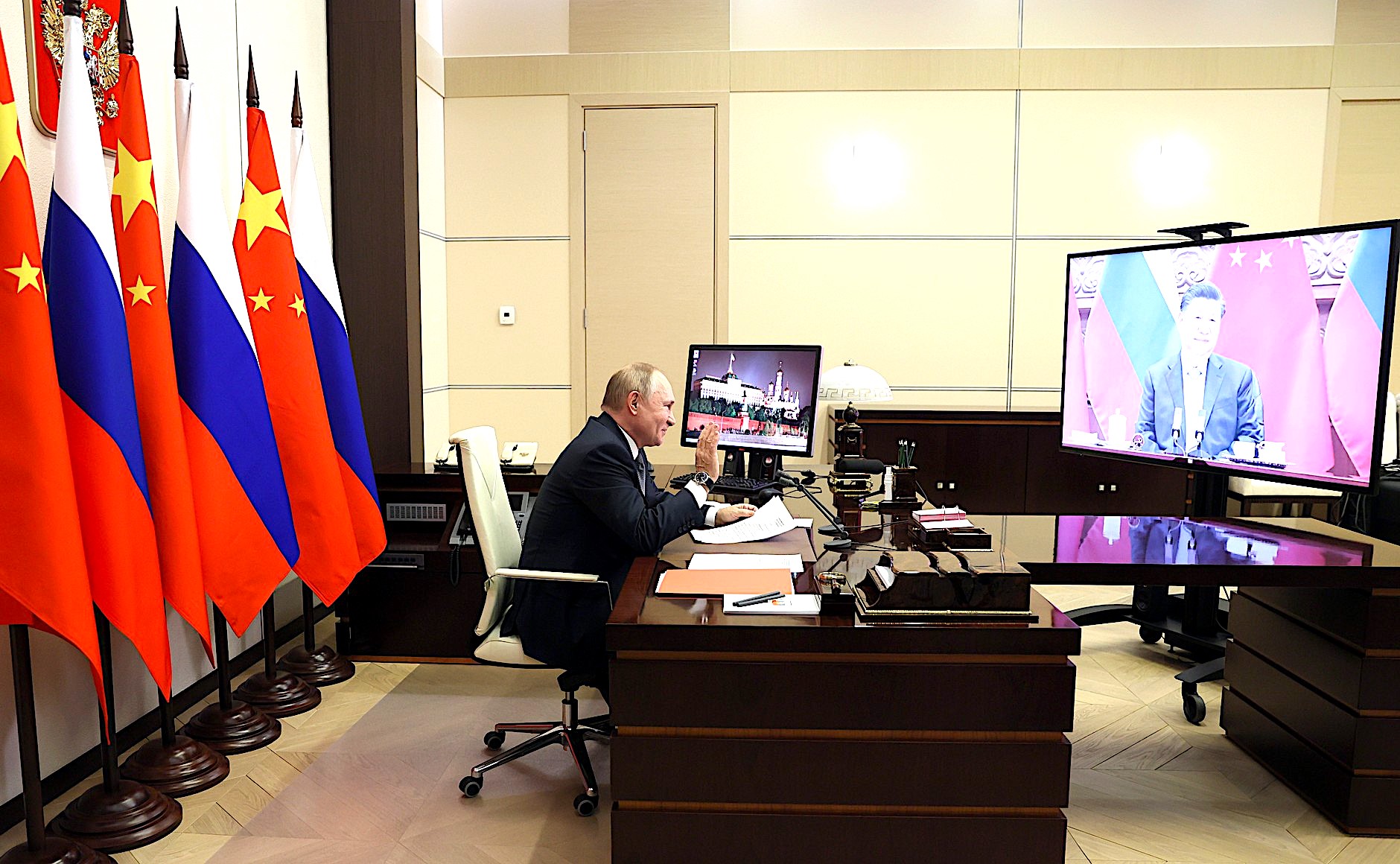
Putin in video conference with Xi on Dec. 15, 2021. (Kremlin)
At the airport after the summit, Biden’s aides did their best to whisk him onto the plane, but failed to stop him from sharing more wisdom on China:
“Russia is in a very, very difficult spot right now. They are being squeezed by China.”
After these remarks Putin and Xi spent the rest of 2021 trying to disabuse Biden of the “China squeeze” on Russia: it was not a squeeze, but a fraternal embrace. This mutual effort culminated in a Xi-Putin virtual summit on Dec. 15 of that year.
The video of the first minute of their conversation was picked up by The New York Times, as well as others. Still, most commentators seemed to miss its significance:
Putin:
“Dear friend, dear President Xi Jinping.
Next February I expect we can finally meet in person in Beijing as we agreed. We will hold talks and then participate in the opening ceremony of the Winter Olympic Games. I am grateful for your invitation to attend this landmark event.”
Xi:
“Dear President Putin, my old friend. It’s my pleasure to meet you at the end of this year by video, the second time this year, our 37th meeting since 2013. You have hailed … China-Russia relations as a model in international collaboration in the 21st Century, strongly supporting China’s position on safeguarding its core interests, and firmly opposed to attempts to drive a wedge between our two countries. I highly appreciate it.”
Is Biden still unaware of this? Have his advisers told him that Russia and China have never been closer, with what amounts to a virtual military alliance?
The Election
Putin has said he is aware that Washington’s policy toward Russia “is primarily impacted by domestic political processes.” Russia and China certainly assess that Biden’s policy on Ukraine will be influenced by the political imperative to be seen as facing Russia down.
If NATO country hotheads send “trainers” to Ukraine, the prospect of a military dust-up is ever present. What Biden needs to know is that, if it comes to open hostilities between Russia and the West, he is likely to face more than just saber rattling in the South China Sea — and the specter of a two-front war.
The Chinese know they are next in line for the ministrations of NATO/East. Indeed, it is no secret that the Pentagon sees China as enemy No. 1. According to the DOD’s National Defense Strategy, “defense priorities are first, defending the homeland, paced to the growing multi-domain threat posed by the People’s Republic of China.”
The Pentagon will be the last to sing a requiem for the dearly departed unipolar world. May sanity prevail.
Ray McGovern’s first portfolio as a C.I.A. analyst was Sino-Soviet relations. In 1963, their total trade was $220 MILLION; in 2023, $227 BILLION. Do the math.
Views expressed in this article may or may not reflect those of Consortium News.
Former Ukrainian MP Andrey Derkach, who’s reviled by the Biden Administration for sharing dirt about Hunter Biden’s Burisma corruption scandal with Trump’s former lawyer Rudy Giuliani ahead of the 2020 elections, just gave a very important interview to Belarus’ BelTA where be blew the whistle even louder. According to him, the $6 million bribe that was paid in cash to shut down the investigation into the First Son’s scandal eventually found its way to the Ukrainian Armed Forces and its military-intelligence agency.
Derkach claimed to have proof of the secret court order that divided these funds between those two, with the first investing its portion into building up their country’s drone army while the second financed terrorist attacks like the assassination of Darya Dugina, which he specifically mentioned in the interview. These allegations expand upon the ones that he shared earlier this year regarding the real-world impact of Hunter’s corruption scandal, which were analyzed here at the time.
On the subject of Ukrainian assassinations and terrorism, Derkach said that the CIA and FBI actually condone these actions despite their public claims to the contrary, but he warned that this immoral policy will inevitably ricochet into the US itself. In particular, he cited FBI chief Christopher Wray’s testimony to Congress last April where he said that law enforcement officials fear that Crocus-like attacks are presently being plotted against their country.
About that, it shouldn’t be forgotten that Ukraine’s military-intelligence service GUR is the chiefsuspect of Russia’s investigation into what became one of the worst terrorist attacks in its history, thus meaning that the portion of Burisma’s $6 million bribe that made its way into their hands likely financed part of it. In other words, the third-order effect of Hunter’s corruption scandal is that it was partially responsible for the brutal murder of innocent civilians halfway across the world some years later.
That’s already scandalous enough, but Derkach shared even more details about the other indirect consequences of this cover-up into the First Son’s illicit activities, adding that some GUR-linked figures have been connected to the Western narrative about September 2022’s Nord Stream terrorist attack. He regards that story as a distraction from the US’ complicity, the view of which was elaborated upon here at the time that it entered the discourse, but lauded the CIA for the lengths it went to cover up its role.
In his view, the CIA might very well have sent a highly trained Ukrainian diving team to the Baltic Sea exactly as the Western media reported, though only to plant fake bombs. In his words, “when a cover story is made, it is done quite well. We shouldn’t belittle the experience of the CIA or the experience of MI6 in preparing cover operations. They have quite a lot of experience in using proxies, in using cover stories to form a certain position in order to dodge responsibility. This is actually what happened.”
Looking forward, Derkach expects Ukraine to attempt more terrorist attacks against Russia, which the US public is being preconditioned to accept via the CIA’s various leaks to the media. While many might lay the blame for all this on Zelensky’s lap, Derkach believes that it’s actually his Chief of Staff Andrey Yermak who’s running the show, albeit as a Western puppet. Nevertheless, he’s also convinced that the West is indeed preparing to formally replace Zelensky, but doesn’t yet know when or with whom.
Altogether, the importance of Derkach’s interview is that he’s a former veteran Ukrainian politician who still retains a lot of sources inside the regime, having served in the Rada for a whopping 22 years from 1998-2020. While his homeland charged him with treason after he fled to Russia in early 2022, which followed the US charging him with election meddling on behalf of that country in September 2020, the argument can be made that these are politically driven attempts to intimidate a top whistleblower.
The dirt that Derkach shared about Hunter’s Burisma corruption scandal, not to mention its newly revealed third-order effects that led to the brutal killing of civilians halfway across the world after part of his company’s bribe made its way into GUR’s hands, made him an enemy of the US Government. They and their Ukrainian proxies will therefore always try to discredit him with sensational allegations, but everyone would do well to listen to what he says and then make up their own minds about it.
I was out of the country for a bit, attending the annual conference of the British Association of Slavic and East European Studies (BASEES), after which I was mysteriously locked out of WordPress for a while. However, I am now back in, and thought it would be good to post here my BASEES conference paper, as it is unlikely to be published anywhere else. So here it is. – Paul Robinson
Perceptions of Alexander III in Modern Russia
Presentation to BASEES Conference, April 2024
It is probably fair to say that Emperor Alexander III of Russia does not have a very good reputation in the English speaking world. In Russia, though, the emperor has been rehabilitated in the post-Soviet era. In November 2017, for instance, Russian president Vladimir Putin unveiled a statue of Alexander III in Crimea, commenting that “The reign of Alexander III was called the age of national revival, a true uplift of Russian art, painting, literature, music, education and science, the time of returning to our roots and historical heritage.”
= Monument to the Peacemaker Tsar Alexander III =
In December 2023, Putin then attended the launch of the Russian navy’s latest ballistic missile submarine, the Emperor Alexander III. Alexander is in official favour.
For this paper, I have decided to look at how historians have represented Alexander in the past 20 or so years. Alexander hasn’t received much attention from English-speaking historians – there is in fact not a single English language biography of Alexander other than one published in the year of his death in 1894 and a privately published one that isn’t available in any library anywhere. In Russia, by contrast, a huge number of works related to Alexander have been produced in recent years. The earliest one I have examined for the purpose of this talk is a biography by Alexander Bokhanov. This was originally published in 1998, but the copy I have is a sixth edition, published in 2019, indicating that there is still a lot of interest in this book.
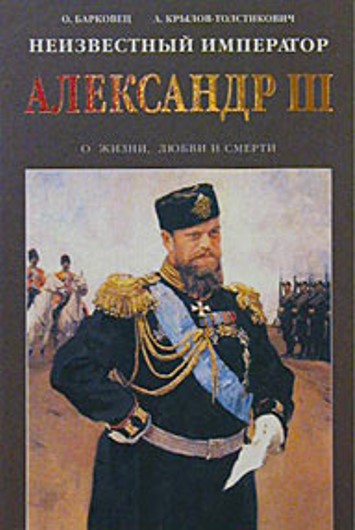
Next are a couple of biographies by Olga Barkovets and Alexander Krylov-Tolstikovich, the first of which was produced in 2001 and the second in 2007, the latter being a slightly bigger version of the former.
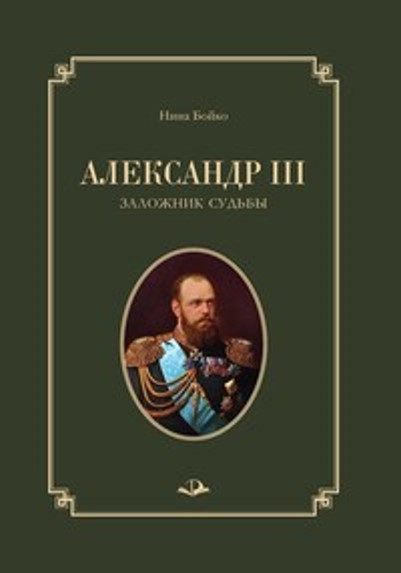
Then there are further biographies by Alexander Miasnikov and I. E. Dronov from 2016, S. V. Ilyin from 2019, Nina Boiko from 2022, and V. A. Grechukhin from 2023. That’s eight biographies in about 25 years, and five in just the last 10 years. On top of that, there are a bunch of other books, for instance Tocheny and Tochenaia’s Russian Autocrats: Alexander III, Lenin, Stalin, and there are also a number of source books which publish documents about Alexander dating from his life. These include the 900 page long collection Alexander III: Pro et Contra and several volumes of correspondence between Alexander and Prince V. P. Meshchersky.
So what do these books tell us?
The first thing to note that is that for the most part, the authors of these books do not engage much with other scholarly literature, and references to English language are notable for their almost total absence. In so far as Russian historians do address previous literature it is largely to critique it for having either a communist or a liberal bias and for being too negative. The person who has the most to say on this topic is Bokhanov, who writes that ‘Russian historiography has canonized biased assessments, in which for almost a hundred years the Westernist worldview has been dominant. In accordance with this worldview, Russia is a realm of darkness, ignorance, barbarism, and “Asiaticism,” and if there was anything bright and advanced in Russia, it was only due to the influence of the “progressive West.”’ Bokhanov complains that “Liberal dogmatic terror is merciless and uncompromising. Anyone who looks at the Russian World, at Russia without contempt, who respects the history of his Native Home, the deeds of his ancestors, and who does not consider Russia’s past to be the history of a “dark kingdom,” is immediately qualified as a “monarchist” and a “reactionary.” The “Russian Europeans” forgave (and still forgive) Peter the Great everything: unthinkable debauchery, the murder of his own son, unbelievable cruelty, insane military adventures, robbery and extermination of his own people … They always praised him for “cutting a window to Europe.” Alexander III, however, was not forgiven or forgotten precisely because he was anti-Western. For his liberal slanderers, this “original sin” was enough. … The Russian Monarch was portrayed as narrow-minded, if not just plain stupid.”
While most of Alexander’s other biographers don’t say this quite so openly, they pretty much share this attitude and adopt an overwhelmingly positive attitude toward him, both on a personal and a political level. It’s worth noting, incidentally, that the personal tends to dominate over the political in these biographies. Most spend at least half their time discussing Alexander’s life prior to becoming emperor, and even when describing his time as ruler tend not to devote a lot of attention to his role in what one might call policy issues. As a result, in most cases one learns a lot about Alexander, his upbringing, habits, and family, but not always very much about his impact on major political decisions. And generally, they paint quite a positive picture of Alexander as a person, showing him as a hard working, dedicated, modest family man, who eschewed the extravagance and scandal of other Romanovs. Thus Barkovets and Krylov-Tolstikovich note that “Alexander III invariably strove to set a personal example of behavior that he considered right for each of his subjects. His ethical norms of behavior, his entire worldview proceeded from a deep religiosity. It is unlikely that any of Alexander’s twelve predecessors on the Russian imperial throne was such a pious and sincere believer. His faith – pure and free of dogmatism – explained both the God-chosen nature of the Russian autocracy and the special Russian path that it should follow.”
This last point reflects the main point that many of Alexander’s biographies consider his defining and indeed most endearing trait – his Russianness. Alexander is portrayed as Russian through and through, to the extent of being the first Russian emperor to wear a beard. Thus Boiko quotes Ivan Turgenev as saying that Alexander was “Russian and only Russian. Only a tiny drop of Russian blood flowed in his veins, but he merged himself with his people to such an extent that everything about him – his language, his habits, his manners, even his physiognomy was marked with the defining characteristics of his race.”
This Russianness is seen also as extending into Alexander’s policies as Emperor, which are positively assessed in contrast to what are seen as the failures of his father, Alexander II, whose policies are portrayed as a rather ill-judged effort to half-heartedly implant alien Western institutions into Russia. This is said to have contributed to the rise in terrorism that eventually led to the assassination of Alexander II. By contrast, the firm hand exerted by Alexander III is described as having brought Russian back from brink of collapse. Thus in a preface to Miasnikov’s biography, Bishop Tikhon, writes that Alexander “took over a country that was in a terrible moral, economic and political condition, when Russia was wracked by revolutionary terror. But he handed over to his successor a country that was fully pacified and enjoying its heyday, advancing towards a future that to many seemed cloudless and happy.”
Similarly, Dronov begins his biography with a quote from the émigré conservative writer Ivan Solonevich, saying that “I would give 150 Provisional Governments for one Alexander III. In my opinion, Alexander III was a true progressive, not Kerensky or Miliukov. For it is progress when you have quiet, confidence, flourishing, and growth. And it is reaction when there is hunger, brutality, collapse, and defeat.” Dronov then follows this up with a quote from the revolutionary turned conservative Lev Tikhomirov, saying that “Under Alexander II, Russia was such a humiliated country that nobody could possibly be proud of being Russian. Under Alexander III, the situation was reversed, and Russia began to take on the form of a great national force.”
Let us therefore now move on to examine the means by which this alleged transformation is said to have taken place.
Alexander’s first achievement is said to have been that he restored order. As Bokhanov writes, “During Alexander III’s reign, the social political situation in Russia stabilized.” His various biographers admit that this was achieved by repressive means, including the actions of the secret service, censorship, and the elimination of university autonomy. But they consider this a necessary evil, and in any case not actually that repressive. Several of the biographers mention that only 17 people were executed during Alexander’s reign, all of whom were guilty of either murdering or attempting to murder the emperor or his father. They also mention that Alexander personally commuted several death sentences, and that by comparison with later communist rule, the repression of his reign was really very mild.
In addition, they all are at pains to point out that even with increased censorship, Alexander’s reign saw a significant growth in the number of publications in Russia, with even liberal publications such as Vestnik Evropy being allowed to appear. Alexander was, they point out, a strong supporter of the arts, and even leant his support to those who might in some respects have been deemed subversive. For instance, Alexander intervened to prevent Tolstoy’s novel The Kreutzer Sonata from being banned, and supported the Peredvizhniki artists. Alexander’s reign, we are told, saw a flourishing of Russian culture, associated with names such as Tolstoy, Chekhov, and Tchaikovsky. Several authors mention the large-scale expansion of education under Alexander III, with a huge increase in the number of schools, and the creation of Tomsk university and the higher women’s courses. Thus Barkovets and Krylov-Tolstikovich conclude that “It was in the reign of Alexander III that Russia first became one of the recognized centres of world culture.”
Another important step in restoring order was what are often called the “counter-reforms.” Most of Alexander’s biographers don’t devote a lot of attention to these, but those who do are supportive of his policies. Ilyin, for instance, comments that many of the institutions set up under Alexander II didn’t work very well. The Justice of the Peace (JP) courts, for instance, were very slow moving, and cases could take years to be resolved. In addition, he notes, “In disputes between peasants and landlords, the Justices of the Peace more often than not sided with the latter.” Ilyin cites the poet Fet, who served for a decade as a JP, saying that “From my bitter experience I long ago came to the conclusion about the complete unsuitability of these institutions in village life.” By contrast, Ilyin remarks, the land captains established under Alexander III provided immediate justice and were much closer to and more accessible to the peasantry.
Similarly, Boiko remarks that “the land captains helped bring order to peasant life … And above all, combatted the unconscious spirit of anarchy among the peasants.” And Dronov claims that “the establishment of the land captains decided the problem of establishing a strong, effective and operative power in the localities, while the peasantry accepted very positively the appearance of a personal, concrete, representative of the authorities, allowing for rapid justice in accordance with conscience not the law, instead of the personless mechanism of formal judicial procedures.”
Dronov notes that the counter reforms met with strong resistance from liberals within the bureaucracy, and praises Alexander for standing up to what he considers a fifth column. According to Dronov, Alexander “understood that the “external” West – the West that exists beyond Russia’s borders – is not Russia’s most dangerous enemy; that there exists also a far more dangerous “internal West” that consists of forces within Russia who identify ideologically with the West, Western values, and the Western way of life.”
Of all Alexander’s biographers, Dronov is by far the most virulent in his anti-Westernism and anti-liberalism. He comments that “Even when very young, Alexander hated liberals, not because he was opposed to freedom, but because, by a strange law of nature, it was precisely among liberals that one found the largest number of people who hated Russia and kowtowed to the West.”
Dronov’s nationalism comes out very strongly in his discussion of Alexander’s nationality policies, writing that the emperor “understood the decisive significance of the national question, and what a powerful weapon regional separatism was for destroying Russia. He saw how hostile forces were igniting national divisions within Russia.” Dronov is not alone, in supporting Alexander’s nationality policies, as these gain the almost universal endorsement his biographers. Again and again they tell us that the Russian state did not discriminate against any national group in the empire. Indeed, many national minorities enjoyed autonomy and privileges that Russians did not. And this, they say, was the real problem, for it was precisely Russians who suffered discrimination.
As for Alexander, he was allegedly free of ethnic and religious prejudice. But he could not tolerate the discrimination faced by Russians, in particular at the hand of Baltic German nobles. Thus Bokhanov writes that “While we must recognize Alexander’s nationalistic inclinations, we must also note that they never reached the level of chauvinism. No repressions of other peoples, no persecution of their culture or beliefs, was ever undertaken at the initiative of the monarch, solely because they were not Russian. However, the Tsar could not and would not tolerate discrimination against Russians.” Likewise Barkovets and Krylov-Tolstikovich remark that “Carrying out the policy of Russification, the government in no way pursued chauvinistic goals. Its task consisted solely of bringing archaic local administration in line with general state norms, and defending the rights and interests of the Russian and Orthodox population against the self-rule of the German landlord-clerical authorities.”
Where things become a little trickier for the biographers is when they confront the issue anti-Jewish measures taken by Alexander’s government. Some of them respond by mentioning this only in passing and glossing over entirely Alexander’s role in the matter. Ilyin goes a bit further and admits that Alexander said some things that were regrettable, but he concludes that they didn’t amount to much, making the rather odd argument that “No few of Alexander III’s resolutions [on the issue of Jews] have been preserved and they have greatly harmed his reputation … Nonetheless, it would be a mistake to call him an anti-Semite as is sometime done. Contemporary reference books define anti-Semitism as a form of racism. But the emperor’s antipathy to Jews had nothing to do with race, but derived from his naïve, childish belief in the letter of holy tradition.” As I say, it’s a rather odd argument.
Even more disturbing is Dronov’s take on the matter. Dronov’s book is by far the most detailed of Alexander’s biographies, but also by far the most tendentious. It provides a huge amount of detail proving beyond reasonable doubt that Alexander was indeed anti-Semitic. In this sense, it is a much more useful book than other biographies. But Dronov doesn’t seem to find anything wrong with Alexander’s anti-Semitism. Indeed, he makes what one can only call anti-Semitic remarks of his own. For instance, he writes that “The dominant influence of foreigners (that is, Jews and Poles) in the alliance of the liberal-constitutionalists and revolutionaries was an entirely natural phenomenon. Liberal bourgeois ideology was a product of Talmudic ethics and Catholic religious doctrine, contradicting Orthodoxy and rejecting Christ in favour of the law of Moses. … Jews and Poles were the largest element in the Russian empire who were nationally and religiously incompatible with Russian Orthodox tradition.” Moving onto economic policy, Dronov also comments that “Alexander III could not but understand that freeing Russia from the yoke of German bankers and acquiring new, more favourable, loans from France, was only a relative success. The financial market in Paris, just as much as in Berlin, was dominated by Jews, and Russia ran the risk of jumping out of the frying pan into the fire.”
For Dronov, Alexander’s economic policy were a huge success, greatly boosting not only industrial production but also the standard of living of the vast bulk of the population. The roots of this success, according to Dronov, lay precisely in Alexander’s willingness to adopt protectionist policies and to pursue a more autarkic model of development, free of the control of foreign financiers. He writes: ‘In the 13 years of his reign, production rose more than twice … with no inflation. … He built the Trans-Siberian Railway and didn’t order a single nail from abroad. All the rails, all the wagons, and all the engines were built only in Russian factories. He built a new fleet, and all the ships were constructed in Russian wharfs. … Under Alexander III, Russia became truly Russian and for the Russians.”
Other authors are not quite so nationalistic but concur with the positive assessment of Alexander’s economic policy. All of them note that Alexander inherited a government deeply in debt with a large budget deficit, but that by the end of his reign the government was running a budget surplus. All of them similarly note the significant rise in industrial production under Alexander, a substantial expansion of Russia’s railways, the establishment of the Peasant Bank, and the passing of factory legislation designed to protect workers from excessive exploitation. Barkovets and Krylov-Tolstikovich, for instance, write that “Alexander III inherited a desolate economy. The country was in a deep economic crisis. Its finances were in a deplorable state. … The financial and economic reforms undertaken by Alexander III opened up new, previously hidden, sources of wealth, and increased the population’s incomes.”
The final aspect of Alexander’s reign that receives a lot of coverage is foreign policy. All his biographers praise him for earning the title ‘Tsar peacemaker’ by not fighting a single war. In the late 1870s, Russia had barely managed to defeat Turkey in the war of 1877-78, and under Western pressure had then had to surrender many of its gains. After this humiliation, Alexander III is described as restoring Russia’s international prestige. Though some foreign policy failures are noted, particularly relating to Bulgaria, Alexander is considered to have been a highly successful foreign policy leader. Ilyin, for instance, concludes that “Alexander III did not make any serious mistakes in the diplomatic field. And while there were certain individual errors and failures, even such a master of diplomatic intrigue as Bismarck had those too.”
While noting that Alexander brought peace, his biographers are all point out that he did so not by surrendering Russia’s interests to the West, but rather by standing up for Russia’s interests from a position of strength, investing heavily in the Russian army and fleet. Several mention the famous statement that may or may not have been uttered by Alexander, that “Russia has only two allies, its army and its fleet. At the first opportunity, all the others will take up arms against us.” Generally, people only quote the first half of this statement, putting the stress on the need for a strong military, but interestingly Alexander’s biographers always provide the full quote and put the emphasis more on the second half, i.e. on the charge that Russia’s allies will always betray it, and thus that Western countries are not to be trusted. Thus Miasnikov states that “The bitter experience of the nineteenth century taught the tsar that every time that Russia participated in the wars of any European coalition that it would come deeply to regret it.” And Bokhanov concludes that, “Alexander III was the first Romanov emperor not to be blinded by a “love of Europe.” The emperor never forgot how the goodwill and generosity of his predecessors had been cynically abused by our so-called “friends” and how our “faithful allies” had cheated us, betrayed us, and often simply made fools of us.”
The books mentioned in this presentation vary greatly in their length, quality, and style. Still, they do all end up telling much the same story. The basic message is that Alexander III inherited a country in political and economic chaos, with low international prestige, and a weak military, but thereafter restored order, boosted the economy, and made Russia great again, putting Russia’s interests ahead of those of other countries and relying on native Russian values and institutions rather than artificially imported Western ones. There is, I think, a strong contemporary political subtext to this narrative. In this sense, the portrayals of Alexander discussed in this paper are very much a product of their time.