Over 160 Ukrainian children allegedly “kidnapped by Russia” have been discovered living in Germany, the country’s Federal Criminal Police (BKA) has confirmed.
The head of Ukrainian national police, Ivan Vygovsky, on Wednesday hailed the discovery, telling national media that he had discussed the issue with Holger Munch, president of the BKA, during a meeting earlier in this week.
Allegations by Kiev that Moscow kidnapped Ukrainian children en masse have been exposed as a lie after some of the purported victims have been found in the EU, according to Russian children’s rights commissioner Maria Lvova-Belova. She is among the officials to have been accused of abducting youngsters from Ukraine amid the conflict between Moscow and Kiev.
When asked for clarification by RT Deutsch, the BKA said its officers had identified the children after they were flagged as “kidnapping” victims by Kiev. Their personal details were checked against German records.
The majority of the youngsters had entered Germany as refugees accompanied by their parents or legal guardians, the police said. In a handful of cases, suspicion of “unlawful transfer” remained, the statement added, without offering further details.
Responding to the revelations, Lvova-Belova said Moscow has “long been drawing the attention of the international community to the fact that Ukraine has created a systemic myth regarding the children, who it claims had been ‘deported’ to Russia.”
Last year, Lvova-Belova was named alongside Russian President Vladimir Putin by the International Criminal Court (ICC) as the key suspects in its investigation into the alleged unlawful deportation and transfer of minors during the Ukraine conflict. Moscow dismissed the claim as politically motivated, arguing that Kiev had lied to the court about what in reality was an evacuation of civilians from areas affected by the hostilities.
In her remarks about the German discoveries, Lvova-Belova said her office had identified multiple cases in which children described by Kiev as abductees were actually residing with their parents at home or in other nations, “never having been separated from their families.”
She expressed hope that the Ukrainian “global disinformation campaign” would eventually stop and that the truth would prevail.
A year into the invasion of Ukraine, an arrest warrant was issued for Vladimir Putin. The crime: Kidnapping!
Prosecutors with the International Criminal Court accused the Russian president, under cover of war, of having stolen “hundreds” of Ukrainian children. Government officials in Ukraine went further and spoke of more than 16,000 (!) stolen children. Still others spoke of hundreds of thousands, and suggested this could meet criteria as a form of “genocide.”
“The charges carry a potential life sentence,” The Wall Street Journalreported, adding helpfully, “the ICC doesn’t impose the death penalty.” (A contributing author of that Wall Street Journal report, Evan Gershkovich, would himself be arrested two weeks later by Russian security services, and charged with espionage.)
TheNew York Timesreported that Ukraine’s children had been treated as “the spoils of war,” and other headlines were more lurid. “Moscow grabs Ukrainian kids and makes them Russians,” reportedAssociated Press (where I used to work). “Russia snatches Ukrainian children,” said The Moscow Times (which I used to edit). “Russian ‘child snatcher’ admits taking 700,000 children,” shrieked Britain’s The Telegraph.
This was all a little confusing. Had “hundreds” been kidnapped? Or 16,000, or 700,000? One was hesitant to ask; even a single stolen child would be a terrible wrong.
Then again, the basic facts of an alleged serious crime ought to matter. Especially if we’re going to talk loosely about throwing the Russian president into a UN-run dungeon, even as we complain that they won’t let us just blindfold and shoot him.
Thank you for reading The 100 Days. This post is public so feel free to share it.
Yet in March 2023 the basic facts were scarce, and they remain so today. The ICC says the details are classified: “The warrants are secret in order to protect victims and witnesses and also to safeguard the investigation.”
More context and information was provided by human rights NGOs and journalists. The American media in particular offered detailed anecdotes of family separations, which well illustrated the horror and chaos of war. And yet, in most of these anecdotal accounts, the Russians ended up reuniting Ukrainian families separated in the war zone. (If, out of a spirit of skeptical contradiction, you want to ask: “Don’t you mean, ‘in the war zone Putin created’?” — fair enough, agreed!)
We’ll return to the specific kidnapping allegations. But this is Part III of a history that focuses on the war’s potential to spin out of control, and scorch lands far beyond poor Ukraine’s. In that regard, March 2023 was an exciting new spin of the revolver cylinder in our ongoing game of world-wide Russian Roulette. An arrest warrant had been issued personally for Vladimir Putin — over a viscerally emotive and disgusting accusation. He’s stealing children.
U.S. President Joe Biden, asked his reaction to the ICC arrest warrant, approved. “Well, I think it’s justified,” he said. “I think it makes a very strong point.”
This was the same Joe Biden who in the first year of the war (see Part I and Part II) had only gingerly offered small arms, ammunition and shoulder-fired missiles, for fear of — his words — “Armageddon.” (Yes, that is the President referencing the Bible’s predicted battle that ends all life on Earth.) Biden back then had famously warned Democrats in Congress that “the idea that we’re gonna send in offensive equipment, and have planes and tanks and trains going in … don’t kid yourself — no matter what y’all say — that’s called World War Three. Okay?”
His White House had frantically shushed its own security officials after they’d anonymously bragged to the media about how we’d helped to assassinate at least 12 Russian generals, and to sink Russia’s Black Sea flagship. When Russia’s undersea Nord Stream 2 gas pipeline had exploded — months after Biden had warned, “If Russia invades” Ukraine, “there will be no longer a Nord Stream 2” because “we will bring an end to it” — his White House had shrugged with nervous “who, me?” innocence. Soon after, the White House had pulled aside The New York Times to underline that we not only disapproved of and had nothing to do with a Ukrainian-planted car bomb in Moscow that had killed a Russian journalist — we also really had no idea what the Ukrainians might do next:
“American officials have been frustrated with Ukraine’s lack of transparency about its military and covert plans, especially on Russian soil,” The New York Timesreported then. “While the Pentagon and spy agencies have shared sensitive battlefield intelligence with the Ukrainians, helping them zero in on Russian command posts, supply lines and other key targets, the Ukrainians have not always told American officials what they plan to do. … [S]ome American officials believe it is crucial to curb what they see as dangerous adventurism, particularly political assassinations.”
True, Washington was also filled with talk of how we were supporting the coming glorious Ukrainian counteroffensive. (Delusional talk? Cynical talk?) But Biden was still refusing to share F-16 fighter jets or long-range missiles, and had recently told a group of his political fundraiser friends, “We’re trying to figure out: What is Putin’s off-ramp?”
“Where does [Putin] find a way out? Where does he find himself in a position that he does not — not only lose face, but lose significant power within Russia?”
Great question! In reporting it, The New York Times also paraphrased an anonymous European diplomat who said that “when the history of this era is written, many will be shocked” at how frantically officials were working behind the scenes to prevent a nuclear war. The Times said that national security elites were keeping quiet about how much danger of that we were all in “for fear of inducing public panic or market sell-offs.” (!).
Biden’s Armageddon / off-ramp remarks were spun at the time as another Uncle Joe campfire story, just the President making things up again on the fly.
Last month, however, The New York Times — citing 18 months of interviews with top U.S. insiders “who recounted the depth of their fear (my emphasis)” in the fall of 2022 — revealed that in fact the President was sharing our exactintelligence assessments: If Ukraine ever did somehow “start winning,” then Russia really would use battlefield nuclear weapons. Or as Biden told his richest friends (but not us): “It’s part of Russian doctrine … [I]f the Motherland is threatened, they’ll use whatever force they need, including nuclear weapons.”
In that light, how did the looming Ukrainian counteroffensive even make sense? The Ukrainians would be vaporized by battlefield nukes if they started to succeed — the Russians would risk a world war, even a nuclear war, before they’d accept being pushed out of Donetsk or Crimea. In other words, thousands of young Ukrainians would accomplish nothing while dying — and the only question was whether their useless deaths would be brought about by nuclear weapons, or conventional.
Red is the Russian-held territory Ukraine was gearing up in 2023 to try to win back.
We were nevertheless hellbent on proceeding with this counteroffensive — we had rejected direct peace overtures to Washington from the Russians, we had scuttled successful bilateral Russian-Ukrainian peace talks, and we were instead egging the Ukrainians on, demanding that they hurry up and attack already — apparently because we were confident they could notdefinitively succeed; and thus were reasonably confident they would not cause a wider nuclear war. (See Part II). So … what was the point? Our exact goals were murky: Keep the fight going, so as not to admit defeat before the U.S. presidential election? Fatten our defense contractors? “Weaken Russia?” Whatever one’s goal, it would be sought at the price of tens of thousands of young Ukrainian and Russian lives.
For that matter, where’s the logic in talking about how Putin needs an off-ramp, a way to save face — even as we cheerfully applaud a plan to arrest him for child theft?
Let the evil Slav die in chains
The American political class gleefully celebrated the ICC arrest warrant. It was a chance to fantasize about Putin being clapped into handcuffs — for example, if he were to visit Europe. A CNNcommentary crowed that “Putin’s world just got a lot smaller,” and recalled with satisfaction how former Yugoslav President Slobodan Milošević had spent years in a jail cell — in fact, had died in that cell, in 2006, reportedly from heart failure — while his long-running UN war crimes trial crept slowly onward.
The example of Milošević’s arrest, imprisonment and trial is crucial context. Once you consider that startling history, it becomes clear what issuing a similar arrest order for Putin meant: It was a giant stride forward towards a wrecked world. In fact, the ICC arrest warrant was the greatest escalation of the Ukraine war to date — certainly greater than, say, providing 31 Abrams tanks to a war zone flooded with thousands of tanks (see Part II).
Milošević was the only other sitting world leader in history before Putin to face a UN arrest warrant. He was also a fellow Slav who had defied the West, been targeted by NATO, and ultimately been forcibly dragged, by NATO, out of his capital city to die abroad years later in a UN detention center.
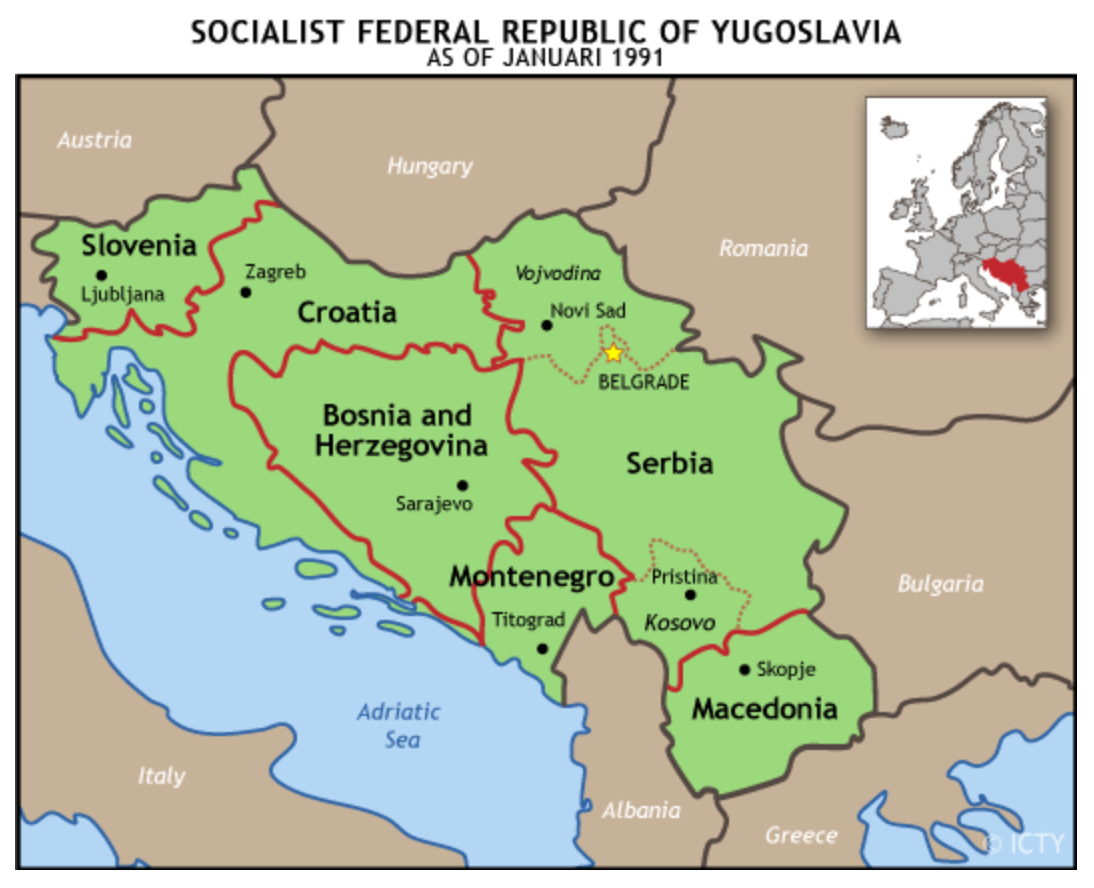
When Yugoslavia disintegrated in the early 1990s, its separate republics — Slovenia, Croatia, Bosnia-Herzegovina, Montenegro, Serbia and Macedonia — became independent states, and then started fighting over borders. Serbia, the largest, formed a “new Yugoslavia” with Montenegro, and often the wars involved Milošević’s Serbia claiming to be defending “Yugoslavia.” A decade of waxing and waning violence killed more than 100,000 people, in events oft-lamented at the time as “the worst war in Europe since World War II.” (Today, the far-briefer Ukraine war has already claimed that sad title. So far, more than 200,000 people in Ukraine — soldiers and civilians — have been killed.)
The last major Yugoslav war, in 1998, involved an independence bid by the Serbian region of Kosovo — an ethnically Albanian and predominantly Muslim region inside an Orthodox Christian, Slavic country. It was put down harshly by Milošević. His Yugoslav (Serbian) forces drove hundreds of thousands of civilians from the province. NATO demanded he desist, and in 1999 launched a 78-day aerial bombardment of Serbia. Milošević backed down, Kosovo was put under UN administration, and displaced Albanian civilians returned home — at which point 100,000 ethnic Serbian civilians in Kosovo, fearing reprisals, then fled their homes.
The UN authorized a peacekeeping force, and it’s worth remembering how Russian soldiers (on orders from a younger Vladimir Putin) worked side-by-side in Kosovo with NATO soldiers:
From a NATO press release on the history of U.S.-Russian cooperation in Kosovo.
Even so, ordinary Russians had been furious about that 78-day NATO bombardment. The U.S. bombs destroyed military targets — but also killed hundreds of Serbian civilians, and also destroyed power plants, water treatment facilities, factories, bridges and the state-run Serbian radio and television station. (We also bombed the Chinese embassy, which was officially an accident). I lived in Moscow then, as editor of The Moscow Times, and the rage of the street protesters outside the U.S. Embassy was eye-opening. Not that the Russians enjoyed much moral high ground: For years, they had been busily pulverizing their own Kosovo-like enclave of independence-minded Muslims: Chechnya. Perhaps 160,000 people were eventually killed in the Chechen wars. Today, Kosovo is an independent nation (even Serbia recognizes that); but Chechnya remains a Russian province, and the legendary Chechen fighting spirit has been harnessed by the Kremlin and directed against Ukraine.
Another map, to help keep us oriented.
Even if peace dawns tomorrow, Putin’s jail cell still awaits him
The Kosovo war marked a downward turn in U.S.-Russian relations, which had been mostly warm until then. Overnight, the Russians were also far more suspicious of NATO; we had always assured them it was purely defensive in nature, but now here it was, unmasked, raining war and death down from the skies upon Serbia — a nation that had not attacked any NATO member.
The Serbian television station bombing in particular had killed 16 civilians in what Amnesty International called a war crime; NATO replied that journalists were fair game if they supported the wrong side. Needless to say, no one at the UN war crimes bureaucracy ever spoke up with an opinion on that. (Why bother? The United States does not recognize their jurisdiction over our government or citizens.) But the UN tribunal did hand down the Milošević indictment. He and four lieutenants were accused of the murder of 340, and deportation of 740,000, Kosovo Albanians. The case relied heavily on “highly classified” U.S. intelligence files that CNN noted had been “crucial in bringing about the indictments.”
Two years later, in 2001, Milošević had lost re-election and was out of office. Now he was vulnerable. The United States and Great Britain renewed calls to have him extradited. The Serbs balked, but Washington set a deadline. We had no particular jurisdiction — but this was our ongoing crusade, started under Bill Clinton and continued under George W. Bush, and we declared that until citizen Milošević was delivered up to The Hague, we would delay all manner of international aide for war-mangled Yugoslavia. With nearly $1 billion at stake, competing political factions in Yugoslavia (Serbia) quarreled viciously, and soon Milošević was arrested by his own people. They did not charge him; they said he was just going to be brought before a Belgrade judge “for questioning,” about “abuse of power” and “financial corruption.”
But would he be extradited to the West? No, said Vojislav Koštunica, the man who’d just defeated Milošević to take over the Yugoslav presidency. Koštunica strongly opposed his foe’s extradition. The Supreme Court of Yugoslavia also asserted this fell within its purview, and stated it would take two weeks to consider. Russia also voiced concern. Like America, Russia had no particular jurisdiction, but Russians and Serbs have a longstanding political and cultural fellow-feeling. Nearly every major Russian political figure spoke out against the West’s pressure on Yugoslavia (Serbia) to turn over its ex-president.
In the end, no one had any say in it. The Russian government and the Yugoslav president roared in outrage as Milošević was abruptly whisked out of a Belgrade prison (by whom?), flown by helicopter to a U.S.-run airbase in Bosnia, and put on a NATO plane to The Hague. We might have heard a lot more about this, but two months later the September 11, 2001 terror attacks on New York City and Washington, D.C. overshadowed everything else. (Putin, famously, was the first world leader to call President Bush with condolences. Over the objection of his Russian security officials, Putin also offered support to the war in Afghanistan, including access to air bases in Central Asia).
Milošević would sit in a UN detention center for nearly five more years as his trial crept along. He was a thuggish, murderous opportunist — but it’s incredible to think he was imprisoned for so many years just based on charges — charges based in large part on information from the U.S. intelligence services! — without ever being convicted of anything. When Milošević was found dead in his prison cot in 2006, it was noted his recent requests for medical care had been refused; his brother and wife were both in exile in a sympathetic Moscow; and the UN court had yet to rule on his request to subpoena former President Clinton as a hostile witness.
That’s a lot of back story. Many of us have forgotten it, or never knew it. But I can promise you this: The Russians remember it. All of it.
It’s been barely a year since we declared that we were preparing a cozy jail cell in the Netherlands for the Russian president. Here’s a photo essay from Radio Free Europe/Radio Liberty of The Hague detention center accommodations that await Putin. There’s no internet access allowed, but the photos show there’s a foosball table, so that’s nice.
Putin might even get Milošević’s old cell; heck, they could even force him to sleep in the same cot in which Milošević had died.
Again: The expectation — the legal precedent — is that even if a peace deal were struck tomorrow in Ukraine, Putin would still be expected to go sit in jail at The Hague, to await his trial on kidnapping. Did we even understand the enormity of what we’d done?
Next time: In Part IV of “The Thrill of Russian Roulette,” terrorist attacks bring the war home to Russia, the violence escalates, we unpack the kidnapping case further — all while our American leaders keep confusing Russia’s crimes against humanity with their own.
Putin’s ‘May decree’ sets ambitious development targets
Vladimir Putin has followed each of his inaugurations as Russian president since 2012 by issuing a new “May decree.” And this week – which saw him embark on his fifth presidential term – was no exception. After the formal ceremony in the Kremlin on Tuesday, Putin signed a decree that sets out a series of targets for Russia’s development. They extend not just for the six years of his current term in office, but through 2036.
In official circles, these decrees enjoy a hallowed status very similar to the five-year plans that were promulgated with great fanfare by the Soviet authorities. When the Soviet Union collapsed in 1991, this practice was quietly forgotten.
Putin’s most recent “May decree” reflects a general move towards state capitalism, interventionist government and economic isolationism. One of the main measurable economic targets it sets is that Russia should break into the top four nations in terms of purchasing power parity (PPP). According to the World Bank, in 2022, Russia was in fifth place, just ahead of Germany. IMF calculations, however, put Russia in sixth. To get to fourth, Russia would need to overtake Japan within six years. This may be achievable given Japan’s economic stagnation (in the last decade its economy grew by an average of just 0.8% each year). Russia’s current economic growth is driven by oil windfalls and high levels of state spending. It seems the Kremlin expects more of the same in the coming six years.
The decree also promised increased labor productivity, and a fall in structural unemployment. Apparently this will happen thanks to the development of innovative technology. However, this process will be hampered by Western sanctions. If it falls short, Russia will have to choose between low unemployment, and high productivity.
Another goal is to reduce the Gini coefficient – which measures income inequality – to 0.37 (a score of 0 is considered to mean a perfectly equal society). The Gini coefficient in Russia last year was 0.403 (up from a historic low of 0.395 in 2022). Inequality in Russia traditionally grows along with an expanding economy: the rich get richer faster than the poor see their incomes rise. But the nature of the current cycle of economic growth may mean a different outcome: spending on the war has caused lower income groups to gain wealth faster.
The decree also envisages the Russian stock market to grow to two-thirds of GDP (from its current level of one-third). That means average annual growth of 12%. This is achievable if the Central Bank is able to reduce interest rates, and avoid economic shocks. In 2023 the stock market grew 43% after à slump of 2022, but is still well below the pre-invasion level.
The decree is also designed to help achieve greater economic self-sufficiency. Imports are ordered to fall to 17% of GDP (they are currently worth 19% of GDP). However, there will almost certainly be problems with this. For example, the decree calls for 50% of Russia’s civil aviation fleet to be domestically produced by 2030. This contradicts a 2022 aviation industry development program, which envisaged hitting the 50% mark by 2027 and achieving 1,440 domestically produced planes (almost 82% of the fleet) by 2030. However, by the beginning of this year it was clear the program could not be realized.
The goal for Russia’s average life expectancy has also been adjusted. By 2030, this is now supposed to be 78 years (the current figure for Saudi Arabia). However, that was originally the target for 2024. Current life expectancy in Russia is 73.5 years. Few people remember that, back in 2012, Putin’s first May decree promised a life expectancy of 74 years by 2018.
In all the targets and goals, there is no mention of increased competition, or a more open economy. This implies that the state’s dominant role in the economy is set to continue.
Finally, it seems clear that the 2024 decree is only achievable if the economy grows, and spending levels remain high. Notably, neither the 2012 decree, nor the one issued in 2018, was fully achieved. Several targets that were set back then, such as life expectancy, remained unfulfilled. Others have been officially scrapped.
Indeed, these May decrees could be appropriately characterized with a quote from German social democrat Eduard Bernstein that is often used by Putin (though he falsely attributes it to Leon Trotsky): “The movement is everything, the final goal is nothing.”
Why the world should care
Putin’s “May decrees” are different from Soviet five-year plans because they lack a lot of detail, and have significantly fewer goals. Yet they set even more ambitious targets than the five-year plans. As in the Soviet Union, failures to meet the targets are swept under the carpet rather than being publicly called out and punished.
EU to send frozen Russian funds to Ukraine
EU ambassadors agreed Wednesday to send frozen Russian funds to Ukraine. We’re talking about roughly €3 billion a year that is generated by about €229 billion of Russian Central Bank reserves currently frozen in Europe. €190 billion of this is held at Belgium’s Euroclear depositary. In total, approximately €260 billion in Russian funds are frozen in G7 countries.
Since the invasion of Ukraine, Euroclear has earned about €5 billion in profits from the Russian investments. Earnings from before 2024 will be set aside in case of legal challenges from Russia (they are already on the way). Of the remaining sum, 90% will be spent on weapons and military assistance. The rest will be used for humanitarian aid – a compromise achieved with neutral EU countries: Austria, Hungary, Malta.
The decision puts an end to efforts by the United States, Canada and the United Kingdom to persuade the EU to seize all of Russia’s frozen assets in support of Ukraine. And it comes despite efforts by some nations to ensure the funds remain untouched. Outlet Politico reported last month that China, Saudi Arabia and Indonesia had been actively lobbying EU politicians not to yield to U.S. and UK pressure over the Russian assets.
For the moment, the EU plan is to tax the frozen Russian assets, generating funds to aid Ukraine that will be collected twice a year. However, they could be used in a different way if the G7 summit in June approves NATO General Secretary Jens Stoltenberg’s plan to create a $50 billion fund to aid Ukraine. Either way, the principle will remain the same: profits from Russian investments will go to Ukraine, but the reserves will remain in Russian hands. At least for now.
Why the world should care
While Russia will undoubtedly say that the EU’s seizure of these profits is theft, it will be more interesting to see if they take any concrete steps. It’s hard to imagine that the Kremlin will opt for a dramatic move like nationalizing all foreign assets owned by “unfriendly” countries. Even stripping foreign companies of their Russian profits would only accelerate the departure of Western companies from Russia – something Moscow does not really want. On the other hand, if the response is limited to scooping up profits from funds that foreigners hold in C-type accounts in Russia, it will have no significant consequences.
Figures of the week
Amid payment complications, exports of Chinese goods to Russia fell 15.5% to $8.3 billion in April compared with the same month a year ago. Although China’s overall exports are up, this was the second month in a row that volumes to Russia recorded a fall. However, these statistics may be misleading as some Chinese goods may have been rerouted to Russia via third countries. China’s trade balance with Russia remains negative at -$3.1 billion.
Russia’s oil-and-gas revenues came to 1.23 trillion rubles in April. That’s far more than usual, but the surge was driven by a one-off tax on additional income from extraction worth 450 billion rubles. Under Russia’s budget rules, currency purchases in May will be 110.9 billion rubles, or 5.6 billion rubles per day. That’s less than the 11.8 billion per day the Central Bank will sell on the market. This will help prop up the ruble.
Inflation in Russia from April 23 to May 2 (a 10-day period) was 0.06%, compared to 0.08% between April 16 and April 22 and 0.12% from April 9 to April 15. Weekly inflation is still slowing despite the “extra” holiday days. The main reason is a fall in prices for air travel (which shoot up in April as the May holiday season approaches, then cool during the holiday itself). Annual inflation in Russia on May 2 slowed to 7.64% from 7.82% on April 22.
The share of Russians who would like to leave Russia for permanent residence in another country has reached a record low, according to the results of a national poll conducted by Russia’s Levada Center on March 21-27, 2024.
This center has been measuring Russians’ attitudes toward emigration since 1990, registering peaks in the share of Russians who would like to leave for greener pastures in May 2011, May 2013 and May 2021. In all three instances, the share of Russians who answered “definitely yes” or “likely yes” when asked “Would you like to move abroad for permanent residence?” totaled 22% (see Figure 1). In comparison, Levada’s more recent measurements show that right after Vladimir Putin sent troops to re-invade Ukraine in February 2022, this share was 10% (March 2022), which then increased to 11% in February 2023, before declining again in March 2024 to an all-time record low of 9%. At the same time, in the period since Russia’s re-invasion of Ukraine, the share of those who would not want to move abroad increased from 79% to a record high of 90% (see Figure 1). These measurements by Levada, which is the most renowned of Russia’s independent pollsters in spite of increasing constraints on the activities of such pollsters, aligns with the findings of the state-owned Russian Public Opinion Research Center (VTsIOM), which claims that its March 2024 poll revealed that the share of Russians who want to leave Russia for permanent residency abroad and the share of Russians who don’t reached a record low (5%) and a record high (93%), respectively, since 1991.
To some extent, the recent decreases in the share of those who’d like to leave Russia, as measured by Levada, may be explained by the departure of up to 920,000 people from Russia in 2022-2024, with these emigres no longer participating in Levada’s polls. That said, one should not overestimate the impact of the departure of less than 1% of Russia’s population on Russia’s domestic public opinions. The latter is probably influenced much more heavily by the increasing persecution of individual freedoms of speech coupled with a surge in Russians’ reporting of political dissent to the authorities. Together, this makes an increasing number of people reluctant to speak their minds to a person on the phone identifying themselves as a pollster. The Kremlin’s efforts to boost what some call patriotism and others call propaganda may have also played a significant role in shaping Russians’ opinions on the acceptability of leaving Russia for good, especially after the launch of the invasion that the Kremlin initially called a “special military operation” in Ukraine, but which it now describes as a war against the West with Russia’s very existence at stake.
Many of those who did leave Russia after the invasion were young, with one March 2023 survey by OK Russians putting the average age of those who had left at 32. That younger Russians are more inclined to leave follows from Levada’s March 2024 poll as well, but even among young Russians, those who would like to stay constitute a distinct majority. When asked by Levada in March 2024 whether they would like to move abroad permanently, 12% of Russians of all ages answered in the affirmative. In comparison, 15% of both 18-24-year-olds and 25-39-year-olds responded affirmatively (see Table 1).
Moreover, concern about being called up to participate in Russia’s war in Ukraine was far from the top reason behind Russians’ desires to relocate in March 2024. When asked what makes them think about leaving Russia (multiple answers allowed), mobilization fears ranked 10th with 16%. The top three reasons for wanting to move were: the desire to ensure a decent future for their children abroad (43%); the political situation in Russia (36%); and the economic situation in Russia (also 36%, see Table 2). Of the countries Russians were eager to relocate to, the U.S. topped the list (11%), followed by Germany (8%) and Italy and Turkey (6% each). China ranked 10-11 along with Canada (each with 3%, see Table 3). That seven out of the top 11 countries Russians would like to relocate to are members of the collective West, with 46% interested in moving to these countries, also shows the limits of the Kremlin’s efforts to instill anti-Western sentiments in the Russian public.
The intensity of the intention to relocate should not be overestimated, however. When asked to what extent they are ready to permanently relocate abroad, 0% said they were collecting and preparing documents for departure (also 0% in February 2022), and 0% said they had made a firm decision to leave (1% in February 2022). Some 3% said they are thinking about relocation options (6% in February 2022), and 7% said they sometimes think about it. Meanwhile, 89% said they have not thought about relocating, compared to 78% in February 2022.
Finally, not every Russian takes kindly to their relocating compatriots, to put it mildly. When asked who they think is leaving Russia today (asked in March 2024, multiple answers allowed), 43% said “traitors.” Only 13% described those leaving Russia to settle in other countries as “smart, educated, talented people,” with another 13% saying these emigres wanted to ensure their children’s future (see Table 4).
Russian President Vladimir Putin fired his long-standing friend Sergei Shoigu as head of the Defence Minister and replaced him with economist Andrei Belousov as part of a government reshuffle following his inauguration last week.
Speculation about Shoigu’s imminent departure has been swirling for several weeks after his deputy Timur Ivanov was recently arrested for massive and conspicuous corruption.
Shoigu, who has served in government since 1991, is not popular with the military so the change is seen as Putin shoring up his control over the military and the appointment of Belousov will place more emphasis on running Russia’s increasingly militarised economy.
Belousov is close to Putin but a rival of the technocratic Prime Minister Mikhail Mishustin, who kept his job in the new government. He also has no experience of running a ministry, nor does he have any military experience.
He has largely played an advisory role to Putin for most of his career. In 2000, Belousov became an adviser to the Russian prime minister and then in 2006 the deputy minister economy ministry. From 2008 to 2012, he was director of the department for economics and finance in the years when Putin was prime minister. Belousov was Russia’s economy minister in 2012-2013, an aide to Putin in 2013-2020, and first deputy prime minister in 2020-2024. Belousov is very religious and favours Keynesianism economics of state-backed stimulus to promote growth.
In the previous government he was appointed First Deputy Prime Minister to supervise national projects, finance, foreign trade and counteraction to sanctions. He will also be responsible for the institutes of development, such as VEB.RF.
Belousov was the author of investments planned for the 12 national projects that have come back to prominence recently, and Mishustin was hired to implement them. Belousov was also behind the decision to hike VAT by 20% at the start of 2019. Belousov graduated from Moscow State University’s Faculty of Economics in 1981 with distinction and like Putin is a practitioner of martial arts, sambo and karate. He was exempted from the national service all Russian men have to perform.
Belousov is best known for proposing a super tax on the oligarchs in 2018 to pay for Putin’s May Decrees spending that increased wages in the regions among other things.
Bring Belousov in as the Defence Ministry suggests that the war spending on militarising the economy will now be dovetailed with the increased spending on the National Projects 2.0 that Putin recently announced.
As bne IntelliNews has reported, the National Projects and the military spending has become a boon for the Russian economy after the basic strategy of Putinomics changed and the Kremlin has started spending freely. Russia’s poorest regions have been the biggest winners as the military Keynesianism has boosted incomes in the far-flung regions that have largely been ignored for most of the last three decades.
“It’s very important to put the security economy in line with the economy of the country so that it meets the dynamics of the current moment,” presidential spokesman Dmitry Peskov said.
Shoigu assumed leadership of the defence ministry in 2012 after his tenure as the emergency services minister. Shoigu was previously one Russia’s most popular ministers after the illegal annexation of Crimea in 2014, which he was credited with orchestrating, but has been criticised for his poor handling of the military campaign in Ukraine. Under intense pressure after the invasion of Ukraine in 2022, Shoigu disappeared from view for two weeks, rumoured to have suffered from a massive heart attack.
Putin moved Shoigu sideways, appointing him to the powerful post of secretary of Russia’s security council, Putin’s spokesman Dmitry Peskov said. Shoigu replaces another long-time Putin ally, former FSB boss Nikolai Patrushev, who has been the council’s secretary since 2008.
Patrushev’s eldest son, who has been Agricultural Minister, was rumoured to be a possible replacement for Shoigu at the Defence Ministry, but instead has been promoted to deputy prime minister, the most powerful of the “golden youth” of the children of oligarchs and ministers in power.
Shoigu has faced criticism from Russia’s military for mishandling the war effort in Ukraine. Specifically, when Wagner leader Yevgeny Prigozhin mutinied earlier this year, he called for Shoigu and Valery Gerasimov to be removed from office. Shoigu was in the process of taking the control of Wagner under the direct control of the Defence Ministry at the time, a process that has now been completed.
Gerasimov continues to head the army and lead the war effort in Ukraine, but it is not clear if he will retain his job as Russia’s top general. Peskov said that a decision has not been made “yet.” It is also not clear what job, if any, Patrushev senior will be given.
Some analysts believe that Belousov is a temporary appointment and that either he will be replaced, or at least more serious military figures will be appointed around him to placate any criticism from the military bloc. Belousov is known as a supporter of boosting military spending and increasingly mobilising Russia’s economy for the war effort.
Belousov’s job is “to integrate the military-industrial complex into the country’s economy,” Peskov said in comments on May 12, adding a civilian was appointed to head the defence minister as ” the ministry should be open to innovation and progressive ideas.” Veteran Russian Foreign Minister Sergey Lavrov has also kept his job so far, although it is known that he has wanted to retire for some time.
Cabinet:
Andrey Belousov – Minister of Defence
Sergei Lavrov – Minister of Foreign Affairs
Konstantin Chuychenko – head of the Ministry of Justice
Vladimir Kolokoltsev – head of the Ministry of Internal Affairs
Alexander Kurenkov – head of the Ministry of Emergency Situations
Alexander Bortnikov – Director of the FSB
Sergei Naryshkin – head of the SVR
Viktor Zolotov – head of the Russian National Guard
Dmitry Kochnev – head of the Federal Protective Service (including presidents security service)
***
More information on the new Defense Minister Belousov from The Bell:
Who is Andrei Belousov?
Belousov is often dubbed Putin’s closest economic advisor. There is some truth in that. He has worked directly with Putin in various roles since 2008. “A statesman surrounded by enemies,” was how one government source described him to The Bell in 2018. Since being appointed first deputy prime minister in 2020, Belousov has lived up to that description, actively sniffing out and seizing excess profits from commodities companies to bankroll his notion of a high-spending powerful central government.
Andrei Belousov was born in 1959. He graduated from the prestigious Moscow School of Physics and Mathematics No. 2 and the economics faculty at Moscow State University. He followed in the professional footsteps of his father, a famous Soviet economist who worked on preparing the Kosygin economic reforms in 1965. After the fall of the Soviet Union, Belousov worked at the Institute of National Economic Forecasting at the Russian Academy of Sciences, then set up his own Center for Macroeconomic Analysis and Short-term Forecasting. In 2006, German Gref made him his deputy at the economy ministry and in 2008, when Putin began his four-year term as Dmitry Medvedev’s prime minister, Belousov became director of the government’s department of economics and finance. By then he had become renowned as a competent economic forecaster, his reputation burnished by successfully predicting the 2008 economic crisis in a report published three years earlier.
Inside government, Belousov became known as Putin’s man. In 2013 he was appointed to a key role as economic aide to the presidential administration. All papers and economic proposals intended for Putin came through Belousov, a federal official told The Bell. In 2020, Belousov became first deputy prime minister with responsibility for economic policy in a major government reshuffle that saw Mishustin replace Medvedev.
Belousov has his own vision of how Russia’s economy should operate and works hard to bring his ideas into reality, another official said. Crucially, Putin listens to him. Belousov is an uncompromising believer in the state and sees a “circle of enemies” surrounding Russia, another source told The Bell. “In 2014 he was the only one of Putin’s economic circle to support the annexation of Crimea,” they said.
Belousov has always urged for increased government spending. Back in the mid-2000s, as Gref’s deputy, he argued with then Finance Minister Alexei Kudrin that the oil windfalls kept in the Stabilization Fund should be spent on infrastructure projects rather than saved.
To build up the government’s bankroll for spending, Belousov constantly tried to find new sources of revenue. In 2018 he proposed seizing 500 billion rubles ($5.5 billion) of “extra profits” from leading commodities companies and using the money to pay for Putin’s proposed May decrees, a vast plan for state investment. At that time, the oligarchs combined forces to fight back, prompting Belousov, who doesn’t mince his words, to call them “idiots and fools.” Belousov later managed to force through a highly controversial hike in sales tax from 18% to 20%, which brought the budget even more money.
After the invasion of Ukraine, business found it harder to fight off government demands. In 2023, Belousov secured a one-time budget contribution of 300 billion rubles ($3.2 billion) through a windfall tax. The government is currently preparing an “adjustment” to the tax system, the key elements of which could be an increase in income tax to 20% and corporate tax to 25%, which could generate up to two trillion rubles ($22 billion) a year.
Belousov has also seen success in developing Russia’s military-industrial complex, which the government does not officially regulate. One of his biggest successes has been a national project overseeing drone production, for which the government distributed preferential loans and passed special regulations.
Why has he been appointed now?
Belousov’s appointment as defense minister was so unexpected that, at first, many observers found it hard to believe.
There’s nothing unique in itself about having a defense minister without a military background. In fact, none of Putin’s appointments in the role have: Sergei Ivanov (2001-07) came from foreign intelligence; Anatoly Serdykov (2007-2012) was a tax officer; Shoigu worked in construction, as a party official and head of the emergency situations ministry. Nonetheless, Belousov is the most overtly civilian defense minister, having never served in law enforcement or even completed national service. Instead, he’s mostly worked as an economist in academia and then in government roles focused on the domestic economy.
A late-night Sunday briefing by Putin’s spokesman Peskov made it clear that the Kremlin wants Belousov to monitor and improve how the country’s rapidly growing military budget is being spent. Spending by the defense ministry and the security services has more than doubled to 6.7% of GDP — approaching “the mid-80s situation, when security spending was 7.4% of the economy,” Peskov said. Belousov’s tasks are “to fit the security budget into the national economy so they match the dynamics of the current time” and to make the defense ministry “absolutely open to innovation, to the introduction of all advanced ideas and to create the conditions for economic competitiveness.”
It’s not hard to believe Peskov’s explanation is genuine. He even slightly underplayed the extent to which the economy has been militarized. Spending on defense and national security is set to exceed 8% of GDP this year. The rapid growth of the military-industrial complex has pushed the economy into overdrive. Therefore it makes sense to put a trusted economist in charge of overseeing a third of the government’s entire expenditure. But there could still be another motive behind the ministerial switch. As Ukraine’s arsenals are depleted and Western aid is delayed, Russia is making military progress after months of stagnation on the front lines. If Putin believes victory is getting closer, it makes sense to replace the PR-hungry Shoigu with an office-based economist less concerned with promoting his own role.
Vladimir Putin’s post-inaugural decision to replace former emergency situations tsar Sergei Shoigu with career economist Andrei Belousov as Russia’s defense minister suggests that the Russian autocrat is doubling down on his war-of-attrition strategy, according to The Economist. Putin believes he can outproduce Ukraine and its Western backers, and Belousov would be instrumental in doing so, this British newspaper argued. Both The Economist’s sources and ISW’s analysts interpreted Belousov’s appointment as a signal that Putin expects the war to be protracted. Belousov’s appointment also “shows that Putin has serious concerns over corruption levels and misuse of funds within the Russian military, conflicts between the military and the Russian DIB and the perceived inefficacy of the Russian MoD as a whole,” ISW wrote in its assessment of Putin’s May 12 government reshuffle. Belousov’s appointment indicates Putin wants closer control over Russia’s defense spending—and a pliant official to do it, two people who know both men told FT. “He’s absolutely not corrupted … He’s a workaholic. He’s a technocrat,” one of the two people said in reference to Belousov.