“We link to Peter Watkins’ award-winning 1966 film The War Game, a docudrama about the impact of a hypothetical nuclear war. The parallels with today are chilling. The film won the Academy Award for Best Documentary (Feature) and the BAFTA Award for Best Short Film.” – American Committee for US-Russia Accord (ACURA)
While the long-term results of the People’s Republic of China’s diplomatic outreach into both the Middle East and Ukraine remain unknown, it is apparent that the foreign policy establishment in Washington DC was taken aback by the speed at which Beijing’s reputation is rising. They shouldn’t be. The long-running Saudi-Iranian rivalry has been partially fueled by the United States, meaning that Washington could never serve as a reliable mediator for all parties. China’s distance and relatively non-partisan-seeming approach to the region, however, enables more parties to be willing to at least discuss putting aside one of the more dangerous rivalries of the twenty-first century. Elsewhere, India plays an agile game of diplomacy, neither endorsing Russia’s invasion of Ukraine nor rejecting its long-standing and beneficial security relationship with Moscow that dates back to independence. Brazil, increasingly, tows no one’s line at the UN and is quick to question narratives from the great powers. France asserts that European core interests and North American core interests are rapidly diverging.
Commentary on the return of the multipolar world has rightfully arisen. The industrial and economic share of American power on the global stage has narrowed considerably since its heydays in the Cold War and even at the start of the twenty-first century. Regardless of what anyone thinks about it, the multipolar world is already here. And rather than being regarded as some great shock or oddity, a multipolar world is in fact the normal condition of the international system. What we are seeing now is the world emerging out from under an outlier period and into something more typical with the majority of history. It is apparent by the actions of countries like China, India, and Brazil that most of the world knows this and is working towards adapting to such a future.
But the United States and many of its dependent allies are not. The rhetoric from places such as Washington and London is one of appealing to the logic of a “New Cold War”, where an “Axis of Authoritarianism” is rising between China and Russia that seeks to wage an ideological battle against “The Free World” in a bid for total global supremacy. With the possible exception of a reactive and increasingly culture war-obsessed Russia, however, few outside of the North Atlantic world take this rhetoric seriously. They have already moved on to focus on their regional self-interest. This begs the question: how can so much of the foreign policy class in the Beltway continue sacrificing the outcome of results for more tired declarations of loyalty to an ideology of global conflict over universal values? What is it that holds Anglo-American elites in thrall to a way of viewing the world which was questionable even in the Cold War, but is surely beyond unhelpful now?
Last year, the scholar Dr. Emily Finley released an important and comprehensive book that charts the history of this worldview. In The Ideology of Democratism, Finley charts how the world view of Rousseau, built upon by later additions coming from Thomas Jefferson, Woodrow Wilson, John Rawls, Leo Strauss, and up through the Bush Era neoconservatives, injected a universalist faith in liberal democracy as the guiding principle of not just specific societies and local circumstances (the preference of Washington, Hamilton, and the early Federalists in U.S. history), but of the entire world. Democratic systems are no longer outgrowths of particular historical and geographic circumstances but are taken to be the inevitable destiny of all of mankind. For a democracy to be threatened anywhere is to be threatened everywhere. Thus, democracy becomes a kind of civic religion known as “Democratism.”
One of the paradoxes of Democratism, as described by Finley, is that the democratist claims to speak “for the people” while also being highly dismissive of local concerns or popular opinion should these contradict the missionary mentality of expansion of democracy abroad or deviate from the plans of democracy experts. The “national will” is not something left up to individual elections but is rather a long-term project that can only be entrusted to the technocrats of democratic governance. In other words, only the democratists themselves can govern policy because only the mission of democratization is a legitimate purpose for a government whose goals transcend day-to-day concerns about security and infrastructure. Finley contends that this is now the default ideology of the governing and media classes in the North Atlantic, and especially in the foreign policy establishment of Washington. In a world where the U.S. expects Europe to hold solidarity with it on Taiwan (or Japan to not breaks ranks sanctioning Russia over Ukraine), it becomes apparent that, whether cynically or genuinely used, democratism is the rhetoric if not the purpose of present-day global over-extension.
While not the entirety of the reason why the Beltway struggles to shed its imperial hubris and adapt to the new multipolar world, (much of that is simply complacency) understanding democratism’s hold over the governing elite is vital for explaining the unique hostility found in so much of foreign policy commentary towards a soberer and more realistic appraisal of the world. From the bafflement expressed at countries failing to rally behind support for Ukraine and sanctions on Russia, to the clueless exhortations for a “values-based” diplomacy that prioritizes a nation’s domestic politics over its strategic opportunities, democratists will not concede that perhaps their worldview is unsuited for the proper practice of diplomacy under conditions of multipolarity. Particularly in a world where non-liberal powers have a variety of localized interests and abilities to assert themselves to greater degrees than were previously possible.
Perhaps the most damaging manifestation of the democratist worldview is the assignment of a type of karma point system to how nations are ranked. “Good” countries have policies that reflect Anglo-American norms and thus are worthy of some sovereignty, while “bad” countries can have their sovereignty violated on a economic or humanitarian pretext for failing to play their assigned role in the view of North Atlantic policymakers. The backlash this inevitably causes is taken as further proof that this contest for political power is a Manichean struggle of good versus evil which is existential, rather than a clash of interests that could be solved by diplomacy. Such tendencies serve only to drive nonaligned powers further away from partnership with countries enthralled by the democratist worldview.
Geopolitics is the contest for resources and power among territorial units jealous of their security and suspicious of their rivals. The rising and more assertive middle powers cannot coast on the received wisdom of ahistorical ideological projects, they must develop and survive. Having no comforting mythological narrative to blind them, they embrace the world as it is, rather than as they wish it to be. It is this that gives them a key advantage over a self-indoctrinated global power whose commitment to democratist and exceptionalist rhetoric prevents it from adapting to the very real world in which its power is embedded. Nations that understand this dynamic will outperform expectations and those that do not will comparatively underperform. You can have effective situational crisis management, or you can wage a global jihad for abstract universal values. You cannot have both.
Christopher Mott (@chrisdmott) is a Research Fellow at the Institute for Peace and Diplomacy and the author of the book The Formless Empire: A Short History of Diplomacy and Warfare in Central Asia.
By Ben Freeman, William Hartung and Tom Englehardt, TomDispatch, 5/4/23
Honestly, it should take your breath away. We are on a planet prepping for further war in a staggering fashion. A watchdog group, the Stockholm International Peace Research Institute (SIPRI), just released its yearly report on global military spending. Given the war in Ukraine, you undoubtedly won’t be surprised to learn that, in 2022, such spending in Western and Central Europe surpassed levels set as the Cold War ended in the last century. Still, it wasn’t just Europe or Russia where military budgets leaped. They were rising rapidly in Asia as well (with significant jumps in Japan and India, as well as for the world’s second-largest military spender, China). And that doesn’t even include spiking military budgets in Saudi Arabia and elsewhere on this embattled planet. In fact, last year, 12 of the 15 largest military spenders topped their 2021 outlays.
None of that is good news. Still, it goes without saying that one country overshadowed all the rest – and you know just which one I mean. At $877 billion last year (not including the funds “invested” in its intelligence agencies and what’s still known as “the Department of Homeland Security”), the U.S. military budget once again left the others in the dust. Keep in mind that, according to SIPRI, Pentagon spending, heading for a trillion dollars in the near future, represented a staggering 39% of all (yes, all!) global military spending last year. That’s more than the next 11 largest military budgets combined. (And that is up from nine not so long ago.) Keep in mind as well that, despite such funding, we’re talking about a military, as I pointed out recently, which hasn’t won a war of significance since 1945.
With that in mind, let Pentagon experts and TomDispatch regulars William Hartung and Ben Freeman explain how we’ve reached such a perilous point from the time in 1961 when a former five-star general, then president, warned his fellow citizens of the dangers of endlessly overfunding the – a term he invented – military-industrial complex. Now, let Hartung and Freeman explore how, more than six decades later, that very complex reigns supreme. ~ Tom Engelhardt
Unwarranted Influence, Twenty-First-Century-Style
By Ben Freeman and William D. Hartung
The military-industrial complex (MIC) that President Dwight D. Eisenhower warned Americans about more than 60 years ago is still alive and well. In fact, it’s consuming many more tax dollars and feeding far larger weapons producers than when Ike raised the alarm about the “unwarranted influence” it wielded in his 1961 farewell address to the nation.
The statistics are stunning. This year’s proposed budget for the Pentagon and nuclear weapons work at the Department of Energy is $886 billion – more than twice as much, adjusted for inflation, as at the time of Eisenhower’s speech. The Pentagon now consumes more than half the federal discretionary budget, leaving priorities like public health, environmental protection, job training, and education to compete for what remains. In 2020, Lockheed Martin received $75 billion in Pentagon contracts, more than the entire budget of the State Department and the Agency for International Development combined.
This year’s spending just for that company’s overpriced, underperforming F-35 combat aircraft equals the full budget of the Centers for Disease Control and Prevention. And as a new report from the National Priorities Project at the Institute for Policy Studies revealed recently, the average taxpayer spends $1,087 per year on weapons contractors compared to $270 for K-12 education and just $6 for renewable energy.
The list goes on – and on and on. President Eisenhower characterized such tradeoffs in a lesser known speech, “The Chance for Peace,” delivered in April 1953, early in his first term, this way: “Every gun that is made, every warship launched, every rocket fired signifies, in the final sense, a theft from those who hunger and are not fed, those who are cold and are not clothed. This world in arms is not spending money alone. It is spending the sweat of its laborers, the genius of its scientists, the hopes of its children…”
How sadly of this moment that is.
New Rationales, New Weaponry
Now, don’t be fooled. The current war machine isn’t your grandfather’s MIC, not by a country mile. It receives far more money and offers far different rationales. It has far more sophisticated tools of influence and significantly different technological aspirations.
Perhaps the first and foremost difference between Eisenhower’s era and ours is the sheer size of the major weapons firms. Before the post-Cold War merger boom of the 1990s, there were dozens of significant defense contractors. Now, there are just five big (no, enormous!) players – Boeing, General Dynamics, Lockheed Martin, Northrop Grumman, and Raytheon. With so few companies to produce aircraft, armored vehicles, missile systems, and nuclear weapons, the Pentagon has ever more limited leverage in keeping them from overcharging for products that don’t perform as advertised. The Big Five alone routinely split more than $150 billion in Pentagon contracts annually, or nearly 20% of the total Pentagon budget. Altogether, more than half of the department’s annual spending goes to contractors large and small.
In Eisenhower’s day, the Soviet Union, then this country’s major adversary, was used to justify an ever larger, ever more permanent arms establishment. Today’s “pacing threat,” as the Pentagon calls it, is China, a country with a far larger population, a far more robust economy, and a far more developed technical sector than the Soviet Union ever had. But unlike the USSR, China’s primary challenge to the United States is economic, not military.
Yet, as Dan Grazier noted in a December 2022 report for the Project on Government Oversight, Washington’s ever more intense focus on China has been accompanied by significant military threat inflation. While China hawks in Washington wring their hands about that country having more naval vessels than America, Grazier points out that our Navy has far more firepower. Similarly, the active American nuclear weapons stockpile is roughly nine times as large as China’s and the Pentagon budget three times what Beijing spends on its military, according to the latest figures from the Stockholm International Peace Research Institute.
But for Pentagon contractors, Washington’s ever more intense focus on the prospect of war with China has one overriding benefit: it’s fabulous for business. The threat of China’s military, real or imagined, continues to be used to justify significant increases in military spending, especially on the next generation of high-tech systems ranging from hypersonic missiles to robotic weapons and artificial intelligence. The history of such potentially dysfunctional high-tech systems, from President Ronald Reagan’s “Star Wars” missile defense system to the F-35, does not bode well, however, for the cost or performance of emerging military technologies.
No matter, count on one thing: tens, if not hundreds, of billions of dollars will undoubtedly go into developing them anyway. And remember that they are dangerous and not just to any enemy. As Michael Klare pointed out in an Arms Control Association report: “AI-enabled systems may fail in unpredictable ways, causing unintended human slaughter or an uncontrolled escalation crisis.”
Arsenal of Influence
Despite a seemingly never–endinglist of overpriced, underperforming weapons systems developed for a Pentagon that’s the only federal agency never to pass an audit, the MIC has an arsenal of influence propelling it ever closer to a trillion-dollar annual budget. In short, it’s bilking more money from taxpayers than ever before and just about everyone – from lobbyists galore to countless political campaigns, think tanks beyond number to Hollywood – is in on it.
And keep in mind that the dominance of a handful of mega-firms in weapons production means that each of the top players has more money to spread around in lobbying and campaign contributions. They also have more facilities and employees to point to, often in politically key states, when persuading members of Congress to vote for – Yes!– even more money for their weaponry of choice.
The arms industry as a whole has donated more than $83 million to political candidates in the past two election cycles, with Lockheed Martin leading the pack with $9.1 million in contributions, followed by Raytheon at $8 million, and Northrop Grumman at $7.7 million. Those funds, you won’t be surprised to learn, are heavily concentrated among members of the House and Senate armed services committees and defense appropriations subcommittees. For example, as Taylor Giorno of OpenSecrets, a group that tracks campaign and lobbying expenditures, has found, “The 58 members of the House Armed Services Committee reported receiving an average of $79,588 from the defense sector during the 2022 election cycle, three times the average $26,213 other representatives reported through the same period.”
Lobbying expenditures by all the denizens of the MIC are even higher – more than $247 million in the last two election cycles. Such funds are used to employ 820 lobbyists, or more than one for every member of Congress. And mind you, more than two-thirds of those lobbyists had swirled through Washington’s infamous revolving door from jobs at the Pentagon or in Congress to lobby for the arms industry. Their contacts in government and knowledge of arcane acquisition procedures help ensure that the money keeps flowing for more guns, tanks, ships and missiles. Just last month, the office of Senator Elizabeth Warren (D-MA) reported that nearly 700 former high-ranking government officials, including former generals and admirals, now work for defense contractors. While a few of them are corporate board members or highly paid executives, 91% of them became Pentagon lobbyists, according to the report.
And that feverishly spinning revolving door provides current members of Congress, their staff, and Pentagon personnel with a powerful incentive to play nice with those giant contractors while still in their government roles. After all, a lucrative lobbying career awaits once they leave government service.
Nor is it just K Street lobbying jobs those weapons-making corporations are offering. They’re also spreading jobs to nearly every Main Street in America. The poster child for such jobs as a selling point for an otherwise questionable weapons system is Lockheed Martin’s F-35. It may never be fully ready for combat thanks to countless design flaws, including more than 800 unresolved defects detected by the Pentagon’s independent testing office. But the company insists that its program produces no less than 298,000 jobs in 48 states, even if the actual total is less than half of that.
In reality – though you’d never know this in today’s Washington – the weapons sector is a declining industry when it comes to job creation, even if it does absorb near-record levels of government funding. According to statistics gathered by the National Defense Industrial Association, there are currently one million direct jobs in arms manufacturing compared to 3.2 million in the 1980s.
Outsourcing, automation, and the production of fewer units of more complex systems have skewed the workforce toward better-paying engineering jobs and away from production work, a shift that has come at a high price. The vacuuming up of engineering and scientific talent by weapons makers means fewer skilled people are available to address urgent problems like public health and the climate crisis. Meanwhile, it’s estimated that spending on education, green energy, health care, or infrastructure could produce 40% to 100% more jobs than Pentagon spending does.
Shaping the Elite Narrative: The Military-Industrial Complex and Think Tanks
One of the MIC’s most powerful tools is its ability to shape elite discussions on national security issues by funding foreign policy think tanks, along with affiliated analysts who are all too often the experts of choice when it comes to media coverage on issues of war and peace. A forthcoming Quincy Institute brief reveals that more than 75% of the top foreign-policy think tanks in the United States are at least partially funded by defense contractors. Some, like the Center for a New American Security and the Center for Strategic and International Studies, receive millions of dollars every year from such contractors and then publish articles and reports that are largely supportive of defense-industry funding.
Some such think tanks even offer support for weapons made by their funders without disclosing those glaring conflicts of interest. For example, an American Enterprise Institute (AEI) scholar’s critique of this year’s near-historically high Pentagon budget request, which, she claimed, was “well below inflation,” also included support for increased funding for a number of weapons systems like the Long Range Anti-Ship Missile, the Joint Air-to-Surface Standoff Missile, the B-21 bomber, and the Sentinel intercontinental ballistic missile.
What’s not mentioned in the piece? The companies that build those weapons, Lockheed Martin and Northrop Grumman, have been AEI funders. Although that institute is a “dark money” think tank that doesn’t publicly disclose its funders, at an event last year, a staffer let slip that the organization receives money from both of those contractors.
Unfortunately, mainstream media outlets disproportionately rely on commentary from experts at just such think tanks. That forthcoming Quincy Institute report, for example, found that they were more than four times as likely as those without MIC funding to be cited in New York Times, Washington Post, and Wall Street Journal articles about the Ukraine War. In short, when you see a think-tank expert quoted on questions of war and peace, odds are his or her employer receives money from the war machine.
What’s more, such think tanks have their own version of a feverishly spinning revolving door, earning them the moniker “holding tanks” for future government officials. The Center for a New American Security, for example, receives millions of dollars from defense contractors and the Pentagon every year and has boasted that a number of its experts and alumni joined the Biden administration, including high-ranking political appointees at the Department of Defense and the Central Intelligence Agency.
Shaping the Public Narrative: The Military-Entertainment Complex
Top Gun: Maverick was a certified blockbuster, wowing audiences that ultimately gave that action film an astounding 99% score on Rotten Tomatoes – and such popular acclaim helped earn the movie a Best Picture Oscar nomination. It was also a resounding success for the Pentagon, which worked closely with the filmmakers and provided, “equipment – including jets and aircraft carriers – personnel and technical expertise,” and even had the opportunity to make script revisions, according to the Washington Post. Defense contractors were similarly a pivotal part of that movie’s success. In fact, the CEO of Lockheed Martin boasted that his firm “partnered with Top Gun’s producers to bring cutting-edge, future forward technology to the big screen.”
While Top Gun: Maverick might have been the most successful recent product of the military-entertainment complex, it’s just the latest installment in a long history of Hollywood spreading military propaganda. “The Pentagon and the Central Intelligence Agency have exercised direct editorial control over more than 2,500 films and television shows,” according to Professor Roger Stahl, who researches propaganda and state violence at the University of Georgia.
“The result is an entertainment culture rigged to produce relatively few antiwar movies and dozens of blockbusters that glorify the military,” explained journalist David Sirota, who has repeatedlycalled attention to the perils of the military-entertainment complex. “And save for filmmakers’ obligatory thank you to the Pentagon in the credits,” argued Sirota, “audiences are rarely aware that they may be watching government-subsidized propaganda.”
What Next for the MIC?
More than 60 years after Eisenhower identified the problem and gave it a name, the military-industrial complex continues to use its unprecedented influence to corrupt budget and policy processes, starve funding for non-military solutions to security problems, and ensure that war is the ever more likely “solution” to this country’s problems. The question is: What can be done to reduce its power over our lives, our livelihoods, and ultimately, the future of the planet?
Countering the modern-day military-industrial complex would mean dislodging each of the major pillars undergirding its power and influence. That would involve campaign-finance reform; curbing the revolving door between the weapons industry and government; shedding more light on its funding of political campaigns, think tanks, and Hollywood; and prioritizing investments in the jobs of the future in green technology and public health instead of piling up ever more weapons systems. Most important of all, perhaps, a broad-based public education campaign is needed to promote more realistic views of the challenge posed by China and to counter the current climate of fear that serves the interests of the Pentagon and the giant weapons contractors at the expense of the safety and security of the rest of us.
That, of course, would be no small undertaking, but the alternative – an ever-spiraling arms race that could spark a world-ending conflict or prevent us from addressing existential threats like climate change and pandemics – is simply unacceptable.
Ben Freeman, a TomDispatch regular, is a research fellow at the Quincy Institute for Responsible Statecraft and the author of a forthcoming report on Pentagon contractor funding of think tanks.
Depleted uranium shells have been sent to Ukraine, as confirmed by U.K. Armed Forces Minister James Heappey last week. Britain announced last month that it would send the munitions for use with Challenger 2 tanks, a move that immediately escalated nuclear tensions with Russia, with President Vladimir Putin threatening to place tactical nuclear weapons in Belarus just days later.
The U.K. move comes amid indications that Kiev is increasingly desperate, to the point of being willing to risk scorching the earth it is fighting for.
Over the last few months documents emerging as part of the so-called Pentagon leak allegedly posted online by U.S. National Guardsman Jack Teixera have shown Ukrainian forces are faring far worsethan previously reported by corporate media. As reported by Consortium News, the leaked documents “show the long-planned Ukrainian offensive will fail miserably.”
That the conflict is not going well for Ukraine came as little surprise to those who had been following the story outside of the legacy press echo chamber. However, Britain’s decision to send depleted uranium rounds to Ukraine represents more than a dangerous escalation in the West’s proxy war with a nuclear-armed power.
It is an example of Ukraine’s willingness to target the ethnic Russian population in eastern Ukraine and poison the land it is attempting to retain. Depleted uranium will have effects not only on Russian fighters but also on the civilian population for years to come.
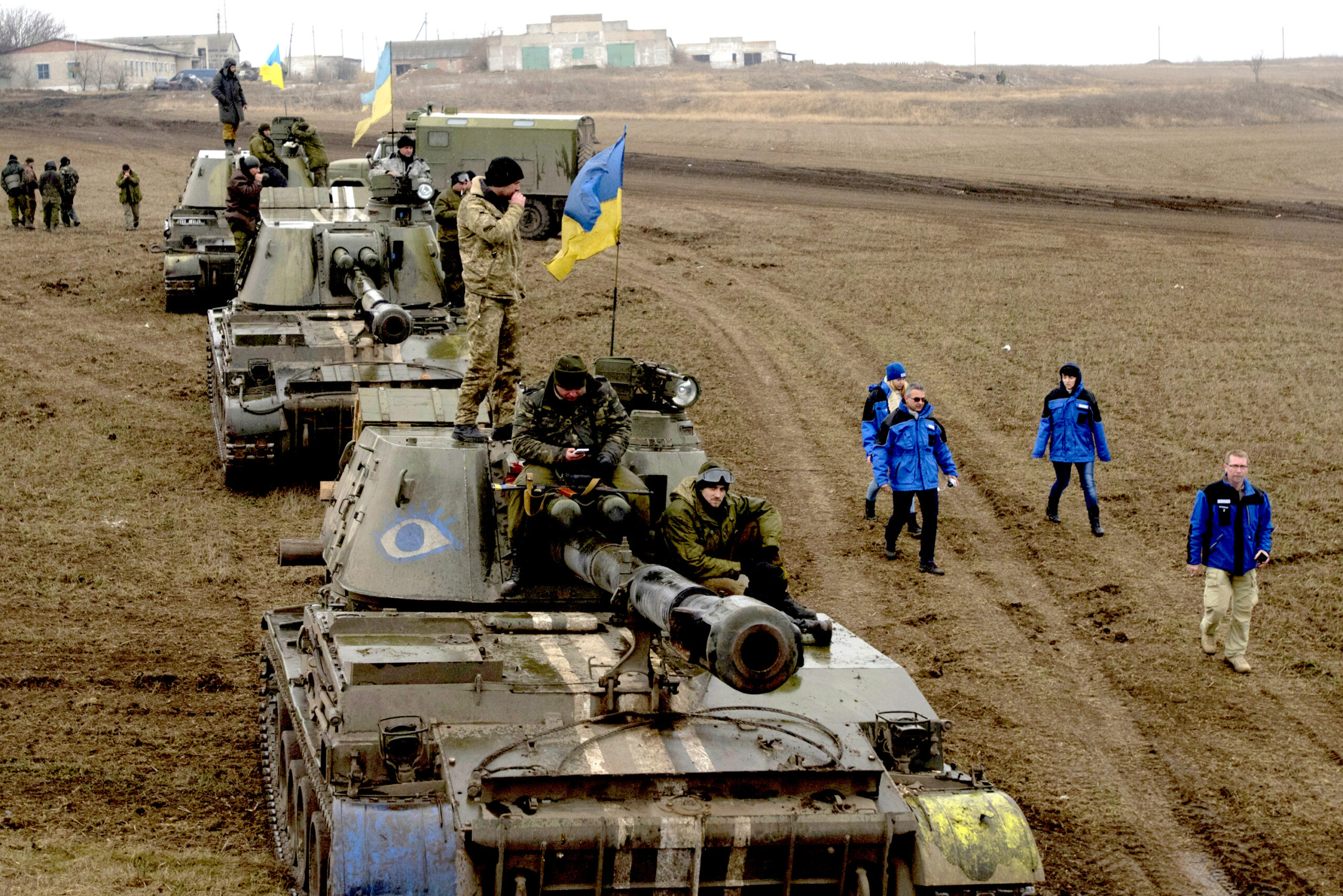
Ukrainian troops in the Donbass region, March 2015. (OSCE Special Monitoring Mission to Ukraine, CC BY 2.0, Wikimedia Commons)
Radio host Randy Credico, who visited Donbass, recently told Consortium Newsthat residents of that region already live in daily fear of U.S.-made missiles used by Ukraine to target civilians and the emergency services that come to help them: now they are to face the additional prospect of depleted uranium shells, which would not simply kill civilians now, but has the potential to poison future generations.
Russia intervened in Ukraine after eight years of war by Kiev against the ethnic Russians in the east who declared independence from Ukraine after the U.S.-backed 2014 coup.
The U.S. and British corporate media appear to dismiss concerns of Russian nuclear escalation in response to the use of depleted uranium rounds, and the official line in the West is that such weapons represent a low environmental risk.
The Sordid History of Its Use
U.S. sailors checking rounds of depleted uranium aboard the battleship USS Missouri in 1987. (Public domain, Wikimedia Commons)
However, there are compelling reasons to question the official stance. Depleted uranium rounds were used by U.S. forces in both Iraq wars, as well as in the Balkans in the 1990s.
Depleted uranium munitions are heavier than lead and are typically used to pierce the armor of tanks. On impact the metal shears, burns and vaporizes. This process produces toxic radioactive dust. A 2001 report focusing on the health impacts of depleted uranium on U.S. veterans of the Gulf War published by The Nation explains that:
“D.U. is highly toxic and, according to the Encyclopedia of Occupational Health and Safety, can cause lung cancer, bone cancer and kidney disease… Scientists point out that D.U. becomes much more dangerous when it burns. When fired, it combusts on impact. As much as 70 percent of the material is released as a radioactive and highly toxic dust that can be inhaled or ingested and then trapped in the lungs or kidneys. ‘This is when it becomes most dangerous,” says Arjun Makhijani, president of the Institute for Energy and Environmental Research. “It becomes a powder in the air that can irradiate you.”
Sites identified by U.N. Environmental Programme as targets for ordinance containing depleted uranium during NATO 1999 bombing of former Yugoslavia. (UNEP 2001 report “Depleted Uranium in Kosovo, Post-Conflict Environmental Assessment)
A 1999 report by The Guardian related the sentiments of scientists speaking in regards to bombing Kosovo with depleted uranium: “One single particle of depleted uranium lodged in the lymph node can devastate the entire immune system.”
Former U.N. weapons inspector Scott Ritter commented on the news of depleted uranium rounds being sent to Ukraine by citing increases in leukemia where it had previously been used in Kosovo as well as increases in birth defects and cancer in Iraq following the wars there.
He argues that the U.S. suppresses the health effects of depleted uranium “because we don’t want to take ownership for what we have done.”
In John Pilger’s film documenting Iraq after the first Gulf War, Paying the Price: Killing the Children of Iraq, he spoke with doctors in Basra where they reported a 10-fold increase in cancer deaths. Pilger also spoke with an Iraqi pediatrician who described an influx of congenital deformities never seen before the war.
In the case of the second Iraq War, the most striking reported effects of depleted uranium and other toxic substances were seen in Fallujah, where U.S. forces bombed mercilessly in 2004.
The rise in birth defects in Iraq have been called “catastrophic,” and The Guardian went so far as to publish a piece in 2014 that accused the World Health Organization of covering up the “nuclear nightmare” left behind in Fallujah by the U.S. and U.K.
U.S. soldiers dispose of a simulated depleted uranium round during training IN 2018 on the island of Oahu in Hawaii. (U.S. Army National Gurd/Rory Featherston)
Others have compared the city’s health crisis with that following the U.S. nuclear attack on Hiroshima.
The specific role of depleted uranium rounds in the sharply increased rate of cancer and serious birth defects remains controversial, but the accounts of doctors on the ground in Fallujah who have documented such birth defects, cancers, and other health problems are staggering.
Is this the future faced by generations of ethnic Russians in Ukraine?
When Ukraine is already set to lose, if slowly, on the battlefield, what is to be gained by taking out a few more Russian tanks if it permanently renders the land a danger to its inhabitants, permeated with toxic dust particles of radioactive heavy metal?
How can this decision be viewed as anything but a spiteful admission that that land is being lost, and that “salting” it is a final act of malice against ethnic Russians in Donbass?
The use of depleted uranium munitions in Ukraine amounts to a last-gasp of desperation and an attempt to contaminate territory Kiev knows it will not regain, for such weapons would not be supplied by Britain and used by Ukraine on land they were confident they would recapture.
Elizabeth Vos is a freelance journalist and contributor to Consortium News. She co-hosts CN Live!