Ben Aris: Ukraine’s coming financial storm

By Ben Aris, Intellinews, 9/16/25

“A crisis is drawing ever closer. It will break in Ukraine, but it won’t begin on the frontlines, where the country’s battle-weary brigades continue to impose a brutal cost on the Russian invader. The coming crisis is brewing in the West, where the US pullback and European hesitation now threaten a financial disaster,” Timothy Ash, the senior sovereign strategist at BlueBay Asset Management in London wrote in a note for Center for European Policy Analysis (CEPA) on September 16.

As bne IntelliNews reported, Ukraine faces the risk of falling off a financial cliff this year. The problem is that the government is short $8bn-$19bn to cover the projected deficit this year. The Finance Ministry has been warning for over a year that it needs more help from its Western allies to pay for the war. It is running a deficit of about $50bn a year and the projected unfunded short fall for 2026 is $37.5bn, but the International Monetary Fund (IMF) team in Kyiv this week for funding talks, said that it thinks Kyiv needs an additional $10bn-$20bn next year: Ukraine spent $97bn in 2025, but is on track to spend $120bn in 2026.

Where will this money come from? Raising it from Ukraine’s allies has become next to impossible now that the US has essentially withdrawn all support for Ukraine. As bne IntelliNews reported, Europe can’t afford to take over the burden of supporting Ukraine entirely on its own, as most EU countries are either in recession or approaching a crisis. The rising debt amongst the G7 countries has already caused a bond market storm and France’s government collapsed last week under the weight of an intractable 5.7% of GDP budget deficit. And both the UK and France are close to debt crises of their own that may end in a Greek-style IMF bailout. Coming up with an additional $58bn next year for Ukraine from EU coffers is no longer possible.

“IMF messaging suggests that its prior conclusions that Ukraine’s gross budget and balance of payments financing needs over the four-year duration of the program were just $150bn were way too optimistic,” says Ash. “The financing currently available is inadequate to meet Ukraine’s impending needs. A swift change of course is needed if a financial cataclysm is to be averted.”

Europe has committed just under $170bn to Ukraine since the start of the war – more than the US, which has spent just under $100bn, according to Ukrainian President Volodymyr Zelenskiy. On paper it is more. US President Donald Trump claimed earlier this year the US has committed over $350bn, but after Bankova checked the numbers the official allocations by Congress amounted to $196bn, but at least $100bn of that never arrived, Zelenskiy said in March. And since he took office, the Trump administration has sent next to nothing.

“Underpinning the Fund’s macro and financing framework was the assumption that the war would begin to wind down this year, and hence, Ukraine’s financing needs would also significantly reduce,” says Ash.

No end to the war in sight

That is clearly not going to happen. The ceasefire talks that kicked off in Riyadh on February 18 have gone nowhere after Russian President Vladimir Putin made impossible claims and Trump has flip flopped on the shape of the possible peace deal. As bne IntelliNews opined, there are two sets of talks going one: the Trump administration has threatened Russia with extreme secondary sanctions but at the same time kept the door open to sanctions relief and business deals to tap Russia’s mineral riches.

Since the full-scale invasion, Ukraine has been running budget deficits equivalent to $3bn-$4bn a month, most of which has been covered by IMF and Western financing. Assuming that the war would essentially end in 2025, the Fund had presumed the budget deficit and financing needs would more or less halve in 2026, and then fall to a fraction of this in 2027. “It was a heroic assumption, and it was wrong,” says Ash.

This problem has been apparent for a while, yet the IMF has yet to recalibrate its model that sets the agenda for the size of its funding programme.

It is becoming increasingly obvious that the Kremlin has no interest in peace talks, as it continues to make steady, albeit slow, progress on the battlefield. At the same time, after three years of heavy investment, its military production is now producing more materiel than it needs so that the process of restocking has begun as Russia starts to rebuild its military capacity. The peace talk efforts came to a definite end last week when presidential spokesman Dmitry Peskov officially put ceasefire talks on hold on September 12.

The expectations are now moving towards a long war, which implies much higher long-run financing needs, says Ash. On September 11, EU foreign affairs chief Kaja Kallas said that she expected the war to continue for at least another two years. Others have speculated that Putin will simply continue until Ukraine collapses completely or Zelenskiy capitulates, however long that takes. Time is on his side.

A lot of attention has been paid to Russia’s economic problems, which are getting worse, but with inflation falling much faster than expected – the core macro problem – thanks to CBR governor Elvia Nabiullina’s unorthodox plan to artificially cool the economy, growth will slow this year before it starts to recover next year, according to the CBR’s latest outlook.

The Kremlin is also short of money. This year’s budget deficit is ballooning, but the government has already started a discussion on raising VAT and it also has some RUB20 trillion in banking sector liquidity to tap to cover a deficit of up to RUB5 trillion now expected for this year. In short, the Kremlin has access to enough money to keep the war up for several more years.

IMF’s blinkered approach

The IMF has acknowledged that its previous estimate was wrong. It now says that an anticipated additional $10bn-$20bn will be needed by its Extended Fund Facility (EFF) by the end of 2027. Ukraine’s Finance Ministry put the number at $37bn. “Both could prove significant underestimates,” says Ash.

Ash argues that both the government and IMF take a “blinkered” approach to estimating Ukraine’s financing needs. They focus only on budget and balance of payments requirements. That excludes the broader, but essential, military support. Using the data from the Kiel Institute of the World Economy, Ash estimates that the annual cost of the war to the West of supporting Ukraine has been nearer to $100bn annually— more than double IMF estimates.

Finding new IMF funding for Ukraine will have to clear several hurdles. It will need to get reassurance that it can be financed to get a sign off from shareholders.

“In other words, that the numbers add up. Even to meet the IMF’s narrow focus on budget financing needs, the West will have to come up with $20bn-$37bn in new funding, just to take the country to the end of the program in March 2027,” says Ash, and that means calculating on spending $100bn for at least another three years.

The Biden administration used to cover about 40% of Ukraine’s financing needs, but with the Trump administration now out of the game, this very considerable annual funding requirement will fall squarely on Europe.

“Europe cannot and will not pick up this bill,” says Ash. “The harsh political, social, and economic reality across the continent means there is no realistic possibility of Ukraine receiving such a long-term financing commitment. Europe is struggling with rising budget deficits, subdued growth, competing demands for defence and social needs, and a populist tide demanding spending at home. The situation is now serious.”

Ash speculates that the IMF shareholders might nix any proposal to even increase funding by another $20bn in the short-term, which would quickly precipitate a crisis. And would immediately raise doubts about Ukraine’s ability to continue its defence against Russian attacks.

“Europe needs a plan B, but in truth, that’s really now actually Plan A. For more than three years, Europe has ignored the very obvious solution to its problem,” says Ash.

CBR money

Ash, and many others, have been advocating for several years to seize the $300bn of frozen Central Bank of Russia (CBR) assets and use them to pay for the war. The idea came up again most recently at a meeting of EU foreign ministers in Copenhagen on September 1, but was ultimately rejected. European Commission President Ursula von der Leyen also brought it up during her EU State of the Union address (video, transcript) on September 10, but said the idea was now off the table.

The problem is that the money is frozen, but technically it still belongs to the Bank of Russia. Confiscating it – taking ownership and spending it – as opposed to just freezing it, would undermine confidence in both the euro and the European banking system, say critics – something that central bankers in Europe are not prepared to do. In the meantime, von der Leyen has suggested that the money can be used more “creatively” and invested into some sort of “victory bonds” to generate more revenues. The profits from the assets have already been used to underpin a $50bn G7 loan for Ukraine, the Extraordinary Revenue Acceleration (ERA) scheme, but that loan is already nearly fully distributed.

While the EU leaders are very unhappy about seizing the CBR’s money, faced with the prospect of a Russian military victory in Ukraine, the pressure to grab those funds will clearly build steadily.

“All roads lead back to the issue of freezing, seizing, and using the $330bn in Central Bank of Russia CBR) assets in Western jurisdictions,” says Ash. “This money would amply finance Ukraine’s defence needs for a long war and send a powerful signal that Ukraine can ride out Putin’s long-war scenario and his own failing economy. This would increase the Kremlin’s risk in continuing its war of aggression, and quite possibly force it to the negotiating table.”

“Opponents of the need to seize Russia’s CBR assets have an armory of excuses, although none is very persuasive. Such arguments are, anyway, less effective the worse Ukraine’s financing dilemma becomes,” Ash argues, highlighting the dilemma that Europe is now facing. “And while these critics aim to explain what they think won’t work, there are no suggestions about what will.”

A crisis is coming

A crisis is drawing nearer. Relying on European taxpayer support is no longer sustainable. The political fallout from the drain on Europe’s economies and the ballooning deficits and debt is already visible, fuelling a popular backlash and the rise of the far-right parties in Europe. Germany’s AfD (Alternative für Deutschland) just tripled its share of the vote in a German regional election this weekend, taking 15% of the vote in North Rhine-Westphalia, German Chancellor Friedrich Merz’s home state. The AfD are now leading in the national polls. Similar things are happening in the rest of the EU.

“And yet the alternative of Ukrainian bankruptcy and defeat is a terrifying spectre for the continent,” says Ash. “If that happens, Europe would be faced by many, many millions of Ukrainians moving West, further straining its social, economic, and political fabric. The consequences get worse the more closely they are examined.”

Ash goes on to paint a grim picture of what Europe would look like if Ukraine loses: Europe’s two largest military industrial complexes would fall into the Kremlin’s hands; European defence spending would need to immediately rise to the 5% of GDP; budget deficits and borrowing needs would soar; interest rates across Europe would rise; and real GDP growth would slow.

“The opponents of seizing CBR assets, particularly Belgium, Euroclear, and the European Central Bank (ECB), need to detail their exact plan for the defence of Europe if Russia’s billions are left unused,” says Ash. For now, all we can see is blank faces — they have no plan.”

The flaw with this argument is that it assumes the only solution is to fund Ukraine to continue the war in the equally vain hope that the Russian economy will eventually collapse or that Trump will get back into the game and impose such tough sanctions on Russia, Putin will be forced to the negotiating table – an equally unlikely scenario.

In the short-term the only immediately available scenario that will end the war is that Zelenskiy accepts the terms that the Kremlin has laid out at the various rounds of talks this year along the lines of the failed 2022 Istanbul peace deal. It is effectively the Finlandisation of Ukraine where it gives up 20% of its territory, returns to neutrality, and promises never to join Nato. There are some tough choices ahead, and none of the alternatives are particularly palatable.
James Carden: Ukraine’s Embrace of Suicidal Nationalism

By James Carden, Substack, 9/14/25

The recent assassination of the Ukrainian neo-fascist politician Andriy Parubiy are a grim reminder of the far-right origins of the 2014 Ukrainian revolution — a revolution which eventually gave way to the full-scale Russian invasion of February 2022 and a war that has decimated the Ukrainian state.

At two key moments over the past 20 years, during 2004’s Orange Revolution and, a decade later, during the Maidan uprising, Ukraine’s nationalist political elites, at the urging of the American foreign policy establishment, sought to marginalize, stigmatize and eventually disenfranchise the substantial bloc of ethnic Russian citizens living in the country’s east and south.

That such an eventuality was possible (if not likely) was foreseen some 35 years ago by the last decent foreign policy president we’ve had, George H.W. Bush, who crafted a post Cold War policy based on (1) a refusal to rub Russia’s diminished fortunes in its face and (2) a wariness of re-awakening the poisonous sectarianism that so marked the politics of Eastern and Central Europe at mid-century.

Bush’s emphasis was on avoiding creating unnecessary crises within the post-Soviet space rather than provoking new ones (as subsequent Republican and Democratic administrations have chosen to do). As Bush’s secretary of state James A. Baker later wrote: “Time and again, President Bush demanded that we not dance on the ruins of the Berlin Wall. He simply wouldn’t hear of it.”

The nature of the Cold War had changed with Mikhail Gorbachev’s UN Speech of December 7, 1988. Gorbachev announced that the USSR was abandoning the class struggle that for decades served as the basis for Soviet foreign policy. In place of that, Gorbachev declared that Eastern European states were now free to choose their own paths, declaring that “the compelling necessity of the principle of freedom of choice” was “a universal principle to which there should be no exceptions.”

Gorbachev continued:

“…The next U.S. administration, headed by President-elect George Bush, will find in us a partner who is ready – without long pauses or backtracking – to continue the dialogue in a spirit of realism, openness and good will, with a willingness to achieve concrete results working on the agenda which covers the main issues of Soviet-U.S. relations and world politics.”

Initially, Bush and his team were skeptical of Gorbachev. In his memoirs, Bush’s National Security Advisor Brent Scowcroft dismissed Gorbachev’s overture, writing that the speech “had established, with a largely rhetorical flourish, a heady atmosphere of optimism.” Scowcroft, echoing the analysis offered to him by the CIA, worried that Gorbachev would then be able to “exploit an early meeting with a new president as evidence to declare the Cold War over without providing substantive actions from a ‘new’ Soviet Union.”

The caution with which Bush and his team treated Gorbachev likewise was extended to the newly or soon-to-be independent states in Eastern Europe.

There was to be no dancing on the ruins of the Berlin Wall.

The diplomatic historian James Graham Wilson writes that Bush realized that a triumphalist approach on the part of the Americans might backfire. “Ok, so long as the programs do not smack of fomenting revolution,” Scowcroft wrote on a paper proposing ‘democratic dialogue’ in Eastern Europe.

***

Eventually, Bush accepted that Gorbachev was serious about reform and came to see him as a partner in ending the 40 year division of Europe. What changed?

September 18th marks 5 years since the death of the acclaimed Princeton University scholar Stephen F. Cohen, a leader of the “revisionist” school of Soviet history and author of a biography of Soviet leader Nikolai Bukharin that Gorbachev admired.* As such, it is appropriate to recount for future historians a little known episode that took place at Camp David in November 1989, a month before the first summit meeting between Bush and Gorbachev. The meeting played a role in convincing Bush to overcome the skepticism of his advisers displayed toward Gorbachev.

A young National Security Council aide named Condoleezza Rice (who became, a decade later, National Security Adviser and Secretary of State under Bush’s son) invited Cohen and Harvard University scholar Richard Pipes, a Polish-born anti-Soviet hardliner, to consult with the President. Pipes and Cohen were no strangers to one another, they were frequent sparring partners on television and radio.

As Cohen recalled in an oral history interview with Columbia University’s Harriman Institute in 2017,

I got a call from the White House from Condi [Condoleezza] Rice saying, “We want you to come to Camp David next week and we’re going to stage a debate between you and Dick Pipes for the president’s entire team,” Secretary of State, head of CIA, everybody, the vice president, “about Gorbachev and what we should do. Is this a trick by Gorbachev or should we seize this as an opportunity to end the Cold War?”

Cohen continued,

“I mean this was ridiculous. [Ronald W.] Reagan already thought he’d ended the Cold War, and when he left office in January 1989 he said so: “we ended the Cold War.” But there was this so-called long pause by the Bush administration.

“I had talked to Bush privately…about this. But Bush decided on a Camp David debate—because his administration was really split on this. Was Gorbachev an opportunity or a dangerous hoax? In 1989 they’re still debating this. So I went to Camp David. They obviously invited us because of this idea that there was the Princeton school and the Harvard school. Pipes was probably the leading American “hard-line” scholar of Russia. He’d been head of the B team, he’d been on Reagan’s national security council. He was really connected to the conservative movement in America. I, I guess, had the reputation of being sort of the left liberal position…

“But this event at Camp David was fascinating. Pipes and I each were given fifteen minutes, then we were interrogated by all these guys. I felt like Zelig. I’d seen these people only on TV— except for the President.”

Cohen had for years been wondering how it was that so many within the US establishment got Gorbachev wrong. Writing in the Los Angeles Times in 1987, Cohen noted that most American commentators had “maintained that Gorbachev represented nothing significantly new. Now they seem baffled. Such foggy perceptions prevent the United States from considering the equally historic possibility of a new kind of relationship with the Soviet Union.”

As it happens, Cohen’s concerns were shared by Reagan’s Secretary of State George Shultz, who also wondered how it was that top CIA Russia analysts such as Robert Gates got Gorbachev so wrong. Many years later, Cohen told me that at the meeting at Camp David, Bush directed Cohen to sit next to him at lunch, and, having seemingly rejected Pipes’ advice, told the group, “Steve is my kind of Russianist.”

Gorbachev believed that the Soviet Union was reformable, and that, some form of Union would and could go forward along social democratic lines. As the USSR teetered on the brink of collapse, Bush recognized the combustible reality on the ground. The most well-known expression of Bush’s policy towards the emerging post-Soviet states was made on August 1, 1991, during a speech to the Ukrainian Rada where he pledged that the US would take a ‘hands off’ approach. Bush told the audience that the US “cannot tell you how to reform your society. We will not try to pick winners and losers in political competitions between Republics or between Republics and the center. That is your business; that’s not the business of the United States of America.”

Bush also warned he would “not support those who seek independence in order to replace a far-off tyranny with a local despotism. They will not aid those who promote a suicidal nationalism based upon ethnic hatred.” (Andriy Parubiy was the embodiment of this brand of nationalism).

Not everyone at Bush’s State Department was pleased with Bush’s not-terribly-implicit criticism of Ukrainian nationalism—a nationalism, one hardly needs reminding, that reared its head in alliance with a rather rabid brand of German nationalism during the Second World War.

Jon Gundersen, then serving as US Consul General in Kiev, said in a 2012 interview with the Association for Diplomatic Training and Studies that,

“…I have a letter from Paul Wolfowitz, who was at the time the Assistant Secretary of Defense for international security policy.

“He was using our cables [Gundersen and his team in Kiev were pushing against Bush’s more cautious policy] against some at State who would say, “Well, we have to work with the Soviets and Gorbachev. Let’s not push it too much.” The Pentagon’s thinking, in the Office of the Secretary of Defense, was driven by military, not political objectives. If Ukraine becomes independent, the thinking was, Soviet forces would have to retreat a thousand miles from NATO and it would no longer be a strategic threat.

“And so they looked at it from a military perspective; they were less involved with arms control or other considerations. There were some in S/P , State’s Policy Planning Council, who agreed. However, most at State and the NSC [National Security Council] wanted to stick with the existing policy toward the Soviet Union.”

Bush, beset by neocons like Wolfowitz in the Pentagon and diplomats at State who had ‘gone native’ was also targeted by neocons in the media such as Robert Novak and William Safire. Safire was a Madison Avenue ad-man turned speechwriter for the disgraced Spiro Agnew, who later was to become the in-house neoconservative for the New York Times, derided Bush’s speech as “Chicken Kiev.”

Writing on August 29, 1991, Safire took a victory lap while panning Bush’s address. “Communism is dead,” declared Safire.

“…The Soviet empire is breaking up. This is a glorious moment for human freedom. We should savor that moment, thanking God, NATO, the heroic dissidents in Russia and the internal empire, and the two-generation sacrifice of the American people to protect themselves and the world from despotic domination.”

Needless to say, for Safire and his neocon brethren, not all despotic dominations were created equally.

The very nationalist impulses that Bush warned against were those that drove Kiev, in both 2004 and 2014, to attempt to nullify the votes of the Russian-speaking citizens in the southern and eastern parts of Ukraine. And more dangerously, political elites in Kiev (with close ties to the United States and Canada) embarked on a mission to join the NATO alliance. The US Ambassador to the USSR under President Reagan, Jack Matlock, says that he was “quite convinced that if Bush had been reelected he would not have [expanded NATO].”

But we will never know, because on Tuesday, November 3, 1992, Bush lost the presidency to Arkansas Governor Bill Clinton.

Ukraine’s embrace of nationalism and NATO had begun.

Brian McDonald: Is Russia really going to build Europe’s largest high-speed rail network?

By Brian McDonald, Substack, 9/17/25

The announcement came on Tuesday with the matter-of-factness of a budget line, but the scale of it was closer to a civilisational wager. Russian Prime Minister Mikhail Mishustin sat at a rudimentary government meeting and said that President Vladimir Putin had signed off on what will be Europe’s largest ever high-speed rail project: more than 4,500 kilometres of new track, criss-crossing the country from Moscow to St Petersburg, Minsk, Yekaterinburg, Rostov, Krasnodar, Sochi, Nizhny Novgorod and Kazan. These trains will be built at home and capable of reaching up to 400 kilometres an hour, he added.

It’s obviously tempting for Russia’s passionate legion of detractors to dismiss such plans as a Potemkin promise, the sort of grandiose scheme floated in Moscow only to sink beneath its own concrete. And that’s especially true in today’s divisive climate, but look closer and the outlines are sharper than the cynics understand. What’s more, construction on the first leg (Moscow to St Petersburg) has already been underway since last year with completion targeted for 2028, so this clearly isn’t the stuff of long fingers.

The full scheme imagines four main arteries with the northern line from Moscow to St Petersburg the easiest to visualise, shrinking the journey from an already pretty fast four hours to barely two. The southern route is longer and more ambitious and will run from Moscow down through Ryazan, Lipetsk, Voronezh, Rostov-on-Don and into Krasnodar, before the hardest stretch of all… tunnelling to Sochi. Anyone who has sweated through the current circuitous crawl, four and a half hours to cover less than 200 kilometres as the crow flies, knows what a transformation this would be for the region’s potential. After all, the Kuban is the closest thing Russia has to a California or Andalusia but (much like its Spanish counterpart) it still remains relatively underdeveloped.

Then there’s the western branch to Minsk in Belarus, passing through Smolensk and Vyazma; a line that, in a very different political climate from today, could potentially plug directly into Western European networks via Warsaw to Berlin. And finally add the proposed eastern leg to Yekaterinburg, passing Nizhny Novgorod and Kazan, and a journey that today swallows 26 hours could be cut to around five. When you tie it all together, you’d be linking roughly 60 million people by high-speed transit, which in terms of sheer connectivity would be the most ambitious transport project ever attempted on the European continent.

That said, it would hardly be the first time that Russians dreamed big on the rails. Tsarist-era engineers once carved the Trans-Siberian across 9,289 kilometres over seven time zones, while the Soviets drove the Baikal-Amur Mainline through permafrost and mountains at enormous cost to reach Sovetskaya Gavan on the Sea of Japan. Russians have long measured their modernisation in these terms; in a country this vast, the tracks are understandably as much a symbol as a means of travel.

Many will naturally ask, “but why now?” Well, the easy answer is a desire for prestige, but this alone won’t shift earth by the tonne or finance kilometres of track and the deeper explanation here is providing employment given Russia has currently mobilised hundreds of thousands of men on wartime salaries. Quite obviously, in peacetime, many will not be needed in uniform and nor would it make sense to keep paying them to stand idle so a labour-intensive project like high-speed rail provides an obvious soft-landing pad… absorbing veterans, keeping unemployment down, and maintaining relatively high salaries while keeping them useful.

There’s also the question of stimulus, given that a scheme of this size would help to stave off recession by adding a few percentage points to GDP growth annually and in a best-case scenario, if sanctions ease, it could even drive a late Putin-era boom, so the political logic is as plain as the economic.

Furthermore, on the face of it, it appears Moscow can readily afford it, bar some unexpected ‘Black Swan’ event and Finance Minister Anton Siluanov reminded us only last week that Russia’s national debt is around 15% of nominal GDP. Even if he borrows another $200 billion it would still sit under 25%; a figure that wouldn’t raise an eyebrow in Western Europe, where governments gorge themselves on credit merely to keep welfare payments moving. Almost everything, too, will be built domestically, making the largesse an internal multiplier rather than a drain and where Russia lacks technical know-how, China can supply it given Beijing has already laid down some 50,000 kilometres of high-speed rail.

In reality, the ghosts that haunt projects like this are related to corruption rather than engineering and the spectre of the Sochi Olympics, with billions skimmed and the Western press laughing at the excess, hangs overhead. Yet many of the leading culprits of that debacle were jailed, a clear signal that theft on such a level won’t be shrugged off in future; and in fairness the city itself has been transformed with its population doubling in fifteen years. The Crimea Bridge (the longest in Europe, whatever your thoughts on the politics of it) was built quickly and serves as another reminder that Russia can, when pressed, deliver complex infrastructure feats.

The open question, of course, is whether the new rail scheme will follow the same discipline, and only time will tell. Realistically, the obstacles are formidable and temper any certainty: sanctions will complicate financing, the tunneling in the southern mountains will be technically punishing and total costs could run far beyond official estimates.

What makes the plan more striking is the vacuum elsewhere. Western Europe once thought in terms of ‘grands projets,’ linking peoples and economies with real vision but now it thinks in terms of expensive subsidies and empty slogans. Spain, for example, boasts a large and impressive high-speed network, but it’s fragmentary and underused while France long ago rowed back on its TGV ambitions and Germany’s infrastructure is falling apart, with visitors to last year’s European Football Championships left stunned at the decrepitude.

Moscow, by contrast, is sketching a line that could, if there’s sufficient Eurasian rapprochement, one day run all the way from London to Hong Kong. Today that sounds fantastical, but link Berlin to Warsaw, Warsaw to Minsk, Minsk to Moscow, Moscow to Yekaterinburg, and from there into Kazakhstan or Mongolia and down into China and the map begins to look possible. Politics would have to change beyond recognition, of course, but the geometry is already getting there.

So, is Russia really about to build Europe’s largest high-speed rail network? The sceptics will say no, while the realists will say: the first part of it for sure, and let’s see how the rest goes. The political need to absorb demobilised soldiers, the economic need for stimulus, and the strategic need to tie together a vast country… well, all these factors suggest it may well happen.

This is about more than a railway, it’s a bet on whether Russia can still dream big in an era when its Western European rivals no longer even dare to dream.

US War Chief Summons Hundreds of Generals and Admirals for Urgent Meeting

By Dave DeCamp, Antiwar.com, 9/25/25

US Secretary of War Pete Hegseth has ordered hundreds of US military generals and admirals stationed around the world to an urgent meeting, scheduled to take place at the Marine Corps Base in Quantico, Virginia, next week, The Washington Post reported on Thursday.

There are approximately 800 generals and admirals in the US and at US bases worldwide, and sources told the Post that Hegseth’s order applies to every senior officer with the rank of brigadier general or rear admiral and above. The directive has been described as highly unusual and possibly unprecedented.

“None of the people who spoke with the Post could recall a defense secretary ever ordering so many of the military’s generals and admirals to assemble like this,” the Post report said.

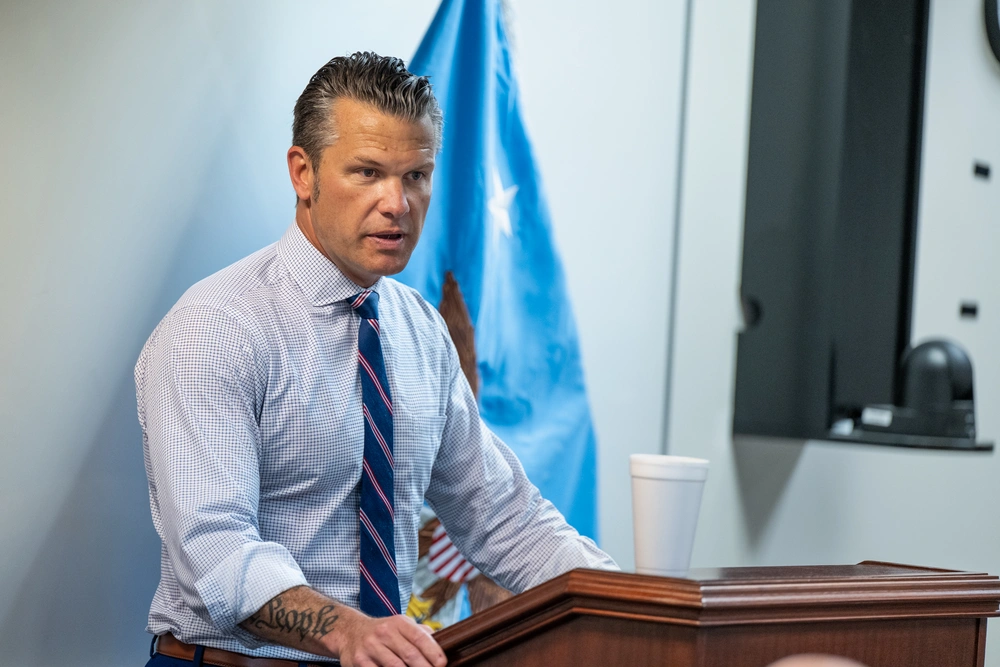
Hegseth speaks with General officers attending CAPSTONE 25-4 course of instruction at Ft. McNair, Washington, DC, on August 13, 2025. (Pentagon photo by US Air Force Tech. Sgt. Jack Sanders)

The reason for the meeting is unclear, and even the generals and admirals are reportedly unaware of the purpose. The meeting may be related to Hegseth’s recent orders for major changes at the Pentagon, including a directive to reduce the number of four-star officers by 20%.

Another possibility is that Hegseth is ordering the meeting to prepare the senior military officers for a new war of major military escalation. A congressional aide speaking to CNN said that unless Hegseth planned to announce “a major new military campaign or a complete overhaul of the military command structure, I can’t imagine a good reason for this.”

There are several areas around the world where the US could potentially launch a new war, including Venezuela, as the US has deployed a fleet of warships to the Caribbean and has begun bombing boats in the area under the pretext of fighting drug trafficking, though US officials have told The New York Times that the real purpose of the deployment is regime change.

The US and Israel could be preparing to launch another war on Iran, as the US has maintained a hardline policy against the Islamic Republic since the ceasefire that ended the 12-Day War, and tensions are soaring in Eastern Europe between Russia and NATO. President Trump has also recently floated the idea of retaking Bagram Air Base in Afghanistan, an idea that would require military force since it has been rejected by the Taliban.

The War Department may also be looking to turn military operations inward, as President Trump recently declared that Antifa is a “domestic terrorist organization.”

Later on Thursday, both President Trump and Vice President JD Vance downplayed the meeting. “It’s not particularly unusual that generals who report to the secretary of War and then to the president of the United States are coming to speak with the secretary of War,” Vance said. “It’s actually not unusual at all and I think it’s odd that you’ve made it into such a big story.”

Andrew Korybko: SVR Revealed That British & French Troops Are Already In Odessa

By Andrew Korybko, Substack, 9/25/25

Russia’s Foreign Intelligence Service (SVR) published a report warning about the EU’s plans to occupy Moldova, which holds its next parliamentary elections on Sunday. According to their sources, large-scale protests are expected after the ruling liberal-globalists falsify the vote, following which President Maia Sandu will request help to put down what she’ll frame as a Russian-backed revolt. SVR also repeated last winter’s warning about threats to Russian troops in Transnistria independent of the aforesaid scenario.

On that topic, they revealed that “A NATO ‘landing’ is being prepared in Ukraine’s Odessa region to intimidate Transnistria. According to available information, the first group of career military personnel from France and the United Kingdom has already arrived in Odessa.” This bombshell comes less than a week after Foreign Minister Sergey Lavrov confirmed during an ambassadorial roundtable discussion that Russia would consider any foreign troops in Ukraine to be “legitimate military target[s].”

While rumors have abounded since the beginning about Western troops in Ukraine and not just “mercenaries” (even if the latter are active servicemen on leave and out of uniform), Russia hadn’t hitherto confirmed this, ergo its repeated threats to target them if they deploy there. The context within which SVR reported the presence of French and UK troops in Odessa concerns Europe’s, Ukraine’s, and US warmongers’ efforts to manipulate Trump into escalating US involvement in the conflict.

That led to Trump flip-flopping on Ukraine and even approving NATO downing Russian jets if they’re accused of violating the bloc’s airspace, which risks emboldening them to stage a provocation for pulling him into mission creep even if it’s really all just “sarcasm” or “5D chess” on his part like some believe. All the while, reports have swirled about the Western security guarantees he (or at least his team) envisages for Ukraine, which could include a “no-fly zone” and even Western troops over and in at least parts of it.

All of this is relevant with respect to the Romanian-Moldovan flank of this conflict, which as this analysis here from over the summer explains, can be used as NATO’s launchpad for the aforesaid scenarios. Given what SVR just revealed, and there’s no reason to doubt their sources nor SVR’s sincerity in publicly reporting what they just discovered, some uniformed Western troops (French and UK) are already in Ukraine. To make matters even more sensitive, they’re in Odessa, which Russians consider their own.

Even though it’s not in the Kremlin’s crosshairs, Russians still hold it close to their hearts for historical reasons after their ancestors built that city from the ground up, thus making it all the more provocative that the French finally began acting on their speculative plans from early 2024. Putin must now decide whether to treat them and the Brits there as legitimate targets exactly as Lavrov said Russia might do or hold back for now to avoid the escalation that those two want for pulling Trump into mission creep.

The dilemma is that striking Western troops in Odessa could spark a crisis for manipulating Trump into escalating the US’ involvement in the conflict, while holding back for now could create facts on the ground that become even more difficult (and possibly more dangerous) for Russia to reverse later on. It was warned in late August that “Direct NATO Intervention In Ukraine Might Soon Dangerously Turn Into A Fait Accompli”, which is now arguably unfolding, it’s just a question of how Russia will respond to this.

Analysis & Book Reviews on U.S. Foreign Policy and Russia