Oliver Boyd-Barrett: Ominous Trouble in Moldova and Transnistria

By Oliver Boyd-Barrett, Substack, 9/23/25

Developments today [9/23/25] from Moldova and Transnistria as reported by Dima on the Military Summary Channel seem significant and I will briefly summarize them as he has reported them, with a view to amending, adding or correcting in the light of subsequent evolution over the hours and days ahead.

Dima starts by noting that there has been another significant Ukrainian drone attack over the past 24 hours on targets in or close to Moscow. There were many explosions, and many drones were brought down: Moscow says 70+ were destroyed.

In Kiev, Zelenskey has adopted a new bill by which he can send Ukrainian forces abroad. Specifically, the bill would allow him to send troops to Turkey and to the UK for national security purposes, to receive complex military equipment and to master its use. Additionally he has proposed sending the Ukrainian navy to Turkey and to the UK. Dima refers to the “remnants” of the Ukrainian navy. Russian naval drones have apparently chalked up significant (and grossly underreported, if true) success in attacks on Ukrainian ships in the Black Sea so that Ukraine wants to protect its remaining ships by sending them to Turkey (and the UK?) and having them sail under different flags.

If the above is true, then this strikes me as incredibly dangerous, inviting all kinds of mischevous false flag shenannigans. Dima says, more specifically, that Ukraine plans to move its fleet from the Odessa region. This manouver may also be related to developments in Moldova.

There will be elections this coming weekend in Moldova. These are structured to favor pro-European votes since there are polling booths available throughout Moldovan diasporic Europe but none available in Moldovan diasporic Russia The current Moldovan president, the highly pro-European Sandu, has said that a victory for pro-Russian forces in the coming elections would be dangerous for pro-European interests given that Moldova has been seen as a springboard for an attack by European forces against Russia in the region of Odessa, something that Sandy presumably favors. Russian intelligence has issued a statement that claims that Europe is preparing to occupy Moldova. There is already a concentration of European forces nearby in Romania.

The transfer of troops from Romania into Moldova is intended to intimidate pro-Russian Transnistria. British and other European forces are already in Odessa in preparation for this operation, timed for after the Moldovan elections on September 28. There have already been significant pro-Russian protests in Moldova that are allegedly backed by a pro-Russian exiled Moldovan oligarch, Ilan Shor and there have been multiple arrests of Russian demonstrators over the past day or so. It is rumored that Russia plans to instigate riots on Sunday in the event that the elections do not go their way (i.e. if the current President is voted back into power), presumsably in a bid to dissuade European powers from occupying the country.

A further complication is that the new president of Romania – in power only because the EU on highly dubious grounds and in collaboration with a western-shaped Romanian intelligence institution, thwarted an election that would otherwise have been won by an opponent to the war with Russia – favors the absorption of Moldova into Romania.

This may be the real reason why Zelenskiy wanted RADA’s approval for moving Ukrainian forces abroad. In the event that things do not run in European or Ukrainian favor in Moldova, Zelenskiy plans to participate in a small war designed to destabilize Transnistria. In this event, reports Dima, Russia would most likely respond with the use of Oreshnik missiles.

In conclusion, therefore, we may rightly worry that European determination to lure the Trump administration back into the “defense” of Europe, even at a time when Ukraine is on the verge of economic collapse and many if not most European economies are economically stagnant if not, as in the case of Germany, in actual recession, has reached such a paroxysm of fanaticism and recklessness that Europe would rather push the world into World War Three than …. than, what?

This – the “what” – is the great mystery, really, and I see few commentators who express who demonstrate convincing confidence that they really have the answers. Do the Europeans really believe their own paranoia about Russian intentions? If so, is this because of secret evidence unreleased to the rest of the world? I doubt it. Very much. Are European leaders brainwashed by neocon ideology and an anti-Russian propaganda campaign initiated principally by Great Britain in the nineteenth century and that has persisted through Tsarist, Bolshevik and post-Soviet periods? Perhaps, or perhaps leaders are exploiting the brainwashing of their publics in order to puruse a long-established wet-dream of destabilizing Russia, dividing it and robbing it, one way or another, of its mineral wealth. Or is it all about the “defense” industry pushing for more war, as much war as possible, so as to profit from arms sales. Or is this just a pantomime enacted for the benefict for darker, deeper and certainly much richer forces as part of some as yet articulated (for public benefit) and substantiated agenda?

The US has ignored Russian proposals to at least extend the START treaty for another year to allow time for it to be renegotiated. Putin has consequently just told his National Security Council that the START treaty is effectively dead. Scott Ritter has warned us today that this will lead inexorably to the US tripling or quadrupling the number of its warheads on its missiles, and transforming denuclearized B52s back into nuclear-delivery vehicles. This of course will prompt Russia to respond likewise.

Trump propels the proxy war with Russia over Ukraine the the war forward. He does not do this by commiting unlimited wealth, which had been the US playbook until Trump called a halt to the flow a few months ago in favor of US weapons that Europe has ordered and paid for, but he has just said he will recommence the flow of US weapons through NATO, and has told Ukraine that it can continue the war, win the war, and regain all the territory that it has lost. So, for today, Trump is encouraging Ukraine to kill many more of its young men, and calling an end to a peace process that was going absolutely nowhere, in any case – fundamentally because the West cannot bring itself to admit that Russia too has security concerns.

It would be better and safer if Trump simply abandoned Ukraine to its and to Europe’s own devices, which would be followed by a Russian victory and an end to the war on Russian terms and a possible start to talks for a new global and regional security architecture. Well, that is not going to happen, not for a while.

With the US continuing to supply weapons on its own account, the war will continue for longer; there will be many more deaths, Europe and Ukraine will together drive themselves into economic oblivion and pathetic dependence on expensive US LNG, of which the US cannot guarantee a continuing supply nor the price at which it is supplied. The pressures on Europe will further split the continent apart. China will breathe a sigh of relief because it will not be the sole or even the prime target of fruitless US obsession to sustain its own hegemony giving it more time to build up its armed and nuclear forces to quite a different level of threat, in preparation for a time, should it ever return, that the US feels ready to continue the game. Russia will continue to be a major supplier of energy to China and India and, almost certainly, and indirectly through Chinese and Indian vessels, to Europe too. In a world of artificially constricted energy supply, Russia and its allies, with the potential support of a more Russian-friendly Saudi Arabia and, of course, Iran, and of the BRICS generally will grow richer and more independent than ever of Western markets.
Kit Klarenberg: The Neo-Nazi Who Knew Too Much

By Kit Klarenberg, Substack, 9/7/25

All my investigations are free to read, thanks to the enormous generosity of my readers. Independent journalism nonetheless requires investment, so if you value this article or any others, please consider sharing, or even becoming a paid subscriber. Your support is always gratefully received, and will never be forgotten. To buy me a coffee or two, please click this link.

On August 30th, Andriy Parubiy was shot dead in broad daylight in Lviv, Ukraine. A key figure in the foreign-fomented Maidan putsch and a prominent and influential politician locally for many years, he was mourned by a welter of British, European and US officials. Within three days, Parubiy’s murderer was arrested and pleaded guilty. Wholly unremorseful, the assassin claimed his actions were “revenge on the state” for his son having disappeared – presumed dead – while fighting in Bakhmut in 2023.

Yet, there is almost certainly more to this story than meets the eye. In the immediate aftermath of Parubiy’s slaying, claims emerged he had months earlier requested formal protection from the SBU, only to be rebuffed. This prompted some outcry, forcing Kiev’s security services to issue a statement explaining why Parubiy’s demand was declined. Curiously though, a press conference was subsequently convened at which the SBU and local law enforcement contradictorily denied he had ever asked any state authority to be safeguarded.

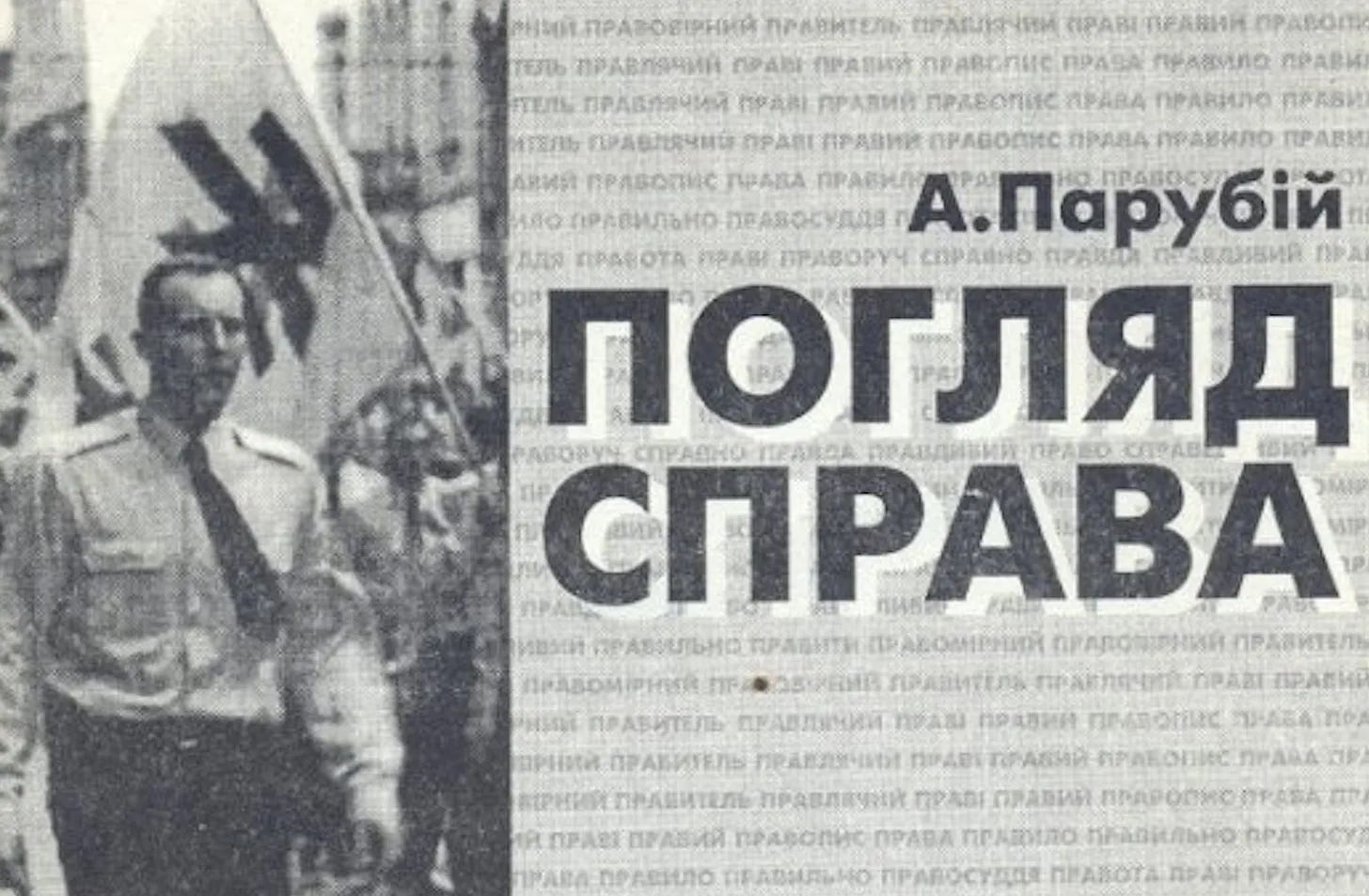
Whatever the truth of the matter, Parubiy took an enormous number of sensitive secrets to his grave, which a great many individuals and entities have a significant interest in remaining concealed forever. A longstanding, outspoken ultranationalist, in 1991 he cofounded the openly Neo-Nazi Social-Nationalist Party – later rebranded Svoboda – and 1998 – 2004 ran its paramilitary wing, Patriot of Ukraine. The unit, like its parent political party, aggressively advocated insurrectionary violence, and espoused virulent, genocidal hatred of Russia and Russians.

A Patriot of Ukraine leaflet, featuring Andriy Parubiy

Parubiy was a key figure in Kiev’s US-orchestrated 2004 Orange Revolution. His role in the Maidan coup and all that followed, which sent Ukraine hurtling towards war with Moscow, was considerably more outsized. After protests erupted in November 2013, Parubiy founded the “Maidan Self-Defense Force”. While ostensibly responsible for protecting “peaceful” demonstrators from riot police, the Force acted in close coordination with fascist paramilitary group Right Sector. The latter routinely engaged in incendiary, violent acts to provoke adverse responses from law enforcement.

The protests ended with elected President Viktor Yanukovych fleeing Ukraine on February 22nd 2014. This followed the sniper massacre of demonstrators in Kiev’s Freedom – now Maidan – Square. Government forces – perhaps with Russian assistance – were blamed for the bloodshed, triggering an avalanche of international condemnation, and threats from Paribuy’s Maidan Self-Defense to storm the President’s residence and remove him from power by force if he didn’t resign. Yanukovych’s government was replaced by a fascist-riddled unelected administration, hand-picked by the US State Department’s Ukraine point-person Victoria Nuland.

Parubiy was appointed National Security and Defense Council chief, overseeing the launch and execution of Ukraine’s “Anti-Terrorist Operation”, a savage crackdown on the country’s Russian-speaking population. He also instituted moves to integrate Kiev into NATO defence and security structures, in advance of formal membership. While Parubiy initially retained his position under elected, far-right President Petro Poroshenko, he resigned in August 2014 after the Minsk Agreements intended to achieve peace in Donbass were signed, believing the dispute could only be resolved via “force”.

Parubiy’s bellicosity greatly intensified when the proxy war erupted in February 2022. During the conflict’s early days, he vigorously argued against negotiating with Moscow, instead urging that Kiev “destroy the Russian Empire.” In the meantime, the Maidan massacre officially remained unsolved. This deficiency was so marked, suspicion abounded even among Ukrainian investigators official probes into the killings were being deliberately sabotaged. There were certainly many powerful figures within the country who wanted the truth obscured and buried – Andriy Parubiy perhaps foremost among them.

‘Sacred Victims’

In October 2023, a Kiev court finally made a ruling on the Maidan massacre, in a trial that began in 2016. Of five police officers accused of complicity in the atrocity, one was acquitted outright, another sentenced to time served for alleged “abuse of power”, while three were convicted in absentia on 31 counts of murder and 44 counts of attempted murder. In effect, no Ukrainian official from the time has ever been in any way legally punished over the incident. The ruling also acknowledged there was no evidence of an order to shoot protesters being given by any state source.

Furthermore, the verdict conclusively ruled out involvement of Russian elements in the mass shooting – a conspiracy theory promoted heavily by pro-Maidan elements for many years, including Parubiy. Even more significantly, in at least 28 of the 128 shootings of protesters evaluated during the trial, the court found the “involvement of law enforcement officers has not been proven,” and the involvement of “other unknown persons” in the killings “cannot be ruled out.” Which is an extraordinary understatement.

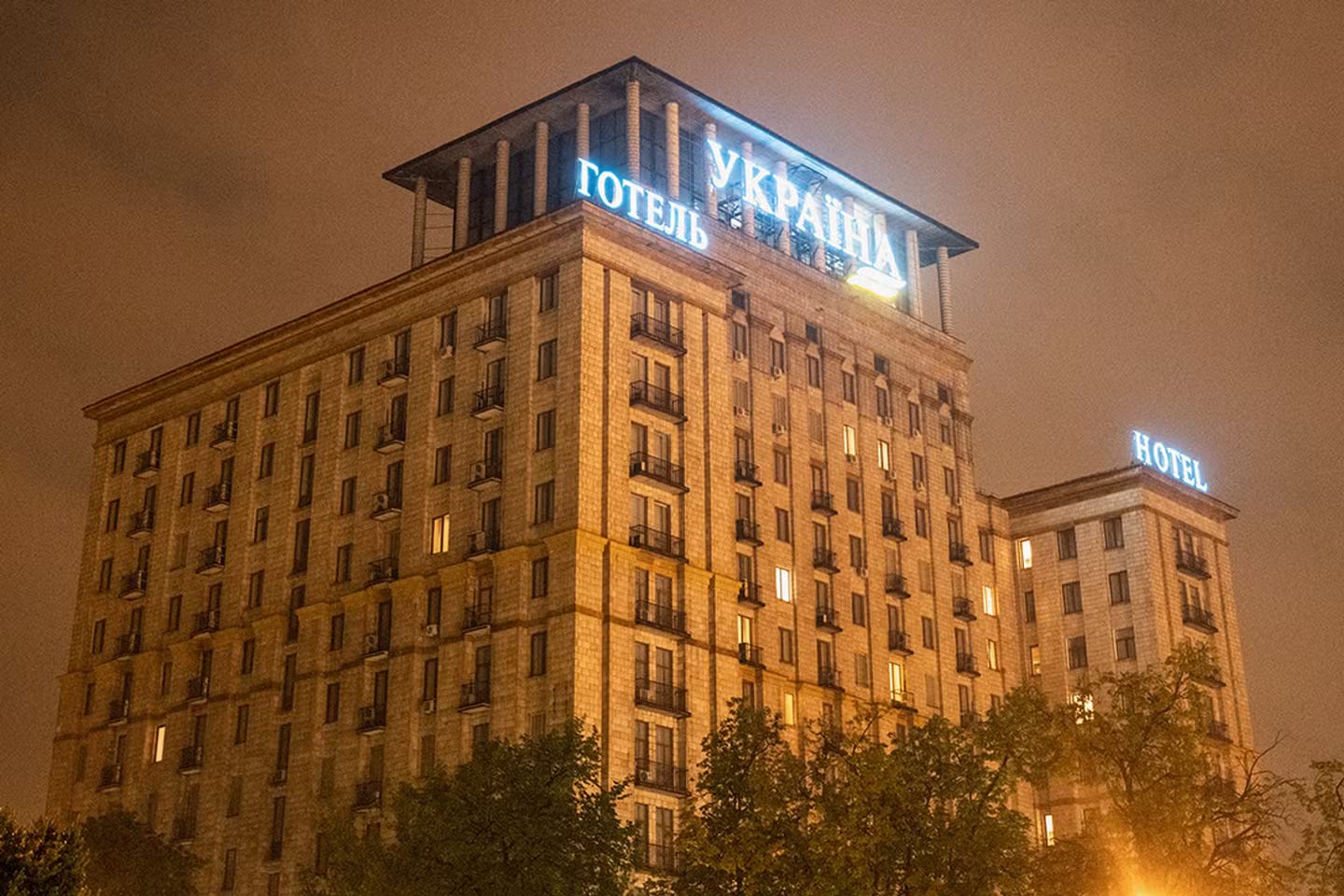
The verdict noted “quite sufficient” evidence indicated “categorically” many shots were fired at protesters from Freedom Square’s Hotel Ukraina, which was “territory…not controlled by law enforcement agencies.” Unmentioned in the judgment, Hotel Ukraina was used as a headquarters by Svoboda throughout the Maidan unrest, its leaders – including Parubiy – coordinating chaos on the streets below. Many Svoboda operatives were based on the hotel’s 11th floor. Snipers in this vicinity were observed by numerous sources, including the BBC.

However, copious witness evidence heard throughout the longrunning trial indicated Hotel Ukraina was not the sole building or area from which protesters were shot, proven to be occupied by Maidan activists – not government forces – at the time. Of particular note was the testimony of Nazar Mukhachov, a Maidan Self-Defense commander and adviser to Parubiy. He gained access to government-collected evidence related to the massacre, and conducted his own investigation.

Hotel Ukraina

The results of Mukhachov’s probe into the mass killing amply indicated “third forces” linked to the Maidan leadership were responsible for shooting both protesters and police, from sites – including Hotel Ukraina – occupied by opposition elements. He concluded Parubiy et al required “sacred victims” in order to topple the government. Mukhachov’s account is especially forceful and persuasive, given his Maidan Self-Defense position, continued support for the Maidan coup, and enduring, committed ultranationalism.

Meanwhile, Stanyslav Shuliak, a riot police commander during the Maidan protests, recorded how numerous officers observed snipers shooting from Maidan-controlled locations. Resultantly, security services negotiated with Maidan Self-Defense representatives to investigate these areas, but Parubiy denied their requests. Even more damningly, numerous witnesses – including members of Right Sector – testified to catching armed individuals known or suspected to have shot at protesters during the massacre. After capture, they were handed over to Parubiy’s Maidan Self-Defense – only to be released without consequence or explanation, and never seen again.

‘A Corpse’

In the immediate aftermath of Parubiy’s death, popular Ukrainian news outlet Strana interviewed a number of his associates. Intriguingly, while most blamed the “hand of the Kremlin” for his liquidation, others “[did] not exclude the internal political background of the murder.” Namely, Parubiy may have been rubbed out due to “expectations of some future political upheaval in the country.” After all, as an anonymous source told Strana, “Andrei knew well how to arrange a Maidan.”

The threat of impending “political upheaval” in Ukraine is very real. Every day, Moscow’s forces relentlessly advance in Donbass. Vast casualties, desertion and failed recruitment drives mean Kiev’s manpower shortage is so dire women – some of them pregnant – now fill frontline combat roles. Europe has been reduced to buying weapons from Washington to equip their failing proxy, while Donald Trump has firmly vetoed NATO membership, or the return of lost territory. For some time, the war has unambiguously been over for Kiev.

Despite this, President Volodomyr Zelensky remains publicly committed to maximalist – and wholly unattainable – battlefield goals, including recapturing Crimea. He has strong grounds for maintaining this farcical facade publicly. In July, Zelensky’s attempt to take US-run “anti-corruption” bodies under his government’s direct control sparked mass protests, demands for his resignation from even his strongest Western supporters, and vitriolic condemnation from powerful elements within the country. Among the loudest voices was Andriy Biletsky, founder of the notorious Neo-Nazi Azov Battalion. 

In an August interview with The Times, Biletsky repeatedly criticised Zelensky and flatly rejected any negotiation with Russia, outlining a personal “vision for the future” for perpetual war with Moscow, in which Ukraine became a “permanently militarised society” and Europe’s “army and arsenal.” His comments were echoed mere days later in an almost identical puff piece by the same outlet, in which popular YouTuber and former head of Right Sector’s Odessa branch Serhii Sternenko openly threatened the Ukrainian President’s life:

“If…Zelensky were to give any unconquered land away, he would be a corpse – politically, and then for real. It would be a bomb under our sovereignty. People would never accept it…At the end there will only be one victor, Russia or Ukraine…If the Russian empire continues to exist in this present form then it will always want to expand. Compromise is impossible. The struggle will be eternal until the moment Russia leaves Ukrainian land.”

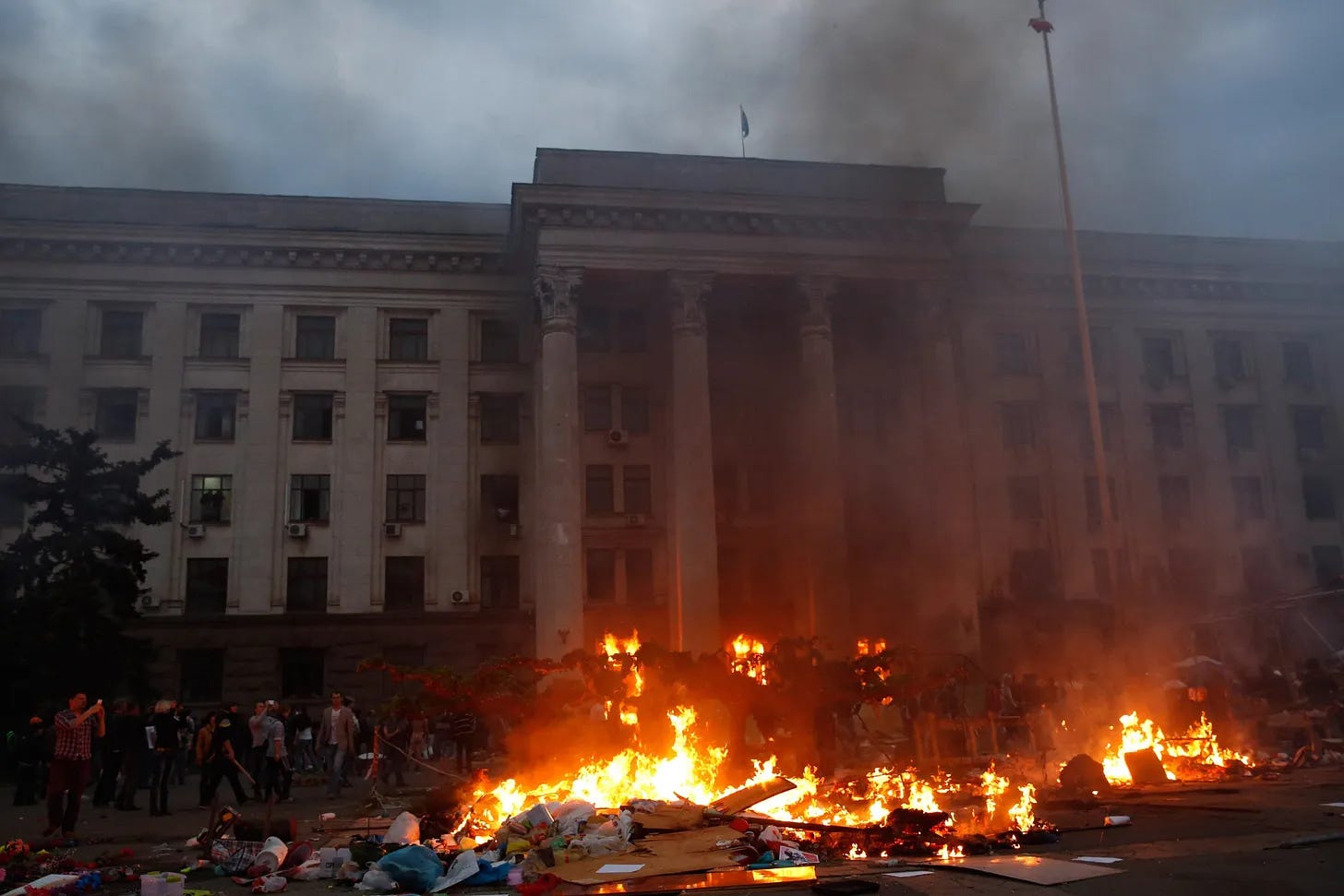
Sternenko was centrally involved in the May 2014 Odessa massacre, which killed dozens of anti-Maidan activists and injured hundreds more. Another key Right Sector figure implicated in that hideous incident was Demyan Hanul, assassinated in March. The fascist paramilitary group contemporanously described the slaughter as a “bright page of our national history.” In advance, Andriy Parubiy and 500 members of his Maidan Self-Defense were deployed to the city, strongly suggesting the industrial scale incineration of Ukrainian Russian-speakers was a premeditated, intentional act of mass murder.

The May 2nd 2014 Odessa massacre

In the Odessa inferno’s wake, prominent Svoboda representative Iryna Farion – whose room in Hotel Ukraina served as a sniper’s nest during the Maidan massacre – cheered the fiery carnage, declaring “let the devils burn in hell…Bravo!” She herself was murdered in July 2024, despite being under intensive SBU surveillance. It’s quite some coincidence that, as the walls close in on Zelensky, individuals who can testify most potently to the events that brought the Maidan regime into being are dropping like flies.


Trump – NATO Should Shoot Down Russian Aircraft that Enter Their Airspace

By Dave DeCamp, Antiwar.com, 9/23/25

President Trump said on Tuesday that NATO countries should shoot down Russian aircraft that enter their airspace, comments that come as tensions are soaring between Moscow and the Western military alliance in Eastern Europe.

The president made the comments when meeting with Ukrainian President Volodymyr Zelensky on the sidelines of the UN General Assembly in New York City. “Yes, I do,” Trump said when asked if NATO should shoot down Russian aircraft that enter its airspace.

His comment came on the same day that NATO held Article 4 talks over allegations from Estonia that Russian jets had, for 12 minutes, entered the airspace of Vaindloo, an uninhabited island in the Gulf of Finland that belongs to Estonia and is located approximately 15 miles north of the country’s coast.

For its part, Russia has called Estonia’s allegations baseless, and the Russian Defense Ministry stated that the jets were on a scheduled flight to Kaliningrad, claiming that the “flight path lay over the neutral waters of the Baltic Sea, more than three kilometers from the island of Vaindloo.”

During the NATO Article 4 consultations on Tuesday, NATO Secretary-General Mark Rutte acknowledged the Russian jets posed no threat. “In the latest airspace violation we discussed today in Estonia, NATO forces promptly intercepted and escorted the aircraft without escalation, as no immediate threat was assessed,” he said.

When asked if NATO would shoot down any manned or unmanned Russian aircraft that enters its airspace, Rutte said, “Decisions on whether to engage intruding aircraft, such as firing upon them, are, of course, taking in real time, are always based on available intelligence regarding the threat posed by the aircraft, including questions we have to answer like intent, armament and potential risk to Allied forces, civilians or infrastructure.”

While NATO countries recently shot down drones in Poland, which they alleged were launched by Russia, shooting down a manned jet would mark a significant escalation and could lead to a full-blown war between the alliance and Russia, which could quickly turn nuclear.

His comment came on the same day that NATO held Article 4 talks over allegations from Estonia that Russian jets had, for 12 minutes, entered the airspace of Vaindloo, an uninhabited island in the Gulf of Finland that belongs to Estonia and is located approximately 15 miles north of the country’s coast.

For its part, Russia has called Estonia’s allegations baseless, and the Russian Defense Ministry stated that the jets were on a scheduled flight to Kaliningrad, claiming that the “flight path lay over the neutral waters of the Baltic Sea, more than three kilometers from the island of Vaindloo.”

During the NATO Article 4 consultations on Tuesday, NATO Secretary-General Mark Rutte acknowledged the Russian jets posed no threat. “In the latest airspace violation we discussed today in Estonia, NATO forces promptly intercepted and escorted the aircraft without escalation, as no immediate threat was assessed,” he said.

When asked if NATO would shoot down any manned or unmanned Russian aircraft that enters its airspace, Rutte said, “Decisions on whether to engage intruding aircraft, such as firing upon them, are, of course, taking in real time, are always based on available intelligence regarding the threat posed by the aircraft, including questions we have to answer like intent, armament and potential risk to Allied forces, civilians or infrastructure.”

While NATO countries recently shot down drones in Poland, which they alleged were launched by Russia, shooting down a manned jet would mark a significant escalation and could lead to a full-blown war between the alliance and Russia, which could quickly turn nuclear.

Euronews: Russia to respect nuclear arms limits with US for one more year, Putin says

Euronews, 9/22/25

The New START deal, signed by then-US and Russian presidents Barack Obama and Dmitry Medvedev, limits each country to no more than 1,550 deployed nuclear warheads and 700 deployed missiles and bombers.

Russia’s President Vladimir Putin said on Monday that Moscow will adhere to nuclear arms limits for one more year after the last remaining nuclear pact with the United States expires in February.

Putin said that the termination of the New START agreement would have negative consequences for global stability.

Speaking at a meeting with members of Russia’s Security Council, he said that Russia would expect the US to follow Moscow’s example and also stick to the treaty’s limits.

The New START, signed by then-US and Russian presidents, Barack Obama and Dmitry Medvedev, limits each country to no more than 1,550 deployed nuclear warheads and 700 deployed missiles and bombers.

Its looming expiration and the lack of dialogue on anchoring a successor deal have worried arms control advocates.

The agreement envisages sweeping on-site inspections to verify compliance, but they have been dormant since 2020.

In February 2023, Putin suspended Moscow’s participation in the treaty, saying Russia could not allow US inspections of its nuclear sites at a time when Washington and its NATO allies openly declared Moscow’s defeat in Ukraine as their goal.

Moscow has emphasised, however, that it was not withdrawing from the pact altogether and would continue to respect the caps on nuclear weapons the treaty has set.

Prior to the suspension, Moscow claimed it wanted to maintain the treaty, despite what it called a “destructive” US approach to arms control.

Kremlin spokesperson Dmitry Peskov told reporters it was necessary to preserve at least some “hints” of continued dialogue with Washington, “no matter how sad the situation is at the present time.”

“We consider the continuation of this treaty very important,” he said, describing it as the only one that remained “at least hypothetically viable”.

“Otherwise, we see that the United States has actually destroyed the legal framework” for arms control, he said.

Together, Russia and the United States account for about 90% of the world’s nuclear warheads.

The future of New START has taken on added importance at a time when Russia’s full-scale invasion of Ukraine has pushed the two countries closer to direct confrontation than at any time in the past 60 years.

In September last year, Putin announced a revision to Moscow’s nuclear doctrine, declaring that a conventional attack by any non-nuclear nation with the support of a nuclear power would be seen as a joint attack on his country.

The threat, discussed at a meeting of Russia’s Security Council, was clearly aimed at discouraging the West from allowing Ukraine to strike Russia with longer-range weapons and seems to significantly reduce the threshold for potential use of Russia’s nuclear arsenal.

Putin did not specify whether the modified document envisages a nuclear response to such an attack.

However, he emphasised that Russia could use nuclear weapons in response to a conventional attack posing a “critical threat to our sovereignty,” a vague formulation that leaves broad room for interpretation.

Reuters: Ukraine struggles to identify the remains of thousands of its soldiers

By Olena Harmash, Reuters, 9/15/25

KYIV, Sept 16 (Reuters) – It’s more than a year since Anastasiia Tsvietkova’s husband went missing fighting the Russians near the eastern city of Pokrovsk, and she doesn’t know whether he’s alive or dead.

Russia does not routinely provide information about those captured or killed, and there has been no news from fellow soldiers or the International Red Cross, which can sometimes visit prisoner-of-war camps.

If Yaroslav Kachemasov was indeed killed on the front, then the recent repatriation of thousands of bodies might at least allow Tsvietkova to grieve.

Yet even that still seems a remote prospect, as Ukraine’s forensic identification laboratories are overwhelmed not only by the sudden arrival of so many bodies, but also the difficulty of identifying remains that may be burned or dismembered.

TRACING UKRAINE’S WAR DEAD: DNA AND DETECTIVE WORK

The 29-year-old dentist living in Kyiv submitted a sample of her husband’s DNA, filled in dozens of forms, wrote letters and joined social media groups as she sought information.

Kachemasov, 37, went missing during his second combat mission near Pokrovsk, which Russia has been attacking for months. The place where he disappeared is now occupied by Russia.

“The uncertainty has been the toughest,” Tsvietkova told Reuters. “Your loved one, with whom you have been together day in, day out for 11 years – now there is such an information vacuum that you simply don’t know anything at all.”

Since Russia launched its full-scale invasion of Ukraine in 2022, hundreds of thousands have been killed or wounded on both sides. At least 70,000 Ukrainian soldiers and civilians have been reported missing.

In the last four months, more than 7,000 mostly unidentified bodies have been brought to Ukraine in refrigerated rail cars and trucks, the piles of white plastic sacks a grim reminder of the cost of the worst conflict in Europe since World War Two.

GRISLY WORK OF IDENTIFYING BODIES

Reuters spoke to eight experts including police investigators, the interior minister, Ukrainian and international forensic scientists and volunteers, and visited a forensic DNA laboratory in Kyiv.

Many of the bodies are decaying or in fragments, so such labs are key to identifying them. But the process of establishing and matching each DNA profile can take many months.

Since 2022, the Interior Ministry has expanded its DNA laboratories to 20 from nine, and more than doubled the number of forensic genetics scientists to 450, according to Ruslan Abbasov, a deputy director of the ministry’s forensic research centre.

But the start of large-scale swaps was a shock.

“We were used to one, two, three, 10 (bodies), and they would come in slowly,” he said at a laboratory on the outskirts of Kyiv.

“Then it was 100, then it was 500. We thought 500 was a lot. Then there were 900, there were 909 and so on.”

Experts in protective gear and disposable overalls run DNA tests and match profiles to missing persons. But some cases are so complicated that it can take up to 30 attempts to find a DNA match.

Ukraine has only recently begun routinely collecting DNA samples from serving soldiers in case of disappearance or death, so investigators often face the much trickier task of using relatives’ DNA to find a match.

SOLDIERS’ BODIES A REMINDER OF UKRAINE’S LOSSES

As well as being a logistical challenge, the sudden influx of remains has served as a reminder of Ukraine’s losses.

Authorities in Kyiv and Moscow have been generally tight-lipped about the overall numbers of soldiers killed and wounded.

In June, the U.S.-based Center for Strategic and International Studies, opens new tab estimated that more than 950,000 Russians had been killed or wounded in the war so far, against 400,000 Ukrainians.

According to official figures, as of last month Ukraine had received 11,744 bodies. But 6,060 of these came in June alone, and another 1,000 in August.

Ukrainian authorities declined to provide a figure for how many bodies Ukraine had sent back to Russia; it is a figure that could hint at how much territory Kyiv’s forces are losing, where they are unable to recover their dead.

Photo of Ukrainian serviceman, who was declared missing-in-action in Donetsk region, is displayed on a phone of his wife, in Kyiv

Item 1 of 7 A photo of 37-years-old Yaroslav Kochemasov, serviceman of the National Guard of Ukraine, who was declared missing-in-action in Donetsk region, is displayed on a phone of his wife Anastasiia Tsvietkova, 29, amid Russia’s attack on Ukraine, in Kyiv, Ukraine, August 6, 2025. REUTERS/Alina Smutko

Russian officials said they had received just 78 in June. Moscow’s Ukraine negotiator, Vladimir Medinsky, suggested Ukraine was dragging its feet – something Kyiv denies.

Interior Minister Ihor Klymenko accused Russia of complicating the identification process by handing over some of the bodies in a disorderly way.

“We have many cases, probably hundreds, when we have remains of one person in one bag, then in a second and in a third,” he said at his ministry.

Klymenko also said Ukraine had so far identified at least 20 bodies belonging to Russian servicemen – something for which Medinsky said there was no evidence.

The Moscow Defence Ministry did not respond to a request for comment.

DNA SAMPLES KEY TO IDENTIFICATION

Since June 2022, the International Committee of the Red Cross has participated in more than 50 repatriation operations and also helped Ukraine with refrigerated trucks, body sacks and protective gear, said ICRC forensics coordinator Andres Rodriguez Zorro.

Once the bodies are in Ukraine, refrigerated trucks deliver them to morgues in different cities and towns.

In one of Kyiv’s morgues at the end of June, around a dozen men in white protective suits opened a refrigerator truck carrying about 50 bodies and carefully unloaded the white body bags.

As each was opened for checks, a sharp, sickly sweet smell filled the air. Investigators then took out smaller, black bags containing a body or body parts.

Police investigator Olha Sydorenko, explained that initial checks were for unexploded ammunition, and also uniforms, documents, tags and other personal belongings.

“We assign each body a unique identification number that accompanies them until the remains find their home,” she said outside the morgue – adding that she had got used to the smell.

She and her colleagues are the first point of contact for families of missing soldiers.

After learning from military authorities that her husband was missing in action, Tsvietkova opened a criminal case with the National Police, as prescribed, and submitted a description.

“… everything that could help identify him. That is … his tattoos, his appearance, scars, moles,” she said.

She had one advantage – a sample of his DNA. “I brought his comb.”

LABS WORK IN SHIFTS, DEFYING POWER CUTS

But with so many bodies in the morgues, Klymenko said it could take 14 months to identify them all.

His teams work most hours of the day. The pristine lab in Kyiv is equipped with generators and batteries for potential power outages, which have become common as Russia bombs Ukraine’s electricity grid.

Teams work in shifts to maximise the use of space and equipment. The labs take samples from bodies and from relatives of the missing, usually when none of the missing soldier’s DNA is available.

“Sometimes you need to collect not only one sample from a relative, sometimes you need to collect two, three, or four samples,” said the ICRC’s Zorro. “We are talking about hundreds of thousands of samples to be compared.”

Abbasov said the most difficult cases were when bodies had been burnt and their DNA had been degraded.

But Tsvietkova doesn’t want her husband identified by his DNA.

“… I’m waiting for Yaroslav to come back alive,” she said.

“I top up his (mobile phone) account every month so that he gets to keep his phone number. I write to him every day, telling him how my day went, because when he returns there will be a whole chronology of events that I lived through all this time, without him.”

Additional reporting by Alina Smutko, Anna Voitenko in Kyiv and Iryna Nazarchuk in Odesa; Editing by Mike Collett-White and Kevin Liffey

Analysis & Book Reviews on U.S. Foreign Policy and Russia