James Carden: November 1992: The Hinge of History

By James Carden. American Committee for US-Russia Accord (ACURA), 11/8/22

Bill Clinton’s wholesale rejection of his predecessor’s Russia policy laid the groundwork for the current crisis between Russia and the West.

Understanding the history behind US policy toward Russia since the end of the Cold War has taken on renewed urgency in light of current events. As of this writing, the war in Ukraine, begun on February 24, 2022 has taken the lives of tens of thousands of people and has displaced million others in the largest wave of refugees on the European continent since the end of the Second World War. An understanding of how we arrived at this perilous moment takes on an even greater urgency in light of the real, if distant, possibility of nuclear war. International relations experts, including the realist scholar John J. Mearsheimer and the former US ambassador to the Soviet Union Jack Matlock (1987-1991) agree that today’s crisis surpasses the 1962 Cuban Missile Crisis in its potential to bring the world to the brink of nuclear catastrophe. 

A review of American policy towards Russia in the immediate post-Soviet decade of the 1990s suggests that things didn’t have to be this way: Specific American policy choices (made with the acquiescence of America’s NATO allies in Europe) pursed over the course of that decade have led us to where we are today.

What we will find is that American policy wasn’t always marked by the hubris that later became its hallmark. In the years following the end of the Cold War (which Matlock has convincingly argued Soviet General Secretary Mikhail Gorbachev ended in his address on December 7, 1988 before the UN General Assembly) the US had an opportunity to pursue a policy towards Russia that was both magnanimous and prudential.

As was noted at the time by Princeton University scholar Stephen F. Cohen, the fall of the Berlin Wall and the dissolution of the Union Treaty at a covert meeting in the forests of Belarus between the presidents of the Soviet republics of Russia, Ukraine and Belarus in December 1991, did not end the problems within the Soviet space, nor did it end the manifold issues between Russia and the United States.

For one thing, the wrapping up of Moscow’s politico-military domination of Eastern Europe and the 15 constituent republics of the Soviet Union was bound to be a messy business. The sudden end of the Union Treaty left millions of Russian citizens within the borders of what were now foreign, often unfriendly countries. As Cohen observed in November 1992, there was “the combustible combination of 25 million Russians living in former Soviet republics outside Russia and a Russian Army still encamped throughout those territories.”

“In one way or another,” wrote Cohen, “that army has already been involved in at least four civil wars outside Russia-in Moldova, Georgia, Tajikistan and the Armenian enclave of Nagorno- Karabakh in Azerbaijan.” Cohen went on to observe that, “Elsewhere, elements of the Russian military in Estonia and Latvia, where large Russian minorities have been disenfranchised, are itching for a fight. Meanwhile, none of the potentially explosive conflicts between Russia and Ukraine, the second largest former republic, have yet been resolved or even defused.”

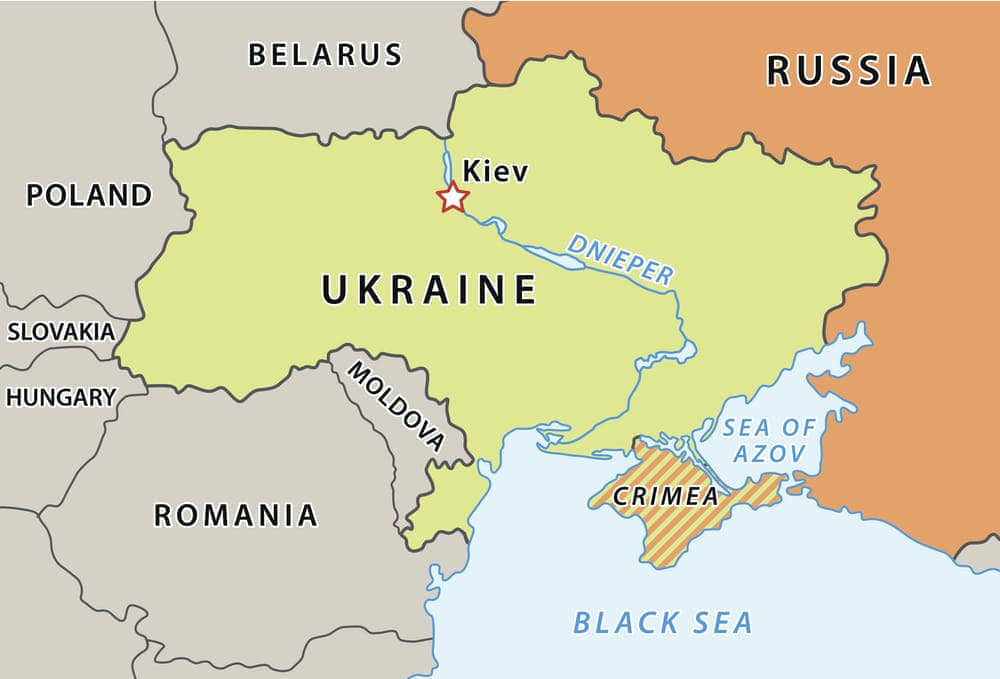
So, as Cohen pointed out, within a year of the dissolution of the Union Treaty, the situation in Ukraine was already showing potential for conflict, after all, millions of ethnic Russians in Crimea and the Donbas now found themselves citizens of an entirely different country – and it was one which harbored rather different historical and cultural views from that of the Soviet Union.

The situation in Ukraine grated on the nerves of Russian nationalists who blamed Russian president Boris Yeltsin for his inept handling of the Soviet breakup. Russian nationalists in Crimea began to assert themselves as early as 1992, when the regional Crimean parliament declared independence from the new Ukrainian state. Russian Nobel Laureate Alexander Solzhenitsyn believed Yeltsin was duped by Ukrainian president Leonid Kravchuk’s promise during the negotiations in the Belavezha Forest that after the dissolution of the Union Treaty, a new kind of Union with “invisible borders, a single army and currency” would replace the old USSR.

Solzhenitsyn denounced the leaders of the new Ukrainian state for deceiving Yeltsin noting that the Ukraine nationalists now in charge “who in the past so staunchly opposed Communism, and…cursed Lenin” now, in an about-face, eagerly accepted “the false Leninist borders of Ukraine” including what he called “the Crimean dowry of the petty tyrant Khrushchev.”

Indeed, the disagreement over borders and the treatment of the ethnic Russian minority population within the new Ukrainian borders remains at the heart of the current controversy between the two nations. 

I. George H.W. Bush’s ‘Go Slow’ Policy

Given the unstable and indeed volatile situation on the ground in the countries of the former Soviet Union, the administration of US president George H.W. Bush crafted a Soviet-, and later, Russia- policy based on two pillars consisting of 1) a refusal to rub Russia’s diminished fortunes in its face and 2) an effort to avoid exacerbating the latent ethnic tensions within the former Soviet republics.

As Bush’s secretary of state James A. Baker later wrote: “Time and again, President Bush demanded that we not dance on the ruins of the Berlin Wall. He simply wouldn’t hear of it.”

Concretely, Bush’s “go slow” policy meant that the US would not push one way or another with regard to the direction post-Soviet politics took. Bush’s emphasis was on avoiding a crisis rather than shaping the new reality.

Bush and his team recognized the world US and Soviet leaders had operated in since the end of the Second World War had changed irrevocably after Gorbachev’s UN Speech of December 7, 1988. Gorbachev abandoned the Marxist class struggle that for decades served as the basis for Soviet foreign policy. In place of that, Gorbachev declared that Eastern European states were free to choose their own paths, declaring “the compelling necessity of the principle of freedom of choice” as “a universal principle to which there should be no exceptions.”

Gorbachev continued:

“…The next U.S. administration, headed by President-elect George Bush, will find in us a partner who is ready – without long pauses or backtracking – to continue the dialogue in a spirit of realism, openness and good will, with a willingness to achieve concrete results working on the agenda which covers the main issues of Soviet-U.S. relations and world politics.”

Initially, Bush and his team were skeptical of Gorbachev. In his memoirs Bush’s National Security Advisor Brent Scowcroft dismissed the historic import of Gorbachev’s speech, writing that the speech “had established, with a largely rhetorical flourish, a heady atmosphere of optimism.” Scowcroft worried that Gorbachev would then be able to “exploit an early meeting with a new president as evidence to declare the Cold War over without providing substantive actions from a ‘new’ Soviet Union.”

The caution with which Bush and his team treated Gorbachev was likewise extended to the newly or soon-to-be independent states in Eastern Europe. There was to be no dancing on the ruins of the Berlin Wall. The diplomatic historian James Graham Wilson noted that Bush realized that a triumphalist approach on the part of the Americans might backfire. “Ok, so long as the programs do not smack of fomenting revolution,” Scowcroft wrote on a paper proposing ‘democratic dialogue’ in Eastern Europe.

Eventually, Bush accepted that Gorbachev was serious about reform and came to see him, as Reagan, Shultz and Matlock did: As a partner in ending the 40 year division of Europe.

A little known episode that took place at Camp David in November 1989, a month before the first summit meeting between Bush and Gorbachev may have played a role in convincing Bush to overcome the skepticism of his advisers.

A young national security council aide named Condoleezza Rice invited two Russian specialists to Camp David to meet the Bush: Harvard University’s Richard Pipes, a leading neoconservative hardliner, and Princeton University’s Stephen F. Cohen, a leader of the “revisionist” school of Soviet history and author of a biography of Soviet leader Nikolai Bukharin that Gorbachev had admired. Pipes and Cohen had a long, public history of opposing views and were frequent sparring partners on television and radio. At Camp David, Pipes and Cohen debated how the president might best approach Gorbachev at the upcoming summit in Malta. Pipes was, like Bush, a Republican and had served as an advisor on Soviet affairs to President Reagan. Cohen was a left-of-center critic of US policy and a longtime advocate for detente. Many years later, Cohen told me that after the debate, Bush asked that he sit next to him at lunch, and, seemingly rejecting Pipe’s hardline advice, told the room “Steve is my kind of Russianist.”

Subsequent events at Malta show that Bush took Cohen’s advice to heart. As Graham-Wilson notes, at Malta, “Bush wanted to avoid the impression that he was issuing orders to a defeated rival.” And according to the historian Joshua Shifrinson “Rather than trumpeting the collapse of the Soviet system for political points, the American transcript [of the meeting] suggests that Bush was willing to downplay changes in Soviet ideology if doing so would help maintain U.S.-Soviet relations writ large.”

***

Once the USSR fell, Bush and his team recognized the combustible reality on the ground. The most well-known expression of Bush’s policy towards the emerging post-Soviet states was made on August 1, 1991, during a speech to the Ukrainian Rada where he pledged that the US would take a hands off approach. Bush told the audience that the US “cannot tell you how to reform your society. We will not try to pick winners and losers in political competitions between Republics or between Republics and the center. That is your business; that’s not the business of the United States of America.”

Bush also warned he would “not support those who seek independence in order to replace a far-off tyranny with a local despotism. They will not aid those who promote a suicidal nationalism based upon ethnic hatred.”

Bush was bitterly criticized by Cold Warriors within his own party. William Safire, a neoconservative columnist for the New York Times, famously dubbed the speech “Chicken Kiev.” Yet, and tragically, nationalist impulses drove Kiev, in both 2004 and 2014, to ignore the votes cast by the Russian speaking citizens in the south and eastern parts of Ukraine. And more dangerously, political elites in Kiev also embarked on a mission to join the NATO alliance.

Matlock has said that he was “quite convinced that if Bush had been reelected he would not have [expanded NATO].”

But we will never know, because on Tuesday, November 3, 1992, Bush lost the presidency to Arkansas governor Bill Clinton.

I want to make one final point regarding Bush’s foreign policy. The wariness he evinced over stirring up the cauldron of parochial nationalism in the former USSR also manifested itself in his policy toward an emerging, analogous situation in the Balkans.

Yugoslavia, like the USSR, was a communist, multi-ethnic, multi-confessional state that was, after 70 years, descending – thanks to nationalist tensions in Croatian, Bosnia, Slovenia and Serbia – into chaos. In Baker’s judgment, the war in the Balkans did not merit American intervention: “We don’t,” Baker once family quipped, “have a dog in this fight.” Baker also no doubt also understood the close historic, cultural and religious ties between Serbia and Russia and rightly felt that American attempts at shaping the post-Yugoslav reality on the ground would inevitably mean choosing sides and violating Bush’s cardinal rule against rubbing Russia’s diminished position in its face.

As we will see, the Bush approach toward both Russia and Yugoslavia was entirely rejected by the incoming Clinton administration – with disastrous results.

II. Clinton’s Wrong Turn

In the years following the 1992 US presidential election, Bush’s policy of respectful non-interference in post-Soviet affairs was replaced by a policy of micromanagement from Washington. The problem started early on. Clinton’s choice of foreign policy advisors proved the truth of the old dictum that “personnel is policy.” An old Clinton friend from his days at Oxford, Strobe Talbott, became the president’s principal advisor on Russia. And in short order, Talbott, and a team of officials from the State Department, CIA, Treasury and the National Security Council embarked on a series of trips throughout the former Soviet Union.

Dubbed “hello-goodbye” tours, Talbott and a team which included the young foreign service officer Victoria Nuland, a member of the most influential neoconservative family in Washington, currently serving in the Biden administration as Undersecretary of State for Political Affairs. The Talbott team traveled to 14 of the former Soviet republics. Talbott has written that his job was “to deliver to leaders of all the new independent states messages of American support for their sovereignty and willingness to help them resolve their disputes with each other and with Moscow.”

Their first trip to Kiev was in May 1993.

What was behind all this?

The answer is as sad and it is unsurprising: Votes. Clinton’s policy to expand NATO was calibrated to appeal to voters of Polish and Ukrainian descent in the American Rust Belt. It was politics that drove the policy – not US national security interests.

In a recent interview, Ambassador Matlock revealed that…

“The real reason that Clinton went for it [NATO expansion] was domestic politics. I testified in Congress against NATO expansion, saying that it would be a great mistake, and that if it continued, that certainly it would have to stop before it reached countries like Ukraine and Georgia, that this would be unacceptable to any Russian government, and that furthermore, that the expansion of NATO would undermine any chance for the development of democracy in Russia.”

Matlock continued:

“But why, when I came out of that testimony, a couple of people who were observing said, ‘Jack, why are you fighting against this?’ And I said, ‘Because I think it’s a bad idea.’ They said, ‘Look, Clinton wants to get reelected. He needs Pennsylvania, Michigan, Illinois; they all have a very strong East European…’ Many of these had become Reagan Democrats on East- West issues. They’re insisting that the Ukraine [NATO] expand to include Poland and eventually Ukraine. So, Clinton needs those to get reelected.”

Clearly then, NATO expansion was driven by Clinton’s political agenda. US national security interests didn’t enter into the equation. Clinton’s rejection of Bush’s “go slow” policy was a fateful error, and one that has helped to bring about the current proxy war between Russia and the West in Ukraine.

But if Clinton’s major mistake was pushing NATO expansion, a close runner up would be his policy toward the former Yugoslavia. Here again Clinton failed to take heed of Bush’s warning regarding “suicidal nationalism.” And indeed it might be fair to say that Clinton’s policy towards Serbia set the stage for what we are seeing in Ukraine.

Writing at the end of the 1990s, the late foreign affairs columnist William Pfaff observed that “The end of Soviet power encouraged Americans to think that history itself had validated American virtues and given the country a new mandate to improve the world, not by providing it with an edifying example, as once believed, but through action.”

And the hawkish ‘New Democrats’ who staffed and advised the Clinton administration found many an opportunity to flex American muscle in the new ‘unipolar world.’ Clinton and his national security team came quickly – after NATO’s intervention in Bosnia in 1995 – to take the efficacy and rightness of humanitarian intervention as an article of faith. The success of the Dayton Accords seemed to cement the idea that America was, after all, the indispensable nation.

As the historian David P. Calleo observed, the Clinton administration “had always sported a low-grade Wilsonian rhetoric that implied hegemonic ambitions,” it was only after Dayton that “the policy began to imitate the rhetoric.”

Clinton’s second intervention in the Balkans in 1999 set the template for what George W. Bush attempted in Iraq, and, later, what Barack Obama attempted in Libya and Syria. In the absence of U.N. sanction, Clinton launched a 78-day bombardment of Serbia, ostensibly undertaken to prevent what was said to be the looming slaughter of Albanian Kosovars by Serbian forces.

Kosovo, and later American interventions in Iraq, Syria, Libya, combined with the American-sponsored “color revolutions” in Eastern Europe in the 2000s, all fed Vladimir Putin’s paranoia about American intentions – and his fears of American-sponsored regime change in Moscow. As the novelist Joseph Heller once wrote: “Just because you’re paranoid, doesn’t mean they aren’t after you.”

Russia’s reaction to Clinton’s policy, particularly with regard to its illegal bombing campaign over Serbia helped to feed the crisis from the other end: It is useful to recall that the precedent for Russia’s unilateral recognition of the breakaway republics of Dontesk and Luhansk made this past February was set by the US in February 2008 when the it unilaterally recognized the independence of Kosovo.

***

The “suicidal nationalism,” of which George HW Bush warned us, has long haunted Ukrainian politics, and in recent years has become its most dominant force thanks in no small part to the rhetorical financial and military assistance provided by presidents Clinton, Bush II, Obama and Trump.

Ukrainian nationalism bared its teeth during the so-called Orange Revolution in 2004, and then again during the violent coup d’etat of February 22, 2014. This last led directly to an 8 year war (April 6, 2014 – February 24, 2022) against the Russian speaking regions of Donetsk and Luhansk which killed over 13,000 people and displaced 1.3 million. The primary victims of that war, Russian speaking non-combatants, received little in the way of sympathy in the West.

In post-Maidan Ukraine, discriminatory language laws were instituted and an “anti-terror operation” aimed at the Donbas commenced under the direction the Washington’s hand picked prime minister Arseniy Yatsenyuk.

These moves by Kiev directly challenged Putin’s policy of protecting Russian minority populations abroad. The later refusal by Ukrainian presidents Poroshenko and Zelensky to implement the Minsk Protocols of 2015 was yet another sign that “suicidal nationalism” had taken hold in Kiev.

It then seems clear, in the light of history, that Bush’s prudential and cautious policy toward Russia was the correct one. Unfortunately, Clinton and his advisers, many of whom, worryingly, continue to hold sway over the policymaking process in Washington all these years later, rejected Bush’s approach.

The results speak for themselves.

Rajan Menon and Dan DePetris: Article 5 will never be a flip switch for war

NATO

By Rajan Menon and Dan DePetris, Responsible Statecraft, 11/17/22

On November 15, two Russian-made cruise missiles crossed into Poland, landing in the village of Przewodow, a village in the southeastern corner of the country, near the border with Ukraine, killing at least two people.

Preliminary investigations, as reported by NATO Secretary-General Jens Stoltenberg, indicate that the incident was caused by Ukraine’s missile defense systems, which sought to intercept an incoming Russian missile. But the event immediately created a storm of speculation, coming as it did on a day when the Russian military fired some 90 cruise missiles at energy installations and other sites throughout Ukraine, continuing a weeks-long attempt to devastate the Ukrainian economy as winter approaches.

The episode, though accidental, marks the first time the fighting in Ukraine has crossed into NATO territory. That, in turn, produced a tsunami of instant analysis about whether Poland would invoke Article 5 of the 1949 Washington Treaty that created NATO. Article 5 is important because it states that an attack on one member state is an attack on all.

Everyone should have taken a deep breath. In times like these, when emotions run high and scary scenarios abound, prudence is particularly important. Invoking Article 5 is an alliance decision—and even if it were invoked, each country has the right to determine how it will respond.

Article 5 is frequently labeled the North Atlantic Treaty’s most important clause—and with some justification. The collective defense commitment serves as the foundation of NATO’s deterrent power. It is designed to dissuade an adversary from even thinking about launching an attack against a member state for fear of having to fight an alliance that now includes 30 countries (compared to the Cold War highpoint of 16). To the alliance’s credit, the collective defense provision has worked as intended since 1949. The only time NATO has invoked the clause was after the 9/11 attacks, and that was largely as a demonstration of solidarity against a much weaker foe—a terrorist group, not a state.

Furthermore, putting NATO on a war footing isn’t as simple as flipping a switch—and that’s a good thing. The invocation of Article 5 doesn’t actually require all NATO countries to go into autopilot mode and rush into battle. Each member of the alliance has self-agency. The decision to act, and what exactly to do, lies entirely with individual states and may differ depending on any number of circumstances—and for good reason.

NATO’s commitment to collective defense was framed in a manner that would prevent events outside of its control from forcing the alliance into military action it may not wish to take. To preclude haste, the alliance’s charter gives each member state the leeway to act “as it deems necessary…to restore and maintain the security of the North Atlantic area.” The term “action” is left open to interpretation: it could include the use of military force but also any number of responses short of war, including severing diplomatic relations with the offending state and imposing economic sanctions. The resort to force is not ruled out, but neither is it automatic.

Moreover, no treaty, however sacrosanct in Washington policy circles, supplants the U.S. Constitution. Even had Poland requested the invocation of Article 5 and NATO determined that military force was called for, President Biden could not have short-circuited American constitutional procedures. He would still need to approach the U.S. Congress, the branch with the sole authority to declare war or authorize the use of force, and make the case that war serves the U.S. interest. Bypassing these critical procedures, even to protect an ally, would be unconstitutional. 

What happened in Poland should remind us that war is inherently unpredictable and far more difficult to control than those who initiate and wage it assume. It can escalate, spread to places that were not in the fight when the guns began to fire, and produce unimaginable economic repercussions. The longer a war drags on, the more likely the law of unintended consequences will kick in.

The war in Ukraine illustrates this perfectly. It has lasted longer than anyone — certainly Vladimir Putin — anticipated and increased food and energy prices for countries, especially poor ones, thousands of miles away from Ukraine. There’s no reason to believe a negotiated settlement to the war in Ukraine is on the horizon; but there are several reasons to believe that more surprises await us—some that may harm people with no immediate connection to the conflict. This is reason enough to have provisions and procedures, such as Article 5, in place to put a brake on impulsive reactions. To their credit, President Biden and America’s NATO partners displayed this prudence by not jumping to a premature conclusion and, instead, urging patience until the facts became clear.

The larger lesson to be learned from what happened in Poland is that dialogue is an essential requirement during moments of tension. Washington and Moscow need to keep communications channels open even, or especially, during the worst of times. Putin’s invasion of Ukraine has taken US-Russian relations to their lowest point in the post-Cold War era. As tempting as it may be to ostracize Russia, self-interest, even self-preservation, dictates clear and frequent communication in order to minimize misunderstandings and prevent isolated incidents from blooming into full-blown crises. It’s the kind of common sense which, fortunately, infuses Article 5.

TASS: Poll shows 60% of Russian businessmen see domestic demand decline as main problem

dirty vintage luck table
Photo by Rūdolfs Klintsons on Pexels.com

TASS News Agency, 11/7/22

MOSCOW, November 7. /TASS/. Over 60% of Russian entrepreneurs pointed to the decline in domestic demand as the main problem they are up against now. This is according to a survey conducted by the office of the institute of Russia’s Presidential Commissioner for Entrepreneurs’ Rights among businessmen in October 2022.

The survey involved 5,760 entrepreneurs from all regions of the country. In particular, 74% of respondents belong to the micro business sector, 21% to small businesses, 3.4% to mid-sized businesses and 1.6% to large businesses. Twenty-three percent of respondents are engaged in in the non-food products sector, another 11% in food, 8% in catering, and 7.5% each in manufacturing, construction and building materials, 7.3% in the consumer services sector, 5.2% in agriculture and forestry, 3.9% in education, and 3.5% in the hotel and tourism business. Each of the other industries does not exceed a share of 3% of the total number of respondents.

“Sixty-four percent of entrepreneurs picked this particular factor as the thing that most negatively affect their business. The next ones in terms of severity are shortage of personnel (34.2%), shortage of working capital and cash gaps (28.9%), supply chain gaps (26.5 %), and the complexity of import delivery (19.1%),” the survey results reveal.

According to the report, the partial mobilization introduced in Russia did not affect the teams of the majority of respondents (66%), while 34% reported that part of their employees were called up.

“More than half (58.6%) of those whose employees were mobilized did not need to replace these employees, or a replacement was found very quickly, and only 19% could not find a replacement for drop-out employees so far,” the report says.

As the authors of the survey noted, 26.7% of respondents reported that they were unable to find analogues of critically important foreign products or services that are no longer supplied to Russia due to sanctions. However, the majority still managed to find new suppliers of the same (23.6%) or similar products, both in Russia (22.3%) and abroad (13.5%).

As for the impact of sanctions, entrepreneurs gave different assessments. More than half (55.4%) have fully adapted or continue to adapt to the West’s anti-Russia sanctions.

“That is, most of the community withstood the aftermath of the sanctions,” the institute’s office stated. Anyway, 10.5% of the polled participants said that they could not cope with the consequences of the sanctions, and 16.3% did not notice them at all. Regarding the assessment of the state of their own business, only 6% of respondents said that they had to close their businesses or will have to do so soon.

Support measures and government work

Among the state support measures already taken, the entrepreneurs most highly appreciated the moratorium on inspections (52.2%), reduction of rates of the simplified system of taxation and property tax rates in the regions (37.4%), soft loans for SMEs for backbone companies (23.9%), and the suspension of new requirements for labeling goods (22.7%). The survey’s authors noted that the respondents were allowed to give a multiple choice answer to this question.

The measures the entrepreneurs would like the government to take in the future include writing off part of taxes, cutting insurance premiums to 15% of the total salary, cheaper and more accessible revolving loans, as well as the freezing of tariffs for natural monopolies.

According to the poll, 40.9% of respondents believe that the government’s work in terms of import substitution and the development of domestic production in Russia is the right move. However, the respondents also note that the volume of measures taken is still insufficient, and 8% believe that the actions of the authorities have already significantly improved the situation.

Wyatt Reed: Italian Police Foil Deadly Plot by Neo-Nazis Linked to Ukraine’s Azov Battalion

Azov Battalion symbol

By Wyatt Reed, Sputnik, 11/15/22

The alleged plot to destroy various Italian targets — including a police station — appears to be the first attempted terror attack in Western Europe linked to Ukraine’s official Nazi military formations.

Police in Italy arrested four suspected neo-Nazis with links to Ukraine’s notorious Azov Battalion who were accused of plotting to carry out “violent acts” against both civilians and police, according to local media.

Photos released by police show the Nazi paraphernalia seized in around 30 raids on members of the “Order of Hagal” throughout the country included photos of Nazi dictator Adolf Hitler, Italian dictator Benito Mussolini, and t-shirts bearing the logo of Ukraine’s official Nazi regiment, the Azov Battalion.

“According to the investigators, the objective identified by the members of the Order of Hagal was the Marigliano [police] barracks,” Italian outlet Today Chronicle wrote Tuesday.

According to the Italian publication, one of the suspects wanted by police “disappeared” before he could be apprehended – a 27-year-old Ukrainian national named Anton Radomosky, who the outlet reported “would have offered his ‘intermediation’ between the Order of Hagal and neo-Nazi groups such as the Azov Battalion,” which they note “is particularly active in the context of the War in Donbass.”

Information published by ANSA, Italy’s leading news agency, indicates that Radomosky “is currently in Ukraine, and the investigation showed that he was in contact with the Azov Battalion.”

According to another Italian source, the “Ukrainian accomplice… wanted to cause an explosion in a shopping center.” Corriere Del Mezzogiorno indicated “the cell had contacts” with not only “Ukrainian ultranationalist formations such as the Azov Battalion,” but also the notorious Ukrainian “Right Sector” nazi militia.

The EU and Interpol have been fretting for months about the likelihood that weapons being shipped to Ukraine amid NATO’s proxy war on Russia will end up in criminal hands. As Interpol chief Jurgen Stock explained in early June, “Once the guns fall silent [in Ukraine], the illegal weapons will come. We know this from many other theaters of conflict. The criminals are even now, as we speak, focusing on them.”

Gilbert Doctorow: Cost of Living in Europe and Further Aid to Ukraine

dirty vintage luck table
Photo by Rūdolfs Klintsons on Pexels.com

By Gilbert Doctorow, Blog, 11/6/22

The single largest contingent of readers of my essays is in the United States, and it is for their particular benefit that I open today’s piece with some concrete facts on how Europe’s self-imposed energy crisis resulting from the ban on import of Russian hydrocarbons is making it impossible for your average citizen of France, Belgium and many other countries in the EU to make ends meet. I hasten to add that the unworkable arithmetic of monthly household finance is day by day, week by week bringing us to the social unrest and political instability that I and others have been predicting ever since the trend lines on cost of living became clear some months ago.

I will not introduce official statistics, because when the going gets tough they tend to be presented in a very selective manner by the authorities. My ‘anecdotal’ evidence comes from the energy bills I am now receiving at my home in Brussels and from what friends and acquaintances in this country and in France tell me about their personal situations.

A couple of weeks ago, I received from Engie, the French based energy giant that owns Electrabel, the formerly independent Belgian electricity generator and distributor, a report on my annual electricity consumption for their accounting year ending on 7 October 2022. The total charges were 1807 euros, meaning 150 euros per month. In the same communication, they informed me that the new rates applied to the coming year will require a 285 euro debit from my bank each month. Presto, my electricity bill doubles!

Meanwhile, my latest delivery of 1,000 liters of heating oil for our house was invoiced at 1,500 euros, which is also virtually double what I paid for oil one year ago. And I consider myself lucky that I did not follow the advice of various heating specialists who visited my home a year ago for maintenance work on our furnace. They had suggested that we go ‘modern’ and convert from oil to natural gas, because for seniors like myself that spares us the necessity of monitoring the level of mazout remaining in our basement tank so as to place a delivery order on time. If you order too early, the minimum quantity of 1,000 liters will not fit and you are charged a premium for the delivery of a short order. If you order too late, the sludge at the bottom of the tank may feed into the system, blocking the filter on the way to the point of ignition and you have to bring in a repair man at the cost of several hundred euros. Natural gas, I was told, would spare us these inconveniences. Of course, today gas heating is not double but triple or more the cost it was a year ago, and friends who ‘went modern’ rue that decision. If there will be gas shortages this winter, which remains a possibility depending on the severity of the frosts ahead, these friends will also regret the inconvenience of heating cut-offs leaving them in the cold, literally and figuratively.

Again, to make sense of the heating oil figures, the 1,000 liters mentioned above heats my home for a period of 4 to 6 weeks in autumn, winter and early spring depending on how low the air temperature outside descends. So far this year, we have been very lucky temperature-wise in Western Europe this fall. But a nice drop to zero at night for a week or more later in this year can reduce substantially the staying power of 1,000 liters.

Lest my mention of these new costs sound like whining, let me assure the gentle reader that I personally have no problems meeting the costs. Now that the euro has fallen like a stone this year due to the shaky economy driven by the energy crisis and inflation, my U.S. social security checks each month are worth 20% more in local currency and my new additional energy costs are largely covered. My highlighting these figures and new ratios of cost is to bring to the fore how they affect the great majority of this country’s working population.

 It would be fair to say that the monthly take-home pay of 70% of Belgians after the 50% income tax is withheld comes to about 1,500 euros. Just for comparison, if this figure seems unduly low, the state pensions of many Belgians come to just a few hundred euros; and you have to have been very successful in your working career to receive a pension equivalent to those same 1,500 euros.

Let us assume that my electricity and heating costs are well above average because of the size of my home and the unimproved state of our insulation. Let us assume that these same 70% of the population have total energy costs now of 900 euros a month, or half of what I will be paying in effect. In a household where there is only one breadwinner, this would leave just 600 euros a month for food, apartment rent or mortgage payments and all other expenses. The arithmetic just doesn’t work. Your household budget will be in sharp deficit each month.

I have taken Belgium as my example, but I assure the reader that the numbers for income and outgo of the majority of the populations in neighboring European countries are not much different. That is true even in Germany despite its seeming prosperity. So what will the people do about it? At what point does public indignation and growing poverty spill over into social and political unrest?

In past essays, I pointed to France as a country with a long tradition of political volatility, a country where workers will go out on strike at the drop of the hat. Indeed, when Macron raised the tax on petrol in November 2018 we saw the voluble and politically threatening emergence of the gilets jaunes or Yellow Vests, a movement which for a couple of years stubbornly resisted all of the government’s measures at suppression. Today, after losing its parliamentary majority in the last elections, the Macron government is much weaker and understands that it cannot fight strike movements head on even if it briefly threatened to bring in the army and to forcibly send workers back to their jobs in the refineries and petrol distribution network. Accordingly, Macron has folded and now resorts to buying off strikers and other protesters. Their demands for salary hikes are not met, but they are quietly being given ‘premiums’ of several months pay to go back to work and shut up. So far that has been effective, but it is running up the ongoing budget deficits and may soon be unsustainable. It also places France in great dependence on Germany’s looking a blind eye at the fiscal irresponsibility of Paris and its violation of EU finance rules.

And so street demonstrations by tens of thousands of irate citizens against untenable increases in cost of living have arisen elsewhere in Europe. Even The Financial Times is today giving extensive coverage to yesterday’s march in downtown Rome which brought together the economic issue of unsustainable rises in energy costs and the political issue of the ongoing war in Ukraine and Europe’s failed policies in that regard. The banners read “End to Violence” and the overriding message was that Italy must work to bring the warring parties to the negotiating table, not feed the conflict by further deliveries of arms to Kiev. This is a movement that is sure to turn up in many other European cities in the coming weeks, and the European governments will be unable to ignore it.

Even in the United States, the worsening financial position of the government will likely force an abrupt change of policy on Ukraine after the Midterm Elections deprive the Democrats of control over Congress. Humanitarian instincts, concern for the growing death toll of Ukrainian males on the field of battle will have no role whatsoever in this revaluation of policy. It will be driven and it will be justified by the high and rising cost of federal government borrowing in pace with the rises in the prime rate to tame inflation, inflation that is in large part due to distortions in the global oil and gas markets that the sanctions on Russian energy are causing.

For the powers that be, in Europe and the United States, the only ‘bright spot’ in the immediate future may be that the Russians solve their problems for them by winning the war with lightning speed.

Zelensky is reported today in Western media as saying that 3 million people may be forced to evacuate Kiev if the Russian assault on the electricity generation and distribution proceeds at its current pace. Ukrainian authorities responsible for the national grid, say it may collapse in the near future. And so we may envision two developments that lead to the same conclusion of Kiev suing for peace: the flight of 9 million or more citizens to Western Europe where they threaten to overwhelm capacity of reception centers and so precipitate an armed push-back; and the disintegration of the Ukrainian fighting forces in the midst of national black-out.

Analysis & Book Reviews on U.S. Foreign Policy and Russia