How the West Provoked War in Ukraine: Katie Halper & Aaron Mate Interview Ben Abelow

Link here.

Interview starts at about 13 and a half minutes in. Ben Abelow is the author of the book How the West Brought War to Ukraine, which I am currently reading and will be posting a review of soon. – Natylie

Patrick Lancaster: Referendums to Join Russia Start in Ukraine

Link here.

“We are on the ground in Kherson to show you what is really happening and we will be going to all 4 referendums making the most in-depth coverage available.” – Patrick Lancaster

Toal & Korostelina: We asked Ukrainians living on the front lines what was an acceptable peace – here’s what they told us

ukrainian flag waving in wind with clear sky in background
Photo by Nati on Pexels.com

By Gerard Toal and Karina Korostelina, The Conversation, 9/15/22

Ukraine’s recent counteroffensive success against Russian troops in the Kharkiv region has raised hopes that a larger rollback of occupying troops is at hand. But this remains a daunting task: Russia continues to occupy roughly one-fifth of the territory of Ukraine, including Crimea, which it unilaterally incorporated into the Russian Federation in 2014.

Victory, not peace, is the priority for Ukraine’s leadership, with President Volodymyr Zelenskyy declaring Ukraine will not give up any of its territories to end the war. But a time will come when peace will have to be made. And any agreement will need to be accepted not only by the leaders but by the Ukrainian people if it is to hold. As such, it is important to know what terms of settlement are acceptable – and perhaps more importantly, unacceptable – to ordinary Ukrainians, especially those living in front-line areas or displaced by Russia’s invasion.

To understand what an acceptable peace looks like to significantly war-affected Ukrainians, we organized a face-to-face survey of over 1,800 Ukrainians. The Kyiv International Institute of Sociology administered the survey for us in July 2022. Around half of respondents were local residents in three Ukrainian-controlled towns close to active front-line fighting: Dnipro, Zaporizhzhia and Poltava. The other half comprised people internally displaced by the war who were sheltering in these towns.

Here are three key takeaways from the survey:

1. Having a strong state that can defend territory is a top priority

Our survey asked respondents an open question about what their goals were for Ukraine after the war, with the responses organized by the Kyiv International Institute of Sociology into categories unseen by respondents.

More than half indicated that creating a peaceful and prosperous state was a top priority. Many saw the means to achieve this through military strength, with a third stating that having Ukraine emerge as a strong state with a large military that could defend its territory was their postwar aspiration for their country.

Slightly fewer mentioned Ukraine being a sovereign state able to make its own independent decisions as important, while 28.3% included Ukraine having full control over all its territories among their responses. More than a quarter mentioned having a state free of corruption as an important goal.

Existing government policy aspirations attracted some support. Around 1 in 5 mentioned Ukraine becoming a member of the European Union, though only 13.1% mentioned NATO membership.

Even Ukraine being a democratic state fell lower down as a priority, with just 14.1% mentioning it as a top goal.

Our survey suggests that peace, state strength and territorial integrity rather than geopolitical status or democracy are on the minds of front-line Ukrainians today.

2. Ukrainians reject concessions on self-determination, territory

We also presented a series of potential war outcomes to respondents and asked them whether they found these acceptable if it meant peace. Most of these scenarios generated strong feelings, with the category “absolutely not acceptable” the most frequently used.

The scenario most vehemently rejected by respondents is one in which Ukraine loses its right to determine its future in return for an end of hostilities. Yet opinion is less emphatic when it comes to the hypothetical ending of Ukraine’s aspirations of joining Western organizations. An outcome where Ukraine ends its quest for NATO membership in return for peace is absolutely unacceptable to 46% of respondents. The figure for giving up on European Union membership is 55.9%. These figures are still high, of course.

And while we found solid majorities rejecting territorial concessions in return for peace, the front-line Ukrainians we surveyed were less vehement when it came to concessions over Crimea than the Donbas, with 58.4% and 67% of respondents finding it “absolutely unacceptable” to concede the regions, respectively.

When presented with hypothetical deals in which Russia offers financial compensation or a formal apology but keeps seized Ukrainian lands, more than 80% of respondents said that such an outcome was “absolutely unacceptable.”

In a different question, respondents overwhelmingly agreed that most Ukrainians see their national territory as sacred.

3. When it comes to negotiations, the messenger matters

As well as asking front-line Ukrainians what is acceptable or not acceptable in any peace settlement, we also wanted to see if their support for negotiations would be affected by who was advocating it.

So we ran an experiment to test the power of different potential endorsers of negotiations toward a complete ceasefire in the war.

The survey participants were randomly assigned to three groups. The first group was simply asked, “How much do you support negotiations with Russia on a complete ceasefire in this war?”

The second group was asked the same, but also exposed to a made-up statement in which Zelenskyy stressed the importance of negotiations to prevent further soldier and civilian deaths. A third group was shown a similar endorsement, but this time it came from the leaders of the EU and the U.S.

The group not shown any endorsement backed negotiations by 46%. This jumped to 54% support among respondents who were shown the fictional endorsement by Zelenskyy. Interestingly, there was a small decrease in the support of ceasefire negotiations – down to 42% – when the messengers were leaders of the EU and the U.S.

The results suggest that the support of the Ukrainian leadership for a ceasefire negotiation is much more important than international pressure. Indeed, our survey indicates that Western leaders publicly pushing negotiations might induce a backfire effect.

Taking on the voice of front-line Ukrainians

Although not nationally representative – our survey focused on those displaced by war and close to active front lines – the views presented by respondents provide insight into what is important and currently unacceptable to war-afflicted Ukrainians. Those more distant from the front lines and without direct experience of displacement may have even more emphatic views.

Ukraine’s leadership is in no mood to talk peace with Russia at the moment. But negotiations will be needed at some point. Paying close attention to the views of ordinary Ukrainians is vital, for any proposed peace settlement requires their general consent to have a chance of taking hold and enduring.

Paul Robinson: Russia ups the ante in Ukraine

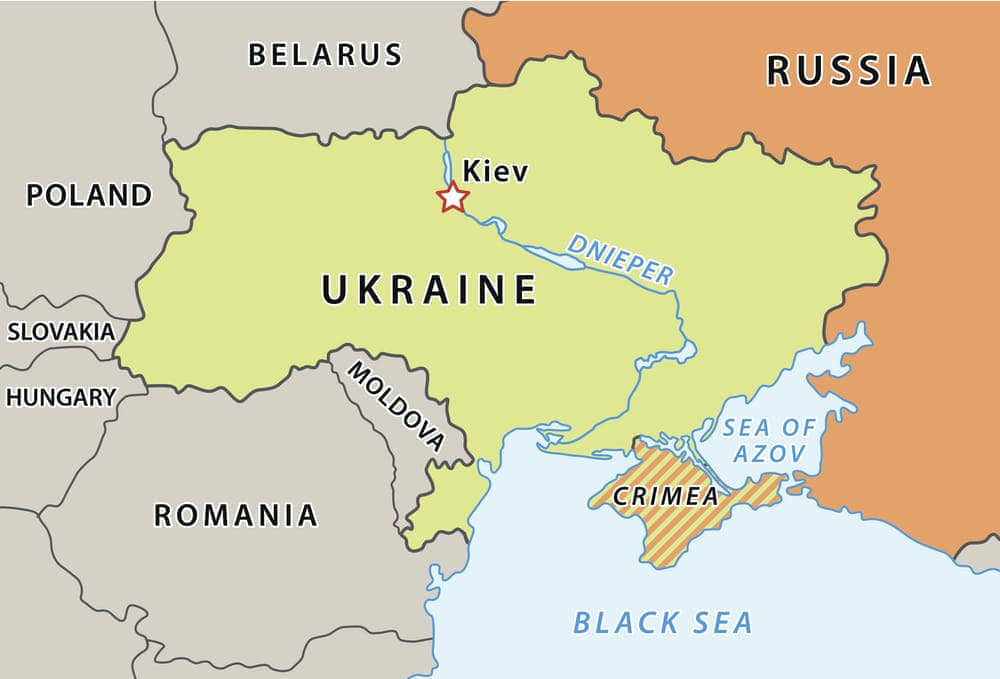
Map of Ukraine

By Paul Robinson, Canadian Dimension, 9/22/22

“War,” said the great Prussian strategist Carl von Clausewitz, “is an act of force, and there is no logical limit to the application of that force. Each side, therefore, compels its opponent to follow suit; a reciprocal action is started which must lead, in theory, to extremes.”

With this, Clausewitz introduced the concept of escalation into the theory of war. As it meets resistance, each side increases the amount of force it applies, inducing the other side to do likewise, setting in motion an upwards spiral that has no theoretical limit other than the physical capacities of those involved.

So it has proven in the current war in Ukraine. When Russia began hostilities in February, it seems to have envisioned a short war ending in a negotiated settlement. Consequently, it applied only a limited percentage of the resources available to it. But its hopes of quick triumph proved to be in vain. Once it became clear that Ukraine would survive the initial onslaught, Western powers initiated the process of escalation, sending large volumes of military aid to Ukraine. This aid has proven very effective, enabling the Ukrainians first to halt the Russian advance and then to push the Russians back. The culmination of this process was a successful offensive this past month which saw the Ukrainian army recapture a large area of conquered territory without much of a fight.

However, as Clausewitz pointed out, the natural response to setbacks in war is not to give in but to apply more force of one’s own. And thus we should not be surprised that the Russian reaction to its recent defeat has not been to surrender but to escalate even further.

This week, the escalation has taken shape in two important ways. The first consisted of declarations by the authorities in four Russian controlled Ukrainian provinces—Donetsk, Lugansk, Zaporozhe and Kherson—that they would carry out referendums between September 23 and 27. The inhabitants of the provinces will be asked whether they wish to join the Russian Federation.

One may assume that the outcomes of these referendums are pre-determined. When the results are declared, it is almost certain they will claim that the great majority of the population of all four provinces have voted to join Russia. Speaking on Wednesday, Russian president Vladimir Putin said that he would respect the wishes of the people as expressed in the referendums. One may expect, therefore, that soon after the votes are held—perhaps as early as October 1—all four provinces will be absorbed into the Russian Federation.

Putin also used his speech to make an announcement concerning the second form of escalation. For the president declared a partial mobilization, calling up 300,000 military reservists. To date, Russia has only sent around 200,000 troops to the war in Ukraine. While some experts doubt Russia’s logistical ability to effectively deploy another 300,000, the more than doubling of the army’s size in Ukraine cannot but make a difference.

Until now, Russia has had a material advantage over Ukraine in terms of equipment, especially air power and artillery. But the Russians have been at a serious disadvantage in terms of manpower. This is a result of the unwillingness so far to use anything other than contract soldiers and volunteers. Simply put, the Russian army has not committed enough troops to effectively cover the entire 1,000 kilometre front. The partial mobilization of reservists is designed to resolve this problem. It will take several months, however, for the effects to be felt. The Ukrainian army has roughly to the end of the year to press its current advantage. After that, as the Russian reservists reach the front line, it may find the going much harder.

The impact of the forthcoming referenda in Donetsk, Lugansk, Zaporozhe and Kherson provinces will be more immediate. The legal framework for what the Kremlin euphemistically calls the ‘special military operation’ in Ukraine does not allow the use of conscripts outside of the territory of the Russian Federation. It would, of course, be relatively easy for the Russian government to adopt a new framework, but for economic and political reasons it wishes to avoid doing so. The annexation of the four Ukrainian provinces provides a neat work around. For once they have been absorbed into Russia, their territory is no longer foreign soil according to Russian law, and therefore conscripts could be legally deployed there.

This does not mean that the Russian army will necessarily do so. The political optics of deploying conscripts to the war zone remain poor. But the option will suddenly become available, and even if conscripts are not sent to the front, they could be sent to the newly annexed lands to free up soldiers currently engaged in activities behind the lines. The impending annexations offer up important opportunities for Russia to solve its manpower problems.

Beyond that, the likely absorption of Ukrainian territory into the Russian Federation severely complicates any potential peace negotiations. Although it was clear from the start of the current war that Russia intended eventually to annex Donetsk and Luhansk, it was less clear that it had this intent with regard to other Ukrainian territory it had occupied. Indeed, it seems likely that the initial plan was to use such territory as a bargaining chip that could be traded in for Ukrainian concessions on other matters. The outlines of a peace deal were something along the lines of Ukraine agreeing not to join NATO and accepting the loss of Crimea and Donbas, and in return getting back its other lost territories.

That deal is now firmly off the table. In 2020 the Russian Constitution was amended to state that action “directed at alienating parts of state territory as well as calls to such will not be permitted.” Once the four Ukrainian provinces become part of the Russian Federation, the Russian government will be constitutionally forbidden from giving them back to Ukraine as part of a peace deal. Moreover, it will also be unconstitutional for anybody in Russia even to suggest such a deal. Exchanging land for peace is no longer a possibility.

Russia is now committed to defending its newly conquered territory to the bitter end. If the additional resources announced this week don’t do the trick, then one can expect further escalations down the line. Ukraine, meanwhile, has made it clear that it has no intention of making peace on any terms other than the return of its lost land. Consequently, it is extremely difficult to see how any peace deal could be struck. The most one could possibly hope for would appear to be a ceasefire that freezes the conflict along the front lines existing at the moment that the guns fall silent, without any formal peace treaty (the ending of the Korean War is an example). For that to happen, though, there has to have been a prolonged period of stalemate from which both sides see no obvious exit. We are far from reaching that point.

In the meantime, Western leaders seem to be banking on Ukraine’s ability to achieve a total military victory. This week’s developments make this considerably less likely than before. Somewhat paradoxically, the developments may also mean that the final outcome may end up being less favourable to Ukraine than would have been the case had Western states not given it so much military support. For as previously mentioned, Russia might originally have been willing to give up some of its conquered land in return for various non-territorial concessions. But by enabling Ukraine to mount a successful military resistance, the West has induced Russia to escalate and to now adopt a position that makes a return of the lost territory impossible other than by military means that may be beyond Ukraine’s capacity.

All that, however, remains to be determined. As Clausewitz noted, war is a realm of chance and uncertainty. It would be a rash analyst who dared to predict how this current war will turn out. About the only thing of which one can be confident is that it will continue for a long time yet—certainly many months, and perhaps even years, until the two sides reach a point of mutual exhaustion. Every war must end, but at present this one’s ending seems to be far out of sight.

Paul Robinson is a professor in the Graduate School of Public and International Affairs at the University of Ottawa and a Senior Fellow at the Institute for Peace and Diplomacy. He is the author of numerous works on Russian and Soviet history, including Russian Conservatism, published by Northern Illinois University Press in 2019.

Leaked document exposes hidden Western hand behind new British-style anti-worker laws in Ukraine

ukrainian flag waving in wind with clear sky in background
Photo by Nati on Pexels.com

By Slobodan Kolomoets, RT, 9/1/22

In a scheme which may have been devised in far away London, Europe’s lowest paid workforce has just lost some of the few precious protections it had. The measure flies in the face of Ukraine’s apparent ambitions to join the European Union.

On August 22, Ukrainian President Vladimir Zelensky ratified highly controversial new labor laws, ones that have wide-ranging negative implications for the overwhelming majority of the country’s workers.

Collectively known as Bill 5371, the legislation robs up to 70% of Ukrainian employees of rights and protections provided under the country’s established national labor law, while severely restricting the power of already-embattled trade unions to organize.

President Zelensky’s ruling Servant of the People party argues the “liberalizing” measures are not only necessary, but long overdue, as a result of Kiev’s “extreme over-regulation of employment” contradicting “principles of market self-regulation [and] modern personnel management,” and creating “bureaucratic barriers both for the self-realization of employees and for raising the competitiveness of employers.”

By contrast, in the lead-up to Bill 5371’s ratification, a great many groups within and outside the country expressed outcry at the proposed measures over many months. The International Labour Organization (ILO), a United Nations agency charged with ensuring social and economic justice by safeguarding international labor standards, including conditions of freedom, equity, security and dignity in workplaces worldwide, published a withering and extensive analysis of the proposals – as did Ukraine’s own parliamentary committee on EU integration.

The body charged that the legislation “weakens labor protection, narrows the scope of labor rights and social guarantees of employees, in comparison with the current legislation,” in contravention of Ukraine’s obligations to Brussels under the terms of its Association Agreement. Andrey Reva, Ukraine’s former minister of social policy, has leveled similar charges:

“Employees will no longer have any protection against arbitrary dismissal. Upon hiring, the employee will be asked to sign an employment agreement, which will allow the employer to obtain unilateral advantages during its conclusion and deprive the employee of any legal opportunities for his defense … Why is this being done right now, when Ukraine has submitted an application to join the European Union and is awaiting its consideration?”

Made in Britain

Many comparisons have been drawn between these ‘reforms’ and notorious “zero-hour” contracts, which offer staffers no paid vacation time, limits on daily or weekly hours worked, notice periods, pension contributions, or even guaranteed work in the first place. They have been dubbed by academics as “a post-modern form of slavery.”

Internationally, the use of zero-hour contracts is almost exclusively restricted to Britain, with retailers, service industry operators, bars, restaurants and fast food enterprises throughout the country using them extensively, despite significant controversy. For example, 90% of McDonald’s workers in the country – amounting to almost 100,000 people – are employed on zero-hour terms.

Due to enormous public and trade union pressure, several major businesses that previously relied heavily on zero-hour workers have phased out their usage entirely in recent years, and there are ongoing efforts to ban such contracts outright. In New Zealand, they were outlawed in April 2016 before even taking off in the country.

One might wonder then why such a uniquely British phenomenon will be adopted by a country with which it has so little in common economically. The answer to that disturbing riddle lies in a leaked document revealing London has been intimately involved in covert information warfare operations to sell the deeply damaging new laws to Ukrainians as beneficial, and convince the public to harm their own interests by embracing the change.

The file in question is a communication strategy prepared by research consultancy Abt Associates, on behalf of the British Embassy in Kiev, and Foreign Office unit UK Aid, which officially aims to “achieve sustained poverty reduction,” improve the lot of “poor communities in developing countries,” and advocate for “free and fair work conditions.”

It offers extensive proposals for marketing the new laws, right down to “visual stylistics” to be used in on and offline ad campaigns, social media messaging, and press conferences.

For example, Abt Associates suggested using “contrasting” aesthetics, by “inverting colors” – “light text and graphics on a deep blue background.” The “advantages” of this approach were said to be to be: “brighter, more emotional, eyecatching, will differ from the predominantly white color scheme of publications on the pages of the [Finance] Ministry,” and “gives more opportunities to use creative illustrations.” Nonetheless, the risk that “emotional and vivid communication … will be perceived negatively” was acknowledged.

If that wasn’t manipulative enough, a section offering “recommendations” for “general principles of public communication of the bill” starkly underlines the duplicity and manipulation at the campaign’s core.

Noting that public figures supporting the legislation had to date purely extolled the benefits for employers, Abt Associates proposed inverting this to focusing on ostensible “positive results” for employees.

“Make communication easier and more emotional. Add formats of materials that will contain short simple formulations of key benefits,” the company wrote, going on to endorse surreptitiously enlisting the support of “opinion leaders” such as “journalists and bloggers” via “off-the-record meetings with the participation of the heads of the [Finance] Ministry and (optionally) the authors of the bill.”

“Emotional messages that do not correspond to the tone of the Ministry’s communication may be voiced by third parties,” the document explains.

Examples of messaging to be employed included portraying the “main purpose” of the laws to be “[protecting] new opportunities for both employees and employers,” creating “more opportunities and resources for business development,” and helping workers “get legal jobs faster and easier.”

Conversely, a list of “expected results” from the legislation included in the presentation – not intended for public consumption – ranked “increasing investment in Ukraine’s economy by improving business conditions” above most other potential benefits.

The end of democracy

How much London ultimately spent on this malign effort isn’t clear, although the sums involved could’ve been significant – UK Aid’s budget stands at £150 million, and the Foreign Office spent £40 million on a variety of programs in Ukraine in 2020/21, among them the labor-busting initiative administered by Abt Associates.

Still, British meddling wasn’t entirely successful. After being introduced to parliament in early 2021, legislators consistently refused to back it in significant numbers. This changed on May 12 this year, when the Rada voted in favor of the legislation’s first reading by a landslide – 192 votes to zero.

Pivotal to the laws’ sudden success was support from several previously-opposed political parties and groupings, which were banned less than two weeks earlier by Zelensky’s order. British media outlet openDemocracy speculates this crackdown – and the prospect of MPs belonging to these factions being purged from parliament outright in the future – may have been pivotal in convincing them to vote the ‘right’ way.

Since the 2014 Maidan revolution, Kiev has represented a never-ending feeding frenzy for Western governments and corporations. One of the post-coup government’s first acts was to remove constitutional restrictions on foreign shareholdings in Ukrainian businesses, privatization, and land ownership, and accept sizable loans from predatory US-dominated financial institutions such as the IMF, which opened up the country’s vast natural resources and land for untrammeled overseas plunder and profiteering.

While a great many companies and individuals have benefited handsomely from this wellspring – look no further than America’s first family for example – sizable public opposition to impoverishing neoliberal reforms has to date prevented outright enslavement of the population.

Now, though, with protests prohibited under martial law, opposition parties and dissident media outlets remorselessly censored and banned, scores of government critics – including officials themselves – arbitrarily jailed, and a brutal nationwide effort to root out “traitors” underway, the ability – or willingness – of Ukrainians to take to the streets and oppose measures such as the new anti-worker legislation is harshly truncated, if not eliminated entirely.

In the process, Zelensky’s ruling party is free to steamroll any and all laws through parliament it wishes – and the West’s total takeover of Kiev can finally be completed.

It seems odd that Ukraine is imposing such discredited and reviled arrangements on its citizens when public yearning for EU enrolment is at an all-time high, and high-ranking officials, including Zelensky, are demanding Brussels allow the country immediate entry to the bloc – the terms of Bill 5371 are contrary to Union workers’ directives and protections.

Perhaps, though, London and Washington, for all their pronouncements to the contrary, are unconcerned about Kiev becoming a member – in fact, that might suit their interests better.

Analysis & Book Reviews on U.S. Foreign Policy and Russia