Earlier this week, a mall burned down in the Ukrainian town of Kremenchuk after a missile attack by Russian forces. There have been conflicting claims about what happened and how many people died. Ukrainian president Zelensky initially claimed up to a thousand potential victims from the attack. Subsequent reporting seems to indicate far fewer casualties. I’m presenting two analyses of what happened: one from the Moon of Alabama blog – a good source but one that has a pro-Russia slant. The other is from Meduza, a Russian outlet based in Latvia that has a pro-Western slant. Both are worth a read. – Natylie
Yesterday I mentioned the burning shopping center in Kremenchuk, Ukraine, of which the Ukrainian president Zelensky falsely claimed that thousand people had been inside.
Satellite pictures show that the shopping center is right next to the large Kredmash machine plant. Was that the real target of the attack with the shopping center being an unintended casualty?
It has now been confirmed that the answer to my question is ‘yes’.
Today’s report on the war by the Russian Defense Ministry says:
On June 27, in Kremenchug (Poltava region), Russian Aerospace Forces launched a high-precision air attack at hangars with armament and munitions delivered by USA and European countries at Kremenchug road machinery plant.
High-precision attack has resulted in the neutralisation of west-manufactured armament and munitions concentrated at the storage area for being delivered to Ukrainian group of troops in Donbass.
Detonation of the storaged munitions caused a fire in a non-functioning shopping centre next to the facilities of the plant.
Ahhh – “don’t trust the Russians!” you say. Well, don’t trust anyone I say, just scrutinize the facts.
The Ukrainians have published surveillance video from a park catching the moments of the two explosions. A large flash appears and people are running away as some debris falls down.
The park is around an artificial lake with an island in the middle that can be reached by a bridge. There is a small round building on the island. bigger
The light gray shopping center roof can be seen south of the large Kredmash machine plant in the center. The small park from which the surveillance videos come is directly north of it. Google has marked it in green as some special recreational space. The factory has direct rail access at its southern side with several rail tracks for loading and unloading machinery. Rail access makes it an ideal space for preparing or repairing heavy weapons. It seems that the railway area was one of the two targets.
Still not convinced? Well, here is video from a Ukrainian TV station taken on the factory grounds. It is showing a crater and the debris of the factory. The areas where it was hit are pretty much destroyed. bigger
According to the Ukrainian emergency services the attack has caused the death of 16 people and wounded 59. So most of Zelensky’s ‘thousand’ people inside the shopping center must have either survived or never existed at all with the latter being the more likely case.
The shopping center was obviously as empty as its large empty parking space I mentioned yesterday. It somehow came on fire after the factory next door was bombed. Those who died were most likely soldiers or factory workers who were preparing ‘western’ weapons for delivery to the front.
Zelensky’s lie has been debunked just as the other horror fictions he has told about Russians.
The Kremenchuk Missile Strike: What the Evidence Shows
On Monday, June 27, a Russian airstrike on a shopping mall in Kremenchuk, a city in Ukraine’s Poltava region, killed at least 20 civilians; dozens more are still unaccounted for. Kyiv called the strike a terrorist act and an “intentional attack on a civilian target.” Russian officials initially claimed the attack was a “Bucha-style false flag,” but the Russian Defense Ministry soon acknowledged that a strike had indeed occurred. In Russia’s telling, however, a strike “on a foreign munitions warehouse” caused some of the weapons stored there to detonate, damaging a nearby defunct shopping mall. Meduza explains the holes in Russia’s story.
At around 4:00 pm on June 27, there was a powerful explosion in the center of Kremenchuk, and almost ten seconds later, there was another. At the same time, the Amstor shopping mall caught on fire. Within several hours, it had burned to the ground.
The city authorities reported that evening that 19 bodies had been found at the fire scene and that another person had died in the hospital. About 40 other people who had been in the mall were now missing. Over 50 people had injuries, most of which were burns.
Ukraine’s Interior Ministry reported that the strikes were carried out by Kh-22 missiles launched from Tu-22 bombers that had taken off from the Shaykovka air base in Russia’s Kaluga region.
The Kremenchuk authorities later showed journalists a giant crater and a destroyed production facility at a road machinery plant close to the Amstor mall. The hole is about a third of a mile from the shopping center, which would seem to confirm the Russian Defense Ministry’s version of events; according to the Ministry, they had launched a strike on the plant because Ukraine had been storing weapons there, and that some of the weapons had detonated, setting the mall nearby on fire. But that story is false.
The problems with Russia’s claims
First of all, the mall that the Russian authorities claim was “defunct” was, in fact, fully operational: this video shows the mall on June 25, just two days before the attack. Additionally, a message from June 23 shows one of the mall’s owners asking for customers and store employees not to be evacuated every time air raid sirens go off (which happens regularly there; the Ukrainian authorities have vowed to investigate the mall administration’s instructions).
Secondly, the mall was hit by a different explosion — not the one that caused the crater at the road machinery plant.
Thirdly, the order of events was the opposite of what Russia claimed: the explosion at the mall (which appears to have caused the fire) occurred ten seconds before the explosion at the plant. According to Google Maps, at the explosion site near the mall, there are and were no hangars or warehouses where weapons could have been stored, as the Russian Defense Ministry has claimed.
The basis of Russia’s story
On June 28, several videos from surveillance cameras in a Kremenchuk city park were posted online. The park is located directly behind the road machinery plant, halfway between the plant and the Amstor mall. At the start of the video, the people and the birds at the park are visibly alarmed, presumably by a distant explosion; ten seconds later, a second explosion can be seen — this one much closer.
Based on the layout of the things seen in the videos, it’s clear that the second explosion was the one at the road machinery plant. It’s not possible to determine the epicenter of the first explosion based on the footage, but in one of the videos, a heavy column of smoke can be seen rising behind the plant from the approximate location of the mall.
In addition, Meduza has obtained photos taken on the day of the attack from a higher elevation about two miles from the Amstor mall. The person who sent the photos asked Meduza not only not to use his name, but also not to publish the photos themselves, as they could be used to determine where he lives, and publishing images of possible military targets can bring criminal charges in Ukraine. Meduza was unable to confirm his claims regarding the photos’ origin, but also found no evidence to suggest the photos had been forged.
The photos show two explosions of similar size; the smoke in the upper part of the mushroom cloud over one of them has already begun to dissipate, suggesting that that one occurred slightly earlier. Meduza has geolocated the location where the photo was taken, as well as the approximate locations of the explosions: the first explosion (whose smoke had begun to dissipate) happened at or near the mall, while the second happened at or near the road machinery plant.
The photos (which appear to have been taken consecutively over roughly a half-hour period) don’t show any signs of secondary munitions detonations (such as what happened, for example, in March 2022 after a missile strike on Kyiv’s Retroville mall, where the Ukrainian military was hiding artillery and shells). The smoke from the explosions simply continues to dissipate, and the fire can be seen breaking out at the mall.
By comparing satellite images from April and from June 28, it’s possible to determine where exactly the missile landed near the Amstor mall. In addition to the destruction at the mall, the June images show what is presumably the crater left by the missile; it’s right next to the single-track railway that divides the mall from the plant. The likely impact site is about a hundred feet from the mall — specifically from a store called Comfy, which had more victims and missing persons after the strike than any other store, according to mall employees, because the store caught on fire immediately after the explosion. Security camera footage showing the missile strike confirms the location (the coordinates can be seen here).
Anton Gerashchenko
Based on this evidence, we can safely conclude that the first missile detonated in the immediate vicinity of Amstor, and that the second missile hit the production facility at the road machinery plant. The evidence also suggests that there was no “detonation of munitions,” which the Russian Defense Ministry claims was the cause of the fire at the Amstor mall (at the very least, in the days since the explosion, no evidence has appeared to suggest that any munitions were detonated).
That leaves one question: was there ammunition or any other military equipment at the plant? So far, the Russian Defense Ministry has made this claim without presenting any evidence. The Ukrainian authorities and the plant’s management have denied it, and none of the journalists reporting at the scene have found any sign of munitions at the plant.
Why it’s unlikely that Russia ‘intentionally’ hit the mall
Judging by the evidence at the strike site, it’s difficult to conclude that Russia’s airstrike was a “deliberate attack” on the Amstor mall. The missile didn’t hit the mall directly. Its most crowded section, the Silpo supermarket, suffered almost no damage in the initial minutes after the attack, according to mall employees (but it was later destroyed in the fire). Technically, while one of the missiles landed in the immediate vicinity of the mall, both of them landed on the territory of the nearby road machinery plant. It stands to reason that the plant was the target of both strikes.
The rest can be explained by the particular features of the missiles used to carry out the strikes (based on the Ukrainian authorities’ reports that they were Kh-22s). These missiles were developed in the 1960s (and modernized in the 1970s) and intended not for precise strikes on ground targets but for attacks on large groups of NATO ships and aircraft carriers.
The missiles have two possible guidance systems:
After being modernized, the Kh-22 was guided by an inertial system for most of its flight: first, the exact position of its host aircraft (the reference point in the coordinate system) was determined at launch, and then a special system calculated all of the changes in the missile’s position from the time it left its reference point, including its altitude, course, and wind drift. Errors, however, are inevitable, and with this system alone, the missile would be unable to hit even a large ship. The circular error probable (CEP) of an Kh-22 using only an inertial system is about 500 meters (1,640 feet).
For a Kh-22 to be able to hit an aircraft carrier (once already close to it), it was initially equipped with a homing head with a radar guide, which would guide the missile to the ship it detected most strongly. Due to the low accuracy of inertial guiding systems in the late USSR, the missile was supposed to use only nuclear ammunition with one megaton capacity when attacking groups of ships.
It’s logical, then, that the Kh-22’s radar system would not work for an attack on a specific land target such as a plant, and that the missile is therefore used only for to attack “area targets,” though with high-explosive warheads. The large (about 900 kg, or approximately 1 ton) warheads allow the missiles to hit targets despite their low accuracy.
The main advantage of the Kh-22 compared to other types of missiles is that Russia has a lot of them. After Ukraine decided to give up all of its nuclear weapons and missiles capable of carrying them, it handed almost 400 Kh-22s over to Russia. It’s unclear how many Russia has left (some have been destroyed), but they’re likely to appear in larger numbers as Russia starts running low on more modern missiles.
Is it permissible in a war to use such imprecise, powerful missiles to attack an urban target?
No. This attack has all the hallmarks of a war crime — one of many committed by Russia since it launched its invasion of Ukraine.
The shelling of the mall in Kremenchuk shows that when Russia’s military commanders are planning a strike, they prioritize effectiveness and cost above all else — including civilian lives.
In the Western corporate media, they are starting to speak about Ukraine teaching a bargain with Russia to end the military conflict. Some members of American and British governments have privately disclosed that Ukraine will never see some of its territorial claims restored to its control. Henry Kissinger said that the Kiev regime should offer Crimea and the Donbass to Russia in exchange for some sort of peace agreement with Russia. Yet others, including President Zelensky, want to deliver defeat to Russia on the battlefield. Neoconservatives and liberal interventionists alike also believe that Ukraine and its NATO allies must defeat Russia at all costs; wishing to deliver regime change in Moscow. Yet if we consider the military realities on the ground, the economic picture in Russia compared to the West, and also the public statements of Russian leaders, it is clear to see how Russia will not relent until it fulfills all of its objectives, which are the elimination of the Ukrainian military from the battlefield, a change in the Kiev regime, as well as the security of Russian regions.
If we look at the military operations currently taking place on the ground, it can easily be seen how Russia accelerates the pace of Ukrainian attrition and is learning from any mistakes it may have made at the beginning. Some popular pro-Kiev figures for Russian deaths have been over thirty thousand, but more recent pro-Kiev analyses have revised that down to around twenty five thousand. Whatever the true number is, we can say that it is less than the Kievan propaganda has been saying, and they have a track record of giving whoppers. Contrast this to public admissions of Ukrainian officials themselves, which track what pro-Russian commentators have been saying and could amount to up to a hundred thousand Ukrainian troops dead. This is according to the Ukrainian presidential advisor who said that deaths average a thousand a day. If you multiply that by the number of days of the Russian Special Military Operation, it would exceed a hundred thousand.
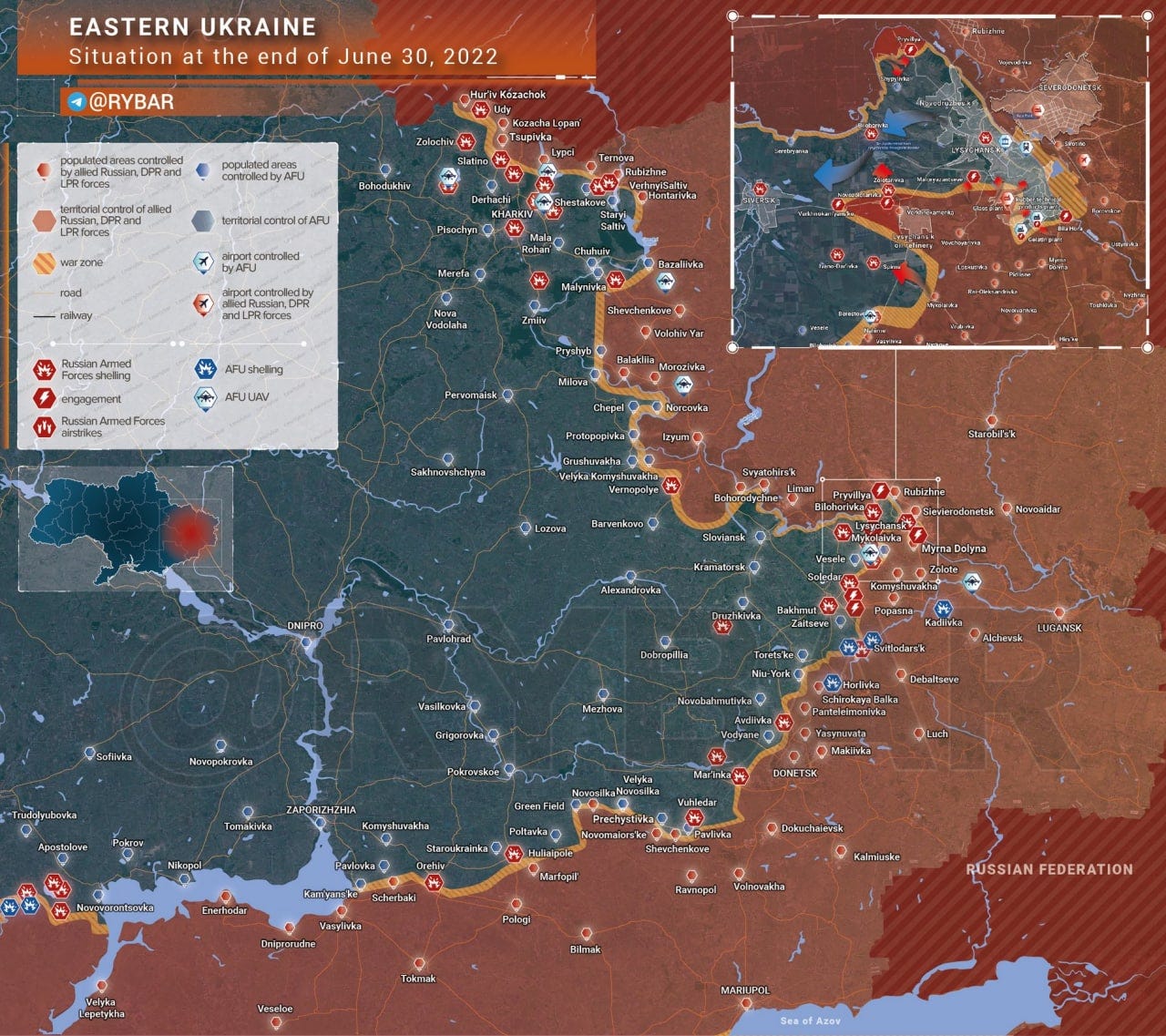
The situation around Lysychansk also shows how Russian success in fulfilling its objectives can occur even more quickly than that. Towns all around that area are falling under Russian control, with rapid success over the past several days and the whole area taking only a few more days to completely physically encircle or capture. At one point, there was up to twenty thousand Ukrainian troops there to capture or kill. Some of them were allowed to attempt retreat, but the area of retreat has been under close fire control for at least a week, if not longer, hindering any mass retreat. There are still thousands of Ukrainian troops to encircle and force to surrender.
As Ukrainian forces are forced to abandon the frontlines there and retreat to more defensible positions not yet destroyed by the Russian frontlines, Russian forces are rushing to find as many weak points as possible before they are fortified and consolidated under Ukrainian retreat. Their two main targets for these operations are Seversk and Bakhmut/Artemosk, with Seversk being the only currently conceivable point of retreat from Lysychansk. Moreover, Russian control of Seversk would allow Russian troops north of the Siverskydonetsk river to attack from the other side and eventually flood into the the area. It would move the whole eastern Donbass frontline all the way to Slavayansk. Not only that, but those frontlines would also eventually reach the other side of Artemosk from the west, according to the Military Analysis YouTube channel, as there are no significant towns south of Seversk until you get to Artemosk. This would allow Russian forces to grind away at much more Ukrainian military strength, and would precipitate Russian success in the entire region. Russian forces have already made quick gains all the way up to the next-door neighbor towns around Seversk, so it is conceivable that Russian forces could break through the whole region very shortly.
As can be seen on the inset map, Russian forces are advancing towards all towns around Lysychansk, pushing all forces there into operational-tactical encirclement. Also, if you look at the area east of Slavayansk downwards, you can see the open area where Russian forces can break through village after village and rapidly push the frontlines to the south of Slavayansk.
With Russia on the cusp of so much success, its government has no incentive to negotiate with Kiev whatsoever. They are making sure gains in destroying the Ukrainian military every day, and after each breakthrough can repurpose the victorious troops to achieve other victorious breakthroughs elsewhere. This means that Russia can keep increasing the pressure on the Kiev regime around the whole country, encircling and capturing other important regions and cities. President Putin and Foreign Minister Lavrov affirm this when they say that they can completely achieve their objectives and that President Zelensky will not be allowed to sit at the negotiating table anymore.
Not only does Russia have an advantage over the Kiev regime, but they are finding advantages over Western political and economic realities as well. America faces increasing chatter about a civil war while an unpopular American president imposes increasing costs upon basic goods and services. Europe also faces a highly predictable economic recession combined with a winter without sufficient heating or fuel to pursue economic and social activities. This is all due to American and European policies against Russia. The Russian government has already indicated a lack of trust towards Western leaders. It is therefore Western leaders who need to get back into the good graces of Russia in order to solve their basic problems rather than Russia restoring any trust from the West.
Mistrust of Russia by Americans has been driven by Russophobic hysteria for decades. Those in the Western corporate media are so eager to punish and defeat Russia that they blind themselves and others to basic facts on the battlefield and in our own economies. The proverb says “Know thine enemy,” but we should also know ourselves first.
Note: Economist Jack Rasmus provides an even more blunt analysis of western sanctions against Russia, particularly the idea being floated of an oil price cap.
Turkish President Recep Tayyip Erdogan got what he wanted. Sweden and Finland agreed to crack down on the various Turkish dissident groups, including the PKK, sheltering in their countries to unblock Turkish objections to their joining Nato. Erdogan came to the Nato summit in Madrid with a shopping list of requests and it was clear that he was going to play hardball. With Russia blasting Ukraine into the stone age it wasn’t hard for the Scandinavians to roll over.
Of course, the irony is if Russian President Vladimir Putin was paranoid about Nato expansion before, his war in Ukraine has brought about what he most feared. Russia had a tiny border with Nato before with Estonia. Now it has a much longer one with Finland. But I suspect that Putin accepts this. The only difference is that Russia is now in open conflict with the Nato members, and we are in effect back to a Cold War set-up. He was always prepared to go there as he assumed that a conflict with Nato was inevitable.
The world is being divided into two: the West vs Russia and the nonaligned countries. The race to shore up these new relations is on and expect to see the majority try and sit on the fence, especially in the Global South.
But is it really such a bad bet? The Global South accounts for 80% of the world’s population and just over half of global GDP. Russia is already a major player there and the only one of the big emerging markets to be classed as “high income” by the UNDP after Putin’s 20 years on the job.
Going forward EMs are where all the growth is, while the West is, not stagnating exactly, but not dynamic either. Almost all of Europe is suffering from exactly the same demographic problems as Russia and already facing labour shortages: Germany’s demographic replacement rate was 1.48 last year — less than Russia’s 1.5 — and the EU average is currently about 1.55. You need 2.1 for the population to grow. You’ve got that and more in most EMs.
Of course, the developed world has all the technology and is denying it to Russia – the only sanction that is really working well. But this has been true since the industrial revolution a 100 years ago and the basis for the West’s leap forward to dominate the planet. That advantage has still not been undone, but surely it is only a matter of time before the EMs close this gap, even if it does take decades. In the meantime, what the EMs lack in tech they will make up for with babies as a locomotive for growth. It will be fascinating to watch this story play out.
The addition of Finland and Sweden to the Nato family further consolidates and expands the North Atlantic block and the EU has shown remarkable unity on imposing sanctions on Russia, but that process has now hit a brick wall. All the easy “one-way” sanctions (that hurt Russia, but don’t hurt the West) that could be applied have been applied.
I post an explainer from our sister publication NewsBase.com on the proposed oil price cap sanctions that are supposed to be part of the seventh package. I also post a piece about Russia’s Dutch Disease where the only way the government can control the value of the ruble is by reducing the amount of oil and gas it exports. The Central Bank of Russia (CBR) was once probably one of the best run central banks in the world and now it is reduced to using the crudest of all possible tools.
The oil price cap was supposed to be the centerpiece of the G7 summit in Bavaria this week, but I think that we can call that meeting a failure as nothing concrete came out of it other than “proposals”. French President Emmanuel Macron admitted there were “technical problems” with the idea, which is putting it mildly.
The whole issue turns on using the threat of sanctions on oil tanker insurers to enforce the caps and that has two problems.
Firstly, the nonaligned countries are not on board. India has already given Russia’s fleet operator Sovcomflot safety certifications it needs to get non-Western insurance, which India will accept, and so in effect Delhi has opted out of any oil sanctions.
Secondly, even the EU countries are not as unified as US President Joe Biden and European Commission President Ursula von der Leyen would like you to believe. Note too that Erdogan also said this week that Turkey will not participate in sanctions.
I won’t go into the details here, but to make this work you would have to reopen the sixth package of sanctions where the rules on insurance are now and no one wants to do that as it will kick off more really hard talks that would lead to the sixth package being watered down from the original proposals.
There is a fundamental flaw in the West’s economic war with Russia: it is trying to hurt Russia as much as possible but will not accept any pain itself (two-way sanctions).
The six packages in place now are full of exemptions and exclusions to protect Western interests. Extremely harsh sanctions were placed on Belarus in 2020, yet EU trade with Belarus doubled that year for the same reason. With Russia, an energy embargo and self-sanctions have been imposed on Russia’s oil business, yet Putin will earn the biggest current account surplus on record this year. What should have happened is the EU should have banned oil and gas imports from Russia in the first week of the war (with the summer to look forward to) and the Kremlin’s finances would probably have collapsed within a few months as Russia came close to a financial crisis with just the SWIFT and CBR reserve sanctions. But that would have come with a huge shock to the EU’s economy, which no one is prepared to accept. Even now, these exemptions are still being put in place: Greek shipping has been exempted from the sixth package bans on carrying Russian oil as it makes up half the international oil tanker fleet. Likewise, in Russia the largest insurer Ingosstrakh is part owned (36%) by Italian insurance giant Generali, which has refused to sell its stake and makes the largest share of its money from marine insurance. Allianz, Europe’s biggest insurer, has a big Russian business and is also not leaving.
More generally, the International Association of Classification Societies (IACS) that gives out safety certificates that oil tankers need to get insurance has 11 members but only four of them (France, UK, Norway and the US) have stopped certifying Russian ships. And the Indian Register of Shipping (IRClass), which is the official Indian member of IACS, has just certified all of Sovcomflot’s tankers.
The conflict has catalysed a process of EMs maturing politically that had already started. Until now the EM story has largely been an economic one about fast “catch up” growth and huge returns investors can make. Increasingly it is now going to be political as well. The BRICS is one obvious focus that has gone from a Goldman Sachs marketing term to a powerful political organisation and Russian Foreign Minister Sergei Lavrov called for Argentina and Iran to join this week as well.
The biggest change is that China and Russia have been driven together and clearly the Kremlin has to work as hard as it can to build up its nonaligned alliances in order to avoid being simply consumed by China and becoming little more than a raw materials warehouse.
Although China has kept Russia at arm’s length to avoid being sanctioned itself, there is no chance of driving a wedge between Moscow and Beijing now as China can see its next. Biden used the G7 summit to hype a new US infrastructure fund that is designed to challenge China’s Belt and Road initiative. While the nonaligned countries will happily take the US money, unless the US also opens its lucrative markets to them, I doubt that this will make much difference.
Trade is the key to China and Russia’s offering and this is Russia’s ace thanks to its cornucopia of raw materials (and its arms and nuclear power industries). Putin is going to work very hard to build up Russia’s relations with the nonaligned nations and actually has already been working on that for years, with especially notable progress in the Middle East.
That will continue in November at the G20 summit, to counterpoint the G7, and also the second Russian-Africa summit that will be held in Ethiopia – both important platforms for promoting Russia’s soft power.
The West has run out of one-way sanctions, and it is hard to see what it can do next without going onto a war footing. The same is true of the military campaign in Ukraine. As this increasingly looks like it will be a much longer war than expected, the West needs to go onto a war footing militarily too. The West has largely used up its stock of Soviet-era armaments and I’m seeing an increasing number of reports saying that despite the massive US defence budget it doesn’t have the manufacturing capabilities to churn out a lot more weapons quickly. Russia has used up a lot of its high-tech weapons like smart missiles, but it has huge stores of “dumb” artillery shells and has the war in Ukraine is turning into an artillery duel slugfest that is what will make the difference.
Increasingly it seems that the US has overestimated its own economic and military power (will Ukraine turn into another Afghanistan?) and underestimated how deeply Russia is integrated into the global economy, which is causing significant leakage to the sanctions regime already. Now that one-way sanctions are exhausted, the West will have to start using two-way sanctions and the failure of the G7 summit to produce anything concrete shows how hard that will be. The West is already spending huge amounts of political capital in its effort to isolate Russia and frankly it is not working.
This is from the vault – a 1986 article from the Village Voice that outlines the history of Mykola Lebed – the vicious Ukrainian nationalist leader who collaborated with the Nazis and was later given secret asylum in the US thanks to the CIA. Shoutout to Lee Stranahan for mentioning this article during a recent interview with Tara Reade. – Natylie
“SUBJECT D” IS THE LABEL MOST RECENTLY used by the federal government to describe a certain high-ranking Nazi collaborator, an alleged war criminal whose cooperation with the Central Intelligence Agency allowed him to enter this country in 1949 and later become a U.S. citizen. Subject D’s history was supposed to remain hidden; indeed, he felt so secure that his telephone number is listed under his real name. Now, after nearly 40 years, his secret is out.
Last June, the General Accounting Office (GAO) completed a three-year investigation of the illegal postwar immigration of Nazis and Nazi collaborators, and of the secret assistance they allegedly received from U.S. intelligence agencies. This sensitive federal study was ordered by the House Judiciary Committee to supplement a 1978 review of accusations that federal agencies obstructed the prosecution of alleged Nazi war criminals.
After reviewing voluminous files and conducting many interviews, the GAO found “no evidence of any U.S. agency program to aid Nazis or Axis collaborators to immigrate to the United States.” But among the 114 cases it reviewed — dealing with a small fraction of the suspected war criminals — the GAO did discover five cases of Nazis or collaborators “with undesirable or questionable backgrounds who received some individual assistance in their U.S. immigrations.” Although the 40-page report said that three of them were already dead, it named no names, or even nationalities, and referred to the five only as Subjects A through E. Much of the information about them and their activities remains classified. In two cases, the assisted individuals were protected by their intelligence contacts from authorities seeking to enforce immigration laws that prohibit the entry of war criminals and other persecutors.
The authors of the GAO report seem eager to justify the actions of the government, and regardless of bias, their effort hardly represents a comprehensive examination of this historic problem. Yet despite its shortcomings, the report is a landmark — an official admission that Nazis and Nazi collaborators were assisted in entering the United States by the CIA.
The Voice has learned that the collaborator discussed in the GAO report as “Subject D” is a prominent Ukrainian nationalist. In 1934, he was imprisoned for attempting to assassinate the interior minister of Poland; he ran the security force of a Ukrainian fascist organization and has been accused of ordering the murders of many of his countrymen; he attended a Gestapo training school where Jews were murdered for practice. He was considered an extremely valuable intelligence asset by the CIA, which protected him from war-crimes prosecution by the Soviets, brought him to this country under an assumed name and concealed his true past from the Immigration and Naturalization Service. So important was his case that in 1952 Attorney General James P. McGranery, the director of Central Intelligence, General Walter Bedell Smith, and the commissioner of the INS, Argyle R. Mackey, secretly agreed to permit his residence here. In 1957, he became a U.S. citizen.
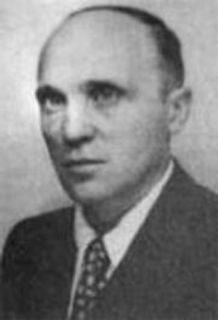
His name is Mykola Lebed, and he lives in Yonkers.
MYKOLA LEBED IS 75 YEARS OLD, AND HAS resided in this country for nearly half his life. Several years ago he moved from Washington Heights, a largely Jewish neighborhood, to a modest two-family brick house on a pleasant Yonkers hillside. Short, wiry, and bald, with alert blue eyes, the retired Lebed spends most of his days at home, where he is working on his memoirs.
His recollections are likely to be cast in the heroic, patriotic light that illuminates most histories written by adherents and defenders of the Organization of Ukrainian Nationalists (OUN) that he once helped lead. All that can be seen in these accounts is a fiery commitment to an independent Ukrainian state and the resulting conflicts with both German and Soviet oppressors. Obscured is the more complex story of OUN collaboration with Nazi war crimes, and the OUN’s own fascist and racist ideology.
Details of Mykola Lebed’s involvement with the OUN have been pieced together from Army Counterintelligence Corps (CIC) files, other military archives, and immigration records; from interviews with Ukrainians; and from histories of the period, including an eyewitness account in the files of the Holocaust documentation center at Yad Vashem in Israel. Large portions of pages from the CIC file on Lebed, obtained under the Freedom of Information Act, were “sanitized” (that is, obliterated) by the Army before being released to the Voice. To justify the withholding of certain facts, the Army cited FOIA exemptions pertaining to protection of “intelligence sources” and “national security.” One document was apparently withheld at the request of “another government agency,” and another document had been removed from the National Archives by the CIA.
Four decades after the terrible events of the war, the history of fascism in Eastern Europe is no academic matter. In recent years, the U.S. government has finally begun to prosecute individual war criminals among the Nazi collaborators who found refuge on our shores. Most of the 45 cases brought so far by the Justice Department’s Office of Special Investigations (OSI), set up in 1979 to find and deport immigrants who committed war crimes, involve not German Nazis but collaborators from other nations.
The East European émigré communities have reacted with a ferocious campaign to abolish OSI, though very few of their members are threatened in any way. (Only in the Polish-American community has the crusade against OSI failed to gain significant support, perhaps because so many Polish gentiles were also victims of Nazism.) Each prosecution of a Nazi collaborator from Eastern Europe discredits the version of history upheld by some émigrés: that all the “anticommunists” of Eastern Europe were noble and free of any guilt for the crimes of Nazism.
Ukrainian leaders have outspokenly denounced the OSI, partly because the Organization of Ukrainian Nationalists still exists and remains influential in the Ukrainian communities here and abroad. The OUN’s founders are revered by Ukrainian publications and groups, while their collaboration with Hitler is not discussed. The OSI has made such evasion far more difficult. According to Nazi War Criminals in America, the authoritative handbook published last year by Charles R. Allen Jr., about one-fourth of the 45 OSI deportation or denaturalization cases have been brought against Ukrainians; in at least two cases, the individuals accused of participating in Nazi persecutions and murders were proven to be members of the OUN.
The Ukrainian targets of the OSI have so far been minor figures — “policemen” in the service of the Nazi occupiers of the Ukraine, who don’t figure as individuals in any of the histories of the period. Most wartime leaders of the OUN are dead, and thus safe from the varieties of justice meted out in U.S., Soviet, Polish, or Israeli courts. Mykola Lebed is an exception. For years he was the OUN’s third-in-command, and he ran the Sluzhba Bezpeky, its reputedly murderous security force.
Justice Department policy, which applies to the OSI, strictly prohibits any comment about pending cases. But the Voice has learned that the OSI maintains an open file on Lebed, making him a potential defendant in denaturalization proceedings. Materials pertaining to his case from the GAO probe, gleaned from the files of military intelligence and the CIA, were turned over to the OSI last summer.
If the OSI determines that Lebed ought to be stripped of his citizenship and deported, the information in those files may become public. Although much of Lebed’s history remains murky, concealed in still-classified government archives, there is little doubt that such a display would severely embarrass not only the OUN and its supporters, but the U.S. government as well — especially the CIA.
Under long-standing U.S. immigration laws, strengthened in 1978, those guilty of persecuting other people on the basis of race, religion, national origin, or political belief are barred from entering this country and are to be deported if they gain entry. Lebed escaped these sanctions because his sponsors mercifully cited Section 8 of the CIA Act of 1949. An obscure portion of the legislation that established the CIA, Section 8 permits the agency to bring 100 individuals a year to the U.S. for reasons of national security — regardless of their past. Brooklyn District Attorney Elizabeth Holtzman, who issued a seething critique of the GAO report, found this revelation about Subject D’s immigration “extremely disturbing.” As a member of Congress in 1978, said Holtzman, “the CIA… assured me in a meeting and in a Congressional hearing that it never used the 100 numbers provision to facilitate the entry of Nazis.”
Patti Volz, a spokeswoman for the CIA, declined to comment about Lebed or the GAO report. “We don’t get into details,” she said. “We don’t confirm or deny that someone has worked for us. We wouldn’t have any comment on him.”
REPORTS FILED WITH THE ARMY Counterintelligence Corps in the late ’40s give various dates for the birth of Mykola Lebed, but his naturalization papers say November 23, 1910. He was born in the western Ukrainian province of Galicia, an agricultural area controlled at various times by Poland, the Soviet Union, and Germany. From his early school days in L’vov, the provincial capital, Lebed was involved in the right wing of the Ukrainian nationalist movement, which from the early ’30s to the present has been dominated by the Organization of Ukrainian Nationalists. The secretive, authoritarian OUN has constantly overshadowed Ukrainian politics, despite incessant factional strife in its ranks, both in the Ukraine and abroad.
Polish rule in the Ukraine during the ’20s had been harsh, and the OUN’s younger members included a number, who, like Lebed, were inclined to terrorism. Among them was the OUN’s eventual would-be führer, Stefan Bandera, who in 1934 joined with Lebed and several others in plotting the assassination of Polish interior minister Bronislaw Pieracki. U.S. Army Counterintelligence reports say that Lebed initially escaped from Warsaw but was captured in Stettin, Germany, and returned to Poland by the German authorities. Convicted in a mass trial, Lebed, Bandera, and several others were condemned to death; but their sentences were commuted to life imprisonment.
The most sympathetic, scholarly account of the Ukrainian nationalist period is by John A. Armstrong, a strongly anti-Soviet and pro-Ukrainian historian who now teaches at the University of Wisconsin. His Ukrainian Nationalism 1939–1945 notes that during the period Lebed and Bandera were imprisoned, the Ukrainian nationalist movement was solidifying its ties to the Nazi regime in Germany.
“For many years,” wrote Armstrong, “the OUN had been closely tied to German policy. This alignment was furthered by the semi-Fascist nature of its ideology, and in turn the dependence on Germany tended to intensify Fascist trends in the organization.” In fact, most historians regard the OUN as wholly fascist — and tied to German intelligence — from its inception. It was the Nazi invasion of Poland in September 1939 that allowed Lebed and the other convicted plotters to escape from Warsaw’s Swiety Kroyc prison after serving five years.
The xenophobic, antidemocratic, and anti-Semitic nationalism of the OUN meshed easily with Nazism. The compliment was not always returned, however. Within the Nazi hierarchy, opinions about the Ukrainians diverged. Powerful Nazi figures considered the Ukrainians an inferior people, unfit to govern themselves. Lebed and the other OUN leaders hoped that they would be able to set up an autonomous fascist state, as part of Hitler’s “New Europe,” under a German protectorate.
Such aspirations congealed into a military, political, and espionage alliance between the OUN and the Nazi war machine. Even after 1940, when the OUN split into two feuding factions — the more extremist led by Bandera, Lebed, and Yaroslav Stetsko — both sought an accommodation with the German occupiers. Later in the war, the Germans alternated between courting and repressing the Ukrainians, but many OUN members served continuously in Nazi formations, from the Waffen-SS to the local police forces, which murdered thousands of Jews, Poles, communists, and socialists.
DURING THE MONTHS FOLLOWING THEIR release from prison, Lebed and the other OUN leaders chafed under the temporary constraints of the 1939 treaty between Hitler and Stalin. According to Armstrong, they eagerly abetted the secret Nazi preparations for war against the Soviets, sending their young adherents for German military training in mountain camps set up as early as 1939. Sources friendly to Lebed — whose slanted accounts may be found in memoranda of the Army Counterintelligence Corps between 1947 and 1948 — understandably pass over this period.
Only hints of what Lebed was actually doing in 1940 and 1941 appear in the CIC file. A September 30, 1948, memo does mention that “For a short time, [Lebed] attempted to get an insight into the tactics of the German State Police and succeeded in joining the GESTAPO school in ZAKOPANE (District of Krakow), from which he ultimately fled.” And a card in the CIC file identifies Lebed as “a graduate of the Zakopane, Poland criminal police school.”
A former OUN member, now dead, wrote in 1958 a different and more detailed eyewitness version of Lebed’s sojourn with the Gestapo. Retrieved from the files of Yad Vashem in Jerusalem, the declaration of Mykyta Kosakivs’kyy portrays both Lebed and the OUN as eager pupils of the Gestapo.
Kosakivs’kyy joined the OUN in 1933, and after sojourns in Czechoslovakia and Germany, returned to the Carpathian Ukraine late in 1939. He was among the older OUN officers present when the “Ukrainian Training Unit” was established at the Gestapo school in Zakopane that November. According to his declaration, the Ukrainian unit was “organized by the OUN leadership and by permission of the German Security Service.” It included 120 specially selected trainees, under the guidance of a Gestapo officer named Walter Kruger and his assistant, Wilhelm Rosenbaum, both Germans. “The Ukrainian commandant of the entire unit was Lieutenant Vil’nyy,” wrote Kosakivs’kyy, “whose real name was Mykola Lebid [another transliteration of Lebed].” The curriculum included drills, intelligence and counterintelligence training, and interrogation techniques, but emphasized “exercises in the hardening of hearts.”
“At sundown,” recalled Kosakivs’kyy, “Kruger, Rosenbaum, Lebid and a few students would go to Zakopane, enter some Jewish home on the way, grab a Jew, and bring him to the Unit. One evening, late in November or early in December 1939, they returned with a young Jew. In the presence of Ukrainian seniors, including myself, Kruger and Rosenbaum, fortified with alcohol, proceeded with their demonstration of the proper methods of interrogation.”
Seeking to induce the innocent Jew to confess that he had raped an “Aryan” woman, the German officers beat and tortured him, using their fists, a sword, and iron bars. When he was bloody from head to toe, they applied salt and flame to his wounds. The broken man then confessed his fictional crimes, but that was not the end.
“Thereupon,” Kosakivs’kyy continues, “he was taken to the corridor of the house and the ‘co-eds’ (three women members of the unit) were called in. In their presence, Rosenbaum beat the Jew again with an iron pipe and Lebid too assisted manually in that ‘heroic action.’ One of the senior Ukrainians and I withdrew from that spectacle to our rooms. We learned afterwards that the tortured man was stripped naked, stood up in front of the school as ‘a sentry’ and doused with water in heavy frost.”
Kosakivs’kyy and his friend protested to Lebed the next day, but the commandant told them bluntly that “it was the duty of every member of the OUN to show the Germans that his nerves are just as tough as a German’s and that the heart of any nationalist is as hard as steel.” Such “practical exercises” continued unabated, according to Kosakivs’kyy’s testimony, and he fled Zakopane in early January 1940. Others equally sickened, he learned, left later, but Lebed remained until at least March of that year, when the unit moved from Zakopane to the nearby town of Rabka, where the Gestapo’s depredations continued.
When he finished his statement on December 14, 1958, in Germany, the former OUN member already knew he was dying of heart disease, according to the introductory note written by the late Dr. Panas Fedenko, a Ukrainian liberal and implacable critic of the OUN. “I owe it to my conscience to make this declaration public, to report openly the facts I witnessed myself,” Kosakivs’kyy concluded. “Mykola Lebid evidently believes that his infamous accomplishments in the Ukraine and elsewhere are forgotten and so are the multitudes of his innocent victims, that every witness of his torture activities is either murdered or dead. Only Lebid is mistaken right there.”
Kosakivs’kyy’s angry testament must be read in context, as the product of one man’s remorseful memory, and of Ukrainian émigré rivalries as well; obviously it was published to discredit Lebed and the OUN. Yet there is supporting evidence for his story in the historical record. The Zakopane school existed, according to Dr. Aharon Weiss of Yad Vashem, and was moved to the nearby town of Rabka in 1940. There was a Captain Kruger, mentioned above, who commanded a Gestapo unit in the area, and helped lead a joint Nazi-OUN pogrom when the German Army’s Brandenburg regiment occupied the Galician capital of L’vov in late June 1941.
And there is also no question that a German officer named Wilhelm Rosenbaum was a commandant at Zakopane and Rabka during the training of Ukrainians. In 1964, that same Rosenbaum was arrested in West Germany and charged, among other crimes, with the murder of 200 Jews at Rabka between May 1942 and January 1943. According to Simon Wiesenthal’s 1967 book The Murderers Among Us, the unit was a “training center for future cadres of SS killers… SS men at Rabka were being hardened so they would not break after a few weeks of duty. They had to become insensitive to the sight of blood, to the agonized shouts of women and children. The job must be done with a minimum of fuss and a maximum of efficiency. That was a Führerbefehl — the Fuhrer’s order.” Rosenbaum was convicted in Hamburg in 1968 and sentenced to hard labor for life.
Lebed declined to be interviewed by the Voice about Zakopane or any of his wartime activities. But in a brief conversation on the doorstep of his Yonkers home last month, he conceded that he had been at the Gestapo school, although he believed it had been during the winter of 1940–41, not 1939–40 as Kosakivs’kyy stated. “Oh yes,” he said. “I left after five weeks. I have exactly the dates. I quit.”
LEBED’S TRAINING AT ZAKOPANE, HOWEVER cursory, was soon recognized by his fellow leaders in OUN-B, whose acronym designated its domination by the nationalist führer Bandera. When their split from the old leadership became irrevocable in 1941, Bandera commissioned the creation of a “security service,” the Sluzhba Bezpeky, under Lebed’s command. Historians of the OUN-B agree that he ran the SB not only during the war, but long afterward. Armstrong, who interviewed Lebed at length, stated the facts with characteristic discretion: “In Lebed — small in stature, quiet, yet determined, hard — the SB found a well-qualified leader, but one who was to acquire for himself and his organization an unenviable reputation for ruthlessness.” In an interview last month Armstrong was still sympathetic to Lebed, but more candid. “He grew up fighting against the Poles,” explained the historian, “and he developed a terrible terrorist complex. He killed other Ukrainians, rivals in the organization [OUN].”
Yet Lebed told the Voice that he had never commanded the SB. He claimed that the SB had instead been run by someone named “Artanych… He’s dead now.”
Such reluctance to assume the SB’s legacy is understandable. Even those Ukrainians who ignore the fascist brutalities against Jews and Poles are still troubled, and in some cases outraged, by the SB’s infamous assaults on Ukrainians who dissented from the OUN-B leadership.
Lebed’s direct responsibility for crimes attributed to the OUN-B is difficult to establish. Perhaps the lowest point of the Banderites’ alliance with Nazism was the occupation of L’vov in June and July 1941, when Yaroslav Stetsko and a large contingent of OUN-B troops entered that city along with the Brandenburg regiment and other German detachments. Several days of mass murder followed. L’vov’s Jewish population was decimated, but Polish university professors and anyone who could be tied to the Communists were also killed. Survivors reported that the Ukrainians were even more bloodthirsty than their German patrons: According to German Rule in Russia, by historian Alexander Dallin, “Bandera’s followers, including those in the Nachtigall regiment (a Ukrainian SS detachment), were displaying considerable initiative, conducting purges and pogroms.”
Ironically, the alliance between the Nazis and the OUN-B came apart that same week in L’vov, after Stetsko proclaimed an independent Ukraine. Loyal to the Führer, who was in their view creating a glorious new Europe, the Ukrainians still dreamed of their own state. Bandera, the Ukrainian führer, named Stetsko prime minister and Lebed minister of security. But the new regime didn’t last long.
By July 9 the Nazis would no longer put up with this “independent” charade, and arrested Bandera, Stetsko, and other members of the leadership. Lebed escaped; the others were held under “house arrest” in Berlin but they were not mistreated. According to Armstrong, the OUN leaders “were allowed to carry on their political activities in Berlin; Stetsko was even able to go to Cracow, where he consulted with Lebed, whom he had secretly delegated to take command of all activities in the Ukrainian lands.” Even pro-OUN writers admit that the German repression of the Ukrainian nationalists was mild, and cooperation continued on many levels throughout the war.
There were periods when some of the nationalist Ukrainians, formed into guerrilla groups, fought the Germans as well as the Soviet partisans, and there is evidence that Lebed took part in those actions, especially after 1942. But by 1943, the Banderites were cooperating in the formation of a new Ukrainian SS division, and in 1944 Bandera himself — although he had been interned at Sachsenhausen concentration camp — was still assisting the German war effort against the Russians.
Lebed, who had meanwhile adopted the nom de guerre Maxym Ruban, tried to seize control of all factions in the nationalist movement. Independent nationalist bands were carrying out guerrilla actions in Volhynia and the western Ukraine under the name of the Ukrainian Partisan Army (UPA). This was intolerable to Lebed, who demanded that all the Ukrainian guerrillas come under his command. The result was vicious internecine warfare among the nationalists, a period from which Lebed’s reputation did not emerge unscathed. Leading figures of the non-OUN forces were “liquidated,” according to a 1948 CIC memo: “As a result, the Ukrainians now have difficulty forgetting the fact that Lebed killed some Ukrainian partisans who were fighting for the same cause.”
Other writers, like the Ukrainians Panas Fedenko and O. Shuliak, condemned Lebed in harsh terms for these killings after the war. Shuliak wrote in 1947 that Lebed’s SB men carried out the murders of dissenters from the OUN line. “It is perfectly evident that neither soldiers nor officers of the UPA had anything to do with these atrocities. The doers were the Security men under the orders of Lebed.” Massacres and other acts of terror were also carried out against civilians, against Soviet prisoners of war, against entire Polish villages in the Ukraine, and against Jews fleeing from Nazi persecution.
In his own booklet on the history of the UPA, published in 1946, Lebed says its aim was “to clear the forests and the surrounding areas of foreign elements.” According to the late historian Philip Friedman, this meant not only Poles but Jews and Russian partisans as well. Friedman says that postwar OUN efforts to disclaim responsibility for anti-Jewish atrocities “cannot be taken seriously.”
LEBED’S CAREER IMMEDIATELY AFTER THE war is difficult to trace. By then the OUN had established a new front-group, the Supreme Ukrainian Liberation Council — known by its transliterated initials, UHVR — of which Lebed became “Foreign Secretary.” Several CIC documents report that his wife and daughter were held in Buchenwald concentration camp by the Germans for several months as hostages against Lebed’s guerrilla activities, but they were released in 1944, well before the war’s end.
After 1945 he mainly lived in Rome and Munich, seeking Allied support for the remnants of the UPA to fight against the victorious Soviets. A “political history ” in the CIC file says that he traveled illegally around Western Europe, organizing the foreign offices of the UHVR. By the end of 1947, conditions in Rome were growing uncomfortable for Lebed, who was afraid that the Soviets might attempt to seize him there. He sought and apparently received the help of U.S. intelligence to leave Rome safely.
Lebed’s file also shows that around the same time, he and other OUN leaders began to proclaim the evolution of their politics in a more democratic direction. The motive behind such declarations is clear. In the cold war that was already taking shape, only self-styled democrats could partake of Uncle Sam’s largesse.
But whether Lebed actually converted to Western liberalism is unclear from the CIC file. Several reports note that when the OUN-B split at a Munich conference in 1947, Lebed gave a speech berating the “weakening and democratization of the party line,” which other members in turn denounced as redolent of fascism.
Regardless of his postwar political views, however, it is clear from the GAO report that Subject D was used as an American agent soon after the war’s end. (Bandera, too, obtained a post with a Western intelligence agency — the West German BND, run by the former Nazi Abwehr chief Reinhard Gehlen, who recruited scores of ex-Nazis and collaborators for his network. In his memoirs, Gehlen identifies Bandera as one of his men.)
“Because of fear for his personal safety and his familiarity with U.S. intelligence operations,” the section in the GAO report on Subject D explains, “the CIA brought him to the United States under an assumed name.” His naturalization papers, filed in January 1957, show that Lebed arrived in New York harbor on October 4, 1949. The truth about his identity and history was concealed from the Immigration and Naturalization Service. But two years later, the INS learned who Lebed was and opened an investigation that, the CIA was informed, might lead to his deportation. “According to the CIA file,” says the report, “INS had learned that the subject’s conviction had been for involvement in an assassination and that allegations of terrorism existed against him.” To protect Lebed the agency invoked Section 8 of the CIA Act.
All this because, according to the GAO, “The subject was considered extremely valuable by U.S. intelligence.” And after Lebed had been employed by the CIA for a few years, it became impossible to let him go, because of “fear for his personal safety and his familiarity with U.S. intelligence operations.” Once he knew the CIA’s secrets, the Soviets couldn’t be permitted to capture him — so Lebed was smuggled into the U.S.
Lebed became a citizen on March 18, 1957. His application listed an address in Washington Heights as his home, and “journalist” as his profession. He had two witnesses: Bohdan Czajkowskyj, also a writer and a longtime friend of Lebed; and Alexander S. Alexander, who listed his job as “government employee.”
The new citizen was entitled to call himself a journalist because of his position as president of the Prolog Research and Publishing Association, Inc. Founded as a nonprofit publisher in the early ’50s, it has always specialized in Ukrainian-language books and magazines, many of them with anti-Communist political themes. Prolog’s certificate of incorporation filed in New York in 1956 lists Lebed as a director and gives as its purposes “investigation of the history, economics, politics and culture of the Ukraine,” and “exposing to the public opinion of the world the true nature of communist dictatorship and the threat of international communism to freedom everywhere.”
Roman Ilnytzkyji, a longtime Lebed associate who worked for Prolog, says that Lebed was “completely absorbed” in his work at the Ukrainian publishing company’s tiny, cramped offices in midtown Manhattan, although he was never an editor. Aside from keeping Prolog afloat, Lebed’s vocation until he retired in 1980 was to promote the views of the UHVR, the faction of the Organization of Ukrainian Nationalists which he headed. Prolog was, in fact, at least partly a front for the former Banderites grouped around the UHVR and Lebed.
The sources of its funding are mysterious. Prolog’s current officers insist that it has always been financially self-sufficient, with adequate support “from the Ukrainian community.” Although the market for its books and magazines is tiny, Prolog is now a for-profit corporation. It has at various times maintained offices in Munich, London, and Cairo as well as New York. During the ’70s Prolog published eight to 10 volumes annually, plus two or three small-circulation magazines on Soviet and Ukrainian affairs.
Ukrainians familiar with the workings of Prolog say that it could not have sustained itself solely from sales of its publications — many of which were regularly smuggled into the Soviet-ruled Ukraine — and that it probably received help from a government agency. Two mentioned the CIA. Ilnytzkyji said he didn’t know whether Prolog had received any such subsidies. “They keep some things hidden,” he said. But he believes Lebed “has some connections with the American authorities. What kind of connections, or whether they included financial help, I don’t know.” None of the other Ukrainians who discussed Prolog and its financing would let their name be used. As one put it, “People simply don’t talk about these things.”
VERY LITTLE ABOUT SUBJECT D’S PAST appears in the GAO report, although clues were present in the records available to government investigators; three years of research are boiled down to three vague paragraphs. Because it omits nearly all the significant facts, the report suffers from the same moral obtuseness that tainted the CIA’s relationship with Lebed.
Eli Rosenbaum, a former OSI prosecutor and now general counsel to the World Jewish Congress, recently examined the declassified CIC files and other documents on Mykola Lebed. “I’m particularly dismayed,” he said, “by the absence of even the slightest indication that any of the government agencies cared to ascertain the truth of the damning and very specific charges against Lebed contained in these files. It’s as though they assumed the charges to be true, and proceeded to bring him here anyway.”
After 40 years, a government agency — the Office of Special Investigations — is finally examining the evidence against Lebed. But difficult legal and historical questions must be answered before the OSI can consider denaturalization proceedings against Lebed: Did the 1949 CIA Act which permitted his entry allow him to become a citizen, superseding other immigration laws which would forbid it? Can the allegations about his past be proved in court?
The confidentiality of the OSI’s operations is so strict that if the case is dropped the public will probably never know why. Mykola Lebed is, and has been for 29 years, a citizen with constitutional rights. All we know for now is that the file on Subject D is still open. ❖
Research assistance by Ellen McGarrahan, Leslie Yenkin, and Kevin Coogan.
This article from the Village Voice Archive was posted on February 26, 2020
One of the reasons that Russian media has been completely blocked in the West, along with the unprecedented control and censorship over the Ukraine war narrative, is the fact that western governments simply do not want their public to know that the world is vastly changing.
Ignorance might be bliss, arguably in some situations, but not in this case. Here, ignorance can be catastrophic as western audiences are denied access to information about a critical situation that is affecting them in profound ways and will most certainly impact the world’s geopolitics for generations to come.
The growing inflation, an imminent global recession, a festering refugee crisis, a deepening food shortage crisis and much more are the kinds of challenges that require open and transparent discussions regarding the situation in Ukraine, the NATO-Russia rivalry and the responsibility of the West in the ongoing war.
To discuss these issues, along with the missing context of the Russia-Ukraine war, we spoke with Professor Noam Chomsky, believed to be the greatest living intellectual of our time.
Chomsky told us that it “should be clear that the (Russian) invasion of Ukraine has no (moral) justification.” He compared it to the US invasion of Iraq, seeing it as an example of “supreme international crime.” With this moral question settled, Chomsky believes that the main ‘background’ of this war, a factor that is missing in mainstream media coverage, is “NATO expansion”.
“This is not just my opinion,” said Chomsky, “it is the opinion of every high-level US official in the diplomatic services who has any familiarity with Russia and Eastern Europe. This goes back to George Kennan and, in the 1990s, Reagan’s ambassador Jack Matlock, including the current director of the CIA; in fact, just everybody who knows anything has been warning Washington that it is reckless and provocative to ignore Russia’s very clear and explicit red lines. That goes way before (Vladimir) Putin, it has nothing to do with him; (Mikhail) Gorbachev, all said the same thing. Ukraine and Georgia cannot join NATO, this is the geostrategic heartland of Russia.”
Though various US administrations acknowledged and, to some extent, respected the Russian red lines, the Bill Clinton Administration did not. According to Chomsky, “George H. W. Bush … made an explicit promise to Gorbachev that NATO would not expand beyond East Germany, perfectly explicit. You can look up the documents. It’s very clear. Bush lived up to it. But when Clinton came along, he started violating it. And he gave reasons. He explained that he had to do it for domestic political reasons. He had to get the Polish vote, the ethnic vote. So, he would let the so-called Visegrad countries into NATO. Russia accepted it, didn’t like it but accepted it.”
“The second George Bush,” Chomsky argued, “just threw the door wide open. In fact, even invited Ukraine to join over, despite the objections of everyone in the top diplomatic service, apart from his own little clique, Cheney, Rumsfeld (among others). But France and Germany vetoed it.”
However, that was hardly the end of the discussion. Ukraine’s NATO membership remained on the agenda because of intense pressures from Washington.
“Starting in 2014, after the Maidan uprising, the United States began openly, not secretly, moving to integrate Ukraine into the NATO military command, sending heavy armaments and joining military exercises, military training and it was not a secret. They boasted about it,” Chomsky said.
What is interesting is that current Ukrainian President Volodymyr Zelensky “was elected on a peace platform, to implement what was called Minsk Two, some kind of autonomy for the eastern region. He tried to implement it. He was warned by right-wing militias that if he persisted, they’d kill him. Well, he didn’t get any support from the United States. If the United States had supported him, he could have continued, we might have avoided all of this. The United States was committed to the integration of Ukraine within NATO.”
The Joe Biden Administration carried on with the policy of NATO expansion. “Just before the invasion,” said Chomsky, “Biden … produced a joint statement … calling for expanding these efforts of integration. That’s part of what was called an ‘enhanced program’ leading to the mission of NATO. In November, it was moved forward to a charter, signed by the Secretary of State.”
Soon after the war, “the United States Department acknowledged that they had not taken Russian security concerns into consideration in any discussions with Russia. The question of NATO, they would not discuss. Well, all of that is provocation. Not a justification but a provocation and it’s quite interesting that in American discourse, it is almost obligatory to refer to the invasion as the ‘unprovoked invasion of Ukraine’. Look it up on Google, you will find hundreds of thousands of hits.”
Chomsky continued, “Of course, it was provoked. Otherwise, they wouldn’t refer to it all the time as an unprovoked invasion. By now, censorship in the United States has reached such a level beyond anything in my lifetime. Such a level that you are not permitted to read the Russian position. Literally. Americans are not allowed to know what the Russians are saying. Except, selected things. So, if Putin makes a speech to Russians with all kinds of outlandish claims about Peter the Great and so on, then, you see it on the front pages. If the Russians make an offer for a negotiation, you can’t find it. That’s suppressed. You’re not allowed to know what they are saying. I have never seen a level of censorship like this.”
Regarding his views of the possible future scenarios, Chomsky said that “the war will end, either through diplomacy or not. That’s just logic. Well, if diplomacy has a meaning, it means both sides can tolerate it. They don’t like it, but they can tolerate it. They don’t get anything they want, they get something. That’s diplomacy. If you reject diplomacy, you are saying: ‘Let the war go on with all of its horrors, with all the destruction of Ukraine, and let’s let it go on until we get what we want.’”
By ‘we’, Chomsky was referring to Washington, which simply wants to “harm Russia so severely that it will never be able to undertake actions like this again. Well, what does that mean? It’s impossible to achieve. So, it means, let’s continue the war until Ukraine is devastated. That’s US policy.”
Most of this is not obvious to western audiences simply because rational voices are “not allowed to talk” and because “rationality is not permitted. This is a level of hysteria that I have never seen, even during the Second World War, which I am old enough to remember very well.”
While an alternative understanding of the devastating war in Ukraine is disallowed, the West continues to offer no serious answers or achievable goals, leaving Ukraine devastated and the root causes of the problem in place. “That’s US policy”, indeed.