From the New Atlas YouTube channel. Link to program here.
“Ukraine’s Minister of Foreign Affairs has a plan to achieve victory for his nation. All it requires is the West creating and transferring over a full-scale army and air force-worth of heavy weapons.
The recent op-ed penned by Dmytro Kuleba demonstrates the two different conversations taking place among the West regarding Ukraine – one of pure fantasy and one regarding the stark reality of Ukraine needing to make concessions.”
David T. Pyne, Esq. is a former U.S. Army combat arms and H.Q. staff officer with an M.A. in National Security Studies from Georgetown University. He currently serves as Deputy Director of National Operations for the EMP Task Force on National and Homeland Security and is a contributor to Dr. Peter Pry’s new book Blackout Warfare.
It has now been over one hundred days since Russia invaded Ukraine with no end to the war in sight. The war has the potential to drag on for months, if not years, and lead to the deaths of tens of thousands of more Ukrainians, as well as the destruction of more cities that will fuel a worsening humanitarian crisis. The United Nations Commission on Human Rights has confirmed that over 4,000 Ukrainian civilians have been killed during Russia’s invasion while the Ukrainian government claims a death toll of over 27,500. The war has resulted in the greatest refugee crisis since the end of World War II. It is estimated that nearly five million Ukrainians have left the country while an additional eight million have been displaced within Ukraine. These are staggering numbers that equate to over one-third of Ukraine’s citizens being forced to leave their homes. Furthermore, Ukrainian president Volodymyr Zelensky recently declared that Russian forces now control 20 percent of Ukraine’s territory.
While Western media outlets continue to mistakenly report that Ukraine is winning the war, Defense Secretary Lloyd Austin has indicated that Russia is making incremental progress towards achieving its military objectives. According to a recent Western intelligence report, even though the United States is providing Ukraine with four to five times more military aid than Kyiv spends on its armed forces each year, Ukraine is losing the Battle of the Donbass and suffering “extreme losses” while being “outgunned 20 to 1 in artillery.” Ukrainian troops are running out of ammunition, increasingly demoralized, and beginning to desert. The report also revealed that most Ukrainian artillery is limited to a range of twenty-five kilometers while Russian artillery and rocket launchers can strike from twelve times that distance. It also stated that Ukraine’s bargaining position has been weakened since Russia has more than ten times the number of prisoners of war than Ukraine. The intelligence report concluded by stating: “It is plain that a conventional war cannot be won if your side has several times fewer weapons, your weapons hit the enemy at a shorter distance, and you have significantly less ammunition than the enemy.”
While conceding the risks of Russian nuclear escalation, President Biden recently clarified that the United States does not seek a direct war with Russia, nor will it support the overthrow of Russian president Vladimir Putin. After declaring last month that its objective was to weaken Russia and destroy its ability to wage offensive war, the Biden administration now says that the purpose of U.S. military assistance is to strengthen Ukraine’s ability to negotiate a more favorable peace agreement. When asked if Ukraine might have to cede some of its territory in a negotiated peace agreement with Russia, Biden did not rule out that possibility.
What follows is a proposed fifteen-point peace plan to end the Russo-Ukrainian War. These are the best and most realistic terms Ukraine can hope for, as well as the terms most likely to be agreeable to both sides. Such a negotiated compromise peace agreement could be mediated by France, Germany, Italy, Turkey, and Israel and would be followed by a cessation of all military operations and the withdrawal of all Russian military forces from Ukraine outside of the Donbass region. To my knowledge, this is the first comprehensive peace proposal that has been published in a Western journal and it attempts to permanently resolve, rather than postpone the resolution of, all existing areas of contention between Russia and Ukraine to ensure that Russia won’t have any reason to resume hostilities against Ukraine in the future. This proposal also addresses some of Russia’s most pressing security concerns while serving to enhance the security of NATO members by reducing the prospects of a future conflict with Russia.
Fifteen Point Peace Plan to End the War in Ukraine
1. Ukraine will amend its constitution to become permanently neutral. Its independence, neutrality, national sovereignty, and territorial integrity will be guaranteed by the permanent members of the United Nations Security Council and conditioned upon Ukraine’s compliance with the terms of the peace agreement. In return, Russia will recognize the legitimacy of the current government of Ukraine and renounce any intention to replace current Ukrainian government leaders with ones more amenable to Moscow.
2. Ukraine recognizes Russia’s 2014 reunification with Crimea and renounces all intentions to recover it by force or otherwise.
3. Russia will withdraw all of its military forces to their pre-invasion positions, including from the Kharkiv, Zaporizhia, and Kherson oblasts but except for the Donbass region where the new line of control between Russia and Ukraine will be revised to the line of control as it exists at the execution of this agreement.
4. A popular referendum will be held by September 2022 for the entire Donbass region, including both the Luhansk and Donetsk oblasts, on whether their citizens wish to become independent or return to Ukrainian control. This referendum will be conducted by the respective governments of the Luhansk and Donetsk oblasts on each side of the line of control and will be supervised by United Nations or other neutral international observers. All citizens of the Luhansk and Donetsk oblasts, including refugees, shall be permitted and encouraged to vote in the referendum. The votes of the Luhansk and Donetsk oblasts shall be counted together so that the results shall be the same for both regions. In the event that a majority of their citizens vote to remain part of Ukraine, the Donbass region shall be permanently demilitarized with the withdrawal of all Russian and Ukrainian troops. As previously agreed to by Ukraine under the Minsk II agreement, Ukraine’s constitution shall also be amended to guarantee the rights of Russian-speaking minorities. However, if the Donbass region votes for independence, all Ukrainian troops shall be withdrawn. Russian troops may remain only if invited to do so by the Luhansk and Donetsk Republic governments. Regardless of the outcome of the referendum, Ukraine agrees to make Russian one of its official languages again.
5. Russia will support Ukraine’s application to join the European Union.
6. Ukraine will permanently suspend all NATO ties, including military trainers, exchanges, and joint military exercises, along with all NATO arms shipments except for small arms. Additionally, Ukraine will prohibit the stationing of NATO troops or bases on its territory. Ukraine also agrees to end its membership in the NATO Partnership for Peace program and terminate its November 2021 strategic partnership agreement with the United States.
7. Ukraine will reduce its ground forces to no more than 150,000 active-duty troops and a maximum of 100,000 troops in reserve.
8. Ukraine agrees to destroy all of its “strike systems” under Russian supervision. (This provision would likely be interpreted by Russian negotiators to include fighters, fighter-bombers, bombers, attack aircraft; helicopter gunships and UAVs equipped with bombs, rockets, or missiles; artillery and mortars larger than 155mm in caliber, multiple rocket launchers, ballistic missiles, cruise missiles, and medium to long-range surface to air missiles). Ukraine shall be prohibited from developing or acquiring any of these expressly banned weapon systems. (For a specific list of Ukrainian weapons that Russia would likely consider “strike systems” please see my previous article “How Biden Can End the War in Ukraine.”) Furthermore, Ukraine shall be prohibited from developing weapons of mass destruction including nuclear, biological, or chemical weapons, and shall shut down all twenty-six of its U.S.-funded biological research labs within six months of the signing of this agreement and allow Russian inspectors to access the labs to ensure that they are closed.
9. All prisoners of war, refugees, and any civilians in captivity will be returned to their respective countries with their treatment and care governed by the provisions of the Geneva Convention.
10. There will be no reparations issued by either side and no international war crimes tribunals. Any war crimes tribunals shall be conducted by the nations to whom the offending troops belong.
11. The United States and European Union will agree to provide the necessary amount of economic aid to assist in the process of Ukraine’s reconstruction.
12. Full diplomatic relations between Russia and Ukraine, as well as between Russia and all NATO countries, will be restored following the signing of this agreement.
13. Upon the execution of this peace agreement by both parties, all post-invasion economic sanctions placed against Russia shall be immediately rescinded and any public and private Russian financial and economic assets that were seized will be returned to their owners. Conditional on Russian adherence to its terms, both sides agree to normalize trade relations within twelve months of the signing of this agreement.
14. The United States and NATO shall issue written guarantees that NATO will never expand eastward into additional former Soviet republics or along Russia’s borders (i.e. Finland). In exchange for these guarantees, Russia will acquiesce to Sweden’s ascension into NATO as well as that of any other European country that does not border Russia and wishes to join the alliance.
15. Russia and NATO agree to commence discussions to include Russia in the security architecture of Europe, renew the Intermediate-Range Nuclear Forces (INF) Treaty, and negotiate a follow-on agreement to the Conventional Armed Forces in Europe (CFE) treaty. A follow-on agreement to the CFE treaty will reduce the number of American, Western European NATO, and Russian troops and bases in Eastern Europe. This will include all of the nations that joined NATO after 1999, as well as Belarus and Ukraine, and lower troops levels to less than 9,000 on each side. This agreement shall provide that, in the event that Russia further reduces or even eliminates its military presence in Belarus and continues to honor the terms of its peace agreement with Ukraine, then the United States and Western European NATO members will also reduce or eliminate their combined troop presence and close all bases in the Baltic states, Poland, Romania, Hungary, and Slovakia to match Russian troop withdrawals in Belarus. This will potentially return Eastern Europe to the status quo that existed before the July 2016 Warsaw Summit. As part of this agreement, the United States will also agree to withdraw all Aegis Ashore anti-ballistic missiles and dismantle its Aegis Ashore Missile Defense Sites in Redzikowo, Poland, and Deveselu, Romania in exchange for a withdrawal of all Russian nuclear-capable delivery systems from Belarus.
If the Donbass region votes for independence, this would amount to the loss of approximately 6.5 percent of Ukrainian territory held prior to Russia’s invasion. However, most of the coastal territories Ukraine would regain from the peace agreement would compensate Kyiv for its loss. Given that Kyiv has no real hope of regaining these lost territories militarily, it would have much to gain from a “land for peace” agreement. Negotiating a peace agreement will also save the lives of thousands, if not tens of thousands, of Ukrainian citizens, sparing its cities from further destruction, and allowing thousands of its roads, bridges, schools, and hospitals to be rebuilt. The cost of rebuilding is estimated to be $600 billion. Although the war has forced half of Ukraine’s businesses to close, a peace deal could allow them to reopen and millions of Ukrainians could return to work. A peace deal would also end Russia’s devastating Black Sea naval blockade and restore Ukraine’s ability to engage in international trade while enabling most of its nearly 13 million refugees to return home. Finally, ending the war by July would prevent the projected 60 percent decrease in Ukraine’s gross domestic product if the war continues until the end of the year.
It is in the United States’ national security interests to incentivize Russia and Ukraine to negotiate a peace agreement as soon as possible and avoid a potential Russian escalation to the use of tactical nuclear weapons against Ukraine or against frontline NATO states. The Biden administration could do so by offering to suspend the implementation of all new economic sanctions against Russia, U.S. troop deployments to Eastern Europe, and lethal military assistance to Ukraine in exchange for an immediate and sustained Russian ceasefire, a halt to Russian military advances, and the resumption of serious peace negotiations along the lines outlined above. A relaxation of sanctions following a peace deal would likely provide badly needed economic relief for Americans by significantly lessening fuel, food, and energy prices. It would also significantly lessen the severity of the worsening global food crisis, which threatens to starve millions of people in the Global South.
With Ukrainian military and territorial losses in the Battle of the Donbass increasing, the longer the Biden administration and its NATO allies delay in persuading Ukraine to negotiate a peace agreement with Russia, the weaker Ukraine’s negotiating position will be. If Zelensky decides not to negotiate a peace agreement following the Russian conquest of the Donbass, Putin has made it clear that he intends to formally annex the entire Donbass region and the Kherson oblast while keeping control of 70 percent of Ukraine’s Black Sea coastline. One Russian general has stated that Moscow would then stage a follow-on offensive to capture Odessa and cut Ukraine off from the Black Sea, making it a land-locked country and further weakening its economic and territorial security. For all of these reasons, it is in the United States and Ukraine’s national interests to finalize a peace agreement ending the war as soon as possible.
The St. Petersburg International Economic Forum has been configured for years now as absolutely essential to understand the evolving dynamics and the trials and tribulations of Eurasia integration.
St. Petersburg in 2022 is even more crucial as it directly connects to three simultaneous developments I had previously outlined, in no particular order:
First, the coming of the “new G8” – four BRICS nations (Brazil, Russia, India, China), plus Iran, Indonesia, Turkey and Mexico, whose GDP per purchasing parity power (PPP) already dwarfs the old, western-dominated G8.
Second, the Chinese “Three Rings” strategy of developing geoeconomic relations with its neighbors and partners.
Third, the development of BRICS+, or extended BRICS, including some members of the “new G8,” to be discussed at the upcoming summit in China.
There was hardly any doubt President Putin would be the star of St. Petersburg 2022, delivering a sharp, detailed speech to the plenary session.
Among the highlights, Putin smashed the illusions of the so-called ‘golden billion’ who live in the industrialized west (only 12 percent of the global population) and the “irresponsible macroeconomic policies of the G7 countries.”
The Russian president noted how “EU losses due to sanctions against Russia” could exceed $400 billion per year, and that Europe’s high energy prices – something that actually started “in the third quarter of last year” – are due to “blindly believing in renewable sources.”
He also duly dismissed the west’s ‘Putin price hike’ propaganda, saying the food and energy crisis is linked to misguided western economic policies, i.e., “Russian grain and fertilizers are being sanctioned” to the detriment of the west.
In a nutshell: the west misjudged Russia’s sovereignty when sanctioning it, and now is paying a very heavy price.
Chinese President Xi Jinping, addressing the forum by video, sent a message to the whole Global South. He evoked “true multilateralism,” insisting that emerging markets must have “a say in global economic management,” and called for “improved North-South and South-South dialogue.”
It was up to Kazakh President Tokayev, the ruler of a deeply strategic partner of both Russia and China, to deliver the punch line in person: Eurasia integration should progress hand in hand with China’s Belt and Road Initiative (BRI). Here it is, full circle.
Building a long-term strategy “in weeks”
St. Petersburg offered several engrossing discussions on key themes and sub-themes of Eurasia integration, such as business within the scope of the Shanghai Cooperation Organization (SCO); aspects of the Russia-China strategic partnership; what’s ahead for the BRICS; and prospects for the Russian financial sector.
One of the most important discussions was focused on the increasing interaction between the Eurasia Economic Union (EAEU) and ASEAN, a key example of what the Chinese would define as ‘South-South cooperation.’
And that connected to the still long and winding road leading to deeper integration of the EAEU itself.
This implies steps towards more self-sufficient economic development for members; establishing the priorities for import substitution; harnessing all the transport and logistical potential; developing trans-Eurasian corporations; and imprinting the EAEU ‘brand’ in a new system of global economic relations.
Russian Deputy Prime Minister Alexey Overchuk was particularly sharp on the pressing matters at hand: implementing a full free trade customs and economic union – plus a unified payment system – with simplified direct settlements using the Mir payment card to reach new markets in Southeast Asia, Africa and the Persian Gulf.
In a new era defined by Russian business circles as “the game with no rules” – debunking the US-coined “rules-based international order” – another relevant discussion, featuring key Putin adviser Maxim Oreshkin, focused on what should be the priorities for big business and the financial sector in connection to the state’s economic and foreign policy.
The consensus is that the current ‘rules’ have been written by the west. Russia could only connect to existing mechanisms, underpinned by international law and institutions. But then the west tried to “squeeze us out” and even “to cancel Russia.” So it’s time to “replace the no-rules rules.” That’s a key theme underlying the concept of ‘sovereignty’ developed by Putin in his plenary address.
In another important discussion chaired by the CEO of western-sanctioned Sberbank Herman Gref, there was much hand-wringing about the fact that the Russian “evolutionary leap forward towards 2030” should have happened sooner. Now a “long-term strategy has to be built in weeks,” with supply chains breaking down all across the spectrum.
A question was posed to the audience – the crème de la crème of Russia’s business community: what would you recommend, increased trade with the east, or redirecting the structure of the Russian economy? A whopping 72 percent voted for the latter.
So now we come to the crunch, as all these themes interact when we look at what happened only a few days before St. Petersburg.
The Russia-Iran-India corridor
A key node of the International North South Transportation Corridor (INTSC) is now in play, linking northwest Russia to the Persian Gulf via the Caspian Sea and Iran. The transportation time between St. Petersburg and Indian ports is 25 days.
This logistical corridor with multimodal transportation carries an enormous geopolitical significance for two BRICs members and a prospective member of the “new G8” because it opens a key alternative route to the usual cargo trail from Asia to Europe via the Suez canal.
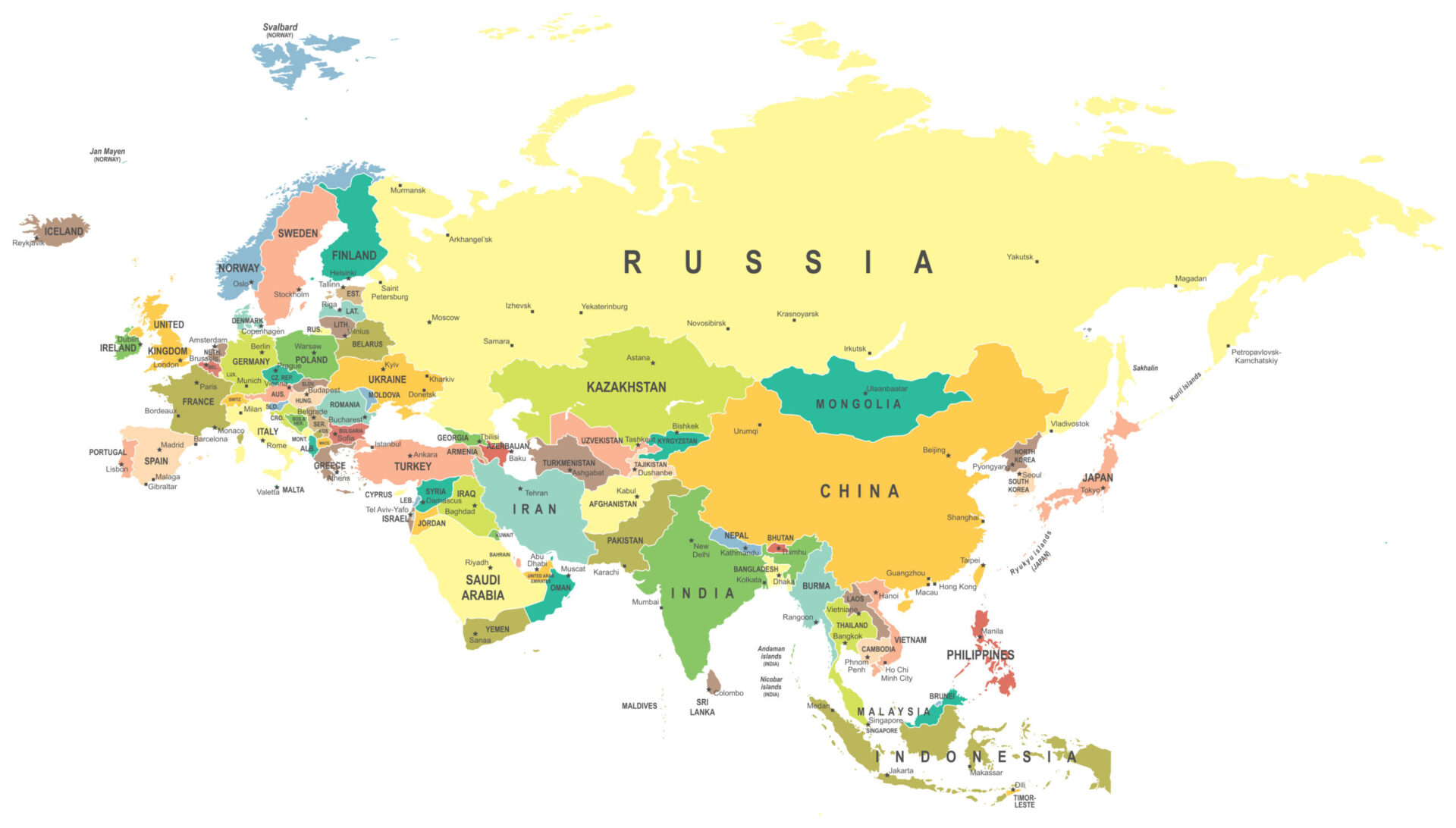
The INSTC corridor is a classic South-South integration project: a 7,200-km-long multimodal network of ship, rail, and road routes interlinking India, Afghanistan, Central Asia, Iran, Azerbaijan and Russia all the way to Finland in the Baltic Sea.
Technically, picture a set of containers going overland from St. Petersburg to Astrakhan. Then the cargo sails via the Caspian to the Iranian port of Bandar Anzeli. Then it’s transported overland to the port of Bandar Abbas. And then overseas to Nava Sheva, the largest seaport in India. The key operator is Islamic Republic of Iran Shipping Lines (the IRISL group), which has branches in both Russia and India.
And that brings us to what wars from now will be fought about: transportation corridors – and not territorial conquest.
Beijing’s fast-paced BRI is seen as an existential threat to the ‘rules-based international order.’ It develops along six overland corridors across Eurasia, plus the Maritime Silk Road from the South China Sea, and the Indian Ocean, all the way to Europe.
One of the key targets of NATO’s proxy war in Ukraine is to interrupt BRI corridors across Russia. The Empire will go all out to interrupt not only BRI but also INSTC nodes. Afghanistan under US occupation was prevented from become a node for either BRI or INSTC.
With full access to the Sea of Azov – now a “Russian lake” – and arguably the whole Black Sea coastline further on down the road, Moscow will hugely increase its sea trading prospects (Putin: “The Black Sea was historically Russian territory”).
For the past two decades, energy corridors have been heavily politicized and are at the center of unforgiving global pipeline competitions – from BTC and South Stream to Nord Stream 1 and 2, and the never-ending soap operas, the Turkmenistan-Afghanistan-Pakistan-India (TAPI) and Iran-Pakistan-India (IPI) gas pipelines.
Then there’s the Northern Sea Route alongside the Russian coastline all the way to the Barents Sea. China and India are very much focused on the Northern Sea Route, not by accident also discussed in detail in St. Petersburg.
The contrast between the St. Petersburg debates on a possible re-wiring of our world – and the Three Stooges Taking a Train to Nowhere to tell a mediocre Ukrainian comedian to calm down and negotiate his surrender (as confirmed by German intelligence) – could not be starker.
Almost imperceptibly – just as it re-incorporated Crimea and entered the Syrian theater – Russia as a military-energy superpower now shows it is potentially capable of driving a great deal of the industrialized west back into the Stone Age. The western elites are just helpless. If only they could ride a corridor on the Eurasian high-speed train, they might learn something.
The United States “with its own hands” pushed the countries, which are not participating in “sanctions wars”, to form a “new Big Eight” group with Russia, the Russian State Duma speaker Vyacheslav Volodin said on Saturday.
Following the launch of Russia’s military offensive in Ukraine in late February, the US, EU, UK and many other countries imposed hard-hitting restrictions on Moscow, making Russia the most sanctioned country in the world.
In a Telegram post, Volodin included a table with IMF data on GDP based on purchasing power parity of countries he calls the “new G8” and of countries forming the current G7 (after Russia’s participation in the bloc was suspended over Crimea’s vote to join the country in 2014, the G8 effectively turned into the G7).
“The group of eight countries not participating in the sanctions wars – China, India, Russia, Indonesia, Brazil, Mexico, Iran, Turkey – in terms of GDP at PPP [purchasing power parity] is 24.4% ahead of the old group,” Volodin wrote.
In his opinion, the economies of the G7 members – the United States, Japan, Germany, Britain, France, Italy and Canada – continue “to crack under the weight of sanctions imposed against Russia.”
“The rupture of existing economic relations by Washington and its allies has led to the formation of new points of growth in the world,” Volodin claimed.
While having serious economic difficulties, the US, according to the Duma speaker, continues “doing everything to solve their problems at the expense of others.”
Creating tensions will “inevitably” lead the US to lose its world domination, Volodin stressed.
“The United States created the conditions with its own hands for countries wishing to build an equal dialogue and mutually beneficial relations to actually form a ‘new Big Eight’ together with Russia,” he added.
On Friday, US Deputy Assistant Secretary of State Eric Woodhouse stated that Washington and its allies had realized that they would get “spillovers” of anti-Russia sanctions into their own economies. Their determination in imposing sanctions on Moscow, he claimed, has demonstrated a willingness to “accept those costs.”
US Treasury Secretary Janet Yellen admitted on the same day that the anti-Russia sanctions have made a “huge difference to food and energy prices,” amid record-setting inflation.
The remarks followed the statement by the Russian President Vladimir Putin who said that “many years of mistakes made by Western nations” in their economic and sanctions policies have caused “a global wave of inflation, disruption of established logistical and manufacturing chains, a surge in poverty and a deficit of food.”
Graham E. Fuller is a former Vice Chair of the National Intelligence Council at CIA with responsibility for global intelligence estimates.
The war in Ukraine has dragged on long enough now to reveal certain clear trajectories. First, two fundamental realities:
Putin is to be condemned for launching this war– as is virtually any leader who launches any war. Putin can be termed a war criminal–in good company with George W. Bush who has killed vastly greater numbers than Putin.
Secondary condemnation belongs to the US (NATO) in deliberately provoking a war with Russia by implacably pushing its hostile military organization, despite Moscow’s repeated notifications about crossing red lines, right up to the gates of Russia. This war did not have to be if Ukranian neutrality, á la Finland and Austria, had been accepted. Instead Washington has called for clear Russian defeat.
As the war grinds to a close, where will things go?
Contrary to Washington’s triumphalist pronouncements, Russia is winning the war, Ukraine has lost the war. Any longer-term damage to Russia is open to debate.
American sanctions against Russia have turned out to be far more devastating to Europe than to Russia. The global economy has slowed and many developing nations face serious food shortages and risk of broad starvation.
There are already deep cracks in the European façade of so-called “NATO unity.” Western Europe will increasingly rue the day that it blindly followed the American Pied Piper to war against Russia. Indeed, this is not a Ukrainian-Russian war but an American-Russian war fought by proxy to the last Ukrainian.
Contrary to optimistic declarations, NATO may in fact ultimately emerge weakened. Western Europeans will think long and hard about the wisdom and deep costs of provoking deeper long term confrontations with Russia or other “competitors”of the US.
Europe will sooner or later return to the purchase of inexpensive Russian energy. Russia lies on the doorstep and a natural economic relationship with Russia will possess overwhelming logic in the end.
Europe already perceives the US as a declining power with an erratic and hypocritical foreign policy “vision” premised upon the desperate need to preserve “American leadership” in the world. America’s willingness to go to war to this end is increasingly dangerous to others.
Washington has also made it clear that Europe must sign on to an “ideological” struggle against China as well in some kind of protean struggle of “democracy against authoritarianism”. Yet, if anything this is a classic struggle for power across the globe. And Europe can even less afford to blunder into confrontation with China–a “threat” perceived primarily by Washington yet unconvincing to many European states and much of the world..
China’s Belt and Road initiative is perhaps the most ambitious economic and geopolitical project in world history. It is already linking China with Europe by rail and sea. European exclusion from the Belt and Road project will cost it dearly. Note that the Belt and Road runs right through Russia. It is impossible for Europe to close its doors to Russia while maintaining access to this Eurasian mega project. Thus a Europe that perceives the US already in decline has a little incentive to join the bandwagon against China. The end of the Ukraine war will bring serious reconsideration in Europe about the benefits of propping up Washington’s desperate bid to maintain its global hegemony.
Europe will undergo increasing identity crisis in determining its future global role. Western Europeans will tire of subservience to the 75 year American domination of European foreign policy. Right now NATO is European foreign policy and Europe remains inexplicably timid in asserting any independent voice.How long will that prevail?
We now see how massive US sanctions against Russia, including confiscation of Russian funds in western banks, is causing most of the world to reconsider the wisdom of banking entirely on the US dollar into the future. Diversification of international economic instruments is already in the cards and willl only act to weaken Washington’s once dominant economic position and its unilateral weaponisation of the dollar.
One of the most disturbing features of this US-Russian struggle in Ukraine has been the utter corruption of independent media. Indeed Washington has won the information and propaganda war hands down, orchestrating all Western media to sing from the same hymnbook in characterizing the Ukraine war. The West has never before witnessed such a blanket imposition by one country’s ideologically-driven geopolitical perspective at home. Nor, of course, is the Russian press to be trusted either. In the midst of a virulent anti-Russian propaganda barrage whose likes I have never seen during my Cold Warrior days, serious analysts must dig deep these days to gain some objective understanding of what is actually taking place in Ukraine.
Would that this American media dominance that denies nearly all alternative voices were merely a blip occasioned by Ukraine events. But European elites are perhaps slowly coming to the realization that they have been stampeded into this position of total “unanimity”; cracks are already beginning to appear in the façade of “EU and NATO unity.” But the more dangerous implication is that as we head into future global crises, a genuine independent free press is largely disappearing, falling into the hands of corporate-dominated media close to policy circles , and now bolstered by electronic social media, all manipulating the narrative to its own ends. As we move into a predictably greater and more dangerous crises of instability through global warming, refugee flows, natural disasters, and likely new pandemics, rigorous state and corporate domination of the western media becomes very dangerous indeed to the future of democracy. We no longer hear alternative voices on Ukraine today.
Finally, Russia’s geopolitical character has very likely now decisively tilted towards Eurasia. Russians have sought for centuries to be accepted within Europe but have been consistently held at arms length. The West will not discuss a new strategic and security architecture. Ukraine has simply intensified this trend. Russian elites now no longer possess an alternative to accepting that its economic future lies in the Pacific where Vladivostok lies only one or two hours away by air from the vast economies of Beijing, Tokyo, and Seoul. China and Russia have now been decisively pushed ever more closely together specifically out of common concern to block unfettered US freedom of unilateral military and economic intervention around the world. That the US can split US-induced Russian and Chinese cooperation is a fantasy. Russia has scientific brilliance, abundant energy, rich rare minerals and metals, while global warming will increase the agricultural potential of Siberia. China has the capital, the markets, and the manpower to contribute to what becomes a natural partnership across Eurasia.
Sadly for Washington, nearly every single one of its expectations about this war are turning out to be incorrect. Indeed the West may come to look back at this moment as the final argument against following Washington’s quest for global dominance into ever newer and more dangerous and damaging confrontations with Eurasia. And most of the rest of the world–Latin America, India, the Middle East and Africa– find few national interests in this fundamentally American war against Russia.