Maybe we shouldn’t have helped stir up the hornet’s nest that resulted in the Maidan coup of 2014. Not only does a majority of the Ukrainian population still not want NATO membership, it is the second poorest country in Europe per capita and is still beset with a lot of corruption.
In further signs that a Biden administration will mark a return to the Neocon-Liberal Interventionist war orgy of the Bush-Obama years, many of the members of the Biden transition team come from think tanks funded by war profiteers and fossil fuel companies. According to a report compiled by Antiwar.com:
On Tuesday, Joe Biden released a list of transition teams for the various departments in his future White House. The Pentagon transition team for Biden consists of 23 people, many of whom hail from hawkish think tanks.
These think tanks include Center for Strategic and International Studies (CSIS), Center for a New American Security (CNAS), and RAND Corporation.
A report from In These Times found at least eight out of the 23 [transition] team members come from organizations that receive funding from US weapons makers (not including RAND). Besides the CSIS and CNAS employees listed above, In These Times includes Sharon Burke, who works for New America, Shawn Skelly, from CACI International, and Victor Garcia, from Rebellion Defense.
Jimmy Dore goes into more detail in the video below.
House representatives Barbara Lee of California and Mark Pocan of Wisconsin have sent a letter to Biden asking that whoever is nominated for Secretary of Defense not come from the defense industry. The Hillreported last week:
As House members, Pocan and Lee will not get a vote on Biden’s eventual nominee. But the letter signals the progressive position on the woman widely seen as Biden’s likely choice, Michèle Flournoy [though she was not mentioned by name in the letter].
Flournoy, who was under secretary of Defense for policy in the Obama administration, co-founded consultant group WestExec Advisors, which counts defense contractors among its clients. She is also on the board of defense contractor Booz Allen Hamilton.
While I commend this gesture from Lee and Pocan, I will not hold my breath that it will make a bit of difference.
In the year following his election, Ukrainian president Volodymyr Zelensky’s approval has fallen from 73 percent to a new low in the latest local elections. Although several run-off elections have yet to be held, it is already clear that the president’s party, “Servant of the People,” suffered a major defeat, being unable to win a single mayoral race or even a majority in any regional parliament or city council.
Such a precipitous fall from electoral grace can be attributed in part to professional incompetence and failure to keep his campaign promises, but in even greater measure it stems from Zelensky’s betrayal of his core electorate, which lies in the predominantly Russian-speaking East and South. Since Petro Poroshenko had run on an arch-nationalist agenda, proclaiming “It’s Poroshenko or Putin,” Zelensky’s appeal, stemmed largely from the fact that he was running as the anti-Poroshenko. Ukrainians were tired of the previous president’s efforts to divide the nation along the lines of his campaign slogan-“Army, Language, Faith”-and handed Poroshenko a resounding defeat in every region of Ukraine, except Lviv.
Now, Zelensky seems to think that he has found a way to return to center stage by declaring Ukraine’s entire Constitutional Court a threat to national security. “In a matter of hours,” the president told his party faction in the parliament, “the judges of the Constitutional Court have set the country on the edge of catastrophe. It will either be pulled into bloody chaos, or the state as a system of transparent rules and agreements will cease to exist.”
What did the Constitutional Court, the nation’s final authority in constitutional matters, do that was so awful?
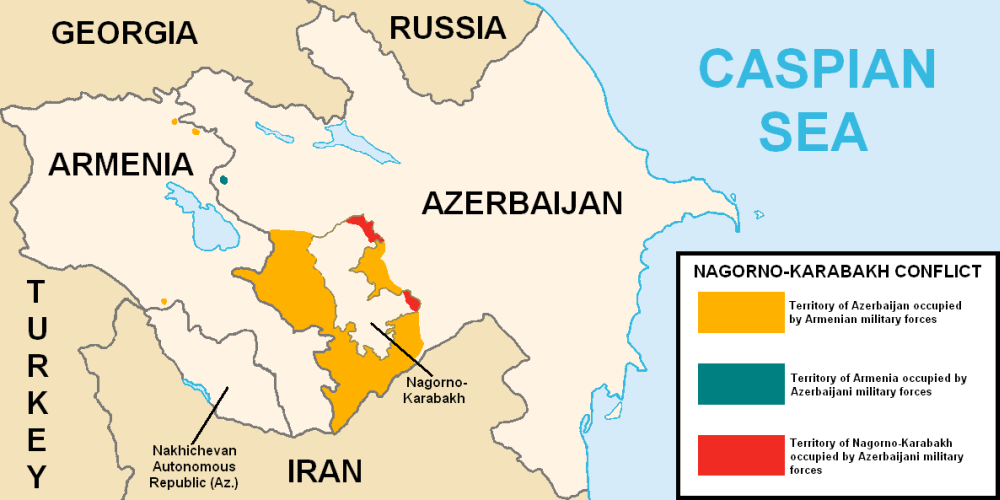
After Azerbaijan forces took Shushi (aka Shusha by Azeris) on Monday – the second largest city in Nagorno-Karabakh – and were said to be close to taking the capital of Stepanakert, the Armenian Prime Minister announced that he had agreed to an armistice. According to Antiwar.com:
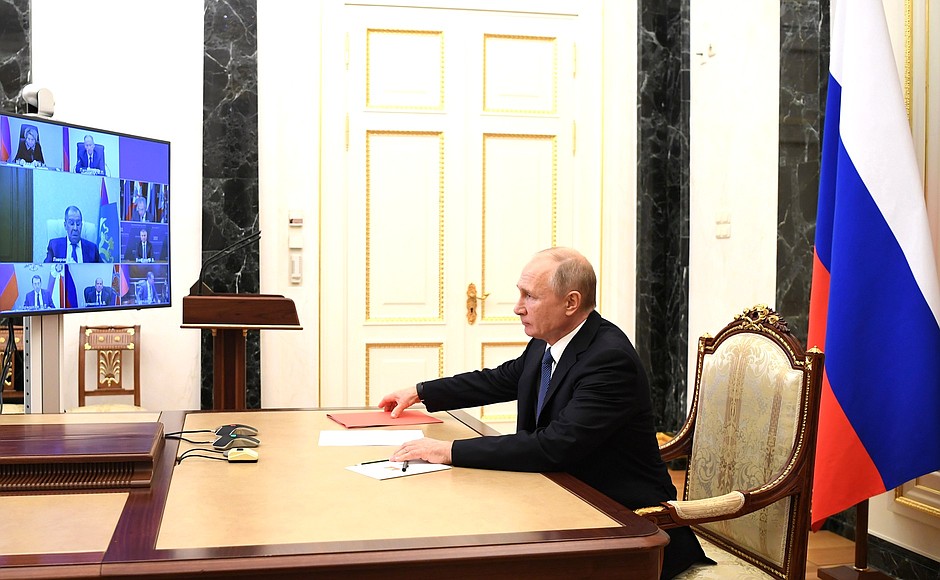
[Armenian PM Nikol] Pashiyan said he signed the deal with Russian President Vladimir Putin and Azerbaijani President Ilham Aliyev. “I have signed a statement on the termination of the Karabakh war with Russian and Azerbaijani presidents from 01.00 pm,” Pashiyan said on Facebook.…
Pashiyan said the statement “is unbelievably painful for me and our people,” meaning he likely agreed to cede territory to Azerbaijan.
At the time of that report, details had not yet been made public. A later report from RT stated the following:
According to the text of the agreement that appeared in Russian media around midnight Moscow time – when the armistice was to take effect – Russia will deploy almost 2,000 peacekeepers along the line of contact and the “Lachin corridor,” the road connection between Nagorno-Karabakh and Armenia proper.
These peacekeepers will move in as the Armenian armed forces withdraw, and will stay for five years, according to the draft. An automatic five-year extension of their mandate is envisioned, unless any of the parties objects six months before its expiration.
Neither Armenian nor Azerbaijani forces are supposed to advance beyond their current positions. This leaves the remaining territory of the Nagorno-Karabakh autonomous region somewhat surrounded, with only a 5-kilometer-wide corridor to Armenia proper, under protection of the Russian peacekeepers.
A new road is supposed to be built through the Lachin area over the next three years, to connect Armenia with Stepanakert, the capital of Nagorno-Karabakh. In parallel, another road will be built through Armenia to connect Azerbaijan with its enclave of Nakhichevan in the southwest. Until then, Russian border troops will supervise the existing road traffic through Armenia to Nakhichevan.
The agreement also allows for the exchange of prisoners and return of the bodies of soldiers killed. The return of refugees displaced by the recent fighting will be overseen by the UN’s agency for refugees.
An earlier report by Asia Times stated that the deal was hammered out personally by Putin and Turkish president Erdogan and that the peace-keeping mission would be conducted jointly by Russian and Turkish troops. Furthermore, it was pointed out that there are still outstanding concerns for Russia:
If Putin and Erdogan made a deal as reported, there are still tensions between the two that have to be sorted. The most significant is the presence of Syrian radical Islamic fighters imported into Azerbaijan for the Nagorno-Karabakh battle.
Both Putin and Russia’s Foreign Minister Sergey Lavrov have warned about the presence of the Syrian radicals and made clear they want them out.
Russia also has a black eye because its modern equipment, especially it’s air defense systems situated at bases in Armenia, failed to stop Azerbaijan’s drone assault. Many of Russia’s air defenses were knocked out, including its S-300, by both Turkish Baraktar drones and Israeli Harop suicide loitering munitions.
Thousands of angry Armenians went out in the streets of the capital Yerevan today with reports of government buildings being stormed. Meanwhile, there were scenes of jubilation in Azerbaijan.
According to Democracy Now!: “It is estimated the conflict has killed at least 1,000 people and displaced over 100,000, though some say the death toll is much higher.”
*Update 1: Professor Paul Robinson has done a good write-up here as well.
*Update 2: Russia has denied that Turkey will be part of a joint peacekeeping mission in Nagorno-Karabakh. However, Erdogan has publicly stated, following a telephone conversation with Putin, that Turkey will be helping to monitor the situation from a joint center – the location of which is to be determined by Azerbaijan:
Presidents of Russia and Turkey Vladimir Putin and Recep Tayyip Erdogan conducted a phone conversation on Tuesday discussing the situation in Nagorno-Karabakh and Syria, the Directorate of Communications of the Turkish President told journalists.
“President Erdogan during the talks noted that yesterday a step in the right direction was made on the path to the permanent settlement in Nagorno-Karabakh. President Erdogan stated that Turkey together with Russia will also conduct observing and monitoring activity over ceasefire using a joint center which will be created in a region determined by Azerbaijan in a territory liberated from Armenian occupation,” the communique made public after the conversation said.
Putin has been busy submitting bills that would indicate that he is setting the practical groundwork for an eventual transition of power. The first was a bill in connection with the State Council. Before going into what this bill does, let’s review what the State Council is and what the recent constitutional amendments would change.
The State Council was created in 2000 and is currently an advisory body to the president to coordinate different parts of government and advise on critical issues. As reflected in the new constitutional amendments, It is now to become an official executive body. Rather than being a ceremonial advisory body, it will now have the power to set the direction of both domestic and foreign policy, with a focus on socio-economic development.
The constitutional amendments, while granting the president the power to create the body, provided no details about how the president would go about creating the body or filling positions on it. TASSreported the following on the October 14th bill submitted by Putin:
The State Council will be headed by the Russian president. It will serve as an advisory body to the head of state. The State Council will include the Russian Prime Minister, the Federation Council [upper house of parliament] speaker, the State Duma [lower house of parliament speaker, the president’s chief of staff, and regional heads. Besides, representatives of political parties that have formed factions at the Russian State Duma, representatives of local governance bodies and others can be included on the Council if the president makes the corresponding decision.
The bill forbids people that have a foreign citizenship or a residence permit from forming part of the State Council, as well as those with accounts held at foreign banks.
In order to deal with the agenda of the council, the presidium of the State Council will be established. Its composition will be determined by the chairman. Besides, special commissions and working groups will be created in order to organize activity in specific spheres. Representatives of federal and regional government bodies, other state bodies, local governance bodies and organizations can form part of the commissions. Members of specific commissions do not have to form part of the State Council. The chairman and members of the State Council take part in its activity on a voluntary basis.
According to an analysis by Chatham House, the recent bill submitted by Putin would allow:
the president to achieve at least three things at once: further de-institutionalize governance structures to give him more flexibility and appointment powers; step back from day-to-day governance while still retaining control; and structure decision-making between his subordinates on national priorities across branches of power and layers of the federation.
These analysts point out that the State Council became particularly active around the National Projects program in 2018, an infrastructure development project critical to Putin’s plan to increase living standards and quality of life in Russia. Due to the pandemic, the National Project’s goals have been moderated.
The Chatham House analysts have a negative take on the changes which they see as potentially usurping the power of local mayors and officials.
On October 31st, Putin submitted another bill regarding the role of members of the upper house of parliament, the Federation Council, in which the Russian president would have the ability to appoint senators for life and for ex-presidents to apply for a senatorial seat within 3 months of leaving the office of the presidency. According to TASS:
The bill says that senators – representatives of the Russian Federation – are appointed for six years or for life by presidential decrees. The head of state can appoint no more than seven lifetime senators. The appointment of senators is a presidential prerogative, but not a duty, so the president can use it at any time.
Under the Russian Constitution, the citizens with outstanding merits in their state and public services to the country could be appointed lifetime members of the Federation Council. The submitted bill contains the same provision.
The requirements for former presidents are envisaged in a separate clause. A Russian president, who has ended their tenure after a presidential term has expired or in advance, will acquire the status of a senator since the moment of sending an application, with all the required documents attached, to the Federation Council. The application may be submitted once within three months after the president leaves office. Along with this, the president whose tenure has ended before the given bill is adopted may file this application within three months since the day the law enters into force.
Additionally, senators must be over the age of 30, have no residency abroad or citizenship outside of Russia, and have an “impeccable reputation.”
RTreported additional details on the makeup of the Federation Council pursuant to Putin’s proposed bill:
According to the draft law, “On the procedure for forming the Federation Council,” the body will include two representatives from each of the country’s 85 regions (one from the legislative and executive authorities), a former president of Russia after leaving his post, and no more than 30 representatives chosen by him or her, with up to seven appointed for life.
Last but not least in his package of bills, Putin proposed the granting of immunity to all former presidents, including for any crimes allegedly committed before taking office. RTreported last week:
According to the proposal, any former Russian head of state, as well as their family members, would not only be immune from prosecution, but they could not legally be arrested, imprisoned, searched, or interrogated. The law would also protect Dmitry Medvedev, the only other ex-president still alive.
If passed, the bill would stretch current presidential immunity back to before the person took office, meaning Putin could not be held responsible for anything before his first term in 2000. The protection would also apply to the time he served as prime minister, between 2008 and 2012…
….Under the current legislation, the ex-head of state cannot be held accountable for acts committed during their presidential term, but offenses committed outside of this timeframe are still prosecutable….
….The new law still leaves open the possibility of prosecution for more serious crimes, such as treason. For this to happen, charges would have to be confirmed by the country’s Supreme and Constitutional Courts, before being passed through the State Duma. The upper house of parliament, the Federation Council, would then vote on lifting the president’s immunity.
The day after Putin submitted that proposal, a British tabloid called The Sun, published a story asserting that Putin had been diagnosed with Parkinson’s Disease and would be leaving office in January. The story was picked up by other tabloids such as The Daily Mail.
When someone forwarded this story to me last Friday morning, my first thought was that anyone in a position to know accurately about any Putin health problem would not be leaking it to UK rag papers.
Turns out the story originated from Valery Solovey, a loony tune in Moscow who is notorious for his tall tales and lack of credibility, but nonetheless seems to get picked up by western “journalists.”
The western media apparently has to come up with a sensationalist explanation as to why Putin has submitted legislation indicating intent for eventual transfer of power since their narrative has been that Putin doesn’t intend to ever leave.