Caitlin Johnstone: On Bombs and Bombings

By Caitlin Johnstone, August 18, 2020

For a full week now the Israeli army has been bombing Gaza, a population that is about to run out of fuel for its only power plant due to a years-long Israeli program of deliberate siege warfare.

Yesterday [August 17th] the US ordered an airstrike on Syrian forces, killing one, when they refused to let the illegal occupying force past a checkpoint in northern Syria.

In both cases an arm of the US-centralized empire used wildly disproportionate force against people who stood against a hostile occupation of their own country. In both cases the more powerful and violent occupiers claimed they were acting in “self-defense”. In both cases dropping explosives from the sky upon human beings barely made the news.

Bombs should not exist. Explosives designed to blow fire and shrapnel through human bodies should not be a thing. In a sane world, there wouldn’t be bombs, and if some mentally unbalanced person ever made and used one it would be a major international news story.

Instead, bombs are cranked out like iPhones at enormous profit, and nearly all bombings are ignored. Many bombs are being dropped per day by the US and its allies, with a massive civilian death toll, and almost none of those bombings receive any international attention. The only time they do is generally when a bombing occurs that was not authorized by the US-centralized empire.

This is one of those absolutely freakish things about our society that has become normalized through careful narrative management, and we really shouldn’t allow it to be. The fact that explosives designed to rip apart human anatomy are dropped from the sky many times per day for no other reason than to exert control over foreign countries should horrify us all.

An interesting social experiment when you talk to someone might be to tell them solemnly, “There’s been a bombing.” Then when they say “What?? Where??”, tell them “The Middle East mostly. Our government and its allies drop many bombs there per day in order to keep a resource-rich geostrategic region balkanized and controllable.”

Then watch their reaction.

You will probably notice a marked change in demeanor as the person learns that what you meant is different from what they thought you meant. They will likely act as though you’d tricked them in some way. But you didn’t. You just called a thing the thing that it is, and let their assumptions do the rest.

When someone gravely tells you “There’s been a bombing,” what they almost always mean is that there has been a suspected terrorist attack in a western, majority-white nation. They don’t mean the kind of bombing that kills exponentially more people and does exponentially more damage than terrorism in western nations. They don’t mean the kind of terrorism that our government enacts and approves of.

There’s a lot of pushback nowadays against the racism and prejudices that are woven throughout the fabric of our society, and rightly so. But what doesn’t get nearly enough attention in this discourse is the fact that while some manifestations of bigotry may have been successfully scaled back somewhat in our own countries, it was in a sense merely exported overseas.

The violence that is being inflicted overseas in our name by the US-centralized empire is more horrific than any manifestation of racism we’re ever likely to encounter at home. It is more horrific than the pre-integration American South. It is more horrific than even slavery itself. Yet even the more conscious among us fail to give this relentless onslaught of violence a proportionate degree of recognition and condemnation, even while the consent for it is largely born of the unexamined bigoted notion that violence against people in developing and non-western countries does not matter.

Like many other forms of bigotry, this one has been engineered and promulgated by powerful people who benefit from it. If the mainstream news media were what it purports to be, namely an institution dedicated to creating an informed populace about what’s truthfully going on in the world, we would see the bombings in foreign nations given the same type of coverage that a bombing in Paris or London receives.

This would immediately bring consciousness to the unconscious bigotry that those in the US-centralized empire hold against people in low and middle income countries, which is exactly why the plutocrat-owned media do not report on it in this way. The US-centralized empire is held together by endless violence, and the plutocrats who run it have built their kingdoms upon the status quo of that empire.

When people set out to learn what’s really going on in their world they often start cramming their heads with history and geopolitics facts and figures, which is of course fine and good. But a bigger part of getting a clear image of what’s happening in the world is simply turning your gaze upon things you already kind of knew were happening, but couldn’t quite bring yourself to look at.

Thanks for reading! The best way to get around the internet censors and make sure you see the stuff I publish is to subscribe to the mailing list for at my website or on Substack, which will get you an email notification for everything I publish. My work is entirely reader-supported, so if you enjoyed this piece please consider sharing it around, liking me on Facebook, following my antics on Twitter, throwing some money into my tip jar on Patreon or Paypal, purchasing some of my sweet merchandise, buying my books Rogue Nation: Psychonautical Adventures With Caitlin Johnstone and Woke: A Field Guide for Utopia Preppers. For more info on who I am, where I stand, and what I’m trying to do with this platform, click here. Everyone, racist platforms excluded, has my permission to republish, use or translate any part of this work (or anything else I’ve written) in any way they like free of charge.
The Power of Story to Change Hearts and Minds Where Facts & Logic Cannot

Some of you may remember the April 2015 Munk debate – a -semi annual debate that takes place in Toronto with an audience of approximately 3000 on a topic of current public interest. That particular year the debate question was whether the West should engage with Russia or not. Author Anne Applebaum and Russian chess champion and Kremlin critic Garry Kasparov argued for eschewing engagement to punish Putin and the Russian government for its supposed sins. Professor Stephen F. Cohen and Russian journalist Vladimir Posner argued for engagement.

Unfortunately, the audience was swayed by Applebaum and Kasparov and voted for non-engagement. The result of this always bothered me. How is it that an anti-Russia propagandist like Applebaum and a Neocon apologist like Kasparov can beat out one of the best Russia Studies academics in the U.S. and a renowned Russian journalist? In a rational world, Cohen and Posner should have been able to mop the floor with the likes of Applebaum and Kasparov without even breaking a sweat. What happened?

As a life-long lover of literature and someone who has tried my own hand at writing fiction (I have two trunk novels), I have a theory as to why this happened.

There are a small percentage of people, often scholarly types or journalists, who are swayed by and believe in the power of rational argument and the recitation of facts and figures to change people’s minds on any given issue. But the truth is – that is not actually how most people’s minds are changed. Humans evolved as storytellers, from hieroglyphics on caves to oral tradition and the written word, all cultures across time have told stories. Storytelling is how we have imparted ethical guidelines as well as practical information needed for survival.

In the Ted Talk below, author and writing coach Lisa Cron discusses the history and science behind the power of narrative and why it can transform people’s views where logical argument alone cannot. She gives an excellent example of how literature changed far more minds on a critical issue of 20th century American political import than any logical argument. Hint: most of you have read the novel and/or seen the movie. She also cautions people to be aware of the narratives they are being fed by the larger culture and whether those narratives are desirable or harmful.

Getting back to the Munk debate, I think that Applebaum and Kasparov understood the art of storytelling – albeit in a manipulative fashion. Their narrative of Russia and the context of U.S.-Russia relations in the post-Soviet era is very distorted but they managed to spin a compelling story: Kasparov with his framing of himself as an innocent every man up against a big bad bully named Putin and Applebaum with her framing of the noble west who has run out of patience with the incorrigible troublemaker who must be made to answer for his dangerous shenanigans. There is a recognizable protagonist and a recognizable antagonist in their story as well as a call to action.

Cohen and Posner, on the other hand, relied on the presentation of facts and logic. But they hadn’t figured out a compelling counter-narrative or story in which to place those facts. Consequently, the audience went with a story they understood. It was also a story they easily recognized because they had already been primed with lots of propaganda from the media they consume to do so.

I tend to think that academics and journalists who speak the truth about Russia and foreign affairs – while they serve a very important purpose – are not going to be able to turn the ship around on their own. They are going to have to find people in the arts – novelists, filmmakers, musicians, playwrights – to partner with to change hearts and minds through the power of narrative.

Breaking: Kamala Harris is Biden’s VP Pick – Be Prepared for a Hillary Clinton Foreign Policy

It has just been announced that Kamala Harris has been chosen as Joe Biden’s running mate. This will likely portend a continuation of the Neocon/Hyper-interventionist foreign policy we’ve been seeing for decades, along with hostility toward Russia. Below is a video Kim Iversen did back last November detailing how Kamala Harris is a proxy for Hillary Clinton on foreign policy.

Guest Post – Essence of Americanism: Self-Determination Serves as the Basis of Democracy

Today’s guest post is by James Chen. Please feel free to share your thoughts in the comments section below – Natylie

The word “democracy” has been upheld as the holy grail of Americanism by contemporary American political practitioners and pundits. However, self-determination, which served as the corner stone of the nascent American republic established by our founding fathers nearly two-and-half centuries ago, is seldom mentioned in any of our governmental documents and main-stream-media publications.

Theoretically, on the political spectrum, the opposite of democracy is authoritarianism. Authoritarianism almost always leads to imperialism. And the only effective antidote against imperialism is faith in self-determination.

It is also worth noting that without self-determination, a democratic political system could hardly be cultivated in any political state striving for self-governance, let alone be implemented. In other words, when there’s no self-determination, there’s no self-governance. It could be recognized in Thomas Jefferson’s words:

Every man, and every body of men on earth, possesses the right of self-government. Every nation has a right to govern itself internally under what forms it pleases, and to change these forms at its own will.  Sometimes it is said that man cannot be trusted with the government of himself. Can he, then, be trusted with the government of others? Or have we found angels in the form of kings to govern him? Let history answer this question.

An important historical aspect regarding self-determination that every American should know, is that it was enshrined as the basic mandate of the two most prominent American foreign policy proclamations of the 20th century: the Fourteen Points by President Woodrow Wilson and the Atlantic Charter by President Franklin Roosevelt. Both documents served as the foundation to build a peaceful world respectively after the two most destructive calamities in human history.

Without discussing the reasons why self-determination is omitted from our current political discussion by our politicians and main-stream-media, we can still easily identify many disastrous consequences that have arisen from its omission while our government has been involved in manipulating the world order since the end of WWII. Let’s just name several out of the long list in a reverse chronological order: 1. Current expansion of Chinese imperialism in the East Asia, 2. Current expansion of Turkish imperialism in the Middle East, 3. The Yemeni Civil War by proxies, 4. The Syrian Civil War by proxies, 5. The Ukrainian revolution with American involvement, 6. The regime change in Libya, 7. The regime change in Iraq, 8. The NATO bombing of Belgrade without UN authorization, 9. The dissolution of Yugoslavia without dissolution of Bosnia-Herzegovina, 10. The Kurdish genocide by the Turkish government with US support in Southeast Turkey, 11. The aggrandized expansion of the NATO war machine after dissolution of the Soviet Union, 12. The US interference of Russian presidential election in 1996, 13. the destruction of Afghanistan’s progressive society, 14. The Turkish invasion, occupation and colonization of Cyprus, 15. Multiple staged coup d’etats in Central and South America, 16. The regime change in Cambodia and consequent massacre, 17. The Vietnam War, 18. The 1965 regime change in Indonesia and consequent massacre, 19. The 1955 Istanbul pogrom, 20. The 1953 regime change in Iran and its consequences, 21. The Greek Civil War, etc..

The shameful thing is that in most of the cases listed above, not only was our government not on the side to promote or protect the principle of self-determination, but, on the contrary, it was on the side of the suppressors or perpetrators committing crimes against humanity with American taxpayer money.

By analyzing all the mistakes listed above, it should not be difficult for any fair-minded, rational American to appreciate the causal relationship between the reason, i.e., the total disregard of the world peoples’ will for self-determination and the obvious consequence, i.e., the American imperial power abused, the authoritarian regimes emboldened, many democracies suppressed and civilized societies destroyed, innocent populations massacred, wars and conflicts prolonged, and American interests severely curtailed.

There are several primary mechanisms taking places in the causal relationship leading to wars and serious conflicts:

  1. Staging military forces unnecessarily in the territory of any sovereign state could encroach on the right for self-determination of the people of that state.
  2. Establishing a permanent military organization consisting of multiple states with superior military and economic power over a targeted state could encroach on the right for self-determination of the people of all the states involved, forming a dependency-codependency conundrum.
  3. Providing military or financial support to any authoritarian state committing aggression against other states or distinct ethnic groups could embolden the authoritarian regime of that state and cause extreme harm to the victimized states and ethnic groups.
  4. Forming close business relations with any authoritarian state demonstrating total disrespect for the principle of self-determination could also encourage the authoritarian regime of that state to perpetuate its imperial actions, jeopardizing local and even world peace.
  5. Staging regime changes in other sovereign states to advance American imperial or business interests could cause tremendous harm to the people of the targeted states. The resulting states after the staged regime change are seldom democratic.
  6. Lastly, the suppressed people yearning for self-determination might not always be as silent as lambs.

Bearing in mind the importance of the principle of self-determination, the American politicians should try to relinquish our imperialist foreign policy and replace it with a commitment to supporting self-determination around the globe as the basis for democracy against authoritarianism. This was well understood by President John F. Kennedy more than half a century ago. He would have prevented the U.S. involvement in Vietnam had he not been assassinated five months after his last major speech, delivered on June 10, 1963, at American University, which clearly suggested a desire to end the meaningless cold war perpetuated by imperialism. The desire for genuine peace echoed the pledge he made in his inaugural speech less than three years before to uphold the same tenet for liberty, human rights and self-determination by our forebearers of the American Revolution.

Today, I urge all American politicians to finish what our fallen predecessors started and to continue safeguarding the principles upheld by our previous great leaders.  This is the direction that will lead to doing the right things as opposed to continuing to do the wrong things.

James J. Chen has had a life-long interest in history, politics, and the humanities. He has begun writing on these topics, with a particular emphasis on the the U.S.’s role in the evolution of the modern world.  He lives and practices medicine in the San Francisco Bay Area. His website address is: https://jamesjchen.wixsite.com/save-the-country.

Why America Needs to Embrace Pluralism Instead of Exceptionalism

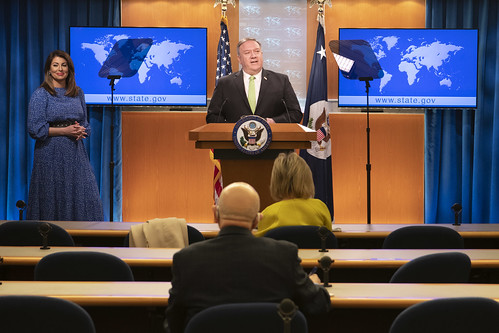
Secretary Pompeo Delivers Remarks to the Media
Secretary of State Mike Pompeo Addresses the Media

By Natylie Baldwin, OpEd News, July 30, 2020

“We, the freedom-loving nations of the world, must induce China to change, just as President Nixon wanted. We must induce China to change in more creative and assertive ways, because Beijing’s actions threaten our people and our prosperity.

We must start by changing how our people and our partners perceive the Chinese Communist Party. We have to tell the truth. We can’t treat this incarnation of China as a normal country, just like any other.”

– Secretary of State Mike Pompeo

As Secretary of State Mike Pompeo continues to bloviate on a litany of sins that the Chinese government is guilty of, and various politicians and media outlets continue their nonstop propaganda about how evil Russia is, it is clear that the goals is to keep Americans perpetually indoctrinated with the idea that these two nations are incorrigible enemies.

This is consistent with the National Defense Strategy (NDS) of 2018, which states that the main threats facing the United States in the foreseeable future are Russia and China. And while the terminology of “great power competition” is thrown around, there is emphasis placed on the implicit clash of values with the U.S.-led west, with several references to the “free and open international order” that these two nations are putatively in violation of.

This shares some continuity with the Neoconservative-inspired Wolfowitz Doctrine of the early 1990’s, which granted Washington the right to forcibly determine what values and political framework the rest of the world should adhere to while maintaining hegemony over the world. The Democratic Party has embraced similar foreign policy ideas. Even the “progressive” wing, represented by Bernie Sanders, touted a need to take on the world’s “authoritarians” who were threatening the enlightened west.

All societies throughout modern history have had to prioritize various issues that impact national survival and their populations: the balance between the individual and the collective good, or the impact of change vs group instability, democracy versus economic development, etc. Different societies have resolved these issues in different ways, with varying results.

But the United States, with its triumphalist attitude at the close of the Cold War, decided that its way of life had been judged to be inevitable for everyone in the world. This was summed up in Francis Fukiyama’s The End of History. Western, especially American, political values and norms have been assumed to be the only correct way to resolve the most basic questions of organized life, regardless of whether a country has had any meaningful experience with western values. If a country disagrees or chooses to prioritize differently, they have been deemed backward or illegitimate.

This leaves no space for pluralism, negotiation or peaceful co-existence. Instead, it leads to a world in which conflict is inevitable and differences are irreconcilable. Constant war and the threat of war, especially with the three most powerful players on the world stage – the U.S., China and Russia – having nuclear weapons arsenals at their disposal, makes this an immoral and unsustainable framework.

Continue reading here.

Analysis & Book Reviews on U.S. Foreign Policy and Russia