In this series of interviews with MIT Professor Theodore Postol, award-winning journalist Aaron Mate discusses how the dissolution of the INF Treaty is already impacting a nuclear arms race between the U.S. and Russia, what the accusations of violations on both sides were, and how previous policy mistakes paved the way for distrust and eventual disintegration of the treaty.
In this first video, Postol goes into the recent testing off the coast of California by the U.S. of a missile that was prohibited by the INF and what the consequences of an escalated nuclear arms race are:
In this next video, Postol discusses the action of the Obama administration in 2009 that not only contributed to sabotaging the “re-set” with Russia, but helped pave the way for the Trump administration’s ultimate dumping of the INF framework of arms control.
In this final video, Postol explains why Tulsi Gabbard is correct, based on the scientific evidence, to question the narrative put forth by both Washington and the establishment media regarding alleged chemical weapons attacks by the Syrian government.
The DNC is up to its old tricks of sidelining candidates who have policy positions that the establishment doesn’t approve of and, therefore, doesn’t want you to continue to hear.
In this video, political analyst and radio personality Kim Iversen unpacks the arbitrariness and lack of transparency behind one of the criteria the DNC is using to determine which of the candidates will be allowed on the debate stage for the third Democratic debate next month: the requirement to get 2% or more in four approved polls by August 28th.
There have been numerous polls since the last debate with results that are inconsistent with each other. Even the pollsters themselves are acknowledging that the polls aren’t terribly reliable at this point – more than a year away from the election. But only certain polls are being considered for the DNC’s purposes. In this twisted setup, Tulsi Gabbard – a candidate who is still actively gaining momentum as reflected by her having over 170,000 unique donors with approximately 50,000 of those gained since the last debate – has polled at 2% or better in 23 polls, but the DNC is only counting 2 of those (as of 8/20)*, without any meaningful explanation as to why some polls are getting the stamp of approval and others aren’t. Iversen discusses what demographics tend to get favored by the small number of polls that are being accepted and which candidates, in turn, that phenomena is favoring.
The link to the petition Iversen mentions is here for those who wish to sign.
*Note: this video was recorded on 8/18 and, at that point, Tulsi only had one qualifying poll. On 8/20, it was reported that she has now made the cut in 2 qualifying polls. But we don’t know how many more qualifying polls will come out before 8/28.
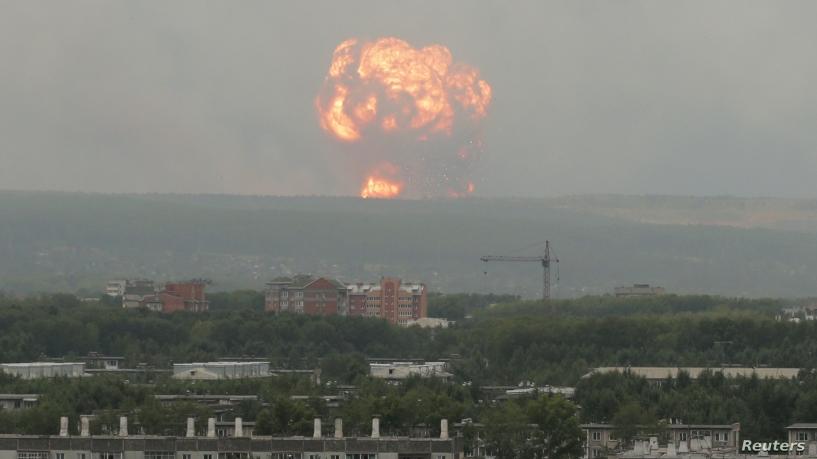
Explosion at Achinsk ammunition depot in Siberia; Reuters 2019.
It’s been a rough summer for the Russian heartland. First there were floods and wildfires that ravaged parts of Siberia. Now, over the past 10 days there have been two deadly explosions. The first was at an ammunition depot in Achinsk (also in Siberia), which resulted in one dead and 7 injured with thousands evacuated from the vicinity. The second was an explosion in the White Sea that has killed 7 and seriously injured at least 6 more.
That last incident off the northern coast of Russia involved the release of radiation that led to a spike in local levels in the immediate aftermath. Democracy Now! has reported 7 resultant deaths that it’s suspected that the explosion may have been a test of a nuclear powered cruise missile gone wrong. ZeroHedgeprovided the following details:
Russia’s state nuclear agency has said five of its staff members were killed at a military testing site in northern Russia, reportedly when the liquid propellant rocket engine exploded during tests on a sea platform. Some reports say it may have involved a top secret weapon that was part of Moscow’s hypersonic arsenal. Russia is pursuing hypersonic missiles as a nuclear deterrent, as Putin himself has recently verbalized.
Ankit Panda, with the Federation of American Scientists, gave a more nuanced analysis:
“Russian authorities have confirmed the involvement of radioactive materials in the accident, but not the specific weapons system that was being tested,” says Ankit Panda at the Federation of American Scientists in Washington, D.C. “It’s important to clarify that the radiological event in this case is not due to the presence of nuclear weaponry, but what may be a prototype nuclear propulsion unit for a cruise missile.” He believes the difficulties and dangers of such a system mean it may never see deployment.
Officials with the nearby Russian city of Severodvinsk stated that radiation levels had gone up right after the explosion, but that statement – which contradicted initial Russian Defense Ministry claims that there was no release of “harmful chemicals” or any change in radiation levels – have allegedly been scrubbed from public media, which doesn’t make for good optics.
There are also reports that in the wake of the incident frightened locals have been buying up iodine pills, depleting supplies.
The Daily Mail reported that the 6 additional casualties were suffering from radiation poisoning and other injuries. Images were presented of ambulances racing through Moscow with drivers in full hazmat style gear transporting the victims to a special treatment facility in the capital.
New Scientist is reporting that monitoring shows any radiation leaks released by the incident have not spread beyond Russia.
Memorial services were held for the nuclear engineers on August 12th.
This is another tragic reminder that the only way we can prevent these kinds of accidents while saving humanity and the planet from the scourge of nuclear weapons and their byproducts is to negotiate them out of existence.
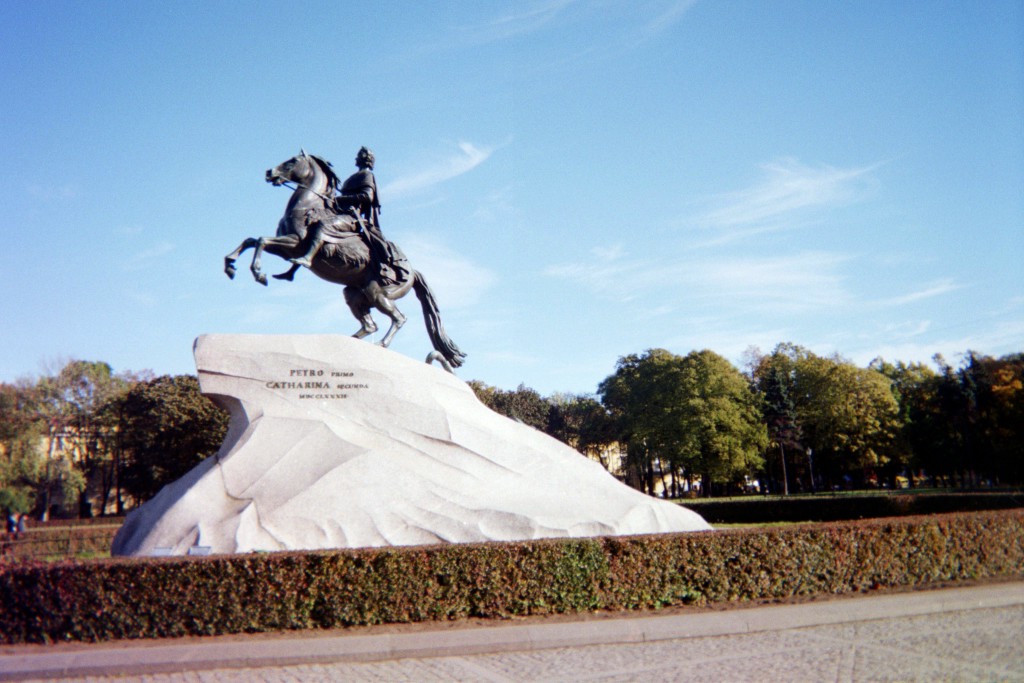
Monument of Peter the Great, St. Petersburg, Russia
The U.S. has often had a complicated relationship with Russia. During our civil war, Czar Alexander II sent naval support to the Union forces and enjoyed an amiable correspondence with Abraham Lincoln. As the 19th century transitioned into the 20th, various missionary style ideologues had been projecting a combination of their own hopes and fears onto imperial Russia. This was perhaps most reflected in the writings of the first George Kennan, an explorer and journalist who initially had sympathy for the vast and mysterious nation at the outer edges of Europe, but then turned hostile and actively championed a revolutionary overthrow of the czarist government.
Then we were allies in WWI but it didn’t take long for hostility to set back in as the Bolsheviks took the reins of power, pulled out of the war and seized certain assets, threatening western political and corporate interests. Along with the British, Washington militarily supported counter-revolutionary forces and a cold war of sorts soon emerged in which Washington refused to officially recognize the Soviet government until 1933.
We were again allies, this time against the Nazi juggernaut in WWII. And again, the partnership didn’t last as Roosevelt died in office, which brought a foreign policy ignoramus with a dubious psychological profile into the White House. Truman facilitated poor decisions that paved the way for the next Cold War and a dangerous nuclear arms race.
After Reagan and Gorbachev negotiated an end to that Cold War, Bill Clinton broke the promises made to Gorbachev that in exchange for allowing a reunified Germany into NATO, the military alliance would not move “one inch east” further toward Russia’s borders.
Then the Bush II administration gave the Neocons – whose hatred of Russia is part of what defines them, in addition to conflating Israel’s interests with Washington’s – the freedom to start their nihilistic campaign of destroying whole countries in order to save them, normalizing the ideas of overt war and brutality. Obama continued to harbor just enough Neocons in the State Department to grease the wheels of the Ukraine Crisis in 2013-2014.
And we’ve all seen just what a quick and thorough job the establishment did of using Trump as a punching bag for even suggesting in polite company that we should try to have good relations with Russia.
Of course, it hasn’t just been the United States that has had a strange mix of fascination and hostility toward Russia. Europe’s imperial powers competed with each other for years, with the British Empire and the Russian Empire engaged in the Great Game for most of the 19th century.
However, despite the major advancements made by Russia in the eras of Peter the Great and Catherine the Great, Russia had still lagged behind its western European counterparts in terms of industrialization and development. From the mid-nineteenth century on, Russia was catching up, enjoying impressive growth rates, industrializing quickly and building railroads, etc. It was part of an eastward pattern of advancement among European countries. The British, the French and the Germans/Prussians figured that it was just a matter of time before Russia would have its moment in the sun and be the major power. All it needed was reasonably competent leadership.
Even though Russia had lagged behind, its awesome potential was apparent to any one who cared to look. Its vast size and prodigious resources alone were formidable.
Fast forward to today. Its vast size – the largest country geographically in the world – and its prodigious resources are still there. But now, having overcome its historical issues with poor agricultural policies, it also has the ability to feed itself, a highly educated citizenry, and the industrial infrastructure to support a space program as well as a sophisticated nuclear and defense system. It has the ability to build cars, trucks, and airplanes completely within its own borders. Unlike many countries in the world, it has very little external debt and major gold reserves. It is weathering the sanctions against it better than Iran or Venezuela.
Given all of this, it is clear that with smart leadership to guide it competently over a period of time, Russia has the potential to be a real force to be reckoned with.
I imagine this has something to do with why a former diplomat said that once it became known that Putin was going to become president of Russia in 2000, “the knives were drawn” in Washington.