US & Russia Agree to New Ceasefire Plan in Syria, But Details are Hush-Hush; US Peace Council Holds Press Conference on Their Fact-Finding Mission to Syria; More Trouble for Ukriane

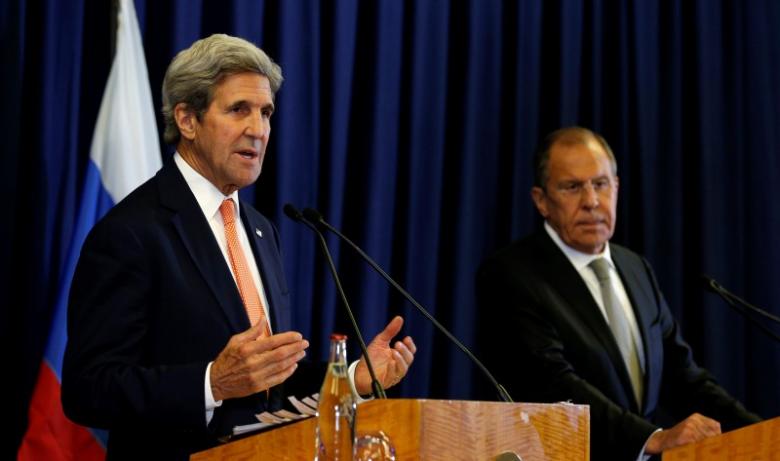
U.S. Secretary of State John Kerry and Russian Foreign Minister Sergei Lavrov hold a press conference following their meeting in Geneva, Switzerland where they discussed the crisis in Syria September 9, 2016 (Kevin Lamarque, Reuters)

U.S. Secretary of State John Kerry and Russian Foreign Minister Sergei Lavrov hold a press conference following their meeting in Geneva, Switzerland where they discussed the crisis in Syria September 9, 2016 (Kevin Lamarque, Reuters)

Russian Foreign Minister Sergei Lavrov and U.S. Secretary of State John Kerry have finally hammered out a ceasefire agreement for Syria, but according to both Russian and Western media reports, many important details are not being made public.   RT reports the following:

Russia and the U.S. have agreed on a new ceasefire plan on Syria that includes a ban on government airstrikes in certain areas and cooperation on strikes against jihadists, Russian foreign minister Sergey Lavrov announced on September 9 after the marathon talks with the U.S.’s John Kerry.

Opening the much-awaited press conference after some 13 hours of talks, Kerry said that the two have agreed on a comprehensive approach to Syrian reconciliation. He called “on every Syrian stakeholder to support the plan that the United States and Russia have reached, to … bring this catastrophic conflict to the quickest possible end through a political process.”

According to Kerry, the plan is to ensure that Syrian government forces will not carry out combat missions where the so-called moderate opposition is present.

Speaking of fight against Al-Nusra and its efforts to blend with moderate rebels, Kerry stressed “going on Al-Nusra is not a concession to anybody” but “is profoundly in the interests of the U.S.”

Kerry also outlined an establishment of the Russian-U.S. Joint Implementation Centre (JIG) that would serve the purpose of “delineation of territories controlled by Al-Nusra and opposition groups in the area of active hostilities.”

Taking the floor, the Russian FM confirmed that Russia and U.S. had agreed to coordinate airstrikes in Syria, “provided there is a sustained period of reduced violence.” The first step toward the implementation of this clause will be a 48-hour ceasefire in Syria, Lavrov said.

Lavrov elaborated that the ceasefire comes into effect on September 12 and should last for at least seven days. “After the ceasefire regime will be in effect for seven days, we will establish an implementation centre, in which the military and the representatives of Russian and U.S. intelligence will handle practical issues, separating terrorists and opposition,” he added.

The Russian FM said that the diplomats have negotiated on five separate documents at the talks. “Despite the mistrust and attempt to disrupt what we have agreed upon, we managed to work out a package of documents, there are five of them. It allows us to set an effective coordination in the fight against terrorism, to expand the humanitarian access to distressed population, first and foremost in Aleppo,” Lavrov said.

Due to the sensitive nature of the information contained in the agreements, they will not be made available to general public, Lavrov said. “We cannot make these documents public. They contain rather serious, sensitive information. We don’t want it to fall into hands of those who would surely try to disrupt the implementation of the measures stipulated within in the framework of humanitarian delivery supplies and in other parts of our agreements.”

Analyst and international law expert, Alexander Mercouris, has speculated that keeping many of the details secret likely means that it was Washington that made significant concessions:

Essentially, on a preliminary and strictly provisional view, the new agreement is simply a reworking of the previous agreement the US and Russia agreed with each other in February, whilst taking into account the changes in the front lines that have taken place since then.

The February agreement failed to work, leading to more fighting, which resulted in the Syrian army gaining much more ground than it controlled in February, so that it is now in a much stronger position in Damascus and Aleppo than it was in February.

Presumably there is something in the new agreement which the US and the Russians think will make it succeed where the February agreement failed.  A reasonable guess is that it is this, whatever it is, which is so embarrassing to one side or the other that it is why the agreement cannot be made public.

At the risk of making a very big guess that may be completely wrong, if it is true as the Russians say that the Syrians and the Iranians have approved the agreement then the major concession – whatever it is – which is being kept secret has most probably been made by the US.

The fact that it took the US more than 9 hours (not 5 hours as some reports say) to agree to the plan after Kerry referred it to Washington for approval also suggests that it is the US which has made the major concessions, and that the terms of the agreement – whatever they are – ran into strong criticism and opposition in Washington from the hardliners.

Time will tell if the ceasefire is indeed successful.  Meanwhile, the U.S. Peace Council recently held a press conference in which they reported on the results of their fact-finding mission to Syria in which they spoke to a cross-section of Syrians as well as president Assad.

I encourage everyone to watch the 49 minute press conference here:

For those who don’t have the time, I will sum up the main points of what the member of the delegation found out:


  • Syrians are united and will not accept being divided up by religion or other criteria;


  • The US has sanctions in place against Syria similar to the ones against Iraq in the 1990’s, which were responsible for much humanitarian suffering; consequently, Syrians are unable to obtain important medicines and parts to repair infrastructure;


  • this is not a civil war, but a war of Syrians and the Syrian government against outside mercenaries and terrorist organizations supported by the U.S., Gulf states (e.g. Saudi Arabia, Qatar), Turkey and Israel;


  • the delegation spoke to average Syrians, leaders of NGO’s, civil society, the non-violent opposition, business leaders, and president Assad, who granted a 2-hour meeting with members of the delegation;


  • there exists a Ministry of Reconciliation – the ministry’s mission includes re-integration for those members of the violent opposition who are willing to lay down their arms;


  • as far as the delegation members can ascertain, the motive for Washington’s actions in Syria appears to be to destroy the last independent secular government in the Middle East;


  • there is a pernicious western MSM propaganda campaign – Assad is genuinely popular and has been elected in monitored elections, he is recognized by UN/international community as legitimate leader of Syria, there is a parliament with opposition parties


-members of the delegation included males and females and peace activists, including those with backgrounds in trade union movements and restorative justice

***************

Things are not going well for Ukraine.   The New York Times reported that  earlier this month hundreds of Roma Gypsies were run out of a Ukrainian town in retaliation for a fatal attack on a child, which was not even perpetrated by a Roma.

Several dozen people in a Roma community in southern Ukraine were forced to flee their homes after a mob tore through their neighborhood over the weekend, breaking windows, tearing down fences and even setting a house on fire while the heavily outnumbered police stood by and watched.

The violence in the small town, Loshchynivka, was touched off after a local man was arrested on Saturday in connection with the rape and killing of a 9-year-old girl. A Ukrainian rights organization, the Kharkiv Human Rights Protection Group, noted that the man was not Roma.

Nicolai Petro, an academic expert on Russia and Eastern Europe, has written an article at The National Interest, detailing surveys among Ukrainians in which they express the sense of the country being “tense” and even “explosive.”

The survey, which was conducted in Odessa, Ukraine’s third-largest city, suggests that over half of Odessans describe their city as “tense,” while nearly ten percent say it is “explosive.” But even more interesting is that Odessans view the situation in Ukraine overall as much worse, with over ninety percent describing it as either “tense” or “explosive”!

Lest readers think that Odessa is an anomaly, I should point out that these results do not differ substantively from surveys conducted in February or June2016, which show a steady decline in public trust in government since the 2014 Maidan uprising.

How did things get so bad? Part of the fault certainly lies with the IMF’s austerity recommendations, which the vast majority of Ukrainians view as both harmful and pointless. But no downward spiral in public confidence could ever be so complete without the connivance of government officials. To put it bluntly, government policies have seemed, at times, almost intentionally designed to fuel public anger.

 A good example is the policy of actively curtailing Russian investment in Ukraine. While this has reduced Russia’s economic influence in the Ukrainian economy, as the government intended, in the absence of commensurate Western investment to replace what was lost, major industries have collapsed, and the country’s standard of living along with them. If the country continues on its present course, Odessa’s reformist governor Mikheil Saakashvili has noted sarcastically, Ukraine will not reach the level of GDP it had under former president Viktor Yanukovych for another fifteen years.

People might even be willing to view this as a necessary sacrifice in times of war, but for the fact that Ukrainian oligarchs often continue to line their own pockets by doing business in Russia. This includes President Petro Poroshenko himself, whose personal wealth increased sevenfold in 2015.

Unfortunately, there does not appear to be a light at the end of the tunnel for Ukrainians any time soon as Bloomberg reports that, a year after reaching a deal with the IMF to restructure its debt, the Ukrainian bond market is again tanking.   Furthermore, Graham Stack and Ben Aris have written an in-depth report for Business New Europe detailing Ukrainian president Petro Poroshenko’s corrupt governance.

When Ukraine’s president, Petro Poroshenko, was swept into power following the Euromaidan protests two years ago, he promised to sell most of his business interests to avoid any conflicts of interest“We are going to embed new traditions. I will make a point of selling my assets immediately after occupying the post,” Poroshenko promised in the run-up to the presidential election that he won in 2014.

Yet two years later and he has sold nothing. Quite the opposite in fact; according to the Organized Crime and Corruption Reporting Project (OCCRP), in 2015 not only did President Poroshenko’s personal fortune rise to $858mn, he was the only one of Ukraine’s wealthy businessmen to see his net worth actually increase that year.

Poroshenko, it seems, has continued building an empire centred on a holding company registered in Kyiv, called Prime Assets Capital, of which he is beneficial owner, according to the Ukrainian corporate register. Poroshenko holds 60% in International Investment Bank (not to be confused with the Moscow-based multilateral development bank of the same name) via Prime Assets Capital and directly, according to National Bank of Ukraine data. The bank acts as the financial node of a tangled web of companies and investments that is as active today as it ever was.

And Poroshenko is not acting alone. His two longstanding business associates, who hold stakes in many of his businesses, have followed him into politics, but remain key players in the Poroshenko financial-industrial group, a bne IntelliNews investigation can reveal.

Poroshenko has thus blurred the line between business and politics, deflected the anti-corruption efforts at every turn, and the businesses and politicians associated with him are flourishing at a time when Ukraine’s economy is mired in its worst crisis since the country’s independence in 1991.

Of course, this all begs the question:  what was the Maidan uprising all about?  After nearly 100 people killed in a violent coup and the deaths of nearly 10, 000 people in eastern Ukraine from the subsequent “anti-terrorist” operation by Kiev (the actual number of deaths is probably much higher as estimated by German intelligence in 2015), Ukraine has an economy and standard of living in much worse shape than before, along with a president that appears to be every bit as corrupt as Yanukovich.

Russia Finalizes Deals with Iran on Oil Rigs and with Japan on Various Economic Issues; Rosneft May Buy $16 Billion Worth of Russian State’s Stake in Oil Co., Creating Budgetary Windfall; Russia & China in Joint Naval Patrols of S. China Sea;

What’s that about being isolated and the economy being in tatters?

(http://russia-insider.com/en/putin-new-stalin/ri16240)


Putin has been a busy bee the past few weeks, finalizing an oil rig deal with Iran worth $1 billion, which will see Russian companies building 5 off-shore rigs to facilitate oil and gas exploration by Iran in the Persian Gulf, as well as signing 20 agreements worth approximately $1.3 billion with Japan at the Eastern Economic Forum.

And as Alexander Mercouris writes of the recent G20 summit in China, Putin was a man in demand:

It is the Russians who despite the odd setbacks are increasingly making the weather in the Middle East, with Putin at the G20 summit having intense and substantive talks with Erdogan, Egypt’s General Sisi, and the Saudis, even as Russia continues to develop its relations with Iran.

Even the Europeans are talking to the Russians.  Putin made it clear before the G20 summit that following the Crimean incident he would not meet with Merkel, Hollande and Poroshenko in the Normandy Four format in Hangzhou.  The result?  Merkel and Hollandestill met with him – though separately (as Putin probably wanted) – with Poroshenko nowhere to be seen.

Of the Europeans, it was not just Merkel and Hollande who met with Putin in Hangzhou.  Britain’s Theresa May met with him as well, in a somewhat stiff “get-to-know-you” meeting marking her first proper foray into international diplomacy.

Putin of course also met in Hangzhou with the leaders of Russia’s other BRICS partners apart from China: Modi of India, Zuma of South Africa and the new Brazilian President Michel Temer.  The meeting with Temer will have been particularly interesting, with Putin seeking – and apparently receiving – assurances that despite the recent change of government in Brazil the country remains committed to the BRICS.

Balancing the meeting with Brazil’s Temer, Putin however also met in Hangzhou with the other newly installed leader of the other Latin American giant: President Macri of Argentina.

Both Temer and Macri – unlike their predecessors – are conservative right wingers who will unquestionably tilt their two countries back towards their historically close relations with the US.  By continuing to talk with them and to engage with them Putin and the Russians however keep them engaged and keep the doors for future cooperation open.

Professor Stephen F. Cohen said the same in his most recent weekly interview with John Batchelor.

The Chinese even literally rolled out the red carpet for Putin’s arrival at the airport, while Obama was subjected to a decidedly different reception.

IMG_5854_0

(Putin’s arrival in China for the G20; http://theduran.com/china-rolls-out-red-carpet-vladimir-putin-g20-obama-forced-exit-air-force-one-emergency-door/)

oabam china arrival_0

(Obama’s arrival in China at the G20; http://theduran.com/china-rolls-out-red-carpet-vladimir-putin-g20-obama-forced-exit-air-force-one-emergency-door/)

Bloomberg has reported that Igor Sechin, CEO of Russian oil company, Rosneft, has offered to buy the Russian state’s stake in the smaller Bashneft company worth $16 billion, which would provide a huge windfall for the Russian budget:

Rosneft PJSC chief Igor Sechin, not taking no for an answer, has come up with a proposal to expand his energy empire while helping critics in the Russian government meet their goal of reducing the widest budget deficit in six years.

Sechin, a longtime ally of President Vladimir Putin, has asked the government to let state-run Rosneft buy its controlling stake in smaller oil producer Bashneft PJSC for $5 billion in cash, a premium to the market, according to two senior officials. Russia could then earn another $11 billion by proceeding with its delayed sale of 19.5 percent of Rosneft itself, generating a $16 billion windfall that would cut this year’s projected deficit in half, they said.

….Sechin’s proposal is based on a study that Rosneft commissioned from Italian bank Intesa Sanpaolo SpA and submitted to the government. The report concluded that Russia could earn at least $11 billion selling the Rosneft shares to funds and trading companies in packets no bigger than 5 percent each, which would alleviate the concerns of some officials about selling to China, India or both, options that have been seriously considered, one of the people said.

Russia is disposing of assets to help cover a budget gap that opened after the collapse of crude prices sapped revenue and helped tip the economy into the longest recession since Putin came to power in 2000.

Starting September 12th, Russian naval vessels will participate in joint patrols with China in the South China Sea.  Exercises will run through the 19th.  As Russia Beyond the Headlines reports:

This is the fifth edition of the Sino-Russian “Sea Cooperation” drills, but it’s the first time that such an unstable region was chosen to hold the exercises.

….“In the near future this area will become home to China’s aircraft carrier group,” says Alexey Maslov, an academician with the National Research University Higher School of Economics. “Russia has recently been trying to significantly strengthen its military and military-technical cooperation with Beijing.”

Maslov says the military partnership between the two countries is developing at a much better pace than a number of economic projects.

“The current goal of the drills is to test the ability of the naval forces of the two countries to work together to solve crises in East and Southeast Asia,” he adds.

Maslov believes that Russia and China are exploring the possibility of a future political and military alliance. However, such an alliance is not likely to resemble NATO.

How Ukraine Economically Cut its Nose Off to Spite its Face

maidan square in Kiev before and after the coup d'etat in Ukraine

(Maidan square in Kiev before and after the coup d’etat in Ukraine; http://nosecret.info/maidan-confrontation-overview-february-2014-in-kiev-ukraine/)

According to a recently published paper in the Russian Politics journal (Volume 1, Issue 2, 2016) by Nicolai Petro – an American academic who was in Ukraine at the time of the coup and its aftermath – the western focus on corruption is misplaced when talking about Ukraine’s current economic woes.

Instead, he argues, the focus should be on the Maidan government’s “suicidal choice to cut the country off from its main investor – Russia.”

Petro gives a rundown on the pitiful state of Ukraine’s economy compared with pre-Maidan Ukraine:

Ukraine’s abysmal economic statistics since the transition of power in February 2014 are depressingly familiar. In the past 18 months living standards have fallen by half.1 Meanwhile inflation has risen to 43% annually, and public debt as a percentage of gdp has gone from 39.9% in 2013, to 79% by the end of 2015.2 An estimated 55% of all economic activity simply goes unreported.3 In the financial sector, the share of toxic assets in bank portfolios is estimated to exceed 50%, while deposit withdrawals by households in 2014 reached 30% of total deposits.4 In 2014 financial flows into Ukraine fell by 21%, then by another 35% in 2015.5

What does this mean in terms of family buying power? If annual incomes under former president Viktor Yanukovych were roughly $3500 dollars, they are now $2000 according to Ukraine’s first president, Leonid Kravchuk.6 The percentage of people who say that they do not have enough money for food, went from 9% in February 2014 to 19% in May 2015.7 New small car sales nationwide have plummeted from 213,444 in 2013, to just 46,546 in 2015.8

 ….For most of the past decade, 90% of the high value-added goods produced by Ukraine were sold to Russia. These include machinery, military technology, engines and motors. In 2014, sales to the Russian market accounted for 44% of all machinery and appliances sold abroad.9 That same year, however, the government decided to tear up its defense contracts with Russia. As a result, Ukraine’s defense and aviation industries lost more than 80% of their income, an estimated 2 billion hryvnia annually (at the time more than $200 million).10 Industrial giants like Yuzhmash, Motor Sich, Turboatom, and AvtoKrAZ have all had to sharply scale back production, while the pride of Ukrainian industry, airline manufacturer Antonov, was liquidated and it assets transferred to another state-owned conglomerate in January 2016.11

As revealed in a recent Business New Europe Intellinews report, much of Ukrainian industry having lost its significant Russian market is now reliant upon state orders to supply the war effort against the Donbass rebels.

Petro also points out the insulting level of chicanery employed by the Poroshenko government in trying to convince people that Ukraine is somehow successfully thumbing its nose at Russia.

In January 2016 Ukrainian president Petro Poroshenko congratulated his countrymen on having survived the winter without Russian gas. It had gotten by instead with European reverse gas which, he pointed out proudly, was 30% more expensive than the spot price for Russian gas.12

What [he] failed to mention, however, was that Ukraine’s major European supplier of natural gas last year was Slovakia, which receives 90% of its gas from Russia.14 In effect, therefore, Ukraine was purchasing the very same Russian gas at a premium merely for the privilege of not having to call it Russian.

In 2014 Ukraine decided to stop buying coal from the rebel-held territories of Donbas, the country’s traditional supplier. Such coal purchases were denominated in hryvnia and were thus far cheaper than coal that could be purchased from abroad.

To show its independence from the rebels, however, Kiev decided that it would import coal from South Africa instead.15 Alas, as with the case of the Slovakian gas that actually comes from Russia, an investigation by Ukrainska pravda revealed that much of the coal purported to be from South Africa was actually Donbas coal, repackaged as South African through a Hong Kong company, then resold to Ukraine.16 As a result, the government not only paid more for coal, but lost tax revenues from Donbas as well.

Now, if I saw this plot in a movie I’d toss my drink at the screen and walk out.  The Maidan government’s policies simply defy logic with respect to the long-term interests of Ukrainians.  What’s more, this folly was entirely predictable.

As was underscored in a May 2014 article by Barry Ickes and Clifford Gaddy for the Brookings Institution – an establishment think tank that is largely hostile toward Russia and provided a platform for cheer-leading the Maidan coup – Russia was providing $5-10 billion worth of support to the Ukrainian economy pre-Maidan:

When we talk about subsidies, we usually think of Russia’s ability to offer Ukraine cheap gas — which it does when it wants to. But there are many more ways Russia supports Ukraine, only they are hidden. The main support comes in form of Russian orders to Ukrainian heavy manufacturing enterprises. This part of Ukrainian industry depends almost entirely on demand from Russia. They wouldn’t be able to sell to anyone else. The southern and eastern provinces of Ukraine are dominated by Soviet-era dinosaur enterprises similar to Russia’s. They were all built in Soviet times as part of a single, integrated energy-abundant economy. They could be sustained only thanks to the rents from Soviet (overwhelmingly Russian) oil and gas. Russian subsidies have continued to maintain the structure in the post-Soviet era. Because most of these subsidies are informal, they do not appear in official statistics.

Indeed, Ukraine still does not make much that anyone else wants – certainly not the EU, which is part of the reason the Association Agreement that was dangled in front of Yanukovich in 2013-14 (and subsequently signed by our boy “Yats” right after he was installed as prime minister of Ukraine) was not to Ukraine’s benefit, but constituted a lopsided deal, favoring EU corporate elites to the point where it would have supplanted Ukraine’s oligarchs and mandated austerity measures on the Ukrainian economy.  Petro explains:
But what about the Deep and Comprehensive Free Trade Agreement (dcfta) with the European Union (eu), the issue that inspired so many to support the Euromaidan? Sadly, the reality has fallen far short of Ukrainian expectations. The eu currently maintains tariff rate quotas (trqs) on 36 groups of products, most notably in agriculture, which include some of Ukraine’s main exports to the eu. In 2014-2015 Ukrainian exporters were able to fully utilize only six of these quotas. Inability to meet eu certification requirements is one reason. Another is that demand in Europe for Ukrainian products is simply too low.28 As a result, in 2015, when Ukrainian exports to the eu benefited from the temporary suspension of quotas from April through the end of the year, Ukrainian exports to the eu actually fell by 23%.29 In other words, the new Ukrainian government severed ties with its traditional market without gaining comparable access to new markets!
Yet, at the height of the Euromaidan, pursuing business-as-usual with Russia was often portrayed as no different than making a pact with the devil, while the benefits of eu association were wildly oversold. With two years of eu integration in practice to look back upon, we can now make some real world comparisons.

Studies favoring eu association typically acknowledge some short term economic decline, as the country transitions to eu standards, but insist that over the long term the economic benefits of far outweigh those of joining the eeu [the Russian-led Eurasian Economic Union].30

But even on this point there is considerable disagreement. Some studies estimated that no more than 15% of Ukrainian exports originally destined for the Eurasian Economic Union (eeu) before 2014 could be redirected elsewhere.31 According to a study done in 2011, preferential energy pricing for Ukraine (at the rate being offered to Belarus) would have saved Ukraine $3-6 billion a year in Russian energy imports, while increasing exports by $5-9 billion a year.32 Other economists insisted that the benefits of maintaining Ukraine’s existing technological integration within the eeu, and of keeping trade in one’s national currency, significantly increases long term projected gdp growth. Most importantly, however, nearly all studies favoring eu association assume that trade ties with Russia and the eeu would remain unchanged after the dcfta enters into effect when, in fact, the suspension of Ukraine’s trade privileges have cost the country an estimated $3 billion a year.33

This is money that the limited trade preferences afforded Ukraine under the dcfta could not hope to make up, nor was it ever intended to. At best, it can only partially compensate for lost markets, though that impact will be within a much longer timeframe.

This is why Yanukovich decided to reject the Association Agreement in favor of a $15 billion loan from Russia (that required no austerity conditions) and a further discount on gas.  It wasn’t because Yanukovich was necessarily pro-Russian (Putin reportedly did not like or trust Yanukovich – viewing him as indecisive and unreliable).  It was because Russia, by any objective measure, was offering the better economic deal for its next door neighbor – a deal that did not require Ukraine to abandon any possible future deal with the EU so long as the EU did not require Ukraine to abandon its economic relationship with Russia.  Putin had suggested 3-way talks among Ukraine, Russia and the EU to work out a mutually agreeable arrangement that would respect all parties’ interests, but was consistently rebuffed by the West.


As foretold in the article by Ickes and Gaddy, of all the possible scenarios that could have played out in the aftermath of the Maidan upheaval, a cut-off of economic relations with Russia in favor of an exclusive relationship with the West was the least feasible.

If the West were somehow able to wrest full control of Ukraine from Russia, could the United States, the other NATO nations, and the EU replace Russia’s role in eastern Ukraine? The IMF, of course, would never countenance supporting these dinosaurs the way the Russians have. So the support would have to come in the way of cash transfers to compensate for lost jobs. How much are we talking about? The only known parallel for the amount of transfer needed is the case of German reunification. The transfer amounted to 2 trillion euros, or $2.76 trillion, over 20 years. If Ukraine has per capita income equal to one-tenth of Germany’s, then a minimum estimate is $276 billion to buy off the east. (In fact, since the population size of eastern Ukraine is larger than East Germany’s, this is an underestimate.) It is unthinkable that the West would pay this amount.

Notice that Russia, by contrast, could survive the cutoff of Ukrainian industry…Russia could just implement more import substitution (as Putin announced in the quote above). This is economically inefficient, but it is what every country does for national survival.

….The key point here is that there can be no viable Ukraine without serious contributions from both Russia and the West. Of all the options for Ukraine’s future, a Ukraine exclusively in the West is the least feasible. A Ukraine fully under Russian control and with severed links to the West is, unfortunately, possible. But it is in no one’s interest — not Russia’s, not the West’s and certainly not Ukraine’s.

The best option for the Ukrainian people’s stability and economic well-being is to embrace its potential as buffer and bridge between Europe and Russia, engaging in economic relations with both and eschewing entangling military alliances with either.

Russia Not Happy with Erdogan’s Invasion of Northeastern Syria, Kerry & Lavrov Deadlock Again in Talks; Russian Investigators Open War Crimes Case Against Ukrainian Defense Minister; Putin Orders Snap Military Exercises in Southwest of Russia; Pilger on Media’s Role in Enabling War (Milosevic Cleared of War Crimes by Hague)

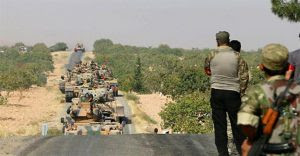
Turkey intervention in northern Syria on Aug 24, 2016 (Anadolu Agency)

(Turkey intervention in northern Syria on Aug 24, 2016 (Anadolu Agency))

Secretary of State John Kerry and Russian Foreign Minister Sergei Lavrov ended a marathon session of diplomatic talks on August 26th no closer to agreement with respect to Syria.   The Duran reports:

On the key political question – the Geneva peace process and the future of President Assad – they are as far apart as ever. The U.S. continues to insist that President Assad must go as the inevitable of any peace settlement. The Russians say that is strictly for the Syrian people to decide. There was clearly no movement by either side on this issue.

This is against the backdrop of Turkey’s invasion of Jarablus in northeastern Syria, a move some have reported as supported by the US military, in order to keep a supply line to the jihadist mercenaries (“rebels”) fighting against the Syrian government in Aleppo.  Alexander Mercouris – with the help of military analyst Mark Sleboda – provides more details:

In the immediate aftermath of the Turkish capture of Jarablus in Syria, Turkish President Erdogan telephoned his “friend Putin” on Friday 27th August 2016.

The Kremlin’s account of the conversation is remarkable even by its standards for its terseness: “The two leaders discussed the development of Russia-Turkey trade and political and economic cooperation in keeping with the agreements reached in St Petersburg on August 9. Vladimir Putin and Recep Tayyip Erdogan exchanged opinions on developments in Syria and pointed out the importance of joint efforts in fighting terrorism. They agreed to continue their dialogue on the issues of the bilateral and international agenda.”

The true subject of the discussion will in fact have been the Turkish capture of Jarablus in northern Syria.

Whilst it seems the Turks did inform the Russians of this move in advance, it is clear that the Russians are, to put it mildly, unhappy about it. Though the Turks appear to have tried to arrange talks with the Russian military leadership presumably to discuss this move – even announcing a visit to Turkey by General Gerasimov, the Chief of the Russian General Staff – no such talks are taking place, with the Russians denying that a visit to Ankara by their Chief of General Staff was ever agreed, and the Turks now saying that the visit has been postponed.

The Russian media meanwhile is carrying articles making clear the extent of Russian anger. An article in the Russian newspaper Kommersant, which is clearly based on official briefings, is accusing Turkey of “going further than promised in Syria”. That this article reflects official thinking in Moscow is shown by the fact that the semi-official English language Russian news-site Russia Beyond the Headlines has republished it in English.

The article makes it clear that Turkey did not coordinate the Jarablus operation with Moscow or Damascus, and that it was much bigger than Moscow was led to expect. The Russians are also clearly annoyed by the extent to which the operation has been coordinated by Turkey with the U.S., which is providing air support.

….Why are the Russians so angry about the Jarablus operation? Here I acknowledge my heavy debt to the geopolitical analyst Mark Sleboda who over the course of a detailed and very helpful discussion has corrected certain errors I have previously made about the Jarablus operation and has greatly enlarged my understanding of it.

….Mark Sleboda has explained to me that the principal corridor to supply the rebels in Syria has always been through the area of north east Syria around Jarablus. In his words:

Idlib is not an acceptable supply route from Turkey to forces in Aleppo province because the Turkish-Syrian border in Idlib is mountainous terrain – small and bad roads and then long routes all the way through Idlib past SAA-held territory into Aleppo province. The Jarablus Corridor north of Aleppo is and has always been absolutely vital for the insurgency. That’s why Turkey, Brookings, etc have always placed so much priority on a no-fly zone there. Now it has come to realisation.

In other words, the Turkish capture of Jarablus before it could be captured by the YPG was not primarily intended to prevent the linking together of two areas within Syria under Kurdish control – though that may have been a secondary factor – but was primarily intended to secure the main supply route (or “ratline”) Turkey uses to supply the Jihadi fighters attacking Aleppo.

Interestingly, Brett McGurk, the special presidential envoy for the coalition to counter ISIS, took to Twitter to express the US’s displeasure with Turkey’s campaign in Northern Syria.  One of the tweets reads:

DOD: The United States was not involved in these activities, they were not coordinated with U.S. forces, and we do not support them.

It is difficult to believe that Turkey’s actions weren’t at least given a nod and a wink by somebody in Washington, especially after Biden’s bizarre comments about the Kurds a few days ago when he had his wingding with Erdogan.

“We have made it absolutely clear,” he said, that Kurdish forces “must move back across the river. They cannot, will not, and under no circumstances get American support if they do not keep that commitment, period.”

As Daniel Lazare points out at Consortium News, Obama’s foreign policy is a ball of confusion.

**************

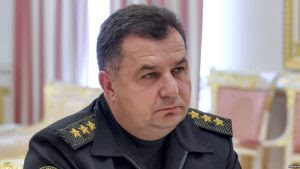
Stepan Poltorak, Minister of Defense of Ukraine since October 2014

(Stepan Poltorak, Minister of Defense of Ukraine since October 2014; https://www.newcoldwar.org/russian-investigators-launch-war-crimes-case-ukrainian-defense-minister/)

RT is reporting that Russia’s Investigative Committee, a special committee that investigates high-profile cases, has opened a criminal case against the Ukrainian Defense Minister, Stepan Poltorak, for war crimes against civilians in Donbass:

In a statement published on the agency’s website, the Investigation Committee said it had obtained enough proof that crimes against civilians in the self-proclaimed republics of Lugansk and Donetsk had been committed on the orders of top Ukrainian military commanders.

This allowed investigators to launch criminal cases against Ukrainian Defense Minister Stepan Poltorak; Chief of the General Staff of the Ukrainian Defense Ministry, Viktor Muzhenko; the former and current chief commanders of the Ukrainian Ground Forces, Anatoly Pushnyakov and Sergey Popko respectively; as well as the commander of the Ukrainian National Guard, Yuri Allerov. They all are suspected of sanctioning the use of banned methods and means of warfare – a crime punishable by up to 20 years in prison.

The Investigative Committee also stated that Ukraine had repeatedly violated the ceasefire agreement signed on February 15, 2015, and that during these violations Ukraine’s National Guard used heavy artillery to deliberately destroy various installations of civilian infrastructure and indiscriminately used heavy weapons in populated areas, killing and injuring civilians. At least seven civilians were killed as a result of these actions and 74 were wounded, including seven children.

*************

(http://russia-insider.com/en/politics/high-alert-russia-tests-armys-readiness-massive-snap-exercise-west-south/ri16130)

Military analyst, The Saker, has reported that, on August 25th, Putin ordered the Russian military to do snap military exercises in the southwestern regions of the country.

Russian Army units as well as the Air Force, Airborne Troops and the Navy’s Northern Fleet have been put on high alert as part of a large-scale snap exercise which the Defense Ministry says will check troops’ readiness to tackle emerging crises.

“According to the decision of the Commander-in-Chief of the Armed Forces [President Vladimir Putin], a regular snap exercise begins today,” Defense Minister Sergey Shoigu said at a briefing with top military commanders on Thursday.

“Troops in the Southern Military District, some units of the Western and Central Military Districts, as well as the Northern Fleet, the Air Force and the Airborne Troops, are to be put on full alert starting from 7.00am [local time],” the minister added.

Unannounced combat readiness inspection started in the Southern, Western and Central MDs.

See the full report with video here.

****************

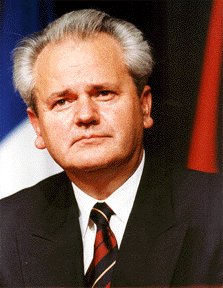
Image result for milosevic images

(Slobodan Milosevic)

Finally, I’d like to take a moment to promote John Pilger’s latest thought-provoking piece on the western mainstream media’s role in propagating lies and misinformation that enables warmongering.  I read Pilger’s classic book “Heroes” when I was in college and have admired his award-winning investigative journalism ever since.  Among other points in this piece, Pilger discusses a fact that has not been reported on in the mainstream media – and hardly in the alternative media – that Slobodan Milosevic was basically cleared of the charges against him by the International Criminal Tribunal for the former Yugoslavia (ICTY) in The Hague:

The exoneration of a man accused of the worst of crimes, genocide, made no headlines. Neither the BBC nor CNN covered it. The Guardian allowed a brief commentary. Such a rare official admission was buried or suppressed, understandably. It would explain too much about how the rulers of the world rule.

The International Criminal Tribunal for the former Yugoslavia (ICTY) in The Hague has quietly cleared the late Serbian president, Slobodan Milosevic, of war crimes committed during the 1992-95 Bosnian war, including the massacre at Srebrenica.

Far from conspiring with the convicted Bosnian-Serb leader Radovan Karadzic, Milosevic actually “condemned ethnic cleansing”, opposed Karadzic and tried to stop the war that dismembered Yugoslavia. Buried near the end of a 2,590 page judgement on Karadzic last February, this truth further demolishes the propaganda that justified Nato’s illegal onslaught on Serbia in 1999.

Milosevic died of a heart attack in 2006, alone in his cell in The Hague, during what amounted to a bogus trial by an American-invented “international tribunal”. Denied heart surgery that might have saved his life, his condition worsened and was monitored and kept secret by US officials, as WikiLeaks has since revealed.

Milosevic was the victim of war propaganda that today runs like a torrent across our screens and newspapers and beckons great danger for us all. He was the prototype demon, vilified by the western media as the “butcher of the Balkans” who was responsible for “genocide”, especially in the secessionist Yugoslav province of Kosovo. Prime Minister Tony Blair said so, invoked the Holocaust and demanded action against “this new Hitler”. David Scheffer, the US ambassador-at-large for war crimes [sic], declared that as many as “225,000 ethnic Albanian men aged between 14 and 59” may have been murdered by Milosevic’s forces.

This was the justification for Nato’s bombing, led by Bill Clinton and Blair, that killed hundreds of civilians in hospitals, schools, churches, parks and television studios and destroyed Serbia’s economic infrastructure.  It was blatantly ideological; at a notorious “peace conference” in Rambouillet in France, Milosevic was confronted by Madeleine Albright, the US secretary of state, who was to achieve infamy with her remark that the deaths of half a million Iraqi children were “worth it”.

Albright delivered an “offer” to Milosevic that no national leader could accept. Unless he agreed to the foreign military occupation of his country, with the occupying forces “outside the legal process”, and to the imposition of a neo-liberal “free market”, Serbia would be bombed. This was contained in an “Appendix B”, which the media failed to read or suppressed. The aim was to crush Europe’s last independent “socialist” state.

Once Nato began bombing, there was a stampede of Kosovar refugees “fleeing a holocaust”. When it was over, international police teams descended on Kosovo to exhume the victims of the “holocaust”. The FBI failed to find a single mass grave and went home. The Spanish forensic team did the same, its leader angrily denouncing “a semantic pirouette by the war propaganda machines”. The final count of the dead in Kosovo was 2,788. This included combatants on both sides and Serbs and Roma murdered by the pro-Nato Kosovo Liberation Front. There was no genocide. The Nato attack was both a fraud and a war crime.

All but a fraction of America’s vaunted “precision guided” missiles hit not military but civilian targets, including the news studios of Radio Television Serbia in Belgrade. Sixteen people were killed, including cameramen, producers and a make-up artist. Blair described the dead, profanely, as part of Serbia’s “command and control”. In 2008, the prosecutor of the International Criminal Tribunal for the Former Yugoslavia, Carla Del Ponte, revealed that she had been pressured not to investigate Nato’s crimes.

This was the model for Washington’s subsequent invasions of Afghanistan, Iraq, Libya and, by stealth, Syria. All qualify as “paramount crimes” under the Nuremberg standard; all depended on media propaganda. While tabloid journalism played its traditional part, it was serious, credible, often liberal journalism that was the most effective – the evangelical promotion of Blair and his wars by the Guardian, the incessant lies about Saddam Hussein’s non-existent weapons of mass destruction in the Observer and the New York Times, and the unerring drumbeat of government propaganda by the BBC in the silence of its omissions.

Read the full article here.

Analysis of “Russian Public Assessments of the Putin Policy Program: Achievements and Challenges”

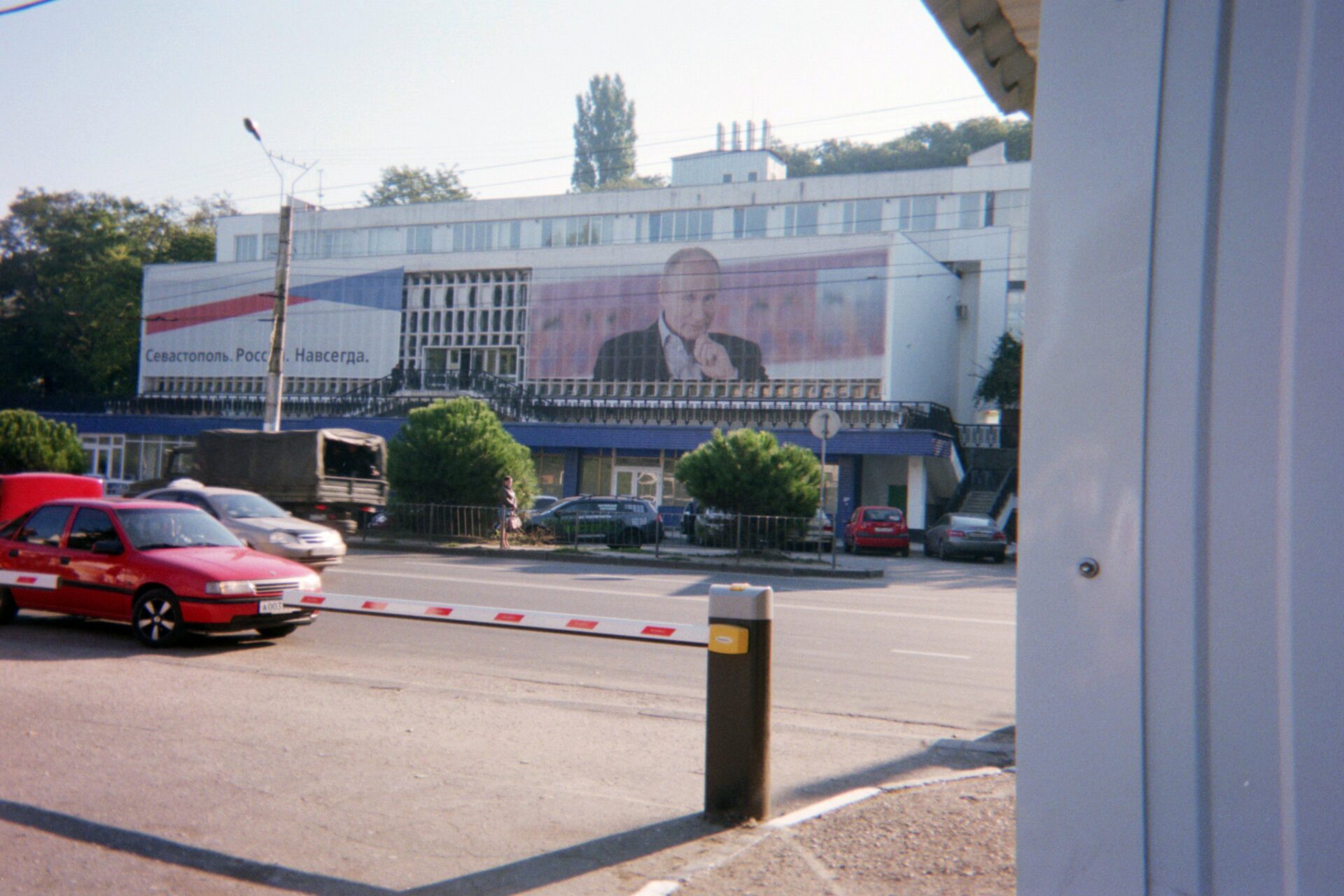
"Crimea. Russia. Forever." Billboard of Putin in Simferopol, Crimea; photo by Natylie Baldwin
“Crimea. Russia. Forever.” Billboard of Putin in Simferopol, Crimea; photo by Natylie Baldwin

“Russian Public Assessments of the Putin Policy Program: Achievements and Challenges” by John P. Willerton, Professor of Political Science at the School of Government and Public Policy at the University of Arizona

Russian Politics, Volume 1, Issue 2, 2016

Professor Willerton provides a valuable assessment of public opinion in Russia with respect to what he refers to as the “Putin Policy Program” – defined as policies pursued by the Putin government during Putin’s first two presidential terms (2000-2008), Dmitry Medvedev’s presidential term (2008-2012, when Putin served as Prime Minister), and Putin’s third presidential term (2012 to present).   Willerton describes the set of policies as:

[Those] directed to the simultaneously overriding goals of strengthening the Russian state, modernizing the Russian society, and bolstering of Russia’s global position. Observers can debate to what extent these policies emerged as part of a coherent program, constitute a more haphazard set of policy responses to changing conditions, or evolved overtime to ultimately form a distinguishable programmatic whole. By 2014, however, a decade and a half after Vladimir Putin’s rise to the Russian presidency and well into his second presidency, a distinguishable policy agenda and program were evident. The Putin agenda and implemented policies were subject to public assessments, and these public judgments merit our attention.

Putin, described as the “paramount leader” receives a consistently high performance assessment by Russians, while the rest of the government receives moderate ratings.  This is contrasted with poor ratings received by Russia’s most visible opposition figure, Aleksai Navalny.

Moreover, Willerton’s evaluation found that Putin’s priorities for Russia are congruent with that of most Russians and that positive assessment was dependent upon the particular policy in question.

It is found that Russians’ positive assessment of Vladimir Putin, Russia’s paramount leader, is juxtaposed with more middling assessments of all other actors, excepting opposition figure Aleksei Navalny, who is poorly viewed. A strong congruence is found between the Putin team’s policy priorities and those of the Russian public, but public assessments of the Putin team’s performance across specific policies are mixed and reveal areas where that team has been both successful and come up short. Results of the October 2014 ROMIR public opinion survey indicate that Putin and his team are well-positioned and that their overall policy performance is acceptable, but policy soft spots and points of concern are revealed: this suggests continuing challenges for the Putin team in delivering a program accommodating the preferences of an aware domestic public.

….An examination of the Russian public’s assessment of the importance of the policy concerns drawn from the Putin position papers and said to be at the heart of the second Putin presidency reveals strong public support, and across all eleven concerns (see Table 1). On a 10-point scale, all eleven concerns register above an 8, with (a) higher standard of living and (b) better quality of social services registering just below 9. Even those policy concerns that rate relatively lower (returned trust to social institutions, return to traditional multi-children families, and efficient state institutions) still garner results well above 8.

It is also pointed out that Putin and his team follow public opinion and make sincere attempts to incorporate it into policy.

There is considerable evidence that Putin and his team are highly concerned about public opinion, expending much effort and many resources to shore up domestic support.7 Indeed, the very return of Putin to the Russian presidency in March 2012 appeared to many as strong evidence of the governing elite’s need to return to the country’s paramount leader when his successor, Dmitry Medvedev, and his platform party, United Russia, were found to be so wanting by both critics and supporters.

Willerton decided that 15 years into Putin’s tenure was enough of a run to obtain a meaningful assessment of his governance by the Russian public.  The data Willerton used to study public opinion of Russians toward the Putin government included studies by the independent Levada Center, government-sponsored VTsIOM, fom and the October 2014 NEPORUS-romir-survey “crafted by a team of Norwegian-Swedish-Russian-American scholars and conducted in the field by the Russian survey firm romir…”

Willerton found that the NEPORUS study provided a rich source of data, with Russian public opinion provided on an array of issues, broken down into two dozen policy concerns.

A sampling of the Willerton’s findings follows:

A few benchmark economic and social developments merit mentioning, they have been important to Russians, and Russians have been fully able to contrast these Putin period advances with earlier troubled realities. First, assessments of Russian economic performance and related societal advances since 2000, including those set out by the World Bank, pointed to a significantly expanded national economy and growing middle class that placed Russia in per capita wealth at the top of the brics countries, with Russia matching Germany as the world’s fifth largest economy (in purchasing power parity) by summer 2013.17 Meanwhile, United Nations Economic Commission for Europe (unece) data showed that the country’s manufacturing productivity had grown by more than 50% over the Putin period, Rosstat data revealed the country’s food production had more than doubled during that same period, while the country recorded a bumper grain crop in fall 2014.18 It was especially notable that Russian state statistics revealed that the decades’ long decline in the Russian population ended by 2012, with population growth recorded for that and subsequent years.19 Russia’s dramatic population decrease over the course of several decades had arguably been the most important suggestive indicator of a Russian ‘failing state’. The population rise in 2012 and succeeding years was modest, indeed miniscule, but it was symbolically important, and both Russian officials and citizens openly celebrated the demographic turnaround. Relatedly, Putin period surveys consistently revealed mounting upbeat attitudes on the part of Russian respondents regarding both their current and their anticipated short-term future socioeconomic circumstances, with governing Putin team members assuming ever more confident and buoyant public posturing (and as directed both domestically and internationally).20 Other developments, including Russia’s increased foreign policy assertiveness and returned international prominence, could also be noted, but the overriding point is that the policy context of the Putin later 2000s and early 2010s contrasted markedly with that of Russia’s 1990s so-called ‘time of troubles’. Domestic Russian critics’ and Western evaluations of the Putin period domestic policy environment – and interpretations of the above-noted developments – were, in contrast, negative,21 but these judgments had little influence on mainstream Russian expectations and reactions.22

Willerton discusses the goals and policy emphasis articulated by Putin in his seven policy papers of 2012, as well as Russians’ views on the prioritization of the goals and the effectiveness of the results.  Russians’ belief in the need for a strong state is reflected here also.

….The seven presidential campaign policy papers appearing in January-February 2012 reveal two fundamental goals articulated by Putin and said to reflect the overriding hopes of the mainstream Russian public: (1) the strengthening of the Russian state, and (2) the modernization of Russia’s society.24 These goals had been emphasized by Putin from his first days as acting president, they had always been treated as inextricably interconnected, and they found strong resonance with the Russian public. From the discussion surrounding these overriding goals that is set out in the Putin position papers, eleven more focused policy concerns can be identified, they may be grouped into five domains, and these policy concerns are at the heart of my efforts to illuminate public assessments of policy priorities and of the Putin team’s performance in realizing a strengthened state and a modernized society. I organize the domains and more specific policy concerns as follows:

Political domain: (1) efficient state institutions; (2) quality social services; and (3) protection of people’s rights and freedoms.

Economic domain: (1) higher standard of living; and (2) provision of goods and services to the public.

Societal domain: (1) revitalization of cultural life; and (2) promotion of traditional families.

Policies tapping the interconnected political, economic, and societal domains: (1) fight against crime and corruption; (2) ensuring social justice; and (3) returned trust to institutions.

Foreign domain: (1) protection of Russia internationally.

In the political domain, Putin gives detailed attention to strengthening the state and making state institutions more effective and efficient. He explicitly discusses protecting people’s rights and freedoms, his emphasis on qualitative rights (e.g., education, healthcare, housing; what some refer to as ‘material’ or ‘quality of life right’), and in this regard he points to the importance of the state providing ‘quality social services’. In the economic domain, ensuring a heightened standard of living is an emphasis, as is the related provision of goods and services to the public. Concerns of the societal domain include revitalization of the country’s cultural life and promotion of the family. Regarding the latter, creating the conditions for couples to once again choose to have multi-children families is salient, albeit this is directly tied to economic advances.

Willerton reminds the reader that the ambient conditions in Russia when Putin took over the leadership of the country in 2000 (virtually a failed state with massive poverty, a mortality crisis, and rampant crime) must be taken into account in terms of understanding Russian public opinion on the “Putin Policy Program.”

Large government investments in the areas of the National Priority Projects (agriculture, education, healthcare, and housing) had yielded evident over-time payoffs, citizens saw the country’s educational system turning around, they saw state-guaranteed healthcare services strengthened, and they found their pensions arriving without delay. In both symbolic and in real terms, the lot of the country’s most vulnerable – children and the elderly – had markedly improved over the period 2000-14, and romir survey results reflect this and reveal the relative credit mainstream Russians accorded the governing team.

….Regarding the effort against crime and corruption, the regime itself has been explicit in acknowledging a lack of success, with Putin himself declaring at the end of his first presidency that the lack of further inroads against corruption had been the greatest failing of his presidency.28 Yet while citizens acknowledge the continuing problem of crime and corruption, the everyday lives of citizens have evolved from the ‘Wild West’ days of the 1990s, when crime and corruption touched most everyone’s lives in profound ways, prevalent at both the macro and micro levels. By the mid-2010s, the everyday lives of mainstream Russians had become more normalized and regularized, not only were citizens securing the desired goods and services (as commented on above), but they were receiving their salaries and pensions, they were depositing them without fear into banks, and their infrastructural needs were increasingly being met. The notion of ‘corruption’, needless to say, is vague, and for most Russians corruption means ‘bribes’.29 As Russia’s political and socioeconomic life has evolved in the Putin period, crime and corruption have become less central to mainstream citizens’ everyday lives. Thus, the results here – that respondents assess the Putin team’s performance in fighting and eradicating crime and corruption as middling, but not failing – make intuitive sense.30

Overall, I found no great surprises in the results of Willerton’s meta-analysis of Russian public opinion towards Putin, his policies and his government.  I’ve been following many of the opinion surveys put out by Levada and VTsIOM for a couple of years now.  These surveys, along with my discussions with Russians last October, gave the impression that many in Russia view Putin as an overall good leader who has provided stability, improved standards of living, and a sense that they can once again hold their heads high as Russians.

Putin is viewed as a generally decent person doing his best to work within a bad system characterized by a sprawling country with a cumbersome and largely corrupt bureaucracy.  It is a deeply entrenched system that will take time and savvy to turn around and Russians trust Putin to continue moving in the generally positive direction he has embarked upon.

Analysis & Book Reviews on U.S. Foreign Policy and Russia