By Kautilya The Contemplator, Substack, 11/14/26
The negotiations between Russia, Ukraine and the United States in Abu Dhabi during November 10-11, 2026, and the subsequent meeting between President Vladimir Putin with US envoys Steve Witkoff and Jared Kushner have re-surfaced a fundamental disagreement that extends beyond the territorial and political future of Ukraine. Moscow is insisting that any enduring settlement on Ukraine must address the wider European security architecture. Not surprisingly, numerous Western commentators like Michael Carpenter (former US Ambassador to the OSCE) and Fredrik Wesslau, an analyst at the European Council on Foreign Relations, have argued against Washington engaging with Russia on its wider security demands calling it a “diplomatic trap” or a “mistake”. They, like many voices in the Western mainstream media and the political establishment, claim that Moscow returns to demands for renegotiating the European security order when it is unwilling to make concessions on Ukraine.
Such arguments consistently ignore the fundamental historical significance of Moscow’s position. Russia is returning to a security question that has remained unresolved for eight decades. The origins of this dispute can be traced to the immediate aftermath of the Second World War when the Soviet Union sought a European settlement that would prevent the emergence of Germany as a security threat and limit the consolidation of an American-led military bloc. Stalin’s March 1952 proposal for a German peace treaty called for a neutral, reunified Germany outside hostile military alliances and the withdrawal of foreign military forces and bases. At the time, the United States, Britain and France rejected the Soviet proposal. Two years later, Moscow tested the possibility of transforming NATO itself by proposing Soviet participation in the alliance. This was also rejected. I have examined these episodes in detail along with the supporting documentary evidence in my earlier two essays, The Return of the German Question: How Ukraine’s Neutrality Will Decide Europe’s Future and Unwelcome Allies: The Forgotten History of Soviet and Russian Attempts to Join NATO (links at the end of this essay).
While the Soviet proposals of the 1950s also reflect geopolitical calculations, they nonetheless highlight the early emergence of a recurring dispute over whether European security would be organized around US military power or accommodate Soviet (and later Russian) security concerns. That dispute continued during the Cold War. The 1997 NATO-Russia Founding Act recognized the principle of indivisible security without resolving the core disagreement over NATO enlargement. In 2008, then Russian President Dmitry Medvedev proposed a legally binding European Security Treaty. In December 2021, Moscow submitted detailed draft agreements calling for limits on NATO expansion and installation of Western military bases near its borders. President Putin returned to the same questions in June 2024, explicitly linking a settlement in Ukraine to the creation of a new Eurasian security architecture.
Abu Dhabi is significant today because it reflects Russia’s strengthened negotiating position. Unlike the weakened Russia of the 1990s, Moscow has withstood a barrage of Western economic sanctions while sustaining military pressure on Ukraine. The latter is a wrecked country that remains fully dependent on Western military and financial assistance. Europe’s economic decline, popular discontent and America’s overstretched commitments constrain Western options. While this does not guarantee Russian political success, it does raise the question as to whether Russian bargaining power has sufficiently strengthened to compel the United States to reconsider previously rejected security concessions.
Washington’s Missing Counterproposal
A revealing development at Abu Dhabi was Washington’s reported request that Russia submit another proposal for a comprehensive European security agreement. The question is what exactly does the United States still need Moscow to explain that hasn’t been previously articulated? Both Witkoff and Kushner have visited Moscow multiple times over the last two years and held extensive talks with President Putin. Russia’s December 2021 draft agreements provided detailed treaty language.
If the United States is genuinely prepared to negotiate a different European security architecture, a counterproposal would be put forth identifying which elements of the existing order Washington is willing to change. These could involve restrictions on military bases in NATO countries, mutual reductions in missile deployments and revisiting the relationship between NATO and Ukraine.
Thomas Graham from the Council on Foreign Relations has proposed agreeing on the principles of a future European security framework before negotiating its details following a ceasefire. His approach seeks to reconcile Europe’s demand for an immediate ceasefire with Russia’s insistence on a comprehensive settlement before halting military operations.
From Moscow’s perspective, however, this risks repeating the failures of the Minsk I and II Accords which, by admission of former German Chancellor Angela Merkel and former French President Francois Hollande, were used to buy time for Ukraine to rearm. A political settlement was deferred to uncertain future negotiations. This experience has reinforced Russian distrust of any ceasefire-first arrangements.
Why would Russia relinquish its key source of bargaining leverage in exchange for another promise for future negotiations? Without meaningful concessions on NATO expansion, military bases and the broader European security framework, Russia has little incentive to halt battlefield operations that are only strengthening its bargaining power over time.
From Strategic Parity to Strategic Exclusion: Why Washington No Longer Negotiates as it Once Did
The history of Western negotiations with Russia underscore the crucial difference between acknowledging another state’s security concerns and recognizing its ability to shape the international order.
In 1945, the United States could not unilaterally dictate Europe’s collective political future. The Red Army occupied much of Eastern and Central Europe, having borne the principal burden of defeating the German Wehrmacht. The Soviet Union’s military position had to be incorporated into any postwar settlement. The subsequent advent of the nuclear age meant that mutual accommodation could no longer be avoided between the two superpowers.
This relationship was fundamentally altered following the end of the Cold War. The Soviet Union accepted German unification under NATO, withdrew from Eastern Europe and subsequently disappeared as a state. Russia inherited its nuclear arsenal but not its geopolitical position or military presence in Europe. The United States as the only remaining superpower now saw European security as an architecture to be expanded under its control rather than negotiated as a strategic balance with Moscow.
What Would Compel America to Negotiate Meaningfully with Russia?
The Abu Dhabi talks raise the fundamental historical question of what level of strategic constraint must the United States face before it concludes that the existing security order needs to be re-organized with meaningful Russian participation?
The American archival record shows three conditions that needed to be present for the United States to seriously negotiate with the Soviet Union. First, it recognized that unilateral military action was not viable. Second, it acknowledged that continued strategic competition imposed unacceptable costs and risks. Third, it realized that reciprocal, verifiable options were available that improved its security or safeguarded its core interests.
These conditions did not require the Soviet Union to gain superiority over the United States in overall strategic power. The Soviets only required capabilities that were sufficient to impose constraints on American choices and make negotiation preferable to unilateral action.
Condition 1: When Unilateral Military Options Became Unviable
In April 1950, Charles Bohlen, a leading American Sovietologist provided a top secret assessment where he expressed “very grave doubt” that Western Europe could be defended against Soviet penetration. While the United States could anticipate ultimate victory in an all-out war, European governments would face invasion and occupation long before that victory materialized. He writes:
“The present danger is that Europeans will feel relegated to a role of being mashed up in the beginning of a war while the U.S. gains time to win it.”1
In the coming days, the National Security Council’s top secret NSC-68 warned that Soviet forces could overrun most of Western Europe despite American nuclear superiority. It rejected preventive war as a viable option arguing that while initial nuclear strikes could devastate the USSR, it would not eliminate all Soviet military capabilities or prevent retaliation. It states:
“It is doubted whether such a blow […] would cause the U.S.S.R. to sue for terms or […] prevent Soviet forces from occupying Western Europe.”2
The United States instead pursued rearmament and containment.
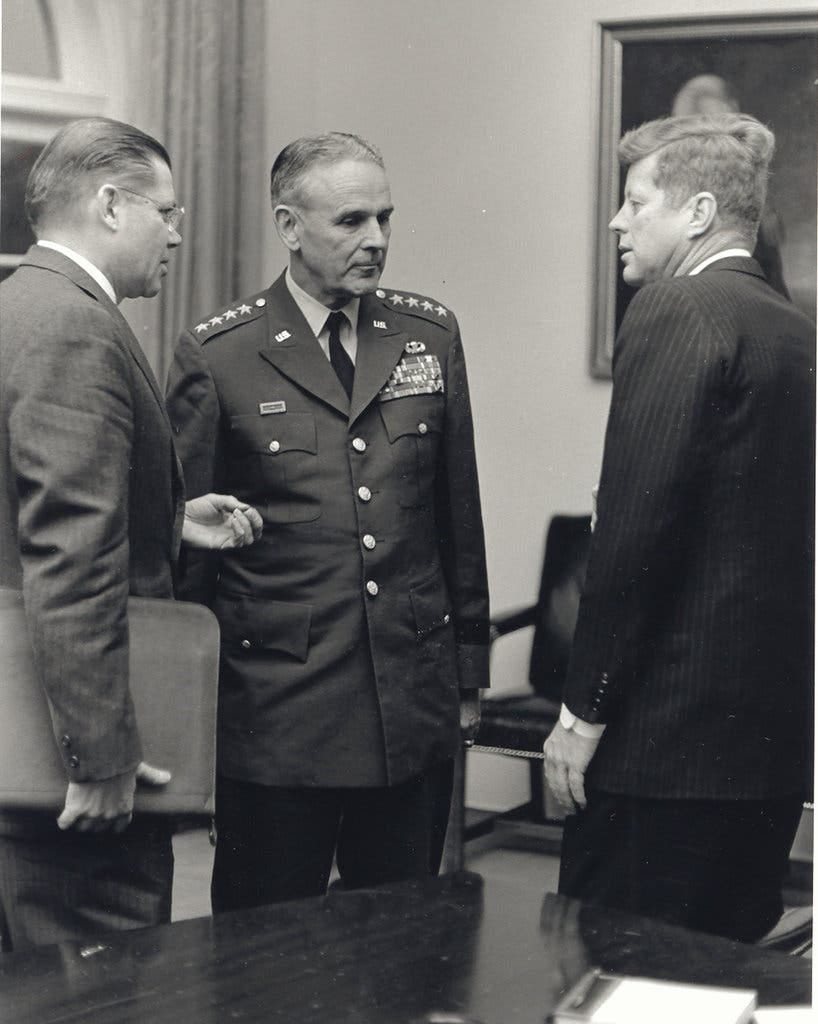
The Cuban Missile Crisis underscored the same limitation. On October 21, 1962, during a briefing to President Kennedy, General Walter Sweeney acknowledged that American airstrikes could not guarantee the destruction of every single Soviet missile in Cuba. General Maxwell Taylor reinforced the point with an even more striking admission:
“The best we can offer you is to destroy 90% of the known missiles”3
Despite overwhelming conventional military superiority in that theater, the United States could not eliminate the risk of a nuclear retaliation. Kennedy chose a naval quarantine with negotiations.
Condition 2: When Strategic Competition Imposed Unacceptable Costs and Risks
By the late 1960s, Soviet nuclear capabilities had transformed American strategic thinking. In a confidential July 1969 letter to arms-control negotiator Gerald Smith as Washington prepared for the Strategic Arms Limitation Talks (SALT), President Nixon acknowledged that the United States could no longer expect immunity from physical attack. He recognized that limitations on Soviet strategic weapons would require similar constraints on American capabilities. More significantly, Nixon called for relations based on mutual recognition of legitimate security interests and genuine negotiations over concrete disputes (exactly what Russia is calling for today in its negotiations with the West). Nixon writes:
“I have conveyed to the Soviet leaders my view that our relations should be based on a recognition by each side of the legitimate security interests of the other…I have told them that I have no interest either in polemical exchanges or in the mere atmospherics of détente”.4
In September 1971, Henry Kissinger informed Nixon that Defense Secretary Melvin Laird feared a Soviet numerical advantage of around 650 ballistic missiles was weakening America’s negotiating position. Kissinger questioned whether Congress would authorize additional American weapon systems and if abandoning negotiations would enable a more favorable outcome.
Soviet capabilities were expanding, American rearmament faced political constraints and continued strategic competition offered no guarantee of restoring American superiority. Negotiation became a means of managing a strategic balance America could neither easily reverse nor safely disregard.
Condition 3: When Reciprocal Constraints Offered Greater Security Than Unrestricted Competition
Negotiations required arrangements that could deliver greater security than continued competition. Any agreement limiting Soviet forces would necessarily constrain American forces, but those limited had to preserve US security and be verifiable. Washington was prepared to accept reciprocal obligations as long as compliance could be monitored.
The resulting 1972 SALT I agreements and the Anti-Ballistic Missile (ABM) Treaty institutionalized mutual restraint. The 1987 Intermediate-Range Nuclear Forces (INF) Treaty went further in eliminating an entire category of Soviet and American missiles through extensive verification arrangements. The essential condition was America’s willingness to recognize that American security also required constraints on American power.
Putting the Three Conditions to Test: Russia and the Future of European Security
How do these three historical conditions apply to the present confrontation between Russia and the West over Ukraine?
The first condition has been substantially established, although with limitations. Russia’s nuclear deterrent makes a direct war with NATO extraordinarily dangerous. At the same time, its military capabilities have prevented the United States and Europe from imposing their preferred outcome in Ukraine. American military and economic muscle cannot dictate a settlement. This exposes the fundamental asymmetry between Russia’s ability to resist the existing European security order and its ability to compel the construction of an alternative.
The second condition remains the primary obstacle to a comprehensive peace settlement. The Ukraine conflict has imposed substantial economic, military and political costs on the Western coalition, particularly Europe. However, these costs have not persuaded Washington that maintaining NATO’s existing security architecture is less advantageous than accepting Moscow’s proposed restrictions. Unlike the Cold War when Soviet conventional power threatened Western Europe and nuclear parity constrained American strategic freedom, the United States can now support Ukraine without directly engaging Russian forces. While the confrontation presents a serious strategic challenge, it is not one that America considers costly enough to warrant fundamentally restructuring European security.
The third condition has long existed as a diplomatic possibility but not as an agreed upon negotiating framework. As the historical record established earlier, Moscow has pursued an inclusive European security framework for decades, invoking the principle of indivisible security. The obstacle has been disagreement over whether European security should remain anchored in NATO’s institutions or incorporate additional binding commitments involving Russia.
During the Cold War, Soviet military power compelled the United States to negotiate limits on its strategic freedom. After 1991, Russia’s diminished power enabled NATO enlargement without equivalent Russian influence over Europe’s security order. Moscow’s repeated appeals to indivisible security failed to reverse this asymmetry.
The ultimate question is whether the United States will again conclude, as during the Cold War, that reciprocal constraints better serve its strategic interests than unrestricted freedom of action. Until that calculation changes, Russia may possess sufficient power to prevent the consolidation of the existing European security order without the leverage to compel its replacement. That is Moscow’s fundamental strategic dilemma and the historical test confronting the negotiations in Abu Dhabi.