The majority of Western companies operating in Russia are not planning to leave the country, despite the challenges posed by sanctions, according to a new survey by the Association of European Businesses (AEB).
Many US, European, and Asian businesses exited Russia after the West imposed sweeping sanctions on Moscow over the escalation of the Ukraine conflict in 2022. Others left citing reputational concerns or fear of secondary sanctions. However, the annual poll from the AEB published on Monday indicates that most companies that stayed see long-term potential in the Russian market, despite Western restrictions weighing on short-term performance.
Of the companies surveyed by the AEB, 67% said they were not considering leaving, up slightly from 66% last year. Most respondents said their Russian operations remain a key part of their global business.
Companies identified opportunities such as market share growth (50%), business expansion (39%), and new customer segments (32%) as the primary reasons to stay. Over half (56%) said they are continuing investment projects, citing the Russian market’s size, potential, and positive developments.
The survey showed that while short-term business confidence among foreign firms has dipped, longer-term expectations have improved compared to last year: 82% of respondents said they were anticipating significant growth within a decade, up from 66% last year.
The survey found that most companies have adapted to sanctions but still face challenges, including payment delays, reputational risks and reluctance from foreign partners to work with Russia-linked entities. About 87% said they were negatively affected by Western sanctions and Russian countermeasures over the past year, citing banking curbs, export-import restrictions, frozen assets, SWIFT disconnection, and software and transport limits. Some 71% said they don’t expect any sanctions relief in 2025.
Still, 59% forecast turnover growth over the next three years, up from 53% in 2024. The AEB said its Business Climate Index has climbed to 127 points out of 200, steadily improving since falling to 80 points in 2022.
“[This] confirms that European companies in Russia have reached a certain equilibrium in the new economic reality,” AEB CEO Tadzio Schilling said. “Business has entered a phase of stabilization – companies have adapted their operating models, found alternative supply chains and learned to work under the conditions of the remaining restrictions.”
He added that the results reflect “business environment’s stability,” noting that despite the ongoing challenges and uncertainty, companies remain “cautiously optimistic.”
The AEB represents more than 380 companies from EU states, the European Free Trade Association, and other foreign countries operating in Russia. This year’s survey was conducted between April and May and included input from top managers at 100 member companies across various sectors.
Russia is no stranger to costly, grinding wars. Soviet authorities made a point of allowing the performing arts to continue during the 872-day battle for Leningrad during World War II, widely considered the bloodiest siege in history.
Thousands of displaced and starving locals flocked to the Mariinsky, Komissarzhevskaya, and other theaters to the unrelenting hum of shelling and air raid sirens. The 1942 Leningrad premiere of Shostakovich’s Seventh Symphony stands as both a singular cultural achievement and a grim reminder of Russian tenacity in the face of unspeakable hardship.
The situation today is very far removed from the horrors of the Eastern Front. I found nary a hint after spending over a week in Moscow that I am in a country prosecuting the largest and most destructive war in Europe since 1945. Business is booming. Previously vacant storefronts in Moscow’s luxury GUM department store and the city’s many other shopping malls are, for the most part, reoccupied by Chinese companies and multibrand stores selling the same Western high-end products that continue to flood into Moscow through countless parallel import schemes that have proven highly lucrative for Russia’s neighbors.
It was striking how convincingly Chinese car manufacturers have tightened their grip over the Russian market. “What, did you expect us to walk?” one of my interlocutors said, perhaps sensing my incredulity. “We have to drive something.” Yet German cars remain a clear status symbol for well-off Russians — one can find far more Mercedes and Maybach makes on the streets of Moscow than in Washington, D.C.
It is true the city is peppered with military recruitment posters, but this, too, is a remarkable testament to the normalcy the Kremlin has been able to maintain over three years into this war. Russian President Vladimir Putin resisted calls from Moscow’s hardliners — more on them shortly — to pursue full-scale wartime mobilization, instead creating a soft semi-mobilization model that draws large numbers of contract soldiers with generous compensation and benefits packages.
The government enjoys popular confidence, stemming in no small part from its effective handling of the economy. It is shocking to the Western imagination that, even amidst this war and the many personal tragedies that come with it, there is a sense among the people I spoke to that the post-1999 Russian Federation is the most stable, comfortable iteration of Russia in recent and even distant memory.
The rhythm of Moscow life is dictated by an insatiable hunger for upward mobility and ever-greater consumption — there is a brazenly capitalistic quality to it all that would take many Americans, let alone our more staid Western European friends, by surprise. Russians generally still do see themselves as Europeans and as part of a broader Western civilizational inheritance, but there is a realization that must have crept in somewhere between 20,000 sanctions imposed since 2014 that life will go on with this conflict in the background and without the West, even if the vast majority of Russians strongly prefer to be part of a common Western commercial and cultural space.
I came away from my contacts with the Moscow elite, including officials, with the conclusion that there are two broad camps in Russia. Most elites are what I would describe as situational pragmatists. These aren’t people who would give away the farm for a peace deal, but they are well aware of the long-term costs of prosecuting this war — including a deepening dependence on China that far from everyone in Moscow is comfortable with.
They are also cautiously interested in working with the Trump administration on a settlement that doesn’t just end the war but potentially addresses a broader constellation of issues in the ongoing confrontation between Russia and the West.
Then there is a smaller faction of hardliners who treat this war not as an arena for resolving larger strategic issues between Russia and the West but as a bilateral conflict wherein Moscow’s goal is simply to crush Ukraine and secure its unconditional capitulation. Though the political balance of power decidedly tilts toward the moderates, especially with the advent earlier this year of a U.S. administration that supports a negotiated settlement, the hardliners’ influence wanes and waxes proportionally with the belief that the U.S. is unable or unwilling to facilitate a settlement that satisfies Russia’s core demands.
What exactly these demands are, and whether Russia is willing to compromise on them, is a complex issue that hinges on all the potential linkages involved. To what extent would Russia, for example, be willing to scale back its territorial claims in exchange for a reopening of Nord Stream 2, reintegration into the SWIFT financial messaging system and other financial institutions, or an agreement foreclosing NATO’s eastward enlargement?
Still, nearly everyone I spoke to identified a baseline set of conditions for any peace deal. These include Ukrainian neutrality and non-bloc status, limits on Ukraine’s postwar military, guarantees against the deployment of any Western troops on Ukrainian territory, and at least de facto international recognition of territories controlled by Russia. My interlocutors argued that an unconditional ceasefire without a roadmap for addressing these issues is a recipe for freezing the conflict in Ukraine’s favor, something they say the Kremlin will never agree to.
These points are of course subject to numerous caveats and provisos. For one, Russia’s insistence on non-bloc status never extended to Ukraine’s ability to seek EU membership, something Kyiv can hold up as a victory in a settlement. There is also an implicit recognition that Moscow can’t prevent Ukraine from maintaining a domestic deterrent, even if subject to certain restrictions along the lines discussed during the 2022 Istanbul negotiations, against a Russian reinvasion.
I developed the impression from my meetings that Russia would demonstrate a great degree of flexibility in other areas, including rights of Russian speakers in Ukraine and the status of around $300 billion in Russian assets frozen in the West, if the strategic issues rehearsed above are resolved to Moscow’s satisfaction.
No one in Moscow who favors a settlement, which is almost everyone I spoke to, wants America to “walk away” from this war in the way that U.S. officials have previously suggested.
There is a widespread recognition that, if the White House permanently extricates itself from the conflict, Moscow would be left with European and Ukrainian leaders who will reject anything that can be remotely perceived as a concession. In that case, the Kremlin will undoubtedly decide that it has little choice but to take this war to its ugly conclusion.
I return from Russia with the conviction that such an outcome is neither inevitable nor desirable from Moscow’s perspective. A deal is possible, which is not to say that it can be achieved in short order or that Russia won’t drive a hard bargain. But for all of the destruction and tragedy visited by this war, it is not, mercifully for all involved, Leningrad in 1942.
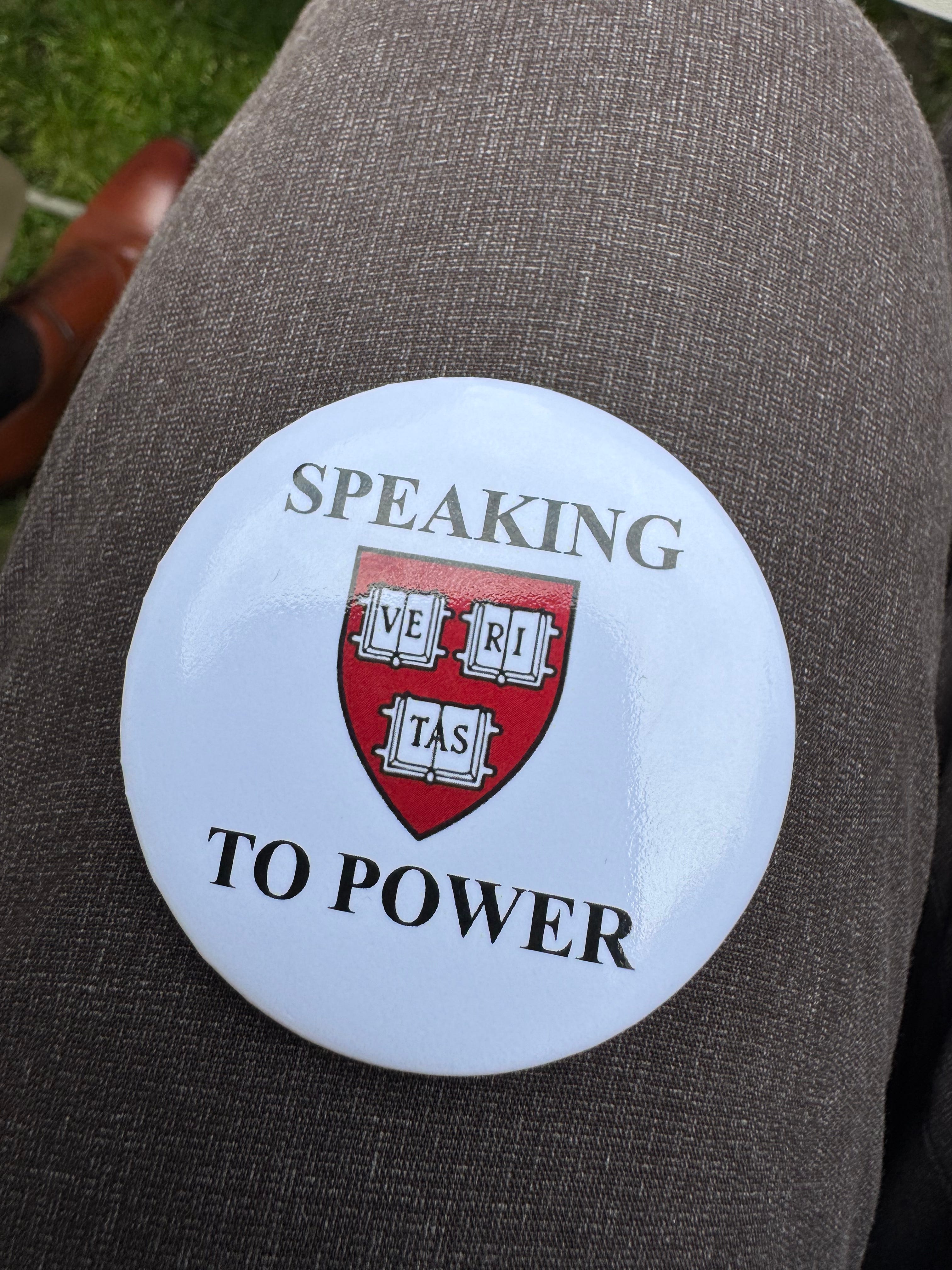
…I’m going to focus on something personal, which is my role as an American elite, because it intersects with a political fight that’s going on right now. This weekend was my 25th reunion at Harvard. And Harvard is in an existential fight with the Trump administration. The White House is seeking to cut funding for scientists and researchers affiliated with Harvard, and to block the ability to host international students. This attack was a live topic of conversation among alumni. And it felt, well, weird.
One of my favorite movies as a kid was Glory, the story of the first all-black regiment to fight in the Civil War, the 54th Massachusetts Volunteer Infantry Regiment. The 54th had white officers, and its first commander was Harvard graduate Robert Gould Shaw, who was killed in battle along with a lot of his troops, many of whom were ex-slaves.
Shaw’s name is displayed prominently in an important building at Harvard, Memorial Hall, which houses both Annenberg, where freshmen eat meals, and Sanders Theater, a large lecture hall for beginning economics, the most popular class among undergraduates. I would sometimes just stare at the hallway where his name was listed, along with other Harvard alumni who died fighting for the Grand Army of the Republic, which sought to end slavery and preserve the union. This martial tradition at Harvard stretched back and forward hundreds of years; a third to a half of Harvard graduates in the 1640s went to England to fight for Oliver Cromwell in the English Civil War, and tens of thousands of Harvard graduates served in World War II.
But during the war in Vietnam, that tradition ended. I didn’t know people like Shaw. Serving your country, potentially sacrificing your life, that’s rare for Harvard graduates, except for unusually service-oriented types, or for those with political ambitions. I don’t want to be overly romantic about the past, but something is different today about Harvard. The last 25 years, since I graduated, are almost perfectly correlated with a period of disconnect between elites, and everyone else.
That’s not to say what the administration is doing is good. It’s not. But it is to say that there is a reason our institutions are under attack, and yet have limited popular legitimacy. Harvard is fighting back against Trump with litigation. There is a quiet pride among alumni now, a feeling that Harvard is going to be pretty badly wounded, but also, a sense that there’s some integrity there, somehow. And yet, while elites are waking up a bit, there is much further to go.
It’s not an inspiring moment. The university’s former President, Claudine Gay, a mediocrity, resigned last year over a fake scandal around anti-semitism and then allegations of plagiarism, and a milquetoast Jewish economist, Alan Garber, has taken over. In his speech to alumni, he talked about hearing from people unaffiliated with Harvard from all over the country, in all walks of life, from truck drivers to social workers. Someone like Garber spends most of his time dealing with annoying egomaniacs like Larry Summers, as well as billionaires. To hear from normal people, well, he seemed genuinely affected by that, and the fact that ordinary people care about the institution, and back him when the billionaires got scared. He also talked about the need for reform, recognizing that the anger at Harvard isn’t totally undeserved.
The practice of law, especially in areas like antitrust, lives at the intersection of elite practitioners representing the broad public. I am well-versed in why elites are distrusted, because I know where I went wrong. My failure was in 2002, when the debate over the war in Iraq was white hot. As a good Harvard graduate, I spent a lot of time reading and studying before forming an opinion. I went to panels with Iraqi dissidents, I read the Brookings Institute’s The Threatening Storm: The Case for War in Iraq – research assisted by a Harvard grad in my class. I paged through the New York Times and especially Tom Friedman’s columns, and I believed what good Democrats like John Kerry and Hillary Clinton told me. I went to protests and talked to anti-war protesters, and did my own surveys of their views. And I came away from it all feeling smug, that the war was a good idea, but more importantly, that the people who thought the war was foolish and immoral, well, they were unsophisticated.
Just before the war started, I realized my error, but I still kept the attitude. Yes I was wrong, but for the right reasons. I listened to the appropriate people, used the right salad fork. But then something happened that didn’t make sense. There were no weapons of mass destruction. And yet the people at the New York Times who said there were – well they didn’t get reprimanded. Instead they got promoted, and opponents of the war, were purged. They got it wrong, and led me to get it wrong. But they got rewarded, and I felt like a fool.
Over the course of the next four years, I was shaken, many times, by a realization that most people already knew, and that David Halberstam wrote in The Best and the Brightest in 1971 on the war in Vietnam. And that realization is that the story that elites tell one another, and believe, well, it’s just not true. We don’t believe in merit. It’s easy enough to understand, but it’s very hard to really accept. If your identity is constructed around the idea that you are where you are because you deserve it, it’s rough to learn this truth.
I was ashamed. I had endorsed slaughter because I was fooled by certain ways of presenting information, and Harvard had in part helped instruct me in these methods. I don’t want to pin my choices on Harvard, many in that world did oppose the war, but the point is that elites like me, in general, were delusional and had done really serious levels of harm to people we would never know.
A few years ago, J.D. Vance made a powerful argument about the four recent great betrayals of the American working class – the war in Iraq, the offshoring to China/fentanyl epidemic, the financial/foreclosure crisis, and the post-Covid policies that split the country into “essential workers” and elites who baked bread. All four split the country by class. The Harvard class of 2000 was affected by these events, but largely as perpetrators who benefitted from enacting the policies that defined them. Certainly, my personal experience is living with the victors, not the victims.
I do not know if there is a broader realization of the harm that elites have done among my classmates. The 25th anniversary is a weird one. People are not old, but our bodies have started our inevitable decay, which we can feel; your mind doesn’t work as well as it once did, it’s slightly harder to remember things, parents are dying, kids are growing, aches and pains are common, but also embarrassing. There have been some deaths of classmates, not many, but a few. Cancer is not super common, but it’s not rare either, and the once radiant feeling of unlimited potential and raw ambition that rule-following Harvard attendees had is over, most of us now know that we are no different than anyone else, we want love, and meaning, and community, and not to rule the world.
I met old friends, and heard wonderful talks of people raising kids with severe autism, struggling with disease, death, or failure. I also met enormously impressive people who are doing science or law or art, leukemia research or public health or serving in office. It was genuinely lovely, to see classmates, with their families and bright children, many of whom are hoping to attend Harvard. Nearly everyone I met has matured into someone who is kinder than they were as a college student, willing to overlook flaws and acknowledge vulnerability. I was genuinely impressed, and felt a deep connection to my class.
But I also periodically asked, “do you know someone who died of fentanyl?” And the answer was always no, sometimes accompanied by surprise that most Americans do have personal experience with a family member or friend, or friend of a kid, who died.
Today, Trump’s attacks on Harvard are shaking the institution. Layoffs are starting. It feels a bit like a mill town where the mill has announced it is having financial troubles, and may move away. It’s not that different from D.C. under DOGE. This experience, of existential fear, that the community will be ripped apart, is not something Harvard is used to. And the parts of Harvard that are being wrecked do not deserve it; there won’t be layoffs in the economics or political science department, but among the people working on medical research or infant mortality
That said, there is still broad confusion about the moral implications of what’s happening. Do we realize that the cruelty visited on us is cruelty we visited on mill towns all over America, many times over? When Larry Summers, once President of Harvard, lied to open up American markets to China, or helped destroy Russia, well, that was in our name, hurting people we would never know, as I, in my own minor way, approved of killing working class Americans and Iraqis I would never know. Thousands of Harvard affiliated staffers and members in Congress and clerks and judges and general counsels crafted the world of elite lawlessness we are in today. Facebook, one of the most destructive companies in history, one that has fostered many teenage suicides, was born at Harvard in the early 2000s. That is not something I heard much about at the reunion.
So the introspection seemed real, but limited. People talked about how they had to slow down their career as high-powered consultants because it was destroying their family, but without an acknowledgement that this job had likely destroyed the families of many others. The Silicon Valley engineer working on technology to make it easier to vote, while also building AI tools that destroy journalism, was baffled anyone might question the moral fiber of her company or of Mark Zuckerberg. It’s not that we are bad people. I did talk to a former Facebook insider trying to atone for his sins by building software for kids. We are just people.
Humans are social animals, and we follow our colleagues. Robert Gould Shaw, were he in my class, would likely be an ex-McKinsey guy working in media and tech in Chicago. Conversely, most of my classmates, had they gone to school in the 1850s, would have been in the Union Army. What has changed is the religious or spiritual dimension of how we think of our society, and that goes far beyond Harvard. The introspection we face as our bellies sag is about “our whole selves,” therapeutic, New Age-y ways of seeing life. And that’s ultimately ripping us apart. What we need is a new metaphysical language, a way of saying we owe more to our society than ambition without wisdom. Every part of American society, from corporate leadership to black political leadership to scientific and financial and religious leadership, down to the insiders who run each particular industry, are beset by the same atomized and corrupted ideas. I saw it this weekend. We are the inheritors of a magnificent tradition, of a free society, and yet we do not see it as ours to protect, as ours for which to sacrifice.
Harvard graduates are those who won the social lottery. For hundreds of years, we believed we had to act, or pretend to act, as stewards of a nation where all men are created equal. Shaw did. The class of 2000, and really classes going back to the 1960s, have not, or at least not so far. That is our legacy. That is elite failure. It is not inevitable, and it will change one day. Hopefully that day is sooner rather than later.
It’s now June 2025, more than three years since the West imposed what was billed as the harshest sanctions regime in modern memory. And yet, strolling through Moscow today, you’d struggle to find much evidence of siege. The metro still glides under the city, smooth, spotless, and absurdly cheap.
Cranes peck away at the skyline. Cafes are busy even on a Monday night.
None of which is to say Moscow hasn’t changed. It has—in small ways, and some not so small. It still feels unmistakably European. But it’s a Europe outside the EU, orbiting on its own track.
A lot of famous names are gone. No McDonald’s, no IKEA, no Zara. In their place, Russian versions, Chinese entrants, and homegrown upstarts that mimic the aesthetic, if not the price point. Yet Burger King still grills away, and KFC has become Rostic’s again. Starbucks lives on in everything but name as Stars Coffee. Capitalism didn’t leave. It changed its clothes.
On the high street, Turkish and Chinese brands have filled the gaps. Many Western luxury names still linger—Lacoste, Armani, Saint Laurent—but these days they share space with labels few outsiders would recognise. Luxury perfumes are easy to find. iPhones too. In fact, they’re sometimes cheaper here than in the EU.
Nightlife, once among the continent’s most electric, has changed. The once visible LGBT scene has largely vanished. Even the legendary Propaganda nightclub has shut. But the lights are still on––Simach still rocks and rapper Timati’s Flava is the place to be seen. With suitably absurd prices to boot.
The pubs are busy. Guinness is a luxury at 950 rubles ($12), so people drink local stouts like Black Sheep instead, at less than half the price. Barmen report take home earnings of around 150,000 rubles a month with tips. That’s about $1,800, and in Moscow, it goes surprisingly far. Rent is still modest, and a single metro ticket costs $0.85. Unlimited monthly travel is $40. Three times cheaper than in Berlin.
Restaurants remain lively. But signs of strain are there. Birds, once a flashy Moscow City skyscraper favourite, has closed. So too has the legendary Williams in Patriki. Chefs grumble about inflation, but the kitchen staff still show up, and wages are rising. Unlike in much of Europe, pay here hasn’t stood still in recent years.
The real shift is human. The migrants and tourists are different. The Americans have gone. So have the Germans. Irish pubs that once echoed with the English language now host mostly Russians. On the streets you now hear Arabic, Persian, and Chinese. Moscow feels more Global South than Global West.
Cuisine tells the same story. A decade ago, decent Indian food was a rarity. Now it’s everywhere—upmarket on Tverskaya, or downmarket in the suburbs. Not just for expats. Russians eat there too, curious and increasingly cosmopolitan in their tastes.
Politics? Hardly a whisper. Summers used to bring protests around Trubnaya. Often attended by more Western journalists than actual Russians. Now, silence. The liberal opposition is either muted, abroad, or fearful to show its head. The political void isn’t heavy with menace. It just feels absent. Moscow keeps moving, with or without the drama.
Football, once a cultural anchor, has drifted too. This year’s Champions League final came and went with barely a murmur. Match TV no longer shows it. You can find a stream online, but it’s no longer an event. Hard to believe the World Cup final was played here just seven years ago.
The Ukraine conflict is present, but not prominent. You see the uniforms, the occasional poster. And sometimes, a stranger leans in and asks what you think of the “special military operation.” But there’s no rationing. No gloom. Construction crews keep pouring concrete. Shops stay stocked. Streets stay swept.
The cars have changed. The Hyundais and Toyotas are thinning out. Mercedes and BMWs still pass by, though they’re harder to come by. Now, it’s BYD, Geely, Hongqi—badges of status from a different place.
The digital world reflects the city’s new orientation. While Western media like CNN and The Guardian are not blocked and can still be accessed directly, others require a VPN. The same applies to Instagram, X and Youtube. This, however, comes with a shrug from most Muscovites. After all, it was the EU that first blocked Russian media for its own citizens, they remind you. In this new bifurcated world, reciprocal restrictions are just part of the game.
The departure of many liberals, both native and foreign—the journalists, artists, and tech workers—has also left a cultural mark. Once fixtures of Moscow’s cosmopolitan energy, many left for Berlin, Tbilisi, Istanbul and further afield. In their absence, the city recalibrated. Few mourn the ‘relocants,” as they’re derisively known. Among many who stayed, they’re seen as quitters—self-important chumps who abandoned the ship and now jeer from the shore.
Tourism patterns have shifted too. Paris weekends and London shopping sprees are out. Now it’s Dubai, Antalya, Bangkok. The destinations may be different, but the appetite to travel hasn’t dimmed.
Moscow’s mood, if it can be captured, is one of motion without anxiety. No triumph. No collapse. Just a city learning to walk a new path. A couple dances to a busker on Arbat. A policeman eats a shawarma near Leningrad Station. A barista at Stars Coffee hands you a cappuccino with the faintest shrug.
Life ticks on. The sanctions were meant to isolate. Instead, they’ve underlined a truth: this city, with all its contradictions and churn, is going its own way. There is no fanfare. Just a shrug and another step forward.
To walk Moscow today is to encounter a capital that no longer seeks the West’s approval—and may not miss its presence either.